
Incentives for renewable energy
191
0
0
Texto completo
(2) PONTIFICIA UNIVERSIDAD CATOLICA DE CHILE ESCUELA DE INGENIERIA. INCENTIVES FOR RENEWABLE ENERGY. MIGUEL FELIPE PÉREZ DE ARCE JERIA. Members of the Committee: ENZO SAUMA SEBASTIÁN RÍOS RICARDO PAREDES RAÚL O´RYAN JAVIER CONTRERAS JORGE VASQUÉZ Thesis submitted to the Office of Research and Graduate Studies in partial fulfillment of the requirements for the Degree of Doctor of Science in Engineering.. Santiago de Chile, June, 2015.
(3) To my wife (Maria Eugenia) and my children (Verónica, Carolina, Daniel and. Francisco),. who. unconditional support.. ii. gave. me.
(4) ACKNOWLEDGEMENTS I want to thank my supervisor professor Enzo Sauma who unconditionally supported me during all the years of study and research, professor Javier Contreras who supported me during my internship in Spain, Members of the Committee who provided comments benefits for the development of research, Natalie Messer for their work during her M.S. program at the PUC and three anonymous reviewers of The Energy Journal for their extremely valuable comments. I also want to thank Fernanda Kattan, Pilar Martinez, Debbie Meza and Gloria Escobar, for their support during each year of my study. This research was also partially supported by the CONICYT, FONDECYT/Regular 1100434 and 1130781 grants. A CONICYT doctoral scholarship and a supplementary scholarship from the College of Engineering at the Pontificia Universidad Católica de Chile (PUC) partially supported to Miguel Pérez de Arce.. I thank God, the Virgin Mary and Jesus, as a source of inspiration.. iii.
(5) TABLE OF CONTENTS Page DEDICATION......................................................................................................... ii. ACKNOWLEDGEMENTS .................................................................................... iii RESUMEN ........................................................................................................... viii ABSTRACT ............................................................................................................ xi 1.. INTRODUCTION ......................................................................................... 13 1.1. 1.2. 1.3. 1.4. 1.5. 1.6. 1.7. 1.8.. CO2 Emissions Worldwide: Climate Change ......................................... 13 Incentive to Renewable Energy in the World ......................................... 17 Objectives of the Thesis ......................................................................... 21 Hypothesis of the Thesis ........................................................................ 21 Methodological Approach of the Thesis ................................................. 22 Policies’ Performance: Deterministic Model .......................................... 23 Policies’ Performance: Probabilistic Model ........................................... 28 Effects of Transmission Capacity Congestion on Policies: Probabilistic Model................................................................................ 34 1.9. Contribution of the Thesis...................................................................... 35 2.. PAPERS ........................................................................................................ 36 2.1. COMPARISON OF INCENTIVE POLICIES FOR RENEWABLE ENERGY IN AN OLIGOPOLISTIC MARKET WITH PRICE-RESPONSIVE DEMAND............................. 36 2.2. PERFORMANCE IN REDUCING CO2 EMISSIONS IN RENEWABLE ENERGY .................................................................... 104 2.3. EFFECTS OF TRANSMISSION CONGESTION ON DIFFERENT INCENTIVE POLICIES FOR RENEWABLE ENERGY ............................................................................................ 137.
(6) 3.. CONCLUSIONS AND FINAL REMARKS ................................................ 182 3.1. Recommendations for Future Research ................................................ 184. 4.. REFERENCES ............................................................................................ 185.
(7) INDEX OF TABLES Page Table 1.1: Modeling of incentive policies............................................................... 27 Table 1.2 Modeling of incentive policies (h: scenario) ........................................... 33.
(8) INDEX OF FIGURES Page Figure 1.1: Pollution in China ................................................................................ 13 Figure 1.2: Melting glaciers ................................................................................... 13 Figure 1.3: Hurricane intensity: Effect on petroleum activity.................................. 14 Figure 1.4: Hurricane intensity: Economic cost ...................................................... 14 Figure 1.5: Evolution of CO2 emissions worldwide ................................................ 15 Figure 1.6: Atmospheric concentration of CO2 and average temperature change ................................................................................................. 15 Figure 1.7: Effects of Climate Change ................................................................... 15 Figure 1.8: Participation of economic activities in CO2 emissions worldwide ............................................................................................ 16 Figure 1.9: Evolution of policies to incentivize renewable energy .......................... 18 Figure 1.10: Evolution of policies to incentivize renewable energy ........................ 19 Figure 1.11: Two-node power network................................................................... 23 Figure 1.12: Two-node power network (h: scenario) .............................................. 30.
(9) RESUMEN Existe un consenso a nivel mundial acerca de los efectos negativos de las emisiones de dióxido de carbono (CO2), lo que se ve reflejado en el cambio climático que estamos experimentando. En este contexto, a través de la evidencia científica se ha determinado que el incremento de la concentración de CO2 en la atmósfera está provocando un aumento de la temperatura media a nivel global. Este aumento de la temperatura ha preocupado a los científicos y autoridades gubernamentales, dado que si continúa incrementándose, el cambio climático podría conllevar efectos no deseados tales como: aumento de las olas de calor y sequías; deshielos; aumento del nivel del mar; aumento de las fuertes lluvias; cambios en la actividad de ciclones y tormentas tropicales e impactos en el sector energético. La generación de electricidad y calor a partir de fuentes convencionales encabeza el ranking de las emisiones de CO2 entre las actividades económicas, siendo responsable del 42% de estas emisiones en todo el mundo, lo que equivale aproximadamente a 13 millones de toneladas de CO2. A nivel mundial se está haciendo un gran esfuerzo por reducir las emisiones de CO2, lo que se demuestra a través del diseño de diferentes políticas que se han implementado para incentivar el desarrollo de fuentes de energía renovables (ER), tales como la eólica, solar, geotérmica, entre otras. En este contexto, según la Agencia Internacional de Energía, en el año 2011, el 4% de la generación mundial de electricidad provino de fuentes de energía renovables (no-hidráulica) y este porcentaje debiera alcanzar el 15% para el año 2035. En términos monetarios la implementación de políticas de incentivos a las ER basados en subsidios llegó a ser 101 mil millones de dólares en 2012 y se estima que debería aumentar hasta 220 mil millones de dólares para el año 2035. Entre las políticas de incentivo, las más utilizadas son: feed-in tariffs, premium payments, quota systems, carbon taxes, cap and trade systems y auctions. Tomando en consideración los antecedentes presentados, podemos decir que existe evidencia suficiente acerca de la contribución que han hecho las diferentes políticas de viii.
(10) incentivo a las ER para reducir gases de efecto invernadero. No obstante existe una gran preocupación acerca de cuál debiera ser la política para hacer frente a los nuevos desafíos en el desarrollo de la ER. Tomando en consideración estos antecedentes, a partir de nuestra investigación hemos tratado de hacer una contribución al conocimiento intentando responder a la pregunta "¿cuál es la mejor política para fomentar las energías renovables y con ello reducir las emisiones de CO2?". Para responder a esta pregunta se desarrolla un modelo económico basado en teoría de juegos aplicado al mercado eléctrico para cada una de las siguientes políticas: feed-in tariffs, premium payments, quota systems y carbon taxes. Los resultados obtenidos a partir de esta investigación se presentan en tres artículos que intentan responder diferentes interrogantes que fueron surgiendo durante el desarrollo de esta tesis. El primer paper presenta los resultados asociados a un modelo determinista (ver sección 2.1), el cual ha sido aprobado para su publicación en la revista The Energy Journal. En el segundo artículo se modifica el modelo anterior adicionando costes marginales, costes fijos, reserva de potencia requerida por los generadores renovables a los generadores convencionales, variabilidad de la demanda y variabilidad en la disponibilidad de recursos renovables (ver sección 2.2). El tercer paper utiliza un modelo basado en el paper 2, para estudiar los efectos que produce la congestión en transmisión en el desempeño de las políticas de energía renovable. También se estudia el uso de dispositivos FACT para mejorar la capacidad de entrega de la energía generada. Además, en este tercer artículo, se analizan los efectos de la multiplicidad de equilibrios de mercado (ver sección 2.3). A través de estos artículos se comparan las políticas de incentivos para fomentar el desarrollo de ER en términos de precios de la energía, la generación de ER, las emisiones de CO2, y el bienestar social. Estos resultados son importantes porque muestran diferentes efectos en términos de penetración de ER, bienestar social y eficiencia de reducción de emisiones. A partir de nuestros modelos hemos sido capaces ix.
(11) de concluir que los resultados quedan condicionados a los supuestos considerados. Por ejemplo, para el caso del modelo determinista los resultados indican que el ranking de política queda condicionado a la estructura de mercado, a los costos de la energía renovable y al método de recuperación del subsidio.. Palabras Claves: energías renovables; feed-in tariff; premium payment; quota system; carbon tax; oligopolio; variabilidad; congestion; FACTS.. x.
(12) ABSTRACT There is worldwide consensus about the negative effects of carbon dioxide (CO2) emissions, which is reflected in climate change we are experiencing. As a result it has increased the concentration of CO2 in the atmosphere, causing an increase in global average temperature. This temperature increase has concerned the scientific community and government authorities. If continuous raising global temperatures, climate change could cause the following effects: increase in heat waves and droughts; permafrost thaw; threat of sea level rise; increase of heavy rain; change in tropical cyclones and storms activity; impacts on energy sector. Electricity and heat production from conventional sources leads the ranking of CO2 emissions between economic activities, it was responsible for 42% of the CO2 emissions worldwide, equivalent approximately to 13 million tons of CO2. Globally is making an effort to reduce CO2 emissions which is demonstrated through the design of different policies that have been implemented to incentivize the development of renewable energy (RE) sources, such as wind, solar, geothermal, among others. According to the International Energy Agency, in 2011, 4% of the world electricity generation came from non-hydraulic renewable energy sources and this percentage should reach 15% by the year 2035. In monetary terms the implementation of incentive policies based on subsidies that reached 101 billion dollars in 2012, this should be increased to 220 billion dollars by 2035. Among the policies, the most commonly used are: feed-in tariffs, premium payments, quota systems, carbon taxes, cap and trade systems and auctions. Nevertheless that there is a consensus about the contribution that different policies have done to reduce greenhouse gases through the incentive provided to renewable energy, there is large concerning about what is the policy to face new challenges in the development of RE. From our research we tried to make a contribution to knowledge trying to answer the question "what is the best policy to encourage renewable energy and xi.
(13) thereby reduce CO2 emissions?". To answer this question, we developed an economic model of game theory applied to the electricity market for each of the following policies: feed-in tariff, premium payment, quota system and carbon tax. To fulfill this objective were developed three papers. The first paper shows a deterministic model (as seen in Section 2.1, which contains the paper’s text approved for publication in The Energy Journal). The second paper presents the modified previous model that incorporate marginal costs, fixed costs, reserve power required by the renewable generators to conventional generators, demand variability, variability in the availability of renewable resources (as seen in Section 2.2). The third paper uses a model based on the model introduced in paper 2 to study the effects of transmission congestion on the performance of the renewable energy policies. The use of FACT devices to improve deliverability of the power generated is explored as well. Furthermore, in this third paper, the effects of considering the multiplicity of market equilibria is analyzed (as seen in Section 2.3). Through these papers are compared the incentive policies to encourage the development of RE in terms of energy prices, RE generation, CO2 emissions, and social welfare. These results are important because they show different effects in terms of RE penetration, social welfare and emission reduction efficiency. From our models we have been able to conclude that the results are conditional on the assumptions. For example, for the first model the results indicate that the RE policy having best performance varies depending on the market structure, the costs of renewable energy, and the subsidies’ recovery method considered.. Keywords: renewable energy; feed-in tariff; premium payment; quota system; carbon tax; oligopoly; variability; congestion; FACTS.. xii.
(14) 13. 1. INTRODUCTION 1.1. CO2 Emissions Worldwide: Climate Change There is worldwide consensus about the negative effects of carbon dioxide (CO2) emissions, which is reflected in climate change we are experiencing. We can mention some effects of pollution such as: It has caused episodes of contamination adversely affecting economic activity in countries such as China (as seen Figure 1.1); it has increased melting of glaciers (as seen Figure 1.2); it has increased intensity of hurricanes causing plant shutdown in economic activities such as oil extraction (as seen Figure 1.3), which has caused economic damage which have been estimated to over 120 billion dollars (as seen Figure 1.4) equivalent approximately to 50% of GDP in Chile.. Figure 1.1: Pollution in China1. 1. Figure 1.2: Melting glaciers2. Source: http://www.ahoranoticias.cl/ internacional/ decretan-alerta-roja-en-china-por-densa-nube-decontaminacion.html. 2 Source: http://recycle-lepate.blogspot.com /2011 /04/ glaciares.html..
(15) 14. Figure 1.3: Hurricane intensity: Effect on petroleum activity3. Figure 1.4: Hurricane intensity: Economic cost4. Along with global economic growth, CO2 emissions have in the atmosphere increased (as seen in Figure 1.5). As a result it has increased the concentration of CO2 in the atmosphere, causing an increase in global average temperature (as seen Figure in 1.6). This temperature increase has alerted the scientific community and government authorities. If continuous raising global temperatures, climate change could cause the following effects: increase in heat waves and droughts; threat of sea level rise; increase of heavy rain; change in tropical cyclones and storms activity; impacts on energy sector (as seen in Figure 1.7).. 3. Source: http://www.government-fleet.com /channel/ operations/article/story/2009/02/best-practices-indisaster-recovery-planning.aspx. 4 Source: cbsnews.com and Equecat..
(16) 15. Figure 1.5: Evolution of CO2 emissions worldwide5. Figure 1.6: Atmospheric concentration of CO2 and average temperature change6. Figure 1.7: Effects of Climate Change7. Electricity and heat production from conventional sources heads the ranking of CO2 emissions between economic activities that are displayed in Figure 1.8. In 2011, it was. 5. Source: see reference IEA (2013a) [18]. Source: see reference EIA (2013b) [19]. 7 Source: see reference EIA (2013b) [19]. 6.
(17) 16. responsible for 42% of the CO2 emissions worldwide8, equivalent approximately to 13 million tons of CO2.. Figure 1.8: Participation of economic activities in CO2 emissions worldwide9. Given the importance of the electricity sector in the economic development of countries worldwide, our research starting in the next section to the end of this document will be focused on this sector.. 8. According to EIA (2011b) [22], in 2009 electricity and heat production was responsible for 41% of CO2 emissions worldwide. 9 Source: see reference IEA (2013a) [18]..
(18) 17. 1.2. Incentive to Renewable Energy in the World Due to the reasons detailed above, policy makers are globally making an effort to reduce CO2 emissions which is demonstrated through the design of different policies that have been implemented to incentivize the development of RE sources, such as wind, solar, geothermal, among others. Among the policies, the most commonly used are: feed-in tariffs, premium payments, quota systems, carbon taxes, cap and trade systems and auctions, as it is pointed out by several authors (Wiser et al., 2007 [47]; Fouquet and Johansson, 2008 [13]; Barroso et al., 2010 [3]; Olimpio et al., 2011 [34]; Kitzing et al., 2012 [28]; Tükenmez and Demireli, 2012 [42]; Fouquet, 2013 [12]; Hinrichs-Rahlwes, 2013 [17]). Feed-in tariff and premium payment are subsidy mechanisms to encourage the development of RE (Cherrington et al., 2013 [8]). Feed-in tariff consists of fixed tariffs determined for each unit of RE generated while premium payments consists of a fixed payment that is additional to the retail price of electricity per each unit of renewable energy produced. On the other hand, the quota obligation system (or simply quota system) places an obligation, generally on electricity suppliers, to generate a specified fraction of their electricity from RE sources (Woodman and Mitchell, 2011 [48]). A carbon tax policy (Green et al., 2007 [14]), seeks to impose an additional cost on thermal generators, so as to disincentivize CO2 emissions. A cap-and-trade policy, like the one described by Green et al. (2007) [14], seeks to incentivize the reduction of carbon emissions through a system of transactions of permits for such emissions. The auction is a system where a fixed amount of energy (or power) is tender among renewable generators. The energy (or power) block is assigned to the one offering the lowest price (IPCC, 2011 [24]). Further detail of this review can be found in section 2.1 of this thesis. A large number of countries have adopted these types of policies, as can be seen in Figures 1.9 and 1.10. In this regard it is possible to find a wide variety in the application of different policies..
(19) 18. Figure 1.9: Evolution of policies to incentivize renewable energy10. 10. Source: see reference IEA (2011a) [21]..
(20) 19. Figure 1.10: Evolution of policies to incentivize renewable energy11. 11. Source: see reference IEA (2011a) [21]..
(21) 20. Nevertheless that there is a consensus about the contribution that different policies have done to reduce greenhouse gases through the incentive provided to renewable energy, there is large concerning about what is the best policy to face new challenges in the development of RE, for which purpose it is possible to cite some of the papers that address this question: (Johnston et al., 2008) [26], (Lesser and Su, 2008) [30], (Su et al., 2008) [40], (Albadi and El-Saadany, 2009) [1], (Farrell, 2009) [11], (Barroso et al., 2010) [3], (Couture et al., 2010) [6], (Couture and Gagnon, 2010) [7], (Guzowski and Recalde, 2010) [15], (Batlle , 2011) [4], (Cansino et al., 2011) [5], (Klessmann et al., 2011) [27], (Oikonomou et al., 2011) [33], (Kitzing et al., 2012) [28], (Sauma, 2012) [36], (Schallenberg-Rodriguez and Haas, 2012) [37], (Tükenmez and Demireli, 2012) [42], (Fouquet, 2013) [12], (Al-Amir and Abu-Hijleh, 2013) [2], (Cherrington et al., 2013) [8], (Jenner et al., 2013) [25], (Uran and Krajcar, 2013) [43], (Stokes, 2013) [39], (Schallenberg-Rodriguez, 2014) [38]. In this context one of the most frequently questions to answer is which of these policies is more efficient. This question can find more than one answer if we pay attention to the results of the different studies, among which we can mention the following: Woodman and Mitchell (2011) [48], mentioned that one of the main differences between a quota system and a feed-in tariff is that the latter has the advantage of managing market risk. In Hart and Marcellino (2012) [16], the author highlights the significant role played by the feed-in tariff in Germany and the quota system, also known as Renewable Portfolio Standards (RPS), in the United States in USA, recommend to continue with such policies. Martin and Rice (2012) [31], identify that was important for the development of RE the implementation of carbon tax policy in Australia. Kitzing (2014) [29], using mean-variance portfolio theory identifies that the feed-in tariff requires lower subsidy level than the premium payment policy. Oak et al. (2014) [32], in a study based on data from UK onshore wind determine the policy premium payment and quota system presented the best performance against the feed-in tariff. Further detail of this review can be found in section 2.2 of this thesis..
(22) 21. 1.3. Objectives of the Thesis The main objective of this research is to analyze policies that provide incentives for the incorporation of renewable energy in the electricity generation market. The policies that are studied in this thesis are: feed-in tariff, premium payment, quota system and carbon tax. According to the IEA (2013c) [20], in 2011, 4%12 of the world electricity generation came from non-hydraulic renewable energy sources and this percentage could reach 15% by the year 2035, through the implementation of incentive policies based on subsidies that reached 101 billion dollars in 2012 and should be increased to 220 billion dollars by 2035. In this context, one specific objective of this research is to contribute to the knowledge in the field by providing highlights that help policy makers in answering the question "what is the best policy to encourage renewable energy and thereby reduce CO2 emissions?". In the same context, another interesting question to be answer through this research is: “Do subsidy policies (feed-in tariff and premium payment) have different performance that taxes and/or fines (quota system) under different assumptions and market structures?”.. 1.4. Hypothesis of the Thesis First, RE incentive policies can be compared regarding their level of effectiveness and build a ranking to determine the best policy under specific conditions of a power system. Secondly, the cost-efectiveness ranking of policies promoting RE, and reducing CO2 emissions, is conditioned by the market structure, the cost structure, and the powersystem operations.. 12. According to the IEA (2011c) [23], the share of electricity production from renewable sources was 16% in 2009 and 16.5% in 2010. According IEA (2013c) [20] it was 20% in 2011 and it is projected that could reach 31% in 2035..
(23) 22. 1.5. Methodological Approach of the Thesis This thesis focuses on the methodological contribution for comparing the economic incentives created by different RE policies and it also intends to analyze the implementation of the RE policies. In this context, the examples used in this thesis to illustrate the developed methodology employ data that are below the rated value regarding the power transfer through transmission lines. Considering the above, in order to answer the question posed in the objective section and to analyze if our hypothesis are adopted or rejected, we develop a model for each of the following policies: feed-in tariff, premium payment, quota system and carbon tax. To address this modeling, first we develop a deterministic model with levelized costs analogously to Downward (2010) [9], paper in which the author develops a simple approach for modeling a carbon tax policy in the power generation market. Drawing on the model Downward (2010) [9], we established the goal of building models for the considered policies, assuming that the supply of power generation can be met by RE besides conventional energy. All this issues form part of a first paper showing the performance of the different policies. Considering that the first model can be enhanced with the aim of improving the representation of the assumptions of electricity generation market, in a second stage of our study, we develop a new model. This new model incorporates new parameters such as: marginal costs, fixed costs, reserve power required by the renewable generators to conventional generators, demand variability, variability in the availability of renewable resources (wind and sun). Then, the results of this model are part of a second paper showing the performance of different policies and comparing the results with the first model. In the third stage, we study the effects of congestion on the performance of the renewable energy policies, by applying a model based on the model used in the second.
(24) 23. paper. The use of FACT devices to improve deliverability of the power generated is explored as well. Furthermore, the effects of considering the potential multiplicity of market equilibria are analyzed. These issues are incorporated in a third paper showing the performance of different policies under the assumption of significant congestion. In the following sections we describe the models used in our investigation, whose results have allowed us to write three papers, as shown in section 2.. 1.6. Policies’ Performance: Deterministic Model In this first part of our research we model the electricity market using game theory, analogously to Downward (2010) [9]. To perform this analysis is mathematically modeled a simplified two-node grid (as seen in Figure 1.11), under the assumption of Cournot competition. It is assumed that the electricity market agents to behave Cournot with linear demand functions. In this game each player Cournot (generator) has some degree of market power. As Downward (2010) [9], we assume constant levelized cost and linear price-responsive demand functions.. Figure 1.11: Two-node power network.
(25) 24. We consider that the generation firm located at node 1 owns two power plants: a (conventional) coal power plant and a (renewable) wind power plant. In turn, the generation firm located at node 2 owns two power plants: one using natural gas (conventional source) and the other using solar energy (renewable source). Each plant has maximum generation. We model the market as a Cournot game, where each generation firm maximizes its profit making rational expectation of its rival decisions, in anticipation of the dispatch performed by an independent system operator (ISO). The optimal dispatch of electric power is determined by the ISO, who indirectly decides on nodal prices and on the energy flowing through the line, with the goal of maximizing social surplus. The formulation of the ISO problem follows the formulation in Downward (2010) [9]:. 1 1 Max a1 × y1 - b1 × y12 + a2 × y2 - b2 × y22 2 2 s.t.. (1). y1 + f = q1 , with q1 = q1r + q1c. (2). y2 - f = q2 , with q2 = q2r + q2c. (3). f £K. (4). The game considered here is as follows: in the first stage, both generation firms simultaneously commit to a specific level of generation for a given period. Then, in the second stage, the ISO solves the dispatch problem by determining the energy flowing through the line and the energy consumption levels (and hence nodal prices) that maximize the total gross surplus. Accordingly, generation firms are able to anticipate the ISO’s dispatch decisions, so that it is possible to infer how their actions affect the transmission line congestion. Naturally, transmission constraints in the dispatch problem have also an influence on generation firms trying to maximize their own profit..
(26) 25. Generation firm i’s problem is as follows:. Max. qic × ( pi - cic ) + qir × ( pi - cir ). s.t. 0 £ qic £ K ic 0 £ qir £ K ir and the optimality conditions of the ISO problem (5) Constraints in (5) relate to both conventional and renewable maximum generation capacity, as well as the optimality conditions of the ISO problem. To formulate this twostage problem as a single optimization program (for each firm), the Karush-KuhnTucker (KKT) conditions of the problem in (1) to (4) are considered as constraints of the problem of each generation firm in (5). Consequently, the problem for generation firm i is formulated as:.
(27) 26. Max s.t.. qic × ( pi - cic ) + qir × ( pi - cir ). ( 6). y1 + f = q1c + q1r. (7). y 2 - f = q 2c + q 2r. (8). p1 + b1 × y1 = a1. (9). p 2 + b2 × y 2 = a 2. (10). p1 - p 2 + h1 - h 2 = 0. (11). h1 × ( f - K ) = 0 h 2 × (- f - K ) = 0. (12) (13). f -K £0. (14). - f -K £0. (15). 0 £ q1c £ K1c. (16). 0 £ q1r £ K1r. (17 ). 0 £ q 2c £ K 2c. (18). 0 £ q 2r £ K 2r. (19). 0 £ p1. 0 £ y1 0 £ h1. (20). 0 £ p2. 0 £ y2 0 £ h 2. ( 21). where pi is the Lagrangian multiplier (shadow price) of the energy balance constraints, (2) and (3) in the problem that the ISO solves. The objective function in (6) reflects the profit of generation firm i when there is no RE incentive scheme in place. The energy balance constraints, (7) and (8) represent the balance between supply and demand for nodes 1 and 2, respectively. Transmission capacity constraints, represented in (14) and (15), have an influence on nodal prices, as noted in (11), (12), and (13), through the Lagrangean multipliers h1 and h 2 . Generation levels of conventional and renewable plants are limited by constraints (16) to (19). Non-negativity constraints are in (20) and (21)..
(28) 27. In order to incorporate the appropriate incentives for each of the policies the objective function had to be modified as shown in the Table 1.1:. Table 1.1: Modeling of incentive policies13 Policy Feed-in tariff. Model. Max. qic × ( pi - cic ) + qir × ( piFIT - cir ). s.t. (7) - ( 21) Premium payment. Max. (22). qic × ( pi - cic ) + qir × ( pi + PREM i - cir ). s.t. (7) - ( 21) Quota system. (23). Max qic × ( pi - cic ) + qir × ( pi - cir ) - C penalty × qipenalty s.t. (7) - (21). (24). 0 £ qipenalty. [(. ). qipenalty ³ qic + qir × b - qir Carbon tax. ]. Max qic × ( pi - cic - a c × g ic ) + qir × ( pi - cir ) s.t.. (25). (7) - ( 21) Taking into consideration the proposed modeling, first we calibrated it with data provided by Downward (2010) [9] and then adjusted by using cost data obtained from the Chilean power market.. 13. Further detail of this model can be found in section 2.1 of this thesis..
(29) 28. We compare the different RE incentive schemes in terms of energy prices, RE generation, CO2 emissions, and social welfare, when considering a certain level of RE penetration, when considering a determined target for carbon emissions, when considering different market structures, and when varying the methods to recover subsidy costs. The effect of network congestion is also studied. We find that the effectiveness of the different incentive schemes (in terms of RE penetration, social surplus, and emission reduction efficiency) significantly vary depending on the market structure assumed, the costs of renewable energy, and the subsidies’ recovery method considered. Subsidy policies (FIT and premium payments) are more cost-effective in reducing CO2 emissions than those policies that apply penalties or taxes, when assuming oligopoly competition and that customers do not directly pay back for the subsidies. However, the opposite occurs (i.e., quota system and carbon tax are more cost-effective) when assuming that either a perfectly competitive electricity market takes place or customers directly pay back for the subsidies. This latter result may be reversed in the case that the costs of RE dramatically drop. Additionally, we show that in the feed-in tariff system, there is an interaction among incentive levels for renewable energy technologies. Specifically, we show that, given a certain feed-in tariff price to be set for a particular renewable technology, this price influences the optimal feed-in tariff price to be set for another technology.. 1.7. Policies’ Performance: Probabilistic Model In this second part of the research have been incorporated comments made by the Doctoral Committee to the deterministic model explained in the previous section. We have incorporated into our model the following considerations: marginal costs, investment costs, reserve power required by the renewable generators to conventional.
(30) 29. generators, demand variability and variability in the availability of renewable resources (wind and sun). The model considers n scenarios representing demand and renewable resources availability, designated through subscript h (since they correspond to representative hours during the year). Each scenario occurs with probability j h , which corresponds to the number of hours occurring similar demand and wind and solar availability during the year divided by 8,760. In the case that each scenario is equally likely to occur in a particular hour during the year, this probability is 1/n.. The main decision variables of the model (Figure 1.12) are the total amount of energy injected into node i in scenario h, qih , (which corresponds to the sum of the conventional, qihc , and renewable, qihr , power generation in node i in scenario h), the demand satisfied in node i in scenario h, yih , the power flow through the transmission line in scenario h, f h , the nodal price (i.e., the Langrangean multiplier of the energy balance constraint) in node i in scenario h, pih , the Langrangean multiplier of the transmission capacity constraints in node i in scenario h, h ih , the conventionalgeneration capacity installed in node i, K ic and the renewable-generation capacity installed in node i, K ir . We assume a linear inverse demand function in each node and in each scenario, given by pih = ai × EhDemand - bi × yih , where EhDemand is a factor accounting for the variability of the peak demand in scenario h, and ai and bi are positive constants of the price-responsive demand curve in node i. In relation to the parameters used in modeling, it is necessary to mention that, K is the c. capacity of the transmission line, K i is the maximum conventional-generation capacity r. that can be installed in node i, K i is the maximum renewable-generation capacity that.
(31) 30. can be installed in node i, ICic is the hourly-equivalent per-MW conventional-generation investment cost in node i, ICir is the hourly-equivalent per-MW renewable-generation investment cost in node i, MCic is the marginal cost of the conventional unit in node i, MCir is the marginal cost of the renewable unit in node i, and PR is the unit price for. reserves. In each scenario h, the maximum generation capacity factor of the renewable power plants is determined by the factor EhSolar or EhWind , which is applied to the K ir , respectively.. Figure 1.12: Two-node power network (h: scenario) We model the market operations as a Cournot game, assuming generation firms are rational and maximize their expected profits in anticipation of the dispatch performed by an independent system operator (ISO). The optimal dispatch of electric power is determined by the ISO, who indirectly decides on nodal prices and on the energy flowing through the line with the goal of maximizing social surplus in each scenario. The formulation of the ISO problem follows the formulation described in Section 2.1 of this thesis, but in this case we incorporate scenarios representing the uncertainty associated with the variability of renewable resources and demand. The ISO’s problem at hour h is formulated as in (26) – (30)..
(32) 31. Max. 1 1 a1h y1h - b1 y12h + a2 h y 2h - b2 y22h 2 2 s.t. y1h + f h = q1h , with q1h = q1rh + q1ch. ,. "h = 1,..., n. (27). y 2 h - f h = q2 h , with q2 h = q2r h + q2ch. ,. "h = 1,..., n. (28). fh £ K. ,. "h = 1,..., n. (29). ,. "h = 1,..., n. (30). q1rh + q2r h £ K1c - q1ch + K 2c - q2ch. (26). We assume generation firms are able to anticipate the ISO dispatch decision. Thus, the game considered here is as follows: in the first stage, generation firms simultaneously commit to a specific level of generation for a given hour in each scenario. Then, in the second stage, the ISO solves the dispatch problem by determining the energy flowing through the line and the energy demands (and hence nodal prices) that maximize the total gross surplus in each scenario. For generation firm i, the problem of optimizing its expected profit is as follows:. n. { [. Maxå j h qihc ( pih - MCic ) - K ic × ICic + PR ( K ic - qihc ) + qihr ( pih - MCir ) - K ir × ICir. ]}. h=1. s.t. 0 £ qihc £ K ic , "h = 1,..., n; "i. (31). 0 £ qihr £ K ir , "h = 1,..., n; "i n. åj. h. =1. h=1. and the optimality conditions of the ISO problem "h = 1,..., n; "i. To formulate this two-stage problem as a single optimization program (for each firm), the Karush-Kuhn-Tucker (KKT) conditions of the problem in (26) – (30) are considered as constraints to the problem for each generation firm in (31). Consequently, the problem for generation firm i is formulated in the following way:.
(33) 32. ì é qihc × ( pih - MCic ) - K ic × ICic ù ü ï ê úï + ï ê úï n ï ê c c úï Maxå íj h PR × ( K i - qih ) ê úý h =1 ï + ê úï ï ê úï ï ê qihr × ( pih - MCir ) - K ir × ICir ú ï ûþ î ë c r s.t. y1h + f h = q1h + q1h. ,. "h = 1,..., n. (33). y2h - f h = q. ,. "h = 1,..., n. (34). p1h + b1 × y1h = a1 × EhDemand. ,. "h = 1,..., n. (35). p2 h + b2 × y 2 h = a2 × E hDemand. ,. "h = 1,..., n. (36). p1h - p2 h + h1h - h 2 h = 0 h1h × ( f h - K ) £ 0 h 2 h × (- f h - K ) £ 0 fh - K £ 0 - fh - K £ 0. ,. "h = 1,..., n. (37). , ,. "h = 1,..., n "h = 1,..., n. (38) (39). ,. "h = 1,..., n. (40). "h = 1,..., n. q1rh + q2r h £ K1c - q1ch + K 2c - q2c h. , ,. "h = 1,..., n. (41) (42). PR × ( q1rh - K1c + q1ch + q2r h - K 2c + q2ch ) = 0. ,. "h = 1,..., n. (43). 0 £ q1ch £ K1c. ,. "h = 1,..., n. (44). 0 £ q2ch £ K 2c. ,. "h = 1,..., n. (45). 0 £ q1rh £ K1r × EhWind. ,. "h = 1,..., n. (46). 0 £ q2r h £ K 2r × EhSolar. ,. "h = 1,..., n. (47). c 2h. +q. r 2h. (32). 0 £ K1c £ K 1. c. (48). 0 £ K1r £ K 1. r. (49). 0 £ K 2c £ K 2. c. (50). r. (51). 0 £ K 2r £ K 2 0 £ p1h 0 £ y1h 0 £ h1h. 0 £ p2 h 0 £ y 2 h 0 £ h 2 h n. åj. h. =1. , ,. "h = 1,..., n "h = 1,..., n. (52) (53) (54). h =1. In order to incorporate the appropriate incentives for each of the policies the objective function had to be modified as shown in the Table 1.2:.
(34) 33. Table 1.2 Modeling of incentive policies (h: scenario) 14 Policy Feed-in tariff. Model ì éqihc × ( pih - MCic ) - K ic × ICic + PR × ( K ic - qihc ) ù ü ï ê úï Maxå íj h ê + úý h=1 ï êq r × ( p FIT - MC r ) - K r × IC r úï i i i i ûþ î ë ih s.t. n. (55). (33) - (54). Premium payment. ì éqihc × ( pih - MCic ) - K ic × ICic + PR × ( K ic - qihc ) ù ü ï ê úï Maxå íj h ê + úý h=1 ï êq r × ( p + PREM - MC r ) - K r × IC r úï ih i i i i ûþ î ë ih s.t. n. (56). (33) - (54). Quota system. ì éqihc × ( pih - MCic ) - K ic × ICic + PR × ( K ic - qihc ) ù ü ï ê úï Maxå íj h ê + úý h =1 ï êq r × ( p - MC r ) - K r × IC r - C penalty × q penalty ú ï ih i i i ih ûþ î ë ih s.t. n. (57). (33) - (54) 0 £ qihpenalty , "h = 1,..., n. [(. ). ]. qihpenalty ³ qihc + qihr × b - qihr , "h = 1,..., n. Carbon tax. ì éqihc × ( pih - MCic - a c × g ic ) - K ic × ICic + PR × ( K ic - qihc ) ù ü ï ê úï Maxå íj h ê + ú ý (58) h =1 ï r r r r ê úï ûþ î ëqih × ( pih - MCi ) - K i × ICi s.t. n. (33) - (54). Taking into consideration the proposed modeling, first we calibrated it with data provided by Downward (2010) [9] and then adjusted by using cost data obtained from the U.S. Energy Information Administration and International Energy Agency’s webpage. Unlike the result obtained in our deterministic model explained in the previous section, with this new model to compare the performance of different policies, we 14. Further detail of this model can be found in section 2.2 of this thesis..
(35) 34. obtained results in a different ranking of policies. This result is explained by the new restriction that links renewable generation with conventional generation reserve.. 1.8. Effects of Transmission Capacity Congestion on Policies: Probabilistic Model In this third part of the research, it has been incorporated an additional comments made by the Doctoral Committee to the second model explained in the previous section. We have assumed here that the transmission capacity of the line is significantly congested. The model used here takes into account a similar probabilistic model to the case of the section 2.2 of this thesis (for more details see section 2.3). We analyzes the effects of congestion on the ranking of incentive policies for the development of renewable energies, and also evaluate the benefits of to relieve transmission capacity through investing in FACTS (Yousefi et al., 2012 [49]; Duong et al., 2013 [10]; Transelec, 2009 [41]) and/or new lines. Furthermore, the effects of considering the potential multiplicity of market equilibria is analyzed. A first effect that was found is the negative effect of having the congestion of transmission capacity on the subsidy policies (feed-in tariff and premium payment) which lose position in the ranking compared to quota and tax policies. The economic analysis regarding to increase the capacity of transmission, through investing in FACTS and/or new lines, we can conclude from the social perspective all policies have positive incentives. However from the private perspective the carbon tax policy may provide insufficient incentives. Additionally, it seems more adequate to invest in higher levels of transmission capacity when taking a social perspective than when considering a private perspective. Finally, the existence of multiple equilibria is directly related to the level of congestion of transmission capacity and the number of scenarios that represent demand and renewable resources availability. 15 15. Further detail of this model can be found in section 2.3 of this thesis..
(36) 35. 1.9. Contribution of the Thesis This thesis provides a methodology for comparing different incentive policies (feed-in tariff, premium payment, quota system and carbon tax) to encourage the development of RE. Through the methodology developed, we can compare the RE policies and determine which of them offers better performance, given the specific conditions in a particular power market.. The results obtained by modeling the different policies to incentivize the incorporation of RE to the power network are useful for decision makers in designing RE policies. These results are important because they show different effects in terms of RE penetration, social welfare and emission reduction efficiency. From our modeling we were able to conclude that the results are conditioned by the market structure, the way how the subsidy costs are recovered, the cost level of RE generation, power system operations, and the potential existence of multiple market equilibria..
(37) 36. 2. PAPERS 2.1. COMPARISON OF INCENTIVE POLICIES FOR RENEWABLE ENERGY. IN. AN. OLIGOPOLISTIC. MARKET. WITH. PRICE-. RESPONSIVE DEMAND. Comparison of Incentive Policies for Renewable Energy in an Oligopolistic Market with Price-Responsive Demand Miguel Pérez de Arce 16, Enzo Sauma16-17 Abstract. This article compares different incentive policies to encourage the development of renewable energy (RE). These incentive policies (carbon tax, feed-in tariff, premium payment and quota system) are modeled in a simplified radial power network, using price-responsive demand. Most results are derived assuming an oligopolistic Cournot competitive framework and that the costs of subsidies are covered by the government (i.e., customers do not directly pay back for the subsidies). We compare the different RE incentive schemes at different congestion levels in terms of energy prices, RE generation, CO2 emissions, and social welfare.. We find that the effectiveness of the different incentive schemes varies significantly depending on the market structure assumed, the costs of renewable energy, and the subsidy recovery method considered. Subsidy policies (FIT and premium payments) are more cost effective in reducing CO2 emissions than those policies that apply penalties or taxes, when assuming oligopoly competition and that customers do not directly pay back 16 17. Industrial and Systems Engineering Department, Pontificia Universidad Católica de Chile. Corresponding Author: E-mail: [email protected]; Phone: +56 2 23544272; Fax: +56 2 25521608.
(38) 37. for the subsidies. Quota and carbon tax policies are more cost effective when assuming that either a perfectly competitive electricity market takes place or customers directly pay back for the subsidies. Additionally, we show that in the feed-in tariff system, there is an interaction among incentive levels for renewable energy technologies. Given a certain feed-in tariff price to be set for a particular renewable technology, this price influences the optimal feed-in tariff price to be set for another technology. Key Words: renewable energy; carbon tax; feed-in tariff; premium payment; quota system; oligopoly. The Energy Journal: in press. 1.INTRODUCTION Due to the great concern worldwide about reducing carbon dioxide (CO2) emissions, different policies have been implemented to incentivize the development of renewable energy (RE) sources, such as wind, solar and geothermal, among others. In 2009, power and heat generation from conventional sources was responsible for 41% of the CO2 emissions worldwide (IEA, 2011a). In 2009, 3% of the electricity generation came from non-hydraulic renewable energy sources (IEA, 2011b). According to the International Energy Agency (2011b), this percentage could reach 15% by the year 2035, through the implementation of annual subsidies of 180 billion dollars. Among the policies that seek to accelerate the reduction of CO2 emissions through the integration of RE, the most commonly used are: carbon taxes, feed-in tariffs, premium payments, quota systems, auctions and cap and trade systems (Wiser et al., 2007; Fouquet and Johansson, 2008; Barroso et al., 2010; Olimpio et al., 2011; Kitzing et al., 2012; Tükenmez and Demireli, 2012; Fouquet, 2013; Hinrichs-Rahlwes, 2013). A.
(39) 38. carbon tax policy, such as the one proposed by Green et al. (2007), seeks to impose an additional cost on thermal generators, so as to disincentivize CO2 emissions, notwithstanding the fact that, in some situations, this might not occur, as pointed out by Downward (2010). Among the incentive policies using subsidy mechanisms to encourage the development of RE, one may distinguish two particular types: feed-in tariff and premium payments (Mitchell, 1995; Lesser and Su, 2008; Couture et al., 2010; Schallenberg-Rodriguez and Haas, 2012; Al-Amir and Abu-Hijleh, 2013; Uran and Krajcar, 2013; Cherrington et al., 2013). The first type consists of fixed tariffs determined for each unit of RE generated while the second type consists of a fixed payment that is additional to the retail price of electricity per each unit of renewable energy produced. Some policies using subsidies for RE specify a maximum installed capacity per technology that is subject to the subsidy. A large percentage of European countries have adopted these types of policies (Germany, Denmark and Spain among others), as it is mentioned in Couture and Gagnon (2010), Farrell (2009), and in Menanteau et al. (2003). In Germany, feed-in tariffs started in the 1980s and were consolidated at the end of the 1990s (Lipp, 2007). This policy has led to a rapid growth of the share of RE on the electricity consumption in Germany, from 3.4% in 1990 to 25.4% for 2013 (Germany Federal Ministry of Economy and Energy, 2013); with political support being one of the key factors for the success in its implementation (Wüstenhagen and Bilharz, 2006). According to the International Energy Agency (2011c), the share of RE on the global electricity production was 16% in 2009 and 16.5% in 2010. On the other hand, the quota obligation system (or simply quota system) places an obligation, generally on electricity suppliers, to generate a specified fraction of their electricity from RE sources (Amundsen and Mortensen, 2001; Berry and Jaccard, 2001; Fischer, 2010; Palmer and Burtraw, 2005; Woodman and Mitchell, 2011). This.
(40) 39. mechanism is also known as Renewable Portfolio Standards (RPS) in the United States, Renewable Electricity Standards (RES) in India, Renewables Obligations (RO) in the United Kingdom and Renewable Energy Targets in Australia. Governments usually set a minimum percentage of electricity to be generated through RE, applied over the total amount of electric power sold during a period (Menanteau et al., 2003). The additional cost is generally transferred to the end consumers. The quota system is usually complemented with tradable certificates, like the Tradable Green Certificates (TGCs) in Europe or the Renewable Energy Credits/Certificates (RECs) in the US (Munoz et al., 2013). These certificates of RE generation are traded in the market by firms that must comply with the RE quota (the quota system establishes penalties for those firms not complying with the RE quota; IPCC, 2011). Mitchell et al. (2006) argue that the main risks faced by generators within a quota system are related to the price retail level, the energy volume and the balance of energy. A cap-and-trade policy, like the one described by Green et al. (2007), seeks to incentivize the reduction of carbon emissions through a system of transactions of permits for such emissions. Through this type of policy it is possible to lay down emission limits that generate credits for companies that are below such a limit, allowing for the existence of a market for trading these credits. Limpaitoon et al. (2011) present a comprehensive model of a cap-and-trade policy, identifying interesting results related to the congestion in the transmission system and the reduction of social welfare. Cap-andtrade policy is not modeled in the present work, but it can be considered a similar policy as carbon tax. Some authors have compared incentive policies for encouraging RE (Butler and Neuhoff, 2008; Barroso et al., 2010; Fischer, 2010; Asano, 2013; Verma and Kumar, 2013; Oak et al., 2014). However, those studies make some oversimplifications like ignoring transmission constraints in the power network and disregarding the possibility that generation firms act as oligopolistic firms, exercising market power. On one hand,.
(41) 40. significant transmission investments are needed to integrate RE, and these investments interact with generation expansion decisions as well (Felder, 2011; Joskow and Tirole, 2005; Kahn, 2010; Martin and Rice, 2012; Mills et al., 2011; Morales et al., 2012; Muñoz et al., 2012; Olson et al., 2009; Pozo et al., 2013a; Pozo et al., 2013b; Sauma and Oren, 2007; Sauma and Oren, 2006; Schaber et al., 2012; Schumacher et al., 2009). On the other hand, although most countries have implemented several policies to promote competition in the electric generation sector (Arango and Larsen, 2011; Sioshansi and Pfaffenberger, 2006), there is still evidence of market power in some markets (Yenita and Kirschen, 2012). Some countries having oligopolistic market structures in the power sector are Finland (Pineau et al., 2011; Pineau and Murto, 2003), Singapore (Chang, 2007; Chang, 2004), India (Kumar and Thampy, 2011), Iran (Hossein and Monsef, 2010), Poland (Kamiński, 2012), Italy (Guerci and Sapio, 2011), England and Wales (Belsnes et al., 2011), Spain (Rious et al., 2008), Germany (Rious et al., 2008), United States of America (Belsnes et al., 2011; Limpaitoon et al. 2011; Yu et al., 2001), United Kingdom (Maiorano et al., 1999; Thomas, 2005), and some Nordic countries (Juselius and Stenbacka, 2011; Hellmer and Warell, 2009). This fact highlights the relevance of considering the exercise of market power in modeling power markets (Mare et al., 2013; Oh and Thomas, 2013; Banal-Estañol and Rupérez, 2011; Sandsmark and Tennbakk, 2010; Percebois, 2008; Thomas, 2005; Wolfram, 1999). Furthermore, some authors have studied the impact of considering market power in the RE penetration (Kazempour and Zareipour, 2014) and in the resulting CO2 emissions (Linares et al., 2008). Our work contributes to the literature by comparing different incentive policies for encouraging RE, considering both transmission constraints in the power network and the possibility that generation firms act as oligopolistic firms. In addition, results under each policy are compared when considering different market structures (oligopoly and perfect competition) and when considering different methods to recover the subsidy costs (no.
(42) 41. direct recovery from the government and recovery through a customers’ pay back scheme). The rest of the paper is structured as follows. Section 2 presents the base power-market model. Section 3 shows the model formulation for the different RE incentive schemes analyzed. A case study is used in Section 4 for comparing RE policies under different criteria. In particular, we study nodal prices, RE penetration differences, the network congestion effect, the cost effectiveness in reducing CO2 emissions, and social welfare, under different market structures and under different assumptions about who bears the cost of the subsidies. Section 5 concludes. 2.BASE POWER-MARKET MODEL In order to study the RE incentive policies, we model the electricity market using game theory, analogously to Downward (2010). Our objective is to analyze the behavior and interaction of power generation firms, which are able to generate through both conventional and RE sources. A simplified radial (two-node) power network is modeled, assuming generation firms compete à la Cournot. In this Cournot game, each player (generation firm) has some degree of market power. As in Downward (2010), we assume constant marginal costs and linear price-responsive demand functions. The power network considered in this work is shown in Figure 1. There are two nodes linked by a transmission line with capacity K. The flow through the transmission line is designated by f. In each node i, there is a generation firm, which can produce power from a RE source at a levelized cost of cir and/or from a conventional source at a.
(43) 42. levelized cost of cic .18 The total amount of energy injected into node i is qi , which corresponds to the sum of the conventional ( qic ) and renewable ( qir ) power generation in node i.. q1. q1c. = c1. +. q1r. c. q2. q2c. =. +. c2 c. c1r. q2r c2r. /f/<K 1. y1 , p1. 2. y 2 , p2. Figure 1: Two-node power network At each node, we consider an inverse demand curve, given by pi = ai - bi × yi , where ai and bi are both strictly positive constants and yi is the power demand satisfied at node i, and pi is the price at node i . We consider that the generation firm located at node 1 owns two power plants: a (conventional) coal power plant and a (renewable) wind power plant. Maximum 18. By considering the levelized costs of energy production, the proposed formulation allows incorporating the generation capacity investment decisions into the dispatch (market clearing) problem. The dispatch problem considers operating, maintenance and fuel cost, assuming generation capacity is fixed for all sources. Accordingly, a RE power plant, which has a marginal cost close to zero, should always be dispatched at its maximum available capacity. Then, in order to incorporate the generation capacity investment decision, another optimization problem should be formulated. A bilevel formulation is usually employed for solving the generation investment and dispatch problems (Pozo et al., 2013a). However, a simpler manner to model this (although with some limitations) is formulating the problem just as a dispatch problem, but replacing the marginal cost of generation by the levelized cost, which includes both investment and operations costs in a per-MWh basis (Becker et al., 2014; Moiseyev et al., 2014; Eichman et al., 2013; Crane et al., 2011; Park et al., 2011; Nicholson et al., 2011). In our problem, we follow this last approach since we are interested in jointly evaluate both the investment in RE capacity and the dispatch decisions, but incorporating later other complexities, like the consideration of market power in an oligopoly framework, while keeping the problem computationally tractable..
(44) 43. generation capacities are K 1c and K 1r , respectively. In turn, the generation firm located at node 2 owns two power plants: one using natural gas (conventional source) and the other using solar energy (renewable source). Maximum generation capacities are K 2c and K 2r , respectively. We model the market as a Cournot game, where each generation firm maximizes its profit making rational expectation of its rival decisions, in anticipation of the dispatch performed by an independent system operator (ISO). The optimal dispatch of electric power is determined by the ISO, who indirectly decides on nodal prices and on the energy flowing through the line, with the goal of maximizing social surplus.19 The formulation of the ISO’s problem follows the formulation in Downward (2010): 1 1 Max a1 × y1 - b1 × y12 + a2 × y2 - b2 × y22 2 2 s.t.. (1). y1 + f = q1 , with q1 = q1r + q1c. (2). y2 - f = q2 , with q2 = q2r + q2c. (3). f £K. (4). The game considered here is as follows: in the first stage, both generation firms simultaneously commit to a specific level of generation for a given period. Then, in the second stage, the ISO solves the dispatch problem by determining the energy flowing through the line and the energy consumption levels (and hence nodal prices) that maximize the total gross surplus. Accordingly, generation firms are able to anticipate the ISO’s dispatch decisions, so that it is possible to infer how their actions affect line congestion and prices (Yao et al., 2008). Naturally, transmission constraints in the. 19 The reader should note that the amounts of energy to be produced by generation firms are decided in advance of the dispatch, so that these quantities are just parameters in the ISO problem. This implies that social welfare maximization is equivalent to total gross surplus maximization in the ISO problem formulation, in an identical way as done by Downward (2010)..
(45) 44. dispatch problem also have an influence on generation firms trying to maximize their own profit. Generation firm i’s problem is as follows:. Max. qic × ( pi - cic ) + qir × ( pi - cir ). s.t. 0 £ qic £ K ic 0 £ qir £ K ir and the optimality conditions of the ISO problem. (5) where pi is the Lagrangian multiplier (shadow price) of the energy balance constraints, (2) and (3). Constraints in (5) relate to generation capacity limits of both conventional and RE power plants, as well as the optimality conditions of the ISO’s problem. To formulate this two-stage problem as a single optimization program (for each firm), the Karush-Kuhn-Tucker (KKT) conditions of the problem in (1) – (4) are considered as constraints of the problem of each generation firm in (5). Consequently, the problem for generation firm i is formulated as:.
(46) 45. Max s.t.. qic × ( pi - cic ) + qir × ( pi - cir ). ( 6). y1 + f = q1c + q1r. (7 ). y2 - f = q2c + q2r. (8). p1 + b1 × y1 = a1. (9). p2 + b2 × y2 = a2. (10). p1 - p2 + h1 - h 2 = 0. (11). h1 × ( f - K ) = 0 h 2 × (- f - K ) = 0. (12). f -K £0 - f -K £0. (13) (14) (15). 0 £ q1c £ K1c. (16). 0 £ q1r £ K1r. (17). 0 £ q2c £ K 2c. (18). 0 £ q2r £ K 2r. (19). 0 £ p1 0 £ y1 0 £ h1. (20). 0 £ y2 0 £ h 2. (21). 0 £ p2. The objective function in (6) reflects the profit of generation firm i when there is no RE incentive scheme in place. The energy balance constraints, (7) and (8) represent the balance between supply and demand for nodes 1 and 2, respectively. Transmission capacity constraints, represented in (14) and (15), have an influence on nodal prices, as noted in (11), (12), and (13), through the Lagrangean multipliers h1 and h 2 . Generation levels of conventional and renewable plants are limited by constraints (16) to (19). Nonnegativity constraints are in (20) and (21)..
(47) 46. 3.MODELING INCENTIVE POLICIES FOR THE DEVELOPMENT OF RE We modify the basic model, presented in the previous section, depending on the incentive policy to be considered. For each one of the incentive schemes, the ISO’s problem in the second stage of the game is modeled in the same way as in the base case, represented by (1) – (4). Later on Section 4, we modify the ISO’s problem to account for the direct recovery of subsidies from end consumers, in the case of the RE policies providing subsidies. 20 3.1.. CARBON TAX POLICY. A carbon tax policy consists of establishing an additional cost to generation firms associated to their CO2 emissions. Mathematically, the generation firm i’s problem (first stage) is:. Max qic × ( pi - cic - a c × g ic ) + qir × ( pi - cir ) s.t. (7) - ( 21) (22) The tax to be imposed and the CO2 emissions factor are identified as a c (in $/Ton of CO2) and g ic (in Tons of CO2/MWh), respectively. We use g 1c = 1 for coal power plants and g 2c = 0.4 for natural gas power plants.. 20. Some countries having RE policies with subsidies impose a direct subsidy recovery method from end consumers (i.e., subsidies are directly paid back by consumers) while other countries using these policies let the government covering the subsidy costs (i.e., customers do not directly pay back for the subsidies). Accordingly, in this paper, we model both cases. In Section 3 and the beginning of Section 4, we only consider the case where consumers do not directly pay back for the subsidies. In Section 4 (precisely in Section 4.6.4), we also consider the case where subsidies are paid back by consumers..
(48) 47. The complete formulation of the generation firm i’s problem, anticipating the ISO dispatch, is presented in Appendix A. Note that, with this incentive scheme, firms are still exposed to variations in market prices.. 3.2.. FEED-IN TARIFF. A feed-in tariff policy consists of the payment of a fixed price for the power generated by means of RE. This mechanism reduces the firm’s risk associated to market price volatility. The generation firm i’s problem is formulated as:. Max. qic × ( pi - cic ) + qir × ( piFIT - cir ). s.t. (7) - ( 21). (23). where piFIT is the fixed price that is paid to the generation firm for each unit of energy generated by means of RE. The complete formulation of the generation firm i’s problem, anticipating the ISO dispatch, is presented in Appendix A.. As mentioned before, the reader should note that this formulation assumes that the cost of the subsidy is covered by the government (i.e., customers do not directly pay back for the subsidy). Although this is the case in some countries, there are also some other countries where customers directly pay back for the subsidy. In Section 4.6.4, we reformulate this policy to evaluate the effect of directly including the subsidy in the demand curve..
(49) 48. 3.3.. PREMIUM PAYMENT. A premium payment policy consists of a fixed payment that is added to the market price, as a premium for power generated by means of RE sources. The generation firm i’s problem is formulated as:. Max. qic × ( pi - cic ) + qir × ( pi + PREM i - cir ). s.t. (7) - ( 21). (24). where PREM i is the premium, in addition to the market price, that it is paid to the generation firm i for generating electricity from RE sources. The complete formulation of the generation firm i’s problem, anticipating the ISO dispatch, is presented in Appendix A. As in the case of the feed-in tariff, this formulation assumes that the cost of the subsidy is covered by the government. In Section 4.6.4, we reformulate this policy to evaluate the effect of directly including the subsidy in the demand curve (i.e., customers directly pay back for the subsidy). 3.4.. QUOTA OBLIGATION. A quota obligation policy consists of setting a percentage of the total power generation over a given period that must be produced by means of RE only. If generation firms (or whoever is obligated to comply with the quota) fail to comply with this obligation, a penalty is applied to them. The generation firm i’s problem is formulated as:.
(50) 49. Max qic × ( pi - cic ) + qir × ( pi - cir ) - C penalty × qipenalty. (25). s.t. (7) - (21) 0 £ qipenalty. [(. ). qipenalty ³ qic + qir × b - qir. ]. (26) (27). In this model, an additional variable is added to the base case, qipenalty . This variable corresponds to the amount of power failing to comply with the RE quota. This amount of power has associated a penalty, C penalty , which is the same for both generation firms. The parameter b establishes the compliance percentage of the quota. Thus, constraints (26) and (27) are added to the basic model. Constraint (26) establishes that qipenalty must take a non-negative value. Constraint (27) establishes the correct relationship among qipenalty , qic. and qir . In this formulation, we assume that the money collected from. penalties goes to the government (i.e., it is not directly recovered by end consumers). The complete formulation of the generation firm i’s problem is presented in Appendix A. 4. CASE STUDY AND RE POLICY ANALYSIS In order to study carbon tax, feed-in tariff, premium payments and quota obligation policies, we implement the proposed models in Matlab© (2012) for the radial network shown in Figure 1. First, we analyze the results for each one of the modeled policies and, then, we perform a comparative analysis among them. 4.1.. DATA. The models were first calibrated with data provided by Downward (2010) and then adjusted by using cost data obtained from the Chilean power market..
(51) 50. Generation costs Information from the Chilean Ministry of Energy (2011) was used as reference for levelized costs, which reflect the cost of capacity investment, operation and maintenance incurred to produce energy, temporarily discounted at a rate of 10%. These costs are presented in Table 1. As explained before, by using levelized costs, we incorporate the decision of the optimal level of investment in RE under different incentive policies into the dispatch problem. Table 1: Electric power generation levelized costs Node 1 Cost. Node 2 Cost. Conventional. Coal ( c1c ): $91/MWh. Natural Gas( c2c ): $117/MWh. Renewable. Wind( c1r ): $122/MWh. Solar( c2r ): $297/MWh. Demand data In each node, a linear demand function was considered, given by the equation: pi = ai - bi × yi ;. i = 1, 2. where yi corresponds to the power consumed at node i. The values utilized for the parameters ai and bi are detailed on Table 2..
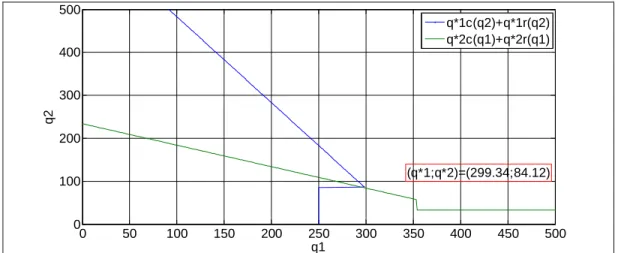
(52) 51. Table 2: Power demand parameters Node 1. Node 2. ai. 180. 250. bi. 5/16. 1/2. Demand curves represent the consumption of cities of similar size, but where there is a group of consumers in node 2 willing to pay more than any consumer in node 1 and where consumption at node 2 is more inelastic than at node 1.. Generation capacity and transmission network data The transmission line capacity (K) was initially assumed to be 200 MW, although sensitivities are made with K=60 MW to analyze the effect of congestion in the transmission line. We assume the actual power generation capacity for conventional sources is 250 MW and the actual power generation capacity for RE sources is 80 MW (based on a 0.32 capacity factor and a nominal installed capacity of 250 MW).. Range of parameters Table 3 shows the range of parameters for which the results are analyzed under each policy..
(53) 52. Table 3: Range of parameters used for analyzing the considered policies Carbon tax. The tax level varies between 0 and $300/ton of CO2.. Feed-in tariff. The fixed tariff varies between 0 and $350/MWh.. Premium payments. The premium varies between 0 and $300/MWh.. Quota obligation. For the case of a penalty of $32/MWh, the obligation compliance varies between 0 and 100%.. Next, in subsections 4.2 – 4.5, we present an analysis by type of policy, following the assumptions made in Section 3. To safeguard the integrality of the results, we use the same assumptions in all these cases. 4.2.. CARBON TAX POLICY OUTCOME. Under the carbon tax policy, in the case of a transmission line with 200 MW of capacity, the results show a decongested line for all carbon tax scenarios considered. As it is shown in Figure 2, the tax implies a monotonic decrease in the power supplied from the conventional technology at node 1, reaching a level of zero for a tax of $60/ton of CO2. In the case of the conventional technology at node 2, the power supply increases as the tax level increases up to $60/ton of CO2 (since the effect of the tax is more than compensated/offset by the increase of the energy price in that node). Once the tax level exceeds $60/ton of CO2, the supply of such technology starts to decrease, as expected, until the tax level reaches $129/ton of CO2. In the tax range between $129/ton and $158/ton the conventional energy supply gets fixed at 60 MWh due to the fact that the cheap renewable generation capacity is fully utilized and demand at node 1 reaches zero..
(54) 53. Figure 2: Power supply, flow and demand at the market equilibrium under the Carbon Tax Policy. On both nodes, for tax levels between 0 and $129/ton of CO2, demand decreases, as a consequence of an increase in the price level. Demand falls to zero at node 1 and to 140 MWh at node 2, for tax values larger than $129/ton of CO2 (values which remain fixed for tax levels larger than $129/ton of CO2). With respect to RE, only the firm at node 1 finds profitable to generate power (at maximum capacity, effective 80 MWh), for tax levels larger than $32/ton of CO2. Accordingly with the previous results, CO2 emissions (at an aggregate level) decrease as the tax increases, see Figure 3. Neververtheless, it is interesting to note that emissions at node 2 grow in the tax range of 0 to $60/ton of CO2..
(55) 54. Figure 3: CO2 Emissions under the Carbon Tax Policy Assuming a carbon tax level of $32/ton of CO2 (which is the lowest tax level needed to encourage RE generation of 80 MWh), we determine the existence of a single market equilibrium, resulting in a single nodal price of $153.24/MWh. From the best response functions of both firms in the Cournot model (resulting with these levels of tax and nodal prices), a power supply of 157.25 MWh at node 1 and 121.89 MWh at node 2 is reached at the market equilibrium, as shown in Appendix C (Figure 24).. 4.3.. FEED-IN TARIFF (FIT) POLICY OUTCOME. Under FIT policy, in the case of a transmission line with 200 MW of capacity, the results show a decongested line for all feed-in tariff scenarios considered. As illustrated in Figure 4, the power supplied takes a step-wise form in the FIT model (the same occurs in the premium-payments model). This is because the subsidy is not directly included into the demand curve, but only applied directly to the supply of RE, which.
Figure


+7



Documento similar