
TítuloNewspaper apps for tablets and smartphones in different media systems: A comparative analysis
42
0
0
Texto completo
(2) app versions analyzed came to 148 (81 for smartphones and 67 for tablets) from 20 newspapers in 10 different countries. One conclusion is that newspapers’ commitment to the tablet and smartphone in general tends to be conservative and far from independent of pre-existing print and web-based media. The paper shows how media systems have become more complex in the digital scenario, in which apps are an important, but not exclusive, aspect. So it is necessary to take into account trends in news globalization and ‘convergent journalism’. Finally this research confirms that crossplatform management and multichannel strategies are still weak, which has consequences for the innovation of app editions.. Keywords Newspaper apps, tablet, smartphone, mobile devices, media system model, digital formats, multimedia, journalism, interactivity.. Introduction After the first phase in which newspaper websites and print dailies hastily churned out smartphone and tablet apps designed with little imagination, there then began the none-toosuccessful experiment with other models. This paper studies the apps developed for tablets.
(3) and smartphones by daily newspapers by analyzing the differences and similarities that exist between three media systems (Hallin and Papathanassopoulos, 2002; Hallin and Mancini, 2004; 2012). The specific aim is to study newspaper strategies for mobile devices by identifying the solutions adopted by publishers and journalists with respect to multimediality, interactivity and commercialization models. As a result, this study is not quantitatively statistical but rather qualitative, descriptive and explorative.. State of the Art and Theoretical Framework App content that is not specifically journalistic has been categorized (marketing advertising, books, music and audiovisual content, videogames, etc.) by various authors. Based on the taxonomy of app content by Scolari et al. (2012) for mobile apps, Canavilhas and Satuf (2013) classified a series of apps by dividing them into those whose content was adapted, original or enhanced. This classification was first proposed by Feijóo et al. (2009) and earlier by Feldmann (2005). Suárez and Martín (2013) provided another kind of classification, although one not based solely on newspapers or apps, in which the apps were catalogued according to whether they were adapted PDF, enriched PDF, specific RSS feed, adapted website, generic RSS feed or multimedia application..
(4) In the specific case of the press, other researchers such as Marques (2014) looked at the news production process taking place in convergent newsrooms with regard to tablets, while Nozal et al. (2014) discussed new native evening editions for tablets, and Fernandes Teixeira (2014) highlighted the characteristics required of multimedia content in order for it not to be a mere transposition from other media. Barbosa et al. (2013) analyzed the dynamics that the native versions have imposed on the journalistic narrative while Gershon (2013), Zhong (2013) and the papers and books written by Valentini (2012a, 2012b) and García (2012) pointed to the opportunities provided by tablets in the new digital scenario. Paulino (2013) focused on the magazines available on tablets and the role of videos in their narrative. Other researchers have investigated magazine editions for tablets, such as Scolari (2013), the adaptation of dailies to the tablet format and user perceptions (Sanjuán et al. 2013a, 2013b), the business models of these new editions (Carvajal, 2012), or the tactile nature of these versions as a basic element (Cunha and Palacios, 2012). Nozal and González-Neira (2012) have compared the different fields of communication research, focusing on usability. Palomo-Torres and Cunha (2016) have conducted usability tests on native tablet publications at Spanish and Brazilian universities and have studied their consumption. Recently, Palacios et al. (2014; 2016) proposed a cartography of the native tablet apps..
(5) The theoretical framework embraces two main topics: the media system models, starting from Hallin and Mancini’s proposal, and the characteristics of the media systems, particularly in the countries selected for this sample, focusing on the digital and mobile media scenario. The Hallin and Mancini model is a reliable framework for comparing media systems, but we have avoided examining the ‘key strength’ of media systems research, which is the relationship between media and politics (Hardy, 2012: 185). In any case, ‘the models have become the reference point for various comparative analyses, even for those which do not deal with political communication’ (Brüggemann et al., 2014: 1039). We are also aware of the recent tendency to adopt the transnational perspective in the comparative analysis of media systems. Hardy (2012: 185) notes that ‘there is undoubtedly a tension between analysis of the cluster of features that have shaped and differentiated media systems […] and the transnational and transcultural dynamics that are reshaping these systems’. Moreover, there have been interesting developments in the literature covering the globalization of news (Berglez, 2008; Gerodimos, 2013; Reese, 2008) and on ‘convergent journalism’ (Chouliaraki, 2013), and as a result, journalism models and their variables have.
(6) necessarily been updated and improved in order to integrate vertical and horizontal dimensions into a transnational and transcultural perspective (Hardy, 2008, 2012). We have considered all these perspectives, and chosen the theory of media system models as our starting point - to integrate a horizontal and transnational viewpoint - because ‘the case for taking the nation unit for comparative analysis remains strong […]. The political economy, cultural and communications policies of nation-state still play a very important role in determining how media industries and markets are organized and regulated’ (Hardy, 2012: 197). The second theoretical topic, the characteristics of media systems, focuses on the digital and mobile media scenario. The Hallin and Mancini model does not take into account these dimensions: ‘the media systems that Hallin and Mancini analyzed may still retain some of their essential historical features, but they are significantly more complex than they were in the late 20th century’ (Flew, Waisbord, 2015: 5). We have considered recent analyses of digital journalism that re-examine the Hallin and Mancini model and which propose new classifications for it (Brüggemann et al. 2014; Perusko et al. 2015). Other studies show that synergies between the media and crossplatform management are challenges that newspapers and publishers are currently facing (Schlesinger, Doyle, 2015)..
(7) We have chosen conceptual dimensions and indicators that could be related to the three thematic areas used for the comparative analysis, selecting indicators for which it was possible to collect comparable data from a common source, Reuters Institute Digital News Report 2016 (Newman et al. 2016). The criteria and indicators selected are the following. 1. Internet penetration level, as one indicator of digital innovation. 2. The media market structure. Hallin and Mancini emphasise newspapers and the mass circulation press. We have also considered information consumption, regarding the use of each medium as a news source, and video news consumption. 3. The percentage of users who paid for online news in 2015. We have integrated some features of each system in the consumption analysis.. Internet penetration In the Polarized Pluralist models, Internet penetration is lower than in other countries and models: Spain (77%), Italy (62%), Portugal (68%), Brazil (58%). In the countries chosen as representative of the Democratic Corporatist model, penetration levels are above 80% (Belgium at 85%, Switzerland 87%, Germany 88%); the three countries selected from the Liberal model have the highest Internet penetration levels: UK (92%), USA (87%), Canada (93%) (Source: Internet World Stats, 2015)..
(8) The media market structure Data on media used for accessing news (Table 1) show that television news consumption still remains most popular, particularly for older people, but overall usage is declining, with differences between the countries. In the Pluralist model, the presence of television is much more consolidated, and it is also significant in the Democratic model, more so in Germany and Belgium than in Switzerland. In the latter two countries, the media systems are particularly complex, subdivided by language with strong crossborder influences. In the USA, television usage is weaker and the presence of a public service broadcaster is weak, contrary to Europe and Canada (Newman et al. 2016). The print sector is declining everywhere. In some countries, especially in the Pluralist model, it has never been particularly strong in the past. In many countries in the Liberal and Democratic model, newspaper circulation has varied between medium and strong, and in some Democratic model countries its strength is moderate and in decline. The drop is most pronounced in the United States and Canada, where La Press has closed its print editions. The British newspaper The Independent did the same, but in the UK there is a “vigorous.
(9) and highly competitive national press, including a strong tabloid sector” (Newman et al. 2016: 34). Regarding social media as a news source, the Pluralist model scores highest. In the Democratic and Liberal models, the percentages are lower but growing. News video consumption is lower in the European countries (both in the Pluralist and Democratic model) than in the American context. There, weekly news video consumption is 33% in United States, 32% in Canada and 30% in Brazil, and it is even lower in the UK, in line with the European average (22%), with higher levels in the Pluralist model, particularly in Spain (27%), and lower levels in the Democratic model, for example in Germany (17%). The other countries selected from these two models tend towards the European average: Italy at 23% and Portugal 21% for the Pluralist model; Belgium with 22% and Switzerland 23% for the Democratic model (Newman et al 2016).. Propensity to pay for online news The trend towards paying for general news online is still weak, particularly in the highly competitive English-speaking world (UK, USA and Canada averaging 9%)..
(10) According to the Reuters Institute Digital News Report 2016, the Pluralist model countries are above average in this respect (Spain at 10%, Italy 16%) with the exception of Portugal (9%), and with the peculiarity of Brazil, which had among the highest percentage of subscribers to online news in 2015 (22%). The Democratic model countries score slightly higher than the average for the Englishspeaking countries (Belgium 12%, Switzerland 10%) with the exception of Germany at 8%. We have also considered the average amount spent on subscriptions and the principal payment method for online news (ongoing or one-off payments). Although the UK and USA have a lower average number of paying subscribers, the payments tend to be ongoing (as in Belgium) and average spending (£82 in the UK and £62 in the USA) is the highest. Spain and Italy have the highest percentages of paying subscribers, but one-off payments prevail and, especially in Italy, the average cost is lower (£28), compared to Spain at £40. In Austria, Germany, Portugal, Switzerland, Brazil and Canada the tendency is equally split between one-off and ongoing payments. Among these, Germans’ average spending is £36, compared to £23 in Canada. We aim to answer the following research questions, with reference to the similarities and differences between the three media systems, and between the countries in each model:.
(11) RQ1. Is greater app innovation related to deeper Internet penetration and a market structure less focused on traditional media? RQ2. Do the higher rates of news sharing via social networks made possible by apps correspond to a greater use of social media as news source? RQ3. Do higher multimediality levels in the app correspond to greater news video consumption? RQ4. Do trends in publishing towards providing smartphones and tablets with paid access to editions correspond to a greater propensity to pay for online news? We hypothesize that there is a relationship between information consumption and newspaper publisher strategies, that the former affect the latter and vice versa. We are aware that media consumption is not an independent variable but rather depends on individual, social and structural factors, which have been taken into account as reflecting the structural characteristics of media systems.. Method To achieve the objectives of this work, a comparative analysis has been carried out in which we designed an analysis table following criteria previously described and then applied it to a sample of applications for data emptying. In the following subsections, we.
(12) describe the design of the table and the sample. The data emptying was done by two researchers during a 10-day period in June 2016. In 2014, a prior study was carried out of the newpaper apps available on iPad.. The analysis tables Analysis sheets were designed based on observations made by three researchers from a sample of versions of newspaper apps from Apple Store. This was followed by a search for elements that could be converted into items for analysis that coincided with thematic elements such as interactivity, multimedia resources, means of commercialization, origin of journalistic content (the newspaper website, print version or developed more or less exclusively for the app) and frequency of updating. This gave us a first version of an analysis table with 279 items which were then coded and tested by two experts with no connection to this work. After this test, various items were recoded and the majority eliminated to provide a table of 59 items that was used as the basis for this analysis.. The sample.
(13) A sample of newspaper apps was selected from the three media systems, with each model represented by three different countries, with the addition of Brazil because the characteristics shared by the Pluralist model ‘can also be found, indeed usually in more extreme forms’ (Hallin and Papathanassopoulos, 2002: 175) in the media markets of Latin America. Each country was represented by two newspapers from among the 10 most widely circulated. They were tracked via Apple Store and Play Store as these platforms are used by most publishers to launch their apps on mobile devices. The total number of app versions analyzed came to 148 (81 for smartphones and 67 for tablets) from 20 newspapers in 10 different countries.. Table 2. Newspaper apps analyzed for each media system and country. With the data-emptying process complete, the percentages for each analysis item was calculated to obtain figures for interactivity, multimedia content and commercialization according to the different media models and the different types of apps. Although the number of cases is limited, and this not being a statistically focused study, we adopted the percentage values for making comparisons since the numbers of cases for each model differ for each type of edition..
(14) Results and discussion. Characteristics of the app in the different media systems. Interactivity The study of app interactivity centres on the options available for personalization, participation and interacting with other services such as gaming and listings. According to the analysis, the three systems are relatively equal in terms of interactivity characteristics. Yet overall, the Pluralist model provides both devices with fewer interaction opportunities. The other two systems show similar results although the Liberal model is slightly higher for the tablet, a result which is accentuated in the smartphone. For interactivity options with other services, the Democratic model offers the fewest items on both devices. One of the most common options is sharing a news item via email or the social networks, as well as activating news alerts or enlarging letter size. The latter mainly appears in the Liberal (tablet and smartphone) and Pluralist (smartphone) models. In contrast, the options most lacking in both devices in the three systems are the vote on news items, interactive listings, changing the reading language and personalization of stock market information..
(15) These differences can be interpreted as a consequence of the more general trend in which ‘there is considerable crossnational variation in how audiences are responding to the multiplatform offer, which means that regulatory, economic and cultural conditions in given states play a large role in shaping enterprise strategies’ (Schlesinger, Doyle, 2016: 307). Interactivity features in apps for on tablets become less apparent between 2014 and 2016. It is significant that the results for 2016 show that interactivity in the three media systems, except in rare cases, is greater on smartphones than on tablets, especially for participation. The instances in which the tablet scores higher is mainly due to personalization in the Democratic model, and in one case in the Pluralist. So, the smartphone rather than the tablet seems to be the three media systems’ device of choice as a means of boosting user participation.. Table 3. Results for interactivity for each media system. Multimedia Content A device’s features enable different types of audiovisual and text content to be viewed on a single newspaper app. This study examines the presence of videos, photos and animations, etc., on these apps regardless of whether these features are fully integrated or not. The.
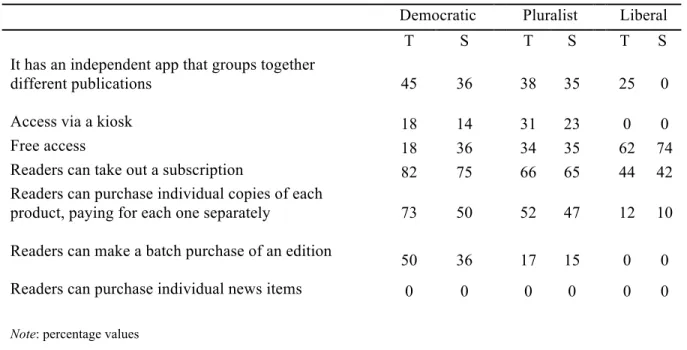
(16) Pluralist system carries the most multimedia content followed by the Liberal model, while the Democratic media offer the least. The Pluralist model has seen a notable decline in the number of multimedia characteristics relative to data gathered in 2014, where the opposite is true for the other two. It is highly likely that this is due to the closure of those evening editions of newspapers designed especially for the tablet. Video is the most abundant multimedia content on both devices, especially in the Liberal model, followed by photo galleries. As observed in the section on market structure, studies on video news consumption show that this form of information access is higher on the American continent. Other multimedia content varies from model to model but there is a general lack of options and little in the way of innovation in this field.. Table 4. Results for Multimedia Content for each media system. Commercialization Many newspapers on tablets (never on smartphones) support an independent app that contains one or several daily editions. This strategy is more frequent in the Democratic and Pluralist models, less so in the Liberal system. In the latter, only La Presse allows the user to access La Presse En Direct and the Web via La Presse+..
(17) Digital news-stands are characteristic of the Pluralist model, such as Global Media Group or Portugal Press in Portugal and Orbyt and Kiosco y más in Spain. The latter two offer access to a vast range of publications belonging to different media companies. Curiously Portugal Press is only available on Apple Store and not on Android’s Play Store. Subscribers are most evident in the Democratic and Pluralist model, especially among tablet users, less so in the Liberal model. The paywall as commercial strategy has been in operation in the Democratic model since 2014. In some Democratic cases, such as Soir+, access to basic content is free but subscribers get full articles –not just bits of them- enriched with options to participate via comments and other possibilities. In this media system smartphones apps are free, except in the case of L’Avenir and 24 heures which have paywalls. Here there is a clear difference in smartphone app commercialization between the German-speaking world (Neue Zeitung, Suddeutsche Zeitung and Frankfurter Allgemeine Zeitung) as Francophone states within the same media system. This analysis shows there to be few differences in the commercial strategy for smartphones or tablets between the three models, except in the case of the Democratic system. In general there is usually one single sales plan covering all mobile devices..
(18) As for newspapers that charge for content, there are few differences between countries in the same media block, however variations do arise when it comes to the options for buying a single copy. In the Democratic model, all the paid-for apps analysed allow the reader to purchase a single copy. In the Pluralist model about half the apps enable the reader to do so, while in the Liberal model the percentage is very low.. Types of newspaper apps for smartphones and tablets By comparing previous data, three major types of newspaper apps for tablets emerge: pdf, web and native editions.. Types of pdf apps This category includes print versions of newspapers transformed into pdf format, and can also incorporate enriched multimedia and interactivity. It is updated according to the timelines of the print version on which it depends. Given its link to the print edition, this is a suitable format for the reading public that has supported the newspaper, providing alternatives that can enhance the multimedia and interactive experience, together with the ease of receiving and viewing it on a portable.
(19) device. Exceptions aside (like 24 heures with its apps for iOS) all the newspapers that provide pdf do so for the app, tablet and smartphone regardless of screen size. This trend seems not to be the consequence of a common mobile strategy but rather an opportunity to apply the product made for print publication to the other two media without investing additional resources to adapt it. All the pdfs examined in the sample are paid-for versions, and are distinguished by their degree of enhancement: a) Ordinary pdf or unenhanced pdf are formats whose scope for interactivity gives them a score of one or less in the analysis table. In fact, the only personalization option available is the choice of edition to download. Apps that offer the most enhanced pdf form, such as O Globo, Estadao, Correio da Manha, Jornal de noticias, 24 heures, or the edition of Le Soir sold as an individual copy separate from the Le Soir+ app, fall into this category. Almost all belong to the Pluralist model, which is less innovative than the others, as we will explain later. There are two exceptions, 24 heures and Le Soir, belonging to the Democratic model, which hybrids (apparent) innovation and (substantial) tradition. b) In this study, enhanced pdf is deemed to contain interactivity features that enable it to score five items or more, even as high as seven in the case of La Repubblica. This.
(20) enhancement depends on the app that supports the pdf which, in many cases, is a newsstand such as Kiosco y más in Spain, or others like PressReader. In app-supported enhanced pdf, the reader can use features to personalize text size and font, as in El País or La Repubblica. In the El País version on Kiosco y más the email addresses or URL that appear in the text become interactive links, so services that appear, such as listings or interactive advertising, offer greater interactivity. All the apps in this category also allows the reader to share a news piece by email or the social networks. c) Between enhanced and unenhanced pdf formats, we find the largest group of apps that enable interactivity and contain multimedia content that relates them to the former but with fewer services available. These score between two and four items, and can be classified as having intermediate enhancement, and include apps provided by L’Avenir, Le Soir, Neue Zeitung and Frankfurter Allgemeine Zeitung, El Mundo, The Sun and The Daily Telegraph.. Web edition This category contains apps based on a website-oriented model: the contents are the same or very similar to the newspaper website, they are often optimized for mobile devices but not developed exclusively for them. We need to distinguish this category from the apps.
(21) accessible via browsers which have not been considered in this research because we focus on the apps available from app outlets (Apple Store and Google Play). The commercialization model, like content and its updating, takes its lead from the website: indeed most apps are free, with the exception of Le Soir +, The Sun, The Daily Telegraph, O Globo, L’Avenir and The New York Times. There are various types of web editions differentiated by the extent of their similarity to the website with respect to content and design: a) Identical or very similar to the online newspaper, with graphic design, sections and articles that are the same for the tablet and web edition, for example Le Soir 17h, Correio da Manhã and El País. They belong to the Democratic (the first) and Pluralist (the last two) model; this trend also reflects the lower level of innovation of the latter and the hybrid Democratic trend. b) Editions that are more independent of the website model with respect to graphic design belong to the Democratic and Liberal models, and include L’actu en continu (Le Soir), L’Avenir and USA Today. The articles are similar but spread over various pages to improve the reading experience or presented in sections that differ with respect to the website, and also include other services. The Toronto Star offers the same articles as in the online edition but the web design is very different, and.
(22) images are more prominent, indeed each article opens with an image and short headline. There is a trend to adapt the design of the web edition app to the new devices, thus moving away from the traditional website. This mainly happens on The Toronto Star and USA Today. The majority of web edition apps carry unmodified articles and content. In the pdf and web editions we find the same repurposing logic, based on content, organizational and working methods of a pre-existing medium, with an important difference: the former is print-oriented, the latter web-oriented. The Liberal model contains most apps of this type. Except in the case of La Presse, and partially in 24 Heures, the apps for tablets are the same as those for smartphones. The Canadian La Presse has a unique and exclusive version for iPhone, as does Correio da Manha, L’Avenir and 24 Heures. In Corriere della Sera, O Globo, Neue Zeitung, Suddeutsche Zeitung and Frankfurter Allgemeine Zeitung, this exclusive smartphone version can be used on both Android and iOS. So, there is a trend, less so in the Liberal model, to create web edition apps just for smartphones, in particular for iOS.. Native Versions.
(23) This category includes versions of the daily newspaper created ex profeso for tablets by taking into account their usability and the features of this device. As opposed to the pdf and the web editions, their origin is neither clearly in newsprint or in the web. These versions require greater financial investment since design and working structures are different. There are fewer apps of this kind in our study and only Estadao is by subscription. These versions are normally promoted as different, exclusive products compared to other newspapers in the same country. Although these versions have been designed with an eye for features that increase tablet interactivity, the technological potential of these apps has yet to be fully exploited. Interactivity options are limited to sharing the news item via email or the social networks. In terms of updating the news on the apps, there are two types: a) Evening edition: some newspapers post their evening editions (published between 17:00 and 19:00) on these native versions, differentiating them from the morning pdf version. No newspaper analyzed has an evening print version, which implies a shift in newsroom work dynamics and routines. They often include exclusive content not found in the web or print version. In some cases (Suddeutsche Zeitung, Estadao Noite) they even break news stories that do not appear in print until the next day. In the event of an important story, publication can be delayed or a special.
(24) edition prepared that covers stories breaking during the night and which appear in a morning edition, adding items that do not appear in the print version. Suddeutsche Zeitung has this delayed evening version, which it updates between 23:00 and 24:00, incorporating breaking news updates that could not be included in the earlier evening edition. b) Morning newspapers: other versions of the native apps are updated in the morning, like La Presse +, via which the user can access the web edition app with continuous updates.. The Democratic model has the greatest number of native apps which, as we have mentioned, presents hybrid trends in innovation. Surprisingly, these apps in the Pluralist system have practically disappeared when compared to 2014, when dailies like La Repubblica, O Globo or El Mundo produced native editions for tablets. With the exception of La Presse, all these apps are available both for tablets and smartphones.. Prevalent characteristics of newspaper apps for the three media systems.
(25) Considering the app features and the types discussed, we can identify the prevalent characteristics of newspaper apps for the three media systems.. Democratic Corporatist This model reveals certain differences between Francophone newspapers and the rest. These provide fewer exclusive versions for smartphones, while Neue Zurcher Zeitung (Switzerland), Suddeutsche Zeitung and Frankfurter Allgemeine Zeitung (Germany) make special web edition apps for these devices, initiating a difference in strategy in terms of offers to users between devices that developing. The opposite case is Le Soir which duplicates the same newspaper content on both devices. The case of 24 heures is noteworthy as it distinguishes between operating system rather than device, in that it offers a pdf version and a web edition for iPad users whereas the Android tablet user can only view the mobile version that it shares with smartphones with the same operating system. In 2014, the Francophone newspapers provided more than one version of the newspaper on tablet, perhaps due to a sense of reminiscence for the language’s country of origin, which marks them out as belonging to the Pluralist system where this custom is common. This is different from the German language communication groups in 2014 that provided only one.
(26) version per operating system and device. By 2016, Frankfuter Allgemeine Zeitung had evolved by following the Francophone trend of offering tablet users a native app for each operating system, as well as the pdfs it was already providing in 2014, all of which signals a moderate punt on mobile devices. This addition of the native app, as well as the one already provided by Suddeutsche Zeitung, makes it the media system with most apps of this type in our sample. And although these newspapers have clearly committed to a mobile device version as a medium separate from its web and print versions, the scope for interactivity is still conservative. All pdf versions analyzed have an intermediate level of enhancement, except two that hardly enriched at all. In terms of the web editions, none is truly independent of its medium of origin; neither is there much in the way of interactivity beyond sharing news items, photos and videos or adding comments, nor in multimedia content. In general, newspapers in this system opt for transferring their pre-existing media to these devices. The focus on traditional newspapers and the tradition of strong and widely read newspapers could have an influence on the weak innovation on smartphones and tablets. At the same time characteristics of greater innovation, such as high Internet penetration, could affect the signs of innovation in the app, for example the higher number of native editions. Polarized Pluralist.
(27) This model has the most versions for both devices. The number of apps on offer for tablets and smartphones are the same in half the dailies analyzed, while the other half provide more apps for smartphones, often twice as many than for tablets, as is the case in Corriere della sera and O Globo. All newspapers, with the exception of Estadao, offer a web edition exclusively for smartphones while only four do so for tablets. The pdf app is the most common, with all newspapers offering this version type for tablets. The sample revealed that newspapers in this category tend to publish two versions, either a pdf and a web edition or a pdf and a native version. There are only two instances in tablets (O Globo and Corriere della Sera) in which there is only one type of app on offer. In contrast to 2014, this model has reduced considerably the number of native apps for tablets (a trend led by El Mundo, La Repubblica and O Globo) with only the Brazilian Estadao producing one for this device. This decline in native versions contrasts with the considerable increase in web edition apps. The two-deadline strategy, with its pdf morning edition followed by a native version in the evening, has been abandoned, and publishers have opted for combining the traditional morning daily and continuous web updates. So, our analysis shows that the trend in the Pluralist model is to abandon versions produced specifically for tablets and to direct this device towards pre-existing print and web media, as occurs in the Democratic model. In the Pluralist system, there is less innovation than in.
(28) the other two, which this trend confirms, and it could be due to low Internet penetration and the focus on TV (especially in Italy), print and radio, as mentioned previously in relation to Internet penetration and media market structure.. Liberal Model In contrast to the other two models, pdf versions here are virtually non-existent. The pdf versions on offer are either intermediate enhanced or fully enhanced in terms of user potential. The exception is La Presse which replaced its printed version on 1 January 2016 with a new native morning edition for tablets called La Presse+, through which users can access the continuously updated web edition app, En Direct, and the web. With this change, the pdf version on offer up to 2016 disappeared. It is also another example of different products for different devices: La Presse Mobile, an optimized web edition, was produced solely for smartphones. This model scores highly for interactivity, and is the only model in which pdf is not the most widely offered version, with web editions given more prominence.. Conclusions.
(29) With the features of the three models described, we now turn to the research questions first raised at the start of this paper. The first regards whether greater app innovation relates to deeper Internet penetration and a market structure less focused on traditional media (RQ1). There are high levels of Internet penetration in the Liberal and Democratic models, although it is slightly lower in the latter; the market structure is more innovative in the former, which could partly explain its higher propensity to digital innovation. As we have observed, greater innovation is more apparent in the apps developed by newspapers in the Democratic system –the only model to see a rise in the number of native apps between 2014 and 2016-, whereas newspapers’ commitment to the tablet tends to be conservative in nature and far from independent of the pre-existing print and web-based media. Full multimedia convergence has yet to arrive in the sense of a new type of journalistic format; the commercialization models reveal nothing new, and neither do they take advantage of the potential to interact with the user. So we can say that this model hybrids (apparent) innovation and (substantial) tradition. Media and television still play an important role in both the Democratic and Pluralist model, albeit declining, which could explain the slower pace of innovation weighed down by these two traditional media types..
(30) The second research question regards whether higher rates of potential news sharing on the social networks via the apps relate to a greater use of social media as news source (RQ2). Data on news shared via email or social networks are similar for all three media systems, although the extent of social media use as a news source varies between them. This trend is probably linked to publishers’ awareness of the strategic role of social networks in news consumption. In fact, all three media models provide ample facilities for participation (more on smartphones than on tablets). Another research question is whether apps’ higher multimediality levels match greater news video consumption (RQ3). Video consumption is higher in countries belonging to the Liberal model, more so in the United States and Canada than in European countries of the same system, and at higher rates than those of the Democratic and Pluralist models. Video news consumption also differs between continents, as we saw in the section on media market structure. The fourth research question is whether the trend by publishers to offer paid access to editions for smartphones and tablets matches a greater willingness by users to pay for online news (RQ4). Here there is a positive relationship although the exceptions do not make for a conclusive interpretation. In fact, in the Liberal countries, where there is a low.
(31) percentage of paying subscribers and where ongoing payments prevail, the incidence of paid editions and the option to purchase single copies are lower. The situation in the Democratic and Pluralist model is more diversified. In the latter, the availability of paid editions is prevalent, along with the option to subscribe or purchase individual copies. Spain, Brazil and Italy have the highest percentages of paying subscribers but one-off payments are the norm (Spain and Italy) or there exists a combination of ongoing and one-off payments (Brazil). Portugal is the exception, with a low percentage of subscribers paying for online news in 2015. We can hypothesize that publishers’ choice of sales strategy can influence users’ behavior. In order to confirm and enrich these results, future research needs to consider more indicators to conceptualize the digital media scenario and test the correlation through variables using multilevel modelling. This paper innovates the debate on comparative media system research both focusing on mobile media and reflecting on publishers’ multiplatform strategies. It also analyses the features of the digital media scenario within the media models. It shows how media systems have become more complex in the digital scenario, in which apps are an important, but not exclusive, aspect. So it is necessary to take into account trends in news globalization and ‘convergent journalism’. Finally this research confirms that crossplatform.
(32) management and multichannel strategies are still weak, which has consequences for the innovation of app editions.. Table 1. News access platforms on a weekly basis (with focus on social media). Pluralist. Democratic. Liberal. Spain. Italy. Portugal. Brazil. Belgium. Switzerland. Germany. USA. UK. Canada. tv. 79. 83. 82. 79. 75. 69. 78. 66. 70. 71. radio. 34. 30. 37. 35. 46. 43. 46. 23. 33. 27. print. 56. 43. 47. 40. 45. 63. 38. 26. 35. 36. online*. 86. 83. 88. 91. 82. 82. 59. 73. 72. 75. social media. 60. 54. 66. 72. 46. 47. 31. 46. 35. 48. Note: percentage values * including social media Source: Reuters Institute Digital News Report 2016. Table 2. Newspaper apps analyzed for each media system and country. MODEL. COUNTRY. NEWSPAPER. Nº.
(33) VERSIONS Spain Italy Polarized Pluralist Portugal. El País. 8. El Mundo. 12. Corriere della Sera Repubblica. 6. Correio da Manhá Journal de noticias. 9. 7. 8 6. Brazil. Belgium Switzerland Democratic Corporatist Germany. UK Liberal. USA Canada. O Globo Estadao. 8. L’Avenir. 7. Le Soir. 16. Neue Zurcher Zeitung 24 heures. 6. Suddeutsche Zeitung Frankfurter Allgemeine Zeitung. 6 10. The Sun. 4. Daily Telegraph The New York Times USA Today. 7. Toronto Star. 6. La Presse. 7. 5. 6 7.
(34) Table 3. Results for tablet (T) and smartphone (S) Interactivity for each media system. Democratic. Pluralist. Liberal. T. S. T. S. T. S. Personalization of the edition that the reader wishes to access. 45. 35. 48. 21. 19. 21 . Letter size. 45. 50. 34. 89. 81. 89 . Font/letter type. 4. 3. 10. 0. 0. 0 . Personalization of weather information. 14. 11. 10. 16. 12. 16 . Personalization of stock market information. 0. 0. 0. 0. 0. 0 . Personalization of services. 0. 0. 7. 0. 0. 0 . Personalization of the ordering of sections. 0. 0. 0. 26. 31. 26 . Can photos, videos, news items be classified as favourites?. 41. 39. 41. 53. 37. 53 . Can news alerts be activated?. 68. 78. 41. 79. 69. 79 . Changing the reading language. 0. 0. 0. 0. 0. 0 . 1. Personalization. . 2. Other services Interactive games. 0. 0. 14. 16. 31. 16 . Interactive Advertising. 0. 0. 7. 5. 5. 5 . Interactive listings. 0. 0. 0. 0. 0. 0 .
(35) Do the news items contain links?. 14. 18 . 28. 26 . 19. 26 . Search engine. 45. 32 . 31. 21 . 12. 21 . . 3. Participation. . Add comments. 27. 21 . 10. 16 . 6. 16 . Add photos. 4. 7 . 0. 0 . 0. 0 . Add videos. 4. 7 . 0. 0 . 0. 0 . Participate in surveys. 0. 0 . 0. 10 . 12. 10 . Share photos by email or social networks. 9. 11 . 7. 21 . 12. 21 . Share videos by email or social networks. 18. 18 . 7. 21 . 12. 21 . Share news items by email or social networks. 72. 86 . 62. 84 . 75. 84 . Vote on news items. 0. 0 . 0. 0 . 0. 0 . Note: percentage values Source: personal compilation. Table 4. Results for tablet (T) and smartphone (S) Multimedia Content for each media system Democratic Videos Video galleries Graphics Photo galleries Audio. Pluralist. Liberal. T. S. T. S. T. S. 54 9 13 27 9. 68 11 14 39 7. 55 21 48 45 7. 62 20 41 50 12. 81 19 37 62 12. 100 53 31 79 10.
(36) Articles by speech synthesizer Other multimedia resources (e.g. radio) Animated infographics and/or animations Prominence of graphics over text (on home page). 0 4 13. 0 0 11. 14 14 0. 18 12 0. 0 0 12. 0 0 21. 22. 18. 10. 12. 69. 47. Note: percentage values Source: personal compilation. Table 5. Results for tablet (S) and smartphone (S) Commercialization for each media system. It has an independent app that groups together different publications Access via a kiosk Free access Readers can take out a subscription Readers can purchase individual copies of each product, paying for each one separately Readers can make a batch purchase of an edition Readers can purchase individual news items Note: percentage values Source: personal compilation. References. Democratic. Pluralist. Liberal. T. S. T. S. T. S. 45. 36. 38. 35. 25. 0. 18 18 82. 14 36 75. 31 34 66. 23 35 65. 0 62 44. 0 74 42. 73. 50. 52. 47. 12. 10. 50. 36. 17. 15. 0. 0. 0. 0. 0. 0. 0. 0.
(37) Barbosa S, Silva F, Nogueira L et al (2013) A atuação jornalística em plataformas móveis. Estudo sobre produtos autóctones e a mudança no estatuto do jornalista. Brazilian Journalism Research 9(2): 1-20. Benson R, Blach-Ørsten M, Powers M, et al (2012) Media Systems Online and Off: Comparing the Form of News in the United States, Denmark, and France. Journal of Communication 62: 21–38. Berglez, P (2008) What is Global Journalism? Journalism Studies 9(6): 845-858. Brüggemann M, Engesser S, Büchel F, Humprecht E & Castro L (2014). Hallin and Mancini revisited: Four models of western media systems. Journal of Communication 64: 1037–1065. Canavilhas J and Satuf, I (2013) Jornalismo en transiçao: do papel para o tablet… ao final da tarde’. In A. Fidalgo A, Canavilhas J (eds) Comunicaçao digital. 10 anos de investigaçao. Coimbra: Minerva Coimbra, 35-60. Carvajal M (2012) Estrategias de distribución del contenido periodístico en dispositivos móviles. Análisis comparativo de los principales editores de prensa española. In Actas IV Congreso Internacional Latina de Comunicación Social: Comunicación, control y resistencias..
(38) Chouliaraki L (2013) RE-MEDIATION, INTER-MEDIATION, TRANS-MEDIATION. The cosmopolitan trajectories of convergent journalism. Journalism Studies 14(2): 267283. Cunha R and Palacios M (2012) A tactilidade em dispositivos móveis: primeiras reflexões e ensaio de tipologias. Contemporanea, setembro-dezembro, 10(3): 668-685. Feijóo C, Maghiros I, Abadie F, Gómez-Barroso JL (2009) Exploring a heterogeneous and fragmented digital ecosystem: Mobile content. Telematics and Informatics 26: 282-292. Feldmann V (2005) Leveraging Mobile Media: Cross-Media Strategy and Innovation Policy for Mobile Media Communication. New York: Physica-Verlag Heildberg Fernandes Teixeira J (2014) Lo audiovisual en productos periodísticos exclusivos para tabletas: observando las tendencias en cuanto a sus formas y funciones. In IV Congreso Internacional de la Asociación Española de Investigadores en Comunicación. AE-IC Flew T, Waisbord S (2015) The ongoing significance of national media systems in the context of media globalization. Media, Culture & Society: 1–17. García M (2012) The iPad design lab. Apple Store. Gerodimos R (2013) Global News, Global Challenge. In K. Fowler-Watt K, Allan S (eds) Journalism: New Challenges. Poole, England: CJCR: Centre for Journalism and Communication Research, Bournemouth University, 476-498.
(39) Gershon R (2013) Digital Media Innovation and the Apple iPad: Three Perspectives on the Future of Computer Tablets and News Delivery. Journal of media business studies 10(1): 41-61. Hallin D and Mancini P (2004) Comparing Media Systems. Three Models of Media and Politics. Cambridge: Cambridge University Press. Hallin D and Mancini P (2012) Comparing Media System: A Response to Critics. In F. Esser F, Hanitzsch T (eds) The Handbook of Comparative Communication Research. London: Routledge, 207-220. Hallin D and Papathanassopoulos S (2002) Political Clientelism and the Media: Southern Europe and Latin America in Comparative Perspective. Media, Culture & Society 24(2): 175-195. Hardy J (2008) Western Media Systems: Communication and Society. London and New York: Routledge. Hardy J (2012) ‘Comparing Media System’. In Esser F, Hanitzsch T (eds) The Handbook of Comparative Communication Research. London: Routledge, 185-206. Marques A (2014) Redações convergentes e o impacto dos tablets nas rotinas produtivas jornalísticas. In 5º Simpósio Internacional de Ciberjornalismo, UFMS, 27-29 August 2014..
(40) Newman N, Fletcher R, Levy DAL, Nielsen RK (2016) Reuters Institute Digital News Report 2016. Reuters Institute for the Study of Journalism, Oxford. Nozal T, González-Neira A (2012) La interactividad en las aplicaciones periodísticas para iPad italianas y españolas. Estudios sobre el Mensaje Periodístico 18: 639-648. Nozal T, González-Neira A, Sanjuán A (2014) Análisis de ediciones vespertinas de prensa para tableta. El profesional de la información 23(4): 393-400. Paulino R (2013) Conteúdo digital interativo para tablets-iPad: uma forma híbrida de conteúdo digital. Revista de Comunicaçao (14)33. Palacios M, Barbosa S, Firmino F, da Cunha R (2014), Aplicativos jornalísticos vespertinos para tablets. Cartografia do fenômeno ante o desafio de uma produção original e inovadora. Sur le journalisme, About journalism, Sobre jornalismo (3)2. Palacios M, Barbosa S, Firmino F, da Cunha R (2016). Mobile Journalism and Innovation: A Study on Content Formats of Autochthonous News Apps for Tablets. In Aguado JM, Feijóo C and Martínez IJ (eds) Emerging Perspectives on the Mobile Content Evolution. Hershei, PA: IGI Global. Palomo Torres MB and Da Cunha RES (2016) El consumo tradicional de los nuevos medios. Análisis de la usabilidad de las publicaciones autóctonas para tableta en el contexto universitario español y brasileño. Estudios sobre el Mensaje Periodístico (22)1: 483-501.
(41) Perusko Z, Vozab D, Cuvalo A (2015), Digital Mediascapes, Institutional Frameworks, and Audience Practices Across Europe. International Journal of Communication 9: 342–364. Reese S (2008) Theorizing a Globalized Journalism. In Löffelholz M, Weaver D (eds) Global Journalism Research. Theories, Methods, Findings, Future. Malden, MA: Blackwell Publishing Ltd, 240-252. Schlesinger P, Doyle G (2016) From organizational crisis to multi-platform salvation? Creative destruction and the recomposition of news media, Journalism, 2015, 16(3): 305323. Sanjuán A, Nozal T, González-Neira A (2013a) Perception of journalistic contents in print and iPad version. Spanisch case La voz de Galicia. In Rizvanog, K (ed) Research and Design Innovations for Mobile User Experience. Hershey: IGI Global, pp. 115-128. Sanjuán A, Nozal T, González-Neira A (2013b) Usabilidad, interactividad y contenidos multimedia en la prensa para iPad: el caso de El País, El Mundo, ABC y La Razón. In Canavilhas J (ed) Notícias e Mobilidade: o jornalismo na era dos dispositivos móveis. Covilha: Universidade Beira Interior, 73-98. Scolari C (2013) De las tablillas a los tablets: evolución de las emagazines. El profesional de la información 22(1): 10-18..
(42) Scolari C, Aguado J and Feijóo, C (2012) Mobile Media: Towards a Definition and Taxonomy of Contents and Application. International Journal of Interactive Mobile Technologies 6(2): 29-38. Suárez F and Martín J R (2013) Exploratory study of tablet publication models: visual communications. and. usability. systems.. CommunicationandSociety. /Comunicación. Sociedad 26(3): 49-66. Valentini, E (2012a) Dalle gazzette all’iPad. Il giornalismo al tempo dei tablet. Milano: Mondadori. Valentini (2012b) The social and technological impact of tablets in the journalism field: a comparative analysis of communicative and business strategies of the newspapers on iPad. In Zamith F, Bastos H and Reis I (eds) III International Conference On Cyberjournalism. Oporto: Obercom, 204-223. Zhong,. B. (2013). From. smartphones. to. iPad:. Power. users’. toward mobile media devices. Computers in human behavior 29(4): 1742-1748.. disposition.
(43)
Figure



Documento similar
However, more recently, the novel work [1] performed ex- tensive per-frame measurements for seven devices of different types (smartphones, tablets, embedded devices and
Based on the required functionalities and evolving the Media Independent Layer proposed in IEEE 802.21, in section 3., we propose a new architecture for a Media Independent
The expansionary monetary policy measures have had a negative impact on net interest margins both via the reduction in interest rates and –less powerfully- the flattening of the
The study is conducted with first year Building Engineering degree students in order to use mobile technologies, augmented reality (AR) and digital sketching (DS) in different
In accordance with the objectives and hypotheses, this article will analyse the different accountability systems used in each of the autonomous communities included in the
In the Ecuadorian case, we have observed a low interaction of journalists with their audiences, determined primarily by sociocultural factors: the low
The applications dedicated to content: Rtve.es | Tablet and Atresplayer and Mitele offer a wide variety of audiovisual products, and facilitate access to in-house
Based on this theoretical framework and the review of previous research in the use of mobile technologies, this article addresses the uses and consumption of tablet
