
Audioblogs: key tool to lower anxiety in oral fluency
116
0
0
Texto completo
(2) AUDIOBLOGS TO LOWER ANXIETY IN ORAL FLUENCY. Audioblogs: Key Tool to Lower Anxiety in Oral Fluency. Lilibeth MONTILLA PIAMBA Mauricio Alberto OSPINA HOYOS Laura Sofía PINEDA BAUTISTA. Research Report submitted in partial fulfillment of the requirementsfor the degree of Master in English Language Teaching – Autonomous Learning Environments. Directed by Liliana Marcela CUESTA Department of Foreign Languages and Cultures Universidad de La Sabana Chía, Colombia Abril, 2016. 2.
(3) AUDIOBLOGS TO LOWER ANXIETY IN ORAL FLUENCY Declaration. I hereby declare that my research report entitled: [Audioblogs: Key Tool to Lower Anxiety in Spoken Performance] • is the result of my own work and includes nothing which is the outcome of work done in collaboration except as declared and specified in the text; • is neither substantially the same as nor contains substantial portions of any similar work submitted or that is being concurrently submitted for any degree or diploma or other qualification at the Universidad de La Sabana or any other university or similar institution except as declared and specified in the text; • complies with the word limits and other requirements stipulated by the Research Subcommittee of the Department of Foreign Languages and Cultures; • has been submitted by or on the required submission date.. Date: April 20th, 2016 Full Name: Pineda Bautista Signature:. Lilibeth Montilla Piamba, Mauricio Alberto Ospina Hoyos, Laura Sofía.
(4) AUDIOBLOGS TO LOWER ANXIETY IN ORAL FLUENCY. i. Acknowledgements. First and foremost I wish to thank to God for the good health and well-being necessary to successfully conduct this research study. I would like to express my deepest gratitude to Dr. Liliana Marcela Cuesta and Luz Dary Arias, whose expertise, understanding and patience, added considerably to my graduate experience. My sincere thanks also go to my son Josue Avila, my husband Carlos Avila, my grandmother Soledad Ruiz, my parents and siblings for the unceasing encouragement, support and attention. Lilibeth Montilla Piamba On one hand, I would like to show my gratitude to Professor Liliana Marcela Cuesta and professor Luz Dary Arias for the guidance and support throughout all this process to be able to reach this goal in my life. On the other side, I would like to thank my mother for her patience, motivation and advice at hard times. Also, I would like to thank Luis Galvis for the support and strength in stressing and hurrying situations to fulfill this meaningful life experience. Mauricio Alberto Ospina Hoyos I owe my deepest gratitude to my son Damian Claudec for being the sun of my days and the moon of my nights; my motivation for accomplishing this process and allowing me to succeed in all life aspects. I am also grateful with my mother Pilar Bautista, my father German Pineda, my brother Sebastian and my grandmother Dora Ines Castillo, who supported me and encouraged me when I needed it the most. Laura Sofía Pineda Bautista.
(5) AUDIOBLOGS TO LOWER ANXIETY IN ORAL FLUENCY. ii. Abstract This mixed method action research study analyzed the influence of the use of audio blogs to lower anxiety and improve students’oral fluency. This study was conducted with three different groups, all the learners classified with an A1 level according to the Common European Framework of Reference for Languages, as they are: six seventh graders from Ofelia Uribe de Acosta IED school, six tenth and eleventh graders from Luis Angel Arango IED school in Bogotá, Colombia and six young adults from SENA (Servicio Nacional de Aprendizaje) in Villavicencio, META, Colombia. According to the needs analysis, the participants showed high. levels of negative anxiety, affecting their desire to speak in the target language as well as lack of fluency by making constant pauses in their oral speech. Due to this fact, the data of this study was collected using a student’s log, a survey, the Foreign Language Classroom Anxiety Scale designed by Horwitz (1986) and the participants’artifacts: audioblogs. All the data collected through these instruments was analyzed following the grounded theory method. The results revealed that the use of audio blogs allowed the participants to lower the level of negative anxiety by increasing the level of positive anxiety; thus, not only the participants enjoyed the process of recording the audio blogs but also the repetition of the task helped them raise awareness of their learning process and the improvement of fluency, variables which enrich the existing research studies since any of them considered audio blogs as a significant tool to decrease anxiety whilst improving fluency.. This study enriches second language learning. research by providing insights on the influence of anxiety on fluency and the impact of audioblogs in the increasing of positive anxiety and the development of learning awareness. Key words: Anxiety, audioblogs, CALL,fluency, speaking skill. ..
(6) AUDIOBLOGS TO LOWER ANXIETY IN ORAL FLUENCY. iii. Resumen El presente estudio acción investigación de método mixto analizó la influencia del uso de los audioblogs para disminuir la ansiedad y mejorar el nivel de fluidez de los estudiantes. Este estudio se llevó a cabo con tres grupos diferentes, todos los participantes clasificados en el nivel A1 de acuerdo al Marco Común Europeo de Referencia para las Lenguas; seis estudiantes de grado séptimo del colegio Ofelia Uribe de Acosta IED, seis estudiantes de grados décimo y undécimo del colegio Luis Angel Arango IED en Bogotá, Colombia y seis adultos jóvenes del centro de comercio y servicios, SENA en Villavicencio, Meta. De acuerdo al análisis de necesidades, los estudiantes evidenciaron altos niveles de ansiedad negativa al hablar en inglés, al igual que falta de fluidez en su discurso oral. Debido a este hecho, los datos de este estudio fueron recolectados a través de la bitácora del estudiante, una encuesta, la escala de ansiedad (FLCAS) diseñada por Horwitz (1986) y los audioblogs. Todos los datos recolectados a través de estos instrumentos fueron analizados de acuerdo al método de teoría fundamentada; los resultados revelaron que el uso de los audioblogs permitió a los participantes disminuir su nivel de ansiedad negativa incrementando el nivel de ansiedad positiva; así mismo, los participantes disfrutaron el proceso de grabación de los audioblogs y la repetición de las actividades les permitió ser conscientes de su proceso de aprendizaje y mejorar su fluidez, variables que enriquecen los estudios de investigación existentes, ya que ninguno de ellos consideró audioblogs como una herramienta significativa para disminuir la ansiedad mientras mejora la fluidez. Este estudio enriquece la investigación en el aprendizaje de una segunda lengua dando perspectivas de la influencia de la ansiedad en la fluidez y el impacto de los audioblogs en el incremento de la ansiedad positiva y el desarrollo de la conciencia de su proceso de aprendizaje. Palabras claves: ansiedad; audioblogs; CALL; habilidad del habla y fluidez..
(7) AUDIOBLOGS TO LOWER ANXIETY IN ORAL FLUENCY. iv. Table of Contents Acknowledgements .......................................................................................................................... i Abstract ........................................................................................................................................... ii Resumen ......................................................................................................................................... iii Table of Figures ............................................................................................................................ vii Table of Tables ............................................................................................................................. vii Chapter 1: Introduction ................................................................................................................... 1 1.1. Introduction to the study ......................................................................................... 1. 1.2. Rationale of the study ............................................................................................. 3 1.2.1 Needs analysis and problem statement ....................................................... 4 1.2.2 Justification of problem’s significance ....................................................... 6 1.2.3 Strategy selected to address problem .......................................................... 7. 1.3. Research question(s) and objective(s) .................................................................... 7. 1.4. Conclusion .............................................................................................................. 8. Chapter 2: Theoretical Framework & State of the Art ................................................................... 9 2.1. Introduction ............................................................................................................. 9. 2.2. Theoretical framework ............................................................................................ 9 2.2.1 Anxiety ........................................................................................................ 9 2.2.2 CALL: Computer-Assisted Language Learning ....................................... 12 2.2.2.1. Audioblogs .............................................................................. 13. 2.2.3 Speaking skill ............................................................................................ 15. 2.3. 2.2.3.1. Fluency.................................................................................... 17. 2.2.3.2. Pauses ...................................................................................... 19. State of the art ....................................................................................................... 20.
(8) AUDIOBLOGS TO LOWER ANXIETY IN ORAL FLUENCY 2.4. v. Conclusion ............................................................................................................ 23. Chapter 3: Research Design .......................................................................................................... 24 3.1. Introduction ........................................................................................................... 24. 3.2. Type of study ........................................................................................................ 24. 3.3. Context .................................................................................................................. 25 3.3.1 Participants ................................................................................................ 26. Ofelia Uribe de Acosta IED .......................................................................................................... 29 Luis Angel Arango IED ................................................................................................................ 29 SENA ............................................................................................................................................ 29 3.3.2 Researcher’s role ....................................................................................... 29 3.3.3 Ethical considerations ............................................................................... 30 3.4. Data collection instruments................................................................................... 30 3.4.1 Descriptions and justifications .................................................................. 30 3.4.1.1. Survey (See Appendix C) ....................................................... 30. 3.4.1.2. Students’ log (See Appendix D) ............................................. 31. 3.4.1.3. Audioblogs (See Appendix E) ................................................ 31. 3.4.1.4. Foreign Language Classroom Anxiety Scale (FLCAS) (See Appendix F) ............................................................................ 31. 3.4.2 Validation and piloting.............................................................................. 32 3.5. Conclusion ............................................................................................................ 32. Chapter 4: Pedagogical Intervention and Implementation............................................................ 34 4.1. Introduction ........................................................................................................... 34. 4.2. Visions of language, learning, and curriculum ..................................................... 34.
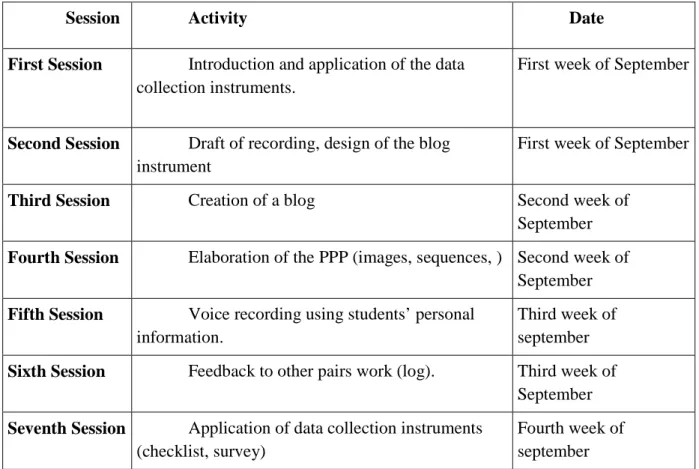
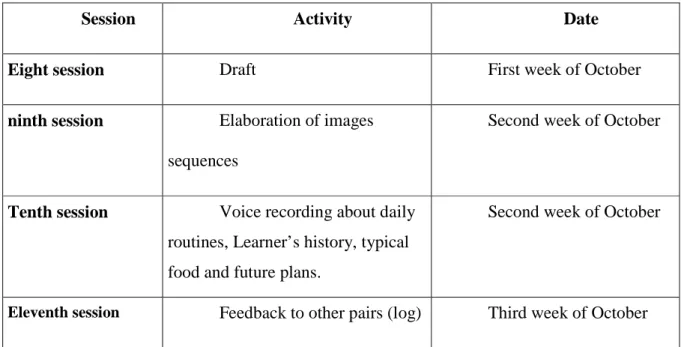
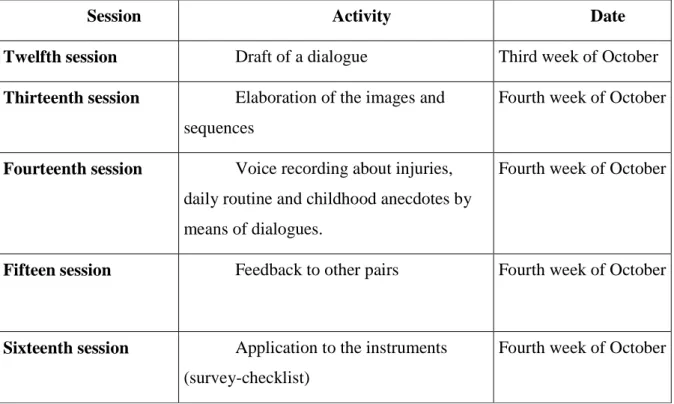
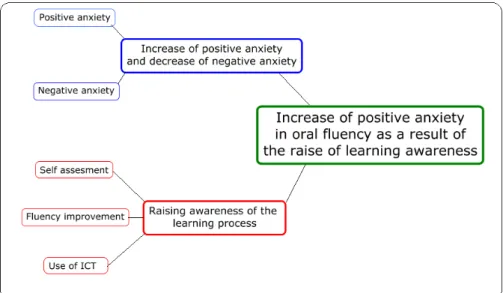
(9) AUDIOBLOGS TO LOWER ANXIETY IN ORAL FLUENCY. vi. 4.2.1 Vision of language .................................................................................... 34 4.2.2 Vision of learning ...................................................................................... 35 4.2.3 Vision of curriculum ................................................................................. 36 4.3. Instructional design ............................................................................................... 38 4.3.1 Lesson planning ........................................................................................ 38 4.3.2 Implementation ......................................................................................... 39. 4.4. Conclusion ............................................................................................................ 42. Chapter 5: Results and Data Analysis ........................................................................................... 43 5.1. Introduction ........................................................................................................... 43. 5.2. Data management procedures ............................................................................... 43 5.2.1 Validation .................................................................................................. 44 5.2.2 Data analysis methodology ....................................................................... 44. 5.3. Categories ............................................................................................................. 45 5.3.1 Overall category mapping ......................................................................... 45 5.3.2 Discussion of categories ............................................................................ 47 5.3.2.1. Increase of positive anxiety and decrease of negative anxiety 48. 5.3.2.1.1. Positive Anxiety ...................................................................... 48. 5.3.2.1.2. Negative Anxiety .................................................................... 50. 5.3.2.2. Raising Awareness of the Learning Process ........................... 52. 5.3.2.2.1. Fluency improvement ............................................................. 52. 5.3.2.2.2. Self assessment ....................................................................... 55. 5.3.2.2.3. Use of ICT............................................................................... 56. 5.3.3 Core category ............................................................................................ 60.
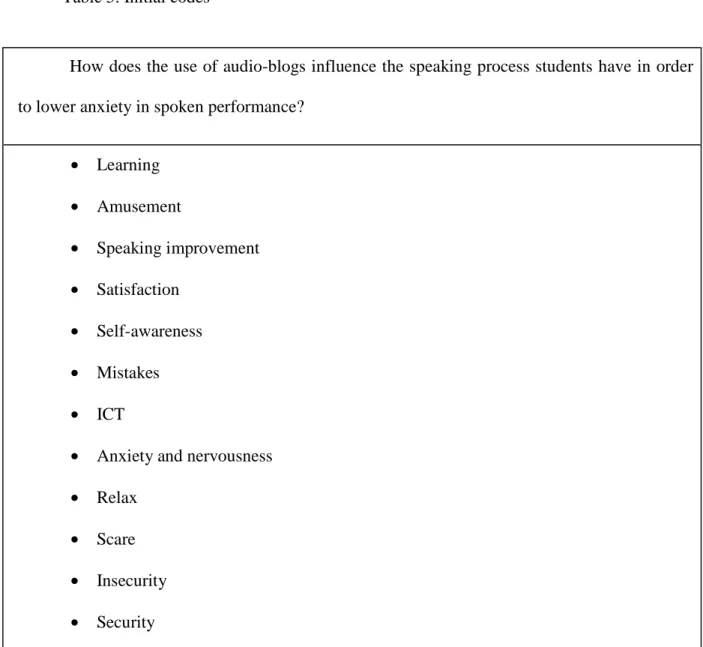
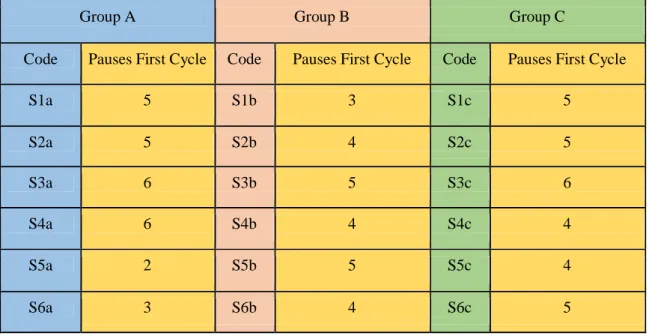
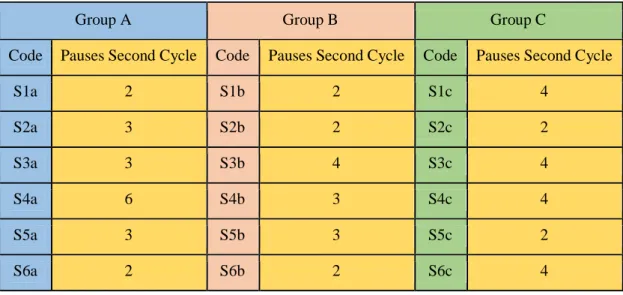
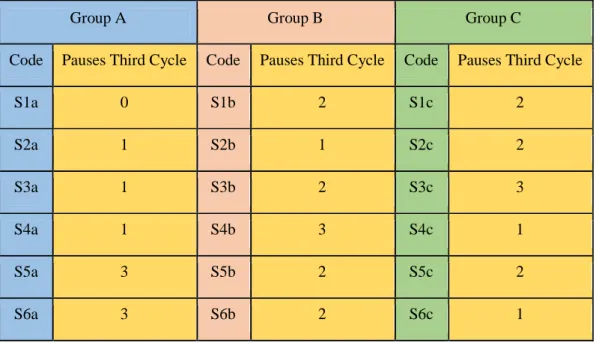
(10) AUDIOBLOGS TO LOWER ANXIETY IN ORAL FLUENCY 5.4. vii. Conclusion ............................................................................................................ 62. Chapter 6: Conclusions and Pedagogical Implications ................................................................. 63 6.1. Introduction ........................................................................................................... 63. 6.2. Comparison of results with previous studies’ results ........................................... 63. 6.3. Significance of the results ..................................................................................... 66. 6.4. Limitations of the present study............................................................................ 67. 6.5. Further research .................................................................................................... 68. 6.6. Conclusion ............................................................................................................ 69. References ..................................................................................................................................... 71. Table of Figures Figure 1. Preliminary categories and subcategories after the axial code procedure ......... 47 Figure 2. Final categories and subcategories after the selective code procedure.............. 62. Table of Tables Table 1. Students’ codes ................................................................................................... 29 Table 2. First cycle implementation .................................................................................. 40 Table 3. Second cycle implementation ............................................................................ 41 Table 4. Third cycle implementation ................................................................................ 42 Table 5. Initial codes ......................................................................................................... 46 Table 6. Split pauses in the first cycle............................................................................... 53 Table 7. Split pauses in the second cycle .......................................................................... 54 Table 8. Split pauses in the third cycle ............................................................................. 55.
(11) AUDIOBLOGS TO LOWER ANXIETY IN ORAL FLUENCY. 1. Chapter 1: Introduction 1.1. Introduction to the study Learning a foreigh language evolves cognitive and metacognitive skills and affective. aspects. Foreign language learners face challenges and drawbacks which may hinder their learning process and affect their motivation to use the target language (Dörnyei, 2003). Regarding this, one of the most significant barriers learners face in performing effectively relies on the level of anxiety many of them experience while being exposed to communicating in a language other than their native one (Gregersen, 2005). Based on this and on the multiple studies which analyze how anxiety affects students’ language learning process and performance, the researchers decided to pay special attention to the high levels of anxiety learners from three different educational settings experience. Horwitz (2001) claims anxiety leads students to failure and decrease their performance level in the classroom. Thus, when learners feel anxious in the foreign language classroom they avoid using target language and fail to reach learning goals which ultimately hinders their oral development (Oxford, 2002). With these circumstances in mind, and acknowledging the social and educational responsibility while offering learners the best conditions to learn a new language, the researchers in the present study identified the patterns surrounding anxiety and determined it was vital to figure out a strategy aimed at reducing anxiety in language-learning environments with the purpose of encouraging learners to use the target language and both, actively and comfortably participate in academic and social communicative events.. Considering it is often asserted that speaking in a new and unfamiliar language is an intimidating experience for foreign language learners (Pleuger, 2001); it is vital to support students’ language learning process with meaningful strategies not only for decreasing anxiety.
(12) AUDIOBLOGS TO LOWER ANXIETY IN ORAL FLUENCY. 2. level but also for promoting the development and strengthening of speaking skills (Horwitz, 2008). This perspective suggests that language teachers look for effective ways to help learners lower anxiety by encouraging them to recognize their frustrations in language-learning situations and create interesting and reasonable language expectations. On account of this and the constant and bigger educational challenges of societal and technological changes; it is imperative that the use of technology within academic environments especially in the foreign language process, allows to help develop language skills effectively by enabling students to tap outside experts, visualize and analize data, link to real world contexts, and take advantage of opportunities for feedback, reflection and analysis (Bransford et al, 1999). Additionally, the use of such tools become into as Raya and Fernandez (2002) conclude “the practical means whereby learners can take a more active part in decisions involved in learning” (Raya & Fernández, 2002) which for the purpose of the present study is optimal due to students possibly gaining more confidence about their learning and this reliance can be reflected in their active participation in classroom communication. Bearing that in mind, it is fundamental to examine how technological artifacts, specifically audioblogs may change learners’ expectations as regards the foreign language learning and the speaking experience by turning it into a more pleasurable and engaging one. Using audioblogs students would have the opportunity to communicate meaning and foster oral skills through voice recordings where they could assess themselves and their peers (Race, 2001) and reflect on their strengths and weaknesses as well as facilitating the possible strategies in overcoming their language difficulties..
(13) AUDIOBLOGS TO LOWER ANXIETY IN ORAL FLUENCY 1.2. 3. Rationale of the study This research project aims at demonstrating the possible impact of audioblogs lowering. anxiety in oral fluency in oral fluency within a group of teens, teenagers and younger adults in three different Colombian environments. Researchers have observed factors which have a debilitating effect on learners’ oral fluency which include some striking features such as: a continual lack of confidence from the learners when speaking in the foreign language, little motivation towards the learning of English and the anxiety which may discourage learners to use target language in potential communicative situations (Aida, 1994; Horwitz et al., 1986; MacIntyre & Gardner,1991; Phillips, 1992) such as oral presentations, role plays, oral interviews and rehearsals in front of the teacher and their peers. Concerning the relationship between anxiety and oral fluency in the target language, especially in the populations explored, anxiety may be a significant obstacle with reference to the development of fluency, required factor to the authentic accomplishment of the learners’ speaking performance, which in Lennon (1990)’s words is defined as the physical representation of the mental process that occurs when speech planning and production are taking place. This definition is related to the learners’ speaking performance of the current research study since it considers pauses, the temporal variable used to measure fluency (Riggenbach,1991) and helps to illustrate the anxiety level in all the participants; an important factor to bear in mind as it suggests that fluent speech is that which presents fewer pauses and faster speech (Lennon, 2000; De Jong et al., 2015). Added to that, the outcomes of the needs analysis of the present research study suggest that the major stressors identified by students when performing orally have to do with performing tasks in front of their peers and English teacher and students feeling afraid of making.
(14) AUDIOBLOGS TO LOWER ANXIETY IN ORAL FLUENCY. 4. mistakes and being mocked by classmates (Appendix B). Therefore, this is why it is imperative for language teachers to constantly seek new optimal alternatives to not only guarantee the learning of the target language but for the case of the present study, to lower anxiety while performing orally, it is also necessary to consider the inclusion of technological resources which can definitely foster the students’ oral language ability and turn it into a more meaningful and personal rewarding spoken experience in both, in and outside the classroom.. After the research on a variety of technological tools to overcome anxiety, it was found that audioblogs were the best choice taking into account their potential as a tool with which learners have the opportunity of providing and receiving feedback from peers favors both the students’ speaking skills and the anxiety management. As stated by Alastuey, (2011) Audioblogs should be included in the English lessons because of different reasons: firstly, the use of audioblogs generate an impact on their communicative competence. Shamsudin and Nesi (2006) realized that learners who carried out computer mediated communication tasks saw significant improvements in their oral communication skills, which indicated better spoken performance. Secondly, audioblogs might help students to overcome negative affective factors such as anxiety and nervousness when using the target language and to develop awareness in the learning process, since learners can provide and receive feedback from peers and tutor. 1.2.1 Needs analysis and problem statement The present research project was conducted in three different groups; with students from Ofelia Uribe de Acosta School and Luis Angel Arango in Bogotá and Trade and Services Center from SENA in Villavicencio. The first group with a total of six students, five girls and one boy whose age ranged from 11 to 15 years old. As regards their language exposure towards learning, they attend two sessions of English per week, each one lasting 110 minutes following the.
(15) AUDIOBLOGS TO LOWER ANXIETY IN ORAL FLUENCY. 5. policies established by the Common European Framework of Reference for Languages (CEFR) and ranked in level A1. According to statistics from Plan Foundation, about 75 percent of Colombian students of public schools have been involved in bullying (Pais, 2014), either as a bully or as a victim of teenage bullying. Consequently, most of the participants of this group avoided speaking in English because they felt afraid of being teased by their classmates when they made any pronunciation errors or lacked fluency. The second group included six learners, four girls and two boys whose average age was 16 from grades ten to eleven. They attend a weekly ten-hour course and their English level is A1, according to the CEFR. In spite of creating appropriate social, emotional and physical conditions such as the use of IT equipment, the class layout, social relationships for learners to use the target language in communicative activities, they refused to speak as they affirmed feeling embarrassed about making mistakes. This is a typical response and is evidence of anxiety which leads to the interruption of fluency. This study was also carried out at SENA-Trade and Services Center in VillavicencioMeta. It was focused on a group of Industrial Mechanic students. In this class there were six students, four boys and two girls whose ages ranged from 17 to 35 years old. They had one fourhour sessions per week. According to the Common European Framework of Reference for Languages (CEFR), the learners’ language level corresponds to A1. According to the results of the need analysis, most students felt nervous and insecure when they had to speak in English and the general concensus among them is that English lessons were limited to learning grammar and vocabulary which is reflected in their fluency abilities..
(16) AUDIOBLOGS TO LOWER ANXIETY IN ORAL FLUENCY. 6. Bearing in mind the different characteristics of the three groups, this project aims to determine the influence of audio-blogs regarding learners’ anxiety levels. For this purpose, two mediums were used as supporting evidence for the student’s needs: a survey and a focus group, instruments which collected relevant information in order to identify and establish the different variables involved in the oral performance which can affect the speaking process. The end result of the methods carried out proved that students from the three groups displayed anxiety in the classroom (Horwitz, 2001 ) when they were expected to participate in speaking activities. Most of the learners stated that they avoided participating in oral activities with a willingness to accept lower grades rather than experiencing speaking anxiety in front of their peers. These findings (Appendix B) support the claim that anxiety may negatively affect the spoken performance of the students when they start the process for learning a foreign language, affecting their learning process not only in the short term but also in the long term. 1.2.2 Justification of problem’s significance Bearing in mind the importance of the spoken performance in the participants’ academic, professional and personal lives, it is vital for language teachers to consider affective factors (Scovel, 1978) that hinder the learners’ progress and level of proficiency in his or her target language such as anxiety, which is an important area of research because of its substantial negative impact on performance (Humpries, 2011). The data collected in the needs analysis revealed that the population for this study was disadvantaged in their oral performance since the participants attributed their passive oral participation during speaking activities to the fear of speaking in public. In fact, the students preferred to get lower grades as it was mentioned before. These findings are the evidence of how.
(17) AUDIOBLOGS TO LOWER ANXIETY IN ORAL FLUENCY. 7. anxiety in the classroom may affect the quality of an individual’s communication or willingness to communicate( Young, 1999), leading it to failure and school desertion. 1.2.3 Strategy selected to address problem Considering the fact that nowadays in the Colombian context people send more audio messages than text messages because it is easy, personal and fun and that most of the students these days are comfortable speaking and listening in their mother language for extended periods of time (e.g. by phone) the researchers found it appropriate to leverage this habit through audio blogs.This tool might be a friendly and affordable technology that contributes to the social construction of knowledge and meaning making (Vygotsky,1978) since with audio blogs learners can create audio projects through voice recordings, share them with fellow students, self-assess and also assess their peers (Race, 2001) in the EFL classroom. Additionally students can also monitor their own learning progress and take up the responsibility and ownership of learning by reviewing their speeches and reflecting on their strengths and weaknesses in terms of speaking competencies and the possible strategies to overcome their learning difficulties. Students can also use the commenting function and voice recorder features to interact with other students. Thus, the speaking experience might turn into a more rewarding and meaningful one both in and outside the classroom, which for the purpose of the present study favors both the students’ speaking skills and the anxiety and nervousness when using the target language. 1.3. Research question(s) and objective(s) In relation to the information provided above, this study’s research question was what is. the possible influence of implementing audio-blogs in order to lower anxiety in oral fluency?; the corresponding general objective was to analyze the possible benefits that the use of audioblogs in EFL class have in the decreasing of anxiety and oral fluency improvement..
(18) AUDIOBLOGS TO LOWER ANXIETY IN ORAL FLUENCY 1.4. 8. Conclusion As mentioned, anxiety may affect the development of oral skills because of fear and. nervousness students experience in certain oral and communicative situations, in particular in the learning of a foreign language; McCroskey (1977) asserts that learners feel anxious or afraid when they have to communicate or interact in real situations; to this phenomenon Horwitz and Cope (1986) also claim that when learners communicate in a foreign language they experience apprehension of communication. In this respect negative feelings discourage communication. Oxford (2002) claims, positive anxiety helps learners to overcome difficulties when learning a foreign language while negative anxiety discourages them to continue the process successfully. Due to this reason, one the main aims of this project accounts is to examine the analysis of the process to lower anxiety in foreign language learners while performing orally.. Also, this study gives an account of the analysis of two other remarkable issues. The first one is the use of technological means, in this case, audioblogs to lower anxiety and foster speaking skills, and second, related to the relationship pauses and speech disfluency have on the increase and decrease of anxiety in speaking performance. Furthermore, other research studies are reviewed in this project which go beyond the aspects mentioned here and their purpose is to gain more insight into the relationship between anxiety and communicative competence and the way in which technological tools may affect it ..
(19) AUDIOBLOGS TO LOWER ANXIETY IN ORAL FLUENCY. 9. Chapter 2: Theoretical Framework & State of the Art 2.1. Introduction In order to identify the main patterns of anxiety in learners’ spoken production, it was. relevant to emphasize the main constructs which support the validity and relevance of the present study namely: Computer-Assisted Language Learning: CALL, specifically audio blogs and speaking skill, especially fluency. These key terms will be analyzed from the point of view of various authors and researchers, in order to discover how they are related and complement each other. The aim is to understand the impact of anxiety in the students’ spoken performance and also to gauge the level of improvement in fluency and anxiety using audioblogs. 2.2. Theoretical framework 2.2.1 Anxiety. Learning a foreign language is a complex process which involves not only cognitive skills but also affective factors such as nervousness, anxiety, self steem and motivation that might influence in a positive or negative way the students’ learning process. Multiple researchers in language teaching have shown that there is a negative relationship between foreign language anxiety and the efficient use of language (e.g. MacIntyre & Gardner, 1991; Phillips, 1992; Aida, 1994; Gardner, 2005). Hence, the negative impact of such relationship became a support in the conduction of this research study because it evidences the influence of anxiety on learners’ speaking skills. Some teachers and practitioners might think language is merely linguistic, cognitive or communicative. However, in some cases language learners have to deal with some affective issues while learning a foreign language; it is a huge responsibility for teachers and institutions.
(20) AUDIOBLOGS TO LOWER ANXIETY IN ORAL FLUENCY. 10. to guarantee the best environment for students to overcome such emotional drawbacks. On this matter, Krashen (1989) posits the affective filter can become an obstacle for learning a second language by the influence of certain negative emotional responses (anxiety, self-doubt and boredom) in a specific environment. He also claims these emotions are similar to a filter that can increase or reduce the rapport between the speaker and the listener, thus, the input is not processed correctly, understanding input as the useful language produced by the speaker to be understood by the listener. Bearing this in mind, affective factors, such as anxiety, play an important role in learning, especially in communicative settings since it can fragmentarily prevent or promote the communication among speakers. For instance, when learners feel anxious, they tend to avoid using the target language because it might increase the affective filter. As concerns the bearing of affective factors when learning a foreign language, Brown (2007) also analyzes a set of human behavior features similar to anxiety that may impede learning a second language, such as illustration, self-esteem, inhibition, risk-taking, introversion, extroversion, among others. These attitudes and emotions are developed according to the received stimuli in the educational setting, Tsiplakides and Keramida (2009) claim it is necessary to use language in a non-threatening context which creates a friendly classroom atmosphere, considering that language errors are natural in the process of language acquisition (Dornyei, 2001). Due to this fact, when learning a second language, students can experience some of those emotions and increase stress while developing classroom activities (Hewitt & Stefenson, 2011). Language anxiety has been defined as the fear of apprehension that learners experience when they have to perform in a second language (MacIntyre, 2007). For the case of our.
(21) AUDIOBLOGS TO LOWER ANXIETY IN ORAL FLUENCY. 11. population, one of the most marked obstacles is when students are performing orally. This type of anxiety may not be considered as general anxiety, because it appears in language learning scenarios and foreign language communication as speaking activities, tests and written exercises (MacIntyre & Gardner, 1991). The level of anxiety depends on the context the learner is immersed in and can be experienced informally and formally, the former, when interacting with others in real contexts and the latter, in the classroom (Horwitz & Cope, 1986). In this scenario, Young (1990) claims that learners face one of the biggest challenges when speaking in the target language since it becomes the most-anxiety producing experience publicly; to illustrate, learners sometimes may not have done enough knowledge of the target language or they might be naturally afraid of making mistakes or feeling embarrassed. In the same line of thought, Oxford (2002) analyses anxiety from two perspectives by claiming rising anxiety depends on one’s personality, that is why certain individuals tend to be more anxious in normal situations, while other individuals only experience a state of anxiety in front of specific situations. Furthermore, Oxford (2002) also identified other types of anxiety which are named as harmful and helpful anxiety, well known as debilitative and facilitative (Alpert & Haber, 1960; Scovel, 1978). In this perspective, the author defines helpful or facilitative anxiety as positive in the second language learning process since students take advantage of difficulties to succeed in the natural use of the target language, for example, when they participate actively in speaking activities to get a good grade and to be more competent among their classmates. On the other side, harmful and debilitative anxiety might impede students learning a language because they seem to inevitably refuse to use the target language to communicate ideas or thoughts..
(22) AUDIOBLOGS TO LOWER ANXIETY IN ORAL FLUENCY. 12. Having said that, it might be concluded that anxiety is an affective variable that debilitates the achievement of students’ goals and speaking performance in language learning contexts. In light of that, anxiety needs to be uncovered and fed through effective and meaningful educational practices in and outside the classroom, such as the use of audioblogs, which may help students to encourage self-confidence and promote the development and strengthening of speaking skills through genuine interactions. 2.2.2 CALL: Computer-Assisted Language Learning Computer-Assisted Language Learning is defined by Egbert (2005) as the process of learning a language with and around computer technologies (p. 4). Correspondingly, Richards and Schmidt (2002) also define CALL as “the use of a computer in the teaching or learning of a second or foreign language.” In this research project, the researchers decided to take into account the variables described by Egbert (2005) having in mind the main components of CALL he described: the learners’ thoughts, behaviors, motivations, experiences and understanding; the status and structure of the language; the context, bearing in mind the physical and temporal environment and the social, economic, cultural and linguistic influences; the technological tools, the participants’ use, such as personal digital tools: cell phones, laptops, digital cameras, software or other devices; the tasks that will be developed and the peers and teachers, taking into account the impact use of ICTs might have in the learning process (Egbert, 2005 ) Considering socio-cultural perspectives of CALL, Warschauer (2005) states that “the incorporation of tools or mediational means does not simply facilitate action that could have occurred without them, but rather, by being included in the process of behavior, alters the entire flow and structure of mental functions” (p. 42). Incidentally, for the present study, technology, in.
(23) AUDIOBLOGS TO LOWER ANXIETY IN ORAL FLUENCY. 13. particular the use of audioblogs, is seen as a tool that mediates and transforms human activity, as regards, oral performance, which and contributes to create meaningful knowledge and respond to the speaking skills objectives of the target population (Warshauer, 2005). Regarding the aspects mentioned above, CALL is a relevant construct for this research, not only because it empowers students in their learning process but also because it allows to mediate and transform the student’s knowledge. This becomes a potential feature to respond to the emerging trends that the new education suggests: learn, unlearn and relearn (Toffler, 1973). This means, learners are in a constant process of change and adaptation by updating their previous knowledge to their current necessities, modifying their outdated ideas and concepts and creating new ways to know the world. Considering this, CALL may help language learners not only reduce anxiety in oral practice, but also to encourage fluency in speaking, motivation and collaborative work among them by providing a new learning environment which takes into consideration the real learners’ cognitive needs. In those contexts learners may feel more confident when participating in oral activities, since they do not feel afraid of making mistakes and do not find their classmate’s reponse as a potential threat, so that they can take advantage of active and crucial self and peer assessment processes. 2.2.2.1. Audioblogs. According to Huann and Thong (2006) audioblogging is an extension of blogs, which is defined by Nam Kin (2007) as the social network software that enhances intercultural communication, giving the learners the possibility of communicating with other languages speakers. Similarly, Hyland (2009) states that: “blogs have emerged as distinctive kind of texts with a characteristic way to commenting, arguing, interacting and making sense” (p. 225).
(24) AUDIOBLOGS TO LOWER ANXIETY IN ORAL FLUENCY. 14. providing users with facilities to organize thoughts before interacting with others. That is to say, in blogging the users can express themselves by choosing from different texts, images, records and even the human voice. Consequently, in audioblogs, the users substitute the text by voice narration records, which allow the students to express their feelings and thoughts to peers and other audiobloggers (Nam Kin, 2007). The most important features audioblogs have in education are: allowing students to create and post their work, responding to e-learning scenarios, affording online interaction through blogs, sharing information worldwide, fostering engagement in a collaborative learning and the enhancing of higher order thinking skills (Huann & Thong, 2006). From a sociocultural perspective, blogs work as a symbolic artifact by which students can mediate the knowledge and regulate it (Lantolf & Thorne, 2007 p. 202). Students’ thoughts are materialized in form of speech, text, graphics or video, and in that way students can build knowledge and make meaningful verbal products when they interact with the multiple media located at this social level, in this case the blogs. Another point for in the use of blogs has to do with the fact that they provide students with the chance of giving feedback on their peers’ products, allowing them to scaffold their peers’ performance and freely but responsibly offer their point of views and opinions following assessment procedures (Huann & Thong, 2006). To conduct this study, the researchers expect students to have positive results on two areas, firstly, by lowering anxiety through the mediation of blogs, as well as improving their performance with a voice recorder and scaffolding their peers, providing learners with a befitting environment to speak English more confidently. Alternatively, to Nam Kim (2007) blogging interactivity helps to enhance motivation because the expectancy among bloggers is to receive feedback or comments from other bloggers, which will help students to improve their spoken performance. Additionally, learners get a higher level of learning satisfaction because they will not feel the.
(25) AUDIOBLOGS TO LOWER ANXIETY IN ORAL FLUENCY. 15. negative peer pressure through verbal bullying which will encourage them to participate freely and becoming become self-motivated by blogging, and therefore, more skillful in oral performance. 2.2.3 Speaking skill Speaking develops naturally in the mother tongue because people grow up being exposed to a large variety of language input. This exposure helps people acquire knowledge from the context because the characteristics of the speakers they grow up listening and speaking to, as well as the different topics and situations they learn to master over the years. When learning a foreign language, what is supposed to be easy in the mother tongue as it deals with speaking, often becomes a difficult task in the target language because of the level of complexity due to fact that it is a different rule system which the brain takes time to assimilate. Furthermore, language participants’ learning process has been, for decades, focused on grammar lessons – teaching grammar rules and relegating to a second place speaking and listening skillswhich affect the process by impeding their use the target language. This fact ineluctably halts communication because learners have not properly received comprehensible input (Krashen, 1989) which increases the affective filter and second language becomes much harder to acquire. Speaking is a productive skill that requires the learners to be able to use the language in a successful way, making a difference between the specific knowledge of the language and the skill in using it (Bygate, 1997). When students are learning a foreign language, they tend to emphasize the specific knowledge rather than the skill because they do not have the real need of using it. For that reason, it is vital for this research project to give the students tools for starting to practice this skill in a comfortable and meaningful way. For such a reason, in the study, three.
(26) AUDIOBLOGS TO LOWER ANXIETY IN ORAL FLUENCY. 16. basic functions of speaking are contemplated: talk as interaction, talk as transaction and talk as performance (Richards, 2006). To this respect, this research project emphasizes the skill in use in communicative skills as transaction, having in mind the main focus of the planned speaking activities is giving and receiving information. For research purposes, accuracy is not a priority since learners at this level are focused on the successfulness of the message; thus, the phenomenon to be analyzed relies on the improvement of fluency in the participants rather than the accuracy of the message. The speaking process in the foreign language classroom requires that students are not just dealing with vocabulary, accent and intonation or grammar but acquiring spoken fluency by understanding the contents. Gradually, learners must be able to organize ideas, codify, listen and comprehend reading (Krashen, 1989), as this is the process students go through to get meaningful input and be able to produce output. These are important facts which act as evidence that it is fundamental for teachers to develop activities in which students use different features of language in real contexts. Comprenhensible Input constitutes relevant data to this research project considering researchers suggest audio blogs, as a digital medium, can guide students to monitor their speech, since learners can record their utterances, self- correct and give peer feedback. Also, audio blogs are supposed to be a good strategy for helping students to control their harmful anxiety when speaking, and move from harmful anxiety to helpful or facilitative anxiety, which leads students to compete and scaffold their process assertively (Brown, 2007)..
(27) AUDIOBLOGS TO LOWER ANXIETY IN ORAL FLUENCY 2.2.3.1. 17. Fluency. A review of the literature on foreign language has paid special attention to fluency since it is not easy to be defined because of the amount of characteristics it covers. bearing in mind it is related to the learner’s communicative competence (Pawley & Syder, 1983; Olynak, Anglejan, & Sankoff, 1990). Fluency is one concerning feature of language for teachers and linguists since it is not only related to the speed learners can speak at, the content of message or the accuracy of language; it also includes other aspects as Lennon (1990) defines fluency as the highest point on a scale that measures spoken performance of a foreign language and it refers to overall oral proficiency covering the distribution and duration of pauses, types of pauses, amount of syllables per minute, hesitation and accuracy of language, as well. From one perspective, Skehan (1996) does not focus on the speed learners take to deliver messages, but he claims it is the ability learners have to use language in real time with little pausing or hesitation, on the other side, Pawley and Syder (2000) define fluency as the ability learners have to use lexis, syntax and larger discourse structures avoiding pauses, hesitations and violation of clauses boundaries to communicate –full stops and other punctuation marks- in complex and familiar situations. For this research project, Lennon (1990) definition is fully considered to account for delimiting the concept of fluency, as its objectives undergo the learners’ English level and the amount of pauses they make when speaking. The evidence on fluency implications in the learners’ spoken performance deals with the precepts discussed by Thornbury (2005) who states fluency might involve both accuracy and fluency. Accuracy-oriented tasks are dedicated to focus on linguistic forms which intake refers to the constant correction of errors and, as in fluency-oriented tasks, the content of what the speaker says is thought to be important. That is to say when considering fluency, learners must strike a.
(28) AUDIOBLOGS TO LOWER ANXIETY IN ORAL FLUENCY. 18. balance between the numbers of words they join in a chunk of language and the accurate use of language to convey meaning. Brown (2004) claims a fluent person is the one who can use language structures accurately paying attention to content rather than form in a normal speed in communicative situations. Nevertheless, Carroll (1980) states that fluency might be measured in all the levels of performance; for example, in an advanced level the student speaks at normal speed and responds promptly, with little hesitation and not too slowly which indicates a satisfactory performance; also, at intermediate level, it is commonly observed that there are some breaks in comprehension and the speech is less than native tempo; in addition, at basic level, the speaker is expected to have a slow enunciation which is focused on the message rather than the speed of the language and, for that reason the speech is uneven. As the research topic is aimed at lowering anxiety, the phenomenon to be measured is the possible improvement of the participants’ speech by focusing on the fluency they had at the beginning of the pedagogical implementation and the possible impact it may have through all the subsequent different planned stages. To this point, only the fact of evaluation constitutes a challenge since to assess fluency is not an easy task; probably, it is why Cohen (1994) claims it is impossible to reduce it to speed or ease of speech terms. Because of this, other researchers have suggested it is possible to measure some features of fluency with the purpose of identifying disfluency phenomenon such as repetition and false starts. For instance, Lennon (1990) proposes the speed of delivery, and hesitation markers. Bearing in mind that the present study seeks to lower anxiety in spoken performance analyzing the number of pauses when learners record their speech by means of audio blogs, it may be unquestionably a worthwhile strategy..
(29) AUDIOBLOGS TO LOWER ANXIETY IN ORAL FLUENCY 2.2.3.2. 19. Pauses. Learners’ communicative competence in fluency may be affected by factors such as pauses. In deed, pauses are understood as periods of silence of two seconds or more which first and foremost, represent external expressions of speakers in cognitive planning and processing (Butterworth, 1980; Pawley & Syder, 2000), and significantly, can be used by learners in a conscious way as communication strategies. Specifically, Ellis (1990) suggests there must be a balance between fluency and accuracy that might be observed in the number of pauses the speaker takes. For instance, learners who are more concerned about fluency might make many mistakes, but simultaneously, decrease the amount of pauses; while speakers who pay more attention to accuracy might increase the number of pauses because of the excessive control they focus on the channel of communication. All things considered, there are five features of fluency regarding pauses; first there are fluent pause groups, which are known as grammatically intact pause groups, when speakers use them sentence meaning is not diminished because they occur at phrasal; secondly, clause boundaries at the end of the sentences; third split pause groups which violate phrase or clause boundaries are generally in the middle of these. Fourth, false start pause groups evidence the speaker’s concerns of using language accurately and having contact with the interlocutor (Olynack et al., 1990, p. 141) because they include self-repairs involving two or more utterances; similarly, happens with fillers which are one or two words without semantic meaning and finally we find rate of speech. This is a more complex process since speakers are more aware of the number of words expressed in a minute (Thornbury 2005; Gorsuch, 2011). For this project, the researchers want to focus on split pauses, which are the ones affecting participants’ speech, because they are related to increasing anxiety (Gorsuch, 2011).
(30) AUDIOBLOGS TO LOWER ANXIETY IN ORAL FLUENCY 2.3. 20. State of the art In spite of the existence of many research studies seeking to lower anxiety by means of. numerous artifacts such as radio shows, podcastings, blogs and recorded journals and different projects aiming to enhance speaking skills through the use of audio blogs or voice recorders (Hsu, Wang & Comac, 2008; Cañas, 2012; Castrillon, 2010; Fandiño, 2010; Huann & Thong, 2010; Ashton-Hay & Brookes, 2011; Hasan & Hoon, 2013; Ibrahim & Mat Daud , 2013; Önem and Ergenç, 2013; McNeil, 2014; Siyli & Kafes, 2015), little or no particular work has focused its attention or research procedures on reflecting upon the impact which audio blogs may have in lowering anxiety in speaking performance as this research study does, specifically the improvement of fluency which has not been considered in the existing research. The negative relationship between anxiety and language learning and the impact it has on spoken performance has been analyzed by multiple authors, Önem and Ergenç (2013) developed a research study to determine the impact of a testing teaching model in anxiety and success for English language teaching. The model of teaching for anxiety and success aimed to reduce anxiety levels, and increase students’ learning success and enjoyment. The emphasis on grammar classes to determine students’ scores and the lack of analysis in the before, during and after teaching phases indicated some limitations of the cited study. With regard to the use of audioblogs and audiorecordings tools to lower anxiety and foster communication skills in foreign language, many research studies have been conducted (Hsu, Wang & Comac, 2008; Huann & Thong, 2010; Ashton-Hay & Brookes, 2011; Hasan & Hoon, 2013; Ibrahim & Mat Daud , 2013; McNeil, 2014; Siyli & Kafes, 2015). The results of these studies revealed that the voice recording tools to manage oral assignments, interact with.
(31) AUDIOBLOGS TO LOWER ANXIETY IN ORAL FLUENCY. 21. learners and evaluate performance outcomes through the submission and archiving of oral tasks, helped learners to assess their oral performance efficiently and effectively by giving and receiving feedback from peers and teachers; additionally the participants overcame negative affective factors such as anxiety, lack of motivation and low self-esteem and enhance oral skills, mainly speaking and listening (Hsu, Wang & Comac, 2008; Huann & Thong, 2010; McNeil, 2014; Siyli & Kafes, 2015). Other researchers have analyzed the contribution of podcasting in the enhancement of target language skills by analyzing the learners’ linguistic outcomes pronunciation-, fluency and listening comprehension- and the learners’ perceptions towards podcasts-opinions, motivations, attitudes and learning styles (Ashton-Hay & Brookes, 2011; Hasan & Hoon, 2013). The results of these studies showed podcasts facilitate language learning and assist them in developing their language skills. Another useful study is the research project carried out by Ducate and Lomicka (2009) who sought to improve pronunciation in the second language and valued the effect on learners’ attitudes toward pronunciation by means of podcasts. In this study researchers completed a survey to monitor students’ perceptions, before during and after, on the improvement of pronunciation and their attitudes towards the project. The results of this study showed the podcast project was perceived positively by students, since they appreciated the feedback given after each recording; they also fostered creativity through extemporaneous podcasts. Similarly, Appel and Borges (2012) developed a project to promote second language oral tasks with audio blogs; it showed positive results regarding the use of audioblogs, for instance, students could improve their communication skills and they felt more comfortable, even though when they were expected to record a video of their tasks they tended to feel anxious and uncomfortable; the researchers of this study project concluded there were some limitations since teachers needed to.
(32) AUDIOBLOGS TO LOWER ANXIETY IN ORAL FLUENCY. 22. be trained to decide the appropriate technological tools and implement strategies to give meaningful feedback. Considering the fact learners felt anxious during the recordings because of the fear to be negatively evaluated and the self-perceived speaking ability (Kitano, 2001), it was relevant to clarify they were not being assessed and raise their learning awareness to identify their language strengths. Multiple studies have focused on the anxiety present in Colombian’s English classrooms and learning environments; some of them identified the anxiety factors that affect foreign language students’ oral participation (Cañas, 2012; Castrillon, 2010; Fandiño, 2010) and others were focused on the effects of anxiety in oral communication and learning (Ariza, 2012; Lafont, 2009; Zapata, 2007) as general avoidance, physical actions and physical symptoms presented at the moment of speaking. The use of ICT tools as Skype and podcasting were considered in order to lower anxiety (Aristizabal, 2009; Romaña, 2015) and improve speaking and fluency. In spite of not using the same technological tool, the action research study proposed by Lemos (2010) intended to foster eighth graders’ speaking confidence through the creation of an online radio show. Its starting points were: speaking confidence, the use of radio in schools and cooperative learning strategies; this research project has a strong connection with the project proposed in this study because it uses a technological tool (radio shows) for mediating the students’ language acquisition and lowering anxiety when developing speaking skills. The results of this study showed that students were capable of raising learning awareness by creating a healthy environment and overcoming anxiety. With the purpose of identifying anxiety patterns, the researcher used students’ logs, teacher’s journal, a video recording and an oral interview; these instruments enrich the data collection since the researcher analyzed the participants’ perceptions and reflections about their possible advances, improvements and failures, as well as.
(33) AUDIOBLOGS TO LOWER ANXIETY IN ORAL FLUENCY. 23. their emotions when using target language . Similarly, Orozco (2013) enhanced language skillsnew vocabulary and pronunciation-, increased awareness in learning and raised self-confidence in forth and fifth graders by means of communicative activities; this research study feeds the present study with enough insights to figure out the accurate way to overcome negative affective factors and improve learners’ speaking skill. 2.4. Conclusion The theories mentioned above and the previous research studies regarding the definitions. have shown that anxiety might have an impact on the learners’ speaking performance. That is why the use of audioblogs as a technological tool may not only decrease anxiety levels but also enhance speaking skills. In addition, in fluency there are some signs to identify language accuracy and cognitive difficulties; for this research project split pauses were chosen in order to measure the level of improvement using audioblogs for improving anxiety in oral fluency. The descriptions of the definitions evidence the need to develop a research study in which anxiety as an affective factor might enhance or impede the development of speaking skills with the support of audioblogs..
(34) AUDIOBLOGS TO LOWER ANXIETY IN ORAL FLUENCY. 24. Chapter 3: Research Design 3.1. Introduction This chapter explains the design of this research project, which focuses on the use of an. easy and affordable tool such as audio-blogs to lower anxiety in students’ oral fluency. The type of research is laid out, as is the teacher’s role, the context, the constraints and the impediments. 3.2. Type of study This research project is mainly qualitative in nature but with a mixed method design. described by Creswell (2007) as the procedure for collecting, analyzing, interpreting, integrating and reporting qualitative and quantitative data. This result is appropriate to gain an understanding of the positive or negative effects anxiety has on students’ spoken performance, and how audioblogging could help them to lower negative anxiety. Bearing in mind the main inquiry of the research project, the type of research that better fits the purpose of the study is action research. According to Burns (2010) “action research involves taking a self-reflective, critical, and systematic approach to explore real contexts”. Likewise, taking into account the result of the needs analysis (Appendix B) which was carried out in the first semester of this research project, the most consistent type of research to support it was collaborative action research, which Butt et al. (1992) illustrates a group of stakeholders cooperating together, to study a particular phenomena, and finally suggest actions which improve practice. With great regard to this research project, the researchers are expected to develop collaborative action research through a systematic process including four important stages: planning, acting, observing and reflecting (Kemmis & McTaggart, 1988) which could help connect theory and practice in order to transform educational practices..
(35) AUDIOBLOGS TO LOWER ANXIETY IN ORAL FLUENCY 3.3. 25. Context Three different educational settings were chosen to carry out this project. IED Ofelia. Uribe de Acosta and IED Luis Ángel Arango in Bogotá, Colombia and SENA (Servicio Nacional de Aprendizaje) in Villavicencio, META, Colombia. The first setting is a public school located in Usme, at El Bosque neighborhood. The school currently has 5000 students per shift. In its afternoon shift there are six groups of pre-school students with about 30 students per group and fifteen groups of primary school students (forty in each grade) and fourteen in high school. In regards to foreign language teaching, the school offers an hour of English classes weekly in elementary and three hours weekly in high school level. Considering that there is not a single teaching methodology the school demands, EFL teachers may design their own materials to meet the students’ needs. As this is a mega-school, English classes are sometimes interrupted by the diverse activities the Education Authority proposes. At high school level, the majority of the students are aged 12 to 17 and most of them belong to the socio-economic strata 0 and 1 and they are also affected by issues related to substance abuse, domestic violence, malnutrition and abandonment problems, which are linked to a low academic achievement performance (Ferrel Ortega, Velez Mendoza, & Ferrel Ballestas (2014). The second setting where this research study was conducted was IED Luis Angel Arango in the Fontibon area of La Cabaña neighborhood; this is a public school that has two shifts, both for elementary and high school level. Regarding English classes, the school offers two hours in elementary and four in secondary level. This educational institution offers a ten hours weekly extracurricular English course called Media Fortalecida for tenth and eleventh greaders. The purpose of this project is to provide students with the chance to study university programs; this.
(36) AUDIOBLOGS TO LOWER ANXIETY IN ORAL FLUENCY. 26. program is commonly supported by a university, which is in charge of developing the syllabi and choosing the textbooks. Bearing in mind the location of the school, the majority of the students belong to social strata 1 and 2. Finally, this research project was implemented with Industrial Mechanics apprentices at SENA- Industry and Services Center from Villavicencio-Meta, a national government vocational training institution. SENA’s main objective is to provide holistic professional training, not only academically but by means of a hands-on approach based on the development of production projects through competences and outcomes. In the same way, SENA promotes bilingualism through face-to-face and virtual courses to pertinently connect the educational supply with national and international labor needs; the group chosen for this study received four hour sessions a week. 3.3.1 Participants Considering the different contexts the researchers worked in, it was necessary to select three groups bearing in mind the participants English level, correspondingly A1, in spite of the difference of age among them. This study was developed with 20 seventh grade students at Ofelia Uribe de Acosta Public School, aged between 11 and 15. According to the Common European framework of Reference (CEFR), the students were placed in A1 level. They received 110 minutes of English classes per week, and they were motivated to learn English. The affective needs of the participants included gaining confidence when performing oral activities since students felt afraid of participating orally because of the serious bullying problem in the class when somebody made a mistake in speaking performance. ..
(37) AUDIOBLOGS TO LOWER ANXIETY IN ORAL FLUENCY. 27. These students were not orally competent in speaking English, which made them opt to rather be more engaged in listening and reading activities. For such verbal tasks, learners prefer first to write in their notebook what they are supposed to say, and next, read it. There is the common belief and experience that learners face too many difficulties concerning selfconfidence and respect when somebody speaks, even in Spanish. Nevertheless, positively some of them use basic commands and simple utterances in the classroom, as well as communicating needs or making requests. In these cases, they scaffold their classmates’ process, as students constantly work in pairs or small groups they support their classmates who face language learning difficulties. According to Brown (2007), students’ predominant learning styles are visual and auditory. Our own students prefer observing charts and images, watching videos and listening to short dialogues rather than doing kinesthetic activities. From the second group, 20 students from Luis Angel Arango school are also participants in this research study. Their average age is 15 and they are studying tenth and eleventh grade. According to the CEFR students are A1 level. These students attend a ten hour English course per week. This particular group of learners need to increase motivation and self-confidence in order for them to use target language to communicate their ideas and thoughts, since many of them refuse to communicate in the target language because they feel embarrassed or discouraged; additionally, it is imperative to consider most of them are teenagers who, as Young (1990) states, are in the stage of shaping their personalities, and as a consequence when they make mistakes, they easily feel embarrassed and anxious. As this group of students receives constant input in the language classroom, they have already developed certain skills to infer vocabulary and some grammar structures, but they lack.
(38) AUDIOBLOGS TO LOWER ANXIETY IN ORAL FLUENCY. 28. speaking strategies since they are not able to hold a conversation, eventhough they express utterances to give their points of view, they do not use linking words and connectors in order to make their speech clearer. They also show constant L1 interference and transfer into target language (Krashen, 1989). This research project is also based on a third group of Industrial Mechanics, apprentices at SENA- Industry and Services center from Villavicencio-Meta, a national government vocational training institution. In this class, there are 17 students, 15 boys and two girls whose ages range from 17 to 35 years old. They had four hour sessions a week. According to the Common European Framework of Reference (CEFR), the learners’ language level corresponded to A1. Considering that students may feel uncomfortable using the target language in speaking performance, it is necessary to create opportunities in order for students to receive comprehensible input (Krashen, 1989) develop high self-confidence and motivation and therefore produce and communicate meaningfully, in a supportive classroom free of constraints. For the purpose of providing better opportunities to develop students’ spoken performance, first, learners need to acquire language in context to communicate aspects of their daily life. What is more, they need to do exercises so that they can infer language rules, improve accuracy and appropriacy and develop analytical thinking, as well as experiential and contextual ability (Sternberg, 1985). Additionally, students need to develop strategies to be autonomous, thus, they might learn by discovering or creating rather than remembering. Finally, they can also benefit from imitating and solving problems which involve the material (Richards & Rodgers, 1986), in this case audioblogs might help them to be more creative and find strategies to overcome language difficulties..
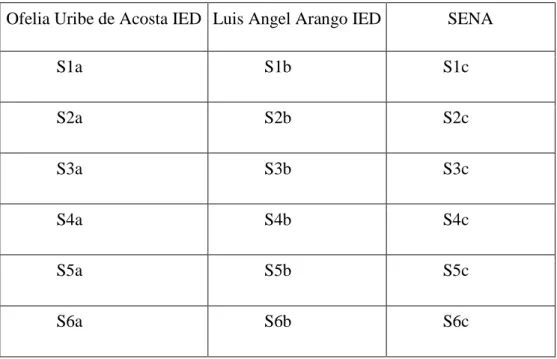
(39) AUDIOBLOGS TO LOWER ANXIETY IN ORAL FLUENCY. 29. The researchers selected six students from each group as the sample population for their research, following Patton (1990) model on purposeful random sampling. This strategy consists on taking small samples randomly to provide rich data to support the credibility of the study since participants are not chosen based on specific characteristics, but at random. For this research study, the participants were coded from S1a to S6c, this with the purpose of guaranteeing the students’ confidentiality and applying the ethical considerations. Table 1. Students’ codes. Ofelia Uribe de Acosta IED Luis Angel Arango IED. SENA. S1a. S1b. S1c. S2a. S2b. S2c. S3a. S3b. S3c. S4a. S4b. S4c. S5a. S5b. S5c. S6a. S6b. S6c. 3.3.2 Researcher’s role Taking into consideration the role of the teacher in qualitative Action Research, it is fundamental to fulfill the roles of researcher and reflective teachers. Kemmis and McTaggart (1988) stated that the teacher has to be involved in four basic steps in Action research: planning, action, observation and reflection. During these steps, teachers become planners, implementers, observers and reflective teachers, which allow a continuous qualitative action research process..
(40) AUDIOBLOGS TO LOWER ANXIETY IN ORAL FLUENCY. 30. Consequently, it is a continuous process that could be overlapped by the different steps; the researcher-teacher could be an implementer and observer at the same time, as well as one who reflects and plans. It means all the roles are reciprocal and connected. 3.3.3 Ethical considerations Taking into account that the chosen populations for working in this research project are minors, it was necessary to ask for their parents’ or tutors’ consent in order to implement the pedagogical intervention. For that reason, all the parents have been informed about the main objectives of the research project, as well as the importance the results would have on the students’ English performance and the educational community. Importantly, anonymity in the results of the studies has been guaranteed, having no influence on the student's’ partial or final grades. 3.4. Data collection instruments The data collection instruments were designed to analyze the possible impact and. effectiveness of audioblogs to lower anxiety in students’spoken performance (Appendix C) 3.4.1 Descriptions and justifications 3.4.1.1. Survey (See Appendix C). This instrument is defined as “a method of getting information on certain selected topics from a number of people” (Wallace, 1998, p.260). During the data collection process the survey (Appendix C) is applied at the beginning and at the end of the pedagogical intervention, in order to record the changes about the students’ perceptions related to the objectives of this research project..
Figure
+7

Documento similar
Nevertheless, it is worth to mention, that in the case of thirteen countries (Australia, Austria, Canada, Denmark, Hungary, Iceland, Ireland, Japan, Norway, Portugal,
Busuu; (2) fieldwork, to observe learners’ learning experience in the two online communi- ties selected for the study; (3) online survey, submitted to learners to find out about their
This is an expected result in squamous cell carcinomas of the oral cavity, reflecting the importance of these habits as risk factors in oral cancer
This study presents the findings of a year-long e-mail exchange between learners of English at Nebrija University in Madrid and learners of Spanish at Trinity College Dublin during
a) Initial session. The purpose of this initial session is to explain the guidelines for the proper functioning of the program and to connect teachers and centers. In this session,
This chapter delineates the main concept that the empirical study seeks to explore: the construction of one's identity, its components, processes and changes in order to shed light on
The objective of the experiments presented in this subsection is to analyze how the behavior of vote-boosting ensembles composed of simple or regular- ized learners, such as
In this paper we propose a research framework to explore the possibilities that state-of-the-art embodied conversational agents (ECAs) technology can offer to overcome
