
TítuloEfficacy of a computerized cognitive training application for older adults with and without memory impairments
9
0
0
Texto completo
(2) The fact that healthy older adults benefit from direct training programs that focus on specific cognitive domains has been documented [12, 13]. The relative efficacy of cognitive rehabilitative interventions among older adults with AAMI and MCI has been also demonstrated [14]. Recent evidence also suggests that cognitive training intervention can improve the cognitive and functional abilities of Alzheimer’s disease (AD) patients and that it may reduce the rate of progression to AD [10]. However, a recent intervention review [15] indicated that not all the performance gains could be specifically attributable to cognitive training. In this regard, practice effect, socialization, natural spontaneous recovery, or improved mood have also been claimed to be relevant factors in the cognitive improvement. With the huge advance of information and communication technologies (ICT) in the past years, a great number of heterogeneous computerized approaches have been developed for elderly population and patients with cognitive decline. In the same line, several studies have found significant cognitive improvements in healthy older adults [16], AAMI patients [17], MCI patients [18], and AD patients [19]. However, it remains an open question whether the results achieved with cognitive training programs based on new software technologies can be transferred to real-life situations and to untrained tasks [19, 20]. As a result of this great technological advance, several specialized software and commercial devices have been placed into the market (e.g., Gradior [21]; Smartbrain, http://www.educamigos.com; THINKable, IBM; CogniFit® Personal Coach, CPC, 2008; RehaCom; Telecognitio® ), but few have been scientifically tested and validated [22–25]. The objective of the present paper was to assess the efficacy and near transfer of one of these programs, Telecognitio® , in a large sample of older adults with and without memory impairments. To this end, we used the Global Deterioration Scale (GDS) [26] as a measure to assess cognitive impairment and to classify participants as not presenting significant memory impairments (GDS-1), AAMI (GDS-2), and MCI (GDS-3) patients. This methodology will allow us to determine what participants are most likely to benefit from the cognitive intervention. Based on previous literature, we hypothesize that the demanding nature of the computerized cognitive training would drive neuronal plasticity and performance improvements in elderly participants across the cognitive domains trained. Methods Subjects One hundred and forty-three older independent-living adults were recruited from local community centers in A Coruña area (Spain) on a voluntary basis. They were chosen according to the following inclusion criteria: ≥55 years of age, ability to use a home personal computer, GDS [26] scores between 1 and 3 points (pre-dementia stages), and written informed consent. Exclusion criteria included illiterate subjects, evidence of current active neurological, affective or psychiatric disease as depression, severe psycho-behavioral disorders, severe visual or hearing deficit, and dementia diagnosis. Finally, subjects presenting musculoskeletal disorders incompatible with the mouse computer device handling, or those participating in other cognitive intervention programs were also excluded from the study. As explained above in the results section, only one hundred and one participants completed the cognitive training program and they were classified, based on the GDS scores, as GDS-1 (subjects without significant memory impairments), GDS-2 (AAMI subjects), and GDS-3 (MCI patients). There were no statistically significant differences among these three GDS subgroups in mean age (F(2,98) = 2.620, p = 0.078; GDS-1 = 69.06 ± 5.18 years; GDS-2 = 68.33 ± 6.01 years; GDS-3 = 73.00 ± 5.50 years), education level (F(2,98) = 0.536, p = 0.587), and gender distribution (F(2,98) = 2.217, p = 0.114) at baseline. The study protocol was approved by the Ethics Committee at the University of A Coruña and conformed to the principles embodied in the Declaration of Helsinki. Procedure Description of the cognitive training intervention Participants were trained with Telecognitio®, a multimedia and interactive cognitive program developed by a team of cognitive psychologists, gerontologists and engineers at the University of A Coruña (Spain) based on their extensive experience in the field of the cognitive stimulation. The decision to use this specific program was made based on its differential characteristics with regard to other.
(3) computerized systems since it involves all main higher cognitive functions, its interface and software have been specifically designed for older users with or without memory deficits based on physical and neurocognitive characteristics of normal and pathological aging and according to actual accessibility legislation, and its adaptability to Spanish geriatric population has been recently demonstrated [23]. Specifically, Telecognitio® supplies cognitive activities or exercises focused on eight major cognitive areas according to the Cambridge Cognitive Examination CAMCOG-R (Cambridge mental Disorders of the Elderly Examination; CAMDEX Battery) [27]: memory, attention, language, calculation, abstract reasoning, perception, orientation, and praxis. Each cognitive domain is stimulated by a specific group of exercises. Memory training focused on immediate and long-term visual and spatial memory exercises. An example is the exercise named ‘‘Shape’’. In this activity, the user must look for a few seconds at a geometric image in the screen. After a short time period, the screen will show several images and the user must select the previously showed geometric image. Attention training involved visual and auditory sustained, selective, and divided attention activities. The activity ‘‘Differences’’ is an example of this kind of training. Two images (A and B) are shown to the user who must find and mark the differences between them. Language training included lexis and syntax-related activities and comprehension and denomination exercises. For instance ‘‘Complete Sentences’’, an activity where the user must select, among several options, the word that better fits to complete a sentence. Calculation activities trained basic numerical operations and problem-solving. This ability is trained with exercises such as ‘‘Greatest’’: the user must look at several digits of different sizes and select the number with the higher value. Abstract reasoning activities trained the ability to understand complex concepts and assimilate new information beyond previous experience (abstraction and categorization), including items that required recognizing similarities between words. ‘‘Abstraction’’ is the task designed to train this ability. In this activity the user must explain what a group of words has in common. Perception activities trained the ability to perceive visual, auditive, and spatial information more efficiently and quickly. For example, in an activity named ‘‘Silhouette’’ an image is shown and the user must select the silhouette that corresponds to the previous picture. Orientation was stimulated by both temporal and spatial orientation exercises. The exercise ‘‘Part House’’ was designed for this purpose: a picture of a part of a house is shown with several options to choose the correct answer. And finally, praxis training included both ideomotor and constructive praxis. ‘‘Puzzle’’ is the activity that the user must perform. In this case, several pieces of a puzzle are shown to the subject who must order the pieces to complete the final figure. The cognitive training was delivered in individual sessions at the community center itself. During the first session, a therapist provided individualized instruction and pretraining as need in the use of the equipment and training program. During the rest of the sessions, the therapist controlled the adequate fulfillment of the sessions and was available for participants who needed help. The assistive system facilitated cognitive training remotely through the Internet and the information of the cognitive sessions was included in a server placed at the University of A Coruña, acting as a control center. The program included 72 total sessions (three sessions of 20 min every week) and lasted 24 weeks (from January 2010 to June 2010). The duration of cognitive intervention that has been verified in the literature was 12–24 weeks [12], with more recent results showing that programs including more than 60 training sessions and lasting more than 12 weeks did not show any advantage over shorter programs, at least in MCI patients [14]. A significant aspect of the design is that intervention to older people with and without memory impairments was provided, making possible to assess the magnitude of the intervention effect both in healthy and in AAMI and MCI older adults. The 7-Minute Screen as outcome measure of cognitive training efficacy In order to explore the effects of the cognitive intervention and to objectively assess the efficacy of Telecognitio®, participants were administered the 7-Minute Screen (7MS), a standardized and validated for the elderly population cognitive status test, at pre- and immediate post-intervention stages. The 7MS is a brief neurocognitive screening instrument [28] that surveys multiple cognitive areas and that can reliably distinguish between AD or other types of dementia and cognitive deficits associated with normal aging [29, 30]. It was selected for its ease of administration and because the focus of the cognitive training program targeted cognitive domains evaluated in the screening instrument. In previous studies, correlation analysis indicated high concurrent validity between the 7MS and existing standard cognitive screening tests widely used in both clinical practice and research, as the MMSE [29]. Additionally, the 7MS improves potential limitations of MMSE, whose scores are affected by demographic characteristics, as age and years of education [31]. We specifically administered a standardized and validated Spanish version of the 7MS [32], consisting of a battery of four brief individual subtests (Temporal Orientation, Enhanced Cued Recall, Clock Drawing, and Verbal Fluency), each focusing on a different cognitive area typically compromised in AD: orientation, memory, visuo-spatial ability, and expressive language..
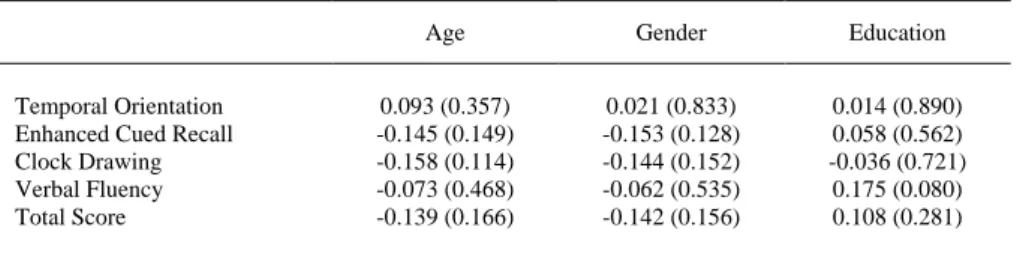
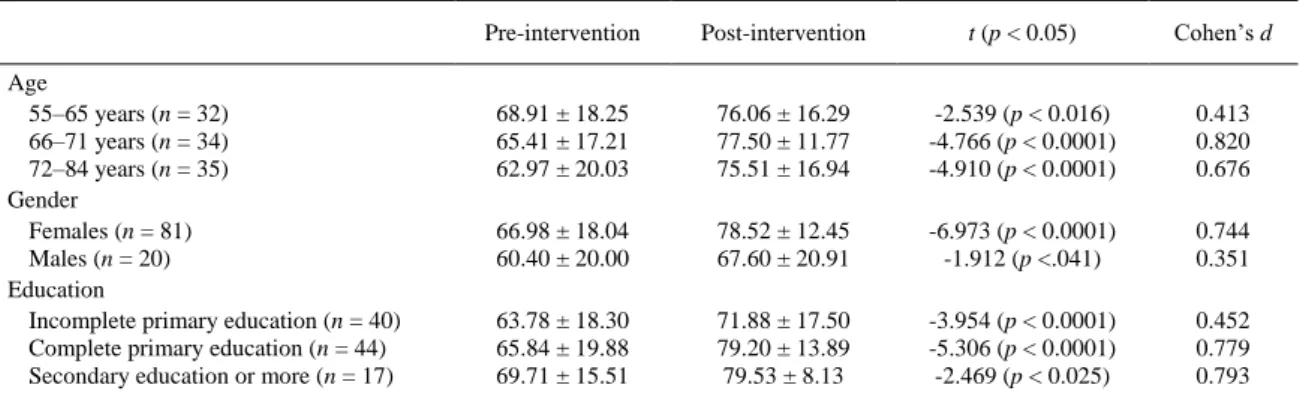
(4) Statistical analysis Pearson correlations were computed to examine the contributions of socio-demographic factors (age, gender and education) to 7MS total score and subscores. The total score of the 7MS was computed as the sum of the z scores of the four subtests [33]. The efficacy measure for cognitive function was the change from baseline to post-intervention assessment on the 7MS. The pre- and postintervention direct scores were compared among GDS subgroups using a paired t test. Statistical significance was set at p<0.05. The power of the sample size was calculated using the standardized population effect size (Cohen’s d) [34]. The standard interpretation offered by Cohen about the power is: small (d = 0.2), moderate (d = 0.5), and large (d = 0.8). All statistical analyses were performed with the PASW Statistics 18 statistical package and results were expressed as mean ± standard deviation (SD). Results Recruitment 143 subjects met the inclusion/exclusion criteria as described in the ‘‘Methods’’. For a variety of reasons, only one hundred and one (70.63 %, mean age: 68.97 ± 5.81 years, range 54–82, 81 females) participants completed the full cognitive training program. Since participants’ adherence to training protocols is a relevant point, we compared completing and not-completing the program subjects and we found that the participants who did not complete the cognitive training were significantly older than the participants who completed the program (73.02 ± 5.53 vs 68.97 ± 5.81 years, p<0.0001). However, they were not significantly different in gender distribution or education level (p = 0.255, p = 0.167, respectively). In our opinion, since we employed a computer-based cognitive training program, the fact that the participants who dropped-out were older may be explained, at least in part, in terms of agetechnology interaction. Based on the GDS, 31 subjects (30.7 %) were classified as GDS-1 (subjects without significant memory impairments), 61 (60.4 %) were classified as GDS-2 (AAMI subjects), and 9 (8.9 %) were classified as GDS-3 (MCI subjects; all met Petersen criteria for amnestic MCI type). Regarding the level of education, 40 subjects (39.6 %) had incomplete primary education, 44 subjects (43.6 %) had complete primary education, and 17 subjects (16.8 %) had secondary education or more. Correlation between socio-demographic characteristics and 7MS scores The correlation analysis between socio-demographic factors (age, gender and education) and the total score and subscores of the 7MS at baseline are presented in Table 1. Results showed that age, gender, and education were not significantly associated either with the total score or with the subscores of the 7MS.. Table 1 Correlations between socio-demographic factors (age, gender and education) and 7MS scores. Temporal Orientation Enhanced Cued Recall Clock Drawing Verbal Fluency Total Score. Age. Gender. Education. 0.093 (0.357) -0.145 (0.149) -0.158 (0.114) -0.073 (0.468) -0.139 (0.166). 0.021 (0.833) -0.153 (0.128) -0.144 (0.152) -0.062 (0.535) -0.142 (0.156). 0.014 (0.890) 0.058 (0.562) -0.036 (0.721) 0.175 (0.080) 0.108 (0.281). The correlation value (Pearson) and bilateral significance (in brackets) are given. 7MS scores pre- and post-intervention 7MS total scores at pre- and post-intervention stages are presented in Table 2 as a function of sociodemographic factors (gender, age and education). As can be seen in the table, both males and females obtained significant higher total scores at the end of the intervention, although taking into account the Cohen’s effect size, the practical significance was moderate to high in the case of females (d = 0.744), and low in the case of males (d = 0.351). Regarding age, and to evaluate possible differences due to age range, we divided the whole sample into three age subgroups (55–65 years, n = 32; 66–71 years, n = 34;.
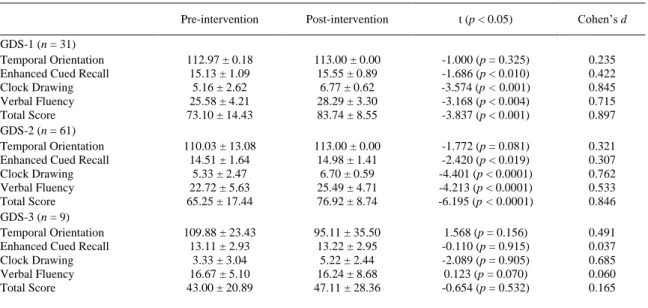
(5) 72–84 years, n = 35). Results indicated that all subjects in the three age groups showed significant total score improvements at post-intervention, although the group with low age average had a low practical significance (d = 0.413). The other two groups showed practical significance, this effect being most pronounced in the medium subgroup (66–71 years, d = 0.820). Finally, regarding education level, all subjects showed significant higher total scores at post-intervention stage, this effect being the most pronounced for participants with complete primary education. Cohen’s value (d = 0.779) suggested a moderate to high practical significance.. Table 2 Pre- and post-intervention 7MS total score as a function of socio-demographic factors. Age 55–65 years (n = 32) 66–71 years (n = 34) 72–84 years (n = 35) Gender Females (n = 81) Males (n = 20) Education Incomplete primary education (n = 40) Complete primary education (n = 44) Secondary education or more (n = 17). Pre-intervention. Post-intervention. t (p < 0.05). Cohen’s d. 68.91 ± 18.25 65.41 ± 17.21 62.97 ± 20.03. 76.06 ± 16.29 77.50 ± 11.77 75.51 ± 16.94. -2.539 (p < 0.016) -4.766 (p < 0.0001) -4.910 (p < 0.0001). 0.413 0.820 0.676. 66.98 ± 18.04 60.40 ± 20.00. 78.52 ± 12.45 67.60 ± 20.91. -6.973 (p < 0.0001) -1.912 (p <.041). 0.744 0.351. 63.78 ± 18.30 65.84 ± 19.88 69.71 ± 15.51. 71.88 ± 17.50 79.20 ± 13.89 79.53 ± 8.13. -3.954 (p < 0.0001) -5.306 (p < 0.0001) -2.469 (p < 0.025). 0.452 0.779 0.793. The differences between pre- and post-intervention performance on the 7MS for the whole sample (n = 101) are shown in Table 3. Mean scores and standard deviations on all the four subtests and on the total score of the 7MS are given. As the table shows, the individual subtests and the total mean scores were higher at the end of 6 months of cognitive training. As shown in the table, the differences between mean scores at pre- and post-intervention were statistically significant for the total 7MS test with a moderate practical significance (d = 0.633). In the case of the Enhanced Cued Recall and Verbal Fluency subtests, although the results seemed to show significant differences (p < 0.011; p < 0.0001) the practical significance according to Cohen’s value was low (d = 0.260; d = 0.433). Nevertheless, pre and post measurements for Clock Drawing were of statistically (p < 0.0001) and moderate to high practical (d = 0.757) significance. For the Temporal Orientation subtest the scores were also higher at the postintervention stage but this difference was not statistically significant. The low value obtained for the Cohen’s index (d = 0.045) also supports the lack of practical significance.. Table 3 Comparisons between pre- and post-intervention performance on the 7MS for the whole sample (n = 101). Temporal Orientation Enhanced Cued Recall Clock Drawing Verbal Fluency Total Score. Pre-intervention. Post-intervention. t (p < 0.05). 110.88 ± 12.19 14.57 ± 1.72 5.10 ± 2.60 23.06 ± 5.67 65.67 ± 18.53. 111.41 ± 11.27 15.00 ± 1.58 6.59 ± 0.99 25.53 ± 5.72 76.36 ± 15.04. -0.386 (p = 0.700) -2.591 (p\0.011) -6.087 (p < 0.0001) -4.388 (p < 0.0001) -7.011 (p < 0.0001). Cohen’s d 0.045 0.260 0.757 0.433 0.633. Table 4 summarizes pre- and post-intervention scores on the 7MS for these three GDS groups. Mean scores and standard deviations for each GDS group on all the four subtests and on the total score of the 7MS are given. As shown in the table, statistical analyses revealed that GDS-1 (n = 31) and GDS-2 (n = 61) subgroups obtained a significant improvement in Enhanced Cued Recall, Clock Drawing, Verbal Fluency, and Total Scores at the time of post-intervention assessment compared with the baseline assessment. Nevertheless, the practical significance for Enhanced Cued Recall was low in both groups (d = 0.422; d = 0.307). These groups also obtained higher scores in Temporal Orientation but this was not statistically.
(6) significant. However, GDS-3 group (n = 9) did not show statistical differences between pre- and postintervention scores (see Fig. 1).. Table 4 Comparisons between pre- and post-intervention performance on the 7MS for the three GDS groups. GDS-1 (n = 31) Temporal Orientation Enhanced Cued Recall Clock Drawing Verbal Fluency Total Score GDS-2 (n = 61) Temporal Orientation Enhanced Cued Recall Clock Drawing Verbal Fluency Total Score GDS-3 (n = 9) Temporal Orientation Enhanced Cued Recall Clock Drawing Verbal Fluency Total Score. Pre-intervention. Post-intervention. t (p < 0.05). Cohen’s d. 112.97 ± 0.18 15.13 ± 1.09 5.16 ± 2.62 25.58 ± 4.21 73.10 ± 14.43. 113.00 ± 0.00 15.55 ± 0.89 6.77 ± 0.62 28.29 ± 3.30 83.74 ± 8.55. -1.000 (p = 0.325) -1.686 (p < 0.010) -3.574 (p < 0.001) -3.168 (p < 0.004) -3.837 (p < 0.001). 0.235 0.422 0.845 0.715 0.897. 110.03 ± 13.08 14.51 ± 1.64 5.33 ± 2.47 22.72 ± 5.63 65.25 ± 17.44. 113.00 ± 0.00 14.98 ± 1.41 6.70 ± 0.59 25.49 ± 4.71 76.92 ± 8.74. -1.772 (p = 0.081) -2.420 (p < 0.019) -4.401 (p < 0.0001) -4.213 (p < 0.0001) -6.195 (p < 0.0001). 0.321 0.307 0.762 0.533 0.846. 109.88 ± 23.43 13.11 ± 2.93 3.33 ± 3.04 16.67 ± 5.10 43.00 ± 20.89. 95.11 ± 35.50 13.22 ± 2.95 5.22 ± 2.44 16.24 ± 8.68 47.11 ± 28.36. 1.568 (p = 0.156) -0.110 (p = 0.915) -2.089 (p = 0.905) 0.123 (p = 0.070) -0.654 (p = 0.532). 0.491 0.037 0.685 0.060 0.165. Fig. 1 7MS scores at baseline (preintervention) and immediately after 24 weeks of cognitive training (postintervention) with Telecognitio® across the three GDS subgroups of participants in Temporal Orientation, Enhanced Cued Recall, Verbal Fluency and Clock Drawing subtests. Bars represent standard deviations. * p < 0.05. Discussion In the present study, we first evaluated the possible correlation between the socio-demographic factors (age, gender and education) and the 7MS total score and subscores at baseline. According to previous studies [29], correlation results revealed that the 7MS was not affected by sociodemographic characteristics. Results also showed that both males and females obtained significantly higher total scores at the end of the intervention program, although in the case of males the statistical power was lower. Nevertheless, these results suggest the efficacy of the training program regardless of gender. Regarding age, results showed that all users in the three age subgroups showed significant cognitive improvements at postintervention, this effect being less pronounced in the younger subgroup (55–65 years). This finding suggests that the accessibility and the ability to learn how to use Telecognitio® application are ageindependent. Since the probability of developing a neurodegenerative disease increases with aging, the efficacy of Telecognitio® at this late age range also suggests that this computerized cognitive program.
(7) might act as a preventive factor for the development of dementia and memory impairments. Finally, regarding education level, all subjects showed significant higher total scores at post-intervention stage, being this effect less pronounced for subjects who had incomplete primary studies. Thus, results suggested that regardless of age, gender, and education, total scores significantly increased across the cognitive domains evaluated following 6 months of cognitive training. These findings provide evidence about the therapeutic efficacy of the cognitive program, Telecognitio®, and confirm results of previous studies demonstrating the beneficial effects of non-pharmacological computer-based training on the cognitive status of older adults [16–18, 35, 36]. Regarding the Enhanced Cued Recall subtest of the 7MS, all participants obtained higher scores after the intervention program, indicating that the recognition and recall memory abilities improved after using the Telecognitio® application. In fact, results showed that subjects were able to recall a greater number of items after the intervention program both spontaneously and through semantic key, revealing an objective improvement in short term episodic memory. A significant improvement in episodic memory function has been previously reported in persons with normal cognitive aging and in persons with MCI receiving a traditional cognitive intervention focused on teaching episodic memory strategies [37]. In the same line, a modest increase in memory performance has also been observed after a training with other computerized system, THINKable, in senile patients [22]. Semantic verbal fluency function refers to the ability to generate words within specific semantic categories and within a fixed time interval, and it is reduced in MCI patients compared with cognitively intact older adults [38]. Fluency tasks involve executive control to some degree. In the present study, participants significantly improved their scores on the Verbal Fluency subtest of the 7MS after the intervention program. In fact, subjects were able to list a greater number of animals at the end of the training, indicating that the speed of information processing (speed of name retrieval from memory) became faster. This improvement might be explained by the fact that Telecognitio® includes a set of different language activities such as lexis- and syntax-related tasks. These activities aim to improve and maintain the language function and also to stimulate the mental agility and speed. This finding suggests that Telecognitio® application significantly improves the verbal fluency and reduces the slowing of mental processing in elderly adults. The Clock Drawing was the subtest that showed higher improvement after the intervention program. We can, therefore, conclude that Telecognitio® is especially effective for training visuo-perceptual, visuospatial, and basic executive functions. It is important to note that a correct performing of this test requires verbal understanding, memory, and spatially coded knowledge in addition to constructive skills. Furthermore, the program includes specific activities related to perceptual skills and constructive praxis in which the user has to complete puzzletype activities, and figure composition. Results revealed that Temporal Orientation seems less responsive to cognitive training by Telecognitio® than the other cognitive functions included in the 7MS. This subtest assesses the patient’s knowledge of year, month, day of month, day of week and time of day, and it is possible that this cognitive process is less plastic than others, thus requiring more intensive or extensive training, or that it is more difficult to train by the activities and exercises included in the program due to a possible lack of congruence between the training used and the cognitive outcome measure. Critically, users without important memory deficits and those with AAMI showed a significant improvement in global cognitive status and in specific cognitive areas as episodic memory, visuo-spatial and verbal fluency abilities at post-intervention. These subgroups also obtained higher scores in temporal orientation although this was not statistically significant. These findings suggest the efficacy of the Telecognitio® program and its capacity to moderately improve the cognitive status of healthy older and AAMI participants after just 6 months of training, consistent with the results of many previous studies indicating that objective measures of cognitive status are significantly improved after cognitive interventions (by both traditional and computer-based programs) in individuals without current diagnosable memory impairments [12, 13, 16, 17]. AAMI is a non pathological extreme of normal brain aging with less severe cognitive impairment than MCI and, therefore, is a feasible target for early intervention against a more severe condition. Mental exercise by cognitive training is an important aspect of prevention [39]. Therefore, the improvement observed in AAMI suggests that Telecognitio® might contribute, at least in part, to retard the MCI development. While these participants’ performance significantly improved over the training period, one can argue that this improvement could be best accounted the effects of either spontaneous/natural recovery or repeated practice. The former explanation appears to be unlikely since elderly people are not likely to have spontaneous improvement. Regarding demonstrating the effect of practice on training programs we should be cautious given the absence of a control or comparison condition in the present study. In this regard, unfortunately, an adequate control group not receiving any cognitive intervention was not.
(8) available in the context of community centers because in this type of centers users regularly participate in other cognitive activities (mainly memory-related) that could affect the results. In contrast, in the MCI subgroup, no significant improvements were observed at the end of the intervention with Telecognitio®, the pre-post intervention comparison being not significant on any of the 7MS subscores. This finding suggests that the intervention program produces different effects according to patient group, with most pronounced effects in older users without significant memory deficits and in those with AAMI. We could argue that the lesser degree of gain following intervention in the MCI group may be partially explained by the presence of a pathological process characterized by neuronal death. However, our finding is in contrast to previous studies reporting significant improvements in different cognitive domains (mainly in memory) in MCI patients after traditional cognitive interventions [14] and after computerized cognitive programs [18, 35, 36, 40]. Nevertheless, our negative finding needs to be interpreted carefully given that the small sample size and the heterogeneity in MCI condition reduce the statistical power and may be suspected for the non significant results. Further research is needed involving larger MCI samples to ensure external validity of results. It should also be convenient in future studies to introduce non-cognitive outcome variables, like wellbeing, quality of life or everyday functioning, as complementary measures of the efficacy of Telecognitio® program, and compare it with other commercial cognitive training programs. Finally, in order to evaluate the persistence or durability of the effect of cognitive intervention and to determine whether it lasts beyond the immediate postintervention period or is continual cognitive training required, longitudinal follow-up studies of cognitive training efficacy would be required in the future. Conclusions To summarize, our results, although not conclusive due the lack of a concurrent control group, support the clinical value of computer-based cognitive interventions, such as Telecognitio® program, to moderately improve the global cognitive status of older adults with normal aging and those with AAMI. Although our results showed no improvement in MCI group, taking into account the low sample size and the contrary data from the bibliography, more research is needed to further explore the beneficial effects of this kind of computerized programs in this population. Acknowledgments We sincerely thank the staff of local community centers in A Coruña for providing us access to their elderly users, and the participants in the cognitive training program. Conflict of interest None.. References 1. Millán-Calenti JC, Tubío J, Pita-Fernández S, González-Abraldes I, Lorenzo T, Maseda A (2009) Prevalence of cognitive impairment: effects of level of education, age, sex and associated factors. Dement Geriatr Cogn Disord 28(5):455–460 2. Hedden T, Gabrieli JD (2004) Insights into the ageing mind: a view from cognitive neuroscience. Nat Rev Neurosci 5(2):87–96 3. Crook T, Bartus RT, Ferris SH, Whitehouse P, Cohen GD, Gershon S (1986) Age associated memory impairment: proposed diagnostic criteria and measures of clinical change—report of a National Institute. Dev Neuropsychol 2:261–276 4. Petersen RC, Smith GE, Waring SC, Ivnik RJ, Tangalos EG, Kokmen E (1999) Mild cognitive impairment: clinical characterization and outcome. Arch Neurol 56(3):303–308 5. Mitchell AJ, Shiri-Feshki M (2009) Rate of progression of mild cognitive impairment to dementia—meta-analysis of 41 robust inception cohort studies. Acta Psychiatr Scand 119(4):252–265 6. La Rue A (2010) Healthy brain aging: role of cognitive reserve, cognitive stimulation, and cognitive exercises. Clin Geriatr Med 26(1):99–111 7. Wilson RS, Scherr PA, Schneider JA, Tang Y, Bennett DA (2007) Relation of cognitive activity to risk of developing Alzheimer disease. Neurology 69(20):1911–1920 8. Greenwood PM, Parasuraman R (2010) Neuronal and cognitive plasticity: a neurocognitive framework for ameliorating cognitive aging. Front Aging Neurosci 2:150 9. Engvig A, Fjell AM, Westlye LT, Moberget T, Sundseth Ø, Larsen VA et al (2010) Effects of memory training on cortical thickness in the elderly. Neuroimage 52(4):1667–1676 10. Sitzer DI, Twamley EW, Jeste DV (2006) Cognitive training in Alzheimer’s disease: a meta-analysis of the literature. Acta Psychiatr Scand 114(2):75–90 11. Papp KV, Walsh SJ, Snyder PJ (2009) Immediate and delayed effects of cognitive interventions in healthy elderly: a review of current literature and future directions. Alzheimers Dement 5(1):50–60 12. Ball K, Berch DB, Helmers KF, Jobe JB, Leveck MD, Marsiske M et al (2002) Effects of cognitive training interventions with older adults: a randomized controlled trial. JAMA 288(18):2271–2281 13. Willis SL, Tennstedt SL, Marsiske M, Ball K, Elias J, Koepke KM et al (2006) Long-term effects of cognitive training on everyday functional outcomes in older adults. JAMA 296(23): 2805–2814 14. Jean L, Bergeron ME, Thivierge S, Simard M (2010) Cognitive intervention programs for individuals with mild cognitive impairment: systematic review of the literature. Am J Geriatr Psychiatry 18(4):281–296.
(9) 15. Martin M, Clare L, Altgassen AM, Cameron MH, Zehnder F. Cognition-based interventions for healthy older people and people with mild cognitive impairment. Cochrane Database Syst Rev 2011;(1):CD006220 16. Smith GE, Housen P, Yaffe K, Ruff R, Kennison RF, Mahncke HW et al (2009) A cognitive training program based on principles of brain plasticity: results from the Improvement in Memory with Plasticity-based Adaptive Cognitive Training (IMPACT) study. J Am Geriatr Soc 57(4):594–603 17. Günther VK, Schäfer P, Holzner BJ, Kemmler GW (2003) Long term improvements in cognitive performance through computer assisted cognitive training: a pilot study in a residential home for older people. Aging Ment Health 7(3):200–206 18. Talassi E, Guerreschi M, Feriani M, Fedi V, Bianchetti A, Trabucchi M (2007) Effectiveness of a cognitive rehabilitation program in mild dementia (MD) and mild cognitive impairment (MCI): a case control study. Arch Gerontol Geriatr 44(Suppl 1):391–399 19. Olazarán J, Reisberg B, Clare L, Cruz I, Peña-Casanova J, Del Ser T et al (2010) Nonpharmacological therapies in Alzheimer’s disease: a systematic review of efficacy. Dement Geriatr Cogn Disord 30(2):161–178 20. Owen AM, Hampshire A, Grahn JA, Stenton R, Dajani S, Burns AS et al (2010) Putting brain training to the test. Nature 465(7299):775–778 21. Franco MA, Bueno Y (2002) Uso de las nuevas tecnologías como instrumentos de intervención en programas de psicoestimulación. Masson, Barcelona 22. Butti G, Buzzelli S, Fiori M, Giaquinto S (1998) Observations on mentally impaired elderly patients treated with THINKable, a computerized cognitive remediation. Arch Gerontol Geriatr 26(Sup 1):49–56 23. González-Abraldes I, Millán-Calenti JC, Balo-García A, Tubío J, Lorenzo T, Maseda A (2010) Accessibility and usability of computer-based cognitive stimulation: Telecognitio. Rev Esp Geriatr Gerontol 45(1):26–29 24. Shatil E, Metzer A, Horvitz O, Miller A (2010) Home-based personalized cognitive training in MS patients: a study of adherence and cognitive performance. NeuroRehabilitation 26(2):143–153 25. Tárraga L, Boada M, Modinos G, Espinosa A, Diego S, Morera A et al (2006) A randomised pilot study to assess the efficacy of an interactive, multimedia tool of cognitive stimulation in Alzheimer’s disease. J Neurol Neurosurg Psychiatry 77(10):1116– 1121 26. Reisberg B, Ferris SH, de Leon MJ, Crook T (1982) The Global Deterioration Scale for assessment of primary degenerative dementia. Am J Psychiatry 139(9):1136–1139 27. Roth M, Tym E, Mountjoy CQ, Huppert FA, Hendrie H, Verma S et al (1986) CAMDEX. A standardised instrument for the diagnosis of mental disorder in the elderly with special reference to the early detection of dementia. Br J Psychiatry 149:698– 709 28. Solomon PR, Hirschoff A, Kelly B, Relin M, Brush M, DeVeaux RD et al (1998) A 7 minute neurocognitive screening battery highly sensitive to Alzheimer’s disease. Arch Neurol 55(3):349–355 29. Ijuin M, Homma A, Mimura M, Kitamura S, Kawai Y, Imai Y et al (2008) Validation of the 7-Minute Screen for the detection of early-stage Alzheimer’s disease. Dement Geriatr Cogn Disord 25(3):248–255 30. Meulen EF, Schmand B, van Campen JP, de Koning SJ, Ponds RW, Scheltens P et al (2004) The seven minute screen: a neurocognitive screening test highly sensitive to various types of dementia. J Neurol Neurosurg Psychiatry 75(5):700–705 31. Crum RM, Anthony JC, Bassett SS, Folstein MF (1993) Population-based norms for the Mini-Mental State Examination by age and educational level. JAMA 269(18):2386–2391 32. Del Ser T, Sánchez-Sánchez F, Jesús García de Yébenes M, Otero A, Munoz DG (2006) Validation of the Seven-Minute Screen Neurocognitive Battery for the diagnosis of dementia in a Spanish population-based sample. Dement Geriatr Cogn Disord 22(5–6):454–464 33. del Ser Quijano T, Sánchez Sánchez F, García de Yébenes MJ, Otero Puime A, Zunzunegui MV, Muñoz DG (2004) Spanish version of the 7 Minute screening neurocognitive battery. Normative data of an elderly population sample over 70. Neurología (Barcelona, Spain) 19(7):344–358 34. Cohen J (1992) A power primer. Psychol Bull 112(1):155–159 35. Cipriani G, Bianchetti A, Trabucchi M (2006) Outcomes of a computer-based cognitive rehabilitation program on Alzheimer’s disease patients compared with those on patients affected by mild cognitive impairment. Arch Gerontol Geriatr 43(3):327–335 36. Rozzini L, Costardi D, Chilovi BV, Franzoni S, Trabucchi M, Padovani A (2007) Efficacy of cognitive rehabilitation in patients with mild cognitive impairment treated with cholinesterase inhibitors. Int J Geriatr Psychiatry 22(4):356–360 37. Belleville S, Gilbert B, Fontaine F, Gagnon L, Ménard E, Gauthier S (2006) Improvement of episodic memory in persons with mild cognitive impairment and healthy older adults: evidence from a cognitive intervention program. Dement Geriatr Cogn Disord 22(5–6):486–499 38. Nutter-Upham KE, Saykin AJ, Rabin LA, Roth RM, Wishart HA, Pare N et al (2008) Verbal fluency performance in amnestic MCI and older adults with cognitive complaints. Arch Clin Neuropsychol 23(3):229–241 39. Valenzuela M, Sachdev P (2009) Can cognitive exercise prevent the onset of dementia? Systematic review of randomized clinical trials with longitudinal follow-up. Am J Geriatr Psych 17(3):179–187 40. Teixeira CV, Gobbi LT, Corazza DI, Stella F, Costa JL, Gobbi S (2012) Non-pharmacological interventions on cognitive functions in older people with mild cognitive impairment (MCI). Arch Gerontol Geriatr 54(1):175–180.
(10)
Figure
Documento similar
