
From metaheuristics to learnheuristics: Applications to logistics, finance, and computing
181
0
0
Texto completo
(2)
(3) 3. OPEN UNIVERSITY OF CATALONIA. Abstract Internet Interdisciplinary Institute (IN3) Doctor of Network and Information Technologies From Metaheuristics to Learnheuristics: Applications to Logistics, Finance, and Computing by Laura Calvet Liñán. A large number of decision-making processes in strategic sectors such as transport, production and finance involve NP-hard problems. Trends such as globalization make systems larger and more complex. Frequently, these problems are characterized by high levels of uncertainty and dynamism. Metaheuristics have become predominant methods for solving challenging optimization problems in reasonable computing times. However, they frequently assume that the inputs, the objective functions, and the set of optimization constraints are deterministic and known in advance. These constitute strong assumptions that lead to work on oversimplified versions of real-world problems. As a consequence, the solutions obtained may have a poor performance when implemented. Simheuristics integrate simulation into metaheuristics to solve stochastic optimization problems in a natural way. Similarly, learnheuristics combine statistical learning and metaheuristics to tackle optimization problems in dynamic environments, where inputs may depend on the structure of the solution. From a methodological perspective, the main contributions of this thesis are the design of learnheuristics and a classification of works hybridizing statistical / machine learning and metaheuristics. It discusses the potential of learnheuristics in a number of fields and studies two specific cases. The first is a routing problem in which the depots are heterogeneous, in terms of their commercial offer, and customers show different willingness to consume depending on how well the assigned depot fits their preferences. Thus, different customer-depot assignment maps lead to different customer-expenditure levels. Regression models are employed to capture the relationship between each customer’s willingness to spend as a function of several variables, including the assigned depot as well as other customer’s features (age, gender, etc.). The second case describes a vehicle routing problem where each customer’s demand depends on the order in which the customers are visited. Moreover, several applications are presented in transport, production, finance, and computing. In the first field, the smart design of routes, including capacitated depots and vehicles, are addressed analyzing stochastic demands, and sustainability indicators. Moreover, the waste collection problem and a routing problem with a heterogeneous fleet, asymmetric costs and site-dependency are studied. In the production arena, the optimization of jobs’ sequences under stochasticity, considering multiple production lines and a common deadline, is discussed. Strategies to invest on risky assets are proposed and assessed. Finally, the parameter fine-tuning of metaheuristics and the effect of the number of agents and the computing time on metaheuristics’ performance are investigated..
(4)
(5) 5. OPEN UNIVERSITY OF CATALONIA. Resum Internet Interdisciplinary Institute (IN3) Doctor of Network and Information Technologies From Metaheuristics to Learnheuristics: Applications to Logistics, Finance, and Computing by Laura Calvet Liñán. Un gran nombre de processos de presa de decisions en sectors estratègics com el transport, la producció i les finances impliquen problemes NP-difícils. Tendències com la globalització fan que els sistemes siguin cada cop més grans i complexos. Sovint, aquests problemes es caracteritzen per alts nivells d’incertesa i dinamisme. Les metaheurístiques s’han convertit en mètodes molt populars per resoldre problemes d’optimització difícils en temps de càlcul raonables. No obstant això, sovint assumeixen que els inputs, les funcions objectiu, i el conjunt de restriccions d’optimització són deterministes i coneguts. Aquests constitueixen supòsits forts que obliguen a treballar en versions simplistes de problemes del món real. Com a conseqüència, les solucions poden conduir a resultats pobres quan s’apliquen. Les simheurístiques integren la simulació a les metaheurístiques per resoldre problemes d’optimització estocàstica d’una manera natural. Anàlogament, les learnheurístiques combinen l’estadística amb les metaheurístiques per fer front a problemes d’optimització en entorns dinàmics, on els inputs poden dependre de l’estructura de la solució. Des d’un punt de vista metodològic, les principals contribucions d’aquesta tesi són el disseny de les learnheurístiques i una classificació dels treballs que combinen l’estadística / l’aprenentatge automàtic i les metaheurístiques. La tesi discuteix el potencial de les learnheurístiques en un conjunt de camps i estudia dos casos específics. El primer és un problema de rutes en el qual els magatzems són heterogenis, en termes de la seva oferta comercial, i els clients mostren diferents disposicions a consumir en funció de com el magatzem assignat s’ajusti a les seves preferències. Per tant, diferents mapes d’assignació de clients a magatzems condueixen a diferents nivells de despesa. Es fan servir models de regressió per representar la relació entre la disposició de cada client per consumir com una funció de diverses variables, incloent-hi el magatzem assignat, així com característiques d’altres clients (edat, gènere, etc.). El segon cas descriu un problema de rutes on la demanda de cada client depèn de l’ordre en què es visiten aquests. D’altra banda, es presenten diverses aplicacions en el transport, la producció, les finances, i la informàtica. En el primer camp, el disseny intel·ligent de rutes, incloent-hi magatzems i vehicles amb capacitat limitada, s’aborda analitzant demandes estocàstiques i indicadors de sostenibilitat. A més a més, el problema de la recol·lecció de residus i un problema de rutes amb una flota heterogènia, i costos asimètrics i dependents del lloc s’estudien. En l’àmbit de la producció, es discuteix l’optimització de seqüències de tasques considerant estocasticitat, múltiples línies de producció i una data límit. Es proposen i avaluen estratègies per invertir en actius de risc. Finalment, s’investiguen la selecció de valors dels paràmetres de les metaheurístiques i l’efecte de la quantitat d’agents i del temps de càlcul en el rendiment de les metaheurístiques..
(6)
(7) 7. OPEN UNIVERSITY OF CATALONIA. Resumen Internet Interdisciplinary Institute (IN3) Doctor of Network and Information Technologies From Metaheuristics to Learnheuristics: Applications to Logistics, Finance, and Computing by Laura Calvet Liñán. Un gran número de procesos de toma de decisiones en sectores estratégicos como el transporte, la producción y las finanzas implican problemas NP-difíciles. Tendencias como la globalización hacen que los sistemas sean cada vez más grandes y complejos. Con frecuencia, estos problemas se caracterizan por altos niveles de incertidumbre y dinamismo. Las metaheurísticas se han convertido en métodos muy usados para resolver problemas difíciles de optimización en tiempos de computación razonables. Sin embargo, suelen asumir que los inputs, las funciones objetivo y el conjunto de restricciones de optimización son deterministas y se conocen de antemano. Estas fuertes suposiciones conducen a trabajar en versiones simplificadas de problemas del mundo real. Como consecuencia, las soluciones obtenidas pueden tener un pobre rendimiento cuando se implementan. Las simheuriśticas integran simulación en metaheurísticas para resolver problemas de optimización estocástica de una manera natural. De manera similar, las learnheurísticas combinan aprendizaje estadístico y metaheurísticas para abordar problemas de optimización en entornos dinámicos, donde los inputs pueden depender de la estructura de la solución. Desde un punto de vista metodológico, las principales aportaciones de esta tesis son el diseño de las learnheurísticas y la clasificación de los trabajos que combinan estadística / aprendizaje automático y metaheurísticas. La tesis discute el potencial de las learnheurísticas en una serie de campos y estudia dos casos específicos. El primero es un problema de enrutamiento en el que los almacenes son heterogéneos, en términos de su oferta comercial, y los clientes muestran una disposición diferente de consumir dependiendo de lo bien que el almacén asignado se ajuste a sus preferencias. Por lo tanto, diferentes mapas de asignación de clientes a almacenes conducen a diferentes niveles de consumo. Se utilizan modelos de regresión para representar la relación entre la disposición de cada cliente a gastar en función de varias variables, incluyendo el almacén asignado, así como las características de otros clientes (edad, género, etc.). El segundo caso describe un problema de enrutamiento de vehículos en el que la demanda de cada cliente depende del orden en que se visitan los clientes. Además, se presentan varias aplicaciones en transporte, producción, finanzas e informática. En el primer campo, el diseño inteligente de rutas, incluyendo almacenes y vehículos con capacidad limitada, se aborda analizando demandas estocásticas e indicadores de sostenibilidad. También se estudia el problema de la recolección de residuos y un problema de enrutamiento con una flota heterogénea, y costes asimétricos y en función del sitio. En el ámbito de la producción, se analiza la optimización de secuencias de tareas considerando estocasticidad, múltiples líneas de producción y un plazo común. Se proponen y evalúan estrategias para invertir en activos de riesgo. Finalmente, se investigan el ajuste de parámetros de metaheurísticas y el efecto del número de agentes y el tiempo de computación en el rendimiento de las metaheurísticas..
(8)
(9) 9. Acknowledgements First of all I would like to thank my supervisors Dr. Angel A. Juan and Dr. Carles Serrat for their guidance, support, innovative ideas and timely feedbacks. I owe a great debt of gratitude for their patience and inspiration. I am also grateful to my advisor Dr. David Masip for his supervision, help and motivation. I feel highly privileged to have worked with him. I would also like to thank my colleagues in the Internet Computing & Systems Optimization (ICSO) research group and collaborators for their support both in research and personal life. My warmest greetings to Enoc Martínez, Jana Doering, Dr. Javier Panadero, Lorena Reyes, Dr. Sara Hatami, Dr. Carlos Quintero, Aljoscha Gruler, Carla Talens, Stephanie M. Alvarez, Dr. Adela Pages and Dr. Jésica de Armas. I would like to extend my sincere acknowledgment to Dr. Madeleine Lopeman and Dr. Guillermo Franco, and Dr. Renatas Kizys for their hospitality during the research stays in Dublin and Portsmouth, respectively. I am also grateful to those who offer me their help in the most crucial stage, the admission to the doctoral program. I would like to express my very warm gratitude to Dr. Joan Manuel Marquès for his encouragement, and Dr. Daniel Riera and Dr. Àlex Sànchez for their support. Likewise, I want to convey my gratitude to the Doctoral School of the Open University of Catalonia (UOC) for all the help and guidance provided. This thesis would have never been possible without the support of the Internet Interdisciplinary Institute (IN3) that funded me. Finally, I would like to thank my family and friends (present and gone, humans and dogs) for their tireless support and endless love. They have brought me here. To all of them I dedicate this thesis..
(10)
(11) 11. Contents.
(12)
(13) 13. List of Figures.
(14)
(15) 15. List of Tables.
(16)
(17) 17. List of Abbreviations ABC ACO AIS ALNS ARP ARPO ASP BA BDS BKS BSS CBR CEF COP COPDI CVRP CWS DE DOE DPCS DFSP DPFSP DPFSP-ST DSS EA EDA EITP FA FSP GA GP GRASP GVRP HBMO HS HSAVRP HoSAVRP HSAVRP-SD ILS IG IPTS IRP ITP IWO LNS LR LRP MDVRP MDVRP-HD MDVRP-SD. Artificial Bee Colony Ant Colony Optimization Artificial Immune Systems Adaptive LNS Arc Routing Problem Algorithm for Rich Portfolio Optimization Algorithm Selection Problem Bat Algorithm Best Deterministic Solution Best Known Solution Best Stochastic Solution Case-Based Reasoning Constrained Efficient Frontier Combinatorial Optimization Problem COP with Dynamic Inputs Capacitated VRP Clarke and Wright Savings Differential Evolution Design Of Experiments Distributed and Parallel Computing Systems Distributed Flowshop Scheduling Problem Distributed PFSP DPFSP with Stochastic Times Decision Support System Evolutionary Algorithm Estimation of Distribution Algorithm Enhanced Index Tracking Problem Firefly Algorithm Flowshop Scheduling Problem Genetic Algorithm Genetic Programming Greedy Randomized Adaptive Search Procedure Green VRP Honey Bees Mating Optimization Harmony Search Heterogeneous Site-dependent Asymmetric VRP Homogeneous Site-dependent Asymmetric VRP HSAVRP with Stochastic Demands Iterated Local Search Iterated Greedy Instance-specific Parameter Tuning Strategies Inventory Routing Problem Index Tracking Problem Invasive Weed Optimization Large Neighborhood Search Logistic Regression Location Routing Problem Multi-Depot VRP MDVRP with Heterogeneous Depots MDVRP with Stochastic Demands.
(18) 18 MCS MFN MLR MOEA MS NN OR PCA PCS PFSP PFSP-ST PM POP PSO PSP PTS PVRP RAT RMP RVRP SA SAM SOM SCOP SM SMEs SPOP SR-GCWS-CS SS SVM TS TSP UEF VNS VRP VRP-SD WCP WCP-SW. Monte Carlo Simulation Multi-layer Feedforward Network Multiple Linear Regression Multi-Objective EA Multi-Start Neural Network Operations Research Principal Components Analysis Parameter Control Strategies Permutation Flowshop Scheduling Problem PFSP with Stochastic processing Times Population-based Metaheuristic Portfolio Optimization Problem Particle Swarm Optimization Parameter Setting Problem Parameter Tuning Strategies Pollution VRP Radio Access Technologies Risk Management Problem Rich VRP Simulated Annealing Successive Approximations Method Self-Organizing Maps Stochastic COP Single-solution based Metaheuristic Small and Medium Enterprises Stochastic POP Simulation in Routing via the Generalized CWS heuristic with Cache and Splitting Scatter Search Support Vector Machine Tabu Search Travelling Salesman Problem Unconstrained Efficient Frontier Variable Neigborhood Search Vehicle Routing Problem VRP with Stochastic Demands Waste Collection Problem WCP with Stochastic Waste levels.
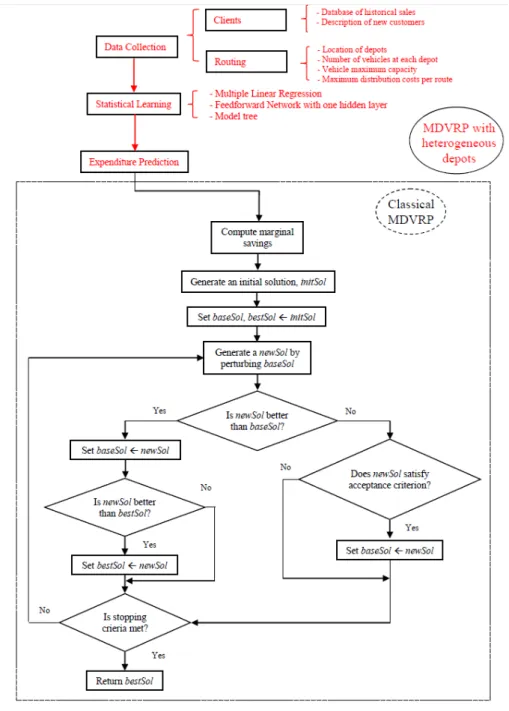
(19) 1. Chapter 1. Introduction This chapter introduces the thesis. Its sections are: motivation, main goal and original contributions, and dissertation outline.. 1.1. Motivation. Metaheuristics constitute a heterogeneous family of algorithms designed to solve a high number of complex combinatorial optimization problems (COPs) without having to deeply adapt them to each problem (Boussaïd et al., 2013). They represent the first recourse for NP-hard problems that are required to be solved in real time. Their quickness and flexibility to address realistic and rich (i.e., complex) problems are two significant advantages in comparison to exact methods. However, they can not guarantee optimal solutions, but tend to provide near-optimal ones. As synthesized in Talbi (2009), “optimization is everywhere; optimization problems are often complex; then metaheuristics are everywhere”. Certainly, metaheuristics are highly popular among researchers and companies, and may be found in a large number of fields. For instance, their use is frequent in: routing, scheduling, telecommunications, machine learning, cryptology, etc. The first works on heuristics (more experience-based procedures) were written in the 1940s (in particular, Polya, 1945, is considered to be the first), but metaheuristics started to be widely used in the 1970s and 1980s. Since then, their importance in operation research (OR) has rapidly increased. Fields such as logistics (including both transport and production logistics), finance and computing are strategic sectors for all developed economies. A number of complex decision-making processes in real-life related applications can be modeled as COPs (Faulin et al., 2012). All theses problems are NP-hard in nature, which leads to the use of metaheuristics. In logistics, road transport is key for the efficient flow of goods in supply chains. The multi-depot vehicle routing problem (MDVRP) represents a non-trivial extension of the classical vehicle routing problem (VRP) combining assignation and routing issues. In the MDVRP with heterogeneous depots (MDVRPHD), the customers show different willingness to consume depending on how well the assigned depot fits their preferences. The MDVRP with stochastic demands (MDVRP-SD) allows demands to follow probability distributions, either theoretical o empirical ones. Also in the routing arena, the interest of the waste collection problem (WCP) and the WCP with stochastic waste levels (WCP-SW) is growing due to the expansion of cities and the relevance of the negative externalities of this service. In fact, there is a growing concern for environmental and social impacts of routing activities in general, which calls for the design of routes based on sustainability indicators. Regarding production, task scheduling is present in the elaboration of products, the design of timetables, etc. The permutation flowshop scheduling problem (PFSP) is a classical problem, which usually aims to find the permutation of jobs that minimizes the total makespan, considering different machines and related restrictions. For instance, the PFSP with stochastic processing times (PFSP-ST) has been extensively studied during the last decade. Frequently, there is a product composed of several components that need to be independently processed before a deadline, when they have to be assembled and the product delivered. This problem is called distributed permutation flowshop scheduling problem with stochastic times (DPFSP-ST). In finance, investments drive the economic growth and social welfare of countries. Metaheuristics are becoming key methodologies for addressing a wide range of problems in this field. For instance, the portfolio optimization problem (POP) consists in selecting a subset of risky assets from a portfolio and setting the weight of the investment of each asset in order to minimize the portfolio’s variance for a given required rate of return. Most works fail to account for stochastic returns and covariances, rendering them unrealistic in the presence of heightened uncertainty in financial markets. On the contrary, the.
(20) 2. Chapter 1. Introduction. stochastic POP (SPOP) deal with returns and covariances modelled as random variables. Finally, computing includes a large number of procedures that may be optimized. Some examples are the parameter-fine tuning on metaheuristics, and the analysis of the effect of the number of agents and the maximum computing time on metaheuristics’ performance. Nowadays, there are two important trends in the literature on metaheuristics. The first sustains the original ideas of metaheuristics: the practical usefulness and logic of simple methodologies relying on local searches (see e.g., Gardi et al., 2014). In contrast, the second encompasses hybrid methodologies, which benefit from the advantages of each component. Indeed, simplicity is an important criteria to assess an algorithm. It facilitates the correct implementation of the algorithm by researchers and companies. However, there are many reasons why an hybrid algorithm may be required: (i) to obtain better results in terms of objective function values and/or computational times; and (ii) to deal with more realistic and richer problems. For instance, most matheuristics (Maniezzo et al., 2009) fall into the first case, solving a subproblem with an exact method. Talbi (2013) presents the combinations of metaheuristics and: (i) complementary metaheuristics; (ii) exact methods; (iii) constraint programming; and (iv) machine learning. While the author discusses interesting ideas, the number of works cited is low and the proposed classification is neither based on works nor on applications, but is a very general framework usable for all the combinations mentioned. In the context of hybrid algorithms, there is another powerful type which combines metaheuristics and simulation, so called simheuristics (Juan et al., 2015a). The framework has been developed during the last years and aims to reduce the lack of works addressing stochastic COPs (SCOPs) (Bianchi et al., 2009). Indeed, the literature has studied some of these problems but usually relying on analytical approaches making hard assumptions or complex approaches. It is crucial to address the stochasticity of these problems, since it is present in most real-life applications. For instance, traveling times greatly depends on factors which are difficult to predict (and so their effects) such as the weather, road works, accidents, etc. Similarly, processing times in scheduling can be affected by machine failures, delays in inputs delivers, etc. This thesis studies and integrates powerful and well-known methodologies such as simulation, metaheuristics and statistical learning. It presents several works aiming to further explore, test and disseminate simheuristics. An original contribution is the development of learnheuristics combining statistical learning and metaheuristics to deal with COP with dynamic inputs (COPDIs), i.e., problems in which the inputs depend on the solution. A number of applications are analyzed, focusing on the fields previously mentioned: routing, production, finance, and computing. A graphical representation of the main methodologies and applications is shown in Figure ??.. Figure 1.1: Scheme of key methodologies and applications of this thesis.. 1.2. Main goal and original contributions. The main goal of this research is to explore the advantages of hybrid algorithms combining statistical learning and/or simulation techniques with metaheuristics. It facilitates the design of methodologies able to solve realistic and rich problems, avoiding hard assumptions usually present in the related literature. This general goal has been concreted in the following results and original contributions:.
(21) 1.3. Dissertation outline. 3. C1. An original approach combining metaheuristics and statistical learning for solving COPDIs, and a general classification and review of works combining statistical learning and metaheuristics. C2. In the routing arena, efficient metaheuristics for solving the MDVRP-HD, the WCP, powerful simheuristics for addressing the MDVRP-SD, the WCP-SW, and the HSAVRP-SD, and a novel approach considering sustainability indicators. C3. Regarding production, a simple simheuristic for tackling the DPFSP-ST. C4. Related to finance, a comprehensive review of works on portfolio optimization and risk management relying on metaheuristics, an efficient metaheuristic and simheuristic for addressing the POP and the SPOP, respectively, and an analysis of the benefits due to diversification of introducing commodity futures in stock portfolios. C5. Considering computing, a classification and an extensive review of works on the parameter fine-tuning of metaheuristics, a methodology based on clustering techniques and design of experiments (DOE) for the parameter fine-tuning of metaheuristics, and an analysis of the effects of increasing the number of agents and the computing time on the performance of well-known heuristics.. 1.3. Dissertation outline. The rest of this thesis is structured in the following three blocks: methodology (chapters ?? to ??), applications (?? to ??), and conclusions, future research, and contributions (?? and ??). The first block focuses on the existing methodology employed and the pure methodological contributions. In particular, chapter ?? introduces metaheuristics, describing their context, reviewing the main definitions and classifications, and presenting a few popular ones. Chapter ?? is devoted to simheuristics, i.e., the integration of simulation techniques into metaheuristics-based frameworks to deal with SCOPs. Chapter ?? provides a brief definition of statistical learning, highlighting the main branches and methods. Afterwards, chapter ?? puts forward learnheuristics, which combine statistical learning and metaheuristics to address COPDIs. The block of applications covers problems in transportation, production, finance, and computing. Chapter ?? analyzes five challenging transportation problems: the MDVRP-SD, the MDVRPHD, the MDVRP with sustainability indicators, the WCP, and the HSAVRP-SD. Different metaheuristics/simheuristics are designed, implemented and validated for them. In the context of production, chapter ?? deals with the DPFSP-ST. Chapter ?? studies optimization problems in finance, presenting a review and focusing on the POP and the SPOP. Next, chapter ?? addresses the parameter fine-tuning of metaheuristics, and discusses issues of parallel computing. Finally, the last block draws some conclusions, and identifies potential lines of future work in chapter ??, while lists the publications, and presentations in chapter ??..
(22)
(23) 5. Part I. METHODOLOGY.
(24)
(25) 7. Chapter 2. Metaheuristics optimization This chapter presents metaheuristics. After introducing them, the main classification criteria are discussed, and biased randomization techniques are presented. Later, the following ones are described: the multi-start, the iterated local search, the simulated annealing and the variable neighborhood search. It is based on the following journal articles: Calvet et al. (2017), Calvet et al. (submitted[a]), and Calvet et al. (submitted[b]).. 2.1. Introduction. OR is a well-established field with a huge and active research community. One of its main goals is to support decision-making processes in complex scenarios, i.e., providing optimal (or nearoptimal) solutions to COPs defined by a given objective function and a set of realistic constraints. The number of applications is immense, e.g.: transportation and logistics, finance, production, and telecommunication systems. A noticeable part of the efforts developed by the OR community has focused on developing exact methods to find optimal solutions to a wide range of COPs. When dealing with NP-hard COPs, this usually requires simplifying somewhat the model and/or addressing only small- and medium-sized instances to avoid incurring in prohibitive computing times. Another noticeable part of the efforts has been invested in developing heuristic and metaheuristic approaches that cannot guarantee optimality of the provided solutions but are usually more powerful in terms of the size of the instances they can solve in reasonable computing times (Talbi, 2009). Additionally, these approximated methods are quite flexible, which makes them suitable for tackling more realistic and richer models. While heuristics are simple and fast procedures based on the specific COP being addressed, metaheuristics represent a heterogeneous family of algorithms designed to solve a high number of COPs without having to deeply adapt them to each problem. Metaheuristics have an enormous number of applications in many fields such as: engineering design, telecommunications, robotics, bioinformatics, system modeling, chemistry, and physics, among many others. A number of them are nature-inspired, include stochastic components, and have several parameters that must be fine-tuned and may interact (Boussaïd et al., 2013). As Feo and Resende (1995) state, the effectiveness of metaheuristics depends upon their ability to adapt to a particular instance problem, avoid entrapment at local optima, and exploit the structure of the problem. The authors also highlight the potential benefit of restart procedures, controlled randomization, efficient data structures, and preprocessing.. 2.2. Classification. Many classification criteria have been proposed to differentiate metaheuristics (Talbi, 2009). The most important are highlighted next. • Memory usage versus memoryless methods. • Iterative versus greedy. An iterative metaheuristic is built from one (or more) complete solution, which is transformed at each iteration. On the other hand, a greedy algorithm starts from an empty solution and, as the execution proceeds, it is built progressively..
(26) 8. Chapter 2. Metaheuristics optimization • Deterministic versus stochastic. A deterministic metaheuristic makes deterministic decisions; consequently, using the same initial solution will lead to the same final solution. Whereas with stochastic metaheuristics, one could obtain different solutions. • Single-solution based search versus population-based search. Single-solution based metaheuristics transform a single solution during their execution. While in population-based metaheuristics, a set of solutions is considered. The first group is exploitation oriented, they intensify the search in local regions. In contrast, population-based metaheuristics are exploration oriented, they allow a better diversification.. Figure ?? includes some of the most popular metaheuristics (first works are cited): ant colony optimization (ACO) (Dorigo, 1992), artificial immune systems (AIS) (Farmer et al., 1986), genetic algorithms (GA) (Holland, 1962), greedy randomized adaptive search procedure (GRASP) (Feo and Resende, 1989), iterated local search (ILS) (Martin et al., 1992), particle swarm optimization (PSO) (Kennedy and Eberhart, 1995), scatter search (SS) (Glover, 1977), simulated annealing (SA) (Kirkpatrick, 1984), tabu search (TS) (Glover, 1986), and variable neighborhood search (VNS) (Mladenovic, 1995). They are grouped according to the following criteria: (i) singlesolution versus population-based metaheuristics (SMs and PMs, respectively); (ii) whether they use memory; and (iii) whether they are nature-inspired. Circles’ size is proportional to the number of Google Scholar indexed articles, from 2006 to 2015, that include the complete name of the specific metaheuristic and “metaheuristics” or “heuristics” in the article (March 15, 2016). The success of the first implementations of metaheuristics aroused the interest of journals in new versions of these methods, which increased the number of authors exploring this topic. Unfortunately, some publications add only marginal contributions to the already existing frameworks (Sörensen, 2015). In this chapter four metaheuristics will be introduced: the multi-start (MS), the ILS, the SA and the VNS. Despite being relatively simple, many state-of-the-art optimization methods are based on them.. Figure 2.1: Main metaheuristics grouped by different criteria.. 2.3. Biased randomization. In optimization, a heuristic is defined as a method for building a feasible solution based on an iterative process. At each iteration, the next movement is chosen from a list of potential candidates that has been previously sorted according to a problem-specific criterion. Pure greedy heuristics select the best next element on the short run, aiming to get a good solution at the end. This simple procedure has two drawbacks: (i) there is no guarantee of finding an optimal solution; and (ii) it is deterministic, so it always returns the same solution. Some pure greedy heuristics are the classical Clarke and Wright savings (CWS) heuristic (Clarke and Wright, 1964) in routing, and the NEH heuristic (Nawaz et al., 1983) in scheduling. Biased randomization (Grasas et al., submitted) refers to the introduction of randomization in the construction phase and/or the neighborhood search of optimization algorithms. On the one.
(27) 2.4. Multi-start. 9. hand, randomization allows increasing the search area covered by selecting a candidate other than the best next option. On the other hand, biased means that the procedure is not totally random in the sense that not all the elements have the same probability of being selected. In particular, each element is assigned a given probability depending on the criterion of the procedure, the higher the element is in the list, the higher the probability. Thus, using biased randomization leads to potentially different outputs each time the procedure is executed. Since running a simple heuristic may take a few seconds or less, implementing biased randomization may improve the solution found taking small amounts of time. The assignation of probabilities can be done by using empirical or theoretical probability distributions. There are analytical expressions that allow the quickly generation of random observations from most theoretical distributions. For this reason, these distributions constitute an efficient option. Examples of distributions widely used are the geometric, the triangular, and the log-normal. Algorithm ?? describes the steps required to implement biased randomization. Algorithm 1 Biased randomization techniques procedure Biased randomization µ ← get random number uniformly distributed in [0, 1) given a specific seed ρ ← get random number from a distribution PD(parameters, µ) l ← get the ρ element of the sorted list 5: return l 6: end procedure. 1: 2: 3: 4:. Some recent works applying biased randomization are introduced here. The reader interested in a comprehensive review is refered to Grasas et al. (submitted). In the context of smart cities, Mazza et al. (2016) study the use of computation offloading for delegating computing-intensive tasks of smart mobile devices to the cloud. The authors develop a biased-randomized algorithm for solving this assignation problem. Related to real-life transportation activities, Dominguez et al. (2016a) focus on the two-dimensional loading VRP with clustered backhauls, where both delivery and pickup demands are composed of non-stackable items. This work presents a hybrid algorithm integrating biased-randomised versions of vehicle routing and packing heuristics within a large neighbourhood search (LNS) metaheuristic framework. Dominguez et al. (2016b) discuss the twodimensional loading capacitated VRP with heterogeneous fleet. A MS algorithm based on biased randomization of routing and packing heuristics is proposed. Quintero-Araujo et al. (2016) solve the location routing problem (LRP), which deals with the simultaneous decisions of: (i) locating facilities; (ii) assigning customers to facilities; and (iii) defining routes of vehicles departing from and finishing at each facility to serve the associated customers’ demands. A biased-randomized metaheuristic relying on classical heuristics is proposed.. 2.4. Multi-start. The MS is a simple metaheuristic consisting of two steps that are alternated for a certain number of global iterations (Algorithm ??). They are: (i) generating a solution; and (ii) applying a local search (i.e., a procedure to move from one solution to a better one by applying local changes). Each iteration produces a solution, usually a local optimum, and the best one is returned. Muth and Thompson (1963) and Crowston et al. (1963), both focused on scheduling, are considered the first works proposing a MS framework. However, Glover (1977) is the one introducing a local search to improve starting solutions. This author compared procedures for generating starting values for variables and for generating values perturbed from other starting points (known as restarts), and adressed controlled randomization, learning strategies, induced decomposition, and adaptive memory processes (Glover, 1986; Glover, 1989; Glover, 2000). A comprehensive review on this metaheuristic is provided by Martí et al. (2013). This work describes the origins of the methodology, includes a classification of versions in terms of their use of memory, and introduces adaptive memory programming and the GRASP metaheuristic..
(28) 10. Chapter 2. Metaheuristics optimization. Algorithm 2 Multi-start structure 1: 2: 3: 4: 5: 6:. procedure MS metaheuristic repeat Generate a solution s s ← LocalSearch(s) until stopping criterion is met end procedure. 2.5. Iterated local search. The ILS metaheuristic is a flexible metaheuristic that became very popular at the beginning of this century with the publication of Lourenço et al. (2010), an article that describes and analyzes its framework, reviews the literature, explains the importance of each of the elements involved and the interactions between them, and discusses its relationship with other metaheuristics. Burke et al. (2010) show that the ILS obtains the best average performance among a set of selected metaheuristic approaches in three classical COPs: bin packing, PFSP, and personnel scheduling. The authors also emphasize two main factors for its success: (i) an excellent balance between exploration and exploitation by “systematically combining a perturbation followed by local search”; and (ii) its simplicity and the reduced number of parameters required, factors that facilitate its quick implementation in practical applications. The high level architecture of the ILS is shown in Algorithm ??. First, an initial solution is generated, usually employing a random solution or the return of a fast heuristic. Afterwards, a local search is applied to the initial solution. It starts then an iterative process that stops when a termination condition is met; this condition can be based on time, number of iterations or solution converge, among others. Initially, the current solution is perturbed; this process may have memory, i.e., depend on the previous walk (history). It is recommended to implement a random move in a neighborhood of higher order than the one used by the local search algorithm. The following step consists in applying a local search to the perturbed solution. This solution will become the next element of the walk if it passes an acceptance test. Otherwise, one returns to the previous accepted solution. The criteria designed can be adaptive. An important advantage of this metaheuristic is its modularity, which enables its development without problem-dependent knowledge. However, usually the most knowledge about the problem one introduces, the best performance it gets. The metaheuristic relies on the assumption that local minima are distributed in clusters. Algorithm 3 Iterated local search structure 1: 2: 3: 4: 5: 6: 7: 8:. procedure ILS metaheuristic Generate an initial solution s0 s∗ ← LocalSearch(s0 ) repeat s0 ← Perturbation(s∗ , history) s∗ ← AcceptanceCriterion(s∗ , s0 , history) until stopping criterion is met end procedure. 2.6. Simulated annealing. The SA metaheuristic is a well-established metaheuristic used in both discrete and continuous optimization. It is inspired by the process of physical annealing with solids in which a crystalline solid is heated, and then allowed to cool slowly until it achieves its most regular possible crystal lattice configuration, without crystal defects (Nikolaev and Jacobson, 2010). Similarly, the metaheuristic searches a global solution following this thermodynamic behavior. Algorithm ?? shows the steps in detail. First, a temperature change counter k is initialized to 0. Additionally, a starting temperature t0 is set, a temperature cooling schedule is designed, and a repetition schedule Mk is stablished, which represents the number of iterations executed at each temperature tk . An initial.
(29) 2.7. Variable neighborhood search. 11. solution s is created, and an outer loop is started. In this loop, a repetition counter m is set to 0. Afterwards, an inner loop starts which repeats the following steps Mk times: (1) a new solution s0 in the neighborhood of s, N(s), is built; (2) the difference between the objective function value of s0 and s, ∆ s,s0 , is calculated; (3) if ∆ s,s0 is negative (assuming a minimization problem), then s0 replaces s, otherwise this replacement is performed with a probability of exp(−∆ s,s0 /tk ); and (4) m is incremented by one. After the inner loop stops, k is increased by one, which represents a decrease in the temperature. The criterion applied to decide whether s must be replaced by s0 is called Metropolis acceptance criterion (Metropolis et al., 1953). It allows the algorithm to escape from local optima. An interesting overview of this metaheuristic can be found in Suman and Kumar (2006). Algorithm 4 Simulated annealing structure 1: 2: 3: 4: 5: 6: 7: 8: 9: 10: 11: 12: 13: 14: 15: 16: 17: 18:. procedure SA metaheuristic Build a solution s Set temperature change counter k = 0 Design a temperature cooling schedule tk Design a repetition schedule Mk repeat Set repetition counter m = 0 repeat Build a solution s0 ∈ N(s) Calculate ∆ s,s0 = f (s0 ) − f (s) if ∆ s,s0 ≤ 0 then s ← s0 elses ← s0 with probability exp(−∆ s,s0 /tk ) end if m←m+1 until m = Mk k ←k+1 until stopping criterion is met end procedure. 2.7. Variable neighborhood search. The VNS was first proposed by Mladenović and Hansen (1997). Besides being a popular metaheuristic in combinatorial as well as global optimization, it has been used in a wide range of research fields such as scheduling, routing, telecommunications, biology, and artificial intelligence. For extensive reviews on applications the reader is referred to Moreno-Vega and Melián (2008) and Hansen et al. (2010). In essence, the VNS proposes systematic changes of neighborhood to find a local minimum by intensifying the search, and to escape from the associated valley by diversifying. It relies on three facts: (i) a local minimum with respect to one neighborhood structure is not necessarily so for another; (ii) a global minimum is a local minimum with respect to all possible neighborhood structures; and (iii) for many problems, local minima with respect to one or several neighborhoods are relatively close to each other. Algorithm ?? shows a simple version of the VNS. Its inputs are the problem instance to solve, the number of neighborhoods considered (K), and the maximum computational time (T ). Frequently, K is set to two or three, and the neighborhoods are nested. First, the variable t for measuring the time is initialized at zero. Afterwards, an initial solution is obtained and stored in currentSol. An outer loop sets the current neighborhood to the first one, and controls that the time-based constraint is satisfied. Inside, another loop builds and tests new solutions. Within this loop, the current solution is initially shaken (or perturbed), generating a solution from the k-th neighborhood of currentSol. The resulting solution is stored in newSol, which is then improved by means of a local search. If there is an improvement (i.e., newSol is preferred over currentSol), newSol is copied into currentSol, and the current neighborhood is set to the first. This constitutes a descendent phase aimed to find a local minimum. Otherwise, the next neighborhood is analyzed (i.e., k is set to k + 1). The inner loop is executed until the last neighborhood is explored (i.e., k = K). Finally, currentSol is returned..
(30) 12. Chapter 2. Metaheuristics optimization. Algorithm 5 Variable neighborhood search structure 1: 2: 3: 4: 5: 6: 7: 8: 9: 10: 11: 12: 13: 14: 15: 16: 17: 18: 19:. procedure VNS metaheuristic Set K t←0 Generate an initial solution s0 s∗ ← s0 repeat k←1 while k ≤ K do s0 ← Shake(s∗ , k) s0 ← LocalSearch(s0 ) if s0 s∗ then s∗ ← s0 k←1 else k ←k+1 end if end while until stopping criterion is met end procedure.
(31) 13. Chapter 3. Simulation and simheuristics This chapter presents simheuristics, including a literature review and a discussion of benefits and limitations. It is based on the following journal articles: Calvet et al. (submitted[a]), Calvet et al. (submitted[b]), Gruler et al. (2017), Gruler et al. (submitted), and Pages et al. (submitted).. 3.1. Introduction. Metaheuristics constitute a powerful approach to tackle COPs, they are indeed highly popular in many research fields. However, these methodologies have been developed considering deterministic problems (i.e., ignoring stochasticity) when, in fact, real-life is plenty of uncertainty. For example, in garbage collection or stocking of vending machines, the demand is not revealed until the place is reached. Other situations in which there is unknown information are flight scheduling and capital management. Unfortunately, the oversimplification of scenarios, i.e., assuming no uncertainty, can lead to poor-quality solutions. This is the reason why there is an increasing interest in considering randomness in COPs (Bianchi et al., 2009). Simheuristics (Juan et al., 2015a) is an approach combining metaheuristics (in a general sense, i.e., including heuristics, metaheuristics, and exact methods, among others) and simulation (Nance and Sargent, 2002; Borshchev and Filippov, 2004; Gass and Assad, 2005), specially designed to tackle COPs containing stochastic components. These components can be modeled as random variables following either theoretical or empirical probability distributions, and can be located in the objective function (for instance, random processing times) or in the set of constraints (e.g., deadlines that must be met with a given probability).. 3.2. Simheuristics. A simheuristic algorithm is a particular simulation–optimization approach oriented to efficiently tackle a COP instance that typically contains stochastic components. These components can either be located in the objective function (e.g., random customers’ demands) or in the set of constraints (e.g., deadlines that must be met with a given probability). In particular, the simheuristic approach is aimed at solving COPs of the form: Min Max subject to:. f (s) = E[C(s)] f (s) = E[B(s)]. or, alternatively,. P(qi (s) ≥ li ) ≥ ki h j (s) ≤ r j. ∀i ∈ {1, 2, . . . , n}. ∀ j ∈ {1, 2, . . . , m} s∈S. (3.1) (3.2) (3.3) (3.4). where: (i) S represents a discrete space of possible solutions s to the optimization problem; (ii) C(s) represents a stochastic cost function (alternatively, B(s) represents a stochastic profit or income function); (iii) E[C(s)] represents a probabilistic measure of interest associated with the cost function (e.g., the expected value of C(s)); (iv) Equations ?? represent probabilistic constraints.
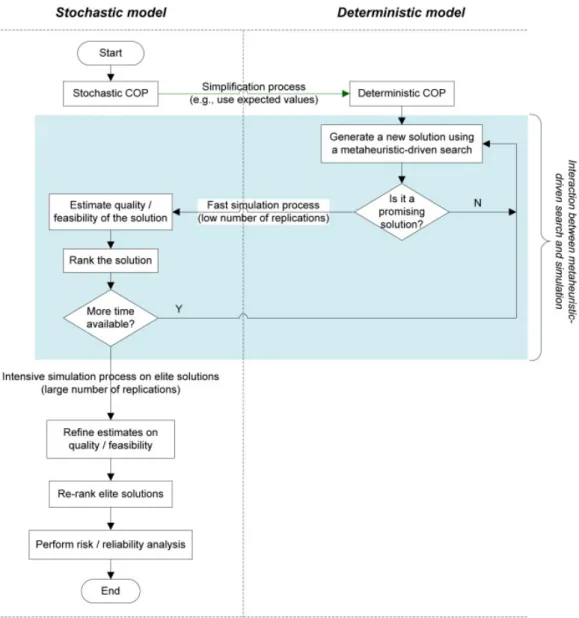
(32) 14. Chapter 3. Simulation and simheuristics. related to the problem (e.g., the probability that the service quality q(s) reaches a given threshold l is above a user-defined value k); and (v) Equations ?? represent typical deterministic constraints in COPs. The simheuristic approach relies on the assumption that high-quality solutions for the deterministic version of a COP are also likely to be high-quality solutions for its corresponding stochastic version, specially in scenarios with a low or moderate uncertainty (variance). The steps proposed to solve a SCOP instance are described next (see also Figure ??). First, a deterministic counterpart of the instance is obtained, for example, by replacing random variables by their expected values. Afterwards, an iterative process is started. It consists in running a metaheuristic-driven algorithm to perform an efficient search inside the solution space associated with the deterministic COP first, and then estimating the quality or feasibility of each of the promising solutions when being considered as solutions of the SCOP instance. These estimations are computed using simulation techniques. The estimated values can be employed to keep a ranked list of the best solutions for the SCOP instance. Once a stopping criteria is met, more accurate estimates are obtained for the best solutions with an intensive simulation process. The advantages of this approach are numerous: it benefits from the extensive literature research related to solve deterministic COPs, and is simple, easy-to-understand and to-implement, efficient, and capable of solving realistic problems. Figure 3.1: Scheme of the simheuristic approach. Source: Juan et al. (2015a).
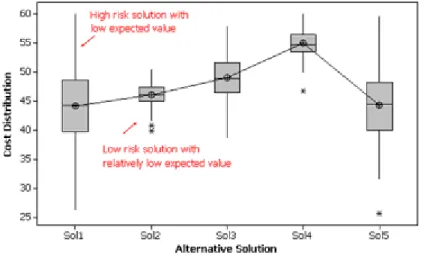
(33) 3.2. Simheuristics. 15. After identifying a set of high-quality solutions (those that provide the highest average performance), the risk aversion of the decision-maker can be taken into account by performing a risk analysis. It is done by studying the empirical probability distribution functions of the quality and feasibility measures computed during the intensive simulation process. An easy and fast procedure can be to provide a multiple box-plot including the solutions returned by the algorithm or only a subset of them, the non-dominated. It provides information (quartiles and outliers) about the functions. Figure ?? shows an example where there is a trade-off between solution risk and expected value. Figure 3.2: Risk analysis of alternative solutions. Source: Juan et al. (2015a).. The described procedure is proposed when simulation is to be used as an evaluation function technique. Nevertheless, simheuristics can also be applied in the context of analytical model enhancement methods. The first case is the most developed so far. An example of the second can be found in Figueira et al. (2013). Despite the fact that this approach is relatively new, there are many relevant lines of investigation being explored. In Juan et al. (2011b), the authors address the VRP with stochastic demands (VRP-SD) employing safety-stocks to reduce the route failure-risk. The single-period stochastic inventory routing problem (stochastic IRP) with stock-outs is tackled in Juan et al. (2014b). Another routing problem, the arc routing problem (ARP) with stochastic demands is studied by Gonzalez et al. (2016). Juan et al. (2014a) present a methodology to solve the PFSP. In Cabrera et al. (2014), the authors address the SCOP of determining a minimum-cost configuration of non-dedicated resources able to support a specific service while maintaining its availability over a user-defined threshold. Focusing on the home service industry, Fikar et al. (2016) propose a flexible discrete-event driven metaheuristic to deal with dynamic routing and scheduling scenarios using combined trip sharing and walking. It facilitates real-world operations, enabling rescheduling and rerouting.. 3.2.1. Benefits. According to Chica et al. (submitted), the most relevant benefits of simheuristics are: • Embracing reality by a validated simheuristic They allow the construction and study of valid complex system models. Indeed, new simulation paradigms can better represent the complexity of reality, and there are computational resources to run demanding simulations for addressing models that are too complicated for analytical models. • Risk assessment of alternative solutions and sensitivity analysis The outputs of the simulations can be employed to generate information about the probability distribution of the quality of each solution. These outputs can also be used to perform a sensitivity analysis, which identifies the parameters having a higher effect on the model. These analyses aim to gain insights into existing or prospective systems, which could lead to better decisions and, as a consequence, to better managerial outcomes..
(34) 16. Chapter 3. Simulation and simheuristics • System understanding and output analysis An innovization process (Deb et al., 2014) consists in analyzing a set of trade-off optimal or near-optimal solutions to decipher useful relationships among problem entities. Visualization methods promote design innovations. An analysis of the input/output variables space of a model may strengthen trust in the solving approach. All these analyses provide a better understanding of the behavior of the optimization and simulation models.. 3.2.2. Limitations. The most important limitations are: • Results are not expected to be optimal Metaheuristics do not guarantee the optimality of the solution provided. Additionally, simulation in simheuristics represents a nonlinear complex system which cannot be analytically treated. Thus, simheuristics should be used when simple and flexible methods are needed to address complex problems. • Additional stakeholders effort is demanded to define the system Simheuristics require additional effort when defining the simulation system and analyzing the results. • More computational resources are required with respect to traditional methods Running a simheuristic algorithm requires a high computational effort, which depends on the selected type of simulation paradigm..
(35) 17. Chapter 4. Statistical learning This chapter introduces statistical learning. It summarizes the basic learning approaches describing the most popular methods and highlighting the main applications. It is based on the following journal articles: Calvet et al. (2017), Calvet et al. (submitted[c]), and Calvet and Juan (2015). This work has been presented at the following seminar: De Armas et al. (2016).. 4.1. Introduction. The term “statistics” was originally created in the 18th century to denote the systematic collection of demographic and economic data of a state. Since then, its meaning has been increasingly broadened. Some more updated informal definitions proposed in Hahn and Doganaksoy (2012) are: (i) the science of learning from data; (ii) the theory and methods of extracting information from observational data for solving real-world problems; and (iii) the science of uncertainty. Statistics plays an important role in numerous economics sectors. The world of statistics1 remarks the most visible: business and industry, health and medicine, learning, research, social sciences and natural resources. The following subsections present the most basic learning methods classified into supervised and unsupervised learning (Hastie et al., 2009).. 4.2. Supervised learning. Supervised learning encompasses a set of procedures for function approximation. Given data pairs {xi , yi } ∀i = {1, . . . , n}, in a (p + 1)-dimensional Euclidean space, there is a function f (xi ) that has a domain equal to the p-dimensional input subspace, and is related to the data via a model such as yi = f (xi ) + εi . The goal of these procedures is to obtain a useful approximation to f (xi ) for all x in some region of R p . Functions are estimated to describe a relation between variables, and to predict a response variable based on explanatory variables. Despite the fact that linear models with few explanatory variables are usually robust and powerful, sometimes a more complex model as a neural network can be required. In this case, the user can hardly explain the specific role of each explanatory variable in the model, i.e., the main aim of the model is to make predictions. It is essential to validate a model before using it. This is done by splitting the dataset into two subsets: a training set, containing the data pairs used to build the model, and the test set, which is used to assess its performance. This split should be random, in order to obtain two representative subsets. Sometimes, it is required to have three subsets: a training, a validation and a test set. The validation test is employed to determine the best model between a set, or to estimate a model-specific parameter like the number of hidden units in a neural network or the parameter that determines the shrinkage penalty in a ridge regression. Often, specially with high-dimensional data (p >> n), it is undesirable or unfeasible to perform those splits. Then, a common procedure consists in applying cross-validation, a method for estimating the prediction error of a model based on the following steps: (1) generate a given number of disjointed training 1 The world of statistics is a global network of more than 2.350 organizations worldwide committed to increasing public awareness of the power and impact of statistics, nurturing statistics as a profession, and promoting the development of probability and statistics. Its official web is: www.worldofstatistics.org..
(36) 18. Chapter 4. Statistical learning. sets from the dataset and define the corresponding test sets (all data pairs except those included in the associated training set); (2) for each training set, build a model and compute the prediction error with the corresponding test set; and (3) estimate the prediction error of the model as the average. The most popular methods of supervised learning are introduced below. • Linear regression A linear regression model assumes that the relationship between the response variable and the explanatory variables is linear. This relationship is modeled through an error variable εi , which is an unobserved random variable. The corresponding model is: p P yi = β0 + β j xi j + εi ∀i = {1, . . . , n} j=1. • Tree-based methods Tree-based methods partition the feature space with splits, and fit a simple model for each subset of data. There are methods both for regression and classification. • Neural networks Neural networks (NNs) extract linear combinations of explanatory variables as derived features, and model a response variable as a non-linear function of these features. Hidden layers are layers between the input and the output layers. Increasing the number of hidden layers and/or hidden neurons adds complexity and improves computational capacity. Having too few hidden neurons, the model might not have enough flexibility to capture the non-linearities in data. NNs tend to have many weights, which might cause problems of overfitting. Weight decay is a method of regularization to prevent it. This method adds a penalty to the error function that shrinks the weights toward zero. A tuning parameter allows weighting the penalty in the error function. There are several types of NN, both in supervised and unsupervised learning. They may be employed for prediction, classification, clustering, and ranking. The most popular is the feed-forward NN for prediction in supervised learning. • Support vector machines The basic support vector machine (SVM) algorithm employs a training subset with a binary response variable to build a model capable of assigning new observations into one category. The algorithm constructs a hyperplane so that categories are separated by the widest margin possible. The model may include penalizations in case observations are not separable. This method may perform non-linear classification by employing the kernel trick, and mapping the explanation variables into high-dimensional spaces.. 4.3. Unsupervised learning. In unsupervised learning, there is a set of observations xi , ∀i = {1, . . . , n}, of a random p-vector X having joint density Pr(X). The aim is to infer the properties of this probability density. The most popular methods are introduced below. • Cluster analysis Cluster analysis consists in grouping a collection of observations into subsets or clusters, such that those within each cluster are more closely related to one another than those assigned to different clusters. The grouping is based on the definition of similarity / dissimilarity between two observations. The dissimilarity between two clusters is defined by the linkage. The most used types are: complete, single, average, centroid, and medoid. The result of the clustering highly depends on the linkage selected. Hierarchical clustering is an approach that aims to build a hierarchy of clusters. The related strategies fall into two types: agglomerative and divisive. The first group starts with each observation being considered a cluster, and pairs of clusters are merged as one moves up the hierarchy. On the other hand, in the divisive approach all observations start in a cluster, and splits are done recursively as one moves down the hierarchy..
(37) 4.3. Unsupervised learning. 19. • Self-organizing maps A self-organizing map (SOM) is a type of NN. It produces a low-dimensional and discretized representation of the input space of the dataset, which is called map. An important characteristic of this NN is that preserves the topological properties of the input space by employing a neighbourhood function. A SOM represents a mapping from the input space to the map space with a lower dimension. • Principal components analysis Principal components analysis (PCA) consists in transforming a dataset to a new coordinate system by applying orthogonal linear transformation in such a way that the greatest variance by some projection of the data comes to lie on the first coordinate or first principal component, the second greatest variance on the second coordinate, and so on. The number of principal components is less or equal to the number of original variables. PCA is usually performed by eigenvalue decomposition of the covariance or correlation matrix of the original data. There is a third method so-called semi-supervised learning (Chapelle et al., 2006), which employs both labeled and unlabeled observations (i.e., not all have associated an output value). It is extremely powerful for problems in which large amounts of unlabelled observations are available, and only a few of them can be manually labelled. Typical examples are visual object recognition, where milions of untagged images are publicly available, or natural language processing..
(38)
(39) 21. Chapter 5. Learnheuristics: statistical learning and metaheuristics This chapter reviews works combining statistical learning and metaheuristics, and proposes a hybrid approach for tackling optimization problems with dynamic inputs. It is based on the following journal articles: Calvet et al. (2017). This work has been presented at the following seminar: Calvet (2015a) and Calvet (2015b).. 5.1. Introduction. The OR community shows a growing interest in coping with increasingly challenging COPs, such as SCOPs and dynamic COPs (in which some of the problem inputs evolve over time). This might be due to several factors, including: (i) the rich characteristics of real-life problems frequently faced by modern companies in sectors such as logistics and transportation (Caceres et al., 2014); (ii) the technological development; (iii) the availability of vast amounts of Internet-based data; and (iv) a shift to a more data-driven culture. During the last years, hybrid approaches have been extensively employed due to their success when dealing with realistic problems, among others: those combining different metaheuristics (Talbi, 2013), matheuristics (i.e., metaheuristics combined with mathematical programming) (Maniezzo et al., 2009), and simheuristics. The hybridization of metaheuristics with statistical learning is an emerging research field. In this context, the main contributions of this chapter are: (i) providing a classification on works combining metaheuristics with statistical learning; and (ii) proposing a novel ‘learnheuristic’ framework, combining a heuristic-based constructive procedure with statistical learning, to deal with COPDIs. In these problems, the inputs are deterministic (i.e., non-stochastic) but, instead of being fixed in advance, they vary according to the structure of the solution (i.e., they change as the solution is being constructed following a heuristic-based iterative process). In this sense, these COPDIs represent an extension of the classical deterministic COPs in which all inputs are given in advance and are immutable. An example of such a COPDI is given next for illustrative purposes. Suppose there is a set of heterogeneous radio access technologies (RATs) that provide pay-per-use services to a group of users. Each user has to be assigned to just one RAT, and each RAT can serve only a limited number of users. The goal is to maximize the total benefit, which depends on the customers’ demands. Several scenarios may be described based on the nature of the demands (Figure ??): (i) they are deterministic and static; (ii) they contain some degree of uncertainty but can be modeled as random variables or using fuzzy techniques; and (iii) they are dynamic in the sense that they depend on the solution characteristics (e.g., the number of users connected to the same RAT, which has an effect on the service quality and, therefore, on the customers’ demands). While the first case corresponds to a classical deterministic COP, the second case introduces a level of uncertainty that usually requires the use of stochastic programming, simulation-optimization, or fuzzy methods. Focusing on the third case, the learnheuristic algorithms have a learning mechanism that updates the input values as the solution is iteratively constructed using the heuristic logic (Calvet et al., 2016d)..
(40) 22. Chapter 5. Learnheuristics: statistical learning and metaheuristics. Figure 5.1: Type of problem according to the nature of the inputs.. 5.2. Related reviews. The existing literature analyzing the hybridization of metaheuristics and statistical learning may be mainly divided into two groups: works were statistical learning is employed to enhance metaheuristics, and those in which metaheuristics are used to improve the performance of statistical learning techniques. Regarding the first group, there are several works providing overviews. For instance, the emergence of hybrid metaheuristics is studied in Talbi (2013), which includes the combination of metaheuristics and: (i) complementary metaheuristics; (ii) exact methods; (iii) constraint programming; or (iv) statistical learning. The author distinguishes between low-level hybridizations, in which a given internal function of a metaheuristic is replaced by another optimization method, and high-level hybridizations, where the different optimization methods are self-contained. In a second phase, these algorithms can be further classified into relay (where techniques are applied one after another) or teamwork hybridization. Jourdan et al. (2006) describe applications of data mining techniques to help metaheuristics. A survey on the integration of statistical learning in evolutionary computation can be found in Zhang et al. (2011). The work presented in Corne et al. (2012) gathers the synergies between OR and data mining, highlighting three benefits of employing data mining in OR: (i) increasing the quality of the results; (ii) speeding up algorithms; and (iii) selecting an algorithm based on instance properties. This chapter builds on the classification in Jourdan et al. (2006) and extends it by proposing more categories and analyzing a higher number of works. Works are classified into specifically-located hybridizations (where statistical learning is applied in a specific procedure) and global hybridizations (in which statistical learning has a higher effect on the metaheuristic design). Similarly, there are a few reviews on metaheuristics used to improve the performance of statistical learning techniques. For instance, Freitas (2008) focuses on two evolutionary algorithms (EAs), namely GAs and genetic programming (GP), and discusses their application to discovery of classification rules, clustering, attribute selection and attribute construction. Corne et al. (2012) analyze the role of OR in data mining discussing the relevance of exact methods, heuristics and metaheuristics in supervised classification, unsupervised classification, rule mining and feature selection. More recently, Dhaenens and Jourdan (2016) provides an overview of the use of optimization in Big Data focusing on metaheuristics. The book introduces the role of metaheuristics in clustering, association rules, classification, and feature selection in classification. Building on these reviews, here the literature works are arranged into the following categories: classification, regression, clustering, and rule mining..
(41) 5.3. Statistical learning for enhancing metaheuristics. 5.3. 23. Statistical learning for enhancing metaheuristics. This section describes works employing statistical learning for enhancing metaheuristics. They are first grouped into specifically-located hybridizations and global hybridizations.. 5.3.1. Specifically-located hybridizations. The fine-tuning of metaheuristic parameters is known to have a significant effect on the algorithm performance. However, this issue is not always properly addressed and many researchers still continue selecting parameter values by performing exhaustive testing or copying values recommended for similar instances or problems. Basically, there are three approaches: 1. Parameter control strategies (De Jong, 2007) apply a dynamic fine-tuning of the parameters by controlling and adapting the parameter values during the solving of an instance. The main types of control are: (i) deterministic, which modifies the parameter values by some deterministic rule; and (ii) adaptive, which employs feedback from the search. For instance, there are works relying on fuzzy logic (Jeong et al., 2009), SVMs (Zennaki and Ech-Cherif, 2010), and linear and SVM regression (Lessmann et al., 2011). 2. Parameter tuning strategies assume that the algorithms are robust enough to provide good results for a set of instances of the same problem with a fixed set of parameter values. Frequently, researchers focus on a subset of the instances and analyze their fitness landscapes. Popular techniques are: response surface (Gunawan et al., 2013), logistic regression (Ramos et al., 2005), and tree-based regression (Bartz-Beielstein et al., 2004). 3. Instance-specific parameter tuning strategies present characteristics from the previous approaches. While the parameter values are constant as in the second approach, they are specific for each instance as in the first one. These strategies employ a learning mechanism able to return recommended sets of parameter values given a number of instance features. Techniques employed are: Bayesian networks (Pavón et al., 2009), case-based reasoning (CBR) (Pereira et al., 2013), fuzzy logic (Ries et al., 2012), linear regression (Caserta and Rico, 2009), and NNs (Dobslaw, 2010). Typically, metaheuristics generate their initial solutions randomly, using design of experiments (Leung and Wang, 2001), or via a fast heuristic. There are also works employing statistical learning techniques. For instance, some of them apply CBR to initialize GAs (Ramsey and Grefenstette, 1993; Louis and McDonnell, 2004; Li et al., 2011b), while others explore the use of Hopfield NNs (Yalcinoz and Altun, 2001). In De Lima et al. (2008) the authors suggest using the Q-learning algorithm in the constructive phase of a GRASP and a reactive GRASP metaheuristics. In this line, the hybridization of data mining and the GRASP metaheuristic is discussed in Santos et al. (2008). In real-life applications it is common to find objective functions and constraints that are computationally expensive to evaluate (Lim et al., 2010; Tenne and Goh, 2010). In these cases, it is required to build an approximation model to assess solutions employing polynomial regression (Zhou et al., 2005), NNs (Adra et al., 2005; Pathak et al., 2008), SVMs (Yang et al., 2009), Markov fitness models (Brownlee et al., 2010), kriging (Díaz-Manríquez et al., 2011) or radial basis functions (Regis, 2014), for example. Some authors combine their use with that of real objective functions (Rasheed and Hirsh, 2000; Zhou and Zhang, 2010). A survey on model approximation in evolutionary computation may be found in Jin (2005). Another option to reduce evaluation costs is to evaluate only representative solutions. Following this idea, Yoo and Cho (2004) apply fuzzy clustering, while Jin and Sendhoff (2004) use clustering techniques and NNs ensembles. Regarding population management, many authors attempt to extract information from solutions already visited and employ it to build new ones, aiming to explore more promising search spaces. A number of works rely on the Apriori algorithm (to identify interesting subsolutions) (Dalboni et al., 2003; Santos et al., 2005; Ribeiro et al., 2006; Santos et al., 2006) or on CBR (Louis, 2003). Another important issue in PMs is the population diversity, since maintaining it may lead to better performances. The most common technique for promoting diversity is clustering analysis. In Streichert et al. (2003), for instance, individuals in a GA are separated in different sub-populations based on their features and only those in the same cluster compete for survival. The selection operator is applied independently to each cluster..
Figure

+7



Documento similar