1 UNIVERSIDAD LAICA VICENTE ROCAFUERTE DE GUAYAQUIL
FACULTAD DE EDUCACIÓN
CIENCIAS DE LA EDUCACIÓN
MENCIÓN INGLÉS RESEARCH PROJECT:
“DEVELOPMENT OF LISTENING SKILLS IN THE ENGLISH CLASS TO IMPROVE THE ORAL EXPRESSION IN 8-10 YEAR OLD CHILDREN AT
CENTRO ECUATORIANO NORTEAMERICANO”
PREVIO A LA OBTENCIÓN DEL TÍTULO DE:
LICENCIADA EN LENGUA INGLESA MENCIÓN EN ENSEÑANZA Y
ADMINISTRACIÓN DE SISTEMAS EDUCATIVOS EN TEFL
AUTHOR:
SARA ELIZABETH VILLÓN RAMÍREZ
TUTOR:
Msc. XAVIER TORRES FRERES
2
CERTIFICACIÓN DE ACEPTACIÓN DEL TUTOR
En mi calidad de Tutor del Proyecto de Investigación, nombrado por el Consejo Directivo de la Facultad de Educación- Carrera de Ciencias de la Educación mención Inglés.
CERTIFICO
Yo, XAVIER HUMBERTO TORRES FRERES, certifico que el Proyecto de Investigación con el tema: “DEVELOPMENT OF LISTENING SKILLS IN THE ENGLISH CLASS TO IMPROVE THE ORAL EXPRESSION IN 8 – 10 YEAR OLD CHILDREN AT CENTRO ECUATORIANO NORTEAMERICANO”, bajo mi tutoría y que el mismo reúne los requisitos para ser defendido ante el tribunal examinador, que se designe al efecto.
TUTOR
FIRMA
3 DECLARACIÓN DE AUTORÍA Y CESIÓN DE DERECHOS DE AUTOR
DECLARACIÓN DE AUTORÍA
Yo, SARA ELIZABETH VILLÓN RAMÍREZ, con cédula de ciudadanía No. 0918382581, en calidad de autor, declaro bajo juramento que la autoría del presente trabajo me corresponde totalmente y me responsabilizo de los criterios y opiniones que en el mismo se declaran, como producto de la investigación que he realizado.
Que soy el único autor del trabajo del Proyecto de Investigación: “DEVELOPMENT OF LISTENING SKILLS IN THE ENGLISH CLASS TO IMPROVE THE ORAL EXPRESSION IN 8 – 10 YEAR OLD CHILDREN AT CENTRO ECUATORIANO NORTEAMERICANO”.
Que el perfil del proyecto es de mi autoría, y que en su formulación he respetado las normas legales y reglamentarias pertinentes, previa la obtención del título de “Licenciado en Lengua Inglesa especialización Lingüística y Literatura” o “Licenciado o Licenciado en Lengua Inglesa mención en Enseñanza y Administración de Sistemas Educativos en TEFL”, de la Facultad de Educación- Carrera de Ciencias de la Educación mención Inglés de la Universidad Laica Vicente Rocafuerte de Guayaquil.
CESIÓN DE DERECHOS DE AUTOR
De conformidad con lo establecido en el Capítulo I de la Ley de Propiedad Intelectual del Ecuador, su reglamento y normativa institucional vigente, dejo expresado mi aprobación de ceder los derechos de reproducción y circulación de esta obra, a la Universidad Laica Vicente Rocafuerte de Guayaquil. Dicha reproducción y circulación se podrá realizar, en una o varias veces, en cualquier soporte, siempre y cuando sean con fines sociales, educativos y científicos.
El autor garantiza la originalidad de sus aportaciones al proyecto, así como el hecho de que goza de la libre disponibilidad de los derechos que cede.
__________________________
4 ABSTRACT
The purpose of this research project is to analyse the effect of the development of the listening skills on the oral production in 8 – 10 year old children at Centro
Ecuatoriano Norteamericano. For English teachers, it is important that their
students are able to understand what it is said in class and to speak in the
target language. For this reason, evaluations to all the research instruments
have been done to conduct this project, and they have been under the
qualitative method, in which deductive and inductive method, as well as the
analysis of literature review were equally important to develop this research. In
addition, the sample population for this research was based on twelve students
in a kids program: and the aim was to help them develop their speaking skill.
The techniques applied were surveys to students to get information about what
they do in class, observations and an interview to one of the teacher in charge of students in this program. The data analysis was based on the student’s
performance in class with the activities they did, and the teacher’s interview,
which gave information how they handle the class. All this information will help to understand the influence of listening skills on children’s speaking at this
institution. Finally, the results of the surveys are represented with graphics that
will make easier the understanding the influence of different activities in
students.
5
INDEX
1. Introduction ... 7
Statement of the problem ...10
1.2 Objectives: Broad and Specific ...10
1.3 Significance of the study ...11
1.4 Scope and delimitation of the study ...11
CHAPTER II ... 12
2. Literature review ... 12
2.1 Introduction ...12
2.2 Theoretical Review ...12
2.3 Conceptual Framework ...13
2.4 Definition of terms ...21
2.5 Hypothesis: ...21
2.6 Variables and indicators ...21
2.7 Summary ...22
CHAPTER III ... 23
3. Research Methodology and Findings ... 23
3.1 Methods and Techniques ...23
3.2 Research Population, Sample, and Setting ...23
3.3 Research Instruments ...24
3.4 Findings and Analysis ...25
3.5 Resources, Timetable and Budget ...41
CHAPTER 4 ... 44
4. Final conclusion ... 44
4.1 Conclusions ...44
4.2 Problems and Limitations...44
6 List of Tables
Table 1: Variables ...22 Table 2: Sample ...24
List of Graphics
Graphic 1: Do you like learning English? ... 25
Graphic 2: How often do you do listening activities? ... 26
Graphic 3: Is it difficult for you when you do listening activities in your
class? ... 27
Graphic 4: What kind of activities do you practice more? ... 28
Graphic 5: Does your teacher encourage the class to ask questions to your
partners? ... 29
Graphic 6: How often do you practice making questions related to a listening
activity( stories, conversation)? ... 30
Graphic 7: Does your teacher encourage you to practice different speaking
activities? ... 31
Graphic 8: Is it difficult for you when you do speaking activities in your
class? ... 32
Graphic 9: What kind of speaking activities do you like more? ... 33
Graphic 10 Do you receive the appropriate feedback from your teacher when
doing a listening/ speaking activity? ... 34
List of Pictures
7
CHAPTER I
1. Introduction
Listening is maybe the most important skill to develop. But, why?
Perhaps, it is because we spend more time listening than speaking (or other
skills). This is why listening is important not only on the academic aspect, but
in life in general too. According to the webpage Udemy, developing this skill
helps improving relationships, and even becoming a better speaker (2013).
This supports the idea that listening can actually influence on speaking abilities.
Pronunciation, grammar and specially vocabulary in little kids are some
of the aspects that can be improved when listening because according to what
they listen is that they will start speaking appropriately. As Gilakjani and Ahmadi (2011) mention, in students’ life listening plays an important role since it is the
main medium of learning at all stages of education. This is why it is important
to develop good listening skills in our students; the younger they are when
developing listening skills, the better listeners they will be. To help students
become good listeners, teachers need a variety of strategies and resources.
Having a good development of students’ listening skills can be achieved
through the different activities that the teacher prepares. The problem is that
teachers do not have enough resources to help them develop this skill. Some
teachers are just given a recorder with the book CD and that is it. If students
do not develop or improve this skill, they may have problems with the oral
expression because they will not know what to say. In an English class, it is
important for teachers that their students can understand them, and that they
are able to express some short ideas, or that they may answer some basic
questions in a short way. This will help students when growing and passing to
higher courses; otherwise, there might be consequences when they do not
8 If students do not have good listening skills and have not improved their
language acquisition at the end of the school year, they will have problems
when going to the next grade. In higher courses, exercises are going to be
more difficult and therefore, they will have more trouble because they will need
to remember all or most of the vocabulary and structures learnt in previews courses. In addition, if students cannot cope with the teacher’s demand (all
activities done in class), they may fail the year.
1.1 Background and Statement of the problem
In some schools, not to say in most of them, English lessons are not given
every day, and some others do not have as many hours of classes as teachers
think it is necessary for students to start having a better acquisition of the
language. This does not allow students to improve their English.
This study will be focused on the improvement of oral expression in
children from 8-10 years old through their listening skills at Centro Ecuatoriano
Norteamericano. Children in the Kids and Kids Junior programs have good
listening skills. They can understand most of what the teacher says without any problem. Songs, and listening—reading activities are related to vocabulary they
already know or that they are learning, so when they listen to those words from
the recorder or the teacher they can understand what they hear. However,
some students are not able to speak totally in English. Students usually answer
to questions in Spanish. They say the answer correctly, but they do no use the
target language.
The activities that students do depends on what the teacher prepares and
on the content they need to learn. The teacher can bring different activities to
help students develop specific skills. They can bring songs or stories for
listening development or have students role-playing a conversation they have
on their books. Teachers can also prepare material related to the content learnt
like filling gaps or writing a short description of a topic given. Whatever happens
9 It is important to mention that how students perform or develop their
skills in class depends on what teachers wants them to develop the most. For
instance, if teachers wants them to improve their listening skills, students will
listen to a song or story and answer questions about it. If teachers wants them
to improve their writing skills, students will be writing short description
frequently, and so on.
Resources play an important role in this process. Students of second
grade at this school are not required to read or write in English by themselves,
but they have to be able to recognize a word when they hear it, and to
understand words when they see them on quizzes or exams. This cannot be
achieved if teachers do not help students with different activities besides the
ones from the book. Having some other resources like a computer to look for
online activities or games, or some extra listening activities from other texts or
games can help to develop this skill in the students. Besides, depending on the
activities, they can encourage students to start speaking in English.
Even when they cannot actually speak in English, when learning some
grammar structures, students learn what the answers to specific questions are.
For instance, if they are learning about food, and they see and listen to the
question Do you like pizza? They know they have two options: Yes, I do or No,
I don’t. They practice this structure with different vocabulary words about food,
and then in a different class they talk about toys, and they find it is the same
answer. Short answers like these ones or some simple sentences like The
pencil is under the table are things they have to know when giving the oral exam. At the end of the ‘quimestre’ students have a written and oral English
exam in which they have to recognize and say vocabulary words, and they are
asked questions like the ones practiced in class.
To sum up, when working with second graders, teachers need to be
prepared with everything they may consider necessary to help students with
their listening skills and therefore their speaking abilities. If teachers do not
10 webpages, etc), it is more likely that their students will not really pay attention
or listen to what they say. And so, students will find the subject more difficult or
boring, and they will not develop their language acquisition and their speaking ability. The purpose of this study is to help teachers develop their students’
listening skills to improve their oral expression. This will help students to
improve their skills in this language; therefore, they will be able to understand
things when they hear it, to read some basic vocabulary words, and say simple
short answers to questions asked by the teacher.
Statement of the problem
What are the effects of developing listening skills on the oral expression in 8 –
10 year old children at Centro Ecuatoriano Norteamericano.?
1.2 Objectives: Broad and Specific
1.2.1 General objective
To determine how the use of listening activities help in the improvement
of oral expression in 8 – 10 year old children at Centro Ecuatoriano
Norteamericano by using different listening strategies in class.
1.2.2 Specific Objective
To identify students’ listening skills level with a listening test to
To identify the appropriate activities for students to improve their
listening skills by implementing different listening activities in class
To improve students’ speaking to improve their communicate
11 1.3 Significance of the study
The reason why this research is important is because in this institution,
Students are used to say things in Spanish. The students need to develop their
speaking ability little by little so they cn be able to talk to their teacher and
classmates in English whenever it is necessary. It was mentioned, that listening
is an important tool to help learners have a better acquisition of the language.
This is the target of this study, that teachers can help students develop listening
skills and therefore their speaking ability with the appropriate techniques and
activities. In this way, educators will not need of their L1 to explain an English
class or to use translation so learners understand what it is said, and students
will improve their oral expression and will have better communicative skills.
This projects beneficiates to:
Students: developing listening skills in students will help them to be aware
of all the sounds around them, they will be able to discriminate unnecessary
information and pay attention to important things mention in a conversation or
in a listening activity. Once their listening skills are developed, they will improve
their oral expression. Students usually repeat what they listen in class, this
helps them memorize new information, when they listen new words, and
structures, they repeat and they get used to it and use it when it is necessary.
For teachers: this research will help teachers to have a variety of listening
and speaking activities for them used in class with their students. Also, they will
be able to create new activities to help students with their language skills
development.
1.4 Scope and delimitation of the study *Group of students: Second graders
*Institution: Centro Ecuatoriano Norteamericano
*Done by: Sara Villon
12
improve their oral production through the improvements of their listening skills.
Developing listening skills can be kind of hard because Spanish speakers are
not used to listen to things in English, however, the development of listening
can lead to good communicative skills
2.2 Theoretical Review
Floriasti (2012) states that “Listening and speaking influence each other
as the more students get input from listening, the richer the knowledge they acquire; then, the more fluent they become”. This means that according to what
students listen, they will start to improve their oral expression, they will acquire
more vocabulary words, and they may be more aware of grammar structures.
In a study done by Pavlenko (2010) it was shown that a more productive
speech was developed in students who were in an integrated listening and
speaking classroom, and that this development of oral/aural skills can be done
through the communicative language approach. If we can apply this
communicative approach in young learners, we could help them to become
fluent speakers and good listeners. But how is this? Well, as students will be
used to face real life situation, they will understand what they hear and will be
able to give appropriate answers to what they listen.
As Gary Buck, president of Lidget Green, mentions, listening is a difficult
thing for language learners to develop and become effective language users.
The development or improvement of this skill has an impact or consequences
(good ones) in other areas. Astorga mentions that special attention on listening
produces an improvement of other skills (2015), and as Brown mentioned, it is
crucial for a child to develop listening skills in order to cope with the academic
13 their listening skills developed, it is more likely that they do good at school, and
they will develop their other skills like speaking, reading and writing little by
little.
It is important for students to improve or even develop, for very new
beginners, their oral production. This will help students to use the target
language in the English class. However, as Osada (2004) mentions, just
speaking does not mean communication, what is said has to be understood by
another person; without this, there is no communication at all. This means that
it is necessary to listen carefully to what another person says to give
appropriate answer and sustain a conversation and show interest on what it is
being said.
also how others use their bodies (2011).
Listening plays an important part in communication. The listener needs to
understand and interpret what they hear. Listening is not just a matter of
hearing, it is important for the listener to be able to give an answer to what it is
said (Sharma, 2011), that is why paying attention and understanding is
important in this process.
Listening is one of the most difficult skills to develop, but why is this?
According to Abrantes (2006) it is because we naturally learn a language
through this skill. He states “listening is a complementary skill to speaking and
therefore it is important to stress listening when teaching English if students
14 To help develop listening we need to consider some aspects like
pronunciation, grammar and vocabulary.
Pronunciation
is important because according to the pronunciation of the words, listeners can have a better picture of what the speaker is saying.Pronunciation is good for acquiring English language and becoming fluent, too.
When students listen things in English, they usually get used to how teachers
pronounce those words. Students start pronouncing things in the way they
listen those words. In a game, for example, in which teacher says things in slow
motion and with a loud (or slow) voice, students will do the same thing the
teacher does. This is why having a good pronunciation can help students to
acquire language and a good pronunciation, because they will pronounce
words as they listen.
Grammar
is also important due to the listener has to identify if it is a formal or informal conversation. Word order should be considered whenteaching listening. Students need to be aware of what the order of words are.
In a class, in which students need to color school supplies according to the
color the teacher says, it is important to say the correct sentences which would
be, for example, It is a blue pencil case.
Vocabulary
is important becausethere are some words that are similar in pronunciation, but they are written in a different way and have anothermeaning. An example of this is ate (verb) and eight (noun). If students have a
wide vocabulary, it would be easy for them to identify words or even pictures.
For example, in a class in which students have to color numbers, if they listen
Color number eight, they will know they have to color a number because they
listen this word, and because they see the numbers.
A good listener can use these factors simultaneously. Wilis lists a series,
of what he calls, enabling skills like recognizing discourse markers, e.g., Well;
15 patterns and uses of stress, etc., which give clues to meaning and social setting • understanding inferred information, e.g., speakers’ attitude or intentions.
Yagang (n.d), states there are four aspects that make listening difficult.
These are the message, the speaker, the listener, and the physical setting.
The message
This is related to the content and its organization. “The listening material
may deal with almost any area of life. It might include street gossip, proverbs,
new products, and situations unfamiliar to the student. Also, in a spontaneous
conversation, speakers frequently change topics. In spontaneous
conversations, people sometimes use ungrammatical sentences because of
nervousness or hesitation. They may omit elements of sentences or add
something redundant. This may make it difficult for the listener to understand the meaning.”
The speaker
If students are reading something aloud, they usually have normal pace,
volume, and intonation. On the other hand, when it is a normal conversation,
these dialogues have a different intonation, pauses and hesitations. These
things make difficult to understand what the other person is saying. These
interruptions like pauses and hesitations can make it hard to get the idea of the
different utterances said. When people start learning English and practicing
normal conversations, it is common to make mistakes in grammar,
pronunciation, vocabulary and even the fluency is not good enough to maintain
a normal conversation. However, this skill can improve with the appropriate
activities and feedback from the teacher.
The listener
The listeners will have some troubles when understanding things. If the
listener has a small range of vocabulary and grammar knowledge, this
16 wants to say because he will not understand some words. It is important for
both, listener and speaker, to have a variety of vocabulary and be aware of
grammar rules. This can help the listener to understand the intended message
and give an appropriate answer.
The physical setting
This aspect refers to the noise obstructing the meaning of the message. Not only the noise makes it a hard task, but not seeing the speakers’ body
language (in case of listening a tape or the radio) and facial expressions
obstructs the way the listener gets the meaning of the message. In a normal
conversation, people is aware of everything, noises, movements, intonation,
the intended message, interruptions, and everything around them. All those
aspects affects the meaning of the message. This can either help or not to
understand what the speakers is trying to say.
Nunam (2001) indicates that there are six different stages in the listening
process (as cited in Segura: 2012). These are: Hearing, Attending,
Understanding, Remembering, Evaluating and Responding. These stages
occur in sequence and rapid succession.
Hearing is the perception of sound, without really paying attention.
Attention refers to the selection of the part to be focused on. Understanding,
this is the analyses of the part selected considering not only words but other
aspects such as sounds like applause.
Remembering means that this information has been added to the mind’s
storage and will be me remember when needed. Evaluating, in this process,
listeners identify facts and opinions and weigh evidence. Finally, responding
refers to giving an answer to what has been listened.
Liao (n.d), indicates that there are three stages in this listening process.
The first one is pre- listening, there are things that teachers can do in this stage
like using Total Physical Response directions. In this kind of exercise students
17 learners’ class, in which students are just getting their ear trained, teacher may
say “Open your book” doing mimics with a real book and repeating it a couple
of more times. In this way, students will understand that what they have to do
is to open their books. As students are beginners. It will be easy for them when
they grow older and understand those kind of utterances. Another option in
this stage could be asking students to make drawing about a description of a
sketch or picture. Students could look at a picture and make a simple sentence.
For example, they could see a flashcard of the preposition on and they could
actually say the sentence representing the picture.
She also mentions the while- listening stage. This is where students are
required to take notes about what they listen, trying to predict possible details
in the listening, but the most important objective is that students are required
to get the main idea of what they are listening to.
Post - listening is the last stage. This is the section in which students can
show what they really understood helping them to increase the speaking skill.
Making summaries or discussing in pairs or groups, or teachers making some
comprehension questions are activities that can be done in this stage according
to Wei (n.d). These are activities more suitable to classes with a higher level of
English. However, if the questions done by the teacher are for the students just
answer yes or no or say vocabulary words, then this activity can be done with
beginners
STRATEGIES FOR LISTENING
Bottom-up and top-down processing are the most common strategies in
teaching listening. The National Capitol Language Resource Center webpage
indicates that bottom-up implies focusing in the language of the message that
is recognizing words and intonation. Top-down refers to using prior knowledge
to help listeners to interpret what is being listened, and how the listener can get
18 One of the activities Liao suggest is having students work in pairs. One of them pretends to be doing a specific activity (let’s say jumping), and the other
students asks ‘what are you doing?’, and the first student says to be doing a
different action (swimming). The second student has to pay attention to do what
he listens not what he sees his partner is doing. This means that he has to make mimics as he is swimming. What is the purpose of this activity? It is to
enable students to immediately answer questions but to help them to give
responses without distractions.
Liao also considers taking notes as a strategy to work with students; they
have to write things as clearly as they can. In this activity the language, speed,
and the organization play an important role. Students have to take notes in the
language used in the listening. This will help them to remember specific words
and their contexts. The speed is an element that will make students feel
obligated to learn to write faster, abbreviation, or symbols to represent ideas.
Organization is ideal to have a better understanding of what has been written;
outlines or graphic organizers can be used in this process. With the information
they have, then they can make a summary. Teacher gives feedback of the
activity, and there, it is when he clarifies questions from students like the
meaning of words, spelling, and words they missed from the listening.
“Listening strategies are techniques or actions that provide directly to the
comprehension and recall of listening input. Listening strategies can be classified by how the listener processes the input” Sharma (2011).
Richards (2008) gives some smalls tasks that can be done like choosing
appropriate answer according to a simple sentence given, students may
choose yes/ no to show agreement with that sentence. He mentions a very
similar activity but with –wh words like when and where, the difference is that
in this activity students will listen to larger sentences with some stressed words,
and the purpose is students to identify the stressed word and choose the
19 Speaking
For learners of English as a foreign language it is required to
communicate in the target language, in this case English. As they do not start
speaking since the first day, it is important for teachers to help them develop
this skill little by little. Depending on the type of students, their ages, and the
knowledge they already have of the language.
Richards (2008) talks about three different functions of speaking that “serve to establish and maintain social relations, and the transactional functions, which focus on the exchange of information.” These functions are:
Talk as interaction
This is what we call conversation, this is the interaction among people to
know each other, to start a small talk and to talk about them. Talking as
interaction may include joking, recounting experiences, interrupting, among others. This kind of talk has features like reflecting speaker’s identity, degrees
of politeness, and it may be formal or casual.
Talk as transaction
In this talk, the focus is on what it is said or done, not on the interaction of
the people involved. Some typical examples are buying things, asking for
directions, ordering food, making phone calls to obtain information, etc. This
talk includes the use of skills such as confirming information, describing things,
asking for clarifications, making comparisons and others.
Talk as performance
This is a public talk, like giving a speech, presentations, announcements
and others. Talking as performance is more like monologue and it is similar to
written language. Skills involved in this type of talk are using appropriate
opening and closing, maintaining the audience engaged and using the correct
20 STRATEGIES FOR SPEAKING
Vălimăreanu (n.d) mentions some activities to consider for developing
speaking.
Role play is a strategy that can be used to help students develop the speaking. This exercise consists in having students work in pairs or groups and
make a kind of dramatization of simple conversation they may have on the
book.
For students that have an advanced level of English; exercises like
debates and giving points of view would be better. In these cases students express their opinion on a given issue or problem. And they have to defend them and consider others’ opinions to give an appropriate answer.
Boyd – Bastone (2013) suggests the ‘caretaker’ speech. Saying simple
sentences with the right intonation is the key of this technique. Teachers
describe an object with simple sentences putting emphasis on key words. This
helps students focus on those key words to say sentences similar to the ones
they listened.
According to The National Capital Language Resource Center, using
minimal response is one strategy teachers can use to help specially
beginners. There are students who are very shy at the beginning, and they just
listen to the conversation. These students use very simple sentences, usually
predictable sentences, just to show agreement or understanding (2004).
Sasson (2016) also mentions that using picture prompts can encourage
students to speak in English. It is a brainstorming exercises in which students
give their ideas (words, sentences) on a given topic according to the picture, of
course.
Segura (2012) suggests other activities to star saying things in English
like drills, which consists in repetition of vocabulary or grammar. In
substitution drill, students have to change vocabulary words. Transformation
21
given by the teacher. Information gap is another type of activity. In this
exercise, students work in pairs and share information they do not have.
Playing games is another strategy. I spy is technique for having students
mention things in their classroom with a letter given. For instance, teacher can
say I spy with my little eye something beginning with M, and so students will
start mentioning things around the classroom that starts with M
2.4 Definition of terms
Skill: This is the ability to do things well.
Bottom – up processing: it is a process, in which perception begins with
the stimulus itself. It suggests that people perceive elements by starting with
the smaller part of that element and then building upward until having solid
representation of it.
Top – down processing: it is the development of pattern recognition. In
this process people focus their attention on the larger concept or idea, and then
look for finer details of that concept or idea.
2.5 Hypothesis:
The development of the listening skill will positively influence the
improvement of the oral expression in 8-10 year old children at Centro
Ecuatoriano Norteamericano.
2.6 Variables and indicators
Variable Definition Indicators Instruments
22
different activities to develop both skills (listening/speaking) are the important
tools for doing this project.
This project could also help other teachers to have a variety of activities
to practice. If they want to practice one of these two or both skills, they will find
different things they can use to make their classes different and funnier
depending on the activity they choose.
Once students develop these two skills they will do better at
communicating. They will improve their listening and will be able to understand
what they hear, and they could give appropriate answer to questions and
maintain a conversation.
To sum up, this research will be helpful for both students and teachers.
Educators will have more activities to work in class and students will develop
their communicative skills. As it was mentioned before, improving their listening
skills will help students with the acquisition of the language. And in this way,
the English class will be more productive and dynamic for the different activities
23 CHAPTER III
3. Research Methodology and Findings
This chapter will gather the information needed to identify the effects of
listening activities in children at Kids programs.
3.1 Methods and Techniques
This research is based on the reality of kids in their English classes.
Children need to develop their listening skills to have a better understanding of
the class; however, their oral expression can have some improvement to have
a more active class. This is why the main purpose of this research is to
determine what listening activities are appropriate to develop oral skills in
students.
This project will be a qualitative research based on the scientific method.
The reason why this type of research was chosen is because of the personal
experience that the researcher has with the students, this will make it easier to
gather information about how children react to different activities to develop
their listening skills. Also the researcher can have a better understanding of
different difficulties that may appear and make it hard for children to develop
their speaking ability through listening activities, and therefore, the researcher
will be able to give some proposal for the solutions to this problem.
3.2 Research Population, Sample, and Setting
For the elaboration of this research project, the population chosen was
the students of Kids Junior Program in Centro Ecuatoriano Norteamericano. It
is divided in Kids Junior 1, 2, 3 and 4. In Kids Junior 2, that was the groups of
students selected for this research. There are approximately 40 students, this
24 course. The main purpose of this study is to improve their oral expression by
developing first their listening skills.
Table 2: Sample
3.3 Research Instruments
To get the information needed, surveys (to children and the English
teacher), and class observations will be applied.
The students’ survey will provide information about the activities they like doing in class for each ability and how often they do those activities.
The teachers’ interview will give information about what skills they want their students to develop the most, the importance they give to listening and
speaking activities and what materials they use.
The class observation will help the researcher to know how teachers develop their classes.
Group Population Sample
Students 40 12
25 3.4 Findings and Analysis
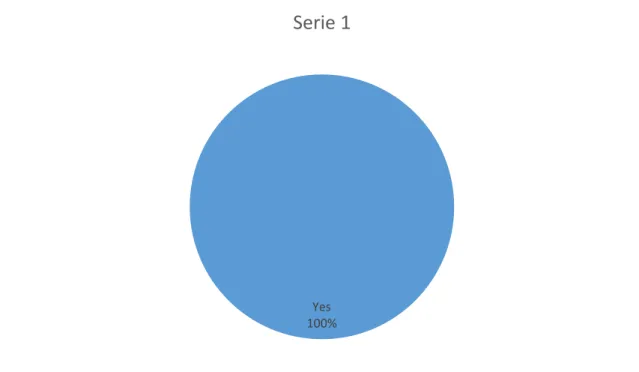
Graphic 1: Do you like learning English?
Source: students’ survey, Centro Ecuatoriano Norteamericano
The twelve students who did this survey indicated that they like learning
English. The no, and not so much options were not marked at all.
26 Graphic 2: How often do you do listening activities?
Source: students’ survey, Centro Ecuatoriano Norteamericano
In this graphic, we can notice that 42%of students checked the always option
as answer for this question, and the sometimes option was chosen for seven
students
Always 42%
Sometimes 58%
27 Graphic 3: Is it difficult for you when you do listening activities in your class?
Source: students’ survey, Centro Ecuatoriano Norteamericano
In this question, 8% of the students thought it is difficult, 67% of them thought
it is not difficult and the %25 of students thought that the listening activities are
not so difficult.
Yes 8%
No 67% Not so much
25%
28 Graphic 4: What kind of activities do you practice more?
Source: students’ survey, Centro Ecuatoriano Norteamericano
Source: students’ survey, Centro Ecuatoriano Norteamericano
This graphic shows that 16% of the students consider that the listening
activities are related to content learnt, 17% of them consider that the activity
they practice the most is the stories, and 67% of the students consider that the
listening activities they practice the most is songs. Content learnt
16%
Stories 17%
Songs 67%
29 Graphic 5: Does your teacher encourage the class to ask questions to your
partners?
Source: students’ survey, Centro Ecuatoriano Norteamericano
In this graphic, we can notice that out of the twelve students who did the survey,
92% of them thought that teacher encouraged them to make questions to their
partners, and 8% of the student does not think that the teacher encourages the
class to make questions to their partners. Yes 92% No
0%
Not so much
30 Graphic 6: How often do you practice making questions related to a listening
activity( stories, conversation)?
Source: students’ survey, Centro Ecuatoriano Norteamericano
This graphic shows that half of the class thought that they always make
questions related to the listening activities, and the other half of the students
do not think they always make questions related to the listening activities. Always
50% Sometimes
50%
31 Graphic 7: Does your teacher encourage you to practice different speaking
activities?
Source: students’ survey, Centro Ecuatoriano Norteamericano
In this questions, 36% of the students indicated that the teacher always
encourage them to practice different speaking activities, 55% of them thought
that the teacher sometimes encourage them to practice speaking activities, one
student does not think the teacher encourage them to do different speaking
activities , and one student did not answer this question. Always
36%
Sometimes 55%
Never 9%
32 Graphic 8: Is it difficult for you when you do speaking activities in your class?
Source: students’ survey, Centro Ecuatoriano Norteamericano
This graphic shows that 92% students thought it is not difficult at all when they
do speaking activities in class, and one student thought that it is not so difficult
when you do speaking activities in class. Yes 0%
No 92% Not so
much 8%
33 Graphic 9: What kind of speaking activities do you like more?
Source: students’ survey, Centro Ecuatoriano Norteamericano
58% of the students indicated that they like more the role-playing speaking
activity, and the other 42% of them indicated that they like more the
conversation activities.
Conversation 42%
Role playing 58%
34 Graphic 10 Do you receive the appropriate feedback from your teacher when doing a listening/ speaking activity?
Source: students’ survey, Centro Ecuatoriano Norteamericano
In this question, 92% of the students thought the teacher gives the appropriate
feedback after the speaking/ listening activity and one student thought that the
teaches does not really give them the appropriate feedback when they do this
activities.
Yes 92% No
0%
Not so much
35 Class observation 1
Put a check in the corresponding option
Yes No Sometimes
listening activities to
encourage students to
ask questions about it
partners questions in
English
Teacher praises
students for their
participation in the
speaking activities
36 Class observation 2
Put a check in the corresponding option
Yes No Sometimes
listening activities to
encourage students to
ask questions about it
partners questions in
English
Teacher praises
students for their
participation in the
speaking activities
37 Class observation 3
Put a check in the corresponding option
Yes No Sometimes
listening activities to
encourage students to
ask questions about it
partners questions in
English
Teacher praises
students for their
participation in the
speaking activities
38 Class observation 4
Put a check in the corresponding option
Yes No Sometimes
listening activities to
encourage students to
ask questions about it
partners questions in
English
Teacher praises
students for their
participation in the
speaking activities
39 Class observation 5
Put a check in the corresponding option
Yes No Sometimes
listening activities to
encourage students to
ask questions about it
partners questions in
English
Teacher praises
students for their
participation in the
speaking activities
40 Class observation 6
Put a check in the corresponding option
Yes No Sometimes
listening activities to
encourage students to
ask questions about it
partners questions in
English
Teacher praises
students for their
participation in the
speaking activities
41 Teacher’s interview
In the first question, the teacher said that the activities for developing listening
skills depends on the age of the group, she suggested activities like completing
a song or try to understand a movie without subtitles. In the second question, she made clear that students’ skills can be developed in different way, but
maybe role-playing can be a funny way to do as speaking activity. In question
number three, she indicated that listening and speaking were the abilities she
would like to develop in her students. In the next question, she indicated that
she, in fact, does listening and speaking activities. In question number five, she
mentioned that besides the book, she uses webpages because they provide
activities for developing other skills too, and some of them provide worksheets
to practice too. In question six, the role-playing and working in pairs about a
specific topic was the speaking activity she uses in the classroom. The next
question is about the listening activities she does, which are songs and
completing dialogues. Question number eight indicates what she does when a
students does not want to do the activity in class. She stops the class and make
a game to try to engage the students back in the activity. In question number
nine, she encourages students with posters around the classroom, and
phrases or words in English they want to know. Finally, in the last question, she
indicated that for her, between listening and speaking, listening is more
important than speaking.
3.5 Resources, Timetable and Budget
To prepare these instruments, the following materials were used:
42 Timeline
43 Budget
To finish this research, it was necessary the following budget:
DETAILS COST
Photocopies $ 4,00
Cds $2,00
Printed material $ 4,00
Internet $ 30,00
Transportation $ 100,00
44
CHAPTER 4
4. Final conclusion
4.1 Conclusions
This project has as purpose to identify students’ listening level and their oral expression. It also analyzes the effect of students’ listening skills improvement on their
speaking and the ability to communicate with their classmates and teachers.
The information gathered was useful for the researcher to be aware of the students’
listening skills, and the listening activities they like doing. Some of them like working with
songs, and some others like stories (for listening) and role-playing (for speaking), which
are the most common activities children at this age like doing. However, some students
find listening difficult when doing a listening activity because they do not understand what
they hear or because they do not do those activities so frequently. Although most of them
indicated that it is not difficult for them when speaking in English, through the observations
made, it can be noticed that they have trouble working with the speaking activities they had. Also, in the teachers’ survey, we could notice that those, in fact, are the activates
the teachers prepare for them but they give as much help as their students need when
working with them.
As it was mentioned in a previous chapter, that children are not really used to
listening things in English. This is because everyone around them speaks in Spanish, but
there are different activities teachers can use to help students to improve these two skills.
Hopefully, this project will provide educators with interesting activities for students
develop their listening and speaking and therefore their communicative skills.
To sum up, having good communicative skills is important. This is why, listening and
speaking play an important role in the communicative skill. All the activities done in class
that implement these two skills will help students in their communication process.
Teachers need to decide what the most suitable activity is for them to work with.
45 There were two problems that came up while doing this research. However, these
two obstacle did not impede it to finish.
One problem was that the Kids programs are only on Saturday mornings.
That means that I could only work with the children one day a week and only in the
morning.
The other problem was that when I first started doing the project I worked
with students in Kids Junior 1, and 2 weeks later, that course finished because the 10
weeks, which is the time each course lasts, were over. Then, students passed to Kids
Junior 2, and I could finished the research. This fact did not affect the project too much
because the age of the students is the same for all the Kids courses, and the students
were the same.
4.3 Recommendations
Every foreign language teacher wants their students to be able to communicate in
English. To reach that objective, it would be a good idea if teachers consider the following
suggestions.
Teachers need to prepare the correct speaking/ listening activity according
to the group they have. They need to consider the amount and age of the students
they have. If it is a large group, they can put students in groups and have them make
a draw of what they listen and then present their work to the class. Also, teachers
need to be aware that the activities they choose are related to the topic they are
learning, because we need to be aware that after all, the activities should be related
to a specific topic. They cannot just do an activity to speak or listen to something
without a purpose. They need to think of activities in which they can practice
vocabulary they are learning and reinforce knowledge like meaning and pronunciation.
If it a listening activity, they can choose a song or story in which, for example, they
46
Teachers also need to think of the activities students like the most and the
ones they will be able to accomplish. There could be one or more students that cannot
perform as well as their classmates, if this happens, educators have to be able to give
the appropriate feedback and encourage these children to do their best in the different
listening/ speaking activities they bring to class. It is important that teacher know students’ strengths and weaknesses so he/ she can work on them and choose the
correct activity for all of them.
Although, this is totally up to the institution and their schedule they offer for
its students, it would be a good idea, if classes to children were at least twice a week,
maybe in this way, students could improve their skills a little bit faster because they
will be exposed to the language more than just one day a week. This would help
students start getting used to listening to things and people talking in English, and they
could speak more often in class and reinforce their knowledge.
In conclusion, developing students’ listening and speaking skills depends on the
teachers, who are the ones that will always know their needs and will try to find the correct
47 Bibliography
Abrantes, M. (2006). Improving How Listening Skills Are Taught in the Efl Classroom.
Retrieved from:
Englishlistening.com. (2016). Educators. Retrieved from:
https://www.englishlistening.com/index.php/educators/
Englishcentral.com. (2015). The importance of Pronunciation for Language Learners.
Retrieved from:
https://blog.englishcentral.com/2015/02/22/the-importance-of-pronunciation-for-language-learners/
Explorable.com (2009). Quantitative and Qualitative Research. Retrieved from
48
Gilakjani, A & Ahmadi, M (2011). A Study of Factors Affecting EFL Learners' English
Listening Comprehension and the Strategies for Improvement. Retrieved from:
http://www.academypublication.com/issues/past/jltr/vol02/05/05.pdf
Sharma, N. (2011). Strategies for Developing Listening Skills. Retrieved from:
http://eltvoices.in/Volume1/Issue6/EVI16.2.pdf
Skillsyouneed.com (2011). Listening Skills. Retrieved from:
http://www.skillsyouneed.com/ips/listening-skills.html
The National Capitol Language Resource Center (2004). Strategies for Developing
Listening Skills. Retrieved from:
http://www.nclrc.org/essentials/listening/stratlisten.htm
The National Capitol Language Resource Center (2004). Strategies for Developing
Speaking Skills. Retrieved from:
http://www.nclrc.org/essentials/listening/stratlisten.htm
49
Vălimăreanu, E. (n.d). Speaking Strategies: Developing Communicative Skills in English.
Retrieved from:
http://english4pleasure.wikispaces.com/file/view/Speaking+Strategies.pdf
Wei, L (n.d), Teaching Listening in EFL Classrooms in Senior High Schools in Taiwan.
Retrieves from:
http://english.tyhs.edu.tw/xoops/html/tyhs/teach_source101/06plan.pdf
Woods, P. (2006). Qualitative Research. Retrieved from:
http://www.edu.plymouth.ac.uk/resined/qualitative%20methods%202/qualrshm.ht
Appendix 1
Students’ survey
Check the best answer for you
1. Do you like learning English?
Yes No Not so much
2. How often do you do listening activities?
Always Sometimes Never
3. Is it difficult for you when you do listening activities in your class?
Yes No Not so much
4. What kind of listening activities do you practice more?
Content learnt Stories Songs
5. Does your teacher encourage the class to ask questions to your
partner?
Yes No Not so much
6. How often do you practice making questions related to a listening activity
(stories, conversations)?
Always Sometimes Never
7. Does your teacher encourage you to practice different speaking
activities?
Always Sometimes Never
8. Is it difficult for you when you do speaking activities in your class?
Yes No Not so much
Conversation Rolle playing Other Specify
__________
10. Do you receive the appropriate feedback from your teacher when doing
a listening/ speaking activity?
Appendix 2
Class observation
Put a check in the corresponding option
Yes No Sometimes
Teacher
encourages students
to participate in class
Teacher works on
the different listening
activities given on the
listening activities to
encourage students to
ask questions about it
Teacher
motivates students to
answer questions in
English
Students practice
content learnt in class
Students ask their
partners questions in
Teacher praises
students for their
participation in the
Appendix 3
Teacher’s interview
1. What kind of activities do you think are more appropriate to develop students’ listening skills?
2. What kind of activities do you think are more appropriate to develop students’ speaking skills?
3. What English skills do you consider the most important to develop in
your students?
4. Do you implement listening and speaking activities with your students?
5. Besides the book, what other materials do you use in your English
class?
6. What speaking activities do you use in your classroom?
7. What listening activities do you use in your classroom?
8. What do you do when a student says he/she does not want to do the
9. What do you do to encourage all the students to ask and answer
questions in English?
Appendix 4 Pictures
REPOSITORIO NACIONAL EN CIENCIA Y TECNOLOGÍA
FICHA DE REGISTRO DE TESIS
TÍTULO Y SUBTÍTULO:
DEVELOPMENT OF LISTENING SKILLS IN THE ENGLISH CLASS TO IMPROVE THE ORAL EXPRESSION IN 8-10 YEAR OLD CHILDREN AT CENTRO ECUATORIANO NORTEAMERICANO AUTOR/ES:
Sara Elizabteh Villon Ramirez
TUTOR:
Xavier Torres Freres REVISORES:
PRESIDE:
MSc.
GiovanniFreireJaramillo;
MIEMBROS DEL TRIBUNAL:
MSc.
Lourdes GranizoVargasy Mtefl. Janeth Mora Zapater INSTITUCIÓN:CIENCIAS DE LA EDUCACIÓN- MENCIÓN INGLÉS FECHA DE PUBLICACIÓN: No. DE PÁGS: TÍTULO OBTENIDO:
LICENCIADA EN LENGUA INGLESA MENCIÓN EN ENSEÑANZA Y ADMINISTRACIÓN DE SISTEMAS EDUCATIVOS EN TEFL
ÁREAS TEMÁTICAS: EDUCACION PALABRAS CLAVE:
RESUMEN:
El propósito de este proyecto de investigación es analizar el efecto del desarrollo de las habilidades auditivas en la producción oral en niños de 8-10 años en el Centro Ecuatoriano Norteamericano. Para los profesores de inglés, es importante que sus estudiantes sean capaces de entender lo que se dice en clase y de hablar en el idioma q se está aprendiendo. Por esta razón, se han realizado evaluaciones de todos los instrumentos de investigación para llevar a cabo este proyecto los cuales son importantes para desarrollar esta investigación. Además, la población de muestra para esta investigación se basó en doce estudiantes en un programa de niños: y el objetivo era ayudarles a desarrollar su habilidad de hablar en inglés. Las técnicas aplicadas fueron encuestas a los estudiantes para obtener información sobre lo que hacen en clase, observaciones y una entrevista a uno de los maestros a cargo de los estudiantes en este programa. El análisis de los datos se basó en el desempeño del alumno en clase con las actividades que realizaron, y la entrevista del maestro, que proporcionó
influencia de las habilidades auditivas en la expresión oral de los niños en esta institución. No. DE REGISTRO (en base de datos): No. DE CLASIFICACIÓN:
DIRECCIÓN URL (tesis en la web):
ADJUNTO PDF: x SI NO
CONTACTO CON AUTOR/ES Teléfono: 2-84-69-73 E-mail:
[email protected] CONTACTO EN LA INSTITUCIÓN: Nombre: Ab. Michelle Vargas Aguilar
Teléfono: 2596500 ext. 221 E-mail: [email protected] x
U
R K U N D
Sources included in the report:
ESCUELA DE LENGUAS Y LINGUISTICA, JACOME RIVERA WENDY_JACOME RIVERA WENDY.doc (D15316012)