
Reflection about the importance of personal values through fables in the EFL classroom
136
0
0
Texto completo
(2) REFLECTION ABOUT THE IMPORTANCE OF PERSONAL VALUES THROUGH FABLES IN EFL CLASSROOM 2. REFLECTION ABOUT THE IMPORTANCE OF PERSONAL VALUES THROUGH FABLES IN THE EFL CLASSROOM. A research study presented as requirement to obtain the degree of Bachelor in English Language Teaching. Thesis advisor: Ángela María Gamboa González. Corporación Universitaria Minuto de Dios Faculty of Education Bachelor in Foreign Language Teaching Bogotá.
(3) REFLECTION ABOUT THE IMPORTANCE OF PERSONAL VALUES THROUGH FABLES IN EFL CLASSROOM 3 Acknowledgements. We would like to thank god for giving us wisdom, patience and strength during the development of this research. And also we are really grateful with our families who supported us during the whole process. They look after us and they gave us strength to move on so that we never give up. In addition, we really appreciated the tutor’s help because she always encourages and gives us new ideas so that our project will be the best that is why we want to say thank you Professor Ángela Gamboa, for your dedication, patience and knowledge in order to help us carry out this project. Indeed, we want to thank students who participated in this project as well as the school where students come from. They were really important so that this research was made successfully. Finally, we thank our professor Mary Luz who helped us to understand different concepts that worked on this project, likewise we appreciate all the professors because thank to their knowledge we could finish this research. Lastly, we appreciate our university which allowed us to develop it with its support..
(4) REFLECTION ABOUT THE IMPORTANCE OF PERSONAL VALUES THROUGH FABLES IN EFL CLASSROOM 4. Abstract Nowadays, students in the educational environment have different problems related to interpersonal relationships that involve their attitude and behaviors among students and even towards their teachers, those behaviors affect the successful learning process of students. Therefore, it was necessary to implement a plan that helped students to improve their relations and promote a favorable coexistence. For that reason, this qualitative study was carried out at Colombo Latino School with thirty students of fourth grade who participated in order to determine, if fables might contribute to generate a reflection about the importance of personal values. With the aim to improve students´ behavior among them and towards their teacher, this study was carried out through the implementation of fables using the pre, while and post reading activities. Finally, the data gathered through the different research instruments evidenced that students generated a reflection through a process in which they recognized the consequences of bad actions, they were aware that they have behaved inappropriately in their lifetime and finally they reflected about those behaviors understanding what they should do in different situations. Key words: Socio-affective dimension, personal values, fables..
(5) REFLECTION ABOUT THE IMPORTANCE OF PERSONAL VALUES THROUGH FABLES IN EFL CLASSROOM 5. Resumen En la actualidad, los estudiantes en el entorno educativo tienen diferentes problemas relacionados con las relaciones interpersonales que incluyen su actitud y comportamiento entre los estudiantes e incluso hacia sus profesores, estos comportamientos afectan el proceso exitoso de aprendizaje de los estudiantes. Por ende, fue necesario implementar un plan que ayudara a los estudiantes a mejorar sus relación y fomentar una convivencia favorable. Por esta razón, este estudio cualitativo fue llevado a cabo en el colegio Colombo Latino con treinta estudiantes de grado cuarto quienes participaron para determinar, si las fábulas podían contribuir para generar una reflexión acerca de la importancia de los valores personales. Todo eso, con el objetivo de mejorar el comportamiento entre ellos y hacia su profesora, esto fue llevado a cabo a través de la implementación de las fabulas usando actividades previas, durante y después de la lectura. Finalmente, la información recolectada a través de diferentes instrumentos de investigación evidenciaron que los estudiantes generaron una reflexión a través de un proceso en el cual ellos reconocieron las consecuencias de las malas acciones, fueron conscientes que ellos se han comportado inapropiadamente en algunas situaciones en diferentes contextos y finalmente reflexionaron acerca de esos comportamientos entendiendo que deben hacer en diferentes situaciones. Palabras clave: Dimensión socio- afectiva, valores personales, fábulas..
(6) REFLECTION ABOUT THE IMPORTANCE OF PERSONAL VALUES THROUGH FABLES IN EFL CLASSROOM 6. Table of Contents Introduction ........................................................................................................................ 10 Chapter I ............................................................................................................................. 13 Justification ......................................................................................................................... 13 Statement of the problem ............................................................................................... 16 Research question ........................................................................................................... 18 Objectives ............................................................................................................................ 19 General objective ............................................................................................................ 19 Specific Objectives .......................................................................................................... 19 Chapter II ............................................................................................................................ 19 Literature Review ............................................................................................................... 19 Theoretical Framework ..................................................................................................... 26 The socio-affectiveness in EFL classroom .................................................................... 26 Values ............................................................................................................................... 29 Personal Values. .......................................................................................................... 31 Fables ............................................................................................................................... 33 Chapter III .......................................................................................................................... 34 Research Design .................................................................................................................. 34 Research paradigm ......................................................................................................... 35 Qualitative research. ................................................................................................... 35 Research approach ......................................................................................................... 36 Action research ............................................................................................................ 36 Setting .............................................................................................................................. 41 Participants...................................................................................................................... 41 Purposive Sampling ........................................................................................................ 43.
(7) REFLECTION ABOUT THE IMPORTANCE OF PERSONAL VALUES THROUGH FABLES IN EFL CLASSROOM 7 Data collection instruments............................................................................................ 44 Interviews ........................................................................................................................ 44 Informal conversational interview............................................................................. 45 Field notes ........................................................................................................................ 46 Students Journals ............................................................................................................ 48 Documentary evidence/ Students’ artifacts .................................................................. 50 Chapter IV .......................................................................................................................... 51 Instructional design ............................................................................................................ 51 Vision of language ........................................................................................................... 54 Vision of learning ............................................................................................................ 55 Analytical learning .......................................................................................................... 56 Vision of classroom ......................................................................................................... 57 The classroom as a school of autonomy. ................................................................... 57 Lesson Planning .................................................................................................................. 59 Session N° 1...................................................................................................................... 59 Session N° 2...................................................................................................................... 60 Session N° 3...................................................................................................................... 62 Session N° 4...................................................................................................................... 64 Session N° 5...................................................................................................................... 65 Session N° 6...................................................................................................................... 68 Chapter V ............................................................................................................................ 70 Data Analysis ...................................................................................................................... 70 Category 1: “Doing bad things brings consequences” .................................................... 74 Subcategory 1.1: “Recognizing bad actions” ............................................................ 75 Subcategory 1.2: “Being aware and reflecting of bad actions” .............................. 78 Category 2: “Relating my life to the fables” .................................................................... 80 Subcategory 2.1: “Comparing the fables with their experiences” .......................... 81 Category 3: “Improving my relationships and behaviors from the moral” ................. 86.
(8) REFLECTION ABOUT THE IMPORTANCE OF PERSONAL VALUES THROUGH FABLES IN EFL CLASSROOM 8 Subcategory 3.2: “Proposing solutions” .................................................................... 90 CHAPTER VI ..................................................................................................................... 94 Conclusions and Implications ............................................................................................ 94 Relevant findings............................................................................................................. 94 Research question answers ............................................................................................ 97 Implications ..................................................................................................................... 98 Limitations of the Study ............................................................................................... 101 Further Research .......................................................................................................... 103 Appendices ........................................................................................................................ 105 Apppendix A: Consent letter for principals ................................................................... 105 Appendix B: Consent letter for parents ......................................................................... 107 Appendix C: Consent letter for students ........................................................................ 109 Appendix D: Format field note ....................................................................................... 111 Appendix E: Students´ journal........................................................................................ 114 ............................................................................................................................................ 114 Journal 5: session # 5 ........................................................................................................ 117 Students´ journal .............................................................................................................. 117 Student # 15 ....................................................................................................................... 117 Appendix F: Students´ artifacts ...................................................................................... 119 Appendix I: Students´ artifacts ....................................................................................... 122 Appendix J: The Fox and the Stork ................................................................................ 123 Appedix K: The Shepherd who Cried ‘‘Wolf!’’ ............................................................ 124 Appendix L: The Ant and the Grasshopper .................................................................. 125 Appendix M: The Lion and the Mouse........................................................................... 126 Appendix N: The Tortoise and the Hare ........................................................................ 127 Appendix O: The Frogs who Wanted a King ................................................................ 128 References.......................................................................................................................... 129.
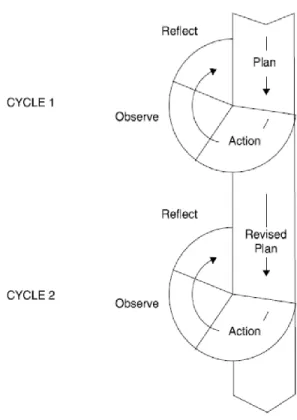
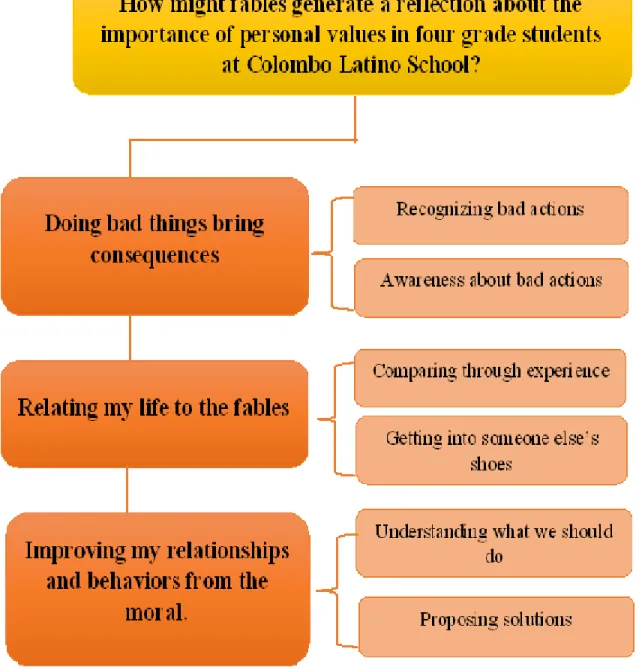
(9) REFLECTION ABOUT THE IMPORTANCE OF PERSONAL VALUES THROUGH FABLES IN EFL CLASSROOM 9 Table of Figures Figure 1 Cyclical AR model based on Kemmis and Mcaggart (1988) Figura 2 Categories..
(10) REFLECTION ABOUT THE IMPORTANCE OF PERSONAL VALUES THROUGH FABLES IN EFL CLASSROOM 10 Introduction The aim of this document is to show readers a research project which involved the teaching of personal values during the English classes so that, students were conscious of their attitude, and behavior, and they could learn much more than a foreign language. According to Morales and Ferradas (2007) ‘‘quality education involves much more than great language teaching, it involves educating the whole person’’ (p.4). Therefore, it can be said, the education and specifically the English classes should keep in mind different aspects, which means, not only the language focus, but also the needs and problems that happen in the English classroom Thus, it is important to teach values, not just for the academic field, but also for students´ life. Hence, Jimenez (2008) stated that ‘‘for the well-being of a community, it is necessary to have shared rules that guide the behavior of its members, otherwise the community will not function satisfactorily for the majority’’ (p.4). This means that people should have the same rules in other words values because they allow people to behave appropriately in different contexts in order to have a good relationship and coexistence within society. Furthermore, if teachers can teach values, students probably develop their abilities, their capacities, and increase knowledge during the learning process, as well as it is important that they learn to be well-rounded people; this means, that they learn and put into practice the values that make people behave properly inside the society in which they are immersed. Hence, the purpose of this research was that English classes had a different.
(11) REFLECTION ABOUT THE IMPORTANCE OF PERSONAL VALUES THROUGH FABLES IN EFL CLASSROOM 11 contribution to learning English as a foreign language in order to integrate knowledge with values education through fables so that, English classes may offer students something that goes beyond and contributes to their lives. Additionally, students might have good relationships and they might analyze several situations according to their thoughts and reflections. For that reason, it is very important the use of fables in the development of the personal values because fables use different reflective messages so that, students take them into account and they might reflect about their actions in their own lives. From researchers' experience, as students and teachers, we can conclude that values’ training does not have the importance it should have in education. For that reason, different behavioral problems happen in some schools because it is given more importance to the language knowledge than values. The issue previously mentioned, could be noticed during some observations that researchers did at Colombo Latino school where there were not values promoted in the classroom; as a result, fourth grade students have not developed good relationships among them; thus, disputes, disrespect and intolerance arise in the class due to the lack or weakness of values; for that, reason the learning process of students was affected and the interpersonal relationships too. To start with this research, in the first chapter, you will find the justification, then the statement of problem, which includes, the research problem and the relevance of this project. In the same chapter, the reader will find the general research question and the objectives which established the starting point of this project..
(12) REFLECTION ABOUT THE IMPORTANCE OF PERSONAL VALUES THROUGH FABLES IN EFL CLASSROOM 12 In the second chapter, it is found the literature review in which there are three studies that support our project. These helped us to find and know what differentiates us from other projects. In the second part of this chapter, you will find the theoretical framework where the socio affective dimension is defined as well as the type of values, and specifically the values that we chose for this research, the personal values. In the third chapter, the paradigm this research belongs to, is presented and the approach through which was developed it. Also, there will be the descriptions of the participants, including their ages, the amount of students, their English level, and so on; another aspect of this chapter is the description of the setting. Moreover, the data collection instruments used to collect data are explained. In this part each instrument is defined in a detailed way. Also, it is explained why we chose them and how we used them during this research because it is really important to clarify what we did during the whole process in order to know what students thought and did. Next, in the fourth chapter the reader will find the instructional design which includes the activities proposed for each class, and how each activity was done regarding the use of fables as a tool to teach values in English as a foreign language classroom. Furthermore, in the fifth chapter, you will see the data analysis, and all the information we found during the implementation of the activities with the use of the instruments that we chose. In the sixth chapter, the reader will find the conclusions; they were divided in relevant findings and the research questions answers, as well as the.
(13) REFLECTION ABOUT THE IMPORTANCE OF PERSONAL VALUES THROUGH FABLES IN EFL CLASSROOM 13 pedagogical implications. Finally, in this document, the reader will find the limitations and further research.. Chapter I Justification Throughout our experience, we have noticed that in English classes; several language skills are usually developed so that students can speak holistically the language which is an important aspect for Colombian education. However, based on the observations we did, it was evident that students do not pay attention since they keep on fighting, screaming, hurting themselves by using bad words, and so forth. Likewise, a research about scholastic violence in Bogotá, in 2006 carried out by ‘‘Secretario de Gobierno de Bogotá’’ in collaboration with ''la Universidad de los Andes'' and ''DANE'' found that ‘‘one of three students have been victims of punches and physical mistreatment by his/her partners in the school (32%); towards the victims one of two, insulted a partner in the year before (46%), and one of three, offended and punched another partner (32%)’’(as cited in Arenas, Hincapié, & Gutierrez, 2008, p.10). It can be said, based on the previous statistics that in Colombia there is a great number of violence issues in classrooms. However, if problems are fixed from the English class environment, the situation may change in favor of the national education. Furthermore, not only through teaching grammar rules, vocabulary, and all the aspects related to English language should be enough for improving children’s education, but English classes should.
(14) REFLECTION ABOUT THE IMPORTANCE OF PERSONAL VALUES THROUGH FABLES IN EFL CLASSROOM 14 have another contribution to students’ lives, that is, English teachers should inquire about what needs and problems students might have; those that are not associated to the language but about their personal contexts in order to improve them through the English class. Bearing in mind the previous statements, it may be said that affairs related to behavior are one of the most common problems upon the classroom. Every student has different ways to communicate, think and behave; for that reason, many of them experience problems in the classroom since they have different points of views which might not be taken into account by other students. Hence, the problem is the way they intend to solve them and in fact, we as teachers we can still do something because behavior can be modified during their development; even more when students are very young. Therefore, behavior can be improved so that there are fewer misunderstandings in students’ personal and academic life. Sometimes students feel jealous, envy, and apathy to other classmates; consequently, those kinds of behaviors make people violent where big consequences may be experienced by students. Therefore, students’ behavior might say much more about who they are. On the way students often act, you can know what kind of students they are; this means that the way they speak, express themselves and behave can reflect their personality and everything surrounded them, because according to the observations we did at Colombo Latino School, it was reflected that students were disrespectful, and also they were aggressive among themselves. For that reason, in English classes, teacher should try to improve those problems so that English classes might be better, but above all students can strengthen their.
(15) REFLECTION ABOUT THE IMPORTANCE OF PERSONAL VALUES THROUGH FABLES IN EFL CLASSROOM 15 socio affective dimension and specially their personal values (which come from this dimension) so that they are less discourteous and more critical and aware of their acts. Moreover, according to United Nations (2003) ‘‘Every society needs to be bound together by common values, so that its members know what to expect of each other, and have some shared principles by which to manage their differences without resorting to violence’’ (p.9). Hence, in this case students should have the same or similar values so that they avoid fighting, that is, students should take into account the personal values because these values promote the elemental, but important values such as the respect, responsibility, honesty, etc. Now, in order to work the personal values; we considered as a suitable resource the use of the fables. Fables are moral tales, often involving animals that represent people. They reveal human experiences and/or show conflicts over issues. They are generally short and concise stories (Detlor, 2001, p.5). Therefore, if we want to promote the personal values, the fables are indicated because they are striking for young learners because they have interesting characters as well as they are short and bring a reflection. Besides, working with fables enables children to build literacy, build ethical and moral development, build classroom community, develop an understanding of metaphor and translate ethical issues into real life (Detlor, 2001, p.5). In that way, young learners are not only entertained, but also they may develop other skills related to language and their acts. And eventually, if personal values are promoted through the fables, students will probably be more conscious of their actions and their speech in order to avoid problems and.
(16) REFLECTION ABOUT THE IMPORTANCE OF PERSONAL VALUES THROUGH FABLES IN EFL CLASSROOM 16 students would not be disrespectful with the people around them because the most of students are impolite, that is, they say some bad words or fight among them and so forth. Although, English classes should contribute to learn another language (different to the native language), this does not mean that teachers should be only focused on the learning of another language, but also as we should notice the different problems or needs that students have in the class, for example, if students have bad behaviors, teachers can investigate why or simply how they can improve that so as to have a better environment with a specific aim and students will have an enriching education. Statement of the problem In the learning process of students it is important to create a favorable environment in the educational context and in the classroom as well, an environment in which students can feel well and comfortable with the teacher and also with other students in order to develop and promote good relationships among the people that are involved there. According to Harecker (n.d) “the aim of values education is to encourage young people’s awareness of having values and their corresponding relationship to the world in which they live” (p.1). Hence, this research project arose due to the necessity to improve the social relationships among the members of an educational context. Furthermore, the research problem of this project emerged when in the English class was evidenced that a favorable environment was not promoted. Based on some observations that researchers did at Colombo Latino School specifically in fourth grade it was evidenced that students had a bad behavior towards the teacher and among them. On the one hand, those problems.
(17) REFLECTION ABOUT THE IMPORTANCE OF PERSONAL VALUES THROUGH FABLES IN EFL CLASSROOM 17 affected the successful learning process of students because the classes were interrupted all the time for those behaviors. On the other hand, good relationships among students were not promoted. The inappropriate behaviors that students had with the teacher and among them were that they were not respectful and during the English class they were aggressive and impolite, in spite of that the teacher did not say anything. Besides when the teacher told something to students they answered inappropriately. Those students´ behaviors may be due to the lack or weakness of values. Azmitia, Margarita, and Gewirtz (1992) state that “values, together with motivations, are forms that determine the thinking and behavior of people” (quoted in Baena, Martínez, Soto, Martínez, & Restrepo, 2009, p.126). Therefore, the values help us to recognize our behavior in difficult situations where we are not able to keep calm and we have to bear in mind the values because those allow us to have good relationships within the society determining the kind of person that we are. Therefore, it is necessary that schools take into account the problems related to behavior and think about any strategy in order to solve them, because it is really important to educate students as well- rounded individuals, not only teach them knowledge about any field such as mathematics or sciences, but also, teach them values that will be useful for their lives and can make them better people. All in all, different researches such as Arrieta, Beleño and Villa´s research (2015) and Campuzano, Granda, and Herrera (2014) have been carried out about the development of values in order to improve the relationships and coexistence. But, we noticed that it has not.
(18) REFLECTION ABOUT THE IMPORTANCE OF PERSONAL VALUES THROUGH FABLES IN EFL CLASSROOM 18 been worked from the language teaching, therefore it is relevant to work on values in other areas such as in English class in order to contribute to the development of integral people able to live in harmony in different contexts. Finally, this study aimed to contribute in first instance to students that were involved in the problem identified in order to improve the relationships among them and also strengthen their personal values that are important in their whole life to coexist in different contexts, however the researchers also wanted that this project benefit the participants’ parents with the purpose of they understood the importance of reinforcing the values of their children. Besides, the educational community in this case Colombo Latino School could implement the strategies in the different areas to foster and strengthen the values of all students, and as a result improve the relationship of the whole community. Furthermore, another benefit of this research was to demonstrate to the educational community that values could be developed from any knowledge field. Last but not least, we as researchers wanted to know how from a foreign language teaching we could work on the different social problems that happen in the daily life such as violence, social inequality, discrimination and so forth.. Research question How might fables generate a reflection about the importance of personal values in EFL classroom with fourth graders at Colombo Latino School?.
(19) REFLECTION ABOUT THE IMPORTANCE OF PERSONAL VALUES THROUGH FABLES IN EFL CLASSROOM 19 Objectives General objective To determine the possible contributions of fables to reflect about the importance of personal values in EFL classroom with fourth graders at Colombo Latino School.. Specific Objectives 1. To explore the kind of fables that can be used according to the project’s purpose. 2. To describe the process students have to achieve awareness and reflection through. fables. 3. To analyze the students’ reflections after the implementation of fables.. Chapter II Literature Review In order to strengthen the students’ values to promote a favorable environment and good relationships among them, some researches have been developed. These studies that are going to be described below implemented strategies and methodologies, in order to demonstrate that through fables students could strengthen and develop their values as well as the development of useful skills in personal and academic fields. The first research involves the development of values in students of first grade at Docente de Turbaco School. Arrieta, Beleño and Villa´s research (2015) was developed in.
(20) REFLECTION ABOUT THE IMPORTANCE OF PERSONAL VALUES THROUGH FABLES IN EFL CLASSROOM 20 Cartagena and their general objective was to develop pedagogical strategies based on stories, fables and myths in order to promote values in students. The specific objectives were in first place, to determine the possible cause of behavior in first grade students. The second objective was to describe the pedagogical strategies that may strengthen some values in students. Finally, the third one was to implement the strategies through storytelling of fables and myths. Furthermore, their research was developed because they could identify that in those schools students had inappropriate behaviors which generated violence and verbal and psychological mistreatments, as a result the environment was not appropriate to develop a successful learning process. Therefore, Arrieta et al (2015) wanted to strengthen the values in students such as respect, tolerance, love, friendship among others in order to create appropriate environments and tools to improve the relationships among them. Moreover, this research used the case study and qualitative approach and they based on Ovidio Decroly´s ideas in which the respect and personality of children are important to prepare them to live in freedom. In addition to that, the methodology that was carried out in their research was to implement some activities and ludic strategies such as storytelling, puppetry, dramatization and drawings. For that, they created different reading spaces in which students could choose different texts and they discussed about them, for each activity the researchers implemented one or two values through different texts..
(21) REFLECTION ABOUT THE IMPORTANCE OF PERSONAL VALUES THROUGH FABLES IN EFL CLASSROOM 21 The results of the previous research were positive because they achieved the awareness of students, parents and teachers about the necessity to strengthen values in students. Besides, promoting values could guarantee a successful environment for a good learning development and peaceful coexistence of students and finally, through those activities parents and teacher could participate in order to build up values in students. Likewise, as Arrieta et al (2015) the project that was carried out aimed to generate awareness about the importance to strengthen values in students and do a collaborative work among the members of the educational contexts and also the family because they play an important role in values education. Moreover, the most important aims were to strengthen their values; so that students could be better people and also, it was to create a favorable environment, thus students could coexist better in the entire context that they were immersed. The contribution of Arrieta et al research (2015) is the methodology that they implemented because the activities were creative and suitable for participants, as well as they used of dramatizations, puppetry and activities that involved painting and drawing. Besides, they promoted for each activity values and chose a fable related to that value hence, it was a proper way to strengthen values in students. What is more, in all the activities they involved all students and promoted the cooperation and tolerance so, it made that the environment was favorable promoting an appropriate coexistence among them..
(22) REFLECTION ABOUT THE IMPORTANCE OF PERSONAL VALUES THROUGH FABLES IN EFL CLASSROOM 22 Finally, the differences between Arrieta et al (2015) and this research are on the one hand, it was not implemented with the fables but also, myths and storytelling and this research just implemented fables because of the moral that it provides us. On the other hand, Arrieta et al (2015) project was not implemented in the English classroom; therefore, it makes that this research different because besides fostering the personal values also this research aimed to develop some skills in English learning. In contrast, there is another study that was done in Praga, Czech Republic and it is called ‘‘The Role of Values in Teaching’’ by Štika (2012). In this study, he wanted to reflect about the importance of teaching values, so the first problem he found in Praga was ‘‘many teachers feel unprepared to teach values, which is one of the causes of frequent reliance on the hidden curriculum’’ (Štika, 2012, p.12). Therefore, his objectives were to examine the role of values in teaching as seen by Czech teachers as well as to find out what importance Czech teachers attribute to moral values in teaching and planning. Štika’s research was qualitative and his approach was phenomenology. He used the anonymous questionnaire and interviews in order to know if teachers really did not feel safe to teach values because they did not know it, and also if teaching values was important in school education, besides if they had prior knowledge about the values and finally which values were the most relevant issue. As a result, in the Štika’s research teachers from higher levels of education exhibited a strong tendency to select self-direction that is a type of values from Schwart (2005). Most of the teachers in his research said that the teaching values is really important part in their.
(23) REFLECTION ABOUT THE IMPORTANCE OF PERSONAL VALUES THROUGH FABLES IN EFL CLASSROOM 23 occupation and finally other fact is that ‘‘It is especially true of teachers in lower levels of education such as elementary schools or pre-schools with university teachers showing the lowest willingness to acknowledge that values are important in their courses” (Štika, 2012, p.39). Therefore, teachers who teach in basic primary and other low courses do not take into account the importance of teaching values, although the teaching of values should be the priority in those types of courses, because the students’ personality and characteristics are built up in the first years of their life. So, it can be said that the greatest contribution of that project to this one is that the teaching of values is really relevant within curriculum, and also teachers should know the importance of working on values, since these allow people to create a new thinking and reflection about what values mean in general for the education because nowadays, values should be important inside school so that Colombian students have self-awareness about their behavior during this time because they have created high levels of violence and disrespectful actions towards other people. Indeed, if teachers promote values teaching, students will be more aware, and they can behave better within this society. Although, some teachers do not have absolute knowledge of this field, it is through their experiences they can teach and present them in their classes. Hence, Štika’s research (2102) is great support to make public the implementation and development of values because it is extremely important in the students’ lives and education itself. And lastly, the other study is related to the socio affective dimension which encompasses different aspects such as the values, personality, thinking, relationships and.
(24) REFLECTION ABOUT THE IMPORTANCE OF PERSONAL VALUES THROUGH FABLES IN EFL CLASSROOM 24 also, emotions. Therefore, those aspects need to be worked in order to develop students as well- rounded individuals. In contrast to the research above, the research of Campuzano, Granda, and Herrera´s research (2014) called “dificultades socio afectivas de los niños y las niñas del hogar infantil Travesuras” carried out in Bello, Antioquia, was developed in order to promote in students the socio affective dimension more specifically emotions and the capacity to socialize, because the researchers could identify that in that kindergarten children had difficulties establishing relationships and expressing their feelings and thoughts because of different problems related to violence because the kindergarten is located in a neighborhood of Bello, Antioquia in which there were social problems related to delinquency as a consequence, the environment did not allow those children to develop the socio affective dimension in an appropriate way. As objectives, Campuzano et al research (2014) proposed, first; to identify the teacher´s role importance facing the socio-affective development, second, to observe the positive and negative conditions about the socio affective environment and finally, to evidence the importance of socio affective dimension in the integral development of children. The design of this research was action research with a qualitative approach to collect data. Additionally, Campuzano et al research (2014) took into account Maria Montessori´s model due to the importance of its ideas in the learning environment. Furthermore, the methodology was carried out through different didactic activities promoting the cooperation among children and participation too, this methodology had different phases; the first one.
(25) REFLECTION ABOUT THE IMPORTANCE OF PERSONAL VALUES THROUGH FABLES IN EFL CLASSROOM 25 was, awareness in which researchers socialize the project to teachers and parents, the second one was, training in this part the action plan to solve the problem was shared and the third one was, implementation phase in which the activities were carried out and finally, projection phase the results were shared. The conclusions of Campuzano et al research (2014) were that the activities carried out allowed creating favorable spaces in which students could build up relationships and were able to express their feelings and thoughts. Additionally, those activities allowed them to strengthen the learning process of children as well- rounded people. All in all, Campuzano et al research (2014) contributed to this research in the implementation of the different phases to carry out the methodology because it was an appropriate way to do it, it made the methodology organized and it could integrate the different members of the specific context such as teachers and parents and also it allowed sharing the strategies that were used in order to solve the problem; as a result, all members could participate during the whole process. Lastly, the difference between Campuzano et al (2014) and this research is the problem identified because it was about students had difficulties expressing their feelings, emotions and socializing; those aspects make part of the socio-affective dimension. Furthermore, this research was focused on generate a reflection about the importance of personal values of students in order to improve their interpersonal relationships. Thus, unlike Campuzano et al research (2014) the participants of this research were not able to.
(26) REFLECTION ABOUT THE IMPORTANCE OF PERSONAL VALUES THROUGH FABLES IN EFL CLASSROOM 26 express their feelings and also they had behavioral problems in the classroom because they had lack of values that allow them to socialize and coexist properly. Theoretical Framework In this theoretical framework, the constructs which involve this research will be defined, all of that in order to clarify the specific concepts which allowed us to address our problem. The first construct to be defined is the socio affective dimension, in this construct there are several aspects like personality, self-esteem, relationships, ethic, moral and values. For that reason, the values were selected and they fit perfectly with the problem and the purpose of this research. In addition, we are going to define what fables are so that reader can notice its importance during this project. Furthermore, in the first instance, you are going to find the socio affective dimension where the values and other aspects come from. The socio-affectiveness in EFL classroom. The socio-affective dimension is really important for the development of children from an early age that is why this research wanted to work on this dimension so that students have a favorable development and training within their academic process. However, to carry it out in this research it is necessary to define this construct properly and for that reason there will be different points of views in order to describe and highlight the most important aspects of this dimension in the classroom. Firstly, it is essential to know what the socio affective dimension is and for this the Ministry of National Education of Colombia (2002) states that:.
(27) REFLECTION ABOUT THE IMPORTANCE OF PERSONAL VALUES THROUGH FABLES IN EFL CLASSROOM 27 The socio - affectivity implies facilitating the expression of emotions, also the anger, rage, fear, crying, as well as wellness, joy, love, enthusiasm, give children security in their actions, providing the opportunity to choose, decide and evaluate within a relationship of mutual respect, acceptance, voluntary cooperation, freedom of expression, appreciation of their own values and solidarity and participation, it is part of the training for life, because it allows children to create their own scheme of moral convictions and ways of relating to others (Translated quotation that appeared in the paper: Lineamientos curriculares, p.17). From the above, the Ministry of National Education emphasizes that the socioaffective dimension contributes to the formation of the children's personality, because it involves their emotions, thinking and relationship with others. As a result, children’s behaviors allow knowing how they are treated; for example people who are around them are models so that children learn from them, because it is here where students are able to recognize themselves and the emotions of others. Consequently, since our experience as teachers and students, the relationship between teachers and parents are involved in the children's behavior that is, if parents are aggressive and use an impolite language, most of the children will do the same. Lastly, the emotional part is suitable for their development. As a result, the affective part involves an effective learning because of the interactions between teacher and student and also among students, for that reason the use of the affective part is a good strategy so that they might learn together, that is, collectively. This.
(28) REFLECTION ABOUT THE IMPORTANCE OF PERSONAL VALUES THROUGH FABLES IN EFL CLASSROOM 28 factor provides students to discover how to work as a team and also they can develop social skills and build their behavior and personality. In addition, the National Association of Geosciene Teachers (NAGT, n.d) states ‘‘the socio affective dimension includes factors such as student motivation, attitudes, perceptions and values. Teachers can increase their effectiveness by considering the affective domain in planning courses, activities, and assessing student learning’’ (p.2) Thus, it refers that the affectivity in the classroom includes the motivation, for example, how the teacher is able to encourage students to make learning effective. It can be said that the activities that are done in the classroom are related to the development of this dimension, where students have the opportunity to be outgoing and also know their values through their life experiences. Besides, the affective part in the classroom carries out the recognition of virtues and qualities for the interpersonal and intrapersonal relationships. As a result, Habte (2009) mentions that ‘‘it involves stimulating learning through establishing a level of empathy between the teacher and student. It includes considering factors such as emotions and attitudes’’ (para.4). It means that education not only involves the cognitive development in which students enrich their knowledge in specific subjects, but also education, especially in the classroom can contribute to the children’s relationship, for example the teamwork, their thoughts, emotions, feelings which drive their behavior and also students are more aware of their actions and they are more responsible and autonomy people..
(29) REFLECTION ABOUT THE IMPORTANCE OF PERSONAL VALUES THROUGH FABLES IN EFL CLASSROOM 29 Furthermore, the social side of the student is important not only to develop the body and verbal communication, but also for increasing the confidence, the self-reliance, among other characteristics that help the student to succeed in their life, as Patrick (2003) states “To understand students’ success at school, therefore, we must attend to their relationships with others at school and ways that the environment promotes different types of social interactions and relationships” (p.9). As a consequence, the social relationships allow children to have success in life so it is important the development of the effective part in the classroom. Maintaining a social environment makes students interact not only to know themselves but also to know others and to recognize their feelings, thoughts, and so on. In conclusion, the socio-affective encompasses different factors such as the development of the personality, the behavior and how children can think, feel and even as the way children act. For that reason, this study wants to be more specific in order to develop a specific socio-affective characteristic that in this case are personal values. So, personal values will be defined in the next stage. Values In human development, values fulfill different fields; one of them is the individual motivational goals. Values form and develop in interaction with others, while the surrounding environment contributes to variability across cultures and changes across time (Brosch & Sander, 2015, p.35). Therefore, it can be said that values start from different fields such as personal, family, cultural, among others. The role of values in everyday life is related to the interaction with each other, as well as the values can be considered and.
(30) REFLECTION ABOUT THE IMPORTANCE OF PERSONAL VALUES THROUGH FABLES IN EFL CLASSROOM 30 constructed through secondary factors, such as the environment where the person lives, the people around him or her as well as his/her cultural background. “Values guide the selection or evaluation of actions, policies, people, and events, but people decide what is good or what is not, justified or illegitimate, worth doing or avoiding, based on possible consequences for their cherished values” (Schwartz, 2012, p.3). As a result, values imply that individuals are aware and critical people according to their actions and mindsets, in order to know what is good and bad, that is, values help the individual to deliberate or in other words, values are a guide that allows the individual to make the right decisions according to what they think that is right. “Talking about values is often about knowledge or justice in which both can be promoted and also guide one's actions, such as when someone maintains that democracy and autonomy or when another person speaks about reliability and integrity as someone's personal values” (Brosch & Sander, 2015, p.6). Therefore, in order to know how to have some autonomy to decide for themselves and be able to determine their own judgment what is right and wrong, values allow people to be guided and they can make their own choices. Nevertheless, there are different types of values which can be characterized for working on specific areas. The most common values are family values, this kind of values are ideas or beliefs that give great importance to the traditional family of a mother, a father, and children all living together (Cambridge Dictionary, 2016, p.1). Also, Farooq (2014) remarks that “the socio-cultural values are hereditary and form core of the culture, it includes customs, rituals, convention, styles, and fashions which refer to the core culture”.
(31) REFLECTION ABOUT THE IMPORTANCE OF PERSONAL VALUES THROUGH FABLES IN EFL CLASSROOM 31 (p.1). As well as, Richins (2004) indicates that “the material values are the way that people interpret their environment and even their lives” (p. 209). Other values are the Spiritual which are the connection with a higher power and give a sense of purpose beyond our material existence (Hereford, n.d, p.1). Besides, the moral values are the attitudes and behaviors that a society considers essential for coexistence, order, and general well-being (Jimenez, 2008, p.1). And finally, the personal values which are defined next. Personal Values. The personal values are really important within the growing of children because they involve their family, but also their interpersonal relationships. What is more, personal values mean to consider essential principles in which we are building our life and guide us to relate with other people. They are usually a blend of family values and social-cultural values, together with our own individual ones, according to our experiences (Jimenez, 2008, p.1). Personal values are the main and important values in the children’s lives because they are a combination between family and socio-cultural values where children can interact to each other as well as develop their interpersonal relationships and also build up their own beliefs. Besides, Raj Son College (n.d) stated, ‘‘Personal values help to achieve to enhance self-awareness, more effective time management and greater integrity’’ (“Clarify and Apply Personal Values,” para. 12). On the one hand, it can be said personal values contribute to interpersonal relationships, in which the interaction is really important in.
(32) REFLECTION ABOUT THE IMPORTANCE OF PERSONAL VALUES THROUGH FABLES IN EFL CLASSROOM 32 order to know different perceptions from young people to old people. On the other hand, the confidence is also important so that they feel comfortable, their time management, autonomy, critical thinking and so forth. Nonetheless, according to the State of New South Wales (NSW, 2009) ‘‘as human beings, we all have our own values, beliefs and attitudes that we have developed throughout the course of our lives. Our family, friends, community and the experiences we have had all contribute to our sense of who we are and how we view the world’’. It means, we have our own personal values, but the family, people around us and even our cultural background can influence our perception about our actions and how we have to behave. Although, all of that influence us, it does not mean that we think like the others, it just means, people have a history, but you decide your own perception of the life. In addition, the personal values are built up through our history, that is, our culture, our triumphs or the problems that we have had in political, social, and economic aspects. Our families also help us to build up who we are, however it does not mean, we can change or we have to agree with the system and our family. Lastly, personal values include the students’ perceptions where they know what is right and what is not good for them. As it was mentioned before, the socio affective dimension specifically the personal values will be worked through fables. That is why; the next construct to be explained is related to this literary genre..
(33) REFLECTION ABOUT THE IMPORTANCE OF PERSONAL VALUES THROUGH FABLES IN EFL CLASSROOM 33 Fables The reading material chosen to promote values inside the EFL classroom in this project was the fables. So first of all, you have to know what a fable is, therefore according to Casildo (2011) ‘‘A fable is a literary composition, in prose or verse, in which, through a fiction of allegorical type and the personification of irrational animals, inanimate objects or abstract ideas, it is try to providing a practical teaching, sometimes even with the intervention of human and divine characters’’ (quoted in Carrascal, n.d, p.11). In this way, a fable has brevity narrative that is easy to understand; also fables have few characters that usually are animals that are not in the same position it means that a character is in a good situation and the other one is not. Besides that, through the characters most of the times animals reflect the behaviors and attitudes of humans with the purpose of giving a moral message to the reader, it develops some values and regulate the conduct and attitudes in order to improve the relationships in the society. Therefore, Forzani (2009), states that “children love folktales and fables. With their simple characters and settings, as well as an enticing conflict early in the story”. (World Folktales and Fables, para.1). According to the previous statement, fables are very good for students, especially primary children because there are interesting and striking characters that help to capture the attention of students, besides fables involve certain characteristics in the monologues and dialogues of the characters where they play with the reader's emotions, making fables adequate to provoke reflective thoughts or reactions in students..
(34) REFLECTION ABOUT THE IMPORTANCE OF PERSONAL VALUES THROUGH FABLES IN EFL CLASSROOM 34 Moreover, according to Forzani (2009) ‘‘Reading world folktales and fables is not only a wonderful way to entertain and bond with children; it is also an effective way to educate them. The stories in classic folklore offer both social lessons as well as an opportunity to teach languages’’ (World Folktales and Fables para. 3). Hence, the fable is not only interesting and appealing to children due to their characters, but there is something more important because fables have also a background or a history that involves values, but especially about education so that students can analyze and start to read with a huge understanding and at the same time students could have different points of views according to the fable and practice their teaching. To conclude, fables are a literary genre that is suitable for children who are involved in this research because it calls their attention, as well as they can develop their English and reading skills, but at the same they can be more critical and aware during the reading process because they analyze what is happening, they can notice the different values that appear in a fable through characters’ actions, thoughts and so on. Thus, students can reflect and learn from the different stories or situations that fables provide. Chapter III Research Design This chapter includes the methodological framework that was taken into account to develop this research. First, the type of study explaining the paradigm and the approach are presented. The chapter is also composed by the description of the setting in which the research was carried out as well as the participants in the project; finally, the reader will.
(35) REFLECTION ABOUT THE IMPORTANCE OF PERSONAL VALUES THROUGH FABLES IN EFL CLASSROOM 35 find the description of the instruments chosen to collect all the qualitative data needed to answer the question proposed. Research paradigm Qualitative research. This project was carried out through the qualitative paradigm. Mack (2005) explains that ‘‘qualitative Research is especially effective in obtaining culturally specific information about the values, opinions, behaviors, and social contexts of particular populations’’ (p.21). This characterizes the most relevant part of this project in order to know and answer our question; it needs to address issues such as participants' behaviors, their social contexts, their opinions and all the aspects related to their personality and actions, so it allows us to understand the students’ experiences and also it can help students to express their perspectives. Besides, qualitative research is also used to describe what is seen locally and sometimes to come up with or generate new hypotheses and theories (Johnson & Christensen, 2012). Hence, it was meaningful for this project because this paradigm allowed us to describe in detail the way in which we saw the relevant issues, students’ thoughts and behaviors, however it was not only focused on the participants, but also in general, that is to say everything that surrounds it. Additionally, Gritlee (2012) stated that ‘‘the qualitative research is used when little is known about a topic or phenomenon and when one wants to discover or learn more about.
(36) REFLECTION ABOUT THE IMPORTANCE OF PERSONAL VALUES THROUGH FABLES IN EFL CLASSROOM 36 it’’ (p.12). Thus, it can be said that the central focus on this research which is the socio affective dimension is not very well-known, for that reason; there are not many results about it, especially in Colombia as well as in English teaching. Hence, it is a plus that gives this paradigm, and also this research because we can investigate and get further on this issue. Lastly, this paradigm was chosen because we as researchers want to know if students might reflect through fables the importance of the socio affective dimension and specifically the personal values, for that reason the process in a qualitative way which helps to describe in detail what is seen during the investigation as students' behaviors, situations, and even their thoughts. Research approach Action research. This research was carried out through action research, Burns (2010) remarks, “the central idea of action part of AR is to intervene in a deliberate way in the problematic situation in order to bring out changes and, even better, improvements in practice” (p. 2). Hence, this approach aims to act and generate some changes in the specific context, solving the problem that was identified by researchers. It refers to the students’ inappropriate behavior in the English class toward the teacher and also among them; as a consequence, the learning process of students in the English class was affected. For that reason, the researchers wanted to intervene implementing fables as a strategy to improve the behavior.
(37) REFLECTION ABOUT THE IMPORTANCE OF PERSONAL VALUES THROUGH FABLES IN EFL CLASSROOM 37 of students generating in the students a reflection about their acts and the importance to put into practice in the educational context the values education from their families. Additionally, the research approach that was carried out in this study was action research. According to Nunan (1992) and Mckernan (1996) “the major focus of action research is on concrete and practical issues of immediate concern to particular social groups or communities. It is conducted in naturally occurring, settings, and primarily using methods common to qualitative research” (quoted in Burns, 2003, p.24). Thus, action research has as aim to solve a problem that is firstly identified by a researcher in a specific group or community. The idea of action research is to collect qualitative data in order to understand better the problem, this is why researchers have to organize, interpret and analyze the data, and then think in a possible solution of that problem. In addition, we have to develop a plan or strategy and implement it, so that through action research, we might help this issue which affects the specific context and also improve the teaching practice in order to contribute to English learning process of students. Furthermore, Burns (1994) indicates that “action research is the application of fact finding to practical problem solving in a social situation with a view to improving the quality of action within it, involving the collaboration and cooperation of researchers, practitioners and laymen” (as cited in Burns, 2013, p. 30). Indeed, action research has as an objective to solve a problem, for that reason, it is necessary researchers identify clearly the problem and think about a proper way to solve it, but the researchers do not work in the problem alone, the researchers need to work in a collaborative and participatory way with.
(38) REFLECTION ABOUT THE IMPORTANCE OF PERSONAL VALUES THROUGH FABLES IN EFL CLASSROOM 38 the people involved in the problem in order to clear it up and as result generate changes in the specific context. Moreover, Kemmis and MacTaggart (1988) advocate the view that “action research occurs through a dynamic and complementary process, which consist of four essential “moments”: of planning, action, observation and reflection” (as cited in Burns, 2003, p. 32). Therefore, it means this approach has a specific process and according to these authors, we wanted to develop our action research in this way. Nevertheless, you can see it better in the following illustration.. Figure 1 Cyclical AR model based on Kemmis and Mcaggart (1988).
(39) REFLECTION ABOUT THE IMPORTANCE OF PERSONAL VALUES THROUGH FABLES IN EFL CLASSROOM 39 Additionally, those set of steps that have to be carefully developed in order to have a successful research. For that, it is necessary that researchers after identifying the problem, collect the data, design a strategy, proposal or methodology that help to solve the problem and then apply to the group or community involved in the problem, the researchers have to analyze, interpret and organize the results of the entire process in order to reflect about it and the results of the study and think if the strategy or methodology that they applied was successful and help to solve the problem identified. To sum up, action research wants to solve a problem that affects the teaching or learning process in an educational context. As a consequence, researchers are able to generate some changes in the context that allow the improvement of the social situations. Indeed, this research aimed to improve the behavior of students toward the English teacher and among students because it affects their successful learning process, this was carried out through the implementation of fables that give students a moral that help them to acquire and reinforce the personal values. Accordingly, the behavior of students will change and improve as well as the environment of the English class. Participatory action research (PAR) approach. In order to have excellent results we chose the participatory action research because we thought that our participation, that is, our opinions, analysis, and thoughts were really relevant for the development of this project. Moreover, according to McDonald (2012) states that ‘‘participatory action research (PAR) is considered a subset of action research, which involves a cyclic process of research, reflection, and action’’ (p.35). In fact, PAR is a.
(40) REFLECTION ABOUT THE IMPORTANCE OF PERSONAL VALUES THROUGH FABLES IN EFL CLASSROOM 40 complement of the approach that we chose and for gathering more information so that we might answer our question. In addition to that, PAR demands that all participants reflect on the changes occurring and decisions that need to be made before further work is undertaken (cited in Guerin, 2011). For that reason, students and even we as researchers need to participate and show what we thought about the events that happened during each session that is why researchers used suitable instruments in order to gather researchers’ analysis and reflection as well as students’ opinions and thoughts. And also, if participants work together in the decisionmaking process to investigate questions that are meaningful to them and they have the opportunity to address problems related to the implementation of research as they work (as cited in Guerin, 2011). In this way, altogether we might notice if through fables children might reflect on the importance of personal values because of the different evidence that each one gives. Lastly, Kemmis and McTaggart (n.d) say that ‘‘Three particular attributes are often used to distinguish participatory research from conventional research: shared ownership of research projects, community-based analysis of social problems, and an orientation toward community action’’ (p.273). Therefore, everybody worked as a team so that we all may achieve the objectives that we created at the beginning of this research, and it was achieved due to students and teachers’ effort, that is, the hard work of describing how we felt, thought, analyzed and were aware..
(41) REFLECTION ABOUT THE IMPORTANCE OF PERSONAL VALUES THROUGH FABLES IN EFL CLASSROOM 41 Setting This research was carried out at Colombo Latino School, located in the neighborhood Leon XIII, Soacha and its social stratum is two. This school offers education from kindergarten to high school and it is focused on artistic and technological education. In addition, Acosta and Escobar (2000) explain, that “the vision of this school is to promote the development of individuals able to acquire a cultural identity through the art, culture, and science” (p.17). Furthermore, this school aims to educate integral individuals responsible with the National heritage. Additionally, this school is focused on educating individuals with a cultural identity as well as promoting some values to create a favorable environment such values are faith and life in order to develop a peaceful coexistence among the members of the community. According to the philosophy of this school the most important is that students develop a cultural identity, for that in this school different activities are developed in order to promote the arts and culture in students thus, the school strengthens the values that were acquired from family. Participants We decided to work with one group of fourth graders that in this case is the four hundred one (401) as it is called in this school. This group is different from the other groups because the school usually divides the girls and boys to put them in different groups. Nevertheless, this group is mixed where we can find fifteen (15) boys and ten (10) girls, in total there are twenty five (25) children..
(42) REFLECTION ABOUT THE IMPORTANCE OF PERSONAL VALUES THROUGH FABLES IN EFL CLASSROOM 42 Participants that involve this project are found in social stratum 2 and they are between nine (9) and eleven (11) years old. These students seem to be happy, energetic, and enthusiastic. On the one hand, when participants are in class, we could notice during the previous observations that boys had a lot of energy and they might not sit down or pay attention for a long time. About the English level of the boys, we could notice that they might recognize and know some vocabulary, as well as they participate actively. Nevertheless, the grammar part is a little more difficult for them. On the other hand, the girls are a little more aggressive because they fight for little things, as well as girls do not pay too much attention and they are screaming and running during most of the English classes. According to the grades and exams that students’ teacher showed us, we might infer that the English level of the girls, we could realize that they do not participate too much; however, when they have some doubts, they ask a lot. In addition, girls might not understand the grammar rules very quickly, so it is a little bit difficult for them as boys. Finally, they usually work more the grammatical aspects and teacher uses grammar books, but students do not reflect some knowledge about what they have worked. Lastly, the previous observations helped us to identify students’ characteristics and some of those characteristics were similar, in fact we decided to work on a sampling in order to gather information from students with these similar particularities..
(43) REFLECTION ABOUT THE IMPORTANCE OF PERSONAL VALUES THROUGH FABLES IN EFL CLASSROOM 43 Purposive Sampling Regarding the sample that we have chosen it was purposive sampling, so, Cresswell and Plano Clark (2011) state that “this involves identifying and selecting individuals or groups of individuals that are specifically knowledgeable about or experienced with a phenomenon of interest”(as cited in Palinkas et al., 2013, p. 3). Hence, the researchers selected the participants through their personal judgment taking into account the observations that were done in which we could identify the different behaviors that students had during the English class, for example most of them are disrespectful with the teacher, and also they are aggressive among them. Additionally, according to Palys (2008) ‘‘to say one will engage in purposive sampling signifies that one sees sampling as a series of strategic choices about with whom, where and how one does one's research. This statement implies that the way that researchers sample must be tried to their objectives’’ (p. 697). For that reason, this kind of sampling is suitable for our research because we wanted to answer our question, as well as develop our objectives and those aims would be developed in a better way through this in order to be specific and discover what we wanted to find out. Ethics Taking into account the ethics of this research, it was necessary to develop consent forms for the school (see appendix A), the parents (see appendix B), and also for the participants (see appendix C). These formats were created in order to ask for their.
(44) REFLECTION ABOUT THE IMPORTANCE OF PERSONAL VALUES THROUGH FABLES IN EFL CLASSROOM 44 permission, and we could carry out the project at Colombo Latino School. In addition, we needed to create a consent form specifically for students’ parents in order to work with their children since they are underage, and in this way they might participate in this research. Finally, other type of consent form was given to the participants, so that they felt comfortable and interested in participating and developing the different activities that were carried out during the whole project. Besides, to continue with the ethic of this project and avoid disclosing the identity of our participants taking into account that they were under age we decided not to use their real names. Furthermore, we assigned them a number that they had to write in their journals as well as in the worksheets for that reason, in the excerpts that we write in the categories appear a number that correspond to students that made part of the sampling. Data collection instruments Interviews Interviews are necessary for this project because they helped us to have enough contact with participants. According to Johnson and Christensen (2012) ‘‘an interview is a data-collection method in which an interviewer (the researcher or someone working for the researcher) asks questions of an interviewee (the research participant)’’ (p.198). As a result, with an interview some questions can be asked in order to know what the participants think and also if the process was developed successfully. In addition, this project was focused on the in-person interviews where face to face encounters are involved..
Figure
Documento similar
In the “big picture” perspective of the recent years that we have described in Brazil, Spain, Portugal and Puerto Rico there are some similarities and important differences,
For data types of this size, the Moir´e interference patterns in the Mandelbrot Set already appear with increment values of about 1.0E − 3.. Is the presence of these patterns in the
The cornerstone of the suspicion of a chiral phase transition is the singular behavior of the quark condensate < q ¯ q >, since this expectation value is an order parameter
Our implementation is similar to CUSP. It uses parallel primitives from Thrust library to find the correspondence among values of A and values of B. One important difference
The aim of this paper is to demonstrate that reading authentic literary material in the English as a Foreign Language (EFL) classroom can improve students’ language learning skills as
As the chart illustrates, the majority of the class passed the poster’s task using the passive voice satisfactorily, thanks to the explanations and the exercises
receiver, communicator in the classroom, participant in meetings and tutorials. The university teaching staff of the future PE teachers were asked to reflect on the level of
The analysis revealed significant differences in categories such as word count, clout, emotional tone, or analytical thinking when comparing the texts written by an
