
Spatio temporal distribution of the fish Synodontis schall (Teleostei: Mochokidae) in Asa lake,Ilorin, Nigeria
6
0
0
Texto completo
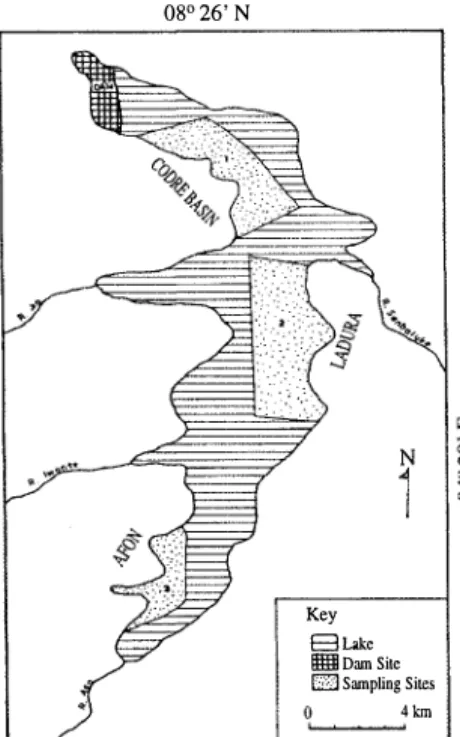
(2) REVISTA DE BIOLOGÍA TROPICAL. 1062. prefers habitat with c10se proximity to the shoreline and fairly deep waters. This works which is the first scientific report on S. schall Ín the lake, Ís aimed at pro viding informatÍon on the spatial and temporal distribution of the fish to enlighten artisanal fisheries on where and when to set their nets around the lake.. MATERIALS AND METHODS Asa dam is located about 5 km South of lIorin, across River Asa in Ilorin, the capital of Kwara State (080 26' N, 040 29' E). The dam was constructed primarily for domestic water supply. The lake, with an area of 302 hectare, has four tributaries river Asa being the major one (Fig. 1). The sampling sites (stations 1 to 3) extended from the dam to Afon, near the river source, where the maximum mean depth at high water levels was 12 m. Close to the dam maximum mean depth was 14 m. 08°26' N. Key. E3Lake limI Dam Si'e c:J Sampling Si", 4km ,. Fig. 1. Asa lake, !he dam and sampling sites.. Bimonthly collections of specimens of S. for 24 months (March 1991 to February 1993) were carried out at the sampling stations with the services of the local fishermen who were a1so involved in the keeping of catch records. GiIl nets of different mesh sizes including 5.08, 6.35, 7.62, 8.89 and 10.16 cm in a fleet were used to sample randomly the surface, shore and bottom habitats. F1eet of nets for the shore and surface were in ply 2, while the bottom nets were in ply 4 in order to resist the effect of the bottom pressure which could foid up the neL Each net was 125 m long and it was set at sÍx randomly selected places (Le. two in each habitat) of the sampling sta tions making a total of 18 sets of net in all the three stations along the lake. Nets were set at about 6 pm and drawn the following day at about 7 am. Specimens of S. schall were separated and numbers caught from the different habitats were recorded separately. Each specimen was allotted a serial number after which they were brought to the laboratory in three different ice containers for measuring and weighing. Standard length (cm) and body weight (g) of each specimen were determined using a gradu ated measuring board in centimetres and a top loading Metler balance in grams respectively. Length and weight measurement were taken to the nearest 0.1. The percentage catches from each habitat was computed and compared sta tistically using analysis of variance. Also catches from the habitats during the period of wet (May to October) and dry (November to April) seasons were compared statistically. The student t-test analysis was a1so used for statistical comparison of the catches between the habitats. Mean monthly rainfaJl from March, 199] to February, 1993 was obtained from llorin intemational airport and mean monthly water levels were recorded from the water leve! board installed at the dam. The graph of the monthly variation of the mean weight of fish and mean water levels is also presented. schall.
(3) \. ARAOYE: Spatio-temporal distribution of the fish SY. RESULTS. 1063. dontiS schall. water levels ( h-tonthly mean range 12.20 to 12.80 cm) due to the rains that commenced in April (Table 1). Catches within the habitats during the wet and lliy seasons were not significantly', different (P > 0.05). Similarly catches between the habitats throughout the sampling period were not significantIy different (P>O.05). =. Synodontis schall was caught throughout the year, but highest catches were recorded in January and February, while total catch decreased from September to November when the lake became flooded as a result of increased. TABLE 1. Monthly variation ofmean weight and mean standard length ofS. schl\lI and monthly mean values ofrainfall and water levels ofAsa lake (March 1991 to February 1993) Total Catch.. Month.. 1991. 1992. 1993. Mean wt.. Mean S.L. Mean rainfall.. Mean water level. (gm). (cm). (cm). (m). O. 11.6. March. 35. 52.43. 12.79. April. 38. 62.92. 13.03. 8.01. 11.5. May. 36. 63.63. 12.85. 14.48. 11.9. June. 36. 68.75. 16.32. 13.24. 12.3. July. 33. 70. 13.2. 18.5. 12.5. Aug. 37. 65.76. 12.54. 16.22. 12.8. Sept. 26. 39.95. 11.64. 26.14. 12.8. Oct. 21. 35.52. 11.2. 10.14. 12.6. Nov. 22. 8.7. 7.54. Dec. 32. 31.99. 9.54. 4.66. 12. 16.9. 12.2. Jan. 41. 88.9. 14.43. 0.31. 11.9. Feb. 48. 81.44. 14.54. 1.97. 11.7. March. 36. 63.1. 12.65. 9.21. 11.6. April. 39. 63.71. 13.55. 12.8. May. 37. 64.5. 14.66. 16.11. 11.9. June. 35. 65.86. 15.96. 11.9. 12.4. 11.6. July. 33. 69.65. 13.8. 22.6. 12.7. Aug. 37. 57. 12.2. 13.9. 12.8. Sept. 27. 39.35. 11.7. 11.27. 12.8. Oet. 22. 34. 11.3. 17.2. 12.7. Nov. 23. 9.11. 0.5. 12.6. Dee. 32. 32.55. 10.22. O. 12.2. Jan. 40. 85.6. 15. 47. 87.3. 15.8. O O. 11.9. Feb. Monthly variation of mean body weight and mean standard length is also shown in Table 1, while monthly variation of body weight and water levels is illustrated in Fig. 2 Lower values of mean standard length and mean body weight were also recorded in October/November. Monthly variation of the percentage catch within the tbree habitat is shown in Table 2. Tbey were not caught from. 8. l i.6. the bottom habitat in October/November. AH the catches during this month were mainly from theshore and surface habitats hence, the monthsof October and November recorded highest catches along the shoreline (Ta�le 2). They were caught along the surface through out the sampling period except in January when the catches were relatively low, and high catches were then recorded at the bottom. This.
(4) 1064. REVISTA DE BIOLOGÍA TROPICAL. corresponded with the period of dry season when the water level had dropped. The fry and the fingerlings sizes were excluded from the gill net catches.. 12.8 12.6 VJ u.l ::.> -l. �. 12.4 12.2. 60. 12. 50. 11.8. Z 40. 11.6. ...: u.l 30. ¿. 11.2. !O O. DISCUSSION. 11.4. 20. 11 .c:. �. ¿. " c::. .:¿. o.. o.l CfJ. > o. Z. <I.l c:: ;:1 ...... .c:. 2 '" ¿. o.. '" CfJ. The presence of S. schall within the three ecologícal niches was due to Íts diverse feed ing habíts. S. schall feeds on a variety of food items including vegetable materials, insects, molluscs, detritus, fish scales and plankton (Motwani; 1970, Fagade; 1983, Olatunde; 1989, Araoye 1997). The flooded liuoral zone. 10.8. U '". Cl. MONTH Fig. 2. Monthly variarían of mean weight of S. schall and mean water levels in Asa lake.. TABLE. 2. Monthly variaríon ofrotal cateh and percentage eomposition (by mumber) ofS. sehall ínthe shore surface and bottom habitats ofAsa lake (March 1991 ro February 1993). Month 1991. 1992. 1993. surface. shore. bottom. %. %. %. catch. catch. catch. surface. Shore. Bottom. March. 11. 5. 19. 31.4. 14.3. 54.3. April. 19. 5. 14. 50. 13.2. 36.8 38.9. May. 7. 15. 14. 19.4. 41.7. June. 10. 20. 6. 27.8. 55.6. 16.7. July. 8. 15. 10. 24.2. 45.5. 30.3. Aug. 13. 14. 10. 35.1. 37.8. 27. Sep!. 10. 1. 15. 38.5. 3.8. 57.7. Oc!. 7. 13. 33.3. 61.9. 4.8. Nov. 6. 16. O. 27.3. 72.7. O. Dec. 12. 14. 6. 37.5. 43.8. 18.8. Jan. 3. 12. 26. 7.3. 29.3. 63.4. Feb. 9. 14. 25. 18.8. 29.2. 52. !. March. 11. 7. 18. 30.6. 19.4. 50. April. 11. 6. 15. 46.2. 15.4. 38.5 37.83. May. 8. 15. 14. 21.6. 40.5. June. 10. 20. 5. 28.6. 57.1. 14.3. July. 8. 15. 10. 24.2. 45.5. 30.3. Aug. 13. 14. 10. 35.1. 37.8. 27. Sep!. 10. 2. 15. 37. 7.4. 55.6. Oct. 8. 12. 2. 36.4. 54.5. 9.1. Nov. 6. 15. 2. 26.1. 65.2. 8.7. Dec. 12. 14. 6. 37.5. 43.8. 18.8. Jan. 4. 11. 25. 10. 27.5. 62.5. Feb. 8. 15. 24. 17. 31.91. 51.1. 231. 290. 292. 28.40%. 35.70%. 36.00%. Total.
(5) ARAOYE: Spatio-temporal distribution of the fish Synodontis schall. of the lake was characterised with insect mul tiplication while the bottom layers were rich in invertebrates particularly molluscs (Araoye 1997). AIso a high percentage frequency of occurrence for plants and detritus were record ed in the gut of S. schall during the wet season and these items became more dispersed along the surface water column at this period due to flood and overtum (Araoye 1997). The ability of S. schall to explore the sur face, shore and bottom habitats in search of food items accounted for the insignificant vari ation of distribution within these niches irre spective of season. Unlike other fish species, the presence of a large physostomous swim bladder, the bony shield of the head and high fat deposition avails this fish the opportunity to explore the bottom habitat despite higher pres sure (Willoughby 1976). The low abundance of this fish at the bottom in OctoberlNovember, when the lake became flooded is attributed to the spawning activities of the fish around this season (Araoye 1997). Over 50% of the adult population were in gonad stages IV (mature) to Vl 1 (spent) as from September to November (Araoye 1997). The flooded littoral zone at this season provid ed an expanded ecological niche for shelter to the early life stages after fertilization (Araoye 1997). AIso flooding appeared to be a critical exogenous parameter because food (detritus) and other conditions including water current, pH and temperature changes essential for the survival of this species carne with flooding to sustain the new recruits into the environment (Ezenwaji 1992). The paucity of relatively large speci mens in the catch at this season was also attributed to restricted movement due to the spawning activities, therefore these sizes becarne less vulnerable to the gill nets. Berst ( 196 1) reported that the fishing success of the passive nets depends on fish movement and their efficiency and selectivity may be affected by abrupt changes from shift in barometer pressure, wind-driven currents,. 1065. water level fluctuation, turbiditYi and trans mitted light. The relative aburulance of S. schall irrespective of season can also be due to the success of the fish within the environ ment due to low predation. Araoye ( 1997) reported the absence of highly piscivorous fishes such as Lates niloticus, Hydrocynus forskahlii and Gymnarcus niloticus in the lalce due to its relatively small size compared with Chad and Kainji lakes. Seasonal abun dance of fish species was also reported to be influenced by a combination of physico chemical properties and the presence of food items (Fagade and Olaniyan 1974). The inverse relationship between the water level and fish weight may be related with increase in fish concentration due to the draw down of water at dry season. Ita ( 1978) using experimental gill net data in a bigger lake also observed an inverse relationship between water level and catch rate, explaining the .prob ability of higher concentration of fishat low water levels. Although this variation may not be significant as reported for S. schall in this report, however the relationship could be sig nificant with commercial· catches (Bazigos; 1972, Biswas 1973). The report of Bishai and Abu Gideiri (1967) which is at variance with this observation, although not explained by the authors was probably due to the different fish ing methods usually embarked upon by the commercial fisheries. The exclusion of fry and fingerlings from the catches in this experiment was due to their non economic sizes which was below 5.08 cm net meshes. The fry and finger lings of S. schall were usually restricted to the flooded liuoral zone of the lake where they feed mainly on zooplankton and insect larvae (Araoye 1997). This research has shown that a substan tial quantity of S. schall can be caught with gill nets set in any of the habitats at any sea son of the year. Feeding and reproductive phenomena were the main factors responsible for the spatio-temporal distribution of S. schall in Asa lake..
(6) REVISTA DE BIOLOGÍA TROPICAL. 1066. ACKNOWLEDGEMENTS. Ita, E.O. 1978. An analysis of fish distribution o n Kainji lake, Nigeria. Hydrobiologia 58: 233-. am grateful to C. Y. Jeje and S.O. Fagade, both of the Department of Zoology, University of Ibadan, for their interest and contribution in this work. 1 also appreciate the co-operation of the local fishermen during field research. 1. 244. McConnell, R.H. 1965. Field identification of fresh water fishes likely to occur in tbe area aboye tbe Kainji dam on tbe River Niger. 43-64 p. In Ed. E. White The first scientific report of the Kainji Biological Research Team. Motwani. M.P. 1970. Fisheries investigation on the. REFERENCES. Niger and Benue rivers in the Northern region and developrnent of a programme of riverine fisheries. Araoye. P.A.. 1997.. Bio-Ecology. of. a. Mochokid.. Synodontis schall (Bloch & Schneider 1801) in Asa dam Ilorin.Nigeria. 201 p.. Nigeria. FAO. FAO\UNOP\SF\NIR. Rorne (No. 24). Berra.T. 1981. An atlas of distribution of tbe freshwater fish families of tbe world. University of Nebraska, Lincoln.Nebraska: 191 p.. .. 1961. Selectivity and efficiency of experi. mental gill nets in Soutb Bay and Georgian Bay of l¡¡Ice Huron. Trans. Am. Fish. Soco 90: 413- 418. Bishai.H.M. &Abu Gideiri.Y.B. 1%7. Studies on tbe biology of tbe genus Synodontis at Khartoum. m - Oassification. and distribution. Rev._zoo!. Bol. Afr. 2: 62-69. Bishai. H.M. & Abu Gideiri. Y.B. 1968. Studies on tbe. genus Synodontis at Khartoum 111. - Reproduction. Hydrobiologia 31: 193-202. Biswas. S. 1973. Limnological observations during early formation of Volta lake in Ghana. Geophys. Mongor. 17: 121-128. Egborge; A.B. 1977. The hydrology and plankton of Asejire lake. Ph.O. Thesis. University of Ibadan. Nigeria. 278 p. Ezenwaji, H.G.M. 1992. The reproductive biology of four African cat fishes (Osteichtbyes: Clariidae) in Anambra River Basin, Nigeria. Hydrobiologia 242: 154-164. Fagade, S.O. 1983. Food and feeding habits of tbe fishes of Lower River Benue, Nigeria. Bul!. de IFAN. Jan. 1. T. 45 Ser. A. No. 3-4. 316-314. Fagade, S.O.. & Olaniyan, C.O. 1974. Seasonal distribu. tion of tbe fish fauna of tbe Lagos lagoon. Bull. de IFAN . Jan. 1. T. Ser. A. 45-67.. 2771. Nawar, G. 1958. Investigation of tbe breeding season of. Bazigos. G.P. 1972. The yield pattern of Kainji lake.. Berst. A.H. management training. UNDP\FAO Tech. Rep. T.A.. sorne species of Nilll fishes. 5th Ann. Rep. Sudan notes Rec. 20-21. Nawar, G. 1959. The fecundity of tbe Nile cat fish. Synodontis schall (Bloch & Schneider.1801). Sudan notes Rec. 40: 139-141. Olatunde, A.A. 1989. Sorne aspects of tbe biology of. Synodontis schall (Bloch & Sehneider. 1801) in Zaria. Nigerian J. Aquat. Sei. 4: 49-54. Oni, S.K., Olaniyan. J.Y.. & Adegboye, J.O. 1983.. Comparative physiology of three eeologieally d istinet. fresh. water. fishes,. Atestes. Ruppell, Synodontis schall (Bloeh. nur se. & Schneider). and Tilapia zillii Gervais. J. Fish. Biol. 22: 105109. Pekkola. W. 1919. Notes on tbe habitats, breeding and food of sorne white Nile fish. Sudan notes Ree. 2: 112-121. Reed, W. Burchad.J. Hopson, AJ., Jennes, J. and Yaro.1. 1967. Fish and fisheries of Northern Nigeria. Pub!. M.A.N.R. 22 p. Sandon, H.. & EI-Tayed. 1953. The food of sorne common. Nile fishes. Sudan notes Ree. 34: 219-221. WilIoughby, N.G. 1974. The ecology of the genus. Syrtodontis (Pisces: Siluroidei) in lake Kainji, Nigeria,. Nigeria. Ph.D.. Thesis,. University. of. Soutbampton. 288 p. WilIoughby, N.G. 1976. The buoyancy and orientation of the upside-down catfishes of tbe genus Syno. dontis (Pisees: Siluroidei) J. Zool. Lond. 180: 291-314..
(7)
Figure

Documento similar
In con- trast, TSP-1 protein levels were significantly decreased in total cell lysates from the different ccRCC parental cell lines (786-O, RCC4 and RCC10) compared to the
Informed by the field of political ecology, this thesis builds on extensive fieldwork undertaken in the Lake Urmia basin in north-western Iran to investigate
Government policy varies between nations and this guidance sets out the need for balanced decision-making about ways of working, and the ongoing safety considerations
The expansionary monetary policy measures have had a negative impact on net interest margins both via the reduction in interest rates and –less powerfully- the flattening of the
Jointly estimate this entry game with several outcome equations (fees/rates, credit limits) for bank accounts, credit cards and lines of credit. Use simulation methods to
In our sample, 2890 deals were issued by less reputable underwriters (i.e. a weighted syndication underwriting reputation share below the share of the 7 th largest underwriter
SIRT1 activation was significantly correlated to the content of Tau, Htau and GABA in EPHs, while antioxidant activities (TEAC and DPPH) were significantly correlated to the
The Dwellers in the Garden of Allah 109... The Dwellers in the Garden of Allah
