1 EDUCACIÓN POSTGRADO
Magister en Enseñanza de Inglés como Segunda Lengua.
The impact on teaching parents of English language
beginners different focusing techniques to deal with
ADD/ADHD 6
thgraders to improve specifically writing in
the EFL classroom.
Tesina to apply to the Masters level.
Student: CAMILO MARCELO SAAVEDRA CANALES
3 Acknowledgements
First of all, I would like to thank my advisor, Miss Jennie Popp, for her constant support and guidance whenever I felt with no direction in mind.
A special acknowledgement to Escuela Ecuador and their Principal Mr Hector Ruíz. Especially to Miss Brenda Reyes and her amazing team of special educators who supported me and spent their time with the intention of helping me in this difficult process.
Thanks to the wonderful people that I met during these two years and who were definitely part of this fruitful experience. I never thought I could meet such an amazing, friendly and funny group of people in such a strict context.
6
V. Conclusions 71
VI. Discussions 79
VII. References 81
a. Links 84
7 Abstract
Through practice it is evidenced that teaching English is a difficult task. In addition, it gets more complicated when parents do not want to support teachers in the educational process because of different reasons. What is more, the situation grew with the current educational norms when the government decided to incorporate ADD/ADHD children in the English subject. Because of that, an Action Research study was conducted, with the objective to explore the impact to which teaching focusing techniques to parents of ADD/ADHD 6th grade EFL students in a municipal school of Tome improves writing skills in students, through the application of a lead in test, a journal of focusing techniques applied by parents which followed the theory of Armstrong (1999) and a lead out test. In this process, parents of ADD/ADHD students evidenced that they were able to improve their levels of concentration which led to the improvement of the writing skills demonstrated through the lead out test. As a conclusion, the contribution of parents in the teaching of focusing techniques generated an impact their ADD/ADHD students’ writing skills.
8 CHAPTER I. PROPOSING THE PROBLEM
1.0 Introduction.
9 This condition has become a social stigma, something only a few are able to confront. According to Corrigan and Shapiro (2010) and Goffman (1963) there are three types of stigmas; 1) public stigma, which is related to how a large number of people discredits other groups of people that are perceived to be physically, behaviorally or intrinsic characteristics different, 2) self-stigma is how different I see myself from the majority of people; this is very much likely to be caused by public stigma, and 3) courtesy stigma is related to the family or close people who have a relationship with a stigmatized person and they are seen or judged negatively due to this stigmatized human being. (Tuchman 1996; Kendall and Hatton 2002; Norvilitis et al. 2002; Koro-Ljungberg and Bussing 2009; dosReis et al. 2010).
10 There are alternatives to fight this condition and transform that mayhem into sharp sword to use it in our advantage. Nevertheless, the decision relies on parents. As a matter of fact, they will have to be willing to accept this challenge of learning more about the condition and teach their children how to empower it so they can go even beyond their classmates. As an investigator I have two major drives for conducting this research. The first one is the lack of interest about this topic in my country. As a matter of fact, I was not able to investigate much about ADD/ADHD and English as a Foreign Language in the Chilean context, it is something that have been recently taken into account with the different inclusive plans that the government is attempting to promote. I want to motivate future local educational EFL researchers to dig deeper into the topic because it is a matter of concern. What is more, teachers of English of the different Chilean contexts are not trained on the topic in any undergraduate program, leaving academic research the task of educating them in the topic.
11 want to understand the issue and help children to manipulate the condition into their favor.
The first major contribution of this research is to become people aware of the different strategies, techniques or alternatives that exist to empower ADD/ADHD children. “Once we break out of the biological paradigm and adopt a more holistic approach to the ADD/ADHD issue, we can entertain a far wider range of techniques, methods, tools, and research methodologies.” (Armstrong, 1999)
The second major contribution of this research is to show parents and teachers of English how important is to work side by side to ensure a good experience of ADD/ADHD students into the EFL classroom by being constantly worried about not only the writing skills but all their educational performance.
12 parents with ADD/ADHD children. After that, the third chapter will explain the different methodologies that drove this qualitative investigation, what instruments were used, how they were used, the context, the target audience, ethical concerns, the results and the analysis concerning them.
13 1.1 Problem Statement.
14 learning is known as the process of comprehending how to recognize and control your emotions in your social environment, how you demonstrate everyone that you care and concern for others, how to make serious and relevant decisions, how to start and maintain relationships with each other and how to face a challenging situation which demands a problem solver rather than a problem maker. (CASEL, 2003)
As discussed before, nowadays, parents are having a really difficult time trying to balance their work life and their parenting life. What is more, there are some effects that they should know in advance in order to tackle them. In fact, some of the effects of having an ADD/ADHD children are: 1) they can be physically exhausting because of the demands of the child, 2) the constant monitoring of the child can be psychologically demanding, 3) the frustration when the child does not listen, 4) the behavior and the consequences of it can make you anxious or stressed, 5) the differences regarding the personality of the parent and the child with ADD/ADHD can make the child’s behavior difficult to accept and 6) frustration, which can lead to anger and guilt about being angry at your child. Authors: Melinda Smith, M.A., and Jeanne Segal, Ph.D. Last updated: September 2015. Taken from:
http://www.helpguide.org/articles/add-adhd/attention-deficit-disorder-adhd-parenting-tips.htm
15 correct implementation of the PIE program is not happening as it is supposed to be (Fundación Chile, 2013). This program is conducted by the decree 170, which is a national law for students with special educational needs. This decree says that every child has the right to have a normal educational process without being exempted no matter the condition(s) he or she has. The decree 170 also subsidizes those students who have a special educational need, so the school can invest that money in whatever need the student may have. But, the ADD/ADHD number of students are increasing and academic results decreasing. Parents, special educators, speech therapists and all the ones in charge of making PIE happen, are not tackling the issue from the proper angle. As a matter of fact, there have been many recent cases where ADD/ADHD children suffer from discrimination from schools, such as the case in a school of Quillota where a boy’s registration to a school was cancelled cause of his low marks and behavior. The boy had ADHD and the school was fined for preventing the boy from continuing in the school. Gonzalez, C, (2015). Retrieved from:
http://diario.latercera.com/2015/05/10/01/contenido/tendencias/16-189330-9-historico-fallo-en-contra-de-colegio-por-no-ayudar-a-alumno-con-deficit.shtml
16 and some behavioral problems like oppositional defiant disorder and depression are caused by: 1) lack of parental love, 2) lack of parental attention, 3) lack of parental discipline, 4) family stress, 5) poor educational methods and 6) putting neurobiological explanations over psychosocial ones. Taken from: http://www.quackwatch.org/04ConsumerEducation/NegativeBR/breggin.html
Authors like Armstrong (1999) see ADD/ADHD as “a conceptual tool accounting for the hyperactive, distractible, or impulsive behavior of schoolchildren”. In other words, ADD/ADHD do not exist, they are just an excuse to dope children (most of them brilliant students) to keep them submissive.
The importance of this study is to first, show parents how important is to know what is happening to their pupils and how relevant is to teach them how to empower ADD/ADHD as a manageable condition to be use it on his behalf rather than be a noxious issue that affects his learning process, specifically in this case their writing skills on the ELT. According to Armstrong (1999) ADD/ADHD is anything but a drawback. As a matter of fact, ADD/ADHD is an uncontrolled power that nor parents or students know how to deal with. Consequently, change people’s perspective towards ADD/ADHD, so students who suffer these conditions are no longer discriminated by society.
17 covered by PIE program. It is important to embrace inclusion as what it is and teach children with ADD/ADHD to defend from themselves. Retrieved from: http://www.educacion2020.cl/noticia/derechos-de-los-ninos-y-ninas-con-deficit-atencional
18 1.2 Objectives and Research Questions
Main Objective: to explore the impact to which teaching focusing techniques to parents of ADD/ADHD 6th grade EFL students in a municipal school of Tome improves writing skillsin students.
Specific objectives:
- To assess writing skills of the ADD/ADHD participating students before the intervention through a lead in test.
-To guide parents' teaching process of the different focusing techniques through a weekly revision of the journal based on Armstrong’s book “ADD/ADHD, Alternatives in the classroom”.
- To assess writing skills of the ADD/ADHD participating students after the intervention through a lead out test.
-To analyze the parents’ reflections done during the intervention process with the ADD/ADHD students through the journals.
19 Research Questions:
Will parents’ influence on the teaching of focusing techniques to ADD/ADHD pupils in a school of Tomé have an impact to improve students’ writing skills in the EFL classroom?
- Do ADD/ADHD pupils show a set of orthographic mistakes in relation to
their free and copied writing?
- Will parents’ participation on the ADD/ADHD students learning process in the EFL classroom have an improvement on their writing skills?
- Do ADD/ADHD pupils show a lower set of orthographic mistakes in relation
to their free and copied writing?
- Will the parents’ findings reveal an improvement regarding their pupils’
ADD/ADHD empowerment and their writing skills from the beginning of the intervention until the end?
- Will the lead in test, lead out test and the parents’ performance analysis
20 CHAPTER II: LITERATURE REVIEW.
2.0 Historical review of language teaching in Chile.
A study conducted by Universidad Metropolitana de Ciencias de la Educación (UMCE) the program of Educational Degree with English reference and English Pedagogy had its origins in the hands of Dr. Rodolfo Lenz in the training of English language teachers for the Chilean system. In November the 4th in 1889, a contract was signed in which the formation of teacher of English was opened in Chile by the Instituto Pedagógico de la Universidad de Chile. In 1924, the Pedagogical Institute suffered curricular changes that derived the English language into the Philosophy department. The educational reform in 6th decade reorganizes the institution and defines it into three central departments, in which English was now part of the Philosophy and letters department. Retrieved from: http://www.umce.cl/index.php/dpto-ingles-antecedentes-historicos
21 The program suffered many changes. In the 1980s, it was awarded the degree of a State Teacher of English, while the career was imparted by the Universidad de Chile (UCh). Subsequently, the Teacher of English degree was given by the UMCE until 1994. This career also grants you with a Graduate degree (as demanded by LOCE in 1991 and LGE in 2009) which prevails in our current date. Retrieved from: http://www.umce.cl/index.php/dpto-ingles-antecedentes-historicos
2.1 English teaching in the present.
Delicio (2009) writes, “As the use of English expands around the world Chilean authorities continue to emphasize the importance of English, not only as a communication tool but also as a means for integrating Chile into the global economy” (p.84)
According to a study conducted by The British Council (2015), Chile is undergoing through education reforms that intend to change how subjects are taught and financed. Nevertheless, English is not a major concern in the reforms but everyone expects some influence in how English is taught and the manufacture of additional opportunities for English teaching in public and subsidized schools.
22 which has granted course books, workbooks, interactive software and other learning tools. Furthermore, it has increased funding to support the EODP in rural areas to increase access of English language learning to at risk communities.
The British Council (2015) also states that Chile’s geographical distribution is a matter of influence in the supervision of how English is taught in isolated areas. As a matter of fact, some students have a single teacher for all the subjects, which does not guarantee a quality English training.
2.2 Special Education towards inclusion.
It is important to first have a clear description of what special education meant some years ago, Thomas and Loxley (2001) define it as an “examination of knowledge”. This short idea shows us that the amount knowledge is the one factor that makes the difference between a special needs student and anyone else. They also mention the importance of how this knowledge is meant to be acquired by special needs (SN) students makes the difference and demonstrate its helpfulness. Nowadays, we know that knowledge is only one minimum part of the complete concept of special education. As a matter of fact, we are trying to abandon the old fashioned concept of integration of students, to a more up-to-date and effective one called inclusion in the classroom.
23 feel confident in their classroom; what is more, their performance will be reconsidered by their teachers and in this way, they will have fun learning the second language. Taken from: http://genkienglish.net/specialneedseducation.htm
Chile wants to go forward in terms of inclusion, as a matter of fact; MINEDUC (2015) together with Andres Palma, The Executive Secretary of the Educational Reform in Chile explains in video format the law of inclusion in education and the relevance in our upcoming educational reform. Taken from: http://portales.mineduc.cl/contenido_int.php?id_contenido=32339&id_portal=1&id_ seccion=10
According to Dixon and Verenikina (2007), Inclusion in our special education contexts need to come round with some concepts like teaching, leadership or school organization. What is more, it is the complete acceptance of a student with disabilities in a regular class, avoiding every kind of discrimination from any of the participants. There are plenty of academics who believe that nobody should be segregated from education no matter the condition they have, nor the school nor their classmates. (Wolfensberger, 1980; Stainbeck & Stainbeck, 1996).
24 from: http://www.educacion2020.cl/noticia/superintendencia-de-educacion-revela-que-mas-del-50-de-denuncias-es-por-discriminacion-ninos
This recent study comes up because of the constant complaints about discrimination they received in 2013-2014 period, which are 1.456 approximately; what is more, 51% of the discrimination complaints are related to ADD/ADHD, which reveals that it is the most discriminated condition in the educational context. These situations are mostly reported from elementary education. Taken from:
http://www.supereduc.cl/images/PPT-Reporte_sobre_Discriminaci%C3%B3n_Escolar_Superintendencia_de_Educaci% C3%B3n.pdf
2.3 ADD/ADHD and English.
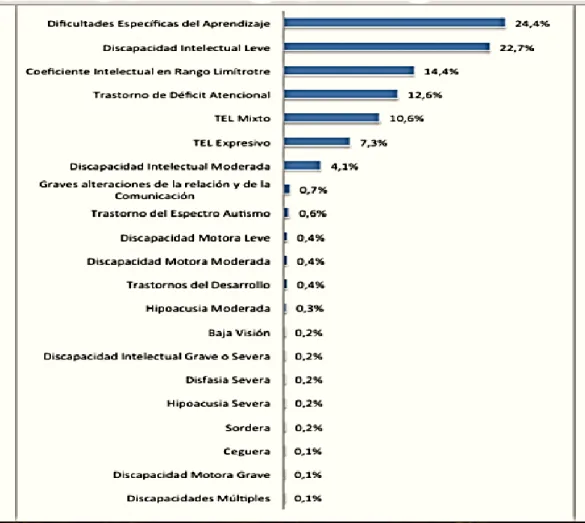
25 A study applied by Fundación Chile (2013) regarding the implementation of PIE, they show clear graphs where there is a great number of students who belong to ADD/ADHD, which locates them in the 4th most common condition of the Chilean country with a 12.6% of the students with special educational needs. (pp. 123-124)
Figure 1: Graph about the percentage of the different conditions dealt by the PIE
program)
26 Learning a second language is a major issue for most of the ADD/ADHD community. As a matter of fact, 50% of this population has different speech and language disorders provoked by a central nervous system dysfunction. (Cantwell, 2006). Swanson (2006) state that the root of ADHD problems is an impairment or underdevelopment of the front lobe of the brain, which is as a matter of fact, the one responsible for the major language functions. (As cited in Turketi, 2010). Other studies show that ADD/ADHD’s language abilities are affected by a deficit of working memory (Witton, 1998, p5). As a matter of fact, the majority of the students has problems with speaking, listening, reading and writing in their mother tongue, battles that they usually carry over and impacts negatively on the second language as well (Sparks, 1992)
In the words of Mapou (2009), an ADHD person has “a weak span for auditory-verbal information” which is followed by problems with listening comprehension. An ADHD child may start listening to what is being said but sooner than later, the concentration goes away as if being attracted by something more interesting than the environment provided by the teacher. Moreover, if the ADHD child is paying attention to the teacher’s speech and continues listening, he may probably be able to catch the unimportant (or slightly important) details of the conversation. Consequently, he ends up focusing on the smallest portion of what was intended to be taught and naturally resulting in an unsatisfactory outcome.
27 collaboration of all the senses” (as cited in Turketi, 2009). Therefore, the more stimulation the teacher provides in the lesson, the more likely an ADHD student will benefit from the lesson.
2.4 Focusing Techniques
Thomas Armstrong, (1999) presents different techniques that have been developed by many cultures, such as: tai-chi, yoga, meditation, introspection, visionary quests, rites of passages, reflection, reverie, and more (Dang, 1994; Goleman, 1996; Iyengar, 1995). Choosing one of these techniques and applying it on a daily basis will ensure an improvement on the concentration levels by connecting body and brain reaching a state of catharsis where anxiety and impulsivity is reduced to its minimum.
He also mentions that there is a very simple activity conducted by the Harvard physician Herbert Benson (Benson & Klipper, 1990) in which kids labeled ADD/ADHD increased their levels of concentration, attention and reduced impulsivity by focusing on a sound for some minutes every day. The activity consisted in playing a sound (hopefully with earphones) where the student is able to concentrate on the different frequencies that stimulate the brain for the sake of concentration and internal stimulation.
28 now?” until the ability to concentrate in only one thing increased progressively. As the frequency of this technique increases (as well as the difficulty), concentration levels improve.
Chilean authors propose that teachers should have some special materials such as little rubber balls or solo games so they channel hyperactivity toward that specific and silent distraction while their work. Parents can provide that small distraction channel so they use it during class activities to deviate the hunger of being active towards the small silent object and focus on what matters at that moment. Condemarín, M.; Gorostegui, M. y Milicic, N., Déficit Atencional, guía para su comprensión y desarrollo de estrategias de apoyo, desde un enfoque inclusivo, en el nivel de Educación Básica (2005) MINEDUC.
29 2.5 Frequent writing mistakes (FWM) of ADD/ADHD children.
According to Santibáñez (2012), writing is an implicit basic skill in the usage of verbal language. In this skill, there is an accumulation of major difficulties, spatial aspects, laterality, auditory memory, motor memory and the like. According to Fernandez & others (1985) “writing is defined as a representation of words and thought, with letters and drawn signs with a variety of instruments (pen, pencil, finger, chalk, among others) in a surface which can vary too (board, paper and the like) “as cited in Santibáñez, 2012”
As an activity it is attached to rules and constitutes a work of art, not only graphic but linguistic. It is defined in a strict sense as the “art of representing oral sound through graphic signs” (Blanco and Sanchez 1920, The art of writing and calligraphy, pp 4-7) “as cited in Santibáñez, 2012”.
For ADD/ADHD students is difficult to follow a pattern if this pattern is not properly adjusted to their needs, as a matter of fact, their impulsivity on writing as fast as they can to finish quickly causes most of their orthographic mistakes. According to Santibáñez (2012), the deficiency on the controlling of the movements causes an alteration of the shape and union of words, what is more, it exists an irregularity on the orientation and dimensions, sometimes appearing double lines.
30 Omissions.
This happens when students eliminate something from the transcription of a text which is either listened or read. This concept expands into three components; Omission of letters: when students subtract a letter from a word (for instance: February Febuary / Government Goverment), omission of syllables: when students subtract a syllable from a word (for instance: she is playing football she is play football) and omission of words: when students subtract a word at the beginning, middle or end of a sentence or paragraph (for instance: Then, she started studying math she started studying math)
Additions.
This arises when students add something from the transcription of a text which is either listened or read. This concept expands into three components; Addition of letters: when the students add an extra letter into a word (for instance: writing writting / vacuum vaccuum), addition of syllables: when the students add an extra syllable into a word (for instance: cut cutted) and addition of words: when the students add an extra word into a sentence or paragraph (for instance: Carlos is happy The Carlos is happy).
Substitutions.
31 Rotations.
This occurs when students move a grapheme 180° (for instance: b d / p
q / u n). Example: dictionary pictionary / upgrade npgrade.
Reversions.
This arises when students change the syllable from its original position (for instance: beautiful feautibul).
Adhesions.
This happens when students put two words together (for instance: blue pencil bluepencil / I am Iam
Segmentations.
This occurs when students divide a word from its original form (for instance: firefighter fire fighter)
32 2.6 Parents’ role with ADD/ADHD students
Parental involvement is such an important matter that not only has an effect on ADD/ADHD, but in the complete emotional development of the student. According to The Center on Innovation and Improvement (2008), These findings on social and emotional learning become even more important considering all the risks, including drug use and violence, facing schools, families, and students today. Preventing such risky behaviors involves many factors; one of them is the involvement of parents. It is imperative that, through their relationship with schools, parents become aware of their great positive influence and preventive power. Major prevention efforts such as the National Youth Anti-Drug Media Campaign, a historic initiative to educate and empower all youth to reject illegal drugs launched in 1998, underlines the important role parents play in prevention that works. The campaign’s motto, Parents: The Anti-Drug, reflects the critical importance of parent involvement in children’s and youths’ healthy development (http://theantidrug.com).
34 applied regarding the aim intended to reach.
If we intend to reach the objective of exploring the impact to which teaching focusing techniques to parents of ADD/ADHD 6th grade EFL students in a municipal school of Tome improves writing skills in students, we must have a clear methodological orientation to follow.
The first section of this chapter presents the paradigm concerning the study and the way it is conducted, along with the methodology. The second section describes the instruments devoted to collect the data, together with the underlying principle in which they are going to be used. The third section is fervent to the description and explanation of the actions to be taken concerning the collected data and the procedures to analyze it.
3.1 Research paradigm and methodology.
35 interpretivism and critical theory, which are categorized through their ontology: what is real of the human being, epistemology: what the researcher wants taking into consideration what it is already known: "epistemology is the branch of philosophy that studies the nature of knowledge and the process by which knowledge is acquired and validated" (Gall, Borg, & Gall, 1996) and methodology: in which way are we going to find out our inquiry. As the study contributes to the second and third paradigms, they are going to be explained in further detail bellow.
For interpretivists, access to reality (given or socially constructed) is only through social constructions such as language, consciousness, shared meanings and instruments (Myers, 2008, p.38). Interpretivism embraces diverse approaches, including social constructionism, phenomenology and hermeneutics; approaches that scrap the objective view of the world and critiques the positivism in social sciences (Collins, 2010, p.38). This approach bases on the following beliefs: a relativist ontology, which perceives reality as intersubjective; that is to say based on meanings and understandings on social and experimental levels, and transactional or subjective epistemology, which states that people cannot be detached from their knowledge, for that reason, there is a connection between the researcher and the research subject. Taken from: http://research-methodology.net/research-philosophy/interpretivism/.
36 carefully controlled (manipulated) to prevent outcomes from being improperly influenced” (Lincoln & Guba, 1994) where two instruments are conducted (a lead in / lead out test) which intend to obtain initial and final findings which the researcher will check according to a list of indicators in writing that denote usual errors in this skill. Also, a learning journal with some focusing techniques for the parents to employ on their houses together with some samples of writing activities to be applied, therefore, parents can register any observed behavior regarding the activities and how they elaborated them. Nevertheless, there are also signs of critical theory in which the researcher is forced to extract all the significant findings made by the parents when employing these focusing techniques and activities with their pupils, and decode the information to relate it to the results obtained in the lead in – lead out tests. “Critical research explicitly extends the assessment to social practices and institutional arrangements, and the evaluation of these is usually in terms of some notion of equity or social justice.” (Hammersley, 2006).
37 researches tend to be questioned because of the lack of consistency regarding to objectivity in the results of the research. According to William (2005, p.85) qualitative methods appeared as a result of unexplainable situations that quantitative method could not respond or emit a judgement about human feelings and emotions.
38 Taking into consideration to what was previously said; qualitative research method was chosen because its nature. I intended to observe a specific social-educational context to intervene on, with the idealism of raising awareness about the work that it has been done so far in a specific area of EFL, so the target audience and participant were able to change their viewpoints and behaviors based on the set of actions taken by the investigator that will question what they have done at that point and will affect the actions to be taken after the intervention. In the words of Berg (2001) qualitative researchers, then, are most interested in how humans arrange themselves and their settings and how inhabitants of these settings make sense of their surroundings through symbols, rituals, social structures, social roles, and so forth.
3.3 Type of method: Action research.
“Action research is conducted by teachers and for teachers. It is small scale, contextualized, localized, and aimed at discovering, developing, or monitoring changes to practice” (Wallace, 2000).
39 plan with the different instruments chosen and reflecting on the effects of the plan for further planning and informed action. The new obtained knowledge results in changes in the teaching practice. (Kemmis and McTaggert, 1988)
The Action research mode chosen was Technical/Scientific/Collaborative mode, which intended to test a particular intervention through a pre-stablished theoretical framework. As a matter of fact, the researcher and the practitioner (parents) have a relationship of great importance. The researcher served the practitioner as a collaborator and facilitator, so the practitioner could bring all the information through the data-gathering instruments also provided by him. In simpler words, the researcher identifies the problem, provides information and guidance to the practitioner in order to orient and facilitate the implementation of theory and instruments. (Berg, 2001)
40 data classification. The researcher had to choose the relevant aspects of the data to elaborate a pre analysis. Later, he had to prepare a system of codes to organize the evidenced information. Hence, the researcher had to assign a code or symbol to each one of the categories previously presented. Moreover, he had to elaborate an inventory of the codes and categories obtained from the data. Fifth, utilize this system of codes in the selected data and relate them to the pre-stablished criterions. In this phase, it is possible to see how feasible and valid the research can be in relation to the coherence that the system of codes provides to the analyzed data. Sixth, the researcher provided a detailed description of the new data, the codes and categories that demonstrated to be more relevant and significant for the research, an interpretation of the information (inferring) and the axiological interpretation of codes, always relating it to the literature review. Finally, there is a consolidation of theory by connecting the new data (findings) with literature review and the objectives.
41 Figure 2: The action research Spiral process.
42 Procedure
First, it was observed that most of ADD/ADHD students in the Chilean context had problems with education (see chapter one) and ELT was not the exception. ADD/ADHD Students were able to learn English but there was one particular point where mistakes were something to be noticed.
At the moment of providing the right oral instruction they could manipulate the language with slight problems. The same situation happened with listening and reading exercises such as scanning, get the gist, fill in the blanks, get the meaning of words and the like, but at the moment of transferring the information to the written format, errors seemed to be more prominent. As a consequence, this situation brought an academic decrease when they went through written test type assessment (which is the most used way of evaluating a student).
43 techniques were taken from his book to be applied, but to do so, it was important to know first the ADD/ADHD students’ level of writing.
Third, a lead in test was taken to reveal all copied and free writing mistakes that ADD/ADHD students were making. In relation to this, an observational guideline for writing was developed following a model proposed by Santibáñez (2012) in her doctoral thesis “Elaboración y evaluación de una prueba de escritura para el ciclo inicial”. This model was adapted and validated to check the lead in test and exhibit the mistakes.
Fourth, as an action and to match the theories from Santibáñez, Armstrong and Action Research, it was necessary to provide Armstrong’s theory of focusing techniques to parents so they were able to apply them in their houses. Therefore, they were provided with a journal in which they had a weekly meeting with one focusing technique explained in its whole and some exercises to prove the effects of the techniques so they were able to register all the relevant observable changes related to the ADD/ADHD students and their writing. Each week they had a new meeting and a new technique to learn about with the researcher and to then apply with their children. The meetings also contributed to foster reflection in parents so they could express properly when registering all the observable findings.
45 findings or changes after the exercise and the activity. This was reported in the journal and presented in the weekly meeting, where the investigator could orient parents in the implementation of each focusing technique.
3.5 The Context
Tomé was an industrial city, it had more than 7 different industries, and everyone circled around that way of generating incomes, so if you ask any person where his parents worked, the most usual answer will be “in a factory, working with fabrics or fish” (Villeg, 2006). After some years, most of the industries went bankrupt. This forced the city to change their perspective towards the working area. Because of that, there was a black age in terms of economy in Tomé, the city was falling apart and poverty was a big issue. Most of the workers emigrated to the biggest industry who was still working at that time, Bellavista Oveja Tomé, but there was not enough employment for all the people. Nowadays the city has only 2 industries working which are big centers of employment, but the city still depends on Concepción as a major source of employment. (Sanhueza, 1998).
The mayor of Tomé is now trying to take advantage of the city’s beauties, nowadays we see many tourists filling the city with their cars and the ambition of getting a good meal, a nice place to stay and enjoy the beach.
46 of students inside the classroom, 45 was something very common in the biggest schools such as Escuela Ecuador, Liceo Vicente Palacios, Escuela Gabriela Mistral, among others. Now the enrolment has decreased a fair number regarding the previous years. In the schools previously mentioned, grades have decreased from 4 to 3, and the highest numbers of students are 40 per class. This is not a surprise because this is a country situation. (Morales, 2009) “Taken from: http://www.gerontologia.uchile.cl/docs/chien.htm“
In relation to family constitution, it is more common to see that families are also falling apart. We can see more and more single mothers and fathers that have to play both roles. Most of the teachers relate this situation to some behavioral issues on the students, which as a matter of fact; it has part of the responsibility.
The PIE program is something very helpful here in Tomé because of the level of vulnerability that the city has. The city does not count with any particular institution that can help all students with special educational needs apart from the one special school that cannot take more population in. This gives a major importance to this program. The big problem is that PIE is not working as it is supposed to. (Fundación Chile, 2013, pp.30-33)
47 approximately 7 years ago and financed with all the needed materials. The majority of the students are vulnerable, so the school provides all the fungible materials that they may need.
3.6 Participants.
3.6.1 Inclusion criteria.
48 in the school where all findings where checked and improved in terms of elaboration if needed.
The parent’s journal will contain a small summary of each lesson pasted on the top of the page, so parents can guide themselves through this in case they forget something, and with some English activities that implied the use of writing skills.
3.6.2 Exclusion criteria
The students who do not bring the consent signed by their parents were not part of the research investigation. It was a matter of importance to have the permission of parents to go through the investigation. Additionally, parents were aware of what they had to do during the process. As a matter of fact, and rigorously speaking, they were the major protagonists in this investigation. Furthermore, parents realized the level of responsibility that the investigation implied for them and saw if their schedules were capable of holding the process.
Students who had ADD/ADHD and were previously diagnosed with language learning difficulties were also exempt from the investigation. In concordance with the investigation, it was relevant to avoid previous issues that may influence on the results of the research.
49 Families who did not possess a laptop or computer were excluded from the investigation. If they wanted to go through the process completely, they needed that electronic gadget to go through it. In fact, some CD’s were provided and they had to go through audiovisual exercises.
3.7 Gantt Chart.
Term October November December
50
51 CHAPTER IV. DATA ANALYSIS AND RESULTS.
4.0 Content Analysis.
In the following section, the different discoveries or findings made by the researcher according to the instruments used in the investigation were analyzed. What is more, they were divided in different categories and organized in a temporal progression so the reader could easily notice the changes from the beginning of the research until the end of it.
4.1 Lead in test analysis.
52 Copied Writing Analysis.
Student 1
53 In relation to the copied writing, ADD/ADHD students had demonstrated to have different errors in their writing. First, there was a pattern regarding to middle sized words which usually were improperly written by eliminating a letter from the middle or the end of it. Another error was the omission of the first word at the beginning of a phrase or sentence. Also, it was evidenced that ADD/ADHD students had the tendency to add letters in the middle of some words. Furthermore, there were invented words added that had nothing to do with the text. Moreover, there was a tendency in not changing a grapheme of the word but the word itself and altering their original form. Finally, it is important to highlight that in this occasion ADD/ADHD students did not show problems with rotation, reversion, adhesions and segmentation of words.
4.1.1 Free Writing Analysis
54 ADD/ADHD students also showed the same pattern of adding a letter, but not only in the middle of it, also at the end. They showed confusion between when to use “m” and when to use “n” in some common words. There was an inclination in attaching an adjective to any other word and write them as one. Moreover, one of them showed their lack of use of the language by writing one very common word incorrectly in two different ways. Finally, they did not show segmentations, reversions, rotations, and additions of words or syllables, omission of words, syllables and letters.
55 4.1.2 Findings
In relation to the previous exercise there were some important findings to highlight regarding both copied and free writing. In the copied writing, one of the students wrote her last name incorrectly. This shows that this student really had a problem with writing which also affected the L1. Also, they had an inclination on transforming the words in their whole. What is more, they also added words that had nothing to do with the text. Nevertheless, the most worrying situation was the translation and insertion of phrases and sentences. ADD/ADHD students moved sentences back and forth and changed them from their original position and returned them to the right location, but only to lose track again. In the free writing, ADD/ADHD students again showed invented words that were indefinable. They also showed a problem with the right position of adjectives. Finally, one of the notebooks was almost impossible to understand what the student was writing. Exercises were incomplete, different types of colors and pens were used, the information was much disorganized and the like.
4.1.3 Synthesis.
57 4.2 Parents’ Journal.
58 4.2.1 Categorization
Category 1. “Writing skill improvement”
Category 1. “Writing Skill Improvement”
This category stands for the quantity of evidence that parents showed in their observations regarding the improvement of the writing skill (as the name says). From this category, it was evidenced from parents that the ADD/ADHD students demonstrated to have in certain occasions Language Autonomy. This concept implies that students were able to develop the activities in English without the necessity of turning to any type of human or material help. We can observe this in phrases like:
P2, T3, D2: “(…) no le tomo mucho tiempo ya que entendio lo que tenia que hacer altiro”
In the same category, it was also evidenced that ADD/ADHD students developed Motivation. This concept is defined as the inner drive which creates the interest for the development of a task. We can observe this in phrases like:
59 Finally, parents also evidenced the code of Self-Correction. This concept is the capacity of noticing an error made during the task and at the same time, correcting the errors made without the necessity of an external agent to highlight it. We can observe this in phrases like:
P2, T1, D3: “(…)solo se equivoco al escribir tres palabras donde están los borrones ”
Category 2. “Concentration Improvement”
60 does not exist the awareness of being concentrated or trying to be it. We can observe this in phrases like:
P2, T3, D3: “Pudo desarrollar la actividad muy concentradamente (…)”
In the same category, it was also evidenced the code of Controlled Impulsivity. This is defined as the appropriate level on the motor activity to develop the different tasks. We can observe this in phrases like:
P1, T2, D7: “(… )trabaja tranquila”
Inside this code emerges a sub-code named Overcome Task. This is described as the self-control that ADD/ADHD students had over an impulsive response to overpower the obstacles the task presents and develop it in spite of the pressure generated by this hurdles. We can observe this in phrases like:
P1, T2, D6: “(…) no demoro tanto en terminar pero le cuesta entender las palabras”
Another code inside this category is the Improved Attention. This code consists of the appreciation or assessment from parents regarding the attention level increase of the ADD/ADHD students, that is to say, the perception of an attention improvement from their ADD/ADHD students during the development of the different tasks. We can observe this in phrases like:
61 The following code is Productive Concentration. This code is defined as the appropriate level of concentration observed by parents which conveys the development of the activities. We can observe this in phrases like:
P1,T1, D2: “se concentro bien (…)”
Finally, parents evidenced a code named Progressive Increase of Concentration. This code is defined as the appreciation or assessment that parents assigned to the increase on the concentration levels of the ADD/ADHD students during the development of the different tasks. We can observe this in phrases like:
P1, T2, D4: “(…) no se dictrae tanto como las primeras fichas”
Category 3. “Writing Skill Barriers”
62 students have. As a consequence, this level blocks the progressive development of the activities. We can observe this in phrases like:
P2, T1, D2: “(…) no se sabia escribir algunas palabras en ingles (…)”
The final code is named as Task Withdrawal. This code is defined as a resignation impulse at the moment of answering an ununderstood activity. The ADD/ADHD students are overwhelmed by the activity and decide to abandon it. We can observe this in phrases like:
P1, T1, D2: “(…) la ultima no supo hacer”
Category 4. “Concentration Barriers”
63 P1, T3, D1: “No se concentro mucho porque encontró que escuchar las melodía era un poco fome (…)”
The second and final code highlighted by parents is named as Unproductive Concentration. This code is described as the inappropriate level of concentration for the proper development of the activities. The ADD/ADHD students concentrate on other factors of less relevance. It is observable in phrases like:
P2, T2, D2: “(…) pero se deconsentra con facilidad solo observa los dibujos (…)”
Category 5. “Absence of Difficulties”
This final category evidenced by parents is defined as the nonexistence of a writing barrier. As a matter of fact, parents identified that in some moments writing activities were easy to be developed by the ADD/ADHD students. It is observable in phrases like:
64 4.2.2 Synthesis.
65 4.3 Lead out test Analysis.
In this section, the students’ performance regarding the copied and free writing through the lead out test was analyzed. It is shown how much the students improved in their writing regarding the different indicators used in the adapted (and validated) version of Santibáñez’s (2012) observational guideline for writing.
4.3.1 Copied Writing Analysis.
66 In relation to the copied writing, ADD/ADHD students had a persistent pattern of omitting, adding and substituting a grapheme or syllable at the end of a word. This particular characteristic highlights as something to be considered in further studies, ADD/ADHD students have a problem with the suffixation of words and also in their root form. Furthermore, it was observed that students eliminated some sentences from the text. Finally, the ADD/ADHD students did not show segmentation, adhesions, reversion, rotations and additions & omissions of words or syllables.
67 4.3.2 Free Writing Analysis
In relation to the free writing, ADD/ADHD students showed problems of omission and additions of the regular verbs. There is a reduced tendency on the regular past. Furthermore, there are few problems with the words ending in “m” or
68 “n”, which tend to be confused by the students. Also, there is a problem with the adjectives which are attached to the word next to them in some occasions. Finally, ADD/ADHD students did not show omissions and additions of syllables and words, rotations, segmentations and reversions.
4.3.3 Findings
Even though ADD/ADHD students skipped some sentences from the copied writing, they were still able to follow a coherent track. What is more, they wrote less than the previous test which shows a higher level of concentration and a lower level of impulsivity. As a matter of fact, this time one student who wrote something not understandable at all in the lead in test, it was possible to be followed this time. The organization and presentation of the notebooks improved dramatically. This time it was possible to follow the activities and check them.
4.3.4 Synthesis.
69 but in very little occasions. As a matter of fact, it was possible to follow the reading without getting lost. Hence, ADD/ADHD were able to improve their writing skills in many aspects, they showed fewer mistakes and the common mistakes were reduced in number. There are still some aspects from the observational guideline of writing that were not needed, such as: rotations, reversions, segmentations and now, addition and omission of syllables and words were avoided.
4.4 Content Analysis Synthesis/Findings.
71 5.0 CONCLUSIONS
During this professional process, a problem was proposed which is related to the lack of interest of ADD/ADHD students in the EFL classroom with a focus on writing, which is evidenced with the low academic performance of those students in the English language and the new existing norms in our Chilean education. In relation to what was previously said, theory related to those issues was scrutinized to guarantee a starting point for this research process and to reach understanding of that particular point.
Following the nature of the issue and what was expected to find in this investigation, applying a Qualitative investigation from an Action Research methodology was decided, because it was expected to answer the research’s objectives which were related to explore the impact to which teaching focusing techniques to parents of ADD/ADHD 6th grade EFL students in a municipal school of Tome improves writing skillsin students.
It was decided to follow a data analysis in a way it is related to the type of investigation that was held, which also answers the proposed objectives. As a consequence, results were obtained which also were closely connected to the initial objectives.
73 actividad se concentra bien no demoro tanto en terminar pero le cuesta entender las palabras” or “no se concentro mucho porque encontro que escuchar las melodias era un poco fome pero despues de un rato estuvo mas atenta y escribió mejor”. As a result, it was possible to see a positive impact on both students regarding their writing skills thanks to the parents’ assistance and the focusing techniques that were applied before going through the activities included in the journal.
74 translation and insertion of sentences or phrases. Furthermore, they demonstrated a lack of preoccupation in the presentation of their notebooks, especially one of them who had his notebook with incomplete exercises and very disorganized. All in all, the researcher was able to identify the initial errors on their writing to later continue with the journal to reduce those mistakes.
75 able to see the major impact their assistance and presence on this process had. In the case of the researcher, he observed that these two children and their parents were able to work committedly from the beginning until the end of the process. As a matter of fact, students answered most of the researcher’s requests in time (consent, lead it test, lead out test, notebooks) allowing the research process to be done in the time constraints. Also, parents attended to most of the weekly requested meetings and asked all the questions they had regarding the focusing techniques or the activities from the journal, so they could do their observations without major drawbacks. In summary, the researcher was able to observe that parents noticed that their contribution caused a positive impact on their children.
76
Student Activity Lead in test Lead out test
78 In relation to the fourth specific objective which is “To analyze the parents’ reflections done during the intervention process with the ADD/ADHD students through the journals”, it can be concluded that the participation of parents during the process of learning a second language is crucial. Furthermore, it is evidenced at the moment of reading the parents’ observations. Initially, they gave short and light comments about their children’s performance on the different activities, but as the journal activities go through, they evidenced more profound and relevant findings about their children’s behavior towards the activities. Therefore, parents were able to see in situ what was happening with their students in the English class and how they might be reacting or performing in the classroom. As a consequence, they started to look and act more worried about their students’ situation with the language and ADD/ADHD students could feel that concern. These situations lead to an improvement in the ADD/ADHD students’ writing and concentration skills. Consequently, a list of codes was developed regarding the parents’ evidences, where the majority of codes inclined towards the improvement of the concentration levels of the students.
79 their results from the first observation process until the assessment of the lead out test.
6.0 DISCUSSIONS
80 to abandon the activity, because it would have meant to abandon their children when they needed them the most. Nowadays, empowerment does not mean to be on your own and solve your problems. Empowerment is constructed, and who better than those who are around you and love you.
81 7.0 REFERENCES
Books and Papers
Armstrong, T. (1999). ADD/ADHD Alternatives for the Classroom. Chapter 3, Strategies to Empower, Not Control, Kids labeled ADD/ADHD. Association for
Supervision and Curriculum Development (ASCD): N Beauregard. Alexandria.
Breggin, P. (1998). Talking back to Ritalin: What Doctors Aren't Telling You about Stimulants for Children. Monroe, Maine: Common Courage Press.
Byrd, K. (2013). Reactions to English Language Learning in Chile as a Means for Personal and National Development. University of San Francisco. (p.84)
Chowa, G., Masa, R., & Tucker, J. (2013). Parental Involvement’s Effects on Academic Performance. Evidence from the YouthSave Ghana Experiment.
University of North Carolina at Chapel Hill. Washington University in St.Louis
Cole, M. (2008). The importance of parental involvement in language acquisition and activities and techniques to enhance the home-school
connection. Washington University School of Medicine Program in Audiology
and Communication Sciences.
CONDEMARÍN, M. y GOROSTEGUI, M. y MILICIC, N. (2005). Déficit Atencional: Estrategias para el diagnóstico y la intervención psicoeducativa.
82 De Ridder, D., van der Loo, E., Van der Kelen, K., Menovsky, T., van de
Heyning, P., & Moller, A. (2007). Theta, alpha and beta burst transcranial magnetic stimulation: brain modulation in tinnitus. International journal of
medical sciences, 4(5), 237.
Donato, R. (2003). Action Research. University of Pitsburg.
Guba, E. G., & Lincoln, Y. S. (1994). Competing paradigms in qualitative research. In N. K. Denzin & Y. S. Lincoln (Eds.), Handbook of qualitative
research (pp. 105-117). Thousand Oaks, CA: Sage.
Jeynes, W. (2005). Parental Involvement and Student Achievement: A Meta-Analysis. Harvard Family Research Project (HFRP).
Mueller, A. K., Fuermaier, A. B. M., Koerts, J., & Tucha, L. (2012). Stigma in attention deficit hyperactivity disorder. Attention Deficit and Hyperactivity
Disorders, 4(3), 101–114. http://doi.org/10.1007/s12402-012-0085-3
Patrikakou, E. (2008). The Power of Parent Involvement: Evidence, Ideas, and Tools for Student Succes. DePaul University. (p.2)
Porta, L & Silvia M. (2003). La investigación cualitativa: El Análisis de
Contenido en la investigación educativa. Universidad Nacional Mar del Plata y
Universidad Nacional de la Patagonia Austral.
83 Santibáñez, J. (2012). Elaboración y evaluación de una prueba de escritura para el ciclo inicial. Universidad de la Rioja, Servicio de Publicaciones.
Schor, E. (1996). Caring for Your School-age Child: Ages 5 to 12. American Academy of Pediatrics. Bantam Books,
Turketi, N. (2010). Teaching English To Children With ADHD. MA TESOL Collection. (pp.5-7)
U.S. Department of Education Contract & American Institutes for Research. (2006). Teaching Children with Attention Deficit Hyperactivity Disorder: Instructional Strategies and Practices. Education Publications Center: U.S.
84 Links
ADD/ADHD, Data and statistics: http://www.cdc.gov/ncbddd/adhd/data.html
ADHD, Ritalin, and Conspiracies: Talking Back to Peter Breggin:
http://www.quackwatch.org/04ConsumerEducation/NegativeBR/breggin.html
Ayuda MINEDUC, Déficit Atencional e Hyperactividad:
https://www.ayudamineduc.cl/Temas/Detalle/6483b325-092d-e211-8986-00505694af53
Departamento de Inglés, Antecedentes Históricos:
http://www.umce.cl/index.php/dpto-ingles-antecedentes-historicos
Histórico fallo en contra de colegio por no ayudar a alumno con déficit atencional: http://diario.latercera.com/2015/05/10/01/contenido/tendencias/16-189330-9-historico-fallo-en-contra-de-colegio-por-no-ayudar-a-alumno-con-deficit.shtml
Informe Final de Estudio: Análisis de la implementación de los programas de
integración escolar (PIE) en establecimientos que han incorporado estudiantes con necesidades educativas especiales transitorias (NEET):
http://www.mineduc.cl/usuarios/edu.especial/doc/201402101719500.InformeEstudi oImplementacionPIE2013.pdf
85 MINEDUC, Educación 20-20 (2013). Derechos de los niños y niñas con Déficit Atencional: http://www.educacion2020.cl/noticia/derechos-de-los-ninos-y-ninas-con-deficit-atencional
Paradigm: http://www.personal.psu.edu/wxh139/paradigm.htm
Research Methodology: http://research-methodology.net/
Ritalin Side Effects and Warnings: http://ritalinsideeffects.net/
Stigmas in Attention Deficit and Hyperactivity Disorders: http://www.ncbi.nlm.nih.gov/pmc/articles/PMC3430836/
Super Intendencia de Educación. La discriminación escolar bajo la lupa: Hacia escuelas más inclusivas:
http://www.supereduc.cl/images/PPT-Reporte_sobre_Discriminaci%C3%B3n_Escolar_Superintendencia_de_Educaci% C3%B3n.pdf
Tips and tricks for special needs students:
http://genkienglish.net/specialneedseducation.htm
86 8.0 APPENDIX
CONSENTIMIENTO INFORMADO
Investigador: Camilo Marcelo Saavedra Canales
Contacto con investigador: [email protected] / +56982110027 Lugar de procedencia: Universidad Andrés Bello
Su pupilo ha sido seleccionado para participar de una investigación denominada “The impact on teaching parents of English language beginners different focusing techniques to deal with ADD/ADHD 6th graders to improve specifically writing in the EFL classroom. An action research study (El impacto de enseñarle a los padres/tutores de estudiantes iniciales de inglés, diferentes técnicas de concentración para lidiar con TDA/TDAH a estudiantes de 6to año para mejorar su quehacer en la clase de inglés, específicamente la escritura. En estudio de investigación acción.)”.
En este estudio los participantes podrán sentir algún nivel de presión respecto al trabajo profesional que realizará, sin embargo, en ningún momento del estudio, se juzgará la pertinencia de la información que usted nos ha otorgado, de igual manera se garantiza a los participantes la salvaguardia de sus intereses por encima de los que pudieran surgir de la propia investigación.
Privacidad y confidencialidad:
La información personal que usted otorgará al investigador en este estudio permanecerá en secreto y no será proporcionada a otros entes, por lo que se ocuparán códigos para identificar a las personas participantes para resguardar su identidad.
Los resultados de esta investigación pueden ser publicados en revistas científicas o ser presentados con fines académicos, pero su identidad no será divulgada. Consentimiento:
He leído la información proporcionada. Consiento voluntariamente participar en esta investigación y entiendo que tengo el derecho de retirarme de la investigación en cualquier momento sin que afecte de alguna manera mi quehacer ni el de mi pupilo.
En consecuencia, autorizo a realizar evaluaciones de “Habilidades de escritura en inglés” a mi pupilo durante el horario de clases y además me comprometo a participar de las cuatro reuniones mencionadas en el anexo.
88 OBSERVATIONAL GUIDELINE FOR WRITING.
Aim:
- To assess writing skills of the ADD/ADHD participating students before the intervention through a lead in test.
- To assess writing skills of the ADD/ADHD participating students after the intervention through a lead out test.
Instructions:
a) For the copied writing:
- The students will have to transcribe as much as they can of a text that is going to be projected on the whiteboard in its original form or in paper format, in a maximum time frame of 20 minutes. After this, the evaluator will observe the written products and record their observations in the
observational guideline for writing.
b) For the free writing:
- The evaluator will observe the students’ notebooks, focusing his attention on their free writing activities such as; writing sentences, answering questions, text composition or brainstorming. After this, the evaluator will record the results in the observational guideline for writing.
90 Copied writing observations:
Free Writing Observations: Rotations: Moving a
grapheme in 180° (bd ; p q ; u n)
Reversions: Changing a syllable from its
original position. (beautiful feautibul)
Adhesions: Putting two words together. (Iam I am; blue pencil bluepencil.
Segmentation: dividing a word from its
original form: (Firefighter fire
92 Validation informs of the Observational Guideline for Writing.
Validation Inform 1
November the 17th
The objective of applying this instrument is to know the writing abilities in English that ADD/ADHD students from 6th grade have, for this reason, I consider appropriate that the evaluator registers the orthographic errors that students do at the moment of transcribing a text because this is related with the diagnose of ADD/ADHD.
It is interesting the idea of considering the students’ notebooks, as a matter of fact, it is absolutely interesting the idea of gathering data related to the students’ writing skills but in their natural form, avoiding the pressure of formality.
The text is appropriate considering that it is a recommended text to be applied by the MINEDUC.
The time frame given for transcription is extensive and appropriate for the concentration period of an eleven years old student.
I recommend doing this evaluation in the morning, preferably the first or second period of class, as a matter of fact, the fatigue of the school hours can negatively influence in the results. Also, it would be a good idea to provide a stimulus for the students to create a good initial bond, and so, ensure the participation of the lead out test. Finally, it is suggested that the transcription is made on a squared sheet of paper and written with pencil.