
An integrated model for operations management in the small and medium size mexican companies
211
0
0
Texto completo
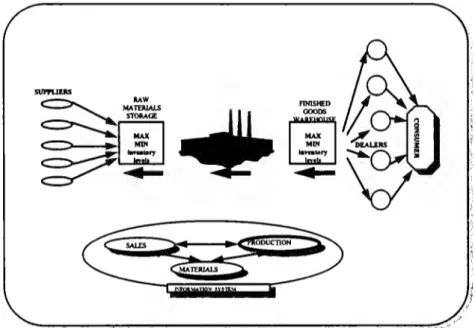
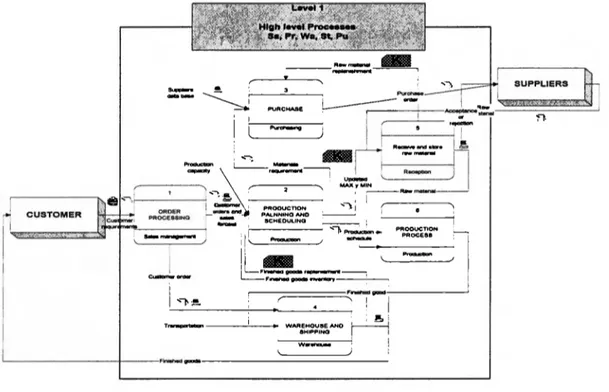
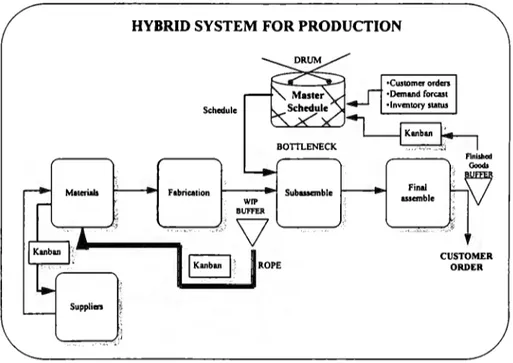
(2) INTRODUCTION An approach is developed to reinforce the value chain of the manufacturing companies, where typically one of its links fail, and as a consequence, both customer satisfaction and success of the supplier business are affected. Severa! approaches are found on the Operations Management and Industrial Engineering discipline, but they offer just local improvements for one or two links ofthe value chain. Other approaches as Total Quality, Systems Thinking and Management are very general and it's very difficult to put them in to practice with good results in the short run. Those philosophies are good promoting a holistic approach, but this is not enough for the small and medium sized manufacturing companies. Through this work I have developed the model named "An lntegrated Model for Operations Management in the Small and Medium Sized Mexican Companies" (IMOM). Its purpose is to integrate and coordinate the following areas of the value chain: ( 1) Order Processing, (2) Production Planning and Scheduling, (3) finished goods storing and shipping (Warehousing), (3)Production, (4) Purchasing and (5) storing and supplying of raw materials. I considered those areas because they are involved from the beginning of the process till the delivery of the goods to the customer. Manufacturing systems look to reach a competitive advantage and to operate as a productivity machine at the same time, but most of the times the complexity of the system restrains its performance, so with the IMOM modela new integrated way to manage the production and operation is presented. I designed the model considering severa! elements that in literáture are treated individually, but in the real world they have to work together. Also, my experience as an employee and consultant in manufacturing companies has provided me with a background that has let me add particular characteristics to the model. Toe model was validated through an implementation of the model in a medium size Mexican manufacturing company, and findings led the model to align four operational elements to the customer expectations and needs. Toe four technical elements of the model are: Hybrid Production System, Integtated Process between departments, Inventory Replenishment Policy and Information System. Three soft elements ofthe model were found to be protagonists for the success of the operational elements. Toe social elements are: Leadership, Organizational Culture and Team Work. Social elements aim to support the success of technical elements in order to allow manufacturing companies being more competitive and productive in domestic and intemational markets..
(3) TABLE OF CONTENTS. EXECUTIVE SUMMARY OF THE THESIS ............................................................ l DESCRIPTION AND JUSTIFICATION OF EACH CHAPTER. ............................. 2 KEYWORDS .............................................................................................................. 4 LIST OF FIGURES ..................................................................................................... 5 LIST OF TABLES ...................................................................................................... 8 1. INDUSTRIAL AND ECONOMIC DEVELOPMENT IN MEXIC0 ......................... 9 1.1. Introduction..................................................................................................... 9. 1.2. Development ofthe Mexican economy ........................................................... 9. 1.3. Current situation of the Mexican enterprises. Barriers for their development ................................................................................................... 12. 1.4. Toe need of developing a new strategy for operation management (local vs. Global vision) ................................................................................................ 17. 2. MANUF ACTURING IN CURRENT DAYS ........................................................... 22 2.1. Introduction................................................................................................... 22. 2.2. Production and Operations Management (POM) .......................................... 22 2.2.1. Understanding POM .......................................................................... 23. 2.2.2 Competitiveness and Productivity ..................................................... 24 2.3. Manufacturing based on literature................................................................. 28 2.3.l. 2.4. 3. Short comings and contributions of the literature.............................. 39. Functional Analysis and hypothesis ............................................................. .42. ANAL YSIS OF THE MODERN TECHNIQUES AND MANAGEMENT PHILOSOPHIES ....................................................................................................... 50 3 .1. Introduction................................................................................................... 50. 3 .2. Description of the modem techniques and management philosophies related to Production and Operations Management in Manufacturing..................... 51.
(4) 3.3. 4. 5. THE INTEGRATED MODEL FOR OPERATIONS MANAGEMENT (IMOM). 69 4.1. Introduction................................................................................................... 69. 4.2. Research methodology (action-research) ....................................................... 69. 4.3. General assumption ofthe IMOM ................................................................. 72. 4.4. Content ofthe IMOM model.. ....................................................................... 80. 4.5. Measures of performance ............................................................................... 95. IMPLEMENTATION OF THE IMOM MODEL (Case Study) ............................... 98 5.1. lntroduction................................................................................................... 98. 5.2. lntroduction and antecedents ofthe company ............................................... 98. 5.3. Opportunities ............................................................................................... 107. 5.4. Implementation ofthe IMOM model.. ........................................................ 108. 5 .5. 6. Findings from the analysis ............................................................................. 64. 5.4.1. Inventory policies ............................................................................ l 08. 5.4.2. Process management ........................................................................ 115. 5.4.3. Hybrid Production System ............................................................... 121. 5.4.4. lnformation System (ASPEL / MERCURI0) ................................. 126. 5.4.5. Team work ....................................................................................... 129. 5.4.6. Organizational culture ...................................................................... 130. 5.4.7. Validation ofthe Implementation through performance measures .. 131. Survey applied to BH based on the Maleo In Baldrige award 1996 ............. 134. OTHER EXPERIENCES ........................................................................................ 138 6.1. lntroduction................................................................................................. 13 8. 6.2. Case 1: Operational Effectiveness in CANELS .......................................... 139. 6.3. Case 2: Operational Effectiveness TISAMATIC ........................................ 141 6.3.1. Information system.......................................................................... 142.
(5) 6.3 .2 Integrated Process for Sales, Production, Scheduling and Warehousing (INPRO process) ........................................................ 144. 6.4. 7. 8. 6.3.3. Synchronous Production.................................................................. 148. 6.3 .4. Social elements ................................................................................ 152. Elements for the evaluation criteria............................................................. 153. LEARNING'S FROM THE IMPLEMENTATION .............................................. .158 7.1. lntroduction............................................................................................ :····158. 7.2. Conceptual Framework (leaming loop) ....................................................... 158. 7 .3. Recommendations of improvement and unanticipated results .................... 160. 7.4. Evaluation ofthe IMOM and improvements ............................................... 164. 7.5. A methodology forthe implementation ofthe IMOM ................................ 166. GENERAL CONCLUSIONS AND FURTHER RESEARCH ............................... 171 8.1. General conclusions..................................................................................... 171. 8.2. Further research ........................................................................................... 174. APPENDIXES ........................................................................................................ 176 1. Sales Demand History January 1995-August 1996. lnventory Cost. ................. 176 2. Finished Goods Policies lnventory based on MAFC ......................................... 178 3. Raw material lnventory Policies based on MAFC. ............................................ 179 4. Survey Based on Malcoln Baldrige Award ........................................................ 180 5. BH'S mapping processes .................................................................................... 186 6. BH's Simulation................................................................................................. 191 7. TISAMATIC's Simulation ................................................................................. 195. REFERENCES ............................................................................................... ;........ 198.
(6) EXECUTIVE SUMMARY OF THE THESIS (graphical representation ofthe thesis). Chapter 1 Introduction Development of the economy and industry in México. Chapter2 Manufacturing in curren days •General review Literature about manufacturing •Functional analysis. Chapter4 Integrated Model for Operations Management (IMOM). ChapterS implementation oftheIMOM model. Chapter3 Modero ~· techniques and , ;; philosophies •Technical analysis •Findings from the analysis to enrich the IMOM model. 1---...i. Chapter7 Learning's from the implementation. Chapter6 Other ex peri en ces related with the IMOMmodel. Chapter8 General conclusions and further research.
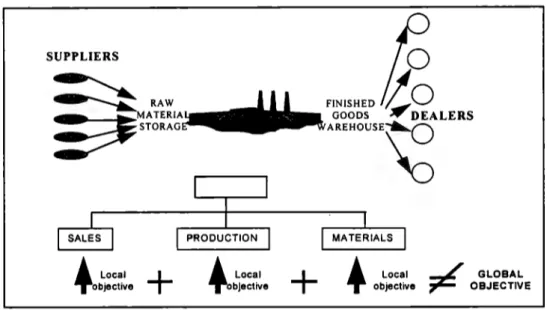
(7) DESCRIPTION AND JUSTIFICATION OF EACH CHAPTER CHAPTER 1. DEVELOPMENT OF THE MEXICAN ECONOMY AND INDUSTRY This chapter aims to clarify the real situation of the Mexican economy and the current situation that Mexican companies are affronting. Real problems and challenges also are covered in order to have an integrated vision to presenta effective solution for the small and medium sized Mexican companies.. CHAPTER 2. MANUF ACTURING IN CURRENT DAYS Due to the relation of the study with the operation management world, it is important to know the different approaches, and new research. Sorne analyzed areas are: process management, team work, Systems Approach, manufacturing and quality. I could mention strengths and weaknesses on these themes for example lack of a global vision of the business, great difficult to work as a team, lack of integration, poor definition ofthe tasks, and functional approaches.. CHAPTER 3. ANAL YSIS OF THE MODERN TECHNIQUES AND MANAGEMENT PHILOSOPHIES ' Toe difference between this chapter and chapter 2 is basically that in chapter 2 publications. related to several big areas of Production and Operations Management are analyzed in order to found opportunity areas for research. In chapter 3 the current techniques and philosophies are put altogether in a matrix comparing them with several activities of the IMOM model. With this chapter we would be able to answer questions such as "How" and "what" found in chapter 2.. CHAPTER 4. THE INTEGRATED MODEL FOR OPERATIONS MANAGEMENT (IMOM) After the developing ofthe last three chapters I would be able to build a model that really integrate the different functional areas, that most of the times work with local objectives. 2.
(8) (poor integration). At the end ofthe chapter a model (IMOM) and its performance measures are ready to be implemented in a manufacturing business. CHAPTER 5. VERIFICATION ANO IMPLEMENTATION This chapter shows an explain an implementation ofthe IMOM model using a real case of a small sized Mexican rnanufacturing cornpany. Sorne good or not so good results carne up. An irnplernentation and the follow up of any project for irnprovement need sornething else than a good model.. CHAPTER 6. OTHER EXPERIENCES In order to provide more feedback to this thesis, this chapter presents others experiences from cornpanies that irnplernented sorne elements related with the rnodel developed in this dissertation.. CHAPTER 7. LEARNING'S FROM THE IMPLEMENTATION Sorne times is not easy to prove a technique or rnodel, and when it is possible, rnost of the times the feed back helps to improve what we have researched. In this case I will explain what happened during the irnplernentation and what needed to be modified or added to the IMOM model. Also is explained different actions taken for the improvement ofthe companies examined. Once the feed back is well handled, a rnethodology for the implementation ofthe IMOM rnodel is suggested to warranty a good success during its implementation.. CHAPTER 8. CONCLUSIONS ANO FURTHER RESEARCH. 3.
(9) KEYWORDS. • HYBRID PRODUCTION SYSTEM. Production strategy combining a Kanban system, using the advantages of MRP II and the excellent concepts of the Theory of Constraints • IMOM. Integrated Mod~l for Operation Management • INPRO. Integrated Process based on a map using data flow diagrams • JUST IN TIME (JIT). A management philosophy based on a Pull Production System • MRP II. Computer support system for Manufacturing Resources Planning and control • THEORY OF CONSTRAINTS (TOC). · A management philosophy based on bottleneck management • GROUP TECHNOLOGY(GT). An engineering and manufacturing philosophy that identifies the physical similarity of parts (common routing) and establishes their effective production. • V ALUE ADDED. In current manufacturing terms, is the actual increase ofutility from the customer point of view during the transformation process of raw materials until the finished good is delivered. • CYCLE TIME. It refers to the length of time to produce an article from the raw material acquisition until the finished good is delivered in customer' s dock. • DRUM-BUFFER-ROPE: Toe generalized technique used to manage resources to maximize throughput. Toe drum is the rate or pace of production set by the system' s constraint. Toe buffers establish the protection against uncertainty so that the system can maximize throughput. Toe rope is a communication process from the constraint to the gating operation that checks or limits material released into the system to support the constraint.. 4.
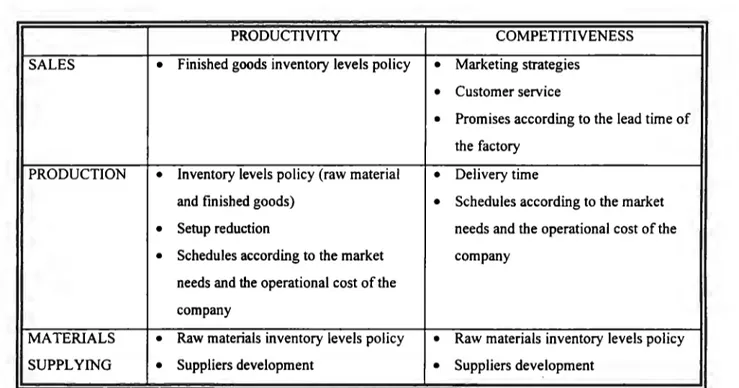
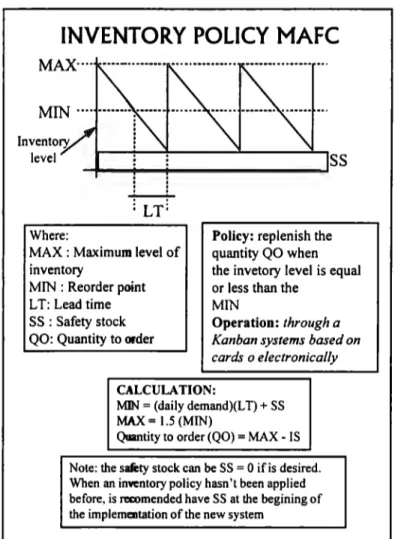
(10) LIST OF FIGURES Figure 1.1 Transfonnation ofthe economical activities in Mexico (Flores, 1997)............... 11 Figure 1.2 A new manufacturing strategic vision (Chased and Aquilano 1995) ................ 17 Figure 2.1 Operations Management as a function (Chase & Aquilano, 1996 ...................... 23 Figure 2.2 Toe criteria equation for customer value (Johansson and Pendlebury, 1993) ..... 25 Figure 2.3 Factors affecting productivity Adapted from Krzysztof Santarek, Productivity Improvement Programs, 1996 (source: Prokopenko J., Productivity Management, Geneva 1987)...................................................................................................................................... 28 Figure 2.4. Hierarchical structure ofthe three main activities of a company and its individual objectives ............................................................................................................................... 44 Figure 2.5. Current reality tree (EFFECT-CAUSE-EFFECT) of the lack of coordination in the Sales - Production - Materials activities (Goldratt, 1993).............................................. .45 Figure 2.6. A schematic hypothesis approach....................................................................... .46 Figure 3.1. ISO 9000 Boundaries .......................................................................................... 62 Figure 4.1 Research process used (adapted from Gill and Johnson, 1991)........................... 71 Figure 4.2 Operationalization process for the research (adapted from Gill and Johnson, 1991) ...................................................................................................................................... 72 Figure 4.3 Model of a manufacturing finn ............................................................................ 74 Figure 4.4 Conceptual model ofthe typical manufacturing activities .................................. 75 Figure 4.5 Current reality ofthe three activities ofthe system ............................................. 76 Figure 4.6 Key business processes ........................................................................................ 77 Figure 4. 7 Processes selected for the research ...................................................................... 77 Figure 4.8 Vision ofthe final result ofthe model.. ............................................................... 78 Figure 4.9 General assumption ofthe model.. ...................................................................... 79 Figure 4.10 Toe general purpose on the IMOM: integration ofthe logistic chain based on the activities of Sales, Production and materials supplying .................................................. 82 Figure 4.11 First level Process mapping .............................................................................. 83 Figure 4.12 Inventory policy MAFC based in maximums and Minimums (Model developed by M. Adrián Flores Castro, l 993) ....................................................................................... 85 Figure 4. 13 JIT pull system [3] ............................................................................................ 89. 5.
(11) Figure 4.14 Drum - Buffer- Rope system for production (TOC) ......................................... 90 Figure 4.15 The Hybrid System for Synchronous Manufacturing ........................................ 91 Figure 4.16 Impact ofthe performance measures to Quality and Profit.. ............................. 96 Figure 5.1 A representation of a BH Excercycle product (GYM) ........................................ 99 Figure 5.2 Layout ofBH Excercycle ................................................................................... 101 Figure 5.3 BH' s stage in the life cycle of an organization.................................................. 102 Figure 5.4 Toe leaming Cycle of soft Systems Methodology (after Checkland 1989) .................................................................................................................................... 103 Figure 5.5 Rich picture ofthe storing and warehousing problematic ................................. 104 Figure 5.6 BH's Conceptual model.. .................................................................................. 106 Figure 5.7 MAFC inventory model (Flores Castro M. A., 1993) ....................................... 109 Figure 5.8 Toe replenishment kanban system using the MAFC model.. ............................ 112 Figure 5.9 A sample ofthe Kanban card used to replenish materials ................................ .113 Figure 5.10 BETA distribution for the daily demand for part 7831001 (sit G-60) ............ .113 Figure 5.11 Simulation ofthe MAFC model through the time ........................................... 114 Figure 5.12 Conceptual representation ofthe BH's processes considered in the IMOM .................................................................................................................................. 115 Figure 5.13 Symbols used to map the process .................................................................... 116 Figure 5.14 Mapping of the BH' s Integrated Process at level O (high level) ...................... 117 Figure 5.15 Mapping of the BH' s Integrated Process at level 1.. ....................................... 118 Figure 5.16 Sales Management subprocess detailed in second level.. ................................ 119 Figure 5.17 Production Planning and Control subprocess in level 2 .................................. 120 Figure 5.18 Toe Integrated Process (INPRO) after Reengineering ..................................... 121 Figure 5.19 Structure ofthe shop floor management from the master schedule for BH ....................................................................................................................................... 122 Figure 5.20 Forms recommended for the shop floor control.. ............................................ 123 Figure 5.21 Toe hybrid production model for BH .............................................................. 126 Figure 5.22 Summary ofthe Total Quality survey .............................................................. 134 Figure 5.23 Other view of the survey results ...................................................................... 135. 6.
(12) Figure 6.1 Operational structure for Platinum and Industrias systems ............................... 143 Figure 6.2 Process mapping for the integration of sales and production using the two infonnation systems ............................................................................................................ 145 Figure 6.3 Second level map of the Melting process .......................................................... 146 Figure 6.4 Second level map for the Molding process ....................................................... .147 Figure 6.5 Second level map ofthe finishing area............................................................. .147 Figure 6.6 TISAMATIC production process ...................................................................... 149 Figure 6. 7 A representation of the Hybrid Production System in TISAMATIC ....................................................................................................................... 150 Figure 6.8 Layout ofthe simulation ofthe TISAMATIC production process.................... 151 Figure 7.1 Toe Kolb's leaming Cycle ................................................................................ .159 Figure 7.2 Relationship matrix ............................................................................................ 161 Figure 7 .3 Graphical relationship with the entities ............................................................. 162 Figure 7.4 New layout plan proposed................................................................................. 162 Figure 7.5 Strategic Planning model focus on quality ........................................................ 164 Figure 7.6 Toe new representation ofthe IMOM model.. .................................................. 166 Figure 7. 7 A methodology for implementing the IMOM model.. ...................................... 168 Figure 7.8 Change Management Components (Luisa Deal 1996) ...................................... 169 Figure 8.1 Conceptual representation ofthe relationship between the elements oflMOM model. .................................................................................................................................. 173. 7.
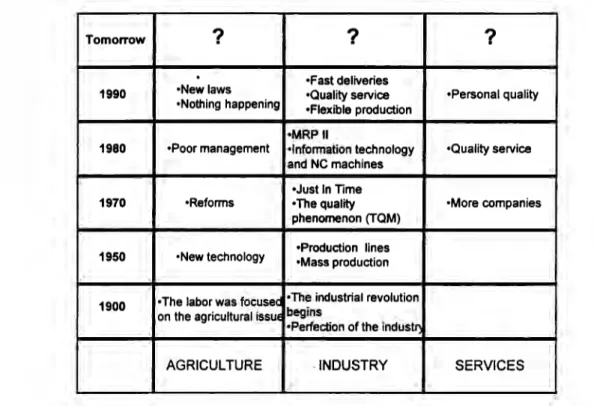
(13) LIST OF TABLES. Table 1.1 Classification ofbusiness size by number of employees ...................................... 14 Table 2.1 Relationship between the three main activities (S, P, MS) and, productivity and competitiveness..................................................................................................................... 4 3 Table 3.1 Relationships Matrix ............................................................................................. 65 Table 4.1 Study of JIT, MRP and TOC (http://www.iaech.nl/users/drshofm/kene/TB/j itord.htm ) .................................................... 8 8 Table 5.1 CATWOE test ..................................................................................................... 105 Table 5.2 Work stations capacity (products by family) in units per 8 hours (one shift ) .... 123 Table 5.3 PRODUCTION REQUIREMENTS OF BH'S PRODUCTS ............................. 124 Table 5.4 WEEKL Y MASTER PRODUCTION SCHEDULE BASED ON THE BOTTLENECK................................................................................................................... 125 Table 5.5 Performance measures used to validate the implementation ofthe IMOM model. .................................................................................................................................. 133 Table 5.6 Percentages of each element ofthe survey .......................................................... 135 Table 6.1 Evaluation ofthe implementations ...................................................................... 155. 8.
(14) Chapter I. INDUSTRIAL AND ECONOMJC DEVELOPMENT IN MEXICO. l.. INDUSTRIAL AND ECONOMIC DEVELOPMENT IN MEXICO. 1.1 Introduction Toe purpose of this chapter is to provide an understanding of how the current situation of the Mexican enterprises is. Will be presented in section 1.2 the development of the Mexican economy and sorne explanations about the reasons of our current situation, which explain its el ose relationship with current manufacturing company' s situation. In section 1.3 the current situation ofthe Mexican enterprises is described and the barriers for its development. Those barriers are the challenges that companies need to confront sooner or later. Section 1.4 is going to present the need to develop a new way of operations managenient strategy, that is, promoting actions based on the global situation of the · manufacturing companies instead of thinking locally.. 1.2 Development of the Mexican economy "1995 will be ayear of adjustment ... " Ernesto Zedillo Ponce de León President ofMexico. This declaration is a tacit admission that 1995 will be characterized by contractions in economic growth, rising inflation and null access to credit. In business terms, this means a decline in profit margins, acute unemployment, bankruptcies all across the private sector, low stock market performance, and higher debt servicing costs. Toe financia} crisis brought about by the currency collapse in December 1994 has not diminished by the wake of strong emergency initiatives to neutralize a nervous market, including the availability of extensive credit lines. This implies a severe contraction of credit. In a word, the challenge in 1995 is: survive (Salinas León, 1995).. 9.
(15) Chapter J. INDUSTRIAL AND ECONOMIC DEVELOPMENT IN MEXICO. At the beginning of 1993 only 15 % ofthe small and medium sized Mexican companies had taken care of productivity and competition issues in the last four years(El Norte, 1993). That means that currently there are many companies missing the tools and technology for being competitively and productive. Actually, the entrepreneur community talks about strong competence, because most ofthe companies have serious problems dueto lack of cash, decreasing markets, high operational cost, war prices, etc., but really a few of them have taken care of up dating their management and operational systems with new technologies in order to reduce their problems, or at least to know how to be competitive and productive with these constraints (Flores, 1997).. On the other hand there are a lot of options for tools and management philosophies to 1. improve the companies (Goldratt , 1991 ), but these options are confusing to the directors and managers ofthe enterprises. That's why sorne ofthem say "it didn't work", "I don't think this will help my company" or "I don't want to change my enterprise, it is making money". The way it is that most business men don't really know how to implement new. I. technologies, what they really need to change, to what to change and they don't realize that they can make three times more money than now. These arguments are talk about the requirements for a new business culture.. Through severa! years our economic activity has been transformed, and we are now considered a great altemative in the manufacturing area, even when we don't have advanced technologies. In regard to the service enterprises, we are being invaded by our NAFTA partners, lecturing how to perform a quality service.. Toe arrival of products from the Asiatic tigers, is bringing chaos in to the Mexican producers. Their prices are so low, even though we say "our labor is not expensive". Sorne these imported products have very low quality, but any way the Mexican market is altered.. 1. Goldtatt's book "Toe Race" explains how the business world has been invaded with too many tools which promise better results for manufacturing companies, but they fmally confuse managers. IO.
(16) Chapter J INDUSTRJAL AND ECONOMIC DEVELOPMENT IN MEX/CO. The current economical situation of México requires strong companies. These companies should be able to compete in the local and intemational markets.. Toe only way to do this is by having a productive and competitive companies from the intemational point of view, this means, world class companies. Also the strategies must be considered in the short, medium and large periods.. Toe rules of the game have been changing, and to be more productive and competitive now and in the future, it is necessary to identify the current situation in Mexican enterprises, and take actions according to this local and intemational situation. Figure 1.1 presents how the economy and the industrialization have been changing through the times.. ?. Tomorrow. .. 1990. 1980. 1970. 1950. 1900. •Newlaws •Nothing happening. •Poor management. •Reforms. •New technology. ? •F ast deliveries •Quality seivice •Flexible production •MRPII •lnformation technology and NC machines •Just In Time •The quality phenomenon (TQM). ? •Personal quality. •Quality seivice. •More companies. •Production lines •Mass production. •The labor was focused •The industrial revolution on the agricultura! issuE begins •Perfection of the industr,. AGRICULTURE. INDUSTRY. SERVICES. Figure l.l Transfonnation ofthe economical activities in México (Flores, 1997). 11.
(17) Chapter I. INDUSTRIAL AND ECONOMIC DEVELOPMENT IN MEXJCO. Figure 1.1 shows the big importance of being aware of how the industry is changing, and what are the new rules for competitiveness. This knowledge will allow the enterprises focus on the right direction. In 1982, Mexico was one of the most protected economies of the world; today, it is one of the most open economies. This means that companies which have survived competition have the flexibility to adapt to difficult situations such as those presented for 1995. In 1982, 78% of exports were derived from only one product: oil. Today, manufacturing goods represent 82% of ali sales abroad.. Toe management of production resources is critica! to our productivity growth and competitiveness as a nation. As president Zedillo mentioned (Time, 1995), productivity is one of the priorities for achieving a successful National Development Plan for the next five years and realizing a higher growth.. 1.3 Current situation of the Mexican enterprises. Barriers for their development "Toe objective ofthe industrial development is to meet permanently rising social needs under the least possible expenditures of human labor and work spent on that development". This phrase presented by Grudzewski and Roslanowska (1981), could be followed by managers and leaders in the industrial sector. I would like to take in to account for the development of this chapter, the next statement of what is understood by industrial development:. "The industrial development ought to be meant as the e.ffect o/human actions oriented toward the accomplishment o/a system o/goals selected by a certain social system, and realized by appropriate strategies in the living conditions ofthe community which would allow to use in the most e.ffective way the capabilities, capacities as well as material and human labor resources being at the disposal ofthis community. " Grudzewski and Roslanowska. ( 1981). 12.
(18) Chapter J. INDUSTRIAL AND ECONOMIC DEVELOPMENT IN MEXICO. Human actions, accomplishment of system' s goals and the community are going to be considered as an essential part of this thesis. Toe development of this thesis will be focused on the small and medium sized companies installed in Mexico. Toe micro, small and medium sized Mexican companies represent a very important part ofthe Mexican economy, 99 % ofthe enterprises. They also provide 78 % ofthe employment (INEGI, 1994).. Small and medium sized companies have similar characteristics regarding the way they are managed, so sorne features about them are important. A small business is characterized (Bemett and Macness,'1983) by: • A lack of specialist services to advice management • Usually only one or two people involved in significant decision making • A lack of senior firm for the senior men to think about the development of the firm • lt has relatively a small share of its market. • It is managed by its owners or part owners in a personalized way. Even this classification is made in the UK, those characteristics are similar to the Mexican small firms. I would like to include sorne characteristics to well define the Mexican small companies: (1) Little empowerment, (2) Non export oriented, and (3) Low technology level. In regard to the medium sized business, they have similar characteristics as the small ones, but differ from the structure. Sorne oftheir characteristics are: (1) it has a formal organizational structure, (2) lt has a regular market share, (3) Moderate costs, and (4) Regular or good quality (INEGI, 1994; Aggarwal, 1997). For purpose of this thesis, I will consider the classification size of companies as Professors Grudzewski and Hejduk purposed for the Polish companies2. This classification is shown in. 2. In the National Institute of Statistics, Geography and lnfonnation (INEGI) in Mexico the classification for the small and medium sized enterprises is mainly represented by less employees compares with the Polish Classification, but for research purpose is more reasonable to consider the Grudzewski and Hejduk' s ( 1997) approach. 13.
(19) Chapter I. INDUSTRJAL AND ECONOMIC DEVELOPMENT IN MEXICO. table 1.1, and it only represents part of her paper published. I will Describe the small and medium companies in the industrial sector as follow:. lndustry sector. Class division by number of employees. Small. from49. Medium. 50 - 499. Large. 500 and more Table 1.1 Classification of business size by number of employees. Toe Mexican government is working hard in order to support the small and medium size companies (Salinas León, 1995). Several institutions were opened to provide financial support, information about exports and consulting. Unfortunately these services don't have the quality and the speed that companies would like to have. Other private institutions like business associations or chambers are providing similar support services as the government institutions, but both private and government institutions, most of the times, are focus in problem solving of extemal productivity factors (see section 2.2 of chapter 2 for details). Interna! productivity factors (Santarek, 1996), most of the times, are ignored or considered to have little importance to the government, the private chambers and business men, and these intemal factors are essential to increase competitiveness and productivity in the companies. To explain this lets consider three similar companies that compete with the same product and they have the same equipment and machinery. Two ofthe companies are local ones, and the third is a foreign company. Toe company with the biggest market share is the one that master effectively the operations and production (intemal factors), taking in to account extemal factors.. I. Several tools have been developed in last years as Total Quality, Just In Time, Theory of Constraints, continuos Improvement and more, but unfortunately the expected results have been dispersed, and they go from great successes to great cracks. This doesn't mean that. 14.
(20) Chapter J INDUSTRIAL AND ECONOMIC DEVELOPMENT IN MEXICO. sorne tools work and other don't. Toe necessities ofthe Mexican enterprises have required severa} modifications in the application of these too Is, and sometimes they disturbed their core objectives. Another common problem in Mexican companies is the paradigms and inertia of the past which blocks the actualization to the real and current business world. For instance, companies force their people to get high volumes of production in order to be more "productive", this is correct ifthe market is demanding it, but if not high inventories will be obtained.. A great part ofnation's economy, is based on its level of production. We may say that Mexico could be a strong country, but it will need a great amount of investments that pulls the productive development, as a consequence, a big production level. Toe current enterprises are affording new challenges, because in the past the words productivity and competitiveness were out of our dictionary. Now a days they are still confused for sorne managers.. The globalization of markets and the economical crisis of 1995 are affecting the Mexican companies as follow: 1.. Most of the companies are being forced to consider that competitiveness and productivity are essential to stay in the business. 2.. Unemployment. 3.. Low technology level in enterprises. 4.. Toe domestic markets are constrained (low earnings by Mexican citizens). 5.. The operational conditions are not in equity compares with other countries, because the interest rates for loans are high, taxes, etc.. 6.. Toe Mexican enterprise is searching new markets. That's it, they are forced to become export companies.. 15.
(21) Chapter J. INDUSTRIAL AND ECONOMIC DEVELOPMENT IN MEXICO. In the other hand, the interna! problerns ofthe Mexican enterprises are also affecting their developrnent. Sorne of the typical problerns found in the Mexican cornpanies are as follow (Flores Castro, 1995a): ~. Toe decision rnaking process in concentrated in the owner or director a the cornpanies. Poor ernpowennent. ~. Resistance to chance (in all levels of the organizations). ~. Lack of a global vision by the ernployees of the organizations. ~. Lack of integration. ~. Management by crisis (a lack of global vision makes everything irnportant). ~. Little strategic planning. ~. Passive focus on customer. ~. Lack of continuity in the irnprovernent projects implernented. Taking in account the intemal problernatic of enterprises, I will describe the sorne challenges (Flores Castro, 1995b) for the Mexican manufacturing cornpanies: ~. Fast changes in the business culture. (commitrnent in continuos improvernents process). ~. Take advantage ofthe Mexican creativity by leading it in the right way. ~. A real focus on customer satisfaction. ~. Effective use of technology. ~. Continuos seeking of integration and communication between employees. ~. Share a global vision with ali the employees of the company. As we can observe, the industry in Mexico is having new challenges, the only way to be in the game is by increasing productivity and competitiveness. There a lot of ways to achieve it, one is by receiving help from the govemment, and the other is by improving internally. Toe second choice is the hands of the business rnen. Toe goal should be searching profit now and in the future, and to reach that goal is in function of the customer satisfaction, and to get the customer satisfaction, requires that the companies work adding value to customer by providing quality products, price, service and fast deliveries.. 16.
(22) Chapter I. INDUSTRJAL AND ECONOMIC DEVELOPMENT IN MEXICO. 1.4 The need of developing a new strategy for operation management (local vision vs. Global) One of the main intemal problems that has most of the companies is the short vision of the organization. This has to be changed by having a global vision ofthe company. Solutions are now considering global impacts. In chapter 2 this is going to be explained in more detail. In order to manage effectively the operations a new vision of the company has to be adopted as presented in figure 1.2. Strategic vision of a world class manufacturing company. New Produets. New products development. Order fulfilment Quality Reliability Flexibllity Price fast deliveries. Finance. lnform ation. amagemont Human Resources. Figure 1.2 A new manufacturing strategic vision (Chased and Aquilano 1995). Figure 1.2 shows the priorities linking into an enterprise capabilities "barre!" since operations cannot satisfy customer needs without the involvement of Research & Development and Distribution and without direct or indirect support of financia! management, human resource management, and information management. Given its performance requirements, an operations division uses its capabilities (as well as those of its suppliers) to achieve those requirements, that is, to win orders. This capabilities include technology, systems, and people. IS (Information Systems) like MRP Il(Manufacturing. 17.
(23) Chapter I. INDUSTRIAL AND ECONOMIC DEVELOPMENT IN MEXICO. resource Planning), JIT (Just In Time) or TOC (Theory of Constraints), and TQM (Total Quality Management) represent fundamental tools and concepts used in each ofthe three areas. A good operations strategy is that it sees capabilities as supporting what Rayes and Pisano term the intended direction of the firm, not just its current situation (Rayes and Pisano, 1994).. Every organization is complex human system, with its own characteristics, culture, and with a system of values which determinate the information systems and the work procedures. All this set of variables have to be continuously observed, analyzed and improved in order to achieve productivity by sharing with all the people in a company the global vision (holistic systems approach).. CONCLUSION OF THIS CHAPTER lt is very important that Mexico has to be capable to export quality products and also leam to think in strategic terms (competitive). But we have to reflect, more than everything else, in productivity and competitiveness. Toe necessary competitiveness implies an orientation of the future behavior. The generation of innovate ideas that add competitive advantages need openness, freedom, incorporation of sciences and technology; involves and demand dynamic enterprises and innovated processes. Finally, the economic policy from the govemment needs to be combined at the same time with the industrial and technology policies to provide an autonomous development of the Mexican economy that provides good response welfare demanded by the society.. Toe next two Chapters (2 and 3), will cover the literature about operations management and the new management tools that in combination with chapter 1 will allow me to generate the model purposed in this thesis (chapter 4).. 18.
(24) Chapter l INDVSTRJAL AND ECONOMIC DEVELOPMENT IN MEXICO. BIBLIOGRAPHY • Aggarwal Sumer. 1997. Flexible Management: Toe Ultimate Strategy. Industrial Management. Vol. 39 Januray-February. pp. 26 • Ballou Ronald. 1991. Logistics Management. Prentice Hall • Béranger. 1994. En Busca de la Excelencia Industrial. Just In Time. Limusa. • Bunge Mario. 1985. La Investigación Científica. Second edition. Ariel. • Chase R. and Aquilano N.J. 1995. Production and Operations Management. Seventh edition. Irwin • Claus Moller. 1982. Personal Quality, the base of all qualities. TMI A/S. • El Norte. November 1993. Sección de negocios. • Fawcett S., Taylor J. and Smith S .. 1995. Toe realities of operating in Mexico: an exploration of manufacturing and logistics issues. International Journal of Physical Distribution and Logistics Management. Vol. 25 No. 3. pp 49-68. • Flores Castro Mario Adrián. 1993. Desarrollo Logístico y Operativo Basado en La Teoría de Restricciones. Tesis Maestría. • Flores Castro Mario Adrián. 1995a.Second International Quality Symposium. UASLP. • Flores Castro Mario Adrián. 1995b. Business Process Reengineering Handbook. Material for seminars. ITESM. • Flores Castro Mario Adrián. July 1997. An Integrated Model For Operations Management, A Window to competitiveness and productivity. Manufactura Magazine. Mexico. • Giral Barnes.1993. Cultura de Efectividad. Second edition. G. E. lberoámerica. • Goldratt E. y Fox R. E. Toe Goal. 1991. A Process of Ongoing lmprovement. Ediciones Castillo • Goldratt E. y Fox R. E.. 1990. Toe Race. [Il]North River Press. • Grudzewski W. M. and Hejduk Irena. (June 1997). Success Small Firms In Poland. The Second International Stockholm Seminar on Risk Behaviour and Risk Management • Grudzewski W. M. and Roslanowska. 1980a. Modeling of production functions of production process by using dimensional analysis. part I vol. 6. Systems Science. 19.
(25) Chapter 1. INDUSTRIAL AND ECONOMIC DEVELOPMENT IN MEXICO. • Grudzewski W. M. and Roslanowska. 1980b. Modeling ofproduction functions of production process ~y using dimensional analysis. part II vol. 6. Systems Science. • Grudzewski W. M. and Roslanowska. 1981. Toe construction of industrial development models by means ofthe model similarity theory. vol. 7. Systems Science. • Hayes and Pisano. January- February 1994. Beyond World Class: Toe New Manufacturing Strategy. Harvard Business Review. • INEGI. 1994. Censos económicos 1994, resultados oportunos. INEGI. • Kenneth G. Merkel. April 1995. Achieving planned performance results using Manufacturing Operations. Industrial Engineering. Volume 27. number 4 • Kevin K. Laughlin. April 1995. Increasing competitiveness, with a simplified cellular process. Industrial Engineering. Volume 27. number 4. • Kidder and Judd. 1986. Research Methods in Social Relations. Holt Rinehart Winston. • Loyola Alarcón A./ M. Schettino. November 1994. Estrategia empresarial en una economía global. lberoamérica. • Loyola Alarcón. 1989 Desafios de la economía Mexicana. Ecasa. First edition. • Moran and Abbott. 1994. NAFTA Managing the Cultural Differences. Gulf. • Quality Resources/llE.1994. Beyond the Basics of Reengineering: survival tactics for the 90's • REFORMA. 14 de Octubre de 1994. Visión realista de nuestra competitividad. Sección de negocios. • Rhodes D.J .. 1995. Root definitions and reality in manufacturing systems. Journal of applied systems analysis. vol. 12. • Riding Alan 1985. Distant neighbors. Planeta. First edition. • Salinas León Roberto. 1995. An overview ofthe Mexican Economy in 1995. MACROECONOMIC FRAMEWORK. • Santarek Krzysztof. 1996. Productivity lmprovement Programs. Warsaw. • Schonberger R. J.. ( 1990) World Class Manufacturing, the Lessons of Simplicity Applied. Toe Free Press. Bi'--UOTf::CA <\t- t.STUDJos". v(¡/). -\ V. ~~. ~...P... r CAMPUS~ '. '. --. E:STAOO. e,;. o .... ~ <<r,.. tri. ~. ' {..;,". 20.
(26) Chapter I INDUSTRIAL AND ECONOMIC DEVELOPMENT IN MEXICO. • Suzaki Kiyoshi. 1987. Toe New Manufacturing Challenge: techniques of continuous improvement. Collier Macmillan. • Tamayo Mario. 1985. Metodología Formal de la Investigación Científica. Limusa. Time Intemational. June 19, 1995. Toe besieged president speaks out. Time.. 21.
(27) Chapterl MANUFACTURING IN CVRRENT DA YS. 2. 2.1. MANUFACTURING IN CURRENT DAYS Introduction. In chapter 1 the real industrial and economic situation of Mexico was presented as an evidence of how we are and what we need to improve. Also, we cover the typical development barriers for the small and medium sized Mexican companies. Finally, the need of a global vision instead a local one was presented as a strategy to manage the production and operations of manufacturing companies. Through this chapter, I will describe in section 2.2 that Production and Operations Management are the core driver for this dissertation, and the issues of competitiveness and productivity are the final targets that have to be impacted with the output of this thesis. In section 2.3 a literature review will cover aspects like manufacturing and its implications in production, quality, operations management and business strategies. What I have leamed through my experience as a professional, is that we have to take in to account all elements related with manufacturing organizations when we are performing a task. At the end of this section (see 2.3.1), I will conclude with the short comings ofthe literature. Section 2.4 will develop a functional analysis between the Sales, Production and Materials Supplying activities, demonstrating how they usually seek local objectives. The functional analysis together with the shortcomings from section 2.3 .1 will lead to the hypothesis of this thesis shown in figure 2.6. This chapter and the next one will be linked to drive the output of chapter 4.. 2.2. Production and Operations Management (POM). When I carne up with the idea of developing the theme ofthis thesis, I hadn't realized how big was the relation with the POM discipline, so now I realize that I am going into this field. Toe next subsections will describe what is understood about POM and then an analysis about competitiveness and productivity will be developed. Even competitiveness. 22.
(28) Chapterl MANUFACTURING IN CURRENT DA YS. and productivity are affected by both interna! and externa! factors, I will focus on the interna! ones asan attempt to at first improve the interior of the organization. Obviously, the externa! factors have to be taken in account when I talk about a holistic approach.. 2.2.1 Understanding POM The history of Production and Operation Management discipline has been integrated from Taylor's approach to management till the current wave ofTotal Quality Management. I consider that the work ofthis thesis is very related to the Operations Management (OM) area because it covers most of its components. OM can be defined as the design, operation, and improvement of the production system that creates the firm' s primary products or services (Chase & Aquilano. 1 ,. 1995). OM is also defined as the leader ofthe transformation. process, which convert the inputs (land, assets, labor and management) in the desired outputs as goods or services (Adam & Ebert, 1991). OM is frequently confused with operations research, management science and industrial engineering. Operations Management provides a systemic way oflooking at the organizational processes (the firm as a whole). Market place. C orporate strategy. Finance strategy. Operatioas strategy. Marketing strategy. Operatioas management. lnputs. Outputs Plaats. Materials Customers. Products Services. Pluaiag aad control system .___ _ _ _ _ _ Production system - - - - - - - - - '. Figure 2.1 Operations Management as a function (Chase & Aquilano, 1995). 1. Chase and Aquilo's book" Production and Operations Management", 1995, is considered one ofthe most complete issue about Operations Management Discipline. 23.
(29) Chapter 2. MANUFACTURJNG IN CURRENT DA YS. Toe heart of OM is the management of the production systems. A production system uses operations resources to transform inputs into sorne desired output. An input may be a raw material, a customer order, or a finished product from another system. Figure 2.1 show how Operations Management is considered inside a organization (Chase & Aquilano, 1995). Operations resources consist of the five P's of operations management: People, plants, parts, processes, and planning and control systems.. 2.2.2 Competitiveness and productivity This section will describe two important elements for the success of manufacturing companies: productivity and competitiveness. It's important that they get to be impacted upon with the implementation of the model developed in this thesis.. At first I would like to talk about the drivers for improvement in most manufacturing enterprises. There are four strategic indicators (Johansson and Pendlebury, 1993 ) for a manufacturing and service enterprises: the quality of the product, service, cost and delivery time.. For the purpose of this thesis Quality refers to the physical quality of the product. Service refers to the attention provided to the customer that includes the order fulfillment process, receiving the product in good conditions, and service needed after the sale (technical support, warranty, etc.). Cost refers to normal operational expenditures as design, engineering, distribution, inventory, materials, quality assurance, etc. That is anything that can reduce customer's cost. The last one, Cycle Time, that is the time required to fill an order since the customer asks for the product until he receives it. The cycle time or lead time is normally accounted by the following steps: (1) Time for processing an order, (2) Time to produce the order (ifthe product is not on hand), and (3) Time to deliver the product from the warehouse to the customer dock. These indicators, as shown in figure 2.2, are strategic weapons in the current business situation and can improve productivity and competitiveness, even more, with the opening. 24.
(30) Chapter 2 MANUFACnJRJNG IN CURRENT DAYS. of global markets. We also need to consider that each company should have its own market share defined. Unfortunately, in Mexico, we are only addressing two ofthese indicators: Quality and Cost (REFORMA, 1994). Regarding service and delivery time we are behind, compared to intemational standards. There are few Mexican companies that successfully handle these four indicators (Flores Castro, 1995).. 1 QUALITY. •. 1 COST I. t. t. QUALITY. SERVICE. IX I. x. +. COST. SERVICE 1 CYCLE TIME. !. CYCLE. '. TIME. Figure 2.2 The criteria equarion for customer value (Johansson and Pendlebury, 1993). Adding customer value is to talk about Competitiveness, but I consider important to analyze and understand what is behind this concept. Competitiveness is a term that is often used but rarely defined. Managers talk about discovering and strengthening competitive advantages, Mexico bemoans its lack of competitiveness in world markets.. Competitiveness is about wimúng. Firms within a given industry compete with one another for market share. Nations also compete with one another for shares in the global markets. In 1985, the president's council on Industrial Competitiveness (Chase and Aquilano, 1996) offered this definition of intemational competition:. '. 25.
(31) Chapter2. MANUFACTURING IN CURRENT DAYS. Competitiveness for a nation is the degree to which it can, und_er free and fair marlcet conditions, produce goods and services that meet the test of international marlcets while simultaneously maintaining and expanding the real incomes o/ its citizens.. An other approach more related with manufacturing companies (Stoner, 1996), considers sorne elements used by the customer in order to evaluate competitiveness:. • Quality (Q). Meet the quality standards ofthe product and customer expectations •. Opportunity (O). Deliveries on time and shortest lead times as possible. •. Price (P). Universal measure. •. • After sale service (AS). Warranties • Technology (I'). Support for the processes • Ecology (E). Nature caring. In the other hand, Schmenner (1993) says that competitive demands that can be placed on manufacturing, can also be classified in three different groups: (1) product-related concems, (2) delivery-related concerns, and (3) cost concems. Which ofthese competitive demands takes priority, at company, they depend on several forces: the economy ofthe industry, particular competitive pressures, govemment regulations and incentives, the company' s own resources, and the company's culture and attitudes. What is important to recognize is that operations can be subject to different, and changing, competitive demands. According to Porter ( 1982 and 1996), competitiveriess is a differential advantage from one company to another, it means, that the essence of a competitive strategy is choosing to perform activities differently than rivals do. In my opinion, it depends more on the company's culture and attitudes. Toe above arguments from Stoner, Schmenner and Porter will be taken in to account for the development of the model in this thesis.. 26.
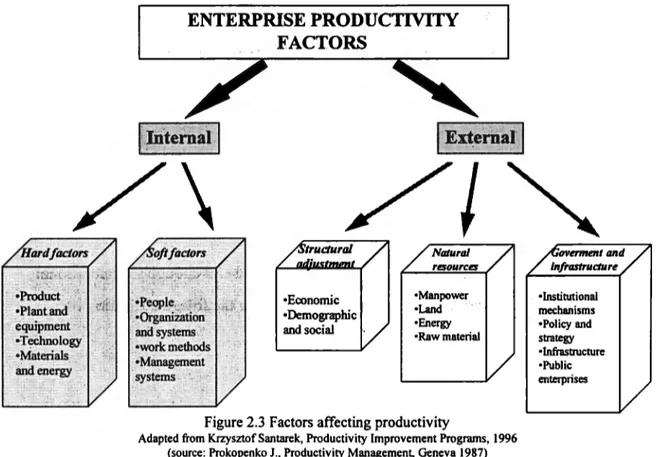
(32) Chapter2 MANUFACTURJNG IN CURRENT DA YS. Productivity is often discussed along with competitiveness. Productivity is the relationship between products produced and sold (system output), and factors used in production (system inputs). This is represented as follow:. . . outputs prod uctzvzy = -.-znputs. In my opinion the above measure of productivity is not useful enough for operational purposes, so for the purpose of this thesis I will consider the follow definition of productivity:. P RODUCTIVITY- the key of business profitability-is the resu/t of how we manage the process for producing goods and services and is driven by implementing innovations in both products and their customer delivery process. (Gregory Watson). Productivity measures the return on investment. Productivity measures both efficiency and effectiveness, and can result from downsizing (eliminatingjobs), upsizing (adding workers, jobs, etc.), doing different things (new products or services), or doing things differently (new or changed business or work process). There are severa! factors that affect the productivity of an enterprise. These factors can be classified as interna! or externa!. Through the history of the Mexican enterprises the externa! factors have affected too many companies, but no special attention is paid to the interna! ones, so they can be managed and controlled by the company itself, Even Externa! factors affect competitiveness. Figure 2.3 represents the enterprise's productivity factors. For the purpose ofthis thesis and regarding operations management, I will consider only the interna! factors, that is, hard and soft factors.. 27.
(33) Chapter2 MANUFACTURJNG IN CURRENT DAYS. ENTERPRISE PRODUCTIVITY FACTORS. ~Interna). /\. j Exteníal -¡. 1. /I~. -----. Natural raourca. r.'. •Product · •Plantand • equij>ment - ·· •Technology •Materials. andenergy. •Manpower. •Economic •Demographic. •Land. •Energy •Raw material. andsocial. -------,,. •lnstiMional mechanisms •Policy and strategy. •lnfrastructure •Public enterprises. •Management systems ,··. Figure 2.3 Factors affecting productivity Adapted from Krzysztof Santarek, Productivity lmprovement Programs, 1996 (source: Prokopenko l, Productivity Management, Geneva 1987). Mex.ico is notas competitive as we would want. According to the Economic World Congress celebrated every year in Davos, Switzerland, Mexico was in the 26th place as a competitive country around the world in 1994, (REFORMA, 14 ofOctober 1994). In 1996 Mex.ico drops till de 42nd place, and in 1997 is in 40th place (REFORMA, 26 of March 1997). Of course more global indicators are needed to verify that position. Delivery time and services are not the best weapons that Mex.ican companies have, and most of the times, they represent key activities to accomplish a sale.. 2.3 Manufacturing based on literature Literature research about manufacturing is a broad field almost impossible to cover in a few pages, but I would like to point out sorne topics related to the manufacturing value 2chain; business strategies; Systems Approach to Management. 1. ;. production planning, control and. 2. The Systems Thinking approach is not necessarily an arca strongly related with manufacturing, but its importance in current business problematic command its analysis (Flood and Jackson, 1991). 28.
(34) Chapter 2 MANUFACTURING IN CURRENT DA YS. scheduling; and Total Quality Management. I am not trying to make a classification ofthe manufacturing approaches, I just want to put this section in a easy way for better reading comprehension.. Sorne of these topics will be covered in combination with others in this section (2.3), and sorne as: JIT, TOC, TQM, BPR and MRP II will be covered and analyzed individually in chapter 3. We would find sorne of these topics in this section because of their relationship with the literature analyzed. The reason to separate the chapters about literature (chapter 2 and 3 ), is because the model developed in this thesis is going to be enriched with a technical review of sorne specific techniques (chapter 3), and the opinion of authors about literature related with this work (chapter 2).. MANUF ACTURING VALUE CHAIN (LOGISTICS) Senior-level materials managers notice consistently that their firms' critica! strategic objectives require greater co-operation among the different value-added functions (Stanley & Stanley, 1995), so fulfilling the customer service requirements occurs as the firm creates customer value, which is best done by bridging functional barriers and managing firm resources as a series of interrelated flows and process. Toe materials management functions of purchasing, operations and logistics are then considered and the four decision areas - infrastructure, materials, technology and people that are common of these functional areas. This should be the way to see the chain by each ofthe functional areas, but in reality this is not happening (Goldratt, 1994). Toree reasons why companies struggle in their quest to fulfill customer expectations are: they possess a myopic vision of customer service; the fail to make the link between utility creation and customer value; and they organize functionally, creating barriers to the development of strategic capabilities (Hicks, 1996; Stanley & Stanley, 1995). Meeting customer's real needs has been identified as the key to competitive success. Unfortunately, few companies excel at achieving high levels of customer service. In fact,. 29.
(35) Chapter 2. MANUFACTURJNG IN CURRENT DA YS. the concept of customer service is frequently misunderstood and often poorly defined at even leading companies. Stanley (1995) has develop three classifications about customer satisfaction: • customer service (meeting the establish performance standards. Intemal measures) • customer satisfaction (eliminating the gap between interna} and extemal measures) • customer success (the knowledge of downstream requirements is used to provide a "better" produce/service mix - a mix that will lead to enhanced competitiveness for the customer). As one CEO notes, "We turn our customers into winners. Their success is cash in our bank".. The role of the strategy is to direct the firm's use of resources so that the most important objectives are achieved. This role is meant to reduce the physical and psychological distance that separates the firm and its customer. Toe main challenge in the strategy selection and management processes is to ensure that a consistency of purpose is achieved throughout the firm so that all the activities, regardless of their functional positioning, work together to accomplish the targeted goal s. That is the role of the value-added functions as Purchasing, Operations and Logistics in meeting customer's needs (Stock and Lambert, 1987; Ballou, 1985).. BUSINESS STRATEGIES According to Hayes and Pisano ( 1994), companies have different strengths and weaknesses and can choose to differenti~te themselves from their competitors. Similarly, different production systems, the composition of decisions in a number of key areas, have different operating characteristics; and therefore rather than adopting an industry-standard production system. They argue that the "task" for a company' s manufacturing organization is to configure a production system, that, through a series of interrelated and intemally consistent choices, reflects the priorities and trade-offs implicit in its competitive situation and strategy. Toe trends on strategic planning consideras a very important element the Vision of a company, because the organization needs to be pulled by something. Collins and ·. 30.
(36) Chapter 2 MANUFACTURING IN CURRENT DA YS. P<fTaS (1996), say that a well-conceived vision consists of two major components: core ideology and envisionedfuture. The core ideology provides the glue that holds an organization together through time. Core ideology consists of core values and core. purpose. Core values are the essential enduring tenets of an organization., and core purpose is the organization' s reason for being. Collins and Porras ( 1996) also say that a way to discover the core ideology is by look.ing inside. lt has to be authentic. Envisioned future consists of two parts: a 10-to-30 years audacious goal plus vivid descriptions of what it will be like to achieve the goal.. Peter Senge ( 1990) with his approach in the learning organizations issue, describes the new roles, skills and tools for leaders who wish to develop leaming organizations. It is based on his published book The Fifth Discipline: Toe Art and Practice ofthe Leaming Organization. The prevailing view of leaming organizations emphasizes increased adaptability. According to Fortune magazine "the most successful corporation ofthe 1990's, will be something called a leaming organization, a consummately adaptive enterprise". Leadership is another aspect considered as a very important element by Senge (1990). He argue that the traditional view of leaders-as a special people who set the direction, make the key decisions, and energize the troops-is deeply rooted in an individualistic and. nonsystemic worldview. Leadership in leaming organizations centers on subtler and ultimately more important work. In leaming organizations, leaders are designers, teachers, and stewards. Leadership in a leaming organization starts with the principie of creative tension. Creative tension means moving the current reality toward the company's vision. Senge also says that new leadership roles require new leadership skills, and this skills can only be developed through a lifelong comrnitment.. As a summary Senge identifies the essences as: Q. system thinking: holism and interconnectedness (the Fifth Discipline). Q. personal mastery: being, generativeness and connectedness. 31.
(37) Chapter 2. MANUFACTURING IN CURRENT DA YS. Q. mental models: love of the truth and openness. Q. building shared visions: commonality of purpose and partnership. Q. team leaming: collective intelligence and alignment. SYSTEMS APPROACH TO MANAGEMENT 3. Toe systems thinking is a wide range discipline with several approaches in the field. The reason to point out this approach, is because it is a serious and well supported discipline of management sciences. The system thinking approach covers a series of areas like:. Hard System Thinking, Cybemetics, Systems Dynamics, Soft System Thinking, Emancipatory Systems Thinking and Critical Systems Thinking. When I refer to Systems Thinking it is about thinking with Holons. Toe Holon word is an abstract idea of a whole having emergent properties (Checkland and Scholes, 1990).. Systems Thinking takes a holistic rather that a partial for good management (Jackson, 1991 and 1995). In my opinion the argument about holisims is one of the major contributions to management sciences, so I am trying to says that this is the only contribution that we can take in account.. PROCESSESMANAGEMENT According toan early survey (Majchrzak and Wang, 1996), I found that in order to promote collective responsibility from the employees is necessary something more than reorganizing a company. Departments can reduce cycle times by redesigningjobs with overlapping responsibilities. In the other hand, managers who aren't ready to promote collaborative culture maybe better off leaving their functional departments intact. Many managers do away with functions but fail to change their own positions. They continue to act like functional chiefs even though the functions no longer formally exist. People who. 3. For more details about the different approaches ofthe Systems Thinking see Lane and Jackson (1995), and Jackson M. C. ( 1991). 32.
(38) Chapter 2. MANUFACTURJNG IN CURRENT DA YS. feel collectively responsible are willing to work especially hard to avoid letting the team down (Majchrzak and Wang, 1996). If companies are not ready to take the steps required to change their culture, they may be better off leaving their functional departments intact. After all, coordination on functions can be greatly improve without reorganizing around complete processes. Majchrzak and Wang (1996) suggest that to cultivate collective responsibility is necessarily to consider the next points:. Make responsihilities overlap. Designing jobs so that employees can at least partially perform most of the functions assigned to the departments helps create a shared sense of responsibility because people understand one other' s work and thus share common language and similar constraints and objectives. More important, if a complete-process department <loes not make responsibilities overlap, it will end up with a set of specialized jobs.. Base rewards on unit performance. This allows to have better company results than individual rewards. A unit reward can be as follow: • X percentage to customer satisfaction • Y percentage to plant performance • Z percentage to others important issues as quality, individual performance, creativity, etc.. lt needs measurement and tightly monitor processes by the departments. The measures need to be done every day in order to show team performance.. Change the physical layout. The layout of a work site can either inhibit or promote collective responsibility. According to this study, complete-process departments with layouts that permitted people to see other's work had cycle times 4.4 times faster than those with layouts that didn't.. Redesign work procedures. When managers redesign their organizations, they should ask their employees what they need in order to work well together (Hammer and Champy, 1993; Johansson & Pendlebury, 1993). It means:. 33.
(39) Chapter 2. MANUFACTURJNG IN CURRENT DAYS. • shared ideas for improvement with people in other discipline • involving everyone who would be affected by a decision • helping others do their work There is no single cookie-cutter design for achieving a collective sense of responsibility, so the designed processes need to be customized.. Business Processes Reengineering (BPR), that is now considered asan important POM tool (Chase & Aquilano, 1995), is changing the way business are manage. Toe BPR approach, attempts to change radically and fundamentally the business processes in order to achieve short lead times, low cost, improve service and quality (Hammer & Champy, 1993), (Johansson & Pendlebury, 1993). See chapter 3 to further details.. PRODUCTION PLANNING, CONTROL AND SCHEDULING Is very important to review what is behind the concept of Lean Manufacturing. According to Oliver, Delbridge and Lowe (1996), Inside the factory, lean producers are characterized by just-in-time production, small lot sizes and minimal inventories. Operators on the shop floor are organized into small groups and these small groups take in many of the responsibilities that have traditionally been the prerogative of specialist support functions in mass-production factories. They explain how the Supply Chain is a manifested by tightly integrated material flows between firms, with frequent deliveries of small batches and mínimum inventories, active information exchange between firms, permitting activities such as joint cost reductions, and "shared destiny" relations between firms. A study of many plants reveals that the common factor across the world-class plants appeared to be a process discipline and control (Oliver, Delbridge and Lowe, 1996). About inventories, it's said they are a key measure of leann.ess, and are affected by the simplicity of productions flows, and the uncertainty ofboth demand and supply. lnventories may be used to protect one stage of the process from problems elsewhere.. 34.
(40) Chapter 2 MANUFACTURJNG IN CURRENT DAYS. The use of production teams in the factory is an important component of the lean production model. A second element of the lean production model involves the pushing of responsibility on the front line operators. Visual Control covers features such as Andon lights above production lines, which are activated by operators in order to indicate a problem with the production process, and by visual and public displays of volume and quality performance.. In specific areas of POM, Thomas M. (1997) says that the traditional scheduling, satisfies a limited group of industries well. Make to stock producers apply Just In Time to continuous and discrete production lines increasing efficiency. Kanban and Zero Inventories work in a computer motherboard assembly. But JIT philosophy has severely limited the role in the one of a kind job shop. In the other hand, Linear programming (LP), the great optimizer, grants stunning success to high volume, continuous producers. LP selects the manufacturing altemative that is economically optima! or near optima!. Sometimes planners apply LP simulation to more limited exercises such as figuring the least cost combination of raw materials for a given output of the optimal transportation schedule. LP determines the best changes to make when rough-cut capacity planning detects an unfeasible master production schedule. Finally Thomas (1997) says that success and survival in industry demands realistic, feasible manufacturing schedules .. The real scenario when applying Materials Requirement Planning systems(MRP) is that it produces production schedules based on an infinity capacity producing big conflicts in the shop floor (Leibert, 1997). Most executives in these industries claim awareness of MRP, but they have never used or investigated it further. Manufacturing Resources Planning (MRP 11) has been promising a good altemative to integrate functional areas based on information systems, but experience has shown that is too complicated to implement it, putting the investments on software, hardware and training in danger.. 35.
Figure
+7
Documento similar
As different communicative elements become integrated in multimodal patterns, the coordination of elements (gesture, gaze and vocalization) at 12 months will be the best predictor of
The expansionary monetary policy measures have had a negative impact on net interest margins both via the reduction in interest rates and –less powerfully- the flattening of the
Jointly estimate this entry game with several outcome equations (fees/rates, credit limits) for bank accounts, credit cards and lines of credit. Use simulation methods to
In our sample, 2890 deals were issued by less reputable underwriters (i.e. a weighted syndication underwriting reputation share below the share of the 7 th largest underwriter
Now that the previously-mentioned transfer of the personnel attendance system from the management information system to the healthcare management information system (HMIS) has
• Administration and maintenance of the learning management system (LMS) for Spanish Army courses. Subdirección de Enseñanza a Distancia:.. c) Webmaster in the
Among the expected results is the development of a conceptual model specialized in the container terminal and the agent- based model approach of event management system to
The Dwellers in the Garden of Allah 109... The Dwellers in the Garden of Allah
