
Effects of Green Advertising on Trust Building, Brand Opinion, and Purchase Behavior Edición Única
118
0
0
Texto completo
(2) Copyright © by Raúl Martínez Flores 2012. 2.
(3) EFFECTS OF GREEN ADVERTISING ON TRUST BUILDING, BRAND OPINION, AND PURCHASE BEHAVIOR. APPROVED BY THE MEMBERS OF. Raquel Castaflo Gonzalez, PhD Professor EGADE Business School, Monterrey. -Anabella Davila Martinez, PhD PhD Program Director EGADE Business School, Monterrey. 3.
(4) DEDICATION. With all my love, admiration and respect:. To God.. To my parents, who have taught me to never see a mountain as too high to climb, to follow honesty and hard work: My love, inspiration, and hope. Team and strength!. To my grandmothers and to my grandfathers.. To my family: My basis to go beyond my own efforts and will.. To my friends: My past, my present, and my future beyond this privileged intellectual, personal, and professional adventure. Several mountains to keep on climbing!. To my professors: Who have shared with me their experience, knowledge, guidance, patience, and trust.. The PhD road is here, now and tomorrow. Let’s keep on walking!. Thank you very much!. 4.
(5) ACKNOWLEDGEMENTS. To the authorities of EGADE Business School, Monterrey and ITESM, who provided me with this unique research pathway of personal and professional growth. I want to thank all my professors at EGADE Business School, who shared with me all their knowledge, good will, and time. To my Dissertation Committee: Dr. Raquel Castaño González and Dr. Edgardo Ayala Gaytán, who oriented me to improve, clarify, and detect new perspectives toward my research topics. They also showed me an unknown and fascinating side of marketing research since the very beginning of the PhD program. To Dr. Gerardo Lozano Fernández who supported me along the entire road, since I arrived at EGADE Business School, until now, as I am finding the pathway to start a research academic career. Thank you for your support, patience, and guidance! And especially, to Dr. Anabella Dávila Martínez, who gave me with her confidence and enthusiasm and always motivated me to pursue my PhD efforts before, during, and after this intense academic experience.. Thank you!. 5.
(6) ABSTRACT OF DISSERTATION EGADE BUSINESS SCHOOL, MONTERREY INSTITUTO TECNOLOGICO Y DE ESTUDIOS SUPERIORES DE MONTERREY, CAMPUS MONTERREY. Degree: Doctor of Philosophy. Program: PhD in Management Sciences. Name of the Candidate: Raúl Martínez Flores Committee Chair: Dr. Gerardo Lozano Fernández Title: EFFECTS OF GREEN ADVERTISING ON TRUST BUILDING, BRAND OPINION, AND PURCHASE BEHAVIOR.. In a 22 between-subjects experimental design with 206 participants and three previous exploratory studies with 112 additional subjects, the author proposes a model that presents social advertising (i.e., green advertisements) from the lens of three main constructs: advertising trust, brand opinion, and purchase intention. Simultaneously, the author studies the role of social advertising as a moderating variable in the relationship between advertising trust and purchase intention. Information plays a central role in advertising (American Marketing Association [AMA], 2012). One problem with advertising’s information is lack of trust. The author hypothesizes that social advertising can enhance brand opinion and advertising trust, and hence, consumers’ levels of purchase intention. The results of the present research reveal that social advertising creates a moderating effect in the relationship between advertising trust and purchase intention for competing brands that attempt to enhance their brand associations with consumers.. 6.
(7) In the present study, a relevant finding is that including green and social content in advertising can improve consumers’ levels of trust and purchase intention and that green content in advertising works as an effective source of brand associations when followers intend to compete with leading or pioneer brands with more effectiveness. As a result of the present study’s exploratory and main research stages, another relevant finding reveals that companies should develop social programs (i.e., social campaigns). So, an opportunity to enhance trust by using green advertising is latent and feasible. In a quid pro quo effort, it is highly important for enterprises to communicate their social initiatives and results to consumers by using advertising as an informative, relevant marketing tool. The present research, then, is relevant to the marketing communications’ field, social advertising, consumer research, and societal marketing programs, as well as other business study fields.. 7.
(8) TABLE OF CONTENTS List of Figures…………………………………………………………….……………… ……….xiii List of Tables…………………………………………………………….……………………...… xiv Chapter I: INTRODUCTION AND PROBLEM STATEMENT……………………….……. 13 1.1. Social Advertising and its Relationship to Corporate Social Responsibility and Consumer Behavior Research………………………………………………………………………………………. 13 1.2. Societal Marketing Programs as a Result of CSR Corporate Efforts…………………...…… 15 1.3. Advertising as a Relevant Tool of Societal Marketing Programs………….................…...…. 17 1.4. General Objectives, Exploratory Pilot Studies, and Contributions…………..…...………… 19. Chapter II: THEORETICAL FRAMEWORK, EXPLORATORY STUDIES’ FINDINGS AND THE INTEGRATED MODEL…………………………………………..……………...……….21 2.1. Theoretical Models Relating Brand Opinion and Purchase Intention………….........…..……21 2.2. Trust and Social Value Delivery from Enterprises toward Final Consumers……..…………. 25 2.3. The Role of Advertising’s Tone in the Positive Perception of Social Causes……….………. 29 2.4. Social Advertising as a Moderator between Advertising Trust and Purchase Intention…….. 31 2.5. Pioneering and Follower Brands……………………………………………………….…….. 34. Chapter III: EXPLORATORY STUDIES……………………….……………………………..37 3.1.. Qualitative Research Study…………………………………………………….………… 37. 3.2.. Exploratory Experimental Design (Open Questionnaire Results)………….….…………. 40. 3.3.. Pilot Study Exploratory Survey……………..………………………………...………….. 41. 8.
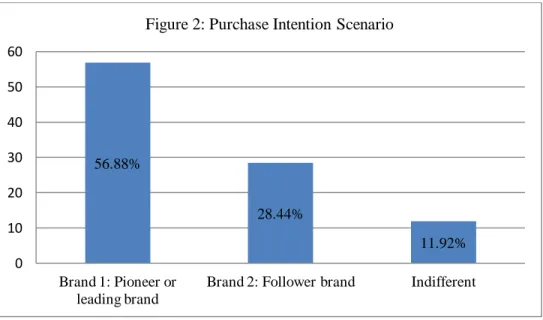
(9) Chapter IV: METHODOLOGY OF THE MAIN EXPERIMENTAL DESIGN……...…… 44 4.1. Experimental Design Insights………………………………………………........…...……… 44 4.2. Justification of Product Category……………………………..…………………..………….. 44 4.3. Population, Sample and Survey Structure……………...…………………………......……… 46 4.4. Key Research Methods…………………………………………..………………………….. 48 4.5. Research Model………………………………………………………….…………..……….. 49 4.6. Description of Social and Nonsocial Advertisements for the Experimental Design……….. 51 4.7. Measures…………………………………………...…………………………………………. 53 4.8. The Survey………………………………………………………………...…………………. 53. Chapter V: DISSERTATION RESEARCH STUDY FINDINGS AND DISCUSSION…………………………………………………………………...…….…… 55 5.1.. Specific Findings about Advertising Trust………………………………….……………. 55. 5.2.. Frequency of Using Bottled Water (Participants)..……………………………...………. 57. 5.3.. Purchase Intention Scenario…………………………………………………..………….. 57. 5.4.. Advertising Trust, Enhancing Believability, and Diminishing Ambivalence...………….. 59. 5.5.. More Findings: One way ANOVA with all Model Variables………………………..….. 62. 5.6.. Multiple Regression and Moderated Multiple Regression Analysis……………..………. 66 5.6.1. Contrasts of Multiple Regression Analysis Considering the Moderator Effect of Social Advertising in the Total Sample…………………………………….…………...……….. 66 5.6.2. Follower Brand 2 with Social and Nonsocial Treatments….................................. 68 5.6.3. Brand 2: The Moderating Total Effect of Social Advertising between ADTRUST and Purchase Intention…………………..………………………………..………70 5.6.4. Pioneer or Leading Brand (Brand 1) and Non-Moderating Effect)……………………………………………………………………………. 73. 5.7.. Brand Opinion: Follower and Pioneer Leading Brands………………………………..… 77. 9.
(10) 5.8.. Hypotheses Results……………………………………………………..………………… 77. 5.9.. Discussion of Brand Associations: Pioneer-Leading and Follower Brands…………….... 78. Chapter VI: PRACTICAL IMPLICATIONS, LIMITATIONS AND FUTURE RESEARCH OPTIONS………………………………………………………………………………………… 81 6.1.. Future Research Directions…………………………………………………...…...…..…. 83. 6.2.. Study limitations and Contrasting Methods………………………………...…..…...…… 84. 6.3.. Practical Implications…...................................................................................................... 85. REFERENCES………………………………………………………………..………...……….. 87 Appendix A. Examples of positive, negative and neutral impact of advertising consumers………………………………………………………………….…….. 95. Appendix B. Support by CSR causes’ benefits (enterprises and final consumers)……...…….. 96. Appendix C. Demographics Exploratory Study #3……………………………...…………….. 97. Appendix D. Description of Advertisements Exploratory Study……..…….………………….. 98. Appendix E. Exploratory Pilot Study Findings……………..………………...……………….. 99. Appendix F. Qualitative Research Guide and Questionnaire…………….……………………. 103. Appendix G. Exploratory Quantitative Study……………………………………..…………… 106. Appendix H. Actual Study Electronic Survey (Follower Brand Social Treatment)…………… 113. Appendix I. ADTRUST one way ANOVA with all treatments included ………...…....…..… 118. 10.
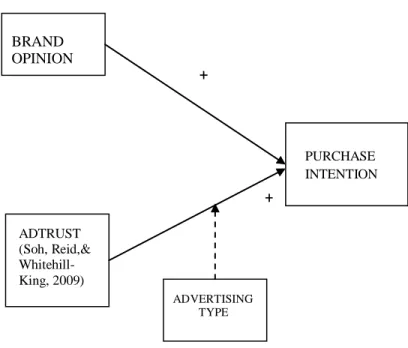
(11) List of Figures 2.1.. First relationship of constructs……………………………………..……….…… 24. 2.2.. Second relationship between constructs…………………………………………. 28. 2.4.. Model and third relationship of constructs……………………..…………...…… 33. 4.1.. The moderating role of social advertising between ADTRUST and purchase intention, and the direct relationship between brand opinion and PI….………… 50. 5.1.. Purchase Intention Scenario……………………………….…………..………… 58. 5.2.. Moderated multiple regression (advertising type: social vs. non social advertising) follower brand (Brand 2).…………………………….………..…........………… 72. 5.3.. Moderated multiple regression (advertising type: social vs. non social advertising) for a pioneer or leading brand (Brand 1).…………...…………………………… 76. 11.
(12) List of Tables 3.1. Research design: in depth interviews………………………………………....…. 38 3.2. Exploratory experimental design…………………...……………………….…... 41. 4.1. Demographics actual study………………………………………….……………47 4.2.Description of advertisements for experimental design………………………..…52. 5.1. Analysis of Variance for ADTRUST………………………………………....…. 61. 5.2. Other comparisons stated by using ANOVA……………………………….…... 63. 5.3. Analysis of variance for Purchase Intention……………………...……………… 65. 5.4. Analysis of variance for Brand Opinion…………………...…………………..… 65. 5.5. Summary of Moderated Unstandardized Regression Coefficients (All Observations)……………………………………………………………….....… 67. 5.6. Correlations Table Sample (After Exposure to Advertisements)……….…......… 68. 5.7. Summary of Moderated Regression Coefficients: Brand 2…….....................…. 69. 5.8. Moderated Multiple Regression (Advertising Type): Follower Brand 2…………71. 5.9. Summary of Moderated Regression Coefficients (Brand 1: Pioneer or Leader)... 75. 12.
(13) CHAPTER I: INTRODUCTION AND PROBLEM STATEMENT. 1.1. Social Advertising and its Relationship to Corporate Social Responsibility and Consumer Behavior Research The present research examines consumers’ reactions to advertising with corporate social responsibility (CSR) and environmental or “green” content, as well as the potential role of social advertising to enhance trust, brand opinion, and purchase intention levels. The idea emerges from the fast-growing social and environmental inertia of companies and stakeholders (i.e., consumers) participating in societal marketing programs. Moreover, it is a premise of this research that CSR and ecological content can enhance advertising trust and credibility of consumers and diminish their ambivalence, lack of credibility, and dual reactions toward advertising. A central concern of this dissertation is to discover how including a social cause (i.e., care for the environment) can diminish duality of opinion toward advertising and enhance consumers’ levels of trust and purchase intention. It has been theoretically demonstrated that duality of opinions toward advertising exists. Chang (2011) stated that it is important to know more about the dual position of consumers toward advertising (i.e., trust or distrust) and ambivalent attitudes toward certain marketing practices (i.e., green or social advertising). Chang (2011) also discussed the relevance of identifying ambivalence in consumers’ attitudes toward green products in their own advertising context. Chang (2011) also stated the following regarding the importance of studying ambivalence as a consumer attitude: Ambivalent attitudes represent important topics that demand more attention from advertising researchers. For example, consumers may hold ambivalent attitudes toward advertising in general, with both positive (e.g., advertising provides product information that facilitates the choice process) and negative (e.g., advertising can be misleading) perceptions (p. 28). 13.
(14) Indeed, ambivalent attitudes toward advertising have been detected in the exploratory and experimental phases of this dissertation. Several contrasting opinions surround advertising trust from the consumers’ point of view. In the exploratory surveys prepared specifically for this dissertation, results showed participants’ opinion about the positive (+), negative (−), or neutral (+/−) implications of advertising in their lives. In the present study, involved participants stated advertising positively impacts their personal and professional contexts because it helps them make better decisions and informs by properly providing elements to make comparisons. Thus, advertising fosters adequate decision making and motivates action. Other consumers, who reflected neutral opinions toward advertising, stated that without considering positive or negative tendencies, advertising affects their consumption patterns and perception of products. In the negative scope of impact to consumers, advertising sometimes confuses consumers and provides unnecessarily excessive information. A summary of the participants’ arguments is included in Appendix A. Another relevant reason for the present research is to know more about the effectiveness of social advertising to enhance purchase intention. Dichter (1949) stated that the effectiveness of an advertisement relies on psychological results produced in the reader’s mind (i.e., consumers). To create effective CSR and green advertising, therefore, consumers’ willingness to participate in CSR campaigns can be enhanced by the argument of “doing well by doing good.” Baughman, Schroeder, and Schroeder (2011) stated, “Nearly 275 years ago, Benjamin Franklin urged his countrymen to mold success upon the forge of virtuous conduct: ‘Do well,’ he instructed, ‘by doing good’” (p. 1). This statement summarizes the core goals of CSR and cause-related managerial and marketing activities. It is posited in the present work that CSR and green advertising should improve trust or credibility, brand opinion, and purchase intention as representative effectiveness indicators of an advertising campaign. 14.
(15) The present research contributes to the fields of marketing, consumer behavior, advertising research, and social or CSR communications. Furthermore, few research works have been conducted in less-developed countries that analyze, explain, contrast, and unify consumers’ perceptual criteria about advertising campaigns (either social or non-social). For example, in Latin America and Spain, few exemplars of these studies have been found in references and literature (e.g., Roca, 2009). 1.2. Societal Marketing Programs as a Result of CSR Corporate Efforts From a managerial point of view, societal marketing programs can provide value to consumers. By definition, marketing is a set of processes and actions that are oriented to develop, communicate, and work in delivering value to stakeholders and more specifically, to customers (American Marketing Association [AMA], 2012). Considering this definition, concern about CSR issues, ethics, and improving life quality is included implicitly in marketing’s definition (i.e., delivering value to stakeholders: nongovernment institutions, donations, ecological- and ethically oriented programs, etc.). In a seminal paper, Carroll (1979) stated the need for a definition of social responsibility that included ethical, economic, legal, and discretionary categories of business performance. Wang (2008) also mentioned that “ethical and responsible advertising practice is expected across stakeholder groups including consumer, corporation, policy maker and society increasingly” (Mohr et al., 2001) (p. 155).With these theoretical contributions, it can be stated that a healthy relationship exists among social issues, ethics, and societal marketing programs. Hence, societal marketing programs, which include social causes and stakeholders (i.e., consumers, suppliers, employees, nonprofit organizations, mass media representatives, among others), emerge as an alternative of value delivery and ethical response to satisfy consumers’ 15.
(16) aspirations and demands. Bloom et al. (2006) defined societal marketing programs as: “Company initiatives involving the provision of money, resources and/or publicity to socially beneficial causes in a way that seeks to create an association in the minds of consumers between the cause and the company or one of its brands” (p. 50). Bloom, et al. (2006) also specified that societal marketing programs included cause-related marketing (CRM), green marketing, cause sponsorship, and social advertising. In general, consumers are more willing to buy products related to social and ethical issues or beneficial causes as stated in the aforementioned definition of societal marketing programs. In this vein, Maignan and Ferrell (2004) proposed a framework in which marketers make valuable contributions to CSR management and go beyond consumers to reach other stakeholders. Maignan and Ferrell (2004) stated that “other studies have also demonstrated that consumers are willing to actively support companies committed to cause-related marketing, environmentally friendly practices, or ethics (Barone et al., 2000; Berger & Kanetkar, 1995; Creyer & Ross, 1997)” (p. 13). In the same way, Maignan and Ferrell (2004) mentioned the other side of the coin: evidence exists that consumers punish or sanction socially irresponsible companies. In addition to consumers, theorists and practitioners are also aware of the relevance of societal marketing programs. Handelman and Arnold (1999) surveyed American Marketing Association members and found they were aware of the value of socially responsible actions in marketing (i.e., CSR, ethics). Another benefit of societal marketing programs is enhancing the image and reputation of companies and their brands. Becker-Olsen et al. (2011) noted that marketing, as a value deliverer, can benefit from CSR communications by improving the reputation of companies, brand associations, and consumers’ response.. 16.
(17) Societal marketing programs, then, emerge to contribute to corporate effectiveness, and the benefits of societal marketing programs are tangible mainly to consumers. In an empirical exploratory study and using a questionnaire applied during the first stage of a repeated-measures experimental design, the next table summarizes the benefits of supporting CSR causes (see Appendix B).. 1.3. Advertising as a Relevant Tool of Societal Marketing Programs One of the problems of societal marketing programs is that some initiatives are not informative enough. Pomering and Dolnicar (2009) mentioned that enterprises should be more concerned with finding effective communication mechanisms to inform consumers about their social actions. They stated, “results of experimental studies indicate that consumer attitudes and purchase intentions are influenced by CSR initiatives-if consumers are aware of them” (p. 285). So, comprehension and effective communication of societal marketing programs should start with efforts within enterprises to reach consumers effectively. First, however, they should define, the benefits of affiliating with a social cause. As Bloom et al. (2006) noted, it is important for managers to compare the benefits of a social−cause affiliation to other commercial types of affiliations (i.e., a rock concert tour). To understand the role advertising plays in reaching consumers, an appropriate definition is helpful to know more about the relevance of advertising’s nature. Wells, Burnett, and Moriarty (2000) stated that advertising can be defined as a paid, impersonal form of communication, which is provided by specific sponsors using mass media to persuade audiences. The AMA (2012) defines advertising as follows: The placement of announcements and persuasive messages in time or space purchased in any of the mass media by business firms, nonprofit organizations, government agencies,. 17.
(18) and individuals who seek to inform and/ or persuade members of a particular target market or audience about their products, services, organizations, or ideas (p. 1) In an exploratory qualitative study for this dissertation, the following testimonies complement theoretical arguments with consumers’ perceptions about how advertising is defined. In the colloquial words of a participant engaged in an in-depth interview, advertising can be defined as follows: Advertising is to make public an idea that could perfectly be a product or a service (Male, 25-30 years old, Monterrey, Mexico). More specifically, social advertising is defined as “the advertising designed to educate or motivate target audiences to undertake socially desirable actions” (AMA, 2012), Thus, if a company uses advertising to communicate and to make public its ethical and social actions to consumers, it is investing in trust-building and enhancing its image by using social advertising. Going further, the AMA’s (2012) classic definition, explains that social advertising is “advertising designed to educate or motivate target audiences to undertake socially desirable actions” (p. 1). A specific example of social advertising is termed “green advertising”. Banerjee, Gulas, and Iyer (1995) defined green advertising as the advertising that “explicitly or implicitly addresses the relationship between a product/service and the biophysical environment, promotes a green lifestyle with or without highlighting a product/service and presents a corporate image of environmental responsibility” (p. 22). Considering the influence of societal marketing programs and the need to communicate them to stakeholders using advertising and other marketing communications mechanisms, a central issue of this dissertation is to study consumers’ behavioral responses toward social advertising with a green focus.. 18.
(19) 1.4. General Objectives, Exploratory Pilot Studies, and Contributions To highlight the importance of social advertising in CSR campaigns, the general objective of this dissertation is to understand consumers’ behavioral responses toward a stimulus of green advertising and compare it to a non-social advertising stimulus. This research thus enhances different scenarios of how consumers interpret social advertising compared to non-social advertising. As a central contribution, this dissertation proposes a model in which advertising type is considered a moderating variable between advertising trust (the ADTRUST scale; Soh, Reid, & Whitehill-King, 2009) and purchase intention. More specifically, Soh, Reid and Whitehill-King (2009) defined trust in advertising as the “confidence that advertising is a reliable source of product/service information and willingness to act on the basis of information conveyed by advertising” (p. 86). To reinforce the theoretical arguments and literature review, a complementary and relevant contribution of this research is the inclusion of three exploratory pilot studies, which were developed prior to undertaking the main research work. These exploratory studies are especially relevant as supportive arguments. Moreover, the main theoretical contribution found in the literature review, has been developed in American (US) or European research environments. The literature review and the results sections are supported by empirical work by including these exploratory pilot studies. In the exploratory stage, these three studies demonstrated that there are empirical and theoretical elements to build a model that relates purchase intention to ADTRUST and brand opinion, including the notion that social advertising moderates such relationships The two years invested in the exploratory analysis were very valuable for detecting the relationships and opportunities for this research.. 19.
(20) The first qualitative exploratory stage provided general insights and theoretical elements to inform the context of the research. This stage included in-depth interviews with seven participants, who were classified as “expert” consumers due to their educational background and theoretical knowledge of CSR and marketing. This qualitative study was a first step to generate evidence to foster empirical elements that contribute to the theory of marketing and advertising aligned to CSR. The second quantitative stage included the experimental design and open questionnaires, which supported the findings of the first qualitative stage. This stage included 69 participants. One aim of this second study was to understand the position the consumer maintains to contrast social advertising campaigns with non-social advertising campaigns. Finally, the third exploratory quantitative stage involved a key study to predict the possible behavior of actual consumers. This third exploratory study proposed some preliminary hypotheses and was helpful for piloting the questionnaires and instruments. A total of 36 participants were included in this stage. In the next section, a detailed description about the theoretical framework and key results of the exploratory studies are integrated to develop the model of this dissertation.. 20.
(21) CHAPTER II: THEORETICAL FRAMEWORK, EXPLORATORY STUDIES’ FINDINGS AND THE INTEGRATED MODEL. 2.1. Theoretical Models Relating Brand Opinion and Purchase Intention A relationship exists between advertising, enterprises, and consumer behavioral constructs by including brand opinion and purchase intention. To understand these relationships better, the review of theoretical advertising models is relevant because they include some of the most studied advertising constructs: advertising credibility (i.e., trust), advertising effectiveness (i.e., purchase intention), and attitude toward the brand (i.e., brand opinion). Theoretical models of advertising began developing with the AIDA (attention, interest, desire, action) model. Vakratsas and Ambler (1999), citing Strong (1925, p. 76) stated, “The first formal advertising model was probably AIDA, attributed to E. St. Elmo Lewis in 1898” (p. 26). Hackley (2010) stated that the AIDA model “…remains highly influential in the field for its clarity, economy and universalism. It conveniently treats advertising as just one thing; it assumes that the single desired end of any advertisement is a purchase” (p. 92). Vakratsas and Ambler (1999) again citing Strong (1925, p. 76) stated, “The main stream in advertising research began with AIDA. Originally a model of personal selling, AIDA was adapted only later for advertising” (p. 28). They also noted the relevance of response hierarchy models, which Kotler (1997) summarized. These models are: AIDA; the hierarchy of effects (Lavidge & Steiner, 1961); and the innovation−adoption model (Rogers, 1962). Vakratsas and Ambler (1999) established that these three models follow the sequence: cognitive stage−affective stage−behavior sequence. In the same vein, Deighton (1984) proposed a two-step advertising effectiveness model. Referencing this two-step model, Hoch and Ha (1986) stated, “Advertising works by initially 21.
(22) arousing expectations that subsequently lead to a disposition to confirm during experience with the product” (p. 221). To this background, it can be expected that if value brand expectancies or hypotheses are not accomplished, cognitive dissonance (Festinger, 1957) might emerge, which might determine whether some consumers are unwilling to buy the product again in the future. As such, brand opinion would diminish consumers’ perceptions. When consumers finally have the intent to purchase a product, the stated sequence of the two-step model can influence consumers’ attitudes toward the brand. In this case, we examine brand opinion and dual feelings due to advertising that may be present in consumers. In sum, Deighton’s model (1984) highlights the dual and even paradoxical opinion that consumers might have toward advertising. Evaluating an advertisement and a product might be dual (either positive or negative). This evaluation responds to the degree of congruence between advertising claims and product’s actual performance. In another theoretical contribution, Hoch and Ha (1986) established that advertising has two different but closely related features. The first feature is that consumers tend to believe in advertising as a source of information and orientation. At the same time, and even paradoxically, consumers often do not have enough information to believe in the advertising. Consumers sometimes show distrust or express that advertising lacks credibility. In this same study, Hoch and Ha (1986) established that advertising plays a core role in consumers’ learning and perceptions. They highlighted that in a non-ambiguous environment, support delivered by advertising to consumers is not as required as it might be in an ambiguous environment. In a non-ambiguous environment, advertisements do not affect consumers’ judgments about the quality of the products. Here, all information included in the advertising will be valuable to orient consumers toward the ability to make the best possible decision. Advertising 22.
(23) thus plays a positive and trustworthy role in providing information and orientation, especially in ambiguous contexts. Additionally, Vakratsas and Ambler (1999) established that advertising positioning is determined by the context surrounding a particular campaign. The context reflects the diversity of objectives, product category, competence, product life cycle, and the target market. In their proposed framework, advertising input (i.e., message content) is filtered by consumers’ motivation and ability. These pathways of communication might determine if the message will resonate with consumers, either positive or negative. To support these theoretical arguments, the results of the in-depth interviews during the qualitative exploratory stage reflect this duality of opinions about brands due to advertising’s impact on consumers. The opinions of seven participants in this qualitative exploratory study reveal that advertising is positive and valuable in terms of “making noise” due to its presence in competitive markets. On the other hand, other participants expressed that advertising is negative. Although these participants noted that advertising is congruent and sometimes embodies trust (i.e., social advertising), they stated that congruence should be a must in all advertisements. Some participants mentioned that advertising is not congruent: their opinion was that “advertising tends to lie” to consumers to achieve its objectives. These sensations provided by advertising have modified, either in a positive or a negative way, the participants’ brand opinion. It is also important to highlight that dual opinions not only exist in advertising, but also in other fields such as CSR. In particular, one of the participants stated: I know this term...I know what this corporate social responsibility is...but I do not believe in these things...Because the truth behind...look...such companies that perform CSR do the same like the others, but they just follow the trend or fashion they have. And behind all these trends and fashions, there is money and there are financial earnings... (Female, 25−30 years old, Poland).. 23.
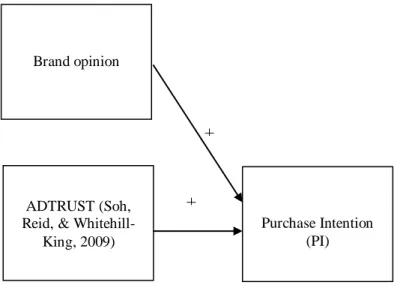
(24) These arguments are relevant for constructing the model because advertising, as a bridge of information and persuasion, and CSR as a trust element included in a social marketing program, share a dual image that can affect the consumers’ perception and brand opinion in either a positive or a negative way. Brand opinion due to advertising congruence, then, can affect consumers’ levels of purchase intention. From these theoretical and empirical arguments, and considering the consumers’ evaluation of the brand as successful after being exposed to an advertisement, the first relationship of constructs and hypothesis is proposed in Figure 2.1.:. + Brand opinion. Purchase Intention. Figure 2.1. First relationship of constructs H1: The higher the consumers’ brand opinion within a social advertisement, the higher their purchase intention (PI) level will be.. 24.
(25) 2.2.. Trust and Social Value Delivery from Enterprises toward Final Consumers In this section, advertising is described as a source of credible and trustworthy. information and a key informational bridge between an enterprise’s efforts and consumers. Prendergast, Liu, and Poon (2009) citing Lutz (1985) stated, “Advertising credibility is the degree to which the consumer perceives claims made about the brand in the ad to be truthful and believable” (p. 5). Credibility, then, is a relevant theoretical construct within advertising. Snyder (2011) stated, “Only one in five Americans trust advertising most of the time and 13 percent say they never trust it [the Adweek Media/Harris Poll]” (p. 481). Durvasula et al. (1993), citing Lutz (1985), highlighted five antecedents to explain consumers’ attitudes toward advertising: (1) ad credibility, (2) ad perceptions, (3) attitude toward the advertiser, (4) attitude toward advertising in general and (5) mood” (p. 627). To inform consumers, advertising plays a major role in enhancing credibility and trust, as well as linking societal marketing programs to consumers. To Morgan and Hunt (1994), communication has a positive relationship to trust (i.e., credibility), which influences relationship commitment. Moreover, MacKenzie, Lutz, and Belch (1986) stated that attitude toward the ad has a mediating role in advertising effectiveness. These theoretical arguments point to the notion that communications (i.e., advertising) that are trustworthy and credible can improve consumers’ opinion of the brand. Along this same line, Arens (1999) stated that “critics often forget (or choose to ignore) that advertising benefits society greatly…It provides a means to disseminate public information about important health and social issues” (p. 57). As a result, the language and symbols used to disseminate information about social issues are of high importance to advertising. For example, the use of symbols and testimonials is 25.
(26) oriented to enhance advertising’s credibility. Advertising is recognized as a relevant and potent source of symbolic meanings (e.g., Elliot & Wattanasuwan, 1998). Advertising, by definition, therefore, provides real and symbolic potential information to consumers about societal marketing and commercial programs, and frequently use symbols to improve their impact. Symbols are relevant because their correct or incorrect use may enhance or diminish trust levels in the eyes of the final consumers. In the aforementioned exploratory qualitative stage, participants showed dual opinions toward the nature of advertising, but their feelings concentrated on their levels of trust toward advertising’s symbolic and informational meanings, which can generate paradoxical feelings. In fact, Needham, Harper, and Steers (1985) established that, in some cases, the information advertisements provide is not necessarily believable, although information certainly brings value to consumers. Participants expressed that credibility instills a level of trust and belief in the information and claims included in the advertisements. More specifically, participants willing to believe in the messages asked themselves if the advertisers really would close the cycle in favor of consumers’ interests (for example, reforesting the land based on consumers’ donations). That is why image can improve value perception of stakeholders such as customers. To some of the participants, communicating the campaign’s results and translating them into a follow-up sequence of advertisements would be an effective way to improve trust and enhance brand opinion. In the exploratory qualitative stage, the seven respondents agreed that transparency in the use of symbols and information would do much for their confidence and the credibility of the campaigns, as this example explains: “... (silence)...This... yes...I mean...even though the ad was. 26.
(27) wrong, you look [at] the good intentions of what they wanted to do ...” (Female, 25−30 years old, Tamaulipas, Mexico). In summary, participants agreed that the idea of providing the audience with tangible results in order to enhance trust-building. So, advertising emerges, in the opinion of the participants, as a source that enhances trust. Communicating the follow-up of results in advertising campaigns would be an effective tool to motivate supportive audiences to keep on participating. Along this same line of argumentation, trust is a more specific construct and means an effort to attract, maintain, and reinforce the relationship with consumers (Berry & Parasuraman, 1991). But what is the role of CSR and social advertising in enhancing credibility or trust in advertising messages? Pomering and Johnson (2009) stated that companies are using CSR initiatives to enhance their levels of credibility and reputation (e.g., Becker-Olsen et al., 2006; Pirsch et al., 2007) and inspire trust to different groups of stakeholders, including consumers. It is necessary, then, for consumers to be aware and correctly informed about CSR actions and company initiatives. Pomering and Johnson (2009) stated “Consumers want and need to be aware of firms’ initiatives if they are to include CSR considerations in their brand evaluations. This awareness creation and preference building can be the focus of corporate image advertising, but successful persuasion is not automatic” (p. 112). Hence, awareness of CSR actions due to effective advertising messages can enhance trust levels. Improving trust improvement is important considering the medium- and low-levels of trust toward advertising the participants of the qualitative exploratory stage expressed. As exploratory empirical evidence, results reflect a medium-average level of trust toward advertising with an average response of 3.25 (on a 5-point Likert scale, with 5 being the highest level of trust). Hence, while the social advertising average response was 3.67 (slightly above the general average), the non-social advertising average was 27.
(28) 2.94 (below the general average). These preliminary results, which are not statistically significant, state that advertising has a medium- to low-level of trust with the consumers surveyed. To contribute to the model’s structure, and during the third exploratory stage, a multiple regression analysis shows that the relationship between ADTRUST and purchase intention are as reported in Appendix E, Table 2.1. The findings of this stage imply that purchase intention depends significantly on the trust in advertising of the consumers. As stated, consumers naturally trust more in social advertising than in non-social advertising. So, these preliminary results reflect the possibility to enhance advertising trust by using social advertising, which can improve purchase intention levels. As a result, appropriate symbols and accurate information can enhance consumers’ perceptions of advertising credibility and trust. Hence, following advertising’s role of benefiting society (Arens, 1999), the relevance of the credibility and ADTRUST constructs and the definition of social advertising, the following relationship between constructs and hypothesis are advanced in Hypothesis 2, illustrated by figure 2.2:. Brand opinion. +. ADTRUST (Soh, Reid, & WhitehillKing, 2009). + Purchase Intention (PI). Figure 2.2. Second relationship between constructs.. H2: The higher perceived advertising trust, the higher the purchase intention (PI). 28.
(29) 2.3. The Role of Advertising’s Tone in the Positive Perception of Social Causes A premise of this dissertation is that the chosen cause should be communicated effectively. Brønn and Vrioni (2001) stated that competitive markets ask for brands to be differentiated and enhanced in terms of reputation. In fact, it is important to consumers to feel that products come from a reliable and honest company. Garriga and Melé (2004) stated “Consumers typically assume that the products of a reliable and honest firm will be of high quality” (p. 55). But this objective cannot be achieved completely without effective communication programs. Morsing and Schulz (2006) noted the importance of communicating CSR actions effectively to stakeholders. Why is it important to communicate social issues properly? Brønn and Vrioni (2001), cite O’Sullivan’s (1997) premise, which describes the behavior of stakeholders toward communications relating to social causes via the CRM mix (including advertising): If they don’t say enough about their charity links, consumers believe that companies are hiding something and if they say too much they believe that charities are being exploited by the big corporations. It makes the promotion of such schemes one of the most delicate jobs in marketing. Go too far one way and consumers believe you are using the charity, go the other way and they will not even know of your involvement. (p. 216) Based on the former argument, lack of credibility, the antithetical argument of trust, appears as a relevant variable in CSR and cause-related marketing strategies. Moreover, Webb and Mohr (1998) note that consumers’ distrust of advertising (one relevant element of CRM campaigns) is one of the drivers of lack of credibility (Brønn & Vrioni, 2001). To reduce distrust and lack of credibility, the tone used in advertising is relevant, as it is part of the informative bundle that consumers receive in an advertising message. During the qualitative exploratory study, contrasting opinions prevailed among participants considering advertising tone (i.e., nostalgia, sadness, happiness, power, force, hope, 29.
(30) change, evolution, creativity, etc.). Although some consumers had a positive experience after buying a product due to the tone of a social advertisement, some had already experienced cognitive dissonance effects (i.e., they already had a bad experience or their pre-existing beliefs about the product were unfulfilled). Hence, some participants admitted that their purchase intention had been affected due to these past experiences and the advertising tone they remember about the campaign. Consider the following testimony about a social advertising campaign: I’m not angry, but I feel bad. Why do advertisers have to reach out to people by using shame, fear, or sadness? If you do so, you’re playing with the consumer… (Female, 25−30 years old, Tamaulipas, Mexico). While some “expert consumers” mentioned that the recalled social campaign brought them memories of sadness or nostalgia, others mentioned that the campaign included feelings of joy or “cool” experiences. This means something is very positive and enjoyable. On the other hand, adjectives such as “power,” “strength,” and “hope to move forward” were mentioned during the interviews. Some participants sensed a tone and feeling of “advertising evolution or change.” Moreover, they preferred to support CSR campaigns due to these characteristics. In summary, societal marketing programs can enhance their informative and persuasive arguments and improve consumer trust when they include a correct social advertising tone. As a theoretical exemplar that illustrates this argument, Small and Verrochi (2009) stated: “Although many factors influence pro-social behaviors, in the realm of charitable appeals with its frequent, vivid pictures of victims, emotion expression could differentiate among appeals and ultimately determine whether consumers open their wallets and donate” (p. 778). Hence, social advertising becomes a source of trust, differentiation, and social value delivery from enterprises toward final consumers, with the possibility of modifying and even improving the relationship between the trust consumers sense in advertising and their purchase intention. 30.
(31) One of the most relevant findings of the overall exploratory qualitative stage is the fact that, to improve trust, information and tracking campaign results should be included. In this way, consumers can see the fruits of their participation expressed in concrete socially beneficial actions. To verify structure, categories, and specific topics, the questionnaire and a detailed guide is included in Appendix F.. 2.4. Social Advertising as a Moderator between Advertising Trust and Purchase Intention Social advertising appears to be well received by consumers (Drumwright, 1996). Drumwright (1996), citing several other studies (Ross, Patterson, & Stutts, 1992; Ross, Stutts, & Patterson, 1991; Smith & Alcorn, 1991) stated that “a majority of consumers view it favorably, and it results in positive purchase intentions among a segment of consumers” (p. 72). Yet ambivalence is also present in the nature of advertising with social or CSR content. Brown and Dacin (1997) asserted, “Negative CSR associations can have a detrimental effect on overall product evaluations, whereas positive CSR associations can enhance product evaluations” (p. 80). So, again, associations consumers make depend on the nature of CSR claims. More recently, Sen and Bhattacharya (2001) stated that there is no clear definition in the general belief that CSR improves consumers’ purchase intention and show that CSR’s positive impact in consumers cannot be assured in all cases. Moreover, Sen and Bhattacharya (2001) provided one of the most cited frameworks that mention relevant and possible mediating and moderating effects of CSR support, information, beliefs, and domain on final consumers’ behavior. They established that “CSR’s influence on consumers’ product purchase intentions is more complex than its straightforward positive effect on their company evaluations” (p. 238).. 31.
(32) In a recent research contribution, Mesarosch (2008) stated the specific constructs in which CSR actions and consumer behavior (i.e., purchase intention) can be moderated. To Mesarosch (2008), the moderating influences are found in: . Product quality and price. . Lack of credibility and perceived sincerity. . Perceived fit between company and good cause. . Consumer/company identification. . Personal support of the good cause, and. . Perceived personal affect. (p. 18) As the former theoretical arguments state, the impact of CSR efforts (i.e., marketing or. advertising societal content) can produce a moderating effect. Mesarosch (2008) specified that perceived sincerity can work as a moderator because when perceived sincerity is high, CSR tends to enhance a company’s reputation and image among its consumers. Mesarosch (2008) also cites Yoon et al. (2006), who supports that there are three possibilities that define the moderating effect of CSR in enhancing consumers’ perception of sincerity: . If perceived sincerity is high, CSR improves company image.. . If perceived sincerity appears to be ambiguous, CSR has no effect on customers.. . If CSR activity appears to be insincere to consumers, this might result in a negative effect on companies’ image (p. 18). To reinforce the aforementioned theoretical arguments, and as a highly relevant part of the. third exploratory study, a moderated multiple regression analysis was performed during the quantitative exploratory stage. The specific results and graph can be analyzed as follows (Appendix E, Table 6 and Figure 2.3).. 32.
(33) The results and graph of appendix E (Figure 2.3) reveal that the variable (social advertising) modifies both the intensity and direction of the relationship between purchase intention and ADTRUST. The graph shown in Appendix E (Figure 2.3.) illustrates that social advertising improves consumers’ purchase intention compared to non-social advertising (for advertising with low levels of trust). In contrast, non-social advertising seems to improve consumers’ PI compared to social advertising (for advertising with high levels of trust). Against this background, the following model and hypothesis are set forth in Figure 2.4:. BRAND OPINION. +. PURCHASE INTENTIONTE. +. NTION. ADTRUST (Soh, Reid,& WhitehillKing, 2009) ADVERTISING TYPE. Figure 2.4: Model and third relationship of constructs H3: There is a higher effect of ADTRUST on consumers’ levels of purchase intention if advertising includes “green” content.. 33.
(34) 2.5. Pioneering and Follower Brands This research compares consumers’ responses by contrasting a pioneering brand with a follower brand. New strategic foci and innovative responses toward first movers or pioneers of a market are relevant for competitive success. Taking actions to generate brand associations and to compete effectively is a highly relevant concern to followers that seek to improve their position in their markets. In analyzing how consumer preferences are formed and the advantage of pioneers, Carpenter and Nakamoto (1989) suggested that “influencing preferences, not simply responding to them, may be an important objective of marketing strategy” (p. 286). And, pioneers or first movers are experts at dealing with innovation in products and processes. Kamins, Alpert, and Perner (2007) cited Golder and Tellis (1992) to define a pioneer brand as “the first to commercialize the product category, which may or may not be the first to invent the product” (p. 594). In fact, leadership in the market is sometimes subjective for consumers. A leading brand can be either a pioneer or a follower brand, but pioneers and first movers have a higher probability of preserving the leadership position, as they arrived first. Imber and Toffler (2002) defined a leader as an enterprise that owns brands or products that were the first to define a market or maintain a dominant market share above other competing brands. Kerin, Varadarajan, and Peterson (1992) shared three approaches a firm can use to reach a first mover or pioneer status: producing new products, entering a new market (Lieberman & Montgomery, 1990), or using new processes. The importance of each approach relies on the leadership consumers perceive toward a brand. Again, Kamins, Alpert, and Perner (2007) provided precise evidence of the impact of a pioneer or first mover brand based on consumers’ favorable evaluations: “A given brand was. 34.
(35) found to have a 50% more favorable evaluation when perceived as a market leader than when perceived as a follower brand” (p. 595). Thus, followers’ response should be strong, creative, endurable, and strategic rather than merely effective in the short term. The alternative of building and communicating environmental brand associations may help follower brands overcome and compete against the strength of pioneer brand advantages (PBA). Alpert and Kamins (1994) stated, “Understanding the underpinnings of PBA is extremely important because, by definition, PBA is unique and cannot be imitated” (p. 244). First movers usually build and enjoy solid PBA due to their leading position. Pioneers rule the characteristics or conditions of a brand category until new competitors appear and creatively challenge their marketing actions. In sum, pioneer advantages are solid, but not invincible from advances from challengers and competitors. Kerin, Varadarajan, and Peterson (1992) stated, “The belief that entry order automatically endows first movers with immutable competitive advantages and later entrants with overwhelming disadvantages is naïve in light of conceptual and empirical evidence” (p. 48). Building successful brands takes time and effort. Following Doyle’s (1989) arguments for building successful brands, the differential advantage should also be sustainable, meaning “an advantage that is not easily copied by competitors” (p. 78). Follower brands can also improve their results in their markets and constructively challenge pioneer and leading brands. This can be accomplished by establishing solid follower advantages. The American Marketing Association (2012) defines the follower advantage: The ability of non-pioneering market entrants to gain long-term competitive advantages due to late entry. Mechanisms that lead to follower advantage include resolution of demand and market uncertainty, shifts in technology or customer needs, the ability to free-ride on first-mover investments in buyer education and infrastructure development, and learning from the pioneer's product, positioning, or marketing mistakes (p. 1).. 35.
(36) The social argument, or cause, can be repeated (i.e., environmentalism), but mechanisms can enhance the sustainable differentiation of follower brands, as a mechanism to enhance the competitive power of followers against the positioning of market pioneer-leading brand positioning. From the former theoretical arguments, the following hypothesis is proposed: H4: There is a significant (different) effect on purchase intention levels between a pioneer-leading brand and a follower brand.. 36.
(37) CHAPTER III: EXPLORATORY STUDIES This chapter presents a more detailed description of the exploratory studies. Indeed, the combination of qualitative and quantitative approaches was especially useful for completing the empirical and theoretical framework to support this dissertation’s model.. 3.1. Qualitative Research Study In-depth interviews were applied in this qualitative exploratory stage. The interviews were semi-structured, and most of the questions were previously defined by a specific questionnaire, which infused each conversation with fluency. Interviews were conducted with graduate students in Monterrey, Mexico. The interviews were audio-recorded in order to prepare and analyze the transcripts. The selected students agreed to participate spontaneously, with each interview lasting between 25 and 45 minutes. Because all participants recalled different trademarks and anecdotes about advertising, many contrasting elements emerged and are helpful for enriching the researchers understanding of the phenomenon. The sample of participants was selected for convenience (i.e., timing delivery restrictions). The trial was a sampling alternative, because the participants’ characteristics were stated clearly, with every intention of securing an adequate number of expert consumers with knowledge about business issues and with different degrees of familiarity with CSR marketing or advertising campaigns. All participants were currently attending a Master’s degree program and worked for a research center within their university.. 37.
(38) The research design is summarized in Table 3.1: Table 3.1. Research Design: In Depth Interviews. Summary Sampling units: Seven students (three men and four women), Master’s degree students. Age: 25−30 years old. Participants came from different locations around Mexico: Tamaulipas, Monterrey (Nuevo León), Chihuahua, and Baja, California. One foreign participant was from Poland. Research schedule: Three days. Interview duration: Between 25 and 45 minutes. Evidence: audiorecording. Geographical scope: Monterrey, Nuevo León, Mexico.. Each participant was classified as a “consumer expert.” For this study, a “consumer expert” was one who, besides being a consumer, had a theoretical background of business, CSR and marketing or advertising, and whose knowledge of these issues could lead to further understanding the phenomenon from a theoretical perspective. The specific profiles of the consumer experts (survey participants) are summarized as follows:. Consumer Expert 1: Female from Tamaulipas, with a professional background in finance and statistics. She enjoys numbers and socially responsible marketing. She likes sports and healthy activities, football, and television commercials. She is an outgoing person and enjoys social activities. Consumer Expert 2: Male, born in Monterrey, Nuevo León. He is an industrial and systems engineer and has worked in strategic planning. He is also familiar with the areas of raw materials for consumer products such as advertising.. 38.
(39) Consumer Expert 3: Male, from Monterrey, Nuevo León. He holds a degree in communication sciences. He enjoys music, sports, media, and marketing. He considers himself a creative professional. He works in the area of CSR and marketing. Consumer Expert 4: Female from Baja, California. She was studying for her Master’s degree in marketing. She did not mention her profession, but at the time of the interviews, she was working in logistics and developing academic activities in a department of the university. Consumer Expert 5: Female from Poland. She earned her MBA in finance. She considers herself a fashionable and outgoing person. She also believes herself to be an optimistic woman, but she does not believe in social advertising with an intrinsic social cause. Despite her disbelief, she enjoys participating in environmental and green races or contests. Consumer Expert 6: Male from Monterrey, Nuevo León. He earned his MBA in finance. He enjoys going to the movies. He also likes to socialize and practice sports. He considers that some messages tend to exaggerate, but he still thinks that advertising can help build a social order and can be positive or formative to society. Consumer Expert 7: Female, graphic designer and graduate student. She likes photography, advertising, and communication. She loves to participate in socially responsible activities, and she considers herself a perfectionist in communications. As shown in previous sections, the results and findings of the qualitative and quantitative exploratory stages are valuable as empirical evidence to enhance and complement this dissertation’s overall theoretical framework. After the qualitative exploratory stage, a quantitative exploratory study was developed. The main findings of this quantitative study are described in the next section.. 39.
(40) 3.2. Exploratory Experimental Design (Open Questionnaire Results) During this stage of the present research, a set of open-ended question surveys was applied to aleatory-chosen subjects within a dynamic experimental design. The objective of the pilot survey’s open-ended questions was to explore the respondents’ opinions of advertising’s believability. Three different experimental groups were considered in two stages in order to administer this questionnaire. The first group included 25 subjects, with the second and third groups each including 44 students. Subjects of this exploratory experimental design phase answered the open-ended question survey before and after being exposed to television commercials. The questions focused mainly on the respondents’ opinion of advertising believability and the CSR programs. In the next phase, participants were exposed to three specific social and nonsocial television advertisements (featuring different categories of products and brands), and they answered a key question: “Considering the dynamics developed with three ads, do you believe in the three advertisements shown?” This question was highly relevant to this second exploratory stage because it related directly to evaluating a specific television advertisement. To reveal respondents’ tendencies before and after being exposed to the television commercials, the main results of the open-ended questionnaires are summarized in Table 3.2:. 40.
(41) Table 3.2 Exploratory Experimental Design. Q UE ST ION. In general, do you believe in advertising? Do you believe in advertising that includes a social content? Considering the dynamics developed with TV ads, do you believe in the 3 advertisements shown?. Do companies should support social causes? % male students % female students Total of participants. ST AGE 1. ST AGE 2. Only group (25 participants). Group 1 (28 participants). Group 2 (16 participants). 80% (yes). 79%. 85%. 88%. 62%. 92%. 64%. 64%. 92%. 96%. 93%. 100%. 72% 28%. 64% 36% 69 participants in 3 stages. 69% 31%. In sum, the explanation of these first tendencies was only exploratory, and statistical results were not analyzed in depth during this exploratory pilot experiment. But these contrasting results sparked a curiosity to keep searching and looking for statistically significant results with a pilot survey study in the next and final exploratory stage.. 3.3. Pilot Study Exploratory Survey In this stage, the survey method and experimental design were used to gather responses (i.e., Qualtrics on-line survey SW). A total of 36 participants answered the complete survey. Participants were medium-level executives who were engaged in graduate-level studies. Most of them work for multinational enterprises in Monterrey, Nuevo León, Mexico. All of the. 41.
(42) participants worked in areas such as controlling, accountancy, financing, planning, and supervising. For details of this sample’s demographics characteristics see Appendix C. The survey was structured in two broad sections: general opinions about advertising and support of companies related to social causes and advertising trust (as a contrast between two advertisements). The survey included two print advertisements featuring the same brand, one of which included social content). In the first half of the questionnaire, participants answered items considering the social advertisement; in the second portion of the survey, they answered the same items, but considered the nonsocial version advertisement. To choose advertising pieces, the product selected for this exploratory pilot study was a soft drink beverage brand. This brand was chosen because it is a first-mover brand, a product widely recognized with high brand loyalty among consumers, and easy to find. Also, the price is affordable, low involvement is required to buy it, and brand recognition and brand awareness are considerable. These attributes of the brand were helpful in obtaining easy and quick responses from participants at this exploratory stage. Another aspect considered in choosing the advertised brand was that the product needed to have both a social and a nonsocial version of their advertising. Internet (electronic media) advertisements were highly helpful for simplifying the logistics of administering the survey and experimental design, as this kind of advertising can also be printed and does not require specific rooms or facilities or special equipment or technical features to be used in the survey. This was the case with the dynamics of including advertising in video format (i.e., television commercials). This decision was made after considering the logistical requirements of the second exploratory pilot study. An additional specification was the definition of the social cause that would be included in the advertising. Environmental content were chosen due to the emphasis that water and packaging contribute to the environment. 42.
(43) The non-social advertisement was chosen based on its lack of text or complementary information in the body copy of the ad as well as the enhancement of only the creative and colorful elements of the advertisement, including slogans, expressive elements, and images. During this quantitative exploratory stage, the variables were operationalized as follows: . Advertising Trust: Dependent and independent variable measured using a Likert scale (1-5) with four dimensions: reliability, usefulness, affect, and willingness to rely on the product (Soh, Reid, & Whitehill-King, 2009).. . Purchase Intention toward the Product in the Ad: Dependent variable measured using a Likert Scale (1-5) (Lekpowska-White, Brashear, & Weinberger 2003).. . Social Advertising: Moderator independent variable, (relationship intention of purchase and advertising trust), used as a dummy variable (1 = social advertising, 0 = non-social advertising).. In the next chapter, considering all the theoretical and exploratory previous studies, we provide a detailed description of the methodology used for the main experimental design.. 43.
(44) CHAPTER IV: METHODOLOGY OF THE MAIN EXPERIMENTAL DESIGN. 4.1.. Experimental Design Insights After the aforementioned exploratory stages were complete, the methodology used for the. main research was an experimental design. Experimental design requires control. It is expected that the experimenter controls one variable or more and that the research can manipulate this chosen variable (Collier & Hummel, 1977). A 22 (i.e., advertising type brand) betweensubjects experimental design was the chosen method. The advertisements used featured two brands of bottled water in Mexico. Brand 1 represents the first-mover or leading brand in its market and Brand 2 represents a direct competing and follower brand, with and without a social cause included in their advertisements. Specifically, electronic and traditional survey methods were used to gather responses (i.e., Qualtrics on-line survey SW). To reach an adequate response rate, 265 surveys were gathered initially. After examining each survey, the final sample included 206 participants who had answered the complete survey with the most important items. This represents a 77.73% complete response rate.. 4.2.. Justification of the Product Category The category of products was chosen based on consumers’ and enterprises’ increasing. consciousness about the environmental importance of bottled water and its health-related benefits. As stated, Brand 1 represents either the market pioneer or leading brand, and Brand 2 represents the follower brand. Brand 2, therefore, as a direct competitor of the market pioneer or leading brand, found an opportunity to compete with Brand 1 and perceived a good chance to. 44.
Figure


+5


Documento similar
The major journals included in this analysis are the International Marketing Review (IMR), Journal of International Business Studies (JIBS), Journal of World Business (JWB), Journal
Based on the preceding discussions, the study posits hypotheses and research questions in terms of four dependent variables of gender effects on mobile advertising
In what follows, the significant contributions of the study are first explained, and the relevant literature on mobile advertising is reviewed in terms of six basic constructs:
To move over from a conception of economics under- stood as technology-of-choice to economics as theory of production-of-action helps us recognize the decisive role of
Illustration 69 – Daily burger social media advertising Source: Own elaboration based
The proposed positive effects of legal, ethical, economic, philanthropic and environmental dimensions of CSR on consumers’ support for corporate reputation, the selection of
This study aims to analyse the discourse and representation of the Other in the graphic advertising published on social networks in Spain by Non-Governmental
The primary research for the thesis is a survey of key stakeholders in the advertising and marketing world on the topic of artificial intelligence.. After fielding the questionnaire,
