/ slaughterhouse wastewaters in a UASB (Upflow Anaerobic Sludge Blanket) reactor and in an AF (Anaerobic Filler). Among the different streams generated, the treatment systems are applicable to slaughterhouse wastewaters and that the UASB reactor shows a better performance, giving higher COD removal efficiencies than the AF. © 1997 Elsevier Science Ltd.
INTRODUCTION
Slaughterhouse wastewaters are considered by the different European legislations as 'very contaminating' (Tritt & Schuchardt, 1992) due to their composition, characterized mainly by a complex mixture of fats, proteins and fibers. The organic matter concentration is medium to high and the residues are partially solubilized, leading to a highly contaminating effect in riverbeds or sewer systems if the wastewater is not previously treated.
In Galicia, a region of Northern Spain, there are more than 80 working
slaughterhouses, producing more than 800,000 m3 wastewater per year. Flow
rates and composition of the effluents vary significantly from one installation to
effluents from agroindustries. The advantages of anaerobic processes are biogas production, low generation of sludge, no aeration costs and elimination of pathogens
(Mateu et al., 1992). which had not had previous removal of the blood and so was of high protein content.
METHODS recirculation flow rates were controlled by intermittent pumping at regular intervals. The wastewater used as feed was maintained in a refrigerator at 4°C. lt had been previously filtered to eliminate suspended solids greater than 1 mm diameter. lt was maintained in a feed reservoir with a mixer to ensure homogeneity.
The reactors were inoculated with a flocculent sludge originating from a
pilot-scale contact anaerobic reactor treating wastewaters from a seafood-processing
factory (Veiga et al., 1994). The UASB reactor was inoculated with 21 sludge.
Yolatite suspended solids (VSS) content of the sludge was 16 g/1 and its maximum methanogenic activity was 0.53 g CODCH4/g VSS/day. The AF was inoculated with 1.8 1 sludge with a VSS concentration of 27.7 g/1 and a maximum methanogenic activity of0.64 g CODCH4/g VSS/day.
The following reactor parameters were checked regularly: temperature, pH and redox potential. Total and soluble COD (for the soluble COD, a sample was
filtered with a glass microfiber filter 0.45 J.lm pore size), alkalinity, volatile
fatty acids/total alkalinity (VFN TA), proteins, ammonium, phosphates, VSS
and total suspended solids (TSS) were measured in the influent and effluent, and the biogas composition was determined.
pH, redox potential and ammonium concentration were determined using ion-selective electrodes. COD, TSS, VSS and phosphate determinations were carried out as proposed by Standard Methods (APHA-AWWA-WPCF, 1992). The
protein content was measured by the method of Lowry (Lowry et al.,
1951). Alkalinity and VFA/TA ratio were measured by sample titration with sulphuric acid, and the biogas composition with an Orsat apparatus.
The batch biodegradability of the wastewater which was used for feeding the
reactors was deter- mined using the methodology described by Soto et al. (1993).
The methanogenic activities were determined in batch assays (Soto et al., 1993),
using a VFA mixture (acetic acid, 2.0 g/l; propionic acid, 0.5 g/l and n-butiric
RESULTS
The slaughtering of animals for commercial meat production is a multistage process, each stage producing wastes with different characteristics. The stages are wide variations for some of the parameters, due to the discontinuity of the process, leading to daily, weekly and seasonal differences. All samples were pretreated by filtering them through a 1 mm metallic mesh.
Table l. Characterization of slaughterhouse wastewaters
Origina pH T(OC) TSS CODt CODs Proteins P-Po - N-NH3
Slaughter 6.6-6.9 35 500-1500 7800-15900 7000-13600 4200-10000 1.3-12.8
54.6-Stomach 7.1-7.8 23 1100-2300 2500-4700 900-1200 400-700 0.8-1.21 9.7-33.7
Intestine 6.7-7.2 18-36 1100-2100 700-5200 400-3100 300-2400 36.1-41.7
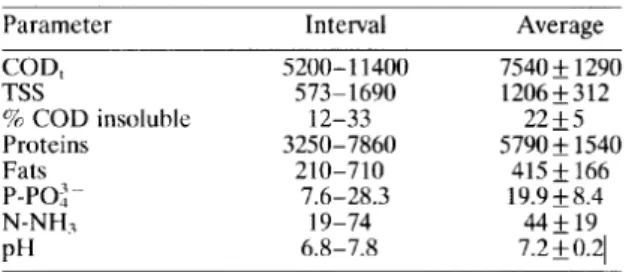
17.3-29.9 accounts for more than 50% of the COD. The slaughter-line wastewater was selected for the present study. Its characteristics at the time of the experiments are shown in Table 2. The ammonium and phosphate concentrations in this wastewater were high enough to satisfy the metabolic needs of the anaerobic bacteria.
Wastewater biodegradability
The data of the wastewater batch biodegradability test are presented in Table 3. The rates of conversion to acid and gas products together with the overall biodegradation are shown in Fig. 2. Acidification was rapid (conversion of the organic matter to VFA), whereas the rate of methanization was slower and more uniform, and did not reach a maxi- mum within the test period.
UASB reactor.
Start-up
Start-up of the UASB reactor lasted 117 days. The reactor was fed intermittently to allow a high con- centration of substrate in the inlet stream. A continuous recycle feed ratio of 1:1 was applied to homogenize the sludge and allow an efficient bio- mass growth. During the first 24 days the reactor was fed a synthetic medium containing an easily degradable substrate using a mixture
After having stopped the reactor operation for one month, the UASB reactor
was restarted (day338) at an OLR between 4.5 and 5 kg COD/m3/day and an HRT
of 1.5 days (Fig. 4). The COD removal efficiency was then about 75% and the methanization around 55%. The reactor operated at this OLR during 72 days, and in order to study the stability of the reactor, hydraulic, organic and thermic shocks were applied, over periods of 15 h. For the hydraulic shock (day 350) the HRT was
decreased from 1.5 to0.8 days which increased the OLR from 4.7 to 9 kg
COD/m3/day. For the organic shock (day 372) an OLR of 14 kg COD/m3/day was
/
Anaerobic filter
Start-up
Raw wastewater, without dilution, was applied at an OLR of 0.5 kg COD/m3/day. To allow a homogeneous and effective colonization of the support material, a increased over the operational period (Table 5).
Total and soluble COD of the feed and effluent are presented in Table 5 for 50%. A wash-out of insoluble matter was observed, but the concentration
of soluble matter in the effluent remained constant, indicating that the filter was
acidification was observed in the effluent, corresponding to a decreasing removal efficiency. When the OLR was restored to its previous value (5 kg
COD/m3/day), the initial biogas production and the effluent characteristics were
recovered in less than 24 h.
was applied by switching off the heating system for a period of 12 h. The subsequent temperature decrease completely inhibited the methanization process and resulted in a slight decrease in removal efficiency. When the temperature was again set at the original value of 37°C, the methanization rate recovered in 18 h. The methanogenic activities of the attached and suspended sludge were measured at different reactor heights at the end of the operation period. During the period of operation, the activity, expressed as kgCODcH4/kg VSS/day, decreased by 28 and 90% in the upper and lower parts of the reactor, respectively.
DISCUSSION wastewater characteristics the addition of nutrients was not necessary, since they were available in adequate concentrations. methanogenic bacteria were not well adapted to the substrate.
sludge and Jeading ultimately to the sludge wash out.
A long term stability of the process could be maintained by applying an OLR
lower than 5 kg COD/m3/day. If excessive accumulation of organic matter
occurs one should try to convert this organic matter into methane, e.g. by removing sludge and digesting it in a separate digester. After stabilization the sludge could be returned to the UASB or AF reactors. treatment method for slaughterhouse wastewaters with a high organic matter content and a considerable nitrogen (ammonium) concentration. In the present experiments ammonium carne from the degradation of proteins present in the wastewater and reached concentrations between 461 and 980 mg/l in both reactors.
The final effluent should undergo an additional treatment e.g. an aerobic biological process to eliminate the ammonium and residual fraction of organic matter.
ACKNOWLEDGEMENTS
by thermophilic aerobic process. Water Research, 23, 573-579.
Field, J., Sierra, R. & Lettinga, G. (1988). Ensayos anaerobios. Proc. of 4th
Symp. on Wastewater Anaerobic Treatment. Valladolid, Spain, pp. 52-81.
Gariépy, S., Tyagi, R. D., Couillard, D. & Tran, F. (1989). Thermophilic process
measurements with the Folin phenol reagent J. Biol. Chem., 193, 265-275.
Marchaim, U., Levanon, D., Danai, 0., Musaphy, S., Chen, Y., Inbar, Y. & Klinger, l. (1991). A suggested solution for slaughterhouse wastes: uses of the
residual materials water anaerobic digestion. Biores. Technol., 37, 127-134.
Mateu, A., Mata-Alvarez, J. & Parés, R. (1992). Enterobacterial and viral
tratamiento. Alimentación, equipos y tecnología. Septiembre, pp. 77-83.
(1988). Anaerobic degradation of the various fractions
of slaughterhouse wastewater. Biological Wastes, 23,117-142.
Sayed, S. & de Zeeuw, W. (1988). The performance of a continuously operated
flocculent sludge UASB reactor with slaughterhouse wastewater. Biological
Wastes, 24,199-212.
Sayed, S., van Campen, L. & Lettinga, G. (1987). Anaero-bic treatment of
slaughterhouse waste using a granular sludge UASB reactor. Biological Wastes, 21,
11-28.
Sayed, S., de Zeeuw, W. & Lettinga, G. (1984). Anaerobic treatment of
slaughterhouse waste using a flocculent sludge UASB reactor. Agricultura/
Wastes, 11, 197-226.
Soto, M., Méndez, R. & Lema, J. M. (1993). Methanogenic and non-methanogenic activity tests: Theoretical basis and experimental set up.
Water Research, 21, 1361-1376.
Tritt, W. P. & Schuchardt, F. (1992). Materials flow and possibilities of treating
liquid and solid wastes from slaughterhouses in Germany. A review. Biores.
Technol., 41, 235-245.
Veiga, M. C., Méndez, R. & Lema, J. M. (1994). Wastewater treatment for
fisheries operations. In Fisheries Processing: Biotechnological Applications, ed. A.