Revisiting the thiosemicarbazonecopper(II) reaction with glutathione. Activity against colorectal carcinoma cell lines.
Javier García–Tojala,*, Rubén Gil–Garcíaa, Víctor Ivo Fouza, Gotzon Madariagab, Luis Lezamac, María S. Galleterod, Joaquín Borráse, Friederike I. Nollmannf, Carlos
García-Giróng, Raquel Alcarazg, Mónica Cavia-Saizh, Pilar Muñizh, Òscar Palaciosi, Katia G. Samperi, Teófilo Rojoc,*.
a
Departamento de Química, Universidad de Burgos, 09001 Burgos, Spain
b
Departamento de Física de la Materia Condensada, Universidad del País Vasco, Aptdo. 644, 48080 Bilbao, Spain
c
Departamento de Química Inorgánica, Universidad del País Vasco, Aptdo. 644, 48080 Bilbao, Spain
d
Servicio Central de Espectrometria de Masas, Universidad de Valencia, Av. Dr. Moliner 100, Burjassot (Valencia), Spain
e
Departamento de Química Inorgánica, Facultad de Farmacia, Universidad de Valencia, 46100, Burjassot (Valencia), Spain
f
Merck Stiftungsprofessur für Molekulare Biotechnologie, Fachbereich
Biowissenschaften, Goethe Universität Frankfurt, 60438 Frankfurt am Main, Germany
g
Unidad de Investigación del Hospital Universitario de Burgos, Avda. Islas Baleares 3, 09006 Burgos, Spain
h
Departamento de Biotecnología y Ciencia de los Alimentos, Universidad de Burgos, Pza. Misael Bañuelos s/n, 09001 Burgos, Spain
i
Departament de Química, Universitat Autònoma de Barcelona, E-08193 Cerdanyola del Vallès, Barcelona, Spain
* Corresponding author: +34 947 258035; Fax:+34 947 258831 e-mail address: [email protected]
Keywords: Colon carcinoma. Copper. Molecular magnetism. Thiosemicarbazone
Conflicts of interest: none
Thiosemicarbazones (TSCs), and their copper derivatives, have been extensively studied mainly due to the potential applications as antitumor compounds. A part of the biological activity of the TSC-CuII complexes rests on their reactivity against cell reductants, as glutathione (GSH). The present paper describes the structure of the [Cu(PTSC)(ONO2)]n compound (1) (HPTSC = pyridine-2-carbaldehyde
thiosemicarbazone) and its spectroscopic and magnetic properties. ESI studies performed on the reaction of GSH with 1 and the analogous [{Cu(PTSC*)(ONO2)}2]
derivative (2, HPTSC* = pyridine-2-carbaldehyde 4N-methylthiosemicarbazone) show the absence of peaks related with TSC-Cu-GSH species. However GSH-Cu ones are detected, in good agreement with the release of CuI ions after reduction in the experimental conditions. The reactivity of 1 and 2 with cytochrome c and myoglobin and their activities against HT-29 and SW-480 colon carcinoma cell lines are compared with those shown by the free HPTSC and HPTSC* ligands.
1.- Introduction
Thiosemicarbazones (TSCs) are sulfur-containing organic substances whose biological properties have been extensively studied [1– 8], in particular their activities against microbial diseases as malaria, small-pot, influenza, leishmaniasis or chagas [9–
ions also provokes the interaction with cell thiols and further formation of reactive oxygen species (ROS) triggers oxidative processes in different cell structures and organelles [54–56]. Thus, the reduced form of glutathione (GSH) reacts with TSC-CuII and TSC-FeIII entities to give oxidized GSSG species and CuI or FeII ions [57], whose re-oxidation processes yield ROS [58,59]. After reduction, the FeII metal ions use to retain their coordination to tridentate NNS and ONS TSC ligands (where the first N and O represent donor atoms arising from pyridine and phenol substituents, respectively), giving rise to Fe(TSC)2 biscomplexes [57,60,61]. The CuI ions, however, could exhibit
4,4-dimethyl-3-thiosemicarbazone (Dp44mt) [71,72] and bis-thiosemicarbazonato ligands [73].
Promising results in cells and animals [74– 79] prompted the researches to test these substances as antitumor therapeutics in humans. In particular, 5-hydroxypyridine-2-carbaldehyde thiosemicarbazone (5OHPTSC) was evaluated in phase I clinical trials [80], while Triapine® has been tested in phase I and phase II ones [81– 89]. Unfortunately, up to date the results have been disappointed. The decrease in the effectiveness in comparison with that observed in animals seems to be related with different drawbacks, as side effects, toxicity and lowest clearance times [80]. Coordination to metal ions could provide better results [90].
Colorectal cancer (CRC) is the third most common cancer worldwide [91,92]. Among the most frequent mutations in CRC are gain-of-function missense mutations in KRAS and BRAF [93,94,95]. Several studies have indicated that these mutations play
distinct roles in development and therapy resistance of CRC [96]. Recently, the effects of the interaction of ribonucleotide reductases with thioredoxin [97] and the influence of the negatively regulated miRNA-mRNA pairs [98] and ribosome-inactivating stress [99] in CRC have been discussed. Taking into account that, as previously mentioned, both ribonucleotide reductases and RNA are targets of TSCs, and previous studies show the attack of CRC cells by TSCs [100,101], it could be interesting to apply these compounds to resistant CRC cells.
In order to shed light on the reaction of thiosemicarbazonecopper(II) species with GSH, we have revisited this reaction using for the first time ESI mass spectrometry techniques over solutions of the [Cu(PTSC)(ONO2)]n (1) and [{Cu(PTSC*)(ONO2)}2]
4N-methylthiosemicarbazone. 2 is fully characterized in the Literature [102], while the structure of the former and some of its magnetic and spectroscopic properties remained undescribed despite being used several times as starting material [103– 105]. The reactivity of 1, 2 and the free thiosemicarbazone ligands with cytochrome c and myoglobin is also discussed. Finally, biological activity against CRC cells is analyzed and the interplay with the GSH reactivity is reported. In this sense, the experimental models chosen for the study of the efficacy of the TSCs in the treatment of colon cancer have been the SW480 and HT-29 cell lines that show different mutational status: HT-29 cells have B-RAF mutation while K-RAS mutation occurs in SW480 cells [106].
2.- Experimental Section
2.1. Preparation of the compounds.
HPTSC and HPTSC* were synthesized by condensation of pyridine-2-carbaldehyde with the corresponding thiosemicarbazide in ethanol following published methods [107–109], in the case of HPTSC* after previous preparation of 4N-methylthiosemicarbazide from methylisothiocyanate and hydrazine [110]. Copper(II) nitrate trihydrate (Fluka, Sigma-Aldrich), pyridine-2-carbaldehyde (Fluka), thiosemicarbazide (Fluka), methylisothicyanate (Aldrich, Acros) and hydrazinium hydroxide (Merck) were used as received. The synthesis of compound 2 has been reported elsewhere [102].
The synthesis of compound 1 has been described in the Literature [103]. We have carried out slight modifications of the method, which are relevant for some of the physical and chemical properties as it will be discussed later. Cu(NO3)2·3H2O (1.00
olive-green precipitate suspended in it. Then, some drops of NaOH 1 M solution are slowly added to pH 3.5. The suspension is kept with stirring for 1 h. Finally, an olive-green solid is filtered off and washed with acetone (20 mL) and ethyl ether (20 mL). The average yield is 56 %, 0.172 g. Anal. found: C, 27.57; H, 2.26; N, 22.89; S, 10.27. Calc. for C7H7CuN5O3S (304.77 g/mol): C, 27.59; H, 2.32; N, 22.98; S, 10.52.
ρexperimental = 1.903(5) (Mg/m3). IR bands (cm–1, ATR): 3297(m), 3153(s), 1643(s),
1610(s), 1592(m,sh), 1566(w), 1487(w), 1459 (s,sh), 1445(s), 1437(s), 1386(s)– υ3(NO3–), 1371 (s,sh), 1322(vs), 1302(vs,sh), 1271(s), 1222(s), 1150(vs), 1111(m),
1050(w), 1020(w)–υ1(NO3–), 969(vw), 919(m), 884(s), 827(w)–υ2(NO3–), 822(vw,sh)–
υ2(NO3–), 773(m,sh), 768(m), 749(m), 742(m,sh), 709(w), 651(w), 626(m), 556(m,b),
512(m), 465(m), 438(vw), 414(m). FAB+ mass spectrometry (m/z): 241.89 [CuL]+. Q-band EPR signal at RT: g = 2.076. Small single crystals suitable for X-ray structural determination were obtained from slow evaporation of the mother liquours for two months.
Solids recovered after reaction of thiols, as glutathione (GSH) and 2-mercaptoethanol (2-MER), were also studied. To achieve this, it was selected Cu(ClO4)2·6H2O as copper(II) salt because its reaction with HPTSC and HPTSC*
yields solids more soluble in water than 1 and 2, and allows to obtain relatively high concentrations of [Cu(TSC)]+ species in aqueous solution. In a typical experiment, Cu(ClO4)2·6H2O (0.30 mmol, 0.111 g) was dissolved in water (20 mL) and solid
solids were obtained, while the evaporation of the mother liquors allowed to isolate crystals corresponding to the (H2PTSC)(ClO4)(H2O)0.5 and (H2PTSC*)(ClO4)
compounds. Anal. Found: C, 28.63; H, 3.14; N, 19.47. Calc. for (H2PTSC)(ClO4)(H2O)0.5 C7H10ClN4O4.5S (289.70 g/mol): C, 29.02; H, 3.48; N, 19.34.
IR bands (cm–1, FT-IR): 3392(m), 3250(m), 3169(m), 3096(w), 1617(vs), 1586(m), 1513(vs), 1455(w), 1355(m), 1275(m), 1246(m), 1122(vs), 1084(vs), 1057(w), 919(m), 877(m), 855(m), 828(m), 770(f), 726(m), 622(m), 592(w), 549(w), 512(w), 449(w), 429(w).
2.2. Physical Measurements.
SimFonia program [111]. Magnetic measurements of powdered samples were carried out in the temperature range 5–300 K using a Quantum Design MPMS-7 SQUID magnetometer and operating with a magnetic field of 0.1 T. Diamagnetic corrections were estimated from Pascal tables.
2.3. Crystal structure determination.
Crystal data collection for compound 1 was carried out on a STOE StadiVari Pilatus-100K single-crystal diffractometer using monochromated MoKα radiation (λ =
0.71069 Å). Absorption correction was made by Gaussian integration. Direct methods (SIR97) [112] were employed to solve the structure and then refined using the SHELXL-2013 computer program [113] within WINGX [114]. The non-H atoms were anisotropically refined, using weighted full-matrix least-squares on F2. The H atoms (excluding those of the water molecules) were included in calculated positions and refined as riding atoms. Selected crystallographic and refinement details are shown in Table 1. CCDC 1424631 contains the supplementary crystallographic data. These data can be obtained free of charge via http://www.ccdc.cam.ac.uk/conts/retrieving.html, or from the Cambridge Crystallographic Data Centre, 12 Union Road, Cambridge CB2 1EZ, UK; fax: (+44) 1223-336-033; or e-mail: [email protected].
2.4. Mass spectrometry measurements.
Compound 1 was dissolved in DMSO for ESI and FAB+ measurements (the latter, in NBA matrix). In the case of the ESI analysis of the reaction with GSH, various experiments were performed in air by using different CuII compounds (1, 2, Cu(NO3)2·3H2O and Cu(ClO4)2·6H2O), together with reduced GSH and oxidized GSSG
were used, whose pH was adjusted to 5‒7 by addition of drops of a 0.1 M NaOH solution.
Regarding the experiments on the interaction with cytochrome c and myoglobin, stock aqueous solutions of lyophilized commercial proteins (Sigma-Aldrich) and stock DMSO solutions of the thiosemicarbazone derivatives were used. Protein:compound (1:5) ratio solutions in NH4HCO3 buffer (25 mM, pH 7.0) were incubated for 24 h at 37
ºC. An ESI-TOF-MS spectrometer with coupled HPLC pump with pH 7.0 mobile phase was used, with 4500 V and 100 ºC experimental conditions. Solubility problems with compound 1 afforded a protein:compound ratio slightly lower than 1:5.
2.5. Biological essays.
2.5.1. Cell culture and treatment.
The human colon adenocarcinoma cell lines HT-29 and SW480 (European Collection of Authenticated Cell Cultures, Salisbury, UK) were grown in DMEM containing 25 mM D-glucose supplemented with 10% fetal bovine serum (FBS), 1% penicillin/streptomycin (P/S), and 1% L-glutamine solutions at 37 ºC in a humidified incubator with 5% CO2. Treatments were prepared in DMEM supplemented with 1%
FBS, 1% P/S, 1% L-glutamine solution, and 0.1% DMSO, which was used to dissolve the HPTSC and HPTSC* and their CuII complexes. For all experiments, HT-29 and SW480 cells were seeded at a 2 106 cells/cm2 density and cultured 24 h with growing DMEM. The treated-cells were exposed for 24 h to treatments at concentrations of 5.5 µM. After either the 24 h treatment or the oxidation period, the cells were scraped and centrifuged (800 g, 5 min, 25 ºC). The cell pellets were re-suspended in 1 mL of PBS, aliquoted, and frozen at –80 ºC until their use for the assays. All the experiments were carried out as three independent assays.
The ability of the thiosemicarbazones and their CuII complexes to inhibit cell proliferation was evaluated by the MTT colorimetric method, which was used to estimate cell viability [115]. Briefly, cells were incubated in 96-well multiplates (1.0x10⁴ cells/well filled with 200 μL of medium) for 24 h under basal conditions and then exposed for other 24 h to different concentrations of the treatments ( 2, 4, 6, 8, 10, 20, 25, 50 μg per mL of medium of each treatment HPTSC, HPTSC*, 1 and 2) or just DMEM for the not treated cells (NT). Then, MTT reagent dissolved in PBS was added to the wells at a final concentration of 0.5 mg/mL of DMEM and the plate was maintained in the incubator for 2 h. After incubation for 2 h with the MTT solution, the medium was removed and 200 μL DMSO were added to each well. The absorbance at 570 nm was measured in a microplate spectrophotometer (MultiSkan, Thermofisher). The experiments were repeated three times in four parallel wells. The % of viable cells was calculated with respect to the NT cells and the concentration of each treatment that inhibited 50% of cell viability (IC50) was determined, expressing the IC50 values for
each fraction in µM.
2.5.3. Glutathione reduced/oxidized (GSH/GSSG) ratio analysis.
Aliquots of the HT29 and SW480 suspensions collected after the treatment period were immediately acidified with HClO4 (2% final concentration), centrifuged (8000
nm provides an accurate estimate of the GSH content in the sample. Briefly, 75 µL of the cellular suspension was neutralized with triethanolamine 4 M and derivatized with vinylpyridine for 1 h. Then 10 µL of the mixture were incubated with 190 µL of the master mix, which contained NAPDH, DTNB and glutathione reductase. The kinetic of the enzyme was followed up during 20 min with a plate spectrophotometer (MultiSkan, Thermoficher).
2.5.4. Carbonyl group.
Protein oxidation was measured by an estimation of carbonyl groups released during the incubation time using the method of Levine et al [116]. Following, 150 µL of the cellular suspension was placed in a 1.5 mL Eppendorf, and 500 µL of 10 mM 2,4-dinitrophenylhydrazine (DNFH) / 2 M HCl, and 500 µL of HCl 2 M were added to the control samples. This mixture was incubated for 1 h at room temperature. Protein precipitation was performed using 500 µL of 20% (w/v) of trichloroacetic acid, washing twice with ethanol/ethyl acetate (1:1 v/v), and samples were centrifuged at 6000g for 3 min. Finally, 1 mL of 6 M guanidine, pH 2.3, was added and the samples were incubated in a 37 ºC water bath for 30 min. Protein concentration was calculated by
absorption spectrophotometry at 373 nm, using a molar absorption coefficient of 22000 M-1cm-1. Results are expressed as nmol/mg protein.
2.5.5. Superoxide dismutase activity (SOD).
potassium phosphate and 0.1 mmolL-1 EDTA. One unit of SOD activity was defined as the amount of SOD that inhibited cytochrome c reduction by 50%.
3.- Results and discussion
3.1.- Synthesis, structure, spectroscopic and magnetic characterization of 1.
The synthesis of compound 1 is apparently easily to achieve starting from aqueous solutions of Cu(NO3)2 and solid HPTSC ligand. However, subtle modifications
of the synthetic method, i.e. longer reaction times and slightly higher pH values, lead to samples of 1 with an increasing amount of impurities, mainly detected as rhombic EPR chromophores arising from the isotropic signal. A study to unveil the nature of the impurities is currently in process. The attainment of good single crystals is a quite difficult task too and, after using many crystallization strategies as diffusion devices, addition of supplementary nitrate sources (NaNO3), vapour diffusion (acetone into
aqueous solutions of 1), layering techniques… we succeed with one of the multiple slow evaporation experiments we tried. In this sense, the gradual acidification of the solution after addition of the thiosemicarbazone ligand must be taken into account once the precipitate of 1 has been removed from the suspension and, if no addition of base is carried out, mother liquours acquire pH 0.8 and the [Cu(ONO2)(HPTSC)(OH2)](NO3)
derivative with the neutral ligand crystallizes [118]. On the other hand, solutions with pH values above 7 give rise to desulfurization processes and yield mixtures of compounds [119,120].
The crystal lattice of 1 contains penta- and hexacoordinate CuII ions that alternate to form chains in the [001] direction where the hydrazinic moiety (N2–N3 fragment) of the tiosemicarbazone ligand acts as a bridge. These chains are connected through bidentate (µ-κO21:κO31) nitrato ligands along the X axis to give a 2D structure (see
center by the Npyridine, Nazomethine and Sthioamide atoms, while the hydrazinc N one (N31 or
N32, respectively) acts as a connector to the contiguous CuII ion. Thus, two kinds of polyhedra are defined: tetragonally distorted octahedral and square-pyramidal (Cu2, τ = 0.09) [121] ones (see Figures 2 and 3, Table 2). The average planes of adjacent thiosemicarbazone ligands in the chain form angles of 67.2(1) º. In spite of the planarity of the [Cu(PTSC)]+ fragments, they arrange far enough and no intense π-π stacking interactions seem to be established. On the other hand, strong hydrogen bonds are present in the crystal building, being remarkable the intrachain N42···O31 contact at 2.94(2) Å (see Supporting Information). Disorder is observed in the nitrato ligands of the square-pyramidal monomers. The closest Cu1···Cu2i distances are 4.832(2) Å (i = x,y,1+z), while Cu1 and Cu1ii are 7.472(2) Å (ii = 1+x,y,z) away linked by nitrato ligands. The whole structure resembles that of the DMSO derivative [122] of 1. However, the presence of DMSO ligands in the latter originates an strict 1D structure of tetragonally distorted [Cu(PTSC)(DMSO)(ONO2)] monomers bridged through the
hydrazinic fragment of the thiosemicarbazone ligand. The role of the hydrazinic N3 as a donor atom is not usual in the thiosemicarbazone chemistry, however some examples are reported in the Literature [123– 125].
The intensities of the IR bands around 1645–1610 cm–1, attributed to ν(C=N)azomethinic, ν(C=N)pyridinic and δ(NH2) modes and lower than those absorptions
of thermally invariable isotropic signals suggests the presence of a strong exchange coupling between adjacent chromophores. Figure 5 exhibits the thermal evolution of χm and χmT. A maximum in the χm vs T plot is observed around 160–170 K, characteristic
of antiferromagnetic interactions. From a quantitative point of view, it has already been described in the Literature the unusually low value for the magnetic moment of this compound at room temperature [103]. However, as far we are aware, its variable temperature magnetic measurements have not been studied. Preliminary experimental results are described using a Heissenberg model for S= 1/2 chains with antiferromagnetic interactions (Equations 1 and 2, [127]). The deduced J/k parameter is –126 K (–87.5 cm-1). The strong antiferromagnetic coupling supports an exchange propagation direction in the same plane of the magnetic dx2–y2 orbitals.
∑
−3.2.- Reactivity with glutathione, cytochrome c and myoglobin.
mixed Cu(ClO4)2.6H2O and HL at pH 7.4 are the free HPTSC and HPTSC* ligands. On
the other hand, the evaporation of aqueous solutions at pH 2.0 have yielded the (H2PTSC)(ClO4)·H2O and (H2PTSC*)(ClO4) derivatives containing
pyridinium-2-carbaldehyde thiosemicarbazone cations, whose structure with chloride anions has been published [128].
corresponding to the [Cu(TSC)]+ species. The reactive oxygen species (ROS) generated could induce the oxidative rupture of different cell structures (Step 3). These results are not in good agreement with previously reported studies in solution, which suggested the formation of thiosemicarbazonecopper(II)-glutathione complexes [63,64]. The divergences could be due to (i) drastic influences of the thiol and complex concentrations, higher in the work here reported, (ii) the medium used in our ESI measurements (see experimental details), or perhaps (iii) to misinterpretation of the EPR and UV-visible spectroscopic measurements caused by the complexity of the speciation in these solutions.
ESI experiments also suggest that free ligands do not show interaction with the proteins assayed, cytochrome c and myoglobin (see Supporting Information), while the interactions are low in the case of 1 and 2. Tests with cytochrome c point to a release of the copper from TSC, in good agreement with the existence of previous reduction processes that provoke binding of presumed CuI ions to cysteine-rich regions in the protein. This behavior is not clear in the case of myoglobin, devoid of cysteine amino acids.
3.3. Biological activity.
Compounds prepared in this work (HPTSC; 1; HPTSC* and 2) have been tested for antiproliferative activity in the cancer cell lines SW480 and HT-29 that have different mutations.
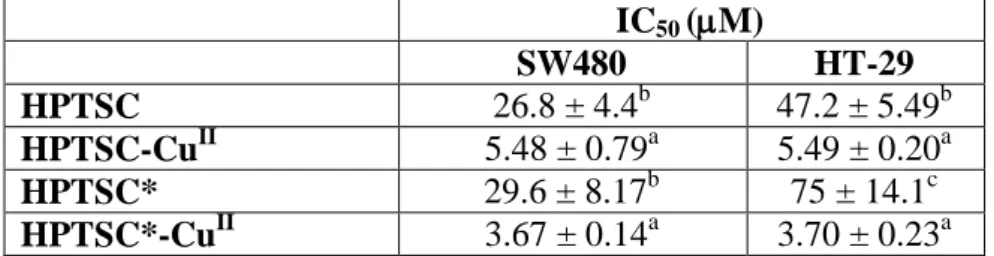
The antiproliferative activity of the ligands HPTSC and HPTSC* and their CuII complexes has been evaluated after 24 h of drug treatment, using MTT assay and the results are summarized in Table 3 in terms of IC50 values. The HPTSC and HPTSC* possess low cytotoxicity with IC50 > 20 μM. The HPTSC and HPTSC* show a cell line-dependent effect, with more cytotoxicity for SW480 than HT-29 line cell. The cytotoxicity of the metal free thiosemicarbazones up to micromolar concentrations are known to be related, at least in part, to their ribonucleotide reductase inhibitory potential [133,134] and a major cytotoxicity in SW480 cells has also been reported [90]. An important structure-activity relationship derived from this study is that the coordination of CuII ions to thiosemicarbazones increases the antiproliferative activity against both colon cancer cells with IC50 < 6 µM. Although the values of IC50 of
compound 2 are lower than 1, the divergence is not significant and no differences are observed in function of the cell line. The same trend was previously observed on V79 cellular line, where the compound 1 showed higher value of cytotoxicity than compound 2 [37].
this study, the role of oxidative stress was examined by the ability of the HPTSC free and copper-coordinated to change the levels of oxidative stress in the cell.
The participation of compounds 1 and 2 to generate ROS has been evaluated quantifying the SOD activity (see Figure 6). The SOD catalyzes the dismutation of the superoxide radical, being the first defense to oxidative stress in cells. Incubation the cell with HPTSC and HTPSC* does not increase the SOD activity relative to control cells. In contrast, incubation of cells with 1 and 2 shows a significant (p < 0.0001) increase in the SOD activity. These results indicate that copper complexes can initiate Fenton reactions, intracellularly resulting in ROS accumulation [54,134]. Furthermore, the CuI ions can react with molecular oxygen and be re-oxidised to CuII generating reactive superoxide radicals (see Equation 4) and thereby increasing the SOD activity. These results demonstrate the ability of the copper complexes to catalyze an increase of ROS levels in the cells. The increment of SOD activity is significantly higher in SW480 than in HT-29.
Cellular thiols are also susceptible to react with several oxidants and they are critical to maintain the intracellular thiol redox balance [139]. The GSH / GSSG redox couple has been the traditional marker for the characterization of oxidative stress, because of its high concentrations and direct roles as antioxidants and cellular protectors. The GSH levels are modified when cells are treated with HPTSC and HPTSC* resulting in a decreased of GSH / GSSG (Figure 8). This decrease is major in the cells treated with the metal 1 and 2 complexes. The SW480 treated with 2 is the most susceptible to the oxidation of GSH levels, as the lowest GSH / GSSG values indicate.
4.- Conclusions
The crystal lattice of [Cu(PTSC)(ONO2)]n (1) contains sheets where both, the
thiosemicarbazone and nitrato ligands, act as connectors between CuII ions. To achieve this, the thiosemicarbazone behaves as tetradentate, chelating a metal ion through the typical NNS donor set, while the hydrazinic N3 atom links a neighbor CuII ion. On the other hand, 1 shows a relatively strong antiferromagnetic behavior. The reaction of 1 and [{Cu(P'TSC)(ONO2)}2] (2) with thiols as 2-mercaptoethanol (2-MER) and
Supplementary material
Crystallographic data for the structure of 1 have been deposited with the Cambridge Crystallographic Data Centre, CCDC–1424631. These data can be obtained free of charge via http://www.ccdc.cam.ac.uk/conts/retrieving.html, or from the Cambridge Crystallographic Data Centre, 12 Union Road, Cambridge CB2 1EZ, UK; fax: (+44) 1223-336-033; or e-mail: [email protected].
Acknowlegments.
We thank Dr. J.J. Delgado, Dr. Pilar Castroviejo and Marta Mansilla (SCAI, Universidad de Burgos, Spain) for the elemental analysis and mass spectra and SCSIE (Universidad de València) for mass spectrometry measurements. This work was supported by Obra Social “la Caixa” (OSLC-2012-007), Ministerio de Economía y Competitividad and FEDER funds (CTQ2013-48937-C2-1-P, CTQ2015-70371-REDT, MAT2015-66441-P, BIO2015-67358-C2-2-P), Junta de Castilla y León (BU237U13), Gerencia Regional de Salud, Consejería de Sanidad, Junta de Castilla y León (GRS 1023/A/14), the Basque Government (project IT-779-13). The authors from the UAB are members of the “Grup de Recerca de la Generalitat de Catalunya” ref. 2014SGR-423. Universidad de Burgos and Caja de Burgos, Spain, are also gratefully acknowledged. R. G.–G. wishes to thank to the Junta de Castilla y León for his Doctoral Fellowship.
References
[1] A.G. Quiroga, C. Navarro-Ranninger, Coord. Chem. Rev. 248 (2004) 119–133. [2] H. Beraldo, Quim. Nova 27 (2004) 461–471.
[4] T.S. Lobana, R. Sharma, G. Bawa, S. Khanna, Coord. Chem. Rev. 253 (2009) 977–1055.
[5] A.I. Matesanz, P. Souza, Mini Rev. Med. Chem. 9 (2009) 1389–1396.
[6] J. García–Tojal, R. Gil–García, P. Gómez–Saiz, M. Ugalde, Curr. Inorg. Chem. 1 (2011) 189–210, and references therein.
[7] B.M. Paterson, P.S. Donnelly, Chem. Soc. Rev. 40 (2011) 3005–3018.
[8] J. García–Tojal, R. Gil–García, P. Gómez–Saiz, M. Ugalde, Curr. Inorg. Chem. 1 (2011) 189–210, and references therein.
[9] A. Molter, J. Rust, C.W. Lehmann, G. Deepa, P. Chiba, F. Mohr, Dalton Trans. 40 (2011) 9810–9820.
[10] T.S. Lobana, RSC Adv. 5 (2015) 37231–37274.
[11] P.F. Salas, C. Herrmann, C. Orvig, Chem. Rev. 113 (2013) 3450−3492.
[12] M. Cipriani, J. Toloza, L. Bradford, E. Putzu, M. Vieites, E. Curbelo, A.I. Tomaz, B. Garat, J. Guerrero, J.S. Gancheff, J.D. Maya, C. Olea Azar, D. Gambino, L. Otero, Eur. J. Inorg. Chem. (2014) 4677–4689.
[13] P.P. Netalkar, S.P. Netalkar, V.K. Revankar, Polyhedron. 100 (2015) 215–222. [14] D. Rogolino, A. Bacchi, L. De Luca, G. Rispoli, M. Sechi, A. Stevaert, L.
Naesens, M. Carcelli, J. Biol. Inorg. Chem. 20 (2015) 1109–1121.
[15] J.L. Hickey, S. Lim, D.J. Hayne, B.M. Paterson, M. White, V.L. Villemagne, P. Roselt, D. Binns, C. Cullinane, C.M. Jeffery, R.I. Price, K.J. Barnham, P.S. Donnelly, J. Am. Chem. Soc. 135 (2013) 16120−16132.
[16] J.L. Hickey, P.J. Crouch, S. Mey, A. Caragounis, J.M. White, A.R. White, P.S. Donnelly, Dalton Trans. 40 (2011) 1338–1347.
[17] A. Mrozek-Wilczkiewicz, M. Serda, R. Musiol, G. Malecki, A. Szurko, A. Muchowicz, J. Golab, A. Ratuszna, J. Polanski, ACS Med. Chem. Lett. 5 (2014) 336–339.
[18] C. Stefani, P.J. Jansson, E. Gutierrez, P. V. Bernhardt, D.R. Richardson, D.S. Kalinowski, J. Med. Chem. 56 (2013) 357–370.
[19] J. Shao, Z.-Y. Ma, A. Li, Y.-H. Liu, C.-Z. Xie, Z.-Y. Qiang, J.-Y. Xu, J. Inorg. Biochem. 136 (2014) 13–23.
[20] D. Palanimuthu, S.V. Shinde, K. Somasundaram, J. Med. Chem. 56 (2013) 722– 734.
[21] F. Bisceglie, S. Pinelli, R. Alinovi, P. Tarasconi, A. Buschini, F. Mussi, A. Mutti, G. Pelosi, J. Inorg. Biochem. 116 (2012) 195–203.
[22] M.D. Hall, K.R. Brimacombe, M.S. Varonka, K.M. Pluchino, J.K. Monda, J. Li, M.J. Walsh, M.B. Boxer, T.H. Warren, H.M. Gales, M.M. Gottesman, J. Med. Chem. 54 (2011) 5878–5889.
[23] R. Prabhakaran, P. Kalaivani, R. Huang, P. Poornima, V. Vijaya Padma, F. Dallemer, K. Natarajan, J. Biol. Inorg. Chem. 18 (2013) 233–247.
[24] Z. Kovacevic, S. Chikhani, Mol. Pharmacol. 80 (2011) 598–609.
[25] M.N.M. Milunovic, É.A. Enyedy, N. V. Nagy, T. Kiss, R. Trondl, M. a. Jakupec, B.K. Keppler, R. Krachler, G. Novitchi, V.B. Arion, Inorg. Chem. 51 (2012) 9309–9321.
[26] Z. Kovacevic, S. Chikhani, Mol. Pharmacol. 80 (2011) 598–609.
[27] K.M. Dixon, G.Y.L. Lui, Z. Kovacevic, D. Zhang, M. Yao, Z. Chen, Q. Dong, S.J. Assinder, D.R. Richardson, Br. J. Cancer 108 (2013) 409–419.
[29] S. V Menezes, S. Sahni, Z. Kovacevic, D.R. Richardson, J. Biol. Chem. 292 (2017) 12772–12782.
[30] B. Zou, X. Lu, Q. Qin, Y. Bai, Y. Zhang, M. Wang, Y.-C. Liu, Z.-F. Chen, H. Liang, RSC Adv. 7 (2017) 17923–17933.
[31] K. Brodowska, I. Correia, E. Garribba, F. Marques, E. Klewicka, E. Lodyga-Chruscinska, J.C. Pessoa, A. Dzeikala, L. Chruscinski, J. Inorg. Biochem. 165 (2016) 36–48.
[32] M.T. Basha, J. Bordini, D.R. Richardson, M. Martinez, P. V. Bernhardt, J. Inorg. Biochem. 162 (2016) 326–333.
[33] V.F.S. Pape, S. Tóth, A. Füredi, K. Szebényi, A. Lovrics, P. Szabó, M. Wiese, G. Szakács, Eur. J. Med. Chem. 117 (2016) 335–354.
[34] C.R. Myers, Free Radic. Biol. Med. 91 (2016) 81–92. Gaspar, J. Borras, R. Gil-Garcia, M. Gonzalez-Alvarez, J. Biol. Inorg. Chem. 15 (2010) 515–532.
[38] Saswati, A. Chakraborty, S.P. Dash, A.K. Panda, R. Acharyya, A. Biswas, S. Mukhopadhyay, A. Crochet, Y.P. Patil, M. Nethaji, R. Dinda, Dalton Trans. 44 (2015) 6140–6157.
[39] M. Muralisankar, N.S.P. Bhuvanesh, A. Sreekanth, New J. Chem. 40 (2016) 2661–2679.
[40] R. Gil-Garcia, M. Ugalde, N. Busto, H.J. Lozano, J.M. Leal, B. Perez, G. Madariaga, M. Insausti, L. Lezama, R. Sanz, L.M. Gómez-Sainz, B. Garcia, J. Garcia-Tojal, Dalton Trans. 45 (2016) 18704–18718.
[41] W.C. Kaska, C. Carrano, J. Michalowski, J. Jackson, W. Levinson, Bioinorg. Chem. 3 (1978) 245–254.
[42] M. Leigh, D.J. Raines, C.E. Castillo, A.K. Duhme-Klair, ChemMedChem 6 (2011) 1107–1118.
[43] J.A. Lessa, J.C. Guerra, L.F. de Miranda, C.F.D. Romeiro, J.G. Da Silva, I.C. Mendes, N.L. Speziali, E.M. Souza-Fagundes, H. Beraldo, J. Inorg. Biochem. 105 (2011) 1729–1739.
[44] J.M. Myers, Q. Cheng, W.E. Antholine, B. Kalyanaraman, A. Filipovska, E.S.J. Arnér, C.R. Myers, Free Radic. Biol. Med. 60 (2013) 183–194.
[45] F. Bacher, E.A. Enyedy, N.V. Nagy, A. Rockenbauer, G.M. Bognár, R. Trondl, M.S. Novak, E. Klapproth, T. Kiss, V.B. Arion, Inorg. Chem. 52 (2013) 8895– 8908.
[46] F. Bisceglie, S. Pinelli, R. Alinovi, M. Goldoni, A. Mutti, A. Camerini, L. Piola, P. Tarasconi. G. Pelosi, J. Inorg. Biochem. 140 (2014) 111–125.
[47] F. Bisceglie, A. Musiari, S. Pinelli, R. Alinovi, I. Menozzi, E. Polverini, P. Tarasconi, M. Tavone, G. Pelosi, J. Inorg. Biochem. 152 (2015) 10–19.
[48] K.Y. Djoko, B.M. Paterson, P.S. Donnelly, A.G. McEwan, Metallomics 6 (2014) 854–863.
[49] E.C. Moore, M.S. Zedeck, K.C. Agrawal, A.C. Sartorelli, Biochemistry 9 (1970) 4492–4498.
[51] Y. Yu, D.S. Kalinowski, Z. Kovacevic, A.R. Siafakas, P.J. Jansson, C. Stefani, D.B. Lovejoy, P.C. Sharpe, P.V. Bernhardt, D.R. Richardson, J. Med. Chem. 52 (2009) 5271–5294.
[52] A. Ozarowski, L. Filipovic, S. Radulovic, E.A. Enyedy, V.B. Arion, Inorg. Chem. 53 (2014) 12595–12609.
[53] A. Popović-Bijelić, C.R. Kowol, M.E.S. Lind, J. Luo, F. Himo, É.A. Enyedy, V.B. Arion, A. Gräslund, J. Inorg. Biochem. 105 (2011) 1422–1431.
[54] F.N. Akladios, S.D. Andrew, C.J. Parkinson, Bioorganic Med. Chem. 23 (2015) 3097–3104.
[55] D.S. Kalinowski, C. Stefani, S. Toyokuni, T. Ganz, G.J. Anderson, N. V Subramaniam, D. Trinder, J.K. Olynyk, A. Chua, P.J. Jansson, S. Sahni, D.J.R. Lane, A.M. Merlot, Z. Kovacevic, M.L.H. Huang, C. S. Lee, D.R. Richardson, Biochim. Biophys. Acta - Mol. Cell Res. 1863 (2016) 727–748.
[56] F.N. Akladios, S.D. Andrew, C.J. Parkinson, J. Biol. Inorg. Chem. 21 (2016) 407–419.
[57] J. García-Tojal, García-Orad, A Díaz, J.L. Serra, M.K. Urtiaga, M.I. Arriortua, T. Rojo, J. Inorg. Biochem. 84 (2001) 271–278.
[58] Y. Yu, D.S. Kalinowski, Z. Kovacevic, A.R. Siafakas, P.J. Jansson, C. Stefani, D.B. Lovejoy, P.C. Sharpe, P.V. Bernhardt, D.R. Richardson, J. Med. Chem. 52 (2009) 5271–5294.
[59] J.M. Myers, W.E. Antholine, J. Zielonka, C.R. Myers, Toxicol. Lett. 201 (2011) 130–136.
[60] M.I. Arriortua, J. Garcia-tojal, J.L. Pizarro, L. Lezama, Inorg. Chim. Acta. 278 (1998) 150–158.
[61] J. García-Tojal, B. Donnadieu, J.P. Costes, J.L. Serra, L. Lezama, T. Rojo, Inorg. Chim. Acta. 333 (2002) 132–137.
[62] J. García-Tojal, A. García-Orad, J.L. Serra, J.L. Pizarro, L. Lezama, M.I. Arriortua, [T. Rojo, J. Inorg. Biochem. 75 (1999) 45–54.
[63] L.A. Saryan, K. Mailer, C. Krishnamurti, W.E. Antholine, D.H. Petering, Biochem. Pharmacol. 30 (1981) 1595–1604.
[64] W.E. Antholine, F. Taketa, J. Inorg. Biochem. 20 (1984) 69–78.
[65] P. Gómez-Saiz, R. Gil-García, M.A. Maestro, J.L. Pizarro, M.I. Arriortua, L. Lezama, T. Rojo, J. Inorg. Biochem. 102 (2008) 1910–1920.
[66] D.B. Lovejoy, P.J. Jansson, U.T. Brunk, J. Wong, P. Ponka, D.R. Richardson, Cancer Res. 71 (2011) 5871–5880.
[67] C. Stefani, Z. Al-Eisawi, P.J. Jansson, D.S. Kalinowski, D.R. Richardson, J. Inorg. Biochem. 152 (2015) 20–37.
[68] D.B. Lovejoy, P.J. Jansson, U.T. Brunk, J. Wong, P. Ponka, D.R. Richardson, Cancer Res. 71 (2011) 5871–5880.
[69] D.B. Lovejoy, P.J. Jansson, U.T. Brunk, J. Wong, P. Ponka, D.R. Richardson, Cancer Res. 71 (2011) 5871–5880.
[70] K.L. Fung, A.K. Tepede, K.M. Pluchino, L.M. Pouliot, J.N. Pixley, M.D. Hall, M.M. Gottesman, Mol. Pharmaceut. 11 (2014) 2692–2702.
[71] A. Gaál, G. Orgován, Z. Polgári, A. Réti, V.C. Mihucz, S. Bösze, N. Szoboszlai, C. J. Streli, Inorg. Biochem. 2014, 130, 52–58.
[73] M.A. Cater, H.B. Pearson, K. Wolyniec,; Klaver, P.; Bilandzic, M.; Paterson, B. M.; Bush, A.I.; Humbert, P.O.; La Fontaine, S.; Donnelly, P.S.; Haupt, Y. ACS Chem. Biol. 8 (2013) 1621–1631.
[74] R.W. Brockman, J.R. Thomson, M.J. Bell, H.E. Skipper, Cancer. Res. 16 (1956) 167–170.
[75] F.A. French, E.J. Blanz, .J. Med. Chem. 9 (1966) 585–589. [76] F.A. French, E.J. Blanz, Cancer Res. 26 (1966) 1638–1640. [77] E.J. Blanz, F.A. French, Cancer Res. 28 (1968) 2419–2422.
[78] E.J. Blanz, F.A. French, J.R. DoAmaral, D.A. French J. Med. Chem. 13 (1970) 1125–1130.
[79] W.A. Creasey, K.C. Agrawal, R.L. Capizzi, K.K. Stonson, A.C. Sartorelli, Cancer Res. 32 (1972) 565–572.
[80] R.C. DeConti, B.R. Toftness, K.C. Agrawal, R. Tomchick, J.A.R. Mead, J.R. Bertino, A.C. Sartorelli, W.A. Creasey, Cancer Res. 32 (1972) 1455−1462.
[81] R.A. Finch, M.-C. Liu, A.H. Cory, J.G. Cory, A.C. Sartorelli, Advan. Enzyme Regul. 39 (1999) 3–12.
[82] L. Feun, M. Modiano, K. Lee, J. Mao, A. Marini, N. Savaraj, P. Plezia, B. Almassian, E. Colacino, J. Fischer, S. MacDonald, Cancer Chemother. Pharmacol. 50 (2002) 223–229.
[83] J. Murren, M. Modiano, C. Clairmont, P. Lambert, N. Savaraj, T. Doyle, M. Sznol, Clin. Cancer Res. 9 (2003) 4092–4100.
[84] F.J. Giles, P.M. Fracasso, H.M. Kantarjian, J.E. Cortes, R.A. Brown, S. Verstovsek, Y. Alvarado, D.A. Thomas, S. Faderl, G. Garcia-Manero, L.P. Wright, T. Samson, A. Cahill, P. Lambert, M. Sznol, J.F. DiPersio, V. Gandhi, Leuk. Res. 27 (2003) 1077–1083.
[85] Y. Yen, K. Margolin, J. Doroshow, M. Gishman, B Johnson, C. Clairmont, D. Sullivan, M. Sznol, Cancer Chemother. Pharmacol. 54 (2004) 331–342.
[86] K.W.L. Yee, J. Cortes, A. Ferrajoli, G. Garcia-Manero, S. Verstovsek, W. Wierda, D. Thomas, S. Faderl, I. King, S.M. O’Brien, S. Jeha, M. Andreeff, A. Cahill, M. Sznol, F.J. Giles, Leuk. Res. 30 (2006) 813–822.
[87] I. Gojo, M.L. Tidwell, J. Greer, N. Takebe, K. Seiter, M.F. Pochron, B. Johnson, M. Sznol, J.E. Karp, Leuk. Res. 31 (2007) 1165–1173.
[88] J.J. Knox, S.J. Hotte, C. Kollmannsberger, E. Winquist, B. Fisher, E.A. Eisenhauer, Invest. New Drugs 25 (2007) 471–477.
[89] J.E. Karp, F.J. Giles, I. Gojo, L. Morris, J. Greer, B. Johnson, M. Thein, M. Sznol, J. Low, Leuk. Res. 32 (2008) 71–77.
[90] F. Bacher, O. Dömötör, A. Chugunova, N.V. Nagy, L. Filipović, S. Radulović, E.A. Enyedy, V.B. Arion, Dalt. Trans. 44 (2015) 9071–9090.
[91] J. Ferlay, H.R. Shin, F. Bray, D. Forman, C. Mathers, D.M. Parkin, Int. J. Cancer 127 (2010) 2893–2917.
[92] B. O Karim, D.L. Huso, Am. J. Cancer Res. 3 (2013) 240–250.
[93] D.M. Muzny, M.N. Bainbridge, K. Chang, H.H. Dinh, J.A. Drummond, G. Fowler, et al. (The Cancer Genome Atlas Network), Nature 487 (2012) 330–337. [94] S. Misale, R. Yaeger, S. Hobor, E. Scala, M. Janakiraman, D. Liska, et al.,
Nature 486 (2012) 532–536.
[95] A.M. Gouw, L.S. Eberlin, K. Margulis, D.K. Sullivan, G.G. Toal, L. Tong, R.N. Zare, D.W. Felsher, Proc. Natl. Acad. Sci. 114 (2017) 4300–4305.
[97] M. Lou, Q. Liu, G. Ren, J. Zeng, X. Xiang, Y. Ding, Q. Lin, T. Zhong, X. Liu, L. Zhu, H. Qi, J. Shen, H. Li, J. Shao, J. Biol. Chem. 292 (2017) 9136–9149.
[98] X. Zhou, X. Xu, J. Wang, J. Lin, W. Chen, Sci. Rep. 5 (2015) 12995.
[99] C.-K. Oh, S.J. Lee, S.-H. Park, Y. Moon, J. Biol. Chem. 291 (2016) 10173– 10183.
[100] M.A. Hussein, M.A. Iqbal, M. Asif, R.A. Haque, M.B.K. Ahamed, A.M.S.A. Majid, T.S. Guan, Phosphorus. Sulfur. Silicon Relat. Elem. 190 (2015) 1498– 1508.
[101] S. Sandhaus, R. Taylor, T. Edwards, A. Huddleston, Y. Wooten, R. Venkatraman, R.T. Weber, A. González-Sarrías, P.M. Martin, P. Cag, Y.-C. Tse-Dinh, S.J. Beebe, N. Seeram, A.A. Holder, Inorg. Chem. Commun. 64 (2016) 45–49.
[102] P. Gómez-Saiz, J. García-Tojal, M.A. Maestro, F.J. Arnaiz, T. Rojo, Inorg. Chem. 41 (2002) 1345–1347.
[103] A.G. Bingham, H. Bögge, A. Müler, E.W. Ainscough, A.M. Brodie,J. Chem. Soc., Dalton Trans. (1987) 493–499.
[104] P. Gómez-Saiz, J. García-Tojal, A. Mendia, L. Lezama, J.L. Pizarro, M.I. Arriortua, T. Rojo, Eur. J. Inorg. Chem. (2003) 518–527.
[105] P. Gómez-Saiz, R. Gil-García, M.A. Maestro, J.L. Pizarro, M.I. Arriortua, L. Lezama, T. Rojo, M. González-Álvarez, J. Borrás, J. García-Tojal, J. Inorg. Biochem. 102 (2008) 1910–1920.
[106] M. Herreros-Villanueva, P. Muñiz, C. García-Giron, M. Cavia-Saiz, M.J. Del Corral, J. Transl. Med. 8 (2010) 15
[107)] F.E. Anderson, C.J. Duca, J.V. Scudi, J. Am. Chem. Soc. 73 (1951) 4967–4968. [108] D.X. West, G.A. Bain, R.I. Butcher, J.P. Jasinskin, R.Y. Pozniakiv, J. Valdés–
Martínez, R.A. Toscano, S. Hernández–Ortega, Polyhedron 15 (1996) 665–674.. [109] D.X. West, G.A. Bain, J.S. Saleda, A.E. Liberta, Transition Met. Chem. 16
(1991) 565–572.
[110] R. Noto, P. Lo Meo, M. Gruttadauria, G. Werber, J. Heterocyclic. Chem. 33 (1996) 863–872.
[111] WINEPR SimFonia v1.25, Bruker Analytische Messtecnik GmßH, 1996.
[112] A. Altomare, M.C. Burla, M. Camalli, G. L. Cascarano, C. Giacovazzo, A. Guagliardi, A.G.G. Moliterni, G. Polidori and R. Spagna, J. Appl. Crystallogr. 32 (1999) 115–119.
[113] G.M. Sheldrick, Acta Crystallogr. A64 (2008) 112–122.
[114] L.J. Farrugia, WINGX; J. Appl. Crystallogr. 45 (2012) 849–854. [115] P. Twentyman, M. Luscombe. Brit. J. Cancer 56 (1987) 279–285. [116] R.L. Levine, E.R. Stadtman, Exp. Gerontol. 36 (2001) 1495–1502. [117] J.M. McCord, I. Fridowich, J. Biol. Chem. 243 (1968) 5753–5760.
[118] J. García-Tojal, J. García-Jaca, R. Cortés, T. Rojo, M.K. Urtiaga, M.I. Arriortua, Inorg. Chim. Acta 249 (1996) 25–32.
[119] P. Gómez-Saiz, R. Gil, M.A. Maestro, J.L. Pizarro, M.I. Arriortua, L. Lezama, T. Rojo, J. García-Tojal, Eur. J. Inorg. Chem. (2005) 3409–3413, and references therein.
[120] R. Gil–García, R. Fraile, B. Donnadieu, G. Madariaga, V. Januskaitis, J. Rovira, L. González, J. Borrás, F.J. Arnáiz, J. García–Tojal, New J. Chem. 37 (2013) 3568–3580.
[122] Y.M. Chumakov, V.I. Tsapkov, E. Jeanneau, N.N. Bairac, G. Bocelli, D. Poirier, J. Roy, A.P. Gulea, Crystallogr. Reports. 53 (2008) 786–792.
[123] D. Dragancea, A.W. Addison, M. Zeller, L.K. Thompson, D. Hoole, M.D. Revenco, A.D. Hunter, Eur. J. Inorg. Chem. (2008) 2530–2536.
[124] D. Dragancea, V.B. Arion, S. Shova, E. Rentschler, N.V. Gerbeleu, Angew. Chem. Int. Ed. 44 (2005) 7938–7942.
[125] W.–S. Wu, W.–D. Cheng, D.–S. Wu, H. Zhang, Y.–J. Gong, Y. Lu, Inorg. Chem. Commun. 9 (2006) 559–562.
[126] R. Gil-García, P. Gómez-Saiz, V. Díez-Gómez, G. Madariaga, M. Insausti, L. Lezama, J.V. Cuevas, J. García-Tojal, Polyhedron 81 (2014) 675–686.
[127] J.C. Bonner, M.E. Fisher, Phys. Rev. A 135 (1964) 640–658.
[128] M.K. Urtiaga, M.I. Arriortua, J. Garcia-Tojal, T. Rojo, Acta Crystallogr. C51 (1995) 2172–2174.
[129] T.S. Lobana, R. Sharma, A. Castiñeiras, R. Jay, Z. Anorg. Allg. Chem. 636 (2010) 2698–2703.
[130] D. Dekanski, T. Todorović, D. Mitić, N. Filipović, N. Polović, K.J. Anđelković, Serb. Chem. Soc. 8 (2013) 1503−1512.
[131] N. Filipović, N. Polović, B. Rašković, S. Misirlić-Denčić, M. Dulović, M. Savić, M. Nikšić, D. Mitić, K. Anđelković, T. Todorović, Monatsh. Chem. 145 (2014) 1089−1099.
[132] Z. Al-Eisawi, C. Stefani, P.J. Jansson, A. Arvind, P.C. Sharpe, M.T. Basha, G.M. Iskander, N. Kumar, Z. Kovacevic, D.J. Lane, S. Sahni, P.V. Bernhardt, D.R. Richardson, D.S. Kalinowski, J. Med. Chem. 59 (2016) 294−312.
[133] J. Li, L.M. Zheng, I. King, T.W. Doyle, S.H. Chen, Curr. Med. Chem. 8 (2001) 121−133.
[134] A. Sirbu, O. Palamarciuc, M.V. Babak, .J.M. Lim, K. Ohui, E.A. Enyedy, S. Shova, D. Darvasiová, P. Rapta, W.H. Ang, V.B. Arion. Dalton Trans. 46 (2017) 3833−3847.
[135] P.D. Ray, B.W. Huang, Y. Tsuji, Cell Signal 24 (2012) 981−990.
[136] M. Valko, D. Leibfritz, J. Moncol, M.T. Cronin, M. Mazur, J. Telser, Int. J. Biochem. Cell Biol. 39 (2007) 44−84.
[137] A.T. Dharmaraja, J. Med. Chem. 60 (2017) 3221−3240.
[138] D. Trachootham, J. Alexandre, P. Huang, Nat. Rev. Drug Discov. 8 (2009) 579−591.
Table 1. Crystallographic data for 1.
θ range for data collection 2.141 to 26.747°
Index ranges -9 ≤ h ≤ 9, -18≤ k ≤ 18, -12 ≤ l ≤ 12
Reflections collected 11139
Independent reflections 4126 [Rint = 0.1787]
Absorption correction Analytical gaussian Data / restraints / parameters 4126 / 343 / 336
Goodness-of-fit on F2 S = 0.639
R indices [I > 2σ(I)] R1 = 0.0591, wR2 = 0.1301
R indices (for all 4126 data) R1 = 0.245, wR2 = 0.1313
Table 2. Selected bonds (Å) and angles (º) of 1.
(1) (2) (1) (2)
Cu–S 2.242(7) 2.256(7) N4–C7 1.30(3) 1.34(2)
Cu–N2 1.962(17) 1.948(16) C7–N3 1.35(3) 1.37(2) Cu–N3 2.002(14) 2.001(16) N2–N3 1.371(19) 1.357(16) Cu–N1 1.997(18) 1.950(16) N2–C6 1.29(3) 1.27(2) Cu–O31/32A 2.75(2) 2.47(3) S–C7 1.74(2) 1.73(2) Cu–O21/22B 2.86(2) 2.51(4)
Table 3. IC50 values of TSCs and their CuII complexes in SW480 and HT29 cell
lines.
IC50 (µM)
SW480 HT-29
HPTSC 26.8 ± 4.4b 47.2 ± 5.49b
HPTSC-CuII 5.48 ± 0.79a 5.49 ± 0.20a
HPTSC* 29.6 ± 8.17b 75 ± 14.1c
HPTSC*-CuII 3.67 ± 0.14a 3.70 ± 0.23a
IC50 (50% inhibitory concentrations) values of free thiosemicarbazones (HPTSC and
FIGURE/SCHEME LEGENDS
Scheme 1. Structures of thiosemicarbazones discussed in the Introduction. The present
manuscript deals with HPTSC and HPTSC*.
Figure 1. View along the [010] direction perpendicular to the layers in 1.
Figure 2. ORTEP drawing of the tetragonal elongated environment around Cu1. Thermal ellipsoids are drawn at the 50% probability level. The labeling scheme of the thiosemicarbazone adds “1” after the corresponding usual notation by the authors (e.g. N13 = N3, etc…).
Figure 3. ORTEP drawing of the square pyramidal polyhedron of Cu2. Thermal ellipsoids are drawn at the 50% probability level. Note the disorder in the oxygen atoms of the nitrato ligand. The labels of the thiosemicarbazone start by “2” in this case (e.g. N23 = N3, etc…).
Figure 4. Powder Q-band EPR spectra of compound 1. The fit is given as a dotted red line.
Figure 5. Graphics of χ vs T (hollow spheres) and χT vs T (black spheres) for
compound 1. The fits are given as continuous lines.
Figure 6. SOD activity (U/mg prot) of SW480 and HT29 cells treated with the
HPTSC and HPTSC* ligands and their complexes. Data are expressed as mean values ± standard deviation (n=3). Significant differences (p < 0.05) among the treatments are expressed in Roman (SW480) and Greek letters (HT29).
Figure 7. Carbonyl groups of SW480 and HT29 cells treated with the HPTSC and
standard deviation (n=3). Significant differences (p < 0.05) among the treatments are expressed in Roman (SW480) and Greek letters (HT29). Figure 8. Intracellular redox status (GSH/GSSG ratio) of SW480 and HT29 cells