Wheat bran valorization by supercritical
fluid extraction.
Characterization, formulation and
application of wheat bran oil
Sara Rebolleda
Alonso
University of Burgos (Spain)
Wheat bran valorization by supercritical fluid
extraction. Characterization, formulation and
application of wheat bran oil
Memoria que para optar al grado de
Doctor por la Universidad de Burgos en
el programa Avances en Ciencia y
Biotecnología Alimentarias presenta
SARA REBOLLEDA ALONSO
UNIVERSIDAD DE BURGOS
Departamento de Biotecnología y Ciencia de los Alimentos
Dña. MARÍA TERESA SANZ DÍEZ, Dña. SAGRARIO BELTRÁN CALVO, y Dña. MARÍA LUISA GONZÁLEZ SAN JOSÉ, Profesoras del Departamento de Biotecnología y Ciencia de los Alimentos de la Universidad de Burgos
CERTIFICAN:
Que la licenciada Dña. SARA REBOLLEDA ALONSO ha realizado bajo su dirección, el trabajo titulado “Wheat bran valorization by supercritical fluid extraction. Characterization, formulation and application of wheat bran oil”, cuyo título en castellano es: “Valorización de salvado de trigo mediante extracción con fluidos supercríticos. Caracterización, formulación y aplicación de aceite de salvado de trigo”.
Considerando que dicho trabajo reúne los requisitos exigidos para ser presentado como Tesis Doctoral, expresan su conformidad con dicha presentación.
Y para que conste, firman el presente certificado,
En Burgos, a 29 de Abril de 2014
UNIVERSIDAD DE BURGOS
Dña. PILAR MUÑIZ RODRÍGUEZ, coordinadora del programa de doctorado Avances en Ciencia y Biotecnología Alimentarias de la Universidad de Burgos,
CERTIFICA:
Que la memoria titulada “Wheat bran valorization by supercritical fluid extraction. Characterization, formulation and application of wheat bran oil” presentada por Dña. Sara Rebolleda Alonso, Licenciada en Ciencia y Tecnología de los Alimentos y Máster en Seguridad y Biotecnología Alimentarias, ha sido realizada en el Departamento de Biotecnología y Ciencia de los Alimentos bajo la dirección de las Dras. María Teresa Sanz Díez, Sagrario Beltrán Calvo, y María Luisa González San José, y en representación de la Comisión Académica del Programa de Doctorado, autoriza su presentación para ser defendida como Tesis Doctoral.
Y para que conste, y a efectos oportunos, firmo el presente certificado,
En Burgos, a 29 de Abril de 2014
A la Junta de Castilla y León y al Fondo Social Europeo por la financiación de mi contrato PIRTU (Orden EDU/1987/2009, de 21 septiembre).
A la empresa Harinas y Sémolas del Noroeste S.A (HASENOSA) que ha financiado esta investigación a través del proyecto GALANG (Ref.: ITC-20113029).
A mis directoras de tesis, Sagrario, Teresa y Marisa, por su constante apoyo, dedicación y confianza.
A Beti, Orlando, Ángela y a todos los compañeros del Área de Ingeniería Química, por su colaboración en este trabajo y por los buenos momentos.
Al Dr. Huang, profesor de la Universidad de Rutgers (New Jersey), por darme la oportunidad de trabajar en su grupo de investigación.
Summary / Resumen ... 15
Introduction ... 23
Objectives ... 43
Chapter 1
Supercritical fluid extraction of wheat bran oil: comparison with
conventional solvent extraction and extraction kinetics ... 47
Chapter 2
Supercritical fluid extraction of wheat bran oil: optimization of
extraction yield and oil quality ... 71
Chapter 3
Characterization of wheat bran oil and evolution during storage ... 93
Chapter 4
Formulation and characterization of wheat bran oil-in-water nanoemulsions ... 117
Chapter 5
Evaluation of polyphenoloxidase inhibitory capacity of wheat bran oil
nanoemulsions ... 139
Conclusions / Conclusiones ... 157
Appendix A
Supercritical fluid extraction equipment ... 163
Appendix B
Antioxidants addition is the most used strategy in the food industry to preserve food quality by retarding deterioration, rancidity or discoloration due to oxidation. Synthetic phenolic antioxidants such as butylated hydroxyanisole (BHA), butylated hydroxytoluene (BHT), and propyl gallate are effective oxidation inhibitors and therefore, they are commonly used additives. Other commonly employed antioxidants are ascorbic acid and tocopherols, which can be both, natural or synthetic, and also sulphites. Sulphites functions include the inhibition of enzymatic and no enzymatic browning and also, the control of microbial growth. The main disadvantage that sulphites present is related to the allergic reactions in consumers in which they are involved, what has resulted in their strict regulation for its application into food products. The increasing consumers demand of natural products and the negative health effects caused by some additives are increasingly promoting the search of alternative natural antioxidants that can protect food products from oxidation and browning and their subsequent quality loss.
In recent years, different natural raw materials such as spices and herbs, tea and grape seed, among others, have been used as antioxidants sources. In this sense, wheat bran appears as a valuable source of antioxidants due to its content of bioactive compounds. Moreover, wheat bran is a readily available product since it is obtained as a by-product during the wheat milling process, mainly intended to animal feed.
The present research work is focused on the extraction of bioactive compounds from wheat bran by using a green technology, supercritical fluid extraction, which may contribute to both, the search of new natural antioxidants with potential uses into the food industry as well as the upgrading of a by-product from the wheat milling industry.
The commonly employed methods for the extraction of bioactive compounds are solvent extraction and hydrodistillation, and they usually involve the utilization of large amounts of solvents, long times and/or high temperatures. To overcome these disadvantages and to increase the extraction yield and extracts quality, different techniques have been developed in the last decades. The high process versatility without using organic solvents makes supercritical fluid extraction a suitable technique for the extraction of high value added products from a wide variety of matrices; in the particular case of this work, wheat bran.
The study of supercritical fluid extraction applied to wheat bran has been the aim of the first part of this work, where the evaluation of different parameters that influence the process has been carried out. These parameters include the extraction conditions and operation mode as well as other parameters related to the raw material characteristics.
In addition to the study of the extraction process, it has been also objective of this work the evaluation of the composition and quality of the extracted oil. Wheat bran is an important source of multiple components, many of which have been recognized as effective antioxidants. The characterization of the extracted oil and the evaluation of its antioxidant activity have been considered fundamental throughout the development of this work in order to recognize the potential use and applicability of the obtained wheat bran oil into the food industry, since, the same antioxidants that can be used to prevent oxidation deterioration in food can also be used in some cases in functional foods design.
As a following step, and looking also for increasing the applicability of wheat bran oil, its formulation in oil-in-water nanoemulsions has been considered. Different targets have been searched with this formulation: on the one hand, wheat bran extracts can be used in water systems, which due to their lipophilic character is not possible without using a formulation strategy and also, nanoemulsification has been described as a suitable way for increasing the stability and bioactivity of active compounds. These formulated systems should be designed taking into account physicochemical, sensory and biological characteristics and therefore, the optimization of the nanoemulsion composition and emulsification process and the study of the emulsions stability was carried out.
La adición de antioxidantes es la estrategia más utilizada en la industria alimentaria para preservar la calidad de los alimentos, retardando su deterioro, rancidez o decoloración debida a la oxidación. Antioxidantes fenólicos sintéticos como el butilhidroxianisol (BHA), butilhidroxitolueno (BHT) y el galato de propilo son inhibidores efectivos de la oxidación y por tanto, comúnmente utilizados como aditivos. Otros antioxidantes ampliamente utilizados son el ácido ascórbico y los tocoferoles, tanto naturales como sintéticos, y los sulfitos. Entre las funciones de los sulfitos se incluyen la inhibición del pardeamiento, enzimático y no enzimático, así como el control del crecimiento microbiano en distintos tipos de alimentos. La principal desventaja que presentan estos aditivos se debe a su relación con reacciones alérgicas en los consumidores, lo que ha dado lugar a una regulación cada vez más estricta para su aplicación en productos alimentarios. La creciente demanda por parte de los consumidores de productos naturales y el efecto negativo para la salud de algunos aditivos está promoviendo en los últimos años la búsqueda de antioxidantes naturales alternativos que puedan proteger los alimentos de la oxidación y el pardeamiento y su consecuente pérdida de calidad.
En los últimos años, diferentes materias primas naturales como especias y hierbas, té y semilla de uva entre otros, han sido utilizadas como fuentes de antioxidantes. En este sentido, el salvado de trigo surge como una valiosa fuente de antioxidantes debido a su contenido en compuestos bioactivos. Además, el salvado de trigo es un producto fácilmente disponible debido a que se obtiene como un subproducto durante el proceso de molienda del trigo y es principalmente destinado a alimentación animal.
El presente trabajo de investigación se ha centrado en la extracción de compuestos bioactivos del salvado de trigo utilizando una tecnología limpia, la extracción con fluidos supercríticos, que puede contribuir tanto a la búsqueda de nuevos antioxidantes naturales con potencial aplicación en la industria alimentaria como a la valorización de un subproducto de la industria alimentaria.
Los métodos más comúnmente utilizados para la extracción de compuestos bioactivos son la extracción con disolventes y la destilación por arrastre de vapor y habitualmente implican la utilización de grandes cantidades de disolventes, largos tiempos de operación y/o altas temperaturas. Para superar estas desventajas y para incrementar los rendimientos de extracción y la calidad de los extractos obtenidos, en las últimas décadas
se han desarrollado diferentes técnicas. La alta versatilidad del proceso de extracción con fluidos supercríticos, que no utiliza disolventes orgánicos, hace que se haya convertido en una tecnología apropiada para la extracción de productos de alto valor añadido de diferentes matrices alimentarias. En el caso concreto de este trabajo, del salvado de trigo. El estudio de la extracción con fluidos supercríticos aplicada al salvado de trigo ha sido el principal objetivo de la primera parte de este trabajo, donde se ha llevado a cabo la evaluación del efecto de diferentes parámetros que influyen en el proceso. Estos parámetros incluyen tanto las condiciones de extracción y el modo de operación como otros parámetros relacionados con las características de la materia prima.
Además del estudio del proceso de extracción, ha sido también objetivo de este trabajo la evaluación de la composición y calidad del aceite extraído. El salvado de trigo es fuente de diversos componentes muchos de los cuales han sido reconocidos como antioxidantes efectivos. La caracterización del aceite extraído y la evaluación de su actividad antioxidante han sido consideradas fundamentales durante todo el desarrollo de este trabajo con el objetivo de determinar el potencial uso y aplicaciones en la industria alimentaria del aceite de salvado de trigo obtenido, dado que los mismos antioxidantes que pueden ser utilizados para prevenir el deterioro de los productos debido a la oxidación, pueden ser utilizados en muchos casos como ingredientes en el diseño de alimentos funcionales.
Como etapa siguiente, y buscando aumentar las posibles aplicaciones del aceite de salvado de trigo, se consideró su formulación en nanoemulsiones de aceite en agua. Con esta formulación se ha buscado por un lado permitir la incorporación del aceite de salvado de trigo en sistemas acuosos, lo cual no es posible sin su formulación debido al carácter lipofílico del aceite, y por otro, aprovechar las ventajas de la nanoemulsificación, que se ha descrito como una técnica adecuada para incrementar la estabilidad y bioactividad de los compuestos activos. Estas formulaciones deben diseñarse teniendo en cuenta las características fisicoquímicas, sensoriales y biológicas de los productos a formular y por ello, se ha llevado a cabo la optimización de la composición de la nanoemulsion y el proceso de emulsificación así como el estudio de la estabilidad de las emulsiones.
INDEX
1. WHEAT BRAN ... 27
1.1. Alkylresorcinols ... 28
1.2. Steryl ferulates ... 31
1.3. Tocopherols ... 31
2. SUPERCRITICAL FLUID EXTRACTION ... 32
3. FORMULATION OF BIOACTIVE COMPOUNDS FOR ITS APPLICATION INTO
FOOD MATRICES ... 35
4. ENZIMATIC BROWNING IN FOOD PRODUCTS ... 36
References ... 38 A general introduction to this work is presented in this chapter. The
characteristics and composition of the raw material used, wheat bran, are
discussed in the first place. The interest of the different wheat bran
phytochemicals and their biological activities is then presented. A brief
approach to the supercritical fluid extraction process which was applied for
obtaining the bioactive compounds of the wheat bran is also shown.
Furthermore, an introduction to the formulation process of bioactive
compounds for their application into food matrices is presented. Finally, a
description of the enzymatic browning occurring in food products is included.
An extensive introduction is showed with more detail in the introduction
1. WHEAT BRAN
Wheat belongs to the genus Triticum of the grass family Graminae, being the hexaploid
type the major class of wheat, known as “common” wheat (Dendy & Dobraszczyk, 2001).
The worldwide production of wheat was estimated to be of 690 million tons during 2013
(www.fao.org/docrep/017/al998s/al998s.pdf) and approximately 72% are used as food
and 16% as a source of animal feed (Dendy & Dobraszczyk, 2001).
The wheat grain can be divided into three distinct morphological parts (Figure I.1): the
endosperm which makes up most of the grain; the bran layer, which surrounds the grain;
and the germ, which includes the embryo and the scutellum. Wheat bran, which is
supposed to be 14-19% of wheat grain, is obtained as a by-product during the wheat
milling process when the endosperm is separated to produce wheat flour (Dendy &
Dobraszczyk, 2001). The raw material used in this work was provided by Harinas y Sémolas
del Noroeste S.A (HASENOSA) and it was bran from three Triticum aestivum L. varieties
and their mix (Soissons, Altria and Nogal), being Soissons the most abundant (around
80%).
Wheat bran is mainly composed of non-starchy carbohydrates and proteins, with a low
amount of fat (Table I.1). The lipid fraction is mainly formed by unsaturated fatty acids,
linoleic and oleic acids (Burkwall & Glass, 1965), what make this fraction interesting from a
nutritional point of view due to the low amount of saturated fatty acids but with the
drawback of being more susceptible to the oxidation.
Wheat bran is also a valuable source of biologically active compounds such as dietary
fiber, sterols, tocopherols, tocotrienols, alkylresorcinols, phenolic acids, and vitamins most
of them of interest in nutrition, pharmacy and cosmetics (Bartlomiej et al., 2012). Then, a
short description of the bioactive compounds object of this work and their biological
activities is presented.
Table I.1. Approximate composition of wheat bran*
Compound %
Moisture 13.2
Protein 14.4
Fat 4.7
Ash 6.3
Carbohydrate 61.4
*(Dendy & Dobraszczyk, 2001)
1.1. Alkylresorcinols
Alkylresorcinols (AR) are a group of phenolic lipids characterized by a benzene ring with
two hydroxyl groups at position 1 and 3 (hydrophilic head) and a non-isoprenoid alkyl
chain attached at position 5 (hydrophobic tail) (Table I.2). AR homologues are classified
according to the length of the alkyl chain (11-29 carbon atoms) and the degree of
unsaturation (0-4 double bonds). Among commonly consumed foods, AR are mainly found
in the outer parts of wheat and rye grains. Due to the presence in these outer parts of the
kernel, they are found in high amounts only in whole grain and bran products and in low
amounts in refined flour products (Landberg et al., 2013). The amphiphilic character,
consequence of the hydrophilic and hydrophobic regions previously described, is an
important aspect related with the analysis, absorption, metabolism and potential
bioactivity of AR (Sampietro et al., 2013). Some of the bioactivities reported for the AR
present in the cereal bran are as antioxidant, antimicrobial and anticancer compounds and
Table I.2. Chemical structure of some bioactive phytochemicals found in wheat bran
Compound R1 R2 R3
Alkylresorcinols
C15-AR C15H31 - -
C17-AR C17H35 - -
C19-AR C19H39 - -
C21-AR C21H43 - -
C23-AR C23H47 - -
C25-AR C25H51 - -
Steryl ferulates
Campesteryl
ferulate H - -
Sitosteryl
ferulate CH3 - -
Campestanyl
ferulate H - -
Sitostanyl
ferulate CH3 - -
Tocopherols
α-tocopherol CH3 CH3 CH3
β-tocopherol CH3 H CH3
γ-tocopherol H CH3 CH3
Bioactive
compounds Bioactivities Potential use Reference
In vitro antioxidant activity Antioxidants in food systems Korycinska et al. (2009)
Alkylresorcinols
C15:0 isolated from Anacardium occidentale fruits slightly inhibits
mushroom tyrosinase Antibrowning agent Kubo et al. (1994)
Inhibition of disease symptoms on fruits inoculate with Penicillium
expansum Antimicrobial agents Dey et al. (2012)
Inhibition of glycerol-3-phosphate dehydrogenase and triglyceride
accumulation prevention in 3T3-L1 cells Prevention of obesity
Rejman and Kozubek (2003)
Inhibition of catecholamine-stimulated lipolysis in adipocytes and
hormone-sensitive lipase activity Protective effect in diabetes risk Andersson et al. (2011)
Inhibition of colon cancer cell growth Anticancer agents Zhu et al. (2011)
Steryl ferulates
Antioxidant activity in bulk and emulsified methyl linoleate Antioxidants in lipid systems Nyström et al. (2005)
Inhibitory activity in Epstein-barr virus activity Antitumor promoters Iwatsuki et al. (2003)
Tocopherols
Reduction of lipid oxidation in salmon package with tocopherol active films
Prevention of lipid oxidation in food systems
Barbosa-Pereira et al. (2013)
γ-T-rich mixture of tocopherols is beneficial for maintaining vascular endothelial function in healthy young men
Cardiovascular disease risk
mitigation Mah et al. (2013)
α- and γ-T and their metabolites inhibit prostatic cancer cells Prevention and therapy
1.2. Steryl ferulates
Ferulic acid esters of plant sterols and their saturated form, stanols (Table I.2), are mostly
found in the bran fraction of wheat grain, in contrast to sterols which are found in both
germ and bran fractions. Approximately 17-24% of the phytosterols in the bran are bound
to ferulic acid (Nurmi et al., 2012).
Steryl ferulates are considered to be potential antioxidants because of the
hydrogen-donating ability of the phenolic group of ferulic acid (Nyström et al., 2005). Ferulic acid,
like various other common antioxidants used in food applications (BHA, BHT, and TBHQ),
is a small and polar compound with only a limited solubility in oils. Once esterified to a
nonpolar compound like phytosterol, the polarity of the molecule is decreased and
solubility in oils is improved (Nyström et al., 2007). Bioactivity of steryl ferulates from rice
bran, known as γ-oryzanol, has been widely reported while bioactivity of wheat bran steryl
ferulates has been less studied (Table I.3).
1.3. Tocopherols
Tocopherols are derivates of 2-methyl-6-chromanol onto which a saturated 16-carbon
isoprenoid chain is attached at C2. Each tocopherol homologue (α-, β-, γ- and δ) differs in
the number and positions of the methyl groups (Table I.2) (Bramley et al., 2000). The main
sources of tocopherols in the human diet are vegetable oils and also cereal grains, being
wheat and rye the richest sources (Bartlomiej et al., 2012). Since tocopherols are found
mainly in the outer layers of the grain, the tocopherol content is enriched in certain
fractions, such as bran and germ, during milling (Andersson et al., 2014).
The interest in tocopherols resides in its vitamin E and antioxidant activities which vary
among the different homologues. Tocopherols are usually employed lipophilic
antioxidants in food systems and they have also shown a potentially beneficial effect in
the prevention of cardiovascular diseases, cancer or neurological disorders among others
(Table I.3) (Bramley et al., 2000; Seppanen et al., 2010).
Tocopherols isolated from natural sources are more biologically active than their synthetic
counterparts. The biological activity is defined in terms of α-tocopherol equivalents (α-TE).
Natural α-tocopherol has an activity of 1 mg α-TE/mg compound and the activities for
natural β-, γ- and δ-tocopherol are 0.5, 0.1 and 0.03 mg α-TE/mg compound, respectively
Regarding the antioxidant activity, different methodologies have been applied to
investigate the antioxidant activities of tocopherols in oils and fats showing α-tocopherol
better antioxidant activity than γ-tocopherol at lower hydroperoxides concentration while
γ-tocopherol was found to be a more active antioxidant at higher concentrations
(Seppanen et al., 2010).
2. SUPERCRITICAL FLUID EXTRACTION
A wide variety of process related to polymer science (foaming, additive blending), catalysis
(hydrogenation), and biotechnology (enzymatic reactions) have been developed using
supercritical fluid technology but, the main application of this technology in the food
industry is supercritical fluid extraction (SFE) (Beckman, 2012).
It is called SFE to the process in which a supercritical fluid is used as extracting solvent;
that is, at a pressure and temperature above its critical point. Under these conditions, the
supercritical fluid shows a density similar to a liquid and a viscosity similar to a gas being
its diffusivity intermediate between the two states so they can diffuse easily through solid
materials giving higher extraction yields than conventional solvent extraction.
Several extracting compounds can be used in supercritical fluid extraction, but CO2 is by far the most used. It shows mild critical conditions (Tc= 304.15 K and Pc= 7.38 MPa), it is not flammable, non-toxic, gas at ambient temperature, naturally abundant and hence
inexpensive (Beckman, 2012). Supercritical CO2 (SC-CO2) is a good solvent for lipophilic (non-polar) compounds, whereas, it has a low affinity with polar compounds. This fact can
be overcome adding a liquid cosolvent to increase its solvent power towards polar
molecules but this strategy has the drawback that, a larger solvent power could also mean
lower process selectivity and since, as a rule, the cosolvent is liquid at atmospheric
pressure, it will be collected in the separator together with the extracted compounds.
Subsequent processing for solvent elimination is required; therefore, one of the
advantages of the SFE, which is solventless operation, is lost (Reverchon & Marco, 2006).
Gas extraction from solids consists of two process steps, the extraction and the separation
of the extract from the solvent. In the extraction, the supercritical solvent flows through a
fixed bed of solid particles and dissolves the extractable components of the solid. The
loaded solvent is removed from the extractor and fed to the precipitator (Brunner, 1994).
The extraction of soluble compounds from solid plant material proceeds in several parallel
1) The plant matrix absorbs the supercritical solvent
2) The extract compounds are dissolved by the solvent
3) The dissolved compounds are transported to the outer surface of the solid.
Diffusion is the most important transport mechanism.
4) The dissolved compounds pass through the outer surface. A phase change may
occur at that place.
The compounds are transported from the surface layer into the bulk of the supercritical
solvent and are subsequently removed with the solvent from the bulk of solid material.
The basic extraction scheme consists of a pump, an extraction vessel charged with the raw
material to be extracted and a depressurization valve at the exit of the extractor, which
flows the supercritical fluid (SCF) into the separator where due to the lower pressure, the
extracts are released from the gaseous medium and collected. Additional separators could
be added to obtain different composition fractions by setting different temperatures and
pressures in each separator. Other operation modes include cosolvents addition or
multistage extraction. In the last one, the extraction process takes place in several steps in
which pressure and/or temperature are varied and therefore the solvent power of SC-CO2 in each step is changed. This strategy can be used when the extraction of several
compound families from the same matrix is required and they show different solubilities
in SC-CO2 (Reverchon & Marco, 2006).
Pressure and temperature, are the main parameters that influence the extraction process.
The density, diffusivity, viscosity, and dielectric constant of the SCF can be controlled by
varying the operating conditions of pressure and temperature, or both in combination.
Thus, the separation process can be affected by simply changing the operating pressure
and temperature to alter the solvating power of the solvent (Shi et al., 2012).
In general, the solvent capacity increases with pressure at a constant temperature and it is
reduced with an increase of temperature, at a fixed pressure. However, the vapor
pressure of the compounds to be extracted increases with temperature and therefore, a
higher temperature often causes a higher extraction rate. Frequently, the solvent power is
described in terms of the SC-CO2 density which is connected to both temperature and pressure conditions (Reverchon & Marco, 2006).
Other important process parameters in SFE are CO2 flow rate, particle size of the matrix and extraction time. They are connected to the thermodynamics (solubility) and the
The process velocity is determined by the mechanism which controls the process that is,
the slowest one. CO2 flow rate is a relevant parameter if the process is controlled by an external mass transfer resistance or by equilibrium: the amount of supercritical solvent
feed to the extraction vessel, in this case, determines the extraction rate. Particle size
plays a determining role in extraction processes controlled by internal mass transfer
resistances, since a smaller mean particle size reduces the length of diffusion of the
solvent. However, if particles are too small, problems of channelling inside the extraction
bed can take place: part of the solvent flows through channels formed inside the
extraction bed and does not contact the material to be extracted thus causing a loss of
efficiency and yield of the process. Process duration is interconnected with CO2 flow rate and particle size and has to be properly selected to maximize the yield of the extraction
process (Reverchon & Marco, 2006).
2.1. SFE of bioactive compounds
A wide range of high value added compounds has been extracted from natural sources
using supercritical CO2 in the last decades due to their potential application into the food, chemical and pharmaceutical industries (Azmir et al., 2013; Reverchon & Marco, 2006).
Bioactive compounds from plant materials can be extracted by various classical extraction
techniques that are usually based on the extracting power of different solvents and the
application of heat and/or mixing such as solvent extraction, maceration and
hydrodistillation (Azmir et al., 2013). These conventional extraction techniques usually
exhibit some disadvantages such as long extraction times, evaporation of the huge
amount of solvent, low extraction selectivity and thermal decomposition of thermo labile
compounds. To overcome these limitations some non-conventional extraction techniques
in which SFE is included have been developed in the last years for the extraction of
bioactive compounds from plant sources (Azmir et al., 2013).
SC-CO2 extraction has been applied to different vegetal sources in order to obtain extracts rich in bioactive compounds that have shown for example antioxidant and antimicrobial
activities such as: essential oils (Danh et al., 2012; Fornari et al., 2012), tocopherols
(Kraujalis & Venskutonis, 2013; Nyam et al., 2010), γ-oryzanol (Jesus et al., 2010;
Tomita et al., 2014) and sterols (Gil-Ramírez et al., 2013).
Most SC-CO2 applications extract natural products or bioactive compounds at pressures ranging between 20 and 50 MPa, and at temperatures between 40 °C and 80 °C. Because
grade modifiers, ranging from 3% to 20%, are sometimes added to help the extraction of
more polar compounds from plant materials (Shi et al., 2012).
The application of SFE in cereal bran reported in the literature is discussed in the
introduction sections corresponding to Chapters 1 and 2.
3. FORMULATION OF BIOACTIVE COMPOUNDS FOR ITS APPLICATION INTO FOOD
MATRICES
There are a number of applications where lipophilic active components (such as bioactive
lipids, flavours, antimicrobials, antioxidants, nutraceuticals, and drugs) need to be
incorporated into aqueous media. One of the most convenient means of achieving this
aim is to encapsulate the lipophilic active components within colloidal-based delivery
systems, such as nanoemulsions (Ziani et al., 2012). Besides allowing the incorporation of
active compounds in aqueous systems, encapsulation is also used to increase its
bioavailability, to control the rate or location of its release or to protect them from
chemical degradation (McClements, 2011).
Basically, an emulsion consists of at least two immiscible liquids, usually oil and water,
with one of the liquids being dispersed as small spherical droplets in the other. A system
that consists of oil droplets dispersed in an aqueous phase is called and oil-in-water (O/W)
emulsion, whereas a system that consists of oil droplets dispersed on an oil phase is called
water-in-oil (W/O) emulsion (Figure I.2). Furthermore, various types of multiple emulsions
can be developed such as oil-in-water-in-oil (O/W/O) or water-in-oil-in-water (W/O/W)
emulsions (Fang & Bhandari, 2010). It is possible to form emulsions that are kinetically
stable for a reasonable period of time by including substances known as stabilizers, e.g.,
surfactants, which are surface-active molecules that adsorb to the surface of freshly
formed droplets during homogenization, forming a protective layer that prevents the
droplets from aggregating (Piorkowski & McClements).
A nanoemulsion can be considered to be a conventional emulsion that contains very small
droplets (10-100 nm). The relatively small droplet size compared to the wavelength of
light means that they tend to be transparent or only slightly turbid so they can be applied
in products that need to be optically transparent. In addition, the small droplet size means
that they have much better stability to gravitational separation and aggregation than
conventional emulsions. Nanoemulsions have also shown to improve the bioavailability of
various lipophilic nutraceuticals and pharmaceuticals, increasing this bioavailability when
Figure I.2 Schematic representation of oil-in-water (O/W) and water-in-oil (W/O) emulsions
Some active components that have been formulated in O/W nanoemulsions for their
incorporation into food, cosmetic or pharmaceutical systems are for example β-carotene
(Yuan et al., 2008), vitamin E (Mayer et al.) and coenzyme Q10 (Cho et al., 2014), which are previously dissolved in different oily phases such as medium chain triglycerides or
sunflower oil before their emulsification by high or low intensity emulsification processes.
More details about nanoemulsion composition and production are discussed in the
introduction of Chapter 4.
4. ENZYMATIC BROWNING IN FOOD PRODUCTS
The colour change which occurs in plant and animal material after cell disruption and
results in the formation of brown or sometimes yellow, black, or pink pigments is mainly
due to enzymatic processes. Cell disruption may arise from mechanical injury,
temperature changes or cell death and results in the decompartmentation of phenolic
substrates and enzymes and then the oxidative production of colored pigments
(Nicolas et al., 2003).
Enzymatic browning is catalyzed by a group of enzymes known as polyphenol oxidases
(PPO), which accomplish the hydroxylation of monophenols into o-diphenols
(monophenolase activity) and the oxidation of o-diphenols into o-quinones (diphenolase
activity) with oxygen as the primary oxidant (Figure I.3). This is followed by non-enzymatic surfactant
oil (continuous phase) oil
(dispersed phase)
water (dispersed phase)
O/W W/O
polymerization of the quinones to form high molecular weight compounds or brown
pigments (melanins) (Yoruk & Marshall, 2003).
Enzymatic browning results in a quality loss in many food products such as fruits and
vegetables during their processing and storage. Also, animal products such as crustaceans
are affected by enzymatic browning which leads to the formation of black spots
(melanosis) in the product. Although the pigmentation seems to be harmless for the
consumer, it drastically reduces the market value of the products causing considerable
financial losses (Montero et al., 2001).
Traditionally sulphites have been used to inhibit the enzymatic oxidation and browning in
‘fresh-cut’ and processed fruits and seafood. Nevertheless, the increase in regulatory
attention and consumer awareness of some risks associated with sulphites has drawn
other food additives, the food industry is particularly interested in the use of browning
inhibitors from natural sources rather than synthetic (Valverde, 2013).
Inhibitory PPO activity of different natural and synthetic compounds is described with
more detail in Chapter 5.
References
Andersson, A. A. M., Dimberg, L., Åman, P., & Landberg, R. (2014). Recent findings on
certain bioactive components in whole grain wheat and rye. Journal of Cereal Science, 59
(3), 294-311.
Andersson, U., Dey, E. S., Holm, C., & Degerman, E. (2011). Rye bran alkylresorcinols
suppress adipocyte lipolysis and hormone-sensitive lipase activity. Molecular Nutrition &
Food Research, 55 (S2), S290-S293.
Azmir, J., Zaidul, I. S. M., Rahman, M. M., Sharif, K. M., Mohamed, A., Sahena, F., Jahurul,
M. H. A., Ghafoor, K., Norulaini, N. A. N., & Omar, A. K. M. (2013). Techniques for
extraction of bioactive compounds from plant materials: A review. Journal of Food
Engineering, 117 (4), 426-436.
Barbosa-Pereira, L., Cruz, J. M., Sendón, R., Rodríguez Bernaldo de Quirós, A., Ares, A.,
Castro-López, M., Abad, M. J., Maroto, J., & Paseiro-Losada, P. (2013). Development of
antioxidant active films containing tocopherols to extend the shelf life of fish. Food
Control, 31 (1), 236-243.
Bartlomiej, S., Justyna, R. K., & Ewa, N. (2012). Bioactive compounds in cereal grains -
occurrence, structure, technological significance and nutritional benefits - a review. Food
Science and Technology International, 18 (6), 559-568.
Beckman, E. J. (2012). Supercritical and near-critical CO2 processing. In J. I. Boye & Y. Arcand (Eds.), Green Technologies in Food Production and Processing, (pp. 239-271). New
York: Springer.
Bramley, P. M., Elmadfa, I., Kafatos, A., Kelly, F. J., Manios, Y., Roxborough, H. E., Schuch,
W., Sheehy, P. J. A., & Wagner, K. H. (2000). Vitamin E. Journal of the Science of Food and
Agriculture, 80 (7), 913-938.
Brunner, G. (1994). Gas Extraction: An Introduction to Fundamentals of Supercritical Fluids
Burkwall, M. P., & Glass, R. L. (1965). The fatty acids of wheat and its milling products.
Cereal Chemistry, 42 (0), 236-246.
Cho, H. T., Salvia-Trujillo, L., Kim, J., Park, Y., Xiao, H., & McClements, D. J. (2014). Droplet
size and composition of nutraceutical nanoemulsions influences bioavailability of long
chain fatty acids and Coenzyme Q10. Food Chemistry, 156 (0), 117-122.
Danh, L. T., Triet, N. D. A., Han, L. T. N., Zhao, J., Mammucari, R., & Foster, N. (2012).
Antioxidant activity, yield and chemical composition of lavender essential oil extracted by
supercritical CO2. The Journal of Supercritical Fluids, 70 (0), 27-34.
Dendy, D. A. V., & Dobraszczyk, B. J. (2001). Cereals and Cereal Products: Chemistry and
Technology. Gaithesburg, MD: Aspen Publishers, Inc.
Dey, E. S., Ahmadi-Afzadi, M., Nybom, H., & Tahir, I. (2012). Alkylresorcinols isolated from
rye bran by supercritical fluid of carbon dioxide and suspended in a food-grade emulsion
show activity against Penicillium expansum on apples. Archives Of Phytopathology And
Plant Protection (1), 105-109.
Fang, Z., & Bhandari, B. (2010). Encapsulation of polyphenols – a review. Trends in Food
Science & Technology, 21 (10), 510-523.
Fornari, T., Vicente, G., Vázquez, E., García-Risco, M. R., & Reglero, G. (2012). Isolation of
essential oil from different plants and herbs by supercritical fluid extraction. Journal of
Chromatography A, 1250 (0), 34-48.
Galli, F., Stabile, A. M., Betti, M., Conte, C., Pistilli, A., Rende, M., Floridi, A., & Azzi, A.
(2004). The effect of α- and γ-tocopherol and their carboxyethyl hydroxychroman
metabolites on prostate cancer cell proliferation. Archives of Biochemistry and Biophysics,
423 (1), 97-102.
Gil-Ramírez, A., Aldars-García, L., Palanisamy, M., Jiverdeanu, R. M., Ruiz-Rodríguez, A.,
Marín, F. R., Reglero, G., & Soler-Rivas, C. (2013). Sterol enriched fractions obtained from
Agaricus bisporus fruiting bodies and by-products by compressed fluid technologies (PLE
and SFE). Innovative Food Science & Emerging Technologies, 18 (0), 101-107.
Gunstone, F. D. (2013). Composition and properties of edible oils. In W. Hamm, R. J.
Hamilton & G. Caliiauw (Eds.), Edible Oil Processing, (pp. 1-39). Chichester, UK: John Wiley
Iwatsuki, K., Akihisa, T., Tokuda, H., Ukiya, M., Higashihara, H., Mukainaka, T., Iizuka, M.,
Hayashi, Y., Kimura, Y., & Nishino, H. (2003). Sterol ferulates, sterols, and
5-alk(en)ylresorcinols from wheat, rye, and corn bran oils and their inhibitory effects on
epstein−barr virus ac^va^on. Journal of Agricultural and Food Chemistry, 51 (23),
6683-6688.
Javed, M. M., Zahoor, S., Shafaat, S., Mehmooda, I., Gul, A., Rasheed, H., Bukhari, S. A. I.,
Aftab, M. N., & Ikram-ul-Haq. (2012). Wheat bran as a brown gold: Nutritious value and its
biotechnological applications. African Journal of Microbiology Research, 6 (4), 724-733.
Jesus, S. P., Grimaldi, R., & Hense, H. (2010). Recovery of γ-oryzanol from rice bran oil
byproduct using supercritical fluid extraction. The Journal of Supercritical Fluids, 55 (1),
149-155.
Korycinska, M., Czelna, K., Jaromin, A., & Kozubek, A. (2009). Antioxidant activity of rye
bran alkylresorcinols and extracts from whole-grain cereal products. Food Chemistry, 116
(4), 1013-1018.
Kraujalis, P., & Venskutonis, P. R. (2013). Supercritical carbon dioxide extraction of
squalene and tocopherols from amaranth and assessment of extracts antioxidant activity.
The Journal of Supercritical Fluids, 80 (0), 78-85.
Kubo, I., Kinst-Hori, I., & Yokokawa, Y. (1994). Tyrosinase inhibitors from Anacardium
occidentale fruits. Journal of Natural Products, 57 (4), 545-551.
Landberg, R., Marklund, M., Kamal-Eldin, A., & Åman, P. (2013). An update on
alkylresorcinols- Occurrence, bioavailability, bioactivity and utility as biomarkers. Journal
of Functional Foods, 7 (0), 77-89.
Mah, E., Noh, S. K., Ballard, K. D., Park, H. J., Volek, J. S., & Bruno, R. S. (2013).
Supplementation of a γ-tocopherol-rich mixture of tocopherols in healthy men protects
against vascular endothelial dysfunction induced by postprandial hyperglycemia. The
Journal of Nutritional Biochemistry, 24 (1), 196-203.
Mayer, S., Weiss, J., & McClements, D. J. (2013). Vitamin E-enriched nanoemulsions
formed by emulsion phase inversion: Factors influencing droplet size and stability. Journal
of Colloid and Interface Science, 402 (0), 122-130.
McClements, D. J. (2011). Edible nanoemulsions: fabrication, properties, and functional
Montero, P., Ávalos, A., & Pérez-Mateos, M. (2001). Characterization of
polyphenoloxidase of prawns (Penaeus japonicus). Alternatives to inhibition: additives and
high-pressure treatment. Food Chemistry, 75 (3), 317-324.
Nicolas, J., Billaud, C., Philippon, J., & Rouet-Mayer, M. A. (2003). Browning/Enzymatic –
Biochemical aspects. In B. Caballero (Ed.), Encyclopedia of Food Sciences and Nutrition,
(pp. 678-686). Oxford: Academic Press.
Nurmi, T., Lampi, A.-M., Nyström, L., Hemery, Y., Rouau, X., & Piironen, V. (2012).
Distribution and composition of phytosterols and steryl ferulates in wheat grain and bran
fractions. Journal of Cereal Science, 56 (2), 379-388.
Nyam, K. L., Tan, C. P., Karim, R., Lai, O. M., Long, K., & Man, Y. B. C. (2010). Extraction of
tocopherol-enriched oils from Kalahari melon and roselle seeds by supercritical fluid
extraction (SFE-CO2). Food Chemistry, 119 (3), 1278-1283.
Nyström, L., Achrenius, T., Lampi, A.-M., Moreau, R. A., & Piironen, V. (2007). A
comparison of the antioxidant properties of steryl ferulates with tocopherol at high
temperatures. Food Chemistry, 101 (3), 947-954.
Nyström, L., Makinen, M., Lampi, A.-M., & Piironen, V. (2005). Antioxidant activity of steryl
ferulate extracts from rye and wheat bran. Journal of Agricultural and Food Chemistry, 53
(7), 2503-2510.
Piorkowski, D. T., & McClements, D. J. (2013). Beverage emulsions: Recent developments
in formulation, production, and applications. Food Hydrocolloids,
http://dx.doi.org/10.1016/j.foodhyd.2013.07.009.
Rejman, J., & Kozubek, A. (2003). Inhibitory effect of natural phenolic lipids upon
NAD-dependent dehydrogenases and on triglyceride accumulation in 3T3-L1 cells in culture.
Journal of Agricultural and Food Chemistry, 52 (2), 246-250.
Reverchon, E., & Marco, I. D. (2006). Supercritical fluid extraction and fractionation of
natural matter. Journal of Supercritical Fluids, 38 (2), 146-166.
Sampietro, D. A., Belizán, M. M. E., Apud, G. R., Juarez, J. H., & Vattuone, M. A. C. (2013).
Alkylresorcinols: chemical properties, methods of analysis and potential uses in food,
industry and plant protection. In C. L. Céspedes, D. A. Sampietro, D. S. Seigler & M. Rai
(Eds.), Natural Antioxidants and Biocides from Wild Medicinal Plants, (pp. 148-166).
Seppanen, C., Song, Q., & Saari Csallany, A. (2010). The antioxidant functions of tocopherol
and tocotrienol homologues in oils, fats, and food systems. Journal of the American Oil
Chemists' Society, 87 (5), 469-481.
Shi, J., Xue, S., Ma, Y., Jiang, Y., Ye, X., & Yu, D. (2012). Green separation technologies in
food processing: supercritical-CO2 fluid and subcritical water extraction. In J. I. Boye & Y. Arcand (Eds.), Green Technologies in Food Production and Processing, (pp. 273-294). New
York: Springer.
Tomita, K., Machmudah, S., Diono, W., Fukuzato, R., Kanda, H., Quitain, A. T., Sasaki, M., &
Goto, M. (2014). Extraction of rice bran oil by supercritical carbon dioxide and solubility
consideration. Separation and Purification Technology, 125 (0), 319-325.
Valverde, J. (2013). Industrial applications of phytochemicals. In B. K. Tiwari, N. P. Brunton
& C. Brennan (Eds.), Handbook of Plant Food Phytochemicals, (pp. 473-501). Oxford: John
Wiley & Sons Ltd.
Yoruk, R., & Marshall, M. R. (2003). Physicochemical properties and function of plant
polyphenol oxidase: A review. Journal of Food Biochemistry, 27 (5), 361-422.
Yuan, Y., Gao, Y., Mao, L., & Zhao, J. (2008). Optimisation of conditions for the preparation
of β-carotene nanoemulsions using response surface methodology. Food Chemistry, 107
(3), 1300-1306.
Zhu, Y., Conklin, D. R., Chen, H., Wang, L., & Sang, S. (2011). 5-Alk(en)ylresorcinols as the
major active components in wheat bran inhibit human colon cancer cell growth.
Bioorganic & Medicinal Chemistry, 19 (13), 3973-3982.
Ziani, K., Fang, Y., & McClements, D. J. (2012). Encapsulation of functional lipophilic
components in surfactant-based colloidal delivery systems: Vitamin E, vitamin D, and
The main objective of this work was the upgrading of a by-product that is obtained during the wheat milling process, thus by-product is wheat bran. The strategy proposed for achieving this objective was the extraction of a high-value added oil which could be of interest for food applications due to its content in bioactive compounds and antioxidant activity. The extraction process applied was supercritical fluid extraction with CO2, a
generally recognized as safe (GRAS) technology.
The specific objectives of the present work are:
1. Optimization of the supercritical fluid extraction of wheat bran
The optimization of the extraction process of wheat bran oil with supercritical CO2 was
carried out using both, a laboratory and pilot supercritical extraction plants. The influence of different process parameters has been studied in order to obtain the extraction kinetics and to model the process. Also, a comparison with organic solvent extraction was assessed. Besides the extraction yield, other parameters such as the alkylresorcinol and polyphenol content of the oil and its antioxidant activity have been taken into account in the study of the extraction process.
2. Characterization and quality evaluation of the extracted oil
A wide characterization of the wheat bran oil was carried out in order to determine its bioactive compounds composition. Quality and antioxidant activity was evaluated and related to the oil composition and its evolution during storage.
3. Formulation of the oil for its application into food matrices
Nanoemulsification was applied as a formulation strategy to increase the bioavailability of the wheat bran oil on water systems. The composition of the emulsion and the emulsification process was optimized and a wide characterization of the optimal nanoemulsion was performed.
4. Evaluation of polyphenoloxidase inhibition potential of wheat bran oil nanoemulsions
The potential of wheat bran oil as antibrowning agent was evaluated. The inhibition capacity of wheat bran nanoemulsions on mushroom tyrosinase and prawn polyphenoloxidase was assessed.
The specific objectives and main tasks together with their link to the different chapters are shown in more detail in Table O.1.
Table O.1. Specific objectives and main tasks of the present work
Specific objective Chapter Main tasks
Optimization of the supercritical fluid extraction of wheat bran oil
Chapter 1
• Comparison of conventional organic solvent and supercritical fluid extractions
• Study of the influence of process parameters (particle size, static extraction pretreatment and temperature) on extraction yield, composition and antioxidant activity
• Modeling of SFE process
Chapter 2
• Study of the influence of process parameters (wheat bran moisture, pressure and temperature) on extraction yield, composition and antioxidant activity
• Fractionation of wheat bran oil by using two-stage extraction
Characterization and quality evaluation of
the extracted oil Chapter 3
• Determination of bioactive compounds content
• Evaluation of oil quality
• Determination of oil antioxidant activity
• Evolution study of wheat bran oil during storage
Formulation of the oil for its application into
food matrices Chapter 4
• Optimization of nanoemulsion composition and emulsification process
• Determination of wheat bran oil nanoemulsions inhibition capacity on mushroom tyrosinase
Rebolleda, S., Beltrán, S., Sanz, M. T., González-Sanjosé, M. L., & Solaesa, Á. G. (2013).
Extraction of alkylresorcinols from wheat bran with supercritical CO2.
Journal of Food Engineering, 119 (4), 814-821.
Chapter 1
Supercritical fluid extraction of
wheat bran oil: comparison
with conventional solvent
extraction and extraction
INDEX
1. INTRODUCTION... 51
2. MATERIALS AND METHODS ... 52
2.1. Raw material ... 52
2.2. Conventional solvent extraction ... 53
2.3. Supercritical fluid extraction equipment and procedure ... 53
2.4. Analytical methods ... 54
2.5. Statistical analyses ... 56
3. RESULTS AND DISCUSSION ... 56
3.1. Yields of conventional solvent extraction and characterization of the extracts . 56
3.2. Influence of process parameters on the extraction yield with SC-CO2 ... 57
3.3. Modeling of the supercritical fluid extraction ... 61
3.4. Characterization of wheat bran extracts ... 64
4. CONCLUSIONS ... 66
Nomenclature ... 67
References ... 68 The supercritical fluid extraction of wheat bran alkylresorcinols has been
studied. Extractions were carried out at 40.0 MPa. The effect of particle size,
static extraction pretreatment with supercritical CO2 and extraction
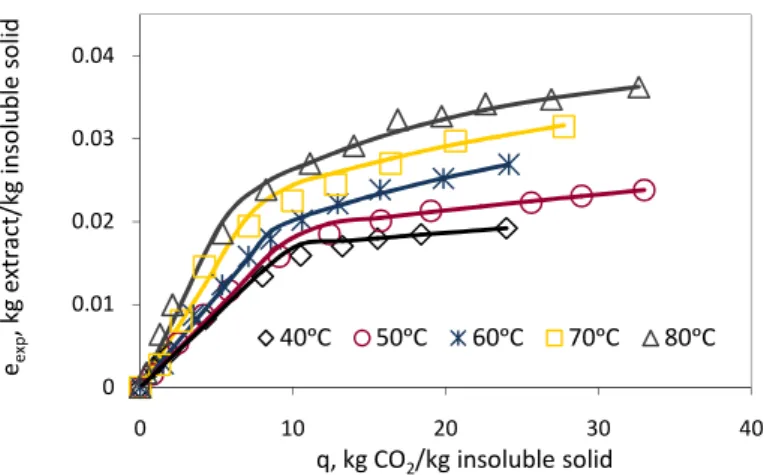
temperature on the extraction kinetics was investigated. The extraction yield
increased as the particle size decreased and with temperature. Extraction
curves present a faster and linear initial extraction period followed by a
slower extraction period. Based on these results the approximate
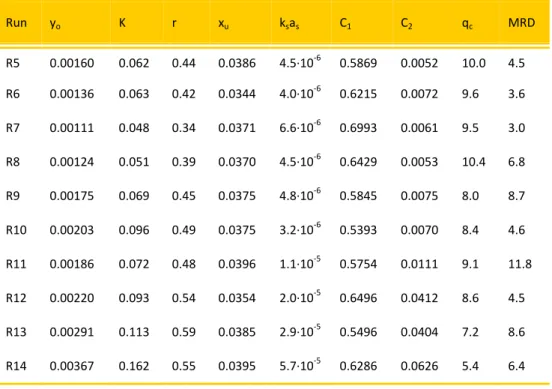
mathematical model of Sovová was successfully applied to describe the
extraction curves. The total content of alkylresorcinols was determined and
compared with the alkylresorcinol content obtained by conventional organic
solvent extraction. Due to the amphiphilic nature of these resorcinolic lipids,
the extraction yield was higher for polar organic solvents than for SC-CO2.
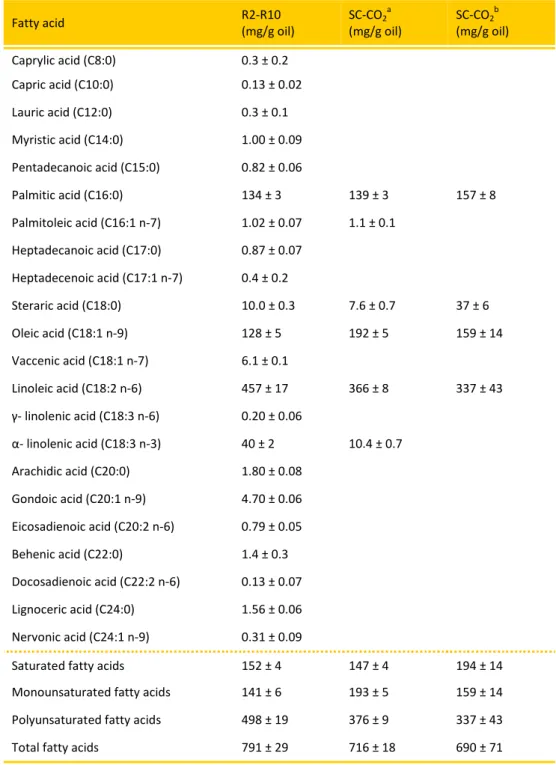
Characterization of supercritical extracts was also performed by determining
1. INTRODUCTION
Alkylresorcinols (AR) are amphiphilic 1,3-dihydroxybenzene derivatives with a long
odd-numbered alkyl chain (15-25 carbon atoms) at position 5 of the benzene ring
(Ross et al., 2003). AR are an important class of secondary metabolites that occur in
bacteria, algae, mosses, fungi, animals and higher plants (Athukorala et al., 2010). AR are
mainly found in the bran fraction of cereal grains and, consequently, are largely missing in
refined cereal flour and conventional cereal products. These compounds represent about
85% of total cereal grain resorcinolic lipids (Francisco et al., 2005a). Among cereal species,
the bran fraction of wheat and rye presents high levels of AR (32-143 and
36-320 mg/100 g dry matter, respectively). AR have been reviewed as protective antioxidants
in biological membranes and as having stimulant or inhibitory effects on some metabolic
enzymes (Bondia-Pons et al., 2009).
Traditionally, different organic solvents have been used to extract AR from the bran
fraction of the Gramineae family (Agil et al., 2012; Mattila et al., 2005; Zarnowski &
Suzuki, 2004; Zhou & Yu, 2004). However, organic solvent extraction usually requires
laborious purification of the extracts.
Francisco et al. (2005a, 2005b) reported, for the first time, the use of supercritical carbon
dioxide (SC-CO2) technology for AR extraction from cereal milling by-products, specifically
from rye bran. However, in these studies none of the AR homologues were detected in the
extract when pure CO2 was used within the imposed operative conditions (35 MPa;
55 ᵒC-70 ᵒC). Therefore, they proposed the use of ethanol as a polar cosolvent to improve
the extractability of AR, upon bran delipidation with pure SC-CO2. Previous to the
extraction with cosolvent a pre-extraction with pure SC-CO2 was performed to remove a
fraction that did not contain AR. Atukorala et al. (2010) also reported AR extraction from
triticale bran by a two-step SC-CO2 extraction since at the operating conditions (35 MPa
and 70 ᵒC) trace amounts of AR were detected when using pure SC-CO2. Dey and
Mikhailopulo (2009) proposed a two-step extraction process to pre-purify AR during the
extraction process from rye bran. In the first step, low concentrations of ethanol cosolvent
were used and higher ethanol cosolvent concentrations were used in the second step.
However, higher amounts of AR were removed during the first extraction step. At 70 ᵒC
and 25 MPa, by using 0.06% of ethanol as cosolvent in the first step, 1054 µg AR/g dry
mater was obtained; while at lower temperatures (45 ᵒC), by using 10% of ethanol in the
previous results obtained in our laboratory, in this work the extraction capability of pure
SC-CO2 on AR from wheat bran has been studied. Solvent power of SC-CO2 has been
improved by working at higher pressures than in previous works related with AR
extraction by using SC-CO2.
The objective of this chapter was the study of the extraction capability of pure SC-CO2 on
AR from wheat bran. Extraction curves at different operating parameters, such as particle
size, static extraction pretreatment with SC-CO2, and extraction temperature, have been
obtained. The Sovova’s mathematical model (Sovová, 2005) was used to describe the
extraction kinetics. This way, parameters that could help to a better understanding of the
extraction process have been estimated. Characterization and comparison of wheat bran
extracts obtained by SC-CO2 and conventional organic solvent extraction has been
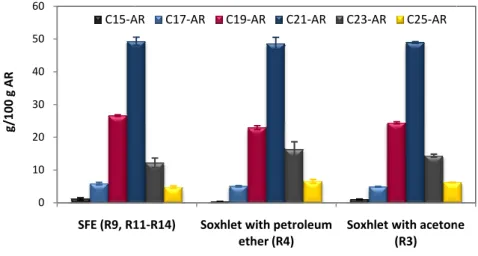
performed in terms of their AR and fatty acid profile and antioxidant activity evaluated by
different methods.
2. MATERIALS AND METHODS
2.1. Raw material
The wheat bran (Triticum aestivum, L.) was kindly supplied by HASENOSA (Spain). The particle size distribution of wheat bran was determined by using a vibratory sieve shaker
(Cisa model RP.09) and it is reported in Table 1.1. The moisture content of the wheat bran,
determined by drying in an oven at 105 ᵒC to constant weight, was found to be around
13 ± 1% (w/w).
Table 1.1. Particle size distribution of wheat bran
Particle size, p Mass percentage (%)
p < 0.5 mm 14.01
0.5 mm < p < 2 mm 81.24
2.2. Conventional solvent extraction
The conventional solvent extraction of wheat bran was carried out by using three different
solvents, acetone (Merck, 99.9%), ethanol (Merck, ≥99.9%) and petroleum ether (Merck,
analytical reagent). Acetone is used in most extraction procedures for AR isolation
(Zarnowski & Suzuki, 2004), ethanol is of interest since it is often used as cosolvent to
modify the solvent power of supercritical CO2 and petroleum ether was considered due to
its similar polarity to CO2.
Conventional solvent extraction experiments are summarized in Table 1.2. Two organic
extraction methods were used: continuous shaking at room temperature and Soxhlet
extraction. In the first case (R1 and R2) 4-6 grams of raw material were extracted with
50 mL of solvent (acetone or ethanol) in a glass flask during 24 h. After the extraction
time, the extracts were filtered through paper filters and evaporated under vacuum using
a rotary evaporator (Heibolph VV2000). In R3 and R4, Soxhlet extractions were done in a
Buchi equipment (B-811 model) using 25 extraction cycles to put the sample (1 g) in
contact with the solvent (acetone or petroleum ether) at its boiling temperature, followed
by rinsing and drying steps. Extraction experiments were replicated twice.
2.3. Supercritical fluid extraction equipment and procedure
The extraction experiments were carried out in a laboratory SFE-plant (Appendix A). In a
SFE experiment, 6-8 grams of wheat bran were loaded in the extractor (40 mL capacity).
Two syringe pumps (ISCO 260 DM), that work alternatively, provide an uninterrupted flow
of CO2 (Carburos metálicos, liquid CO2 ≥ 99.9 %) compressed up to the desired operating
pressure, 40.0 MPa. The pressurized solvent was pre-heated up to the desired extraction
temperature before entering the extractor. The extractor was held in an oven whose
temperature is controlled within an accuracy of ± 0.5 ᵒC. The carbon dioxide flow was set
to 1.5 ± 0.3 g/min. Depressurized CO2 was quantified with a totalizer flow meter.
Extraction yield was determined gravimetrically by measuring the extract weight at
different time intervals. Extraction parameters evaluated to study the extraction of wheat
bran oil were: particle size, static extraction pretreatment raw material-SC-CO2 at the
extraction pressure and extraction temperature. A total of ten experiments were carried
out under different extraction conditions (Table 1.3). Runs 5 to 8 were performed to
evaluate the influence of the particle size on the extraction yield. Runs 8 to 10 were
to 14 and run 9 were carried out to determine the effect of extraction temperature. Most
of the extractions were replicated twice.
2.4. Analytical methods
A full description of the analytical methods used in this chapter can be found in the
Appendix B.
2.4.1. Chemicals and materials
Fast Blue RR salt, olivetol, AR standards (C15, C17, C19 and C25), fatty acid methyl esters
Trolox (6-hydroxy-2,5,7,8-tetramethylchromane-2-carboxylic acid), DPPH
(2,2-diphenyl-1-picrylhydrazyl) and TPTZ (2,4,6-tris(2-pyridyl)-s-triazine), were supplied by Sigma-Aldrich Co. (St. Louis, MO, USA). K2CO3, FeCl3 and FeSO4 were obtained from Panreac (Barcelona,
Spain) and methyl tricosanoate by Larodan (Malmö, Sweeden).
2.4.2. Determination of total AR
The total AR content in the extracted material was determined by a colorimetric method
based on the use of Fast Blue RR salt (Sampietro et al., 2009). A stock solution of 0.05%
Fast Blue RR reagent was used to prepare a working solution by mixing 1 part of stock
reagent with 4 parts of methanol. Aliquots (20 µL) of methanol solutions of wheat bran
extracts (5 mg/mL) were placed in assay tubes and made up to 200 μL with methanol.
Then, 2 mL of the working solution and 10 μL of a 10% K2CO3 solution were added to each
tube. Absorbance of the reaction mixture was measured at 480 nm (Hitachi U-2000
spectrophotometer, Tokyo, Japan) after 20 min. Olivetol (5-pentylresorcinol) was used as
internal standard.
2.4.3. Determination of AR profile
Alkylresorcinols were determined according to a modification of the method proposed by
Knödler et al. (2008) using an Agilent HPLC (series 1100) equipped with a diodo array
detector and a mass spectrometry detector with an APcI source. The column used was
Kromasil C18-5 250 x 4.6 mm that operated at 25 ᵒC. The mobile phase was methanol (A)
and water (B) and the following gradient was used: 2% B to 0% B in 10 min. The total run
time was 100 min. The injection volume was 100 μL. All AR were monitored at 280 nm at a
flow rate of 0.6 mL/min.
Positive-ion mass spectra of the column eluate compounds were recorded in the range
the nebulizing gas at a pressure of 380 Pa. The nebulizer temperature was set at 350 ᵒC
and a potential of 4000 V was used on the capillary.
Individual compounds were identified by their mass spectra (Knödler et al., 2008) and
quantified using a calibration curve of the corresponding standard compounds.
2.4.4. Determination of fatty acids profile
The fatty acid profile was determined by the AOAC method (AOAC, 1995). The fatty acid
methyl esters were firstly prepared and then analyzed by GC-FID (Agilent Technologies,
Santa Clara, CA, USA). The separation was carried out with helium (1.8 mL/min) as carrier
gas. A fused silica capillary column (Omegawax TM-320, 30 m×0.32 mm i.d.) was used. The
column temperature was programmed starting at a constant temperature of 180 ᵒC for
20 min, heated to 200 ᵒC at 1 ᵒC/min, held at 200 ᵒC for 1 min, heated again to 220 ᵒC at
5 ᵒC/min and finally held at 220 ᵒC for 20 min. A split injector (50:1) at 250 ᵒC was used.
The FID was also heated to 250 ᵒC. Fatty acid methyl esters were identified by comparison
of their retention times with those of chromatographic standards. Their quantification was
made by relating the peaks area to the area of an internal standard (methyl tricosanoate)
as indicated by the AOAC method (AOAC, 1995). Calibration was made for several pairs
formed by the internal standard + chromatographic standards in order to find the
corresponding response factors.
2.4.5. Determination of antioxidant capacity
FRAP (Ferric Reducing Ability of Plasma) assay
The FRAP assay is used to measure the reductive power of a sample (Benzie &
Strain, 1996). It is based on increased absorbance at 593 nm due to the formation of
tripyridyl-S-triazine (TPTZ) complexes with ferric (II) in the presence of a reductive agent.
Briefly, 970 μL of FRAP reagent was mixed with 30 μL of methanol solutions of bran
extracts (5 mg/mL). The FRAP reagent was prepared by mixing 25 mL of 0.3 M sodium
acetate buffer solution at pH 3.6, 2.5 mL of TPTZ (10 mM), 2.5 mL of FeCl3 (20 mM), and
3 mL of water. The reaction was carried out at 37 ᵒC during 30 minutes and the
absorbance was measured at 593 nm (Hitachi U-2000 spectrophotometer, Tokyo, Japan).
Methanolic solutions of known Fe (II) obtained with different concentrations of FeSO4