
Leaf morphology of the Pejibaye palm (Bactris gasipaes H B K )
10
0
0
Texto completo
(2) 1 04. REVISTA DE BIOLOGIA TROPICAL. In general , the aboye descriptions serve well for the Pejibaye from Surinam and perhaps from the Amazon Basin as a whole . However, the plants studied in Costa Rica and reported here show generally larger dimensions. Sorne additions to this description that are worth mentioning come from Tomlinson ( 1 96 1 ): " .. .leaflets narrowly lanceolate , reduplica te, each with a prominent adaxial midrib, often setose. Rachis and petiole densely spinous below". From MacBride ( I 960) : " ...midnerve prominent aboye, the 3 or 4 secondaries on both sides, margins, remo tely setulose or mi nutely aculeate . . . " From Martius ( 1 824) (trans lated by W. Ro driguez, pers. com.): " . . .petiole base convex vaginate lanceolate . . . rachis bifacial on dorsal part, on ventral side convex, spiny ... pinnae ... the more apical and basal crispate, linear-lanceolate acuminate . . . . With these additions and the observations gathered fo r this article , a more detailed description may be presented : 10 to 25 (rarely reduced to 4 or 5, or up to 36) contempora neous fronds in a plumose crown, fronds cur ving, when old even curling, and drooping; 300 to 450 cm in length of which the rachis is 200 to 330 cm long; petiole sheath involves one half to two thirds trunk circumference, m argins bro ken somewhat fibrous, con cave aboye, convex below (Fig. 1 ) ; rachis concave becoming bi facial aboye, convex beneath ; spinyness absent to extremely dense on trunk and frond , usually more or less aligned on petiole, less so on rachis, occasionally stattered; leaflets in groups of :2 to 9 with lower leaflet of group more perpendicular to the rachis dorsel surface, following leaflets less perpendicular, giving a many-planed arrangement ; 1 1 0 to 140 leaflets per side , arranged in sup-opposite pairs or alternately on rachis with more 011 one side than on the other, basal and apical leaflets frequently fused with grouping less pronounced o r a b s e n t ; l e a flet s lin e a r- l a nce o la t e bi-acumin ate , length 20 to 80 cm, width 3 to 5 . 8 cm; midnerve prominent aboye, with 3 or 4 second aries on both sides; midvein, secondaries and/or margin of leaflets may present small spines; leaflet base convex vaginat e-lanceolate at insertion on rachis ; leaflets glossy dark green a b oye , opaque green below with more trichomes and stomata below; frond outline irregular to occasionally ovoid or obovoid. Although this description is more detailed than the others given here, it is still general. ". Thus to distinguish between genotypes, a qualitative and quantitative an alysis of the different characters is required. Prelirninary information on sorne characters is here pres ented, based on six different plants (B/3 , 4/ 1 , 9/ 1 , 1 6/ 1 , 1 /8 and 1 / 10). One -B/3- from Panamá, planted in 1 973 (Morera Monge, 1 98 1 ), and the other five from Costa Rica planted in 1 968; both collections at CATIE , Turrialba. The older frond was chosen between positions 1 2 and 1 6 and the newer between 8 and 1 2, thus both were probably mature. Rachis length : The rachis lengths observed are presented in Table l . One notes imme diately that these fronds are indeed much larger than those described from Surinam (Wessels Boer, 1 96 5), the smallest being more than 50 cm longer and the largest 1 30 cm longer. As mentioned aboye this may be due to the genetic variation between the populations of Pejibaye from Costa Rica and those of Surinam, or to the richer soils of Costa Rica, or to a combi nation of both . Further study is necessary to determine the cause of these differences. One also notes that the younger group of fronds is srnaller. This result was not expected to be so constant as is shown here. In the oil palm, the size of the leaf increases during the juvenile stage, until it reaches full maturity, after which it stabilizes for a while and then starts to diminish slightly (Hardon, et al. 1969 ; Corley and Gray, 1 9 76), although the age factor alone cannot explain these results in Pejibaye. The difference in size is too la rge between fron ds close in age. In addition, on e of the palms -B/3 from Panamá- also presents a rachis length reduction which is not expected to occur in an immature plant . Because all the palms show the same size reduction one must assume that there is an environme ntal factor, such as rainfall , that influences rachis length and frond size. Such changes must consequently be seasonal and superimp osed on the change which occurs with age . This subject obviously requires more study. .. Leaflet number : The number of leaflets per frond and per frond sides are presented in Table 2. In all the frortds studied there was a notable spacial difference in the point of insertion of the first basal leaflets between the two sides of the frond. It will be noted that plants 9/ 1 and 1 6/ 1 have more le aflets on the right side, while B/3 , 4/ 1 , 1 / 8 and 1 / 1 0 have more on the left.
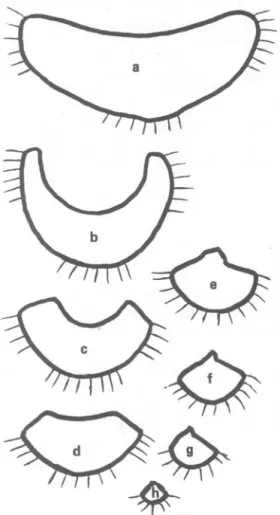
(3) CLEMENT & MORA URP/: Leaf morphology of Bactris gasipaes. 1 05. fronds. This is to be expected on immature plants where leaflet number is assumed to increase with age until maturity and then remain relatively constant. The difference is only 1 .67% and so statistically not significant; and consequently, it may be attributed to environmental influence . However, comparing Tables 1 and 2 , the younger fronds are shorter and have more leaflets than the older, so that one finds more leaflets pe r meter on the younger fronds . Thus the older fronds have an average of 86.8 leaflets per meter while the younger have 96.6 ( 1 1 .3% more per meter). These two results, rachis length and leaflet number, seem somewhat contradictory . It may be assumed that leaflet number may have a stronger genetic determination than rachis length bu t this may be affected by age differ ence while the palm has not fully matured. If such is the case , then it must be conc1uded that even the 1 2-year-old plants, such as those from Costa Rica, have not reached complete matu rity since the number of leaflets is still on the increase.. Fig. l . Petiole and rachis cross-sections in Bactris gasipaes H . B.K.: a. 50 cm below the first leaflet ; b. at the first leaflet ; c. 5 0 cm aboye the first leaflet ; d. 1 00 cm aboye the first leaflet ; e. 1 5 0 cm aboye the first leaflet ; f. 200 cm aboye the first leaflet ; g. 250 cm aboye the flrst leaflet; h. 300 cm aboye the first leaflet and 35 cm below end of rachis. Actual sizes are shown.. side . This bilateral assymetry is common in palms and especially evident in pinnate palms. This assymetric character seems to be related to the direction of the helix in whjch the fronds are inserted on the trunk (Davis , 1 96 8). Thus one máy assume that plants 9 /1 and 1 6/ 1 have a right-handed orientation to their helix while the others have left-handed phylotaxis. This assyme try is also observed in several of the other characters that will be presented below. There is a small difference between the fronds on the same plant with respect to the number of leaflets . Except for plant 1 / 1 0, there is a greater number of leaflets in the younger. Grouping of leatlets: The architecture of the Pejibaye frond is intimately related to the grouping of the leaflets . The main portion of the lamina has the leaflets arranged in grou ps that are easily distinguished by their angles of insertion on the rachis. Thus the first leaflet of each group is always the on'e that is inserted most perpendicularly to the rachis. Each suc ceeding leaflet in the group is less perpen dicular, with the last being most parallel to the rachis or even falling below the rachis plane. Figure 2 (a, b) presents groups of leaflets, cut to allow them to remain as erect as possible to make more obvious their angles of insertion. These different planes of leaflet arrangement on the fronds are lost somewhat with age when they tend to flatten out, losing sorne of the architectu ral efficiency to capture light . The groups of leaflets observe d on the ol der fronds of each plant studied are presented in Table 3 . It is evident that the number of groups on each frond show a relation with the number of leaflets but not a very direct one . This is pro bably due partially to the fact that the first basal and last apical groups are rnasked by fusion of the leaflets, causing a relative lack of well-defined differences in insertion angle in those fused leaflets. Table 4 presents the number of leaflets fused, or not organized in.
(4) REVIST A DE BIOLOGIA TROPICAL. 1 06. TABLE 1. Raehis length measurements. Comparison between two fronds of differen t age from eaeh of the six plants studied X. S.D.. C.V.. B/3. 4/1. 9/1. older. 275. 277. 330. 293. 282. 316. 295 .5. 22.63. 7.66. younger. 252. 261. 302. 258. 251. 294. 269 .7. 22.40. 8. 3 1. 263 .5. 269. 316. 275.5. 266.5. 305. 282.6. 22.27. 7.88. 8.75. 2.34. 26. 7 7. Plant Frond. X. dif.. (%). 5 . 78. 8.36. 1 /8. 1 6/1. 1 1 .94. 8.4 8. 1/10. 1 0.99. 6.96. TABLE 2. Number of leaflets per frond. Data taken from two fronds of eaeh of the six plants studied. Eaeh frond is separated for eomparison into rif}¡t vs left side and (bottom of table) into the sides where leaflets start lower vs higher on the raehis Plant 16/1U). 16/1(2). 8/3(1). 8/3(2). 4/1(1). 4/1 (2). 9/10). 9/1(2). right side. ll6. ll7. 127. 132. 134. 135. 137. 140. leCt side. ll7. ll8. 132. 136. 131. 132. 135. 137. total. 233. 235. 259. 268. 265. 267. 272. 277. Frond. 234. x/plant. 263.5. 274.5. 266. 1 /8(2). 1/l0(1). l/lO (2). 122. 123. 130. 127. 123. 135. 133. 131. 245. 258. 263. 258. 1/8U). 251.5. x(l). S.D.(tot). C.V.(tot). x(2). x(totaI). 1 27.7. 129. 128.3. 7.73. 6.02. 128.5. 131.5. 130. 6.85. 5.27. 256.2. 260.5. 258.3. 13.93. 5.39. 258.3. 14.07. 5.45. 260.5. lower. ll7. 132. 134. 137. 123. 133. 1 29.3. 7.66. 5.92. higher. 116. 127. 131. 135. 122. 1 30. 126.8. 6.85. 5.40. (1) older fronds (2) younger fronds. S.D. and C.V. from the older (1) fronds only. groups , found on the basal and apical ex tentions of the rachis . In these cases the leaflets are frequently identified as mid-ribs with their concomitant insertion swellings rather than as distinct leaflets . The average number of leaflets on the right and left sides of the lamina are almost equal, but the coefficient of variation shows how widely this number differs among plants . The lack of a clear correlation between groupings of leaflets and o ther characters dis cussed in this paper suggests that this character and the one of fusion of basa! and apica! leaflets would be of little use as descriptors in these populations, although there are very few examples presented here to justify this conclu sion . However, the grouping of leaflets appears to serve very well as a systematic randomizing factor for use in leaf area ca1culations.. Length and width of the leaflets : Again the results presented in Tables 5 and 6 show that the fronds of the Pejibaye in Costa Rica are gene rally larger than those of the plants described from Surinam (Wessels-Boer, 1 96 5). One architectura! feature of importance is that the total wid th of the leaflets per side is greater than the rachis length, accounting for the way that the leaflets are intricately folded upon themselves before the opening of the frond. The length and width of the leaflets are of importance because of their direct relation to area, an important component of the potentia! pho tosynthetic efficiency of the frond . Along the rachis the length and wid th of the leaflets vary considerably, with the first basa! and last apica! leaflets being the shortest and narrowest, while sorne of the mid-rachis leaflets are the.
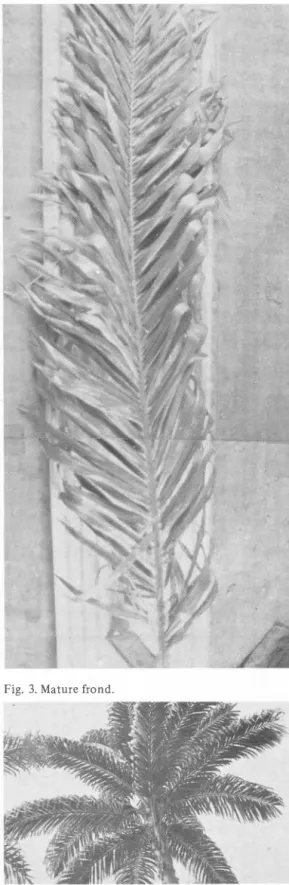
(5) CLEMENT & MORA URPI: Leaf morphology of Bactris gasipaes. Fig. 2. Groups of leaflets -with far ends cut- showing the different angles of insertion to the frond rachis.. longest and widest. Minimum lengths approach 20 cm, rapidly increase along the rachis toward the center. Minimum widths approach 5 m m and are related to the breaking line between leaflets. It is not unusual to find sorne leaflets with the mid-rib on the margin because of the way that the leaflets split apart. Because of the irregularity of splitting, the minimum and maximum widths have more of an element of chance in their determination than do the minimum and maximum lengths. This may be seen by comparing Tables 5 and 6 with the observations about assymetry of the leaves of the palm. While the leaflets of maximum length are always found on the side of the rachis with the largest average length and the greatest number of leaflets, the leaflets of maximum width are not always so related, as may be seen on most of the plants observed in this study. The maximu m lengths and widths found on the six plants studied are presented here for com parison with the averages and for sorne possible use in future calculati_ons. However, because of the somewhat irregular splitting of the leaflets, the individual maximum width figure is of Httle use when ca1culating leaf area. It is of special interest to observe that the maximum width appears to be unrelated to the maximum length. Frond Shape: The shape of the Pej ibaye fronds appears, at first glance , to be quite. Fig. 3. Mature frond.. Fig. 4. Crown of fronds from an adult planto. 107.
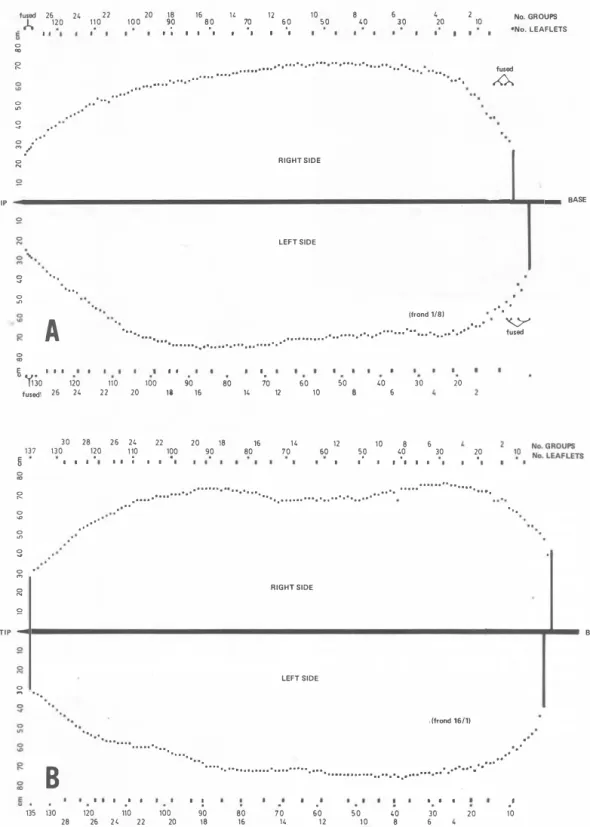
(6) 108. REVIST A DE BIOLOGIA TROPICAL. fused. ,J... 26 120. 24. o. ... n. 110. ,. ". l. 100. '. lO •. R o '" o �. M/ o. ,. ,,'. 0. 0. ... ,,'. -. ... .. .. . .. .. .. . .. .. 18 90. 16. I. . . .. . .. . . ... . . ... l'. 80. I. •. 11. 70. . .. ... .... .. . . ... . .. . . .. 8. 50. 0,. 6. 40. 4 lO. 30. 1. No. GROUPS. 10. oNo. LEAFlETS. ". ..... .... .. . . . . . .. .. . . .. .. .. .. . .. ... ... .. .. .. .. . . .. fused. .. . .. rO--. .. RIGHT SIDE. 2 T I.. 10. 60. '1. ..........................................................................�....--. --. BASE. LEFT SIDE. °o. �. •. .. .. o '". .. ". A � E. u. y, jo. fusadl. 5 �. (frond 1/81. '". I I I 16. 30 130. 137. I. I. 120 14. .. ". .. o <D o. .. . ... .. 24 1 10. ... .. ... ...... .. I. la. 22 .. I :. •. .. .. I. 100. lO. 26. R. .. . . . .. .. •. 110 n. 18 120 .. 0. .. .. .. .. . ... .... . .. . . . . . . . . . . . . . . .. 90. 20. 100. .. . . .. 80. 16. 90. 18. I. 70. 14. 80. .. . .. . . ..... 60. .. 11. 16. 70. ". ... .... .. .... ... ••••••. .. lO. . .. . . . .. .. ... ... .. . .. .. ... 60. 12. . . . . . . ... 40. �. . . ... ... ... .. .... . ... .. ... .. ... 8 40. "o. 6. , ,. . . . ... .. . ... .. .. '. .. '<.Y fused. lO. lO. , ',. .. ... . . ... I. 6. 10. 5 ,. . . . ... .. 50. 10. 14. .. .. ." .... 30. 20 ". . . .. .. .. . . . .... . . . ... . ". .. '". 3 g. ". RIGHT SIOE. 2 TI .. Q. -1. �..... ............................................................... .. .. .. .. .. ... BASE. lEFT SIOE :;:. -',. ". \ (frond 16/1). " ". ". ". ,. .. .. .. . ... .. ... . . . .. . . . . .. .. . .. B 135. 130. ". 28. 120 26. ,. 24. ". 110. ,. 22. 100 20. .. . . . .. , !. ... 90 18. .. .. .. . . . . . 80 16. . . . . . . . . .. . . . . . . . .. 70 14. ". .. . .. . . ... . . . . . . . . . . . . .. . . . . . . . .. 60 12. 50 10. 40 8. 1. 30 6. ,. .. . . .. . . . .. 1. 20. . .. .. ... ','. ". . ... 10. .'. Fig, 5 . Outlines of older fronds from two of the six different plants studied, showing number, length, distribution and grouping of leaflets: A, Frond 4/1 ; B, Frond B/3..
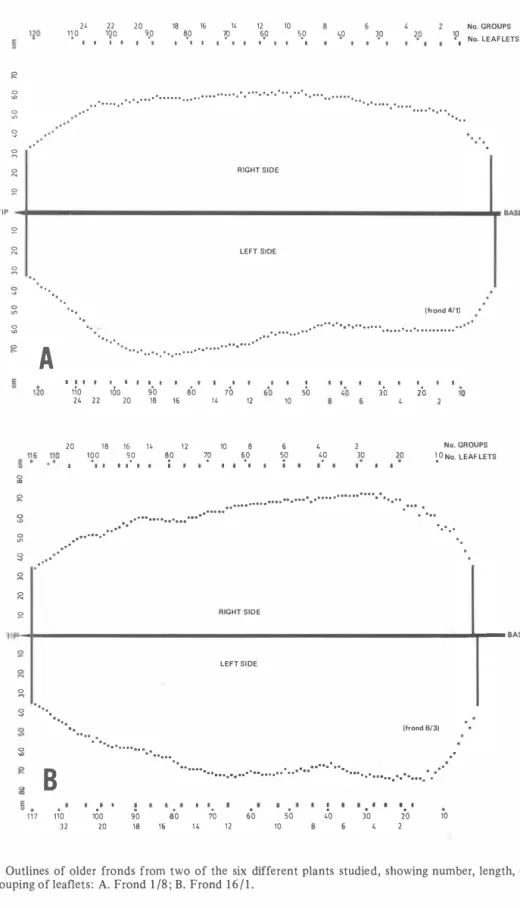
(7) 1 09. CLEMENT & MORA URP/: Leaf morphology of Bactris gasipaes. 24. '1 0. I. 22 '90 I. •. 20. •. 18. 9.0. 16. 8.0. ,. �O. ,. 14. 10. 12 6.0 ,. 3.0. �O. 5.0. No. GROUPS. lp,. No. lEAF LETS. R. o � o � o � o �. ... '. .. ...... ... .. , .. .. . .... .. . . .. .... .. .. . .. . .. . . ... . ... .. .. .. .. ... .. .... . . .. .. .. .. ... .. .. . .. . . . ... .. . . . . . .. .. . .. ... .. ... .'. RIGHT SIOE. o N. TIP. .. �. �. p .. .. .. .. .. .. .. .. .. .. .. .. .. .. .. .. .. .. .. .. .. .. .. .. .. .. .. .. .. .. .. �. � � o �. 8�E. LEFT SIDE. '. .. ". '. o �. .. '. .. .. ". '. . ... .. ... A •. I. 1;0. I. I. 24. uio. 22. 20. 100. .. 18. ". •. ,. o '". ..... •. r. ... .. .. ... I. 20. 9'0 18. 16 90. 14. 1°. ,. ... . . ... •. .. R. � :;:. S. ... .. ... . .. ... .. .. ... .. .. .. .... .. .. .. ... ... .. . .. . ... 7p .. .. . .. .. . ..... 70. ". 12. 80 i. ... .. ... ... .. .. .... .... .. 12. 10 ,. .. . .. . .. ,. . ... .. .. .. . ... .. .. . . . .. . .. ,. ,. 8'0. 16. •. . ... . ... .. 10. 8 6.0. . . . .. . .. .. .. ... .. .. .. ... 4. .. ,. .. .. 20. No. GROUPS. �O No. LEAF LETS. ". ". .. . . . . .. . . ... 2 30. 40. . .... .. 30. 50. 6 50 i. ,. {frond 4/11 . . . .. . . . .. ... ... ... .. .. . . . . .. .. ... .. ... .. .... .. ... .. .. .. ... '.. �. �. RIGHT SIOE. �. ��. � __ __ __ __ __ __ __ __ __ __ __ __ __ __ __ __ __ __ __ __ __ __ __ __ __ __ __ __ __ __ __ __ __ __ TIP �. ___. 8ASE:. LEFT SI DE. o M 3. .. .. ... . '. .. '. . '. o �. .. .. .. .. ... (frond 8/3) .. .. .. ... .. ... . .. .. .. .. ... '. ... B 117. 110 32. .. .. .. 100 20 '. ,. 90 18. 16. 80. .... .. ,. 14. ..... .. .. '.. 70. 12. .. ... .. .. 60. .. ... .. .. 10. .. ... 50. . . ... ... . .. . .. ! 40. .. . ... .. ... . .. ... 30. ,. ... ,. ... . .. .. . . .. .. 20 2 '. .. '. .. '. ,,-. 10. Fig. 6. Outlines of older fronds from two of the six different plants studied, showing number, length, distribution and grouping of leaflets: A. Frond 1 /8 ; B. Frond 1 6 / 1 ..
(8) 1 10. REVIST A DE BIOLOGIA TROPICAL. TABLE 3. Number ofgroups of leaflets per frond. Data taken from one frond of each of the six plan ts studied. Each frond is separated for comparison into right vs left side and (bottom of table) into the sides where leaflets start lower vs higher on the rachis B/3 (1). Plant. 4/1(1). 9/1 (1). 1 6/1 (1). 1 /8(1). 1 /1 0 ( 1 ). Frond. x. S.D.. C.V.. right side. 20. 29. 27. 30. 24. 31. 26.8. 4.17. 1 5.5 6. left side. 22. 29. 27. 28. 25. 29. 26.7. 2.73. 10.22. total. 42. 58. 54. 58. 49. 60. 5 3.5. 6.86. 1 2. 8 2. lower. 22. 29. 27. 30. 25. 29. 27.0. 3.03. 1 1 .2 2. higher. 20. 29. 27. 28. 24. 31. 26.5. 3 .94. 14.87. ( 1 ) considers only the older frond of previous tables .. TABlE 4. Numb er o[leaflets fused o r not organized i n groups. Data taken [rom one [rond per plan! [rom each of the six plal/ts studied. Each frond is separated for comparison into right vs left side al/d (bottom of table) into (he sides where leaflets start lower vs higher on the rachis B/3(1 ). Plant. B. 4/ 1 (1 ). A. B. A. right. 21. 4. left side. 17. 7. 6. total. 38. 11. 13. 11. lower. 17. 5. higher. 21. 6. B. basal leaflets. A. apical leaflets. (1). B. 9 / 1 (1 ) A. 16/1(1 ) B. A. 7. 6. 8 14. 10. 15. B. II. 19. 6. I I. 6. 8. x. 1/100). A. 13. 6 4. 1 /8(1 ) B. A. S.D.. B. A. B. C.V.. A. B. A. 4 1 .3 1. 12. 8. 9.3. 6.5. 3 .01. 63.65. 8. 6. 9.2. 6.2. 4.26. 1 .1 7. 46.30. 1 8. 8 7. 20. 14. 1 8.5. 1 2.7. 9.89. 3 .93. 5 3 .46. 30.94. 6. 9.3. 6. 4.1 3. 1 .09. 44.41. 1 8. 1 6. 12. 8. 9.2. 6.7. 6.01. 3 .0 1. 65.3 3. 44.93. 9. 5.92. o lder fronds. TABLE 5. Length ofleaflets: summation, mean and maximum length. Data taken from one frond of each of the six plants studied. Each frond ,is separated for comparison irlto right vs left sideand (bottom of table) into the sides vJ¡ ere leaflets sta rt lower vs higher on th e rachis. Data given in cm B/3(1) Plant. Ex. right side. 6939. ",. 4'/1(1). ",. 59.8. 72.4. 4357 34.3. 42.4. 73.9. 4682 35.5. 44,9. left side. 7319. 62.6. total. 14258. 61.2. 9040 34.9. 8445. 9/1(1). 16/1(1). 63.0. 14.5. 7684. 58.7. 71.3. 16129. 60.9. 8850. 1/8(1). 1/10(1). ". 64.6. 75.6. 8573. 63.5. 74.6. 17423. 64.1. 6537. 53.6. 61.8. 7334. 59.6. 72,6. 13871. 56.6. S.D.. c.v.. 8209. 63.1. 76.5. 56.4. 11.52. 8873. 69.3. 79,2. 58.2. 11.73. 20.2. 17082. 66.2. 57.3. 11.45. 20.2. 20.4. lower. 62.6. 35.5. 63.0. 64.6. 59.6. 69.3. 59.1. 1l.99. 20.3. higher. 59.8. 34.3. 58.7. 63.5. 53.6. 63.1. 55.5. 10.99. 19.8. (l} older fronds.
(9) 111. CLEMENT & MORA URPI: Leaf morphology of Bactris gasipaes. TABLE 6. Leaflet width: summation for the frond, mean and maximum width. Data taken from one frond of each of the six plants studied. Each frond is separated for comparison into right vs left side and (bottom oftable) into sides where leaflets start lower vs higher on the rachis. Data given in cm. total. ,. ",. 523.2. 4.12. 5.8. 413.5. 3.09. 4.0. 539.0. 4.08. 5.4. 393.2. 3.00. 4.0. 1062.2. 4.10. 806.7. 3.04. 3.8. 350.0. 2.99. 3.'. 683.5. 2.93. 333.5. 9/1(1). m". 2.88. right side. 4/1(1). ;¡. ",. "'. left side. B/3(1) m". Phmt. ",. 16/1(1). lO'. 1/8(1). 561.6. 4.10. 4.7. 359.8. 2.95. 3.7. 536.4. 3.97. 4.8. 373.9. 3.04. 3.8. 1098.0. 4.04. 133.7. 2.99. 1/10(1). ,. S.D.. 4.42. 5.6. 3.59. 0.69. 19.22. 548.0. 4.28. 5.2. 3.56. 0.61. 17.13. 1123.1. 4.35. 3.58. 0.65. 18.16. ", 575.1. C.V.. IOwer. 2.99. 4.08. 3.09. 4.10. 3.04. 4.28. 3.60. 0.61. 16.94. higher. 2.88. 4.12. 3.00. 3.97. 2.�5. 4.42. 3.56. 0.64. 19.38. (1) older fronds.. regular (Figs . 3 , 4). However, the irregularity of the shape is apparent when the leaflets are cut off from the rachis and ranked in order. Figures 5 and 6 present the shapes observed on the older frond of each of four of the six Pejibaye plants studied. One notes immediately this irregularity since sorne fronds present their maximum width near to the petiole (B/3 and 1 / 1 0), others nearer to the rachis apex (4/ 1 , 9 / 1 ), another showing two areas of maximum width ( 1 6/ 1 ) and still another ( 1 / 8) with different positions of the maximum width on both sides. One also notes that most of the fronds are more irregular on one side than on the other, and in four (B/3 , 9 / 1 , 1 6 / 1 and 1 / 8) the most irregular side is the one with the most leaflets. The o ther two leaves present frond shape irregularities on both sides. Because of the irregularities noted here the methodologies of frond area calculation developed by Hardon et al. ( 1 969) and Mendham (1 9 7 1 ) for the oil palm do not work quite as well in Pejibaye . ACKNOWLEDG EMENTS We thank, in B razil, the BID/FINEP/CNPq (convenio No.5 3 1 /CT) for financial assistance, Dr. William Rodrigues for translation and bo tanical orientation and Dr, Anthony A nderson for palm botanical orientation, and in Costa Rica, the Consejo Nacional de Investigaciones Científicas y Tecnológicas (CONICIT) and the Centro Agronómico Tropical de Investigación y Enseñanza (CATIE) for economic and material assistance , respectively. RESUMEN Este estudio preliminar sobre la morfología de la fronda del pejibaye, (Bactris gasipaes) se. inicia con una descripción morfológica de la hoja, que complementa aquellas existentes en la literatura. La información obtenida indica que los pejibayes de Centro América poseen un raquis foliar considerablemente más largo que aquel reportado para las poblaciones de Suri nam y se supone que por lo menos parte de esa diferencia tiene un fundamento genotípico. Contrario a lo esperado, se encontró que las frondas de mayor edad poseen un raquis de mayor longitud que aquellas más jóvenes pero ya adultas del mismo estípite. Esta diferencia es posiblemente causada por factores ambientales que varían estacionalmente , tal como la lluvia. Se indica que los foliolos están asociados en grupos , en donde cada foliolo presenta un ángulo diferente de inserción en el raquis, dando muchos planos en su ordenamiento, lo cual aumenta la eficiencia en el aprove chamiento de la luz. Esta ventajosa disposición de los foliolos en múltiples planos desaparece paulatinamente en las frondas viejas al arquear se los foliolos cada vez más, anulando el efecto de los diferentes ángulos de inserción. También · se encontró que existe asimetría entre los lados opuestos de la misma fronda con respecto a número de foliolas, longitud y área total. Asimismo , los foliolos de un mismo lado muestran una variación asimétrica. También se encontró un mayor número de foliolos en las frondas jóvenes cuando se compararon con otras más viejas de la misma corona, a pesar de presentar, éstas últimas mayor longitud del raquis. Esto puede indicar que aún en palmares de 1 2 años de edad las frondas no han alcanzado su pleno desarrollo, puesto que se supone que el número de foliolos es menos afectado por variaciones ambientales que la longitud del raquis..
(10) 1 12. REVIST A DE BIOLOGIA TROPICAL. REFERENCES Barbosa Rodrigues, · J. 1 90 3 . Sertum Palmarum Brasiliensium. Vol. 1 1 : 46-5 0 . Tipographique Veuve Monnom, Bruxelles. Broekmans, A.F.M. 1 95 7 . Growth, Flowering and Yield of the Oil Palm in Nigeria. J. W.A.I.F .O.R., 2 : 1 87-220 .. MacBride, J.J. 1 960. Bactris gasipaes H.B.K. In : Flora of Pem. Field Mus. Nat. Hist. Bot. Series Vol. 1 3, pt. 1 , # 2, Pub!. 8 95 . M a r tius, C.F.P. von. Palmarum. 2: 8 1-83.. 1 824 .. Historia. Naturalis. Mendham, N.J. 1 9 7 1 . Note of Leaf Area Measurement in Oil Palms. Papua New Guinea Agric. J . , 2 2 : 230-23 l .. Corley, R.H.V., & B.S. Gray. 1 97 6 . Growth and Morphology, 5 3 1 p. In R.H.V. Coriey, 1.1. Hardon, & B.J. Wood (eds .). Gil Palm Research. Elsevier Sci. Publ. Co. , Amsterdam.. Mora Urpí, J . & C.R. Clement. 1 98 1 . Aspectos T a x onómicos Relativos al Pejibaye (Bactris gasipaes H.B.K.) Rev. Biol. Trop., 29: 1 3 9-14 2.. Davis, T .A. 1 968. Bilateral Symmetry in the Leaves of Cocos nucifera L. FAO . 3rd. Tech. Work-Party on Coconut Prod. Prot. & Proe. Jogjakarta. 7 p.. Morera Monge, J .A. 1 9 8 1 . Descripción Sistemática de la "Colección Panama" de Pejibaye (Bactris gasipaes H.B.K.) de CATIE. Tesis M.Sc. CATIE, Turrialba. 1 22 p.. Hardon, J.J., C.N. Williams , & 1. Watson . 1 969. Leaf Area and Yield in the Oil Palm in Malaya. Exp. Agrie., 5 : 25-32. Hartley, C.W.S. 1 97 7 . The Gil Palm ( IJlaeis guineensis Jacq .). Longman, New York. 806 p. Humboldt. A., A. Bonpland, & C.S. Kunth, 1 8 1 5- 1 825 . Nova genera et species plantarum. Lutetiae Parisiorum. Paris. 7 Vol.. Nixon, R.W. 1 95 0 . Imported Varieties of Date in the United States. USDA Circular # 834. 1 44 p. Tomlinson, P.B. 1 96 1 . Anatomy of the Mono cotyledons. n. Palmae. Edited by C.R. Metcalfe. Oxford. 453 p. Wessels-Boer , J.G. 1 9 6 5 . Indigenous Suriname. Leiden E.J. Brill. 106. p.. Palms. of.
(11)
Figure
Documento similar
Assume the test data is typed with the right hand; then typing keys on the right hand side of the keyboard will be typed in a normal manner, while keys on left hand side of the
In the previous sections we have shown how astronomical alignments and solar hierophanies – with a common interest in the solstices − were substantiated in the
Considering LCC A as the Land Cover Component for land cover class A, and LCC B as the Land Cover Component for land cover class B, Equation 1 is transformed into
teriza por dos factores, que vienen a determinar la especial responsabilidad que incumbe al Tribunal de Justicia en esta materia: de un lado, la inexistencia, en el
• Experiment 1: Real vs synthetic signatures perfor- mance. The performance of the selected verification system for the real and each of the synthetic databases is evaluated in
Inserting into the flow hash table: The segment data in the GPU segment hash table is inserted in the GPU flow hash table to obtain the number of segments and retransmissions for
Disease Adrenergic Receptor Sotalol (Betapace) is a non-selective beta blocker and a potassium channel blocker with an IC50 of 43 µM. Sparfloxacin Infection Others Sparfloxacin
So, the engineering data enabled the team to establish that there was interfer- ence in the science data (SQUID output voltage signal) at the spin frequency of the gyros and that
