
Didactic Materials to Foster Dictionary Skills in the EFL Classroom
50
0
0
Texto completo
(2) ABSTRACT The present project can be identified as belonging to Modality number 6: didactic materials included in the rules established by Jaume I University. This particular modality refers to the creation of singular didactic materials, educational innovations as well as technological resources which can be exploited in an educational context. In this particular case, a series of didactic materials have been created to reinforce the learning of English skills through the reiterated employment of digital dictionaries, to foster their use. In the present case, the elaborated didactic materials belong to the English subject taught in 4th grade of ESO in IES “Els Ports”, Morella. On the one hand, through the development of the whole set of activities we pretend to break with the traditional methodology of teaching grammar, vocabulary and the different skills. In order to strengthen this teaching and learning process students increase their use of Communication and Information Technologies (ICTs) since they have to make a proper use of technological equipment and the affordances it brings into language learning. On the other hand, the creation and preparation of these activities aims at examining the use of two particular online dictionaries in depth, since all of them do not exhibit the same information and all e-dictionaries do not present information in the same way. Moreover, the lack of activities in textbooks requiring students to use online dictionaries is a reality since the textbook employed in IES “Els Ports” to teach English does not exhibit these exercises, or whether they exist, the statement implies to use a dictionary if needed, without being more specific and without being a requirement. Finally, the assessment will not follow the usual process, in contexts in which students have to sit in front of a final exam because all the activities are complementary to the first unit of the book. In this sense, each activity will receive a 5% within the unit, so that, 10 dictionary activities will account for five points in the unit. In the same way, several methods will be used in order to evaluate the activities: field notes through direct observation in the classroom, material/task delivery and rubrics..
(3) TABLE OF CONTENTS. 1. Introduction …………………………………………………………………1 2. Theoretical background 3. Objectives. …………………………………………………………………7. 4. Curricular context 5. Activities. …………………………………………………4. ……………………………………………...………….8. ………………………………………………………………..13. 6. Activity assessment ……...………………………………………………...29 7. Conclusion. ………………………………………………………………..33. 8. References. ………………………………………………………………..35. 9. Appendix: activity samples and materials …………………………………..38.
(4) ACRONYMS. . CAA: Competencia de aprender a aprender.. . CD: Competencia digital.. . CEC: Competencia de conciencia y expresiones culturales.. . CMCT: Competencia matemática y competencias básicas en ciencia y tecnología.. . CLLI: Competencia en comunicación lingüística.. . CSC: Competencia social y cívica.. . CEFRL: Common European Framework of Reference for Languages. . LDOCE: Longman Dictionary of Contemporary English.. . SIEE: Competencia de sentido de iniciativa y espíritu emprendedor..
(5) 1. INTRODUCTION The main aim of the present project is to create a series of didactic materials to foster the use of online dictionaries in the EFL classroom. Another objective is to present activities to implement the use of online dictionaries as tools for vocabulary acquisition; for grammar acquisition and for the improvement of other skills which are: reading, writing, listening and speaking. I made the decision of working with online dictionaries because in a technological era, traditional printed dictionaries are becoming useless; they do not really fulfil what both learners and teachers pretend to achieve when dealing with the English language, that is, printed dictionaries do not offer the same amount of possibilities as online ones. According to Aust, Kelley and Roby (1993) the use of online dictionaries promotes a higher level of consultation than that of paper dictionaries. Concerning the possibilities online dictionaries offer it is relevant to explain that these tools are available in different languages; students can find there the pronunciation of a huge variety of words, synonyms and antonyms, activities to practice and even games to enjoy learning. However, in spite of the fact that online dictionaries offer more possibilities over printed ones, the real fact is that neither online nor traditional dictionaries are considered as part of the syllabus, as shown in the work of Chi (1998). In high schools in general, these devices are not as used as they should and in case some students decide to use them, they are not taught about that. Apart from not being present in the syllabus, it is also important to mention that in many textbooks used in the EFL classroom, there are not any activities which imply the use of online dictionaries. In order to demonstrate the absence of exercises and therefore, the innovative part of the present project the book Real English Eso 4 has been analysed; more specifically unit 1, titled Moving On. Analysing the whole unit and following the studies carried out by several authors (Chun, 2001; Lan, 2005; Laufer & Hill, 2000) all the activities in textbooks, implying the use of a dictionary are those created to increase vocabulary acquisition in reading and writing tasks. However, these activities only present as statement the following sentence: use a dictionary if you need it. This sentence does not specify the 1.
(6) type of dictionary students have to use and in case they decide to employ an online dictionary, they are not able to know which one would be better to find the information they are looking up. Following the analysis of the textbook Real English Eso 4, another aspect which needs to be taken into account is that, in case students decide to use an online dictionary, being able to use it adequately is not the same as simply using it. During my internship period I could observe that vocabulary, grammar and other English skills are taught following traditional methods. If students do not know the meaning of a word, the teacher provides them with the solution; in terms of grammar, students do not know that dictionaries offer grammatical explanations and in terms of the other skills, they are not concerned about how useful an online dictionary can be. Concerning the importance of using an online dictionary properly, both teachers and students have their own role. On the one hand, what teachers have to do is to clearly explain to their students the type of dictionary they have to use and the reason. In many occasions, teachers prefer their students to use monolingual dictionaries because in this way they learn a foreign language in a more effective way (Ali 2012). However, there are many other occasions, when the use of bilingual or other specific dictionaries is better, because online dictionaries are plenty of information and formats which need to be discovered. On the other hand, students at the same time need to be clearly explained what they are expected to do with the online dictionary. If this does not occur, they tend to use bilingual dictionaries, because they feel they are easy to use (Ali 2012) and they should also be concerned about the usefulness of other types of online dictionaries. Following these ideas, students would not employ the dictionary when the book asks them to do so, or just to look for the meaning in their own language, they would use them for other purposes; they would also use other strategies and seek semantic meanings rather than lexical forms or meanings (Jin & Deifell 2013). In order to solve this, dictionary skills need to be introduced in high schools; students need to be trained by teachers to develop these skills and they have to be taught in an effective way (Bishop 2001; Lew and Galas 2008) because dictionary skills do not come naturally (Chi 1998). Moreover, learners should know what they are doing when 2.
(7) using online devices (Lew 2013a); that is why they should to be taught about how to choose an online dictionary capable of meeting their needs (Chi 1998). Taking into consideration the importance of including dictionary skills in textbooks students need to be aware of the fact that “The dictionary is an important pedagogical tool that plays a vital role in various processes of language learning including reading comprehension and vocabulary learning and acquisition” (Ali 2012, p.3). In order to demonstrate both the importance of online dictionaries and all the particular functions they present, I have developed 10 online dictionary activities; two online dictionaries have been selected to carry out the different tasks: Longman Dictionary of Contemporary English (LDOCE) and Merriam-Webster online dictionary because they are the ones which exhibit the information in a clear way. Eventually, these activities are going to be innovative because, as previously mentioned, there are no activities implying the use of online dictionaries and they will foster the use of two online dictionaries with different purposes. Furthermore, the following activities will be created in such a way that students will know the specific dictionary they have to use, the reason and how they have to use it, because their textbook Real English Eso 4 does not specify it. Moreover, the set of activities will also be innovative in the sense that students will employ ICTs, in this case online dictionaries, in order to obtain more information than just the meaning or the translation of a word when learning English (Ranalli 2013).. 3.
(8) 2. THEORETICAL BACKGROUND The emergence of online resources has affected all branches of education including Foreign Language learning and learners are considered digital natives. Within this context, the importance of language dictionaries in language learning is indisputable and it aims at changing the way students learn the foreign language (Jin & Deifell 2013; Ali 2012). Following the ideas presented above it can be stated that traditional and printed dictionaries are decreasing their use in a technological world; they are becoming less employed within an educational context and that is the reason why e-dictionaries present several advantages over traditional ones. On the one hand, the availability of online dictionaries allows teachers to teach and test a Foreign Language, English in the current case, in an efficient and dynamic manner. It means that online dictionaries scaffold language learning both within and outside the classroom and this allows students to learn in contexts other than the classroom (Jin & Deifell 2013). E-dictionaries are freely available on the web where, for many purposes, they can be more quickly and conveniently consulted than the paper-based versions (Lew 2010). Students can even download the application on their smartphone or computer and access it without the need of internet connection. Other advantage to be mentioned could be that there is a huge variety of online dictionaries; each one offering different possibilities which can be exploited in high schools and users can have all these possibilities at their disposal. The last advantage to consider is that users get to be liberated from the alphabetical order (Lew 2013b). Bearing all these advantages in mind, it is crucial to deal with educational innovation in this project since both teachers and students have to be adapted to the context and they have to use different dictionary types with different purposes. Educational innovation, according to Cañal de León (2002) is a set of ideas, processes and strategies which try to introduce and replace the traditional and current educational system. Even though, innovation means a large process, the final purpose is. 4.
(9) to alter the current reality by means of improving and renovating the teaching-learning processes. As the present project aims to create didactic materials in order to modify these processes, I have taken into account the work of several authors who provide their analysis of innovation through the use of Information and Communication Technologies, and more specifically through the development of dictionary skills. According to Hartmann and James (1998, p. 117) dictionary skills are “the abilities required on the part of the dictionary user to find the information being sought”. In this sense, there is a need for training both students and teachers in dictionary skills, key to innovate in an educational context. These dictionary skills are not easy to get and according to Campoy (2015) the development of these dictionary skills depends on the students’ look-up strategies; their abilities to use the best strategy in a particular context and for a determined purpose. In this sense, the use of online dictionaries in high schools would foster the acquisition of dictionary skills and it would demonstrate the usefulness of dictionaries as learning tools. In spite of being learning tools, the role of online dictionaries does not appear in the syllabus; dictionary skills are not included as an important measurement in language skill testing for reading, writing, listening or speaking. However, dictionary skills are related to language proficiency levels because a student belonging to an A2 level is not able to accomplish the same objectives as one student of a B2 level and it would be an important reason to include dictionary skills in the syllabus. In order to innovate within an educational context and create suitable activities to give dictionary skills the same importance as to other skills implies knowing the stages that both students and teachers have to follow when working with an e-dictionary. These stages defined by Nesi (1991) will be assessed in the activities presented below: -. Before study,. -. Before dictionary consultation,. -. Locating entry information,. -. Interpreting entry information,. -. Recording entry information, and 5.
(10) -. Understanding lexicographical issues.. These are the stages that students are supposed to follow but also the teacher when giving them relevant information. In this sense it is important to mention that the first stage implied knowing the type of dictionary as well as the information each dictionary portrays in order to get to know how to design dictionary tasks. The second stage suggested by Nesi (1999) is not as relevant as the other ones because in this step students have to realise whether they need to consult or not an online dictionary. As the present project is intended to foster the use of e-dictionaries the whole set of activities has been designed to employ them. Following Nesi’s process (1999), the third stage is really important since in the process of teaching-learning English, both students and teacher have to understand the structure of an online dictionary in order to find the correct and needed information. The fourth step also affects students and it hints the right interpretation and the selection of the information they have encountered. The fifth step consists of recording entry information but this step is not going to be considered. Finally, the last step suggested by Nesi (1999) is Understanding Lexicographical Issues which is not relevant for students but it can be useful for English teachers since it could help them to create proper and adequate tasks. In order to include the development of dictionary skills in high schools’ syllabi and to innovate increasing the use of online dictionaries, these stages together with the rubric for assessment purposes presented by Campoy in 2015 need to be taken into consideration. Therefore, in the following set of activities, both the teacher and the students are required to follow these processes to clearly demonstrate the usefulness of online dictionaries as well as the innovative part of the present project.. 6.
(11) 3. OBJECTIVES The main objective of this Master’s dissertation is basically the creation of didactic materials to foster the use of online dictionaries in the English subject; for students of 4th grade of ESO because during my internship period I could observe that those were the ones who did not make an appropriate use of e-dictionaries. Moreover, I focused on this level because they are supposed to have an A2 level of English according to the CEFRL so the whole set of activities have been prepared following the textbook Real English Eso 4 designed for 4th ESO. With this material and as a main goal it is intended to foster the use of e-dictionaries when learning and teaching English. In this way, the general objectives could be described as: -. To foster the use of Information and Communication Technologies (ICTs) and more specifically online dictionaries.. -. To raise awareness towards the usefulness of online dictionaries when learning a language, in this case, English.. -. To help students to make a proper use of e-dictionaries.. -. To elaborate a set of activities to allow students to acquire the necessary linguistic competences.. -. To create a series of didactic materials to go deeper into the use of Longman Dictionary of Contemporary English online and Merriam-Webster online dictionary.. The following activities are innovative because they present an alternative way of learning English. With the creation of this set of activities, the aim is to foster the use of online dictionaries in an English as a Foreign Language classroom in order to learn grammar, vocabulary and the rest of linguistic skills.. 7.
(12) 4. CURRICULAR CONTEXT The Practicum subject was developed in IES “Els Ports”. It is located in Morella and it is characterised by being a small high school. It is surrounded by nature; the students it receives come from the whole region and the percentage of immigrant students is high. This fact means that there is a high level of diversity among students. Having completed the Practicum, the whole set of activities is proposed for 4th grade of ESO because I could observe that this group of students was the one making a nonappropriate use of online dictionaries. Furthermore, the present group was the one which made lower use of these tools; therefore, it was relevant to foster the use of edictionaries in this particular classroom. Bearing in mind that the content of these didactic materials is prepared for 4th ESO it is relevant to contextualise it. The following activities pretend to achieve the contents established in the Documento Puente Generalitat Valenciana, since all of them have been designed to deal with the contents established by the Decreto 87/2015 which established the Curriculum for ESO and Bachillerato in the Comunidad Valenciana. The present project to foster the use of online dictionaries has to be developed within the English subject. According to the Curriculum students in this course should know how to use dictionaries. In fact, the Curriculum portrays: “Use of monolingual and bilingual dictionaries in both printed and digital formats”. However, their role in the language learning process is not completely clear. Moreover, if we pay attention to the CEFRL, taking into consideration that students of 4th grate of ESO are supposed to have an A2 level of English, dictionary materials are not analysed in detail. According to the ideas presented by Campoy in 2015 the CEFRL implies that dictionaries are a kind of text, a device that can help students to develop reading and writing skills and part of the learner’s ability to access information. This description does not give dictionary skills the importance they deserve and therefore, dictionary skills need to be defined in isolation. Paying attention to what this decree-law implies there appears a relevant question which needs to be answered. What type of information does a dictionary portray? Generally, all dictionaries present the same information but they do not show it the same way. In order to clearly explain this fact I will take into consideration the 8.
(13) Merriam-Webster online dictionary and the Longman Dictionary of Contemporary English online. On the one hand, if we consider grammar, students will find irregular verbs in the selected dictionaries; the infinitive, the past simple column and the past participle one. On the other hand, considering vocabulary, these students will find in the selected dictionaries the translation and the definition of the word, synonyms and antonyms, the incorporation of sound to learn pronunciation, the type of word, etc. Moreover, in the case of the Merriam-Webster online dictionary Campoy (2002) shows that learners can encounter an explanation of the word with the help of high quality drawings and pictures. As a book to follow I have chosen unit 1 within the book Real English Eso 4 which is the one employed by 4th ESO students in the aforementioned high school. This book has not been chosen randomly, it has been selected because it does not present activities which suggest the use of online dictionaries. Therefore, with the following tasks I suggest students could use these tools in order to better learn vocabulary, grammar and other skills. Within unit 1, students will learn vocabulary related to travel, travel arrangements and transports; they will practise using the Present Perfect Simple. Following this particular unit of the book, the previously mentioned dictionaries and the set of activities created, students are able to find a huge amount of information. Taking into account the information that Merriam-Webster online dictionary and Longman online dictionary as well as unit 1 in Real English ESO 4 portray, the pages below will explain in a detailed manner the content, the competences and the evaluation criteria that the set of activities have to follow. Nevertheless, the activities will not follow a particular order and they will be considered as complementary within the unit.. 9.
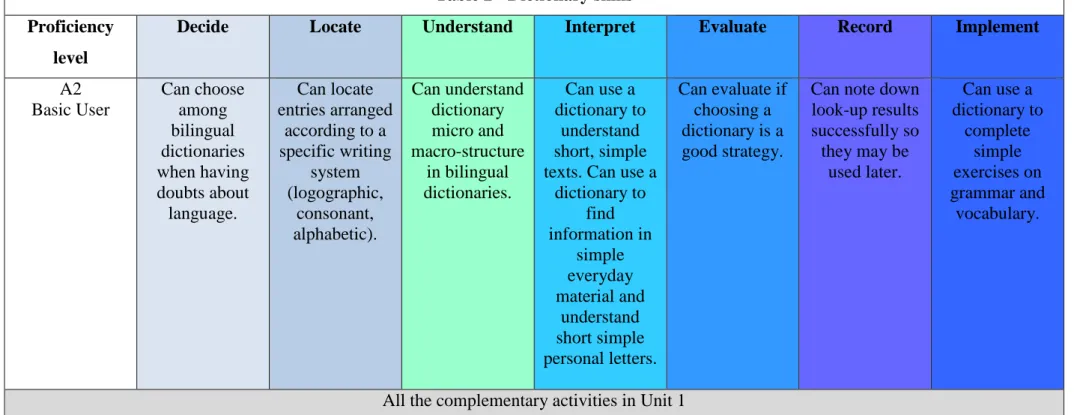
(14) CURRICULAR CONCRETION OF THE ACTIVITIES CONTENTS. EVALUATION CRITERIA. ASSESSMENT CCLV. ACTIVITIES. TEST/INSTRUMENTS. CLLI CAA. Activity 2 Activity 5. Rubric 1. A - ORAL COMPREHENSION. -Identification of the text type 4ºLE.BL1.1 Identify, applying oral comprehension strategies, the essential information, the main ideas and the most relevant and structure: podcasts. details in oral texts of medium and structured length, in different -Narration of past events, supports, and articulated at medium speed, on general or less description of states, current usual subjects, in the personal fields, public, educational and occupational and in their corresponding records, in acoustic situations and expression of conditions that do not distort the message.. future events.. 4ºLE.BL1.3 Distinguish the communicative functions of the. - Development and expansion level and the associated morphosyntactic structures, as well as of the following vocabulary: the textual organization and the lexicon, expressions and idioms trips and holidays. of frequent use and more specific for the understanding of oral. CLLI CSC. texts of medium length, clearly structured and in different supports. B - ORAL PRODUCTION: EXPRESSION AND INTERACTION. - Message production with clarity, distinguishing the main idea or ideas and its basic structure.. 4ºLE.BL2.1 Produce, applying oral expression strategies, monological or dialogic texts of medium length, comprehensible and structured, in different supports, on general or more specific topics, in the personal, public and educational and occupational fields, in a formal, informal or neutral register , although sometimes there are pauses, hesitations and rectifications.. - Narration of past events, description of states, current 4ºLE.BL2.3 Produce or co-produce oral texts of medium length, situations and expression of in different supports, coherent and appropriate to the future events. communicative purpose, using knowledge about functions,. CLLI CAA SIEE. Introductory activity Activity 1 Activity 6 Activity 7 Activity 8 Activity 10. Rubric 1. CLLI CAA SIEE. 9.
(15) discursive patterns, textual organization, morphosyntactic and - Development and expansion lexical structures, expressions or idioms of frequent or more of the following vocabulary: specific use, with meaning aesthetic and creativity.. CD. trips and holidays. C - WRITTEN COMPREHENSION -Use of monolingual and bilingual 4ºLE.BL3.1 Identify, applying written comprehension strategies, dictionaries both in printed and the essential information, the main ideas and the most relevant digital format. details in texts of medium length, continuous and discontinuous, in different media, in a formal, informal or neutral register, on - Expressive reading out to general or more specific topics in the personal, public, improve the pronunciation, educational and occupational spheres. intonation and rhythm, key to understand the text. 4ºLE.BL3.2 Read out literary and non-literary texts of medium - Development and expansion length with precision, fluency and expressiveness.. of the following vocabulary: 4ºLE.BL3.5 Infer the meaning of words and expressions of less trips and holidays. frequent use and more specific use in medium length written texts, in different supports, with support from the context and the context. D - WRITTEN PRODUCTION - Expression of the message with 4ºLE.BL4.1 Produce or co-produce medium length written texts, clarity adjusting it to the models continuous or discontinuous, coherent and structured, in different and formulas of each type of text. formats, in a formal, informal or neutral register, on general or more specific topics, in the personal, public, educational and - Development and expansion occupational spheres, applying strategies of planning, execution of the following vocabulary: and revision with creativity and aesthetic sense.. trips and holidays. 4ºLE.BL4.3 Produce or co-produce medium length written texts in different media, coherent and appropriate to the communicative purpose, using knowledge about functions, discursive patterns, textual organization, morphosyntactic structures, orthographic, typographical and punctuation. CLLI CD CAA CMCT. Activity 3 Activity 4. Rubric 1. Activity 9. Rubric 1. CLLI. CLLI CSC CEC. CLLI CMCT CAA SIEE. CLLI CD SIEE. 10.
(16) conventions, as well as the lexicon, expressions and idioms of frequent use and more specific, in the different communicative situations with aesthetic sense and creativity. E – TRANSVERSAL ELEMENTS OF THE SUBJECT Search, selection and organization of information in digital media. -Digital tools: search in blogs, wikis, forums, sound banks, specialized web pages, dictionaries and virtual encyclopaedias, specialized databases. - Assessment of the positive aspects of ICT for the search and contrast of information.. 4ºLE.BL5.1 Search and select information, text documents, images, soundtracks and videos from a filtering strategy and in a contrasted way in digital media such as sound banks, specialized web pages, dictionaries and virtual encyclopaedias or specialized databases, registering it in paper carefully or stored digitally in computing devices and network services.. CD. All the activities. Rubric 1. Table 1. Curricular concretion of the activities.. 11.
(17) As students of 4th grade of ESO are supposed to have an A2 level of English, the following table (taken from Campoy, 2015) will be used to assess students’ dictionary skills. This table is understood as a process in the sense that once students know how to decide, they can be able to locate, understand, etc.. Table 2 - Dictionary skills Proficiency. Decide. Locate. Understand. Interpret. Evaluate. Record. Implement. Can choose among bilingual dictionaries when having doubts about language.. Can locate entries arranged according to a specific writing system (logographic, consonant, alphabetic).. Can understand dictionary micro and macro-structure in bilingual dictionaries.. Can use a dictionary to understand short, simple texts. Can use a dictionary to find information in simple everyday material and understand short simple personal letters.. Can evaluate if choosing a dictionary is a good strategy.. Can note down look-up results successfully so they may be used later.. Can use a dictionary to complete simple exercises on grammar and vocabulary.. level A2 Basic User. All the complementary activities in Unit 1 Table 2. Dictionary skills. 12.
(18) 5. ACTIVITIES In this section the set of 10 activities prepared in order to foster the use of online dictionaries when learning and teaching English is shown. Each one of the activities has been created in order to be developed during a different period of time, depending on the activity. There are some activities which can be done just using a short period of time and some other require more time to be developed. Therefore, the exact timing will be detailed in the following pages. We will start with an introductory activity which pretends to introduce the functioning system of the two analysed dictionaries (LDOCE and Merriam-Webster online). In this initial activity, students will be taught about e-dictionaries’ use. The following 10 activities will be focused on vocabulary and grammar acquisition but also on developing linguistic skills through the use of online dictionaries. Eventually, the final task has been created to make students reflect upon the process and the activities.. INTRODUCTORY ACTIVITY OBJECTIVES To activate previous knowledge. To introduce students towards the content they will deal with in the activities. To activate students. To make students reflect upon possible uses of dictionaries. To raise awareness towards the amount of useful things they can do with online dictionaries.. KEY COMPETENCES. TIMING 1 session (55 minutes approximately). AREA . . CLLI CAA CSC CD CEC. ICT room. MATERIALS Computer with internet access LDOCE and Merriam-Webster online dictionaries List of words (see Appendix 1) METHODOLOGY Explanation / list / question / comment /further explanation DEVELOPMENT The teacher explains how Merriam-Webster and Longman online dictionaries work as well as the possibilities they offer. Moreover, he/she shows the main page of both 13.
(19) dictionaries to make students being familiarised with them.. Image 1. Taken form Merriam-Webster online dictionary. Image 2. Taken from Longman Dictionary of Contemporary English (LDOCE). . The teacher provides a list of words related to travelling, the topic of the unit. He/she asks if they know more aspects rather than the meaning of the words. Individual thinking in order to answer the previous question. Then, the teacher explains how they have to look up the words. Later, he/she suggests them to search the words both in Merriam-Webster and Longman online dictionaries. In groups of four people they comment everything they have found. In a piece of paper they write in a paper all the interesting aspects they have found, in the different groups (e.g. “we have found synonyms and an audio with the pronunciation”). They read out what they have learnt. If there are some aspects they have not been able to discover, the teacher provides them with an explanation (e.g. collocations, thesaurus, bilingual dictionary, etc.).. EVALUATION CRITERIA There is no evaluation as such regarding this introductory activity, but the teacher takes notes about the participation of each student both individually and within the group through field notes.. 14.
(20) ACTIVITY 1 – VOCABULARY and PRONUNCIATION OBJECTIVES KEY COMPETENCES To activate previous knowledge. To increase the use of online CLLI dictionaries. CAA To learn vocabulary related to CSC travelling. CD To learn definitions of words SIEE belonging to the world of travelling. To learn about the pronunciation of key words. TIMING AREA 1 session (55 minutes) ICT room MATERIALS A computer with internet access Longman monolingual dictionary A paper including a circle of words (see Appendix 2) METHODOLOGY Word / definition / practicing pronunciation DEVELOPMENT Firstly, the teacher divides the class into groups of four people and each group choses a speaker. The teacher gives each group a paper with a circle with all the letters of the alphabet and one word beginning with each letter (See Appendix 2). Each group reads all the words carefully. Then, the teacher suggests they have to employ Longman online dictionary and they have to access the first window and select the monolingual option: English – definition. Afterwards, the teacher asks for the definition of the first word (e.g. A - Airplane) and they have to find the proper definition according to the topic of the unit (this is not always the first definition). In this case, the definition they should select would be the following:. . Image 3. Airplane taken from LDOCE. The whole group looks up a proper definition. Once a group obtains a definition the participants say: “stop the fire” and the speaker of the group provides the definition out. If the definition is adequate and the key word is pronounced properly, the whole group gets one point. Then, the teacher asks for the definition of the rest of the words in the circle and the speaker changes. The game finishes when the teacher has asked for all the definitions and the winner is the group which has obtained more points. EVALUATION CRITERIA In order to evaluate this activity the teacher has prepared Rubric 1 which takes into account students’ linguistic skills and Rubric 2 which is used to assess students’ abilities when using an online dictionary. This task accounts for 5 % of the final mark. EVALUATION INSTRUMENTS Rubric 1, criteria B and E Rubric 2. 15.
(21) ACTIVITY 2 – VOCABULARY OBJECTIVES To learn specific vocabulary about travelling. To increase the use of online dictionaries. To use multimodal information (visual mode). To learn proper definitions of words belonging to the world of travelling.. KEY COMPETENCES. TIMING 1 session (55 minutes). AREA . . CLLI CAA CSC CD. ICT room. MATERIALS Computer with internet access Merriam-Webster and LDOCE online dictionaries Illustrations Kahoot METHODOLOGY Image / pronunciation / repetition / Kahoot DEVELOPMENT First of all, students are given an airplane image with some words showing the different parts of a plane (see Appendix 3). Afterwards, students have to read the words and select the easiest words because the most difficult ones do not appear in the dictionary because of being too specific. Then, students need to look up the translation of the easiest words (i.e. Airplane, weather radar, cockpit, pylon, wing, rudder, elevator and cabin) in the bilingual English-Spanish online dictionary. Afterwards, using the same bilingual dictionary the teacher explains to students that they need to pay attention to phonetics. Later, they have to press the “speaker” in order to hear the proper pronunciation of each word and they repeat the word well-pronounced. Finally, the teacher asks them to do a Kahoot in order to answer some questions regarding pronunciation. EVALUATION CRITERIA In order to evaluate this activity the teacher has prepared Rubric 1 which takes into account students’ linguistic skills and Rubric 2 which is used to assess students’ dictionary skills. This task accounts for 5 % of the final mark. EVALUATION INSTRUMENTS Rubric 1, criteria A and E Rubric 2. 16.
(22) INTRODUCTION TO ACITIVITY 3 In order to explain Activity 3 in a clear way, students will be given a brief introduction by the teacher in order to better know how LDOCE works. They will be doing one of the activities created by the dictionary itself.. Image 4. Irregular verbs taken from LDOCE. In this previous example we assume that students do not know the meaning of “bee” and therefore, they do not know the right answer because they are not able to know which is the verb related to a bee. The teacher has to explain that in the monolingual English window they can look for this word. In this same window they find that a bee is an insect which can sting.. Image 5. Bee taken from LDOCE. Once they know the infinitive (i.e. sting) they have to keep themselves in the same window, monolingual English. Then, they have to open another window and students have to select the bilingual option (English- Spanish) and there they can find the past participle of the verb sting as well as the meaning. In this sense they can observe that the meaning they are looking for is the one which says: picar.. Image 6. Sting taken from LDOCE. 17.
(23) ACTIVITY 3 – GRAMMAR (IRREGULAR VERBS) OBJECTIVES To learn Irregular verbs. To enhance self-assessment. To foster the use of the Longman Dictionary of Contemporary English. To employ monolingual and bilingual windows. To motivate students.. KEY COMPETENCES. TIMING 20 minutes approximately. AREA . . CLLI CAA CSC CD CEC. ICT room. MATERIALS Computer with internet access Longman Dictionary of Contemporary English (LDOCE) METHODOLOGY Read / fill in the gaps DEVELOPMENT The teacher develops the introductory activity and explains how LDOCE works and how they have to go from one window to another (see Introduction to Activity 3). Students individually search the information they do not know and complete the following 10 sentences provided by the dictionary.. EVALUATION CRITERIA Self-assessment will be the evaluation criteria followed to give a mark to this activity. In this activity, the dictionary itself provides a result from 0 to 10 and students are able to know their knowledge regarding irregular verbs. Also Rubric 1 and 2 will help the assessment of this activity. This task accounts for 5 % of the final mark. EVALUATION INSTRUMENTS Rubric 1, criteria C and E Rubric 2. 18.
(24) ACTIVITY 4 – GRAMMAR (PRESENT PERFECT SIMPLE) OBJECTIVES Learn about irregular verbs. Learn about the use of present perfect simple. Learn about the existence of irregular verbs in a dictionary.. KEY COMPETENCES. TIMING 20 minutes. AREA . . CLLI CAA CSC CD CEC ICT room. MATERIALS Computer with internet access Longman Dictionary of Contemporary English (LDOCE) Crossword (see Appendix 4) METHODOLOGY Explanation / crossword / research and understanding DEVELOPMENT The teacher explains students that they are going to do a crossword and they have to complete the empty spaces with the past participle form of the verbs. Then, the teacher gives them the crossword. In the crossword they have to write their answers in the numbered boxes. The students are provided with the definition of an irregular verb. Once they have discovered the infinitive of the irregular verb by understanding the sentence, they have to look up this verb in the given dictionary. As the teacher has previously explained, if they look up an irregular verb in LDOCE, they can find both the past simple and past participle as shown in this image:. . Image 7. Eat taken from LDOCE. Afterwards, students have to select the past participle form and they have to write it on the crossword. Then, students have to hand in the crossword to the teacher. Finally, they have to complete 10 sentences using the verbs in the crossword together with present perfect simple (see Appendix 4).. EVALUATION CRITERIA This activity will receive a 5% of the final mark and in order to give this mark, the teacher will collect all the crosswords and will correct them by giving punctuation from 0 to 0.5 being the former the lowest mark and the latter the highest one. Moreover, Rubrics 1 and 2 will help the assessment of this activity. EVALUATION INSTRUMENTS Rubric 1, criteria C and E Rubric 2. 19.
(25) ACTIVITY 5 – PRONUNCIATION OBJECTIVES Learn about the pronunciation of words. Learn the meaning of words through sentences. Learn vocabulary related to the topic. Discover other possibility the dictionary offers. Improve listening skills.. KEY COMPETENCES. TIMING 30 minutes. AREA . . CLLI CAA CSC CD SIEE. ICT room. MATERIALS Computer with internet access Longman English monolingual dictionary (LDOCE) Speakers List of words (see Appendix 5) METHODOLOGY Words / listening / repetition / pronunciation DEVELOPMENT Students are given a list of three words related to travelling and travelling arrangements. The teacher explains that they should look up the meaning in the Longman English monolingual dictionary. There, they find different meanings as well as sentences which exhibit the meaning in a clearer manner, as the following image exhibits:. Image 8. Accommodation taken from LDOCE. . They must listen to all the sentences with the included audio and repeat them in order to improve pronunciation. Then, students have to select one sentence, the one they are more familiar with. Finally, each student has to read his/her sentence aloud.. EVALUATION CRITERIA This activity receives a 5% of the final mark within the whole unit and it is evaluated following Rubric 1 in order to assess linguistic skills and Rubric 2 to assess their abilities when using online dictionaries. EVALUATION INSTRUMENTS Rubric 1, criteria A, B and E Rubric 2. 20.
(26) INTRODUCTION TO ACTIVITY 6 In order to provide students with the main idea of the task and how they have to work to find appropriate meanings and sentences, the teacher will spend 15 minutes of the session to explain that. First of all, the teacher explains they have to employ the monolingual dictionary of English following the same process as in activity 1 (Monolingual English – definition). Afterwards, students look for the first given word, in this case, station. Then, if they search for the word station, there appear many definitions and they have to select the one related to the world of travelling as shown in the following image:. Image 9. Station taken from LDOCE. Once students have found the adequate definition, they have to select the sentence which is more appealing to them, or the one they believe is better to build their own story and they have to write it down in a piece of paper. In the example provided the most appropriate sentence is the first one: “I want to get off at the next station”.. Then, they repeat the process with the other words, for example bus. Once they have selected the definition, students are asked to choose one of the sentences provided by the dictionary for example: “The best way to get there is by bus”.. Image 10. Bus taken from LDOCE. Finally, they do the same with the last word and they select the most suitable sentence: “Petrol is becoming more and more expensive” as in the example below:. Image 11. Expensive taken from LDOCE. Once they have all the sentences written on a sheet of paper students are asked to create a story. In order to do that they can use connectors, they can add as many words as they need and they can change the order of the sentences as they like. For example our example would be: “While I am in the bus I am thinking that I want to get off at the next station because I don’t have more time. I used to think that going by car was always the best idea, but as petrol is becoming more and more expensive I think that the best way to get there is by bus”. 21.
(27) ACTIVITY 6 – PRONUNCIATION OBJECTIVES Learn repetition and pronunciation skills. Learn the meaning of words through the use of LDOCE. Learn vocabulary related to travelling. Discover other possibilities the dictionary offers. Improve listening skills. Cooperative learning.. KEY COMPETENCES. TIMING 1 session (55 minutes). AREA . . CLLI CAA CSC CD SIEE. ICT room. MATERIALS Computer with internet access Sheet of paper LDOCE (English monolingual dictionary) List of words in English (see Appendix 6) Meanings and sentences METHODOLOGY Division/ searching / selection/ creation / pronunciation DEVELOPMENT Students are divided into groups of three people. Each student within the group is given three words related to travelling. Using the monolingual dictionary they have to search the meaning of the three given words (see Introduction to Activity 6). Each student must select the most appropriate meaning and its pertinent sentence. Once they have selected both the meaning and the sentence, pupils have to create and write a meaningful story using the three sentences and the meanings they have previously selected. Each student has to tell the story to the rest of the members of the group. They have to agree on which story is the best and which one makes more sense. EVALUATION CRITERIA Rubric 1 will be used to evaluate this activity, but mainly students’ pronunciation. Also Rubric 2 will be employed in order to assess students’ abilities to understand the words and to select the correct information in the dictionary. The punctuation it receives is 5 % within the unit. EVALUATION INSTRUMENTS Rubric 1, criteria B, D and E Rubric 2. 22.
(28) INTRODUCTION TO ACTIVITIES 7 AND 10 The teacher will devote 15 minutes of the session to explain students how to use the thesaurus dictionary to find synonyms and antonyms. Firstly, students have to log in Merriam-Webster online dictionary. Then, students have to press on the word Thesaurus as shown in the following image:. Image 12. Thesaurus taken from Merriam-Webster. Once there, they have to search the word they want to work with and the gadget provides them with synonyms and antonyms.. Image 13. Trip taken from Merriam-Webster. Finally, students are given tasks 7 and 10 in which they have to find synonyms and antonyms and replace some words.. 23.
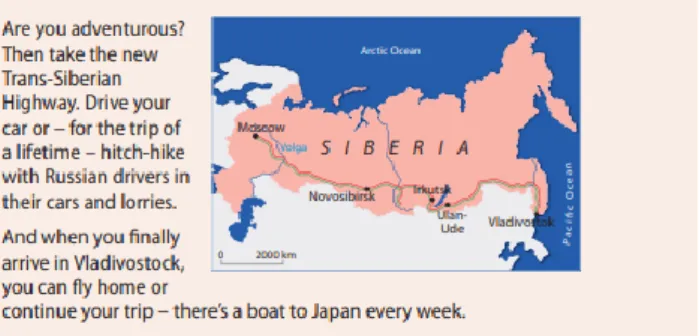
(29) ACTIVITY 7 – READING OBJECTIVES To learn new adjectives related to the topic of travelling. To use the thesaurus option for synonyms and antonyms. To improve reading skills. KEY COMPETENCES CLLI CAA CSC CD SIEE. TIMING AREA 30 minutes approximately ICT room MATERIALS Computer with internet access Merriam-Webster online thesaurus Photocopy with the text (see Appendix 7) Paper and pen METHODOLOGY Reading / research / pronunciation DEVELOPMENT Students are given a piece of paper with a short text on it. The teacher explains that each student has to read at least a sentence of the given text aloud and if they have some doubts regarding words’ pronunciation, they are allowed to look up the proper pronunciation. Then, the teacher explains that they have to highlight words related to the topic of travelling. Once they have found the words, they are asked to provide a meaning without using an online dictionary. After that, they are explained how to use the dictionary of synonyms and antonyms (see introduction to activity 7). Finally, they have to look up a synonym and an antonym of each one of the highlighted words and provide them to the rest of the classmates as in the following example:. Image 14. Miss taken from Merriam-Webster. EVALUATION CRITERIA This activity receives a 5% of the final mark within the whole unit and it is evaluated following Rubric 1 in order to assess linguistic skills and Rubric 2 to assess their abilities when using online dictionaries. EVALUATION INSTRUMENTS Rubric 1, criteria B and E Rubric 2. 24.
(30) ACTIVITY 8 – VOCABULARY and PRONUNCIATION OBJECTIVES Learn vocabulary related to travelling. Improve pronunciation. Foster recordings. Foster the use of ICTs and online dictionaries. TIMING 30 minutes approximately. KEY COMPETENCES AREA . CLLI CAA CSC CD SIEE ICT room. MATERIALS Computer with internet access Merriam-Webster online dictionary Audacity (recording tool) List of words (see Appendix 8) METHODOLOGY Words / listening / repetition / pronunciation DEVELOPMENT The teacher introduces the activity by giving students a piece of paper with 20 words related to the vocabulary of the unit. Then, he/she suggests students to read all the words aloud. Later, the teacher explains that they have to look up the words in the dictionary but not in order to know the meaning. Students have to look for the word and play its pronunciation, pressing the button showed in this image:. Image 15. Timetable taken from Merriam-Webster. . Afterwards, students must repeat the same process with all the words provided. Then, the teacher explains how to use Audacity, which is a device to record voices. Once students know how to work with this tool, they have to record themselves pronouncing all the words. Finally, the teacher will play their recordings in front of the classroom and the whole class will suggest a mark for each one of his/her classmates and if the teacher agrees (following the Rubric) that would be the mark.. EVALUATION CRITERIA This activity receives 5% of the final mark and in order to assess it, the teacher uses Rubric 1 which has been created to assess students’ linguistic skills, including pronunciation and Rubric 2 to assess students’ dictionary skills. EVALUATION INSTRUMENTS Rubric 1, criteria B and E Rubric 2. 25.
(31) ACTIVITY 9 – WRITING OBJECTIVES Learn vocabulary related to the topic of the unit. Improve pronunciation of words. Foster writing skill.. KEY COMPETENCES. TIMING 1 session (55 minutes). AREA . . CLLI CAA CSC CD CMCT. ICT room. MATERIALS Computer with internet access Writing (see Appendix 9) List of prohibited words (see Appendix 9) Merriam-Webster online thesaurus METHODOLOGY Example / list / searching / writing DEVELOPMENT The teacher introduces the activity showing students a text to be read carefully. Then, the teacher asks students to write a composition about a country or a city they have already visited but without writing the name (e.g. the country I have visited has got the Eiffel Tower). Before starting the composition the teacher explains that there are some prohibited words and he/she writes a list on the blackboard. Afterwards the teacher tells students that whether they want to use the prohibited words they have to use a synonym and they have to look it up in the dictionary. After saying that, the teacher explains the rules and they have to look for at least four synonyms and write them on the composition. Finally, they are given time to write the composition. EVALUATION CRITERIA This activity receives 5% of the final mark within the unit and it will be evaluated following Rubric 1 which has been created to assess students’ linguistic skills and Rubric 2 to assess their abilities when using online dictionaries. EVALUATION INSTRUMENTS Rubric 1, criteria D and E Rubric 2. 26.
(32) ACTIVITY 10 – VOCABULARY AND PRONUNCIATION OBJECTIVES Learn vocabulary related to travelling. Improve pronunciation. Foster recordings. Learn the use of other ICTs.. KEY COMPETENCES CLLI CAA CSC CD SIEE. TIMING AREA 1 session (55 minutes) ICT room MATERIALS Computer with internet access Merriam-Webster online dictionary Voki (recording tool) Writing Activity 9 (see Appendix 10) METHODOLOGY Story / reading / listening / repetition / recording DEVELOPMENT The teacher introduces the activity by giving students the story written by themselves in activity 9 (see Appendix 10). Then, the teacher suggests students to read the story individually in order to reflect upon the pronunciation of some words. Later, the teacher explains that they have to look for the pronunciation of the words following the same procedure as in Activity 8. Afterwards, students have to play their pronunciation and repeat the words out. Repeat the same process with all the words they do not know. Later, the teacher explains to students that they are going to create a voki, which is a fictitious person who opens his/her mouth and reproduces the text students have recorded (see Appendix 10).. . Image 16. Voki taken from https://www.voki.com/site/create. Then, students have to create the Voki recording their voices while reading the text. Finally, students have to share the Voki with one of their classmates and he/she has to guess the country he/she has visited. Whether students are not able to know the country his/her classmate has visited, they can raise their hands and ask for clues. Once students have guessed all their classmates’ countries, all of them send the Voki to the teacher. EVALUATION CRITERIA In order to assess this activity which receives a 5% of the final mark within the unit, the teacher will use Rubric 1 which has been created to assess pronunciation and Rubric 2 to assess students’ dictionary skills. EVALUATION INSTRUMENTS Rubric 1, criteria B and E Rubric 2. 27.
(33) FINAL ACTIVITY OBJECTIVES KEY COMPETENCES Reflect upon the use of online CD dictionaries. CLLI Foster the use of online dictionaries in CAA the future. CSC Help students to carry out a debate. SIEE Evaluate themselves.. TIMING 20 minutes approximately. AREA . English classroom. MATERIALS Questions Paper and pen METHODOLOGY Questions / answers / debate DEVELOPMENT Firstly, the teacher explains to students that they are going to answer a series of questions in order to know their feelings and thoughts. Then, the teacher provides students with a piece of paper including questions such as the following ones: - Have you learned something new with these activities? - Do you think that using online dictionaries is useful when learning English? - Will you use online dictionaries in the future? . Students have to answer yes or no in the questions and write some comments in case they consider it necessary. Finally, after answering the questions, a kind of debate lead by the teacher is created and students comment their sensations towards the activities and they reflect upon the usefulness of online dictionaries while learning a language.. EVALUATION CRITERIA There is no evaluation as such regarding this final activity, but the teacher takes notes about the participation of each student individually through field notes in order to know their feelings and thoughts towards the use of online dictionaries in the EFL classroom.. 28.
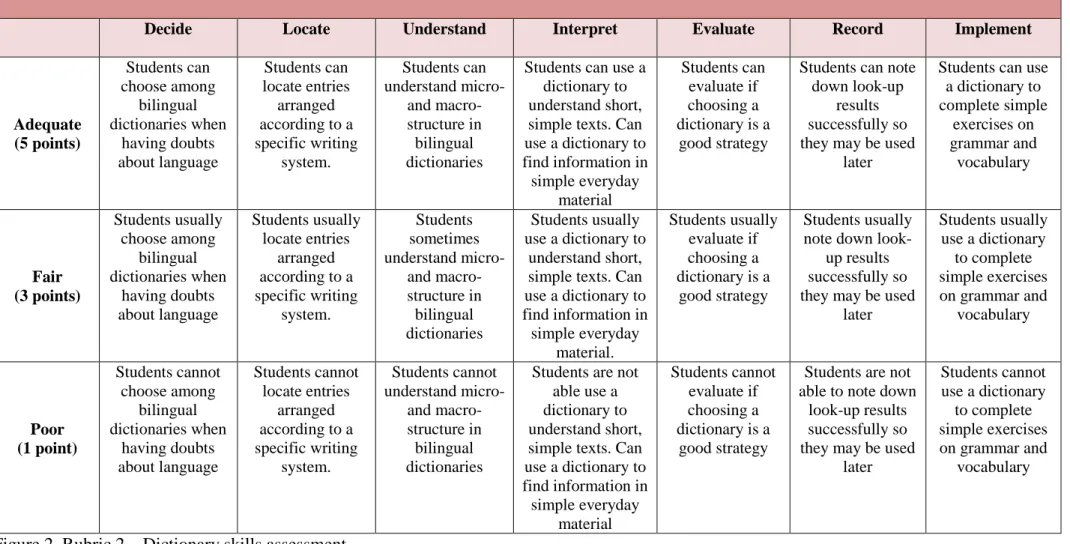
(34) 6. ACTIVITY ASSESSMENT The assessment process of the whole set of activities presented above will take place at the end of each activity and students will receive the whole mark at the end of unit 1 because the designed activities are considered complementary and they are done during the development of the unit. All the dictionary activities will receive 5 points (0.5 each) within the unit and the rest of the activities done by the teacher through the unit will receive another 5 points. The former activities will be assessed by obtaining the average of both the linguistic skills developed as well as dictionary skills. The later will not be considered within this project because it is intended to deal with the development of dictionary skills only and we assume they are done by the teacher at the same time as dictionary activities. The evaluation of the activities related to the use of online dictionaries will be carried out through the use of four main tools, in order to evaluate students’ linguistic skills, their proficiency when using online dictionaries and their involvement in all the activities. On the one hand, field notes and direct observation will be used in order to pay attention to students’ participation and involvement but this tool will be employed in the introductory activity because it has been designed to make students be familiar with online dictionaries and it does not receive a mark itself, this introductory activity is not included in the average marking system. On the other hand, two rubrics have been created. Rubric 1 will be employed to assess students’ linguistic skills. This instrument allows the teacher to give students punctuation per each activity giving them 5, 3 or 1 points through direct observation. Rubric 2 (taken from Campoy 2015) will be used to assess students’ abilities when using online dictionaries and the employed system would be the same as with the previous instrument. In this sense, the teacher will provide students with 5, 3 or 1 points. Once the teacher has both marks taking the rubrics into consideration he/she will obtain the average. The last technique employed in order to assess students consists on tasks collection. This way of assessment just takes place in activity 4 because pupils should 29.
(35) hand in the crossword they have done. In this way, the teacher will provide them with the whole mark if it is has been completed properly. Finally, in order to have a clear idea of the evaluation process, activity 1 will be explained in a more detailed way as an example. In the case of this activity Rubrics 1 and 2 will be employed because students are required to practice their linguistic skills (in this case oral production and pronunciation, criteria B) and their dictionary skills (the whole process). If we consider that one student obtains the whole mark in activity 1, it means that this student has obtained 5 points in terms of linguistic skills and 5 more points because he/she has been proficient when looking up information in the dictionary; he/she has fulfilled the whole process assessed through direct observation and taking into account if the activity has been properly done. As the student has answered the activity correctly, the average considering both rubrics is 5 and it divided into 10, which is the total number of activities, shows us that the student gets 0.5 in this activity. The same process is followed with the rest of activities and if he/she completes all the dictionary activities properly the student will obtain. the. full. mark,. which. is. 5. points.. 30.
(36) Rubric 1 – linguistic skills The present rubric is used to assess students’ linguistic skills when doing the aforementioned activities. Adequate (5 points) Oral comprehension. Oral production. Pronunciation. Written comprehension. Written production. The student is able to identify the essential information in medium length oral texts. The student distinguishes the communicative functions of the level. The student is able to produce or coproduce medium length oral texts in different supports and registers. The student’s pronunciation is good with just only occasional problems for the listener. The student is able to identify the essential information within medium length written texts. The student frequently makes use of written comprehension strategies. The student is able to produce or coproduce medium length written texts in different supports and registers.. Fair (3 points). Poor (1 point ). The student rarely identifies the essential information in medium length oral texts. The student distinguishes the communicative functions of the level. The student rarely produces or coproduces medium length oral texts in different supports and registers.. The student is not able to identify the essential information in medium length oral texts. The student distinguishes the communicative functions of the level. The student cannot produce or coproduce medium length oral texts in different supports and registers.. The student’s pronunciation is fair with some problems for the listener.. The student’s pronunciation is bad with serious problems for the listener. The student cannot identify the essential information within medium length written texts. The student frequently makes use of written comprehension strategies. The student cannot produce or coproduce medium length written texts in different supports and registers.. The student rarely identifies the essential information within medium length written texts. The student frequently makes use of written comprehension strategies. The student rarely produces or coproduces medium length written texts in different supports and registers.. Figure 1. Rubric 1 – linguistic skills. 31.
(37) Rubric 2 – Dictionary skills The present rubric is used to assess students’ dictionary skills. Rubric 2 – Dictionary skills assessment. Adequate (5 points). Fair (3 points). Poor (1 point). Decide. Locate. Understand. Interpret. Evaluate. Record. Implement. Students can choose among bilingual dictionaries when having doubts about language. Students can locate entries arranged according to a specific writing system.. Students can understand microand macrostructure in bilingual dictionaries. Students can evaluate if choosing a dictionary is a good strategy. Students can note down look-up results successfully so they may be used later. Students can use a dictionary to complete simple exercises on grammar and vocabulary. Students usually choose among bilingual dictionaries when having doubts about language. Students usually locate entries arranged according to a specific writing system.. Students sometimes understand microand macrostructure in bilingual dictionaries. Students usually evaluate if choosing a dictionary is a good strategy. Students usually note down lookup results successfully so they may be used later. Students usually use a dictionary to complete simple exercises on grammar and vocabulary. Students cannot choose among bilingual dictionaries when having doubts about language. Students cannot locate entries arranged according to a specific writing system.. Students cannot understand microand macrostructure in bilingual dictionaries. Students can use a dictionary to understand short, simple texts. Can use a dictionary to find information in simple everyday material Students usually use a dictionary to understand short, simple texts. Can use a dictionary to find information in simple everyday material. Students are not able use a dictionary to understand short, simple texts. Can use a dictionary to find information in simple everyday material. Students cannot evaluate if choosing a dictionary is a good strategy. Students are not able to note down look-up results successfully so they may be used later. Students cannot use a dictionary to complete simple exercises on grammar and vocabulary. Figure 2. Rubric 2 – Dictionary skills assessment. 32.
(38) 7. CONCLUSION In order to elaborate the content of the present Master’s Dissertation, which is devoted to the design of didactic materials, it has been taken into consideration the idea of changing the way of teaching English, but more specifically unit 1 in the textbook Real English Eso 4: using online dictionaries. In order to do that, two online dictionaries have been introduced to the students of 4th grade of ESO. As previously mentioned, the choosing of this project typology has not been random since it was necessary to introduce the use of online dictionaries as fundamental tools when learning and teaching English to ESO students, as indicated in the curriculum and the CEFRL (Campoy 2015). This project intends to show students how useful these tools are as well as to use them as hooks in order to encourage students to learn English in a different way. These activities are considered necessary to complement the unit and to fulfil the objectives of the present project; in this case it is important to mention that other dictionaries could have been selected, but Longman and Merriam-Webster online are the ones which show the information in a clear way and both of them contain all the information necessary to carry out the proposed activities. Moreover, with the development of the activities students learn vocabulary and grammar and they develop all the skills (reading, writing, listening and speaking) that is why the evaluation criteria considers both students’ linguistic and dictionary skills. Through the development of these activities it can be stated that the figure of the teacher is really important; students are not familiar with online dictionaries and he/she is the one who has to explain in a detailed way the process students have to follow to benefit of online dictionaries (Chi 1998). In order to finish with the content of the project it is relevant to take into consideration the evaluation process. These activities pretend to foster the use of online dictionaries in the EFL classroom and it is the teacher who has to control students’ learning through direct observation. Therefore, students do not need to pass a final exam in order to demonstrate they have learnt how to use online dictionaries, they are assessed every day and that is why each activity receives the same score.. 33.
(39) Finally, we can state that it is not easy to create and develop dictionary activities to be complementary in a unit, mainly due to the lack of time but if the curriculum specifies that students have to know how to use an online dictionary, it can be interesting and useful to include activities like the ones presented above. Moreover, it can be grateful for the teacher to teach students something new and something they are not used to employ. Therefore, “It can be said that online dictionaries are utility tools: they are made to be used” (Müller 2014, p. 85).. 34.
(40) 8. REFERENCES -. Ali, H. I. H. (2012). Monolingual Dictionary Use in an EFL Context. English Language Teaching, 5(7), 2-7.. -. Aust, R., Kelley, M. J., Roby, W. (1993) "The Use of Hyper-Reference and Conventional Dictionaries". Educational Technology Research and Development. vol. 41, 63-73.. -. Bishop, G. 2001. Using quality and accuracy ratings to quantify the value added of a dictionary skills training course. Language Learning Journal, 24(1), 62-69.. -. Chi, M. L. A., Fontenelle, T., Hiligsmann, P., Michiels, A., Moulin, A., & Theissen, S. (1998). Teaching dictionary skills in the classroom. Thierry Fontenelle et al, 56577.. -. Chun, D. (2001). L2 reading on the Web: Strategies for accessing information in hypermedia. Computer-Assisted Language Learning, 14(5), 367-403.. -. Cubillo, M. C. C. (2002). General and specialised free online dictionaries. Teaching English with technology, 2(3), 42-47.. -. Cubillo, M. C. C (2015). Assessing dictionary skills. Lexicography, 2(1), 119-141.. -. Cañal de León, P. (2002). La Innovación Educativa, Madrid.. -. Decreto 87/2015, de 5 de junio, del Consell, por el que establece el currículo y desarrolla la ordenación general de la Educación Secundaria Obligatoria y del Bachillerato en la Comunitat Valenciana. [2015/5410]. -. Hartmann, R. R. K., & James, G. (2002). Dictionary of lexicography. Routledge.. -. Jin, L., & Deifell, E. (2013). Foreign language learners' use and perception of online dictionaries: A survey study. Journal of Online Learning and Teaching, 9(4), 515.. -. Laufer, B., & Hill, M. (2000). What lexical information do L2 learners select in a CALL dictionary and how does it affect word retention? Language Learning & Technology, 3(2), 58-76. Retrieved from http://llt.msu.edu/vol3num2/lauferhill/index.html 35.
(41) -. Lan, L. (2005). The growing prosperity of online dictionaries. English Today, 21(3), 16-21.. -. Lew, R. (2010). Online dictionaries of English. In P. A. Fuertes-Olivera & H. Bergenholtz. (Eds.),. e-Lexicography:. The. Internet,. digital. initiatives. and. lexicography (pp. 230-250). London/New York: Continuum. -. Lew, R. (2013a). Online dictionary skills. In Electronic lexicography in the 21st century: Thinking outside the paper, ed. I. Kosem, J. Kallas, P. Gantar, S. Krek, M. Langemets, and M. Tuulik, 16-31., Proceedings of the eLex 2013 conference, 17-19 October 2013, Tallinn, Estonia Ljubljana: Trojina, Institute for Applied Slovene Studies/Eesti Keele Instituut.. -. Lew, R. (2013b). From paper to electronic dictionaries: Evolving dictionary skills. In Lexicography and dictionaries in the information age, ed. D. A. Kwary, N. Wulan, and L. Musyahda, 79-84., Selected papers form the 8th ASIALEX international conference Surabaya: Airlangga University Press.. -. Lew, R. and Galas, K. (2008). Can dictionary skills be taught? The effectiveness of lexicographic training for primary-school-level Polish learners of English. In Bernal, E. and DeCesaris, J. (eds). Proceedings of the XIII EURALEX International Congress. Barcelona: Universitat Pompeu Fabra, 1273-1285.. -. Longman. Dictionary. of. Contemporary. English. Online.. https://www.ldoceonline.com/ -. Marks, L. & Addison, C. (2010) Real English ESO 4. Burlington Books: Cyprus. -. Merriam-Webster Dictionary and Thesaurus. https://www.merriam-webster.com/. -. Müller-Spitzer, C., & Koplenig, A. (2014). Online dictionaries: expectations and de mands. Using online dictionaries, 145, 143.. -. National Geographic Learning: English: Sample Unit 9: Travel accessed from https://ngl.cengage.com/assets/downloads/life_pro0000000047/sample_unit_9_life_b eginner.pdf. 36.
(42) -. Nesi, Hilary. (1999). The specification of dictionary reference skills in higher education. In Dictionaries in language learning. Recommendations, national reports and thematic reports from the TNP sub-project 9: Dictionaries, ed. Reinhard Hartmann, 53–66. Berlin: Free University Berlin.. -. Online dictionary. Dictionary.com. Retrieved from https://www.dictionary.com/. -. Ranalli, J. (2013). Designing online strategy instruction for integrated vocabulary depth of knowledge and web-based dictionary skills. CALICO Journal, 30(1), 16-43.. -. Real Decreto 1105/2014, de 26 de diciembre, por el que se establece el currículo básico de la Educación Secundaria Obligatoria y del Bachillerato.. -. Voki - Create. Retrieved from https://www.voki.com/site/create. 37.
(43) 9. APPENDIX: ACTIVITY SAMPLES AND MATERIALS Appendix 1 - Materials Introductory Activity: In order to put students into situation the teacher explains how to use both dictionaries and he/she gives clues to discover what they can learn by using online dictionaries. Initial questions: -. Do you know the meaning of the following words?. -. Other than the meaning, do you know something else of the following words?. -. If so, what do you know?. List of words: -. Countryside. -. Trip. -. Airline. -. Airport. -. Luggage. -. Passenger. -. Flight. -. Accommodation. -. Journey. -. Fare. 38.
(44) Appendix 2 - Materials Activity 1: Circle of words:. Figure 3. Circle of words created with Paint. Definitions: -. Airplane: a vehicle that flies through the air and has one or more engines.. -. Boat: a ship, especially one that carries passengers.. -. Countryside: land that is outside cities and towns.. -. Day: the period of time between when it gets light in the morning and when it gets dark.. -. Europe: the continent that is north of the Mediterranean and goes as far east as the Ural Mountains in Russia.. -. Fare: the price you pay to travel somewhere by bus, train, plane, etc. 39.
(45) -. Gate: the place where you leave an airport building to get on a plane.. -. Hotel: a building where people pay to stay and eat meals.. -. Island: a piece of land completely surrounded by water.. -. Journey: an occasion when you travel from one place to another, especially over a long distance.. -. Luggage: the cases, bags, etc, that you carry when you are travelling.. -. Mobile home: a type of house made of metal that can be pulled by a vehicle and moved to another place.. -. Night: the dark part of each 24-hour period when the sun cannot be seen and when most people sleep.. -. Oyster card: a smart card which can be used as an electronic ticket on public transport in London.. -. Passenger: someone who is travelling in a vehicle, plane, boat etc, but is not driving it or working on it.. -. Queue: a line of people waiting to enter a building, buy something etc, or a line of vehicles waiting to move.. -. Railway: a system of tracks along which trains run, or a system of trains.. -. Station: a place where trains or buses regularly stop so that passengers can get on and off, goods can be loaded or the buildings at such a place.. -. Trip: a visit to a place that involves a journey, for pleasure or a particular purpose.. -. Urban: relating to towns and cities.. -. Vacation: a holiday or time spent not working.. -. Warm: lightly hot, especially in a pleasant way.. -. Xmas: a Christian feast on December 25 or among some Eastern Orthodox Christians on January 7 that commemorates the birth of Christ and is usually observed as a legal holiday.. -. Yacht: a large boat with a sail, used for pleasure or sport, especially one that has a place where you can sleep.. -. Zone: a large area that is different from other areas around it in some way.. 40.
(46) Appendix 3 - Materials Activity 2 Image:. Figure 4. Illustration of airplane taken from Merriam-Webster online dictionary. Translation: -. Airplane /ˈɛrpleɪn/ Avión. -. Weather radar /ˈwɛðɚreɪdɑr/ Radar meteorológico. -. Cockpit /ˈkɑkˌpɪt/ Cabina. -. Pylon /ˈpaɪlɑn/ Torre de alta tension. -. Wing /wɪŋ/ Ala. -. Rudder /ˈrʌdɚ/ Timón. -. Elevator /ˈɛləˌveɪtɚ/ Elevador. -. Cabin /ˈkæbɪn/ Cabina. Link to the a59c7efbb016. Kahoot:. https://play.kahoot.it/#/?quizId=64ce3c2a-609b-4793-a49f-. 41.
(47) Appendix 4 - Materials Activity 3: Crossword:. Figure 5. Irregular Verbs Crossword created with Educima. Sentences: -. The boy _____________ his position during the whole session.. -. The cleaner _______________ the floor with a brush.. -. People _______________ the kind of bread to eat.. -. I ____________________ to bring my identification card.. -. The gardener _________________ a hole to plant a tree.. -. Teenagers’ __________________ a lot of money.. -. Today, students _______________ how to create a time machine.. -. The sun _________________ during the entire summer.. -. Many people __________________ in a war.. -. This week, teachers ____________________ gravity laws.. 42.
(48) Appendix 5 - Materials Activity 5: Words: accommodation, flight, luggage. Appendix 6 - Materials Activity 6: Words per group: -. Station, bus and expensive.. -. Railway, train and trip. -. Luggage, accommodation, travel. Appendix 7 - Materials Activity 7: Reading:. Figure 6. Reading taken from Sample Unit 9: Travel. Words related to travelling: train, book, tickets, travel agent, passengers, travel, hotel, sightseeing, visit, bus, hitch-hike, car, trip, lorries and boat.. Appendix 8 - Materials Activity 8: List of words: Mobile home, accommodation, luggage, trip, flight, airline, fare, airport, high-speed train, convenient, station, journey, passenger, countryside, place, hotel, road, expensive, cheap and holiday.. 43.
Figure

Documento similar
This study aims to determine how the three elements present in the quality criteria (research skills, academic reading and writing and innovation processes) of this systematic review
Likewise, those students re- taking the subject, who can attend lectures, may choose either to do the continuous evaluation (40% of the final mark of the subject) and to take the
And secondly, how students’ logs can be used to automate the assessment of different skills such as the ability to explain terms in a foreign language or to assess definitions
The “Course for Erasmus and International Exchange Students” of the University of Mala- ga, 70 class hours, allows students to consolidate and acquire Spanish skills in order to
Our goal has been to design and verify a scale of perception regarding participative methodologies and formative evaluation (EMPEF in Spanish) which will allow us to assess the way
The aim of this paper is to demonstrate that reading authentic literary material in the English as a Foreign Language (EFL) classroom can improve students’ language learning skills as
In the first question of the questionnaire regarding this phase, it is questioned which soft skills - social and problem-solving skills - and which of the hard skills -
To this end, the activities and teaching materials comprised in the following Didactic Unit are designed following the three-model approach by Carter & Long
