
TítuloGenetic diversity in fishery exploited populations of the banded murex ("Hexaplex trunculus") from the southern Iberian Peninsula
16
0
0
Texto completo
(2) Introduction The family Muricidae constitutes a diverse and important component of marine communities (Vokes, 1996), comprising 1150 (Vokes, 1996) to 1300 species distributed worldwide (Houart, 2001). The banded murex, Hexaplex trunculus (Linnaeus, 1758), is found in the Mediterranean Sea, whereas in the adjacent Atlantic Ocean it is mainly present from the Portuguese coast southward to Morocco and to the Madeira and Canary Archipelagos (Poppe and Goto, 1991, Macedo et al., 1999, Houart, 2001). Recently, a first record of this species in NW Spain (O Grove - Galicia), probably due to an accidental introduction from the importation of oysters (Quintas et al., 2005), was followed by the establishment of an apparently stable population of H. trunculus, as confirmed by the catch of hundreds of specimens in this area (Rolán and Bañon-Díaz, 2007). This species occurs in the inter-tidal and infra-littoral zones reaching up to 100–120 metres depth (Poppe and Goto, 1991, Muzavor and Morenito, 1999), although they are more frequent at 0.3–30 metres depth (Houart, 2001). It inhabits both hard and soft substrates, from rocky shores (Houart, 2001) to sandy, sandy-muddy and preferentially muddy bottoms (Poppe and Goto, 1991, Macedo et al., 1999, Muzavor and Morenito, 1999) and also occurs in areas enriched with organic matter and in the vicinity of ports (Šimunović, 1995). The banded murex is regularly or occasionally fished for human consumption in several countries in the Mediterranean Sea (Poppe and Goto, 1991, Houart, 2001), namely in Italy, Cyprus, Turkey (Gaillard, 1987), Croatia (Peharda and Morton, 2006) and Tunisia (Gharsallah et al., 2004). In Iberian waters, H. trunculus is commercially exploited both in southern Spain, along the Mediterranean and Atlantic coasts of Andalucía (Anon., 2001, Tirado et al., 2002), and in southern Portugal, mainly inside the coastal lagoons located along the Algarve coast (principally in Ria Formosa, but also in Ria de Alvor) (Muzavor and Morenito, 1999, Vasconcelos et al., 2008). In the Ria Formosa lagoon, H. trunculus is exploited in locally important artisanal fishery. This activity is traditionally undertaken both by manual harvesting during low tide and with an illegal fishing gear locally known as “wallet-line” (Vasconcelos et al., 2008). Additionally, the massive aggregations of females during collective spawning (that can comprise hundreds of individuals) are subjected to hand collecting during low tide, due to the easy capture and high fishing yield (Muzavor and Morenito, 1999, Vasconcelos et al., 2004). More recently, scuba divers operating illegally inside the lagoon have also been collecting considerable quantities of this species (P. Vasconcelos, personal observation). Altogether, these fishing and harvesting activities are regularly or occasionally carried out by tens of professional fishermen and recreational users, but the appraisal of the overall number of persons involved is almost impossible due to the illegal character of some of these activities. Therefore, no reliable official statistics are available on the catches of H. trunculus in the Ria Formosa lagoon, because much of the trade is conducted through a parallel economy in which sales are not declared. Probably due to over-fishing, detrimental collecting practices and disregard to the minimum landing size established for this species (50 mm shell length), the abundance of H. trunculus in the Ria Formosa lagoon has decreased noticeably over recent years. Furthermore, because H. trunculus deposits collective spawns and has direct intracapsular development (i.e., lacking a planktonic larval stage), it is also highly restricted in mobility which limits its ability to colonise new areas (Vasconcelos et al., 2004). Altogether, the reduced catches and the increasing commercial value of the banded murex (reaching values of 10–15€/kg for first sale) have inclusively raised some expectations about the potential of H. trunculus as a new species for molluscan aquaculture, both for commercial production and for stock enhancement in the Ria Formosa lagoon. The availability of information on the species genetics is essential for establishing successful stock enhancement or restocking operations (e.g., Bell et al., 2005, Gaffney, 2006, Wenne et al., 2007), which could ultimately contribute for a long-term sustainability of the fishing resource. This work aimed to characterise genetic variations in H. trunculus in the context of its ecology and exploitation. A fisheryexploited population from the Ria Formosa (southern Portugal) was compared with two adjacent populations.
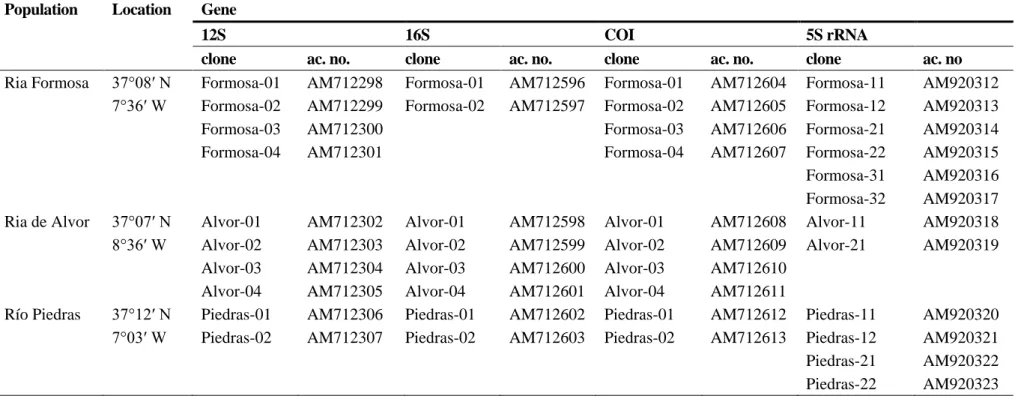
(3) (Ria de Alvor in southern Portugal and Río Piedras in Huelva, southern Spain), which could potentially constitute source-populations for stock enhancement of the autochthonous population from the Ria Formosa.. Materials and methods Sampling Commercial samples of H. trunculus were obtained during 2006 from the autochthonous population in Ria Formosa (Algarve coast in southern Portugal) and from two potential source-populations: Ria de Alvor (Algarve coast in southern Portugal, approximately 30 nautical miles westward) and Río Piedras - El Rompido (Huelva, southern Spain, approximately 20 nautical miles eastward) (Table 1).. In the laboratory, individuals were measured (shell length, SL) using a digital calliper (precision 0.01 mm) and weighed (total weight, TW) on a top-loading digital balance (precision 0.01 g). Routine sexual identification was made in sacrificed specimens by breaking the shells in a bench vice to allow the removal of the soft parts and the exposition of the mantle cavity. Due to the incidence of the imposex phenomenon (development of male secondary sexual characters into females) in local populations of this species (Vasconcelos et al., 2006) males were identified by the presence of a penis and lack of capsule gland, while females were identified by the presence of a vagina and capsule gland. Subsequently, a small portion (roughly 1 cm2) of foot tissue was cut using dissecting instruments and preserved in 70% ethanol until further processing. To prevent the contamination of the tissue samples, particular attention was taken to avoid cutting the muscle tissue in close proximity to the proboscis (containing digestive enzymes) and to the external surface of the foot (with dark pigmentation). DNA extraction, amplification and sequencing Total genomic DNA was extracted as in Winnepennickx et al. (1993) from 20 mg of ethanol-preserved (70% ethanol) muscle tissue. The tissue was homogenised and incubated in CTAB buffer (2% CTAB, 1.4 M NaCl, 20 mM EDTA, 100 mM Tris-HCl pH 8.0). The DNA was purified with phenol/chloroform/isoamylalcohol (25:24:1) and precipitated using two-thirds volume of isopropanol, overnight at room temperature. After DNA centrifugation, the pellet was washed with 90% ethanol and air-dried. Finally, the DNA was dissolved in 1xTE (pH 7.5) to a final concentration of approximately 10 ng/μL. The 12S rRNA, 16S rRNA and cytochrome c oxidase I (COI) genes were amplified using universal primers. The primers used for 12S rRNA were 12SA-5′ and 12SB-3′ (Kocher et al., 1989), for 16S rRNA were 16Sar and 16Sbr (Palumbi, 1996), and for COI primers LCO1490 and HCO2198 (Folmer et al., 1994) were used. For nuclear ribosomal 5S gene, the primers were 5S-Univ-F: 5′- accggtgttttcaacgtgat-3′ and 5S-Univ-R: 5′cgtccgatcaccgaagttaa-3′. All PCR amplifications were performed in 25 μL of a solution containing 1 ng/μL DNA, 10 mM Tris-HCl, 50 mM KCl pH 8.3, 1.5 mM MgCl2, 2.5 mM dNTPs, 1 U of Taq DNA polymerase, and 1 μM of each primer. The PCR profile for 12 S and 16S rRNA consisted of one initial denaturation cycle of 3 min at 94°C, followed by 35 cycles at 94°C for 20 s, 50°C in the case of the 12S rRNA and 51°C for the 16S rRNA for 20 s, and 72°C for 45 s. A final extension was carried out at 72°C for 5 min. For COI, the PCR profile consisted of one initial denaturation cycle of 3 min at 94°C, followed by 35 cycles at 94°C for 1 min, 40°C for 1 min, and 72°C for 1.5 min and a final extension at 72°C for 2 min. The PCR amplification profile for 5 S rRNA consisted of one initial denaturation cycle of 3 min at 94°C, followed by 35 amplification cycles of 45 s at 94°C, 45 s of annealing temperature at 50°C, 1 min at 72°C, and a final extension cycle at 72°C for 10 min. The PCR products were purified with ExoSAP-IT (Amersham.
(4) Pharmacia Biotech) following the manufacturer's instructions. Purified PCR products were cloned with TA cloning kit (Invitrogene). Then, the plasmid was purified using the QIAprep®Miniprep kit (Qiagen) based on alkaline lysis of bacterial cells followed by adsorption of DNA onto silica in the presence of high salt. Sequence reactions were carried out in a capillary DNA sequencer (CEQ™8000 Genetic Analysis System) in both directions. The sequences were deposited in GenBank (Accession Nos. listed in Table 1). Alignment and sequence analyses. Homologue sequences were obtained from GenBank using BLAST program. Alignments for 12S rRNA, 16S rRNA and 5S rRNA were performed with CLUSTAL X (Thompson et al., 1997) using default parameter gap opening 15.0 and gap extension 6.66. To determine the reliability of the data, we tested different orders of sequence input, obtaining identical results. For 16S rRNA we did not detect the hypervariable region corresponding to the loop of domain V, and for this reason, all the sequences obtained were included in the analysis. The alignment of COI nucleotide sequences was constructed on the basis of the translated amino acid sequences using the programs BIOEDIT (Hall, 1999) and CLUSTAL X (Thompson et al., 1997). Because of the skew in AT content, genetic distances (d) and transition/transversion ratios (R) were calculated according to Tamura's three-parameter model (Tamura, 1992) for the mitochondrial regions, and Kimura two-parameter model (Kimura, 1980) for the 5S rRNA gene. These analyses were performed using the software package MEGA 3.1 (Kumar et al., 2004). Maximum parsimony (MP, heuristic searches) analyses were conduced using equal character weighting, 100 random stepwise addition and tree bisection-reconnection (TBR) branch-swapping. Inferred sequence gaps were considered as missing data. Branch support levels were estimated with bootstrapping (Felsenstein, 1985) (1000 replications, 10 random additions each) using PAUP*. A maximum likelihood (ML) analysis was also performed on the combined matrix under the HKY model (Hasegawa et al., 1985). Genetic diversity within populations was measured by calculating the nucleotide diversity (π, the average number of nucleotide differences per site between two sequences) (Nei, 1987) using DnaSp software, version 4.0 (Rozas et al., 2003). To test the presence or absence of STRs (Simple Tandem Repeats), we used the Tandem Repeats Finder (TRF) program, version 2.02 (Benson, 1999). PCR-RFLPs The amplifications of the 12S and 16S rRNA genes were used to develop PCR-RFLPs. Different endonucleases, Alu I, Hae III, Dra I and Apa I, were selected. Restriction reactions were performed in a 20 μL volume containing 5 μl of PCR product, 1X reaction buffer and 3 units of endonuclease and incubated at the appropriate temperature overnight. Resulting fragments were resolved after electrophoresis on 2.5% agarose gels in 1X TAE (40 mM Tris-acetate, 1 mM EDTA pH 8.0)..
(5) Table 1. Sampling locations and accession numbers of the Hexaplex trunculus specimens analysed in this study. Population. Location. Gene. Ria Formosa. 37°08′ N 7°36′ W. 12S clone Formosa-01 Formosa-02 Formosa-03 Formosa-04. ac. no. AM712298 AM712299 AM712300 AM712301. Ria de Alvor. 37°07′ N 8°36′ W. Río Piedras. 37°12′ N 7°03′ W. Alvor-01 Alvor-02 Alvor-03 Alvor-04 Piedras-01 Piedras-02. AM712302 AM712303 AM712304 AM712305 AM712306 AM712307. 16S clone Formosa-01 Formosa-02. ac. no. AM712596 AM712597. Alvor-01 Alvor-02 Alvor-03 Alvor-04 Piedras-01 Piedras-02. AM712598 AM712599 AM712600 AM712601 AM712602 AM712603. COI clone Formosa-01 Formosa-02 Formosa-03 Formosa-04. ac. no. AM712604 AM712605 AM712606 AM712607. Alvor-01 Alvor-02 Alvor-03 Alvor-04 Piedras-01 Piedras-02. AM712608 AM712609 AM712610 AM712611 AM712612 AM712613. 5S rRNA clone Formosa-11 Formosa-12 Formosa-21 Formosa-22 Formosa-31 Formosa-32 Alvor-11 Alvor-21. ac. no AM920312 AM920313 AM920314 AM920315 AM920316 AM920317 AM920318 AM920319. Piedras-11 Piedras-12 Piedras-21 Piedras-22. AM920320 AM920321 AM920322 AM920323.
(6) Results. A total of 102 specimens of H. trunculus (56 males and 46 females) with broad size ranges (SL: 39.29 to 89.10 mm; TW: 5.69 to 87.50 g) were analysed: 40 individuals from Ria Formosa (SL = 62.00 ± 5.01 mm; TW = 22.62 ± 5.58 g), 40 individuals from Ria de Alvor (SL = 49.14 ± 5.29 mm; TW = 11.55 ± 4.17 g) and 22 individuals from Río Piedras (SL = 71.29 ± 11.99 mm; TW = 43.12 ± 20.73 g). The partial amplification of 12S rRNA showed a length of 370 bp, and an AT content higher than 66%, as expected for the 12S rRNA region III. The alignment of nucleotide clones (data not shown) revealed a low number of nucleotide changes among them. Genetic distance and nucleotide diversity values among clones within populations (Table 2) were very low, being zero for Ria Formosa. Likewise, the values of genetic distance among localities (Table 3) were also low (0.001– 0.007). Table 2. Mean pairwise distances (d) and nucleotide diversity (π) within populations. Population Ria Formosa Ria de Alvor Río Piedras. 12S d. π. 16S d. π. COI d. 0. 0. 0.001 0.003. π. 5S d. 0.004. 0.0039. 0.0014. 0. 0.0027. 0. π. NTS d. π. 0. 0.0010. 0.0258. 0.0250. 0.647. 0.4204. 0. 0. 0. 0.0341. 0.0333. 0.974. 0.5079. 0. 0. 0. 0.0112. 0.0111. 0.508. 0.2220. Within group means are arithmetic means of all individual pairwise distances between specimens within a group.. The internal region of 16S rRNA was 513 bp in length and the AT content was higher than 63%. Again, alignment among the different clones displayed low variability (data not shown). Genetic distance values among clones within populations (Table 2) and among populations (Table 3) were lower than for the 12S rRNA gene. This was also supported by the low value of nucleotide diversity (Table 2), which was zero for Ria de Alvor and Río Piedras. Ria Formosa displayed higher values than those for the 12S rRNA gene. Table 3. Distance between populations average, below diagonal for 12S gene, above diagonal for 16S. Ria Formosa Ria de Alvor Río Piedras. Ria Formosa 0.001 0.007. Ria de Alvor 0 0.007. Río Piedras 0.002 0.002 -. The average distance is the arithmetic mean of all pairwise distances between two groups in the inter-population comparisons.. The E1 region corresponding to the COI gene was 657 bp in length and showed AT content >62%. The translation of the nucleotide sequences into amino acid sequences, following the Drosophila yakuba mitochondrial genetic code (Clary and Wolestelholme, 1985), allowed us to obtain open reading frames in all the clones, not finding stop codons in the middle of the sequence. The length of the amino acid chains was of 219 amino acids. The percentages of each amino acid were calculated, this region being rich in hydrophobic amino acids of which leucine was the most abundant. Alignment of COI nucleotide sequences revealed that all clones were identical (Table 2), only showing one variable site out of 657 nucleotides. Genetic distance and nucleotide diversity values (Table 2) were even lower than for the 12S rRNA and 16S rRNA genes..
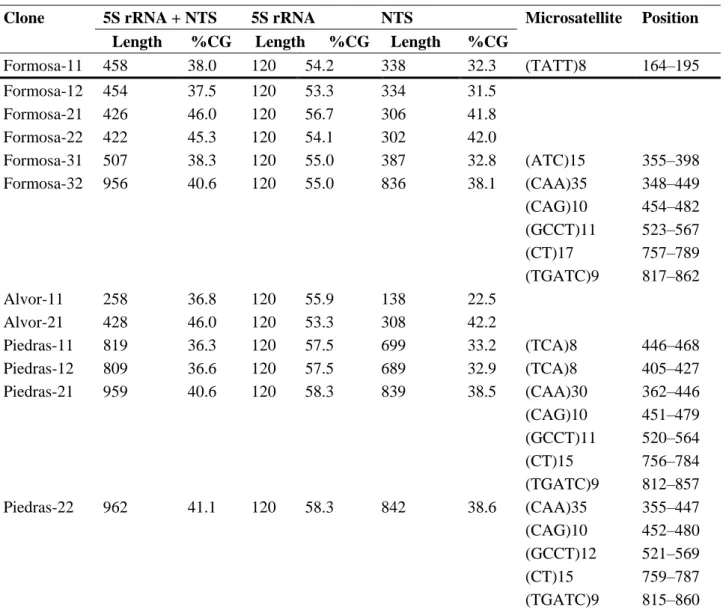
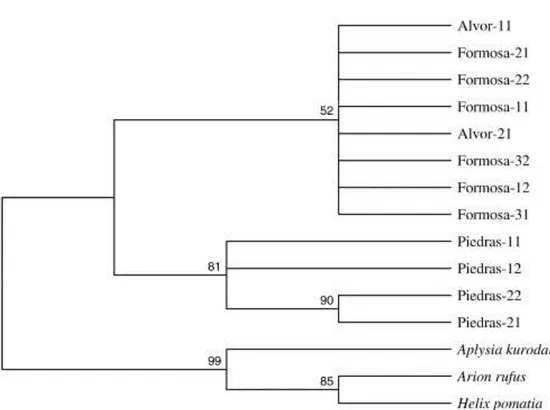
(7) The PCR-RFLPs from 12S and 16S rRNA were developed to analyse genetic polymorphism in 30 individuals for each of the Portuguese localities and 20 for the Río Piedras locality. After digestion with the four restriction endonucleases, Alu I, Hae III, Dra I and Apa I, all the samples were monomorphic, displaying only one haplotype. Genetic variability was also analysed by cloning and sequencing the 5S rRNA gene. The cloned fragments showed high variability in the size of the insert, ranging from ~250 bp to 1000 bp (Table 4). Different clones were randomly selected to study the transcribed (5S) and non-transcribed (NTS) regions. For the 5S coding region, all clones showed 120 bp length and a GC content ranging from 53.3 to 58.3 (Table 4), displaying higher genetic variability than the mitochondrial genes. Genetic distances among clones within each locality (Table 2) revealed Río Piedras as the lowest variable (lowest d and π values), while Ria de Alvor displayed the highest genetic variability. Furthermore, genetic distances among populations (Table 5) showed Río Piedras as being more distant from Ria de Alvor and Ria Formosa. The maximum parsimony phylogenetic analysis of the 5S region (Fig. 1) showed one cluster containing all the clones of H. trunculus and the rest of the gastropod species included in this analysis and available in the Genbank (Arion rufus, Aplysia kurodai and Helix pomatia). The topology showed the monophyly of H. trunculus with regard to the rest of gastropods and grouped the clones from Río Piedras separately from those from Ria de Alvor and Ria Formosa. Table 4. Lengths and guanine-cytosine content of coding and spacer regions of 5S rRNA, and microsatellite sequences with positions. Clone Formosa-11. 5S rRNA + NTS Length %CG 458 38.0. 5S rRNA NTS Length %CG Length 120 54.2 338. %CG 32.3. Formosa-12 Formosa-21 Formosa-22 Formosa-31 Formosa-32. 454 426 422 507 956. 37.5 46.0 45.3 38.3 40.6. 120 120 120 120 120. 53.3 56.7 54.1 55.0 55.0. 334 306 302 387 836. 31.5 41.8 42.0 32.8 38.1. Alvor-11 Alvor-21 Piedras-11 Piedras-12 Piedras-21. 258 428 819 809 959. 36.8 46.0 36.3 36.6 40.6. 120 120 120 120 120. 55.9 53.3 57.5 57.5 58.3. 138 308 699 689 839. 22.5 42.2 33.2 32.9 38.5. Piedras-22. 962. 41.1. 120. 58.3. 842. 38.6. Microsatellite. Position. (TATT)8. 164–195. (ATC)15 (CAA)35 (CAG)10 (GCCT)11 (CT)17 (TGATC)9. 355–398 348–449 454–482 523–567 757–789 817–862. (TCA)8 (TCA)8 (CAA)30 (CAG)10 (GCCT)11 (CT)15 (TGATC)9 (CAA)35 (CAG)10 (GCCT)12 (CT)15 (TGATC)9. 446–468 405–427 362–446 451–479 520–564 756–784 812–857 355–447 452–480 521–569 759–787 815–860.
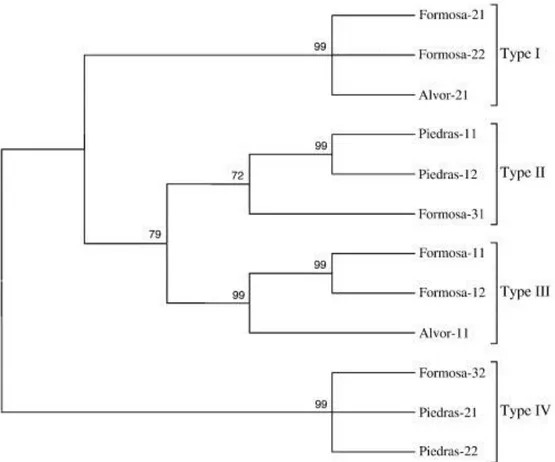
(8) Table 5. Distance between populations average, below diagonal for 5S gene, above diagonal for NTS. Ria Formosa Ria de Alvor Río Piedras. Ria Formosa 0.027 0.050. Ria de Alvor 0.623 0.052. Río Piedras 0.583 0.760 -. The average distance is the arithmetic mean of all pairwise distances between two groups in the inter-population comparisons.. Figure 1. The single most-parsimonious tree (1000 bootstrap replicates; L = 34, CI = 0.8056, RI = 0.8444, RC = 0.6802) obtained from the maximum parsimony analysis of 5S transcribed sequences in Hexaplex trunculus. Maximum likelihood analysis produced a largely congruent topology (HKY model, -Ln L = 353.85784). Sequences from the three gastropod species deposited in Genbank (Aplysia kurodai X04305, Arion rufus J01888, and Helix pomatia J01889) were incorporated into the tree. Bootstrap values over 50% are shown above branches. (For more details of the populations, clones and accession numbers, see Table 1).. Regarding the NTS, the lengths ranged from 138 to 842 nucleotides and the GC content from 31.5 to 42.2% (Table 4). This region showed higher variability than the 5S coding region, as observed from the analysis of the genetic distances within populations (Table 2) and among the different populations (Table 5). Sequence alignments of clones revealed the existence of four groups: i) Formosa-21, Formosa-22 and Alvor-21, ii) Piedras-11, Piedras-12 and Formosa-31, iii) Formosa-11, Formosa-12, and Alvor-11, and iv) Formosa-32, Piedras-21, and Piedras-22. Ria de Alvor was the locality with the highest variability and genetic distance values. This grouping is observed in the maximum parsimony tree (Fig. 2), which shows that types II and III are more closely linked to each other than to the other two NTS types..
(9) Figure 2. The single most-parsimonious tree (1000 bootstrap replicates; L = 275, CI = 0.8667, RI = 0.8906, RC = 0.7719) obtained from the maximum parsimony analysis of 5S non-transcribed sequences in Hexaplex trunculus. Maximum likelihood analysis produced a largely congruent topology (HKY model, -Ln L = 3637.83163). Bootstrap values over 50% are shown above branches. (For more details of the populations, clones and accession numbers, see Table 1).. The analysis of NTS regions using the TRF program allowed us to detect the existence of microsatellite sequences in some of the clones studied (Table 4). Using a penalty of 2 for the match, 7 for the mismatch, and 7 for the presence of indels, and using alignment score values of 50 and maximum period size of 500, we obtained five different types of microsatellites in the clones of NTS type IV (Formosa-32, Piedras-21, Piedras-22). Repetitive units are basically trinucleotides, with the triplet CAA repeated at least 30 times.. Discussion Mitochondrial DNA (mtDNA) is a useful marker to investigate genetic diversity and it has been used to analyse polymorphism and define stocks in many invertebrate species (Boudry et al., 1998, O'Foighil et al., 1998, Arnaud-Haond et al., 2003). However, mtDNA must be used in conjunction with nuclear markers to accurately identify populations for conservation (Moritz, 1994), because when considering a low effective number of genes (Birky et al., 1989), mtDNA can diverge while nuclear genes do not. The value of combining mtDNA with nuclear markers has been demonstrated for a great variety of some intensively managed species (see Moritz, 1994 for review). In some cases, low mtDNA diversity is correlated with low nuclear gene diversity. This suggests that it is inappropriate to set conservation or management priorities on the basis of within-population mtDNA diversity (Moritz, 1994). Thus, in this study, we combined the analysis of three mitochondrial genes (12S rRNA, 16S rRNA and cytochrome c oxidase subunit I) and the.
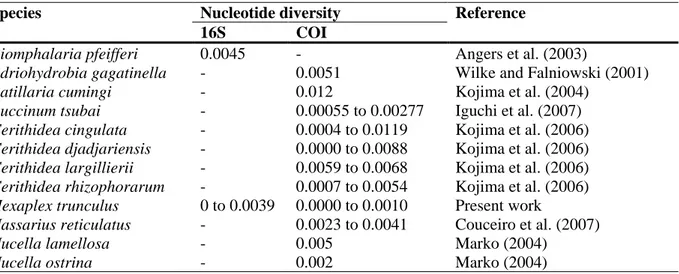
(10) nuclear 5S rRNA gene to investigate the genetic diversity in three populations of the banded murex (H. trunculus) subjected to different levels of fishery exploitation (intensively exploited in Ria Formosa and moderately exploited in Ria de Alvor and Río Piedras). A considerable number of works have revealed high levels of both inter- and intra-specific variability in 12S rRNA, 16S rRNA and COI genes in marine molluscs and also from RFLPs analyses. However, our results showed that the H. trunculus populations examined have low genetic variability for the four genes analysed. For the mitochondrial genes, in the analyses of the 12S and 16S rRNAs the sequence length and the AT content were similar to those found in other gastropods (Marko and Vermeij, 1999, Holznagel and Lydeard, 2000, Kirkendale and Meyer, 2004), while nucleotide diversity values, π, were lower than those obtained from 16S rRNA for Biomphalaria pfeifferi (Angers et al., 2003) (Table 6). Furthermore, the analysis from 12S and 16S RFLPs showed that they were monomorphic, confirming the low genetic differentiation among and within populations. For COI, there was also low variability for nucleotide diversity, in this case being lower than that detected in the genera Adriohydrobia (Wilke and Falniowski, 2001), Cerithidea (Kojima et al., 2006), and in the species Nucella lamellosa and N. ostrina (Marko, 2004), Batillaria cumingi (Kojima et al., 2004), Buccinum tsubai (Iguchi et al., 2007) and Nassarius reticulatus (Couceiro et al., 2007) (Table 6).. Table 6. Nucleotide diversity (π values) for 16S and COI mitochondrial genes in different gastropod species. Species Biomphalaria pfeifferi Adriohydrobia gagatinella Batillaria cumingi Buccinum tsubai Cerithidea cingulata Cerithidea djadjariensis Cerithidea largillierii Cerithidea rhizophorarum Hexaplex trunculus Nassarius reticulatus Nucella lamellosa Nucella ostrina. Nucleotide diversity 16S COI 0.0045 0.0051 0.012 0.00055 to 0.00277 0.0004 to 0.0119 0.0000 to 0.0088 0.0059 to 0.0068 0.0007 to 0.0054 0 to 0.0039 0.0000 to 0.0010 0.0023 to 0.0041 0.005 0.002. Reference Angers et al. (2003) Wilke and Falniowski (2001) Kojima et al. (2004) Iguchi et al. (2007) Kojima et al. (2006) Kojima et al. (2006) Kojima et al. (2006) Kojima et al. (2006) Present work Couceiro et al. (2007) Marko (2004) Marko (2004). However, the analysis of the nuclear 5S rRNA revealed higher values of π than for those obtained from the mitochondrial ones. This gene displayed guanine-cytosine richness, with a percentage surpassing 52% for the coding region (Table 4), similar to that obtained for A. kurodai and A. rufus (Komiya et al., 1986), and H. pomatia (Fang et al., 1982). Values of nucleotide diversity obtained from the 5S region were higher than those obtained from the mitochondrial genes, possibly due to the high conservation degree of this gene through species (Drouin and Moniz de Sá, 1995). Regarding NTS, this is the first time that this region is used to perform an analysis of genetic diversity in a gastropod. The results obtained revealed that the guaninecytosine content was 22.5% – 42.2% and the length ranged from 138 bp to 839 bp, which is due to the absence/ presence of microsatellite sequences. For most invertebrate fisheries, the key to understanding the population structure lies, in part, in knowing the mobility of the species and their larvae (Thorpe et al., 2000). Most of them have reduced mobility or are sessile, thus the only mode of dispersion is through the larval stages (or ultimately through accidental introductions of larvae, juveniles or adults). In the case of the gastropods, the scale of genetic differentiation between populations or stocks (or localities) appears to be related to larval type (Thorpe et al., 2000). The banded murex, H. trunculus, is a direct-developer species (lacking planktonic larva), and both juveniles and.
(11) adults are highly restricted in mobility (Vasconcelos et al., 2004). Furthermore, unintended transport by the currents is most unlikely, because they normally live adhered to the bottom, and occasionally even burrow shallowly into soft sediments to avoid both the unfavourably low and high water temperatures (Spanier, 1981, Spanier, 1986, Spanier and Karmon, 1987), being often observed partially buried in the sand (Spanier, 1986, Rilov et al., 2004). Altogether, this could explain the low genetic diversity and differentiation found in the banded murex. In this sense, the analysis of different mitochondrial genes in gastropod species with pelagic and nonpelagic larvae has revealed a significant reduction in nucleotide diversity in species with nonpelagic larvae (Grant and da Silva-Tatley, 1997, Foltz, 2003). This is consistent with the suggestion that the nonpelagic lineages have reduced effective population sizes, which is correlated with the lower levels of gene flow among populations (Foltz, 2003). Furthermore, if the population size is small, the low values of genetic diversity could be also caused by genetic drift. The reduced mobility of H. trunculus crawling hatchlings (benthic early post-metamorphic individuals) implies low dispersal (and hence, small population size), therefore stocks are much more vulnerable to the multiple effects of natural and anthropogenic stressors than those species which have planktonic larvae with high dispersal. The relationships between larval type and gene flow are complex, and the level of gene flow in a species probably depends on other life history factors in addition to the mode of reproduction, such as the adult body size, reduced fecundity, or ecological conditions (Wilke and Davis, 2000). Taking this into account, another cause for the low genetic variability in H. trunculus could be the eventual existence of a recent bottleneck and an event of decreasing population size, possibly due to overfishing, although this would be more likely to have occurred in the case of the population from Ria Formosa. This, together with detrimental collecting practices (hand collecting in communal spawns during low tide and illegal catches through scuba-diving) might have dramatically worsened the status of genetic diversity in this locality. However, overfishing solely does not explain the low genetic variability detected in the populations from Ria de Alvor and Río Piedras, both subjected to lower levels of fishery exploitation (only moderately exploited, when compared to the intensively exploited population from Ria Formosa), and thus other factors must be considered, namely the species distributional range and the geographical location of the localities sampled. Indeed, H. trunculus is essentially a Mediterranean species, and therefore Río Piedras, Ria Formosa and Ria de Alvor are peripheral localities in its geographic distribution, constituting the westernmost populations along the southern Iberian Peninsula (moreover, the distances between them are relatively short). It is known that the distribution of most species is characterised by central dense populations and peripheral marginal populations, and that this distribution is regulated by biotic and/or abiotic factors that make peripheral habitats less suitable for the maintenance of populations (Brown et al., 1995, Brown et al., 1996). Demographic characteristics of these margins together with spatial and temporal variations of the environment determine the exact range of the boundary (Brown et al., 1996). Usually, marginal or peripheral populations are fragmented in patches or areas that favour metapopulational processes (Holt and Keitt, 2000). Each population within a metapopulation is relatively independent of the rest, and may eventually be endangered or become extinct as a consequence of demographic stochasticity. Furthermore, individuals from marginal habitats are expected to have lower fitness and population growth than those from central areas of distribution (Holt and Keitt, 2000, Maurer and Taper, 2002), and subsequently, to have low or reduced genetic variability. This situation, in conjunction with human activities that lead to a reduction of the suitable habitats, may ultimately result in a reduction of the species' range (Faugeron et al., 2004). In addition, all these assumptions should be integrated in a scenario of global climate change that will most probably aggravate the overall situation. Indeed, recent rapid climate change has resulted in modifications in the biogeographic ranges, abundance, and population structure of several species (including Lusitanian species) (Mieszkowska et al., 2005). Moreover, it is believed that species with small and/or isolated populations and low genetic variability (often indicated by recent bottlenecks in population numbers) are least likely to withstand impacts of climate change (Inkley et al., 2004), increasing their risk of extinction. In.
(12) this context, species vulnerable to genetic bottlenecks may benefit from conservation efforts that enhance the genetic diversity (Hellmann and Pineda-Krch, 2007), consequently increasing the population's ability to adapt to environmental changes (Ray, 2001, Bell and Okamura, 2005, Frankham, 2005). In terms of the stock enhancement of H. trunculus from Ria Formosa, several genetic considerations must be taken into account, being one of the most important to ascertain the geographic distribution of genetic diversity. This must be investigated before performing a stock selection for restoration. To compare the distribution of genetic diversity between populations in central areas of distribution and peripheral populations (also including more distant locations such as northern Africa, Madeira and Canary Archipelagos), could provide qualitative indications about the genetic status of the banded murex. The analysis of genetic diversity and genetic differentiation of populations will supply fundamental data for conservation and stock enhancement, allowing the sustainable exploitation of the fishing resources and preserving biodiversity.. Acknowledgements The authors would like to thank Óscar Moreno (IFAPA - Centro Agua del Pino), Jorge Barra and Amador Lopes (IPIMAR - Posto de Amostragem de Portimão) for kindly providing the biological samples for genetic analysis. The authors are also grateful to three anonymous referees whose suggestions improved the manuscript. This study was partially funded by a PhD grant from the Fundação para a Ciência e Tecnologia (FCT: SFRH/BD/5139/2001). [RH]. References Angers B., Charbonnel N., Galtier N., Jarne P., 2003. The influence of demography, population structure and selection on molecular diversity in the selfing freshwater snail Biomphalaria pfeifferi. Genet. Res. Camb., vol. 81, pp. 193-204. Anon., 2001. Especies de Interés Pesquero en el Litoral de Andalucía. Invertebrados, vol. II, Junta de Andalucía, Consejería de Agricultura y Pesca, Sevilla. Arnaud-Haond S., Bonhomme F., Blanc F., 2003. Large discrepancies in differentiation of allozymes, nuclear and mitochondrial DNA loci in recently founded Pacific populations of the pearl oyster Pinctada margaritifera. J. Evol. Biol., 16, pp. 388-398. Bell J.J., Okamura B., 2005. Low genetic diversity in a marine nature reserve: re-evaluating diversity criteria in reserve design. Proc. R. Soc. B, vol. 272, pp. 1067-1074. Bell J.D., Rothlisberg P.C., Munro J.L., Loneragan N.R., Nash W.J., Ward R.D., Andrew N.L., 2005. Restocking and stock enhancement of marine invertebrate fisheries. Adv. Mar. Biol., 49, pp. 1-392. Benson G., 1999. Tandem repeats finder: a program to analyze DNA sequences. Nucleic Acids Res., 27, pp. 573-580. Birky C.W., Fuerst P., Maruyama T., 1989. Organelle gene diversity under migration, mutation and drift: equilibrium expectations, approach to equilibrium, effects of heteroplasmic cells, and comparison to nuclear genes. Genetics, 121 (1989), pp. 613-627. Boudry P., Heutebise S., Collet B., Cornette F., Gérard A., 1998, Genetic differentiation between Portuguese oyster (Crassostrea angulata) and Pacific oyster (Crassostrea gigas) populations, as revealed by RFLP analyses of PCR amplified mitochondrial DNA segments. J. Exp. Mar. Biol. Ecol., 98, pp. 279-291..
(13) Brown J.H., Mehlman D.W., Stevens G.C., 1995. Spatial variation in abundance. Ecology, 76, pp. 20282043. Brown J.H., Stevens G.C., Kaufman D.M., 1996. The geographic range: size, shape, boundaries, and internal structure. Annu. Rev. Ecolog. Syst., 27, pp. 597-623. Clary D.O., Wolstelholme D.R.,1985. The mitochondrial DNA molecule of Drosophila yakuba: nucleotide sequence gene organization and genetic code. J. Mol. Evol., 22, pp. 252-271. Couceiro L., Barreiro R., Ruíz J.M., Sotka E.E., 2007. Genetic isolation by distance among populations of the netted dog whelk Nassarius reticulatus (L.) along the European Atlantic coastline, J. Heredity, 98, pp. 603-610. Drouin G., Moniz de Sá M., 1995. The concerted evolution of 5S ribosomal genes linked to the repeat units of other multigene families. Mol. Biol. Evol., 12, pp. 481-493. Fang B.L., De Baere R., Vanderberghe A., De Watcher R., 1982. Sequences of three molluscan 5S ribosomal RNAs confirm the validity of a dynamic secondary structure model. Nucleic Acids Res., 10, pp. 4679-4685. Faugeron S., Martínez E.A., Correa J.A., Cardenas L., Destombe C., Valero M., 2004. Reduced genetic diversity and increased population differentiation in peripheral and overharvested populations of Gigartina skottsbergii (Rhodophyta, Gigartinales) in southern Chile. J. Phycol., 40, pp. 454-462. Felsenstein J., 1985. Confidence limits on phylogenies: an approach using the bootstrap. Evolution, 39, pp. 783-791. Folmer O., Black M., Lutz R., Vrijenhoek R., 1994. DNA primers for amplification of mitochondrial cytochrome c oxidase subunit I from diverse metazoan invertebrates. Mar. Biol. Biotech., vol. 3, pp. 294299. Foltz D.W., 2003. Invertebrate species with nonpelagic larvae have elevated levels of nonsynonymous substitutions and reduced nucleotide diversities. J. Mol. Evol., 57, pp. 607-612. Frankham R.Genetics and extinction, 2005. Biol. Conserv., 126, pp. 131-140. Gaffney P.M.The role of genetics in shellfish restoration, 2006. Aquat. Living Resour., 19, pp. 277-282. Gaillard J.M., 1987. Gastéropodes. In: W. Fischer, M.L. Bauchot, M. Schneider (Eds.), Fiches FAO d'Identification des Espèces pour les Besoins de la Pêche, Méditerranée et Mer Noire, vol. I, FAO, Rome. Gharsallah I.H., Zamouri-Langar N., Missaoui H., El Abed A., 2004. Étude de la croissance relative et de la biomasse d'Hexaplex trunculus dans la lagune de Bizerte. Bull. Soc. Zool. Fr., 129, pp. 427-436. Grant W.S., da Silva-Tatley F.M., 1997. Lack of genetically-subdivided population structure in Bullia digitalis, a southern African marine gastropod with lecithotrophic development. Mar. Biol., 129, pp. 123137. Hall T.A., 1999. BioEdit: a use-friendly biological sequence alignment editor and analysis program for Windows 95/98/NT. Nucleic Acids Symp. Ser., 41, pp. 95-98. Hasegawa M., Kishino H., Yano T., 1985. Dating of the human-ape splitting by a molecular clock of mitochondrial DNA. J. Mol. Evol., 21, pp. 160-174. Hellmann J.J., Pineda-Krch M., 2007. Constraints and reinforcement on adaptation under climate change: selection of genetically correlated traits. Biol. Conserv., 137, pp. 599-609..
(14) Holt R.D., Keitt T.H., 2000. Alternative causes for range limits: a metapopulation perspective. Ecol. Lett., 3, pp. 441-447. Holznagel W.E., Lydeard C., 2000. A molecular phylogeny of North American Pleuroceridae (Gastropoda: Cerithioidea) based on mitochondrial 16S rDNA sequences. J. Molluscan Stud., 66, pp. 233-257. Houart, R., 2001. A review of the recent Mediterranean and Northeastern Atlantic species of Muricidae. Ed. Evolver, Rome. Iguchi A., Takai S., Ueno M., Maeda T., Minami T., Hayashi I., 2007. Comparative analysis of the genetic population structures of the deep-sea whelks Buccinum tsubai and Neptunea constricta in the Sea of Japan. Mar. Biol., 151, pp. 31-39. Inkley D.B., Anderson M.G., Blaustein A.R., Burkett V.R., Felzer B., Griffith B., Price J., Root T.L., 2004. Global climate change and wildlife in North America. Wildlife Society Technical Review 04-2. The Wildlife Society, Bethesda, Maryland, USA, 26 pp. Kimura M.A, 1980. A simple method for estimating evolutionary rate of base substitution through comparative studies of nucleotide sequences. J. Mol. Evol., 16, pp. 111-120. Kirkendale L.A., Meyer C.P., 2004. Phylogeography of the Patelloida profunda group (Gastropoda: Lottidae): diversification in a dispersal-driven marine system. Mol. Ecol., 13, pp. 2749-2762. Kocher T.D., Thomas W.K., Meyer A., Edwards S.V., Pääbo S., Villablanca F.X., Wilson A.C., 1989. Dynamics of mitochondrial DNA evolution in animals: amplification and sequencing with conserved primers. Proc. Natl. Acad. Sci. U. S. A., 86, pp. 6196-6200. Kojima S., Hayashi I., Kim D., Iijima A., Furota T., 2004. Phylogeography of an intertidal direct-developing gastropod Batillaria cumingi around the Japanese Islands. Mar. Ecol. Prog. Ser., 276, pp. 161-172. Kojima S., Kamimura S., Iijima A., Kimura T., Kurozumi T., Furota T., 2006. Molecular phylogeny and population structure of tideland snails in the genus Cerithidea around Japan. Mar. Biol., 149, pp. 525-535. Komiya H., Hasegawa M., Takemura S., 1986. Differentiation of oocyte- and somatic-type 5S rRNAs in animals. J. Biochem., 100, pp. 369-374. Kumar S., Tamura K., Nei M., 2004. MEGA 3: Integrated software for Molecular Evolutionary Genetics Analysis and sequence alignment. Brief. Bioinform., 5, pp. 150-163. Macedo, M.C.C., Macedo, M.I.C., Borges, J.P., 1999. Conchas marinhas de Portugal (seashells of Portugal). Editorial Verbo, Lisboa. Marko P.B., 2004. “What's larvae got to do with it?” Disparate patterns of post-glacial population structure in two benthic marine gastropods with identical dispersal potential. Mol. Ecol., 13, pp. 597-611. Marko P.B., Vermeij G.J. 1999. Molecular phylogenetics and the evolution of labral spines among eastern Pacific Ocenebrine gastropods. Mol. Phylogenet. Evol., 13 (2), pp. 275-288. Maurer B.A., Taper M.L., 2002. Connecting geographical distributions with population processes. Ecol. Lett., 5, pp. 223-231. Mieszkowska N., Leaper R., Moore P., Kendall M.A., Burrows M.T., Lear D., Poloczanska E., Hiscock K., Moschella P.S., Thompson R.C., Herbert R.J., Laffoley D., Baxter J., Southward A.J., Hawkins S.J., 2005. Marine biodiversity and climate change: assessing and predicting the influence of climatic change using intertidal rocky shore biota. Mar. Biol. Assoc. Occ. Publ., vol. 20, pp. 1-53..
(15) Moritz, C., 1994. Applications of mitochondrial DNA analysis in conservation: a critical review. Mol. Ecol., 3, pp. 401-411. Muzavor S., Morenito P.M., 1999. Roteiro ecológico da Ria Formosa. Moluscos gastrópodos, vol. IV. Universidade do Algarve, Faro. Nei M., 1987. Molecular Evolutionary Genetics. Columbia Univ. Press, New York, USA. O'Foighil D., Gaffney P.M., Wilbur A.E., Hilbish T.J., 1998. Mitochondrial cytochrome oxidase I gene sequences support an Asian origin for the Portuguese oyster Crassostrea angulate. Mar. Biol., 131, pp. 497503. Palumbi S.R, 1996. .Nucleic acids II: The polymerase chain reaction. In: Hillis, D.M., Moritz, C., Mable, B.K. (Eds.), Molecular Systematics, 2nd edition, pp. 205-248. Sunderland, Massachusetts, USA. Peharda M., Morton B., 2006. Experimental prey species preferences of Hexaplex trunculus (Gastropoda: Muricidae) and predator-prey interactions with the Black mussel Mytilus galloprovincialis (Bivalvia: Mytilidae). Mar. Biol., 148, pp. 1011-1019. Poppe G.T., Goto Y., 1991. European seashells, vol. 1 (Polyplacophora, Claudofoveata, Solenogastra, Gastropoda). Verlag Christa Hemmen, Wiesbaden. Quintas P., Rolán E., Troncoso J.S., 2005. Sobre la presencia de un ejemplar vivo de Hexaplex trunculus en la ensenada de O Grove (Ría de Arousa, Galicia). Not. Soc. Esp. Malacol., 43, pp. 77-78. Ray C., 2001. Maintaining genetic diversity despite local extinctions: effects of population scale. Biol. Conserv., 100, pp. 3-14. Rilov G., Benayahu Y., Gasith A., 2004. Life on the edge: do biomechanical and behavioral adaptations to wave-exposure correlate with habitat partitioning in predatory whelks? Mar. Ecol. Prog. Ser., 282, pp. 193204. Rolán E., Bañon-Díaz R., 2007. Primer hallazgo de la especie invasora Rapana venosa y nueva información sobre Hexaplex trunculus (Gastropoda, Muricidae) en Galicia. Not. Soc. Esp. Malacol., 47, pp. 57-59. Rozas J.J., Sanchez DelBarrio C., Messeguer X., Rozas R., 2003. DnaSp, DNA polymorphism analysis by the coalescent and other methods. Bioinformatics, 19, pp. 2496-2497. Šimunović A., 1995. Ecological study of Prosobranchiata (Gastropoda) in the eastern part of the Adriatic Sea and their relationship to benthic biocoenoses. Acta Adriát., 36, pp. 3-162. Spanier E., 1981. Behavioral ecology of the marine snail Trunculariopsis (Murex) trunculus. In: Shuval, H. (Ed.), Developments in Arid Zone Ecology and Environmental Quality. Balaban ISS, Philadelphia, pp. 6570. Spanier E., 1986. Cannibalism in muricid snails as a possible explanation for archaeological findings. J. Archaeol. Sci., 13, pp. 463-468. Spanier E., Karmon N., 1987. Muricid snails and the ancient dye industries. In: Spanier, E. (Ed.), The Royal Purple and the Biblical Blue: Argaman and Tekhelet. Keter Publishing House Jerusalem Ltd., Jerusalem, pp. 179-192. Tamura K., 1992. The rate and pattern of nucleotide substitution in Drosophila mitochondrial DNA. Mol. Biol. Evol., 9, pp. 814-825..
(16) Thompson J.R., Gibson T.J., Plewniak F., Jeanmongin F., Higgins D.G., 1997. The clustal X windows interface: flexible strategies for multiple sequence alignment aided by quality analysis tools. Nucleic Acids Res., 24, pp. 4876-4882. Thorpe J.P., Solé-Cava A.M., Watts P.C., 2000. Exploited marine invertebrates: genetics and fisheries. Hydrobiologia, 420, pp. 165-184. Tirado C., Rodríguez de la Rúa A., Bruzón M.A., López J.I., Salas C., Márquez I., 2002. La Reproducción de Bivalvos y Gasterópodos de Interés Pesquero en Andalucía. Junta de Andalucía, Consejería de Agricultura y Pesca, Huelva. Vasconcelos P., Gaspar M.B., Joaquim S., Matias D., Castro M., 2004. Spawning of Hexaplex (Trunculariopsis) trunculus (Gastropoda: Muricidae) in the laboratory: description of spawning behaviour, egg masses, embryonic development, hatchling and juvenile growth rates. Invertebr. Reprod. Dev., 46, pp. 125-138. Vasconcelos P., Gaspar M.B., Castro M., 2006. Imposex in Hexaplex (Trunculariopsis) trunculus (Gastropoda: Muricidae) from the Ria Formosa lagoon (Algarve coast - southern Portugal). Mar. Pollut. Bull., 52, pp. 337-341. Vasconcelos, P., Carvalho, S., Castro, M., Gaspar, M.B., 2008. The artisanal fishery for muricid gastropods (banded murex and purple dye murex) in the Ria Formosa lagoon (Algarve coast - southern Portugal). Sci. Mar. 72, pp. 287–298. Vokes E.H., 2006. One last look at the Muricidae. Am. Conchol., 24, pp. 4-6. Wenne R., Boudry P., Hemmer-Hansen J., Lubieniecki K.P., Was A., Kause A., 2007. What role for genomics in fisheries management and aquaculture? Aquat. Living Resour., 2, pp. 241-255. Wilke T., Davis G.M., 2000. Intraspecific mitochondrial sequence diversity in Hydrobia ulvae and Hydrobia ventrosa (Hydrobiidae: Rissooidea: Gastropoda): do their different life histories affect biogeographic patterns and gene flow? Biol. J. Linn. Soc., 70, pp. 89-105. Wilke T., Falniowski A., 2001. The genus Adriohydrobia (Hydrobiidae: Gastropoda): polytypic species or polymorphic populations? J. Zoolog. Syst. Evol. Res., 39, pp. 227-234. Winnepennickx B., Blackeljau T.D., Wachter R., 1993. Extraction of high molecular weight DNA from molluscs. Trends Genet., 9, p. 407.. *. This is a post-peer-review, pre-copyedit version of an article published in [Journal of Experimental Marine Biology and Ecology]. The final authenticated version is available online at: [https://doi.org/10.1016/j.jembe.2008.06.013]. †. © 2008. Licensed under the Creative Commons CC-BY-NC-ND 4.0 license http://creativecommons.org/licenses/bync-nd/4.0/ ‡. [email protected].
(17)
Figure

+3
Documento similar
