
Massive Stellar X ray Sources in the Galactic Center
5
0
0
Texto completo
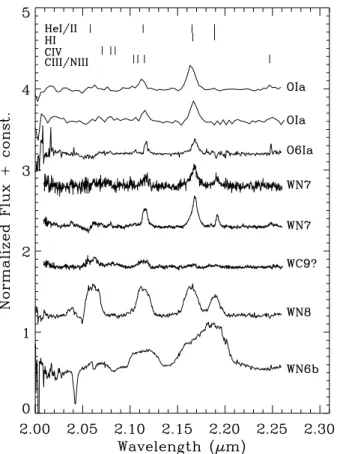
(2) winds from O stars. Here we present the most recent discoveries of WR/O counterparts to Chandra X-ray sources in the GC.. Figure 1. K-band spectra of 8 out of the 13 WR/O stars identified as counterparts to Chandra sources in the Galactic center (obtained at the IRTF, UKIRT, and Keck). The counterparts span the range of post-main-sequence evolution for massive stars, including O-supergiants, and Wolf-Rayet stars of subtype WNE, WNL, and WC.. 2.. Observations and Results. A catalog of over 10,000 X-ray point sources has been assembled from Chandra observations of the inner 2◦ × 0.8◦ of the Galaxy, incorporating all ACIS-I observations of the region. 123. Downloaded 02 Jun 2008 to 131.215.225.137. Redistribution subject to AIP license or copyright; see http://proceedings.aip.org/proceedings/cpcr.jsp.
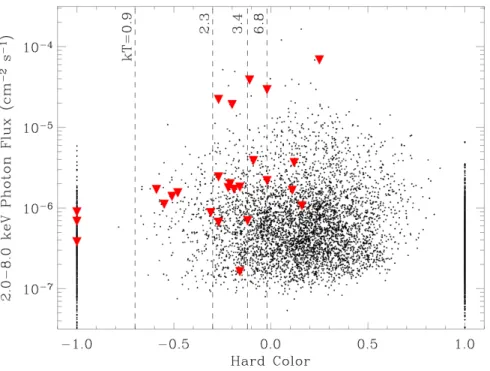
(3) as of 2007 September (Muno et al. in prep). Assuming a distance of 8 kpc to the GC, the catalog is complete down to Lx > 1032 erg s−1 over one square degree and an order of magnitude more sensitive in the few arcminutes around Sgr A∗ , where there is 1 Msec of exposure. We cross-correlated the Chandra GC point-source catalog with NIR catalogs produced by the Simultaneous 3-color Infrared Imager for Unbiased Surveys (SIRIUS) on the 1.4-meter Infrared Science Facility (Nishiyama et al. 2006), and the Two-Micron All-Sky Survey (2MASS; Cutri et al. 2003). In order to select Chandra sources at or beyond the Galactic center, we restict our sample to sources having soft X-ray colors indicative of an interstellar absorbing column of hydrogen with NH > 4 × 1022 cm−2 . The IR sample was restricted to sources having colors with J − H > 2.3 mag and H − Ks > 1.1 mag, consistent with our adopted cutoff value of NH . Further restricting our IR sample to sources with Ks < 12, we produced a list of 125 X-ray/IR matches of which 39±8 should be genuine, as determined from Monte Carlo simulation. To determine the nature of these counterparts we obtained K-band spectra of 39 stars, of which 13 were discovered to have WR/O counterparts, in excellent agreement with our predicted success rate. This work brings the total number of known X-ray-emitting WR/O stars in the Galactic center to 18, outside the Arches and Quintuplet clusters. For the stars of this work, spectral-types were determined by comparison with spectra of previously identified Galactic WR/O stars in the literature (Hanson et al. 1996, Figer et al. 1996). Figure 1 exhibits K-band spectra of 8 of the 13 counterparts discovered, spanning the range of massive star post-main-sequence evolution, from O-supergiants to nitrogen-type WR stars (WN) to carbon-type WR stars (WC). Broad emission lines of H at 2.16 µm, and HeI and NIII near 2.12 µm dominate the spectra of transitional O supergiants, while HeII emission near 2.19 µm emerges in the helium-burning WR stars. The emission lines of the WC9 stars of our sample are extremely diluted, most likely due to continuum emission from dust. The WN6 and WN8 have very broad lines of H, HeI, HeII, and NIII/CIII, indicative of a supersonic wind with v ≈2000-3000 km s−1 . The flat-topped shape of the lines indicates that the wind is extended and optically-thin. 2.1.. X-ray Properties. Figure 2 shows a plot of hard X-ray color vs. 2-8 keV photon flux. Hard color is defined as (h − s)/(h + s), where h and s are the fluxes in the 3.3-4.7 and 4.7-8.0 Chandra bands, respectively. The vertical lines locate the hard color values expected for thermal plasmas of various temperatures, absorbed by NH = 6 × 1022 cm−2 . The WR/O counterparts are systematically softer in X-rays than the general Galactic center field population presumed to be accretion powered CVs. However, their X-ray colors do indicate the presence of a hard component with kT ≈ 2 − 6 keV. 3.. Origin of the Hard X-ray Emission. The hard X-ray emission (kT > 2 keV) observed for most of the stars in our sample is not ubiquitous among single WR/O stars. However, X-rays from WR+OB binaries with colliding, supersonic stellar winds typically exhibit a hard component. Given the high binary fraction observed among massive stars (Mason et al. 1998), we regard the CWB hypothesis as the most likely. However, we cannot yet rule out the possibility that our sample also contains wind-accreting neutron stars and black holes in HMXBs. However, if there are HMXBs in this sample, their low X-ray luminosities (Lx ≈ 1031−33 erg s−1 ) compared with known HMXBs would imply a relatively low accretion rate. It has been suggested that the propeller effect produced by a neutron star magnetosphere could prevent the accretion of a. 124. Downloaded 02 Jun 2008 to 131.215.225.137. Redistribution subject to AIP license or copyright; see http://proceedings.aip.org/proceedings/cpcr.jsp.
(4) Origin of hard X-ray emission. Mauerhan; Massive Stellar X-ray Sources in the Galactic Center. 4. WR fiel CIII. H. H. rays from confirmed WR/O stars consistent with thermal plasma • Counterparts incolor X-rays relative to fieldto CVs Figure 2. softer Hard X-ray vs. flux for the WR/O counterparts Chandra sources in the Galactic center. In general, the WR/O stars are softer in X-rays than the field • But harder in X-rays than single massive (kT>2keV) population of CVs, but nonetheless exhibit evidence for hardstars X-ray emission from a kT > 2 keV plasma. • Consistent with colliding-wind binary interpretation • Single-star scenario: oblique magnetic rotators wind at low Ṁ , which would make quiescent HMXBs in the Galactic center undetectable in X-rays (Liu & Li 2006). Single star scenarios also remain possible. O stars with strong magnetic fields can channel supersonic winds from opposite stellar hemispheres into a selfcollision zone near the stellar equator. Such a model has been developed to explain the hard X-ray emission from the late-O giant θ1 Orionis C (Wade et al. 2006). In conclusion, if these WR/O sources are members of CWBs, higher signal-to-noise spectra at medium to high resolution could reveal the spectral signature of a lower luminosity OB companion. Furthermore, multi-epoch spectroscoptic monitoring for velocity variations could also confirm the presence of companions and constrain their masses. These future data will discriminate the various models for hard X-ray emission and elucidate the nature of these objects. References Cutri, R. M. et al. 2003, “Explanatory Supplement to the 2MASS All Sky Data Release”. 125. Downloaded 02 Jun 2008 to 131.215.225.137. Redistribution subject to AIP license or copyright; see http://proceedings.aip.org/proceedings/cpcr.jsp.
(5) Figer, D. F., McLean, I. S., & Najarro, F. 1997, ApJ, 486, 420 Hanson, M. M., Conti, P. S., & Rieke, M. J. 1996, ApJS, 107, 281 Hyodo, Y., Tsujimoto, M., Koyama, K., Nishiyama, S., Nagata, T., Sakon, I., Murakami, H., & Matsumoto, H. 2007, ArXiv e-prints, 712, arXiv:0712.0280 Laycock, S., Grindlay, J., van den Berg, M., Zhao, P., Hong, J., Koenig, X., Schlegel, E. M., & Persson, S. E. 2005, ApJ, 634, L53 Liu, X. W.& Li, X. D. 2006, A&A, 449, L135 Mauerhan, J. C., Muno, M. P., & Morris, M. 2007, ApJ, 662, 574 Mikles, V. J., Eikenberry, S. S., Muno, M. P., Bandyopadhyay, R. M., & Patel, S. 2006, ApJ, 651, 408 Muno, M. P., Bower, G. C., Burgasser, A. J., Baganoff, F. K., Morris, M. R., & Brandt, W. N. 2006, ApJ, 638, 183 Nishiyama, S., et al. 2006, ApJ, 638, 839 Wade, G. A., Fullerton, A. W., Donati, J.-F., Landstreet, J. D., Petit, P., & Strasser, S. 2006, A&A, 451, 195. 126. Downloaded 02 Jun 2008 to 131.215.225.137. Redistribution subject to AIP license or copyright; see http://proceedings.aip.org/proceedings/cpcr.jsp.
(6)
Figure
Documento similar