Effect of an energy supplementation, weaning and oestrous
synchronisation on ovarian activity and ovulation in early
postpartum primiparous
Bos indicus
cows raised
in the tropics of Costa Rica
J. Galindo
A, S. Estrada
B, C. S. Galina
C, R. Molina
A, D. A. Contreras
Cand M. Maquivar
D,EAEscuela de Agronomía, Instituto Tecnológico de Costa Rica, 21001 San Carlos, Alajuela, Costa Rica.
BSalud de Hato, Escuela de Medicina Veterinaria, Postgrado Regional en Ciencias Veterinarias Tropicales
Programa en Producción Animal Sostenible, Universidad Nacional, Heredia, Costa Rica.
C
Departamento de Reproducción, Facultad de Medicina Veterinaria y Zootecnia, Universidad Nacional Autónoma de México, 04510 DF, México.
D
Department of Animal Sciences, Washington State University, Pullman, WA, 99164-6310, USA.
E
Corresponding author. Email: [email protected]
Abstract. To evaluate the effect of an energy supplementation, 26 postpartumBos indicuscows were assigned either to receive an energy diet supplementation (n= 11, SSD) or no supplementation (n= 15, NSSD). Cows in the SSD treatment received a diet consisting of 5.5% crude protein, 2.85 Mcal digestible energy per head per day, at 1% ratio of the average bodyweight, started 23.53.4 days after calving and continued for 44 days. In contrast, NSSD cows were grazing only native pastures during the experiment. All cows were synchronised at 65 days postpartum with a subcutaneous progestin ear implant (Norgestomet) for 9 days and an injection of oestradiol valerate and Norgestomet at the same time as implant placement. A random sample of six animals from each treatment was scanned with ultrasound every 6 h and the dominant follicle (s) was measured until ovulation occurred or after 114 h. The nadir of body condition score for the NSSD was observed at 37.53.4 days postpartum, while SSD was at 22.37.9 days (P<0.01); no differences (P>0.05) in dorsal backfat thickness or average bodyweight between treatments were observed. During the ultrasound-scanning period, four of six cows ovulated in the SSD treatment andfive of six in the NSSD. No difference (P>0.05) was observed at the time of ovulation after progestin implant withdrawal (55.87.8 h in NSSD vs 94.521.7 h in SSD). The largest follicle diameter at the beginning of the scanning was in SSD treatment (7.251.4 mm in SSD vs 5.00.8 mm in NSSD), whereas at the time of ovulation, it was similar (15.21.8 mm in SSD vs 11.01.4 mm in NSSD) between the treatments (P>0.05). The resumption of ovarian activity was similar between SSD (6920.7 days, ranging from 42 to 83 days) and NSSD (69.86.4 days, ranging from 59 to 73 days). The length of postpartum anoestrus was influenced by the onset of the nadir of body condition score. Energy diet supplementation did not influence the onset of ovarian activity.
Additional keywords: follicle, nutrition, ovary, reproduction, zebu.
Received 10 September 2014, accepted 11 May 2015, published online 7 September 2015
Introduction
Anoestrus postpartum is one of the main physiologic conditions affecting the reproductive efficiency of cattle, and this event is more accentuated under tropical conditions (Galina and Arthur 1989). This event delays the resumption of ovarian activity, consequently disturbing the reproductive efficiency of the cow in the herd (Jollyet al.1995). This episode is particularly important in primiparous cows, since they need to continue growing and support the new lactation and the growing calf, which in turn can jeopardise the productive performance and increase open days and culling rate of these animals. Postpartum anoestrus is characterised by the arrest of follicular growth, lack
of response to gonadotropin release and absence of oestrus activity (Short et al. 1990; Rhodes et al. 1996; Bossis et al.
1999). Moreover, this effect is more aggravated in primiparous zebu-type cattle (Bos indicus), in which the resumption of the ovarian activity is observed after 100 days postpartum (Galina and Arthur1989; Crowe2008).
It has been suggested that increasing energy intake after parturition shortens the length of the postpartum interval (Montgomery et al. 1985). Additionally, the inhibition of gonadotropin releasing hormone (GnRH) secretion caused by the presence of the offspring in the cow poses yet another burden on the onset of ovarian activity. Williams (1990) suggested that
http://dx.doi.org/10.1071/AN14993
nursing inhibits the synthesis and release of GnRH, resulting in a subpar secretion of luteinising hormone (LH); thus, follicular growth and particularly the dominant follicle do not develop at a normal rate, affecting their maturation. Hoffmanet al.(1996) suggested that calf presence alone without suckling delays the resumption of thefirst ovulation postpartum. Moreover, several reports identified the effect of the body condition score (BCS) on reproductive performance; in fact, cows with poor BCS at parturition are less likely to resume ovarian activity than are cows with a good BCS (Spitzeret al.1995; Richardset al.1996; Ciccioliet al.2003). However, it is not clear how the nutritional supplementation, particularly in primiparous cows, may affect changes in the energy balance of the animal and this, in turn, influences the resumption of ovarian activity.
Therefore, the objective of the present study was to evaluate the effect of supplementation of an energy diet on the resumption of ovarian activity in suckled zebu primiparous cows.
Materials and methods
All procedures were approved by the institutional committee for safety and welfare in experimental animals of the Agronomy school, Instituto Tecnológico de Costa Rica (ITCR).
Location
The study was carried out at the experimental station‘La Vega’ ITCR, located in Santa Clara, province of Alajuela, Costa Rica, located at an altitude of 172 m above sea level. The climate is classified as tropical humid, with an annual precipitation of 3062 mm, average temperature of 27.3C, and a relative humidity of 85.3%. The study was conducted in May 2012, when the seasonal breeding program was commencing in the area.
Animals
Two groups of primiparous Bos indicus crossbred cows (Bos indicus·Bos taurus) were randomly assigned either to receive an energy diet supplementation (n= 11, SSD treatment) or no supplementation, (n= 15, NSSD treatment).
Experimental procedures
During the last trimester of gestation (2 months before expected date of parturition), bodyweight (BW), BCS and dorsal backfat thickness (DBFT) were recorded approximately at 30-day intervals. At parturition, age of the cows in SSD was 33.2 months and they weighed 476.450.3 kg, while cows in NSSD were 33.8 months old and weighed 462.338.6 kg. Overall, calving range between thefirst and the last animal to calve was 10 days.
Supplementation with the energy diet started at 23.53.4 days after calving and continued until 67 days postpartum. Cows in the SSD treatment received a commercial energy supplement (Citrocom, Casa Dos Pinos, Alajuela, Costa Rica, 5.5% crude protein (CP), 2.85 Mcal digestible energy (DE)) at a ratio of 1% of their BW, and the concentrate was provided to the whole group every morning at 0700 hours, together with a mineral salt mix ad libitum (Pecutrin, Laboratory Bayer, San Jose, Costa Rica). Concentrate was provided during 44 days, and only the mineral mix was offered ad libitum to the cows in the non-supplemented treatment. After supplementation time, SSD and NSSD treatments were mixed and animals were grazing on
a mixed pasture of African star grass (Cynodon nlemfuensis, 23.1% DM, 17.1% CP, 70.2% digestibility) and ratana grass (Ischaemum indicum, 20.5% DM, 9.1% CP and 66.1% of digestibility). A phosphorus and vitamin B12 supplement (Fosfotón, Servinsumos, SA, Bogotá, Colombia) was administered (25 mL/animal, intramuscular) as well as 5 mL/ animal of vitamin E and selenium (Selenie, Laboratory, Virbac, Costa Rica) at the beginning of the supplementation regimen.
Finally, the synchronisation of oestrus started in all cows at 65 days postpartum on average. During this period, all animals received a subcutaneous progestin ear implant containing 6 mg of Norgestomet (Crestar, Laboratory, Intervet, Mexico) for 9 days and a 2 mL intramuscular injection containing 5 mg of oestradiol valerate and 3 mg of Norgestomet at the same time as implant placement. After withdrawal, calves were weaned for 72 h, neither allowing suckling, nor visual or olfactory contact with their respective dam.
Reproductive evaluations
So as to evaluate the presence of a corpus luteum (CL), ultrasonography screening (US) of the reproductive tract and the ovaries was performed twice a week from Day 23 until Day 115 postpartum in all animals, using an Aloka SSD-500 ultrasound machine with a 5 MHz linear probe (Hitachi Alokamedical, Ltd, Tokyo, Japan). Additionally, after implant withdrawal, six animals were randomly selected on each treatment and ultrasound scanning of their ovaries was performed every 6 h, starting at 18 h after implant withdrawal, until 114 h or disappearance of the largest follicle, which was considered as a sign of ovulation. Simultaneously, blood samples were obtained from the coccigeal vein or artery to measure serum progesterone concentration using solid-phase radioimmunoassay, with a commercial kit validated previously in our laboratory (Pulidoet al. 1991; Coat-a-Count, Siemens, Los Angeles, CA, USA). Average intra-assay coefficient variation (CV) was 2.21%, inter-assay CVs for pooled plasma samples were <5%. The average sensitivity of the assays was 0.043 ng/mL.
Bodyweight, body condition score and dorsal backfat evaluations
Body condition score was evaluated every 15 days on a scale of 1–5, according to Pullan (1979). A score of 1 was considered emaciated and 5 obese. The DBFT was measured using the same ultrasound machine as described previously, with a 3.5 MHz linear array probe accordingly, to the specifications reported by Silvaet al.(2005). Briefly, linear probe was placed perpendicular to the backbone between the 3rd and 4th lumbar vertebrae and the depth of the subcutaneous fat was measured with the caliper tool available in the ultrasound equipment. Finally, BW was recorded every 15 days (tru-test ID3000, Auckland, New Zealand) so as to identify the lowest BW that was defined as nadir from 60 days pre-partum until 115 days postpartum.
Reproductive parameters
classified into the following three categories according to the structures and measures identified in the ovary:
(1) presence of a CL associated with serum progesterone concentrations greater than 1 ng/mL,
(2) presence of follicular growth 5 mm in diameter with progesterone concentrations<1 ng/mL and
(3) inactive ovary, no follicular development and absence of a corpus luteum.
Figure1depicts the general experimental design and the time line of the procedures described previously.
Statistical analyses
Results are presented as meanss.e. and statistical differences were considered at 0.05. A proportion analysis (Dawson-Saunders and Trapp 1997) was used to determine differences in the percentage of animals at different ovarian categories described previously. To evaluate the final ovulation, a chi-square distribution test was used. BW, BCS and DBFT were analysed with the PROC MIXED procedure of SAS (SAS Institute Inc. 2004, version 9.1) using repeated measures, and initial bodyweight, body condition score, and DBFT (average of the observations on late gestation) were used as co-variables in the model, applying the following statistical model:
Yijk¼mþTiþhj:iþDkþ ðTDÞikþbðXijxÞ þeijk,
whereYijk= observation of thejth animal in theith treatment on
thekth day,m= overall mean,Ti=ith treatment (SSD or NSSD),
hj:i= random effect of the jth animal within theith treatment
(hj:i~N[0,s2 h]),Dk= kth day, (TD)ik = interaction between
treatment and day,b= coefficient of correlation andeijk= error.
In addition, the coefficient of correlation (r2) was calculated between days postpartum and backfat thickness. Finally, a Student’s t-test was performed to analyse the initial follicular diameter at implant withdrawal compared with the follicular size at ovulation, and time of ovulation in the subsample of animals (n = 6 per treatment) was scanned after implant withdrawal. Analysis included only those animals that ovulated confirmed by ultrasound scanning and progesterone concentration 7 days after oestrus.
Results
Before the synchronisation program (Day 65) 18% (2/11) of the cows from SSD treatment and 6% (1/15) of the cows from NSSD treatment had resumed ovarian activity expressed as a functional
corpus luteumdetected by progesterone evaluations. At the end of the phase of synchronisation, the percentage of cows that ovulated was not different (P>0.05) among treatments (82%, 9/11 SSD vs 67%, 10/15 NSDD). The number of animals with a CL at the end of the experiment (Day 115) was similar in the SSD (82%, 9 of 11) and NSSD (73% 11 of 15) treatments.
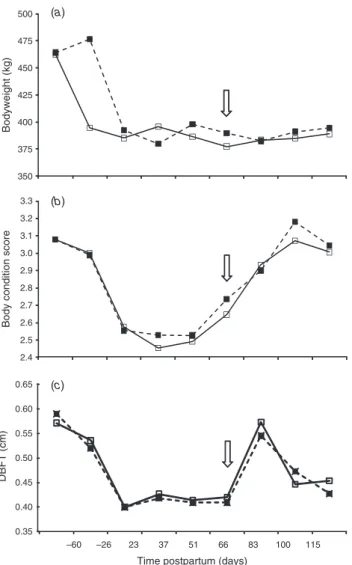
Both treatment groups had comparable BCS both before or after parturition, and cows from both treatments reached the pre-partum BCS after 100 days postpartum. Likewise, the average weight and the DBFT were similar (P>0.05) in each treatment before parturition and during the experimental trial (Fig. 2). In addition, the coefficient of correlation (r2) between days postpartum and backfat thickness score was 0.40 and 0.31, respectively, in the SSD and NSSD treatments. The lowest point in BCS (nadir) occurred at 37.53.4 days and 22.37.9 days (P<0.01) for the NSSD and SSD treatments, respectively. At the end of the synchronisation program (73 days
Bodyweight (BW) Body condition score (BCS) Dorsal back fat thickness (DBFT)
–60 –23 0
Calving 23
Initiation of energy supplementation
65
Oestrus synchronisation
74 77
Weaning of calves (72 h)
115 Ultrasonography screening of the reproductive tract and the ovaries (US) was performed twice a
week from Day 23 until 115 days postpartum Bodyweight (BW), body condition
score (BCS) and dorsal back fat thickness (DBFT) every 15 days
Time (days)
Energy supplementation
(n = 11, SSD)
No supplementation
(n = 15, NSSD)
postpartum on average), 82% (9/11) of the cows from the SSD treatment ovulated, while only 67% (10/15) of the cows from the NSSD did. However, the difference was not significant, nor was the number of animals that resumed ovarian activity at the end of the experiment; 82% (9/11) in the SSD group and 73% (11/15) in the NSSD group. Finally, the resumption of ovarian activity in both groups was similar (P>0.05), in the SSD (6920.7 days, ranging between 42 to 83 days) and the NSSD (69.86.4 days, ranging between 59 to 73 days) treatments.
As can be seen, the proportion of animals with inactive ovaries decreased over time and, consequently, the number of cows with follicles>9 mm in diameter increased. Coincidentally, after the onset of the nadir for BCS in the SSD (23 days postpartum), an increase in the proportion of animals with follicles above 9 mm in diameter was observed, whereas in the NSSD, this proportion increased after Day 40 postpartum (nadir for this group was observed at 37 days postpartum).
During the intensive scanning, four of six cows ovulated in the SSD treatment and five of six in the NSSD treatment. Cows from the NSSD treatment ovulated faster (although not significantly faster,P>0.05) than did the cows from the SSD treatment (55.8 7.8 and 94.5 21.7 h post withdrawal, respectively). No statistical differences were observed between the treatments in the diameter at the beginning of the scanning (SSD 7.251.4 mm vs NSSD 5 0.8 mm) or at ovulation (SSD 15.21.8 mm vs NSSD 11.01.4 mm).
Discussion
Animals from both treatments had a similar weight, body condition and dorsal backfat throughout the entire experiment. Our data are at odds with the results of other authors (Tegegneet al. 1992; Rekwotet al.2004) where cows that are not supplemented showed a lower reproductive performance, evaluated as late resumption of ovarian activity and low pregnancy rates. The discrepancy might be explained by earlier evidence of Holroydet al.(1979) who observed differences in productive and reproductive parameters between animals given nutritional supplementation only if the control group lost weight. The present study confirmed thisfinding, since both treatments reached their nadir before the beginning of the supplementing phase. Thus, the early restoration of ovarian activity was the consequence of a rapid re-establishment of body condition after calving. In fact, Sinclairet al.(2002) observed that for animals calving with good body condition (BCS 3 at a scale of 1–5), the resumption of ovarian activity and, consequently, thefirst oestrous cycle occur earlier than for peers in poor body condition (BCS of
<2). In fact, in a recent study in lactating dairy cows, Santoset al.
(2009) showed that animals calving at a good BCS (between 3 and 3.5, at a scale of 1–5), 80% of them resumed normal oestrous cycle by 65 days postpartum. These authors also noted a decrease in BCS between parturition and artificial insemination by 1 unit or more, resulted in only ~58% resuming oestrous cycle by 65 days. Additionally, in the same study, primiparous cows have a lower probability (70.2%) to become cyclic than do multiparous cows (80.5%). Even though these observations are based on dairy animals, results can be extrapolated to the conditions observed in beef cows raised in the tropics, in which primiparous animals struggle to recover from the negative energy balance after parturition, therefore delaying the onset of ovarian activity.
During the early postpartum period, nutritional demands exceed dietary intake and cows enter a state of negative energy balance, during which mobilisation of body reserves occurs (Jollyet al.
1995). Dynamics of BW and BCS at the last trimester of pregnancy and during the early postpartum period have an important effect on the resumption of the ovarian activity (Brar and Nanda 2008; Samadiet al.2013). Several studies have shown that animals with an early BW gain after parturition can be associated with an early onset of ovarian activity (Ghoshet al.1993; Rekwotet al.2004; Montiel and Ahuja 2005). The results from the present study concurred with previous data, indicating that once the animals reached their nadir and started to gain body condition and dorsal fat layer, there is a reduction in the number of cows with inactive ovaries. Several studies have suggested that a positive relationship exists between calving and thefirst ovulation and the magnitude of negative energy balance (Selket al.1988; Sinclairet al.2002; Montiel and Ahuja2005). The resumption of ovarian activity is
(a)
driven by many complex interactions between metabolic hormones and the reproductive axis (Hess et al.2005). The evaluation of the nadir and BCS reflects the nutritional balance of the animal and directly relates to the resumption of the ovarian activity (Short
et al.1990). In fact, recent reports by Socaet al.(2014a,2014b) suggested thatflushing cows with 2 kg/day of whole rice bran (86.5% DM, 13.5% CP, 44% neutral detergentfibre and 13.5% ether extract) for 22 days increases the proportion of cows that resume ovarian activity (105 days postpartum) and increases pregnancy rate; additionally, BCS prepartum and at calving influences the metabolic status of the animals. Our results are at odds with the results of other workers (Tegegneet al.1992; Rekwot
et al.2004) who have found that the resumption of ovarian activity usually takes longer than 80 days. In the current study, animals from both groups established normal oestrous cycles earlier than 80 days. The present contribution also underlines the importance of choosing an adequate moment to target a costly intervention such as supplementation, because, in this case, the extra feed had only a slight benefit for the animals. In fact, Vizcarraet al. (1998), and later Socaet al. (2014a), concluded that body condition before calving and after delivery determines to a great extent the onset of ovarian activity. Cows with postpartum anoestrus do not resume their ovarian activity until they reach a bodyweight and condition similar to the one they had when calving. Results from the present study agreed with this concept as our research confirmed that animals in both treatments calved at similar weight, BCS and DBFT, and the subsequent productive performance was similar. This suggestion that cows recover BCS to the similar lever as before calving would have an immediate effect on follicular dynamics and the resumption of ovarian activity.
Additionally, 50% of the animals in each treatment exhibited a follicle larger than 9 mm in diameter after 44 days postpartum, being indicative of the catabolic status of the animal (negative energy balance) coming to a halt, and hence, the animal achieving energetic homeostasis. Finally, despite the fact that the size of the largest follicle at ovulation was not different between the treatments, the discrepancies in the diameter of the follicles indicated that, although ovulations might have occurred, the opportunity for a smaller follicle to stimulate oestrus behaviour and the ability to ovulate and form a functional CL capable of maintaining pregnancy was questionable. Sá Filhoet al.(2010) suggested that inBos indicuscows inseminated at afixed time, the probability to display oestrus after controlled internal drug release removal and having a 10-mm-diameter follicle is ~50%, whereas the likelihood to ovulate with a similar-sized follicle is 80%. Comparablefindings were observed in the present study, where 66% and 83% of the cows from SSD and NSSD ovulated dominant follicles of 15.2 mm and 11.0 mm, respectively.
It is concluded that energy supplementation did not improve the reproductive performance when considering the number of animals that ovulated and formed a CL after treatment. Thus, event is more important as the population of animals used in the present experiment was primiparous cows that tend to delay the resumption of ovarian activity in pasture-based systems (Wiltbank 1970; Adrien et al.2012). It is interesting that animals in both SSD and NSSD had similar responses, questioning the value of the energy supplementation provided in this experiment. Additionally, an early intervention to induce the oestrous cycle may also contribute to increasing the number of cows that form a CL at
the end of the experiment (73% in NSSD and 83% in SSD). Further research is required to investigate the factors affecting the response to supplementation and the relation between the productive and reproductive variables and their influence over the length of the anoestrus postpartum. Also, more research is needed to investigate how nutritional intervention affects the metabolic status of the animals and their reproductive axis.
Acknowledgements
The authors are grateful for the economic support of the government of Mexico through the program for technical assistance of the Secretaría de Relaciones Exteriores.
References
Adrien ML, Mattiauda DA, Artegoitia V, Carriquiry M, Motta G, Bentancur O, Meikle A (2012) Nutritional regulation of body condition score at the initiation of the transition period in primiparous and multiparous dairy cows under grazing conditions: milk production, resumption of postpartum ovarian cyclicity and metabolic parameters. Animal 6, 292–299. doi:10.1017/S175173111100142X
Bossis I, Wettemann RP, Welty SD, Vizcarra JA, Spicer LJ, Diskin MG (1999) Nutritionally induced anovulation in beef heifers: ovarian and endocrine function preceding cessation of ovulation.Journal of Animal Science77, 1536–1546.
Brar PS, Nanda AS (2008) Postpartum ovarian activity in south Asian zebu cattle.Reproduction in Domestic Animals43(Suppl 2), 207–212.
doi:10.1111/j.1439-0531.2008.01163.x
Ciccioli NH, Wettemann RP, Spicer LJ, Lents CA, White FJ, Keisler DH (2003) Influence of body condition at calving and postpartum nutrition on endocrine function and reproductive performance of primiparous beef cows.Journal of Animal Science81, 3107–3120.
Crowe MA (2008) Resumption of ovarian cyclicity in postpartum beef and dairy cows.Reproduction in Domestic Animals 43(Suppl 2), 20–28.
doi:10.1111/j.1439-0531.2008.01210.x
Dawson-Saunders B, Trapp GR (1997)‘Bioestadística médica.’2nd edn. (Manual Moderno: Mexico City, Mexico)
Galina CS, Arthur GH (1989) Review of cattle reproduction in the tropics. Part 3. Puerperium.Animal. Breeding. Abstracts57, 899–910. Ghosh A, Alam MSG, Akbar MA (1993) Effect of urea–molasses–mineral
block supplementation on postpartum ovarian activity in zebu cows. Animal Reproduction Science82–83, 349–360.
Hess BW, Lake SL, Scholljegerdes EJ, Weston TR, Nayigihugu V, Molle JDC, Moss GE (2005) Nutritional controls of beef cow reproduction. Journal of Animal Science83(E Suppl), E90–E106.
Hoffman DP, Stevenson JS, Minton JE (1996) Restricting calf presence without suckling compared with weaning prolongs postpartum anovulation in beef cattle.Journal of Animal Science74, 190–198. Holroyd RG, Arthur BA, Mayer BG (1979) Reproductive performance of
beef cattle in northwestern Queensland.Australian Veterinary Journal
55, 257–262. doi:10.1111/j.1751-0813.1979.tb00391.x
Jolly PD, McDougall S, Fitzpatrick LA, Macmillan KL, Entwistle KW (1995) Physiological effects of undernutrition on postpartum anoestrus in cows. Journal of Reproduction and Fertility49(Suppl), 477–492.
Montgomery GW, Scott IC, Hudson N (1985) An interaction between season of calving and nutrition on the resumption of ovarian cycles in postpartum beef cattle.Journal of Reproduction and Fertility73, 45–50. doi:10.1530/ jrf.0.0730045
Montiel F, Ahuja C (2005) Body condition score and suckling as factors influencing the duration of postpartum anestrus in cattle: a review.Animal Reproduction Science85, 1–26. doi:10.1016/j.anireprosci.2003.11.001
cattle: effects of anticoagulant, time and temperature of incubation. Theriogenology35, 965–975. doi:10.1016/0093-691X(91)90307-Y
Pullan NB (1979) Productivity of White Fulani cattle on the Jos Plateau, Nigeria. I. Herd structures and reproductive performance. Tropical Animal Health and Production11, 231–238. doi:10.1007/BF02237810
Rekwot PI, Akinpelumi OP, Sekoni VO, Eduvie LO, Oyedipe EO (2004) Effects of nutritional supplementation and exposure to bulls on resumption of postpartum ovarian activity in Bunaji (Bos indicus) cattle.Veterinary Journal (London, England)167, 67–71. doi:10.1016/ S1090-0233(02)00266-6
Rhodes FM, Entwistle KW, Kinder JE (1996) Changes in ovarian function and gonadotropin secretion preceding the onset of nutritionally induced anestrus inBos indicusheifers.Biology of Reproduction55, 1437–1443.
doi:10.1095/biolreprod55.6.1437
Richards MW, Spitzer JC, Warner MB (1996) Effects of varying levels of postpartum nutrition and body condition at calving on subsequent reproductive performance in beef cattle.Journal of Animal Science62, 300–306.
Sá Filho MF, Crespilho AM, Santos JEP, Perry GA, Baruselli PS (2010) Ovarian follicle diameter at timed insemination and estrous response influence likelihood of ovulation and pregnancy after estrous synchronization with progesterone or progestin-based protocols in suckledBos indicuscows.Animal Reproduction Science120, 23–30.
doi:10.1016/j.anireprosci.2010.03.007
Samadi F, Phillips NJ, Blache D, Martin GB, D’Occhio MJ (2013) Interrelationships of nutrition, metabolic hormones and resumption of ovulation in multiparous suckled beef cows on subtropical pastures. Animal Reproduction Science137, 137–144. doi:10.1016/j.anireprosci. 2012.12.012
Santos JEP, Rutigliano HM, Sá Filho MF (2009) Risk factors for resumption of postpartum estrous cycles and embryonic survival in lactating dairy cows.Animal Reproduction Science110, 207–221. doi:10.1016/ j.anireprosci.2008.01.014
SAS Institute Inc (2004) ‘SAS OnlineDoc® 9.1.2.’(SAS Institute Inc.: Cary, NC)
Selk GE, Wettemann RP, Lusby KS, Oltjen JW, Rasby SL, Garmendia JC (1988) Relationship among weight change, body condition and
reproductive performance of range beef cows. Journal of Animal Science66, 3153–3159.
Short RE, Bellows RA, Staigmiller RB, Berardineli JG, Custer EE (1990) Physiological mechanisms controlling anestrus and infertility in postpartum beef cattle.Journal of Animal Science68, 799–816. Silva SR, Gomes MJ, Dias-da-Silva A, Gil LF, Azevedo JMT (2005)
Estimationin vivoof the body and carcass chemical composition of growing lambs by real-time ultrasonography.Journal of Animal Science
83, 350–357.
Sinclair KD, Revilla R, Roche JF, Quintans G, Sanz A, Mackey DR, Diskin MG (2002) Ovulation of thefirst dominant follicle arising after day 21 postpartum in suckling beef cows.Animal Science75, 115–126. Soca P, Carriquir M, Claramunt M, Gestido V, Meikle A (2014a) Metabolic
and endocrine profiles of primiparous beef cows grazing native grassland. 1. Relationships between body condition score at calving and metabolic profiles during the transition period. Animal Production Science54, 856–861.
Soca P, Carriquiry M, Claramunt M, Ruprechter G, Meikle A (2014b) Metabolic and endocrine profiles of primiparous beef cows grazing native grassland. 2. Effects of body condition score at calving, type of suckling restriction andflushing on plasmatic and productive parameters. Animal Production Science54, 862–868.
Spitzer JC, Morrison DG, Wettemann RP, Faulkner LC (1995) Reproductive responses and calf birth and weaning weights as affected by body condition at parturition and postpartum weight gain in primiparous beef cows.Journal of Animal Science73, 1251–1257.
Tegegne A, Entwistle KW, Mukasa-Mugerwa E (1992) Effects of supplementary feeding and suckling intensity on postpartum reproductive performance of small East African zebu cows.Theriogenology38, 97–106.
doi:10.1016/0093-691X(92)90221-C
Vizcarra JA, Wettemann RP, Spitzer JC, Morrison DG (1998) Body condition at parturition and postpartum weight gain influence luteal activity and concentrations of glucose, insuline, and nonesterified fatty acids in plasma of primiparous beef cows.Journal of Animal Science76, 927–936. Williams GL (1990) Suckling as a regulator of postpartum rebreeding in
cattle: a review.Journal of Animal Science68, 831–852.
Wiltbank JN (1970) Research need in beef cattle reproduction. Journal of Animal Science31, 755–762.