
Using online thesis generators to write persuasive essays in EFL with secondary school students
133
0
0
Texto completo
(2) DOCUMENTO DIGITAL PARA REPOSITORIO El presente formulario debe ser diligenciado en su totalidad como constancia de entrega del documento para ingreso al Respositorio Digital (Dspace). Using Online Thesis Generators to Write Persuasive Essays in EFL with Secondary School Students TITULO SUBTITULO Tinoco Restrepo, Katya Bibiana AUTOR(ES) Apellidos, Nombres (Completos) del autor(es) del trabajo. PALABRAS CLAVE (Mínimo 3 y máximo 6). Planteamientos de tésis. Reacciones de estudiantes. Composición. Auto-reflexión. Retroalimentación. RESUMEN DEL CONTENIDO (Mínimo 80 máximo 120 palabras). Fomentar estrategias de escritura en EFL / ESL ha ocasionado que los programas institucionales reconozcan su importancia. En secundaria, los procesos de escritura con énfasis en productos finales tienen limitaciones de tiempo, poca retroalimentación significativa y falta de claridad y cohesión. Este estudio propone usar generadores de tesis en línea para ayudar a estudiantes de secundaria a escribir declaraciones de tesis claras para ensayos persuasivos más cohesivos y coherentes. También propone una metodología concreta de auto-reflexión durante la etapa de preescritura acompañada de retroalimentación. Los resultados revelaron que aunque la precisión lingüística obstaculizó usar los generadores de tesis en línea, estos fueron bien acogidos para producir y organizar ideas. Además, la retroalimentación fue útil para mejorar la competencia lingüística. Autorizo (amos) a la Biblioteca Octavio Arizmendi Posada de la Universidad de La Sabana, para que con fines académicos, los usuarios puedan consultar el contenido de este documento en las plataformas virtuales de la Biblioteca, así como en las redes de información del país y del exterior, con las cuales tenga convenio la Universidad. De conformidad con lo establecido en el artículo 30 de la Ley 23 de 1982 y el artículo 11 de la Decisión Andina 351 de 1993, “Los derechos morales sobre el trabajo son propiedad de los autores”, los cuales son irrenunciables, imprescriptibles, inembargables e inalienables..
(3) 1 USING ONLINE THESIS GENERATORS TO WRITE PERSUASIVE ESSAYS IN EFL WITH SECONDARY SCHOOL STUDENTS. Using Online Thesis Generators to Write Persuasive Essays in EFL with Secondary School Students. Katya Bibiana Tinoco Restrepo. Master in English Language Teaching – Autonomous Learning Environments Department of Foreign Languages and Cultures Universidad de la Sabana Chía, 2012.
(4) 2 USING ONLINE THESIS GENERATORS TO WRITE PERSUASIVE ESSAYS IN EFL WITH SECONDARY SCHOOL STUDENTS. Using Online Thesis Generators to Write Persuasive Essays in EFL with Secondary School Students. By: Katya Bibiana Tinoco Restrepo. Submitted in fulfillment of the requirements for the degree of Master in English Language Teaching – Autonomous Learning Environments. Directed by: David Shepherd. Master in ELT – Autonomous Learning Environments Department of Foreign Languages and Cultures Universidad de la Sabana Chía, 2012.
(5) 4 USING ONLINE THESIS GENERATORS TO WRITE PERSUASIVE ESSAYS IN EFL WITH SECONDARY SCHOOL STUDENTS. Acknowledgements First of all, I would like to thank God because he gave me faith, strength and endurance to withstand the hardship and stressing moments during the last 3 years. My utmost gratitude goes to my thesis director, Mr. David Shepherd for his guidance and advice. Even though you did not have to, your constant suggesting to adapt my discourse to a more academic writing style by upgrading the wording of various parts of the document and your continuous positive feedback on my analytical skills throughout the entire process were definitely something that had a great impact on my work and on my own vision of English Language Teaching. My thanks and appreciation goes to my Action Research Seminar teacher, Luz Dary Arias and my Action Research Project teacher, Liliana Marcela Cuesta Medina. Your comments on my research project report were really useful and greatly contributed to improve it. You really made me see things I had not considered in the theoretical framework, the research design and the analysis of the data. I consider myself very much indebted to all my professors at the Master’s program for their patience and support. I thank Ms. Maureen Fleming de Perez for allowing me to carry out my research implementation at Colegio Gran Bretaña. Also, Michelle Coleman and Joanna Dench at for their trust in me and for permitting me not only to take this opportunity to acquire the knowledge and expertise to continue growing as a teacher-professional but also to use more of the allotted time for the English Language Support classes to be able to complete my implementation phase. I would also like to thank my students in year 10 at Colegio Gran Bretaña for their collaboration during the implementation and data collection processes. Not only did I learn a lot from them, but I also had a great time being your teacher. Above all, I thank my children,.
(6) 5 USING ONLINE THESIS GENERATORS TO WRITE PERSUASIVE ESSAYS IN EFL WITH SECONDARY SCHOOL STUDENTS. Nicolas and Bibiana and my parents Rosmery and Luis, who stood beside me and were patient enough to endure long days without my presence. Whenever is the time of a new great achievement, I know it was because of my mom’s prayers and love. I hope I can make it up to you four for the time the Master’s program took from us. Finally, I would like to thank Diana Sanchez Lujan for encouraging me along the whole Master’s and for being my only companion in most of my sleepless nights..
(7) 6 USING ONLINE THESIS GENERATORS TO WRITE PERSUASIVE ESSAYS IN EFL WITH SECONDARY SCHOOL STUDENTS. Abstract In recent years, there has been a growing interest in the teaching of writing strategies in the EFL/ESL high school classrooms. This is reflected in how institutional programs and textbook series regard writing management as crucial in the L2 learning environment. In this sense, nonetheless, high school classrooms have become spaces for product writing processes in which time constraints have made writing as process and implementation of feedback very difficult tasks to achieve. This has resulted in lack of clarity and cohesion in essays of different types, not to mention the scarce provision of meaningful feedback to aid students accomplish better products. This study focuses on the use of online thesis generators to help 16 students in year 10 in an international school in Bogota (following the National Curriculum of England and Wales) write clearer thesis statements to achieve more cohesive and coherent persuasive essays. The study proposes a concrete methodology to create self-awareness of the pre-writing stage and the use of feedback to improve final products. Findings revealed that although the use of online thesis generators posed some problems to students in terms of accuracy, they were well-accepted because of the advantages to generate and organize ideas. Also, the provision of feedback was very much appreciated because of the possibility to improve linguistic competence despite the fact that it not always ensured students’ better performance in writing.. Key Words: thesis statements, writing, feedback, learner reactions, self-awareness.
(8) 7 USING ONLINE THESIS GENERATORS TO WRITE PERSUASIVE ESSAYS IN EFL WITH SECONDARY SCHOOL STUDENTS. Resumen En los últimos años, ha habido un creciente interés en la enseñanza de estrategias de escritura en secundaria en donde el inglés se enseña como lengua extranjera o como segunda lengua (EFL / ESL). Esto se refleja en la visión que los programas académicos de los colegios y los libros de texto tienen con respecto a al manejo del proceso de escritura de ensayos como aspecto importante en el aprendizaje de una segunda lengua. Sin embargo, las aulas de la escuela secundaria se han convertido en espacios en los que el proceso de escritura se basa sólo en los ensayos finales ya terminados debido a que las limitaciones de tiempo han hecho del proceso de preparación y escritura de ensayos y la retroalimentación del mismo algo muy difícil de lograr. Como resultado tenemos que la mayoría de los ensayos finales carece de claridad y cohesión por no hablar de escasez de retroalimentación significativa y útil para ayudar a los estudiantes a escribir mejor. Este estudio se centra en el uso de una herramienta en línea que ayudaría a que 16 estudiantes de año 10 de un colegio internacional en Bogotá (que se rige por el Currículum Nacional de Inglaterra) generen enunciados de tesis más claros para así poder escribir ensayos persuasivos más integrados y coherentes. El estudio propone una metodología concreta para crear conciencia de la etapa de preparación y planeación así como del uso de las tecnologías de la comunicación y la información para mejorar los productos finales. Los resultados revelaron que aunque el uso de generadores de tesis en línea planteó algunos problemas a los estudiantes en términos de precisión gramatical, éstos fueron bien aceptados por las ventajas para generar y organizar ideas. Además, la retroalimentación fue muy bien recibida debido a la posibilidad que.
(9) 8 USING ONLINE THESIS GENERATORS TO WRITE PERSUASIVE ESSAYS IN EFL WITH SECONDARY SCHOOL STUDENTS. los estudiantes tenía para mejorar la competencia lingüística a pesar de que no siempre dicha retroalimentación garantizó un mejor desempeño en la parte escrita.. Palabras Clave: planteamientos de tésis, composición, retroalimentación, reacciones de estudiantes, conocimiento de uno mismo.
(10) 9 USING ONLINE THESIS GENERATORS TO WRITE PERSUASIVE ESSAYS IN EFL WITH SECONDARY SCHOOL STUDENTS. Table of Contents Acknowledgements ......................................................................................................................... 4 Abstract ........................................................................................................................................... 6 Resumen.......................................................................................................................................... 7 Table of Contents ............................................................................................................................ 9 Introduction ................................................................................................................................... 12 Statement of the Problem .............................................................................................................. 14 Research Questions ....................................................................................................................... 17 Main Question ........................................................................................................................... 18 Sub-question .............................................................................................................................. 18 Research Objectives ...................................................................................................................... 18 Rationale ....................................................................................................................................... 18 Theoretical Framework ................................................................................................................. 25 Approaches to Teaching L2 Writing............................................................................................. 26 Process Approach to Writing .................................................................................................... 27 Prewriting. ............................................................................................................................. 29 Drafting. ................................................................................................................................ 30 Revising and Editing. ............................................................................................................ 31 Publishing. ............................................................................................................................ 32 Genre Approach to Writing ....................................................................................................... 33 Technology as a writing learning tool .......................................................................................... 34 Computer Assisted Language Learning (CALL) ...................................................................... 35 Feedback ....................................................................................................................................... 38 Research Design............................................................................................................................ 42 The Educational Context at Colegio Gran Bretaña....................................................................... 45 Students’ profile ............................................................................................................................ 48 Role of the Researcher .................................................................................................................. 50 Data Collection Instruments ......................................................................................................... 52.
(11) 10 USING ONLINE THESIS GENERATORS TO WRITE PERSUASIVE ESSAYS IN EFL WITH SECONDARY SCHOOL STUDENTS. Surveys ...................................................................................................................................... 52 Teacher’s Reflective Journal ..................................................................................................... 53 Students’ Structured Logs ......................................................................................................... 54 Classroom Documents (Artifacts in Portfolios) ........................................................................ 55 Data Collection Procedures........................................................................................................... 55 Preliminary Survey.................................................................................................................... 55 Students’ Structured Logs ......................................................................................................... 56 Final Survey .............................................................................................................................. 56 Classroom Documents............................................................................................................... 57 Design and Validation of the Instruments and Procedures ........................................................... 57 Surveys and Structured Logs..................................................................................................... 57 Ethical Considerations involved in Data Collection and Analysis ............................................... 58 Pedagogical Intervention and Implementation ............................................................................. 60 Methodology ................................................................................................................................. 60 Research Implementation Preliminary Lesson Plan ..................................................................... 65 Results and Data Analysis ............................................................................................................ 69 Data Analysis Methods ................................................................................................................. 69 Data Management ......................................................................................................................... 70 Data Reduction.............................................................................................................................. 70 Open Coding ............................................................................................................................. 71 Axial Coding ............................................................................................................................. 73 Selective Coding ....................................................................................................................... 75 Core Category ....................................................................................................................... 76 Categories ..................................................................................................................................... 77 Category 1: Developing awareness of the pre-writing stage (generation and organization of ideas using the Online Thesis Generator) ................................................................................. 78 Category 2: The use of feedback during the writing process .................................................... 84 Conclusions and Pedagogical Implications .................................................................................. 90 Conclusions related to the main research question ....................................................................... 90.
(12) 11 USING ONLINE THESIS GENERATORS TO WRITE PERSUASIVE ESSAYS IN EFL WITH SECONDARY SCHOOL STUDENTS. Conclusions related to the sub-question: ...................................................................................... 92 Conclusions related to the research objective ............................................................................... 93 Other Conclusions ......................................................................................................................... 96 Recommendations and Limitations............................................................................................... 97 Pedagogical Implications and Further Research ......................................................................... 100 Pedagogical Implications ........................................................................................................ 100 Further Research ..................................................................................................................... 101 References ................................................................................................................................... 102 Appendixes ................................................................................................................................. 107 Appendix 1: CGB Academic Program ....................................................................................... 107 Appendix 2: Pre-Test .................................................................................................................. 108 Appendix 3: Preliminary Survey ................................................................................................ 110 Appendix 4: Midterm Students’ Structured Log ........................................................................ 114 Appendix 5: Final Students’ Structured Log .............................................................................. 115 Appendix 6: Final Survey ........................................................................................................... 116 Appendix 7: Self-correction Codes ............................................................................................. 120 Appendix 8: Letter of Consent to the Director ........................................................................... 121 Appendix 9: Letter of Consent to Parents ................................................................................... 123 Appendix 10: Research Project Informed Consent to students .................................................. 125 Appendix 11: Research Project Timeline (Action Plan)............................................................. 126 Appendix 12: Transcription of Participants’ Responses to Surveys and Structured Logs ......... 127 Appendix 13: Color Coding Categories Main Question ............................................................. 128 Appendix 14: Color Coding Categories Sub-Question............................................................... 129 Appendix 15: Research Implementation Lesson Plan ................................................................ 130.
(13) 12 USING ONLINE THESIS GENERATORS TO WRITE PERSUASIVE ESSAYS IN EFL WITH SECONDARY SCHOOL STUDENTS. Introduction. The aim of most of the work carried out in Foreign Language (FL) classrooms is to improve learners’ linguistic and communicative competences. In many language teaching and learning environments students are expected to learn the language and use it for communicative purposes in the four language skills. In addition, there is a considerable emphasis on the use of language as a means to convey ideas through writing and how those ideas should match form in order to ensure there is a clear intended meaning conveyed to an intended reader. In many English Language Teaching (ELT) contexts, writing is undoubtedly a required task so as to help students refine their thinking and planning skills. Nevertheless, writing tasks have become stressful practices because learners experience difficulties generating ideas and usually do not have sufficient time to organize their thoughts within a given period of time. Similarly, English language teachers can consider writing tasks as time-consuming due to the fact that there is usually not enough time to provide customized and content-based feedback regularly. Despite these drawbacks, several authors and researchers have confirmed the importance that substantial amounts of time will have to be devoted to the teaching of writing because of the influence this skill has on formal education. A research study done by Arndt (1987) suggested that learners have little awareness of the nature of writing; thus, the demand it poses to its production ought to be taken into consideration and included within instruction. Similarly, Fidalgo et al. (2010) recognize the fact that writing is a very complex activity in which a combination of several cognitive and self-regulation strategies is required as well as the application of various mental processes.. Therefore, in their studies, strategy focused instruction has proven to have a.
(14) 13 USING ONLINE THESIS GENERATORS TO WRITE PERSUASIVE ESSAYS IN EFL WITH SECONDARY SCHOOL STUDENTS. beneficial effect in the knowledge and understanding of writing strategies to improve students’ writing processes. As far as writing approaches are concerned Fidalgo et al. (2010) consider that the shift from a product-oriented approach to a process approach to writing has brought forth not only conceptual changes in writing instruction but also a development of methods and techniques to facilitate and improve the writing processes. When teaching writing, it is important to clarify if whether what is expected from writing is no more than a finished product, or whether the process that underlies such production. On the one hand, a product approach (Badger & White, 2000) usually controls what happens in an FL classroom and its main focus is on linguistic knowledge i.e. appropriate use of lexicon, syntax and cohesion. On the other hand, a process approach, which according to Olive (2010) is a real-time or on-line method to track the writing process by coming back to the text as many times as necessary to improve it, emphasizes activities that involve generation of ideas and collection of data, and much more emphasis is made on linguistic skills such as pre-writing, drafting, revising, and editing to reach a finished product (Tribble, 1996 as cited in Badger, 2000). This study focuses on the use of online thesis generators to help 16 EFL/ESL students in year 10 in an international school in Bogota (following the National Curriculum of England and Wales) to write clearer thesis statements, which this teacher-researcher considers of special importance in attempting to achieve more cohesive and coherent persuasive essays. According to Muller and Lan (2010, p. 8) a thesis statement is vital to be successful in persuasive writing due to the fact that it focuses and announces a writer’s argument and helps the writer “think through the issues and decide which points are relevant”. The study proposes a concrete methodology to.
(15) 14 USING ONLINE THESIS GENERATORS TO WRITE PERSUASIVE ESSAYS IN EFL WITH SECONDARY SCHOOL STUDENTS. create self-awareness of the pre-writing stages and the use of feedback throughout the writing process to improve final products.. Statement of the Problem. Foreign language teachers and learners around the globe greatly focus their attention on writing in a foreign or second language due to the social value that society places on this activity and which is a clear sign of well-rounded education, self-reflection abilities, originality and even creativity. In view of the fact that the teaching of writing in the ELT world is recognized as a way to facilitate the development of language proficiency, school programs in which English is not a dominant language have started to introduce L2 writing in a variety of contexts and situations. In a study by Rinnert and Kobayashi (2009), it was identified that L2 writing is mainly characterized by explicit instruction on rhetorical features (organization, coherence and cohesion) of the texts produced by students. The study made evident the fact that after following a process writing approach, high-quality products were achieved by most students. Additionally, in a local research done by Edgar Mendoza (2005), it was found that writing instruction in most of Colombian schools follow a product oriented approach. As opposed to these findings, Viáfara (2008) reports that there have been local studies, which conclude that writing skills in our country support learner’s expressions and creativity at the same time as they develop knowledge and communicative skills..
(16) 15 USING ONLINE THESIS GENERATORS TO WRITE PERSUASIVE ESSAYS IN EFL WITH SECONDARY SCHOOL STUDENTS. Specifically at Gran Bretaña School (henceforth CGB), in Bogota, all subjects are taught in English and followed the syllabi defined by the National Curriculum of England and Wales. The main characteristics of this curriculum are English as the language of instruction and the introduction to global perspectives and social studies. At the secondary level, students follow the International General Certificate of Secondary Education (IGCSE) in years 10 and 11 (see Appendix 1) while in years 12 and 13 they follow the International Baccalaureate (IB) Diploma Program. As an English Language Support (ELS) teacher for secondary at CGB, the teacherresearcher has had the opportunity to work hand in hand with the English literature teachers. During the first year in those classes, the researcher witnessed that secondary students are asked to write persuasive essays on a regular basis for their literature classes as part of the text analysis tasks. These written tasks are usually the product of reading and analyzing fragments extracted from literary texts or they can also be related to the provision of an answer to a question given by the teacher. This, one might be tempted to say, is a common practice seen in high school settings; however, the writing processes undertaken at CGB are much more product oriented basically because there is little time to devote to the whole process of continually guiding the various written tasks. This approach is adopted because schemata for writing is taken for granted at this stage of students’ learning process. Moreover, year 10 is the first year in secondary in which students are exposed to the IGCSE-type writing examinations, which students have to sit for in year 11. Such examinations require a highly specialized type of communicative competence in writing persuasive, informative, analytical, imaginative, descriptive and narrative texts..
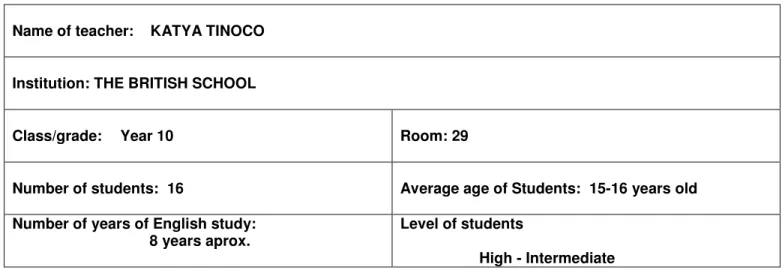
(17) 16 USING ONLINE THESIS GENERATORS TO WRITE PERSUASIVE ESSAYS IN EFL WITH SECONDARY SCHOOL STUDENTS. Nevertheless, after working with the same 16 students in year 9 and having applied a prewriting test (see Appendix 2) the researcher was able to observe that, although these students made an attempt to write essays, they failed in writing a well-structured paper in which there was evidence of a planning stage followed by an introductory paragraph presenting their thesis statement, in addition to content paragraphs, which provided evidence to support their opinion provided in the thesis statement. Also, papers lacked clearer conclusions to summarize the main points and re-state their thesis. These failures not only affected students’ results in writing assignments but also tended to create a sense of insecurity and little motivation to write, as the results of the preliminary survey (see Appendix 3) highlighted. in this survey, generally speaking, most participants claimed that writing assignments were not motivating due the fact that they did not feel skilled at them or because they did not know how to write a thesis statement. The need, therefore, was to find a tool that could possibly help students create sound thesis statements so as to make sure that essays would be developed around a core idea. With this in mind, the teacher-researcher states that through the use of an online tool called “online thesis generators”. such. as. the. ones. found. in. Tom. March. Thesis. Generator. site. chttp://www.mpcfaculty.net/molly_may/thesis_generator.html, students could possibly receive better guidance and help to generate thesis statements and outlines that would allow them to write and concentrate on the opinions and opposition to the essay topics. Online thesis Generators take students through a series of steps to assist them in producing a thesis statement that can be used as model to write persuasive or argumentative essays. In fact, with a good thesis.
(18) 17 USING ONLINE THESIS GENERATORS TO WRITE PERSUASIVE ESSAYS IN EFL WITH SECONDARY SCHOOL STUDENTS. statement, students are very likely to convince readers about a logical point of view as well as being able to inform the audience about the reasons or evidence that support their claim as a preview of the entire essay. As stated by Pennington (2001, p.26), the most important part of a multi-paragraph essay is a well-worded thesis statement that states the point to be proved or the purpose. Additionally, on-going, formative and useful feedback which, in turn, will create awareness of the writing process as a whole, might avoid learners having a lack of desire to write in class and being afraid of making mistakes; this is because when feedback is planned and specific, it is much more likely to influence students’ performance. Good quality feedback allows teachers to not only to correct students’ writing but also encourage them to apply good writing practices and adopt appropriate learner behaviors (Paltridge, et al., 2009).. Research Questions. When teachers of literature at CGB marked students-generated essays, students’ effort was usually acknowledged. However, although the content may be praiseworthy, essays did not always receive very high grades for they may be seen as lacking in either grammatical or lexical cohesion or in discourse coherence at times. Subsequently, they would well give general recommendations on how to improve their papers in efforts to achieve a passing grade. However, appropriate guidance in the writing process as follow-up to make improvements was rarely provided. The way the assessment process for writing was done at CGB made the teacher-.
(19) 18 USING ONLINE THESIS GENERATORS TO WRITE PERSUASIVE ESSAYS IN EFL WITH SECONDARY SCHOOL STUDENTS. researcher believe that explicitly training students’ on how to prepare persuasive essays by planning, creating thesis statements, generating outlines, drafting and revising and editing would allow them to better structure essays, upgrade their writing skills and feel more confident with their writing abilities. The following question guided the inquiry: Main Question Do online thesis generators help EFL secondary students when writing persuasive essay thesis statements and do students think they help? Sub-question What is the effect of feedback in the writing process? Research Objectives To determine how year-10 students’ persuasive essays are influenced by the use of online thesis generators to help them write thesis statements. Rationale. It has been shown that the L1 and L2 writing processes can be very similar despite the linguistic difficulties learners might have (Arndt, 1987, p. 258). Similarly, discourse types pose problems for students to write in L2, which makes the introduction of genre approaches (Badger & White, 2000, p. 156) a potentially crucial component of FL curricula to develop language-related skills, especially for writing, at the same time as content is delivered. The genre approach may be.
(20) 19 USING ONLINE THESIS GENERATORS TO WRITE PERSUASIVE ESSAYS IN EFL WITH SECONDARY SCHOOL STUDENTS. considered as very similar to the product approach in the sense that both consider writing as linguistic knowledge, the genre approach, however, takes also into account the social context in which writing will be produced. Most students at the secondary level CGB, as well as most of the student community, come from different cultural settings and speak languages other than English. Therefore, their writing skills are not fully standardized, and in some cases writing is not very well-developed, which often provokes lack of motivation. As argued by Hyland (2007, p. 149), “students bring different identities, understandings, and habits of meaning-making to their learning, and teachers cannot assume that students’ previous learning experiences will provide them with appropriate writing schemata.” Therefore, the idea of developing writing skills within the curriculum was intended to engage them directly with content and enhance motivation. Thus, by making this connection, learners would be led to explore, oppose and make connections between ideas; processes which in turn could well lead to learning, which, when applied to curriculum and other subjects, would encourage the development of other content-related skills (Boughey, 1997, p. 126).. By. providing learners with the necessary tools, which enable them to express themselves in writing and achieve specific outcomes, certain of the learners may well feel confident enough to opt for more than writing very simple and maybe off-topic texts, which, in turn, may lead to improved writing in terms of a better structured essay. The idea that “students naturally learn to write by writing and that the more they write, the better writers they become” (Dyer, 1996, p.313) seemed to be the guiding principle at CGB..
(21) 20 USING ONLINE THESIS GENERATORS TO WRITE PERSUASIVE ESSAYS IN EFL WITH SECONDARY SCHOOL STUDENTS. While the researcher was providing English Language Support (ELS) to students in Key Stage 3 and 4 (see Appendix 1) during their English literature classes, she was never able to observe a process approach to writing in which students had the possibility to brainstorm, plan, draft and revise and edit their writing tasks. This definitely was due to the fact that by the time students started their secondary education, they had already been exposed to the different writing stages during their primary education. Therefore, the process writing approach was taken for granted and students were expected to apply it in an autonomous way for each and every writing task assigned. Therefore, literature teachers would assign writing tasks on a weekly basis so that students would have enough writing practice and of various types; which at the end, would help students be ready for their final or international examinations. Thus, one may be tempted to say that the fact that these writing tasks lacked the concept that writing needs to be geared to achieving specific purposes directed to a target reader, there should be a focus on a product/process approach with emphasis on genre in order to facilitate and narrow the communication process through writing. However, only a product approach to writing was clearly observed for all the writing tasks. To provide students with the necessary tools to facilitate written expression and the achievement of specific objectives would not be possible through only a process approach to writing. Innovative technology in the L2 writing classroom so as to make the writing process easier and more appealing to students is also a way of being up-to-date with the influence technologies such as computers and word processors as well as the Internet and the World Wide Web. By using new technologies in writing instruction such as Online Writing Labs (OWLs).
(22) 21 USING ONLINE THESIS GENERATORS TO WRITE PERSUASIVE ESSAYS IN EFL WITH SECONDARY SCHOOL STUDENTS. (Hyland, 2003), practitioners have tried to remedy some of the difficulties students have during academic writing. One of these difficulties, which was identified in the preliminary test (see Appendix 2) is the generation of a clear thesis statement as an initial stage to write any kind of essay. A possible solution to this problem has been attempted by employing online thesis generators, which guide learners through the writing process by means of questioning them about the topic they want to write about, ensuring the creation of a positive thesis statement, and generating an outline which might well help students to achieve improved essay structures at a later stage. It may also be argued that coming to terms with the actual content and organization of texts is of paramount importance to facilitate clear communication and successful compositions. Therefore, if students can make use of tools contained in OWLs such as the thesis Generators/generators, this could be a way of writing better thesis statements and actually imitating models to better learn how a thesis statement is worded. In reference to writing genres, there is enough information about persuasive writing both on paper and online, though it seems CGB students did not conduct prior research on how to write a persuasive essay despite the fact that at CGB, access to the Internet is unlimited and everyone has the possibility to manipulate their own laptop computers. Therefore, digital resources could be accessed through electronic networks or even downloaded into the learners’ own computers and stored for later use. Similarly, all the Internet-based activities could be incorporated into the regular face-to-face classes at CGB so as to have mixed-mode classes (Bates, 2005, p. 21), which could provide teachers with the opportunity to combine traditional teaching with online instruction. According to Bates (2005), mixed-mode classes have proven to.
(23) 22 USING ONLINE THESIS GENERATORS TO WRITE PERSUASIVE ESSAYS IN EFL WITH SECONDARY SCHOOL STUDENTS. improve quality of learning outcomes; thus, in this particular study, such a method of teaching, in which process approach to writing, e use of thesis generators, together with the provision of continuous teacher feedback, may result in having a favorable effect in students writing processes, skills and products. Attempts to understand the influence of online thesis generators to overcome failure in form and content of persuasive essays in an EFL/ESL class at an international IB school ought to bring about important theoretical and practical outcomes. Theoretically speaking, this study provided the research community interested in the influence of online thesis generators on persuasive writing with a different understanding of the writing process that learners need to go through when writing persuasive essays. From a practical perspective, this study also attempted to contribute with students’ learning and development of writing skills. Given that it had a practical intervention component, this study allowed the teacher-researcher to devise teaching practices that eventually would help students create and consolidate tools to prepare and actually carry out persuasive writing when taking their IGCSE English practice tests as well as when preparing for other kinds of written discourse types for the different academic subjects year-10 students take at CGB. One final line of justification for carrying out this study was related to the growth as a teacher-researcher. In my seventeen-year experience of teaching English the researcher has seen how her colleagues (and also herself) constantly complain about students’ written products. In these casual conversations, students’ faulty written products are usually accounted for by referring to their carelessness for writing or even their lack of aptitude to write in L2. As a result,.
(24) 23 USING ONLINE THESIS GENERATORS TO WRITE PERSUASIVE ESSAYS IN EFL WITH SECONDARY SCHOOL STUDENTS. the teacher-researcher hoped she would be more aware of the needs students have when facing new and more challenging writing tasks at CGB school. She expected that by the implementation of online thesis generators and the provision of continuous feedback, both as part of the writing process approach, students could improve their written products by producing better structured and more coherent and cohesive essays. To understand the process year-10 students need to go through in order to write a persuasive essay could open interesting lines of research in the Colombian EFL classroom. A better understanding of the effect of online thesis Generators on writing might eventually allow English language teachers to fine-tune their own writing sessions, which might be enhanced by a solid theoretical comprehension of students’ writing process and by a growing tolerance and fascination for the processes that the development of their communicative competence undergoes. This project attempted to study the extent to which the use of online thesis generators could have some influence on persuasive essays written by year-10 students from CGB when preparing for the IGCSE English tests. This proposal is organized in six chapters. This first chapter is the introduction which presents the statement of the problem, the research question and objective, and the rationale to carry out the study. The second chapter discusses theoretical framework, which includes theoretical principles related to the constructs and the state of the art of other similar projects made locally and internationally. The third chapter presents the research design, which includes the type of study that will be carried out as well as the researcher’s role, the context, the participants, and the data collection instruments and procedures. Immediately.
(25) 24 USING ONLINE THESIS GENERATORS TO WRITE PERSUASIVE ESSAYS IN EFL WITH SECONDARY SCHOOL STUDENTS. afterwards, the fourth chapter presents the pedagogical intervention and implementation in which the steps and processes to solve the problem will be described. Data analysis and findings will be both presented in chapter five, which will have detailed explanations on how the analysis was conducted: categories, sample data, interpretation of data, comparison with theory and other research projects. Finally chapter six will draw conclusions based on the analysis and will describe how the research questions were responded and the extent to which objectives were achieved. This final chapter will also include limitations the action research teacher had as well as giving recommendations that maybe other teachers could consider if there were a possible replication of this study. Moreover, possible issues for further investigation based on the findings will also be included in this final last chapter..
(26) 25 USING ONLINE THESIS GENERATORS TO WRITE PERSUASIVE ESSAYS IN EFL WITH SECONDARY SCHOOL STUDENTS. Theoretical Framework. The actions that language learners perform when they attempt to write a certain type of text can be examined by analyzing the implications of different theoretical constructs that refer to various approaches to writing and the use of Internet as a massive online database that gives users access to various writing tools. This literature review presents an account on the theories and literature found on the process approach to writing and the use of technology as a learning tool to improve writing. It also explores the concept of feedback as a possible determining factor that may affect quality of writing products. The framework will be organized as follows: First, the researcher presents a historical account of the different approaches there have been to writing and she includes the roles that teachers and students have had throughout time. She also explores the benefits that have been allocated to process writing and a proposal to make the approaches to writing complement each other. Second, the researcher briefly reviews the importance of using technology as a learning tool and reviews certain new technologies such as computers, the Internet and Computer Assisted Language Learning (CALL). Third, the teacher-researcher discusses the concept of feedback as a possible mechanism to help students improve the quality of their writing products. In the different sections of this literature review, the researcher makes reference to theories and research processes in which these concepts have been studied..
(27) 26 USING ONLINE THESIS GENERATORS TO WRITE PERSUASIVE ESSAYS IN EFL WITH SECONDARY SCHOOL STUDENTS. Approaches to Teaching L2 Writing. According to Peregoy and Boyle (2001), when our parents went to school, writing was taught by just giving students topics to write about and this might explain why the teaching of writing to L1 students was, and in many Colombian settings, still is considered to be a parallel process to the teaching of writing in L2. However, principles, perspectives and models of writing definitely need to be clarified and differentiated in both languages so that learners can master both writing processes and become knowledgeable and understanding of writing differences, which in turn are cultural differences to which eventually learners might become tolerant. More specifically and in tandem with this clarification and differentiation of writing models and perspectives, persuasive writing skills both in L1 and L2 also need to be emphasized because, according to Lee (2008, p. 43), undergraduate students present a lack of critical stance when arguing a case. In respect of L2 writing instruction, there have been a succession of orientations which have become dominant during certain periods of time to later be replaced by new ones, which by no means have eradicated their predecessors. In fact, during the present times several of the beliefs to these approaches to writing are drawn upon increasingly as the teaching of writing proceeds. The following section focusses on the process approaches to writing..
(28) 27 USING ONLINE THESIS GENERATORS TO WRITE PERSUASIVE ESSAYS IN EFL WITH SECONDARY SCHOOL STUDENTS. Process Approach to Writing. In the 1970’s researchers found themselves quite unsatisfied with product approaches to writing because, according to Paltridge et al. (2009), controlled composition and currenttraditional rhetoric “ignored individual thought and expression” (p. 66). Consequently, Emig (1994) decided to compare what students and professional writers used to do when they started to write and found out that good writers would focus on ideas first rather than on correctness. Thus, the idea of guiding rather than controlling gained relevance and a new proposal came to surface: To let content, ideas and the need to communicate determine form instead of focusing on form first (Paltridge et al, 2009, p. 66). This plea for focusing on linguistic skills such as prewriting, drafting, revising, editing and publishing intended to release so much importance on linguistic knowledge. Amongst the first attempts to achieve this focus on linguistic skills we can find Jacobs’ (1986) quickwriting (free/loop/speed/flash writing) as a technique for invention used to generate ideas, concentrate on content without worrying about form so as to achieve writing without stopping (p. 282). Clearly, he could also be appointed as one of the pioneers of process writing since he asserts that breaking the writing process down into stages reduces the cognitive load and facilitates that writing projects can be undertaken more easily and successfully provided that things are done one at a time (p.283). Similarly, according to Jacobs (1986) Hilgers’ research (1980) showed that learners exposed to quickwriting produced pieces of writing richer in ideas and better as a whole (p. 283). Furthermore, Arndt (1887) affirms that research findings show that teaching L2 writing as a process centered approach helps inefficient writers become more.
(29) 28 USING ONLINE THESIS GENERATORS TO WRITE PERSUASIVE ESSAYS IN EFL WITH SECONDARY SCHOOL STUDENTS. efficient and enriches knowledge of linguistic resources and how they can be utilized to meet writing demands such as coherence, discourse and formality (p. 265). Similarly, Hamp Lyons (1986) argues that process writing helps writers understand writing strategies and how to use them effectively (p. 316). Additionally, Rogers (2008), also acknowledges the benefits of process writing by claiming that process writing and metacognition are very much interrelated. Thus, during the stages of writing, it is necessary to have moments of planning, editing, and revision, which are all directly related to the metacognitive learning strategies suggested by Chamot and O’Malley (1994, p. 61) i.e. planning, directed attention, selective attention, self-management, self-monitoring, problem identification and self-evaluation. Therefore, this process approach to writing allows learners to choose, reject and revise their own content and help them create the belief that, according to Robinson (1991), it is feasible to empower students and eventually foster autonomy. According to Dyer (1996, p. 313), in process writing, teachers are facilitators who neither assign specific topics or give evaluative criteria nor demonstrate good writing with models or assign grammatical exercises. These teachers believe that students naturally learn to write and the more they write the better writers they become. The process approach to writing places the writer as an independent producer of texts and it goes further to address the issue of what teachers should do to help learners perform a writing task. This writing teaching perspective recognizes the following basic cognitive processes of paramount importance in the writing activity so as to help learners develop abilities to plan, define, propose and evaluate their writing performance: Prewriting, drafting, revising, editing and publishing. Hyland (2003, p. 11) avers that the process approach considers writing as a “non-.
(30) 29 USING ONLINE THESIS GENERATORS TO WRITE PERSUASIVE ESSAYS IN EFL WITH SECONDARY SCHOOL STUDENTS. linear, exploratory and generative process through which writers discover and reformulate ideas until achieving the desired meaning.. Prewriting. This stage allows learners to get started. The teacher’s role is to aid students in finding topics, generating ideas, focusing, and planning the structure and procedure. Students try to decide what they are going to say by brainstorming, collecting data, note taking and outlining. In short, as Sundem describes it (2006, p. 43), writers generate ideas and put their thoughts is order by means of using techniques such as bubbling or outlining. On the one hand, Sundem (2006, p. 44) explains that bubbling implies using mind webs in which all ideas are related to a central topic. These ideas, in turn, would correspond to each one of the paragraphs of the main written text. Sundem affirms that bubbling is the easiest of the prewriting techniques because it lacks strictness and students do not need to have much clarity on how bubbles can correspond to paragraphs. Unlike bubbling, outlining is much more guided and specific for functions and contents of each paragraph need to be described by means of including topic sentences and supporting details. Sundem asserts that once students have been able to organize their ideas in an outline form, they are more likely to produce a functional draft because paragraphing will be really wellmanaged. Nevertheless, he also argues that one of the flaws that derive from outlines is that drafts may sound like “shopping lists” because of the lack of flow in them (p.46). Berger (2008, p. 37) claims that even though outlines set the logical structure of the text, writers might find the need to move ideas from one place to another; which in turn, may save up some time when.
(31) 30 USING ONLINE THESIS GENERATORS TO WRITE PERSUASIVE ESSAYS IN EFL WITH SECONDARY SCHOOL STUDENTS. drafting. However, when drafting starts, some sections of the outlines might need to be eliminated or changed especially because in writing some ideas from the outline do not blend well together. Whether mentally or physically, this part of the planning stage requires that writers consider the purpose of and the audience for their writing as well as the content structure (Harmer, 2004, p. 5), which directly influences the type of text to write, the information to include and the choice of language. When writing essays, part of the prewriting process is to focus the essay subject through the creation of a thesis statement, which clearly identifies the writer’s topic and clarity of thought. According to an article from Pasadena City College issued by the Writing Center (n.d.), a good thesis statement aids readers in understanding and creates an expectation about what will follow in the rest of the essay.. Drafting. During this stage of writing, rewriting is an ongoing process (Berger, 2008, p. the assumption that they will be later amended (Harmer, 2007, p. 113). For this reason, Sundem (2006, p.53) asserts that drafting need not be perfect due to the fact that words can be misspelled, some ideas can be better expressed, punctuation might be unelaborated; aspects which by no means indicate lack of writing ability. Sundem also identifies another feature of the drafting process which is its cyclical process. This means that writers cannot be bound by the outline or bubble they have previously designed. During the writing process, new ideas can arise, these should be inserted and the plan needs to be reorganized. Similarly, former ideas can be crossed out or maybe rewritten until writers feel satisfied with their own products. Similarly, according.
(32) 31 USING ONLINE THESIS GENERATORS TO WRITE PERSUASIVE ESSAYS IN EFL WITH SECONDARY SCHOOL STUDENTS. to Woodward-Kron (2005, p. 38), during the drafting process arguments are organized into paragraphs with each paragraph containing an argument in support of the thesis statement. Sundem (2006, p. 54) suggests that during the process of writing, teachers act as encouragers by providing help, positive and formative feedback as well as by giving students the possibility to share what they have produced with their peers. Drafting, in short, could allow writers to feel successful and motivated with their writing skills.. Revising and Editing. After producing a draft, both teachers and learners respond to the ideas and seek for ways to refine them so as to produce clearer information, better paragraphing, and more appropriate words and/or grammatical accuracy (Harmer, 2004, p. 5). This refinement process might be neglected by the majority of writers because of the belief that the writing task has already been finished. However, Sundem (2006, p. 55) asserts that “the greatest potential for learning lies in revising” since writers can develop several techniques to improve their writing, which later on they can replicate in other drafting experiences. Sundem avers that revising implies knowing the mechanics of revision such as having direct annotation on drafts, recopying onto new pages, adding or deleting information and modifying large-scale organizations. Additionally, Sundem (op.cit., p. 56) suggests that writers be trained on identifying specific elements to be revised such as word choices or verb forms under the condition that this specific revision be done one at a time moving from ideas to organization, word choice, voice and sentence fluency..
(33) 32 USING ONLINE THESIS GENERATORS TO WRITE PERSUASIVE ESSAYS IN EFL WITH SECONDARY SCHOOL STUDENTS. Even though Berger (2008) does not make a distinction between revising and editing, Sandem (2006), clarifies that revising should not be confused with editing (proofreading) because the former is related to content, whereas the latter is focused on spelling, punctuation and grammar conventions. With this in mind, it is suggested that writers do their own editing before texts are given to a third party on account of the learning opportunity it offers to them. Publishing. This final stage implies the production of a final version, which may look considerably different from the original plan and the first draft, but which is ready to be sent to the intended audience especially because its neatness and presentation will ensure that it is taken seriously. Publishing may have the form of written products shared with peers, oral presentations reporting what has been written or even having the written task published in a magazine of journal. The process described above may present the process approach to writing as a linear one; however, throughout the process, writers continuously discover and reformulate their ideas again and again, sometimes in a chaotic order before actually producing a final version (Hyland, 1996). On balance, product and process approaches to writing allowed teachers tackle writing from a different perspective which could also be complemented with the genre approach to writing, which is considered by Badger and White (2000) as an extension of the product approach. In the genre approach to writing, linguistic skills predominate but much more emphasis is placed on the social context of writing and its purpose, which influences the subject matter, the relationship between writer and audience, and the structure of the text (Badger and White, 2000, p.155). With this said, Badger and White propose three (3) stages to follow during.
(34) 33 USING ONLINE THESIS GENERATORS TO WRITE PERSUASIVE ESSAYS IN EFL WITH SECONDARY SCHOOL STUDENTS. genre approaches: a) model, b) exercises to manipulate language forms according to the purpose of the text, and c) production of a text. Clearly, the genre approach to writing is similar to the product approach to writing inasmuch as language is tied to social purposes and writing is the product of imitation and analysis of input provided by teachers. Distinctly, since writing involves knowledge about language (as in product and genre approaches), knowledge of the context in which writing happens and especially the purpose for the writing (as in genre approaches), and the skills in using language (as in process approaches), Badger and White (2000) propose that the three approaches to writing be synthesized so as to have a more thorough concept of writing and thus, facilitate the teaching of it. Genre Approach to Writing Applications of genre approaches are the product of communicative approaches which stress the role that language plays to achieve a particular purpose in context. Hyland (2007) thus claims that writing varies according to the context, which clearly means that a set of abstract, cognitive and technical abilities cannot produce a specific text type. Genre approaches have strong similarities with process approaches due to the fact that they also make emphasis on a planning-writing-reviewing methodology. However, unlike process approaches, genre approaches go beyond by emphasizing that writing processes vary according to the social contexts in which it is produced (Badger, 2000). The central aspects of each writing situation are purpose, subject matter, writer-audience relationship and writing structure..
(35) 34 USING ONLINE THESIS GENERATORS TO WRITE PERSUASIVE ESSAYS IN EFL WITH SECONDARY SCHOOL STUDENTS. Genre pedagogies have proved to be a real benefit for learners since they enable them to put together language, content and context to communicate an intended message (Hyland, 2007). More specifically, persuasive writing is considered to be one of the types of writing that can be taught following a genre approach. During the planning stage, writers require to apply skills that reflect the ability to think critically and to persuade readers towards a position regarding a given issue. Therefore, Wu (2008) argues that critical analysis is one of the most desirable characteristics of undergraduate writing usually assessed through persuasive essays in which careful rationalization, justification and persuasion techniques need to be foreseen by writers. In a study carried out by Kongpetch (2006) it was clearly demonstrated that process writing and the genre approach had a significant impact on students’ writing due to the fact that clear thesis statements made part of the generic structure of their persuasive essays. Tapscott (2010) has also acknowledged the fact that in persuasive writing thesis statements represent the strongest support for a position and clearly present the conviction of a writer. Thus, in genre approaches to writing, and more specifically in persuasive writing, the claim used for an argument will be more credible if the syntax of the thesis statement is error free.. Technology as a writing learning tool In the field of second language acquisition (SLA) technology is at the students’ and teachers’ fingertips; hence, both teachers and students currently come to the classroom with their own laptops and USB flash drives in order to access theirs or someone else’s written tasks which.
(36) 35 USING ONLINE THESIS GENERATORS TO WRITE PERSUASIVE ESSAYS IN EFL WITH SECONDARY SCHOOL STUDENTS. have been composed on computers, shared electronically and are maybe awaiting for some electronic feedback as well. According to Pennington (1996), the writing skill is “a form of expertise requiring the development of cognitive structures and routines for high-level management and coordination of many different types of physical and mental activity, toward the ultimate goal of expressing the writer’s intended meaning.” (p. 125). For the coordination of the physical and mental activities to take place, it has always been necessary to have certain application of technology, e.g., quills, pencils, typewriters, printing press (Hyland, 2003, p. 144) and obviously computers and the Internet. Consequently, each innovation involves new skills applied in new ways which means that writing is not fixed but constantly evolving and that teachers have seen the need to come to grips with what professionally this means for them. In other words, writing teachers are constantly facing demands to integrate Information and Communication Technologies (ICT) into their classes and this has influenced the way we teach and write and the forms finished writing products take (Hyland, 2003).. Computer Assisted Language Learning (CALL). By the end of the 1980s, the use of computers for L2 acquisition began to look for ways in which computers could be integrated into task- or project-based approaches through the use of the Internet, which gave birth to the integrative CALL. Integrative CALL allowed students to “communicate directly, inexpensively and conveniently with other L2 speakers” (Warschauer,.
(37) 36 USING ONLINE THESIS GENERATORS TO WRITE PERSUASIVE ESSAYS IN EFL WITH SECONDARY SCHOOL STUDENTS. 1996). As a result, Computer-Mediated Communication (CMC) and the use of the Wide World Web (WWW) have since then facilitated an integrative approach to learning a second language through the use of technology. Hyland (2003) also suggests that theory and technology interact with language teaching and this reflects definite trends in computer-mediated learning (CML) and CALL towards the view that learning depends on the exposure to authentic language and using language for communication (p.166). Pennington (1996) argues that writing on computer and its novelty can produce better attitudes towards writing, less apprehension and anxiety about mistakes, revising, and rewriting and more involvement in psychological and physical terms (p. 125). Similarly, a study by Sun and Chang (2011) revealed that any Web technology with its interactive and collaborative features comes in handy in the process of reconstructing academic writing knowledge. They emphasize the fact that human and computer interaction by itself does not guarantee better education or make students learn unless they are used as platforms to encourage and extend students’ learning along with instructors’ “constant monitoring and timely intervention” (p. 58). Similarly, Ahluwalia, Gupta & Aggarwal (2011) and Rojas (2011) agree in arguing that cutting-edge technologies in language teaching increase effective communication especially by improving writing skills. Additionally, their studies affirm that ICTs instill a high degree of motivation into students because of the transformation of the existing traditional education into a more active and engaging type in which knowledge is applied, analyzed, synthesized, and evaluated. In their study, Ahluwalia, Gupta & Aggarwal (2011) concluded that the use of technology was an attractive and powerful curriculum component which indeed helped.
(38) 37 USING ONLINE THESIS GENERATORS TO WRITE PERSUASIVE ESSAYS IN EFL WITH SECONDARY SCHOOL STUDENTS. students refine and develop their writing skills besides motivating students to have meaningful language learning interactions. In the same manner, Rojas (2011) found that teachers could encourage students to improve their writing skills through the use of technology due to the fact that students tried to write more than they used to when they had no technology available. Graham, S., McArthur, C., and Fitzgerald, J., (2007) suggest that when planning to make of the Internet an integral component of any writing curriculum, several guiding principles need to be taken into consideration. In the first place, Internet writing practices can be as simple or as complex as the teacher chooses and should be modified to meet the students’ needs. Secondly, Internet writing practices should support required curriculum standards and encourage students to think about the social implications of their work. Finally, Internet writing practices should promote deeper understandings of the multicultural community through technology-based social interactions besides helping students learn the literacy skills necessary to be successful in the 21st century (p. 240). Additionally to the guidelines proposed by Graham et al (2007), Hyland (2003) also offers for consideration that Internet, in tandem with any other learning and teaching material is only effective when it is integrated into a sustained, coherent program that offers learners some control and guidance from teachers (p.172), which brings solace to the fear that computers will eventually replace teachers. According to Hyland (2003) in addition to the benefits mentioned above, computers have also brought forth the Internet as a vast source of information which has changed several aspects of the teaching of writing by facilitating not only Computer-Mediated Communication but also providing information, tasks, and materials for various writing assignments as well as advice on.
(39) 38 USING ONLINE THESIS GENERATORS TO WRITE PERSUASIVE ESSAYS IN EFL WITH SECONDARY SCHOOL STUDENTS. writing. For example, Hyland suggests some key teaching and learning possibilities like the utilization of online resources for writing such as online writing workshops and Online Writing Labs (OWLs) both offering help for students to focus on academic writing besides including links to other sites. More specifically, and through the Internet students can have access to online thesis generators that seek to aid in creating comprehensive thesis statements by following the basic principles of thesis writing. In other words, online thesis generators facilitate the process of inclusion of supporting details that help the writer construct his/her own idea and provide the scope of their intent. Feedback According to Boughey, (1997, P. 127) current practice in English Language Teaching (ELT) and first language pedagogy make much more emphasis on what good pieces of writing are rather on the characteristics these good pieces of writing should have; namely, a process of writing, revising, and rewriting. In order for this process of writing to be successfully achieved, on-going and constructive feedback is desirable as well as. Similary, Cresswell (2000, p. 235) alleges that feedback, either as informed correction or positive feedback, enhances selfmonitoring and autonomy in the learning of writing and should be directed to students’ (p. 235). Therefore, process writing is effective when feedback focuses on content, organization, coherence, cohesion, argumentation, and audience awareness (p.236) because learners need to be more aware of the importance of global factors during reviewing. Hyland & Hyland (2006) believe that feedback has been widely seen in education as crucial for both encouraging and consolidating learning, especially in the field of second language.
(40) 39 USING ONLINE THESIS GENERATORS TO WRITE PERSUASIVE ESSAYS IN EFL WITH SECONDARY SCHOOL STUDENTS. writing. Undeniably, feedback is a key element of the learners’ growing control over composing skills and as Keh (1990, p.294) claims, feedback is the drive which steers the writer through the process of writing on to the product. She suggests that reader feedback throughout the process pushes the writer to the end-product, which makes of feedback a fundamental element to process approach in which input from a reader to a writer provide information for revision to produce reader-based prose (Flower, 1979 as cited by Keh, p. 294). Keh (1990) identifies three (3) major areas of feedback as revision in writing: peer feedback, conferences feedback and teachers’ comments all of which have also been identified by Paltridge et al. (2009) as teacher feedback, dialogue in teacher feedback, and peer feedback, which aim at providing information about students’ performance in different types of writing. Teacher corrective feedback or comments can be direct or indirect. Direct feedback is characterized by direct corrections, such as providing more appropriate verb forms or words, while indirect feedback deals with identification of an error type which encourages students to make specific changes. In their study, Beuningen, Jong & Kuiken (2008) argued that students would benefit more from indirect corrective feedback because of the more profound engagement in language processing while editing. Nevertheless, their hypothesis cannot yet be confirmed due to the fact that results from other studies remain inconclusive. Conference feedback (dialogue in teacher feedback) is feedback that occurs during a communicative act between the teacher and the student. This type of feedback implies “sitting together with a draft version of the student’s writing, with the teacher asking questions to develop new understandings of the written work” ( Keh, 1990, pp. 124-125)..
(41) 40 USING ONLINE THESIS GENERATORS TO WRITE PERSUASIVE ESSAYS IN EFL WITH SECONDARY SCHOOL STUDENTS. Peer feedback, on the other hand, is not considered by Paltridge et al. (2009) a replacement for teacher feedback but an essential part of learning. It is assumed that this type of feedback can be more informal, less threatening; thus, more motivating for students due to the fact that they are based on the notion of collaborative learning in which learning is constructed socially (p. 128). However, Hyland and Hyland’s surveys of students’ feedback preferences (2006, p. 3) have indicated that ESL students greatly value teacher written feedback and consistently rate it more highly than the other forms of feedback. This being this the case, Keh (1990, p. 301) has observed that teacher’s written comments could cause frustration and take lots of time; these might not be read or understood or might not even produce the desired results. As a result, she suggests that comments be limited to fundamental or higher-order problems while reducing the comments for lower-order concerns. In this same research Keh (1990, p. 301) showed that learners find one-word comments less helpful than comments with more information (p. 301) pointing out specific problems and providing suggestions, giving overall strengths and weaknesses. She also advises that it is very important to praise learner achievements first followed by identification of target areas. Moreover, it was found that question comments were very useful as well because they forced students to think. Even though feedback has been greatly acknowledged as a beneficial tool during the learning process, Hattie and Timperley (2007, p.102) have also asserted that its impact can also be negative because of the way feedback is given to learners. Hattie and Timperley (p. 102) suggest that for feedback to be effective, it needs to be immersed in a learning context to which feedback can be addressed more effectively. In.
(42) 41 USING ONLINE THESIS GENERATORS TO WRITE PERSUASIVE ESSAYS IN EFL WITH SECONDARY SCHOOL STUDENTS. their study, Hattie and Timperley concluded that contextualized feedback increases effort, motivation as well as engagement and similarly, it empowers students to attend self-regulation en enhances learning. Additionally, Cohen & Cavalcanti (1990) affirm that teacher feedback is most effective if it is focused and if it is followed by immediate student revision if a strong effect in student’s writing is desired. Thus, if effective interactive feedback procedures are put in operation by means of balancing the number, the nature and the quality of comments made on the different pieces of writing as well as by providing more positive reinforcement than criticism, teachers may be able to observe improvement in students’ writing skills and their attitudes towards SLA..
Figure


Documento similar
In fact, Smith and Geller (2004) report that in a speech at the World Council of Teachers in Mathematics (NCTM), the Deputy Secretary of Education, Marshall Smith (1997),
• Validated: although the obtained report provides valuable information to help teachers assessing students’ performance in terms of vocabulary knowledge, the teacher became aware
In this experience the High School Students would offer to Compulsory Secondary Education students some physical activities for connecting and doing them together?. These
The incomplete information might be due to the size of interaction data, since 300 instances (24 students) was not sufficient for applying data mining methods in
Here, we have analysed 2 variables, the score (0-10) obtained by the students in the different activities and the proportion of students that pass the activity (score≥5),
The results obtained from students’ responses to the questionnaire used in this research study indicate that the academic trajectory of students in the Language Teaching program at
The objective of this FMP is to research the affordances of the online tool Flip to help Baccalaureate students cope with their speaking anxiety when delivering oral presentations in
With respect to the first level, students value that free writing offers the possibility for personal life to have a role in school writing, in the form of expressing and
