Aggregation operators on type-2 fuzzy sets
Carmen Torres-Blanc
a, Susana Cubillo
a, Pablo Hernández
ba Departamento Matemática Aplicada TIC, Universidad Politécnica de Madrid, 28660 Boadilla del Monte, Madrid, Spain
Departamento de Matemática y Física, Universidad Nacional Experimental del Táchira, Avenida Universidad, San Cristóbal, Táchira, Venezuela
Abstract
Cubillo et al. in 2015 established the axioms that an operation must fulfill to be an aggregation operator on a bounded poset (partially ordered set), in particular on M (set of fuzzy membership degrees of T2FSs, which are the functions from [0, 1] to [0, 1]). Previously, Taká cˇ in 2014 had applied Zadeh’s extension principle to obtain a set of operators on M which are, under some conditions, aggregation operators on L*, the set of strongly normal and convex functions of M. In this paper, we introduce a more general set of operators on M than were given by Taká cˇ, and we study, among other properties, the conditions required to satisfy the axioms of the aggregation operator on L (set of normal and convex functions on M), which includes the set L*.
© 2017 Elsevier B.V. All rights reserved.
1. Introduction
Type-2 fuzzy sets (T2FSs) were introduced by Zadeh in 1975 [35] as an extension of type-1 fuzzy sets (FSs). Whereas for FSs the membership degree of an element in a set is determined by a value in the interval [0, 1], the membership degree of an element in a T2FS is a fuzzy set in [0, 1], that is, a T2FS is determined by a membership function μ : X M, where M = [0, 1][0,1] is the set of functions from [0, 1] to [0, 1]. In [23,24], Mizumoto and
Tanaka gave some first properties of T2FSs. Later, Mendel and John [20] presented a new representation in order to derive formulas for union, intersection and complement of type-2 fuzzy sets without having to use Zadeh’s extension principle. Finally, Walker and Walker [30] carried out an exhaustive work on the algebraic properties of the operations in the type-2 fuzzy sets. Because the membership degrees of T2FSs are fuzzy, they are better able to model uncertainty than FSs [18]. Fortunately, new methods have been introduced for the purpose of achieving a computationally efficient and viable framework for representing T2FSs, as well as the T2FLS (type-2 fuzzy logic system) inferencing processes (see, for example, [4-6,19,21]). Thanks to these computational simplifications, the first applications of generalized
Corresponding authors.
T2FSs and not just interval type-2 fuzzy sets (IT2FSs), which is a subset of T2FSs, are now being reported, such as, for example, [3,17,25,28].
As it will be pointed out in Section 2, working on T2FSs is equivalent to working on their membership degrees, that is, on M. So, in this paper, we will get results on the set M, as well as on the subset L of normal and convex functions of M.
The theory of aggregation of real numbers is applied in FSs-based fuzzy logic systems (see, for example, [9,22, 32]). Aggregation operators for real numbers were extended to aggregation operators for intervals (see, for example,
[8]). Then, Takácˇ [27,26] introduced the definition of aggregation operator on M. We reviewed these ideas in [7] and presented a more general definition of aggregation operator on bounded poset. Furthermore, Takácˇ applied Zadeh’s extension principle ([35]) to extend type-1 aggregation operators to T2FSs. Previously, however, Zhou et al. [36] gave an approximation using the extension of the ordinary aggregation operators called OWA (ordered weighted averaging, see [33]). One of the most significant results reported by [27,26] are the aggregation operators obtained on L*, the set of strongly normal and convex functions of M. Note that L* is a subset of L, the set of normal and convex functions of M.
The purpose of this paper is to provide in the T2FSs a wider family of aggregation operators than were presented in [27,26], so that in each application the expert can choose the aggregation operator that best fits the specifications of the problem. So, we introduce new operators on M and determine, among other properties, the conditions under which they are aggregation operators on L. Although the target is to obtain operators of aggregation on M (the set of membership degrees of T2FSs), a first step is to obtain these operators on L, which is a subset of M having a lattice structure.
The article is organized as follows. Section 2 reviews some definitions and properties of FSs, IVFSs (interval-valued fuzzy sets) and T2FSs, and explains the background of the axioms for aggregation operators on FSs and T2FSs ([27, 26]), showing some examples of aggregation operators. Section 3 introduces a set of more general operators on M than were presented in [27,26], analyzing whether they fulfill the axioms of aggregation operators on L. Section states some conclusions.
2. Preliminaries
Throughout the paper, X will denote a non-empty set which will represent the universe of discourse. Additionally, ≤ will denote the usual order relation in the lattice of real numbers.
2.1. Several types of fuzzy sets and operations
To assure that this paper is self-contained, this section establishes the essential requirements for the framework the paper deals with. The first definitions review different types of fuzzy sets, and Definitions 4 and 5 show that a type-2 fuzzy set is an extension of both a type-1 and an interval-valued fuzzy set. These definitions will be necessary to study the closure properties of the aggregation operators presented in this paper. Finally, we define and characterize the partial orders on the membership degrees of T2FSs. These orders are necessary to build aggregation operators.
Definition 1. ([34]) A type-1 fuzzy set (FS) is characterized by a membership function f, f : X [0, 1],
where f(x) is the membership degree of an element x∈Xin the set.
Definition 2. ([1,29]) An interval-valued fuzzy set (IVFS) is characterized by a membership function a, a : X 7([0, 1]) = {[a, b] : 0 ≤ a ≤ b ≤ 1}.
Accordingly, the membership degree of an element x∈Xin the set is a closed interval in [0, 1].
Definition 3. ([23,24]) A type-2 fuzzy set (T2FS) is characterized by a membership function:
Fig. 1. Example of a T2FS.
Fig. 2. Example of the membership degree of an element of a T2FS.
that is, fi(x) is a fuzzy set in the interval [0, 1] and also the membership degree of the element l e X i n the set (see
Figs. 1 and 2). Therefore,
fi(x) = fx, where fx : [0,1] -> [0, 1].
Let F2(X) = Map(X, M) denote the set of all type-2 fuzzy sets on X.
Definition 4. ([30]) Let a e [0, 1]. The characteristic function of a is a : [0, 1] -> [0, 1], where
1 if x = a 0 if x = a
Let J c M be the set of all characteristic functions of the elements of [0, 1], that is, J = [a : [0, 1] —>- [0, 1] : a e [0, 1]}. There is a bijection from J to [0, 1], set of membership values of the fuzzy sets.
Definition 5. ([30]) Let [a, b] c [0, 1]. The characteristic function of [a, b] is [a, b]: [0, 1] -> [0, 1], where
1 if x e [a, b] 0 ifx<jt[a,b]'
Let K c M be the set of all characteristic functions of the closed subintervals of [0, 1]. There is a bijection from
K to the set 7([0, 1]) of membership values of the IVFSs. An interval type-2 fuzzy set (IT2FS) is a T2FS where all
the membership degrees are functions in K or the maximum of a finite number of functions in K, being ([a, b] v [c, d])(x) = [a, b](x) V [c, d](x) = max {[a, b](x), [c, d]{xfj (see [2]).
The notation between two slashes, for example /a, b/, refers to a general (closed or unclosed) interval in [0,1], and its characteristic function is /a, b/ (interval function), defined as in Definition 5. Note that the support of the function /a, b/ is /a, b/ and could be an empty set if a = b and is unclosed, in which case /a, b/ = 0 (0 denotes the constant function given by 0(x) = 0 for all x e [0, 1]). Furthermore, the minimum of the characteristic functions of two intervals is the characteristic function of the intersection of these intervals, and the intersection of two intervals is another interval or the empty set. Therefore,
a{x)
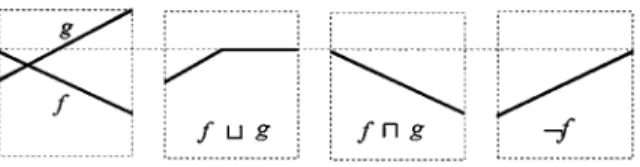
Fig. 3. Example of the operations U, n, and ¬.
Fig. 4. Functions 0 and 1.
I a, bj A /c, dj
if/a,b/n/c,d/
(1) /max(a, c), min(b, d)/ ^ 0 if /a, b/ C\ /c, d/ = 0
as (/a, b/ A /c, d/){x) = /a, b/(x) A /c, d/(x) = min /a, b/(x), /c, d/{x).
Walker and Walker justify in [30] that the operations on Map(X, M) can be defined naturally from the operations on M and have the same properties. In fact, given the operation * : M x M -> M, we can define the operation * : Map(X, M) x Map(X, M) -> Map(X, M), such that, for each pair f, ge Map(X, M), we have (/ * g)(x) =
f(x) * g(x), for all x, where f(x), g(x) e M (see [30,16]). Therefore, in this paper, we will work on M, as all the
results are easily and directly extensible to Map(X, M).
Definition 6. ([13,30,10,11]) The operations of u (generalized maximum), n (generalized minimum), ¬ (complemen-tation) and the elements 0 and 1 are defined on M as follows:
(/ U g)(x) = sup{f(y) A g(z): y V z = x]
(f n s)(x) = sup{f(y) A g(z) '• y A z = x]
¬fix) = sup{fiy) : 1 — y = x] = /(1 — x)
0(x )
{0
if x = 0
if x 7^ 0 1 f X )
{0
if x = 1 if x ^ 1
where v and A are the maximum and minimum operations, respectively, on lattice [0, 1]. Note that 0 and 1 are just the characteristic functions of 0 and 1, respectively (see Figs. 3 and 4).
We can easily prove that u and n satisfy De Morgan’s laws with respect to the given operation ¬, but M =
(M, u, n, ¬ , 0, 1) does not have a lattice structure, as it does not comply with the absorption law [13,30]. Nevertheless,
the operations u and n satisfy the properties required for each one to define a partial order on M.
Definition 7. ([24,30]) The partial orders defined on M are as follows: f^g i f / n g = / ; f<g iffug = g.
Generally, these two partial orders do not coincide [24,30].
The following definition and theorem were given in previous papers in order to facilitate the operations in the set M.
Definition 8. ([13,30,10,11]) If / e M, then fL, fReM are defined as f ix) = sup{fiy) : y < x],
Fig. 5. Examples of fL and fR.
Fig. 6. Example where / E g .
fL and fR are monotonically increasing and decreasing, respectively (see Fig. 5). Note that f < fL, f < fR, (fL)L = fL, (fR)R = fR, and (fL)R = (fR)L = sup f, for all / e M ([30]), where < is the usual order in the set of functions ( / < g if and only if f(x) < g(x), for all x).
In the following, we will consider L, the subset of normal and convex functions of M. This set has a bounded and complete lattice structure, thanks to which aggregation operators can be constructed applying Zadeh’s extension principle.
Definition 9. ([12,13,30,16]) A function / e M is normal if sup{f(x) : x e [0, 1]} = 1.
Let N denote the set of all normal functions in M. Note that given / e M, we have that / e N if and only if
fLvfR = 1, where 1 is the constant function such that 1(x) = 1, for all x e [0, 1]. The equation fL v fR = 1
is equivalent to any of the following four properties: a) fL(x) = 1 or fR(x) = 1, for all x e [0, 1], b) fR(0) = 1, c) /L( 1 ) = 1, d) (fL)R = (fR)L = 1. Takác [27,26] established that / e M is a normal function if f(x) = 1, for some x e [0, 1]. Nevertheless, we will name such a function strongly normal (see [12]). So, the set of strongly normal functions of M, which we will denote by N*, is a subset of N.
For example, the function / e M
f(x) = J 0-2 ifx = 0>
[ 1 — x otherwise,
is normal (supf = 1 ) , but it is not strongly normal, as there is no element x e [0, 1] satisfying f(x) = 1.
Definition 10. ([30]) A function / e M is convex, if for any x < y < z, it holds that f(y) > f(x) A f(z).
Let C be the set of all convex functions on M. Note that if / e M, then / e C if and only if / = fL A fR, which means that for all x e [0, 1], f(x) = fL(x) or f(x) = fR(x).
The set of all normal and convex functions of M will be denoted by L. The algebra L = (L, u, n, ¬ , 0, 1) is a subalgebra of M = (M, u, n, ¬ , 0, 1). The partial orders c and ^ on L coincide, and L is a bounded complete lattice (0 and 1 are the minimum and the maximum, respectively) (see [12,13,24,30]). Besides, it is obvious that
J C K c L c M. There exists an order isomorphism from (J, c ) to the interval ([0, 1], <). There also exists an order
isomorphism from (K, c ) to the set (/([0, 1]), </) (remember that [a1, a2] <j [b1, b2] if and only if a1 < b1 and a2 < l>2).
The following characterization will be useful for establishing new results.
Theorem 1. ([12,13]) Let f, g eh. f c g if and only if g < f and f < g •
2.2. On aggregation operators
Remember that:
Definition 11. ([22,27,26]) A function A : [0, 1]" -> [0, 1] is an n-ary aggregation operator on [0, 1] (type-1 operator) if the following conditions are fulfilled:
i) A(0, ..., 0) = 0, ii) A(1, ..., 1) = 1,
iii) if x{, yt e [0, 1], and x; < yi, for all i = 1, ..., n, then A{x1, ..., xn) < A{y1, ..., yn) (increasing in each argument).
The arithmetic mean A{x1, ..., x„) = J21=1xi/n, for all x1> •••>xn <= [0, 1] is an aggregation operator on [0,1], as are all the t-norms and t-conorms (triangular norms) on [0,1].
Takácˇ [27,26] extended, according to Zadeh’s extension principle ([35]), the w-ary aggregation operator on [0, 1] (see Definition 11) to the following w-ary operator on M.
Definition 12. ([27,26]) Let A : [0, 1]" -> [0, 1] be an w-ary aggregation operator on [0, 1]. The w-ary operator on M,
A : M" -> M, is given by
A(f1, ..., fn){x) = sup{f1(y1) A ... A f„(y„) : A{y1, ..., yn) = x},
where x, y1, ..., yn e [0, 1] and f1, ..., fn e M.
Nevertheless, note that, in order to define the operator A for all x e [0, 1], the set of the images of the function A should contain all the values in the interval [0, 1]. This is guaranteed if A is surjective. For example, if we consider the M-ary type-1 aggregation operator
f 1 if y1 = ••• = y« = 1,
A(y1,..., y„) = I
[0 otherwise,
the corresponding A is not defined for x e (0, 1).
Furthermore, Takácˇ [27,26] introduced the definition of type-2 aggregation operators. We reviewed these ideas in
[7] and presented a more general definition of aggregation operator on a bounded poset.
Definition 13. Let U be a set and <u be a partial order in U such that (U, <u) has a minimum element 0 ^ and a
maximum element 1 ^ . An «-ary aggregation operator on (U, <u) is a function / :Un —>- £/ such that: 1) x(0<(/, •••, 0<u) = 0<u,
2) x ( 1 < ( / ) •••) 1<(/) = 1<(/,
3) given / , , gi e U, if /, <JJ gi for all i = 1, ..., n, then x ( /1, •••, fn) <u X(g1, ••-, gn) (increasing in each argument).
Takácˇ ([27,26]) proved that if A is a continuous «-ary aggregation operator on [0, 1], then A (as given in Defini tion 12) is an aggregation operator on L*, the set of strongly normal and convex functions, which is a subset of L (the proof of this result was improved by C. Wang in [31]). However, he did not get any aggregation operator on either L or M. It is noteworthy that the closure properties presented in [27,26] are established on L* and not on L.
3. Some aggregation operators on L
In this section, we propose a more general «-ary operator on M than was given in [27] (see Definition 12), and study, among other properties, whether it is an aggregation operator on L.
Definition 14. Let <f>: [0, 1]" —>- [0, 1] be a surjective «-ary operator on [0, 1], and let *: [0, 1]" —>- [0, 1] be an «-ary
operator on [0, 1]. We define the «-ary operator on M / * ^ : M" —>- M, as
A^^pif1,..., fn){x) = sup{k{f1{y1),..., fn(yn)): <p(y1, •••, yn) = x},
Note that if *(fi(yi), •••, fn(yn)) = /Kyi) A / ^ t e ) A... A/„(;y„), and</> is a continuous w-ary aggregation operator on [0, 1], then, according to [27,26], X*^ is an w-ary aggregation operator on L*. The operator X*^ of Definition 14
is also a generalization of the operations given by Hernández et al. in [14,15].
Example 1. Let *{z\, zi, Z3) = (zi v zi) A 23, for all z\, zi, Z3 e [0, 1], and (p be the arithmetic mean, then for all
f\, / 2 , fo e M,
3?l + }?2 + J3 X* <A(/I,fi,fi){x) = sup{{f\{y\) V / i t e ) ) A /3(y3) : = x}.
3
Note that * and <f> are binary aggregation operators on [0, 1], and <f> is surjective, but X*^ is not an aggregation operator on either M or L, as it does not satisfy the boundary conditions.
From now on, X*^ will denote the operation introduced in Definition 14, where <f> must always be surjective.
Proposition 1. Let * be an operator such that 0 is an absorbing element of*, and *(1, ..., 1) = 1. Then
- If<p(0, ..., 0) = 0, then X* ^(0, ..., 0) = 0. - If 4>{\, ...,\) = \, then X*^(l, ..., 1) = 1.
Proof. If x = 0, then X*^(0, ..., 0)(0) = sup{*(0(yi), ..., 0(yn)) : <p(yi, ..., yn) = 0} = *(0(0), ..., 0(0)) =
*(1, ..., 1) = 1.
If x 7^ 0, for all y\, ...yn such that <f>(yi, ...yn) = x, at least one yj e [yi, ...yn] should be yj ^ 0, and so 0(yj) = 0.
Then for all y\, ...yn such that 4>(y\, •••yn) = x, *(0(yi), ..., 0(yn)) = 0, as 0 is the absorbing element of *, and
therefore X,^(0, ..., 0)(x) = 0. Finally, X*^(0, ..., 0) = 0. The second property is proved in a similar way. •
Proposition 2. i) IfO is an absorbing element of*, then X , ^ ( / i , ..., /„) = 0 (the constant function 0), provided fi = 0
for some i = 1, ..., n.
ii) If* is such that *(l, ..., 1) = 1, then X*^(l, ..., 1) = 1, 1 being the constant function 1.
Proof. A^^pifi, ..., fn){x) = sup{*(fi(yi), ..., fn(yn)) : <p(yi, •••, yn) = x). As fi(yi) = 0 for some i = 1, ..., n, and,
taking into account that 0 is an absorbing element of*, we have that A^(fi, ...,/„) = 0. Proof of the second item is straightforward. •
Proposition 3. If* is increasing in each argument, and f\, ..., fn, gi, ..., gn e M, such that f\ < g\, ..., /„ < gn, then
X*,0(/l, ..., fn) < A^^pigi,..., gn).
Proof. As fi(yt) < gi(yt), for all i = 1, ..., n, and * is increasing in each argument, then for all x e [0, 1],
X*,^(/i,..., fn)(x) =
sup{*(fi(yi),..., fn(yn)) '• <P(yi, •••; yn) = x] <
sup{*(gi(y\),..., gn(yn)) '• <P(yi, •••, yn) = x} =
X^(gi,...,g„)(x). D
Proposition 4. If both (j) and* are continuous and increasing in each argument, then for all f\, ..., /„ e M, we have
(X*,0(/l, ..., fn)) = X^0(/j ,..., /„ ) ,
(X*,0(/l, ..., fn)) = X*^(/j ,..., /„ ) .
Proof. As * is continuous and increasing in each argument, we have that, for any {w^}, ..., {ws} c [0, 1],
-k{sup{f1{u1) : u1 > y1}, ..., sup{fn(un) : un > yn}) = sup{k{f1{u1), ..., fn(un)) : u1 > y1, ..., un > y„},
and consequently,
X*,</,(/1 > •••> fn )(x) =
sup{-k(fR(y1),..., f„(yn)) : 4>(y1i •••) yn) =x} =
sup{k{sup{f1{u1): u1 > y1},..., sup{fn(un): un > yn}) : (p{y1,..., yn) = x} =
sup{-k(f1(u1),..., fn{un)): u1 > y1,..., un>yn, (j){y1,..., y„) = x}.
Moreover, if u1 > y1, ..., un > yn, (p{y1, ..., yn) = x, as (p is increasing, we have that (p{u1, ..., un) > x, and, be-cause (p is continuous, there exist m1, ..., mn e [0, 1], such that u1 > m1, ..., un > mn and 4>{m1, ..., mn) = x. Thus
•^*,<p(f1 , —, fn )(x) =
sup{k{f1{u1),..., fn{un)) :u1>y1,..., un>yn, (p{y1,..., yn) = x} =
SUp{-k{f1{u1), ..., fn(un)) : <P(U1> •••) un) > x} =
(X^0(/1,..., fn)) (x) , Vx e [0, 1].
The proof of (X,^(/1, ..., fn))L = A+^if^ , •••, f„) is similar. n
Remark 1. There are cases in which * is not continuous and, although the other conditions of Proposition 4 hold, the equalities are not fulfilled. For example, let
*(w, v)
f(x) = \ x
u if v = 1, v if u = 1, 0 otherwise, x if x e [0,1),
3 otherwise,
and let <p be any continuous binary aggregation operator in [0, 1]. Under these conditions, f(x) < 1, for all x e [0, 1], and sup f = 1. Then,
(A+^(f, / ) ) (0) = sup{-k(f(y1), f(y2)) : 4>(y1i y2) > 0} = sup{0} = 0.
And A*^(fR, fR)(0) = sup{-k(fR(y1), fR(y2)) : 4>(y1^ y2) = 0} = +(fR(0), fR(0)) = *(1, 1) = 1. Therefore,
(A^(f f))R(0) = A ^ ( fR, fR)(0).
Furthermore, (A+^(f, f))L(1) = sup{-k(f(y1), f(y2)) : 4>(y1i y2) < 1} = sup{0} = 0. And, A+^(fL, fL)(1) =
sup{-k(fL(y1), fL(y2)) : 4>(y1, y2) = 1} = *(fL1, /L( 1 ) ) = 1. Then we have that (X* ,p(f, f))L(1) =
X ^ ( /L, /L) ( 1 ) .
Let us now focus on the closure properties in N, K, J, C and L.
In the following, it will be useful to consider, for any function / e M, the set
Wf ={w e [0, 1]: Ve > 0, sup f(x) = 1}.
Let us note that / e N if and only if Wf = 0.
Proposition 5. If+(1, ..., 1) = 1, then X*^ is closed in N*.
Proof. If f1, ..., fn e N*, there exist w1, ..., wn, such that *(/1(w1),..., fn(u)„)) = * ( 1 , . . . , 1 ) = 1.
Proposition 6. Let (j) be continuous and increasing in each argument, and let * be increasing in each argument and
continuous at point (1, ..., 1) e [0, 1]", where, besides, *(1, ..., 1) = 1. Then X*^ is closed in N.
Proof. If /1, ..., /„ e N, we have that W/t ^ 0 for all i. Let us take the values w1 e W/1, ..., wn e W/n. For all e > 0, sup{fi(yi) : yt e (w; — e, w; + e)} = 1. Because * is increasing in each argument and continuous at point (1, ..., 1), we have that
sup{k{f1{y1),..., fn(yn)): yi e (w; — e, w; + e ) } = 1.
Let (p{w1, ..., wn) = z, and taking into account that <f> is surjective, continuous and increasing in each argument, we have that for all e > 0, sup{k{f1{y1), ..., fn(yn)) :<p(y1, •••, yn) <= (z — e, z + e)} = 1. Then z e ^/x*^(/1,...,/„) and
so ^x^^(/1,...,fn) T1 $. Therefore A * ^ { J 1 , ...jn) is normal. •
Remark 2. The example of Remark 1 also shows that there are cases in which * is not continuous at point (1, ..., 1), and although the other conditions of Proposition 6 are fulfilled, X*^ is not closed on either N or L. In that case, actually, / e N, / e L, but (X* ^(/, f))R(0) = 0 ^ 1 , and X* ^(/, / ) is not normal and so is not in L.
The following function * is an example of a binary function, which is increasing in each argument, continuous at point (1, 1) and such that *(1, 1) = 1, that is, a function that satisfies the conditions of Proposition 6:
[ H A D ifw>0.8 and v > 0.8, 1 0 otherwise.
Also any t-norm (and any t-conorm) fulfilling the continuity condition at point (1, 1) is a binary operation * satis-fying the conditions of Proposition 6. For example, the t-conorm
u ifu = 0, v ifw = 0, 1 otherwise. +(u, v)
Proposition 7. Let (j) be continuous and increasing in each argument, and let * be such that 0 is an absorbing element
and-k(1, ..., 1) = 1. Then for any family {[a;, &;]};=1,...,« c K of closed intervals, we have
X*,$( [a1, b1],..., [a„, bn] ) = [<p(a1,..., a„), <fi{b1,..., b„)] e K,
that is, X*^ is closed in K.
Proof.
X*,$( [a1, £>1],..., [a„, bn] )(x) = ,sw/?{*([a1, b1](y1),..., [a„, &„](>•„)) : <p(y1, •••, yn) = x}.
As *(1, ..., 1) = 1 and 0 is the absorbing element of*, we have that
*([fl1, b1](y1), ..., [an, bn](yn)) = 1
if and only if yi e [a;, bf\ for all i = 1, ..., n. Otherwise, *([a1, b1\{y1), ..., [a„, bn](y„)) = 0. Because <f> is continuous and increasing in each argument, we have
X*,$( [a1, fc1], ..., [a«, bn] )(x) = 1, for all x e [cp{a1, ..., an), (p{b1, ..., £>„)]; otherwise X*^( [a1, fc1L..., [a„,bn] )(x) = 0.
Summarizing, X* ^( [a1, fc1], ..., [a„, fc„] ) = [</>(a1..., a„), <fi{b1,..., &„)] e K. •
Remark 3. There are cases in which <f> is not continuous, and although all the other conditions of Proposition 7 are fulfilled, X*;0 is not closed in K. For example, let * be any t-norm, and consider the non-continuous t-norm
<p(u, v) =
then
h
XJ. </,( 10, II, 10.3, 0.71 )(x) = i „
,^v [0 and so X*^( [0, 1], [0.3,0.7]) ^ K.
ifx = 0 or x e[0.3,0.7] 0 otherwise,
Corollary 1. Under the same conditions as in Proposition 7, if di e J, for all i = 1, ...,«, then
^*,cp(di, •••, d,n) = e , where e = 4>{a\,..., a„) e [0, 1],
that is, A+^ is closed in J.
Proof. Straightforward from Proposition 7, noting that J c K and a; = [a;,a;], for all i = 1, ..., n. •
Let us now study the case in which the arguments of the operator X* ^ are general (not necessarily closed) intervals.
Proposition 8. Let /a,-, b{/ be the characteristic function of an interval, for all i = 1, ..., n. Under the same conditions
as in Proposition 7 (4> is continuous and increasing in each argument, 0 is an absorbing element of* and *( 1, ..., 1) =
1), we have that:
If /a;,bil = 0 (empty support), for some i, then A*^(/ai,b\/, ..., /an,bnf) = 0.
If /at,b^ ^ 0 (non-empty support), for all i, then A+t(p(/ai,b\j', ..., /an,bnf) = /4>{a\,..., an), (p{b\,..., bn)/ ^ 0.
Proof. 1) Suppose that /a;,b{/ = 0, for some i, then, according to Proposition 2i, X*^(/ai,b\j', ..., /an,bn[) = 0. 2) Suppose that /a;, fcr-/ ^ 0, for all i. By definition, A+rf(/ai,bi/, ..., /an,bn/)(x) = sup{k{/a\,b\/{y\), ...,
/a„,bn/(yn)) : (p{y\, ..., y„) = x], and, because /a;,bi/(u{) = 1, for all wr- e /a;, &;/, we have *(/ai,b\/{u\), ...,
/a„,bn/(un)) = *(1, ..., 1) = 1, and so A+t(p(/ai,b\j', ..., /a„, &„/) ^ 0. Furthermore, as (p is increasing in each
argument, then <j>{u\, ..., un) e /4>(a\, ..., an),4>(b\, ..., bn)/, for all w; e /a;,^;/, and as </> is continuous, then X*^(/ai, fci/, ..., /a„,bnf) = I4>(a\, ..., a„), (p{b\,..., fc„)/ ^ 0 . D
Definition 15. Let a e [0, 1]. For any / e M, we define two functions fa, f>a : [0, 1] -> [0, 1]: „ f l , if f(x)>a, „>„ f 1, if f(x) > a,
f (x) = i . / (x) = i
10, otherwise 10, otherwise
It is easy to prove that i) f>a < fa
-ii) If ot\ < c(2, then /a 2 < fai and /> a 2 < f>ai.
iii) / e C if and only if for all a e [0, 1] fa(f>a) = 0 or fa(f>a) = /a, b/ for some a, b e [0, 1].
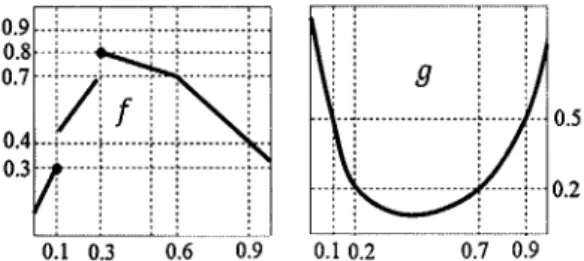
Example 2. Fig. 7 shows two functions, where / is a convex function and g is not a convex function. As / is a convex function, then, for all a e [0, 1], f>a and fa are interval functions whose supports are a not necessarily closed interval or the empty set. For example, f03 = [0.1,1], f>03 = (0.1, 1], f0A = (0.1,0.9], f>0A = (0.1, 0.9), f0J = [0.3,0.6], f>0J = [0.3,0.6), f0-8 = [0.3,0.3], /> a 8 = (0.3,0.3) = 0 and fs = f>0-9 = 0 .
On the other hand, as g is not a convex function, then g0-2 = [0, 0.2] U [0.7, 1], g>0-2 = [0, 0.2) U (0.7, 1], g0-5 = [0, 0.1] U [0.9, 1] and g>0'5 = [0,0.1) U (0.9, 1], for example, are functions whose supports are not an interval.
H o w e v e r f>^-9 < f>0.& < J - 0 . 8 < J - > 0 . 7 < J - 0 . 7 ^ ^ > 0 . 4 < ^-0.4 ^ ^ > 0 . 3 ^ J - 0 . 3 OJIH p>^-5 <; p^-5 < p>^-2 <; p0 . 2
regardless of whether or not / and g are convex.
The purpose of the following results is to prove that X*^ is closed on C.
Proposition 9. Let ft e C, ap e [0, 1], with i = \...n and p = 1, 2, ..., In. Under the same conditions as in Proposi-tion 7 (4> is continuous and increasing in each argument, 0 is an absorbing element of* and *(1, ..., 1) = I) and * is increasing in each argument, we have that
Fig. 7. Examples of convex and non-convex functions.
ii) A+^if"1, ..., fn") A Xt^ ( /1 n + 1, ..., fn2n) ^ 0 if f"1 ^ 0 and fi n+l ^ 0 for all i. Moreover, in this case, we have Cn+1 tt2n
that X^0(/1 , ..., fnn) A X^0(/1 , ..., /n ) = /m, nj for some m, n e [0, 1].
Proof. i) If f"' = 0 or f"n+l = 0 for some i, according to Proposition 2i, A+^if"1, ..., f% ) = 0 or Ai,^(f"n+1, ..., fn2") = 0, and the minimum is 0.
ii) In this case, as a; < «„+; or «„+; < a; and fi eC for all i, there are three possibilities.
a) //*' < f"n+l, for all i = 1, ..., n. According to Proposition 3, we have that A+^if"1, ..., f%n) < A^(f"n+1, ..., fn2"), and so A+^if"1, ..., f£n) A A+^if1n+1, ..., f„2n) = A+^if"1, ..., f£n) ^ 0, according to Proposition 8.
b) f"n+l < f"', for all i = 1, ..., n, and the proof is similar to a).
c) f£k < f^"+k and fm"+m < fmm, for all k e A and for all m e B, where A and B are non-empty subsets of [1, ..., n] such that AU B = [1, ..., n] and An B = 0.
Replacing any argument fmm by fmn+m in the m-th position, we have, according to Proposition 3, that
••) fn"). Also, as f£k < fkn+k, according to Proposition 3,
X ^ C /1 1, ..., fm+m, -.., /*") < A,,4>{f"n+\
-and then
0 ^ X ^ C / "1, . . . , /•?+"%..., /„"") < x ^ c /1 1
Moreover, according to Proposition 8, A+^if"1, ..., f£n) and Ai,^{f1n+1, ..., /^*2n) are interval functions and,
because X* ^ (f"1, ..., fnn)/\AiKlp(f1 n+1, ..., fn2n) ^ 0, we have, according to Equation (1), that X* ^{f"1, ..., //f") A X * , 0 ( /1 *+1, ..., //T2*) is the characteristic function of an interval. •
fan+m f&2n \
Jm ; •••; Jn ^
j„
s")A^(/r
+1D .
<*n + 1Let us now prove the closure in C. Hernández et al. [15] highlighted this property in the case of binary operations on M, requiring the continuity of*, but Proposition 10 does not require this condition.
Proposition 10. Let (j) be continuous and increasing in each argument, and let * be increasing in each argument, with
an absorbing element 0, and such that *(1, ..., 1) = 1. Then A*,<p is closed in C.
Proof. Let / ; e C, for all i = 1, ..., n. Let us prove that A+^if1, ..., fn) e C. For this purpose we must see that for any a e [0, 1], (X^^,(/1,..., / „ ) is an interval function or the constant function 0. Let a e [0, 1],
• If a < *(o!1, ..., an), then A+^if"1, ..., f%") < (A+^if1, ..., fn))>a .
In fact, if A+rfif"1, ..., f%n) = 0, then A+^if"1, ..., f£n) < (A+^if1, ..., fn))>a. Otherwise, let f"' = /a;,b{/ ^ 0 for all i, and
A+^if"1,..., f%n) = I4>{a1, ..., an), 4>{b1, ..., bn)/ ^ 0.
If A* ^ {f"1, ..., fn"){x) = 0, then A+^if"1, ..., f„n)(x) < (A^^if1, ..., fn))>a(x). If A* ^ (f"1, ..., fn"){x) = 1 = I4>{a1,..., an), 4>{b1,..., bn)/(x),
then x e /4>{a1, ..., an), (p{b1, ..., bn)/. As <f> is continuous, there exists, for all i, yi e /ai, b{/ such that <f>(y1, ..., yn) = x.
Therefore, A+^if1, ...fn)(x) > a, A+^if1, ...fn)>a(x) = 1 and, finally, (A*,<f,(f"\..., fnn))(x) = 1 = (A^if1, ..., fn))>a(x).
• Let us now prove that (A+^if1, ..., fn))>a = Sup*(c1,...,«„)>« X*^ if"1, ..., fn").
For “>”, it is trivial, because the inequality for each A+^{f"1, ..., f^n) is given, provided *(a1, ..., an) > a. For “<”, if (X^^C/1, ..., fn))>a{x) = 0, the inequality is evident.
Otherwise, (A+^if1, ..., fn))>a(x) = 1, and (A^(f1, ..., fn))(x) > a.
So there exist yt, ...yn, such that <f>(y1, ..., yn) =x, and*(/1(;y1), ..., fn(yn)) > a. Denoting fiiyi) = a;, we have, for all i, that /• (j;) = 1 and *(a1, ..., a„) > a. Then (AiK^(j1 , ..., f„ ))(x) = * ( 1 , ..., 1) = 1, and
SupMa1.^an)>a X*,0 (/f1, ..., /„a")(x) = 1.
• According to the last item, (A+^if1, ..., fn))>a is the supremum of characteristic functions of intervals and/or the zero function. If all these functions are zero, then (A+^if1, ..., fn))>a = 0. If a function is the characteristic function of an interval and the others are zero, the supremum will obviously be the characteristic function of the interval.
If two or more functions of {A+^if"1, ..., f%n) : *(a1, ..., an) > a] are characteristic functions of intervals, then suffice it to prove that the minimum of any two of these characteristic functions of intervals is also the characteristic function of an interval in order to prove that the supremum is the characteristic function of an interval. This is deduced from Proposition 9. •
Remark 4. There are cases in which <f> is not continuous, and although all other conditions in Proposition 10 are fulfilled, X^^ is not closed on C. For example, see the case introduced in Remark 3.
Proposition 11. Let (j) be continuous and increasing in each argument, and * increasing in each argument, with
absorbing element 0, and such that *(1, ..., 1) = 1. Then A+^ is closed in L*.
Proof. Straightforward from Propositions 5 and 10. •
Remark 5. There are cases in which <f> is not continuous, and although all other conditions in Proposition 11 are fulfilled, X*;0 is not closed on L*. See, for example, the case shown in Remark 3.
Proposition 12. Let (j) be continuous and increasing in each argument, and * be increasing in each argument, with
absorbing element 0, such that *(1, ..., 1) = 1, and continuous at point (1, ..., 1), then A+^ is closed in L.
Proof. Straightforward from Propositions 6 and 10. •
Remark 6. There are cases in which * is not continuous at point (1, ..., 1), and although all other conditions in Proposition 12 are fulfilled, X*^ is not closed on L. See Remark 2.
Also, there are cases in which <f> is not continuous, and although all other conditions in Proposition 12 are fulfilled,
X*;0 may not be closed on L. See, for example, the case introduced in Remark 3.
Let us now see the increase in each argument with respect to the partial order of L.
Proposition 13. Under the same conditions as in Proposition 12, A+^ is increasing in each argument with respect to the partial order of L. (Remember that the partial orders c and < in L are the same.)
Proof. Let / , , g{ e L, such that fi c gt, for all i = 1, ..., n. According to Theorem 1, gf < ftL and ftR < gf, for all i. As, according to Proposition 12, X*^ is closed in L, we can work with the order of L.
Let us prove that (A+^if1, ..., fn))R < (A^(g1, ..., gn))R.
For each / , , gi e L and yi e [0, 1], such that <p(y1, y2, ..., yn) = x, f^iyi) = sup{fi(zi) : Zi > yi] < sup{gi(zi) :
Zi > yi] = gf(yi). And, because * is increasing, sup{+(f1(z1), •••, fn(zn)) : Zi > yi,4>(y1, y2, •••, yn) = x] <
Moreover, if zt > yi, i = 1, •••, n, <p(y1, ..., yn) = x, as <f> is increasing in each argument, <p(z1, • ••, zn) > x, and, if </>(z1, ..., zn) > x, as </> is continuous, there exist mi e [0, 1], i = 1, ..., n, such that z; > mi, Vi = 1, ...,«, and
(p{m1, ..., mn) = x. Thus
5Mp{*(/1(Z1), ..., fn(zn)) '• Zi > yi, <p(y1,..., >•«) = x} =
= SUp{k{f1{z1), ..., fniZn)) '• <P(Z1, ..., Z«) > x} <
< 5w/?{*(^1(z1),..., gn(zn) '• zt > yt, <p(y1, •••, yn) = x} =
= SUp{-k{g1{z1), ..., gn(zn)) : <p(Z1, •••, Zn) > x},
that is, (X^^C/1, ..., fn))R(x) < (A+^ig1, ..., gn))R(x), for all x e [0, 1]. Similarly (A+^if1, ..., fn))L > (A+^ig1, ..., gn))L is proved, and so
A*,(p(f1, •••, fn) E A+^ig1,..., gn). •
Corollary 2. Under the same conditions as in Proposition 11, X*^ is increasing in each argument in L* with respect to the partial order of L.
Proof. Straightforward, taking into account Proposition 13, that L* c L and X*^ is closed on L*. •
From the previous results, the following Theorem is deduced.
Theorem 2. Let (j) be a continuous n-ary aggregation operator on [0, 1]. And let * be an n-ary aggregation operator
on [0, 1], with an absorbing element 0 and continuous at point (1, ..., 1) e [0, 1]". Then X*^ is an n-ary aggregation operator on L.
Proof. Straightforward from Propositions 1, 12 and 13. •
The purpose of the following Examples 3 and 4 is to highlight how continuity at (1, 1) of the operator * affects the operator X*^. So, the same <f> is taken in both examples, while the operator * is changed.
Example 3. If * is a t-norm on [0, 1] that is continuous at (1, 1), and <f> is a continuous binary aggregation operator on
[0, 1], then A+rf is a binary aggregation operator on L and on L*. For example, suppose we have the t-norm
*(w, v)
u if v = 1 v if u = 1
u A v if u> 0.25 and v > 0.25 0 otherwise
which is continuous at (1, 1), and the continuous binary aggregation operator
a +b (b(a,b) = .
2
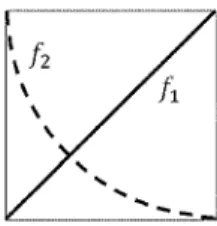
Let the functions f1, f2 e L* such that f1{x) = x and f2(x) = (1 — x)2 (see Fig. 8), f1 could be interpreted as the
membership function of the label true and f2 could be interpreted as the membership function of the label very false. We have
{
y1 + y2 1*(f1(y1), f2iy2)) '• = x | .
Note that
f1iy1) > 0.25 <=J y1 > 0.25
f2iy2) > 0.25 <=J )>2 < 0.5.
Fig. 8. Examples of strongly normal and convex functions.
• If x e [0, 0.125), there are no y1, y2 with y1 > 0.25 and y2 < 0.5 such that y1~^y2 = %. So, the only option for +(f1(y1)> f2iy2)) ¥" 0 is y2 = 0. For this reason, x = 2^±0 and
{
y1 + y2 1*(/1()'1); f2(y2)) '• = x\ = *(/1(2x), /2(0)) = *(2x, 1) = 2x.
• If x e [0.125, 0.75], then
{
y1 + y2 12 y1 + J2 1 y1 A (1 — y2) : = x,y1> 0.25, ^2 < 0.5 \
and the supremum is achieved at y1 = 1 (and then y2 = 2x — 1 < 0.5), or at y2 = 0 (and then y1 = 2x > 0.25). Now
- If x < 0.5, the supremum is achieved at y2 = 0 and y1 = 2x, and so
{
2 y1 + y2 1y1 A (1 — }?2j : = x, y1 > 0.25,y2 < 0.5 [ = 2 i A 1 = 2x, - If x > 0.5, the supremum is achieved at y1 = 1 and ^2 = 2x — 1, and so
{
2 y 1 + y 2 1 2 2y1 A (1 — }?2j : = x,y1> 0.25, ^2 < 0.5 > = 1 A (1 — 2x + 1) = (2 — 2x) . • If x e (0.75, 1] there are no y1, y2 with y1 > 0.25 and y2 < 0.5 such that y 2 2 = *, and thus j2 > 0.5. So, the
only option for *(/1(;y1), f2iy2)) ^ 0 is y1 = 1 (^2 = 0 is impossible). For this reason, x = 1+22~1 and
{
y1 + 3?2 1*(/1()'1)) f2iy2)) '• = x\ =
= *(/1(1), /2(2x — 1)) =•*•(1,(2 — 2x) ) = (2 — 2x) .
Therefore (see Fig. 9),
<^-+,(p(f1> f2){x) = 2 (2 — 2x)2x if x e [0,0.5], 2 if x e [0.5,1].
This was the expected result, as the resulting function could be interpreted as the membership function of the label between true and false.
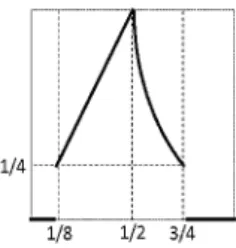
Now, let us see an example where f1 and f2 are normal and convex functions, but not strongly normal functions. Let the functions /1, / 2 6 L (/1, f2 <£ L*) such that f1(x) = x if x ^ 1 and /1( 1 ) = 0.5 and f2ix) = (1 — x)2 if
x ^ 0 and /2(0) = 0.5 (see Fig. 10).
Fig. 9. Aggregation of the strongly normal functions f\ and f2 in Examples 3 and 4.
Fig. 10. Examples of normal and convex functions, but not strongly normal functions.
• If x G [0, 0.125) there are no y\, y^ with y\ > 0.25 and y^ < 0.5 such that yi 2y2 = x- Moreover, f\(y\) ^ 1 for
all y\ and f^iyi) 7^ 1 for all j 2 . Therefore, for all y\, y^ such that yi 2yi = x is *(/iCyi)> fliyi)) — 0, and so
{
Jl + J2 1*(/lCyi)> /2CJ2)) • = X \ = 0 . • If x G [0.125, 0.75], then
{
y\ + j2 1*(/iCyi)> fiiyi)) '• = *> J i > 0.25, j2 < 0.5 >,
and the supremum is obtained when y\ is near to 1 and then j2 is near to 2x — 1, or when j2 is near to 0 and then y\ is near to 2JC,
- If JC < 0.5, the supremum is obtained when y\ is near to 2x and y^ is near to 0, and so
{
y\-\- y2*(/iCyi)> fiiyi)): = •*> J i > 0.25, j2 < 0.5 = *(2x, 1) = 2JC,
I
- If JC > 0.5, the supremum is obtained when y\ is near to 1 and y^ is near to 2x — 1, and so{
yi -\- y 2 1 ? 2*(/iCyi)> fliyi)): = •*> y\ > 0.25, j2 < 0.5 \ = *(1,(1 — 2x + 1) ) = (2 — 2;t) . If x G (0.75, 1] there are no y\, y^ with y\ > 0.25 and j2 < 0.5 such that yi^n = x. Moreover, f\(y\) ^ 1 and
fliyi) T^ 1 for all y\ and j 2 . Therefore, for all j i , j2 such that ^ ^ = JC, then * ( / i ( j i ) , fiiyi)) = 0, and hence
(
Jl + J2 1*(/iCyi)> fiiyi)): = x i = 0-Therefore (see Fig. 11),
0 ifjcG [0,0.125) 2x if x G [0.125, 0.5] (2 — 2JC) if JC G [0.5, 0.75]
0 if* e ( 0 . 7 5 , l ]
Proposition 14. Let (j) be a continuous n-ary aggregation operator on [0, 1]. And let • be an n-ary aggregation
Fig. 11. Aggregation of f1 and f2 that are normal functions, but not strongly normal functions, in Example 3.
Proof. Straightforward from the Propositions 1, 11 and Corollary 2. •
Example 4. If • is a t-norm on [0, 1] and 0 is a continuous binary aggregation operator on [0, 1], then X*50 is a binary
aggregation operator onL*, but X*50 may not be an aggregation operator on L.
For example, let the t-norm
*(t/, V)
u if v = 1 v if u = 1 0 otherwise
and the continuous binary aggregation operator be
a + b cj)(a, b) = .
Let the functions f1, f2 e L* such that f1 (x) = x and f2(x) = (1 — x)2 (see Fig. 8). We have
{
y1 + y2 ]*(/1Cy1)> f2iy2)): = JC | =
J1 + J2 1
*(/1Cy1)> f2iy2)): = *> j1 = 1or y2 = 0 [ ,
as /1 (j1) = 1 if and only if j1 = 1, and f2iy2) = 1 if and only if j2 = 0. Therefore,
- if x G [0, 0.5], the supremum is achieved at j2 = 0 and y1 =2x, and so
y1 + j2
sw/? *(/1(v1), f2iy2)) '• x, y1 = 1 or j2 = 0 = *(/1(2JC), /2(0)) = 2JC,
if X G [0.5, 1], the supremum is achieved at j1 = 1 and j2 = 2JC — 1, and so
y1 + J2
^w/7 *(/1(j1), f2iy2)) '• x, y1 = 1 or j2 = 0 I = * ( /1 (1), /2(2JC — 1)) = (2 — 2JC) .
Then (see Fig. 9),
X*,</>(/1,f2)(x) f 2x if x G [0,0.5]
I (2 — 2JC) if X G [0.5,1]
Now, let us see that X*50 is not an aggregation operator on L. Let the functions f1, f2 G L (/1, f2 £ L*) such that
/1(JC) = x if x 7^ 1 and /1( 1 ) = 0.5 and f2(x) — (1 — •*) if .x 7^ 0 and /2(0) = 0.5 (see Fig. 10). As f1(y1) 7^ 1 for
all y1 G [0, 1], and f2iy2) 7^ 1 for all J2 G [0, 1], we have that *(/1(j1), f2iy2)) = 0 for all j1, J2 G [0, 1]. Therefore,
X*,0(/1, f2){x) = sup *(f1(y1), f2(y2)) '• J1+J2 x = 0 for all x G [0, 1], and so X^0(/1, /2) = 0 ^ L. 4. Conclusions
they are aggregation operators on L (or L*), which is the set of normal (strongly normal) and convex functions of M. Also, after each result, we have given examples showing that if some condition fails, the conclusion may not be true.
In future research, we plan to explore some other aggregation operators on L (and on L*), using different methods or formulae to the ones used in this paper.
Acknowledgements
This paper was partially supported by UPM (Spain) and UNET (Venezuela).
References
[1] H. Bustince, E. Barrenechea, M. Pagola, Generation of interval-valued fuzzy and Atanassov’s intuitionistic fuzzy connectives from fuzzy connectives and from Kα operators. Laws for conjunctions and disjunctions. Amplitude, Int. J. Intell. Syst. 23 (2008) 680–714.
[2] H. Bustince, J. Fernandez, H. Hagras, F. Herrera, M. Pagola, E. Barrenechea, Interval type-2 fuzzy sets are generalization of interval-valued fuzzy sets: towards a wider view on their relationship, IEEE Trans. Fuzzy Syst. 23 (5) (2014) 1876–1882.
[3] S. Coupland, M. Gongora, R. John, K. Wills, A comparative study of fuzzy logic controllers for autonomous robots, in: Proc. IPMU, Paris, France, Jul, 2006, pp. 1332–1339.
[4] S. Coupland, R. Jhon, A fast geometric method for defuzzification of type-2 fuzzy sets, IEEE Trans. Fuzzy Syst. 16 (4) (2008) 929–941. [5] S. Coupland, R. John, Fuzzy logic and computational geometry, in: Proceedings of RASC 2004, Nottingham, England, 2004, pp. 3–8. [6] S. Coupland, R. John, Geometric type-1 and type-2 fuzzy logic systems, IEEE Trans. Fuzzy Syst. 15 (1) (2007) 3–15.
[7] S. Cubillo, P. Hernández, C. Torres-Blanc, Examples of aggregation operators on membership degrees of type-2 fuzzy sets, in: Proceedings of IFSA–EUSFLAT 2015, Gijón, Spain, 2015, pp. 719–726.
[8] G. Deschrijver, E. Kerre, Aggregation operation in interval-valued fuzzy and Atanassov’s intuitionistic fuzzy set theory, in: H. Bustince, et al. (Eds.), Fuzzy Sets and Their Extensions: Representation, Aggregation and Models, Springer, Berlin, 2008, pp. 183–203.
[9] D. Dubois, H. Prade, A review of fuzzy set aggregation connectives, Inf. Sci. 36 (1–2) (1985) 85–121.
[10] Z. Gera, J. Dombi, Exact calculations of extended logical operations on fuzzy truth values, Fuzzy Sets Syst. 159 (11) (2008) 1309–1326. [11] Z. Gera, J. Dombi, Type-2 implications on non-interactive fuzzy truth values, Fuzzy Sets Syst. 159 (22) (2008) 3014–3032.
[12] J. Harding, C. Wa l k e r, E. Wa l k e r, Convex normal functions revisited, Fuzzy Sets Syst. 161 (2010) 1343–1349. [13] J. Harding, C. Wa l k e r, E. Wa l k e r, Lattices of convex normal functions, Fuzzy Sets Syst. 159 (2008) 1061–1071. [14] P. Hernández, S. Cubillo, C. Torres-Blanc, Negations on type-2 fuzzy sets, Fuzzy Sets Syst. 252 (2014) 111–124.
[15] P. Hernández, S. Cubillo, C. Torres-Blanc, On t-norms for type-2 fuzzy sets, IEEE Trans. Fuzzy Syst. 23 (4) (2015) 1155–1163. [16] B. Hu, C. Kwong, On type-2 fuzzy sets and their t-norm operations, Inf. Sci. 255 (2014) 58–81.
[17] O. Linda, M. Manic, General type-2 fuzzy C-means algorithm for uncertain fuzzy clustering, IEEE Trans. Fuzzy Syst. 20 (5) (2012) 883–897. [18] O. Linda, M. Manic, Monotone centroid flow algorithm for type reduction of general type-2 fuzzy sets, IEEE Trans. Fuzzy Syst. 20 (5) (2012)
805–819.
[19] F. Liu, An efficient centroid type-reduction strategy for general type-2 fuzzy logic system, Inf. Sci. 178 (2008) 2224–2236. [20] J. Mendel, R. Jhon, Type-2 fuzzy sets made simple, IEEE Trans. Fuzzy Syst. 10 (2) (2002) 117–127.
[21] J. Mendel, F. Liu, D. Zhai, α-Plane representation for type-2 fuzzy sets: theory and applications, IEEE Trans. Fuzzy Syst. 17 (5) (2009) 1189–1207.
[22] R. Mesiar, A. Kolesárová, T. Calvo, M. Komorníková, A review of aggregation functions, in: H. Bustince, et al. (Eds.), Fuzzy Sets and Their Extensions: Representation, Aggregation and Models, Springer, Berlin, 2008, pp. 121–144.
[23] M. Mizumoto, K. Tanaka, Fuzzy sets of type-2 under algebraic product and algebraic sum, Fuzzy Sets Syst. 5 (1981) 277–290. [24] M. Mizumoto, K. Tanaka, Some properties of fuzzy sets of type-2, Inf. Control 31 (1976) 312–340.
[25] A. Niewiadomski, On finity, countability, cardinalities, and cylindric extensions of type-2 fuzzy sets in linguistic summarization of databases, IEEE Trans. Fuzzy Syst. 18 (3) (2010) 532–545.
[26] Z. Ta k á cˇ, Aggregation of fuzzy truth values, Inf. Sci. 271 (2014) 1–13.
[27] Z. Ta k á cˇ, Type-2 aggregation operators, in: Proc. of EUSFLAT 2013, Milán, Italy, 2013, pp. 165–170.
[28] C. Wagner, H. Hagras, Towa r d general type-2 fuzzy logic systems based on zSlices, IEEE Trans. Fuzzy Syst. 18 (4) (2010) 637–660. [29] C. Wa l k e r, E. Wa l k e r, Some general comments on fuzzy sets of type-2, Int. J. Intell. Syst. 24 (2009) 62–75.
[30] C. Wa l k e r, E. Wa l k e r, The algebra of fuzzy truth values, Fuzzy Sets Syst. 149 (2005) 309–347. [31] C. Wang, Notes on aggregation of fuzzy truth values, Inf. Sci. 296 (2015) 119–127.
[32] R. Ya g e r , Aggregation operators and fuzzy systems modeling, Fuzzy Sets Syst. 67 (2) (1994) 129–145. [33] R. Ya g e r , Quantifier guided aggregation using OWA operators, Int. J. Intell. Syst. 11 (1) (1996) 49–73. [34] L. Zadeh, Fuzzy sets, Inf. Control 20 (1965) 301–312.
[35] L. Zadeh, The concept of a linguistic variable and its application to approximate reasoning-I, Inf. Sci. 8 (1975) 199–249.