Conflict and cognitive control during sentence comprehension: Recruitment of a
frontal network during the processing of Spanish object-first sentences
David del Rioa b*, Fernando Maestúa c, Ramón López-Higesc, Stephan Morattia d
,
Ricardo Gutiérrez3, Ceferino Maestú3, Francisco del-Pozoa
1 Laboratory for Cognitive and Computational Neurosciences, Centre for Biomedical Technology (Technical University of Madrid and Complutense University of Madrid), Spain b Department of Psychology, Camilo José Cela University, Spain
c Department of Basic Psychology II (Cognitive Processes), Complutense University of Madrid, Spain d Department of Basic Psychology I (Basic Processes), Complutense University of Madrid, Spain
A B S T R A C T
Keywords: Frontal cortex
Magnetoencephalography Sentence comprehension Syntactic processing Thematic roles Word order
During sentence processing there is a preference to treat the first noun phrase found as the subject and agent, unless marked the other way. This preference would lead to a conflict in thematic role assignment when the syntactic structure conforms to a non-canonical object-before-subject pattern. Left perisylvian and fronto-parietal brain networks have been found to be engaged by increased computational demands during sentence comprehension, while event-reated brain potentials have been used to study the on-line manifestation of these demands. However, evidence regarding the spatiotemporal organization of brain networks in this domain is scarce. In the current study we used Magnetoencephalography to track spatio-temporally brain activity while Spanish speakers were reading subject- and object-first cleft sentences. Both kinds of sentences remained ambiguous between a subject-first or an object-first interpretation up to the appearance of the second argument. Results show the time-modulation of a frontal network at the disambiguation point of object-first sentences. Moreover, the time windows where these effects took place have been previously related to thematic role integration (300-500 ms) and to sentence reanalysis and resolution of conflicts during processing (beyond 500 ms post-stimulus). These results point to frontal cognitive control as a putative key mechanism which may operate when a revision of the sentence structure and meaning is necessary.
1. Introduction
A basic requisite for sentence comprehension is thematic role assignment (i.e., determining who did what to whom). Word order, morphosyntactic information (as case or agreement), animacy or definiteness are all helpful cues to determine the thematic hier-archy of the arguments, i.e., who is the actor (bearing the most prominent thematic role) and who the undergoer of the given event.1 In fact, different languages across the world seem to cap-italize to a higher or lesser degree on these cues to convey the interpretation of the sentence (Bornkessel & Schlesewsky, 2006; MacWhinney, Bates, & Kliegl, 1984).
In this regard, one of the most studied cues influencing sen-tence comprehension has been word order. Processing difficulties have been found to arise in sentences where the linear order of the syntactic constituents does not correspond to their thematic prominence (e.g. object-first vs. subject-first sentences, as in the English example l b compared to la, Gordon, Hendrick, &Johnson, 2001; Grodner & Gibson, 2005; Just, Carpenter, Keller, Eddy, & Thulborn, 1996; King&Kutas, 1995).
la. This is (the boy)SUBjECT who¡ __¡ kissed (the girl)0B]ECT. lb. This is (the boy)0BjECT who¡ (the girl)SUBJECT kissed _ ¡ .
Constable et al., 2004; Cooke et al., 2001; Just et al., 1996; Kinno, Kawamura, Shioda, & Sakai, 2008). However, there are different factors which may account for the greater difficulty in the pro-cessing of object-first sentences such as lb. First, in English there exists an increase in working memory demands because the inte-gration of the object with the verb implies the establishment of a long-distance dependency (as represented by the empty space coindexed with the relative pronoun in example lb, Gibson, 1998, 2000; Lewis, Vasishth, & Van Dyke, 2006). Previous studies have attributed brain activity increases when processing object-first sentences, particularly over regions of the LIFG, to specific syntactic operations related to the computation of the relationship between a displaced constituent and its thematic position (Ben-Shachar, Palti, & Grodzinsky, 2004) or to working memory resources supporting long-distance syntactic dependencies (Cooke et al, 2001; Fiebach, Schlesewsky, Lohmann, von Cramon, & Friederici, 2005).
Importantly, though, aside from working memory demands, processing difficulties for object-first sentences may also arise because of a preference for subject-first sentences. Subject-first could be considered computationally simpler than object-first sentences, because an initial object argument would need the pre-sumption of an additional subject and a transitive verb in order to complete a grammatical utterance, while an initial subject argument does not (Bornkessel & Schlesewsky, 2006). Subject-first sentences also conform to the subject-verb-object canonical word order (SVO), which usually corresponds to an "agent-event-undergoer" template (Ferreira, 2003; MacDonald & Christiansen, 2002; Townsend & Bever, 2001). In any case, there will be a prefer-ence for a "subject-first" bias, leading the first argument to bear the most prominent thematic role2, at least when the input is ambiguous between a subject-first or an object-first structure. Recent research has suggested that posterior regions of the LIFG, particularly the pars opercularis, might be engaged by argument lin-earization demands: object-first sentences engender a higher brain activity on this area when the object bears a lower thematic role than the subject, but not when the object bears a higher thematic role (Bornkessel et al., 2005). In a similar vein, recent proposals have emphasized the importance of a cognitive control mechanism dependent on the frontal cortex (particularly on the LIFG) when conflict between alternative analyses arises in sentence processing (January, Trueswell, & Thompson-Schill, 2009; Novick, Trueswell, & Thompson-Schill, 2005; Thompson-Schill, Bedny, & Goldberg, 2005). From this point of view, increased engagement of the LIFG for object-first sentences is related to the conflict between the initially preferred subject-first and the final object-first structure.
However, the limited temporal resolution of classical func-tional neuroimaging techniques (fMRI and PET) does not provide the possibility of assessing the on-line temporal course of activ-ity of the different components of cognitive brain networks, at least in the sub-second range where psycholinguistic processes takes place. Therefore, it is difficult to disentangle to what extent different brain regions are involved in the rapid succession of pro-cesses related to the incremental syntactic building, interpretation
2 As a reviewer pointed out it is still a matter of research whether the human parser commits to an "agent-first" preference, interpreting the first argument found as the agent of the sentence, or, more generically, to a "subject-first" preference for the simpler analysis in computational terms. As the aim of the present study is not to differentiate between them, in the following we will use "subject-first preference" or "subject-first bias" to referto the parsing preference forthe first NP as the syntactic subject of the sentence. In any case, taking into account that the present experiment deals with the role of the linear order of arguments in sentence interpretation, and our current materials do not use semantic information, verb class or referentiality to further constraint thematic role assignment, this "subject-first bias" would lead to a preference for the first argument to bear the most prominent thematic role ("actor") and to a processing conflict when later incoming information contradicts this assignment and signals a reversed thematic hierarchy.
and (when necessary) revision of the sentence. Fortunately, psy-chophysiological measures of electromagnetic brain activity such as electroencephalography (EEG) and magnetoencephalography (MEG) can provide a better estimation of neurocognitive processing in the millisecond range.
Concerning the temporal course of processing, Bornkessel and Schlesewsky (2006, see also Friederici, 2002) have developed a model based on data from Event Related Potentials (ERPs) defining different temporal stages during word-by-word on-line sentence comprehension: an initial, very early stage, where categorical grammatical information determines the inclusion of the word in a syntactic template (about 100-300 ms after the information is available), a second stage (between 300 and 500 ms after word onset) where thematic roles are assigned based on morphosyn-tactic and semantic information, and a late checking stage (beyond 500 ms post-word onset) aimed at resolving conflicts that arise in previous stages in order to derive adequately the interpretation of the sentence. This late stage is manifested in a late positive com-ponent (usually termed P600) which has been linked to processes of syntactic repair (when a grammatical error exists, Hinojosa, Martín-Loeches, Casado, Muñoz, & Rubia, 2003; Osterhout & Holcomb, 1992) syntactic revision and reanalysis (as in ambigu-ous garden-path sentences, Osterhout, Holcomb, & Swinney, 1994) or integration complexity (for example, at the point of integra-tion of long-distance dependencies, Phillips, Kazanina, & Abada, 2005). Note that sequential stages of processing have also been described during language production, where different responses were detected on the LIFG at different time windows depending on lexical (about 200 ms), grammatical (about 320 ms), and phono-logical (about 450 ms) processing demands (Sahin, Pinker, Cash, Schomer, & Halgren, 2009).
Previous studies using ERPs have confirmed a preference for canonical structures as the sentence is computed on-line. However, this entails the necessity to revise the sentence structure when the actual input does not conform to the canonical word order. These revision costs arise at the point of disambiguation of the sen-tences, showing effects that span the second and the late phase of the Bonkessell and Schlesewsky and Friederici models, related respectively with the integration of syntactic and semantic infor-mation for thematic assignment and with the revision and checking for the well-formedness of the sentence (Demiral, Schlesewsky, & Bornkessel-Schlesewsky, 2008; Friederici, Mecklinger, Spencer, Steinhauser, & Donchin, 2001; Matzke, Mai, Nager, Russeler, & Munte, 2002).
However, in spite of the existence of a large corpus of research about the brain networks involved in sentence comprehension through fMRI and PET and about the temporal course of neu-rocognitive processing through ERPs, little research has aimed at investigate j ointly both the detailed temporal course of processing and the spatial pattern of brain activity during conflicting thematic role assignment. Notwithstanding, we can gain a better perspective on the functional role of brain regions if we can determine how they interact across time and link them to specific stages of processing defined in previous ERP studies.
object-Table 1
Overview and examples of the experimental conditions. Subject-first cleft sentences
Este es el policía que criticaba al comisario. S(VO) This is the policeman/iMB that/iMs criticised to-theAcc captain.
This is the policeman that criticised the captain.
Object-first cleft sentences
Este es el policía que criticaba el comisario. O(VS) This is the policeman^s that/mj criticised the captainNoM.
This is the policeman that the captain criticised.
S, Subject; V, Verb; O, object; AMB, ambiguous; ACC, accusative (marked as object); NOM, nominative (marked as subject).
first sentences, complementing previous functional neuroimaging and electrophysiological studies.
Further, in this study we compare Spanish subject- and object-extracted cleft sentences as those shown in Table 1. The use of Spanish permits a manipulation of syntactic constituents that is not possible for English, which is the language most widely used to study the neurological bases of complex sentence comprehension, thus contributing to cross-linguistic research in this domain.
Although Spanish canonical word order is SVO, Spanish object-relative clauses allow for subject inversion (see Gutiérrez-Bravo, 2003), where the subject of the clause is positioned after the verb. As a result, the same content words appear in the same position in both structures at a superficial level. A relevant point here is that increased processing costs in object-first sentences will reflect mainly a revision of the initial parsing preferences and thematic role assignment, and would not be intertwined with working mem-ory demands related to the long-distance integration of the object at the verb position, as specified by Gibson (1998, 2000), that occur in the English example 1. Thus, the contrast will reflect more purely processing costs related to sentence revision and cognitive control. Previous studies have shown that Spanish subject-first sen-tences are easier to process and comprehend than object-first sentences (Betancort, Carreiras, & Sturt, 2009). Previous work has used ERPs to study the impact of syntactic and semantic cues on the disambiguation of the order of constituents in simple declarative Spanish sentences (Casado, Martin-Loeches, Munoz, & Fernandez-Frias, 2005). These studies have found a P600 effect either when semantic (animacy) or syntactic information (the absence of the Spanish preposition "a" in the second NP, see below) indicated an object-first structure. This finding reveals that subject-first structures are preferred during Spanish on-line sentence compre-hension, and different cues signalling a noncanonical structure engender higher processing costs and prompt a revision of the sentence analysis and interpretation up to that point.
In the current study, we have used cleft sentences which are ini-tially ambiguous between a subject-first or an object-first analysis (see Table 1). We hypothesize that they will be initially interpreted following a subject-first preference, leading the first NP to bear the higher thematic role of the sentence. In the case of subject-first cleft sentences, this analysis is confirmed by the second NP marked as direct object by the Spanish preposition "a" (to, cliti-sized in the example as "al", to-the). Thus, sentence processing will proceed without substantial difficulties. In contrast, for object-first cleft sentences, the subject-first initial analysis and thematic role assignment should be revised when the second and last animate noun is found. At that point, a specific and animate noun which is not marked as direct obj ect, as it is the case, should receive the more prominent actor role, which is incompatible with a subject-first analysis.
Nevertheless, we have to note that there are two points where Spanish object-clefts with subject inversion could be dis-ambiguated, depending on features of the verb. The Spanish
preposition "a" is used to distinguish the object from the subject when it is animate and definite (which are prototypical proper-ties of subjects), but not when it is an inanimate entity (Leonetti, 2003). Hence, when the verb allows either for an animate or an inanimate object (e.g.: criticise someone/something), object-first sentences are disambiguated by the animacy of the last noun, as the determiner of the last NP without a direct-object morpholog-ical mark is compatible with a direct object inanimate NP (e.g.: Este es el policíaAMe queAMe criticó el procedimientoACc/This is the policeman that criticised the procedure) but incompatible with a direct object animate NP (e.g.: Este es el policíaAMe queAMe criticó el comisarioNoivi/This is the policeman that the captain criticised). However, when the verb allows only for an animate undergoer (e.g.: hurt someone/#something) object-first sentences are dis-ambiguated earlier by the non-marked determiner of the last NP (e.g.: Este es el policíaAMB queAMB hirió elNOM atracador/this is the policeman that the burglar hurt). In the current study we used only verbs allowing for both an animate and an inanimate object, like "criticised", and therefore object-first sentences were always disambiguated by the last animate noun.
In this regard, we expected brain functional networks related to the revision and the resolution of conflict to be more active dur-ing the processdur-ing of the last noun of object-clefts. This process of revision will increase processing costs and will probably trig-ger demands for cognitive control involved in the resolution of the conflict during the late checking stage of sentence comprehension.
2. Methods
2.1. Subjects
Seventeen native Spanish speakers (6 male, 11 female, mean age 25.44 ±3.5) volunteered to participate in the study. They were all university students recruited from the area of Madrid. All of them were right handed according to the Edinburgh handedness inventory (Oldfield, 1971). Mean handedness score was 90.41 ± 15.98. Increased variability in handedness score might be due to three subjects show-ing handedness scores of 69, 60 and 50, beshow-ing the remainshow-ing subjects above 85 on this questionnaire. In any case, visual inspection of data revealed no signs of an anomalous language-related lateralization of brain activity in participants with low handedness score. All subjects had normal or corrected-to-normal vision, and none had suffered from neurological, psychiatric or developmental impairments according to self-report. Four subjects of an initial sample of 21 were dropped from the analysis, 3 of them because of a very low accuracy level at comprehending object-first cleft sentences (below 60%), and 1 because of excessive blinking and eye-movement artifacts. All participants signed a written informed consent. 2.2. Materials
A total number of 120 pairs of experimental sentences were created, alternat-ing between subject-first and object-first cleft sentences, as shown in Table 1. All were semantically reversible, as both arguments were plausible fillers of the the-matic roles of agent and undergoer. Further, the verbs used in the experimental sentences allow for an animate oran inanimate object (e.g.: "the policeman criticised someonejsomething') to ensure that object-first-sentences remained ambiguous up to the point of appearance of the last animate noun (see footnote 1). The full set of experimental sentences is reported in Appendix A. Additionally, 120 filler sentences were also included, consisting of diverse sentence structures, and interspersed with experimental items as reported in the procedure section.
23. Procedure
Subjects were instructed to read sentences for comprehension. Stimulus presen-tation was controlled by a PC using SuperLab (Cedrus Corp., San Pedro, CA). Before the onset of the trial, a fixation cross was displayed in the centre of the screen for 950 ms. Afterwards, the screen remained blank for 750 ms. Next, the sentence was displayed word-by-word, centred on the screen, with white letters on a black back-ground. Each word was displayed for 300 ms, with a 330 ms inter-stimulus interval. The first word of the sentence began with a capital letter and the last word was presented with a full-stop at the end. Then, the screen remained blank again for 1 s, before the next trial or a verification probe appeared.
.que crítica al/el
. that criticises to-the/the
«04 0 IDO 200 300
comisaria.
captain.
500 000 700 BOO 000 1000 time (ms)
Subject-first Object-first
Fig. 1. Grand-average Root-Mean-Square (RMS) of the MEG signal over a subset of anterior sensors covering frontal areas. The image shows the time course of the signal during the time window spanning the final noun phrase of subject-first (blue) and object-first sentences (red). Note that the RMS showed increased amplitude after the onset of the final noun at about 400-500 and 800-900 ms post-stimulus for object-first sentences, coinciding roughly with the time course of differences detected in the MNE analysis of brain activity. (For interpretation of the references to colour in this figure legend, the reader is referred to the web version of the article.)
verification probes in each condition were true and half were false. Subjects pressed a button on a response box with their right thumb to respond 'true", and a different button with their left thumb to respond "false". Response time (RT) and accuracy in each experimental condition for true and false verification probes were measured. Each member of the pair of experimental sentences was assigned alternatively to one of two different blocks, which included also half of the filler items. Each participant was presented with both blocks of sentences, alternating the order of presentation between subjects. Sentences were presented pseudo-randomly in each block, with no more than 2 experimental sentences from the same condition pre-sented in succession. Short resting intervals were allowed each 10-15 min, for a total scanning session of approximately 50-60 min.
2.4. MEG recordings and data analysis
MEG was recorded using a 148-channel whole head magnetometer (Magnes 2500, 4-D Neuroimaging Inc., San Diego, CA). The signal was filtered online with a band-pass between 0.1 and 50 Hz and digitized with a 254.31 Hz sampling rate. Data epochs of 3900 ms were selected from the continuous signal for analysis. These epochs were time-locked to the onset of the relative pronoun "que" {that), including 600 ms previous to the onset of that word and 3300 ms post-stimulus, spanning the whole final relative clause of the cleft sentences. Thereafter the MEG signal was submitted to a noise reduction procedure that uses simultaneous recordings from nine reference channels that are part of the magnetometer system, in orderto reduce the influence of environmental noise on the recordings, and subsequently low pass-filtered at 30 Hz. The 600 ms pre-stimulus period was used as a baseline. Artifact-free epochs for each experimental condition were averaged separately in orderto obtain the individual event-related magnetic fields (ERFs). A minimum of 80 epochs were used to calculate ERFs for each subject and condition. Fig. 1 displays the ERFs from both experimental conditions in a representative subject.
A minimum norm estimation (MNE) procedure was applied to estimate the cor-tical origin of the brain response (Hamalainen & Ilimoniemi, 1994; Hauk, 2004). We aimed to use the MNE procedure because it can be performed without any a priori assumptions about the localization and number of sources. Therefore MNE is consid-ered a valuable method for neuromagnetic brain activity modelling when no reliable information about source generators is known a priori, as in higher order cogni-tive tasks (Hauk, 2004). A tessellated cortical mesh template surface derived from the Montreal Neurological Institute (MNI) phantom brain as implemented in SPM5 (http://www.fil.ion.ucI.ac.uk/spm/software/spm5/) served as a brain model to esti-mate the current source distribution. Typically the dipoles of the distributed source model are evenly placed at each node of the mesh representing the white/grey mat-ter inmat-terface (Mangin, 1995). The SPM5 template we used contained 3004 dipole locations. This dipole mesh was used to calculate the forward solution using a spher-ical head model. As the magnetic field propagation was not distorted by the various tissue types of the head, a spherical head model is agood approximation to a realistic model in the case of MEG (Crouzeix, Yvert, Bertrand, & Pernier, 1999; Cuffin, 1991; Sarvas, 1987). The inverse solution (the estimation of the current source density based on the MEG topography) was calculated using the 12 minimum norm solution (Hauk, 2004) implemented in "in-house-MATLAB©-code" (The Mathworks, Natick, MA) using a standarized lambda value of 10 for Tikhonov regularization (Maestu et al., 2008; Moratti, Rubio, Campo, Keil, & Ortiz, 2008).
3. Results
3.1. Behavioural results
Subject's accuracy in answering verification probes showed that subject-first sentences were easier to comprehend than object-first
sentences (see Fig. 2a). Differences were assessed by means of a paired samples t-test [r(l6) = 4.301, p< 0.001].
In order to evaluate differences in response time, a repeated measures ANOVA with sentence (subject-first vs. object-first) and type of probe (true vs. false) as within-subjects fac-tors was performed. Results showed main effects of sentence [F(l,16) = 6.829, p<0.05, MSE = 14884.592] and type of probe [F(l,16) = 102.905, p<0.001, MSE = 17294.996], and no significant interactions between them. Fig. 2b shows how reaction times were faster for probes concerning subject-first sentences compared with probes concerning object-first sentences. Reaction times were also faster for true than for false verification probes.
A
Subject-first sentences • Object-first sentences •
B 1800 1600
Subject-first true • Subject-first false •
Object-first true Object-first false
0.3000
E" 0.2500
~ 0.2000 -I
o- 0.1500 c
TO
| 0.1000
O 0.0500 H
0.0000
0.3000
.=. 0.2500
0.2000
-• I 0.1500
0.1000
0,0500 H
0.0000
u.zouu
| 0.2000
c:
"§ 0.1500
&
a.f 0,1000
c: m
= 0.0500
n nnnn
_
Subject-first sentences [—|
Object-first sentences ^
Fig. 3. Brain activity differences between subject-first and object-first cleft sentences according to the MNE analysis of MEG data at (A) left DLFC between 435 and 467 ms
after the onset of the last noun, (B) left alFG between 809 and 836 ms after the onset of the last noun and (C) bilateral frontal medial cortex between 907 and 923 ms after the onset of the last noun. Error bars represent the standard error of mean.
3.2. MEG results
To reduce the computational complexity of the analysis, a tem-poral window of interest was selected extending over 1650 ms after the appearance of the determiner (or the contraction of preposition and determiner) of the last NP of the sentence ("al comisario/el comisario", "to-the captain/the captain"). As stated before, it is dur-ing the processdur-ing of this last NP that conditions differed and the reanalysis of the sentence is expected to occur, particularly after the appearance of the last noun. Differences in brain activity between conditions were assessed by means of a paired sam-ples student's t test. For each time sample, this analysis compared
consid-Table 2
Summary of brain activity differences between subject-first and object-first cleft sentences.
Time window (after the onset of the last noun) Talairach coordinates Brodmann Area Brain region Maximal rvalue (d.f. = 16)
435-467 ms
809-836 ms
907-923 ms
-42
-46
10
19
32
36
49
-12
6/8/9
47
32/24/10
Left DLFC
Left alFG
Bilateral
frontal medial cortex
4.829 (p = 0.0001
5.8716 (p< 0.0001
6.0373 (p< 0.0001
DLFC, dorsolateral frontal cortex: alFG, anterior inferior frontal gyrus: d.f, degrees of freedom.
ered to be neighbourgs if the distance between them was lower than 12 mm.
Results are summarized in Table 2. For each one of the significant clusters we report the t value and its associated p value at the spatio-temporal point were it reached its maximum. As there were no significant results in the time window spanning the processing of the determiner or the contraction of preposition and determiner of the NP, we report the latency of the results with respect to the onset of the last noun.
The first cluster of significant results arises between 435 and 467 ms after the onset of the last noun [r(16) = 4.829, p = 0.0001]. This cluster is located at the left dorsolateral frontal cortex (DLFC), with a maximum over the lateral premotor cortex, but extend-ing also towards dorsolateral prefrontal and superior frontal areas (AB 6/8/9, see Fig. 3a). Results show an increase in the MNE cur-rent intensity during the processing of object-first compared with subject-first sentences.
A second cluster showing significant differences arises between 809 and 836 ms after the onset of the last noun [r(16) = 5.871, p < 0.0001 ]. Again, results show higher brain activity during the pro-cessing of object-first compared with subject-first sentences. In this time window, differences were found in the anterior region of the LIFG (aLIFG, BA 47, pars orbitalis, see Fig. 3b).
Finally, a late cluster showing differences between conditions was located bilaterally in fronto-medial regions, including the anterior cingulate gyrus (ACG, BA 32/24/10, see Fig. 3c) between 907 and 923 ms after the onset of the last noun [r(l6) = 6.0373, p< 0.0001]. Here again, brain activity was higher for object-first than for subject-first sentences.
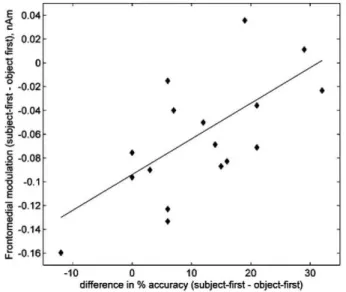
To further explore the relationship between these increases in brain activity and the higher difficulties in the comprehension of object-first sentences at a behavioural level, partial correla-tion coefficients were computed between the sum of the MNE current intensity of each spatio-temporal cluster and compre-hension accuracy for object-first sentences, while controlling for MNE current intensity and comprehension accuracy in subject-first sentences. These partial correlation coefficients describe the subject-by-subject relationship between brain activity and behavioural accuracy in object-first sentences, when brain activ-ity and behavioural accuracy in subject-first sentences are held fixed. Therefore, they represent how brain activity modulation in object-first vs. subject-first sentences is related to each subject's individual difference in behavioural accuracy between conditions. Results show a significant and positive partial correlation coeffi-cient between brain activity and behavioural accuracy, but only for the late fronto-medial cluster (r = 0.634, df=13, p<0.05). As it is shown in Fig. 4, the higher the brain activity increase dur-ing the comprehension of object-first compared to subject-first sentences, the lower the difference between the comprehension accuracy in both conditions. In other words, subjects showing increased engagement of this region for object-first, in compari-son with subject-first sentences, performed equally well on both
-10 0 10 20 30 difference in % accuracy (subject-first - object-first)
Fig. 4. Scatterplot showing the relationship between the modulation of activity in
the medial frontal cortex (subject-first vs. object-first sentences) and the differ-ences in percentage accuracy between both conditions on post-sentence verification probes.
conditions. In contrast, subjects who showed little modulation of this region on the complex condition performed worst on object-first than in subject-object-first sentences, interpreting them erroneously according to the "subject-first" bias.
4. Discussion
The aim of the current work was to study the cortical dynam-ics related to processing conflicts during thematic role assignment. In this concern, we compared brain activity while subjects were reading Spanish subject-cleft sentences and noncanonical ambigu-ous object-first cleft sentences. We hypothesize that a subject-first structure would be initially assigned to both kinds of sentences, but this structure should be revised in the case of object-first sen-tences, thus recruiting brain areas related to the revision of the sentence structure and the thematic hierarchy. Further, through the use of MEG, we aimed to provide a temporal characterization of this brain network and to gain an additional insight into its functional organization complementing previous functional neu-roimaging and electrophysiological studies.
conditions are not based on working memory and/or interference costs associated to the longer maintenance of the antecedent of the relative clause in object-first sentences, as happens in English (Gibson, 1998; Gordon et al., 2001). In contrast, the higher pro-cessing complexity of object-first sentences in this study seems to be attributable to the preference for subject-first structures, and the necessity to revise this preference when the last animate noun is found. In the present experiment, the off-line sentence verifica-tion task revealed that object-first sentences showed increased RTs and were often misinterpreted as subject-first sentences, which is attributable to the conflict engendered between the subject-first bias and the final object-first structure of these sentences.
With regard to previous psychophysiological data, Casado et al. (2005) found a P600 effect on ERPs when semantic or syntactic information signalled an object-first structure, revealing, as in the current study, a process of revision engendered by the conflict between the preferred canonical structure and the actual non-canonical structure of the sentence. However, their effect was time-locked to the onset of the determiner without the preposi-tion "a" in the second NP of the sentence when this informapreposi-tion was crucial to signal a noncanonical word order. In contrast, our present results arise slightly later, after the onset of the noun of this second NP. Nevertheless, they used some verbs allowing only animate undergoers (e.g.: hurt, arrest), while we used only verbs allowing animate and inanimate undergoers (e.g.: criticise, defend, etc.). As discussed above, the preposition "a" in Spanish is used to mark animate but not inanimate objects (Leonetti, 2003). Then, as already noted, when the verb allows only for an animate undergoer, Spanish object-first sentences with subject inversion are disam-biguated by the non-marked determiner of the NP. In contrast, when the verb allows for an animate or an inanimate undergoer, as in the current study, noncanonical sentences with subject inversion are disambiguated by the animacy of the noun. Hence, the object-first structure is disambiguated earlier in the study by Casado et al. (2005), at least in some trials, but is delayed until the animacy of the last noun is confirmed in the present work. Moreover, in the present study we were able to map brain increases at different frontal regions related to the processing conflicts engendered by object-first sentences. The results of the MNE source analysis of brain activity show differences between subject-first and object-first sentences arising during the processing of the last noun. At this point a complex frontal network revealed higher activity during the processing of sentences where the object precedes the subject. Furthermore, it occurred in a time modulated manner, suggesting that the different regions might be involved in different stages of processing. In the following, we will discuss the putative role of this functional network in the processing of Spanish ambiguous noncanonical sentences.
4.1. LeftDLFC
Many previous neuroimaging studies have reported the left DLFC (including the lateral premotor cortex, where the effect showed its maximal amplitude) as a region engaged in the compre-hension of noncanonical or more complex sentences in interaction with other areas (see for example Bornkessel et al., 2005; Chen, West, Waters, & Caplan, 2006; Constable et al, 2004; Kinno et al., 2008; Meltzer, McArdle, Schafer, & Braun, 2010). Additional evi-dence about the main role of this region in the comprehension of complex sentences comes from a recent study using voxel-based lesion mapping (VBLM) in a large sample of patients with a left frontal glioma. In this study, Kinno et al. (2009) found that patients were impaired at understanding object-before-subject sentences when the lesion overlapped the left lateral premotor or the LIFG.
Our results also show that increased engagement of the left DLFC during the processing of object-first sentences occurs around
450 ms after the appearance of the noun disambiguating the order of arguments in the clause. This temporal window coincides with the second phase of neurocognitive models of sentence compre-hension based on ERP data, where thematic roles are assigned on the basis of morphosyntactic and semantic information (Bornkessel & Schlesewsky, 2006; Friederici, 2002). In the present case, the appearance of a non object-marked specific and animate argument after the verb engenders a conflict with the previous subject-first analysis and triggers the reanalysis and revision of the previous sentence structure.
Bornkessel et al. (2005) suggest that the premotor cortex could be involved in the linearization of the arguments of the sentence as a basis to establish the thematic prominence (who is the actor and who the undergoer) when the linear positions of the arguments do not correspond to their hierarchization in the thematic structure. They base this proposal on recent studies demonstrating that the premotor cortex is not only involved in the processing of motor sequences but also more generally in the internal sequencing of external events (see Schubotz, 2007). Alternatively, the left pre-motor areas might be involved in the reanalysis of the sentence through phonological rehearsal (see for example Chein, Ravizza, & Fiez, 2003). Although it has sometimes been stated that phonologi-cal rehearsal is not necessary for complex sentence comprehension (Caplan, Alpert, Waters, & Olivieri, 2000), recent evidence sug-gest that impairments in phonological short-term memory could lead to problems in the comprehension of noncanonical complex sentences (Papagno, Cecchetto, Reati, & Bello, 2007). In the same vein, Rogalsky, Matchin, and Hickok (2008) have found articulatory rehearsal to interfere with the processing of English object-relative clauses (although in this case the interaction between subvocal rehearsal and the processing of object-relative clauses was found over the pars opercularis of Borca's area). In any case, both interpre-tations converge on the idea that the left DLFC seems to be engaged in a reanalysis of the sentence structure to provide an adequate linearization of the arguments in order to establish the thematic hierarchy.
4.2. Anterior LIFG
Following the temporal sequence of the results, we found an increase of activity when processing object-first sentences over the aLIFG, between 809 and 836 ms after the appearance of the criti-cal last noun. The LIFG have been repeatedly shown to be engaged in the comprehension of complex sentences (Caplan, 2001; Kaan & Swaab, 2002). It has been proposed that posterior regions of the LIFG might be engaged by linearization demands, when deter-mining the prominence of one argument over the others becomes more complex (Bornkessel et al., 2005; Bornkessel-Schlesewsky, Schlesewsky, & von Cramon, 2009). In more general terms, the LIFG has been proposed to be devoted to the resolution of con-flict between alternative representations when competition among them exists (Badre & Wagner, 2007), and this view has recently been extended to the field of sentence processing (Novick et al., 2005; Thompson-Schill et al., 2005). From these points of view we will have expected an increase of activity on a more posterior focus over the LIFG when processing first sentences, as in object-first sentences the thematic assignment based on the linear order of the arguments conflicts with the actual correct interpretation of the sentence.
may have triggered controlled semantic processes for the revi-sion and checking of thematic role assignment during the sentence reanalysis (Caplan, Stanczak, & Waters, 2008). The time window where our results showed an increased recruitment of this region (around 800 ms post-stimulus) takes place within the late stage of controlled sentence processing to check and resolve conflicts which is usually manifested in a late positivity (the P600).
The key importance of this region in the comprehension of com-plex sentences is highlighted by the results of Dronkers, Wilkins, Van Valin, Redfern, and Jaeger (2004), who used VBLM to exam-ine the correlation between brain damage in a large sample of aphasic patients and their sentence comprehension abilities. They found that damage exclusive to classical Broca's area (pars tri-angularis and/or opercularis, BA 44/45) did not result in concrete or persistent difficulties in the comprehension of complex sen-tences, while damage to the left pars orbitalis (as well as to the adjacent BA 46) results in selective deficits in the comprehension of complex sentences such as those containing object-extracted relative clauses. However, more recent studies using VBLM have found that damage to more posterior regions of the LIFG might also impair the comprehension of complex sentences (Amici et al, 2007; Kinno et al., 2009). Further, a recent study using VBLM indicates posterior aspects of the LIFG as crucially implicated in "selection for position" (i.e., resolving the interference among mul-tiple representations simultaneously activated during sequencing, Thothathiri, Schwartz, & Thompson-Schill, 2010) an issue which might be of critical importance when word order conflicts with thematic prominence computations during sentence comprehen-sion.
Then, at present it is not fully clear why the current contrast tend to recruit anterior regions of the LIFG but not the "classi-cal" more posterior regions of Broca's area (pars triangularis and/or pars opercularis). Some studies failing to replicate the effect of object-first structures on posterior regions of the LIFG have used German sentences containing object-extracted relative clauses and wh-questions (Fiebach et al., 2005). In contrast, German sentences containing a permuted order of constituents actually recruit the LIFG in a higher degree when the permutation of arguments occur in the so-called middlefield of the clause (i.e., not in the clause initial position, Bornkessel et al., 2005; Friederici, Fiebach, Schlesewsky, Bornkessel, & von Cramon, 2006). Bornkessel and Schlesewsky (2006) have underscored the fact that English object-extracted relative clauses increased the activity of the LIFG, but German object-extracted relative clauses and wh- questions not, bearing in mind that all them show a noncanonical order of constituents. They interpreted that clause initial positions in German does not prompt thematic role prominence computations, as German clause initial positions can host any constituent, independently of its grammat-ical function. In contrast, for German middlefield positions, linear order is an important cue to determine thematic prominence. In the case of English, which shows a very restrictive word order, the linear order of the arguments will engender the computation of thematic prominence independently of the position in the clause.
With regard to Spanish, tough word order is an important cue for thematic assignment, it seems not to be as restrictive as in English, as it allows, for example, for subject inversion. Consequently, we might ask ourselves whether Spanish cleft sentences as those used in the present work might behave similarly to German relative clauses and wh-questions. Comparing the engagement of the LIFG in different kinds of Spanish sentences containing a canonical or a noncanonical order of arguments (for example, in simple declar-ative sentences, where changes in the position of arguments do not involve the clause initial position vs. relative clauses or wh-questions, where objects are fronted to a clause initial position), as well as in other languages where word order is not as fixed as it is in English, might help to resolve this problem.
Notwithstanding, some previous English studies have also failed to replicate the effect of increased LIFG activation in object-first compared to subject-first sentences (Caplan et al., 2002; Cooke et al., 2001; Lee & Newman, 2010). These studies have used rapid serial visual presentation (RSVP) of words or segments of the sen-tences instead of whole-sentence presentation. For example, Lee and Newman (2010) found and increased engagement of the LIFG for complex object-extracted sentences, compared to simpler con-joined sentences, during whole sentence presentation, but not
during RSVP. Additionally, they verify that brain activity was higher in the LIFG during RSVP than during whole sentence presentation for the simpler sentences, which might be due to increased work-ing memory demands for this kind of paradigm. Hence, posterior regions of the LIFG playing a crucial role for verbal working mem-ory (Rogalsky et al., 2008) might be recruited in a higher degree during RSVP even for simple canonical sentences, obscuring the increased recruitment of this region when syntactic-to-thematic mapping demands increase. As the present study uses the standard procedure of word-by-word RSVP in psychophysiological studies of sentence processing, this might have contributed to mask the engagement of more posterior regions of the LIFG for object-first sentences.
In any case, as an anonymous reviewer correctly pointed out, there have neither been, to the best of our knowledge, previous neuroimaging studies contrasting the impact of word order on sen-tence comprehension in Spanish, nor previous MEG studies on the impact of word order on sentence comprehension. So, the failure of the present study to replicate previous fMRI and PET results on posterior regions of the LIFG might be due, either to methodologi-cal differences with previous neuroimaging studies, cross-linguistic differences with the languages employed in previous studies, or any combination of them. Therefore, any tentative explanation of the present data in this regard is only speculative and should be contrasted through further detailed research.
4.3. Medial frontal cortex
The last cluster of significant differences arises about 907-919 ms after the appearance of the critical word, showing again higher brain activity during the processing of object-first sentences. This cluster is located bilaterally over medial frontal regions (see Fig. 3c). Brain activity over the frontomedial cortex, and particularly over the ACG, has been found in tasks that require overriding a predominant response, to select a more adequate one, to select among competing possibilities, or error monitoring (Botvnick, Cohen, & Carter, 2004). So this region has been generally related with conflict monitoring during task performance. Some previous functional neuroimaging studies have also shown that, in comparison with subject-first sentences, object-first sentences increase mediofrontal brain activity, which has been attributed to attentional resources necessary to process the more complex mate-rial (Caplan, 2001; Constable et al., 2004).
Notwithstanding, this frontomedial circuit is not usually assumed to be part of the core language processing network in the brain. However, it can be thought as part of a widespread network supporting domain-general cognitive resources, which might be recruited by task demands and interact with language processing (Cooke et al., 2006). In this sense, it could be essential to sustain late, post-interpretative resources, in the sense of Caplan and Waters (1999), i.e., resources devoted to "the use of [..] meaning [extracted from the sentence] to accomplish other tasks such as storing infor-mation in long term semantic memory, reasoning, planning actions, and other functions".
at comprehending noncanonical sentences correlate not only with their verbal working memory deficits but also with executive and inhibitory control problems such as those shown in cognitive set-shifting (Hochstadt, Nakano, Lieberman, & Friedman, 2006). In a similar vein, functional neuroimaging results have shown an underactivation of medial frontal regions during complex sentence processing in patients with Parkinson's disease (Grossman et al., 2003).3
So, independent of purely linguistic processing, the fronto-medial cortex might be highly relevant in adapting behavioural performance to task demands. Results of the correlation analysis reveal that subjects who showed an increased engagement of this region during the comprehension of object-first, in comparison with subject-first sentences, performed better in the compre-hension task. In contrast, subjects showing little modulation of frontomedial areas comprehended subject-first sentences ade-quately but performed poorly when comprehending object-first sentences, interpreting them according to the "subject-first" bias. Hence, the increased recruitment of frontomedial areas during the processing of object-first sentences might be due to an additional cost of monitoring the reanalysis to cope with the sentence verifi-cation task.
In this regard, an appealing idea could be that this region is recruited to monitor the conflict between competing propositional representations of the sentence: one based in the preliminary "subject-first" preference and the actual, syntactically based, inter-pretation. Tough only the later is accurate, the former seems to interfere and lead to a misunderstanding of the sentence, which is reflected in a lower performance and increased response times in the off-line sentence-verification task. This is in accordance with recent proposals suggesting that syntactically unlicensed but "good-enough" sentence interpretations, which are created during sentence processing, are not completely abandoned and might influence the interpretation of the sentence (Ferreira, 2003; Ferreira, Bailey, & Ferraro, 2002).
Moreover, the temporal window where these effects arise (around 900 ms after the appearance of the critical word) also takes place within the late stage of checking and resolution of conflicts that neurocognitive models of sentence comprehension have pointed to (Bornkessel & Schlesewsky, 2006; Friederici, 2002). The presumed role of frontal cognitive control mechanisms in the processes of revision of ambiguous noncanonical sentences is also emphasized by a recent ERP study (Erdocia, Laka, Mestres-Misse, & Rodriguez-Fornells, 2009) reporting a sustained widespread nega-tivity with a right frontal maximum when ambiguous noncanonical Basque sentences are disambiguated by the verb meaning. Erdocia et al. (2009) interpreted this negativity as reflecting the engage-ment of frontal networks involved in attentional control to sustain the reanalysis in favour of the unpreferred noncanonical structure, an interpretation that is clearly compatible with the present results. In summary, although further research is necessary to reveal in detail how brain circuits involved in executive control interact with sentence processing, the current study highlight the importance of frontal cognitive control mechanisms when conflict arises
dur-3 In fact, Parkinson's disease implies the pathology of frontostriatal circuits, including the basal ganglia, which are crucial for executive functions and might also play an important role on language processing (Grossman, 1999). For exam-ple, patients with basal ganglia pathology have failed to show P600 effects during sentence processing, revealing deficits in late stages of integration of the informa-tion and resoluinforma-tion of processing conflicts (Friederici and Kotz, 2003; Frisch et al., 2003). Unfortunately, MEG is not optimal to measure the activity of subcortical struc-tures because of the rapid decrease of the measured magnetic held with distance to the source (Hamalainen and Hari, 2002). Bearing this in mind, we can not extract from this study any conclusions about the possible role of subcortical structures pertaining to cortico-striatal circuits.
ing thematic role assignment. Moreover, the results suggest that, beyond the sentence reanalysis, late post-interpretive processes related to conflict monitoring which depend on frontomedial areas might be of critical importance for accurate comprehension.
Acknowledgements
D.R. is currently supported by the project Madr.IB (S-SAL-0312-2006) funded by the Madrid Government. Authors would like to thank Manuel Carreiras for his help in suggesting the more ade-quate contrast between subject- and object-first Spanish sentences, Maria Teresa Martín-Aragoneses for her help in the recruitment of volunteers for the study and Gabriela Castillo for helpful comments on earlier versions of the manuscript.
Appendix A. Supplementary data
Supplementary data associated with this article can be found, in the online version, at doi:l 0.1016/j.neuropsychologia.2010.12.005.
References
Amici, S., Brambati, S. M., Wilkins, D. P., Ogar, J., Dronkers, N. L, Miller, B. L., et al. (2007). Anatomical correlates of sentence comprehension and verbal working memory in neurodegenerative disease Journal of Neuroscience, 27(23), 6282-6290.
Badre, D., & Wagner, A. D. (2007). Left ventrolateral prefrontal cortex and the cog-nitive control of memory. Neuropsychologic 45, 2883-2901.
Ben-Shachar, M., Palti, D., & Grodzinsky, Y. (2004). Neural correlates of syntac-tic movement: Converging evidence from two fMRI experiments. Neuroimage, 21(4), 1320-1336.
Betancort, M., Carreiras, M., & Sturt, P. (2009). The processing of subject and object relative clauses in Spanish: An eye-tracking study. Quarterly Journal of Experi-mental Psychology (Colchester), 62(10), 1915-1929.
Bornkessel, I., & Schlesewsky, M. (2006). The extended argument dependency model: A neurocognitive approach to sentence comprehension across lan-guages. Psychological Review, ¡ ¡3(4), 787-821.
Bornkessel, I., Zysset, S., Friederici, A. D., von Cramon, D. Y., & Schlesewsky, M. (2005). Who did what to whom? The neural basis of argument hierarchies during lan-guage comprehension. Neuroimage, 26(1), 221-233.
Bornkessel-Schlesewsky, I., Schlesewsky, M., & von Cramon, D. Y. (2009). Word order and Broca's region: Evidence for a supra-syntactic perspective. Brain and Language, 11 ¡(3), 125-139.
Botvnick, M., Cohen, J. D., & Carter, C. S. (2004). Conflict monitoring and anterior cingulate cortex: An update. Trends in Cognitive Sciences, 8(12), 539-546. Caplan, D. (2001). Functional neuroimaging studies of syntactic processing. Journal
of Psycholinguistic Research, 30(3), 297-320.
Caplan, D., Alpert, N., & Waters, G. (1999). PET studies of syntactic processing with auditory sentence presentation. Neuroimage, 9(3), 343-351.
Caplan, D., Alpert, N., Waters, G., & Olivieri, A. (2000). Activation of Broca's area by syntactic processing under conditions of concurrent articulation. Human Brain Mapping, 9(2), 65-71.
Caplan, D., Stanczak, L., & Waters, G. (2008). Syntactic and thematic constraint effects on blood oxygenation level dependent signal correlates of comprehension of relative clauses. Journal of Cognitive Neuroscience, 20(4), 643-656.
Caplan, D., Vijayan, S., Kuperberg, G., West, C, Waters, G., Greve, D., et al. (2002). Vascular responses to syntactic processing: Event-related fMRI study of relative clauses. Human Brain Mapping, ¡5(1), 26-38.
Caplan, D., & Waters, G. (1999). Verbal working memory and sentence comprehen-sion. Behavioral and Brain Sciences, 22(\), 11-94,95-126; discussion Casado, P., Martin-Loeches, M., Munoz, F., & Fernandez-Frias, C. (2005). Are semantic
and syntactic cues inducing the same processes in the identification of word order? Brain Research Cognitive Brain Research, 24(3), 526-543.
Chein, J. M., Ravizza, S. M., & Fiez, J. A. (2003). Using neuroimaging to evaluate models of working memory and their implications for language processing. Journal of Neurolinguistics, ¡6,315-339.
Chen, E., West, W. C, Waters, G., & Caplan, D. (2006). Determinants of BOLD sig-nal correlates of processing object-extracted relative clauses. Cortex, 42(4), 591-604.
Constable, R. T., Pugh, K. R., Berroya, E., Mencl, W. E., Westerveld, M., Ni, W., et al. (2004). Sentence complexity and input modality effects in sentence compre-hension: An fMRI study. Neuroimage,22(\), 11-21.
Cooke, A., Grossman, M., DeVita, C, Gonzalez-Atavales, J., Moore, P., Chen, W., et al. (2006). Large-scale neural network forsentence processing. Brain and Language, 96(1), 14-36.
Crouzeix, A., Yvert, B., Bertrand, O., & Pernier, J. (1999). An evaluation of dipole recon-struction accuracy with spherical and realistic head models in MEG. Clinical Neurophysiology, 2 20, 2176-2188.
Cuffin, B. N. (1991). Moving dipole inverse solutions using MEGs measured on a plane over the head. Electroencephalography and Clinical Neurophysiology, 78, 341-347.
Demiral, S. B., Schlesewsky, M., & Bornkessel-Schlesewsky, I. (2008). On the univer-sality of language comprehension strategies: Evidence from Turkish. Cognition, 206(1), 484-500.
Dronkers, N. F., Wilkins, D. P., Van Valin, R. D., Jr., Redfern, B. B., & Jaeger, J. J. (2004). Lesion analysis of the brain areas involved in language comprehension. Cogni-tion, 92(1-2), 145-177.
Erdocia, K., Laka, I., Mestres-Misse, A., & Rodriguez-Fornells, A. (2009). Syntactic complexity and ambiguity resolution in a free word order language: Behavioral and electrophysiological evidences from Basque. Brain and Language, 209(1), 1-17.
Ferreira, F. (2003). The misinterpretation of noncanonical sentences. Cognitive Psy-chology, 47(2), 164-203.
Ferreira, F., Bailey, K. G. D., & Ferraro, V. (2002). Good-enough representations in lan-guage comprehension. Current directions in psychological science, 22(1),11-15. Fiebach, C. J., Schlesewsky, M., Lohmann, G., von Cramon, D. Y., & Friederici, A.
D. (2005). Revisiting the role of Broca's area in sentence processing: Syntac-tic integration versus syntacSyntac-tic working memory. Human Brain Mapping, 24(2), 79-91.
Friederici, A. D. (2002). Towards a neural basis of auditory sentence processing. Trends in Cognitive Sciences, 6(2), 78-84.
Friederici, A. D., Fiebach, C. J., Schlesewsky, M., Bornkessel, I. D., & von Cramon, D. Y. (2006). Processing linguistic complexity and grammaticality in the left frontal cortex. Cerebral Cortex, 2 6( 12), 1709-1717.
Friederici, A. D., & Kotz, S. A. (2003). The brain basis of syntactic processes: Functional imaging and lesion studies. Neuroimage, 20(Suppl. 1), S8-17.
Friederici, A. D., Mecklinger, A., Spencer, K. M., Steinhauser, K., & Donchin, E. (2001). Syntactic parsing preferences and their on-line revisions: A spatio-temporal analysis of event-related brain potentials. Cognitive Brain Research, 2 2,305-323. Frisch, S., Kotz, S. A., von Cramon, D. Y., & Friederici, A. D. (2003). Why the P600 is not just a P300: The role of the basal ganglia. Clinical Neurophysiology, 2 24(2), 336-340.
Gibson, E. (1998). Linguistic complexity: Locality of syntactic dependencies. Cogni-tion, 68,1-76.
Gibson, E. (2000). The dependency locality theory: a distance-based theory of linguistic complexity. In A. Marantz, Y. Miyashita, & W. O'Neil (Eds.), Image, language, brain. Cambridge, Mass: The MIT Press.
Gordon, P. C, Hendrick, R., & Johnson, M. (2001). Memory interference during language processing. Journal of Experimental Psychology: Learning Memory and Cognition, 27(6), 1411-1423.
Grodner, D., & Gibson, E. (2005). Consequences of the serial nature of linguistic input for sentential complexity. Cognitive Science, 29(2), 261-290.
Grossman, M. (1999). Sentence processing in Parkinson's disease. Brain and Cogni-tion, 40(2), 387-413.
Grossman, M., Cooke, A., DeVita, C, Lee, C, AIsop, D., Detre, J., et al. (2003). Grammat-ical and resource components of sentence processing in Parkinson's disease: An fMRI study. Neurology, 60(5), 775-781.
Gutiérrez-Bravo, R. (2003). Subject inversion in Spanish relative clauses. A case of prosody-induced word order variation without narrow focus. In T. Geerts, & H. Jacobs (Eds.), Romance languages and linguistic theory. Amsterdam: John Benjamins.
Hamalainen, M., & Hari, R. (2002). Magnetoencephalographic characterization of dynamic brain activation: Basic principles and methods of data collection and source analysis. In A. W. Toga, & J. C. Mazziotta (Eds.), Brain mapping: The methods. San Diego: Academic Press.
Hamalainen, M., & Ilimoniemi, R. (1994). Interpreting magnetic fields of the brain: Minimum norm estimates. Medical and Biological Engineering and Computing, 32, 35-42.
Hari, R., Levanen, S., & Raij, T. (2000). Timing of human cortical functions during cognition: Role of MEG. Trends in Cognitive Sciences, 4( 12), 455-462.
Hauk, O. (2004). Keep it simple: A case for using classical minimum norm estimation in the analysis of EEC and MEG data. Neuroimage, 22(4), 1612-1621.
Hinojosa,J. A., Martín-Loeches, M., Casado, P., Muñoz, F., & Rubia, F.J. (2003). Similar-ities and differences between phrase structure and morphosyntactic violations in Spanish: An event-related potentials study. Language and Cognitive Processes, 28(2), 113-142.
Hochstadt.J., Nakano, H., Lieberman, P., & Friedman.J. (2006). The roles of sequencing and verbal working memory in sentence comprehension deficits in Parkinson's disease. Brain and Language, 97(3), 243-257.
January, D., Trueswell, J. C, & Thompson-Schill, S. L (2009). Co-localization of stroop and syntactic ambiguity resolution in Broca's area: Implications for the neural basis of sentence processing. Journal of Cognitive Neuroscience, 22(12), 2434-2444.
Just, M. A., Carpenter, P. A., Keller, T. A., Eddy, W. F., & Thulborn, K R. (1996). Brain activation modulated by sentence comprehension. Science,274(5284), 114-116. Kaan, E., & Swaab, T. Y. (2002). The brain circuitry of syntactic comprehension. Trends
in Cognitive Sciences, 8(6), 350-356.
King, J. W., & Kutas, M. (1995). Who did what and when? Using word- and clause-level ERPs to monitor working memory usage in reading. Journal of Cognitive Neuroscience, 7(3), 376-395.
Kinno, R., Kawamura, M., Shioda, S., & Sakai, K. L. (2008). Neural correlates of non-canonical syntactic processing revealed by a picture-sentence matching task. Human Brain Mapping, 29(9), 1015-1027.
Kinno, R., Muragaki, Y., Hori, T., Maruyama, T., Kawamura, M., & Sakai, K. L. (2009). Agrammatic comprehension caused by a glioma in the left frontal cortex. Brain andLanguage, 220(2), 71-80.
Lee, D., & Newman, S. D. (2010). The effect of presentation paradigm on syntactic processing: An event-related fMRI study. Human Brain Mapping, 32(1), 65-79. Leonetti, M. (2003). Specificity and object marking: The case of Spanish a. In K.
von Heusinger, & G. A. Kaiser (Eds.), Proceedings of the workshop semantic and syntactic aspects of specificity in romance languages. Konstanz: Fachbereich Sparachwissenchaft.
Lewis, R. L., Vasishth, S., & Van Dyke, J. A. (2006). Computational principles of work-ing memory in sentence comprehension. Trends in Cognitive Sciences, 20(10), 447-454.
MacDonald, M. C, & Christiansen, M. H. (2002). Reassessing working memory: Com-ment on Just and Carpenter(1992) and Waters and Caplan (1996). Psychological Review, 209(1), 3 5 - 5 4 , 5 5 - 7 4 : discussion.
MacWhinney, B., Bates, E., & Kliegl, R. (1984). Cue validity and sentence interpreta-tion in English, German and Italianjourna/ of Verbal Leamingand Verbal Behavior, 23,127-150.
Maestu, F., Campo, P., Del Rio, D., Moratti, S., Gil-Gregorio, P., Fernandez, A., et al. (2008). Increased biomagnetic activity in the ventral pathway in mild cognitive impairment. Clinical Neurophysiology, 2 29(6), 1320-1327.
Mangin, J. F. (1995). From 3D magnetic resonance images to structural representa-tions of the cortex topography using topology preserving deformarepresenta-tions .Journal of Mathematical imaging and Vision, 5(4), 297-318.
Matzke, M., Mai, H., Nager, W., Russeler, J., & Munte, T. (2002). The costs of free-dom: An ERP-study of non-canonical sentences. Clinical Neurophysiology, 123(6), 844-852.
McDermott, K. B., Petersen, S. E., Watson, J. M., & Ojemann, J. G. (2003). A proce-dure for identifying regions preferentially activated by attention to semantic and phonological relations using functional magnetic resonance imaging. Neu-ropsychologia, 42(3), 293-303.
Meltzer, J. A., McArdle, J. J., Schafer, R. J., & Braun, A. R. (2010). Neural aspects of sentence comprehension: Syntactic complexity, reversibility and reanalysis. Cerebral Cortex, 20(8), 1853-1864. doi:10.1093/cercor/bhp249
Moratti, S., Rubio, G., Campo, P., Keil, A., & Ortiz, T. (2008). Hypofunction of right tem-poroparietal cortex during emotional arousal in depression. Archives of General Psychiatry, 65(5), 532-541.
Novick, J. M., Trueswell, J. C, & Thompson-Schill, S. L. (2005). Cognitive control and parsing: Reexamining the role of Broca's area in sentence comprehension. Cognitive, Affective & Behavioral Neuroscience, 5(3), 263-281.
Oldfield, R. C. (1971). The assessment and analysis of handedness: The Edinburgh inventory. Neuropsychoiogia, 9(1), 97-113.
Osterhout, L., & Holcomb, P. J. (1992). Event-related brain potentials elicited by syntactic anomaly. Journal of Memory and Language,31, 785-806.
Osterhout, L., Holcomb, P. J., & Swinney, D. (1994). Brain potentials elicited by garden-path sentences: Evidence of the application of verb information dur-ing parsdur-ing. Journal of Experimental Psychology: Learndur-ing Memory and Cognition, 20, 786-803.
Papagno, C, Cecchetto, C, Reati, F., & Bello, L. (2007). Processing of syntactically complex sentences relies on verbal term memory: Evidence from a short-term memory patient. Cognitive Neuropsychology, 24(3), 292-311.
Phillips, C, Kazanina, N., & Abada, S. H. (2005). ERP effects ofthe processing of syntac-tic long-distance dependencies. Brain Research Cognitive Brain Research, 22(3), 407-428.
Poldrack, R. A., Wagner, A. D., Prull, M. W., Desmond, J., Glover, G. H., & Gabrieli, J. D. E. (1999). Functional specialization forsemantic and phonological processing in the left inferior prefrontal cortex. Neuroimage, 20,15-35.
Pylkkanen, L, & McElree, B. (2007). An MEG study of silent meaning. Journal of Cognitive Neuroscience, 29(11), 1905-1921.
Rogalsky, C, Matchin, W., & Hickok, G. (2008). Broca's area, sentence comprehension, and working memory: An fMRI study. Frontiers in Human Neuroscience, 2,14. Sahin, N. T., Pinker, S., Cash, S. S., Schomer, D., & Halgren, E. (2009). Sequential
processing of lexical, grammatical and phonological information within Broca's area. Science, 326, 445-449.
Sarvas, J. (1987). Basic Mathematical and electromagnetic concepts ofthe biomag-netic inverse problem. Physics in Medicine and Biology, 32,11-22.
Schubotz, R. I. (2007). Prediction of external events with our motor system: Towards a new framework. Trends in Cognitive Sciences, 2 2(5), 211-218.
Thompson-Schill, S. L., Bedny, M., & Goldberg, R. F. (2005). The frontal lobes and the regulation of mental activity. Current Opinion in Neurobiology, 25, 219-224.
Thothathiri, M., Schwartz, M. F., & Thompson-Schill, S. L. (2010). Selection for posi-tion: The role ofthe ventrolateral prefrontal cortex in sequencing language. Brain and Language, 123, 28-38.