
TEM and SAED Characterization of Metakaolin. Pozzolanic Activity
L. Trusilewicz,*^ F. Fernández-Martínez,* V. Rahhal,
§and R.TalercA
^Escuela Técnica Superior de Ingeniería y Diseño Industrial, Universidad Politécnica de Madrid, 28012 Madrid, Spain
Civil Engineering Department, Faculty of Engineering, U.N.C.P.B.A, Avda. del Valle 5737, B7400JWI Olavarría, Argentina
^Instituto de Ciencias de la Construcción "Eduardo Torroja", Consejo Superior de Investigaciones Científicas, 28033 Madrid, Spain
The present study deals with a characterization of metakaolin pozzolanic activity and its chemical character exhibited in the Ordinary Portland Cement (OPC) blends by means of Trans-mission Electron Microscopy (TEM) and Selected-Area Elec-tron Diffraction (SAED) techniques principally. Metakaolin sample was prepared by calcination of kaolin rock (Guadalaj-ara, Spain) at 780°C. Two OPC of different chemical composi-tion from the tricalcium alumínate content point of view were chosen and Portland cement blends series elaborated and then submitted to the pozzolanic activity test (EN 196-5 or Frattini test). The main mineralogical components of the metakaolin are determined qualitatively: /-alumina and quartz. The chemi-cal character of the metakaolin is described because of its final composition as well as due to its Al atoms possible coordina-tion. The crystalline order of the material is found to be of both amorphous and polycrystalline, being an intimate amor-phous mixture of alumina and silica. Finally, all the alumina capable of reacting chemically is denominated and classified as reactive alumina component, Al203 r , of pozzolans, as well as
the aluminic chemical character of metakaolin in OPC blends is once again proved and exhibited by means of Friedel's salt formation studied already at 4 h-age.
I. Introduction
K
AOLIN rock is classified to a mineral group composed by clays or clayey rocks, generally of detritus kind. These minerals possess a different crystalline structure between each other (kaolinite, illite, montmorillonite), but are constituted by subsequent sheet of Si tetrahedral and Al octahedral.The most attractive properties of clayey minerals from their usefulness for Portland cement (PC) industry are those achieved thanks to their usually programmed, thermal treat-ment which gives rise to new semi-crystalline/amorphous compounds, conserving their original crystalline structure or not. Kaolinite, 2Si02Al203-2H20, (S2AH2 in cement nomen-clature, i.e., S-Si02, A-A1203, H - H20 ) , heated at given con-ditions is converted into metakaolinite, 2Si02Al203, (S2A). In other words, it becomes the intermediate artificial reactive product resultant from adequate thermal dehydroxylation (OH~ groups loss) of the kaolinite crystalline lattice that begins at 550°C.1 Whereas the heating continues at higher temperatures, new properties of the materials can be
achieved, modified and also designed.4 As an example, the solubility in acids (HC1 or HF) can be modified, which is an important parameter from the material pozzolanic activity point of view, since, as demonstrated previously,5'6 the non-soluble quantities of clay are not capable of reacting with portlandite (a main Portland cement hydration products) and/or calcium hydroxide.
The thermal transformation mechanism of kaolin and a subsequent new properties achievement by its resultant me-takaolin has been described by several authors.2'6 9 When all the dehydroxylation water is out from the original crystalline lattice of kaolin, the new reactive transitional structure is con-served (metakaolinite).2 However, a certain disagreement still exists to assign any particular crystal structure to this transi-tional state. According to Brindley and Nakahira,10 the Al3 + and Si4 + cations maintain their reticular positions, but report a different coordination to oxygen anions. Taylor1 claims that the oxygen possesses some specific disposition to be bonded randomly to the cations Al3 + and Si4 +, considering the men-tioned proton migration essential for the resultant structure of metakaolin. Freund11 sustains an elevated concentration of reticular defects in the structure and also combined with tet-rahedral coordination of Al, therefore it is impossible to assign any determined structure of such a metastable level.
Finally, the only certainty obtained so far is that metakao-lin conserves some part of original crystalmetakao-line structure, so-called "crystalline memory" of its kaolinite precursor,2 denominated its thermal activation as "topologic transforma-tion" of original clayey mineral. However, Jaffee11 presents some assumptions based on experimental chemical reactivity of metakaolinite, formulating an idea that it possesses fixed bounds of Si-O-Al, although somewhat weaker than those of its precursor kaolin. Therefore, their complete separation during acid-basic attacks can be achieved, for instance, by means of Florentin method.1
Talero's considerations12 about the classification used for the reactive fractions of pozzolans, as a mineral partial sub-stitute for Portland cement, have been supplemented by Moya et alP 2 years later. Those observations of kaolinite dehydroxylation process delivered that reactive alumina, Al203 r~, studied by Talero in PC/MK blends,7 9'12 corre-sponds to tetra- and pewto-coordinated alumina of metakao-lin, characterized by its physicochemical amorphous state,13 principally.
Pozzolanic activity of these active mineral admixtures con-sists of a chemical reaction of their "hydraulic factors", Si02 r~ and Al203 r~, with portlandite, Ca(OH)2, (released from Portland cement hydration), to generate new phases of cementitious properties.14 Moreover, a given pozzolanic material should fulfill the following chemical condition15: Si02(totai) + Al203 ( t o t a l ) + Fe203 ( t o t a l ) > 70 wt%.
II. Objectives
The main objective of this study was the morphological char-acterization of metakaolin (MK), taking into account its crystalline degree aspect and thermal evolution especially, related directly to its high pozzolanic activity in its OPC blends and the chemical character involved.
III. Experimental Procedure
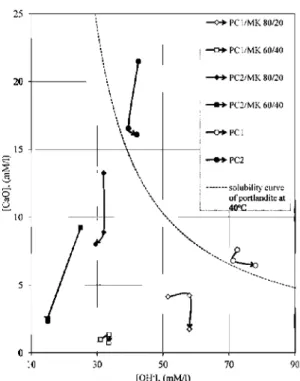
The experimental part of this work consisted first of a MK sample preparation by calcination process of kaolin rock at 780°C (24 h) in air atmosphere, being the most appropriate temperature to obtain the most reactive chemically material as indicated by previous authors.11 For this purpose, the high purity raw material was selected from Guadalajara region (Spain). Moreover, to compare, two OPC of different miner-alogical composition from the tricalcium alumínate, C3A, and tricalcium silicate, C3S, content point of view, (C-CaO, A-A1203, S-Si02), PCI and PC2, were chosen. The elabo-rated Portland cement blends series were then submitted to the pozzolanicity test16 (EN 196-5 of obligatory compliance for pozzolanic cements17), Fig. 1. This standard procedure of pozzolanic cements, so-called Frattini test,16 consists of the
quantitative determination of Ca(OH)2 concentration, released from PC during hydration reaction process, which is carried out in aqueous solution containing the hydrated sam-ple, once a given time is passed (2, 7, and 28 days in this study). The collected data are presented together with the calcium hydroxide, Ca(OH)2, solubility isotherm estimated for an alkaline solution at 40°C. The correspondent point [CaO;OH~] placed below the solubility isotherm indicates positive result of the test, i.e., points out pozzolanic activity of the tested addition (MK). The selected replacement dosages used in this study for the PC/MK blends were 80/20 and 60/40 wt%. The obtained results are present in Fig. 1.
The chemical composition of the materials, MK and PC, is given in Table I and it was achieved by means of ASTM C31118 and EN 196-219 procedures, respectively. The specific area BET was determined by N2 adsorption method in iso-thermal conditions at 77 K. The potential composition of PC, PCI, and PC2, using the Bogue's formulas,20 was as fol-lows: 51% C3S, 16% C2S, 14% C3A, and 5% C4AF for PCI (OPC), and 79% C3S, 2% C2S, 0% C3A, and 10% C4AF for PC2, respectively.
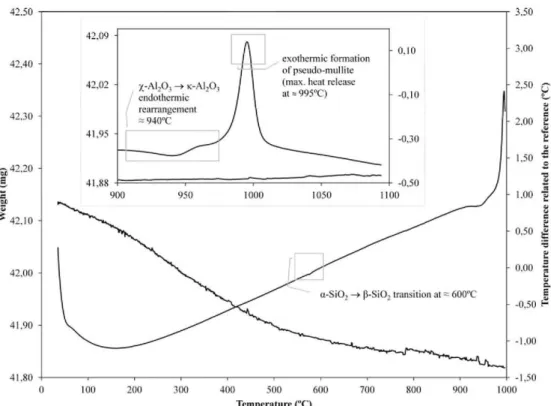
Thermal Analysis (TA) of the MK as well as of its precur-sor, kaolin, was performed (Figs. 2 and 3). Non-isothermal decomposition of the sample was determined with SDT Q600 TA Instruments thermogravimeter (WATERS, Madrid, Spain), under the N2 dynamic flow. The experiment was car-ried out up to 1100°C with a heating rate of 10°C/min. The sample weight applied did not exceed 50 mg, (Pt sample holder). The thermal transformation stages were correspon-dently assigned and kinetics models calculated for the kaolin dehydroxylation by means of the Coats & Redfern
approxi-25
20
S
PC 1/MK 80/20
P( 'MK 60/40
PC2/MK 80/20
PC2/MK 60/40
PC
PC2
- solubility curve
of port I and i teal 40°C
/
X
- ^
^
1
30 50
[OH-], (mM/l)
70
Fig. 1. Frattini results for PCI and PC2 cements blended with the metakaolin (MK). Hydration reaction at 2, 7, and 28 days-age.
Table I. Chemical Composition of MK (ASTM C31118)
and the Cements, PCI and PC2 (EN 196-219)
Material/Parameter LOI%
RI% Si02% F e203% A1203% CaO total % MgO%
so
3%
N a20 + K20 % Physical Parameter
Real density (g/cm3) SEB (m2/kg) BET (m2/kg)
MK
0.46 0.26 55.50 0.33 41.40 0.08 0.16 0.00 0.00
2.52
333 9000
PCI
1.60 0.70 19.18 1.75 6.44 63.94 1.48 3.50 0.90 + 0.52
3.08
319
-PC2
1.11 0.15 21.70 4.11 1.52 67.97 0.42 2.34 0.43 + 0.20
3.21
329
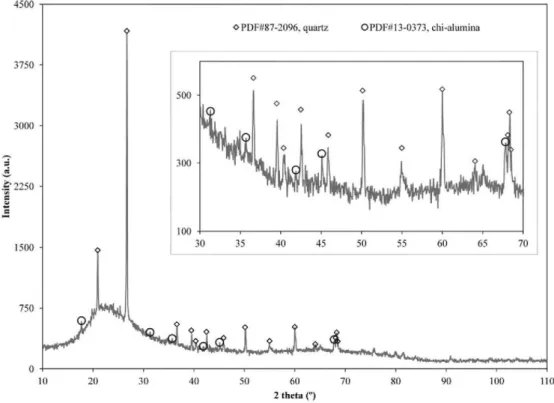
-mation,21 applied for non-isothermal conditions. Both me-takaolin and kaolin were examined by XRD technique, using Siemens D-5000 diffractometer (BRUKER, Madrid, Spain) with CuKa = 1.54056 Á radiation, equipped with a graphite
monochromator (power settings of 40 kV and 20 mA). The scanning rate was 0.02° in 29 per second in the angular range of 2°-100° in 29, Fig. 4.
In addition, TEM and Selected-Area Electron Diffraction (SAED) techniques were applied. The sample preparation consisted of the following: the solid deposit was dispersed in butyl alcohol by ultrasonic wave technique to prevent parti-cles agglomeration, then several drops were placed on Cu grids (coated with holey-carbon support film), dried and examined by JEOL microscope (JEM-2000 FX, 200 kV; National Microscopy Center, Madrid, Spain). The SAED data were collected in different zones of the TEM image, Figs. 5 and 6.
42.50
42.40
42.30
-4 2 , 0
42.10
41.TO
41.SO
3.50
2,50
2.00 £
1,50
1.00
0,50 I
11.00
I
-0,50 £
-1,00
-1.50
0 100 200 300 400 500 600 700 800 900 1000
Temperature (°C)
Fig. 2. Thermal decomposition of the MK sample. 0.84% total weight loss at 1000°C.
600
Temperature ("C)
Fig. 3. Thermal decomposition of the kaolin.
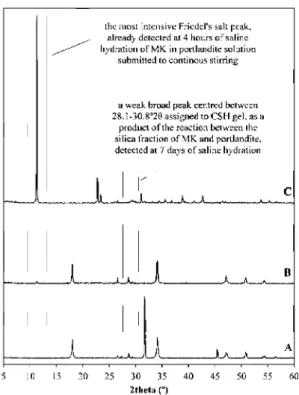
7 days, separately. The reactive system was submitted to calcium hydroxide, Ca(OH)2, constant saturation and 3.75% NaCl solution was applied. The final solid parts of the exper-iment were analyzed qualitatively by XRD. The scanning rate was 0.05° in 29 per second at the angular range of 5°-70° in 29. The results can be observed in Fig 7.
IV. Results and Discussion
(1) Chemical Composition and Frattini Results
The chemical composition of the MK is given in Table I. It presents principally its aluminous and siliceous nature
4500
3750
3000
p
é
£"2250
I
1500
750
s
OPDF#87-20%. quartz OPDF#l 3-0373, chi-alumina
5(H)
1(H)
30 35 40 45 50 55 60 65 70
U/"TV1
** w*/*»Awrh» i«rV**Sii%>S'i Ai*
III 20 30 4(1 51) 60 2 thcta (")
70 SI 90 III!) no
Fig. 4. XRD pattern of MK.
Fig. 5. TEM image of MK (a) Intimate amorphous mixture of Al + Si, (b) Thin crystalline/amorphous hexagonal sheets. SAED pattern of MK (c) Amorphous, (d) Amorphous/crystalline overlapped.
between 7 and 28 days, which means that, in this particular case, all the chemical reactions progress faster than for the PC2 cements. The reason for that is the difference in
the C3A content of both PCI and PC2 mainly,
i.e., 14% and 0%, respectively. The C3A phase is the most active OPC component from the others (PCI case), which is additionally activated with the MK presence, especially at early age, promoting a chemical reaction series, competitive between each other. '9 On the other hand, the MK action in the PC2 blends is limited only to C3S amount, which is the most abundant constituent of OPC, but its hydration occurs more slowly as well as without any interaction with C3A particles, (due to their absence; PC2 case). Therefore, the MK pozzolanic activity in the PC2 blends is more spectacular that
(c)
(d) ||h001
l l l k = l
[00Í] /one axis
Fig. 6. TEM image of MK (a) Structure defects, (b) Hexagonal polycrystals. (c) SAED pattern of MK (polycrystalline). (d) Indexing of SAED pattern (Al/Si = 1); [001] zone axis.
the most intensive Friedcl's salt peak, already detected at 4 hours of saline hydration of MK. in port I and i te solution
submitted to cootinousstirring
a weak broad peak centred between 28.1 -30.8°2e assigned to CSH gel, as a
product of the reaction between the silica fraction of MK and porllandite, delected at 7 days of saline hydration
JL
_ • * _ * - — J
ÜL
5 10 15 20 25 30 35 40 45 50 55 60
2!heta (')
Fig. 7. Saline hydration of the MK samples submitted to Ca(OH)2, portlandite, and 3.75% NaCl continuously stirred suspension during (a) 0 h, (b) 4 h, and (c) 7 days.
practically constant, within a framework of the each PC2 replacement obviously, up to the end of the test).
(2) Thermal Analysis and XRD Diffraction
The thermal analysis curves of MK, (TG/DTA), are present in Fig. 2. The total weight loss reached at 1000°C is 0.84% only. Two transitions are observed, i.e., the MK thermal decomposition curves show an endothermic effect at 940°C which is attributed to Si02 r~ segregation and another one, subsequent to the former, exothermic change assigned to pseudo-mullite (3Al203-2Si02) formation which presents the maximum heat release at 995°C, compatible with the previ-ous observations.22 The thermal analysis results show a small presence of quartz, identified by the transition from cx-quartz to (5-quartz at approximately 600°C. However, it is clearly detected in the XRD pattern, (PDF#87-2096), and seems to be the most abundant crystalline phase in the sample, which means that physicochemical state of the metakaolin is amor-phous in predominance. On the other hand, some semi-crys-talline/amorphous peaks are also observed and pre-identified as x-alumina phase (PDF#13-0373, hexagonal system). The observed Bragg reflections and their assignation for the crys-talline phases are given in Fig. 4.
Furthermore, the XRD pattern presents poorly crystalline character and diffuse distribution of some diffracted intensi-ties is noticed. Hence, the first one well-defined Bragg's inten-sity (16°-34° 29) is observed, as well as two others, highly diffused and less-evident than the former, (34°-45° 29 and 52° -84° 29). Their presence testifies a high number of crystal imperfections of the kaolin precursor that lead to an increase in peak width and simultaneously a decrease in height, a case of the (16°-34° 29) range especially. It corresponds to the overlapping of the different diffraction signals, which results optically in a distribution of the intensity around the Bragg peak widens, usually distorted both symmetrically and asym-metrically. On the other hand, if the diffuse intensity is dis-tributed over the whole pattern, as in a case of the (34°-45° 29 and 52°-84° 29) ranges, it indicates a localized defects pres-ence and that their positions are not correlated between each
other (diffuse scattering). These two discussed diffuse intensity ranges are preliminarily assigned to Si tetrahedral and Al octahedral thermal regroupings of the kaolin, respectively. In other words, they represent the reactive silica, Si02 r~, and reactive alumina, Al203 r~, fractions12 and their effect on the XRD pattern profiles. This observation will be correlated with the microscopic data presented in the next Sections.
(3) TEM and SAED Observations
The MK sample was analyzed by TEM to confirm its inter-nal morphology and by SAED due to crystalline structure of the observed particles. The microscopic results show that the sample appears to consist of aggregations of long and, thin hexagonal sheets, which are RS150—300 nm in overall diame-ter size, Figs. 5(a) and (b). However, in general, it displays compositional homogeneity in its morphology with a quite pronounced hexagonal texture, shown especially by the major particles. The hexagonals crystals present also some-what exfoliated and ragged aspect, especially in the crystals borders, Figs. 5(a), (b) and 6(a). These morphological tem-perature alterations, which produce high reactivity on the crystals surface and diffusion are extremely beneficial for the chemical activation of kaolin, as it increases number of its dislocations, (contribution to reactive fractions of the pozzo-lan). Besides, aggregates of the sheets are different as the par-ticles size increases to microscale giving a polycrystalline hexagonal aspect, as shown in Fig. 6(b). According to the XEDS scanning carried out supportively together with the microscopic results, the intimate mixture of Al and Si is found in all the analyzed parts of the sample, which may suggest a conservation of the original structure of the kaolin precursor, despite its thermal treatment. These results are conforming to the previous ones11 and suggest, moreover, that Si-O tetrahedral sheets remain untouched or at least less-affected, even when dehydroxylation finalizes and tem-perature continues increasing up to 780°C, as in this study. On the other hand, the Al atoms are expected to change their coordination to four and/or five-fold at the expense of its original six-fold Al coordination (kaolin), as proved
by Moreover and consequently, the six-fold Al coordination is possible to remain residually in the MK structure if any hydroxyl groups are kept. It can be con-firmed by the TA analysis where a negligible weight loss up to the 1000°C (0.84%), Fig. 2, pointing no hydroxyls left from the thermal activation. Therefore, exclusively four and/ or five-fold Al atoms coordinations coexistence is suggested, as reported in the literature.13 This constant Al/Si ratio and oxygen vacancies are beneficial and desirable for the chemical reactivity of any highly reactive PC substitute because of its contribution to PC hydration development, as demonstrated by the Frattini results, Fig. 1 and by other authors.8'9
(4) Indexing of the SAED Patterns
To determine the crystals geometry, a series of conventional SAED patterns were recorded from three different areas of the sample, Figs. 5 and 6. Two types of SAED pattern are observed, ring and spot ones, both correspondent to different physicochemical state of the MK sample, i.e., amorphous, Fig. 5(c), crystalline, Fig. 6(d), and polycrystalline, Fig. 6(c). Their mutual superposition is captured as well, Fig. 5(d).
which is clearly confirmed by the XRD pattern. The range of 5.3-2.6 Á is characterized by well-pronounced intensities of amorphous character assigned to Si tetrahedral, which should remain less affected during the activation than the Al octahe-dral fraction, giving both a homogenous mixture, but without amorphous silica detachment (occurred at higher tempera-ture). The Fig. 5(a) corresponds to this amorphous pattern and presents particles of about 100 nm in their smallest dimension, as well as demonstrates their irregular shape. This fraction is the most attractive part for the very important pozzolanic properties of the MK. In addition, as the edge dis-locations of the Al octahedral are more significant than in a case of the Si tetrahedral, as shown by these findings, as well as the Si atoms do not suffer any coordination change, while the Al atoms do, the most reactive fraction from the pozzola-nic activity point of view must be reactive alumina, aside from the fact that reactive silica is quantitatively major in this case. However, the A12032~ and A1203~ fractions possess qualita-tively major chemical affinity to originate privileged reactions (ettringite7'8'12 or Friedel's salt9 formation).
The Fig. 5(d) shows again an amorphous aspect of the hexagonal in form of diffuse ring at the range between the following limits, starting with the most external: 1.33 Á, 1.82 Á, 2.25 Á and 4.00 Á. These values are consistent with those found in Fig. 5(c), although a crystalline phase of hex-agonal kind is superposed on the plane. Moreover, the parti-cles aspect is unchanged in form, but major in diameter than in the previous case, as it is shown in its respective SAED pattern, Fig. 5(b). These observations indicate a presence of non-activated and unbroken structure of kaolin together with irregular metakaolin particles. Hence, the diffuse/crystalline signals collapse is observed.
The Figs. 6(a)-(c) present TEM and SAED results for polycrystalline fraction of the metakaolin. The microphoto-graphs show pseudo-hexagonal structure with numerous crys-tal defects of different kind, the particles are about 200-500 nm in diameter and the SAED pattern present both polycrystalline and crystalline character. The polycrystalline rings are about 1.29 Á and 2.22 Á in diameter, which corre-sponds to two of the diffuse rings shown in the Fig. 5(d). This points that the same structure is observed; however, in
different atoms arrangement, both disordered (amorphous) and semi-organized (polycrystalline).
Finally, the last SAED pattern, Fig. 6(d), shows exclusively crystalline character for which the XEDS scanning was per-formed giving the Al/Si « 1 ratio approximately. The SAED reflections were successfully confronted with the hexagonal %-alumina crystallographic data25 and are given in Table II. Based on these findings, the [001] zone axis is computed, Fig. 6(d). The indicated presence of near-x-alumina structure in the kaolin thermal decomposition product, as shown by the SAED results, remains in a good agreement with the XRD and TA data. However, it is reported for the first time in the literature. The interplanar spacings measured of the pattern are also compared with the reflections obtained from the XRD d-values as well as with these delivered from the authors.25 A good agreement is obtained, although the litera-ture offers limited possibility of reference in this very case. In addition, the crystallographic data of quartz (minor mineral-ogical component of MK) to comparison were included as well, Table II. It also exhibits a proximity to the SAED find-ings as x-alumina; however, the angles between the particular ¿-spacing plains do not remain in satisfactory agreement, as it would have been expected, Table II.
(5) Final Considerations
According to the XRD results, an approximate degree of crystal breakdown was calculated using the following ratio: (I0—I)/I0, where I0 is XRD peak intensity of a given
crystal-line phase and / is a XRD peak intensity of the same phase after its thermal activation and structure rupture. Hence, tak-ing into consideration the XRD pattern for kaolin and me-takaolin, (reflection at 7.18 Á; the same experiment conditions), 96% of crystal breakdown degree is obtained. In addition, the kinetics study carried out for the dehydroxyla-tion process of the kaolin at the temperature range of 457°C -711°C, Fig. 3, has permitted to distinguish its two stages, although overlapped. The first one is responsible for the principal water loss, whereas the second subtle change is where the stronger bounded water molecules are detached. Independently, both the intervals respond to the random
Table II. Indexing of the SAED Pattern Given in Fig. 6(d).[dhkl (A) and <p (")]
Tertian & Papée (1958) 500°C _ -2.848 -2.404 -2.126 1.910 -1.394 Angle (hikili,hnknln)
(110,100) (110,010) (100,210) (110,210) (100,210) (210,120)
Russell et al. (1956) _ -2.400 2.270 2.110 1.980 -1.530 1.390 Brindley d obs. _ -2.794 2.401 -1.397
& Choe (1961) 47(
d cale. 4.822 -2.880 2.785 2.411 -2.106 1.971 -1.393 (p obs. 30° 30° 19° 11° 22° 22° )°c hkl indices 100 -003 110 200 202 104 -220
Present work 780°C (MK)
nucleation kinetic models, A3 and F2, (Avrami and second-order reaction, respectively), i.e., simultaneous occurrence of diffusion and phase-boundary control mechanisms. There-fore, the detachment of H+ and its subsequent union to another OH~ group, to be finally released from the kaolin structure as water molecule, occurs heterogeneously. If H + bonds to another OH~ than the closest, the inner OH~, the process is kinetics-dependent and an additional water pres-sure is generated inside the structure. On the other hand, the kaolin dehydroxylation may be controlled by thermodynamic effects, as not all the parts of the structure receive the same energy packet to break their bonds, producing extra protons and anions migrations and enhancing water pressure through the interior. Hence, highly defective structure finally col-lapses, but maintaining its original tendency. Some part can be transformed into crystalline phase, as occurring in this study, since the mentioned x-alu m m a-like structure is detected, probably developed by means of the aid of the water pressure from the kaolin dehydroxylation. In addition and because of the same reason, the polycrystalline aspects of the resultant metakaolin are observed. In summing up, not all the fraction of kaolin structure is activated in the same degree and the dehydroxylated material contains amor-phous, polycrystalline and crystalline parts. However, the amorphous fraction (Si02r~+Al203r~ mainly) must be pre-dominant and, for this reason, the chemical character of the MK is aluminic12 due to the high kaolin's crystal structure
breakdown (96% of reactive fraction from the kaolinite crys-talline phase origin, estimated by XRD data), Fig. 1.
According to the13 and as a contribution to this pioneer research carried out on the kaolin rock from the same origin as used in the study, it can be claimed that the 780°C-obtained metakaolin must be at its most metastable state, i.e., it must possess the Al3 + coordination abundance of both A104 and AIO5, which results in extremely high chemi-cal reactivity of this fraction, as demonstrated in the previous work.7 9'12 On the other hand, for comparison, more signifi-cant amount of the Si tetrahedral part should be less reactive from the chemical point of view. It remains consistent with the previous research,13 where the signal correspondent to the Si tetrahedral sheets breakdown is not observed before 900°C to be finally expulsed as a nuclei of mullite is being formed, i.e., the A106 coordination is reestablished. In the TA results, this Si tetrahedral structure rupture contributes to the endothermic signal at 940°C, Fig. 2, which is not observed in case of the thermal decomposition of the pure kaolin material, Fig. 3. This finding confirms the other obser-vations13 and permits to assign the silica fraction segregation directly to the mullite formation signal at 991°C, Fig. 3. The altered kaolin structure after its thermal treatment for 24 h (the MK sample) enhances the silica expulsion before the A106 coordination is re-achieved.
In summing up, the MK obtained in this study, destined as Portland cement partial substitute, is characterized by a highly deformed Al tetra- and pewto-coordinated aluminous fraction, which predominates over practically regular Si tetra-hedral sheets, built mostly by Q4(1A1) and Q4(0A1) arrange-ments.13'26 Hence and as a final demonstration, the MK shows its aluminic chemical character already at initial hours when submitted to saline hydration (NaCl) in calcium hydrox-ide suspension, studied for the purpose at 4 h and 7 days, Fig. 7. Taking into consideration the reactive silica and reactive alumina parameter values for the MK, 48.5 and 29.0%, respectively,8 the Al203 r~ fraction starts to react already at 4 h, forming the first crystals of Friedel's salt, i.e., it detaches from the altered thermally structure, activated by Ca(OH)2 and NaCl reagents. However, no visible Si02 r~ action is observed during the first 4 h of the experiment, although it predominates quantitatively. But the CSH gel presence27 is clearly shown at 7 days of the saline hydration, Fig. 7, although it is expected to start forming once the Al203 r~ fraction is separated from the Si02 r~ one, as logical.
Furthermore, the reactive alumina found in the MK is differ-ent from this investigated in fly ash or another volcanic glasses with pozzolanic properties as well, i.e., it is present in vitreous physicochemical state for the latter, which means that it possesses mechanical hardness and needs to be dissolved first to react with portlandite, Ca(OH)2, originated from PC hydration.9 Hence, the same action scheme for these parame-ters, Si02 r~ and Al203 r~, in these conditions is predicted not to be equal for all pozzolans as previously shown for some of them,8 neither for those from the equivalent clayey origin (i. e., spheroidal pearlite), as their particular chemical character depends, regardless of each material physicochemical history, on atoms arrangement and correlation of their coordination as well as on the presence/absence in the blend of other crys-talline additions as fillers,28 as the pozzolan Si02 r~/Al203 r~ quantitative ratio will be substantial only in a lesser extent.
V. Conclusions
Taking into a special consideration the cement industry needs, the kaolin material was dehydroxylated obtaining me-takaolin. The material structure conserves its "crystalline memory" and presents a polycrystalline near-x-Al203 meta-stable as well as polymorphic aspect. The total kaolin crys-tals breakdown has been estimated to be of 96%.
The reactive silica, Si02 r~, fraction provided from the kao-lin structure is found neither to be segregated nor especially deformed. Moreover, its state does not affect the Al octahe-dral sheets thermal development and vice versa, the new cor-relation of Al coordination, Al203 r~, {tetra- and penta-) does not deform the Si tetrahedrals significantly.
The crystalline phase found in the SAED pattern of the metakaolin is indexed as x_Al203 phase observed from the [001] zone axis, the finding which is reported for the first time in literature as correspondent to kaolin dehydroxylation process.
The Talero's classification of pozzolanic additions realized in function of their chemical character is once again exposed as the only reliable manner to define their possible behavior in cement pastes, mortars and concretes in front of sulfate and chloride attacks, separately. This chemical charac-ter can be aluminic, silicic or an aleatory combination of these two extremes (Si02r~ and Al203 r~ components) i.e., silicic-aluminic for those with silicic chemical character predo-minant over the aluminic one, and on the contrary, aluminic-silicic, for the opposite reason. The chemical character of poz-zolan is independent from its origin (natural or artificial) and nature (siliceous or aluminous, according to ASTM C618).
The chemical character of the metakaolin is aluminic being based on its high reactive alumina, Al203 r~, content, (29.0 wt %8) , even despite the higher content of reactive silica, Si02 r~, (48.5 wt%8). The chemical character of pozzolans is expected to be more related to their crystals structure history and also to their specific atoms coordination than it can depend on their reactive parameters (mostly Si02 r~ and Al203 r~) quan-titative ratio.
Acknowledgments
The authors are grateful to the Instituto de Ciencias de la Construcción "Edu-ardo Torroja-CSIC for supplying all the necessary materials, as well as to the ICTS Centro Nacional de Microscopía Electrónica, Universidad Complutense de Madrid for all the indispensable instrumental techniques and to Dr. Este-ban Urones Garrote for his kind and valuable assistance during the measure-ments. Research supported by Technical University of Madrid (Spain), Ph.D. grant No. RR01/2008 (L. Trusilewicz).
References
1H. F. W. Taylor, Cement Chemistry. Academic Press Ltd., London, 1990. 2M. Murat and M. Dripuche, "Chemical Reactivity of Thermally Activated
Clay Minerals. Estimation by Dissolution in Hydrofluoric Acid," Cem. Conor.
3F. M. Lea and C. H. Desdi, "Química del Cemento y del Hormigón"; pp. 130-131 in Cement and Concrete Chemistry, 3rd ed., Edward Arnold Publisher, London, 1970.
4J. Ambroise, S. Martin-Calle, and J. Pera, "Pozzolanic Behavior of Ther-mally Activated Kaolin"; pp. 731-748 in 4th CAN MET ¡ACI Int. Conf. on Fly
Ash, Silica Fume, Slag and Natural Pozzolans in Concr., Edited by V. M.
Mal-hotra. SP-132. CANMET/ACI, Istanbul, Turkey, 1992.
A. López Ruiz, Determinación Experimental Rápida de las Condiciones
Óptimas de Activación de Arcillas Para su Transformación en Puzolanas Artifi-ciales, ("Experimental and Fast Determination of Optimal Conditions Applied for Clays Activation with a Purpose to Their Transformation Into Artificial Po-zzolans"), Monograph No. 85. Laboratorio Central de Ensayo de Materiales
de Construcción (CEDEX), Madrid, 1995.
A. López Ruiz, Posibilidades de Empleo de las Arcillas en la Fabricación de
Aglomerantes Económicos, ("Possibilities of Clays use in Economical Conglom-erates Manufacturing"), Monograph No. 84. Laboratorio Central de Ensayo de
Materiales de Construcción (CEDEX), Madrid, 1995.
7R. Talero, "Expansive Synergic Effect of Ettringite From Pozzolan (Me-takaolin) and From OPC, co-Precipitating in a Common Plaster-Bearing Solu-tion. Part I: By Cement Pastes and Mortars," Constr. Build. Mater., 24 [9] 1779-89 (2010).
8R. Talero, "Expansive Synergic Effect of Ettringite From Pozzolan (Me-takaolin) and From OPC, co-Precipitating in a Common Plaster-Bearing Solu-tion. Part II: Fundamentals, Explanation and Justification," Constr. Build.
Mater., 25 [3] 1139-58 (2011).
9R. Talero, L. Trusilewicz, A. Delgado, C. Pedrajas, R. Lannegrand, V. Rahhal, R. Mejia, S. Delvasto, and F. A. Ramirez, "Comparative and Semi-Quantitative XRD Analysis of Friedel's Salt Originating From Pozzolan and Portland Cement," Constr. Build. Mater., 25 [5] 2370-80 (2011).
10G. W. Brindley and M. Nakahira, "The Kaolinite-Mullite Reaction Series: I, A Survey of Outstanding Problems," J. Am. Ceram. Soc, 42 [7] 311-4 (1959).
R. W. Grimshaw, The Chemistry and Physics of Clays and Other Ceramic
Materials. Ernest Benn Limited, London, 1971.
12R. Talero, "Contribution to the Analytical and Physical-Chemistry Study of the Ternary System: Pozzolanic Cements-Gypsum-Water"; Ph.D. Thesis, Universidad Complutense de Madrid, Chemical Science Faculty, Madrid, Spain, 1986.
13S. Moya, J. Sanz, J. M. Serratosa, A. Madani, and S. Aza, "Aluminum-27
and Silicon-29 Magic-Angle Spinning Nuclear Magnetic Resonance Study of the Kaolinite-Mullite Transformation," J. Am. Ceram. Soc, 71 [10] C418-21 (1988).
EN 197-1:2011 Standard, Cement: Composition, Specifications and
Confor-mity Criteria for Common Cements. Spanish Association for Standardization
and Certification - AENOR, Madrid, Spain, 2011.
ASTM C 618-95a, Standard Specification for fly ash and raw or Calcined
Natural Pozzolan for use as Mineral Admixture in Portland Cement Concrete. Annual book of ASTM Standards, Vol. 04.02. ASTM International, West
Con-shohocken, PA, 1994.
16EN 196-5:2005 Standard. Methods for Testing Cement. Part 5:
Pozzolanici-ty Test for Pozzolanic Cements. AENOR, Madrid, Spain, 2005.
17Instmcción Para la Recepción de Cementos RC-08 (R.D. 956/2008, 06/06/ 2008), Cement Acceptance Instruction RC-08. Spanish Association for Stan-dardization and Certification - AENOR, Madrid, Spain, 2008.
ASTM C311-07. Standard Test Methods for Sampling and Testing fly ash
or Natural Pozzolans for use in Portland-Cement Concrete. Annual book of ASTM Standards, Vol. 04.02, ASTM International, West Conshohocken, PA,
2007.
EN 196-2:2005 Standard, Methods of Testing Cement. Chemical Analysis
of Cement. Spanish Association for Standardization and Certification
-AENOR, Madrid, Spain, 2005.
RC-75, Pliego de Prescripciones Técnicas Generales Para la Recepción de
Cementos, 1975 (Decreto de la Presidencia del Gobierno 1964/1975 de 23 de
mayo). B.O.E., No. 206, 1975.
21A. W. Coats and J. P. Redfern, "Kinetic Parameters From
Thermogravi-metric Data," Nature, 201, 68-9 (1964).
R. C. Mackenzie, The Differential Thermal Investigation of Clays. Mineral-ogical Society, London, 1957.
23S. Iwai, T. Nagai, and T. Shimamune, "Untersuchung des Vorgangs de Strukturveránderung des Dickits bei Entwásserung," Acta Crystallogr. Sect. B, 27, 248-50 (1971).
24K. J. D. MacKenzie, I. W. M. Brown, R. H. Meinhold, and M. E. Bow-den, "Outstanding Problems in the Kaolinite-Mullite Reaction Sequence Inves-tigated by 29Si and 27A1 Solid-State Nuclear Magnetic Resonance: I,
Metakaolinite," J. Am. Ceram. Soc, 68 [6] 293-7 (1985).
25G. W. Brindley and J. O. Chloe, "The Reaction Series, Gibbsite x-Alu-mina K-Alux-Alu-mina Corundum," Am. Mineral., 46 [12] 771-85 (1961).
26A. Fernández-Jiménez and A. Palomo, "Caracterización del Cemento por
29Si and 27A1 RMN-MAS. Estado del Arte", ("Cement Characterization by Means of 29Si and 27A1 RMN-MAS. State of the art")," Cemento y Hormigón,
936, 12-20 (2010).
27G. Renaudin, J. Russias, F. Leroux, F. Frizon, and C. Cau-dit-Coumes,
"Structural Characterization of C-S-H and C-A-S-H Samples - Part I: Long-Range Order Investigated by Rietveld Analyses," J. Solid State Chem., 182 [12] 3312-9 (2009).
28V. Rahhal, V. Bonavetti, L. Trusilewicz, C. Pedrajas, and R. Talero,
"Role of the Filler on Portland Cement Hydration at Early Ages," Constr.
![Table II. Indexing of the SAED Pattern Given in Fig. 6(d).[d hkl (A) and <p (")] Tertian & Papée (1958) 500°C _ -2.848 -2.404 -2.126 1.910 -1.394 Angle (hikili,h n k n ln) (110,100) (110,010) (100,210) (110,210) (100,210)](https://thumb-us.123doks.com/thumbv2/123dok_es/6764708.830117/6.978.89.847.764.1179/table-indexing-pattern-given-tertian-papee-angle-hikili.webp)