FACULTAD de FILOSOFÍA Y LETRAS
DEPARTAMENTO de FILOLOGÍA INGLESA
Grado en Estudios Ingleses
TRABAJO DE FIN DE GRADO
The use of Skype as a motivational tool when
teaching ESL in a high school classroom
Zornitsa Yordanova Kirova
Tutor: Ruth Martín Moro
3
ABSTRACT
This undergraduate dissertation proposes a method inspired in Skype as an ICT tool used to support the English as a Second Language teaching/learning process in high school classrooms. The main purpose is to motivate students to improve their spoken language skills. For this reason, it has been proposed to connect a Spanish and an English class via Skype. To create this method, it has been taken into account a theoretical background, such as intrinsic and extrinsic motivation, the role of the teacher and the Communicative Language teaching methodology. In order to find other classrooms, it has been used Skype in the classroom that is a community created by Microsoft. It has been proposed this educational method due to motivation is one of the most important factors when teaching L2.
Key words: communication skills, ESL, high school education, ICT, motivation, Skype
RESUMEN
Este Trabajo Fin de Grado (TFG) propone una metodología basada en Skype, como herramienta TIC (Tecnologías de la Información y la Comunicación), usada para enseñar Inglés como Lengua Extranjera (ILE) en las clases españolas de Educación Secundaria Obligatoria. El objetivo principal es motivar a los alumnos a mejorar sus competencias comunicativas, por esta razón, se ha propuesto conectar alumnos españoles e ingleses vía Skype. En esta propuesta se ha tenido en cuenta una base teórica, como la motivación intrínseca e extrínseca, el rol del profesor y la metodología comunicativa. Para encontrar otras clases se ha usado Skype in the classroom, una comunidad creada por Microsoft. Este método educativo ha sido propuesto por su carácter motivador, ya que rompe las barreras de la distancia y pone en contacto diferentes culturas.
5
TABLE OF CONTENTS:
1. INTRODUCTION
2. ESL teaching/learning process 2.1Motivation
2.1.1 Intrinsic motivation 2.1.2 Extrinsic motivation 2.2The role of the teacher
2.3Communicative language teaching methodology
3. ESL in the Digital Age/ Using ICT tools in education………..……….. 3.1 When did educators start to apply ICT in education?
3.2 Skype as an ICT tool
3.2.1 What is Skype?
3.2.2 A brief history of Skype in education
3.2.3 Skype as a motivational tool in ESL teaching/learning
3.2.4 ‘Skype in the classroom’ community created by Microsoft
4. PROPOSAL OF INTERVENTION………..…………
4.1 Materials, participants and basic conditions
4.2 Objectives………...……….
4.3 Selection of the English class
4.4 Selection and preparation of the topic
4.4.1 Aspects that students will work on
4.5 Skype lesson – motivation and practice
4.6 Problems …….………...……..
4.7 Expected Results ………...………...
5. CONCLUSIONS ………...…………
6 List of Acronyms
ICT: Information and Communication Technology
ESL: English as a Second Language
CALL: Computer-assisted Language Learning
TEL: Technology Enhanced Learning
VLE: Virtual Learning Environment
PLEs: Personal Learning Environments
OERM: Open Educational Resources Movement
VoIP: Voice over Internet Protocol
7 Introduction
As it is well known, the use of technologies has increased the recent years. It is much easier to communicate to people from a different location since social media and softwares, which allow videoconferencing, have been introduced into society. Furthermore, ICT, i.e. Information and Communication Technology has been introduced into education. One of the advantages is the possibility to communicate with another person from around the world which is a great opportunity to help the process of learning a foreign language.
In this paper we want to introduce a motivational method based on the Communicative Language Teaching (CLT) and the Direct method using ICTs when teaching ESL. Many times learners are not capable to understand a native person because of the difference among cultures, different accent and pronunciation, paralinguistic elements, or everyday expressions such as slang, idioms, metaphors, proverbs, etc. Languages change all the time, so we have to adapt to their usages.
One of the most important aspects that have to be taken into account when teaching ESL is motivation – intrinsic and extrinsic. Furthermore aspects that influence motivation are age and gender (Baublitz; 2010). The aim of this dissertation is to introduce a didactic proposal of intervention where Skype will be used as a motivational tool in high school ESL classrooms.
It is well known that cultural exchange is very important when learning a foreign language. The method that is proposed is based on natural learning based on the Direct method, due to it is close to the way you learn a new language when you live in the foreign country for a period of time and you learn the language from natives.
8
9 2. ESL teaching/learning process: Aspects
When teaching ESL and languages in general, educators have to take into account several aspects, in order to prepare their lesson plans. In this section it will be discussed motivation as one of the most important aspect when teaching ESL and its types. Skype will be used as a motivational tool for students to use the foreign language in a CALL environment and to improve their communicative skills.
2.1 Motivation
‘The term motivation is derived from the Latin “movere”, meaning “to move”, and is
commonly defined as a cluster of factors that energizes behavior and gives it direction’ (Baublitz; 2010).
According to Laurillard, students have to be motivated by teachers. Educators should bring support, motivation and opportunity to their students (In Beetham and Sharpe, 2013: foreword). So, they have to imply the students in the process of learning, i.e. to motivate them to participate. ICTs help teachers to imply the students by involving them in this process.
Among the different factors that influence foreign language learning, motivation is one of the most important. The teacher has to act as ‘the triggering element that stimulates students’ (Harmer 2007: 20; Wang 2009: 98; Sung 2013: 19). The instructors are the ones who have power in the classroom to positively influence students into wanting to study or know more about a subject.
Motivation forms one of the fundamental elements in language learning; it is essential that students feel motivated and encouraged to start learning. However, motivation is a complex matter in which many different factors interact (e.g. age, gender, society, culture, proficiency).
Sung’s (2013) study says that age and gender are two aspects that might play a significant
10
established that ‘the younger the students, the more motivated they were, meaning that motivation deteriorates as students grow up.’ Although there were other studies (Kobayashi 2009; Ryan 2009; and Polat 2011) that stated that maybe age and gender were also determined by other factors such as society and culture.
A more global approach to a student’s motivation is Gardner’s (1985) proposal “that
motivation for language learning can not only include goal orientation but the combination of effort, desire to achieve the goal of learning the language and favorable
attitudes toward learning the language” (in Wang 2009: 98). Wang (2009: 98) also refers
to an issue of great relevance: the fact that motivation is closely related to proficiency, an aspect that also concerns the learning process. What this indicates is that all issues influence one another, and that achieving a balance between them means achieving great mastery of the language.
Motivational Types
Motivational theorists describe two motivational types when trying to explain the aspects that influence and the best classroom environment. The two types are intrinsic and extrinsic motivations.
According to Harmer (2007:20) Teachers are the extrinsic motivation. He states that ‘they have it in their hands to create a friendly environment for children who are in the process of learning a new language; some of the resources that are useful (…) are their teaching methods and activities in which the students can participate.’ Moreover, he also distinguishes an intrinsic motivation that comes from the student’s life outside the school, but this one is more difficult to control since teachers have no power over the students
outside the classrooms. It is defined as ‘the extent to which the individual works or strives
to learn the language because of a desire to do so and the satisfaction experienced in this
activity’ (Chiew Fen Ng and Poh Kiat Ng; 2015).
2.1.1 Intrinsic motivation in L2 learners
L2 intrinsic motivation brings joy to the person who is learning the new language.
The three types of intrinsic motivation are knowledge, accomplishment and stimulation.
‘Knowledge can be defined as motivation for learning L2, exploring new ideas and
11
achieve a goal. Stimulation is related to motivation based on stimulation of performing the task, such as aesthetic appreciation, fun or excitement’ (Noels et all in Ng 2015).
As teachers we want to accelerate the process of learning, so we start looking for ways to maintain students motivated. ESL learners offer a mayor interest and motivation at the beginning. Through the time and when learners have achieved a good level of English, they start to demotivate and their attitude toward the class and language starts to decrease (2015: 99). Here are captured some ways to maintain learners’ intrinsic motivation:
Firstly, give learners some opportunities to opine about programme, issues, or interests, create a safe classroom environment, a supportive atmosphere in the class with mutual trust and respect and with low levels of anxiety and stress. Learners should be encouraged to express their opinions and perspectives and to feel safe and protected from embarrassment and sarcasm. Teachers should take care of student’s personal issues and challenges that they face in and outside the classroom (2015: 100).
Secondly, develop a sense of community and a sense of belonging and be enthusiastic.
‘Enthusiasm is contagious in classrooms; therefore, if learners recognize their teacher‘s
enthusiasm to the task, they will be enthusiastic as well’ (2015: 100)
Thirdly, ‘make language learning enjoyable and interesting: texts, audiovisual, ICT materials, tasks, and class activities should be related to learners' interests and culture’ (2015: 100).
Fourth, make the teaching materials relevant to the learners. Provide material that will help them to succeed in the classroom and that will be useful beyond the school ground.
‘Motivation to learn decreases dramatically when the learners do not see any relevance to
their lives’ (2015: 100).
Fifth, involve the learners in selecting their own goals and usages. This helps them to think about their learning and be more connected to it. Teacher’s feedback should be specific and linked to the learning goal (2015: 100).
Students will feel more confident and motivated if they feel that they will succeed in an activity. Besides that, working in pairs or groups when learning the target language makes collaboration and communication among learners is in itself motivating and provides more opportunities to practice the language (2015: 100).
12
External encouragements in the form of rewards, good marks or praise, are often considered as excellent motivating strategies. ‘Conversely, extra homework, punishment or other sanctions, proved not only ineffective in bringing about positive change, but also having exactly the opposite effect’ (2015: 101)
According to Dornyei (in Ng 2015: 102), ‘motivation in language learning is affected by various external influences such as the school environment which constitutes factors such as teachers, peer-groups and instructional material.’ However, there are some social and contextual factors such as family and friends that also have an effect on motivation. These factors that are part of learners’ environment play a critical role at the time of ‘setting goals, forming attitude towards learning, influencing their own self-efficacy beliefs in learning and determining the effort and persistence in accomplishing a learning activity.’ All these external factors are part of the extrinsic motivation.
2.2 The role of the teacher
The teacher is an important key for L2 students. They influence students’ motivation due
to classroom experience will be the first motive when increasing students’ interests.
Although there are a few hours per week, teachers are the principle source of knowledge of the new language.
Many studies on motivation also conclude that L2 teachers play one of the most influential roles to help learners engage and persist in the long process of learning. We can see that the teacher‘s practices on motivation are indirectly influence on learners’ intrinsic motivation.
In an article published in 1982, Finocchiaro and Brumfit (in Gn 2015: 100-1) have explained the importance of:
(a) making sure the learners comprehend every dialogue, utterance, the list of the reading passage; (b) giving them extensive practice in using verbal or non-verbal alternatives for communicative expressions, structures or language items; (c) correcting important errors tactfully by rephrasing a question, expanding an answer, or by merely saying ―listen and giving the correct answer; (d) letting them either grade their own papers or do so with a partner; (e) showing concern for school or community problems of individuals; (f) making it possible for them to enjoy small successes and the feeling that they are making definite – even if slow – progress toward their goals.
13
A teacher is able to foster learners’ motivation when he or she employs the use of motivational strategies in a class.Guilloteaux and Dornyei (in Gn 2015: 102) proposed to separate them into four general groups:
x The first motivational teaching practice, i.e. strategy is Creating the basic
motivational conditions. It includes an appropriate teacher behaviours, a pleasant and supportive classroom atmosphere and a cohesive learner group with appropriate group norms.
x The second strategy is Generating initial motivation. It promotes enhancing the learners' L2 related values and attitudes, increasing the learners expectancy of success, increasing the learners' goal-orientedness, making the teaching materials relevant for the learners and creating realistic learner beliefs.
x The third strategy practice is called Maintaining and protecting motivation and
includes making learning stimulating, presenting tasks in a motivating way, setting specific learner goals, protecting the learners self-esteem and increasing their self-confidence, allowing learners to maintain a positive social image, promoting cooperation among the learners, creating learner autonomy and promoting self-motivating learner strategies.
x The fourth and last strategy is Encouraging positive retrospective self-evaluation
that can be achieved by promoting motivational attributions, providing motivational feedback, increasing learner satisfaction and offering rewards and grades in a motivating manner.
Teachers’ roles are similarly related to assumptions about both language and language learning at the level of approach. Some methods are totally dependent on the teacher as a source of knowledge and direction.
2.4Communicative language teaching (CLT)
Teaching activities that focus on grammatical accuracy may be quite different from those teaching communicative skills.
14
example a classroom, in which there is interaction between people, objects and culturally organized activities. Leaning is a process of guided participation, mediated through the direction of a teacher. Through repeated participation in a variety of joint activities, the novice gradually develops new knowledge and skills (Rogoff, 1990).
3. ESL in the Digital Age – Using ICT tools in education
3.1 When did educators start to apply ICT in education?
First of all, it is important to explain what ICT is and how it could be used for educational purposes. Many schools are already equipped with computers, digital whiteboards, projectors or even tablets in their classrooms. Nowadays, technology and network take an important part in our lives, so it could be useful for teachers and learners to introduce ICTs in their lessons in a way that they may change the educational system. With the help of ICTs, students may be encouraged to participate in a higher range.
According to the British Council, ICT refers ‘to technological tools that are used to communicate and to manage information’ (British Council, Teaching English, ‘ICT’, 2009). There are many different tools such as social networks, blogs, podcasts, softwares and so on.
Pelgrum and Law (2003) state that near the end of the 1980s, the term ‘computers’ was
replaced by ‘IT’ (information technology) signifying a shift of focus from computing
technology to the capacity to store and retrieve information. This was followed by the
introduction of the term ‘ICT’ (information and communication technology) around
1992, when e-mail started to become available to the general public (Pelgrum, W.J., Law, N., 2003).
The various kinds of ICT products available and having relevance to education, such as teleconferencing, email, audio conferencing, television lessons, radio broadcasts, interactive radio counselling, interactive voice response system, audiocassettes and CD ROMs, etc. have been used in education for different purposes (Sharma, 2003; Sanyal, 2001; Bhattacharya and Sharma, 2007).
15
result educators became more focused on the use of technology to improve students learning as a rationale for investment.
The use of information and communication technologies in the educative process has been divided into two broad categories: ICTs for Education and ICTs in Education. ICTs for education refers to the development of information and communications technology specifically for teaching/learning purposes, while the ICTs in education involves the adoption of general components of information and communication technologies in the teaching learning process.
ICTs have the potential to innovate, accelerate, enrich, and deepen skills, to motivate and engage students, to help relate school experience to work practices, create economic viability for tomorrow's workers, as well as strengthening teaching and helping schools change (Davis and Tearle, 1999; Lemke and Coughlin, 1998; cited by Yusuf, 2005)
A lot of professional researches, professors, and studies have confirmed the theory that ICT tools used in classrooms are useful when learning a foreign language (Cashion & Palmieri, 2002, p.157 in Pinkman, 2005: 14).
Moreover, educators have affirmed that by providing ‘authentic and flexible learning environments, computer-based resources’ could develop a ‘reflective and collaborative learning.’ Skype is an example of this type of resources. This on-line environments encourage ‘reflective thinking, interactivity, and deep learning where students interpret information and apply their knowledge’ (Cashion & Palmieri, 2002, p.157 in Pinkman, 2005: 14).
Among all the ICT tools that are available to work with, the software ‘Skype’ has been selected as a tool used to teach ESL, due to it provides real time video conversations. For this reason, it would be very useful when motivating students to practice English and to improve their communicative skills.
3.2 Skype as an ICT tool
16 3.2.1 What is Skype?
Skype is a ‘free software that turns your computer into a worldwide videoconferencing’ that allows you to talk –with or without a video – and to send instant written messages to other people who have Skype accounts wherever they are in the world, i.e. Skype is used to chat, talk or send attachments such as word documents and photos to other people (Kevin Jarret in Solomon and SChrum, 2010).
Technically, Skype is a VoIP (Voice over Internet Protocol) software. The VoIP is the
‘routing of voice conversations over the Internet or any other IP-based network’ (Fryer,
Skype in the Classroom, 2005).
Skype is classified as a Technology Enhanced Learning (TEL) that is defined as ‘any
online facility or system that directly supports learning and teaching. This may include a formal Virtual Learning Environment (VLE), an institutional intranet that has a learning and teaching component, a system that has been developed in house or a particular suite
of specific individual tools.’ (Trajkovik and Mishev, 2013:1). In other words, Skype is a
technological tool which could be used for educational purposes within a virtual educational environment.
3.2.2 A brief history of Skype in education
Skype was founded in 2003 by the Swedish Niklas Zennstrom and the Danish Janus Friis.
Skype software was ‘developed by Estonians Ahti Heinla, Priit Kasesalu and Jaan
Tallinn’, creators of Kezaa – a peer to-peer file sharing software (Arnau).
In 2010, 663 million users were registered in Skype. The average number of users connected each month was 145 million in the fourth quarter of 2010, versus 105 million a year earlier. Skype reached a record with 30 million simultaneous online users on 28th
March, 2011. The network is operated by Microsoft Skype Division. ‘eBay’ acquired
Skype Limited in September 2005 and in April 2009 announced plans to spin it off through an initial public offering in 2010. It was acquired by Silver Lake Partners in 2009. Microsoft agreed to purchase Skype for $8.5 billion on May 2011 and the company is to be incorporated as a division of Microsoft called Microsoft Skype Division (Lubǒs
Ptáček, 2011).
17
and blogger, in his article called Skype in the Classroom: conectando todas las aulas de todos los colegios del mundo wrote that the first person who has demolished the walls is Sebastian Thrun, a professor from the University of Stanford. In 2011 he offered a free course about the artificial intellect via Internet. It was similar to the course that he was teaching in the University. According to Carole Cadwallardr, 23.000 students finished the course and achieved the diploma. Seeing the results, Thrun decided to create ‘Coursera’ along with his colleagues Andrew Ng and Daphne Koller. ‘Coursera’ is a website where
you can find ‘the world’s best courses online, for free’ (Sergio Parra, Skype in the
Classroom: conectando todas las aulas de todos los colegios del mundo).
3.2.3 Skype as a motivational tool in L2 education
In Educational systems, it is important to distinguish between the ‘Grammar -Translation Method’ and the ‘Direct Method’ also known as ‘Natural’ or ‘Conversational
Method’. The first method is based on reading and writing and the second method on
listening and speaking (Arnau, Skype en la ecucación). In relation with this, Skype is such an important tool when practicing communication and it is a great tool that can help us to
develop the ‘Direct Method’.
In addition, Arnau, who is a linguist from the University of Barcelona, explains that Skype can help us to practice oral language and improve communicative strategies
(‘Direct Method’), investigate and create innovative types of studies, create discussion
groups with other students to exchange and learn about other cultures, traditions and countries, and create realistic educative situations. It is well known that we learn more when practicing a second language in real situations or as in this case in a VLE (Virtual Learning Environment) (Arnau, Skype en la educación).
Baublitz (2010), who is a professor of the Hankuk University of Foreign Studies, asked his students what motivational factors will influence their ESL learning. The options he gave were 6 answers created by him. It was a multiple choice question. After analyzing the result he created a chart where we can see that the answer b) Communication with native English speaker is in second position after answer d) The belief that English ability is necessary to get a job, that is to say that the communication with English speakers is an important motivational aspect that can be putted into practice through Skype.
18
(a) An English teacher I liked or an interesting class. (b) Communication with native English speakers.
(c) Better understand English movies, music, and TV shows. (d) The belief that English ability is necessary to get a job. (e) Encouraged by parents and friends to learn English. (f) English is the global or international language.
Chart 1. Baublitz’s chart about motivational aspects – answers
3.2.4 ‘Skype in the classroom’, community created by Microsoft
First of all, it is important to define what ‘Skype in the classroom’ is. According to the people who have created it, the Skype in the classroom team, ‘Skype in the classroom is a free community that connects teachers to other educators and/or guest speakers from around the world.’ (Skype in the classroom, How to get started with Skype in the classroom). It is a community created by Microsoft and it is a tool that may be used to find another classroom to work with.
In addition, Skype in the classroom’s community helps teachers to find Skype lessons or to connect teachers and guest speakers. Josie Fraser, who is a UK-based social and educational technologist, affirms that ‘connecting to educators who have learnt what works well is a great way to develop confidence and share great advice’ (Skype in the classroom, How to get started with Skype in the Classroom). There is the option to select the region you want to connect.
19
As it has been explained before, this study is focused on the process of motivating students to learn a foreign language in a real virtual situation with the help of an ICT tool. It is described and discussed an ESL didactic proposal, where Skype will be used to connect two classrooms, a Spanish and an English class, in order to motivate students to exchange cultures, opinions and the most important, languages.
Due to motivation is one of the most relevant aspects when teaching and learning a foreign language (English), teachers have to take into account when preparing their lessons. Teachers can motivate their students to use the spoken language through Skype as it is a software that allows the use of a VLE. Changing the context of learning, as in this case, educators are going to inspire students to think, learn, speak, and exchange ideas. The reason is that they would have the possibility to practice English in a different, realistic virtual environment. Although Skype used during English classes is part of the extrinsic motivation, it will also affect the intrinsic motivation due to it will raise students’ interest and personal satisfaction.
Communication is an everyday issue and it is important when learning a second language. So, to achieve the purpose of this work, it is proposed the use of Skype and Skype in the Classroom. As seen before, Skype in the Classroom community help teachers to connect each other. It is similar to a social network. There is the option to add information about your native language and the language you are teaching, so the process to meet other educators will be much easier.
4.1 Materials, participants, and basic conditions
In this section, it is going to be explained what is needed to perform this didactic proposal and which conditions are going to determine the area of usage.
20
This proposal is dedicated to students from the 2nd year of Secondary Education (students between 12 and 13 years old). The participants involved will be Spanish high school students learning ESL and English high school students learning Spanish. According to the MECD (Ministerio de Educación, Cultura y Deporte), the average number of the students in a secondary class is 30 (E4 Alumnos por grupo y por professor). This average number will be taken as a reference in the proposed methodology. The number of students will be only relevant if there are more than 30 students in a class, due to they will not be able to participate all of them because of time limitation.There is a time limitation, due to the Skype session is implemented in an ordinary lesson (50- 55 minutes).
According to LOMCE, the ESL hours for the 2nd year of Secondary Education are 3 hours per week (Organización horaria de la LOMCE en ESO y BACHILLERATO, 2015). As this proposal is a long-term activity, it will take 1 hour per week along the three quarters. If there are four weeks in a month, it will take 3 hours to select and prepare the topic and one hour to perform the Skype session. The use of technology in the classroom and the idea to connect to other students from around the world will motivate students to prepare the material that they will need when talking to the English class.
The difference between the two classes in relation to their English level is based on the Common European Framework of Reference for Languages (CEFR) (see Table 1) which
is a ‘framework of reference’ for the European countries.
It was designed to provide a transparent, coherent and comprehensive basis for the elaboration of language syllabuses and curriculum guidelines, the design of teaching and learning materials, and the assessment of foreign language proficiency. The CEFR describes foreign language proficiency at six levels: A1 and A2, B1 and B2, C1 and C2. It also defines three ‘plus’ levels (A2+, B1+, B2+). (Council of Europe, Education and Languages, Language Policy)
Spanish students English students
English L2 L1
Level A2 C2 – native
Table 1. Language differences between the Spanish and the English class.
It has been selected level A2 (basic user) because, according to LOMCE, the level A2 corresponds to the second year of secondary schools.
21
Can understand sentences and frequently used expressions related to areas of most immediate relevance (e.g. very basic personal and family information, shopping, local geography, employment). Can communicate in simple and routine tasks requiring a simple and direct exchange of information on familiar and routine matters. Can describe in simple terms aspects of his/her background, immediate environment and matters in areas of immediate need (24).
Moreover according to the Common Reference Levels: qualitative aspects of spoken language use A2 corresponds to –‘Uses basic sentence patterns with memorised phrases; can answer questions and respond to simple statements; can make him/herself understood in very short utterances, even though pauses, false starts, and reformulation are very evident; can link group of words with simple connectors like ‘and’, ‘but’ and ‘because’; uses some simple structures correctly, but still systematically makes basic mistakes;
Taking the information said above into account it can be stated that to keep students motivated, teachers do not have to focus on correcting their mistakes all the time but in encouraging them to use the target language and to keep trying.
An important fact to take into account is that motivation, curiosity and anxiety are related, so they will take an important part of how a Skype session will proceed. Students must be motivated, increasing their curiosity and decreasing their anxiety (Eaton, 2010:5). As it is an innovative lesson plan, it is expected to increase students’ curiosity and, as a consequence, motivate them to learn. Anxiety, that is a negative aspect because it
decreases students’ curiosity and motivation, is expected to decrease when using ICTs in
education (see Figure 1).
22
This proposal is focused on Skype and its CALL nature as motivations for students to practice ESL by speaking with natives and exchange native language skills for both English and Spanish students.
There are many ways in which a language is learnt and taught. The Council of Europe has promoted an approach to improve learners’ communicative skills. The function of the Framework is no promoting one particular methodology but it is giving some options. Here is the first option they are presenting – ‘by direct exposure to authentic use of language in L2 in one or more of the following ways:’
face to face with native speaker(s); overhearing conversation; listening to radio, recordings, etc.; watching and listening to TV, video, etc.; reading unmodified, ungraded, authentic written texts (newspapers, magazines, stories, novels, public signs and notices, etc.); using computer programmes, CD ROM, etc.; participating in computer conferences on- or off-line; participating in courses in other curriculum subjects which employ L2 as a medium of instruction; (143)
New approaches to language teaching are trying to cover all the language aspects where students will achieve a major proficiency of the L2 language. As we can appreciate the Council of Europe is promoting the immersion of students in an authentic language learning environment.
23
Screenshot 1. Common European Framework A2 – Objectives and Syllabus
According to the LOMCE and The Common European Framework of Languages, and as a consequence of the proposal and all its activities, students will achieve the next objectives:
- To listen and comprehend general and specific information, i.e. students will develop their listening-comprehension skills.
- To express themselves and interact verbally – students will be able to communicate to other people and to create a dialogue.
- To develop cooperative working and critical thinking. During the activities previous to the Skype session, students will learn to work in groups and to develop their critical thinking.
- To use phonetics, lexical structures and grammar in real communication contexts. As said before, Skype is a software that allows to work in a VLE where students will improve their grammar, lexicon and pronunciation.
24
- To learn communicative strategies. Students will develop their capacity of conversation.
- To increase vocabulary knowledge. While speaking, students will learn new words and they will start to use them.
These are the main objectives that will be achieved with the application of the proposal, where teachers are the basic promoters motivating students to learns about new topics and to use the L2 language.
4.3 Selection of the English class
First of all, teachers will focus on finding a classroom to connect with. From the range of options that are available, it has been selected Microsoft’s ‘Skype in the Classroom’ community where it will be searched high school classes from the United Kingdom to connect with a Spanish classroom. Teachers will register and start sending invitations and messages to their English colleagues. Once they have entered in the community, they could receive messages from other educators, too. The teachers, who have made contact, have to take into account the time zone and after checking it, they will fix a date and an hour to implement the Skype session. If teachers are not familiar with it and they do not know how to proceed, there is the option to connect with ‘Educator Trainers’ who will help and introduce them to ‘Skype in the classroom’. These trainers will explain to the teachers, step by step, the process of registration and the options that are available to search for a classroom. Furthermore, there is the possibility for teachers to connect to
invite a ‘Guest Speaker’ which consists of meeting a specialist in an area of knowledge
to talk to their students through Skype (see screenshot 3).
25
After this process of registrations, searching and finding the correct classroom to connect to the Spanish students, verifying the technology gadgets needed, and meeting at an exact date and time with the other educator, teachers will proceed to define the topic.
It has been proposed the United Kingdom because the time zone is similar, there is only one hour difference. Furthermore they have been selected some English schools where Spanish is the second language – Colchester Sixth Form College (Colchester), St. Thomas of Acquin's High School (Edinburg), Runshaw College (Leyland), Liverpool College (Liverpool), Broughton Hall High School (Liverpool), St Monica's RC High School (Manchester), Hillside High School (Merseyside), and Ullapool High School (Ross-Shire) (MECD, Consejeria de Educación, Reino Unido).
4.4 Selection and preparation the topic.
When selecting the topic it has been taken into account the syllabus corresponding to the 2nd year of Secondary Education in Spain (Objetivos y Contenidos Principales). This
syllabus has been divided into grammatical and lexical competences separated into three section, each one corresponding to the three assessments.
1st Evaluation
Grammar Lexicon
x To be
x Have got
x There is / there are
x Simple present
x Adverbs of frequency
x Subject and object pronouns
x Present continuous
x Present continuous with future meaning
x Can / Can’t
x Comparative adjectives
x Review: family, parts of the body, objects in a class, months, days of the week
x Prepositions of place: in, on, under, next to, behind, in front of
x Free time activities
x Verb + -ing form.
x Places
x Jobs
x Work clothes
x Geographical features
x Animals
2nd Evaluation
26
x Past simple: affirmative form with regular verbs
x Past simple: affirmative form with irregular verbs
x Could / couldn’t
x Temporal clauses: when
x Simple past: negative and interrogative
x There was / there were
x Pronouns
x Past continuous
x Past simple and past continuous
x Verbs: historical achievements.
x Verbs: life events
x Buying something in a shop
x TV programs
x Cinematic genres
x Means of transport
x Prepositions of movement: across, along, around, down, into, off, onto, out of over, through, under, up
3rd Evaluation
We have seen the general English syllabus of the second year High School course. But to
be more specific we have selected a student’s book used in the second year in a high school Spanish program. The name of the book is ‘English in motion’ written by Robert
Campbell, Gill Holley and Rob Metcalf, and published by Richmond Publishing in 2009.
The student’s book is composed by a Welcome and nine units.
CONTENTS
Unit Vocabulary Grammar Reading and Listening
Speaking and Pronunciation
Culture Writing
Grammar Lexicon
x Countable and uncountable nouns
x Some and any
x How many / How much…? x Should / shouldn’t
x Going to
x Will
x First conditional must / mustn’t
x Food
x Electronic technology: camcorder, cordless phone, desktop computers, digital camera, DVD player, games console, handheld games console, Wi-Fi, laptop computer, mobile phone, MP3 player, netbook, remote control, widescreen television.
x Computer relational vocabulary
x Material relational vocabulary
27
Welcome Meet my family
My room Classroom objects
Wh-questions There is/ there are
My profile
Interview a partner
In the classroom Contractions
1.Friends Personality adjectives Objects Present simple Adverbs of frequency Present simple: questions
Like + -ing form
A good friend Film friends
Describe famous people
Do an interview Get to know people
Third person –s
Greet the world My friends and I Too and also 2.About town Shops Music genres Present continuous Object pronouns Present simple v. Present
continuous Time expressions
Look who’s here!
Favourite music
Talk about what people are doing Do a music survey
Make requests
Autographs My free time
And, but, or, because
3. Let’s go Transport Places in a city
Comparatives Superlatives Bike it! Tourist spots Compare people and things Make a quiz Ask for travel information
Under London
My city Punctuation
4.Prodigies The body The face Was/were Could Past simple: affirmative Past simple: negative and questions Child prodigies Back in time
Talk about your abilities in the past
Interview a historic figure
Say what’s wrong Past simple: regular verbs Einstein’s brain My family history Before/after
+ -ing form
5.Telling tales Verbs of movement Science fiction There was/there were Past continuous Past continuous: questions
Past simple v. past continuous
Witnesses Close encounters
Say what was happening
Describe an alien encounter React to stories Weak forms Unsolved mysteries My story Past time expressions
6.Electric! TV
programmes Electrical appliances Countable and uncountable nouns
A lot of, some, not any
How much? How many? A lot, not much, not many, none not much/not many with verbs
TV habits Switch on!
Do a habits survey
Talk about things you can’t live without
Give instructions
Switch off! My favourite TV
programme/ film
Because
and so
7.Health Healthy habits Body words
Should Should: questions Must
Must v. should
Train your brain
Mind and body
Give tips Give instructions Give opinions Should/shouldn’t Nothing’s impossible
My top tips
28
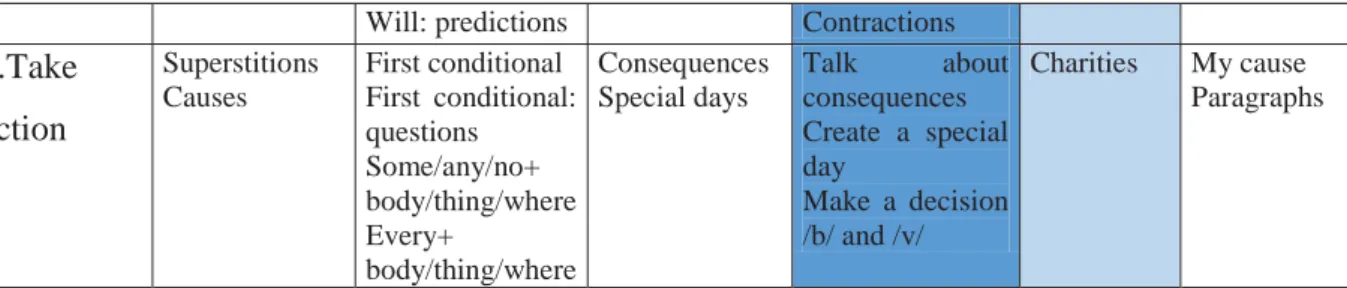
Will: predictions Contractions
9.Take action
Superstitions Causes
First conditional First conditional: questions Some/any/no+ body/thing/where Every+
body/thing/where
Consequences Special days
Talk about consequences
Create a special day
Make a decision /b/ and /v/
Charities My cause Paragraphs
Table2. Campbell, English in motion: Contents
We can realize that the grammar syllabus is very similar in both, general selection and
student’s book selection. To prepare the topic it will be taken into account the student’s
book contents, more specifically, it will focus on Speaking and Pronunciation and
Culture because we want to motivate students to prepare the topics and practice the speaking part through Skype.
The topic will be familiar to the students. At first, they will work in groups to prepare the topic. This first activity will consist on searching for information, selecting the information that is considered appropriate, organizing the information. These process will take two hours. The third hour, they will prepare a presentation. And the last hour will be dedicated to the Skype session.
The topic will be Describe famous people because it will imply speaking characteristics and cultural exchange. Besides, it will be familiar to the children involved. As motivation is the aim of this proposal, it is essential for the students to like the topic and to feel comfortable with it.
Table 3 shows which grammatical skills and which lexical skills will be improved during the activity.
GRAMMAR Present Simple tense
Third person -s
Wh-questions
VOCABULARY Personality adjectives
The face The body
29 4.5 Skype session – motivation and practice
Once ESL teachers have the English class and the topic identified, they will proceed to prepare the Skype lesson. Teachers need to prepare the lesson, in order to guide their student in the process of communication. Students will know what they have to do previously, so it will be avoided any confusion or long silence. The material that they have to prepare for the topic is to find 10 famous people who they like. They have to know how they look like, what they like and what their job is. The English class will do the same. Then they have to exchange their famous people and try to guess who is in the
other class’ mind. It will be similar to the Who is who? game.
At the beginning of the lesson, during 5 minutes, teachers will introduce briefly their students to the other class. The duration of the Skype session will be comprised between 45 and 50 minutes and the duration of the whole lesson will be 55 minutes.
After that, the first 20 minutes, the used language will be English, so the Spanish students will try to guess the famous people prepared by the English class by making questions. The second 20 minutes, it will be used the Spanish language and the English students will try to guess the famous people that the Spanish students prepared. The last ten minutes, students will describe themselves.
Examples of questions
- Is it man or woman? - How old is he/she?
- What colour are his/her eyes? - What does his/her hair look like? - Is he/she tall?
- What does she/he do? - Where is he/she from - Where does he/she live?
- Has he/she got any brothers or sisters?
The activity is dedicated to groups, the feedback is also received from a group of students. It is an activity made in real time and students will not have much time to think about the answers, so they have to think fast and answer immediately, just like in a face to face conversation.
30 4.6 Problems
In this section, it is going to be analyzed some of the problems that could appear during the process of elaboration of the Skype lesson and during the implementation of the Skype session. Although, it is a carefully elaborated process, teachers could have to deal with some of the problems mentioned hereafter.
The first problem that is found is the difference between the times zones. For instance, if you are in Spain and the person you have connected to is from the USA, there will be many hours apart ( People in Spain are 6 hours ahead of the people in the USA). To avoid a huge difference, it is proposed to connect classes from Spain and the United Kingdom.
The second problem could be wrong pronunciation or dialects, due to the channel of communication and the message could be interrupted, i.e. students could not understand the questions or the answers. It has to be taken into account the different parts of the process of communication that according to Canale and Swain (1980:17) the participants are ‘speaker, hearer, sender and receiver’. Other elements are:
The setting (physical time and place that could be outdoors or indoors), scene (psychological or fictional), the actual form of the message (a linguistic description of the message), topic (what the message is about), purpose (goal or intention), key (serious, mock), channel (oral, written), code (language, or variety within a language) (Canale and Swain, 1980:17).
These elements have to be taken into account because they are important for the correct transmission of the message. When the channel is oral, pronunciation is a significant factor.
Another problem is that, although there are many teachers registered in Skype in the Classroom community, it may result difficult to find a classroom to work with. Many educators may not answer your request, so you have to be persistent.
If the class is bigger than 30 students, it will not be possible for all of the students to participate. In consequence, there will be students who have not practiced their spoken language skills, only their listening skills.
31
To conclude, it is important to clarify that teachers may find this five problems, but if they have their lesson and their technology devices prepared, they could proceed with the lesson. It is also important to check the Internet service, because if there is a problem, teachers could try to fix it before the beginning of the lesson. Moreover, as said before, it is expected from teachers to help their students in the process of learning communicative skills and in the process of performing them into the practice, due to motivation and curiosity are very important in the process of learning. If students feel quite prepared to speak and curiosity about the Skype session, it will be interesting for them to realize it.
4.7 Expected results
In this section it will be appointed the expected results in relation to this didactic proposal. As said before, real results will not be obtained, due to it has not been implemented. It can be expected to obtain a favorable progression, though.
It is expected that the experience using Skype in the classroom will be positive since it is a technological tool for communication. Students will be motivated to use the English language and to practice their spoken skills, due to as we have seen using technologies and speaking to natives are some of the important motivational aspects.
The results will be visible in a long term; within a semester students’ progress might be checked by an oral examination. Although it cannot be affirmed that the progress will be positive, basing the study on previous literary reviews, it is expected that it will be a beneficial experience for ESL learners. Moreover, it is supported the idea that every kind of communication approach is positive for students.
In consequence, by motivating students with the contribution of Skype in the process of teaching ESL, it will be expected the following results:
- To motivate students to continue learning inside and outside the classrooms - To increase students’ participation
- To increase cultural exchange
- To develop communicative oral skills - To improve students’ pronunciation
32
- To learn new vocabulary and paralinguistic elements
CONCLUSIONS
Many times teachers don’t follow any motivational strategies and, as consequence, it is difficult to maintain students’ attention and motivation along the year. For this reason, this dissertation was focused on this direction. The aim of the proposal of intervention is to motivate student to use the English language in a Virtual Learning Environment and, as consequence, to improve the spoken skills of the ESL Spanish students. Furthermore, students will not improve only their communicative skills, but they will also improve their listening-comprehension capacity. The relation among reading, writing, listening, and speaking is essential to English fluency.
With this proposal, it can be concluded that the elaboration of an educational method based on Skype as an ICT motivational tool requires background knowledge about the ESL learning/teaching process, motivational strategies and types of motivation, ICTs in education and Skype. Before creating a lesson plan, it is important to investigate theories related to it, in this case, communicative approaches/methods. Moreover, it is relevant to study the different types of motivation due to it is an essential aspect when teaching and learning ESL.
In this case, it has been selected Skype, as a communicative tool, due to this dissertation was focused on motivating and teaching conversation. In addition, it is important to say that students will be able to practice what they have learned before (grammar and vocabulary) in a Virtual Learning Environment (VLE). As a result, it can be affirmed that teachers, who have used VLE, have obtained positive results with their students.
In order to create a lesson plan that may be applied by teachers, it is a major aspect to describe every step that educators may follow, so it is important to describe participants, materials needed, process of creating a motivational method and the description of the proposed lesson. A good Skype lesson should be very well organized, as well as, teachers and students should feel comfortable when using it.
33
the teaching of spoken English. Furthermore, the ideal results are really positive and it is expected that students, who will try this lesson plan, will be pleasant to work with other groups of students outside their classroom (intrinsic motivation). Through the point of view of the teaching method proposed, the most important thing is that students will be motivated to improve their communicative skills and, consequently, their lexicon, grammar and pronunciation.
REFERENCES
x "ALUMNOS POR GRUPO Y POR PROFESOR." Instituto De Evaluación,
Sistema Estatal De Indicadores De La Educación (2011): n. pag. Web. 3 June 2016.
x Arnau, Cristina. "Skype En La Educación." (n.d.): n. pag. Web. 23 Feb. 2016.
x Beetham, Helen, and Rhona Sharpe, eds. Rethinking Pedagogy for a Digital
Age: Designing for 21st Century Learning. New York: Routledge, 2013. Web. 7 Feb. 2016.
x "Common European Framework of Reference for Languages: Learning, Teaching, Assessment (CEFR)." Council of Europe. N.p., 2014. Web. 15 May 2016.
x Canale, M., and M. Swain. "Theoretical Bases Of Communicative Approaches
To Second Language Teaching And Testing." Applied Linguistics I.1 (1980): 1-47. Web. 3 Mar. 2016.
x Counsil of Europe, Common European Framework of Reference for Languages:
Learning, teaching, assessment; Cambridge University press
x Eaton, Sarah Elaine. "Using Skype in the Second and Foreign Language
Classroom." Social Media Workshop, Language Acquisition Resource Centre
(2010): n. pag. Web. 3 Apr, 2017
x Curation. Edinburgh: Digital Curation Centre. Handle: 1842/3372.
x Encouraging Learner Independence." The JALT CALL Journal. Kwansei Gakuin
34
x España. Enseñanzas Mı́nimas De Educación Secundaria: Real Decreto
1631/2006, De 29 De Diciembre, Por El Que Se Establecen Las Enseñanzas
Mı́nimas Correspondientes a La Educación Secundaria Obligatoria. Madrid:
Ministerio De Educación Y Ciencia, Subdirección General De Información Y
Publicaciones, 2007. Web. 2 Jun. 2016
x Fryer, Wesley A. "Skype in the Classroom." TechEdge (2005): n. pag. Web. 20 Jun, 2016
x "ICT." TeachingEnglish. N.p., 2009. Web. 8 Apr. 2016.
x MECD, Centros educativos del reino unido que enseñan español como lengua
extranjera, 2014. Web. 20 Jun 2017
x "Objetivos De Inglés Segunda Lengua." Inglés Segunda Lengua/ English L2.
Departamento De Inglés, 2012-2013. Web. 2 Apr. 2016.
x Parra, Sergio. "Skype in the Classroom: Conectando Todas Las Aulas De Todos
Los Colegios Del Mundo." Yorokobu. N.p., 21 Jan. 2015. Web. 26 Mar. 2016.:
x Richard and Rodgers, Approaches and Methods in Language Teaching; 2014
x Towell, Richard, and Roger Hawkins. Approaches to Second Language
Acquisition. Clevedon, Avon, England: Multilingual Matters, 1994. Web. 3 Apr. 2016.
x Trajkovik, Vladimir, and Anastas Mishev, eds. ICT Innovations 2013: ICT
Innovations and Education. Skopje: ICT ACT, 2013. Web. 4 Mar. 2016.
x Schrum, Lynne, and Gwen Solomon. Web 2.0 How-To for Educators. N.p.:
International Society for Technology in Education / ISTE, 2010. Print.
x Wells, C. Gordon. The Meaning Makers: Children Learning Language and
Using Language to Learn. Portsmouth, NH: Heinemann, 1986. Print.
x "Useful Tools for the Learning and Teaching of English." SlideShare. N.p., n.d.
Web. 26 Mar. 2016.
x Young, S. S.c. "Integrating ICT into Second Language Education in a