Technological Innovation Inputs,
Outputs and Performance:
the moderating role of Family
Involvement in Management
Julio Diéguez-‐Soto
1, Montserrat Manzaneque-‐
Lizano
2, Alfonso Rojo-‐Ramírez
31
Universidad de Málaga,
2
Universidad de Cas3lla-‐La Mancha,
Technological innova-on: the role of family management
strengthens its leading position in Germany's
automotive industry with the opening of its new Chassis Innovation
Center in Bielefeld
“For us the R & D is a priority. We believe that innova3on is a key factor for success through differen3a3ng our products and services.During the process of concep3on, design and produc3on of a product, we focus on reducing weight and increasing passive safety “(hNp://www.gestamp.com)
General aims of the study
•
To enhance the understanding of exis3ng models of
antecedents and effects of technological innova3on (TI) in
SMEs
•
To compare antecedents and effects of TI in family and
nonfamily managed firms
Technological innova-on: the role of family management
Theory development and hypotheses
Theory development and hypotheses
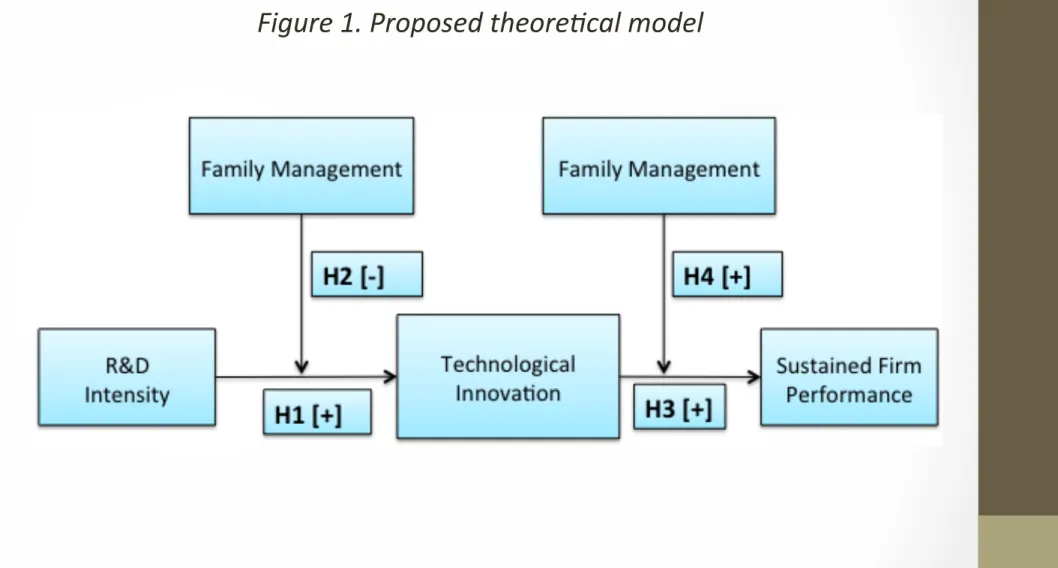
R&D intensity and con9nuous technological
innova9on outcomes
• The R&D effort -‐determinant of technological innova3on-‐ (Souitaris, 1999)
• + Rela3onship between R&D intensity and TI (Chu, 2009; Mansfield, 1981).
• Some lag between R&D spending and research outcomes (Chin et al., 2009)
• R&D resources are vital to achieve CTI (Shang et al., 2010) over 3me (Damanpour & Evan, 1984)
H1: R&D intensity has a posi-ve effect on the occurrence of
con-nuous technological innova-on (CTI) outcomes.
Technological innova-on: the role of family management Theory
development and hypotheses
R&D intensity, con9nuous technological innova9on
outcomes and family management
• Family Ownership is detrimental to R&D intensity (e.g. Block, 2012)
• It is con3ngent on the economic performance levels below the family’s aspira3ons (Christman & Patel, 2012) or the overlap family wealth/firm equity (Sciascia et al., 2014).
• Concerning the outcomes of innova3on ac3vity: inconsistent and inconclusive findings (Nordqvist, 2010; Westhead, 1997).
• RBV have argued for resource orchestra3on advantages (Sirmon, HiN, Ireland, & Gilbert, 2011), while BAM have suggested that FBs underinvest in R&D (Chrisman & Patel, 2012; Kotlar et al., 2013).
• Chrisman et al. (2015): superior ability to innovate yet lower willingness to engage in technological innova3on (the paradox)
• Duran et al. (2015): that family control undermines innova3on input but that these very same aNributes translate into superior innova3on output
Theory
development and hypotheses
R&D intensity, con9nuous technological innova9on
outcomes and family management
• As there has been liNle research on whether family firms are more efficient than non-‐family firms in the conversion process of innova3on input into output
• and we have very limited insights about whether family firms generate more efficiently economic consequences from technological innova3on than non-‐family firms:
-‐ We propose that the level of family management could act as a driver of the ability
and willingness paradox influencing technologic innova3on efficiency.
-‐ Family management dimension is more apt to reflect a family`s SEW agenda and its
consequences (Gomez-‐Mejia, Cruz, et al., 2011).
-‐ We expect the pursuit of SEW may affect the rela3onship between R&D intensity
Technological innova-on: the role of family management Theory development and hypotheses
R&D intensity, con9nuous technological innova9on
outcomes and family management
Family management may limit the conversion of R&D ac9vi9es into CTI.
Less Willingness
• Invest less intensively, reluctant to jeopardize their discre3on (Classen et al., 2012) and their wealth (Zahra, 2005). Resource-‐constraining SEW agenda. Risk adverse managers/modest innova3ons.
• Lack of execu3ve talent, limited pool of human capital (Block, et al., 2013). Known for taking assets out (Sirmon & HiN, 2003).
Less ability
• Entrepreneurial spirit and talent not necessarily inherited (Chrisman et al., 2005).
H2: Family management has a nega-ve influence in the
rela-onship between R&D intensity and the occurrence of CTI
Theory development and hypotheses
Technological innova9on outcomes and sustained
firm performance
• The significance of the TI outcomes ≠ their specific economic consequences.
• The relevance of TI outcomes will come with their impact on economic growth and firm performance (Hall et al., 2005; He & Wang, 2008; Schumpeter, 1942).
• Previous research supports the view that TI is a major influence on industrial compe33veness and na3onal development (Tidd, 2002).
H3: The existence of technological innova-on outcomes have a
posi-ve effect on long-‐term performance.
Technological innova-on: the role of family management Theory development and hypotheses
Technological innova9on outcomes,
sustained performance and family management
Family management may facilitate the conversion of Technological
innova9on outcomes into firm long-‐term performance.
More willingness
• Adopt a risky behaviour (Chrisman et al, 2014b) to avoid the loss of socio-‐ emo3onal wealth (Gómez-‐Mejia et al., 2007). Extraordinarily competent and sensi3ve to shape their firms`s strategy in a more muscular way if long-‐term performance is not appropriate (changing the course if necessary).
More ability
• Greater discre3on, low levels of formaliza3on and bureaucracy, interest alignment between owners and managers (Block et al., 2013), the protec3on of family name and reputa3on (Dunn, 1996) by the long-‐term rela3onships with firm stakeholders (Miller & Le Breton-‐Miller 2005).
Theory development and hypotheses
Family management facilitates the conversion of Technological
innova9on outcomes into firm long-‐term performance
.
More ability
Under the influence of the family management, family firms creates a
dis3nc3ve social resource and support (Habbershon & Williams, 1999)
that contribute to generate a higher long-‐term performance from the
occurrence of TI outcomes.
Technological innova-on: the role of family management
Research focus: Does family management affect the antecedents
and effects of technological innova9on?
•
Par3cularly, does family involvement in management
moderate the posi3ve expected influence of R&D intensity
(antecedent) on con3nuous presence of technological
innova3on (CTI)?
•
Does family involvement in management moderate the
Data and Method
•
The data used come from the Survey on Business
Strategies (ESEE). This survey is built on informa3on from
Spanish manufacturing firms.
•
Accoun3ng and innova3on data was collected for the
Technological innova-on: the role of family management
Technological innova-on: the role of family management
Results
(H1: Fixed effects)Effect of R&D intensity on con-nuous technological innova-on outcomes (H1)
Variables Predicted
sign
Model 1.1. Model 1.2. Model 1.3. Model 1.4.
OLS Random Effects Fixed Effects Fixed effects with
heterogeneity control
RDI + 2.301**
(1.19) 2.983*** (0.753) 3.133*** (0.749) 3.133** (1.872)
SIZE + 0.282*** (0.013) 0.183*** (0.028) (0.046) 0.022 (0.087) 0.022
AGE - 0.004*** (0.001) (0.003) -0.003 -0.019*** (0.005) -0.019** (0.009)
Intercept -2.851***
(0.235) -1.057** (0.551) 2.005*** (0.702) 2.005 (1.335)
Industry effects Yes Yes
Lagrange multiplicator tests 10657.87***
Hausman test 61.61***
F test 55.30***
[22, 5956]
11.30*** [3, 5425]
2.02 [3, 550]
Wald Chi2 141.42***
(22)
R2 0.17
Within 0.0010 0.0062 0.0062
Between 0.2180 0.0304 0.0304
Overall 0.1530 0.0213 0.0213
Modified Wald test for heteroskedasticity
1.4e+31*** [551]
Results
(H2: Fixed effects)Modera-ng effect of family management on the rela-onship between R&D intensity and con-nuous technological innova-on outcomes (H2)
Variables Predicted
sign
Model 2.1. Model 2.2. Model 2.3. Model 2.4.
OLS Random Effects Fixed Effects Fixed effects with
heterogeneity control
RDI + 5.239***
(2.109) 7.808*** (1.358) 8.083*** (1.354) 8.083*** (2.402)
RDI*FAMILY - -4.297** (2.551) -7.006*** (1.643) -7.184*** (1.638) -7.184*** (2.834)
SIZE + 0.282***
(0.013) 0.184*** (0.028) 0.026 (0.046) 0.026 (0.086)
AGE - 0.004***
(0.002) -0.003 (0.002) -0.020*** (0.005) -0.020*** (0.009)
Intercept -2.848***
(0.235) -1.064** (0.550) 1.963*** (0.700) 1.963 (1.331)
Industry effects Yes Yes
Lagrange multiplicator tests 10692.41***
Hausman test 60.50***
F test 53.04***
[23, 5955]
13.31*** [4, 5424]
3.91*** [4, 550]
Wald Chi2 159.57***
(23)
R2 0.17
Within 0.0037 0.0097 0.0097
Between 0.2165 0.0289 0.0289
Overall 0.1529 0.0187 0.0187
Modified Wald test for heteroskedasticity
1.4e+31*** [551]
Number of firms 551 551 551 551
Technological innova-on: the role of family management
Results
(H3: Fixed effects)Effect of technological innova-on outcomes on long-‐term performance(H3)
Variables Predicted
sign
Model 3.1. Model 3.2. Model 3.3. Model 3.4.
OLS Random Effects Fixed Effects Fixed effects with
heterogeneity control
TI + 0.002
(0.001) 0.004*** (0.002) 0.001 (0.001) 0.001 (0.001)
SIZE + 0.006*** (0.001) 0.009*** (0.001) 0.021*** (0.002) 0.021*** (0.005)
AGE - -0.001***
(0.001) -0.002*** (0.001) -0.008*** (0.001) -0.008*** (0.001)
Intercept -0.005
(0.011) -0.009 (0.025) -0.011 (0.036) -0.011 (0.079)
Industry effects Yes Yes
Lagrange multiplicator
tests
6130.60***
Hausman test 985.61***
F test 13.43***
[22, 7081]
417.78*** [3, 6527]
77.05*** [3, 550]
Wald Chi2 317.04***
(22)
R2 0.04
Within 0.1453 0.1611 0.1611
Between 0.0074 0.0039 0.0039
Overall 0.0121 0.0001 0.0001
Modified Wald test for heteroskedasticity
3.7e+05*** (551)
Number of firms 551 551 551 551
Results
(H4: Fixed effects)Modera-ng effect of family management on the rela-onship between technological innova-on outcomes and long-‐term performance (H4)
Variables Predicted
sign
Model 1 Model 2 Model 3 Model 4
OLS Random Effects Fixed Effects Fixed effects with
heterogeneity control
TI + 0.003**
(0.002)
0.003** (0.002)
-0.001
(0.002) -0.001
(0.002)
TI*FAMILY + (0.002) -0.003 (0.003)0.001 0.004** (0.003) (0.003) 0.004
SIZE + 0.005***
(0.001) 0.009*** (0.001) 0.021*** (0.002) 0.021*** (0.005)
AGE - -0.001
(0.001) -0.002*** (0.001) -0.008*** (0.001) -0.008*** (0.001)
Intercept -0.004
(0.011) -0.009 (0.025) -0.009 (0.036) -0.009 (0.079)
Industry effects Yes Yes
Lagrange multiplicator tests 6125.94***
Hausman test 980.14***
F test 12.90***
[23, 7057]
314.10*** [4, 6526]
58.84*** [4, 550]
Wald Chi2 317.31***
(23)
R2 0.04
Within 0.1454 0.1614 0.1614
Between 0.0073 0.0040 0.0040
Overall 0.0121 0.0001 0.0001
Modified Wald test for heteroskedasticity
3.7e+05*** (551)
Number of firms 551 551 551 551
Technological innova-on: the role of family management
Findings and Contribu9ons
•
This ar9cle provides new insights into the effect of family
management on the conversion of R&D intensity into the con9nuous
ocurrence of innova9on outcomes
•
as well as the produc9vity of the firm in terms of genera9ng long-‐term
performance from technological innova9on outputs.
•
Family management acts as a driver of less ability and willingness to
carry out TI outcomes efficiently, exer3ng a nega3ve influence.
•
Less ability and willingness expressed as a constraining SEW agenda,
Conclusions
•
But, our findings also show that once family-‐managed firms have
obtained TI outcomes, they are able to achieve greater long-‐term
performance than non-‐family firms.
•
It seems that they become competent and sensi3ve to shape their firm´s
strategy if long-‐term performance is not appropriate because it would
involve losses in terms of economic and non-‐economic family-‐centred
goals.
•
They put all its social capital into opera3on to show improvement in the
Technological innova-on: the role of family management
Thanks for your attention!
Málaga
Almería Cas-lla.-‐La