Ruan D. Gomes
1, Emerson B. Gomes
2, Iguatemi E. Fonseca
2, Marcelo S. Alencar
3and Cesar Benavente-Peces
41Federal Institute of Para´ıba, Guarabira, 58051-900, Brazil 2Federal University of Para´ıba, Jo˜ao Pessoa, 58058-600, Brazil
3Federal University of Campina Grande, Campina Grande, CEP: 58401-490, Brazil 4Universidad Politecnica de Madrid, Madrid, Spain
Keywords: Industrial Wireless Sensor Networks, Multi-channel Communication, Wireless Channel Characterization, Outdoor Industrial Environment.
Abstract: This paper describes an experimental study which investigates relevant properties of multi-channel wireless communications in an outdoor industrial environment. A testbed of IEEE 802.15.4 radios was developed in order to evaluate the performance of the 16 channels defined by the standard, at all the nodes, simultaneously. From the collected data, some relevant facts are discussed, such as the spatial variations in channel quality, the differences in the characteristics of different channels, the link asymmetry, and the non-stationary charac-teristics of the channel. The possible problems that can arise in the deployment of industrial wireless sensor networks, based on the characteristics of the standards developed for this type of network, are described, as well as some possible solutions.
1 INTRODUCTION
The use of Industrial Wireless Sensor Networks (IWSN) to implement monitoring and control systems has some advantages, such as low cost and high flex-ibility to reconfigure the network. However, it is nec-essary to deal with typical problems of wireless net-works, such as noise, electromagnetic interference, fading and high attenuation, due to the presence of many objects and obstructions. Many industrial en-vironments also present characteristics that make the wireless channel non-stationary for long time peri-ods (Agrawal et al., 2014).
Another problem is the link asymmetry. Some protocols use acknowledgement per packet and, in this case, it is necessary to guarantee a good quality of communication in the two directions of the link. Spa-tial variations in the channel quality can also occur in IWSN. In (Watteyne et al., 2010), a coherence length of 5.5 cm was found for IEEE 802.15.4 radios operat-ing in the 2.4 GHz band. Hence, two nodes positioned at a distance more than 5.5 cm apart from each other, and using the same channel, can be considered
uncor-related, and thus the channel can present a high qual-ity for one node, and a low qualqual-ity for the other.
Some standards have been proposed in the last years with a focus on industrial applications, such as the WirelessHART and the ISA100.11a, which are based on the physical layer of the IEEE 802.15.4 stan-dard, but define their own MAC layer based on Time Division Multiple Access (TDMA), to avoid colli-sions, and reduce the power consumption. They also use frequency hopping and blacklisting, to mitigate the problems related to interference and fading.
More recently, the IEEE 802.15.4e standard was released, which proposes solutions for applications that require high reliability (e.g. industrial applica-tions) (Guglielmo et al., 2016). Five modes of op-eration are defined, but only the Time-Slotted Chan-nel Hopping (TSCH), Deterministic and Synchronous Multi-Channel Extension (DSME), and Low Latency Deterministic Network (LLDN) modes have been ex-plored in the literature, until now. In general, the modes are based on TDMA or frequency hopping to reduce collisions and mitigate the effects of interfer-ence and fading.
60
Gomes, R., Gomes, E., Fonseca, I., Alencar, M. and Benavente-Peces, C.
Even these new protocols define mechanisms to deal with the unreliability problems of IWSN, it is necessary to analyze the characteristics of the multi-channel communication in such environments, in or-der to properly deploy the network. For exam-ple, when using channel hopping, the nodes usually switch to a new channel before each transmission. However, if a proper management of the blacklist is not made, the network performance can be signifi-cantly degraded (Grsu et al., 2016). Problems due to the spatial variations in channel quality can also affect the performance of beacon-based protocols.
In this paper, the characteristics of the 16 chnels, defined by the IEEE 802.15.4 standard, are an-alyzed, in an outdoor industrial environment, and for eight different links. Based on the experimental re-sults, possible problems that can arise in the deploy-ment of IWSN, and some possible solutions are de-scribed. The parameters of the log-normal shadow-ing model for the environment were also determined. Some studies have been performed in outdoor indus-trial environments (Boano et al., 2010) to analyze the impact of environmental aspects (e.g. temperature) on link quality. The novel contribution of this paper is the detailed analysis of the multi-channel commu-nication in an outdoor industrial environment, which may be important to design new techniques and pro-tocols, as well as, more accurate simulation and theo-retical models.
1.1 The Wireless Channel in Industrial
Environments
The industrial environment usually contains metallic and mobile objects, such as robots, cars and people. This influences both the large-scale and small-scale fading. The power of the received signals depends on the transmission power, the antennas gains, the distance between transmitter and receiver and the ef-fects caused by the environment. Even with the same values for the aforementioned parameters, there is a variation in the mean received power, depending on the place where the measurement is performed, which is known as log-normal shadowing. The log-normal shadowing model has been used to model the large-scale path loss and shadowing in industrial environ-ments (Tanghe et al., 2008).
Besides path loss and shadowing, it is also nec-essary to analyze the small-scale channel fading due to rapid changes in the multipath profile of the en-vironment, which is caused by the movement of ob-jects around the receiver and transmitter. Experi-ments demonstrated that, in industrial environExperi-ments, the temporal attenuation follows a Rice distribution.
In industrial environments the K factor of the Rice distribution has a high value. For the experiments de-scribed in (Tanghe et al., 2008), in industrial environ-ments, K presented values between 4 dB and 19 dB, while in office environments, values between -12 dB and -6 dB were reported, as discussed in (Tanghe et al., 2008). This can be explained by the open nature of industrial buildings and the large amount of reflec-tive materials. Thus, there are many time-invariant rays and only a small part of the multipath profile is affected by moving objects.
The IEEE 802.15.4 standard defines sixteen chan-nels in the 2.4 GHz band, with 2 MHz of bandwidth, and channel spacing of 5 MHz. Thus, the chan-nels are highly uncorrelated. Experiments described in (Amzucu et al., 2014) have found that changing the communication channel can lead up to 30 dB dif-ference in the received power, in an office environ-ment. Vargaet al.(Varga et al., 2016) performed ex-periments for a short range, in an environment with-out multipath, and with line-of-sight. In that experi-ment, differences up to 10 dB were observed for some channels. Thus, besides the variation in shadowing observed depending on the place that the nodes are positioned, there is also a variation in shadowing re-garding the different channels. In the experiments de-scribed in (Gomes et al., 2017), differences of up to 15 dB were found for different channels in an indoor industrial environment, but only one link was ana-lyzed.
In this paper, the aspects that influences the chan-nel characteristics are discussed, based on experi-ments performed in an outdoor industrial environ-ments, and considering eight links simultaneously, to analyze the temporal, spatial, and frequency varia-tions in channel quality.
2 EXPERIMENT
METHODOLOGY
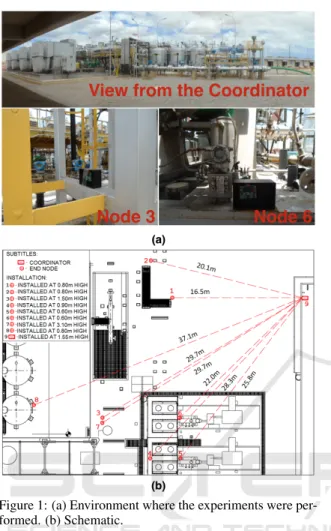
Figure 1: (a) Environment where the experiments were per-formed. (b) Schematic.
were placed alongside wired sensors that are currently installed in the unit.
To allow the nodes to communicate using all chan-nels, and without collisions, a protocol based on TDMA and channel hopping was implemented. In the protocol, the medium access occurs based on a slot-frame structure, which repeats continuously, similar to the slotframe defined on the TSCH protocol, but with the use of beacons, transmitted by the coordina-tor to synchronize the end-nodes in each cycle. The temporal structure of the slotframe is shown in Fig-ure 2.
Figure 2: Slotframe structure of the implemented protocol.
The slotframe repeats continuously and is com-posed by 10 slots. In the first slot the coordinator
transmits the beacon in broadcast, and waits to receive data packets that are transmitted by the end-nodes in the following eight time slots (S1toS8). There is an inactive interval in the end of the slotframe, that is used by the nodes to switch the channel and wait the next slotframe.
When an end-node receives a beacon from the co-ordinator, it waits until the time interval allocated to it and performs the transmission of a data packet to the coordinator. Each slot has a duration of 100 ms. This protocol was developed to allow the characteri-zation of the multi-channel communication for mul-tiple links simultaneously, but it was not developed taking under consideration any particular application. In eachslotframea different channel is used, se-quentially. To accommodate the use of channel hop-ping in the transmission of the beacons, it is necessary to have a mechanism to maintain the network syn-chronized in case of failures during the reception of a beacon. To do this, a timer is used in the end-nodes to identify that a beacon has been lost. The coordina-tor sends a new beacon for each 1 s, thus the timer is configured to expire after 1.1 s. If a node receives a new beacon before the timer expires, the timer is re-seted. Otherwise, the node switches the channel, and waits for the next beacon, which maintains the syn-chronization.
After the reception of a beacon, the end-nodes ob-tain the Received Signal Strength Indication (RSSI) of the beacon, and transmit it back to the coordinator. For each received packet at the coordinator, the RSSI of the packet, as well as the RSSI of the beacon, sent by the end-node, are uploaded to a computer through a serial port. Thus, it is possible to analyze the spa-tial variations in the channel quality, and asymmetry, for all links. Even the individual RSSI samples are obtained in different moments for the different nodes and channels, due to the TDMA protocol, with the ac-quisition of many samples over time, it is possible to obtain the mean received power and the standard devi-ation, and compare the characteristics of the different channels for the different links.
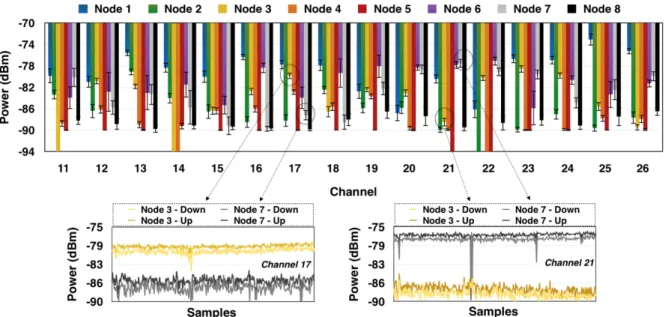
Figure 3: Spatial variations in the channel quality for different nodes, in the first day of experiment.
multi-channel communication in outdoor industrial environments.
3 RESULTS
Fig. 3 shows the mean received power, and the stan-dard deviation, for each end-node, considering the ex-periment performed in the first day. The mean re-ceived power varies significantly, even for the adja-cent channels and for the same end-node. For ex-ample, for Node 1, the differences for some chan-nels were higher than 10 dB (e.g. Ch 20 and Ch 25). For Nodes 4 and 5, which were positioned in a place without Line-Of-Sight (LOS) (see Fig. 1(b)), no com-munication can be set, for example, when using Ch 22, due to a deep fading problem in the channel. All channels shown a low quality for Node 5, but for Node 4 some channels presented high quality, such as the Ch 17. Deep fading problems have also oc-curred for some other nodes and channels, in which the number of packets received was very low.
From Fig. 3 it is also possible to analyze the spa-tial variations in the quality of the channels. The val-ues of received power for Nodes 3 and 7 are analyzed in detail for two different channels. These nodes were positioned at nearly the same distance to the coordina-tor, and with a 1.6 m of difference in the height. The Ch 17 presented a high quality for Node 3, but the quality was significantly lower for the Node 7. On the other hand, the Ch 21 presented a high quality for Node 7, but a low quality for Node 3. The re-ception power in the two directions of the links are
shown. There is a high correlation between the re-ceived power in both directions of the links, but with a small difference in the mean values. When the re-ceived power is near to the sensitivity threshold of the transceiver, such as is the case of Ch 21 for Node 3, this small difference can provoke an asymmetry in the link quality.
Hence, it is difficult to guarantee a good Quality of Service (QoS) for all nodes when only one channel is used in the whole network, such as in the MAC proto-cols defined by the IEEE 802.15.4 standard. Even for the new standards defined for IWSN, some problems can arise due to the spatial variations in channel qual-ity. In the LLDN mode, TDMA is used to avoid colli-sions, with a star topology, to achieve very low laten-cies (Anwar et al., 2016). However, only one channel is used for all end-nodes. One possible solution is the use of multiple sink-nodes, using different channels. When the channel being used by an end-node starts to present low quality, that node can switch to another channel and communicate with a different sink. How-ever, some mechanism to estimate the link quality in real-time (Gomes et al., 2017), and a specific syn-chronization mechanism needs to be developed. The protocol described in (Patti and Bello, 2016) uses a tree topology and multi-channel communication for LLDN networks, with adaptive channel selection, but the same channel is allocated to all nodes in the sub-network, and spatial variations in channel quality can also occur inside the same sub-network.
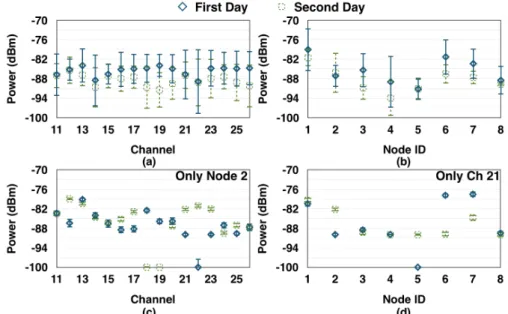
Figure 4: Comparative results between the two days of experiment.
standards use TDMA and channel hopping. In this ap-proach, all the channels can be used by the end-nodes to perform communication. However, the blacklist needs to be properly managed in order to achieve a good QoS in the network. In (Du and Roussos, 2013) it was observed that the larger the size of the black-list, the better the communication performance. This result corroborates with the results presented in (Grsu et al., 2016). However, this type of behavior only oc-curs if an adequate monitoring of the quality of the channels is performed, in order to properly configure the blacklist.
One problem is that, when a channel is black-listed, all the nodes stop using that channel. In the result shown in Fig. 3, Ch 21 presented a low quality for four end-nodes and could be put on the blacklist. However, this channel is the one that presents the best quality for Node 7, and also presents good quality for Nodes 1 and 6. Thus, the QoS for these nodes can de-crease once this channel is put on the blacklist. When the quality of the channel is affected by external in-terference, as considered in (Du and Roussos, 2013), putting a channel in the blacklist for all network can be a good solution, but the challenge is higher when spatial variations in channel quality, due to multipath problems, affect the links.
The DSME mode employs channel hopping or channel adaptation, during the contention free peri-ods. When using the channel adaptation, a pair of nodes can communicate using the same channel for a long time period, and a channel switch only occurs when the channel in use starts to present low quality. Thus, it is possible to deal with the spatial variations
in the quality of the channels, since the decision about the channel to be used can be made based on the qual-ity of a specific link between a given pair of nodes. The implementation of this procedure is not defined by the standard (Guglielmo et al., 2016). The DSME networks use beacon packets, transmitted in broad-cast using a single channel. Sometimes it is difficult to pick one channel that presents good quality for all nodes in the network. Deep fading problems can also occur, and some nodes can remain disconnected for a long time. While the use of channel adaptation can be a good solution for unicast data packets, channel hop-ping can be a good solution for packets transmitted in broadcast.
that the characteristics of the channels vary differently for the different nodes. For example, the Ch 21 pre-sented a high quality for the Node 6 in the first day, but a low quality in the second day. On the other hand, it presented a higher quality on the second day for the Node 2.
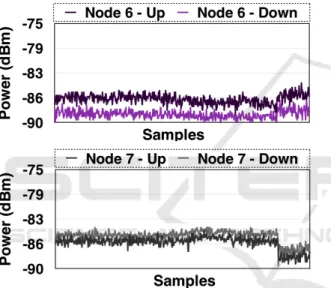
Some abrupt variations in the reception power for some nodes and channels were also observed during the second day (Fig. 5). This behavior was also ob-served in (Agrawal et al., 2014) for an indoor indus-trial environment. The quality of the Ch 24 decreased after some time for Node 7, while at the same time the channel showed an increase in its quality for Node 6. Again, a high correlation between the two directions of the links was observed, but with a small difference in the mean value of each direction of the link.
Figure 5: Abrupt change in channel characteristics.
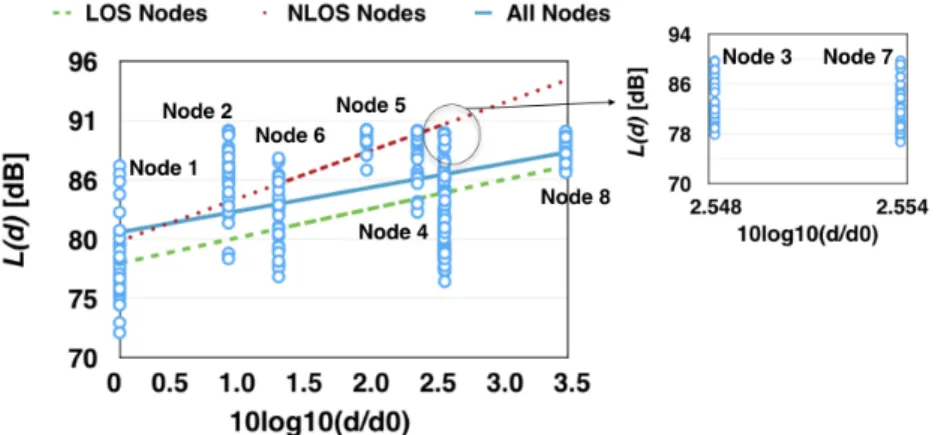
The chart in Fig. 6 shows the path loss (L(d)) for a distance (d) between transmitter and receiver. The values obtained for Node 1 were used as reference (d0=16.5 m). From this experiment, the path loss
exponent (n), the shadowing deviation (σ), andL(d0)
were obtained, to be applied in the log-normal shad-owing model. Fig. 6 shows the curves of the model for three different scenarios: with all nodes, with the LOS nodes (Nodes 3, 6, 7 and 8), and with the NLOS nodes (Nodes 2, 4, and 5). Node 1 was considered in both cases as the reference. Table 1 shows the param-eters for the three scenarios. These values can be used to simulate outdoor IWSN.
To allow an accurate simulation, it is important to consider all the aspects and conclusion discussed in this paper, and also nodes with LOS and NLOS, with different parameters for the path loss and shad-owing. Also, the level of shadowing in each channel for the different links need to be modified over time.
Sometimes abrupt changes can occur in the charac-teristics of the channel, and the modifications occur differently for the different channels and nodes, and the protocols for IWSN need to be capable to dealing with these modifications to maintain a good QoS over time.
Table 1: Parameters for the log-normal shadowing model.
Path Loss Exponent (n)
Shadowing
Deviation (σ) L(d0) All Nodes 2.00 4.53 dB 81.182 dB
LOS Nodes 2.43 4.54 dB 78.351 dB
NLOS Nodes 4.03 4.98 dB 80.352 dB
4 CONCLUSIONS
This paper describes a set of experiments to evalu-ate and characterize the performance of multi-channel communications in an outdoor IWSN. Relevant char-acteristics of the wireless channel were described, based on the experimental results. Some problems that can occur in the deployment of an IWSN, as well as some possible solutions, are discussed in the paper, considering the characteristics of the wireless channel in the environment under study, and the characteris-tics of the protocols that are used to implement the IWSN. The parameters of the log-normal shadowing model were also obtained. The information contained in this paper can be used to allow the implementation of new techniques and protocols for IWSN, as well as more accurate simulation models.
Figure 6: Relation between the path loss and the distance between transmitter and receiver.
ACKNOWLEDGEMENTS
The authors would like to thank the support of the Institute for Advanced Studies in Communications (Iecom), the Brazilian Council for Research and De-velopment (CNPq), the Coordination for the Improve-ment of Higher Education Personnel (CAPES), and Petrobras.
REFERENCES
Agrawal, P., Ahl´en, A., Olofsson, T., and Gidlund, M. (2014). Long term channel characterization for en-ergy efficient transmission in industrial environments.
IEEE Trans. on Communications, 62(8):3004–3014. Amzucu, D. M., Li, H., and Fledderus, E. (2014). Indoor
radio propagation and interference in 2.4 ghz wireless sensor networks: Measurements and analysis. Wire-less Personal Communications, 76:245–269. Anwar, M., Xia, Y., and Zhan, Y. (2016). Tdma-based
ieee 802.15.4 for low-latency deterministic control ap-plications. IEEE Trans. on Industrial Informatics, 12(1):338–347.
Boano, C. A., Tsiftes, N., Voigt, T., Brown, J., and Roedig, U. (2010). The impact of temperature on outdoor in-dustrial sensornet applications.IEEE Trans. on Indus-trial Informatics, 6(3):451–459.
Du, P. and Roussos, G. (2013). Spectrum-aware wireless sensor networks. In 2013 IEEE 24th Annual Inter-national Symposium on Personal, Indoor, and Mobile
Radio Communications (PIMRC), pages 2321–2325.
Gomes, R. D., Queiroz, D. V., Filho, A. C. L., Fonseca, I. E., and Alencar, M. S. (2017). Real-time link qual-ity estimation for industrial wireless sensor networks using dedicated nodes. Ad Hoc Networks, 59:116 – 133.
Grsu, M., Vilgelm, M., Zoppi, S., and Kellerer, W. (2016). Reliable co-existence of 802.15.4e tsch-based wsn and wi-fi in an aircraft cabin. In 2016 IEEE
Inter-national Conference on Communications Workshops (ICC), pages 663–668.
Guglielmo, D. D., Brienza, S., and Anastasi, G. (2016).
{IEEE}802.15.4e: A survey. Computer Communi-cations, 88:1 – 24.
Patti, G. and Bello, L. L. (2016). A priority-aware multi-channel adaptive framework for the ieee 802.15.4e-lldn. IEEE Transactions on Industrial Electronics, 63(10):6360–6370.
Tanghe, E., Joseph, W., Verloock, L., Martens, L., Capoen, H., Herwegen, K. V., and Vantomme, W. (2008). The industrial indoor channel: Large-scale and temporal fading at 900, 2400, and 5200 mhz. IEEE Trans. on Wireless Communications, 7:2740–2751.
Varga, L.-O., Heusse, M., Guizzetti, R., and Duda, A. (2016). Why is Frequency Channel Diversity so Ben-eficial in Wireless Sensor Networks? InIFIP Wireless Days, Toulouse, France. IFIP.