The structure of the Offshore Niger Delta
C. D. C
ONNORS1*, B. R
ADOVICH2, A. D
ANFORTH3ANDS. V
ENKATRAMAN41Dept. of Geology, Washington and Lee University, Lexington, VA, USA.
2ION/GX Technology and Dynamic Global Advisors, Houston, TX, USA.
3Independent Consultant, Houston, TX, USA.
4ION/GX Technology, Houston, TX, USA.
*e-mail: [email protected]
Abstract: We present a new analysis of the linked gravity-driven deformation in the Tertiary Niger Delta. On the shelf, the fundamental detachment surface sits at over 11 km subsea and shallows to 7 km in the toe of the delta. The inner slope is both translating and accommodating shortening from updip extension, and exhibits a ductile and complex shale response. The deepwater contractional toe of the delta is primarily a brittle fold-and-thrust belt of imbricate fault-bend, fault-propagation folds, and shear fault-bend folds. Growth commenced in the late Oligocene, and continues to the present day on some structures.
Keywords: Niger Delta, gravity spreading, toe thrust, fault-related folding, mobile shale.
It has long been recognized that the prograding Niger Delta causes extensive gravity spreading with the offshore manifestation of this gravity-driven deformation consisting of substantial extension on the shelf and inner slope, and con-tractional folding and thrusting in the outer slope and basin floor (Lehner and De Ruiter, 1977; Evamy et al., 1978; Doust and Omatsola, 1990; Damuth, 1993; Rowan et al., 2004; Corredor et al., 2005). The depth of deformation and complexity of some of the structures has lim-ited the ability of previous work to fully con-strain the detachment depths, structural styles, timing of deformation, and influence of the base-ment. We present here a regional analysis of the structure and stratigraphy of the offshore Niger Delta from an interpretation of the new regional 2D seismic survey that clarifies much of these previous uncertainties.
Methods
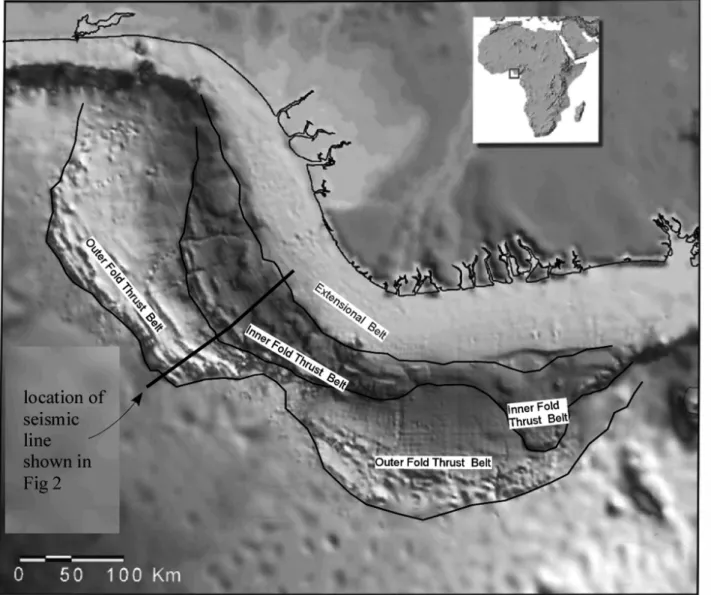
We interpreted over 4800 line-km of 2D marine seis-mic reflection data from the NigeriaSpan survey, acquired and processed by GX Technology in 2005 and 2006. The survey extends from the shelf to basin floor and covers most of the deformed regions of the delta depicted in figure 1 except for a minor portion of the eastern and southeastern part of the delta. The seismic data have optimal characteristics (long offset, long recording time, prestack depth migrated) that provide advanced imaging of previously enigmatic mobile shale structures, as well as deep imaging of the prodelta stratigraphy, and detachment levels.
boundaries in Neogene and Quaternary strata. We used standard sequence stratigraphic concepts to interpret sequence boundaries away from well control and for Paleogene and older strata. The top of ocean crust was recognized by high ampli-tude, low frequency reflection above chaotic, hummocky seismic facies. The Moho was inter-preted as a discontinuous high amplitude reflec-tor several km below ocean crust.
Structural interpretation was guided by the concept that the tectonics of the Niger Delta is gravity driven and thus detached. Detachment surfaces were recog-nized where normal faults and thrust faults sole into a surface conformable with foot wall strata or hanging wall strata. Standard fault-related folding concepts
(Shaw et al., 2005) were applied where appropriate, and ductile structures were interpreted in areas where seismic facies did not show laterally continuous reflec-tors and discrete faults were difficult to discern.
Results
Figure 1 shows the grouping of discrete deforma-tional belts based on mapping of the NigerSpan data set. The most proximal is the Extensional Belt, a regional of substantial extensional growth faults due to progradation of the delta. The region is limited to the shelf, and is equivalent to exten-sional provinces documented by Doust and Omatsola (1990). Translation from the soling out of these listric normal faults results in
F
igur
e 2.
R
egional, pr
estack depth migrated and interpr
eted seismic line acr
oss the offshor
e N
iger D
elta. S
ee figur
e 3.
Complex brittle and ductile str
u
ctur
es of the I
nner F
old and
Thr
ust B
elt. S
h
own is a long-liv
ed str
u
ctural high with early thr
u
sting, later r
efolding as par
eral unconformities on the cr
est. E
n
largement of par
t of figur
F
igur
e 4.
B
rittle fold-and-thr
ust belt of imbricate fault-r
elated folds stepping up fr
om a clear detachment in the O
ligocene-E
ocene strat
a. E
n
largement of par
t of figur
gravity spreading. The line sits outboard of most of the Extensional Belt, but displays the result of this proximal gravity-driven extension as translation that occurs on an unambiguous detachment surface at over 11 km subsea, near the base of the Tertiary. In the contractional toe of the delta this fundamental detachment shallows to about 7 km subsea, rather uniformly in the Upper Eocene to Lower Oligocene section.
The inner slope is both translating and accommo-dating shortening from updip extension, and exhibits a ductile and complex shale response. One very large fold is shown in figure 2. Based on the high quality of the NigeriaSpan imaging we inter-pret structures such as these as primarily contrac-tional, asymmetric, sometimes thrusted, detach-ment folds with mobile, Eocene-Early Oligocene prodelta and marine shale chaotically deformed in the cores of these structures. An adjacent updip basin shows evacuation of the prodelta and marine shale out of the syncline forming a weld on the underlying Lower Tertiary strata. While this rela-tionship implies mobility to the Lower Tertiary strata we would not characterize this as diapiric. Growth commenced in the late Oligocene, and continues to the present day on many of these structures. This can be seen in figure 3 where just outboard of the large detachment fold, older con-tractional structures are refolded during more recent contraction. These long-lived structural highs often show later thrusting, with substantial cut-and-fill geometries and several unconformities on their crests (Fig. 3).
This structural and stratigraphic style is in stark contrast to the deepwater contractional toe of the delta which is primarily a brittle fold-and-thrust
Discussion and conclusions
New long offset, long recording time, prestack depth migrated from the NigeriaSpan regional seismic reflection data set shows clear differences in structur-al style from the more ductile Inner Fold and Thrust Belt to the more brittle Outer Fold and Thrust Belt. Detachment horizons are well constrained below the shelf at around 11 km subsea, near the base of the Tertiary. In the contractional toe of the delta this fun-damental detachment lies at about 7 km subsea, in the Upper Eocene to Lower Oligocene section. Growth is more long-lived in the Inner Fold and Thrust Belt, commencing in late Oligocene and many structures are still active. In the Outer Fold and Thrust Belt growth commenced in the late Miocene, with some structures still active. The differences in the structural styles and timing are probably the result of several factors related to the underlying prodelta and marine shales including differences in overpres-sure, original thickness and composition of the shales.
Acknowledgements
The authors are members of the GX Technology NigeriaSpan team and would like to thank GX Technology Corporation Houston, Texas, an ION Geophysical Company for permission to use and show the seismic data. We would also like to thank NigeriaSpan partners, Department of Petroleum Resources (DPR), Nigeria, and Mabon Ltd and the GX processors Bernard Lachaux and Tom Brady, team-manager Peter Nuttall, and data-management specialist Tom Mize. The manuscript benefited from the helpful review of Jose de Vera. This work was presented at the International Meeting of Young Researchers in Structural Geology and Tectonics (YORSGET-08). We are grateful to the organizers of YORSGET-08 for hosting such a stimulating con-ference.
References
CORREDOR, F., SHAW, J. H. and BILOTTI, F. (2005): Structural
styles in deepwater fold and thrust belts of the Niger Delta. AAPG Bull., 89: 753-780.
LEHRNER, P. and DERUITER, P. A. C. (1977): Structural History of the Atlantic Margin of Africa. AAPG Bull., 61: 961-981.