Article
A Lightweight Anonymous Client–Server
Authentication Scheme for the Internet of Things
Scenario: LAuth
Yuwen Chen * , José-Fernán Martínez, Pedro Castillejo and Lourdes López
Departamento de Ingeniería Telemática y Electrónica (DTE), Escuela Técnica Superior de Ingeniería y, Sistemas de Telecomunicación (ETSIST), Universidad Politécnica de Madrid (UPM), C/Nikola Tesla, s/n, 28031 Madrid, Spain; [email protected] (J.-F.M.); [email protected] (P.C.); [email protected] (L.L.) * Correspondence: [email protected]; Tel.: +34-913-365-526
Received: 2 October 2018; Accepted: 26 October 2018; Published: 30 October 2018 Abstract:The Internet of Things (IoT) connects different kinds of devices into a network, and enables two-way communication between devices. A large amount of data are collected by these devices and transmitted in this network, it is necessary to ensure secure communications between these devices, to make it impossible for an adversary to undermine this communication. To ensure secure communication, many authentication protocols have been proposed, in this study, a fully anonymous authentication scheme for the Internet of things scenario has been proposed, it enables the remote client to anonymously connect to the server and being serviced by the server. The proposed scheme has been verified by AVISPA and BAN Logic, and the result shows that it is safe. Besides, the simulation shows that the proposed scheme is more efficient in computation cost and communication cost.
Keywords: mutual authentication; lightweight authentication; internet of things; elliptic curve cryptography; user anonymity; IoT security and privacy
1. Introduction
The Internet of Things is a network that connects all kinds of sensors, actuators, and other embedded devices. These devices can exchange data remotely via the network. A significant amount of data are collected by these devices and transmitted in this network. Among these data, there are many personal data, for example, blood pressure, pulse, and electrocardiogram, as well as home environment data, home humidity, and home temperature, etc. People are reluctant to let any party use the data without authorization. There is a need for an authentication scheme to make sure that the data is only accessible to authorized members. Authentication schemes have been studied in the past to solve this problem.
However, in some cases, mutual authentication is not sufficient for protecting the privacy of the clients. In the healthcare environment, an adversary can eavesdrop the information flow and find out which patient’s data is being transmitted. The client’s medical condition is revealed in this way. In this study, a light weighted authentication and key establishment scheme was proposed, which enables the remote client to be authenticated anonymously by the server. In the proposed scheme, we only used some light weighted security operations: XOR operations, hash functions and a minimal amount of asymmetric encryptions to fulfill perfect forward secrecy, as discussed in the previous work, these operations are relatively light weighted ones, we will continue to discuss this problem in Section7.1. As energy consumption is of paramount importance in the context where energy are provided by small batteries, there is a high demand for a lightweight authentication scheme [1,2]. For these two reasons, we come up with this authentication scheme. Our contributions are mainly three- fold:
Sensors2018,18, 3695 2 of 21
1. We propose a lightweight anonymous authentication for the Internet of things scenario;
the scheme achieves various security features: perfect forward privacy, user anonymity, resistance to an offline dictionary attack, etc. In addition, to verify the security features of the proposed scheme, the proposed scheme is also verified by AVISPA and the BAN Logic.
2. We specially design the password changing phase, making it more efficient compared to that in the related works.
3. We simulate the proposed scheme and other related schemes using C++. The results show the communication cost and the computation cost are reduced compared with related proposals.
In Section2, we discussed the related works, in Section3, we introduced the proposed scheme, Sections4and5are security analyses using AVISPA and BAN logic, Section6is the formal security analysis section. In Section7, we compared the proposed scheme with related works. In Section8, we analyzed the security features. Section9is the conclusion part.
2. Related Work
Tu et al. proposed an authentication protocol based on a smart card; the protocol is a two-factor authentication scheme based on an elliptic curve [3]. However, this scheme is found to be vulverable to impersonation attacks; an attacker can impersonate as a legal server according to Farash [4]. Ibrahim et al. proposed secure anonymous mutual authentication for star two-tier wireless body area networks [5]. Chaudhry et al. proposed a remote user authentication scheme using elliptic curve cryptography that can withstand various attacks in the internet of things scenario, for example, smart card lost attack, replay attack [6]. Kumari analyzed the scheme of Farash [7], and they found that Farash’s scheme is vulnerable to various attacks, for example, impersonation attack, password guessing attack and temporary session specific information reveal attack, etc.
Jing et al. proposed an authentication between user and server, which could protect well the identity privacy of the user [8], however, their scheme requires extra storage capacity at the server side. In the scheme of Xiong [9], only registered users can authenticate each other and build a shared key, besides, this shared key is only known by the two registered users and the network manager could not know this shared key. According to the public information transmitted between the two users, an adversary is unable to learn this shared key. The scheme of Jing et al. is a scheme equipped with elliptic curve cryptographic primitives. Their scheme achieves anonymity regardless of network infrastructure. Their scheme enables the server to provide various services for a client more than once with a negligible computational cost [10]. Idrissi proposed a security scheme for mobile agent based on two techniques: anonymous authentication and intrusion detection [11]. In the work of Xiong et al. [12], the anonymity is enabled, however the gateway has to store a lot of the identity and key pairs.
In some schemes, the gateway assigns a random number, and a unique key based on this number to the clients. This number is used as an indicator of the key, the user encrypts his identity with this key. Many other schemes use this way to protect the identity of the users, for example, the scheme in the works of [13–18]. Biometrics are used in the scheme of Wu et al. [19], Odelu et al. [20], Wang et al. [21] and Islam et al. [22]. Human beings’ biometrics are extracted as random strings by using the fuzzy extractor.
3. The Proposed Scheme
3.1. Structure of the Scheme
There are two types of entities in the scheme: remote clients and the server, which is shown in Figure1.
1. A client is the one who wants to access the services provided by the server. A client first registers at the server, after the registration, he can conduct a mutual authentication with the server, after authentication, the two can build a shared key, the client can access to the server’s service using this key.
2. A server is the one that provides different kinds of services to the client. A server is also responsible for the registration and password modification for the client. Before the server provides a service to a client, the server has to make sure if the client is a registered one or not.
Sensors 2018, 18, x FOR PEER REVIEW 3 of 20
3. The Proposed Scheme
3.1. Structure of the Scheme
There are two types of entities in the scheme: remote clients and the server, which is shown in Figure 1.
1. A client is the one who wants to access the services provided by the server. A client first registers at the server, after the registration, he can conduct a mutual authentication with the server, after authentication, the two can build a shared key, the client can access to the server’s service using this key.
2. A server is the one that provides different kinds of services to the client. A server is also responsible for the registration and password modification for the client. Before the server provides a service to a client, the server has to make sure if the client is a registered one or not.
Figure 1. The structure of the proposed scheme.
The proposed scheme is a mutual authentication scheme between the client and the server. The scheme consists of three phases: registration phase of the client, mutual authentication and key establishment phase and the phase for a client to change his password.
3.2. System Initialization
In the beginning, the server 𝑆 generates and publicizes the parameters of an elliptic curve, which is {𝑝, 𝑎, 𝑏, 𝑃, 𝑛, ℎ}. After that, 𝑆 generates its private key 𝑋 , and keeps it as a secret. The symbols that will be used in this study are summarized in Table 1.
Table 1. Symbols used in this study.
Symbols Meaning
S The server
𝐶 The 𝑖 client
𝐼𝐷 The 𝑖 client’s identity
|| String connector, connecting two strings
⊕ XOR operation
P The generator of ECC
𝑇 Timestamp
h The SHA-256 hash function
ℎ A hash a string to a random number function
3.3. Registration Phase
All the clients have to register at the server, a client 𝐶 with identity 𝐼𝐷 generates a registration request message, and sends this request to the server 𝑆.
1. Client 𝐶 chooses a random number 𝑟.
2. Client 𝐶 calculates a hash message 𝑀𝑃 = ℎ(𝑟 ||𝐼𝐷 ||𝑃𝑊 ). 3. Client 𝐶 sends {𝐼𝐷 , 𝑀𝑃 } to the server.
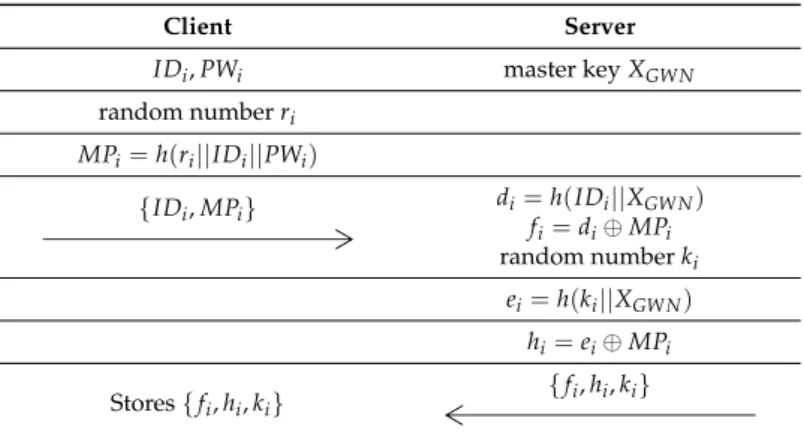
When the server 𝑆 receives the message, server 𝑆 generates the keys for client 𝐶, after that, the server 𝑆 sends these keys to the client 𝐶. Table 2 is a description of the process.
Figure 1.The structure of the proposed scheme.
The proposed scheme is a mutual authentication scheme between the client and the server. The scheme consists of three phases: registration phase of the client, mutual authentication and key establishment phase and the phase for a client to change his password.
3.2. System Initialization
In the beginning, the serverSgenerates and publicizes the parameters of an elliptic curve, which
is{p,a,b,P,n,h}. After that,Sgenerates its private keyXGW N, and keeps it as a secret. The symbols
that will be used in this study are summarized in Table1.
Table 1.Symbols used in this study.
Symbols Meaning
S The server
Ci Theithclient
IDi Theithclient’s identity
|| String connector, connecting two strings
⊕ XOR operation
P The generator of ECC
T1 Timestamp h The SHA-256 hash function
h1 A hash a string to a random number function
3.3. Registration Phase
All the clients have to register at the server, a clientCiwith identityIDigenerates a registration request message, and sends this request to the serverS.
1. ClientCichooses a random numberri.
2. ClientCicalculates a hash messageMPi =h(ri||IDi||PWi). 3. ClientCisends{IDi, MPi}to the server.
Sensors2018,18, 3695 4 of 21
1. ServerScalculates a hash messagedi=h(IDi||XGW N). 2. ServerScalculates fi=di⊕MPi.
3. ServerSchooses a random numberki.
4. ServerScalculates a hash messageei=h(ki||XGW N). 5. ServerScalculateshi=ei⊕MPi.
6. ServerSsends{fi,hi,ki}and other system parameters to the clientCi.
Table 2.Registration phase.
Client Server
IDi,PWi master keyXGW N
random numberri
MPi=h(ri||IDi||PWi)
{IDi,MPi}
Sensors 2018, 18, x FOR PEER REVIEW 5 of 20
When client 𝐶 gets the message{𝐵 , 𝑀 }, 𝐶 will do the following steps to authenticate the incoming message, if the client verifies the message, he will build a shared key with the server. 1. Client 𝐶 computes the shared key as 𝑆𝐾 = ℎ(𝑘 ∙ 𝐵 ||𝑇 ).
2. Client 𝐶 decrypts 𝑀 to get 𝑒 ||𝑀 = 𝑀 ⨁ℎ(𝑑 ||𝑇 ). 3. Client 𝐶 computes the random number 𝑘 = ℎ (𝑆𝐾||𝑇 ).
4. Client 𝐶 checks if 𝑀 = ℎ(𝐵 || 𝑒 ||𝑘 ||𝑑 ||𝑆𝐾), if they are equal, 𝐶 accepts the shared key 𝑆𝐾 , and now client 𝐶 and the server 𝑆 can communicate using the shared key 𝑆𝐾 = 𝑆𝐾 , otherwise the scheme terminates here.
5. Client 𝐶 updates ℎ = 𝑒 ⊕ 𝑀𝑃 and 𝑘 = 𝑘 .
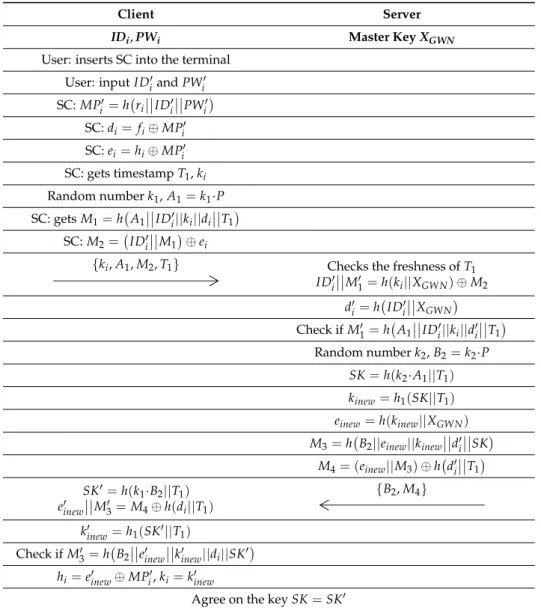
Now the client 𝐶 and the server 𝑆 have authenticated each other and built a shared key. The Table 3 below depicts the whole process.
Table 3. Authentication phase.
Client Server
𝑰𝑫𝒊, 𝑷𝑾𝒊 Master Key𝑿𝑮𝑾𝑵
User: inserts SC into the terminal
User: input𝐼𝐷 and𝑃𝑊
SC: 𝑀𝑃 = ℎ(𝑟 ||𝐼𝐷 ||𝑃𝑊 ) SC: 𝑑 = 𝑓 ⊕ 𝑀𝑃 SC: 𝑒 = ℎ ⊕ 𝑀𝑃 SC: gets timestamp𝑇, 𝑘
Random number𝑘,𝐴 = 𝑘 ∙ 𝑃
SC:gets𝑀 = ℎ(𝐴 ||𝐼𝐷 ||𝑘 ||𝑑 ||𝑇 )
SC: 𝑀 = (𝐼𝐷 ||𝑀 )⨁𝑒
{𝑘 , 𝐴 , 𝑀 , 𝑇 } Checks the freshness of𝑇 𝐼𝐷 ||𝑀 = ℎ(𝑘 ||𝑋 )⨁𝑀
𝑑 = ℎ(𝐼𝐷 || 𝑋 )
Check if𝑀 = ℎ(𝐴 ||𝐼𝐷 ||𝑘 ||𝑑 ||𝑇 ) Random number 𝑘 , 𝐵 = 𝑘 ∙ 𝑃
𝑆𝐾 = ℎ(𝑘 ∙ 𝐴 ||𝑇 ) 𝑘 = ℎ (𝑆𝐾||𝑇 ) 𝑒 = ℎ(𝑘 ||𝑋 ) 𝑀 = ℎ(𝐵 ||𝑒 ||𝑘 ||𝑑 ||𝑆𝐾) 𝑀 = (𝑒 ||𝑀 )⨁ℎ(𝑑 ||𝑇 ) 𝑆𝐾 = ℎ(𝑘 ∙ 𝐵 ||𝑇 ) 𝑒 ||𝑀 = 𝑀 ⨁ℎ(𝑑 ||𝑇 ) { 𝐵 , 𝑀 } 𝑘 = ℎ (𝑆𝐾||𝑇 )
Check if𝑀 = ℎ(𝐵 ||𝑒 ||𝑘 ||𝑑 ||𝑆𝐾)
ℎ = 𝑒 ⊕ 𝑀𝑃, 𝑘 = 𝑘
Agree on the key 𝑆𝐾= 𝑆𝐾
3.5. Password Change Phase
When a client 𝐶 wants to change his password, he can send a request to the server 𝑆, this request is sent in public channel. Table 4 is a description of this process.
1. The client 𝐶 inserts his smart card into a card reader, inputs his identity and password 𝐼𝐷 and 𝑃𝑊.
2. SC computes: 𝑀𝑃 = ℎ(𝑟 ||𝐼𝐷 ||𝑃𝑊 ).
3. SC uses 𝑀𝑃 to get 𝑑 = 𝑓 ⊕ 𝑀𝑃 and 𝑒 = ℎ ⊕ 𝑀𝑃. 4. SC gets the current timestamp 𝑇 and the random number 𝑘. 5. SC gets the hash 𝑀 = ℎ(𝐼𝐷 ||𝑘 ||𝑑 ||𝑇 ).
6. SC computes 𝑀 = (𝐼𝐷 ||𝑀 )⨁𝑒.
7. Finally, SC sends {𝑘 , 𝑀 , 𝑇} to the server 𝑆.
di=h(IDi||XGW N)
fi=di⊕MPi
random numberki
ei=h(ki||XGW N)
hi=ei⊕MPi
Stores{fi,hi,ki}
{fi,hi,ki}
Sensors 2018, 18, x FOR PEER REVIEW 5 of 20
When client 𝐶 gets the message{𝐵 , 𝑀 }, 𝐶 will do the following steps to authenticate the incoming message, if the client verifies the message, he will build a shared key with the server. 1. Client 𝐶 computes the shared key as 𝑆𝐾 = ℎ(𝑘 ∙ 𝐵 ||𝑇 ).
2. Client 𝐶 decrypts 𝑀 to get 𝑒 ||𝑀 = 𝑀 ⨁ℎ(𝑑 ||𝑇 ). 3. Client 𝐶 computes the random number 𝑘 = ℎ (𝑆𝐾 ||𝑇 ).
4. Client 𝐶 checks if 𝑀 = ℎ(𝐵 || 𝑒 ||𝑘 ||𝑑 ||𝑆𝐾 ), if they are equal, 𝐶 accepts the shared key 𝑆𝐾, and now client 𝐶 and the server 𝑆 can communicate using the shared key 𝑆𝐾 = 𝑆𝐾, otherwise the scheme terminates here.
5. Client 𝐶 updates ℎ = 𝑒 ⊕ 𝑀𝑃 and 𝑘 = 𝑘 .
Now the client 𝐶 and the server 𝑆 have authenticated each other and built a shared key. The Table 3 below depicts the whole process.
Table 3. Authentication phase.
Client Server
𝑰𝑫𝒊, 𝑷𝑾𝒊 Master Key𝑿𝑮𝑾𝑵
User: inserts SC into the terminal
User: input𝐼𝐷 and𝑃𝑊
SC: 𝑀𝑃 = ℎ(𝑟 ||𝐼𝐷 ||𝑃𝑊 )
SC: 𝑑 = 𝑓 ⊕ 𝑀𝑃
SC: 𝑒 = ℎ ⊕ 𝑀𝑃
SC: gets timestamp𝑇, 𝑘
Random number𝑘,𝐴 = 𝑘 ∙ 𝑃
SC:gets𝑀 = ℎ(𝐴 ||𝐼𝐷 ||𝑘 ||𝑑 ||𝑇 ) SC: 𝑀 = (𝐼𝐷 ||𝑀 )⨁𝑒
{𝑘 , 𝐴 , 𝑀 , 𝑇 } Checks the freshness of𝑇 𝐼𝐷 ||𝑀 = ℎ(𝑘 ||𝑋 )⨁𝑀
𝑑 = ℎ(𝐼𝐷 || 𝑋 )
Check if𝑀 = ℎ(𝐴 ||𝐼𝐷 ||𝑘 ||𝑑 ||𝑇 ) Random number 𝑘 , 𝐵 = 𝑘 ∙ 𝑃
𝑆𝐾 = ℎ(𝑘 ∙ 𝐴 ||𝑇 ) 𝑘 = ℎ (𝑆𝐾||𝑇 ) 𝑒 = ℎ(𝑘 ||𝑋 ) 𝑀 = ℎ(𝐵 ||𝑒 ||𝑘 ||𝑑 ||𝑆𝐾) 𝑀 = (𝑒 ||𝑀 )⨁ℎ(𝑑 ||𝑇 ) 𝑆𝐾 = ℎ(𝑘 ∙ 𝐵 ||𝑇 ) 𝑒 ||𝑀 = 𝑀 ⨁ℎ(𝑑 ||𝑇 ) { 𝐵 , 𝑀 } 𝑘 = ℎ (𝑆𝐾||𝑇 )
Check if𝑀 = ℎ(𝐵 ||𝑒 ||𝑘 ||𝑑 ||𝑆𝐾)
ℎ = 𝑒 ⊕ 𝑀𝑃, 𝑘 = 𝑘
Agree on the key 𝑆𝐾= 𝑆𝐾
3.5. Password Change Phase
When a client 𝐶 wants to change his password, he can send a request to the server 𝑆, this request is sent in public channel. Table 4 is a description of this process.
1. The client 𝐶 inserts his smart card into a card reader, inputs his identity and password 𝐼𝐷 and 𝑃𝑊.
2. SC computes: 𝑀𝑃 = ℎ(𝑟 ||𝐼𝐷 ||𝑃𝑊 ).
3. SC uses 𝑀𝑃 to get 𝑑 = 𝑓 ⊕ 𝑀𝑃 and 𝑒 = ℎ ⊕ 𝑀𝑃. 4. SC gets the current timestamp 𝑇 and the random number 𝑘. 5. SC gets the hash 𝑀 = ℎ(𝐼𝐷 ||𝑘 ||𝑑 ||𝑇 ).
6. SC computes 𝑀 = (𝐼𝐷 ||𝑀 )⨁𝑒.
7. Finally, SC sends {𝑘 , 𝑀 , 𝑇} to the server 𝑆. 3.4. Authentication Phase
If a clientCi with identity IDi wants to ask a service from the serverS, first, the two have to authenticate each other and build a shared key. The clientCiinserts the smart card into a card reader, inputs his identityID0iand passwordPWi0. The smart card (SC) prepares the following message and sends it to the serverS.
1. The clientCiinserts its smart card into a card reader, inputs his identityIDi0and passwordPWi0. 2. SC computes: MPi0 =h ri
IDi0
PWi0
.
3. SC usesMPi0to getdi= fi⊕MPi0andei =hi⊕MPi0.
4. SC gets the current timestampT1and the random numberki. 5. SC gets a random numberk1∈[1,n−1], and calculatesA1=k1·P. 6. SC gets the hashM1=h A1
ID0i
ki di T1 . 7. SC computesM2= ID0i
M1
⊕ei.
8. Finally, SC sends {ki,A1,M2,T1} to the serverS.
When the serverSreceives the incoming message, it first checks the correctness of the message, after the verification, the server will generate the shared key between himself and the client. Then the server prepares the message for sending back to the client.
1. ServerSchecks the freshness of theT1, ifT1is not fresh, serverSabandons the incoming message, the scheme ends here.
2. ServerScalculates the keyh(ki||XGW N)based onki. 3. ServerSuses the keyh(ki||XGW N)to decryptM2to get ID0i
M01, ID0i
M01=h(ki||XGW N)⊕M2.
4. ServerScalculatesd0i=h ID0i
XGW N
based on the identityIDi0. 5. ServerSchecks if M01=h A1
ID0i
ki d0i
T1
, if they are equal, the server accepts the incoming message, otherwise, the scheme terminates here.
6. ServerSgets a random numberk2∈[1,n−1], and calculatesB2=k2·P. 7. ServerScalculates the shared keySK=h(k2·A1||T1).
9. ServerScalculates a hash messageeinew=h(kinew||XGW N). 10. ServerScalculatesM3=h B2
einew kinew d0i
SK . 11. ServerScomputesM4= (einew||M3)⊕h d0i
T1 . 12. ServerSsends{B2,M4}to the clientCi.
When clientCi gets the message {B2,M4},Ci will do the following steps to authenticate the incoming message, if the client verifies the message, he will build a shared key with the server.
1. ClientCicomputes the shared key asSK0 =h(k1·B2||T1). 2. ClientCidecryptsM4to get e0inew
M30 = M4⊕h(di||T1).
3. ClientCicomputes the random numberk0inew=h1(SK0||T1). 4. ClientCi checks if M30 = h B2
e0inew
k0inew
di SK0
, if they are equal, Ci accepts the shared keySK0, and now clientCiand the serverScan communicate using the shared keySK=SK0, otherwise the scheme terminates here.
5. ClientCiupdateshi=e0inew⊕MPi0andki =k0inew.
Now the client Ci and the server S have authenticated each other and built a shared key. The Table3below depicts the whole process.
Table 3.Authentication phase.
Client Server
IDi,PWi Master KeyXGWN
User: inserts SC into the terminal User: inputID0iandPWi0
SC:MPi0=h ri IDi0
PWi0
SC:di= fi⊕MPi0
SC:ei=hi⊕MPi0
SC: gets timestampT1,ki
Random numberk1,A1=k1·P
SC: getsM1=h A1
IDi0||ki||di T1
SC:M2= IDi0 M1 ⊕ ei
{ki,A1,M2,T1}
Sensors 2018, 18, x FOR PEER REVIEW 5 of 20
When client 𝐶 gets the message{𝐵 , 𝑀 }, 𝐶 will do the following steps to authenticate the incoming message, if the client verifies the message, he will build a shared key with the server.
1. Client 𝐶 computes the shared key as 𝑆𝐾 = ℎ(𝑘 ∙ 𝐵 ||𝑇 ). 2. Client 𝐶 decrypts 𝑀 to get 𝑒 ||𝑀 = 𝑀 ⨁ℎ(𝑑 ||𝑇 ). 3. Client 𝐶 computes the random number 𝑘 = ℎ (𝑆𝐾||𝑇 ).
4. Client 𝐶 checks if 𝑀 = ℎ(𝐵 || 𝑒 ||𝑘 ||𝑑 ||𝑆𝐾), if they are equal, 𝐶 accepts the shared key 𝑆𝐾, and now client 𝐶 and the server 𝑆 can communicate using the shared key 𝑆𝐾 = 𝑆𝐾 , otherwise the scheme terminates here.
5. Client 𝐶 updates ℎ = 𝑒 ⊕ 𝑀𝑃 and 𝑘 = 𝑘 .
Now the client 𝐶 and the server 𝑆 have authenticated each other and built a shared key. The Table 3 below depicts the whole process.
Table 3. Authentication phase.
Client Server
𝑰𝑫𝒊, 𝑷𝑾𝒊 Master Key 𝑿𝑮𝑾𝑵
User: inserts SC into the terminal
User: input𝐼𝐷 and𝑃𝑊
SC: 𝑀𝑃 = ℎ(𝑟 ||𝐼𝐷 ||𝑃𝑊 ) SC: 𝑑 = 𝑓 ⊕ 𝑀𝑃 SC: 𝑒 = ℎ ⊕ 𝑀𝑃 SC: gets timestamp𝑇, 𝑘
Random number𝑘 ,𝐴 = 𝑘 ∙ 𝑃
SC:gets𝑀 = ℎ(𝐴 ||𝐼𝐷 ||𝑘 ||𝑑 ||𝑇 ) SC: 𝑀 = (𝐼𝐷 ||𝑀 )⨁𝑒
{𝑘 , 𝐴 , 𝑀 , 𝑇 } Checks the freshness of𝑇 𝐼𝐷 ||𝑀 = ℎ(𝑘 ||𝑋 )⨁𝑀
𝑑 = ℎ(𝐼𝐷 || 𝑋 )
Check if 𝑀 = ℎ(𝐴 ||𝐼𝐷 ||𝑘 ||𝑑 ||𝑇 )
Random number 𝑘 , 𝐵 = 𝑘 ∙ 𝑃
𝑆𝐾 = ℎ(𝑘 ∙ 𝐴 ||𝑇 ) 𝑘 = ℎ (𝑆𝐾||𝑇 ) 𝑒 = ℎ(𝑘 ||𝑋 ) 𝑀 = ℎ(𝐵 ||𝑒 ||𝑘 ||𝑑 ||𝑆𝐾) 𝑀 = (𝑒 ||𝑀 )⨁ℎ(𝑑 ||𝑇 ) 𝑆𝐾 = ℎ(𝑘 ∙ 𝐵 ||𝑇 ) 𝑒 ||𝑀 = 𝑀 ⨁ℎ(𝑑 ||𝑇 ) { 𝐵 , 𝑀 } 𝑘 = ℎ (𝑆𝐾||𝑇 )
Check if𝑀 = ℎ(𝐵 ||𝑒 ||𝑘 ||𝑑 ||𝑆𝐾)
ℎ = 𝑒 ⊕ 𝑀𝑃, 𝑘 = 𝑘
Agree on the key 𝑆𝐾= 𝑆𝐾
3.5. Password Change Phase
When a client 𝐶 wants to change his password, he can send a request to the server 𝑆, this request is sent in public channel. Table 4 is a description of this process.
1. The client 𝐶 inserts his smart card into a card reader, inputs his identity and password 𝐼𝐷 and
𝑃𝑊.
2. SC computes: 𝑀𝑃 = ℎ(𝑟 ||𝐼𝐷 ||𝑃𝑊 ).
3. SC uses 𝑀𝑃 to get 𝑑 = 𝑓 ⊕ 𝑀𝑃 and 𝑒 = ℎ ⊕ 𝑀𝑃.
4. SC gets the current timestamp 𝑇 and the random number 𝑘. 5. SC gets the hash 𝑀 = ℎ(𝐼𝐷 ||𝑘 ||𝑑 ||𝑇 ).
6. SC computes 𝑀 = (𝐼𝐷 ||𝑀 )⨁𝑒.
7. Finally, SC sends {𝑘 , 𝑀 , 𝑇} to the server 𝑆.
Checks the freshness ofT1
IDi0
M10 =h(ki||XGW N)⊕M2
d0i=h IDi0
XGW N
Check ifM10 =h A1
ID0i||ki||d0i T1
Random numberk2,B2=k2·P
SK=h(k2·A1||T1)
kinew=h1(SK||T1)
einew=h(kinew||XGW N)
M3=h B2||einew||kinew
d0i
SK
M4= (einew||M3)⊕h d0i
T1
SK0=h(k1·B2||T1)
e0inew
M03=M4⊕h(di||T1)
{B2,M4}
Sensors 2018, 18, x FOR PEER REVIEW 5 of 20
When client 𝐶 gets the message{𝐵 , 𝑀 }, 𝐶 will do the following steps to authenticate the incoming message, if the client verifies the message, he will build a shared key with the server.
1. Client 𝐶 computes the shared key as 𝑆𝐾 = ℎ(𝑘 ∙ 𝐵 ||𝑇 ). 2. Client 𝐶 decrypts 𝑀 to get 𝑒 ||𝑀 = 𝑀 ⨁ℎ(𝑑 ||𝑇 ). 3. Client 𝐶 computes the random number 𝑘 = ℎ (𝑆𝐾||𝑇 ).
4. Client 𝐶 checks if 𝑀 = ℎ(𝐵 || 𝑒 ||𝑘 ||𝑑 ||𝑆𝐾), if they are equal, 𝐶 accepts the shared key 𝑆𝐾, and now client 𝐶 and the server 𝑆 can communicate using the shared key 𝑆𝐾 = 𝑆𝐾, otherwise the scheme terminates here.
5. Client 𝐶 updates ℎ = 𝑒 ⊕ 𝑀𝑃 and 𝑘 = 𝑘 .
Now the client 𝐶 and the server 𝑆 have authenticated each other and built a shared key. The Table 3 below depicts the whole process.
Table 3. Authentication phase.
Client Server
𝑰𝑫𝒊, 𝑷𝑾𝒊 Master Key 𝑿𝑮𝑾𝑵
User: inserts SC into the terminal
User: input𝐼𝐷 and𝑃𝑊
SC: 𝑀𝑃 = ℎ(𝑟 ||𝐼𝐷 ||𝑃𝑊 ) SC: 𝑑 = 𝑓 ⊕ 𝑀𝑃
SC: 𝑒 = ℎ ⊕ 𝑀𝑃 SC: gets timestamp𝑇, 𝑘
Random number𝑘 ,𝐴 = 𝑘 ∙ 𝑃
SC:gets𝑀 = ℎ(𝐴 ||𝐼𝐷 ||𝑘 ||𝑑 ||𝑇 ) SC: 𝑀 = (𝐼𝐷 ||𝑀 )⨁𝑒
{𝑘 , 𝐴 , 𝑀 , 𝑇 } Checks the freshness of𝑇 𝐼𝐷 ||𝑀 = ℎ(𝑘 ||𝑋 )⨁𝑀
𝑑 = ℎ(𝐼𝐷 || 𝑋 )
Check if𝑀 = ℎ(𝐴 ||𝐼𝐷 ||𝑘 ||𝑑 ||𝑇 )
Random number 𝑘 , 𝐵 = 𝑘 ∙ 𝑃
𝑆𝐾 = ℎ(𝑘 ∙ 𝐴 ||𝑇 ) 𝑘 = ℎ (𝑆𝐾||𝑇 ) 𝑒 = ℎ(𝑘 ||𝑋 ) 𝑀 = ℎ(𝐵 ||𝑒 ||𝑘 ||𝑑 ||𝑆𝐾) 𝑀 = (𝑒 ||𝑀 )⨁ℎ(𝑑 ||𝑇 ) 𝑆𝐾 = ℎ(𝑘 ∙ 𝐵 ||𝑇 ) 𝑒 ||𝑀 = 𝑀 ⨁ℎ(𝑑 ||𝑇 ) { 𝐵 , 𝑀 } 𝑘 = ℎ (𝑆𝐾||𝑇 )
Check if𝑀 = ℎ(𝐵 ||𝑒 ||𝑘 ||𝑑 ||𝑆𝐾)
ℎ = 𝑒 ⊕ 𝑀𝑃, 𝑘 = 𝑘
Agree on the key 𝑆𝐾= 𝑆𝐾
3.5. Password Change Phase
When a client 𝐶 wants to change his password, he can send a request to the server 𝑆, this request is sent in public channel. Table 4 is a description of this process.
1. The client 𝐶 inserts his smart card into a card reader, inputs his identity and password 𝐼𝐷 and
𝑃𝑊.
2. SC computes: 𝑀𝑃 = ℎ(𝑟 ||𝐼𝐷 ||𝑃𝑊 ).
3. SC uses 𝑀𝑃 to get 𝑑 = 𝑓 ⊕ 𝑀𝑃 and 𝑒 = ℎ ⊕ 𝑀𝑃.
4. SC gets the current timestamp 𝑇 and the random number 𝑘. 5. SC gets the hash 𝑀 = ℎ(𝐼𝐷 ||𝑘 ||𝑑 ||𝑇 ).
6. SC computes 𝑀 = (𝐼𝐷 ||𝑀 )⨁𝑒.
7. Finally, SC sends {𝑘 , 𝑀 , 𝑇} to the server 𝑆.
k0inew=h1(SK0||T1)
Check ifM30 =h B2
e0inew
k0inew||di||SK0
hi=e0inew⊕MPi0,ki=k0inew
Sensors2018,18, 3695 6 of 21
3.5. Password Change Phase
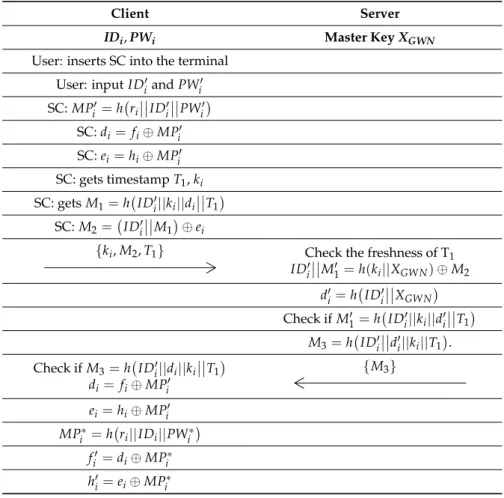
When a clientCiwants to change his password, he can send a request to the serverS, this request is sent in public channel. Table4is a description of this process.
1. The client Ci inserts his smart card into a card reader, inputs his identity and password ID0i andPWi0.
2. SC computes: MPi0 =h ri
IDi0
PWi0
.
3. SC usesMPi0to getdi= fi⊕MPi0andei =hi⊕MPi0.
4. SC gets the current timestampT1and the random numberki. 5. SC gets the hashM1=h ID0i||ki||di
T1 . 6. SC computesM2= ID0i
M1
⊕ei.
7. Finally, SC sends {ki,M2,T1} to the serverS.
Table 4.Password change phase.
Client Server
IDi,PWi Master KeyXGWN
User: inserts SC into the terminal User: inputID0iandPWi0 SC:MPi0=h ri
ID0i
PWi0
SC:di= fi⊕MPi0 SC:ei=hi⊕MPi0 SC: gets timestampT1,ki SC: getsM1=h IDi0||ki||di
T1
SC:M2= IDi0
M1
⊕ei
{ki,M2,T1}
Sensors 2018, 18, x FOR PEER REVIEW 5 of 20
When client 𝐶 gets the message{𝐵 , 𝑀 }, 𝐶 will do the following steps to authenticate the incoming message, if the client verifies the message, he will build a shared key with the server.
1. Client 𝐶 computes the shared key as 𝑆𝐾 = ℎ(𝑘 ∙ 𝐵 ||𝑇 ). 2. Client 𝐶 decrypts 𝑀 to get 𝑒 ||𝑀 = 𝑀 ⨁ℎ(𝑑 ||𝑇 ). 3. Client 𝐶 computes the random number 𝑘 = ℎ (𝑆𝐾||𝑇 ).
4. Client 𝐶 checks if 𝑀 = ℎ(𝐵 || 𝑒 ||𝑘 ||𝑑 ||𝑆𝐾), if they are equal, 𝐶 accepts the shared key 𝑆𝐾 , and now client 𝐶 and the server 𝑆 can communicate using the shared key 𝑆𝐾 = 𝑆𝐾 , otherwise the scheme terminates here.
5. Client 𝐶 updates ℎ = 𝑒 ⊕ 𝑀𝑃 and 𝑘 = 𝑘 .
Now the client 𝐶 and the server 𝑆 have authenticated each other and built a shared key. The Table 3 below depicts the whole process.
Table 3. Authentication phase.
Client Server
𝑰𝑫𝒊, 𝑷𝑾𝒊 Master Key𝑿𝑮𝑾𝑵
User: inserts SC into the terminal User: input 𝐼𝐷 and𝑃𝑊 SC: 𝑀𝑃 = ℎ(𝑟 ||𝐼𝐷 ||𝑃𝑊 )
SC: 𝑑 = 𝑓 ⊕ 𝑀𝑃 SC: 𝑒 = ℎ ⊕ 𝑀𝑃 SC: gets timestamp𝑇, 𝑘
Random number𝑘 , 𝐴 = 𝑘 ∙ 𝑃
SC:gets𝑀 = ℎ(𝐴 ||𝐼𝐷 ||𝑘 ||𝑑 ||𝑇 ) SC: 𝑀 = (𝐼𝐷 ||𝑀 )⨁𝑒
{𝑘 , 𝐴 , 𝑀 , 𝑇 } Checks the freshness of𝑇 𝐼𝐷 ||𝑀 = ℎ(𝑘 ||𝑋 )⨁𝑀
𝑑 = ℎ(𝐼𝐷 || 𝑋 )
Check if𝑀 = ℎ(𝐴 ||𝐼𝐷 ||𝑘 ||𝑑 ||𝑇 ) Random number 𝑘 , 𝐵 = 𝑘 ∙ 𝑃
𝑆𝐾 = ℎ(𝑘 ∙ 𝐴 ||𝑇 ) 𝑘 = ℎ (𝑆𝐾||𝑇 ) 𝑒 = ℎ(𝑘 ||𝑋 ) 𝑀 = ℎ(𝐵 ||𝑒 ||𝑘 ||𝑑 ||𝑆𝐾) 𝑀 = (𝑒 ||𝑀 )⨁ℎ(𝑑 ||𝑇 ) 𝑆𝐾 = ℎ(𝑘 ∙ 𝐵 ||𝑇 ) 𝑒 ||𝑀 = 𝑀 ⨁ℎ(𝑑 ||𝑇 ) { 𝐵 , 𝑀 } 𝑘 = ℎ (𝑆𝐾 ||𝑇 )
Check if𝑀 = ℎ(𝐵 ||𝑒 ||𝑘 ||𝑑 ||𝑆𝐾)
ℎ = 𝑒 ⊕ 𝑀𝑃, 𝑘 = 𝑘
Agree on the key 𝑆𝐾= 𝑆𝐾
3.5. Password Change Phase
When a client 𝐶 wants to change his password, he can send a request to the server 𝑆, this request is sent in public channel. Table 4 is a description of this process.
1. The client 𝐶 inserts his smart card into a card reader, inputs his identity and password 𝐼𝐷 and
𝑃𝑊.
2. SC computes: 𝑀𝑃 = ℎ(𝑟 ||𝐼𝐷 ||𝑃𝑊 ).
3. SC uses 𝑀𝑃 to get 𝑑 = 𝑓 ⊕ 𝑀𝑃 and 𝑒 = ℎ ⊕ 𝑀𝑃. 4. SC gets the current timestamp 𝑇 and the random number
𝑘
.
5. SC gets the hash 𝑀 = ℎ(𝐼𝐷 ||𝑘 ||𝑑 ||𝑇 ).6. SC computes 𝑀 = (𝐼𝐷 ||𝑀 )⨁𝑒.
7. Finally, SC sends {𝑘 , 𝑀 , 𝑇} to the server 𝑆.
Check the freshness of T1
ID0i
M10 =h(ki||XGW N)⊕M2
d0i=h IDi0 XGW N
Check ifM01=h ID0i||ki||di0 T1
M3=h ID0i
d0i||ki||T1
. Check ifM3=h IDi0||di||ki
T1
di= fi⊕MPi0
{M3}
Sensors 2018, 18, x FOR PEER REVIEW 5 of 20
When client 𝐶 gets the message{𝐵 , 𝑀 }, 𝐶 will do the following steps to authenticate the incoming message, if the client verifies the message, he will build a shared key with the server.
1. Client 𝐶 computes the shared key as 𝑆𝐾 = ℎ(𝑘 ∙ 𝐵 ||𝑇 ). 2. Client 𝐶 decrypts 𝑀 to get 𝑒 ||𝑀 = 𝑀 ⨁ℎ(𝑑 ||𝑇 ). 3. Client 𝐶 computes the random number 𝑘 = ℎ (𝑆𝐾||𝑇 ).
4. Client 𝐶 checks if 𝑀 = ℎ(𝐵 || 𝑒 ||𝑘 ||𝑑 ||𝑆𝐾), if they are equal, 𝐶 accepts the shared key 𝑆𝐾 , and now client 𝐶 and the server 𝑆 can communicate using the shared key 𝑆𝐾 = 𝑆𝐾, otherwise the scheme terminates here.
5. Client 𝐶 updates ℎ = 𝑒 ⊕ 𝑀𝑃 and 𝑘 = 𝑘 .
Now the client 𝐶 and the server 𝑆 have authenticated each other and built a shared key. The Table 3 below depicts the whole process.
Table 3. Authentication phase.
Client Server 𝑰𝑫𝒊, 𝑷𝑾𝒊 Master Key 𝑿𝑮𝑾𝑵
User: inserts SC into the terminal User: input 𝐼𝐷 and𝑃𝑊 SC: 𝑀𝑃 = ℎ(𝑟 ||𝐼𝐷 ||𝑃𝑊 )
SC: 𝑑 = 𝑓 ⊕ 𝑀𝑃 SC: 𝑒 = ℎ ⊕ 𝑀𝑃 SC: gets timestamp𝑇, 𝑘
Random number𝑘 , 𝐴 = 𝑘 ∙ 𝑃
SC:gets 𝑀 = ℎ(𝐴 ||𝐼𝐷 ||𝑘 ||𝑑 ||𝑇 ) SC: 𝑀 = (𝐼𝐷 ||𝑀 )⨁𝑒
{𝑘 , 𝐴 , 𝑀 , 𝑇 } Checks the freshness of𝑇 𝐼𝐷 ||𝑀 = ℎ(𝑘 ||𝑋 )⨁𝑀
𝑑 = ℎ(𝐼𝐷 || 𝑋 )
Check if 𝑀 = ℎ(𝐴 ||𝐼𝐷 ||𝑘 ||𝑑 ||𝑇 ) Random number 𝑘 , 𝐵 = 𝑘 ∙ 𝑃
𝑆𝐾 = ℎ(𝑘 ∙ 𝐴 ||𝑇 ) 𝑘 = ℎ (𝑆𝐾||𝑇 ) 𝑒 = ℎ(𝑘 ||𝑋 ) 𝑀 = ℎ(𝐵 ||𝑒 ||𝑘 ||𝑑 ||𝑆𝐾) 𝑀 = (𝑒 ||𝑀 )⨁ℎ(𝑑 ||𝑇 ) 𝑆𝐾 = ℎ(𝑘 ∙ 𝐵 ||𝑇 ) 𝑒 ||𝑀 = 𝑀 ⨁ℎ(𝑑 ||𝑇 ) { 𝐵 , 𝑀 } 𝑘 = ℎ (𝑆𝐾 ||𝑇 )
Check if 𝑀 = ℎ(𝐵 ||𝑒 ||𝑘 ||𝑑 ||𝑆𝐾)
ℎ = 𝑒 ⊕ 𝑀𝑃, 𝑘 = 𝑘
Agree on the key 𝑆𝐾 = 𝑆𝐾
3.5. Password Change Phase
When a client 𝐶 wants to change his password, he can send a request to the server 𝑆, this request is sent in public channel. Table 4 is a description of this process.
1. The client 𝐶 inserts his smart card into a card reader, inputs his identity and password 𝐼𝐷 and
𝑃𝑊.
2. SC computes: 𝑀𝑃 = ℎ(𝑟 ||𝐼𝐷 ||𝑃𝑊 ).
3. SC uses 𝑀𝑃 to get 𝑑 = 𝑓 ⊕ 𝑀𝑃 and 𝑒 = ℎ ⊕ 𝑀𝑃.
4. SC gets the current timestamp 𝑇 and the random number
𝑘
.
5. SC gets the hash 𝑀 = ℎ(𝐼𝐷 ||𝑘 ||𝑑 ||𝑇 ).6. SC computes 𝑀 = (𝐼𝐷 ||𝑀 )⨁𝑒.
7. Finally, SC sends {𝑘 , 𝑀 , 𝑇} to the server 𝑆. ei=hi⊕MPi0
MPi∗=h ri||IDi||PWi∗
fi0=di⊕MPi∗
h0i=ei⊕MPi∗
When the serverSreceives the message, serverSwill verify if the message is from a legitimate client, after that, the serverSsends a replay to the clientCi.
1. ServerSchecks the freshness of theT1, ifT1is not fresh, serverSabandons the incoming message. 2. ServerScalculates the keyh(ki||XGW N)based onki.
3. ServerSuses the keyh(ki||XGW N)to decryptM2to get ID0i
M01, ID0i
M01=h(ki||XGW N)⊕M2.
4. ServerScalculatesd0i=h ID0i
XGW N
based on the identityIDi0. 5. Server Schecks ifM10 = h ID0i||ki||d0i
T1
6. ServerScalculatesM3=h IDi0 d0i
ki
T1
. 7. ServerSsends{M3}to the clientCi.
When a client Ci receives the replay message from the server S, the smart card checks the correctness of this message, if it is from the serverS, then the smart card will allow the clientCito input his new password.
1. SC checks if M3 = h IDi0||di||ki
T1
, if they are equal, then the client is allowed to change his password.
2. SCcomputesdi = fi⊕MPi0using the stored fiand the oldMPi0. 3. SCcomputesei=hi⊕MPi0using the storedhiand the oldMPi0 4. ClientCiinputs the new passwordPWi∗.
5. SCupdatesMPi0to beMPi∗=h ri||IDi||PWi∗
.
6. SC uses this new MPi∗ to update the stored version of fi and hi to get fi0 = di ⊕MPi∗, h0i =ei⊕MPi∗.
4. Security Analysis by AVISPA
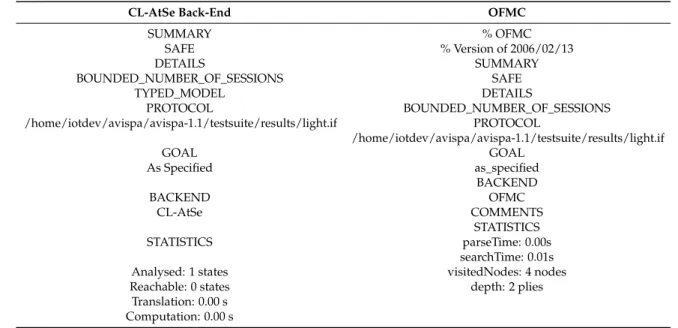
Automated Validation of Internet Security Protocols and Applications (AVISPA) is “a push-button tool for the automated validation of Internet security-sensitive protocols and applications” [30]. To test security features of the scheme in this study, we write the scheme in a role-based language called High-Level Protocols Specification Language (HLPSL), which is used for describing protocols and specifying their intended security features. The HLPSL code is listed in AppendixA.
We run the security check by using the CL-based Model-Checker [31], and the checker of On-the-Fly Model-Checker (OFMC) [32,33]. The simulation result shown in Table5demonstrates that the proposed scheme is safe.
Table 5.Simulation results of AVISPA.
CL-AtSe Back-End OFMC
SUMMARY % OFMC
SAFE % Version of 2006/02/13
DETAILS SUMMARY
BOUNDED_NUMBER_OF_SESSIONS SAFE
TYPED_MODEL DETAILS
PROTOCOL BOUNDED_NUMBER_OF_SESSIONS /home/iotdev/avispa/avispa-1.1/testsuite/results/light.if PROTOCOL
/home/iotdev/avispa/avispa-1.1/testsuite/results/light.if
GOAL GOAL
As Specified as_specified BACKEND
BACKEND OFMC
CL-AtSe COMMENTS
STATISTICS STATISTICS parseTime: 0.00s
searchTime: 0.01s Analysed: 1 states visitedNodes: 4 nodes Reachable: 0 states depth: 2 plies
Translation: 0.00 s Computation: 0.00 s
5. Security Analysis Using BAN Logic
Sensors2018,18, 3695 8 of 21
5.1. The Premise and Proof Goals
Suppose there are two entities in the system: clientCiand the serverS. Before we start the proof, we first translate the messages into an idealized form of BAN logic, the results are shown in Table6.
Table 6.The idealized form of the messages.
Message Flow Idealized Form
1 Ci→S
n
ki,A1,{A1,IDi,ki,T1}di,T1 o
2 S→Ci {B2,{einew,B2,kinew,di,SK}h(di||T1)}
The goals in BAN Logic are described below. These goals can ensureCiandSto agree on a shared keySK.
1.Ci| ≡Ci SK
←→S2.S| ≡S←SK→Ci
5.2. Assumptions
We make some assumptions to help us to prove the protocol; assumptions are listed in Table7. First, we show the proof of assumption A1 and A3.
1. According to the “#()-introduction” rule, clientCicreatesT1
Ci |≡#(T1) (1)
2. According to (1) and the “promotion #” rule:
Ci|≡#(M4) (2)
3. According to (2) and the “promotion #” rule:
Ci|≡#(B2,M4) (3)
4. According to (3) and the “elimination of multipart messages” rule:
Ci|≡#(B2) (4)
In this part, we show the proof of assumption A2 and A4. By checking the timestampT1, the server Scan judge ifT1is fresh or not, ifT1is not fresh, the serverSwill abandon the message and the scheme ends here. Thus, we only consider the situation that serverSbelieves timestampT1is fresh, which is
S| ≡#(T1).
5. According to the “promotion #” rule:
S|≡#(ki,A1,M2,T1). (5)
6. According to (5) and the “elimination of multipart messages” rule:
S|≡#(A1) (6)
After registration, both serverSand the clientCibelieve that they have a shared keydi. Translating into BAN Logic, we get assumptions A6:S| ≡Ci
di
←→SandCi| ≡S
di
←→Ci. We can get assumptions A5:Ci| ≡S
h(di||T1)
←−−−→Cibased onCi | ≡S
di
has complete control over the dataB2, assumption A8 says that serverSbelieves clientCihas complete control over the dataA1.
Table 7.Assumptions.
Number Assumptions Number Assumptions
A1 Ci|≡#(T1) A2 S|≡#(T1)
A3 Ci|≡#(B2) A4 S|≡#(A1)
A5 C
i≡S
h(di||T1)
←−−−→Ci A6 S≡Ci di ←→S
A7 Ci|≡SB2 A8 S|≡CiA1
5.3. The Proof of the Proposed Scheme
In this section, we start the proof. According to the messagenki,A1,{A1,IDi,ki,T1}di,T1 o
, which the clientCisends to serverS, we can get the followings:
7. According to the messagenki,A1,{A1,IDi,ki,T1}di,T1
o
:
S nki,A1,{A1,IDi,ki,T1}d
i,T1 o
(7)
8. According to (7) and “ ‘,’-elimination” rule:
S {A1,IDi,ki,T1}di (8)
9. According to (8), A6 and “|∼introduction” rule:
S|≡Ci| ∼ {A1,IDi,ki,T1} (9)
10. According to (9) and “ ‘,’-elimination” rule:
S|≡Ci| ∼A1 (10)
11. According to A4, (10), and “|∼elimination” rule:
S|≡Ci| ≡A1 (11)
12. According to A8, (11), and “jurisdiction or control” rule:
S|≡A1 (12)
13. Ask2is randomly created byS, according to “#()- introduction” rule:
S|≡#(k2) (13)
14. According to (13), A2, A4, and “#()- promotion” rule:
S|≡#(SK) (14)
15. According to (11), (14), and “←→k introduction” rule:
Sensors2018,18, 3695 10 of 21
Now we have proved the second goal, we will begin to prove the first goal by analyzing the message serverSsends to clientCi:{B2,{einew,B2,kinew,di,SK}h(di||T1)}.
16. According to the message{B2,{einew,B2,kinew,di,SK}h(di||T1)}:
Ci {B2,{einew,B2,kinew,di,SK}h(di||T1)} (16)
17. According to (16) and “ ‘,’-elimination” rule:
Ci {einew,B2,kinew,di,SK}h(di||T1) (17)
18. According to (17), A5 and “|∼introduction” rule:
Ci|≡S| ∼ {einew,B2,kinew,di,SK} (18)
19. According to (18) and “ ‘,’-elimination” rule:
Ci|≡S| ∼B2 (19)
20. According to A3, (19), and “|∼elimination” rule:
Ci|≡S| ≡B2 (20)
21. According to A7, (20), and “jurisdiction or control” rule:
Ci|≡B2 (21)
22. Ask1is randomly created byCi, according to “#()- introduction” rule:
Ci|≡#(k1) (22)
23. According to (22), A1, A3, and “#()- promotion” rule:
Ci|≡#(SK) (23)
24. According to (20), (23), and “↔k introduction” rule:
Ci| ≡Ci SK
←→S (24)
Now, we have proved the two goals of the scheme. We can say that the proposed scheme is secure under BAN logic.
6. Formal Security Analysis
SupposeG1 is a cyclic additive group of prime orderq, Pis the generator of G1, the Elliptic Curve Computational Diffie–Hellman (ECCDH) problem is thought to be a computational hardness. The security of the shared key of the proposed scheme is based on the computational hardness of the ECCDHproblem.
Theorem 1.The proposed scheme achieves shared key security if and only if the ECCDH problem is unable to be solved in polynomial time.
We define the shared key security as that an adversary is unable to get the shared key between the clientCiand serverSbased on the messages transferred publicly between them.
Proof.
(⇒) Suppose there is an efficient algorithm OI which could break the ECCDH problem in probabilistic polynomial time. The adversary is able to get the messages publicly sent between the client Ciand the serverS: {ki,A1,M2,T1}, and{B2,M4}. Supposea·P = A1 = k1·PandP = B2 = k2·P, adversaryAI is able to get thecP=k1·k2·Pby using efficient algorithmOI, the adversary is able to
break the security of the shared key and get the shared keyh(k1·k2·P||T1).
(⇐) Suppose there is an efficient algorithmOI Iwhich could get the shared key between clientCi and serverS, as the hash operation is secure, the adversary has to get the shared key by calculating k1·k2·P. This means given A1 = k1·P and B2 = k2·P, an adversary AI I is able to get k1·k2·P. For theECCDH problem, supposea·P = A1 = k1·Pandb·P = B2 = k2·P, the adversary is able to getc·P=a·b·P=k1·k2·P. This apparently contradicts the hardness of theECCDHproblem.
Theorem 2.The proposed scheme achieves perfect forward privacy if and only if the ECCDH problem is unable to solve in polynomial time.
Proof.
The proof of perfect forward privacy is similar to Theorem 1. Even if the private key of the client is leaked to the adversary. What the adversary get is the same public information{ki,A1,M2,T1}and
{B2,M4}. Thus it is unable to get the past session key, neither.
7. Comparison
In this section, we compared our scheme with related works in computation cost, computation at the registration phase and the authentication phase. The schemes are implemented in C++, the running codes have been upload to a public repository in the github.com [36]. The MIRACL C/C++ Library is used in this study [37], the library can be accessed at github.com [38]. The experiment is conducted in Visual Studio C++ 2017 on a 64-bits Windows 7 operating system, 3.5 GHz processor, 8 GB memory. The hash function is SHA-256, the symmetric encryption/decryption function is AES in MR_PCFB1 form, the 256-bit long key for symmetric encryption/decryption function is generated by SHA-256 hash operation. The Koblitz curve secp256k1 which is recommended by NIST is used in this study [39]. The parameters of this curve are listed in AppendixB. The code is compiled in x86 form, this simulation does not take into account the transmission of the data.
7.1. Computational Performance Analysis
Sensors2018,18, 3695 12 of 21
Table 8.Computation costs in the form of operation per phase.
Reference Registration Phase Authentication Phase Password Change Phase
Tu et al. [3] 2TH+ 1TMUL 10TH+ 7TMUL+ 1TADD 6TH+ 1TMUL+ 4TE/D Chaudhry et al. [6] 5TH+ 1TMUL 14TH+ 6TMUL+ 1TADD —
Wu et al. [19] 4TH 12TH+ 4TMUL+ 4TE/D 9TH+ 1TMUL+ 2TE/D
Our scheme 3TH 14TH+ 4TMUL 9TH
First, we run the registration phase of different schemes 5, 10, 15, 20 and 25 times separately. The computation times are shown in Figure2. The horizontal axis represents the number of runs of the experiment, the vertical axis represents the time required for the experiment to run, and the unit is milliseconds. The computation cost of Wu et al. [19] and that of the proposed scheme are relatively smaller, while the scheme of Chaudhry et al. [6], and that of Tu et al. [3] cost more computation time. This is mainly because the proposed scheme and the scheme of Wu et al. [19] only need lightweight operations, SHA-256 hash operations and XOR operation, while for the scheme of Chaudhry et al. [6], and that of Tu et al. [3], symmetric encryption/decryption operations are required, these operations cost more computation time.
Sensors 2018, 18, x FOR PEER REVIEW 11 of 20
Reference Registration Phase Authentication Phase Password Change Phase Tu et al. [3] 2TH + 1TMUL 10TH + 7TMUL + 1TADD 6TH + 1TMUL + 4TE/D
Chaudhry et al. [6] 5TH + 1TMUL 14TH + 6TMUL + 1TADD ---
Wu et al. [19] 4TH 12TH + 4TMUL + 4TE/D 9TH + 1TMUL + 2TE/D
Our scheme 3TH 14TH + 4TMUL 9TH
First, we run the registration phase of different schemes 5, 10, 15, 20 and 25 times separately. The computation times are shown in Figure 2. The horizontal axis represents the number of runs of the experiment, the vertical axis represents the time required for the experiment to run, and the unit is milliseconds. The computation cost of Wu et al. [19] and that of the proposed scheme are relatively smaller, while the scheme of Chaudhry et al. [6], and that of Tu et al. [3] cost more computation time. This is mainly because the proposed scheme and the scheme of Wu et al. [19] only need lightweight operations, SHA-256 hash operations and XOR operation, while for the scheme of Chaudhry et al. [6], and that of Tu et al. [3], symmetric encryption/decryption operations are required, these operations cost more computation time.
Figure 2. The computation cost of registration phase.
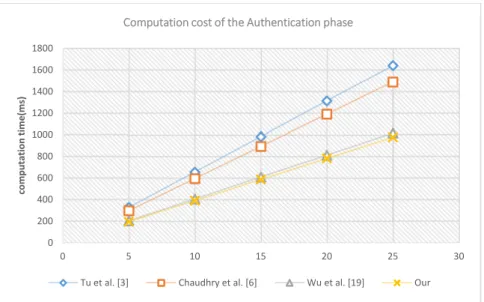
Second, we run the authentication and key establishment phase of different schemes 5, 10, 15, 20 and 25 times separately. The computation costs are shown in Figure 3. The horizontal axis represents the number of running the experiment, the vertical axis stands for the number of milliseconds to accomplish the experiment. The computation cost of Wu et al. [19] and that of the proposed scheme are relatively smaller, while the scheme of Chaudhry et al. [6], and the scheme of Tu et al. [3] cost more computation time. The computation cost of the proposed scheme is the minimal.
0 50 100 150 200 250
0 5 10 15 20 25 30
computation
time
(m
s)
Computation cost of the registration phase
Tu et al. [3] Chaudhry et al. [6] Wu et al. [19] Our
Figure 2.The computation cost of registration phase.
Second, we run the authentication and key establishment phase of different schemes 5, 10, 15, 20 and 25 times separately. The computation costs are shown in Figure3. The horizontal axis represents the number of running the experiment, the vertical axis stands for the number of milliseconds to accomplish the experiment. The computation cost of Wu et al. [19] and that of the proposed scheme are relatively smaller, while the scheme of Chaudhry et al. [6], and the scheme of Tu et al. [3] cost more computation time. The computation cost of the proposed scheme is the minimal.
Sensors2018,18, 3695 13 of 21
Sensors 2018, 18, x FOR PEER REVIEW 12 of 20
Figure 3.The computation cost of authentication phase.
Third, we run the password change phase 5, 10, 15, 20 and 25 times separately. The computation costs are shown in Figure 4. In this figure, the horizontal axis indicates the number of times the experiment was run; the vertical axis indicates the number of milliseconds to accomplish the experiment. The computation cost of the proposed is the minimal, the computation cost of Wu et al. [19], and that of Tu et al. [3] are much higher, this is because in the proposed scheme only SHA-256 hash operations and XOR operation are needed, while in the scheme of Wu et al. [19], and in the scheme of Tu et al. [3], symmetric encryption/decryption, and elliptic curve operation are needed, these operations cost more computation time.
Figure 4. The computation cost of password change phase.
7.2. Communication Performance Analysis
In this part, we compared all the schemes in communication cost. We use the same criteria as that in the study of Jing et al. [8], the identity costs 2 bytes. The general hash operation in this study is SHA-256, the result of a hash operation is set to be 32 bytes. In this study, the random number is set to be 4 bytes, the timestamp is set to be 4 bytes. The element of the 𝐺 of the Koblitz curve secp256k1 is 64 bytes. The order |𝑞| of 𝐺 is 32 bytes long.
At the registration phase, the client sends {𝐼𝐷 , 𝑀𝑃 } to the server, 𝑀𝑃 is a result of hash, it is 32 bytes long. The length of this message is 2 + 32 = 34 byte. The server sends {𝑓 , ℎ , 𝑘 }, 𝑓 is 32 byte
0 200 400 600 800 1000 1200 1400 1600 1800
0 5 10 15 20 25 30
computation
time
(m
s)
Computation cost of the Authentication phase
Tu et al. [3] Chaudhry et al. [6] Wu et al. [19] Our
0 50 100 150 200 250 300 350 400
0 5 10 15 20 25 30
computatti
on
time(ms)
Computation cost of the password change phase
Tu et al. [3] Chaudhry et al. [6] Wu et al. [19] Our Figure 3.The computation cost of authentication phase. Figure 3.The computation cost of authentication phase.
Third, we run the password change phase 5, 10, 15, 20 and 25 times separately. The computation costs are shown in Figure 4. In this figure, the horizontal axis indicates the number of times the experiment was run; the vertical axis indicates the number of milliseconds to accomplish the experiment. The computation cost of the proposed is the minimal, the computation cost of Wu et al. [19], and that of Tu et al. [3] are much higher, this is because in the proposed scheme only SHA-256 hash operations and XOR operation are needed, while in the scheme of Wu et al. [19], and in the scheme of Tu et al. [3], symmetric encryption/decryption, and elliptic curve operation are needed, these operations cost more computation time.
Figure 4. The computation cost of password change phase.
7.2. Communication Performance Analysis
In this part, we compared all the schemes in communication cost. We use the same criteria as that in the study of Jing et al. [8], the identity costs 2 bytes. The general hash operation in this study is SHA-256, the result of a hash operation is set to be 32 bytes. In this study, the random number is set to be 4 bytes, the timestamp is set to be 4 bytes. The element of the 𝐺 of the Koblitz curve secp256k1 is 64 bytes. The order |𝑞| of 𝐺 is 32 bytes long.
At the registration phase, the client sends {𝐼𝐷 , 𝑀𝑃 } to the server, 𝑀𝑃 is a result of hash, it is 32 bytes long. The length of this message is 2 + 32 = 34 byte. The server sends {𝑓 , ℎ , 𝑘 }, 𝑓 is 32 byte
0 200 400 600 800 1000 1200 1400 1600 1800
0 5 10 15 20 25 30
computation
time
(m
s)
Computation cost of the Authentication phase
Tu et al. [3] Chaudhry et al. [6] Wu et al. [19] Our
0 50 100 150 200 250 300 350 400
0 5 10 15 20 25 30
computatti
on
time(ms)
Computation cost of the password change phase
Tu et al. [3] Chaudhry et al. [6] Wu et al. [19] Our
Figure 4.The computation cost of password change phase. 7.2. Communication Performance Analysis
In this part, we compared all the schemes in communication cost. We use the same criteria as that in the study of Jing et al. [8], the identity costs 2 bytes. The general hash operation in this study is SHA-256, the result of a hash operation is set to be 32 bytes. In this study, the random number is set to be 4 bytes, the timestamp is set to be 4 bytes. The element of theG1of the Koblitz curve secp256k1 is 64 bytes. The order|q|ofG1is 32 bytes long.
At the registration phase, the client sends{IDi,MPi}to the server,MPiis a result of hash, it is 32 bytes long. The length of this message is 2 + 32 = 34 byte. The server sends {fi,hi,ki}, fi is 32 byte long,hiis also 32 byte long. kiis 4 bytes a random number. The length of this message is 32 + 32 + 4 = 68 byte long. In the registration phase, the communication cost is 34 + 68 = 102 byte.
At the authentication phase, the client has to send{ki,A1,M2,T1}to the server,kiis a random number of be 4 bytes, A1is an element of G1, it is 64 bytes long, M2 = ID0i
M1
Sensors2018,18, 3695 14 of 21
M4 = (einew||M3)⊕h d0i
T1
, einew and M3are the results of hash, they are both 32 bytes long, the length of M4 is 32 + 32 = 64 byte. The length of this message is 64 + 64 = 128 byte long. The communication cost of is 106 + 128 = 234 byte.
At the password change phase, the client has to send{ki,M2,T1}to the server,ki is a random number of be 4 bytes,M2= IDi0
M1
⊕ei,Id0iis an identity, it is 2 bytes long,M1is the result of an hash operation, it is 32 bytes long, the length ofM2is 32 + 2 = 34 byte.T1is a 4 bytes long timestamp. The length of this message is 4 + 34 + 4 = 42. The server has to send{M3}back to the client,M3is the result of hash, it is 32 bytes long, the length of this message is 32 byte long. The communication cost of this phase is 42 + 32 = 74 byte.
The communication costs of other schemes are computed in the same way, note that, in the scheme of Tu et al. [3], to change a client’s password, the client and the server has to build a shared key in advance, thus, the communication cost of the password change phase is calculated as the communication cost of the authentication phase and the messages sent during the password change process. The scheme of Chaudhry et al. [6] does not have a password change phase; we did not calculate their scheme’s communication cost. The result is shown in Table9.
Table 9.Communication costs of different schemes.
Reference Registration Phase Authentication Phase Password Change Phase
Tu et al. [3] 98 byte 230 byte 456 byte
Chaudhry et al. [6] 130 byte 226 byte —
Wu et al. [19] 102 byte 238 byte 138 byte
Our scheme 102 byte 234 byte 74 byte
8. Security Feature Analyses
In this section, we analyzed the security features of different schemes. At the end of this section, we concluded the results into a table.
8.1. Client Anonymity
Regarding client anonymity, in the proposed scheme, the identity of the user is encrypted by a shared key between the client and the server, the adversary is unable to find out the real identity of the client. In the scheme of Tu et al. [3], the identity of the user is transmitted transparently; the adversaries can get the identity easily. In the scheme of Chaudhry et al. [6] and Wu et al. [19], the identity is encrypted, too.
8.2. Perfect Forward Privacy
Perfect forward privacy means that even when an adversary gets the private key of the client or the server, it is unable to recover the past session key based on this private key and the publicly transmitted messages. As we have proved in Section5, the proposed scheme gains perfect forward privacy.
Meanwhile, the scheme of Chaudhry et al. [6] cannot ensure perfect forward privacy, if the adversary gets the private keymskand the session related messagesDIDua, EIDua, QuaandTsb, Hsb. The adversary is able to compute the past session key in the following manner:
M0ua=msk·Qua
EIDua=M0ua⊕DIDua T ID0ua=H1(msk⊕IDua)·P
Q0sb=Tsb⊕M0ua
SK=H5 Qua⊕T IDua0 ⊕M0ua⊕T ID0ua
8.3. Reply Attack
In the proposed scheme, there is a timestampT1in the message{ki,A1,M2,T1}, and the timestamp T1is also concealed in the hash messageM1=h A1
Di0
ki
di
T1
. If an adversary sends a former message to the server, the server will abandon this message after checking the timestamp. However, if the adversary replaces the timestampT1with a new one, the server can still find it out by checking the hash messageM1=h A1
D0i
ki
di
T1
. Thus, an adversary is unable to launch a replay attack. For the scheme of Chaudhry et al. [6], if an adversary sends a former message to the server, the server is unable to judge if the message is a previous one or not, therefore, their scheme is subjected to replay attack.
8.4. Offline Dictionary Attack
In the proposed scheme, if the adversary gets the message in the smartcard {fi,hi,ki,ri}. The adversary could conduct an offline dictionary attack in the following steps:
1. The adversary insert the smart card into a card reader, inputs a random identity and password pairIDi0andPWi0.
2. SC computes: MPi0 =h ri
IDi0
PWi0
.
3. SC usesMPi0to getdi= fi⊕MPi0andei =hi⊕MPi0. 4. SC gets the current timestampT1, and getski.
5. SC gets a random numberk1∈[1,n−1], and calculatesA1=k1·P. 6. SC gets the hashM1=h A1
ID0i
ki
di
T1
. 7. SC computesM2= ID0i
M1
⊕ei.
8. Finally, SC sends {ki,A1,M2,T1} to the serverS.
9. If the server sends back a replay message, the identity and password pair is correct, otherwise, go to step 1.
Now,qsendis used as the number of times an adversary can send a message to the serverSin a time period, the server will set a limit onqsend, if the qsend exceeds this preset limit, The server will no longer process the incoming messages from this adversary, the adversary cannot continuing the dictionary attack in this time period. The|Did|,
Dpassare used as the dictionary size of the
identity and the password. Thus the probabilitypadvthat adversary correctly guesses the identity and password pair correctly is:
padv= qsend |Did| ∗
Dpass
Set|Did|,
Dpassto be large enough, thepadvwill be a small value, the aforementioned analysis is
based on the authentication phase, the attack on the password changing phase is the same.
Meanwhile, in the scheme of Chaudhry et al. [6], the adversary could conduct an offline dictionary attack in the following steps:
1. The adversary inserts the smart card into a card reader, inputs a random identity and password pairIDi0andPWi0.
2. The adversary waits for the computation of the smart card.
3. If the smart card sends out a message, the identity and password pair is correct, otherwise, goes to step 1.
Sensors2018,18, 3695 16 of 21
8.5. Impersonation Attack
In the scheme of Tu et al. [3], an adversary can impersonate the server. Given the message a user sends to the server,{username,V,W}, an adversary can forge the following message, the user is unable to find out if this message is coming from an adversary or the server:
Generate random numnberc,r∈Zn C=c·P,K=c·V
SK=h1(K||r||username)
Auths =h2(K||W||r||SK)
However, in the proposed scheme, if an adversary wants to impersonate the server, it has to get d0i=h ID0i
XGW N
, the probablity that an adversary correctly guessesd0iispdi =1/ |Did| ∗
DXGW N
,
where
DXGW Nmeans the dictionary size of the server’s private key.
8.6. Secret Information Leakage Problem
In the scheme of Tu et al. [3], if an adversary accidentally get the session ephemeral informationb. The adversary is able to get the secret informationh(username||s)·Pin the following manner:
h(username||s)·P=b−1·V0
With this secret information, the adversary can impersonate a legitimate client. However, in the proposed scheme, even the session ephemeral information is leaked, the adversary is unable to get the client’s secret information.
Finally, we get Table10, we find that the proposed scheme has more security features than the schemes in the related works.
Table 10.Security features comparison.
Security Feature Tu et al. [3] Chaudhry et al. [6] Wu et al. [19] Our Scheme
Client anonymity × √ √ √
Client being tracked × √ √ √
Reply attack × × × √
Impersonation attack × √ √ √
Offline dictionary attack √ × √ √
Smart card lost attack √ × √ √
Changing password √ × √ √
Secret information leakage problem × √ √ √
Perfect forward privacy √ × √ √
9. Conclusions
In this study, an authentication and key establishment scheme between remote clients and a server is proposed. The proposed scheme has been verified by AVISPA and BAN Logic, the verification results show that the proposed scheme can withstand various attacks. The proposed scheme has been simulated in C++, by comparison, it shows clearly that the proposed scheme is more efficient compared to the related works regarding the computation cost and the communication cost. Besides, the proposed has more security features compared to the related works. Our work is part of the LifeWear project, in which we focus on the safety of data transmission and identity privacy problem.
Funding: This research was funded by Spanish Ministry of Industry, Energy and Tourism, grant number TSI-010400-2010-100 and the Chinese Scholarship Council (CSC) grant number 201507040027.
Conflicts of Interest:The authors declare no conflicts of interest. Appendix A
The role of the client.
role sender(Ui,Sj: agent,
Di,Ei: symmetric_key, H : hash_func, P : text,
SND_US,RCV_US : channel (dy)) SND_US,RCV_US : channel (dy)) played_by Ui
def=
local State: nat, K1,T1,A1,IDi,Ki,M1,M2,SK,B2 ,Einew: text const user_server_sk,user_id:protocol_id
init State := 0 transition
1. State = 0 /\RCV_US(start)=|> State’:= 2 /\Ki1’ := new()
/\T1’:= new() /\A1’:= exp(P,K1’) /\M1’:= xor(Ei,(A1’.IDi)) /\M2’:= H(A1’,IDi,Ki,Di,T1) /\SND_US(Ki.M1’.M2’.T1) 2. State = 2 /\RCV_US( B2’.
xor( (Einew’.
H(H(exp(B2’,K1).T1).T1). H(B2’.
Einew’.
H(H(exp(B2’,K1).T1).T1). Di.
H(exp(B2’,K1).T1))), H(Di,T1)
) )=|> State’:= 4 /\SK’:= H(exp(B2’,K1).T1)
/\Ei’:= Einew’
Sensors2018,18, 3695 18 of 21
The role of the server.
role server( Ui,Sj: agent,
Di,Ei :symmetric_key, Xgwn :symmetric_key, H : hash_func, P : text,
SND_US,RCV_US: channel(dy)) played_by Sj
def=
local State: nat,A1,T1,Ki,IDi,SK,K2,B2,Kinew,Einew,M3,M4: text const user_server_sk,user_id:protocol_id
init State := 1 transition
1. State = 1 RCV_US( Ki’.
xor(H(Ki’.Xgwn),(A1’.IDi’)). H(A1’,IDi’,Ki’,Di’,T1’). T1’
) =|> State’ := 3 /\K2’ := new()
/\B2’ := exp(P,K2’) /\SK’ := exp(A1’,K2’) /\Kinew’ := H(SK’,T1’) /\Einew’:= H(Kinew’,Xgwn)
/\M3’ := H(B2’,Einew’,Kinew’,Di’,SK’) /\M4’ := xor((Einew’.Kinew’.M3’),H(Di’,T1’)) /\SND_US( B2,M4’)
/\secret(IDi,user_id,{Sj,Ui})
/\witness(Sj,Ui, user_server_sk,SK’) /\request(Sj,Ui, user_server_sk,SK’) end role
The role of the session.
role session(Ui, Sj : agent,
Di,Ei, Xgwn : symmetric_key, H : hash_func,
P : text) def=
local SU,RU,SS,RS:channel(dy) composition
The role of the environment.
role environment() def=
const ui,sj : agent,
di,xgwn,dii,ei: symmetric_key, user_server_sk,user_id:protocol_id, h : hash_func,
p : text
intruder_knowledge={ui, sj, dii,eii,xgwni, h,p} composition
session(ui,sj, di,ei,xgwn, h,p) /\session( i,sj, dii,eii,xgwn, h,p) /\session(ui, i, di,ei,xgwni, h,p) end role
The role of the goals.
goal
% Confidentiality (G12)
secrecy_of user_server_sk,user_id % Message authentication (G2) authentication_on user_server_sk end goal
Appendix B
The parameters of the Koblitz curve secp256k1 by NIST are listed in this part. The curve is defined asE: y2=x3+ax+boverFp. The bit length of p is 256 bit.
p= FFFFFFFF FFFFFFFF FFFFFFFF FFFFFFFF FFFFFFFF FFFFFFFF FFFFFFFE FFFFFC2F
a= 0
b= 7
Gx= 79BE667E F9DCBBAC 55A06295 CE870B07 029BFCDB 2DCE28D9 59F2815B Gy= 483ADA77 26A3C465 5DA4FBFC 0E1108A8 FD17B448 A6855419 9C47D08F
n= FFFFFFFF FFFFFFFF FFFFFFFF FFFFFFFE BAAEDCE6 AF48A03B BFD25E8C D0364141
h= 01
References
1. Almenares, F.; Arias, P.; Marin, A.; Diaz-Sanchez, D.; Sanchez, R. Overhead of using secure wireless communications in mobile computing.IEEE Trans. Consum. Electron.2013,59, 335–342. [CrossRef] 2. Potlapally, N.R.; Ravi, S.; Raghunathan, A.; Jha, N.K. A study of the energy consumption characteristics of
cryptographic algorithms and security protocols.IEEE Trans. Mob. Comput.2006,5, 128–143. [CrossRef] 3. Tu, H.; Kumar, N.; Chilamkurti, N.; Rho, S. An improved authentication protocol for session initiation
protocol using smart card.Peer-to-Peer Netw. Appl.2015,8, 903–910. [CrossRef]
4. Farash, M.S. Security analysis and enhancements of an improved authentication for session initiation protocol with provable security.Peer-to-Peer Netw. Appl.2016,9, 82–91. [CrossRef]
5. Ibrahim, M.H.; Kumari, S.; Das, A.K.; Wazid, M.; Odelu, V. Secure anonymous mutual authentication for star two-tier wireless body area networks.Comput. Methods Programs Biomed.2016,135, 37–50. [CrossRef] [PubMed]