J. Chem. Phys. 120, 6142 (2004); https://doi.org/10.1063/1.1650303 120, 6142 © 2004 American Institute of Physics.
First principles calculations of electronic
structures and metal mobility of
and
clathrates
Cite as: J. Chem. Phys. 120, 6142 (2004); https://doi.org/10.1063/1.1650303
Submitted: 23 September 2003 . Accepted: 05 January 2004 . Published Online: 16 March 2004
J. C. Conesa, C. Tablero, and P. Wahnón
ARTICLES YOU MAY BE INTERESTED IN
Hybrid functionals based on a screened Coulomb potential
The Journal of Chemical Physics 118, 8207 (2003); https://doi.org/10.1063/1.1564060
First-principles calculation of intrinsic carrier mobility of silicene
Journal of Applied Physics 114, 093712 (2013); https://doi.org/10.1063/1.4820526
Commentary: The Materials Project: A materials genome approach to accelerating materials innovation
First principles calculations of electronic structures and metal mobility
of Na
xSi
46and Na
xSi
34clathrates
J. C. Conesa
Instituto de Cata´lisis y Petroleoquı´mica, C.S.I.C., Campus de Cantoblanco, 28049 Madrid, Spain
C. Tableroa) and P. Wahno´n
Instituto de Energı´a Solar, ETSI Telecomunicacio´n, Universidad Polite´cnica de Madrid, 28040 Madrid, Spain
共Received 23 September 2003; accepted 5 January 2004兲
Energetics, geometry, electronic band structures, and charge transfer for NaxSi46 and NaxSi34
clathrates with different degrees of cavity filling by sodium, and the mobility of the Na atom inside the different cavities are studied using first principles density functional calculations within the generalized gradient approximation. The stabilization of the clathrate lattice and the cell volume variation upon the inclusion of Na共which appears to move easily in the larger cavities of NaxSi34,
thus justifying the experimental observations兲 are discussed in connection with the onset of the repulsion between Na and Si for distances shorter than ⬃3.4 Å. For all degrees of filling of the different cavities examined we find that the electron population of the s orbitals in the partially ionized Na atoms increases with a decrease in the size of the cavity, and that the Na states contribute significantly to the density of states at the Fermi level and thus influence the properties of these compounds. © 2004 American Institute of Physics. 关DOI: 10.1063/1.1650303兴
I. INTRODUCTION
Since its discovery nearly four decades ago,1,2 the so-called silicon clathrate compounds, made up of tetrahedrally coordinated Si frameworks containing intracrystalline voids in which guest atoms共usually alkaline or alkaline earth ele-ments兲can be inserted, have attracted a great deal of atten-tion because of their potential for developing interesting and controllable semiconducting,3–5 superconducting,6,7 elastic,8,9 thermoelectric,10,11 or optoelectronic12 properties. Two types of framework have been found experimentally and characterized for these compounds: The so-called clath-rate types I and II, which coincide with two known zeolite topologies共called MEP and MTN,13with 46 and 34 tetrahe-dral atoms per primitive crystal cell, respectively兲. These sili-con framework structures are semisili-conductors having indirect and wide band gaps, and constitute promising candidate ma-terials for making optoelectronic devices through the inser-tion of different metallic guest atoms in their intracrystalline voids. Our interest in these clathrate types arises from the possibility of identifying a new type of intermediate band semiconductor material presenting improved photovoltaic efficiency.14,15According to a recent proposal,16 similar in-tracrystalline voids, although with tunnel-like interconnec-tions, might also be present in the so-called allo-Si material, a crystalline variety of pure Si formed by the demetalation of the NaLi3Si6 compound,
17
the structure of which, however, has not been established to date. It may be added that other clathrate-like structures, composed of the same cages as clathrates I and II, have been proposed as possible polymor-phs, and computer simulations of their properties have been
carried out, for example, the so-called Hex-Si40 structure, or, in the case of C frameworks, the related Hex-C61 structure.18 A few experimental works关using photoemission, nuclear magnetic resonance 共NMR兲 and x-ray absorption spectroscopies兴19–24on silicon clathrates of both types I and II, as well as several quantum-theoretical studies,3,4,11,12,24 –28 have been reported trying to understand their electronic structures. This would allow, among other issues, to clarify the changes which occur in the energy bands of these mate-rials when the internal voids are partially or completely oc-cupied by metallic guest atoms and the degree of charge transfer between these and the Si sublattice. In these theoret-ical studies, the crystal structures used are those resulting from the most recent crystallographic determinations,29,30all of which describe the solid according to the full symmetry of the cubic framework topology and with the guest atoms lo-cated in the center of the voids. However, recent EXAFS measurements20indicate that, at least for Na inserted into the larger cavities of a Si framework with the type I clathrate structure, a significant displacement (⬃0.9 Å) of the alkali atoms from the center of the cavities may be present共at least at low temperatures兲, this being explained in terms of a Jahn–Teller or Peierls-type distortion. This fact, incidentally, might help to explain the large, Na concentration-dependent values of the thermal parameters calculated from XRD data for Na 共when assumed to be in the center of the cavity兲 in these structures.29 It must be noted that the possibility of displacing easily the guest atoms away from the cavity cen-ters to achieve low thermal conductivity, besides a large elec-tronic conductivity and Seebeck coefficient 共highly depen-dent on the degree of charge transfer to the Si lattice兲, constitutes a key factor in achieving good thermoelectric properties in these compounds.11
a兲Electronic mail: [email protected]
JOURNAL OF CHEMICAL PHYSICS VOLUME 120, NUMBER 13 1 APRIL 2004
6142
In order to address the likelihood and possible implica-tions of such alkali atom off-center deviaimplica-tions, first-principles electronic structure calculations have been carried out in this work for silicon clathrate structures of both types I and II, with different degrees of cavity filling by Na atoms, in which the latter are allowed to move their position away from the cavity centers.
Detailed results of the effect of the Na gradual filling of the different cavities for both types of clathrates structures are also obtained, and presented in terms of formation en-ergy, Mulliken population analysis, massive band structures, density of states 共DOS兲 and the mobility of Na inside the cavities.
II. COMPUTATIONAL DETAILS
In this study the electronic structures and total energies were calculated using two different codes, both based on the formalism of the density functional theory共DFT兲, where the selfconsistent Kohn–Sham equations are solved within the generalized gradient approximation共GGA兲for the exchange and correlation potential, but with different types of basis set for valence electrons: The SIESTA31 code uses a linear com-bination of finite range numerical atomic orbitals basis set, while the CASTEP32 code uses a Fourier expansion within a
plane wave basis set.CASTEPis preferred for obtaining total energies共for which it is more efficient in obtaining well con-verged, accurate values兲and related properties such as crys-tal structures, while SIESTA is particularly appropriate for studying in detail electronic band structures and analyzing the atomic composition of wave functions and electron den-sity distributions.
Band diagrams and total and atomic projected density of states calculations were carried out using the SIESTA31 code program. The calculations of the nonpolarized Schro¨dinger equation have been carried out using the GGA corrections of Perdew et al.33 for the exchange correlation potential. This method has been extensively tested for a great variety of semiconductor type systems.14,15 Norm conserving pseudo-potentials of Troullier and Martins-type34 in the fully sepa-rable form of Kleinman and Bylander35 have been used for representing the core electrons of all atoms. These were taken to be the 2 p and deeper levels for Si and Na atoms. Pseudopotentials were generated from the neutral atoms, and optimization of all orbitals was carried out. A linear combi-nation of finite-range pseudoatomic orbitals of the Sankey and Niklewski-type36 has been used as basis set for the de-scription of valence electrons. Shift energy parameters for the finite range of the pseudoatomic orbitals ⌬EPAO were
chosen to be less than 0.05 eV to ensure the energy conver-gence within GGA exchange and correlation potentials used. In the calculations we used a double 共DZ: The valence orbitals are split in two components兲basis set. Convergence tests including polarization functions were also done in order to ensure the obtaining of the required accuracy. Integration in k-space has been carried out using 18 points in the Bril-louin zone, for all calculations in the MTN and MEP unit cells used. Relaxation of the ions to mechanical equilibrium was achieved by the conjugate gradients minimization of the total energy with respect to the ionic positions and cell sizes.
The residual atomic forces were generally less than 0.04 eV Å⫺1 and the stress tolerance less than 0.1 GPa.
Total energy DFT calculations were carried out using the total energy CASTEP code, as implemented in the CERIUS32
suite 共version 4.2兲 of molecular and solid modeling pro-grams. This code uses a plane wave description共i.e., a Fou-rier expansion兲 of the periodic single-electron wave functions,37the atomic cores being represented by pseudopo-tentials of the ultrasoft Vanderbilt-type.38 To speed up the computation, full use of symmetry was made, allowing the calculations to be carried out including only nonequivalent points in the k-space grid used for sampling the Brillouin zone 共BZ兲. Spin-unpolarized methods and Fermi-level con-trolled occupancy of the band states共with 25 meV smearing兲 were used for all the Na-containing structures. The geometry optimizations共with convergence tolerances of 20eV/atom, 0.001 Å and 0.05 eV/Å for energy changes, rms atomic dis-placements and forces respectively兲 were carried out within the generalized gradient approximation 共GGA兲 as specified by Perdew and Wang;39 a moderate precision plane wave cutoff 共330 eV: the ‘‘medium’’ cut-off setting inCASTEPfor Na, the most demanding element here兲 was used, together with a Monkhorst–Plank 共MP兲sampling of the BZ defined by a grid interval of 0.05– 0.06 Å⫺1. For the resulting final structures, more accurate energy values were then computed with the same code, again within GGA, using a more precise cut-off figure共625 eV兲and finer MP samplings. The spacing of the latter was 共for the clathrates兲 respectively, 0.03/0.04 Å⫺1 for high–low symmetry structures, leading to 32/14 points in the BZ which, after considering symmetry, are reduced to between 4 and 10 nonequivalent points de-pending on the specific cases. In both stages of DFT calcu-lations, energy correction for the finite plane wave basis set40 was included. Preliminary tests verified that this set of values allowed convergence in the total energy figures to be achieved to within 5 meV/atom, the convergence in energy differences being significantly better. Additional fixed-geometry calculations of total energy with Na atoms dis-placed from the cavity centers were made, again using GGA and the 625 eV cutoff, within the corresponding 共decreased兲 symmetry.
III. RESULTS AND DISCUSSION
A. Crystal structures
The structures of the clathrates considered, correspond-ing to the MEP and MTN topologies, are well known.1,2,13 Here it may be recalled that both have cubic lattices: MEP has a primitive simple cubic lattice with 46 Si atoms/unit cell arranged according to the symmetry of space group Pm-3n
faces, while the MTN has large cavities made up of 28 Si atoms共2 cages/primitive cell兲arranged in polyhedra with 12 pentagonal and 4 hexagonal faces.
In the MEP, the Si20 cavities lie共isolated from one
an-other兲at the corners and center of the unit cell; the Si24cages
are interconnected by sharing hexagonal faces in linear stacks running parallel to the cell axes, while their pentago-nal faces are shared with Si20 and other Si24 cells. This
ar-rangement is depicted in Fig. 1共a兲. In the MTN, the large Si28
cavities share hexagonal rings only, in a fourfold-connected topology equal to that of a diamond lattice, while the 5-member rings are shared only with the small Si20 cages, which run in mutually intercrossing rows parallel to the兵110其 and equivalent directions. This structure, in which the Si28 and Si20cage centers are arranged as the Mg and Al atoms in the MgAl2O4 spinel lattice, is less easy to visualize; a
frac-tion of it is represented in Fig. 1共b兲. For both clathrates, published diffraction-derived data29,30were used as starting configurations in the calculations.
B. Total energy calculations
1. Effects of the gradual filling of the structure cavities by Na
For both the MEP and MTN topologies, structures were built having cavities filled by Na atoms to different extents characterized by a parameter x as defined below. The cases computed here are, besides the Na-free structures:
1. for the MTN topology 共with 34 Si in the primitive cell兲, those having:
共a兲 two Na atoms/primitive cell 共formula Si34Na2; x ⫽0.111 11), filling either the two larger Si28 cavities
existing in this structure 共filled symbol in Fig. 2兲 or half of the four smaller Si20cavities共open symbol兲;
共b兲four Na atoms/p.c. (Si34Na4; x⫽0.2106), filling either
the four S20 cavities 共open symbol兲 or the two Si28
cavities plus half of the Si20cavities共closed symbol兲;
共c兲 six Na atoms/p.c. (Si34Na6; x⫽0.30), which fill all
cavities.
2. for the MEP topology 共with 46 Si in the primitive cell兲, those having:
共a兲 2 Na/u.c. (Si46Na2; x⫽0.08333), filling the two Si20
cavities in this structure;
共b兲3 Na/u.c. (Si46Na3; x⫽0.1225), filling one half of the Si24 cavities in such a way that no two adjacent such cavities共connected by a 6-member ring兲 are simulta-neously filled by Na;
共c兲 5 Na/u.c (Si46Na5; x⫽0.1961), filling the cases 共a兲
and共b兲above;
共d兲 6 Na/u.c. (Si46Na6; x⫽0.2308), filling all the larger
Si24 cavities of this structure;
共e兲8 Na/u.c. (Si46Na8; x⫽0.2963), with all cavities共large
and small兲occupied.
FIG. 1.共a兲Fragment of the MEP lattice, including three Si24cavities共
shar-ing 6-member rshar-ings, highlighted in gray兲stacked along a line parallel to a horizontal cell axis 共and to the drawing plane兲as well as one small Si20
cavity centered at a cell corner.共b兲Fragment of the MTN lattice, including three Si28cavities connected through 6-member rings共highlighted兲 in an
angular way共with the other 6-member rings in the middle cavity highlighted also in lighter gray shades兲as well as a small Si20cavity共upper middle part兲
sharing 5-member rings with the three Si28cavities.
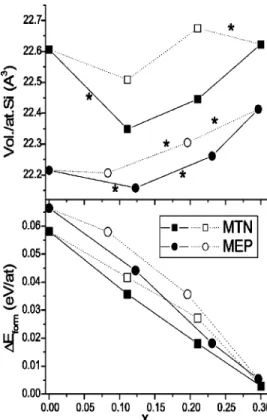
FIG. 2. Plots, against composition parameter x, of data from total energy calculations for Nax/2Si1⫺x/2clathrate structures. Lower part: Energy of
for-mation共from Na0.5Si0.5and diamond Si兲. Upper part: Volume per Si atom. Full symbols: Structures where the small Si20cavities are never occupied by Na before the larger Si24or Si28cavities are fully occupied. Open symbols: Structures where共some兲Si20cavities contain Na while larger cavities are not fully occupied. Each full or dashed line indicates a step in the cavity filling, which is marked共only in the upper figure, for clarity兲with an aster-isk when it implies adding Na to larger cavities.
In these structures, filling only half of the small Si20
cavities in MTN structures implies a decrease in the symme-try to orthorhombic共space group Imma, Nr. 74兲. Filling only half of the larger Si24cavities in MEP also implies a decrease
in symmetry; here the highest possible remaining symmetry, that of the rombohedral group R32 共Nr. 155兲, was chosen from the different possibilities.
These structures were geometry-optimized 共relaxing both cell parameters and atom positions兲by minimizing the energy evaluated with CASTEP, and the total energies of formation of the thus obtained configurations were computed with the improved planewave cutoff and BZ sampling as previously stated. The results are expressed here as the en-ergy change共per atom兲of the hypothetical reaction
共1⫺x兲 Si⫹x Na0.5Si0.5→Nax/2Si1⫺x/2.
Here Si 共in the diamond lattice兲 and the known stable compound NaSi 共with monoclinic structure and eight for-mula units per primitive unit cell41兲 are taken as reference states, taking into account that clathrates are frequently syn-thesized by decomposition of NaSi. In the same way as for the clathrates, these two reference structures were relaxed, and their total energies evaluated at the GGA level. The re-sults are given in Fig. 2, where the energy variation ⌬E of
this reaction is plotted against the composition parameter x. This way of presenting the results has the advantage that a given composition with 0⬍x⬍1 is predicted 共within the method used兲to be stable against disproportionation in two compositions with higher and lower x values if and only if its representative point lies below a straight line connecting the points which represent the two hypothetical decomposition products.
Figure 2 also presents data on the volumes共per Si atom兲 of the resulting structures. One may compare the values computed for the Si and SiNa reference solids and for the fully loaded (Na6Si34 and Na8Si46) and empty Si34
clath-rates: 19.743, 50.144, 22.623, 22.412, and 22.606 Å3, re-spectively, with the corresponding values measured experi-mentally 共at ambient temperature兲: 20.023, 48.796, 23.390
共value30 for Na5.8Si34), 23.058 and 23.084 Å3 共the latter
value29 for Na0.25Si34); no experimental data seem to be
available for the empty Si46共MEP兲clathrate. Except for the
NaSi compound, where a quite different type of bonding sustains the structure, the predicted values are lower than the experimental ones by⬃1.5% – 3%; it is also observed that, for the clathrates, the calculated volumes are higher than those of diamond Si by percentages 共15%–17%兲only a bit higher than the experimentally measured ones 共13.5%– 14.5%兲. A more detailed discussion on the effect of Na filling on the structure volume is given below.
As can be seen in Fig. 2, all ⌬E values obtained are
positive, indicating that the structures would be unstable in comparison to a mixture of pure Si 共diamond phase兲 and NaSi共represented by the two extremes, at x⫽0 and 1, of the
⌬E⫽0 horizontal line兲. However, for the completely filled clathrates (Si46Na8 and Si34Na6) ⌬E is very small 共this
co-incidence between both being probably fortuitous兲, and lies probably within the accuracy limits of the method; one can-not then discard the possibility that van der Waals dispersion
共London兲interactions共i.e., those leading typically to attrac-tive terms of the C/r6kind兲, which are not accounted for by these standard DFT methods, produce an energetic effect which in the case of the clathrates is different to that occur-ring in the case of pure Si and the SiNa compound, so as to lead to a specific stabilization effecting the former.
These results are, therefore, compatible with the experi-mentally observed stability of the completely filled clathrates in comparison with a Si⫹NaSi mixture. In the case of par-tially filled clathrates, the larger⌬E values predict that they
are unstable against decomposition. This does not contradict the experimental results showing that they can be prepared by eliminating thermally Na from the wholly filled struc-tures; the lower temperatures used in this last synthesis step are probably high enough to achieve high mobility of Na atoms within the structure and their equilibration among the different cavities, but insufficient to break the Si–Si covalent bonds and provoke the alteration of the clathrate framework. Thus it is admissible to discuss in connection with the ex-perimental observations the relative stabilities computed for the different locations of Na within one same structure even when the latter is clearly metastable against decomposition in Si共diamond兲and NaSi.
Considering first the extreme situations, one observes that both Na-free clathratelike structures (x⫽0) appear, as expected, as more energetic than Si 共diamond兲, the empty MTN lattice being slightly more stable共by⬃8.5 meV/atom) than the MEP-type one. This coincides with previous DFT evaluations using a local orbital method,3 although the dif-ferences obtained here are a bit smaller. On the other hand, the Na-filled structures are clearly more stable than a mixture of NaSi and the corresponding empty clathrate, indicating that the Na–Si interaction in them is more favorable than that which makes up the NaSi compound. This can be ex-plained by considering that, in this latter, the structure is made up of Si4tetrahedra in which each Si has only threefold
Si–Si connectivity 共with very strained Si–Si–Si angles of 60°) and can be considered to have one lone electron pair
共thanks to the transfer of an electron from Na兲; i.e., the ma-terial can be described as constituted by 关Si4兴4⫺ tetrahedral
units the charge of which is compensated by Na⫹ions. This situation is understandably less favorable than achieving a fourfold Si–Si connectivity of the type present in these clath-rates. A similar trend is observed for the MEP and MTN data leading to the suggestion that, if there were some other clath-ratelike Si lattice having full fourfold connectivity and an intrinsic formation energy similar to that of the MEP and MTN, and which allowed the inclusion of higher proportions of Na in cavities such as those found here, it would probably be formed preferentially. The fact that this has not been ob-served suggests that there is no such structure.
One can also see that the variation in ⌬E with x is,
slope of the graph in the first case. The latter effect would have as consequence that, in any mixture of both clathrates in which the total amount of sodium available is not enough to fill all cavities but can reach equilibrium distribution among them, it would be more favorable 共so long as the proportion between the amounts of both lattices is kept fixed兲 to fill the cavities of the MEP lattice completely and mini-mize the occupation of the small ones 共the majority兲in the MTN component. This agrees with experimental observa-tions made in cases in which both compounds appear simul-taneously during the synthesis.29,30
Going into finer details, one particular effect is observed for structures with only partial filling of the cavities. If one compares the situations in which the larger cavities are filled first 共full symbols兲 with those in which the smaller cavities are filled first 共empty symbols兲, the latter always appears higher in energy. This can be explained assuming that, when the Si20cages are occupied, the some of the Na–Si distances
which appear共3.15 and 3.34 Å for MTN, 3.22 and 3.33 Å for MEP兲 are rather short and lead to some Na–Si repulsion which makes the situation less stable than that in which Na occupies only larger cavities. However, this might not be the main 共or only兲 factor determining the energy difference, since this latter seems to be somewhat larger for the MEP structure in spite of the fact that the Na–Si distances in the small cages are somewhat larger than in MTN as said before. For MTN, the energy difference is computed to be 0.091 eV/Na; this is⬃50% of the value deduced in the literature from an analysis of partial occupancy values determined from experimental x-ray diffraction data.30These differences in cavity filling energies lead to small nonlinearities in the plots of Fig. 2 which imply that structures with the large and small cavities respectively full and empty are the most stable ones against disproportionation; but the differences are small, and might be overridden by thermal effects at the temperatures typically used to prepare the partially Na-loaded materials from the fully Na-loaded ones29,30 共between
⬃620 and 720 K兲. Indeed, it must be recognized that disper-sion interactions 共that as mentioned above cannot be calcu-lated with these methods兲and thermal or entropy effects may introduce energy differences in addition to those computed here; therefore, only the main trends found should be con-sidered reliable.
It is also of interest to examine the variations in cell volume appearing upon the occupation of the cavities by Na. From Fig. 2, which also summarizes these results, it is clear that for both the MEP and MTN structures an initial filling of the larger cavities with Na leads to a decrease in overall cell volume. This qualitatively agrees with some experimental observations29 made for MTN 共although this was not ob-served in other cases30兲, and may be explained as due to electrostatic attraction between the opposite charges of Na and Si atoms resulting from charge transfer 共explained be-low兲. Indeed, the shortest distances between Si atoms and the centers of these large cavities are seen to become shorter by
⬃0.02 Å upon the location of Na in them. Occupation of only the smaller cavities produces a much smaller overall contraction, and indeed it is observed that the Si-cavity cen-ter distances do not decrease, in spite of the fact that the
extent of charge transfer is larger than for larger cavities共see below兲. These results agree with the above hinted at idea that the free room in the smaller ones is a bit too narrow for occupation by Na, so that the Na–Si repulsion resulting from this steric hindrance counteracts the electrostatic attraction. However, the reasons might be not so simple, since Fig. 2 shows that, in general, any cavity filling step leads to lower contraction or higher expansion if it is produced at higher values of x. This indicates that other factors may be at play; one may be, for example, the decreased degree of bonding between Si atoms which will occur when the excess electron density transferred to them populates, to significant extent, the conduction band, the orbitals of which will have mostly antibonding character, so that the Si–Si bonds will become progressively weaker and longer.
C. Electronic structures
1. Band structures and density of states calculations
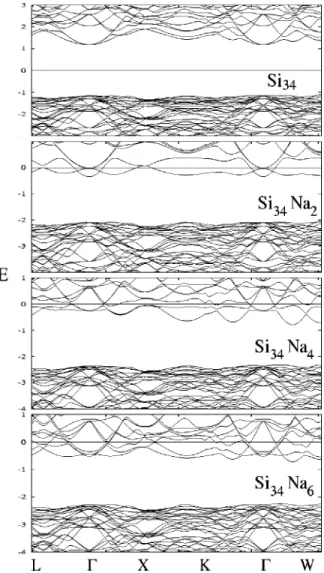
Using the atomic geometries given by the afore men-tioned optimized crystal structures, we have calculated the atomic band structures and its density of states for both the MEP and MTN structures with their cavities filled by Na atoms at different proportions using theSIESTAcode. Calcu-lations were made with DZ-GGA corrections in the zero tem-perature structures. In all structures atomic position param-eters were allowed to relax. Band structures near the band-gap region 共for the minimum energy configuration兲 for different schemes of cavity filling 共only small ones, only large ones of complete filling, besides the Na-free case兲are plotted in Fig. 3 for the MTN structures and in Fig. 4 for the corresponding MEP structures, showing the semiconductor-metal transformation occurring upon Na inclusion for both of them. In these figures, the zero of energy is taken at the Fermi level. Due to the large number of atoms in the unit cells, the two series display a large number of bands and complex electronic band structures. Semiconductor band structures with wide indirect energy band gaps have been calculated for the MEP Si46and MTN Si34structures by
sev-eral groups,3,4,11,12,24 –28most of them using local density ap-proximation共LDA兲approximation, showing band gap values
⬃0.7 eV larger than those computed for crystalline silicon
共i.e., predicting gap values of ⬃1.9 eV). It is well known that the LDA generally underestimates semiconductor band gaps. In our GGA studies we find band gaps of 2.30 eV for both the MEP Si46and the MTN Si34frameworks. In the case of Si34, a minimum indirect gap clearly occurs between the W points at the top of the valence band and the⌫point at the bottom of the conduction band. However, in the case of Si46 the maximum in the valence band appears in the ⌫–X line, although it is difficult to precise it due to the flatness of this band, which has nearly the same energy at the ⌫ and X points. The conduction band minimum is at the same line although closer to the⌫point, giving a nearly direct band for this material.
NaxSi34 have features very close to those of the parent Si46
and Si34, while conduction band structures become modified
共and partially occupied by electrons兲 upon the inclusion of different numbers of guest alkali atoms. The minimum gap for each different compound is also shown in this calculation to be indirect in all cases except in the Na2Si34and Na2Si46
structures, where only two Na atoms completely fill one type of cavity. In all these clathrate compounds the extra electrons
共majority carriers兲coming from the guest共donor兲Na atoms populate the conduction states resulting in metallic behavior as inferred from the crossing of several bands by the Fermi level 共determined by the number of metallic atoms inserted in the different cages兲. Ionic behavior, which would result from complete electron transfer from Na to the conduction band 共originally of Si–Si antibonding character兲 is not pro-duced probably due to the strength of the Si–Si bond. These behaviors are in agreement with the available experimental results about transport properties.20,21
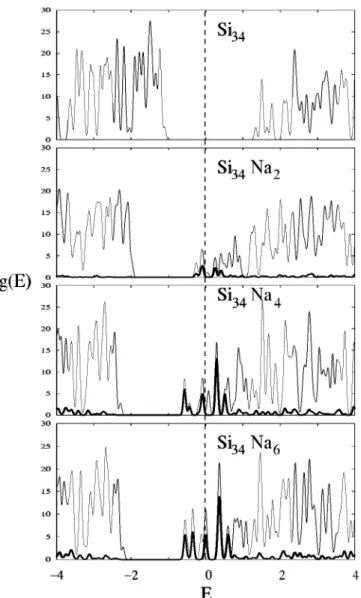
Figures 5 and 6 show density of states 共DOS兲 curves, total and projected on the Na atoms (the latter multiplied by
a factor of three for a best visualization), for the two series
of clathrates. To compute the DOS a peak width for broad-ening the eigenvalues of 0.05 eV has been used in all cases. An analysis of the difference in the electronic properties of the Na filling variations for the two systems can be reached by comparing their electronic density of states. The position of the Fermi levels above the bottom of the conduction band rises with Na content, the distance reaching 0.60 eV in the case of Na8Si46and 0.72 eV in the case of Na6Si34. The gap
between the valence band top and the conduction band bot-tom is, in the case of Na8Si46, 0.79 eV narrower than in the
Na-free Si46host, and, in the case of Na6Si34, 0.77 eV
nar-rower than in Si34. The distributions of partial and total DOS
at the first levels of the conduction bands show a charge
FIG. 3. Electronic band structure for MTN Si clathrate structures with dif-ferent degrees of Na atom cavity filling, using DFT DZ-GGA calculations. The Na2Si34case corresponds to the structure with two Na atoms filling the two larger Si28cavities and Na4Si34to that with four Na atoms in the four Si20cavities. The diagram displays the band positions along several main directions of the first Brillouin zone corresponding to the fcc lattice. Ener-gies are measured in eV and Fermi levels, which are denoted by a horizontal line, have been set as zero of energy.
transfer from Na atoms to the Si skeleton, with both compo-nents contributing to the filled bands as results of some over-lapping between their low lying orbitals. Comparison of the DOS at the Fermi levels shows moderate metallic peaks for both series of clathrates, the number of carriers being a bit lower in the case of NaxSi46. A peak of DOS at the Fermi
level could be observed mainly in NaxSi34, in the two cases
where Na atoms completely fill the small Si20cavities
inde-pendently on the degree of filling of the larger cavities.
2. Mulliken population analysis
The degree of charge transfer occurring between Si and Na upon the inclusion of the latter atom共s兲 in the clathrate structures can be examined through a Mulliken population analysis, which provides values for the degree of occupation of the different atomic orbitals. Of course, Mulliken charges cannot be taken as absolute values, and other electron parti-tioning schemes 共e.g., Hirschfeld or Voronoi charges, Bader analysis charges, etc.兲may be argued as preferable; but the former are the easiest to obtain, and serve at least for
com-parative purposes. In particular, it is instructive to examine the electronic population of the Na s orbitals in this way; since in the isolated Na atoms these orbitals contain exactly one electron each, the lower their occupation number the higher the extent of electron transfer from them to the frame-work.
The results show one clear and simple trend: Whatever the order of filling of the different cavities may be, within each clathrate type the electron population of the Na s orbit-als increases with the decrease in the size of the cavity in which they reside. This fact is also reflected in the Na-projected DOS data obtained for both structures with only one type of cavity filled共Figs. 5 and 6兲. In particular, in the case of the MTN structure the average Na s orbital popula-tions lie around 0.51 (⫾0.015) for atoms in the Si28cavities
and around 0.63 (⫾0.02) for those in the Si20cavities, while
in the MEP case they lie around 0.57 (⫾0.005) for those in the Si24 cavities and around 0.62 (⫾0.02) for those in the
Si20cavities. Thus, according to this analysis it appears that
in each structure the transfer of charge from an occluded Na
FIG. 5. Total density of states and projected density over all Na atoms共the latter displayed as a thick line and multiplied by a factor of three兲for the different MTN structures, using DZ-GGA calculations. Fermi level is dis-played by a broken line. Energies are in eV.
FIG. 6. Total density of states and projected density over all Na atoms共the latter displayed as thick line and multiplied by a factor of three兲for the different MEP structures, using DZ-GGA calculations. Fermi level is dis-played by a broken line. Energies are in eV.
atom to the Si framework is somewhat lower if the number of Si neighbors is lower.
Test calculations for both MTN and MEP structures with 2 Na atoms that completely fill one type of cavity, have been done using also polarization function on all the atoms. Re-sults with these DZP basis, show that in both cases Na atoms are actually less ionic. Also, test calculations with DZP basis show that Na ionicity do not change significantly with the Na mobility inside of the cavity.
D. Mobility of sodium inside the structure cavities
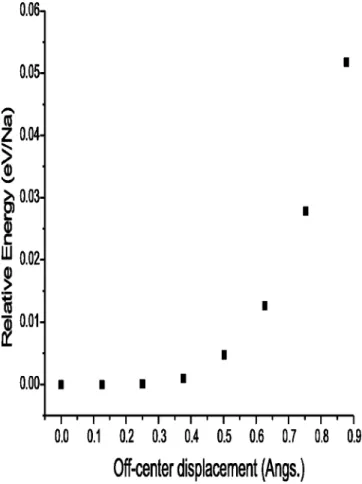
The geometry optimizations performed in order to obtain the relaxed structures used in the above analyses were car-ried out initially keeping the maximal symmetry allowed by the topology of the structure, with any Na atoms present located at the centers of the cavities following the results of the diffraction studies published in the literature.29,30 Tests with decreased 共or completely destroyed兲 symmetry were also made in which the Na atoms were initially more or less displaced from the centers of the cavities, particularly for the larger ones. The energies found with the atoms located at the cavity centers were always the lowest; however, in some cases it was found that only very small energy changes were obtained by subjecting the Na atoms to quite significant dis-placements. This was most remarkable in the case of the MTN structure, when displacing Na from the center of its larger cavities; as an example, Fig. 7 shows the energy changes obtained for this structure, with both large cavities in the primitive cell occupied, when moving the two Na at-oms along one共common兲ternary axis of the respective cavi-ties, while keeping a trigonal symmetry 共rombohedral space group R–3m, Nr. 166兲, so that these atoms approach sym-metrically the six-member ring connecting both cavities关the situation depicted in Fig. 8共a兲兴. A very similar behavior is found when the movement does not imply an approach be-tween neighboring Na atoms关as in the situation given in Fig. 8共b兲兴. Significant movements of Na away from the cavity center would therefore be allowed; for example, a 0.65 Å displacement, reducing the shortest Na–Si distances to val-ues around 3.35 Å, would be possible within an energy in-crease per Na atom lower than the ambient thermal energies (kT⫽0.026 eV at T⫽300 K). It thus seems that the Na at-oms can move rather freely within a large space in these large cavities, which act as an oversized container.
It must be noted that the results do not reveal any spe-cific Na atom-pairing interaction, which if present would probably lead to a net difference in energy between the con-figurations in Figs. 8共a兲and 8共b兲. The flatness of the potential well in Fig. 7 indicates rather that the off-center Na atom displacement is not driven by DFT-addressable electronic ef-fects. The Jahn–Teller or Peierls interaction mechanisms suggested in Ref. 20 are therefore not supported by the present calculations. Concerning the energy rise occurring upon Na–Si approach共displayed in Fig. 7兲, with the present calculation results it is not possible to say whether it reflects interactions additional to the expected Pauli repulsion. The shortest Na–Si distance seemingly achievable (⬃3.3– 3.4 Å) is larger than that between Na⫹ and the
共Si兲44⫺ clusters in the rather ionic NaSi compound 共2.9–3.0 Å兲, indicating a significantly lower Coulomb attraction in agreement with an only partial ionic character of the Na–Si interaction in the clathrates.
One can thus explain the EXAFS results given in the literature20 which indicate the presence in these situations of short Na–Si distances, which would correspond to displace-ments away from the large cavity center as large as 0.9 Å. Here it should be recalled again that these DFT methods are not able to reproduce dispersion interactions; inclusion of these might well lead to the appearance of a distinct mini-mum in the graph in Fig. 7 for displacements of⬃0.7 Å or higher, in agreement with the EXAFS results. In any case, the results of the calculations made here justify the large thermal parameters determined for the Na atoms from the diffraction data of these compounds,29 and agree with the usual assumption that these atoms, being able to rattle largely inside the cavities, lead to large phonon scattering effects which make it possible to achieve a low thermal conductance and consequently important thermoelectric properties.11
The study of similarly displaced locations of the Na at-oms inside the Si24cavities of the MEP structure indicated a
much narrower range for movement; significant Na–Si re-pulsive interactions关at the same level as those corresponding to the situation of Fig. 8共a兲兴 already began to appear for
displacements towards the six-member windows of⬃0.1 Å
关situation depicted in Fig. 8共c兲兴. Note that this occurs for Na–Si distances similar to those appearing in Fig. 8共a兲
共around 3.35 Å兲. It seems unlikely that such small displace-ments may be experimentally detectable with either EXAFS or x-ray diffraction. On the other hand, for the smaller Si20
cavities present in both the MEP and MTN structures such off-center deviations appear as clearly unfavorable; indeed, the calculations summarized in Fig. 7 show repulsions be-tween Na and Si when the distance bebe-tween them in these structures decreases below 3.30 Å. This repulsion most likely determines the previously discussed fact that filling these cavities before the larger ones is unfavorable.
IV. CONCLUSIONS
Filled cage systems like the known MTN and MEP clathrate compounds are interesting for future materials re-search. A comparative study is reported here on clathrates derived from both structures in which the guest sites located at the different cages are partially or fully occupied by Na metal atoms. Using first principles calculations within the
framework of density functional theory, band diagrams, DOS, Mulliken population, relaxed structures and total ener-gies for these compounds are studied to elucidate the effects of the inclusion of Na atoms. We find that the electron popu-lation of Na s orbitals increases共i.e., the degree of electron density transfer to the surrounding Si lattice decreases兲with a decrease in the size of the cavity and also that Na orbitals strongly contribute to the density of states at the Fermi level, especially in the case of the Si34clathrate, and can influence
the properties of the compounds. The experimental crystal cell sizes of the structures, where known, are rather well reproduced, and the completely filled clathrates are predicted to be nearly as stable as a mixture of pure Si共diamond兲and NaSi phases; their real stability, deduced from the experi-mentally proven feasibility of their preparation, might be the result of dispersion interactions and/or vibrational contribu-tions at finite temperatures. On the other hand, the study on the mobility of sodium inside the structures cavities clearly shows that preferential filling of larger cavities 共where large free movement of the Na atom is allowed in the MTN case, explaining experimental EXAFS observations兲 is favored due to Na-Si repulsive interactions appearing for Si–Na dis-tances below⬃3.30 Å.
ACKNOWLEDGMENTS
We want to thank Professor A. Luque for much insight-ful discussion about this work. P.W. and C.T. are grateinsight-ful to the Spanish Plan Nacional de I⫹D program 共Ref. TIC2000-1339-C02-02兲 and the European Commission 共contract ENK6 CT200 00310兲for partial support of this work.
1C. Cros, M. Pouchard, and P. C. Hagenmuller, C. R. Acad. Sci. III 260,
4764共1965兲.
2J. S. Kasper, P. Hagenmuller, M. Pouchard, and C. Cros, Science 150,
1713共1965兲.
3
G. B. Adams, M. O’Keeffe, A. A. Demkov, O. F. Sankey, and Y-M. Huang, Phys. Rev. B 49, 8048共1994兲.
4C. A. Perottoni and J. A. H. da Jornada, J. Phys.: Condens. Matter 13,
5981共2001兲.
5
J. Gryko, P. F. McMillan, R. F. Marzke, G. K. Ramachandran, D. Patton, S. K. Deb, and O. F. Sankey, Phys. Rev. B 62, R7707共2000兲.
6T. Yokoya, A. Fukushima, T. Kiss, K. Kobayashi, S. Shin, K. Moriguchi,
A. Shintani, H. Fukuoka, and S. Yamanaka, Phys. Rev. B 64, 172504 共2001兲.
7
H. Kawaji, H. Horie, H. Yamanaka, and M. Ishikawa, Phys. Rev. Lett. 74, 1427共1995兲.
8A. San-Miguel, P. Ke´ghe´lian, P. Me´linon, Phys. Rev. Lett. 83, 5290
共1999兲.
9
A. San-Miguel, P. Me´linon, D. Connetable, X. Blase, F. Tournus, E. Reny, S. Yamanaka, and J. P. Itie´, Phys. Rev. B 65, 054109共2002兲.
10G. S. Nolas, J. L. Cohn, G. A. Slack, and S. B. Schujman, Appl. Phys.
Lett. 73, 178共1998兲.
11J. S. Tse, K. Uehara, R. Rousseau, A. Ker, C. Ratcliffe, M. A. White, and
G. MacKay, Phys. Rev. Lett. 85, 114共2000兲.
12M. Menon, E. Richter, and K. R. Subbaswamy, Phys. Rev. B 56, 12290
共1997兲.
13This nomenclature is the standard one used for zeolite materials; see W.
M. Meier, D. H. Olson, and Ch. Baerlocher, Atlas of Zeolite Structure Types, 5th revised edition, data accessible through Internet URL http:// www.iza-structure.org/databases,共Elsevier, London, 2001兲.
14P. Wahno´n and C. Tablero, Phys. Rev. B 65, 165115共2002兲. 15C. Tablero and P. Wahno´n, Appl. Phys. Lett. 82, 1, 151共2003兲. 16
J. C. Conesa, J. Phys. Chem. B 106, 3402共2002兲.
17H.-G. von Schnering, M. Schwarz, and R. Nesper, J. Less-Common Met.
137, 297共1988兲. FIG. 8. Schematic pictures of pairs of large cavities in the Na2Si34共
MTN-type兲and Na6Si46共MEP-type兲clathrates, with the Na atoms displaced from
the cavity centers to positions where Na–Si interaction begins to raise the energy by⬃15 meV共picture a corresponds to the point with displacement
⫽0.63 Å in Fig. 7兲.共a兲and共b兲: MTN structures with viz. symmetric and nonsymmetric Na displacements;共c兲: MEP structure共with symmetric dis-placement兲. Some significant Na–Si distance values are highlighted.
18E. Galvani, G. Onida, S. Serra, and G. Benedek, Phys. Rev. Lett. 77, 3573
共1996兲. G. Benedek, M. Bernasconi, and A. Gambirasio, Phys. Status So-lidi B 237, 296共2003兲.
19
J. He, D. D. King, K. Uehara, K. F. Preston, C. Ratcliffe, and J. S. Tse, J. Phys. Chem. B 105, 3475共2001兲.
20F. Brunet, P. Me´linon, A. San Miguel, P. Ke´ghe´lian, A. Pe´rez, A. M. Flank,
E. Reny, C. Cros, and M. Pouchard, Phys. Rev. B 61, 16550共2000兲.
21G. S. Nolas, J. M. Ward, J. Gryko, L. Qiu, and M. A. White, Phys. Rev. B
64, 153201共2001兲.
22E. Reny, M. Me´ne´trier, C. Cros, M. Pouchard, and J. C. Se´ne´gas, Cr. Acad.
Sci., Ser. IIc, 1, 129共1998兲.
23J. Gryko, P. F. McMillan, and O. F. Sankey, Phys. Rev. B 54, 3037共1996兲. 24
P. Me´linon, P. Ke´ghe´lian, X. Blase, J. Le Brusc, A. Pie´rez, E. Reny, C. Cros, and M. Pouchard, Phys. Rev. B 58, 12590共1998兲.
25A. Moewes, E. Z. Zurmaev, J. S. Tse, M. Geshi, M. J. Fergurson, V. A.
Trofimova, and Y. M. Yarmoshenko, Phys. Rev. B 65, 153106共2002兲.
26V. I. Smelyansky and J. S. Tse, Chem. Phys. Lett. 264, 459共1997兲. 27
K. Moriguchi, M. Yonemura, A. Shintani, and S. Yamanaka, Phys. Rev. B 61, 9859共2000兲.
28T. Nagano, K. Tsumuraya, H. Eguchi, and D. J. Singh, Phys. Rev. B 64,
155403共2001兲.
29E. Reny, P. Gravereau, C. Cros, and M. Pouchard, J. Mater. Chem. 8, 2839
共1998兲.
30G. K. Ramachandran, J. Dong, J. Diefenbacher, J. Gryko, R. F. Marzke, O.
F. Sankey, and P. F. MMcillan, J. Solid State Chem. 145, 716共1999兲.
31
SIESTA1.1 User Guide 2001; E. Artacho, D. Sanchez-Portal, P. Ordejo´n, A. Garcı´a, and J. M. Soler, Phys. Status Solidi B 215, 809 共1999兲; D. Sa´nchez-Portal, P. Ordejo´n, E. Artacho, and J. M. Soler, Int. J. Quantum Chem. 65, 453共1997兲.
32
CERIUS2. Quantum Mechanics User Guide共San Diego, MSI, 1998兲.
33J. P. Perdew, K. Burke, and M. Ernzerhof, Phys. Rev. Lett. 77, 3865
共1996兲.
34N. Trouiller and J. L. Martins, Phys. Rev. B 43, 1993共1991兲. 35
L. Kleinman and D. M. Bylander, Phys. Rev. Lett. 48, 1425共1982兲.
36
O. F. Sankey and D. J. Niklewski, Phys. Rev. B 40, 3979共1989兲.
37M. C. Payne, M. P. Teter, D. C. Allan, T. A. Arias, and J. D. Joannopoulos,
Rev. Mod. Phys. 64, 1045共1992兲.
38D. Vanderbilt, Phys. Rev. B 41, 7892共1990兲. 39
J. P. Perdew and Y. Wang, Phys. Rev. B 46, 6671共1992兲; J. A. White and D. M. Bird, ibid. 50, 4954共1994兲.