Suicidal ideation and suicide attempts are important indicators of emotional distress and are identifi ed risk factors for eventual completed suicide. Suicidal ideation represents the early stage of a continuum that begins with low mood and moves to passive death wishes, suicidal thoughts, and plans and acts of self-harm or suicide (Nock et al., 2008). A growing body of research has found that sexual minority individuals are at an increased risk for suicide. In a meta-analytic review, Marshal et al. (2011) found that the odds ratio of the relationship between sexual orientation and suicidality is 2.92, and that 28% of sexual minority individuals
report a history of suicidality as compared to 12% of heterosexual counterparts. King et al. (2008), in a systematic review and meta-analysis, demonstrated that gay and bisexual men have suicidal ideation rates almost twice those of heterosexual individuals.
Determining the association of suicidal behaviors with sexual orientation is challenging because both suicidal behaviors and a sexual minority status are rare, and studies about these issues require very large samples to achieve statistical power (Ploderl et al., 2013). Disparities between sexual minority and heterosexual individuals can be attributed in part to discrimination and victimization experiences that are often consequences of a homophobic context. Different studies (Friedman et al., 2011; Russell, Sinclair, Poteat, & Koenig, 2012) reported that sexual minority individuals with a history of victimization report higher levels of suicidal ideation. Several studies pointed to the minority stress model (Meyer, 2003) to explain the reasons for increased suicide problems among sexual minorities. According to Meyer
ISSN 0214 - 9915 CODEN PSOTEG Copyright © 2014 Psicothema www.psicothema.com
Suicidal ideation in Spanish and Italian lesbian and gay young adults:
The role of internalized sexual stigma
Roberto Baiocco
1, Salvatore Ioverno
1, Rita Cerutti
1, Federica Santamaria
2, Lilybeth Fontanesi
1, Vittorio Lingiardi
1,
Emma Baumgartner
1and Fiorenzo Laghi
11 Sapienza University of Rome and 2 University of Messina
Abstract
Resumen
Background: A growing body of research claims that sexual minority individuals have nearly twice the suicidal ideation rate of heterosexual individuals. Method: The main objective of the current study was to test a model wherein internalized sexual stigma (ISS) mediates the association between some gay-related stressors and suicidal ideation. The present cross-sectional survey involved two samples of lesbian and gay young adults from Spain (N = 209) and Italy (N = 345). The total sample included 316 gay men and 228 lesbian women. Path analysis was used to test the direct and indirect (mediated) effects of the variables from different domains on repulsion by life. Results: In both the Spanish and Italian samples, past victimization experiences and ISS had a signifi cant direct effect on repulsion by life. In both samples, ISS acted as a signifi cant mediator in the effect of the concealment of one’s sexual orientation and the religious involvement of repulsion by life. Conclusion: The current study indicates that ISS is a potential moderator of the effect of concealing one’s sexual orientation, religious involvement, and past experiences of victimization on suicidal attitudes.
Keywords: suicidal ideation, internalized sexual stigma, homophobia, sexual minority, gay men, lesbians.
Ideación suicida de adultos jóvenes lesbianas y gays en España y Italia: el rol del estigma sexual interiorizado. Antecedentes: la literatura científi ca puso de relieve que se encontraron individuos de minorías sexuales que tenían el doble de ideas suicidas que las personas heterosexuales. Método: el objetivo principal del presente estudio fue probar un modelo donde el estigma sexual interiorizado (ISS) midiera la relación entre algunos factores de estrés relacionados con la homosexualidad y las ideas suicidas. El estudio involucró a dos grupos de adultos jóvenes lesbianas y gays de España (N = 209) y de Italia (N = 345). La encuesta total incluyó 316 hombres gays y 228 mujeres lesbianas. Se utilizó el Path Analysis para verifi car los efectos directos e indirectos (mediados) de las variables en repulsión por la vida. Resultados: en ambos grupos, tanto el español como el italiano, las pasadas experiencias de victimización y el ISS tuvieron un efecto signifi cativo en repulsión por la vida. En ambos grupos el ISS actuó como mediador signifi cativo entre el efecto de la ocultación de la orientación sexual y la participación religiosa en relación con la repulsión por la vida. Conclusiones: el presente estudio demostró que el ISS es un moderador potencial en la ocultación de la orientación sexual, la participación religiosa y las experiencias pasadas de la victimización en ideas suicidas.
Palabras clave: ideación suicida, estigma sexual interiorizado, homofobia, minorías sexuales, hombres gays, mujeres lesbianas.
Psicothema 2014, Vol. 26, No. 4, 490-496 doi: 10.7334/psicothema2014.1
Received: January 1, 2014 • Accepted: August 6, 2014 Corresponding author: Roberto Baiocco
Dept. of Social and Developmental Psychology Sapienza University of Rome
00185 Roma (Italia)
(2003), in addition to general stressors, minority-specifi c stressors cause mental health problem, including suicidality. The main minority stressors relevant to sexual minority individuals are (a) external objective events and conditions; (b) expectations of such events and consequent vigilance; (c) concealment of one’s sexual orientation; and (d) internalization of negative attitudes, feelings, and representations toward homosexual orientation that sexual minority individuals experience, even unconsciously, toward themselves as nonheterosexual individuals.
Depending on the theorist, there are several defi nitions to refer to the latter stressors of the minority stress continuum (e.g., internalized homophobia, internalized homonegativity, and internalized sexual stigma). This article uses “internalized sexual stigma” (ISS) (Herek, Gillis, & Cogan, 2009). The term sexual stigma specifi cally refers to a society’s shared belief system of devaluating any nonheterosexual behavior, identity, relationship, or community. The internalization process of the sexual stigma is theorized to lead to confl icts within the individual, which include lowered self-esteem, self-devaluation, and discomfort with the disclosure of their sexual orientation to others (Lingiardi, Baiocco, & Nardelli, 2012; Meyer, 2003).
An important minority stressor to consider when investigating the well-being of sexual minority individuals is also the effect of the concealment of one’s sexual orientation. Concealment is often used as a coping strategy aimed at avoiding real harm, discrimination, and shame, especially in homophobic social environments. However, it can often become an important source of stress (Meyer, 2003), negatively associated with mental health (Pachankis, 2007; Weiss & Hope, 2011). Whereas several studies have documented the benefi ts of disclosure on mental health (Baiocco, Laghi, Di Pomponio, & Nigito, 2012; Pachankis, 2007), other studies have found no association (Kuyper & Fokkema, 2011) or a negative impact (Hershberger, Pilkington, & D’Augelli, 1997).
Another important area of research of the impact of sexual stigma on the well-being of sexual minority individuals concerns institutionalized discrimination (Meyer, 2003). Institutionalized discrimination refers to the discrimination that has been incorporated in laws and public policies. According to Hatzenbuehler et al. (2010), living in a state with discriminatory laws has a negative impact on the mental health of sexual minority individuals.
Institutionalized discrimination can also occur in other types of social institutions, including religion. Often, sexual minority individuals who are strongly devoted to a religious doctrine and consider homosexual orientations as immoral are more likely to live in a state of confl ict and incongruence with their own identity (Harris, Cook, & Kashubeck-West, 2008).
Taken together, these factors suggest that individuals may internalize aspects of society that are adverse to sexual minorities and consequently develop a lower attachment to life.
The main objective of the current study was to evaluate in lesbian and gay young adults the role of ISS on the development of a repulsion by life attitude as a potential predictive factor of suicidal ideation. To examine the complex topic of suicidal ideation, we used the phenomenological framework of suicidal behavior grounded on the premise that suicide evolves due to a basic confl ict among attitudes toward life and death: attraction to life, attraction to death, repulsion by life, and repulsion by death (Orbach, 1988). The balance between these attitudes is assumed to determine a higher or lower risk of suicidal behavior. In the
present study, we considered only the risk attitudes (repulsion by life), leaving out the protective ones (attraction to life, repulsion by death). Indeed, because repulsion by life refl ects the individual experiences of “rejection, receiving destructive messages, isolation, alienation, family disorganizations, internalization of self-destruction” (Orbach et al., 1991, p. 399), it is conceivable that it is strictly related to the internalization process of sexual stigma and may be explained from a minority stress perspective. We also did not include the attraction to death dimension in the analyses because it is too strictly related to religious beliefs. Indeed, it “represents religious convictions or perceptions that death is a superior way of being in the most concrete sense” (Orbach et al., 1991, p. 399).
We chose to include in the analysis models potential stressors relevant to lesbian and gay individuals that contribute to higher levels of ISS and to lower levels of mental health: Experiences of discrimination, low levels of political and religious acceptance of homosexuality in the context of belonging, and the integration of individual and public sexual identity. We studied the role of institutional discrimination on health, comparing two culturally similar Mediterranean countries, Spain and Italy, linked by a strong Catholic tradition but that present substantially different scenarios of civil rights for lesbian and gay individuals. (For example, in Spain, same-sex marriage and adoption by same-sex couples are legal, unlike in Italy.) Therefore, we examined in the Spanish and Italian samples the roles of past experiences of victimization, concealment of one’s sexual orientation, and ISS in the propensity to refuse life as well as the possibility that ISS might mediate the relationship between religious involvement, past experiences of victimization, concealment of sexual orientation, and propensity to refuse life.
Given the differences in Spain and Italy’s legislation on civil rights for sexual minority individuals, we hypothesized that as compared to Spanish gay and lesbian people, more institutional forms of discrimination would affect Italian gay and lesbian individuals—who would, as a consequence, have higher rates of ISS. Moreover, according to previous studies (Herek et al., 2009; Lingiardi et al., 2012), we hypothesized that there are higher levels of ISS in gay participants compared to lesbian ones. Indeed, in contexts where traditional gender ideology is widespread, individuals are expected to assume roles and characteristics associated with their respective biological sex. Because these gender norms are more rigidly prescribed for men (Herek, 2000), gay men who violate traditional masculine norms are more visible targets of discrimination and are more likely to internalize negative feelings about being gay (Baiocco, Nardelli, Pezzuti, & Lingiardi, 2013). Finally, we predicted that ISS would be associated with suicidal ideation and would mediate the associations between the concealment of sexual orientation, religious involvement, and past experiences of victimization with suicidal ideation.
impact and its role as a potential mediator in Spanish and Italian gay and lesbian young adults. Of note, no studies have examined the association between ISS and suicidal ideation in Spain and Italy despite the signifi cant levels of social homophobia (European Commission, 2009). Given that others have found an association between institutionalized discrimination and lower levels of psychological health in sexual minority individuals (Hatzenbuehler et al., 2010; Lingiardi et al., 2012), it is important to deepen the impact of internalization of sexual stigma, especially in cultural contexts in which prejudice and discrimination are widespread (Lingiardi et al., 2012; Baiocco et al., 2010).
Method
Participants
The present cross-sectional survey involved two samples from Spain and Italy. The total sample included 316 gay men (183 from Italy and 133 from Spain) and 228 lesbian women (152 from Italy and 76 from Spain). Participants were between 18- and 35-years-old and Spanish or Italian citizens. The mean age of the entire sample was 26.52 (SD = 6.77). Table 1 provides demographic information disaggregated by gender and nationality. The Kinsey Scale (Kinsey, Pomeroy, & Martin, 1948) was used to assess sexual orientation. Based on this scale, respondents were eligible to participate in the study if they self-identifi ed as predominantly or exclusively homosexual. Among all respondents, participants who declared being Catholic or being raised in a Catholic context were selected. To focus our study on the relationship between sexual minority-related stressors and suicidal ideation, we excluded from analyses participants who reported some variables identifi ed in the literature (Nock et al., 2008) as important risk factors for suicide: a psychiatric history and a history of past attempts of suicide. Participation was completely voluntary, and respondents were not paid for their participation.
Instruments
Internalized Sexual Stigma (ISS). ISS was assessed with the Measure of Internalized Sexual Stigma for Lesbian and Gay (MISS; Lingiardi et al., 2012). The MISS is a 17-item scale assessing three fundamental dimensions of the internalized sexual stigma: (a) identity, the acceptance of one’s own sexual orientation, and the propensity to consider sexual stigma as a part of one’s own identity; (b) social discomfort, the fear of public identifi cation of one’s proper minority sexual status, and the diffi culty of disclosing proper sexual orientation; and (c) sexuality, the pessimistic evaluation of the quality and duration of same-sex relationships, and the negative conception of gay or lesbian sexual behaviors. The MISS showed adequate internal reliabilities in the Italian (Cronbach’s alpha = .88) and Spanish samples (Cronbach’s alpha = .91).
Attitudes toward life and death. The Multi-Attitude Suicide Tendency (MAST; Orbach et al., 1991) scale was used to measure attitude toward life and death. The scale examines four types of confl icting attitudes identifi ed as Attraction to Life, Attraction to Death, Repulsion by Life, and Repulsion by Death. Because suicidal behavior is a complex, multiply determined phenomenon, we focused on testing associations between gay-related stressors and a specifi c aspect of suicidal ideation: Repulsion by Life (RL). Indeed, Hangstrom and Gutiérrez (1998) suggested that high levels of RL increase the likelihood of expressing suicidal ideation and depression. The choice of this subscale was mostly due to the fact that it assesses specifi c experiences—such as pain and stress—that may be identifi ed as risk factors for suicidal ideation and may be explained from a minority stress perspective (e.g., “Sometimes I feel that my problems can’t be solved,” or “Life seems to be one long and diffi cult struggle”). For this reason, RL may be hypothetically related to the construct of internalized sexual stigma.
Although the instrument was validated on adolescent participants, several studies (Gutiérrez, Rodríguez, & García, 2001; Hanstrom & Gutiérrez, 1998; Nahaliel et al., 2014; Payne & Range, 1995) suggested that the MAST scale has a good internal consistency for samples of young adults. Previous studies (Fachinelli, Straniero, Páramo, Fachinelli, & Chacón, 2005; Ioverno, Baiocco, Baumgartner, Laghi. & Pastorelli, 2013; Poggioli, Mancaruso, Costa, Chiodo, & Rigon, 2005) verifi ed the reliability and validity of the MAST in Italy and Spain. In the current study, Cronbach’s alpha in the RL subscale for both the Italian and Spanish samples was 0.71.
Religious involvement. Participants were asked to indicate their religious affi liations and assess their religious involvement using a 10-point Likert-type item (1 = low involvement and 10 = very high involvement).
Concealment of one’s sexual orientation. Participants were asked to indicate the extent to which family members, friends, and members of their social networks were aware of their sexual orientation (Vyncke & Julien, 2008).
Past experiences of victimization. A four-item victimization subscale of the Illinois Bully Scale (Espelage & Holt, 2001) was used to assess the frequency of being picked on, made fun of, called names, and hit or pushed. In the present study, Cronbach’s alpha for the Italian and Spanish samples were good (α = .86 and .88, respectively).
Procedure
Respondents participated in an online survey that took approximately 15 minutes to complete. The instructions stated Table 1
Sample demographics across nationality and gender (n = 544)
Nationality Gay (n = 316)
Lesbian (n = 228)
Total (n = 544) Spanish
Respondents 133 76 209
Age (Range: 18-35) 25.68 (6.86) 25.78 (9.09) 25.72 (7.73) Years of education 14.36 (2.52) 14.18 (2.63) 14.31 (2.55) Occupation
Student Employed Student and employed Unemployed
47.2% 35.4% 13.2% 4.2%
43.9% 31.7% 17.1% 7.3%
46% 34.1% 14.6% 5.3%
Italian
Respondents 183 152 335
Age (Range: 18-35) 27.62 (5.36) 25.71 (4.75) 26.75 (5.17) Years of education 14.98 (2.46) 14.30 (3.32) 14.67 (2.42) Occupation
Student Employed Student and employed Unemployed
38.3% 55.3% 6.4% 0%
42% 45.4% 11.8% 0.8%
40% 50.8%
8.8% 0.4%
that the questionnaire was voluntary and that responses were anonymous and confidential. Both Spanish and Italian samples were obtained through a snowballing sampling design. People were approached through advertising or direct contact and asked to help to identify other recruits. The survey link promoting the project was made available at the universities of Sapienza in Rome and Complutense in Madrid, in gay, lesbian, bisexual, and transgender (GLBT) community centers and districts, and posters and notices in the universities and advertisements on websites. Participation was secured through an informed consent procedure that required active consent from participants. This survey was reviewed and approved by the Ethics Commission of the Department of Developmental and Social Psychology of Sapienza University of Rome (Italy).
Data analysis
The Statistical Package for the Social Science (SPSS 20.0) was used to conduct bivariate and multivariate analyses relating to independent variables. MANCOVA statistical analysis was used to verify gender and nationality differences in the three dimensions of ISS, with age, depression symptomatology, and concealment of one’s sexual orientation included as covariates. Keeping separate data for Spain and Italy, path analysis using Lisrel 8.8 was used to test the direct and indirect (mediated) effects of the variables on RL.
Results
Sex and nationality differences in ISS
The MANCOVA performed on the three dimensions of MISS (identity, social discomfort, and sexuality) revealed a signifi cant effect of sex, Wilks’s λ = .95, F(1, 478) = 8.01, p<.001, η2 = .05, and
an interaction effect of sex and nationality, Wilks’s λ = .98, F(1, 478) = 2.69, p = .04, η2 = .02. No signifi cant effect of nationality
was found, Wilks’s λ = .99, F(1, 478) = .95, p = .42, η2 = .006.
As covariates, depression symptomatology, Wilks’s λ = 0.89, F(1, 478) = 20.21, p<.001, η2 = .11, and concealment of one’s sexual
orientation, Wilks’s λ = 0.71, F(1, 478) = 65.56, p<.001, η2 = .29,
had signifi cant effects, and age was not signifi cant, Wilks’s λ = 0.99, F(1, 478) = 1.567, p = .196, η2 = .01.
Subsequent univariate analyses showed a signifi cant sex main effect on all three dimensions of MISS (sexuality: F(1, 480) = 3.15, p = .002, η2 = .02; identity: F(1, 480) = 11.66, p<.001, η2
= .04; social discomfort: F(1, 480) = 2.53, p = .021, η2 = .02):
Results revealed that lesbian participants reported lower scores in sexuality (M = 1.14, SD = .47), identity (M = 1.45, SD = .65), and social discomfort (M = 1.79, SD = .83) dimensions as compared to gay participants (sexuality: M = 1.32, SD = .69; identity: M = 1.78, SD = .99; social discomfort: M = 1.97, SD = .88).
Univariate results suggested a signifi cant interaction effect of sex and country on the identity dimension, F(1, 541) = 6.53, p = .011, η2 = .01. Contrary to our hypotheses, results from Duncan’s
test revealed that Spanish gay men showed the highest scores on the identity dimension (M = 2.01, SD = 1.11), compared with Spanish lesbians (M = 1.43, SD = .69), Italian lesbians (M
= 1.48, SD = .62), and Italian gay men (M = 1.54, SD = .81).
No signifi cant differences were found among the latter three groups.
Direct and indirect effects of the variables of RL
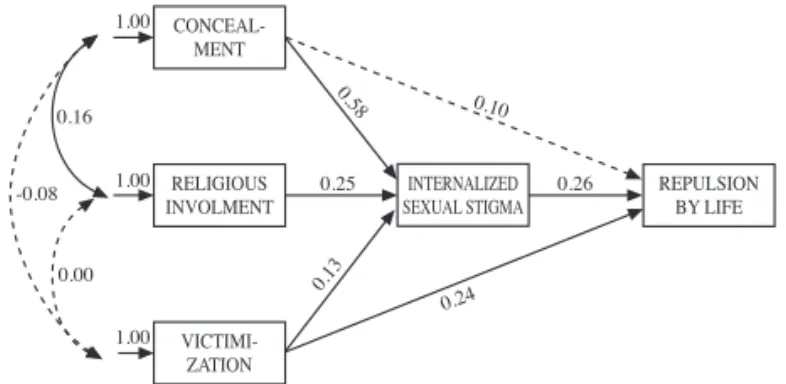
In both the Spanish (Figure 1) and Italian samples (Figure 2), the concealment of one’s sexual orientation and religious involvement had a signifi cant direct effect on ISS.
Only in the Spanish sample did past victimization experiences have a direct effect on ISS. In both samples, past victimization experiences and ISS had a signifi cant direct effect on RL. The Sobel test suggested that ISS acted as a signifi cant mediator on the effect of the concealment of one’s sexual orientation and the religious involvement in RL, both in the Italian and Spanish samples. Only in the Spanish sample were the mediation effects of ISS on past victimization experiences and RL signifi cant. The total effects for past victimization experiences in RL were .27, p<.001. All the fi t indices showed an acceptable model fi t, both for the Spanish (RMSEA = 0.01, CFI = 1, NFI = .99, and NNFI = 1) and Italian samples (RMSEA = .60, CFI = .99, NFI = .98, and NNFI = .88).
Discussion
The current study sought to examine the relative contributions and interrelations among multiple lesbian- and gay-specifi c risk factors and suicidal ideation. Consistent with prior studies
CONCEAL-MENT
RELIGIOUS INVOLMENT
VICTIMI-ZATION
INTERNALIZED SEXUAL STIGMA
REPULSION BY LIFE 1.00
1.00
1.00 0.16
0.00 -0.08
0.10
0.26 0.25
0.58
0.24 0.13
Figure 1. Path analysis model RL: Spanish Sample. Signifi cant paths are represented by solid lines and include completely standardized
path coeffi cients. Non-signifi cant paths are represented by dashed lines.
Signifi cant indirect effects based on the Sobel test: Concealment of one’s
sexual orientation --> ISS --> RL (0.15; t = 3.19; p<.001); Religious Involvement --> ISS --> RL (0.07; t = 2.77; p<.01). Victimization --> ISS --> RL (0.03; t = 2.06; p<.05)
CONCEAL-MENT
RELIGIOUS INVOLMENT
VICTIMI-ZATION
INTERNALIZED SEXUAL STIGMA
REPULSION BY LIFE 1.00
1.00
1.00 -0.04
0.07 -0.06
-0.01
0.37 0.15
0.33
0.19 0.07
Figure 2. Path Analysis model for RL: Italian Sample. Signifi cant paths are represented by solid lines and include completely standardized path
coeffi cients. Non-signifi cant paths are represented by dashed lines.
Signifi cant indirect effects based on the Sobel test: Concealment of one’s
(Herek et al., 2009; Lingiardi et al., 2012), we confi rmed the hypothesis of fi nding a higher level of ISS in gay participants compared to lesbian ones. In the Italian and Spanish contexts, sexism plays a dominant role in the social pressure to conform to heteronormative gender roles. In these contexts, gay men are more visible targets than lesbian women and thus are more ostracized by heteronormative pressures (Herek et al., 2009). However, contrary to our expectations, data revealed that Spanish gay men reported the highest levels of ISS on the identity dimension compared to the other participants. Previous research about the evolution of gay and lesbian policies in Spain led us to propose some explanations. For example, Platero (2007a,b) explained that same-sex marriage in the offi cial debates in Spain have dominated the political agenda on sexual minority issues, marginalizing many other issues, such as homophobia and discrimination, which are still present in the Spanish context. Moreover, social changes in Spain brought about new challenges as same-sex marriage created visibility for LGBT rights. The concrete political demands for LGBT rights could probably make the homophobic attitudes against the most visible targets in the sexual minorities—the gay men—more critical, especially in contexts where traditional gender roles and religious beliefs against homosexual orientation are dominant (Lingiardi et al., 2012). We argued that the achievement of legal rights does not automatically imply the normalization of the LGBT reality. However, to fi ght discrimination, it is necessary to educate people about equality and diversity. In fact, although antidiscrimination laws may increase acceptance of sexual minorities (Hatzenbuehler, 2011), there is overwhelming evidence that even in more-accepting cultures, sexual minorities are still at risk for victimization, depression, suicidality, and substance abuse (Friedman et al., 2011; Marshal et al., 2011).
According to the literature (Hatzenbuehler, 2009; Newcomb & Mustanki, 2010), the hypothesis about a direct effect of ISS on suicidal attitudes was confi rmed. ISS may help explain the differences in suicidal ideation between gay and lesbian individuals and their heterosexual peers. Furthermore, the current study indicated that ISS is a potential moderator of the effect of concealing one’s sexual orientation, religious involvement, and past experiences of victimization on suicidal attitudes. In the current study, concealment of one’s sexual orientation showed only a mediated effect by ISS on RL and not a direct effect. This could contribute to explaining why the most extensive literature about the effect of disclosure of sexual orientation on the mental health of sexual minorities is not unanimous. Indeed, several authors (Baiocco et al., 2012; Meyer, 2003; Weiss & Hope, 2011) suggested that the concealment of one’s sexual orientation can be associated with preoccupation and vigilance, which can lead to negative affective statuses, such as social anxiety and depression. However, the greater social anxiety experienced by sexual minority people can be confounded by the fact that their fears may be considered reasonable, perhaps even adaptive, given the societal sexual prejudice they may encounter.
Based on our fi ndings, we argued that lower levels of self-disclosure are not a risk factor per se, but if the concealment of one’s sexual orientation is related to a higher degree of worry related to sexual orientation because of ISS, it may be considered highly salient to several aspects of one’s overall attitude toward life. It may lead to a lower degree of satisfaction with life due to the reduced intimacy in relationships and a lower social support against homonegativity from signifi cant others.
Regarding the impact of religious involvement, the results of the present study suggested that religion potentially plays an important role for gay and lesbian persons in terms of attitudes toward life. In literature (Gearing & Lizardi, 2009), religiosity, especially Catholicism and Judaism, is identifi ed as a protective factor for suicidal ideation as it is a potential supporter of cultural sanctions about the acceptability of suicide. However, differences have been documented based on sexual orientation. With fair consistency in the literature (Sherry, Adelman, Whilde, & Quick, 2010), the results suggested that religiosity was associated with increased internal sexual stigma. Negative messages perceived by gay and lesbian persons coming from religious institutions may create an internal confl ict among existential needs. From the results, it seems likely that Catholic participants with a high religious involvement may internalize messages condemning their sexual orientation, creating a greater risk for negative attitudes toward life. Indeed, in the present study, religious involvement mediated by ISS can lead to a high RL.
Finally, consistent with previous research (Friedman et al., 2011; Russel et al., 2012), our results support the connection between victimization and suicidal ideation. Past experiences of victimization at school increased the degree of ISS in the Spanish participants but not in the Italian ones. This difference led us to think that there is a difference in sensitivity and the nature of bullying in each country, which is probably related to educational campaigns (Smith et al., 2002). Depending on the country, students associate different meanings to episodes of bullying. In order to understand this difference, it is necessary to unpack the contents of the culture and the specifi c psychological processes that differ across cultures. However, in both samples, past victimization had a direct effect on RL. The mediator effect of ISS on suicidal attitudes found in the Spanish participants is consistent with previous studies (Feinstein et al., 2012), where internalized homonegativity mediates the relationship between homophobic bullying and depression, suggesting that by experiencing homophobic victimization, gay and lesbian persons develop negative feelings about their identity and learn to expect rejection, which can lead to a higher risk of suicidality.
This study is not without limitations. First, not all sexual minority subgroups were considered in the research: gay, lesbian, bisexual, and transgender persons experience different levels of risk of suicide (Haas et al., 2011). Thus, it is important to look at the differences. Second, snowball recruitment could have differentially affected the associated variables to attitude toward life and death. Third, the surveys focused on specifi c urban areas of the capitals of Rome and Madrid and might not be generalizable to all suburban areas or all regions of Italy and Spain. Forth, the relation to suicidal ideation of only a limited number of variables was tested. Personality factors, social support, satisfaction with life, purpose in life, and cognitive processes (like cognitive rigidity, cognitive deconstruction, and hopelessness) were not examined, although these variables have been shown to be signifi cantly associated with suicidal ideation (Baumesteir, 1990; Heisel & Flett, 2004; Nock et al., 2008; Nock & Kazdin, 2003).
important consideration for clinicians and health professionals working with sexual minorities. Furthermore, taking into account the moderator variable of ISS can help the design of future studies to analyze the effects of risk factors for suicide in sexual minorities.
Additionally, the present research suggests potentially important implications for health professionals working with nondisclosing lesbian or gay people (Rosario, Schrimshaw, & Hunter, 2009). The fi nding that concealment is indirectly associated with suicidal ideation by way of greater ISS may suggest that the risk for suicide in nondisclosing gay and lesbian persons may be facilitated by
helping them to accept themselves, reduce the hypervigilance associated with the fear of being identifi ed as gay or lesbian, and realistically assess the consequences of disclosure to family or friends. Future research would be benefi cial to understand the relationship between ISS and disclosure on how concealment can be considered a risk for suicidal ideation.
Promoting accepting environments is necessary to improve the adjustment of sexual minorities. Therefore, it is important to work to educate teachers and other school personnel in creating supportive and welcoming environments where homophobic victimization is not tolerated.
References
Baiocco, R., Ioverno, S., Lonigro, A., Baumgartner, E., & Laghi, F. (2014). Suicidal ideation among Italian and Spanish young adults: The role of sexual orientation. Archives of Suicide Research: Offi cial Journal of
the International Academy for Suicide Research (May 2014), 37-41. d
oi:10.1080/13811118.2013.833150
Baiocco, R., Laghi, F., Pomponio, I.D., & Nigito, C.S. (2012). Self-disclosure to the best friend: Friendship quality and internalized sexual stigma in Italian lesbian and gay adolescents. Journal of Adolescence, 35, 381-387. Baiocco, R., Nardelli, N., Pezzuti, L., & Lingiardi, V. (2013). Attitudes of
Italian heterosexual older adults towards lesbian and gay parenting.
Sexuality Research and Social Policy, 10, 285-292.
Baumeister, R.F. (1990). Suicide as escape from self. Psychological
Review, 97, 90-113.
Espelage, D.L., & Holt, M.K. (2001). Bullying and victimization during early adolescence: Peer infl uences and psychosocial correlates.
Journal of Emotional Abuse, 2, 123-141.
European Commission (2009). Special Eurobarometer 317. Discrimination in the EU in 2009. European Commission. Retrieved from http:// ec.europa.eu/public_opinion/archives/ebs/ebs_317_en.pdf.
Fachinelli, C., Straniero, C., Páramo, M.A., Fachinelli, J., & Chacón, C. (2005). Diferencias de género en actitudes hacia la vida y la muerte y sucesos vitales estresantes en adolescentes según riesgo de suicidio.
Revista de Psicopatología y Salud Mental del Niño y del Adolescente,
1, 63-72.
Feinstein, B.A., Goldfried, M.R., & Davila, J. (2012). The relationship between experiences of discrimination and mental health among lesbians and gay men: An examination of internalized homonegativity and rejection sensitivity as potential mechanisms. Journal of
Consulting and Clinical Psychology, 80, 917-927.
Friedman, M.S., Marshal, M.P., Guadamuz, T.E., Wei, C., Wong, C.F., Saewyc, E.M., & Stall, R. (2011). A metaanalysis of disparities in childhood sexual abuse, parental physical abuse, and peer victimization among sexual minority and sexual nonminority individuals. American
Journal of Public Health, 101, 1481-1494.
Gearing, E.R., & Lizardi, D. (2009). Religion and suicide. Journal of
Religion and Health, 48, 332-341.
Gutiérrez, P.M., Rodríguez, P.J., & García, P. (2001). Suicide risk factors for young adults: Testing a model across ethnicities. Death Studies,
25, 319-340.
Haas, A., Eliason, M., Mays, V., Mathy, R., Cochran, S., D’Angelli, A., & Clayton, P. (2011). Suicide and suicide risk in lesbian, gay, bisexual, and transgender populations: Review and recommendations. Journal
of Homosexuality, 58, 10-51.
Hagstrom, A.H., & Gutiérrez, P.M. (1998). Confi rmatory factor analysis of the Multi-Attitude Suicidal Tendency Scale. Journal of
Psychopathologyand Behavioral Assessment, 20, 173-186.
Harris, J. I., Cook, S.W., & Kashubeck-West, S. (2008). Religious attitudes, internalized homophobia, and identity in gay and lesbian adults.
Journal of Gay and Lesbian Mental Health, 12, 205-225.
Hatzenbuehler, M. (2009). How does sexual minority stigma “get under the skin”? A psychological mediation framework. Psychological
Bulletin, 135, 707-730.
Hatzenbuehler, M.L. (2011). The social environment and suicide attempts in lesbian, gay, and bisexual youth. Pediatrics, 127, 896-903.
Hatzenbuehler, M.L., McLaughlin, K.A., Keyes, K.M., & Hasin, D.S. (2010). The impact of institutional discrimination on psychiatric disorders in lesbian, gay and bisexual populations: A prospective study. American Journal of Public Health, 100, 452-459.
Heisel, M.J. , & Flett , G.L. ( 2004 ). Purpose in life, satisfaction with life and suicide ideation in a clinical sample. Journal of Psychopathology
and Behavioral Assessment, 26, 127-135.
Herek, G.M. (2000). The psychology of sexual prejudice. Current
Directions in Psychological Science, 9, 19-22.
Herek, G.M., Gillis, J.R, & Cogan, J.C. (2009). Internalized stigma among sexual minority adults: Insights from a social psychological perspective. Journal of Counseling Psychology, 56, 32-43.
Hershberger, S.L., Pilkington, N.W., & D’Augelli, A.R. (1997). Predictors of suicide attempts among gay, lesbian, and bisexual youth. Journal of
Adolescent Research, 12, 477-497.
Ioverno, S., Baiocco, R., Baumgartner, E., Laghi, F. & Pastorelli, C. (2013). Suicidal ideation and internalized sexual stigma in an Italian and Spanish sample. Psychology, Community & Health, 2, 259-303. King, M., Semlyen, J., Tai, S.S., Killaspy, H., Osborn, D., Popelyuk,
D., et al. (2008). A systematic review of mental disorder, suicide, and deliberate self harm in lesbian, gay, and bisexual people. BMC
Psychiatry, 8: 70.
Kinsey, A.C., Pomeroy, W.B., & Martin, C.E. (1948). Sexual behavior in
the human male. Philadelphia: W.B. Saunders.
Kuyper, L., & Fokkema, T. (2011). Minority stress and mental health among Dutch LGBs: Examination of differences between sex and sexual orientation. Journal of Counseling Psychology, 58, 222-233. Lingiardi, V., Baiocco, R., & Nardelli, N. (2012). Measure of internalized
sexual stigma for lesbians and gay men: A new scale. Journal of
Homosexuality, 59, 1191-1210.
Marshal, M.P., Dietz, L.J., Friedman, M.S., Stall, R., Smith, H.A., McGinley, J., …, Brent, D.A. (2011). Suicidality and depression disparities between sexual minority and heterosexual youth: A meta-analytic review. Journal of Adolescent Health, 49, 115-123.
Meyer, I.H. (2003). Prejudice, social stress, and mental health in lesbian, gay, and bisexual population: Conceptual issue and research evidence.
Psychological Bulletin, 5, 674-697.
Nahaliel, S., Sommerfeld, E., Orbach, I., Weller, A., Apter, A., & Zalsman, G. (2014). Mental pain as a mediator of suicidal tendency: A path analysis. Comprehensive Psychiatry, 55, 944-951.
Newcomb, M.E., & Mustanski, B. (2010). Internalized homophobia and internalizing mental health problems: A metaanalytic review. Clinical
Psychology Review, 30, 1019-1029.
Nock, M.K., & Kazdin, A.E. (2002). Examination of affective, cognitive, and behavioral factors and suicide-related outcomes in children and young adolescents. Journal of Clinical Child & Adolescent
Psychology, 1, 48-58.
Orbach, I. (1988). Children who don’t want to live. San Francisco: Jossey-Bass.
Orbach, I., Milstein, I., Har-Even, D., Apter, A., Tyano, S., & Elizur, A. (1991). A multi-attitude suicide tendency scale for adolescents.
Psychological Assessment: A Journal of Consulting and Clinical
Psychology, 3, 398-404.
Pachankis, J.E. (2007). The psychological implications of concealing a stigma: A cognitive-affective-behavioral model. Psychological
Bulletin, 133, 328-345.
Payne, B.J., & Range, L.M. (1995). Attitudes toward life and death and suicidality in young adults. Death Studies, 19, 559-569.
Platero, R. (2007a). Love and the state: Gay marriage in Spain. Feminist
Legal Studies, 15, 329-340.
Platero, R. (2007b). Overcoming brides and grooms. The representation of lesbian and gay rights in Spain. In Multipel Meanings of Gender Equality:
A Critical Frame Analysis of Gender Policies in Europe, edited by Mieke
verloo, 207-232. Budapest: Central European University Press. Plöderl, M., Wagenmakers, E.J., Tremblay, P., Ramsay, R., Kralovec, K.,
Fartacek, C.R. (2013). Suicide risk and sexual orientation: A critical review.
Poggioli, D.G., Mancaruso, A., Costa, S., Chiodo, S., & Rigon, G. (2008). Tentato suicidio in età evolutiva: intervento clinico, strumenti di
valutazione e analisi dei fattori di rischio. Psichiatria dell’Infanzia e
dell’Adolescenza, 1, 113-135.
Rosario, M., Schrimshaw, E.W., & Hunter, J. (2009). Disclosure of sexual orientation and subsequent substance use and abuse among lesbian, gay, and bisexual youths: Critical role of disclosure reactions. Psychology
of Addictive Behaviors, 23, 175-184.
Russell, S.T., Sinclair, K.O., Poteat, V.P., & Koenig, B. (2012). Adolescent health and harassment based on discriminatory bias. American
Journal of Public Health, 102, 493-495.
Sherry, A., Adelman, A., Whilde, M.R., & Quick, D. (2010). Competing selves: Negotiating the intersection of spiritual and sexual identities.
Professional Psychology: Research and Practice, 41, 112-119.
Smith, P.K., Cowie, H., Olafsson, R., & Liefooghe, A.P.D. (2002). Defi nitions of bullying: A comparison of terms used, and age and sex differences, in a 14-country international comparison. Child
Development, 73, 1119-1133.
Vyncke, J.D., & Julien, D. (2008). Social support, coming out, and adjustment of lesbian mothers in Canada and France. Journal of GLBT
Family Studies, 3, 397-424.