Article
E
ff
ects of pH Conditions and Application Rates of
Commercial Humic Substances on Cu and Zn
Mobility in Anthropogenic Mine Soils
Javier Pérez-Esteban1,* , Consuelo Escolástico1, Inés Sanchis2, Alberto Masaguer2
and Ana Moliner2
1 Department of Organic and Bio-Organic Chemistry, Sciences Faculty, Universidad Nacional de Educación
a Distancia, Paseo de Senda del Rey 9, 28040 Madrid, Spain
2 Soil Science Unit, Department of Agrarian Production, Agricultural Engineering School, Universidad
Politécnica de Madrid, Avenida Puerta de Hierro 2, 28040 Madrid, Spain
* Correspondence: [email protected]; Tel.:+34-91-398-7321
Received: 18 July 2019; Accepted: 30 August 2019; Published: 5 September 2019
Abstract:We studied the effects of commercial humic substances derived from leonardite at different
rates (0, 0.25, 2, 10 g kg−1) and pH (4.5, 6.0, 8.0) on Cu and Zn mobility, to evaluate their use
for remediation of metal contaminated mine soils and to optimize their application conditions. We conducted a single-step extraction experiment and analyzed extracts for metal concentrations,
soluble organic carbon and their E4/E6 ratio (ratio of absorption at 465 to 665 nm). Metal speciation
in a soil solution was simulated by the non-ideal competitive adsorption-Donnan (NICA-Donnan) model. Increasing the amount of humic substances and the pH caused higher release rates of
soluble organic carbon with a lower humic/fulvic acids ratio. This led to a higher mobility of metals
(up to 110 times Cu concentration in control and 12 times for Zn) due to the formation of soluble metal-humic complexes. Speciation modeling predicted that increasing rates of humic substances would result in a higher proportion of Cu and Zn associated with fulvic acids, more mobile than
the humic acids fraction. Application of commercial leonardite humic substances at 2–10 g kg−1
and with pH levels similar to or below natural soil could be useful for assisted-phytoextraction of contaminated anthropogenic soils. High rates of humic substances in more alkaline conditions could entail a considerable risk of metal leaching to groundwater, toxicity and transfer to the trophic chain.
Keywords: copper; fulvic acid; humic acid; leonardite; metal mobility; soluble organic carbon; zinc
1. Introduction
Human activities, such as metal mining, are important sources of soil contamination by heavy metals [1–3]. Soils from mine spoils not only contain high levels of toxic metals, but also have poor physical properties, high acidity and low nutrient content [4,5].
Appropriate soil management techniques should be applied to remediate anthropogenic mine soils in order to reduce bioavailability and dispersion of metals and to limit the exposure for humans and other organisms [4–6]. The high concentrations of metals and the poor conditions of these soils limit plant growth and the application of phytoremediation strategies, such as assisted-phytoextraction. Nevertheless, the use of organic amendments can improve the physical and chemical properties of these soils, reduce metal toxicity and enhance plant growth [2–7].
The addition of organic amendments with high soluble organic matter contents could increase metal mobility through the formation of soluble metal-organic complexes [6,8,9], which can enhance
metal uptake by plants improving the efficiency of assisted-phytoextraction techniques. However,
an excessive increase in metal mobility could result in a high risk of metal leaching and consequent
groundwater contamination [6,7] and/or accumulation in plant shoots increasing the transfer of metals
to the trophic chain [10].
Humic substances are natural organic amendments that have been widely used in agriculture, as they improve plant growth and mineral nutrition, increase the organic matter content and cation exchange capacity of soils, and facilitate the formation of macroaggregates in mine tailings [8]. Humic
substances can be differentiated into three main fractions by their solubility in acid or alkali: humic
acid, soluble in alkali solutions but insoluble in acid; fulvic acid, soluble in both acid and alkali; and humin, insoluble in both solutions [9,11]. Humic and fulvic acids possess similar structures, but have
different molecular weights and contents in functional groups; humic acids have higher molecular
weight and less oxygen-containing functional groups than fulvic acids [9]. These chemical differences
make humic acids less soluble than fulvic acids, decreasing their solubility at higher polyvalent cation contents, and lower pH due to aggregation of humic molecules themselves by cation bridging and their adsorption onto soil particles by reduced electrostatic repulsion [12–15]. Humic and fulvic acids present in humic substances contain a great variety of functional groups that are very active adsorption sites—especially carboxyl and phenolic OH (acidic groups)—and have strong complexation ability with metal ions [8,9,11,16]. Thus, humic and fulvic acids may increase metal mobilization in soils by the formation of soluble metal-humic complexes, which depends on the nature and properties of these humic substances, their interaction with soil components, ionic strength, content of metals and other cations, and pH [3,8,9]. This makes humic substances promising amendments for the improvement of assisted-phytoextraction, but the conditions of their application should be studied to maximize their efficiency while avoiding metal leaching.
There are several available commercial humic products, commonly found as soil amendments or growing media improvers in agriculture, whose use in field applications is more feasible than those purified humic substances extracted in the laboratory from soils, water, compost, peat or coal. Among these commercial products, leonardite humic substances are mainly composed of humic and fulvic acids extracted with KOH from leonardite—an oxidized form of lignite coal.
In our previous work [17], we evaluated the use of a commercial humic product derived from American leonardite in combination with metal-tolerant plants (vetiver grass) for the phytoremediation of anthropogenic mine soils through pot experiments. In that study, we reported that humic substances
exhibited different behaviors depending on the soil. In soils with relatively low concentrations of
metals, humic substances increased the uptake of metals by plants and their accumulation in roots due to the promotion of metal mobilization by the formation of soluble metal-organic complexes. In contrast, in other soils with considerably higher metal concentrations and lower pH, there was a low uptake of metals with high rates of humic substances due to metal immobilization by cation bridging between humic molecules that could have induced the aggregation of metal-organic complexes, as well as by the reduced solubility of organic matter at low pH. As well, other works have studied the
effects of humic substances on metal mobility and their uptake by plants. Most of these works have
reported that the addition of humic substances increased the release of metals to the soil solution and promoted their uptake and accumulation in plants by the formation of soluble complexes, although their
effects depended on the concentrations of humic compounds, pH and the metals involved [6,9,11,18].
Conversely, other studies have observed decreasing mobility of metals and accumulation in roots, but increasing translocation to shoots with high rates of humic substances [16]. Thus, it is necessary in this study to find out the optimal conditions, such as pH or application rates, at which these humic substances should be applied to contaminated soils without the risk of metal leaching or transfer to the trophic chain, as well as to elucidate the dynamics of metals in the soil solution.
In this study we aimed to investigate the effects of these commercial leonardite humic substances
on Cu and Zn mobility in an anthropogenic mine soil at different application rates and pH conditions
simulated to examine their complexation with the soluble organic matter, in order to provide more information about metal mobility in relation to these humic substances.
2. Materials and Methods
2.1. Soil Samples and Commercial Humic Substances
In this study we selected a contaminated anthropogenic soil from a mining site in northwest Madrid (Central Spain). At this site, there is an abandoned copper mine which was exploited until 1909. The main minerals present in this mine are chalcopyrite (CuFeS2) and arsenopyrite (FeAsS), although others like malachite (Cu2CO3(OH)2), azurite (Cu3(CO3)2(OH)2), siderite (FeCO3), fluorite (CaF2), olivenite (Cu2AsO4OH) or chalcanthite (CuSO4·5H2O) were also found [19]. Before the closure of the mine the reserves of chalcopyrite were estimated at one million tons, with a copper content about 10% [20].
Soil samples were collected from the top 20 cm of soil at several points within the mine dumps. These samples consisted of mine tailings with no defined horizons. Samples were homogenized,
air-dried and sieved to<2 mm before analyses and experimental procedure.
A solid humic substances (HS) product derived from American leonardite was used for this study, which was provided by a commercial supplier. This organic product consisted of a soluble black fine powder obtained from the extraction of natural humic substances from leonardite with KOH, and which is usually used as soil amendment or growing media improver. The rates of this humic
product recommended by the commercial supplier for agricultural application are about 12–16 kg ha−1
(0.005–0.007 g kg−1of soil calculated for 20 cm depth and soil density of 1.2 g cm−3).
2.2. Single-Step Extraction Procedure
A single-step extraction experiment was performed to evaluate the effects of the commercial
humic substances on Cu and Zn mobilization in the contaminated soil at different rates and under
different pH conditions. The experiment was conducted using a relatively high soil/solution ratio to
simulate the addition of humic substances to soil with rain or irrigation water.
The study was conducted in triplicate in 40 mL centrifuge tubes adding 20 mL of extracting solution to 10 g of contaminated soil sample. This extracting solution contained the commercial humic
substances dissolved in deionized water at different concentrations: 0 g kg−1of soil (control, HS0),
0.5 g kg−1(HS0.5), 2 g kg−1(HS2) and 10 g kg−1(HS10). Although these rates are considerably higher than those recommended by the commercial supplier, they were feasible for assisted-phytoextraction purposes in comparison with other expensive decontamination techniques. The humic substances solution was previously adjusted to different pH values: 4.5, 6.0 (natural soil pH) and 8.0 using diluted
HCl and KOH solutions (as described inÁlvarez-Puebla et al. [21]). After the addition of the humic
substances solution, tubes were shaken for 24 h at room temperature, centrifuged for 10 min at 6650×g,
and decanted.
Extracts were analyzed for pH, electrical conductivity (EC), metal concentrations (Cu, Zn, Cd and
Pb), water soluble organic carbon content (WSOC), and ratio of absorption at 465 to 665 nm (E4/E6) as
an estimation of the humic/fulvic acids ratio in the soil solution. Concentrations of Cd and Pb were
below the detection limits, due to the low Cd content of this soil and the low mobility of Pb meaning
they were insufficiently extracted by the humic solution, and therefore they were not included in
this study.
2.3. Chemical Speciation Modeling
The chemical speciation of metals in the extracts was simulated using Visual Minteq 3.1 [22] to predict the formation in the soil solution of complexes between metals and soluble humic substances
NICA-Donnan model [25] was used for the simulation, which models the binding of metals to humic substances by two types of sites—carboxylic (“weak”) and phenolic (“strong”).
The inputs used for the model were the pH values, Cu and Zn concentrations and WSOC measured in the extracts obtained from the single-step extraction experiment.
The model was calculated using the equilibrium constants for inorganic aqueous complexes from the default Visual Minteq thermodynamic database derived by Smith et al. [26]. The generic parameters and constants for humic and fulvic acids in the aqueous phase from Milne et al. [27] were used for the model.
Soluble organic matter present in the extracts was assumed to contain 59% organic carbon (calculated from organic carbon content and total humic extract). The proportion of humic acid was assumed to be 81.5% of the soluble organic matter, and fulvic acid was assumed to be 18.5%, according to the humic and fulvic acid content of the commercial humic product from the data provided by the
supplier (Table1). Data sets were calculated considering the solution in equilibrium with atmospheric
CO2(3.8×10⁻⁴
atm). The temperature was set to 25◦C. The Davies method for activity correction was
selected, and oversaturated solutions were not allowed to precipitate. Surface complexation with solid particles was not considered.
2.4. Analytical Methods
Oxidizable organic carbon was determined in the soil sample by a modified Walkley-Black procedure [28]. Electrical conductivity (for soil and commercial humic substances) and pH were
analyzed in deionized water extracts (1:2.5w/v). The Bouyoucos hydrometer method was used for
the determination of particle size distribution [29]. Data concerning the properties of the commercial humic product were provided by the commercial supplier, except EC.
Table 1.Characteristics of the anthropogenic mine soil and commercial humic substances (HS).
Properties Soil HS
Clay (%w/w) 7 nd
Silt (%) 14 nd
Sand (%) 79 nd
pH (H2O 1/2.5w/v) 5.9 11.2 EC (dS m−1H2O 1/2.5w/v) 0.05 58.4
OC (%w/w) 0.3 38.6
Humic acids (%w/w) nd 53 Fulvic acids (%w/w) nd 12 Solubility (g L−1) nd 100
K2O (%w/w) nd 17
Cu 1+2+3 (mg kg−1) 660 nd Zn 1+2+3 (mg kg−1) 6.3 nd Total Cu (mg kg−1) 2838 9 Total Zn (mg kg−1) 240 119 Total Cd (mg kg−1) 3.2 dl
Total Pb (mg kg−1) 127 4
EC, electrical conductivity; OC, organic carbon; Cu and Zn 1+2+3, sum of the first three most labile fractions (water-soluble+exchangeable+acid-soluble) by procedure of Tessier et al. [30]; nd, not determined; dl, below detection limits (Cd<0.02 mg L−1
in the extracts). Data of HS provided by the commercial supplier, except EC and metal concentrations.
Total metal concentrations (Cu, Zn, Cd and Pb) in the soil and commercial humic product
were determined by microwave-assisted acid digestion withaqua regiaand analyzed by inductively
the extracts were also measured but were in most cases below the detection limits (<0.02 mg L−1for Cd and<0.2 mg L−1for Pb).
The concentration of WSOC was determined by digestion in a microwave oven with potassium dichromate and sulphuric acid—a modified version of the method used by Islam and Weil [31].
A 5 mL-aliquot of extracts from treatments with 0 and 0.5 g kg−1of humic substances (HS0 and HS0.5)
was placed in a Teflon vessel with 0.5 mL of 0.5M Cr2O7K2and 4 mL of concentrated H2SO4(96%). For
samples with 2 and 10 g kg−1of humic substances (HS2 and HS10), a 2 mL-aliquot from the extracts
was placed in the Teflon vessel with 2 mL of 0.5M Cr2O7K2and 4 mL of concentrated H2SO4. Solutions
were heated in the microwave oven for 15 min at 135◦C, cooled and made up to 10 mL with deionized
water. A spectrophotometric method was used to measure the concentration of Cr3+produced by the
reduction of Cr6+(λ=590 nm; UV-1203 spectrophotometer, Shimadzu, Japan) and the organic carbon
content was determined using a calibration curve prepared with glucose standards [32,33].
The extracts were directly analyzed using UV-Vis spectroscopy (UV-1203 spectrophotometer,
Shimadzu) at 465 and 665 nm. The E4/E6 was calculated as the ratio of both absorbances [34].
All analyses were performed in triplicate. Results were adjusted for oven-dry (overnight at 105◦C)
weight of sample. All reagents used for this work were of analytical grade or better. Standard solutions
used for calibration were obtained from 1000 mg L−1stock standard (CertiPUR standards, Merck,
Germany). All dilutions were prepared with deionized water. Plastic and glassware were soaked in
5% HNO3solution overnight and rinsed with distilled water prior to use.
2.5. Statistical Analyses
Statistical analyses of data were performed using SPSS 23.0 software (SPSS Inc., Chicago, IL, USA).
Statistical differences in means between different treatments (rates of commercial humic substances)
and between different adjusted pH were determined by two-way analysis of variance (ANOVA) tests.
Simple effects of each factor at each level of the other factor were analyzed when appropriate through
one-way ANOVA followed by Tukey’s honestly significant difference (HSD) test (p<0.05). Pearson’s
correlation coefficients (r) were used to determine relationships between different parameters.
3. Results and Discussion
3.1. Characteristics of the Contaminated Soil and Commercial Humic Substances
The main characteristics of the contaminated soil used for this study are showed in Table1.
This soil had a sandy texture and exhibited an acidic pH, low EC and low organic matter content. This soil contained a high total concentration of Cu, which considerably exceeded the guideline value
(150 mg kg−1) suggested by Toth et al. [35] for potentially contaminated soils in non-industrial areas,
defined on the basis of ecological or health risks. The total concentration of Zn was also relatively
high, although slightly lower than the guideline value (250 mg kg−1). In contrast, soil Cd and Pb total
concentrations were considerably lower than these guideline values (10 mg kg−1of Cd and 200 mg kg−1
of Pb).
The characteristics of the commercial humic substances are also shown in Table1(data provided
by the supplier), with a great solubility, high salinity, a high content in K, a very alkaline pH and a great content in humic and fulvic acids. The commercial humic product exhibited low metal concentrations, in all cases lower than those in the studied soil.
3.2. Effects of the Addition of Commercial Humic Substances to Soil on Water Soluble Organic Carbon and E4/E6 Ratio
Table2shows the WSOC content extracted with different concentrations of the commercial humic
substances solution adjusted to different pH conditions. The two-way ANOVA showed significant
Table 2.Water soluble organic carbon content (WSOC) and E4/E6 ratio in soil solution extracted with commercial humic substances solution at different rates and adjusted pH conditions. Mean±standard
deviation,n=3. Values within a column followed by the same capital letter are not significantly different between different HS rates (p<0.05). Values within a row followed by the same lower-case letter are not significantly different between different pH conditions (p<0.05).
Treatment WSOC (g kg
−1) E4/E6
pH 4.5 pH 6.0 pH 8.0 pH 4.5 pH 6.0 pH 8.0
HS01 0.29 Aa ±0.10 0.44 Aa ±0.08 0.32 Aa ±0.04 0.71 Ab ±0.04 0.65 Aab ±0.04 0.61 Aa ±0.01 HS0.5 0.42 Aa ±0.04 0.35 Aa ±0.01 0.66 Bb ±0.04 0.65 Aa ±0.02 0.68 ABa ±0.03 0.69 ABa ±0.02 HS2 0.26 Aa ±0.03 0.31 Aa ±0.02 1.26 Cb ±0.00 0.79 Aa ±0.01 0.85 Bab ±0.04 0.93 Bb ±0.02 HS10 0.64 Ba ±0.03 0.75 Ba ±0.07 4.37 Db ±0.07 1.70 Ba ±0.27 2.46 Cb ±0.13 3.31 Cc ±0.23
df F df F
Treatment2 3 1070.180 *** 3 238.504 ***
pH 2 1011.084 *** 2 13.257 **
Treatm *pH 6 638.605 *** 6 14.114 ***
1Rates of commercial humic substances (HS): 0, 0.5, 2 and 10 g kg−1
.2Two-Way ANOVA:df, degree of freedom; **p<0.01; ***p<0.001; NS, not significant.
Simple effect analysis showed that WSOC content was significantly higher with the greatest rate of
commercial humic substances (p<0.05). This increased WSOC with higher rates was more pronounced
at pH 8.0, with significant differences between all treatments (p<0.05). Humic substances provided
a great amount of organic matter that was released into the soil solution.
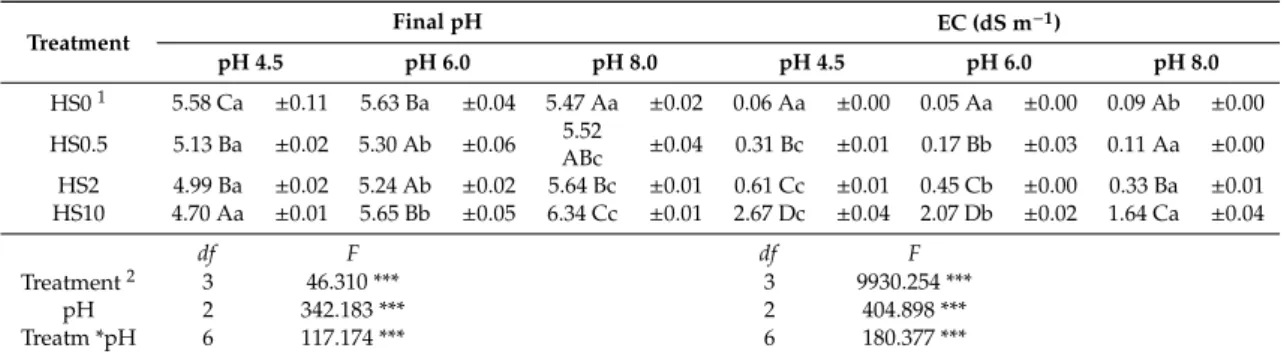
It can also be observed that WSOC content was significantly higher when the extracting solution
of humic substances was adjusted to pH 8.0 (p<0.05)—reaching a final pH value in soil solution
up to 6.3 (final pH values are shown in Table3)—due to the greater solubility of humic compounds
under alkaline conditions. This effect of high pH conditions on organic matter dissolution has also
been reported by other authors [14,15,36]. As was suggested by You et al. [15], the higher negative charges on both organic matter and soil surfaces with increasing pH resulted in the repulsion between both components. This repulsion led to a lower sorption of organic matter. In our study we found
a significant and positive correlation between WSOC and pH (Table3) measured in the extracts (r=0.70,
p<0.01).
Table 3.Final pH values and electrical conductivity (EC) in soil solution extracted with commercial
humic substances solution at different rates and adjusted pH conditions. Mean±standard deviation,n =3. Values within a column followed by the same capital letter are not significantly different between different HS rates (p<0.05). Values within a row followed by the same lower-case letter are not significantly different between different pH conditions (p<0.05).
Treatment Final pH EC (dS m
−1
)
pH 4.5 pH 6.0 pH 8.0 pH 4.5 pH 6.0 pH 8.0
HS01 5.58 Ca ±0.11 5.63 Ba ±0.04 5.47 Aa ±0.02 0.06 Aa ±0.00 0.05 Aa ±0.00 0.09 Ab ±0.00
HS0.5 5.13 Ba ±0.02 5.30 Ab ±0.06 5.52
ABc ±0.04 0.31 Bc ±0.01 0.17 Bb ±0.03 0.11 Aa ±0.00 HS2 4.99 Ba ±0.02 5.24 Ab ±0.02 5.64 Bc ±0.01 0.61 Cc ±0.01 0.45 Cb ±0.00 0.33 Ba ±0.01 HS10 4.70 Aa ±0.01 5.65 Bb ±0.05 6.34 Cc ±0.01 2.67 Dc ±0.04 2.07 Db ±0.02 1.64 Ca ±0.04
df F df F
Treatment2 3 46.310 *** 3 9930.254 ***
pH 2 342.183 *** 2 404.898 ***
Treatm *pH 6 117.174 *** 6 180.377 ***
1Rates of commercial humic substances (HS): 0, 0.5, 2 and 10 g kg−1
.2Two-Way ANOVA:df, degree of freedom; ***p<0.001; NS, not significant.
Table2also shows the E4/E6 ratio in the extractions. This ratio is characteristic of the degree of condensation and the molecular weight of humic substances. As the UV-Visible absorption is greater
at 465 nm for smaller molecules and greater at 665 nm for larger molecules, E4/E6 is expected to be
The E4/E6 ratio was significantly higher with increasing rates of the commercial humic substances
(p<0.05), with differences more pronounced at high pH, as happened with WSOC. A larger amount of
humic substances remained in the soil solution at higher rates of the commercial humic product, with a relative increase in fulvic acid with respect to the humic acid fraction (lower degree of humification). There was a strong and positive correlation between E4/E6 and WSOC (r=0.78,p<0.01) in the extracts.
We also found strong correlations between WSOC and absorbances at 465 (r=0.89,p<0.01) and 665
nm (r=0.88, p<0.01) (absorbances shown in Table S1). Other authors [37,38] also reported high
correlations between absorbances at 465 nm and at 665 nm with dissolved organic matter.
Regarding differences between adjusted pH conditions, it can be observed in Table2that the
E4/E6 ratio significantly increased with increasing pH (p<0.05) in the treatments with high rates of humic substances (HS2 and HS10). However, in the control treatment with no addition of humic
substances (HS0), E4/E6 significantly decreased at higher pH conditions (p<0.05). You et al. [15]
reported that the E4/E6 ratio decreased with increasing pH. These authors suggested that despite the
higher concentrations of both humic and fulvic acids found with increasing pH, the humic acid fraction increased at a greater rate and became predominant in the soil solution.
We observed that the colors of the extracts from the control treatment were absolutely clear. In contrast, the other samples were composed of a dark organic extract, which was darker with increasing rates of commercial humic substances and pH. This range of colors agreed with the absorbances measured in the extracts.
3.3. Effects of Commercial Humic Substances on Cu and Zn Mobility
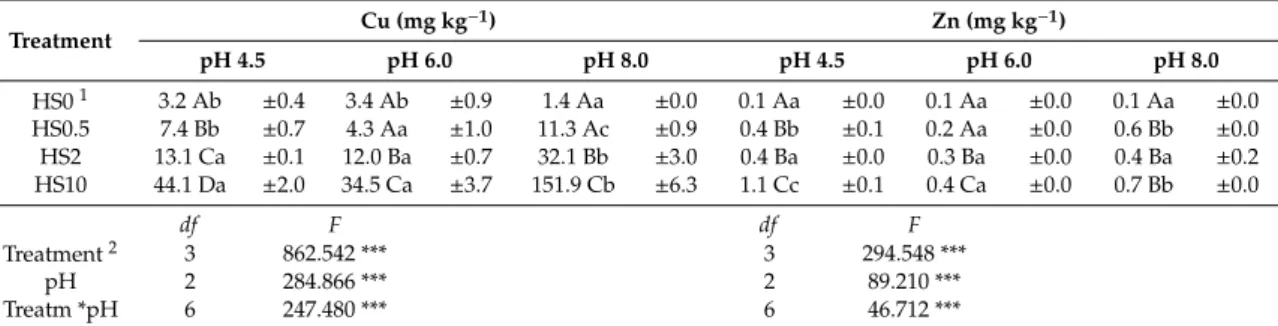
The concentrations of Cu and Zn extracted with different rates of commercial humic substances
and adjusted pH values are shown in Table4. There were significant differences among the treatments
and pH conditions and an interaction between both factors.
Table 4. Concentrations of Cu and Zn in soil solution extracted with commercial humic substances
solution at different rates and adjusted pH conditions. Mean±standard deviation,n=3. Values within
a column followed by the same capital letter are not significantly different among HS rates (p<0.05). Values within a row followed by the same lower-case letter are not significantly different among pH conditions (p<0.05).
Treatment Cu (mg kg
−1) Zn (mg kg−1)
pH 4.5 pH 6.0 pH 8.0 pH 4.5 pH 6.0 pH 8.0
HS01 3.2 Ab ±0.4 3.4 Ab ±0.9 1.4 Aa ±0.0 0.1 Aa ±0.0 0.1 Aa ±0.0 0.1 Aa ±0.0 HS0.5 7.4 Bb ±0.7 4.3 Aa ±1.0 11.3 Ac ±0.9 0.4 Bb ±0.1 0.2 Aa ±0.0 0.6 Bb ±0.0 HS2 13.1 Ca ±0.1 12.0 Ba ±0.7 32.1 Bb ±3.0 0.4 Ba ±0.0 0.3 Ba ±0.0 0.4 Ba ±0.2 HS10 44.1 Da ±2.0 34.5 Ca ±3.7 151.9 Cb ±6.3 1.1 Cc ±0.1 0.4 Ca ±0.0 0.7 Bb ±0.0
df F df F
Treatment2 3 862.542 *** 3 294.548 ***
pH 2 284.866 *** 2 89.210 ***
Treatm *pH 6 247.480 *** 6 46.712 ***
1Rates of commercial humic substances (HS): 0, 0.5, 2 and 10 g kg−1
.2Two-Way ANOVA:df, degree of freedom; ***p<0.001; NS, not significant.
Concentrations of Cu followed the same pattern as WSOC. The amount of extracted Cu considerably
increased with increasing rates of the commercial humic substances (p<0.05), up to 110 times (in
HS10 at pH 8.0) the concentration extracted in the control treatment (HS0). The formation of Cu complexes with soluble organic compounds provided by the commercial humic product could explain the higher mobilization of Cu with increasing water soluble organic carbon. We found strong and
positive correlations between Cu concentration and WSOC (r=0.97,p<0.01), as well as with E4/E6
(r=0.87,p<0.01).
The higher ionic strength reached in the soil solution with increasing rates of the commercial humic
due to the high competition from other cations for sorption sites on soil particles. The main competitor
cation could be the K provided by the commercial humic product, although its competition effect is
low against divalent cations, such as Cu and Zn [39]. This increase in metal desorption with higher ionic strength takes place in metals bound onto soil components by outer-sphere complexation, which involves electrostatic interactions [40].
The mobilization of Cu decreased in the treatments with humic substances (HS0.5, HS2 and HS10) from adjusted pH 4.5 to 6.0. The higher pH at this range could have led to a greater Cu adsorption due to an increase in negative (pH-dependent) charges of soil surfaces and the formation of Cu precipitates, which might have obscured the increase in Cu mobility by the formation of soluble organic complexes. In contrast, Cu mobility underwent a significant rise (p<0.05) in the treatments with humic substances when the adjusted pH increased from 6.0 (natural soil pH) to 8.0. This increase in extracted Cu with pH was considerably more accentuated in the HS10 treatment, where the final pH of the soil solution
reached a value of 6.3 (Table3). Other studies [36,41,42] reported that the addition of soluble organic
carbon from organic amendments reduced the adsorption of Cu and other metals on soil surfaces
because of the formation of soluble complexes. They also reported that this effect was stronger at high
pH due to the higher desorption of the organic matter as was explained above. There was a significant and positive correlation between Cu concentration and pH values in the soil solution (r=0.59,p<0.01). Similarly, in an earlier study [24] we reported a higher mobilization of Cu and a greater WSOC content with increasing rates of organic amendments added to soil and at higher pH conditions due to the formation of soluble organic complexes.
Regarding Zn (Table4), its mobilization significantly increased with higher rates of commercial
humic substances (p<0.05). This increase was up to 12 times (in HS10 at pH 4.5) the concentration
extracted in the control treatment (HS0). Özkaraova Güngör and Bekbölet [9] also reported a higher release of Zn from soil with increasing concentrations of humic and fulvic acids. The formation of Zn complexes with soluble organic compounds provided by the commercial humic product and the higher ionic strength could also explain Zn mobilization, as happened with Cu. However, Zn concentration
was neither correlated with WSOC nor E4/E6 ratio.
The effect of pH conditions on Zn mobilization followed the same trend as Cu. In HS0.5 and
HS10 treatments, Zn concentrations significantly decreased from adjusted pH 4.5 to pH 6.0 (p<0.05)
probably due to an increase in negative soil charges, whereas its concentration raised again from pH
6.0 to 8.0 (p<0.05) by the formation of soluble organic complexes with Zn. Contrary to Cu results,
concentrations of Zn were not significantly correlated with pH values of the extracts.
The concentrations of Zn extracted to the soil solution were considerably lower than those of Cu
due to the lesser Zn content of the soil studied (Table1). Also, this lower Zn mobilization could be due
to the lower affinity of this metal for organic molecules, given the lower stability constants of complexes formed between Zn and humic compounds than those with Cu [43]. It should be considered that the
addition of the humic product, which had a relatively high concentration of Zn (Table1), may have
contributed to the Zn extracted to the soil solution. In treatment HS10, humic substances provided up
to 1.2 mg kg−1of Zn, which is equivalent to the Zn concentration measured in the extracts (Table3).
These results showed that the addition of 10 g kg−1of commercial humic substances (HS10) at
adjusted pH 8.0 achieved the highest mobilization of Cu, and at pH 4.5 was the highest for Zn. These treatments managed to extract from the soil 5.4% of the total concentration of Cu (or 23% of the most
labile fractions of Cu, shown in Table1) and 0.5% of total Zn (or 17.5% of the most labile fractions of
Zn) in a single extraction step.
Our previous pot experiment using vetiver grass grown in contaminated soils with commercial humic substances [17] showed a greater uptake of Cu by plants with increasing rates of the humic
product (10–20 g kg−1) in soils that had higher pH conditions. This greater Cu uptake was due to the
their uptake by vetiver grass and other plants with the application of humic substances to soils [11,18], whereas others have reported lower metal mobilization and uptake with humic substances [16].
3.4. Chemical Species of Metals in Soil Solution
A simulation of the chemical speciation of Cu and Zn was conducted to elucidate the main organic
forms of these metals found in the soil solution and their relation with metal mobilization at different
rates of added humic substances and pH conditions.
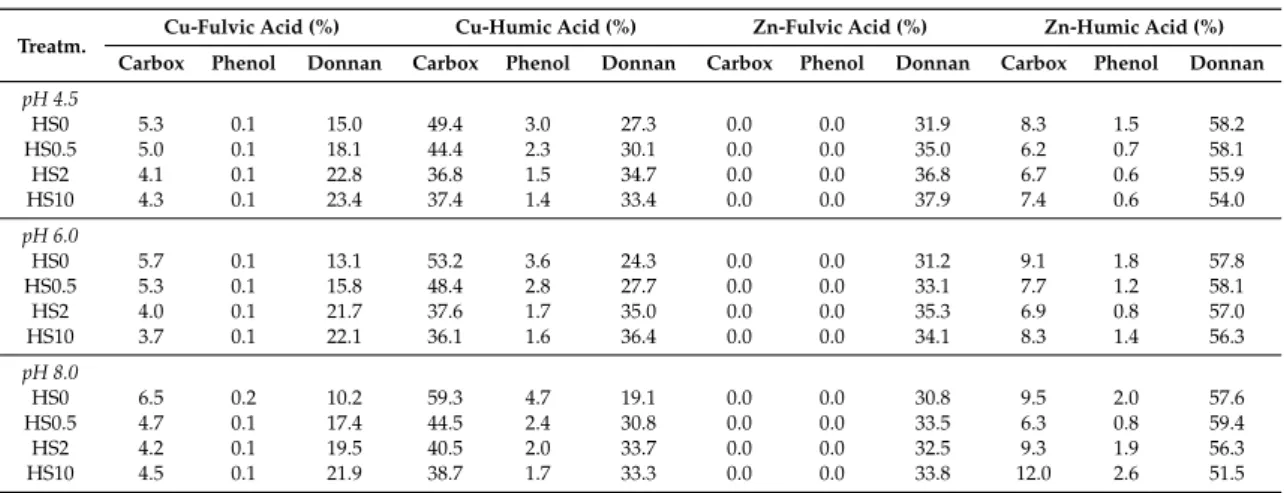
Table5shows the proportion of soluble Cu species complexed by the humic and fulvic fraction of
the soluble organic matter simulated by the NICA-Donnan model.
Table 5.Predicted percentages of Cu and Zn species in soil solution extracted with commercial humic
substances solution at different rates and adjusted pH conditions using the non-ideal competitive adsorption-Donnan (NICA-Donnan) model.
Treatm. Cu-Fulvic Acid (%) Cu-Humic Acid (%) Zn-Fulvic Acid (%) Zn-Humic Acid (%)
Carbox Phenol Donnan Carbox Phenol Donnan Carbox Phenol Donnan Carbox Phenol Donnan
pH 4.5
HS0 5.3 0.1 15.0 49.4 3.0 27.3 0.0 0.0 31.9 8.3 1.5 58.2
HS0.5 5.0 0.1 18.1 44.4 2.3 30.1 0.0 0.0 35.0 6.2 0.7 58.1
HS2 4.1 0.1 22.8 36.8 1.5 34.7 0.0 0.0 36.8 6.7 0.6 55.9
HS10 4.3 0.1 23.4 37.4 1.4 33.4 0.0 0.0 37.9 7.4 0.6 54.0
pH 6.0
HS0 5.7 0.1 13.1 53.2 3.6 24.3 0.0 0.0 31.2 9.1 1.8 57.8
HS0.5 5.3 0.1 15.8 48.4 2.8 27.7 0.0 0.0 33.1 7.7 1.2 58.1
HS2 4.0 0.1 21.7 37.6 1.7 35.0 0.0 0.0 35.3 6.9 0.8 57.0
HS10 3.7 0.1 22.1 36.1 1.6 36.4 0.0 0.0 34.1 8.3 1.4 56.3
pH 8.0
HS0 6.5 0.2 10.2 59.3 4.7 19.1 0.0 0.0 30.8 9.5 2.0 57.6
HS0.5 4.7 0.1 17.4 44.5 2.4 30.8 0.0 0.0 33.5 6.3 0.8 59.4
HS2 4.2 0.1 19.5 40.5 2.0 33.7 0.0 0.0 32.5 9.3 1.9 56.3
HS10 4.5 0.1 21.9 38.7 1.7 33.3 0.0 0.0 33.8 12.0 2.6 51.5
Chemical species: Carbox, metals associated with carboxylic groups; Phenol, metals associated with phenolic groups; Donnan, metals associated with the Donnan phase. Rates of commercial humic substances (HS): 0, 0.5, 2 and 10 g kg−1
.
In all cases there was a negligible proportion of free Cu2+and other inorganic Cu species in
the soil solution (<0.05%). Matijevic et al. [44] also reported that Cu in the soil solution is mainly
associated with soluble organic compounds at pH>5. As well, Ondrasek et al. [16] found that metals
were predominantly governed in the solution by metal-humic complexes in treatments with high concentrations of humic acids.
There was a considerably higher proportion of Cu species associated with the humic acid fraction (72–83%) than with the fulvic acids (17–28%), given the predominant concentration of humic acid in the
soil solution—the commercial humic substances contain 53% humic acid and 12% fulvic acid (Table1).
Hattab et al. [6] also found that Cu was more abundant in the humic acid fraction than in fulvic acid, due to the high affinity of humic acids for this metal.
Copper associated with the humic acid fraction was mainly complexed with carboxylic functional groups, whereas there was a low proportion of Cu complexed with phenolic groups. At the
near-neutral pH conditions in this study, carboxylic groups were deprotonated—whosepKaranges
from 3 to 6—resulting in higher negative charge, whereas phenolic groups—withpKa from 8 to
>10—were partially active [13]. The proportions of Cu associated with the Donnan phase—counterions
accumulated in the diffuse layer of the soluble organic compounds that are weakly bound by electrostatic
interactions—were almost as high as those associated with carboxylic groups.
If the different treatments are compared, it can be observed that the proportion of Cu associated with the humic acid fraction decreased with the addition of higher rates of commercial humic substances, especially Cu complexed by carboxylic and phenolic groups. This decrease was counteracted by increasing percentages of Cu associated with the fulvic acid fraction—which is more labile and mobile than the humic acid—mainly in the Donnan phase. These results agreed with the higher values of
E4/E6 measured with greater rates of commercial humic substances, which indicated a decrease in the
humic/fulvic ratio.
If the rate of commercial humic substances was fixed, the proportion of Cu associated with the fulvic acid fraction generally decreased with increasing pH, whereas Cu of the humic acid fraction generally increased, especially Cu complexed by carboxylic and phenolic groups, probably due to the deprotonation of these acidic functional groups at higher pH.
Table5also shows the predicted proportions of Zn species in the soil solution that were associated
with the humic and fulvic acids fractions.
There was also a negligible proportion of free Zn2+and other inorganic Zn species (<0.05%).
Although other studies [6] reported that fulvic acids were the main organic fraction associated with Zn, in our study there were higher proportions of Zn complexed with the humic acid fraction. This may be
due to the higher stability constants for humic acid (logK=5.45 at pH 7) than for fulvic acid (logK=
4.01) [9]. Nevertheless, the differences between both fractions (62–69% for humic acids and 31–38%
for fulvic acids) were less pronounced than in Cu. In both humic and fulvic acids fractions, Zn was mainly associated with the Donnan phase, whereas the proportions of complexes with carboxylic and phenolic groups were very low. In the fulvic acid fraction, the percentages of Zn associated with these functional groups were even below 0.05%.
As happened with Cu, proportions of Zn associated with the humic acid fraction generally decreased and those of fulvic acid increased with greater rates of commercial humic substances, what could lead to a higher metal mobility. An increase in the percentages of Zn associated with the carboxylic and phenolic sites of the humic acid fraction could also be observed with increasing adjusted pH, which was probably due to deprotonation of these functional groups at higher pH values. Özkaraova Güngör and Bekbölet [9] reported a greater release of Zn with the addition of humic acid at high pH conditions attributed to the involvement of acidic functional groups.
Although Zn complexed with humic and fulvic fractions in soil solution was considerably lower
than Cu due to the lesser content of Zn in soil and its lower affinity for organic ligands, it should be
considered that there are competitive interactions between both metals for humic substances. As a result, increasing Zn could lead to a decrease in Cu-organic complexes, as was reported by Baker [45].
Spectroscopic techniques, such as nuclear magnetic resonance (NMR) and infrared (IR), are needed
in future research to study the interactions between metals and these humic substances at different pH
conditions in more detail.
4. Conclusions
The addition of commercial humic substances derived from leonardite at increasing rates and at high pH conditions managed to mobilize greater concentrations of Cu and, to a lesser extent, Zn from the contaminated soil, due to the formation of soluble metal-humic complexes.
The results from the present study and from our previous pot experiment with plants [17] suggest
that the addition of humic substances at high rates (about 2–10 g kg−1
) could be a suitable tool to improve assisted-phytoextraction techniques in contaminated anthropogenic mine soils by the enhancement of metal uptake by plants due to a high metal mobility. However, the application of these rates under more alkaline conditions than natural soil pH could lead to an excessive Cu mobility, and therefore to an increasing risk of leaching to groundwater and its transfer to the trophic chain, as well as a greater toxicity for plants and soil microorganisms.
Supplementary Materials:The following are available online athttp://www.mdpi.com/2071-1050/11/18/4844/s1, Table S1: Absorbances at 465 nm and 665 nm in soil solution extracted with commercial humic substances solution at different rates and adjusted pH conditions.
Author Contributions: Conceptualization, J.P.-E., A.M. (Ana Moliner) and C.E.; methodology, J.P.-E. and I.S.;
validation, J.P.-E., C.E. and A.M. (Ana Moliner); investigation, J.P.-E. and I.S.; writing—original draft preparation, J.P.-E.; writing—review and editing, A.M. (Ana Moliner), C.E., A.M. (Alberto Masaguer) and I.S.; supervision, A.M. (Ana Moliner), C.E., A.M. (Alberto Masaguer); funding acquisition, A.M. (Ana Moliner) and A.M. (Alberto Masaguer).
Funding:This research was funded by MINISTERIO DE ECONOMÍA Y COMPETITIVIDAD (SPAIN), grant
number CTM2013-47874-C2-1-R.
Acknowledgments: The authors are grateful to Lorena Sinche for her assistance on soil and extracts analyses
at the laboratory of the Soil Science Unit (Universidad Politécnica de Madrid). The authors are also grateful to Tradecorp®for the materials and information on the commercial humic product provided.
Conflicts of Interest:The authors declare no conflict of interest.
References
1. Alloway, B.J.Heavy Metals in Soils, 3rd ed.; Springer: Dordrecht, The Netherlands, 2013.
2. Rodríguez-Vila, A.; Asensio, V.; Forján, R.; Covelo, E.F. Remediation of a copper mine soil with organic amendments: Compost and biochar versus Technosol and biochar.Span. J. Soil Sci.2015,5, 130–143. 3. Soler-Rovira, P.; Madejón, E.; Madejón, P.; Plaza, C. In situ remediation of metal-contaminated soils with
organic amendments: Role of humic acids in copper bioavailability.Chemosphere2010,79, 844–849. [CrossRef] [PubMed]
4. Hbaieb, R.; Soubrand, M.; Joussein, E.; Medhioub, M.; Casellas, M.; Gady, C.; Saladin, G. Assisted phytostabilisation of As, Pb and Sb-contaminated Technosols with mineral and organic amendments using Douglas fir (Pseudotsuga menziesii(Mirb.) Franco).Environ. Sci. Pollut. Res.2018,25, 32292–32302. [CrossRef] [PubMed]
5. Mendez, M.O.; Maier, R.M. Phytoremediation of mine tailings in temperate and arid environments. Rev. Environ. Sci. Bio Technol.2008,7, 47–59. [CrossRef]
6. Hattab, N.; Soubrand, M.; Guégan, R.; Motelica-Heino, M.; Bourrat, X.; Faure, O.; Bouchardon, J.L. Effect of organic amendments on the mobility of trace elements in phytoremediated techno-soils: Role of the humic substances.Environ. Sci. Pollut. Res.2014,21, 10470–10480. [CrossRef]
7. Schwab, A.P.; Zhu, D.S.; Banks, M.K. Heavy metal leaching from mine tailings as affected by organic amendments.Bioresour. Technol.2007,98, 2935–2941. [CrossRef] [PubMed]
8. Clemente, R.; Bernal, M.P. Fractionation of heavy metals and distribution of organic carbon in two contaminated soils amended with humic acids.Chemosphere2006,64, 1264–1273. [CrossRef] [PubMed] 9. Özkaraova Güngör, E.B.; Bekbölet, M. Zinc release by humic and fulvic acid as influenced by pH, complexation
and DOC sorption.Geoderma2010,159, 131–138. [CrossRef]
10. Dar, M.I.; Khan, F.A.; Green, I.D.; Naikoo, M.I. The transfer and fate of Pb from sewage sludge amended soil in a multi-trophic food chain: A comparison with the labile elements Cd and Zn.Environ. Sci. Pollut. Res.
2015,22, 16133–16142. [CrossRef]
11. Evangelou, M.W.H.; Daghan, H.; Schaeffer, A. The influence of humic acids on the phytoextraction of cadmium from soil.Chemosphere2004,57, 207–213. [CrossRef]
12. Kloster, N.; Avena, M. Interaction of humic acids with soil minerals: Adsorption and surface aggregation induced by Ca2+.Environ. Chem. 2015,12, 731–738. [CrossRef]
13. Römkens, P.F.A.M.; Dolfing, J. Effect of Ca on the solubility and molecular size distribution of DOC and Cu binding in soil solution samples.Environ. Sci. Technol.1998,32, 363–369. [CrossRef]
14. Vermeer, A.W.P.; van Riemsdijk, W.H.; Koopal, L.K. Adsorption of humic acid to mineral particles. 1. Specific and electrostatic interactions.Langmuir1998,14, 2810–2819. [CrossRef]
15. You, S.J.; Yin, Y.; Allen, H.E. Partitioning of organic matter in soils: Effects of pH and water/soil ratio.Sci. Total Environ.1999,227, 155–160. [CrossRef]
17. Vargas, C.; Pérez-Esteban, J.; Escolástico, C.; Masaguer, A.; Moliner, A. Phytoremediation of Cu and Zn by vetiver grass in mine soils amended with humic acids. Environ. Sci. Pollut. Res. 2016,23, 13521–13530. [CrossRef] [PubMed]
18. Angin, I.; Turan, M.; Ketterings, Q.M.; Cakici, A. Humic acid addition enhances B and Pb phytoextraction by vetiver grass (Vetiveria zizanioides(L.) Nash).Water Air Soil Pollut.2008,188, 335–343. [CrossRef]
19. Jiménez, R.; Jordá, L.; Jordá, R.; Prado, P. La minería metálica en Madrid desde 1417 hasta nuestros días. Bocamina2004,14, 52–89. (In Spanish)
20. Mazadiego Martínez, L.F.; Puche Riart, O. La Minas de cobre de Colmenarejo. 1999. Available online: http://oa.upm.es/9908/1/colmenarejo.pdf(accessed on 18 July 2019). (In Spanish).
21. Álvarez-Puebla, R.A.; Valenzuela-Calahorro, C.; Garrido, J.J. Modeling the adsorption and precipitation processes of Cu (II) on humin.J. Colloid Interface Sci.2004,277, 55–61. [CrossRef]
22. Gustafsson, J.P. Visual MINTEQ, v.3.1. 2018. Available online: https://vminteq.lwr.kth.se(accessed on 18 July 2019).
23. Pérez-Esteban, J.; Escolástico, C.; Moliner, A.; Masaguer, A. Chemical speciation and mobilization of copper and zinc in naturally contaminated mine soils with citric and tartaric acids.Chemosphere2013,90, 276–283. [CrossRef]
24. Pérez-Esteban, J.; Escolástico, C.; Masaguer, A.; Vargas, C.; Moliner, A. Soluble organic carbon and pH of organic amendments affect metal mobility and chemical speciation in mine soils. Chemosphere2014,103, 164–171. [CrossRef] [PubMed]
25. Kinniburgh, D.G.; Van Riemsdijk, W.H.; Koopal, L.K.; Borkovec, M.; Benedetti, M.F.; Avena, M.J. Ion binding to natural organic matter: Competition, heterogeneity, stoichiometry and thermodynamic consistency. Colloids Surf. A Physicochem. Eng. Aspects1999,151, 147–166. [CrossRef]
26. Smith, R.M.; Martell, A.E.; Motekaitis, R.J. NIST critically selected stability constants of metal complexes database. InNIST Standard Reference Database 46, Version 7.0; National Institute of Standard and Technology: Gaithersburg, MD, USA, 2003.
27. Milne, C.J.; Kinniburgh, D.G.; Van Riemsdijk, W.H.; Tipping, E. Generic NICA−Donnan model parameters
for metal-ion binding by humic substances.Environ. Sci. Technol.2003,37, 958–971. [CrossRef] [PubMed] 28. Nelson, D.W.; Sommers, L.E. Total carbon, organic carbon, and organic matter. InMethods of Soil Analysis,
Part 3. Chemical Methods; Sparks, D.L., Page, A.L., Helmke, P.A., Loeppert, R.H., Eds.; Soil Science Society of America and American Society of Agronomy: Madison, WI, USA, 1996; pp. 961–1010.
29. Day, P.R. Particle fractionation and particle-size analysis. InMethods of Soil Analysis, Part 1; Black, C.A., Ed.; American Society of Agronomy: Madison, WI, USA, 1965; pp. 545–567.
30. Tessier, A.; Campbell, P.G.C.; Bisson, M. Sequential extraction procedure for the speciation of particulate trace metals.Anal. Chem.1979,51, 844–851. [CrossRef]
31. Islam, K.R.; Weil, R.R. A rapid microwave digestion method for colorimetric measurement of soil organic carbon.Commun. Soil Sci. Plant Anal.1998,29, 2269–2284. [CrossRef]
32. Ciavatta, C.; Govi, M.; Antisari, L.V.; Sequi, P. Determination of organic carbon in aqueous extracts of soils and fertilizers.Commun. Soil Sci. Plant Anal.1991,22, 795–807. [CrossRef]
33. Sims, J.R.; Haby, V.A. Simplified colorimetric determination of soil organic matter.Soil Sci.1971,112, 137–141. [CrossRef]
34. Chen, Y.; Senesi, N.; Schnitzer, M. Information provided on humic substances by E4/E6 ratios.Soil Sci. Soc. Am. J.1977,41, 352–358. [CrossRef]
35. Tóth, G.; Hermann, T.; Da Silva, M.R.; Montanarella, L. Heavy metals in agricultural soils of the European Union with implications for food safety.Environ. Int. 2016,88, 299–309. [CrossRef] [PubMed]
36. Ashworth, D.J.; Alloway, B.J. Influence of dissolved organic matter on the solubility of heavy metals in sewage-sludge-amended soils.Commun. Soil Sci. Plant Anal.2008,39, 538–550. [CrossRef]
37. Chica, A.; Mohedo, J.J.; Martín, M.A.; Martín, A. Determination of the stability of MSW compost using a respirometric technique.Compost Sci. Util.2003,11, 169–175. [CrossRef]
38. Zmora-Nahum, S.; Markovitch, O.; Tarchitzky, J.; Chen, Y. Dissolved organic carbon (DOC) as a parameter of compost maturity.Soil Biol. Biochem.2005,37, 2109–2116. [CrossRef]
40. Lützenkirchen, J. Ionic strength effects on cation sorption to oxides: Macroscopic observations and their significance in microscopic interpretation.J. Colloid Interface Sci.1997,195, 149–155. [CrossRef] [PubMed] 41. Bolan, N.; Adriano, D.; Mani, S.; Khan, A. Adsorption, complexation, and phytoavailability of copper as
influenced by organic manure.Environ. Toxicol. Chem.2003,22, 450–456. [CrossRef]
42. Zhou, L.X.; Wong, J.W.C. Effect of dissolved organic matter from sludge compost on soil copper sorption. J. Environ. Qual.2001,30, 878–883. [CrossRef]
43. Prado, A.G.S.; Torres, J.D.; Martins, P.C.; Pertusatti, J.; Bolzon, L.B.; Faria, E.A. Studies on copper(II)- and zinc(II)-mixed ligand complexes of humic acid.J. Hazard. Mater.2006,136, 585–588. [CrossRef]
44. Matijevic, L.; Romic, D.; Romic, M. Soil organic matter and salinity affect copper bioavailability in root zone and uptake byVicia fabaL. plants.Environ. Geochem. Health2014,36, 883–896. [CrossRef]
45. Baker, B.J. Investigation of the Competitive Effects of Copper and Zinc on Fulvic Acid Complexation: Modeling and Analytical Approaches. Master’s Thesis, Colorado School of Mines, Golden, CO, USA, 2012. Available online:https://mountainscholar.org/bitstream/handle/11124/76824/Baker_mines_0052N_10049.pdf (accessed on 18 July 2019).