1 INTRODUCTION AND MAIN CHARACTERISTICS OF THE STUDY AREA
Being able to determine the potential impacts that climate change may have on water resources is a complicated task, due to the limited data available for the calibration of the models, and the high exploitation rate of the aquifers in the study area, which makes the modeling almost im-possible under conditions of functioning of the system in natural regime.
The Sierra de las Cabras aquifer is located in the central part of the province of Cadiz (Figure 1A). This includes, from West to East, the sierras of del Valle, Dos Hermanas, de la Sal, de las Cabras and Loma del Tempul. All these reliefs constitute a mountain range of 42 km2, whose planform is a crescent with concavity open towards the Southwest. Sierra de las Cabras is crossed by two streams: Bogaz and Bujalance (Figure 1B).
The materials of Sierra de las Cabras belong to the unit of the same name, within the Medi-um Subbetic domain of the External Zone of the Betic Cordillera (Chauve 1960, 1962, Martín-Algarra 1987, ITGE 1990). The stratigraphic series (Figure 1C) consists of three main lithologic units (from wall to ceiling): Triassic in German-Andalusian facies (Keuper), Jurassic of calcareous-dolomitic nature with 300 meters thickness, and Cretaceous-Tertiary of marly na-ture (Jiménez 2011).
The outcrops of Jurassic limestones and dolomites, with an area of approximately 34 km2, constitute an aquifer. The aquifer recharge occurs by direct infiltration from rainfall on car-bonate outcrops and, sometimes, by infiltration of runoff from Bogaz stream and Bujalance stream. The different materials in the study area have been grouped into two categories accord-ing to their hydrological behavior: carbonate medium permeability and carbonate high permea-bility (Figure 1B).
Modelling of last hypothesis of climate change impacts on water
resources in Sierra de las Cabras aquifer (Southern Spain)
P. Jiménez-Fernández & P. Jiménez-Gavilán
Department of Geology. Faculty of Science. University of Malaga. Malaga. Spain
Centre of Hydrogeology of the University of Malaga (CEHIUMA). University of Malaga. Malaga. Spain
The discharge occurs, in a natural way, by the El Tempul spring, at elevation 120 m a.s.l., the flow varies between 20 L/s and less than 2000 L/s, with an historical average value of 283 L/s (Jiménez et al 2001). In periods of exceptional recharge the ‘trop plein’ of Fuente Imbro comes into operation (Figure 1B) at elevation 140 m a.s.l.. There is a preferentially groundwater flow directed towards the El Tempul spring (Carreras 1996). So, the hydrodynamic study of this point showed that this aquifer has a predominantly inertial hydrogeological behaviour, which is indicative of a low degree of functional karstification and, in this case, of significant groundwa-ter reserves (Jiménez 2011).
Figure 1. A) Location of Sierra de las Cabras, B) Sierra de las Cabras, and C) stratigraphic series (modi-fied (modi(modi-fied from Martín-Algarra 1987).
The assessment of water resources is essential for a proper planning and management. There are basically two methods to assess the water resources: restitution to the natural regime and rainfall-runoff modeling. Both methodologies are often complementary and necessary.
twenty-first century. The forecasts made in the RCP4.5 and RCP8.5 scenarios have been simulated for three time intervals (IPCC 2013): 2016-2035, 2046-2065, and 2081-2100.
2 METHODOLOGY
2.1 Bibliographic compilation
A detailed analysis of all the information on the application of methodologies for characterizing the hydrodynamic functioning of aquifers has been carried out, but particularly in relation to the Betics aquifers (Delannoy 1998, Andreo et al. 2002, Jiménez et al. 2001, Jiménez 2011). Moreover, any information regarding the different climate change scenarios that are envisaged by the IPCC (IPCC 2013) has been also analyzed.
Forecasts carried out by global circulation models (75th percentile) have been considered for RCP4.5 and RCP8.5 scenarios in the study area (Table 1).
Table 1. Temperature and precipitation change for the three time intervals simulated (IPCC 2013).
2016-2035 2046-2065 2081-2100 2016-2035 2046-2065 2081-2100 2016-2035 2046-2065 2081-2100 2016-2035 2046-2065 2081-2100 RCP4.5 RCP4.5 RCP4.5 RCP8.5 RCP8.5 RCP8.5 RCP4.5 RCP4.5 RCP4.5 RCP8.5 RCP8.5 RCP8.5
Dec-Fe b 1 2 2 1 3 4 Oct-Ma r 0 -10 -10 0 -10 -20
Ma r-Ma y 1.5 2 3 1.5 3 5 Apr-Sep -10 -10 -10 0 -20 -30
Jun-Aug 1.5 3 3 2 4 7
Sep-Nov 1.5 2 3 1.5 3 5
Peri od
Tempe ra ture cha nge ºC
Peri od
Pre ci pi ta ti on cha nge %
2.2 Hydrometeorological data compilation
SIMPA model (Cabezas et al. 1999, Ruiz 1999, Estrela and Quintas 1996) provides information for the main components of the hydrological cycle in natural regime. This information is con-tained in raster layers covering the entire territory of Spain on a monthly basis between 1940 and 2012. A GIS tool has been developed for extracting information on precipitation, tempera-ture, and potential evapotranspiration (PET).
2.3 Modelling and model calibration
Data between 1986-1995 have been used to calibrate the model because this is the period that has daily flow data drained by El Tempul spring. When the system has been calibrated the val-ue of the parameters used by Sacramento model have been determined (Table 2).
Table 2. Parameters value.
Carbonate medium permeability Carbonate high permeability Carbonate medium permeability Carbonate high permeability Carbonate medium permeability Carbonate high permeability Uztw m 120.000 80.000 Zperc 6.000 10.000 Lzpk 0.004 0.006 Uzfw m 210.000 230.000 Rexp 0.500 0.800 Pfree 0.200 0.300
Uzk 0.060 0.080 Lztw m 75.000 65.000 Side 0.150 0.150
Pctim 0.000 0.000 Lzfsm 245.000 300.000 Rserv 0.800 0.900 Adimp 0.000 0.000 Lzfpm 300.000 300.000 Dt 1.800 1.800
Riva 0.000 0.000 Lzsk 0.150 0.278
Materials Parameter Materials Parameter Materials Parameter
2.4 Climate change
The forecasts made in the RCP4.5 and RCP8.5 scenarios have been simulated for time intervals 2016-2035, 2046-2065, and 2081-2100 (Figure 2). The data series have been built with refer-ence to SIMPA data for the period 1986-2005.
However, this study is intended as a preliminary approximation to a future regionalization of data.
Figure 2. Map of change in temperature and precipitation for the RCP4.5 scenario (IPCC 2013).
3 RESULTS AND DISCUSSION
The comparison of observed data regarding estimated data by Sacramento model, for the period 1986-1995 (Figure 3), has been conducted by the efficiency coefficient of models of Nash-Sutcliffe (Nash and Nash-Sutcliffe 1970).
Figure 3. Water resources drained and simulated by El Tempul spring.
According to the value obtained from the Nash-Sutcliffe coefficient, 0.87, for the calibration period, the monthly series have a very good goodness of fit (Table 3).
Table 3. Criteria for evaluating the goodness of fit of Nash-Sutcliffe (Van Dijk et al. 2008).
Indicator Excellent Very good Good Reasonable Modest Poor Very poor
RN2 >0.95 0.8-0.95 0.75-0.8 0.6-0.75 0.5-0.6 0.3-0.5 <0.30
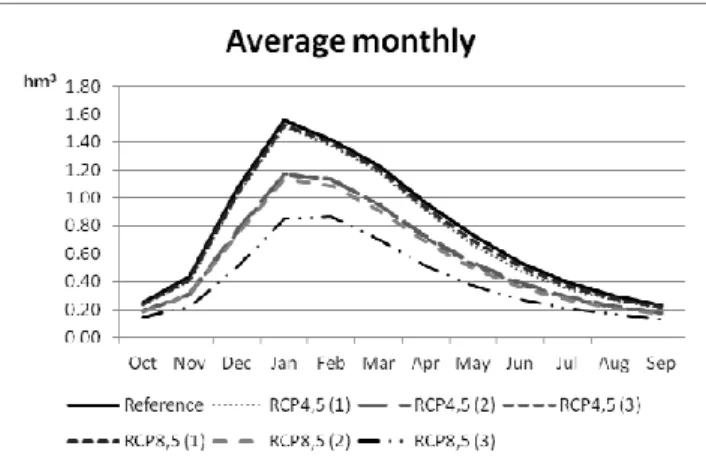
In Figure 4 the average monthly water resources obtained by Sacramento model has been represented for RCP4,5 and RCP8,5 scenarios and for the reference period. In Table 4 varia-tions are shown, both in absolute terms and as a percentage for the different simulated scenari-os.
Figure 4. Average monthly water resources drained and simulated by El Tempul spring.
This decrease of water resources will produce drought events that will compromise to long-term the implementation of the qualitative and quantitative environmental objectives for surface water bodies and groundwater bodies that are downstream of the study area. This would affect the availability of resources to the Bay of Cadiz and Jerez de la Frontera which is an area with a high demand for supply, and also has significant seasonal variations (higher demand in summer than in winter), like other coastal areas (Jiménez 2001).
Table 4. Differences between scenarios.
1986-2005 2016-2035 2046-2065 2081-2100 2016-2035 2046-2065 2081-2100 2016-2035 2046-2065 2081-2100 2016-2035 2046-2065 2081-2100 Reference RCP4,5 (1) RCP4,5 (2) RCP4,5 (3) RCP8,5 (1) RCP8,5 (2) RCP8,5 (3) RCP4,5 (1) RCP4,5 (2) RCP4,5 (3) RCP8,5 (1) RCP8,5 (2) RCP8,5 (3) Oct 10 0.25 0.23 0.19 0.19 0.24 0.18 0.14 7.11 22.99 24.57 4.24 26.56 43.01 Nov 11 0.43 0.41 0.32 0.31 0.41 0.30 0.22 6.13 26.92 29.30 4.16 29.88 49.44 Dec 12 1.06 1.01 0.77 0.75 1.03 0.74 0.51 4.47 27.91 29.40 3.35 30.61 52.44 Jan 1 1.55 1.51 1.17 1.17 1.52 1.13 0.85 2.91 24.71 24.85 1.94 27.10 45.28 Feb 2 1.41 1.38 1.13 1.14 1.39 1.09 0.87 2.42 20.27 19.63 1.45 23.03 38.53 Mar 3 1.23 1.19 0.95 0.95 1.20 0.91 0.70 3.71 22.57 22.87 2.55 26.24 43.14 Apr 4 0.97 0.91 0.73 0.72 0.93 0.69 0.51 6.10 24.46 25.93 3.93 29.00 46.91 May 5 0.73 0.66 0.54 0.52 0.69 0.50 0.37 9.82 26.46 28.42 5.36 32.16 49.35 Jun 6 0.54 0.48 0.39 0.38 0.51 0.36 0.27 11.47 27.22 29.15 6.06 32.78 49.20 Jul 7 0.39 0.35 0.29 0.28 0.37 0.27 0.21 10.95 25.98 27.85 6.04 31.20 47.07 Aug 8 0.30 0.27 0.22 0.22 0.28 0.21 0.16 10.14 24.42 26.20 5.70 29.25 44.48 Sep 9 0.23 0.21 0.18 0.17 0.22 0.17 0.13 9.32 22.68 24.36 5.27 27.25 41.69
9.10 8.60 6.88 6.80 8.79 6.55 4.95 5.54 24.42 25.32 3.39 28.08 45.61
Percentage difference respect to the reference period %
Month
Total
Resource hm3
4 CONCLUSIONS
This preliminary research concludes that Sacramento model is quite representative of the sys-tem real conditions for carbonate aquifers. Thus, the obtained results might be influenced by the higher number of parameters used for Sacramento model. The high inertness that this aqui-fer has cannot mitigate the effects of climate change on monthly values of water resources. The increase in temperature and decrease in precipitation (Table 1) generate a high impact, with creases of the resource much higher than foreseeable if only it has taken into account the de-crease in rainfall. In this regard, the continuation of the work described in this research has been proposed on other systems.
The estimated parameters used in this research by Sacramento model can be considered use-ful for systems that present a similar hydrogeological behavior and without available data series of hydrometric to perform a calibration thereof.
The results obtained in this research must be considered preliminary until a regionalization of data from global circulation models is done. However, the results are similar to the predic-tions for the Mediterranean region that are included in the AR5 which has just been published recently (October 2014).
Finally, the use of Sacramento model is recommended in hydrological planning whenever a high prior knowledge of the hydrological and hydrogeological behaviour of the study area.
5 ACKNOWLEDGEMENTS
This work is a contribution to the project Water Accounting in a Multi-Catchment District (WAMCD-8.06.UE/44.7066) of European Commission, and the Research Group RNM-308 of the Andalusian Government.
6 REFERENCES
Andreo, B., Carrasco, F., Bakalowicz, M., Mudry, J. and Vadillo, I.. 2002. Use of hydrodynamic and hy-drochemistry to characterise carbonate aquifers. Case study of the Blanca–Mijas unit (Málaga, southern Spain). Environmental Geology, 43 (1-2): 108-119.
Burnash, R.J., Ferral, R.L. and McGuire, R.A., 1973. A Generalized Streamflow Simulation System-Conceptual Modeling for Digital Computers. Joint Federal-State River Forecast Center, Sacramento, CA. 204 p.
Cabezas, F., Estrada, F. and Estrela, T., 1999. Algunas contribuciones técnicas del Libro Blanco del Agua en España. Ingeniería Civil, 115, 79-96.
Carreras, A., 1996. Investigación y explotación del acuífero de la Sierra de las Cabras (S. José del Valle, Cádiz). Jornadas sobre Recursos Hídricos en Regiones Kársticas, Vitoria (España), 9-21.
Chauve, P., 1960-62. Structure Géologique de la Région Centrale de la Province de Cadix (Espagne).
Memories hors de sèrie de la Societe Geologique de France, 1: 257-264.
Delannoy, J.J., 1998. Contribución al conocimiento de los macizos kársticos de las Serranías de Grazale-ma y de Ronda. En: J.J Durán y J.L. Martínez (Eds.) El Karst en Andalucía, Instituto Tecnológico Geominero de España; Madrid (España), 93-129.
Estrela, T. and Quintas, L., 1996. El sistema integrado de modelización precipitación-aportación SIMPA. Ingeniería Civil, 104, 43-52.
IGME, 2013. Mapa de permeabilidades de España a escala 1/200.000.
ITGE, 1990. Mapa geológico de España 1:50.000. Hoja 1063 Algar. Madrid (España).
IPCC, 2013: Climate Change 2013: The Physical Science Basis. Contribution of Working Group I to the
Fifth Assessment Report of the Intergovernmental Panel on Climate Change [Stocker, T.F., D. Qin,
G.-K. Plattner, M. Tignor, S.G.-K. Allen, J. Boschung, A. Nauels, Y. Xia, V. Bex and P.M. Midgley (eds.)]. Cambridge University Press, Cambridge, United Kingdom and New York, NY, USA.
Jiménez, P.; Andreo, B.; Durán, J.J.; Carrasco, F.; López-Geta, J.A.; Vadillo, I. and Vázquez, M., 2001. Estudio hidrodinámico del manantial de El Tempul (Sierra de las Cabras, Cádiz, Sur de España).
Bo-letín Geológico y Minero, Vol. 112 (2): 85-102.
Jiménez, P., 2011. Los acuíferos carbonáticos del Sur de España. Caracterización y clasificación a partir de sus respuestas naturales. Académica Española–Lap Lambert Academic Publising GmbH&Co. 384 p. Martín Algarra, A., 1987. Evolución geológica Alpina del contacto entre las Zonas Internas y las Zonas Externas de la Cordillera Bética (Sector Occidental). Tesis Doctoral, Universidad de Granada (Espa-ña). 1171 páginas.
Nash, J.E. and Sutcliffe, J.V., 1970. River flow forecasting through conceptual models, part I: A discus-sion of principles. J. Hydrol. 10, 282-290.
Paredes-Arquiola, J., Solera Solera, A., Andreu Álvarez, J. and Lerma Elvira, N., 2012. Manual técnico de la herramienta EVALHID para la evaluación de recursos hídricos. Grupo de Ingeniería de Recursos Hídricos. Universitat Politècnica de València.
Ruiz, J. M., 1999. Modelo distribuido para la evaluación de recursos hídricos. Monografías CEDEX M67. Van Dijk, A., Kirby, J., Paydar, Z., Podger, G., Mainuddin, M., Marvanek, S. and Peña-Arancibia, J., 2008. Uncertainty in river modeling across the Murray-Darling Basin. A report to the Australian Gov-ernment from the CSIRO Murray-Darling Basin Sustainable Yields Project CSIRO: Water for a Healthy Country National Research Flagship.