BCN
Barcelona Social Inclusion Plan for
Quality of Life, Equality and Sport Barcelona Social Inclusion Plan for 2012-2015
2
Barcelona Social Inclusion Plan for 2012-2015
Publication copyright: Barcelona City Council
The 2012-2015 Barcelona Social Inclusion Plan is the result of the joint work of Barcelona City Council and the organizations of Barcelona civil society, coming together in the framework of the Citizens’ Agreement for an Inclusive Barcelona (ACBI), together with the Municipal Social Welfare Council and its working groups. The plan was drawn up with the participation of citizens, organi-zations, municipal technical staff and representatives of all the political groups of Barcelona City Council, under the leadership of the office of the Deputy Mayor and the Department of Quality of Life, Equality and Sport of Barcelona City Council.
Area of Quality of Life, Equality and Sport
Maite Fandos, Deputy Mayor.
Councillors: Irma Rognoni (Childhood, Family, Use of Time, Disability), Raimond Blasi (Ado-lescents and Young People), Francina Vila (Women and Civil Rights). Health Delegate: Cristina Iniesta. Commissioner for Immigration and Community Action: Miquel Esteve. Commissioner for the Elderly: Assumpció Roset. Commissioner for Religious Affairs: Ignasi Garcia Clavel.
Technical office: Jordi Arcarons, Iolanda Latorre, Eulàlia Cardeña, Susana Abril, Borja Aitor Arriaga.
Board of Directors: M. Glòria Figuerola, Àngels Canals, Josep Villarreal, Ramon Lamiel, Teresa Batet, Josep M Miró, Jordi Tolrà, Àlex Masllorens, Xavier Amador, Jordi Arcarons.
Àngel Miret, manager.
2012-2015 Barcelona Social Inclusion Plan Director: Jordi Tolrà.
Work team: Àlex Masllorens, Xavier Sisternas, Alena Collado and Carla Pascual.
Publication coordination: Department of Communication.
Quality of Life, Equality and Sport Plan for Social Inclusion of Barcelona 2012-2015
3
My main priority as mayor is to continue to make Barcelona a city of people and for people. A city that leaves no one behind, especially in these difficult times. A city that takes care of its most vulnerable groups and that fights to prevent social fracture. This is my firm commitment and this is the will of the current team of the municipal government.
The impact of the economic crisis on the quality of life of Barcelona's residents de-mands rapid, efficient and united responses from us, via the authorities and civil so-ciety, under the leadership of the City Council.
Above all, the crisis demands prevention and anticipation. Because many people and families are living in situations of poverty that are not structural. Not only are we see-ing an increase in the vulnerability of population sectors that were already below the poverty threshold, but these are now joined by families and individuals not previously at risk of exclusion, because some or all the members are unemployed.
As a result of our commitment, we present the 2012-2015 Barcelona Social Inclusion Plan. A plan that was the result of a wide-ranging process of participation, in the fra-mework of the Citizens’ Agreement for an Inclusive Barcelona, with the involvement of organizations from the tertiary sector, with the Social Welfare Council and the pro-fessionals of the different departments of Barcelona City Council.
I am fully convinced that Barcelona has the strength and the potential to overcome these difficult moments. We have active and supportive citizens, with a rich fabric of associations, who want to take part in the daily life of the city, and a capable, profes-sional and committed city council.
I have no doubt that this plan, which will be carried out with the involvement of civil society and the organizations of the tertiary sector, will be a highly valuable tool for improving the quality of life of the people of Barcelona, by reducing social inequality and achieving equal opportunities. It is an authentic city plan to make Barcelona a more inclusive and cohesive city.
Xavier Trias
Quality of Life, Equality and Sport Barcelona Social Inclusion Plan for 2012-2015
Quality of Life, Equality and Sport Plan for Social Inclusion of Barcelona 2012-2015
5
Barcelona is and has been a reference in inclusion policies. Nevertheless, the econo-mic situation of Europe today is having a considerable effect on the different social groups of the city, particularly among the most vulnerable. In this context, Barcelona needs to address the important challenges it faces by leveraging its assets, streng-ths and potential.
The 2012-2015 Barcelona Social Inclusion Plan has thus been designed to be the main instrument for formulating a comprehensive, unified and effective response from the whole city – as opposed to solely from the City Council. Its aim is to set new goals and innovative strategic lines for the future, in addition to specific actions to meet short-term needs effectively. It is also the basic municipal instrument for buil-ding an inclusive and cohesive city.
It was drawn up in a broad framework and a rich participative process that has cul-minated in a document that sets out 88 objectives and 183 actions.
The resulting document has two parts: the first develops the conceptual framework and makes a diagnosis of the city's current situation, while the second sets out the guiding principles of the inclusion policy, defines its strategic lines and details the necessary actions to be carried out. The document also specifies the tools and ins-truments that will be used to build this cohesive city and details the procedure for implementing the Plan's actions across the city. Lastly, it describes the strategy that will be adopted for roll-out and monitoring.
The almost 90 objectives of the Plan are grouped into four strategic lines, which co-ver the actions to be carried out by the Council oco-verall (lines I and II), the actions relating to Quality of Life, Equality and Sport (line III).
The plan contains a fourth strategic line (line IV) proposed by the Citizens’ Agreement for an Inclusive Barcelona, with objectives and actions that will be carried out by civil society, particularly by the tertiary sector of social action. Thus, the plan becomes fully part of the city, as it brings together municipal actions and actions of the tertiary sector, and is an exercise of joint responsibility and mutual commitment between the city council and civil society, rolling out a shared strategy that will make it possible to successfully take on the challenges of inclusion. The Citizen Agreement for an Inclu-sive Barcelona is particularly relevant as a point of reference and constitutes a key partner in the shared definition of the strategy to implement the Plan.
The proposals contained in this document aim to consolidate Barcelona as a city committed to the defence of the rights of its citizens, to the fight against social in-equality and in favour of effective equal opportunities.
Maite Fandos i Payà
9
11 11 12 13
13
13 13 14 15 15 15 19 19 19
20 20 27 35 38 43 48 52
55 56 57 59 61
62
67 68 70 71 88
94 94 94 Quality of Life,
Equality and Sport Barcelona Social Inclusion Plan for 2012-2015
6
Part I
Introduction ...
1. Social inclusion in context ... 1.1. Conceptual framework ... 1.2. Current crisis ... 1.3. Social inclusion as a key part of European Union social policy ... 1.3.1. The open method of coordination for achieving social inclusion together ... 1.3.2. The European Year for Combating Poverty and Social Exclusion (2010) and the European Year for Active Ageing and Solidarity between Generations (2012) ... 1.3.3. Tackling the crisis with the Europe 2020 strategy ... 1.3.4. Other EU instruments and policies ... 1.4. Regulatory framework and existing plans ... 1.4.1. The framework of powers in Spain ... 1.4.2. The framework of powers in Catalonia ... 1.5. The regulatory and institutional framework of the city of Barcelona ... 1.5.1. The regulatory framework ... 1.5.2. The institutional framework ...
2. Diagnosis: Issues and Trends ... 2.1. Demographic indicators ... 2.2. Economic and labour indicators ... 2.3. Residential and relational indicators ... 2.4. Educational indicators ... 2.5. Health and welfare indicators ... 2.6. Cultural indicators ... 2.7. Indicators on individual and collective rights ...
Part II
Introduction ...
1. Vision for 2015: Barcelona, the long road to social inclusion ... 1.1. The value of a cohesive and inclusive city ... 1.2. Holistic and transversal focus of the actions ... 1.3. The City Map ...
2. Guiding Principles of the Plan ...
3. Strategic Lines, Objectives and Actions of the Plan ... 3.1. Barcelona City Council, an inclusive local authority ... 3.2. Barcelona, an inclusive and cohesive city ... 3.3. People and their neighbourhoods, central to policies on quality of life and equa-lity ... 3.4. A joint strategy with civil society and citizens ...
4. Tools and instruments for building a cohesive city ... 4.1. Sectoral plans ...
Barcelona Social Inclusion Plan for 2012-2015
95
101 102 103
105
109
111
116
117
121
135
Quality of Life, Equality and Sport Plan for Social Inclusion of Barcelona 2012-2015
7
4.2. Specific plans and programmes ...
5. Geographical Implementation ...
6. Implementation and monitoring strategy
6.1. Presentation of the Barcelona Social Inclusion Plan for 2012-2015 ... 6.2. Implementation of the Plan ...
Part III
1. Drafting process ...
2. Management structure of municipal social inclusion policy ...
3. Maps of resources for inclusion (public, tertiary sector and community) ...
4. Glossary ...
5. Data sources and references ...
6. Organisations and institutions participating in the Barcelona social inclusion plan for 2012-2015 ...
Quality of Life, Equality and Sport Barcelona Social Inclusion Plan for 2012-2015
8
Context and Diagnosis
Quality of Life, Equality and Sport Plan for Social Inclusion of Barcelona 2012-2015
9
Barcelona is a city well known for the social cohesion of its residents and for the awareness among its institutions that this is key to quality of life here. The current government is committed to ensuring that Barcelona remains an example of a cohesive city while addressing today's challenges.
The impact of the economic crisis on the quality of life of Barcelona's resi-dents is such that it will require a uni-ted response from local authorities and civil society – under the coordination of the City Council – if we are to main-tain social cohesion and prevent social breakdown.
Many quality-of-life indicators have been adversely affected by this crisis, the impact of which is particularly evi-dent among groups such as children. We are also seeing an increase in the vulnerability of population sectors that were already below the poverty thres-hold, which are now joined by families and individuals not previously at risk of exclusion.
In this context, Barcelona needs to address the important challenges it fa-ces by leveraging its assets, strengths and potential, bearing in mind that only the city itself can be held accountable for its success or failure. Barcelona has powerful assets and effective instru-ments of action to address these future challenges:
"A local government formed by pro-fessionals with an extensive track cord, which manages facilities and re-sources for social inclusion in all of its neighbourhoods.
"A large network of quality social as-sociations organised through networks of participation and social representa-tion.
"The civic, charitable and proactive
character of the citizens of Barcelona.
The Barcelona Social Inclusion Plan for 2012-2015 seeks to structure the sec-toral and regional policies that will gua-rantee the provision of services for the inclusion of citizens. Hence, it has been designed to be the main instrument for formulating a comprehensive, unified and effective response from the who-le city – as opposed to sowho-lely from the City Council. Its aim is to set new goals and innovative strategic lines for the future, in addition to specific actions to meet short-term needs effectively. It is also the basic municipal instrument for building an inclusive and cohesive city.
On 10 November 2011, the City Govern-ment passed a resolution on the Social Inclusion Plan for 2012-2015. This was followed by an inclusive participatory process that led to the reworking of the document with input from the whole of civil society. This process involved the Municipal Council for Social Welfare, the Citizen Agreement for an Inclusive Barcelona and the staff of several mu-nicipal departments, most notably the Department of Quality of Life, Equality and Sport.
The Plan is the result of an extensive and productive consultation process. It contains more
than 88 objec-tives and 191 actions requi-ring the par-ticipation of the entire City Council, asso-ciations, the general public
and other authorities whose coopera-tion is key.
The resulting document has two parts: the first develops the conceptual fra-mework and makes a diagnosis of the city's current situation, while the se
Quality of Life, Equality and Sport Barcelona Social Inclusion Plan for 2012-2015
10
cond sets out the guiding principles of the inclusion policy, defines its strate-gic lines and details the necessary ac-tions. The document also specifies the tools and instruments that will be used to build this cohesive city and details the procedure for implementing the Plan's actions across the city. Lastly, it describes the strategy that will be adopted for roll-out and monitoring.
The 88 objectives of the Plan are grouped into four strategic lines, which cover the actions to be carried out by the Council overall (lines I and II), the actions relating to Quality of Life, Equality and Sport (line III), which form the bulk of the actions, and social ac-tions, which will be channelled through the Citizen Agreement for an Inclusive
Barcelona (line IV). The Plan outlines a roadmap with a specific time hori-zon, 2015, and includes the launch of new strategies. This roadmap will be valid from 2012 to 2015, after which time an assessment will be made and, if necessary, new proposals must be formulated or existing ones extended. The Citizen Agreement for an Inclusive Barcelona is particularly relevant as a point of reference and constitutes a key partner in the shared definition of the strategy to implement the Plan.
Quality of Life, Equality and Sport Plan for Social Inclusion of Barcelona 2012-2015
11
Main areas in which the dynamics of exclusion may emerge and the main factors affecting each one Economic:
relative poverty Labour:unemployment, job un-certainty
Residential:
unaffordable housing, homelessness, infor-mal settlements
Education:
illiteracy, inadequate education
Social and health care:
frailty in old age, di-sability, diseases with social risk
Relational:
weakened family and community networks
Citizenship:
poor exercise of civil and political rights
Cultural:
digital illiteracy, in-equality of access to cultural capital
1.
SOCIAL INCLUSION IN CONTEXT
1.1.
Conceptual framework
Social inclusion policy is a part of so-cial policy, so it needs to be defined within the context of the social issues affecting the city. It should be noted that social problems are adaptive in nature;1 in other words, they do not res-pond to any particular logic and cannot be solved by technical solutions alone.
Adaptive problems are often ill-defi-ned, involve complex challenges and demand hitherto unknown solutions that necessitate a learning period.
A prime example of an adaptive pro-blem is the eradication of the social phenomenon of homelessness. This challenge is adaptive because it is ill-defined, finding the ideal solution is problematic, and because the answer requires us to join forces and take jo-int action with the many stakeholders affected by the phenomenon. Hence, we need to work together to come up with an innovative solution that we can implement as a group while avoiding situations that could lead to new cases of homelessness.
Once we realise that social inclusion is a social – and hence, adaptive – is-sue, we can start to deal with the root of the problem. Defining the concept of social inclusion – and exclusion – is a complex task that can give rise to many viewpoints and issues for deba-te. In this document, social exclusion is taken to mean a process of social
disin-tegration whereby a vulnerable person or group suffers from greater inequali-ties than the reference community in one or more areas of inclusion.
The concept of social exclusion defines inequalities beyond strictly economic aspects and incorporates the recent and current changes to our society in an effort to capture the changing and multi-dimensional nature of social problems, often described as poverty. In other words, the term is not used to refer exclusively to severely marginali-sed groups or to extreme forms of di-sadvantage like homelessness; rather, the concept can be applied to other phenomena.
The definition is broad: we are referring to that significant proportion of the population that faces a combination of disadvantages with varying degrees of significance, from unemployment to the obligation of caring for a dependent family member. Social exclusion is con-sidered to emerge in eight areas:
Quality of Life, Equality and Sport Barcelona Social Inclusion Plan for 2012-2015
12
The new Barcelona Social Inclusion Plan for 2012-2015 will be implemen-ted at a time of recession and global economic crisis, during which we will need to question how we operate and ask ourselves whether we are doing things in the best possible way or whe-ther we could improve. We may find some procedures effective, efficient and of the required standard, but we may have to revise others.
We will need to work on creating quali-ty services in order to address the eco-nomic situation as best we can. This crisis is deepening social inequalities, even in "developed" societies such as ours, bringing about the general impo-verishment of the middle classes and increasing the vulnerability of our ci-tizens, driving people from all ranks of society into exclusion. In recent years, and particularly since 2008, the social services of several local authorities have detected a new profile of indivi-dual requiring help. Barcelona is one of those councils.
Very often, these are people who were previously in a stable situation but, sin-ce the outbreak of the crisis, they have suddenly found themselves in need be-cause of debts that exceed their abili-ty to pay. For example, a large number
of families who previously had a regular, stable in-come and social situation have found themsel-ves in vulnerable situations, usually due to job loss. Hence, the services we offer to com-bat social exclusion and poverty need to be adapted to these new profiles because they very often have different requirements and needs to previous profiles. While an ad hoc interven-tion plan is sometimes necessary (in the case of evictions, for example), at other times, we simply need to
impro-ve the quality of the information we provide, because the users are asking for information and advice rather than financial aid. This is true of families who are unaware of the inclusion ser-vices available to them.
The most vulnerable groups of society have also seen an increase in the obs-tacles to improving their quality of life and, hence, to embarking on processes of social inclusion.
In this respect, the importance of so-cial inclusion efforts already under way has grown. A revision of the model of public policies is now more urgent than ever if we are to make them more efficient and capable of dealing with the different profiles requesting help. There are still significant challenges to social inclusion despite the efforts of various government authorities, inclu-ding, in the specific case of Barcelona, the implementation of the Municipal Social Inclusion Plan for 2005-2010, which was a step forward in municipal social policy.
Barcelona's actions to promote so-cial inclusion have taken place in the context of the programmes that it has implemented over the years. These in-clude: a) the Municipal Social Inclusion Plan for 2005-2010 and the current one; b) the series of programmes im-plementing the latter; c) networking and participative working methods; d) the basic social services model; and e) mainstreaming in other areas of public policy.
We will need to work on
creating quality services
in order to address the
economic situation as best
we can.
1.2.
Quality of Life, Equality and Sport Plan for Social Inclusion of Barcelona 2012-2015
13
1.3.
Social inclusion, a key part of European Union social policy
The powers of the European Union in relation to inclusion date back to 1997 with the adoption of the Amsterdam Treaty, which incorpo-rated social exclusion as an area to be addressed through social policy. Three years later, in March 2000, the European Council adopted the Lis-bon Strategy, the main aim of which is to achieve greater social cohesion. Since then, the EU has worked acti-vely on inclusion, taking on new com-mitments, monitoring the changing contexts, and creating instruments and policies for action with the aim of creating an integrated, cohesive and inclusive Europe.
Relevant policies include the entry into force of the EU Charter of Fundamental Rights in December 2009, with the ra-tification of the Lisbon Treaty by the 27 EU Member States. An overview of the EU's work on social inclusion now fo-llows, with particular emphasis on the initiatives adopted to tackle the econo-mic crisis and its main instrument for social policy: the Europe 2020 strategy.
1.3.1. The open method of coordination for achieving social inclusion together The open method of coordination (OMC) is an instrument created by the European Council to define a space for cooperation, networking and the exchange of experiences between the diverse stakeholders working to im-prove social inclusion. The OMC sets common objectives and indicators ba-sed on a shared measurement system to allow for comparisons and learning from the different experiences around Europe.
The OMC instrument is based on the notion that social inclusion policies should be formulated with a participa-tory element. The drafting of a social inclusion plan with the participation of stakeholders is, in fact, the first inclu-sive measure of this instrument.
1.3.2. European Year for Combating Po-verty and Social Exclusion (2010) and European Year for Active Ageing and Solidarity between Generations (2012) In 2008, the European Parliament and the Council agreed to declare 2010 European Year for Combating Poverty and Social Exclusion. In doing so, the EU reaffirmed its commitment to era-dicating exclusion with an initiative de-signed to inform the citizens of Europe of the current situation and to act as a voice for people at risk.
The EU also declared 2012 European Year for Active Ageing and Solidarity between Generations in order to stimu-late the introduction of policies to pro-mote active ageing and intergeneratio-nal solidarity between Member States and the different levels of local govern-ment, in collaboration with the diverse stakeholders and civil society.
Barcelona City Council joined in with this celebration as a way of underlining its commitment to building a city for all ages that addresses the vulnerabilities of the life cycle of individuals in society and to creating an age-friendly city.
1.3.3. Tackling the crisis with the Euro-pe 2020 strategy
Quality of Life, Equality and Sport Barcelona Social Inclusion Plan for 2012-2015
14
Source: http://ec.europa.eu/europe2020/index_en.htm [January 2012]
Europe 2020 strategy Objectives of the
European Union Objectives of the Spanish Government
Employment (20-64 years) 75% 74%
School drop-out 10% 15%
Individuals aged 30 34 years completing
tertiary education 40% 44%
Reduction in the population at risk of
po-verty or social exclusion 20,000,000 people 1,400,000 and 1,500,000 people
and reducing the population at risk of poverty. To achieve these objectives, the European Commission created the Europe 2020 Agenda, which contains a set of seven flagship initiatives that are a shared priority for all levels of regional authority. They include guide-lines for employment policies (October 2010), the European platform against poverty and social exclusion (early 2011), and European social innovation (2010).
1.3.4. Other EU instruments and poli-cies
Besides its commitment to combating poverty and social exclusion in Europe with the Europe 2020 strategy, the EU set the precedent with earlier measu-res that are still relevant to achieving this objective.
Firstly, the EU has a Social Protec-tion Committee, which was set up in 2000 by the European Council of Nice
to promote effective exchange and cooperation between the European Commission and the Member States for the updating and improvement of social protection structures. Secon-dly, it has a Community Programme for Employment and Social Solidari-ty (Progress 2007-2013), which is an initiative of the European Parliament and the Council that offers financial assistance to help achieve the EU's objectives in employment and outrea-ch. This initiative is implemented through a series of grants to the main stakeholders in employment and so-cial inclusion.
Also of note is the European Commission's communication "New Skills for New Jobs. Anticipating and Matching Labour Mar-ket and Skills Needs", dated December 2008, which offers guidance to Member States on how to mitigate the conse-quences of the financial crisis on la-bour markets.
Quality of Life, Equality and Sport Plan for Social Inclusion of Barcelona 2012-2015
15 1.4.1. The framework of powers in
Spain
1.4.1.1. The regulatory framework
The regulatory framework in Spain is governed by the Spanish Constitution, whose third chapter cites the guiding principles of social and economic poli-cy. This chapter states that the autho-rities shall ensure the social, economic and legal protection of the family, pro-mote favourable conditions for social and economic progress, guarantee the right to the protection of health, and re-cognise the right of all national citizens to decent and adequate housing.
Law 39/2006 on the Care of Dependent Persons, passed on 14 December 2006, is also relevant in that it constitutes the fourth pillar of the social policies of the welfare state.3 This law recognises the universal and public nature of benefits and equal and non-discriminatory ac-cess thereto. In its wording, the legisla-tion states that it will be implemented progressively, starting at the highest degree of dependence. Nonetheless, we are currently witnessing difficulties associated with the fact that the text has little in common with the real si-tuation.
1.4.1.2. Government plans for inclu-sion and social coheinclu-sion
The Social Inclusion and Cohesion Plan for 2008-2010 is the fourth inclusion and cohesion plan to be approved by the Spanish Government. It follows the EU guidelines set out in the previous section and gives itself a time horizon of 2010, European Year for Combating Poverty and Social Exclusion. Looking at the 2008-2010 plan in detail, we see that it has the same five priority objec-tives as the previous plan (2006-2008), formulated around a two-fold strategic purpose: to promote active inclusion (i.e. to boost employment in combina-tion with an appropriate policy of guaranteed income and access to ser-vices of the necessary standard) and to
mitigate the effects of the social exclu-sion caused by the rise in immigration and population ageing.
In February 2010, the Spanish Gover-nment approved the Extraordinary Plan to Promote Social Inclusion and Combat Poverty with a view to streng-thening the 2008-2010 Plan and adap-ting it to the new social reality marked by growing numbers of people at risk brought about by the economic situa-tion.
1.4.2. The framework of powers in Ca-talonia
Any discussion of the framework of powers relating to social inclusion in Catalonia cannot overlook the Catalan Statute of Autonomy of 2006 and the legislation passed to date that addres-ses or affects this area.
The Statute of Autonomy lists the rights and duties of citizens and, with specific regard to social services, its article 24 provides that, "all individuals have the right to equal access to the network of social services managed by the public authorities", "individuals with special needs relating to the maintenance of their personal autonomy have the right to receive care appropriate to their condition" and "individuals or families living in a
situa-tion of poverty have the right to a guaranteed in-come enabling them to enjoy a decent standard of living".
It highlights social cohesion and welfa-re as one of its guiding principles (ar-ticle 42) and requires the authorities "to ensure the full social, economic and labour integration of individuals and groups in most need of protection, particularly those at risk of poverty and exclusion, and to protect the dignity,
This law recognises the
universal and public nature
of benefits and equal and
non-discriminatory access
thereto.
3See glossary in annexes.
1.4.
Quality of Life, Equality and Sport Barcelona Social Inclusion Plan for 2012-2015
16
safety and full protection of all indivi-duals, especially those most vulnera-ble, to promote preventive community policies, and to guarantee quality so-cial services and free basic soso-cial ser-vices".
1.4.2.1. Legislative framework
The most relevant legislation passed in recent years on benefits and servi-ces relating to inclusion include the following:
Organic Law 1/2004 on Integrated Pro-tection Measures against Gender Vio-lence (dated 28 December 2004).
This legislation is applicable throug-hout Spain and its purpose is to eradi-cate violence against women by adop-ting integrated protection measures in various areas. It also seeks to raise awareness among the public and gua-rantee women's rights.
Financial Benefits Law 13/2006 (da-ted 27 July 2006), as amended by Law 14/2010 (dated 27 May 2010) and by Law 5/2012 (dated 20 March 2012).
Applicable to Catalonia, these benefits are intended to provide the necessary support to individuals who need it to cover their basic needs and foster their social integration. The law grants
fi-nancial assistan-ce to individuals whose income is below the self-sufficiency in-come standard with a view to na-rrowing the gap with the stan-dard for Catalonia.
Law 39/2006 on the Care of Dependent Persons (dated 14 December 2006).
Of national scope, this legislation has been amended, developed and con-solidated by subsequent regulations.
The Government of Catalonia has also implemented the regulation in accor-dance with its own powers. It provides the framework and regulates the basis for building a National System of De-pendent Care with the cooperation and participation of all general government bodies. Where benefits fall within the powers of the Government of Catalo-nia, they are integrated into the Cata-lan Social Services system.
Law 12/2007 on Social Services (dated 11 October 2007), as amended by Law 5/2012, of 20 March 2012).
This Catalan legislation defines access to social services as a civil and univer-sal right. It provides for a range of ser-vices through a dynamic instrument that must be periodically renewed and allows for the possibility that certain users have to participate in the pay-ment of the services.
Law 5/2008 on the Rights of Women to Eradicate Gender Violence (dated 24 April 2008).
This legislation applicable to Catalonia puts in place mechanisms to help era-dicate violence against women and to make further progress in their guaran-tees. It also requires the Government of Catalonia to develop models of integra-ted intervention
throughout the region.
Decree-Law 1/2010 on the Minimum Income Allowance (12 January 2010), as amended by Law 7/2011 on Fiscal and Financial Measures (27 July 2011).
Quality of Life, Equality and Sport Plan for Social Inclusion of Barcelona 2012-2015
17
legislation increased the requirements for receiving the allowance, which re-sulted in a reduction in the numbers of eligible individuals.
Law 10/2010 on the Reception and Return of Migrants in Catalonia (7 May 2010).
This law establishes the integrated legal framework of reference for re-ception in Catalonia and implements a set of tools that will be progressively applied to newcomers.
Law 14/2010 on the Rights and Oppor-tunities of Children and Adolescents (27 May 2010), as amended by Law 10/2011 (29 December 2011).
This legislation applies to Catalonia and sets out measures for children and adolescents, regardless of whe-ther they are at risk. It improves the system protecting them against abu-se, streamlines the national adoption procedure and prioritises the interests of children and adolescents in policies relating to children.
Decree 142/2010 approving the Por-tfolio of Social Services for 2010-2011 (11 October 2010), extended by Law 1/2012 (22 February 2012) and partly amended by Order 127/2012 of the De-partment of Welfare and Family (dated 9 May 2012).
Under this Catalan legislation, the por-tfolio distinguishes between guaranteed benefits, which are civil rights, and non-guaranteed benefits, which are subject to the availability of budget resources. The portfolio identifies both the benefit and diverse indicators. The tax treatment of financial benefits is also set out.
Decree 384/2011 (30 August 2011), de-veloping Law 10/1997 on the Minimum Income Allowance (3 July 1997).
Applicable to Catalonia, this regulation
details the eligibility requirements for the minimum income allowance under the legal framework defined in the le-gislation.
Royal Legislative Decree 3/2011 (14 November 2011) revising the Public Sector Contracts Law.
Of application in Catalonia, successi-ve amendments to the Contracts Law made it advisable to recast the legis-lation in a single text. It is applicable to the self-governing regions and local authorities where they have not been afforded specific powers in this regard.
1.4.2.2. Inclusion and social cohesion plans and other instruments
The 2010-2013 Action Plan for inclu-sion and social coheinclu-sion in Catalonia
adopts a different approach to the one previously used in Catalonia. The new plan covers the different dimensions of exclusion as outlined in the conceptual framework. The 2010-2013 Plan has eight strategic areas, one for each area of social inclusion. Based on the Euro-pe 2020 strategy and drawing on prin-ciples such as the holistic approach and sequence of life stages, mains-treaming, proximity and participation, the Plan follows on from the aims of previous plans while remaining "sen-sitive to social change and the exten-sion to the wider
community of the risks of fracture associated with social exclusion processes".
The Plan outlines five priorities for 2013:
»To promote integrated and strategic initiatives that focus on undermining the structural factors responsible for social exclusion.
Quality of Life, Equality and Sport Barcelona Social Inclusion Plan for 2012-2015
18
»To foster networking.
»To design participatory instruments to ensure strong public involvement. »To promote innovative practices.
The 2010-2013 Plan regards the dis-ruption of the sequence of life stages as key to tackling social inclusion poli-cies. It also puts an emphasis on laying the foundations for creating synergies with all stakeholders working to achie-ve social inclusion in Catalonia.
Another important instrument in this regard is the 2008-2011 Strategic Agreement to Promote the Internatio-nalisation, Job Quality and the Com-petitiveness of the Catalan Economy, which set out a series of actions for strengthening social cohesion in con-sensus with the social sector.
The agreement included measures for the development of the Care of Depen-dent Persons Law and an ambitious and realistic housing policy to suit the most needy.
Lastly, on 13 December 2011, the Wor-king Group on Poverty and Social Inclu-sion, led by the Department of Social Welfare and Family of the Government of Catalonia unanimously approved the
Document of Proposals for Combating Poverty and Social Inclusion in Cata-lonia. The text was drafted to promote the National Pact for Social Inclusion and the Eradication of Poverty in the context of an economic and financial crisis that, as it states repeatedly, has given rise to a "new profile of affected individuals who have suddenly found themselves in poverty".
The document contains a series of proposals for action with a dual fo-cus: those aimed at mitigating the effects of the crisis on poverty and social exclusion (and hence, designed for short-term implementation) and medium- and long-term actions based
Quality of Life, Equality and Sport Plan for Social Inclusion of Barcelona 2012-2015
19 1.5.1. The regulatory framework
The City Charter is the basic regulation of reference for the city. Its aims inclu-de strengthening the city's autonomy with an effective administrative mana-gement that is responsive to the needs of citizens, making progress in decen-tralisation, fostering mechanisms for public participation, promoting the exercise of democracy and fostering cooperation between the City Council, its associations and social agents.
Regarding the principles and powers of the Council, which include housing, social services and youth, the Charter states that social services must make a real and effective contribution to equality by guaranteeing and allowing all citizens the possibility of access to services designed to promote the free and full development of individuals and groups in society, especially when they have limitations and unmet needs. We must prevent and eradicate the causes of exclusion and integrate all of the city's residents by fostering solidarity and par-ticipation.
1.5.2. The institutional framework The City Council is organised into five deputy mayor's offices, eighteen councillor's offices (ten of which are district offices), five commissioner's offices and one delegation.
The city's management is split into five areas, one for each deputy mayor's office: President's Office, Internal Affairs, Safety and Mobility; Economy, Enterprise and Education; Town Plan-ning, Infrastructure, Environment and Information Systems; Quality of Life, Equality and Sport, and Culture
Knowledge, Creativity and Innovation. Another important institution is the Barcelona Social Services Consortium, which regulates the management of social services in the city. It was set up under the City Charter of Barcelona
by Decree 113/2006, of 25 April 2006, to develop the network of social services in Barcelona and specifically services for more vulnerable groups: children and adolescents, people with disabili-ties and drug addicts.4
The Barcelona Social Inclusion Plan for 2012-2015 sets a series of priorities for guaranteeing an inclusive city that ge-nerates well-being for all its residents. Before the adoption of any strategy, a detailed analysis must be conducted of the dynamics of social exclusion at play in Barcelona and how these are affecting its residents.
Taking as reference demographic in-dicators and the eight areas of social inclusion outlined in the conceptual framework, we will now present a diag-nosis of the current state of affairs in the city that will later be useful in de-fining the main challenges to inclusion. Nonetheless, this diagnosis is not in-tended to serve as a statistical year-book. Rather, it uses selected, summa-rised data in order to focus on the key elements affecting the social inclusion of the city's population.
4On 28 January 2008, the Governing Council of the Barcelona Social Services Consortium approved the Spe-cialised Social Services Master Plan for Barcelona, which regulates the management and control of centres specialising in women and children at risk, drug users and people with disabilities.
1.5.
60 80 100
Ciuta t Vell
a
79,5
83,2 83,0 83,9 84,3 82,8 82,5 82,3 83,7 82,9 82,8
Eixam ple
Sant s-Mon
tjuïc Les C
orts
Sarri à-Sa
nt G erva
si Gràc
ia
Horta -Guin
ardó Nou B
arris Sant
Andr eu
Sant Mar
tí Barce
lona
Ciuta t Vell
a Eixam
ple Quality of Life,
Equality and Sport Barcelona Social Inclusion Plan for 2012-2015
20
Figure 1. Life expectancy by district. Barcelona 2010
2.
DIAGNOSIS: ISSUES AND TRENDS
2.1.
Demographic indicators
2.1.1 Life expectancy
Life expectancy is an indicator of health and living conditions. Barcelona has an average life expectancy of 82.8 years, with significant differences by sex (85.9 years for women and 79.3 for men) and district (Figure 1).
2.1.2 Adolescence and youth
There is a lack of opportunities for young people, which leads to identity problems and other aspects, such as gangs and social groups. In 2011, the unemployment rate was 56% among residents aged 16-19 years and 40.7% among those aged 20-24 years. Tem-porary contracts are also on the rise, making it difficult for this group to plan for the future. The option of studying is increasingly less attractive because it no longer guarantees a qualified job. As a result, the numbers of young people who neither study nor work have risen, reaching 23.1% of all 18-24-year-olds in Spain in 2011.
Ciuta t Vell
a
12.976 2.903
46.623 11.585
30.236 5.436
15.888 2.912
24.743 5.902
20.936 4.740
33.299 5.763
33.461 5.099
24.867 4.204
38.849 6.559
Eixam ple
Sant s-Mon
tjuïc Les C
orts
Sarri à-Sa
nt G erva
si Gràc
ia
Horta -Guin
ardó Nou B
arris Sant
Andr eu
Sant Mar
tí
Quality of Life, Equality and Sport Plan for Social Inclusion of Barcelona 2012-2015
21
Figure 2. Senior citizens by district. Barcelona 2011
2.1.3 Ageing and longevity
One of the dynamics of today's develo-ped societies is the progressive ageing of the population. In Barcelona, 20.8% of the population is aged 65 or over and 3.4% of these individuals are aged 85 or over.
The Eixample district has the highest population of senior citizens, with 58,208 people over the age of 65. By contrast, the Ciutat Vella district has the fewest senior citizens in the city, both in absolute figures (15,879 aged over 65) and in relative figures (15.3% of the population of this district).
The longevity index indicates the num-ber of people aged 75 or over as a per-centage of all of the city's senior citi-zens (aged 65 or over). Across the city, 55% of senior citizens are aged 75 or over, with a clear predominance of women. The district with the highest longevity index is the Eixample, with 58.5%.
0 20 40 60 80 100
Ciuta t Vell
a
58,5 58,5 55,9
51,5 56,1 56,5 53,5 53,9 53,2 54,2 55,3
Eixam ple
Sant s-Mon
tjuïc Les C
orts
Sarri à-Sa
nt Ger vasi
Gràc ia
Horta -Guin
ardó Nou B
arris Sant
Andr eu
Sant Mar
tí
Barce lona Quality of Life,
Equality and Sport Barcelona Social Inclusion Plan for 2012-2015
22
Figure 3. Index of longevity by district (%). Barcelona 2011
Note: index of longevity: (population aged 75 and over/population aged 65 and over) x 100.
2008 56,82% 100
80 60 40 20 0
60,56%
76,91%
75,32%
86,40%
2009 2012 2011* 2012*
Quality of Life, Equality and Sport Plan for Social Inclusion of Barcelona 2012-2015
23
Source: Authors, based on data from the Executive Directorate of the Area of Quality of Life, Equality and Sport. Barcelona City Council *In 2011, entry of Degree 1, level 2. The data for 2012 cover January to September.
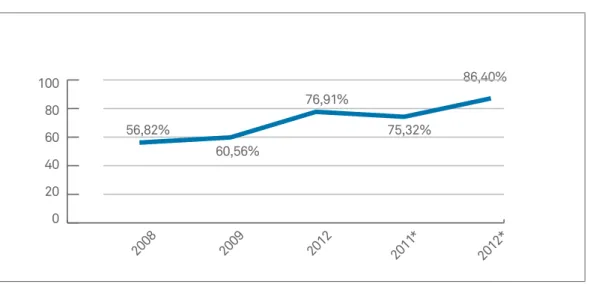
Figure 4. Trend in ICPs in relation to entitlement awarded. Barcelona 2008-2012
Source: Municipal Social Services Institute. Barcelona City Council. *Entry of Degree 1, level 2. **Data from January to September 2012.
Year 2008 2009 2010 2011* 2012**
Eligibility assessments 15,010 15,592 10,687 15,053 5,687 Cumulative eligibility assessments 15,010 30,602 41,289 56,342 62,029
ICPs drafted 8,529 10,004 13,225 10,680 11,161
Cumulative ICPs 8,529 18,533 31,758 42,438 53,599
ICPs as a % of eligibility assessments 56.82% 60.56% 76.91% 75.32% 86.40% Table 1. Care for dependent persons. Barcelona 2008-2012
2.1.4 Dependent persons
Since the entry into force in 2007 of the Law on Promotion of Personal Au-tonomy and Care for Dependants in Barcelona, there has been a steady in-crease in the percentage of Individual Care Plans (ICPs) in relation to eligibi-lity assessments. This upward trend was reversed in 2011 due to two
Quality of Life, Equality and Sport Barcelona Social Inclusion Plan for 2012-2015
24
Table 2. Profile of individuals with a legally recogni-sed form of disability. Barcelona 2011
Profile Number Sex Men Women TOTAL 55,170 62,834 118,004 Age
0 to 15 years 16 to 44 years 45 to 64 years 65 to 74 years 75 years and over
2,729 17,930 36,790 23,015 37,540 Type of disability
Locomotor
Physical, not locomotor Visual Hearing Mental disability Mental illness Not available 40,883 28,499 9,747 6,322 8,862 23,564 127 Degree of disability
33% to 64% 65% to 74% 75% and over
59,974 31,629 26,401
Source: Statistics Department. Barcelona City Council.
2.1.5 People with disabilities
People with disabilities are particu-larly vulnerable to the dynamics of social exclusion because they often need special care to be able to lead a normal life. Barcelona has 118,004 people with some form of legally re-cognised disability, which may take the form of limited mobility, visual impairment, hearing difficulty, men-tal disability or menmen-tal illness, among others (Table 2). This condition is ge-nerally more prevalent in women and people over the age of 44. Most cases of disability are physical but there are also important cases of mental illness. With regard to degree, almost 60,000 people have a recognised disa-bility of 33%-64%, almost 32,000 have 65%-74%, and 26,401 people have a disability of more than 74%.
There are still barriers preventing people with disabilities from living dependently and inclusively. These in-visible barriers stigmatise people with disabilities and, more importantly, tho-se with mental health problems. Gaps have also been detected in certain ser-vices that support independent living, such as personal care services.
70,89 29,11 59,70 40,30 62,74 37,26 72,13 27,87 78,37 21,63 84,57 15,43
Quality of Life, Equality and Sport Plan for Social Inclusion of Barcelona 2012-2015
25
Source: Authors, based on data from the Municipal Statistics Department. Municipal Register of Inhabitants (consulted on 30/06/2011).
45-4 9 yea
rs
40-4 4 yea
rs
35-3 9 yea
rs
30-3 4 yea
rs
25-2 9 yea
rs
20-2 4 yea
rs
Figure 5. Spanish and foreign nationals aged 20 to 49 years. (%) Bar-celona 2011
2.1.6 Immigration
Barcelona's foreign-born population totals 279,724 (data from 30 June 2011), who are markedly younger than the local average because they usua-lly emigrate for financial reasons and hence arrive when they reach wor-king age. The age groups in which fo-reign nationals make up the highest percentages of the total are 25 to 29 years, where they account for 40.3% of the total population, 30 to 34 years (37.26%) and 35 to 39 years (27.87%).
The economic boom brought with it a high demand for labour, which was met mostly by foreign workers. Since early 2000, Barcelona has become home to 163 different nationalities. The eco-nomic crisis has hit the immigrant po-pulation particularly hard because the most precarious or unstable jobs were often filled by foreign nationals, and these jobs were the first to be destro-yed.
Their problems are exacerbated by the fact that they are not in their home towns, so they generally have weaker relational networks and less social su-pport for dealing with social risk fac-tors. The following figure illustrates the proportion of Spaniards to foreign nationals in the age groups with the highest numbers of foreign-born po-pulation (20-49 years).
The foreign-born population of Ciutat Vella makes up 41.6% of the total po-pulation living there, which far exceeds the proportion of foreign nationals in other districts (Figure 6).
In recent years, however, the foreign population has stabilised, indicating that there has been a turnaround in migratory trends. While an exponential increase of 241,490 new foreign natio-nals was recorded between 2001 and 2009, from 2010 to 2012, a decline of 12,740 foreign nationals was obser-ved in the city. This, together with the
increase in mixed marriages and the decline in applications for family re-unification and social integration, is indicative of a change in the migratory paradigm of the city that has been all the more dramatic because of the eco-nomic changes.
Ciuta t Vell
a
Eixam ple
Sant s-Mon
tjuïc Les C
orts
Sarri à-Sa
nt Ger vasi
Gràc ia
Horta -Guin
ardó Nou B
arris Sant
Andr eu
Sant Mar
tí
58,4%
41,6%
82,1%
17,9%
80,0%
20,0%
87,6%
12,4%
88,6%
11,4%
84,3%
15,7%
86,9%
13,1%
83,1%
16,9%
86,5%
13,5%
84,4%
15,6%
2008 8.000
6.000 4.000 2.000 0
2009 2012 2011*
Quality of Life, Equality and Sport Barcelona Social Inclusion Plan for 2012-2015
26
Percentage of Spaniards residing in the district Percentage of foreign nationals residing in the district
Source: Authors, based on data from the Directorate of Immigration. Barcelona City Council.
Source: Authors, based on data from the Statistics Department. Barcelona City Council. Municipal Register of Inhabitants (consulted on 30/06/2011).
Source: Directorate of Immigration. Barcelona City Council.
Year 2008 2009 2010 2011
Applications for family reunification 6,243 4,603 4,178 3,452
Change since 2008 - -26.2% -33.1% -44.7%
Applications for reports on social integration 9,306 11,405 10,048 8,969
Table 3. Family reunification and social integration. Barcelona 2008-2011 Figure 6. Spanish and foreign population by district. (%) Barcelona 2011
5Family reunification is a right enshrined in both EU and Spanish legislation by which foreign residents in Spain can apply to have their families reunited with them.
6Foreign nationals who are in Spain illegally and meet certain conditions (three years' continuous residence in Spain, with means of support and a certain level of integration in the host society) may be eligible for a residen-ce permit through the report on social integration proresiden-cedure.
Quality of Life, Equality and Sport Plan for Social Inclusion of Barcelona 2012-2015
27
Before all transfers before other transfersAfter pensions and transfersAfter all
Barcelona Catalonia Barcelona Catalonia Barcelona Catalonia
Men 34.2 39.8 19.2 26 14.1 18.5
65 years and over 84.4 88.7 - 23 - 18.5
Women 40.6 43.5 22.6 27.8 17.7 21.3
65 years and over 77.6 84.2 21.4 26.4 19.2 23.7
Total 37.5 41.6 20.9 26.9 16 19.9
Under 16 years 29.1 32.5 29.1 31.4 22 23.7
16 to 64 years 25.7 32.8 19.2 26.3 13.7 18.6
65 years and over 80.4 86.1 21.6 25 19.4 21.4
Table 4. At-risk-of-poverty rate before and after social transfers by age. Barcelona 2010
2.2.1 At-risk-of-poverty rate
Given that they are retired, senior citi-zens tend to have moderate incomes, often obtained through state pensions.
Before social transfers,7 the at-risk-of-poverty rate for Barcelona in 2010 stood at almost 80.4% for its senior ci-tizens (over 65s), although social trans-fers cut this figure to 19.4%.
The at-risk-of-poverty rate is even hig-her among children and adolescents, reaching more than 22% of the
popu-lation, after accounting for all transfers. The age range of 16-64 years, represen-ting the working population, has the least risk: 13.7% in Barcelona (Table 4).
The differences between sexes are also striking: on average, women have almost four percentage points more risk than men. This difference is even more appa-rent between men and women aged 65 years or above, for whom the risk rates are 21.3% and 28%, respectively (in this case, the data is for 2009).
2.2.
Quality of Life, Equality and Sport Barcelona Social Inclusion Plan for 2012-2015
28
2006 2007 2008 2009 2010
Barcelona Catalonia Barcelona Catalonia Barcelona Catalonia Barcelona Catalonia Barcelona Catalonia Gini index
S80/20 S90/10
0.31 5.12 8.96
0.29 4.71 7.65
0.32 4.97 8.16
0.29 4.71 7.65
0.31 4.83 9.04
0.29 4.83 9.04
0.30 5.26 8.88
0.29 5.01 10.08
0.33 6.22 15.91
0.32 5.75 13.4 Note: the survey was not designed to be representative of the whole municipality. The results for Barcelona may have a greater margin of error.
Source: Living Conditions Survey. Spanish National Statistical Institute (INE). For Barcelona and Catalonia, data processed by Idescat (Statistical Institute of Catalonia).
Table 5 Gini index. Barcelona and Catalonia. 2006-2010
2.2.2 Gini index
Barcelona has a Gini index8 of 0.3. This means that the 20% of the population with the highest economic level has 6.22 times more income than the 20% of the population with the lowest eco-nomic level. The inequalities between the proportion of the population with the highest purchasing power in the city and that with the lowest have in-creased during the recession, since the S80/20 income quintile share ratio for 2009 is higher than that of 2007 (4.97) (Table 5).
2.2.3 Distribution of income
With regard to the distribution of dis-posable household income per capita between the different districts of Bar-celona (Figure 1), taking as a referen-ce Barreferen-celona=100, we observe that 18 neighbourhoods (out of a total of 73) have very high, high or medium-high in-comes (the top three categories), while the remaining 55 have low-middle, low or very low incomes (the bottom three categories).
Income inequalities between neigh-bourhoods have increased between 2008 and 2011 and now stand 10 po-ints above or below the Barcelona=100 threshold.
12
Zona Franca-Port
Parc de Montjuïc
11 01 10 09 08 26 24 27 07 02 04 67 68 69 70 71 65 72 73 59 58 52 51 48 49 43 45 46 47 57 53 54 55 50 56 64 63 61 62 60 44 35 36 34 30 37 29 28 39 40 41 42 38 33 32 31 06 66 05 03 14 15 16 17 18 19 20 21 23 22 25 13
Quality of Life, Equality and Sport Plan for Social Inclusion of Barcelona 2012-2015
29
Disposable household income
per capita 2011
Neighbourhoods of Barcelona
Source: “Distribució territorial de la renda familiar a Barcelona”, Barcelona Economia, Gabinet Tècnic de Programació. Barcelona City Council.
Ciutat Vella
01 el Raval 02 el Barri Gòtic 03 la Barceloneta
04 Sant Pere, Santa Caterina i la Ribera
l’Eixample
05 el Fort Pienc 06 la Sagrada Família 07 la Dreta de L’Eixample 08 l’Antiga Esquerra de l’Eixample 09 la Nova Esquerra de l’Eixample 10 Sant Antoni
Sants-Montjuïc
11 el Poble Sec
12 la Marina del Prat Vermell 13 la Marina de Port 14 la Font de la Guatlla 15 Hostafrancs 16 la Bordeta 17 Sants-Badal 18 Sants
Les Corts
19 les Corts
20 la Maternitat i Sant Ramon 21 Pedalbes
Sarrià-Sant Gervasi
22 Vallvidrera, el Tibidabo i les Planes
23 Sarrià 24 les Tres Torres
25 Sant Gervasi-La Bonanova 26 Sant Gervasi-Galvany 27 el Putxet i el Farró
Gràcia
28 Vallcarca 29 el Coll 30 la Salut 31 la Vila de Gràcia
31 el camp d’en Grassot i Gràcia Nova
Horta-Guinardó
33 el Baix Guinardó 34 Can Baró 35 el Guinardó 36 la Font d’en Fargues 37 el Carmel
38 la Teixonera
39 Sant Genís dels Agudells 40 Montbau
41 la Vall d’Hebron 42 la Clota 43 Horta
Nou Barris
44 Vilapiscina i la Torre Llobeta 45 Porta
46 el Turó de Peira 47 Can Peguera
48 La Guineueta 49 Canyelles 50 les Roquetes 51 Verdun 52 la Prosperitat 53 la Trinitat Nova 54 Torre Baró 55 Ciutat Meridiana 56 Vallbona
Sant Andreu
57 la Trinitat Vella 58 Baró de Viver 59 el Bon Pastor 60 Sant Andreu 61 la Sagrera
62 el Congrés i els Indians 63 Navas
Sant Martí
64 Camp de l’Arpa del Clot 65 el Clot
66 el Parc i la Llacuna del Poblenou 67 la Villa Olímpica del Poblenou 68 el Poblenou
69 Diagonal Mar i el Front Marítim del Poblenou
70 el Besós i el Maresme 71 Provençals del Poblenou 72 Sant Martí de Provençals 73 la Verneda i la Pau
Disposable household income per capita
2011 (index numbers. Basis is Barcelona=100)
0 50000 100000 150000 200000
2006 2007 2008 2009 2010
170.900
164.200 176.900 176.800
148.800
Quality of Life, Equality and Sport Barcelona Social Inclusion Plan for 2012-2015
30
Source: Authors, based on data from the Municipal Statistics Department. Note: units in thousands. The survey was not designed to be representative of the whole municipality. The results for Barcelona may have a greater margin of error.
2.2.5 Unemployment and job insecurity In June 2012, there were 110,521 unemployed people in Barcelona, with an almost even split between the sexes (51.1% men and 48.9% women). It is not so uniform with regard to age, however, given that 50.4% of the total were aged 25 to 44 years, while 44.1% were aged 45 or over. Nonetheless, sin-ce the working population figures vary by age group, the percentage of unem-ployed people in each group can in fact be very high or very low (here, the analysis is based on the absolute value of all unemployed people in Barcelona).
Regardless of the level of education among the total unemployed, nearly 70% of unemployed people have a low educational level (no education or in-complete primary education, primary education or general studies). There is a high percentage of unemployed with a university education (more than 16% of all unemployed have a univer-sity degree). With regard to nationality, although the foreign-born population only accounts for 21.1% of yed residents, the impact of unemplo-yment on this group is higher because they make up just 17% of the total po-pulation of Barcelona and because this group has a higher rate of people of working age than the local population.
The duration of this unemployment is somewhat polarised: 44.2% of unem-ployed people have been in this situa-tion for less than 6 months, but 36% have been unemployed for over a year. The latter figure is worrying because the negative consequences of being unemployed worsen as the duration increases (chances of finding employ-ment, personal distress, etc.).
People over the age of 45 have longer periods of unemployment, since they account for 64% of people who are unemployed for over a year. This group usually has the most difficulties fin-ding another job (Figure 9 and 10). Figure 8. Household perceptions of the difficulty in
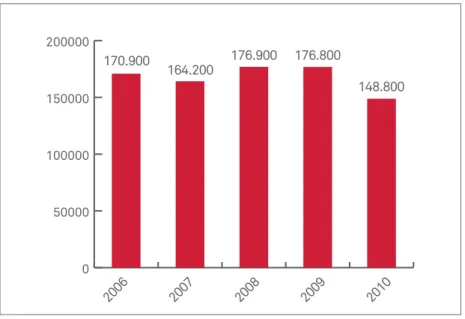
making ends meet. Barcelona 2006-2010
2.2.4 Difficulties making ends meet The economic crisis is affecting a large section of the population and many fa-milies are suffering its consequences. One way to measure this impact is how households perceive the difficulties they have in making ends meet.
The number of families that said they felt this was the case dropped bet-ween 2006 and 2007, only to increase again sharply between 2007 and 2008, when the figure rose from 164,200 to 176,900, accounting for 27.18% of all households in the city. A similar trend is observed between 2008 and 2009, when the figure stood at 27% of house-holds (Figure 8).
50% 40% 30% 20% 10% 0%
Quality of Life, Equality and Sport Plan for Social Inclusion of Barcelona 2012-2015
31
Jun ' 12 Apr '1
2 Feb '
12 Dec '
11 Oct '1
1 Aug '
11 Jun '
11 Apr '1
1 Feb '
11 Dec '
10 Oct '1
0 Aug '
10 Jun '
10 Apr '0
9 Feb '
09 Dec '
09 Oct '0
9 Aug '
09 Jun '
09
Source: Authors, based on data for the second quarter of 2012 from the Labour Force Survey (INE).
45 years and over
64%
< 25 years
1%
25-44 years
35%
Figure 10. Unemployed population not receiving benefits in Barcelona. June 2009 to June 2012 (%)
Source: Authors, based on data from the Labour Force Survey (INE) and the Department of Emplo-yment. June 2012 data. Government of Catalonia. Prepared by the Statistics Department. Barcelona City Council.
Number of unemployed persons % of total unemplo-yed
Total unemployed 110,521 100%
Sex Men
Women 56,44054,081 51.1%48.9% Age
Under 24 years 25 to 44 years 45 years and over
6,106 55,661 48,754 5.5% 50.4% 44.1% Education level
No education or did not finish primary
Primary
Vocational training General education Advanced technical or vocational training University
Other post-secondary education 2,739 5,231 9,284 67,280 8,150 17,596 241 2.5% 4.7% 8.4% 60.9% 7.4% 15.9% 0.2% Nationality Spanish
Foreign 87,23023,291 78.9%21.1% Months unemployed
Less than 6 months 6 to 12 months More than 12 months
48,821 21,884 39,816 44.2% 19.8% 36.0%
Table 6. Unemployment. Barcelona, June 2012
Figure 9. Long-term unemployed: more than 12 months. Barcelona 2012
Source: Authors, based on data from the Labour Force Survey (INE) and the Department of Emplo-yment. June 2012 data. Government of Catalonia. Prepared by the Statistics Department. Barcelona City Council.
One of the most serious consequen-ces of long-term unemployment is the loss of benefits. In a single year, 2010, the rate of unemployed people not re-ceiving unemployment benefit has ri-sen from 27% to 34% (Figure 10). This trend, which is likely to continue over the coming years, has serious conse-quences for the population concerned, since they no longer have a stable sour-ce of income and often have to rely on their social networks (family, friends, etc.) to get by.
0 300 600 900 1.200 1.500
Ciuta t Vell
a Eixam
ple
Sant s-M
ontju ïc
Les C orts
Sarri à-Sa
nt G erva
si Gràc
ia
Horta -Guin
ardó Nou B
arris Sant
Andr eu
Sant Mar
tí
1.201
443
560
70 170
287 656
996
406 729
Quality of Life, Equality and Sport Barcelona Social Inclusion Plan for 2012-2015
32
Source: Authors, based on data from the Department of Research and Knowledge. Area of Quality of Life, Equa-lity and Sport. Barcelona City Council.
Figure 11. Number of minimum income allowance beneficiaries by district. Barcelona 2011
Source: Government of Catalonia.
No. of open cases No. of beneficiaries
Minimum income allowance recipients 2,708 5,470
Table 7. Minimum income allowance recipients. Barcelona 2012 (January to September)
2.2.6 Minimum income allowance The purpose of the minimum income allowance is to provide support to tho-se who cannot otherwitho-se meet their basic needs, with resources for their sustenance and to foster their social and labour integration or rehabilita-tion, as set out in Article 1 of Decree 384/2011 of 30 August 2011.
This Decree sets out mechanisms for social and labour integration and re-integration in an effort to tackle the problems of poverty and marginalisa-tion. It recognises the right to a welfare subsidy, subject to the beneficiary's commitment to continue and perform actions to promote his/her social and labour integration, which are set out in the document formalising their inte-gration agreement. Law 7/2011 on Tax
and Financial Measures (27 July 2011) made substantial amendments to the Law on the Minimum Income Allowan-ce, particularly the conditions for eligi-bility.
Quality of Life, Equality and Sport Plan for Social Inclusion of Barcelona 2012-2015
33
Source: Idescat and the Department of Research and Knowledge. Area of Quality of Life, Equality and Sport. Barcelona City Council.
% Men % Women
Minimum income allowance recipients 25.7% 74.3%
Disability NCPs 47.5% 52.4%
Law on Social Integration of People with Disabilities 18.3% 81.7%
TOTAL 30.8% 69.2%
Table 9. Non-contributory Social Security pensions by sex. Barcelona 2011.
NCPs BARCELONA
2007 2008 2009 2010 2011
Retirement NCPs 8,207 7,977 7,737 7,632 7,565
Annual average €3,976 4,287 4,341 4,386 4,574
Disability NCPs 7,617 7,648 7,694 7,782 7,892
Annual average 4,427 4,752 4,802 4,878 5,049
Welfare Fund 17 9 9 6 5
Law on Social Integration
of People with Disabilities 378 282 240 212 184
Additional support to
widow's pensions 13,388 12,102 6,029 5,112 4,646
2.2.7 Non-contributory pensions Non-contributory pensions (NCPs) are a type of welfare benefit awarded to people who are unable to work either due to age or disability. This benefit is intended to be a stable source of inco-me for these individuals.
The annual sum paid out in non-con-tributory pensions is EUR 4,574, which is received in 14 instalments of EUR 325 per month. Despite this financial support, elderly people without
so-cial networks tend to be at risk of ex-clusion if they rely exclusively on these pensions because they tend to have the added problem of reduced mobility (Table 8).
Most of the beneficiaries of retirement NCPs are elderly women, a group that is particularly vulnerable to the risks of social exclusion. By contrast, the gen-der balance of disability NCPs is more even (Table 9).
Source: Department of Research and Knowledge. Area of Quality of Life, Equality and Sport. Barcelona City Council.