Artificial Neural Network Algorithm for On-Line Glucose Prediction from
Continuous Glucose Monitoring
C. Pérez-Gandía
1'
2, A. Facchinetti
3, G. Sparacino
3,
C. Cobelli
3, E.J. Gómez
2'
1, M. Rigla
4, A. de Leiva
5, M.E. Hernando
2'
1'Networking Research Center on Bioengineering, Biomaterials and Nanomedicine (CIBER-BBN), Madrid, Spain.
2Grupo de Bioingeniería y Telemedicina, Universidad Politécnica de Madrid, Spain. 3Dipartimento di Ingegneria dell'Informazione, Universitá degli Studi di Padova, Italy.
4 Endocrinology Department, Hospital de Sabadell, Spain. 5Endocrinology Department, Hospital Sant Pau, Barcelona, Spain.
Funding source:
This work was partially supported by the Spanish FIS grant from the Ministry of Health and Consumer Affairs "ADVISING"- FIS PI060437 and CIBER-BBN (PREDIRCAM) and by the grant "Simulation models and filtering/prediction techniques for the development of an artificial pancreas" from the Italian Ministry of Education, University and Research (PRIN 2007).
Corresponding Author: Carmen Pérez-Gandía
Address: Grupo de Bioingeniería y Telemedicina, ETSI Telecomunicación, Ciudad Universitaria
s/n, 28040 MADRID, Spain
Phone +34 91 5495700
Fax +34 91 3366828
Email [email protected]
Author Disclosure: The authors have no conflicts of interest
Abstract
Background and Aims: Continuous glucose monitoring (CGM) devices could be useful for real-time
management of diabetes therapy. In particular, CGM information could be used in real-time to predict future
glucose levels in order to prevent hypo/hyperglycemic events. This paper proposes a new on-line method for
predicting future glucose concentration levels from CGM data.
Methods: The predictor is implemented with an artificial neural network model (NNM). The inputs of the NNM
are the values provided by the CGM sensor during the preceding 20 minutes, while the output is the prediction of
glucose concentration at the chosen prediction horizon (PH) time. The method performance is assessed using
datasets from two different CGM systems (9 subjects using the Medtronic Guardian and 6 subjects using the
Abbott Navigator). Three different PH are used, i.e. 15, 30 and 45 minutes. The NNM accuracy has been
estimated by using the root mean square error (RMSE) and prediction delay.
Results: The RMSE is around 10, 18 and 27 mg/dl for 15, 30 and 45 minutes of PH, respectively. The prediction
delay is around 4, 9 and 14 minutes for upward trends and 5, 15 and 26 minutes for downward trends,
respectively. A comparison with a previously published technique, based on an autoregressive model (ARM) [1],
has been performed. The comparison shows that, the proposed NNM is more accurate than the ARM, with no
significant deterioration in the prediction delay.
Conclusions: The proposed NNM is a reliable solution for the on-line prediction of future glucose concentrations
1 Introduction
One of the difficulties in achieving a good metabolic control is that patients have limited information about blood
glucose for assessing the adequacy of the therapy for their daily actions. Insulin therapy has to respond dynamically
to the glucose levels and the corresponding insulin demand. The factors that play an important role in the
insulin-glucose balance are: the diet, the physical exercise, stress and illness, etc. For this reason, blood sugar levels may
become harder to control by the patient himself [2].
Traditionally self-monitoring of blood glucose requires the drawing of a blood spot several times a day. The
number of capillary blood glucose measurements (CBGM) is reduced mainly due to the pain associated with testing.
Nowadays, the availability of continuous glucose monitoring (CGM), which provides information in real time,
makes it possible to obtain a subcutaneous glucose reading every few minutes [3]. In this new scenario patients have
to interpret a huge amount of continuous information in order to calculate the necessary insulin dose and bring
blood sugar levels as close to normal as possible.
Most of the CGM systems available in the market are minimally invasive systems that measure the glucose in the
interstitial fluid (ISF) compartment and not directly from plasma. Thus, there is a distortion between the glucose in
the ISF with regard to the blood glucose levels, with a temporal delay that can become longer than 10 minutes [3].
A glucose predictor would enhance the CGM with valuable information on the expected glucose level in a time
horizon. The predictor could aid the patient in anticipating his/her actions, but a predictor model is useful if the
prediction horizon (PH) is long enough to allow the patients to anticipate their decisions, and that also depends on
the relative delay between the CGM system measurement and the blood glucose value.
Artificial Neural Networks could be especially recommended to solve problems that cannot be easily described
by mathematical algorithms that are highly non-linear or when the variables can evolve from the initial conditions.
For these reasons neural network techniques have been used in the past for predicting glucose levels using CBGM
values as input and also within glucose control systems. Some examples are reported below.
Sandham et al. [4] presented a neural network model (NNM) that used blood glucose capillary measurements,
insulin doses and intake as input data, for predicting blood glucose levels. It also considered other relevant
patients.
Mougiakakou et al. [5] proposed a hybrid system based on the combination of a compartmental model (CM) and
a NNM for blood glucose prediction. The CM generates an estimation of the insulin and intake effect and the NNM
used this estimation and two previous CBGM to predict the subsequent blood glucose levels. The CM utilized
information about insulin type and doses as well as the description of food intake. The network was evaluated with
data from a Type 1 diabetes patient over a period of 69 days.
Volker Tresp et al. [6] also presented a hybrid CM-NNM system. The CM simulates the delay in carbohydrate
intake absorption, the physical exercise and the administered insulin dynamics. The NNM uses the CM estimation
and the current and previous estimates of the blood glucose to predict the next glucose value. Data was used from
one patient monitored over 63 days at 15-minute intervals.
All of the predictors referred to the use of self-CBGM [4-6] and required auxiliary details like insulin and intake
data, hypoglycemic events and exercise among others. The availability of CGM opens a new scenario: glucose
measurement is continuous information and any method suitable for time series analysis could be explored in the
attempt to find a solution for the prediction problem [9].
Sparacino et al. compared the predictive performance of a order polynomial model [10] with that of a
first-order autoregressive model (ARM) [1], both with time-varying parameters. The inputs of the models were past
glucose data. The models were evaluated with data of diabetic patients wearing the GlucoDay® CGM System (A.
Menarini Diagnostics, Italy) that provides glucose levels every 3 minutes. The results demonstrated that glucose
prediction was feasible with the two prediction methods and concluded that for the dataset used and a prediction
interval of 30 minutes, the ARM was the more reliable for obtaining a clinically significant prediction performance.
Reifman et al. [11] used a 10th-order data-driven ARM. The inputs of the model were the previously observed
glucose levels. It was trained and evaluated with data of the iSense® CGM system (iSense Corporation, Portland,
Oregon). The CGM measurement rate was one sample per minute. The results demonstrated that the predictions for
a PH of 30 minutes were quite accurate.
Palerm et al. [12] proposed an algorithm to predict glucose levels based on the estimation of glucose and its rate
of change, using a Kalman filter. They applied the algorithm to predict hypoglycemia using data from a series of
30 minutes of PH and an alarm threshold of 70 mg/dl, the algorithm was effective in predicting hypoglycemia
(sensitivity of 90% and specificity of 79%).
Artificial Neural Network Models have also been applied in the prediction of glucose concentrations using CGM
data. Pappada et al. [14] presented a NNM trained with data from the CGMS Medtronic System in combination with
other data manually recorded by the patient in an electronic diary (i.e. CBGM, insulin dosages, carbohydrate
intakes, hypoglycemic and hyperglycemic symptoms, lifestyle activities, events and emotional state). Unfortunately
the prediction accuracy cannot be compared with that reported in other works in the literature [1, 10, 11] because
they calculated the mean percent absolute difference of the model's predictive abilities instead of the commonly
used evaluation parameters. They concluded that the model tended to underestimate extreme hyperglycemic values
and overestimate hypoglycemic values.
In this paper we propose a new real-time prediction algorithm based on a NNM for CGM. The model is trained
using only CGM data as inputs, and the validation is performed by exploiting two datasets from two different
commercial CGM devices. The results show that the accuracy of NNM prediction is satisfactory. Furthermore, the
NNM is more accurate than the ARM developed by Sparacino et al. [1], with no significant deterioration in the
prediction delay. The proposed NNM algorithm is therefore a reliable solution for the on-line prediction of future
glucose concentrations based on CGM data.
2 M e t h o d s
2.1 Subjects and Dataset
The evaluation of the prediction algorithm was performed using data from the Guardian® Real-Time CGM
System (Medtronic-Minimed, Northridge, CA) and the FreeStyle Navigator® CGM System (Abbott Laboratories,
Abbott Park, Illinois). The Guardian® provides a single output measurement every 5 minutes (288 samples per day).
The FreeStyle Navigator® produces a single output measurement every minute (1440 samples per day).
The Guardian® dataset includes data from nine patients with Type 1 diabetes. The patients wore the CGM system
intermittently for 72 hours/week over four weeks. The dataset includes 12 daily profiles for every patient: 6 full-day
The FreeStyle Navigator® dataset includes data from six patients with Type 1 diabetes. The patients wore the
CGM system for around 72 hours. The dataset includes 2 complete daily profiles for every patient [16].
Figure 1 shows two profiles extracted from the respective datasets.
Remark 1. Before feeding the prediction algorithm, it was found convenient to reduce the effect of noise in the
FreeStyle Navigator® profiles (1 min. sampling) by pre-filtering them using a causal Kalman filtering method [17].
However, the quantitative assessment of the prediction methodology in Section 2.4 is done by taking the original
profiles as reference.
2.2 Description of the neural network model
The network architecture has three layers with a first layer of 10 neurons and a second layer of 5 neurons [15].
The transfer function is sigmoidal in both layers. Neurons are totally connected and feedforward. The output layer
has one neuron with linear transfer function.
The network input information is the current glucose measurement and its timestamps together with a limited
number of previous glucose samples from the CGM system. The NNM takes into account the glucose measurements
up to 20 minutes before the current time. Since the sampling rate varies from one CGM system to another, the
number of the NNM inputs is different for each dataset. The output of the network is the glucose prediction at the
PH time.
Figure 2 shows the NNM architecture using the Guardian® data. In this case, the sensor registers the glucose
every 5 minutes, so this model needs 5 CGM samples as inputs to work with a memory of 20 minutes. Using the
FreeStyle Navigator®, the NNM presents 20 CGM samples as inputs. The current time is provided as the order
Network parameters (weights and bias) are randomly initialized and, afterwards, are updated according to a
backpropagation Levenberg-Marquardt optimization training algorithm. The training algorithm is applied in a batch
mode, in which weights and biases are only updated when all the inputs and targets are presented. Three NNM have
been trained to predict glucose after 15, 30 and 45 minutes in order to evaluate the network performance depending
on the PH.
For each dataset, 3 subjects (each with 2 daily profiles) were used for training the NNM. Missing samples have
been calculated using spline techniques to recover missing samples before using the glucose profiles for training.
Patients in the training set did not take part in the validation.
2.3 Description of the autoregressive model
The autoregressive model proposed here is the same first order model used in [1], which corresponds to the
time-domain equation
Ui=aui_i+Wi (1)
In eq.(l), i=l, 2, .. .n denotes the order of glucose samples collected up to the n-th sampling time tn and {wt} is a random white noise process with zero mean and variance equal to o2. Letting 0=(a, o2) denote the vector of the parameters of the model, at each sampling time tn, a new value of 0 is determined by fitting past glucose data un, un_ i, un_2,... by a weighted linear recursive least squares algorithm. Once 0 is determined, the model is used to calculate the prediction of glucose level Q steps ahead, i.e. u1+Q. where Q-TS=PH (Ts is the sensor sampling period). All the past data participate, with different relative weights, in the determination of 0. As in [1], here we chose exponential
weights, i.e. Lik is the weight of the sample taken k instants before the actual sampling time with LI termed forgetting factor. For more specific details on the algorithm, we refer the reader to [1].
A different optimal LI value has been chosen for each dataset and for each PH, minimizing the root mean square
error RMSE (mg/dl) between the original data of the training set and the predicted values obtained applying the
For the Guardian® dataset this optimization step suggested the use of u=0.695, 0.795, and 0.87 for PH=15, 30,
and 45 minutes, respectively. For the FreeStyle Navigator® dataset, the parameters were u=0.92, 0.938, and 0.985
forPH=15, 30, and 45 minutes.
2.4 Evaluation Methodology
Patients in the training set did not take part in the NNM and ARM validation. The validation set for the
Guardian® monitor includes 6 patients and 6 profiles per patient. The validation set for The FreeStyle Navigator®
monitor includes 3 patients and 2 profiles per patient. The profiles in the training set have been suitably chosen in
order to represent both low and high glucose levels, e.g. they contain several hypo and hyperglycemic events.
Figures 3 and 4 show the original CGM profile and the predictions from the NNM and ARM for 15, 30 and 45
minutes of PH for the same examples shown in Figure 1 (a) and (b).
To assess the performance of each model, we calculate the model accuracy and the model delay and we evaluate
the influence of different PH (15, 30 and 45 minutes) on the two parameters.
The model accuracy has been evaluated as the RMSE (mg/dl) of the predicted profiles vs. the original ones.
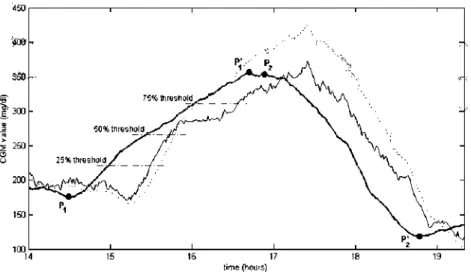
The model delay has been estimated calculating the delays between the original and the predicted profiles when
they cross three different thresholds, defined in the following way. First, peaks and nadirs are identified in the
original sensor profile. Then, thresholds are placed at 25%, 50% and 75% of the nadir-to-peak (Px — Px ) I
peak-to-nadir (P2 —P2) distance for positive / negative trends, respectively (figure 5). The final model delay is calculated as
the average of threshold delays for every positive and negative trend. Notably, for the Navigator data, the calculated
delay includes a contribution due to the use of the pre-filtering procedure described in Section 2.1 (Remark 1).
Remark 2. In order to identify threshold crossings more easily, given the retrospective nature of the assessment,
the original and the predicted profiles have been filtered by a first order Butterworth low-pass filter, with
The differences in RMSE between the Guardian® and the FreeStyle Navigator® systems are analyzed with the
non-parametric Mann-Whitney U test.
3 Results
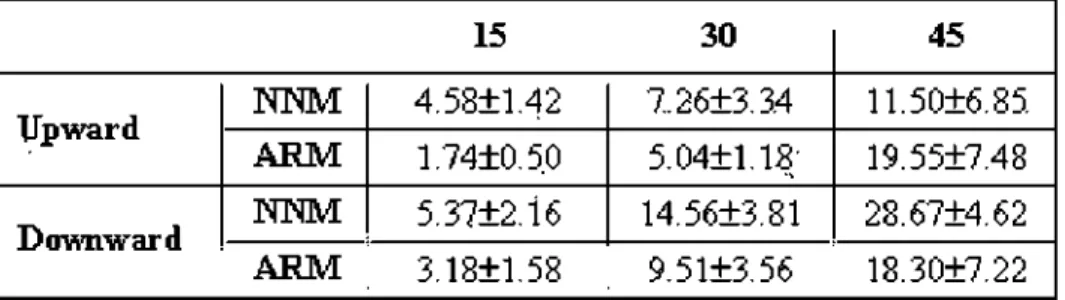
Tables 1 and 2 show the average prediction error, RMSE in mg/dl and the standard deviation (SD), for each
model (NNM and ARM) when applied to the Guardian® and the FreeStyle Navigator® validation sets. The results
are calculated for 15, 30 and 45 minutes of PH.
Tables 3 and 4 show the average delay in minutes and the SD, considering positive (upward) and negative
(downward) trends.
The precision of the NNM and the ARM (RMSE values in Tables 1 and 2) are quite similar and very accurate for
PH=15' (around 10 mg/dl for both models). However considering PH=30 and 45, the NNM is more accurate than
the ARM presenting lower RMSE values (18 mg/dl vs. 22 mg/dl for PH=30 and 27 mg/dl vs. 35 mg/dl for PH=45)
For PH=15 the mean delay with the NNM is usually around 3 minutes longer than for the ARM. When the PH
increases, for PH=30 and 45, the ARM is more rapid than the NNM in all cases except for upward trends and
FreeStyle Navigator®. The delay (tables 3 and 4) shows that the NNM is useful for PH=30 and 45 in helping Type 1
diabetic patients to prevent hypo and hyperglycemic events.
It is interesting to note that both models are more rapid in upward than in downward slopes (tables 3 and 4). This
could be explained by the fact that, for physiological reasons, the upward trends are usually more rapid than the
downward trends, and the upward-to-downward changes are usually more marked than downward-to-upward
changes. For this reason both models exhibit greater overshooting in the upward-to-downward zones and the
subsequent downward trend is dogged by this effect, so both models exhibit a greater delay in crossing the threshold
The non-parametric Mann-Whitney U test shows that the RMSE is lower for the Guardian® than for the
FreeStyle Navigator® system both for the NNM and the ARM (NNM-15, NNM-30, NNM-45, ARM-15, ARM-30
and ARM-45). The differences were always significant (pO.Ol).
4 Conclusions
From the results, we can conclude that the NNM predictor is a reliable solution to the problem of predicting
glucose values from CGM systems. The method presented here is totally causal and can be applied for on-line
glucose prediction. The training algorithm can be executed on a common PC. For the training set size used (6
profiles), the training algorithm takes from 1.5 to 2.5 hours for Guardian® data (it depends on the configuration of
the learning algorithm parameters) and from 7.5 to 8.5 hours (because of the more frequent sampling rate) for
FreeStyle Navigator® data. It is important to point out that, once the NNM is trained, the algorithm that calculates
the prediction could run in real time even on a portable PDA system.
The results obtained by applying the NNM are very encouraging. In this work, we successfully tested the
possibility of applying the NNM by exploiting as input data only the previously collected CGM values. We have
proved that, even if the NNM has been trained with a reduced number of profiles, coming from several subjects
(excluding individual data) and representing a variety of situations (including hypo and hyperglycemic events), the
prediction is sufficiently accurate. This fact allows us to speculate that if the training set is incremented, almost any
changes in glucose profile due to individual metabolic fluctuations may be accurately assessed by the NNM.
However, the fact that only past CGM data is used as input of the NNM introduces some limitations, i.e. it does
not allow the NNM to rapidly detect possible sudden changes in the time derivative of the signal due to intrinsic
changes (i.e. individual metabolic fluctuations) as well as extrinsic changes (i.e. meal intake and/or insulin
injections). Integrating into the model quantitative information concerning, for example, insulin injections and meal
intakes could be beneficial to the prediction (i.e. it could also allow the use of a wider PH and facilitate tracking of
rapid changes in glucose). However, how to do it is still rather unexplored in the literature (also because of the lack
At the present time, we are investigating new models that take into account intake and insulin delivery in
different ways (as simple as possible for the patient) as input data. In order to improve the NNM structure, a new
trial protocol has been designed in which meals and insulin delivery are tracked.
The results show that the prediction accuracy is better with Guardian®, even though its sample rate is lower than
that of the FreeStyle Navigator®.
Several other aspects could be studied in the future. For instance, since the quantitative performance of the
predictor seems to be quite dependent on the specific CGM system, it might be interesting to evaluate the NNM
with other CGM systems. It could be of interest to analyze the impact on predictors of different sampling rates and
different noise variances. In addition, the possibility of predicting the blood glucose rather than the interstitial
glucose could be taken into account, i.e. by combining the model with an on-line deconvolution procedure based on
a physiological model for comparing plasma and interstitial fluid glucose kinetics.
Acknowledgements
Prof. Boris Kovatchev (University of Virginia Health System, Charlottesville, VA) is acknowledged for having
provided part of the data published in [16].
5 References
[1] G. Sparacino, F. Zanderigo, S. Corazza, A. Maran, A. Facchinetti and C. Cobelli, "Glucose Concentration can be Predicted
Ahead in Time From Continuous Glucose Monitoring Sensor Time-Series," Biomedical Engineering, IEEE Transactions on,
2007, vol. 54, pp. 931-937.
[2] The American Association of Clinical Endocrinologists, AACE., "Medical guidelines for the management of diabetes
mellitus: the AACE system of intensive diabetes self-management," Endocrine Practice, 2007, vol. 13.
[3] S. K. Garg, H. K. Hoff and H. P. Chase, "The role of continuous glucose sensors in diabetes care," Endocrinology &
[4] W. A. Sandham, D. Nikoletou, D. J. Hamilton, K. Patterson, A. Japp and C. MacGregor, "Blood glucose prediction for
diabetes therapy using a recurrent artificial neural network," in IX European Signal Processing Conference (EUSIPCO),
Rhodes, 1998, pp. 673-676.
[5] S. G. Mougiakakou, K. Prountzou and K. S. Nikita, "A real time simulation model of glucose-insulin metabolism for type 1
diabetes patients," in 27th Annual International Conference of the Engineering in Medicine and Biology Society
(IEEE-EMBS), 2005, pp. 298-301.
[6] V. Tresp, T. Briegel and J. Moody, "Neural-network models for the blood glucose metabolism of a diabetic," Neural
Networks, IEEE Transactions on, 1999, vol. 10, pp. 1204-1213.
[7] Z. Trajanoski and P. Wach, "Neural predictive controller for insulin delivery using the subcutaneous route," Biomedical
Engineering, IEEE Transactions on, 1998, vol. 45, pp. 1122-1134.
[8] S. G. Mougiakakou and K. S. Nikita, "A neural network approach for insulin regime and dose adjustment in type 1 diabetes,"
Diabetes Technology and Therapeutics, 2000, vol. 2, pp. 381-389.
[9] T. Bremer and D. A. Gough, "Is blood glucose predictable from previous values? A solicitation for data," Diabetes, 1999,
vol. 48, pp. 445-451.
[10] G. Sparacino, F. Zanderigo, A. Maran and C. Cobelli, "Continuous glucose monitoring and hypo/hyperglycaemia
prediction," Diabetes Research and Clinical Practice, 2006, vol. 74, pp. S160-S163.
[11] J. Reifman, S. Rajaraman, A. Gribok and W. K. Ward, "Predictive monitoring for improved management of glucose levels,"
Journal of Diabetes Science and Technology, 2007, vol. 1, pp. 478-486.
[12] C. C. Palerm, J. P. Willis, J. Desemone and B. W. Bequette, "Hypoglycemia Prediction and Detection Using Optimal
Estimation," Diabetes Technology & Therapeutics, 2005, vol. 7, 1, pp. 3-14.
[13] C. C. Palerm and B. W. Bequette, "Hypoglycemia detection and prediction using continuous glucose monitoring — a study
on hypoglycemic clamp data," Journal of Diabetes Science and Technology, 2007, vol. 1, pp. 624-629.
[14] S. M. Pappada, B. D. Cameron and P. M. Rosman, "Development of a Neural Network for Prediction of Glucose
Concentration in Type I Diabetes Patients," J Diabetes Sci Technol, 2008, vol. 2, pp. 792-801.
[15] C. Pérez-Gandía, M. E. Hernando, C. O. S. Sorzano, A. Otero-Quintana, G. García-Sáez, A. Rodríguez-Herrero, M. Rigla,
A. de Leiva and E. J. Gómez, "Neural networks for glucose prediction in continuous glucose monitoring," in 1st Conference
on Advanced Technologies & Treatments for Diabetes (ATTD), Prague, 2008, pp. 112.
[16] B. P. Kovatchev, L. A. Gonder-Frederick, D. J. Cox and W. L. Clarke, "Evaluating the Accuracy of Continuous
Glucose-Monitoring Sensors: Continuous glucose-error grid analysis illustrated by TheraSense Freestyle Navigator data," Diabetes
[17] A. Facchinetti, G. Sparacino and C. Cobelli, "Real time adaptive Kalman filtering for continuous glucose monitoring noise
t * [t-20]
Gp[t-15]
Gp[t-10]
Gp[t-6]
Gp[t]
[t]
|Gp[t+PH]
PH = 15'
9 10 11 12 13 14 15 16
time (hours)
17 18 19 20
350
_ 3 0 0 -TJ
% c 250
-4> 3 200 H
(4 > ¡E 150
-o o 100
50
-) 10 11 12 13
PH=30'
.'"•.
/ni—~\I7~~~~'-14 15 16
time (hours)
17 18 19 20
350
_ 3 0 0
-I1 250
-a 3 200
-a
>
E 150 -O o
100
-_ 3 10 11 12 13
PH=45'
. • • .
14 15 16
time (hours)
17 18 19 20
13 1 4 15 1E
time (hours)
450
400
§ 3 5 0
§.300
-01
3 250
-03 * 200 g l S O
100
-5 ^ * -5 ^ " ^
Í 10 11 12 13
PH=30'
14 15 16 time (hours)
17 18 19 20
450
400
S 3 5 0
§ . 3 0 0
-a
3 250
-&
* 200 § 1 5 0
100
-10 11 12 13
PH=45'
14 15 16 time (hours)
17 "
18 19 20
400
350
300
250
200
150 "Vi
75% threshold > ^
50%thresholcic^*\/
25% t h r e s h o l d / /•••'
P,
i i
P> "=• 7 \
i
í**"
-_
i
time (hours)
WTSM
ARM
15
9.74±2.71
9.2612.97
30
45
17.45±5.44 25.08±8.73
20.27±7.27
30.30±11.89
RNM
ARM
15
10.3813.15
10.4613.55
30
19.5115.53
24.3618.97
45
29.07±6.77
39.36±10.38
15
Upward
Downward
RNM
ARM
RNM
ARM
3.92±1.21
0:75+0.28
5.10+1.65
1.30+0.38
30
11.65+4.11
6.26+1.35
15.92+3.64
8.87+0.44
45
16.46+4.79
12.59+3.01
23.82+5.13
19.15+1.41
Upward
Downward
W1NM
A R M
W1NM
A R M
15
4.58±1.42
1.74±0.50
5.37±2.16
3.18±1.58
30
7..26±3.34
5.04±1.18
14.56±3.81
9.51±3.56
45
11.50±6.85
19.55±7.48
28.67±4.62
18.30±7.22