Article
An Adaptive Control Scheme for Variable Speed
Wind Turbines Providing Frequency Regulation in
Isolated Power Systems with Thermal Generation
Ana Fernández-Guillamón1,† , Guillermo Martínez-Lucas2,*,† and Ángel Molina-García1,†
and Jose Ignacio Sarasua2,†
1 Department of Automatics, Electrical Engineering and Electronic Technology, Universidad Politécnica de Cartagena, 30202 Cartagena, Spain; [email protected] (A.F.-G.); [email protected] (Á.M.-G.) 2 Department of Hydraulic, Energy and Environmental Engineering, Universidad Politécnica de Madrid,
28040 Madrid, Spain; [email protected]
* Correspondence: [email protected]; Tel.: +34-91-067-43-33
† These authors contributed equally to this work.
Received: 27 May 2020; Accepted: 28 June 2020; Published: 1 July 2020
Abstract:The lack of synchronous inertia, associated with the relevant penetration of variable speed
wind turbines (VSWTs) into isolated power systems, has increased their vulnerability to strong frequency deviations. In fact, the activation of load shedding schemes is a common practice when an incident occurs, i.e., the outage of a conventional unit. Under this framework, wind power plants should actively contribute to frequency stability and grid reliability. However, the contribution of VSWTs to frequency regulation involves several drawbacks related to their efficiency and equipment wear due to electrical power requirements, rotational speed changes, and subsequently, shaft torque oscillations. As a result, wind energy producers are not usually willing to offer such frequency regulation. In this paper, a new control technique is proposed to optimize the frequency response of wind power plants after a power imbalanced situation. The proposed frequency controller depends on different power system parameters through a linear regression to determine the contribution of wind power plants for each imbalance condition. As a consequence, VSWTs frequency contribution is estimated to minimize their mechanical and electrical efforts, thus reducing their equipment wear. A group of sixty supply-side and imbalance scenarios are simulated and analyzed. Results of the case study are compared to previous proposals. The proposed adaptive control reduces the maximum torque and rotational speed variations while at the same time maintaining similar values of the load shedding program. Extensive results and discussion are included in the paper.
Keywords:frequency control; isolated system; linear regression; power system stability; wind turbines
1. Introduction
The different services carried out by the transmission system operators (TSO) for a reliable and
secure power system are known as ancillary services [1]. Among them, load-frequency control
focuses on mitigating the effects of unpredictable changes both in the demand and in the generation
units that can address frequency deviations [2]. In fact, power imbalances between generation and
consumption cause frequency variations [3]. In Europe, frequency control has a hierarchical structure,
usually organized in up to five layers (from fast to slow timescales): (i) frequency containment (also known as primary frequency control); (ii) imbalance netting; (iii) automatic and/or manual
frequency restoration (also known as secondary frequency control), and (iv) replacement [4]. If the
different reserves of such frequency control layers are consumed or unable to keep frequency within an acceptable range, a variety of strategies called special protection systems are then used. Load shedding
is included in those special protection systems. Moreover, it is considered as the last option to prevent
frequency instability [5]. Despite load shedding being an effective solution to prevent a power system
collapse after a major imbalance, it is considered as an undesirable situation and it is important to reduce it as much as possible [6–8].
Traditionally, power systems have been based on conventional power plants with synchronous generators directly connected to the grid, automatically providing their stored kinetic energy after
a generation-load mismatch [9]. However, in recent decades, power systems have been suffering a
slow change from conventional synchronous power plants to inverter-interfaced renewable energy sources (II-RES), i.e., wind power plants based on variable speed wind turbines (VSWTs) and/or
solar photovoltaic (PV) [10]. Among them, VSWTs are considered as the most efficient, developed,
and installed renewable resource, and currently they account for more than 650 GW of installed
capacity around the world [11,12]. This remarkable integration of wind power plants requires an
important reformulation of their contribution to ancillary services [13]. Moreover, as they are connected
to the grid through power inverters, the synchronous inertia of the power system decreases when
such renewable source replaces conventional power plants [14]. Indeed, faster rate of change of
frequency (RoCoF) and larger frequency deviations are related to low synchronous system inertia
values [15]. These effects are even more critical in isolated power systems [16,17]. As a result,
Toulabi et al. consider that, due to the massive integration of VSWTs, their participation into frequency
control is necessary [18]. With this aim, different frequency control approaches can be found in the
specific literature to effectively replace conventional power plants by VSWTs and maintain a reliable
power system operation [19]. These strategies are summarized in Figure1according to the different
approaches [20,21].
VSWTs frequency control strategies
De-loading
(
Over-speed Pitch angle
Inertia response
Droop
Hidden inertia emulation Fast power reserve
Figure 1.General classification for Variable Speed Wind Turbines (VSWTs) frequency control techniques.
VSWTs are designed to work in their maximum power point (MPP) according to the available
wind speedsw:pMPP(sw)[22]. As a consequence, the first approach (deloading technique) consists of
operating the VSWTs in a suboptimal power pointpdel, belowpMPP(sw). Therefore, a certain amount
of power∆pdcan be supplied in case of a power imbalance [23,24]. Two different possibilities are
identified [25]: (i) the pitch-angle control and (ii) over-speed control. In the first one, the pitch angle
is increased fromβ0to β1 for a constantsw. Subsequently, the generated powerpdel is below the
maximum powerpMPP[26–29]. When the additional power∆pdis supplied, the pitch angle reduces to
β0. The over-speed control increases the rotational speed of the rotor, shifting the supplied powerpdel
towards the right of the maximum powerpMPP[30–32]. When the additional power∆pdis supplied,
the rotor speed has to be reduced toωMPP, releasing kinetic energy [33]. However, despite the fact
that this technique can improve the long term frequency regulation, it is not an economically viable
solution for wind power plants’ operators due to loss of profits [34].
Due to the power inverter, VSWTs cannot naturally provide the kinetic energy stored in their rotor and generator. To overcome this, one or more additional control loops must be included in the power inverter. Three different possibilities can be found in the specific literature: (i) the droop control, (ii) the hidden inertia emulation control, and (iii) the fast power reserve approach. The droop
control provides an additional active power∆pproportional to the frequency deviation∆f, following
∆p=−R∆WTf , whereRWTis the droop control setting of the VSWT [35–39]. This definition of∆pgives
frequency control of conventional generation units [40]. The hidden inertia emulation control usually includes two different loops: one considering the RoCoF and the other considering the frequency
excursion (∆p∝RoCoF &∆f) [41–43]. However, there are also proposals to use only one additional
loop, being∆p∝RoCoF [44–46]. Even though these methods improved the nadir frequency (minimum
value), a little frequency dip was observed in later stages. This was due to a small reduction in the
generated power compared to the prefault active power (thus, not operating in the MPP) [47]. The fast
power reserve approach defines the overproduction power∆pas a constant value independent of
the power system configuration and frequency deviation [48–51] or as a variable value depending on
the frequency deviation or minimum rotor speed limits [52–54]. With these three techniques, as the
additional power∆pis provided, the rotor and generator rotational speeds decrease (subsequently,
modifying their torques). Rotor speed variations cause large amplitude edgewise vibrations for the
blades [55], affecting the productivity and reducing the efficiency [56]. Large torque increases can
address severe mechanical loads on the turbine, even causing critical situations under high mechanical
stress conditions [57]. Moreover, consecutive torque increments is related to random load cycles,
with important influences on fatigue loads [58].
In this work, a new fast power reserve controller for frequency regulation is proposed for isolated power systems including conventional generation (thermal units) and wind power plants (VSWTs). The proposed adaptive frequency controller is based on a linear regression from different power system parameters (i.e., RoCoF, active power supplied by each synchronous group, and synchronous inertia) to estimate the additional power provided by the wind power plants by maintaining certain frequency thresholds. This way mechanical stress is reduced without excessively prejudicing power system. Subsequently, VSWTs do not always participate in the frequency control but only when they are required according to both the monitored variables. VSWTs frequency control contributions are thus optimized, improving the grid frequency response and providing similar or lower load shedding actions in line with previous frequency control strategies. This proposed VSWT controller approach is tested in the Gran Canaria Island (Canarian archipelago, Spain), an isolated power system where the
wind power capacity has doubled since 2017 (from 90 to 180 MW) [59]. Moreover, from 2005 to 2010,
more than 200 trips of generators were registered per year in the Canarian archipelago, hence activating
the corresponding load shedding programs [60].
The rest of the paper is organized as follows: Section2describes the mathematical model used to
simulate the power system under consideration; the new frequency control approach proposed in this
work is explained in Section3; cases of study and simulation results are provided in Section4; Finally,
Section5gives the conclusions.
2. Power System Modeling
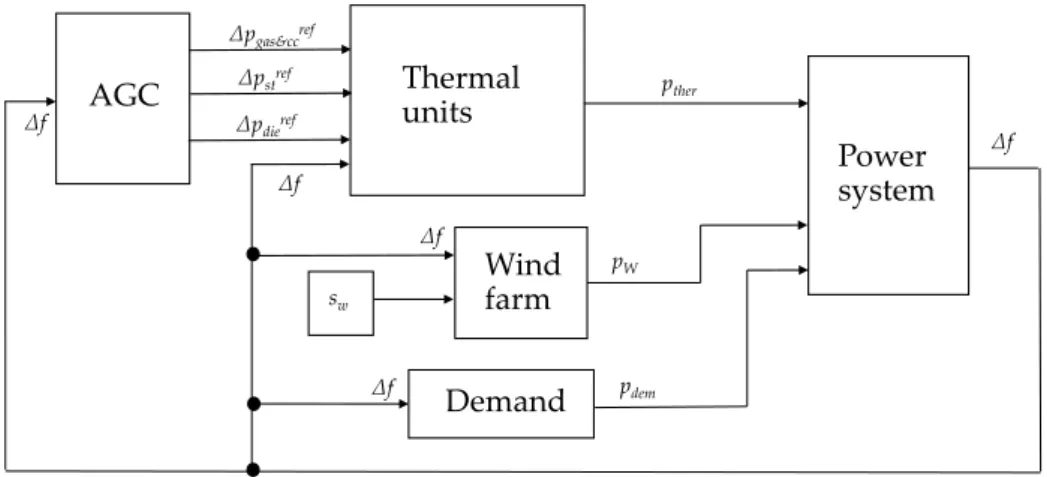
A mathematical model has been designed to analyze the proposed VSWT adaptive frequency control in an isolated power system. A generic wind-thermal isolated system is considered in this
study (refer to Figure2), including steam, diesel, gas, and combined cycle units, as well as wind
power plants. Consequently, the model developed in Matlab/Simulink (2016) includes these thermal units, one equivalent VSWT acting as the wind power plants, the automatic generation control (AGC), the power system, and the power demand (including a load shedding scheme). The electromagnetic transients are supposed to be much faster than the other components of the model, and their influence
in the system’s dynamics is omitted [61]. In Figure3, the block diagram of the power system under
Consumer load 1
Combined
cycle 1 Combinedcycle 2 Combinedcycle l …
… …
Diesel 1 Diesel 2 Diesel k
… …
Wind farm
Consumer
load 2 … Consumerload h
Figure 2.Simplified one-line diagram of the generic isolated power system.
AGC Thermalunits
Δpdieref
Wind farm Δf
Δf
sw
Power system
Δf pther
pW
Δf
Demand
Δf pdem
Δpstref
Δpgas&ccref
Figure 3.Block diagram of the frequency analysis model.
2.1. Power System
Frequency regulation based on droop speed control can be divided into two consecutive control actions: frequency containment and frequency restoration. On the one hand, frequency containment (or primary frequency regulation), which is based on the governor control, adjusts the active power of the generation units to correct frequency variations. In fact, the frequency nadir is directly related with the generator’s droop characteristic. In Spanish electric power system, primary regulation services act
up to 30 s after a frequency disturbance [62]. On the other hand, frequency restoration (or secondary
frequency regulation) refers to the AGC, adjusting the active power output of generation units to bring system frequency back to its rated value after the governor-based primary response.
An aggregated inertial model is commonly used to analyze frequency deviations in isolated
power systems [63]. This modeling approach has been previously applied in El Hierro isolated power
system (another isle of the Canarian archipelago) in [64]. Therefore, frequency deviations are the result
of the imbalance between the power supplied by the generation units and the power demand:
f d f dt =
1
Tm,ther(t)(pther+pw−pdem−Dnet∆f), (1)
whereTm,ther(t)corresponds to the total mechanical inertia of thermal units depending on the number
When frequency disturbances are higher than certain limits, an under frequency load shedding scheme is activated to recover the grid frequency and fulfill certain frequency range requirements. In this work, a realistic load shedding scheme is included, consisting of the sequential and sudden disconnection of certain amount of load as established frequency thresholds are exceeded. The load
shedding program can be found in [59].
2.2. Thermal Power Plants
The different thermal generation technologies (i.e., steam, diesel, gas, and combined cycle)
included in the isolated power system are modeled by different transfer functions proposed in [59,65].
These transfer functions supply the power variation of each thermal technology from the frequency deviation and power reference provided by the AGC. Both the model and the parameters can be found
in [59]. Since fast response of combined cycle power plants is in charge of the gas turbines, frequency
response of combined cycle and gas units is assumed to be equal. The total thermal generation is then the sum of each thermal unit power supplied.
2.3. Variable Speed Wind Turbines
One equivalent VSWT model aggregating all the VSWTs is used [59,66]. The proposed VSWT
equivalent model includes the wind power model and both pitch and torque maximum power point
tracking control. Further information can be found in [67]. The one-mass rotor mechanical model is
used for simulations, which is detailed enough according to [68] for power converters decoupling the
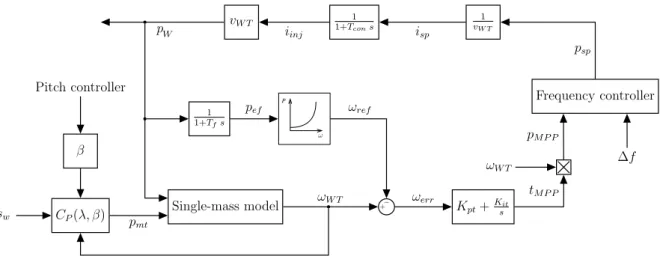
generator from the grid. The VSWT diagram is represented in Figure4. This wind turbine model has
been previously used in [69] for short-time period frequency analysis. The equivalent aggregated wind
turbine modeling also includes the frequency control response strategy, described in Section3.
Figure 4.Block diagram of VSWT.
2.4. Automatic Generation Control (AGC)
The secondary control action removes the steady-state frequency error after the primary frequency
control. It is modeled similar to [70]. The total secondary regulation effort (∆RR) is obtained from:
∆RR=−∆f Kf, (2)
beingKf determined according to the European Network of Transmission System Operators for
Electricity (ENTSO-E) recommendations [71]. This regulation effort is distributed among each i
synchronized thermal unit as a function of their participation factors (Ku,i), which are related to the
∆pre fi = 1 Tu,i
Z
∆RR Ku,idt = T−1 u,i
Z
Ku,iKf dt, (3)
whereirepresentsgas,cc,die, andstrespectively. All thermal units connected to the grid participate
in secondary control, whereas the participation factors of those units not connected are considered as zero,Ku,i =0.
3. Adaptive Frequency Control Strategy—Methodology
The adaptive control approach proposed in this work tries to minimize the effort of VSWTs when providing frequency response. The proposed approach is based on the fast power reserve technique. This control strategy distinguishes two different periods after a sudden power imbalance: (i) overproduction and (ii) recovery. During overproduction, the stored kinetic energy in the rotating
masses of the VSWTs is supplied to the grid as an additional active power∆pduring a few seconds,
being thuspwoverpMPP(sw). Subsequently, the rotational speedωis reduced. Different definitions
of this∆phave been proposed. In fact, some authors consider∆pas a fixed constant value [48–51],
whereas others propose to estimate∆pas dependent on the torque limit [52] or proportional to the
frequency excursion [53]. The recovery period aims to restoreω to the prefault rotational speed
value ω0. To overcome this, pw should be reduced below pmech(ω). Previous proposals specified
an underproduction powerpUPby different ways, being thus the supplied power of each VSWTs:
pW =pmech−pUP.
In the proposed adaptive frequency control strategy, the initial value of∆pfor the overproduction
period is related to the power system conditions. The authors propose a new frequency control
approach based on the methodology followed in [73]. This reference estimates the exact and minimum
amount of load needed to be shed after an imbalance depending on the RoCoF. In fact, a decision table that links the RoCoF with the strict amount of load shedding is developed based on presimulations. Then, the corresponding load shedding is activated after a contingency, tripping some amount of load
demand immediately [74]. In this case, the proposed adaptive controller is based on a decision table
that estimates the accurate value of∆pfor the VSWT overproduction.
The first step to formulate the decision table consists of defining several simulation scenarios that reflect the variability of the demand, the scheduling units, and/or the wind power penetration.
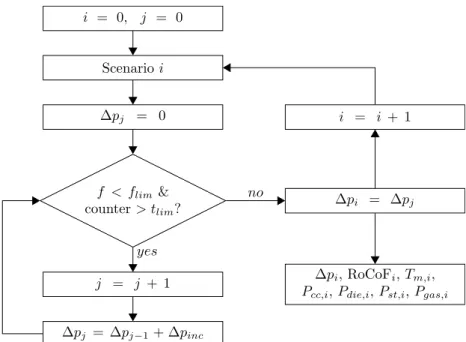
To estimate the overproduction power∆pafter the outage of a thermal group, an iterative process
is proposed for each scenario (see Figure5). The condition considered to calculate such∆pis that
frequencyf should not be below a certain limit flimfor longer than a preset time limittlim. Both values
flimandtlimare related to the load shedding program of the power system. A counter is thus triggered
when f is below flim, computing the time that frequency is under that flim. Initially, thei–scenario is
simulated assuming that the overproduction power in the first iterationjis equal to 0 (∆pj=0). If f
is below flimfor longer thantlim,∆pjis increased by a fixed value∆pincwith respect to the previous
iteration (∆pj = ∆pj−1+∆pinc) and the samei–scenario is simulated again with the new value of
∆pj. When the condition is satisfied (i.e., f is below flimless time that tlim), the minimum∆p for
thei–scenario (∆pi) that VSWTs should provide has been determined (∆pi = ∆pj). Note that the
overproduction power∆pis supplied with a delay of 200 ms, in order to have the measure of the
RoCoF and in line with the delay time-interval in between 50 and 500 ms suggested in [75]. Once all
the∆pvalues have been determined from the simulations, a mathematical relationship between such
∆pand other variables of the power system need to be found. The obtained expression will be the
i = 0, j = 0
Scenarioi
∆pj = 0
f < flim&
counter> tlim?
j = j + 1
∆pj = ∆pj−1+ ∆pinc
∆pi = ∆pj
i = i + 1
∆pi, RoCoFi,Tm,i,
Pcc,i,Pdie,i,Pst,i,Pgas,i
yes
no
Figure 5.Flow-chart to estimate the overproduction of VSWTs.
When a power imbalance occurs, the VSWTs’ controller determines the overproduction power∆p
according to the previous decision table. This situation causes a suddenpwincrease and, after that,
the supplied power starts to decrease. In this approach, instead of “forcing” the recovery period, the transition to recovery is carried out by the rotor speed PI controller in the converter, which slowly
reduces the active power to achieve againpMPP(sw). In order to avoid a fast power change, that could
cause a secondary frequency dip,KptandKit(proportional and integral constants of the converter,
refer to Figure4) must be conveniently tuned. As a consequence, instead of fixing apUPor defining an
underproduction trajectory, the converter should adapt both the electrical power and the rotational
speed to make them return to their pre-event values. Figure6presents the evolution ofPWandω
under an imbalanced situation with the proposed approach, pointing out the overproduction and recovery periods.
Recovery
Overproduction
(a)
Overproduction
Recovery
(b)
Figure 6.Example of overproduction and recovery periods. (a) Electrical power (MW); (b) Rotational
4. Case Study—Results
The VSWT adaptive control strategy proposed in this study is applied to the Gran Canaria power system. Gran Canaria Island belongs to Spanish Canarian archipelago, being thus an isolated power
system. Its electrical generation has always been based on fossil fuels from two power plants:Jinámar
andBarranco de Tirijanapower plants. These power plants included diesel, steam, gas, and combined cycle units. However, in recent decades, the government started to promote wind power plants’
installation, doubling its capacity up to 180 MW since 2017. Table1lists each thermal unit capacity of
the Gran Canaria power system.
Table 1.Gran Canaria thermal units power.
Steam Gas Combined Cycle Diesel
Pst,1 72.4 MW Pgas,1 32.3 MW Pcc,1 206.1 MW Pdie,1 8.5 MW Pst,2 72.4 MW Pgas,2 32.3 MW Pcc,2 227.0 MW Pdie,2 8.5 MW Pst,3 55.6 MW Pgas,3 17.3 MW Pdie,3 8.5 MW Pst,4 55.6 MW Pgas,4 32.3 MW Pdie,4 20.5 MW
Pgas,5 32.3 MW Pdie,5 20.5 MW
4.1. Scenarios under Consideration
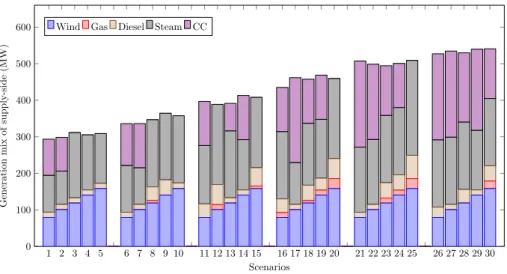
Thirty different generation mixes of supply-side programs are under study for different demands
and wind power generation. The generation mix scenarios are taken from [59], where a unit
commitment model was also included. Figure7presents the different supply-side energy schedule of
each program. From these generation mix scenarios, two different imbalance conditions are defined: (i) the loss of the largest power plant and (ii) the loss of the second largest power plant. In this
way, a total of sixty different scenarios are analyzed. Figure8summarizes the supply-side after the
disconnection of the largest and second largest units. In addition, it also points out the percentage that represents the loss of each unit over the total system demand.
1 2 3 4 5 6 7 8 9 10 11 12 13 14 15 16 17 18 19 20 21 22 23 24 25 26 27 28 29 30 0
100 200 300 400 500 600
Scenarios
Generation
mix
of
supply-side
(MW)
Wind Gas Diesel Steam CC
(a)
(b)
Figure 8.Generation mix after disconnection (a) Largest power plant disconnection. (b) Second largest
power plant disconnection.
4.2. Decision Table Definition: Regression Analysis
From the sixty scenarios presented in Section4.1, the corresponding∆pvalues are determined
following Section 3. In this work, and according to the load shedding scheme presented in
[59], flim=49 Hz, tlim = 1 s and ∆pinc = 0.01 pu for the Gran Canaria island power system.
A mathematical relationship between such ∆p and other variables of the power system need to
be found. As aforementioned, [73] proposed to relate the power to be shed with the RoCoF by a
linear and quadratic regression, withR2 = 0.951 andR2 =0.969, respectively. However, both the
linear regression and the quadratic regression of∆Pand RoCoF for this case study accounted for
low values ofR2: R2 = 0.433 for linear regression and R2 = 0.512 for quadratic regression. As a
consequence, other variables are introduced in the proposed mathematical lineal regression. By also considering the electrical power of each thermal technology assigned in the scheduled program, the system synchronous inertia before the incident, and neglecting all those cases in which the estimated
∆pwas∆p=0, the coefficient of determination increased toR2=0.801 following Equation (4):
∆P=−386.15+108.63·RoCoF−1.32·Pgas+0.26·Pdie+0.65·Pst−0.42·Pcc+32.92·Tm, (4)
being∆Pin MW, RoCoF in Hz/s,Piin MW (istands forgas,cc,dieandst), andTmin s.
Comparing the results of∆Pobtained from the simulations and those estimated with Equation (4),
1. If the power supplied by the combined cycle power plants before the imbalance was over 180 MW (Pcc,0>180 MW),∆P=0
2. If the estimated∆Pwith the regression is negative (∆P<0),∆P=0
Moreover, the maximum overproduction power∆Pof the wind power plant was considered as
20% over the installed capacity of the wind power plant,∆Pmax =0.2·Pw.
4.3. Results
Apart from the adaptive control approach, other frequency strategies have been simulated and compared for the sixty scenarios under consideration:
1. Frequency control only provided by thermal power plants (referred to aswithout VSWTs).
2. Frequency control provided by thermal power plants and VSWTs. The overproduction is defined
as proportional to∆f; change from overproduction to recovery period occurs whenω/ω0<0.9,
andpUP=0.05 pu (fast power reserve technique). It is triggered when∆f ≥100 mHz and the
maximum∆p=0.15·pmech(ω)(referred to asprevious approach).
3. Frequency control provided by thermal power plants and VSWTs using the proposed control
approach (referred to asadaptive approach).
As was discussed in Section4.1, sixty different scenarios are considered to evaluate the new
frequency control approach for VSWTs. Results are focused on four different aspects for each scenario:
(i) the minimum rotational speedωmin; (ii) the maximum torque Tmax; (iii) the power shed due to
the corresponding load shedding programs; (iv) number of cases in which VSWTs do not participate
in frequency control with the adaptive proposed approach. BothωminandTmax are expressed in %
with regard to the pre-event values, which is equal to their values when they do not participate in frequency control.
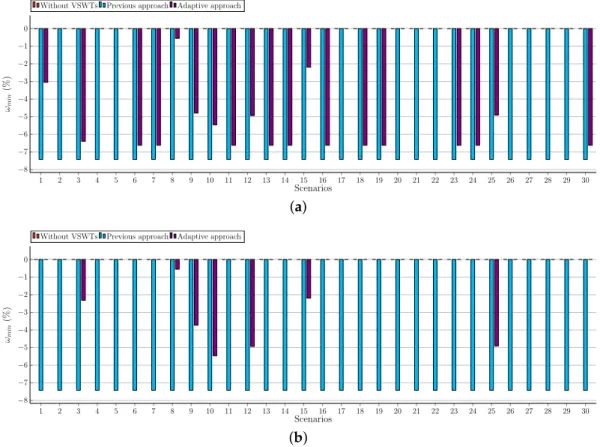
Figure9depicts the range values of the rotational speed in % compared to the pre-event value.
When VSWTs do not participate in frequency control, itsωvariation is null, as they are providing
pMPP(sw). According to these results, and depending on the frequency control strategy, important
differences can be identified. With regard to the frequency control referred to asprevious approach,
and considering that the change from overproduction to recovery period is always withω/ω0<0.9,
all scenarios then give the same minimumω, which represents more than a 7% variation. Based on the
adaptive approach,ωminvariations range in between 0 (for those cases in which the frequency control is
not activated) and 6.62%. In fact, the averageωminvariation with the proposed strategy is 2.15%. As a
consequence, the new frequency control strategy technique does not only optimize those imbalances
where VSWTs frequency control participation is required but also reduces the averaged variation ofω
to more than half of the previous frequency control approaches.
Figure 10 compares the maximum torque during the VWST frequency response to the
corresponding pre-event value. These results are in line with the previous rotational speed comparison,
see Figure9. The torque does not vary when VSWTs do not participate in frequency control, as bothω
andperemain constant. With theprevious approachfor VSWT frequency control, the maximum torque
variation is always the same. Moreover, this variation is over a 30% increase—in comparison to the pre-event value, which can address relevant mechanical loads on the turbine shaft. In contrast, with the
proposedadaptive approach, the maximumTmaxvariation is 26.5% (only 9 out of 60 scenarios), with an
averageTmax of 9.7%. It can be then deduced that the new frequency control approach does not only
avoid the activation of the frequency control of VSWTs in most of imbalance scenarios but also that
1 2 3 4 5 6 7 8 9 10 11 12 13 14 15 16 17 18 19 20 21 22 23 24 25 26 27 28 29 30
−8
−7
−6
−5
−4
−3
−2
−1
0
Scenarios ωmin
(%)
Without VSWTs Previous approach Adaptive approach
(a)
1 2 3 4 5 6 7 8 9 10 11 12 13 14 15 16 17 18 19 20 21 22 23 24 25 26 27 28 29 30
−8
−7
−6
−5
−4
−3
−2
−1
0
Scenarios ωmin
(%)
Without VSWTs Previous approach Adaptive approach
(b)
Figure 9.Minimum rotational speed (a) Largest power plant disconnection; (b) Second largest power
plant disconnection.
1 2 3 4 5 6 7 8 9 10 11 12 13 14 15 16 17 18 19 20 21 22 23 24 25 26 27 28 29 30
0 5 10 15 20 25 30 35
Scenarios Tmax
(%)
Without VSWTs Previous approach Adaptive approach
(a)
1 2 3 4 5 6 7 8 9 10 11 12 13 14 15 16 17 18 19 20 21 22 23 24 25 26 27 28 29 30
0 5 10 15 20 25 30 35
Scenarios Tmax
(%)
Without VSWTs Previous approach Adaptive approach
(b)
Figure 10.Maximum torque variation (a) Largest power plant disconnection; (b) Second largest power
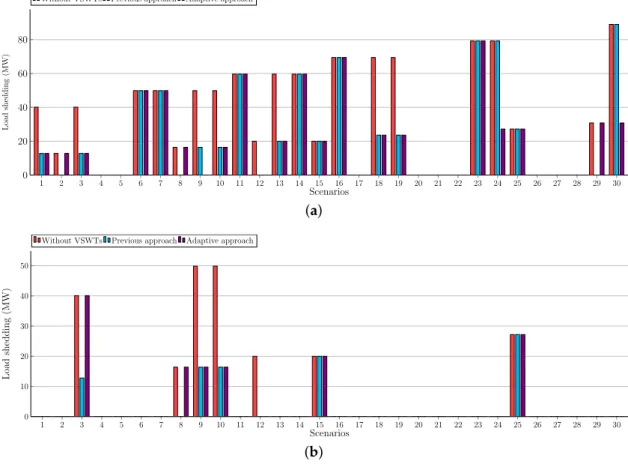
Figure11shows the power shed by the load shedding program. As can be seen, it is reduced when wind power plants participate in frequency control, compared to the current case in which only thermal power plants are providing such ancillary service. Comparing the two different frequency
control approaches analyzed, small differences are found. Theprevious approachgets better results in 4
out of 60 scenarios under study, whereas theadaptive approachobtained lower load shedding values in
2 out of 60 scenarios. In the other cases, both frequency controllers obtain the same load shedding.
1 2 3 4 5 6 7 8 9 10 11 12 13 14 15 16 17 18 19 20 21 22 23 24 25 26 27 28 29 30 0
20 40 60 80
Scenarios
Load
shedding
(MW)
Without VSWTs Previous approach Adaptive approach
(a)
1 2 3 4 5 6 7 8 9 10 11 12 13 14 15 16 17 18 19 20 21 22 23 24 25 26 27 28 29 30 0
10 20 30 40 50
Scenarios
Load
shedding
(MW)
Without VSWTs Previous approach Adaptive approach
(b)
Figure 11. Load shedding (a) Largest power plant disconnection; (b) Second largest power
plant disconnection.
Finally, 57% of imbalances without any VSWTs frequency response participation have been identified. These results reduce significantly the mechanical and electrical VSWT efforts under imbalances, maintaining similar frequency excursions to the previous control strategies. More specifically, the VSWT frequency participation is not required to provide additional power in 11 out of 30 for the largest power plant loss and 23 out of 30 for the second largest power plant
loss. These 34 scenarios where the adaptive frequency control is not triggered can be seen in Figures9
and10: imbalance scenarios will null variation ofωminandTmax for the proposed control strategy.
Therefore,peandωvalues keep as constant during the imbalance and, subsequently, also maintain the
torque. In addition, authors have checked that in 94% of the cases in which VSWTs are not participating
in frequency control with theadaptive approach, the power shed was initially null, pointing out that
their participation was not required within acceptable frequency excursion ranges.
As an additional result, Figures12–14depict the frequency evolution, load shedding, wind power,
and rotational speed for scenarios 9, 16, and 27, respectively, for the loss of the largest power plant. Together with the aforementioned advantages of the new approach, authors also point out that the rotational speed of VSWTs is recovered in a lower time interval than with the previous frequency control approach. Moreover, the transition from overproduction to recovery period is also smoother,
0 10 20 30 40 50 60 70 80 49 49.5 50 Time (s) f (Hz)
Without VSWTs Previous approach Adaptive approach
(a)
0 10 20 30 40 50 60 70 80 0 20 40 Time (s) Load shedding (MW)
Without VSWTs Previous approach Adaptive approach
(b)
0 10 20 30 40 50 60 70 80 100 110 120 Time (s) PW (MW)
Without VSWTs Previous approach Adaptive approach
(c)
0 10 20 30 40 50 60 70 80 1.1 1.15 1.2 Time (s) ω (pu)
Without VSWTs Previous approach Adaptive approach
(d)
Figure 12.Results for scenario 9 (a) Frequency (Hz). (b) Load shedding (MW) (c) Wind power (MW)
(d) VSWTs rotational speed (pu).
0 10 20 30 40 50 60 70 80 49 49.5 50 Time (s) f (Hz)
Without VSWTs Previous approach Adaptive approach
(a)
0 10 20 30 40 50 60 70 80 0 20 40 60 Time (s) Load shedding (MW)
Without VSWTs Previous approach Adaptive approach
(b)
0 10 20 30 40 50 60 70 80 60
70
Time (s) PW
(MW)
Without VSWTs Previous approach Adaptive approach
(c)
0 10 20 30 40 50 60 70 80 1.1 1.15 1.2 Time (s) ω (pu)
Without VSWTs Previous approach Adaptive approach
(d)
Figure 13.Results for scenario 16 (a) Frequency (Hz); (b) Load shedding (MW); (c) Wind power (MW);
0 10 20 30 40 50 60 70 80 49
49.5 50
Time (s)
f
(Hz)
Without VSWTs Previous approach Adaptive approach
(a)
0 10 20 30 40 50 60 70 80 −1
−0.5 0 0.5 1
Time (s)
Load
shedding
(MW)
Without VSWTs Previous approach Adaptive approach
(b)
0 10 20 30 40 50 60 70 80 90
100
Time (s) PW
(MW)
Without VSWTs Previous approach Adaptive approach
(c)
0 10 20 30 40 50 60 70 80 1.1
1.15 1.2
Time (s)
ω
(pu)
Without VSWTs Previous approach Adaptive approach
(d)
Figure 14.Results for scenario 27 (a) Frequency (Hz); (b) Load shedding (MW); (c) Wind power (MW);
(d) VSWTs rotational speed (pu).
5. Conclusions
Due to the massive penetration of VSWTs, their contribution to frequency regulation has become a need. As isolated power systems have low synchronous inertia, VSWTs frequency control is even more required. Even though different control strategies for VSWTs have been proposed in the last decade, they usually imply important drawbacks in terms of efficiency, economic profits, and/or equipment wear. As a result, with the aim of reducing the mechanical stress of VSWTs providing frequency response, an adaptive control strategy is proposed in this work. Our approach is based on estimating the minimum overproduction power provided by VSWTs following a linear regression estimation. In this way, such overproduction power depends on some grid parameters (i.e., RoCoF, synchronous inertia, and assigned power of thermal units before the incident). The proposed controller is compared to a conventional fast power reserve strategy. The Gran Canaria isolated power system (Spain) is considered as case study, analyzing sixty representative imbalance scenarios. Results show that similar values for the power shed with the load shedding program are obtained with the two approaches. However, the new adaptive control reduces the VSWTs maximum torque variations and the speed variations (23% and 5% on average, respectively), in comparison to the conventional VSWTs frequency control strategy. This is due to the smoother transition from overproduction to recovery periods, which reduces the electrical and mechanical VSWT efforts. In addition, in 57% of the imbalance scenarios under consideration, VSWTs are not required to participate in frequency response. Thus, both electrical power and rotational speed are kept as constants (subsequently maintaining the torque). As a result, a longer life span is expected for the VSWTs electrical and mechanical components.
Author Contributions:Conceptualization, J.I.S.; Data curation, A.F.-G.; Formal analysis, G.M.-L.; Investigation,
Funding: This work was partially supported by ‘Ministerio de Educación, Cultura y Deporte’ of Spain
(ref. FPU16/04282) and by ‘Ministerio de Economía y Competitividad’, under the project “Value of pumped-hydro energy storage in isolated power systems with high wind power penetration” of the National Plan for Scientific and Technical Research and Innovation 2013–2016, grant number ENE2016-77951-R.
Conflicts of Interest:The authors declare no conflict of interest.
Abbreviations
The following abbreviations are used in this manuscript:
β Pitch angle (grades)
ω Rotational speed (p.u.)
∆P Overproduction power of VSWT (MW) ∆RR Total secondary regulation effort
f Frequency (Hz) p Active power (p.u.) sw Wind speed (m/s)
Dnet Damping factor of loads
Ku Participation factor in secondary control
P Active power (MW) Tm Inertia constant (s)
0 Pre-event value (subscript) cc Combined cycle (subscript) dem Demand (subscript) die Diesel (subscript) gas Gas (subscript)
max Maximum value (subscript) mech Mechanical (subscript) min Minimum value (subscript) st Steam (subscript)
ther Thermal (subscript) w Wind (subscript)
UP Underproduction (subscript) AGC Automatic Generation Control
II-RES Inverter Interfaced Renewable Energy Sources MPP Maximum Power Point
PV Photovoltaic
RoCoF Rate of Change of Frequency TSO Transmission System Operator VSWT Variable Speed Wind Turbine
References
1. Kaushal, A.; Van Hertem, D. An Overview of Ancillary Services and HVDC Systems in European Context. Energies2019,12, 3481. [CrossRef]
2. Martínez-Lucas, G.; Sarasúa, J.I.; Wilhelmi, J.R.; ángel Sánchez, J. Contribution to load-frequency regulation of a hydropower plant with long tail-race tunnel. In Proceedings of the 15th International Conference on Environment and Electrical Engineering (EEEIC), Rome, Italy, 10–13 June 2015; pp. 1886–1891.
3. Qi, Y.; Wang, D.; Wang, X.; Jia, H.; Pu, T.; Chen, N.; Liu, K. Frequency control ancillary service provided by efficient power plants integrated in Queuing-Controlled domestic water heaters. Energies2017,10, 559.
[CrossRef]
4. ENTSO-E. Electricity Balancing in Europe. Available online: https://docstore.entsoe.eu/(accessed on 15 April 2020).
6. Tofis, Y.; Timotheou, S.; Kyriakides, E. Minimal load shedding using the swing equation. IEEE Trans. Power Syst.2016,32, 2466–2467. [CrossRef]
7. Costa, M.H.; Ravetti, M.G.; Saldanha, R.R.; Carrano, E.G. Minimizing undesirable load shedding through robust coordination of directional overcurrent relays. Int. J. Electr. Power Energy Syst.2019,113, 748–757.
[CrossRef]
8. Rudez, U.; Mihalic, R. RoCoF-based improvement of conventional under-frequency load Shedding. In Proceedings of the 2019 IEEE Milan PowerTech, Milan, Italy, 23–27 June 2019; pp. 1–5.
9. Fernández-Guillamón, A.; Molina-García, A.; Vigueras-Rodríguez, A.; Gómez-Lázaro, E. Frequency response and inertia analysis in power systems with high wind energy integration. In Proceedings of the 2019 International Conference on Clean Electrical Power (ICCEP), Otranto, Italy, 2–4 July 2019; pp. 388–393. 10. Fernández-Guillamón, A.; Vigueras-Rodríguez, A.; Molina-García, Á. Analysis of power system inertia
estimation in high wind power plant integration scenarios.IET Renew. Power Gener.2019, 13, 2807–2816.
[CrossRef]
11. Molina-García, A.; Fernández-Guillamón, A.; Gómez-Lázaro, E.; Honrubia-Escribano, A.; Bueso, M.C. Vertical Wind Profile Characterization and Identification of Patterns Based on a Shape Clustering Algorithm. IEEE Access2019,7, 30890–30904. [CrossRef]
12. Available online:https://gwec.net/global-wind-report-2019/(accessed on 29 April 2020).
13. Muñoz-Benavente, I.; Hansen, A.D.; Gómez-Lázaro, E.; García-Sánchez, T.; Fernández-Guillamón, A.; Molina-García, Á. Impact of combined demand-response and wind power plant participation in frequency control for multi-area power systems. Energies2019,12, 1687. [CrossRef]
14. Tielens, P.; Van Hertem, D. The relevance of inertia in power systems. Renew. Sustain. Energy Rev.2016,
55, 999–1009. [CrossRef]
15. Daly, P.; Flynn, D.; Cunniffe, N. Inertia considerations within unit commitment and economic dispatch for systems with high non-synchronous penetrations. In Proceedings of the 2015 IEEE Eindhoven PowerTech, Eindhoven, The Netherlands, 29 June–2 July 2015; pp. 1–6.
16. Martínez-Lucas, G.; Sarasúa, J.I.; Sánchez-Fernández, J.Á.; Wilhelmi, J.R. Power-frequency control of hydropower plants with long penstocks in isolated systems with wind generation. Renew. Energy2015,
83, 245–255. [CrossRef]
17. Martinez-Lucas, G.; Sarasúa, J.I.; Sánchez-Fernández, J.Á.; Wilhelmi, J.R. Frequency control support of a wind-solar isolated system by a hydropower plant with long tail-race tunnel.Renew. Energy2016,90, 362–376.
[CrossRef]
18. Toulabi, M.; Bahrami, S.; Ranjbar, A.M. An input-to-state stability approach to inertial frequency response analysis of doubly-fed induction generator-based wind turbines. IEEE Trans. Energy Convers. 2017,
32, 1418–1431. [CrossRef]
19. Fernández-Guillamón, A.; Gómez-Lázaro, E.; Muljadi, E.; Molina-García, Á. Power systems with high renewable energy sources: A review of inertia and frequency control strategies over time. Renew. Sustain. Energy Rev.2019,115, 109369. [CrossRef]
20. Alsharafi, A.S.; Besheer, A.H.; Emara, H.M. Primary Frequency Response Enhancement for Future Low Inertia Power Systems Using Hybrid Control Technique. Energies2018,11, 699. [CrossRef]
21. Fernández-Guillamón, A.; Vigueras-Rodríguez, A.; Gómez-Lázaro, E.; Molina-García, Á. Fast power reserve emulation strategy for VSWT supporting frequency control in multi-area power systems. Energies2018,
11, 2775. [CrossRef]
22. Chen, Z.; Yin, M.; Zou, Y.; Meng, K.; Dong, Z. Maximum wind energy extraction for variable speed wind turbines with slow dynamic behavior. IEEE Trans. Power Syst.2016,32, 3321–3322. [CrossRef]
23. Ziping, W.; Wenzhong, G.; Tianqi, G.; Weihang, Y.; ZHANG, H.; Shijie, Y.; Xiao, W. State-of-the-art review on frequency response of wind power plants in power systems.J. Mod. Power Syst. Clean Energy2017,6, 1–16.
24. Fernández-Guillamón, A.; Gómez-Lázaro, E.; Muljadi, E.; Molina-Garcia, Á. A Review of Virtual Inertia Techniques for Renewable Energy-Based Generators. InPower Systems; IntechOpen: London, UK, 2020. 25. Yingcheng, X.; Nengling, T. Review of contribution to frequency control through variable speed wind turbine.
Renew. Energy2011,36, 1671–1677. [CrossRef]
27. Moutis, P.; Papathanassiou, S.A.; Hatziargyriou, N.D. Improved load-frequency control contribution of variable speed variable pitch wind generators.Renew. Energy2012,48, 514–523. [CrossRef]
28. Žertek, A.; Verbiˇc, G.; Pantoš, M. Optimised control approach for frequency-control contribution of variable speed wind turbines. IET Renew. Power Gener.2012,6, 17–23. [CrossRef]
29. Martínez-Lucas, G.; Sarasúa, J.I.; Pérez-Díaz, J.I.; Martínez, S.; Ochoa, D. Analysis of the Implementation of the Primary and/or Inertial Frequency Control in Variable Speed Wind Turbines in an Isolated Power System with High Renewable Penetration. Case Study: El Hierro Power System. Electronics2020,9, 901.
[CrossRef]
30. Castro, L.M.; Fuerte-Esquivel, C.R.; Tovar-Hernández, J.H. Solution of power flow with automatic load-frequency control devices including wind farms.IEEE Trans. Power Syst.2012,27, 2186–2195. [CrossRef]
31. Vidyanandan, K.; Senroy, N. Primary frequency regulation by deloaded wind turbines using variable droop. IEEE Trans. Power Syst.2013,28, 837–846. [CrossRef]
32. Zhang, X.; Zha, X.; Yue, S.; Chen, Y. A Frequency Regulation Strategy for Wind Power Based on Limited Over-Speed De-Loading Curve Partitioning. IEEE Access2018,6, 22938–22951. [CrossRef]
33. Wang, S.; Tomsovic, K. A Novel Active Power Control Framework for Wind Turbine Generators to Improve Frequency Response.IEEE Trans. Power Syst.2018,33, 6579–6589. [CrossRef]
34. Fang, X.; Krishnan, V.; Hodge, B.M. Strategic offering for wind power producers considering energy and flexible ramping products. Energies2018,11, 1239. [CrossRef]
35. Ye, H.; Pei, W.; Qi, Z. Analytical modeling of inertial and droop responses from a wind farm for short-term frequency regulation in power systems. IEEE Trans. Power Syst.2016,31, 3414–3423. [CrossRef]
36. Arani, M.F.; Mohamed, Y.A.I. Dynamic Droop Control for Wind Turbines Participating in Primary Frequency Regulation in Microgrids.IEEE Trans. Smart Grid2017,9, 5742–5751. [CrossRef]
37. Lertapanon, P.; Wangdee, W. Analysis and modeling of wind turbine generators considering frequency controls. In Proceedings of the Electrical Engineering Congress (iEECON), Pattaya, Thailand, 8–10 March 2017; pp. 1–4.
38. Huang, L.; Xin, H.; Zhang, L.; Wang, Z.; Wu, K.; Wang, H. Synchronization and Frequency Regulation of DFIG-Based Wind Turbine Generators With Synchronized Control. IEEE Trans. Energy Convers.2017,
32, 1251–1262. [CrossRef]
39. Deepak, M.; Abraham, R.J.; Gonzalez-Longatt, F.M.; Greenwood, D.M.; Rajamani, H.S. A novel approach to frequency support in a wind integrated power system. Renew. Energy2017,108, 194–206. [CrossRef]
40. Margaris, I.D.; Papathanassiou, S.A.; Hatziargyriou, N.D.; Hansen, A.D.; Sorensen, P. Frequency control in autonomous power systems with high wind power penetration. IEEE Trans. Sustain. Energy2012,3, 189–199.
[CrossRef]
41. Morren, J.; de Haan, S.W.H.; Kling, W.L.; Ferreira, J.A. Wind turbines emulating inertia and supporting primary frequency control.IEEE Trans. Power Syst.2006,21, 433–434. [CrossRef]
42. Díaz-González, F.; Hau, M.; Sumper, A.; Gomis-Bellmunt, O. Participation of wind power plants in system frequency control: Review of grid code requirements and control methods. Renew. Sustain. Energy Rev.2014,
34, 551–564. [CrossRef]
43. Dreidy, M.; Mokhlis, H.; Mekhilef, S. Inertia response and frequency control techniques for renewable energy sources: A review.Renew. Sustain. Energy Rev.2017,69, 144–155. [CrossRef]
44. Ekanayake, J.; Jenkins, N. Comparison of the response of doubly fed and fixed-speed induction generator wind turbines to changes in network frequency.IEEE Trans. Energy Convers.2004,19, 800–802. [CrossRef]
45. Gonzalez-Longatt, F.; Chikuni, E.; Stemmet, W.; Folly, K. Effects of the synthetic inertia from wind power on the total system inertia after a frequency disturbance. In Proceedings of the Power Engineering Society Conference and Exposition in Africa, Johannesburg, South Africa, 9–13 July 2012; pp. 9–13.
46. Bonfiglio, A.; Invernizzi, M.; Labella, A.; Procopio, R. Design and Implementation of a Variable Synthetic Inertia Controller for Wind Turbine Generators. IEEE Trans. Power Syst.2018,34, 754–764. [CrossRef]
47. Singarao, V.Y.; Rao, V.; Harral, M.A. Review on engineering and regulatory aspects associated with frequency control capabilities of wind power plants. In Proceedings of the 2013 IEEE Energytech, Cleveland, OH, USA, 21–23 May 2013; pp. 1–6.
49. Keung, P.K.; Li, P.; Banakar, H.; Ooi, B.T. Kinetic energy of wind-turbine generators for system frequency support. IEEE Trans. Power Syst.2009,24, 279–287. [CrossRef]
50. El Itani, S.; Annakkage, U.D.; Joos, G. Short-term frequency support utilizing inertial response of DFIG wind turbines. In Proceedings of the Power and Energy Society General Meeting, Detroit, MI, USA, 24–28 July 2011; pp. 1–8.
51. Hafiz, F.; Abdennour, A. Optimal use of kinetic energy for the inertial support from variable speed wind turbines.Renew. Energy2015,80, 629–643. [CrossRef]
52. Kang, M.; Kim, K.; Muljadi, E.; Park, J.W.; Kang, Y.C. Frequency control support of a doubly-fed induction generator based on the torque limit.IEEE Trans. Power Syst.2016,31, 4575–4583. [CrossRef]
53. Fernández-Guillamón, A.; Villena-Lapaz, J.; Vigueras-Rodríguez, A.; García-Sánchez, T.; Molina-García, Á. An Adaptive Frequency Strategy for Variable Speed Wind Turbines: Application to High Wind Integration Into Power Systems. Energies2018,11, 1436. [CrossRef]
54. Liu, K.; Qu, Y.; Kim, H.M.; Song, H. Avoiding Frequency Second Dip in Power Unreserved Control During Wind Power Rotational Speed Recovery. IEEE Trans. Power Syst.2018,33, 3097–3106. [CrossRef]
55. Staino, A.; Basu, B. Dynamics and control of vibrations in wind turbines with variable rotor speed.Eng. Struct.
2013,56, 58–67. [CrossRef]
56. Rahman, M.; Ong, Z.C.; Chong, W.T.; Julai, S.; Khoo, S.Y. Performance enhancement of wind turbine systems with vibration control: A review.Renew. Sustain. Energy Rev.2015,51, 43–54. [CrossRef]
57. Hansen, A.D.; Altin, M.; Margaris, I.D.; Iov, F.; Tarnowski, G.C. Analysis of the short-term overproduction capability of variable speed wind turbines. Renew. Energy2014,68, 326–336. [CrossRef]
58. Lind, P.G.; Herráez, I.; Wächter, M.; Peinke, J. Fatigue load estimation through a simple stochastic model. Energies2014,7, 8279–8293. [CrossRef]
59. Fernández-Guillamón, A.; Sarasúa, J.I.; Chazarra, M.; Vigueras-Rodríguez, A.; Fernández-Muñoz, D.; Molina-García, Á. Frequency control analysis based on unit commitment schemes with high wind power integration: A Spanish isolated power system case study.Int. J. Electr. Power Energy Syst.2020,121, 106044.
[CrossRef]
60. Padrón, S.; Hernández, M.; Falcón, A. Reducing under-frequency load shedding in isolated power systems using neural networks. Gran Canaria: A case study. IEEE Trans. Power Syst.2015,31, 63–71. [CrossRef]
61. Martínez-Lucas, G.; Sarasúa, J.I.; Sánchez-Fernández, J.Á. Frequency regulation of a hybrid wind–hydro power plant in an isolated power system.Energies2018,11, 239. [CrossRef]
62. Aziz, A.; Oo, A.T.; Stojcevski, A. Frequency regulation capabilities in wind power plant. Sustain. Energy Technol. Assess.2018,26, 47–76. [CrossRef]
63. Mansoor, S.; Jones, D.; Bradley, D.A.; Aris, F.; Jones, G. Reproducing oscillatory behaviour of a hydroelectric power station by computer simulation.Control Eng. Pract.2000,8, 1261–1272. [CrossRef]
64. Sarasúa, J.I.; Martínez-Lucas, G.; Lafoz, M. Analysis of alternative frequency control schemes for increasing renewable energy penetration in El Hierro Island power system. Int. J. Electr. Power Energy Syst. 2019,
113, 807–823. [CrossRef]
65. Kundur, P.; Balu, N.J.; Lauby, M.G.Power System Stability and Control; McGraw-Hill: New York, NY, USA, 1994; Volume 7.
66. Pöller, M.; Achilles, S. Aggregated wind park models for analyzing power system dynamics. In Proceedings of the 4th International Workshop on Large-Scale Integration of Wind Power and Transmission Networks for Offshore Wind Farms, Billund, Denmark, 20–21 October 2003.
67. Clark, K.; Miller, N.W.; Sanchez-Gasca, J.J. Modeling of GE wind turbine-generators for grid studies. GE Energy2010,4, 0885–8950.
68. Zhao, S.; Nair, N.K. Assessment of wind farm models from a transmission system operator perspective using field measurements. IET Renew. Power Gener.2011,5, 455–464. [CrossRef]
69. Martínez-Lucas, G.; Sarasúa, J.I.; Sánchez-Fernández, J.Á. Eigen analysis of wind–hydro joint frequency regulation in an isolated power system. Int. J. Electr. Power Energy Syst.2018,103, 511–524. [CrossRef]
70. Perez-Diaz, J.I.; Sarasua, J.I.; Wilhelmi, J.R. Contribution of a hydraulic short-circuit pumped-storage power plant to the load–frequency regulation of an isolated power system.Int. J. Electr. Power Energy Syst.2014,
71. UCTE (Union for the Co-ordination of Transmission of Electricity). Operation Handbook. 2004. Available online:https://www.entsoe.eu/publications/system-operations-reports/operation-handbook(accessed on 4 May 2020).
72. Wood, A.J.; Wollenberg, B.F.; Sheblé, G.B. Power Generation, Operation, and Control; John Wiley & Sons: Hoboken, NJ, USA, 2013.
73. Sigrist, L. A UFLS scheme for small isolated power systems using rate-of-change of frequency.IEEE Trans. Power Syst.2014,30, 2192–2193. [CrossRef]
74. Dai, Y.; Xu, Y.; Dong, Z.; Wong, K.; Zhuang, L. Real-time prediction of event-driven load shedding for frequency stability enhancement of power systems. IET Gener. Transm. Distrib.2012,6, 914–921. [CrossRef]
75. Arani, M.F.M.; Mohamed, Y.A.R.I. Analysis and mitigation of undesirable impacts of implementing frequency support controllers in wind power generation. IEEE Trans. Energy Convers.2015,31, 174–186.
[CrossRef]
c