UNIVERSIDAD NACIONAL DE EDUCACIÓN
Enrique Guzmán y Valle
Alma Máter del Magisterio Nacional
ESCUELA DE POSGRADO
Thesis
The Use of Audiovisual Aids and Reading Comprehension in Second Grade Students of English at 25 Fe y Alegria School, San Juan de Lurigancho 2016
Presented by
Leny Maria LLALLERI CARDENAS
Adviser
Rogil SANCHEZ QUINTANA
To apply for the Academic Degree of a Teacher in Educational Sciences with a mention
in Teaching English as a Foreign Language Lima - Perú
To my parents, instilling the importance of hard work and higher education in me, to my adviser for his help and encouragement, and to my dear friends for
Acknowledgements
This research project would not have been possible without the support of many people. First of all, I would like to express my profound gratitude to my adviser Dr. Rogil Sanchez Quintana, for his patient, continuous guidance and excellent advice throughout this thesis.
I would like to thank all the teachers from the national university Enrique Guzman y Valle La Cantuta, for their careful attention and guidance throughout this mastery and for her comments on refinement of my studies.
I also like to thank my dear students and supervisor in Fe y Alegria 25 School for their cooperation.
Most of all, I would wholeheartedly like to express my deep gratitude to my parents and my teacher David Solis Cristobal and my friends for their endurance, support, and
Table of contents
Title ii
Dedication iii
Acknowledgement iv
Table of contents v
List of tables vii
List of figure ix
Summary x
Abstract xi
Introduction xii
Chapter I. Research problem 1
1.1. Determination of problem 1
1.2 Formulation of problem 3
1.2.1. General problem 3
1.2.2. Specific problems 3
1.3 Objectives 3
1.3.1. General objective 3
1.3.2. Specific objectives 3
1.4 Scope and relevance of problem 4
1.5 Limitations of the research 5
Chapter II. Theoretical framework 6
2.1 Research background 6
2.1.1. International researches 6
2.1.2. National researches 8
2.2 Theoretical bases 10
2.2.1. Variable I. Audio Visual aids 10
2.2.2. Variable II Reading comprehension 21
2.3 Definition of key terms 31
Chapter III. Hypothesis and variables 33
3.1. Hypothesis 33
3.1.1. General hypothesis 33
3.1.2. Specific hypotheses 33
3.3. Operationalization of variables 34
Chapter IV. Methodology 36
4.1. Research approach 36
4.2. Research type 36
4.3. Research design 36
4.4. Population and sample 37
4.5. Techniques and instruments of data collection 37
4.6. Statistical treatment 39
Chapter V. Results 40
5.1. Validity and reliability of instruments 40
5.2. Presentation and analysis of results 46
5.3. Discussion of results 64
Conclusions 66
Recommendations 67
References 69
List of tables
Table 1. Variables and operationalization of variable 01 34 Table 2. Variables and operationalization of variable 02 35 Table 3. The techniques and instruments of data collection in this research will
be:
37
Table 4. Technical data of the instrument of variable I 38 Table 5. Technical data of the instrument of variable II 38 Table 6. Expert’s evaluation results of the research instrument 42 Table 7. Test of English Validation of instruments by experts 43
Table 8. Criteria of Instruments’ Validity 43
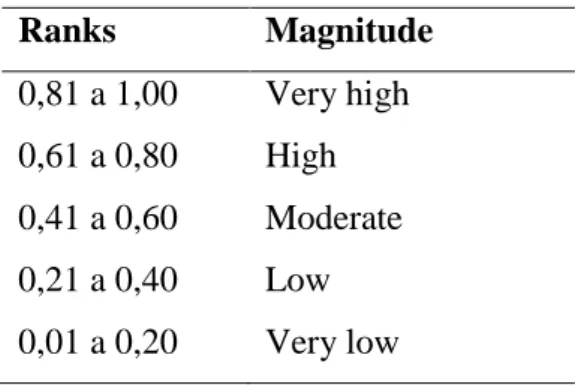
Table 9. Interpretation Scale 44
Table 10. Interpretation Scale 45
Table 11. Multimedia projector use Summary of the frequency and percentage 46 Table 12. Internet use A summary of the frequency and percentage 47 Table 13. Videos use - A summary of the frequency and percentage 48 Table 14. Variable, audiovisual aids - A summary of frequency and
percentage
49
Table 15. Variable reading comprehension - A summary of the frequency and percentage
50
Table 16. Use Multimedia Projector and Reading Comprehension 51 Table 17. Interpretation of correlation coefficients 52 Table 18. The use of internet and reading comprehension 54 Table 19. Interpretation of correlation coefficients 54
Table 20. Use of Videos and Reading Comprehension 57
List of figures
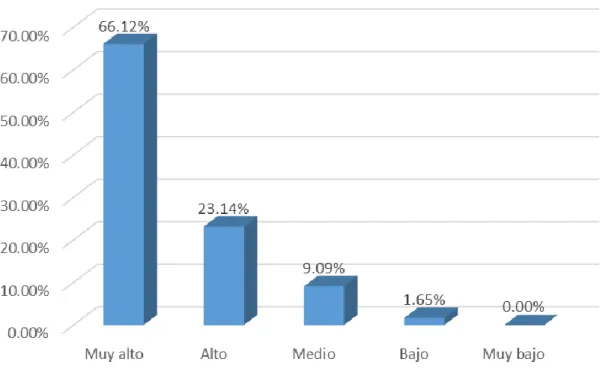
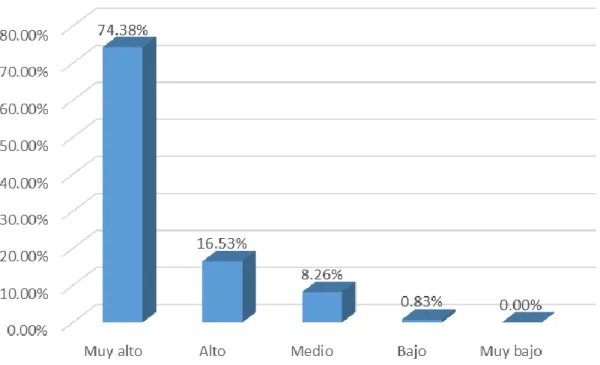
Figure 1. Multimedia Projector Use 47
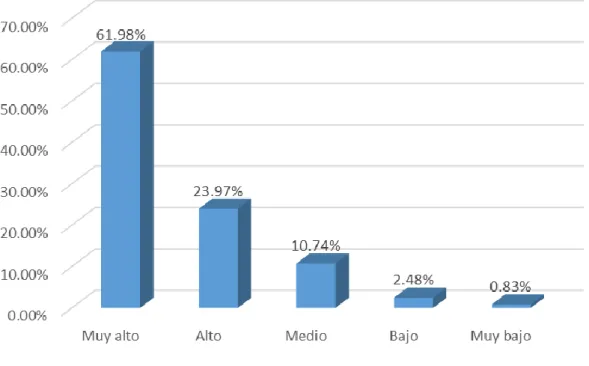
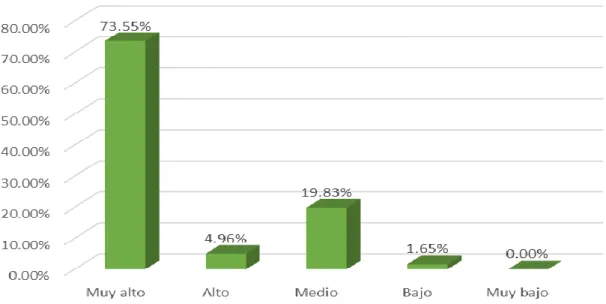
Figure 2. Internet Use 48
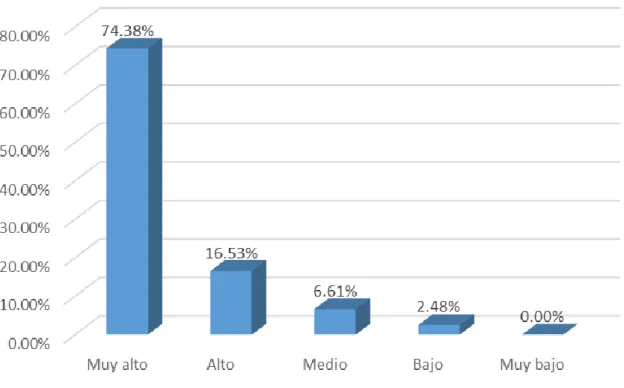
Figure 3. Videos Use 49
Figure 4. Variable Audiovisual Aids 50
Figure 5. Variable, Reading Comprehension 51
Figure 6. Multimedia Projector and Reading Comprehension Figure 7. The use of internet and reading comprehension Figure 8. Use of Videos and Reading Comprehension
Figure 9. Use of Audiovisual Aids and Reading Comprehension
Summary
Este trabajo titulado The use of audiovisual aids and reading comprehension in second grade students of English at 25 Fe y Alegria School, San Juan de Lurigancho 2016, tuvo como hipótesis principal que existe una relación estrecha entre el uso de ayudas audiovisuales. y comprensión de lectura en inglés en estudiantes de segundo grado de inglés en la escuela 25 Fe y Alegría, San Juan de Lurigancho, 2016. Es una investigación sustantiva en su variedad de métodos descriptivos con un diseño correlacional. Su
población y muestra estaban compuestas por 121 estudiantes que estudiaban inglés como asignatura en la escuela secundaria pública. Después de la prueba de hipótesis, se encontró que la hipótesis alternativa era verdadera, lo que confirma que las ayudas audiovisuales y la comprensión de lectura en inglés en los estudiantes de segundo grado son muy altas, debido al hecho de que rs = 0.980, con respecto al estudio de muestra, son
significativamente Relacionados de la muestra con un nivel de significación de 0,05.
Abstract
This work entitled The use of audiovisual aids and reading comprehension in second grade students of English at 25 Fe y Alegría school, San Juan de Lurigancho, 2016, had as the main hypothesis that there is a close relationship between the use of audiovisual aids and reading comprehension in English in second grade students of English at 25 Fe y Alegría school, San Juan de Lurigancho, 2016. It is a substantive research in its variety of descriptive method with a correlational design. Its population and sample was made up of 121 students who were studying English as a subject in the public high school. After the hypothesis testing, the alternative hypothesis was found to be true, confirming that audiovisual aids and reading comprehension in English in the Second grade students are very high, due to the fact that rs = 0.980, with respect to the sample study, are significantly related of the sample with a significance level of 0,05.
Introduction
This research had as the main objective to establish the relationship between the use of audiovisual aids and reading comprehension in second grade students of English at 25 Fe y Alegría school, San Juan de Lurigancho, 2016. Technology has been significant progress in recent times, considering that one of the most important skills that allow us to know and understand the environment around us, its phenomena, its advances and
discoveries, is the ability of reading comprehension, the same which it must be encouraged from the earliest years of life.
Multimedia resources seeking to bring about learning easier and faster by creating interactive lessons that help students acquire or strengthen contained in the various areas of learning. It is important for students to read in English using strategies that allow them to approach the understanding of texts and that both strategies can be used as tools that enforce readers can to overcome difficulties during the process of reading comprehension.
The purpose of this study is to insert audiovisual media and reading comprehension strategies and see whether these in turn influence text comprehension. For the development of this thesis research protocol awarded by the postgrade of the National University of Education Enrique Guzmán y Valle La Cantuta, and is structured as follows:
In chapter I we develop the determination of problem, formulation of problem, objectives, scope and relevance of problem and limitations of the research. In chapter II we develop the theoretical framework, the research background, theoretical bases and
In chapter V it develops the results, validity and reliability of instruments, presentation and analysis of results and discussion. Finally, it presents conclusions, recommendations, references and appendices. This research is within reach of everybody for knowledge and application.
Chapter I Statement of problem
1.1 Determination of the problem
Do audiovisual aids help someone’s comprehension of text? A sum of research addresses this question directly; the general opinion is that audio visual aids in text have positive effects on reader comprehension. Within the context of these studies, audiovisual refer to any graphic displays or resource that show all or some of the accompanying text’s content. Some examples of audiovisuals are pictures, photos, maps, diagrams, charts, animations, slides, videos, songs, movies and cartoons.
Nowadays the educational system cannot be separated from the development of science and technology. In relation to education, teaching and learning in the class was demanded to be innovative and creative. In this case in English lessons especially reading skills are very low understood by the students in these days.
Reading is one of the four skills which needs to be learned besides listening, speaking, and writing. Reading has a considerable role in learning a second language which are acquired by the students. Reading skill affects the other skills learning process. Besides, the students have to be able to achieve reading competencies in different level by the national curriculum by Minedu. When the readers cannot comprehend a text, they may shift their attention from the text to the accompanying visual images or try to make a relation with something before they could know. During reading process, reader constructs a meaningful representation of the text through an interaction of their conceptual and linguistic knowledge with the ideas present in the text. Prior knowledge of reading is one of the most important factors in reading process. There are some strategies to activate this knowledge such as: pre reading, during reading, after reading, class discussion,
Visual aids such as maps, slides, diagrams, tables, charts, gits and pictures play an important role in reading comprehension in schools. By using visual aids, students specially teenagers feel more motivate and make accurate links between text and visuals, and they have a better understanding in the learning process.
Audiovisual aids, when they integrate into the lesson plan through media, attract students´ attention to the topic presented in the classroom, improve and help
comprehension of grammar and language, increase students’ motivation, as well as help students to memorize the new vocabulary and structures. Apart from being an excellent tool to improve the language acquisition, the use of audiovisual aids in the classroom provides a more meaningful context for the students. All these factors lead students to become more participative and communicative members of the class group.
On the other hand, at the School of Fe y Alegria N°25, English classes were attended by students from different backgrounds with the objective of passing to the next grade, in this case to the second grade. In the process of passing from one grade to other students face many academic difficulties; especially in reading comprehension, they could not understand topics, they could not do different kind of activities. Also in public schools, the time for teaching the English subject is too short, just half an hour per week, besides that, schools did not have enough didactic material to improve learning English. This research was an innovate proposal for introducing audiovisual aids in the reading comprehension. This project had been designed for the second grade of secondary in Fe y Alegria School. The use of audiovisual aids to develop reading comprehension in the school was important and paramount to be measured and known in terms of their academic performance.
This study re-examined the role of audiovisual aids within the context of education learning contexts and investigated to what extent the presence of audiovisual aids to
results occurred, so the incorporation of these resources into teaching would be strongly recommended to EFL teachers.
1.2 Formulation of problem 1.2.1 General problem.
GP: To what extent is the use of audiovisual aids related to reading comprehension in second grade students of English at 25 Fe y Alegría school, San Juan de
Lurigancho, 2016? 1.2.2 Specific problems.
SP1. To what extent is multimedia projector related to reading comprehension in English in second grade students of English at 25 Fe y Alegría school, San Juan de Lurigancho, 2016?
SP2. To what extent is the use of internet related to reading comprehension in second grade students of English at 25 Fe y Alegría school, San Juan de Lurigancho, 2016?
SP3. To what extent is the use of videos related to reading comprehension in second grade students of English at 25 Fe y Alegría school, San Juan de Lurigancho, 2016?
1.3 Objectives
1.3.1 General objective.
GO: To establish the relationship between the use of audiovisual aids and reading comprehension in second grade students of English at 25 Fe y Alegría school, San Juan de Lurigancho, 2016.
1.3.2 Specific objectives.
Alegría school, San Juan de Lurigancho, 2016.
SO2. To determine the relationship between the use of internet and reading
comprehension in English in second grade students of English at 25 Fe y Alegría school, San Juan de Lurigancho, 2016.
SO3. To determine the relationship between the use of videos and reading
comprehension in English in second grade students of English at 25 Fe y Alegría school, San Juan de Lurigancho, 2016.
1.4 Scope and relevance of the problem
Eventually, one thing that could not be denied is that students live in a media world, in which most of the information was provided by visual input, through different
technological devices. As scholars had always argued, in order to make the acquisition of the language more meaningful for the students, teachers must bring the real world into the classroom. Visual materials worked as a powerful tool in this aspect, as far as they give teachers the opportunity to show the culture of the target language, the habits and the body language that lie behind the language transactions. All this makes students understood that the use of the target language had a purpose: the real purpose of real communication.
This research produced significant knowledge related to the role of audiovisual aids into the reading comprehension. The results of this study promote change of attitudes toward the use and promotion of the audiovisual aids in the investigated population and the teachers of English or any other subjects.
This study was benefit directly the students of “Fe y Alegria” School N° 25 and could be benefit others with similar characteristics, because the description and
valuable information and conclusions regarding the theoretical aspects and research instruments to collect information about the two study variables.
1.5 Limitations of the research
According to Bernal, (2006, p. 105) stated the limitations of the research were these: Limitations of time.
This research took place between December 2016 and August 2017, during this period had been develop.
Limitations of the space.
This research was run in Fe y Alegria School N° 25 in San Juan de Lurigancho, Lima-Peru.
Limitations of resources.
Chapter II Theoretical framework 2.1 Research background
2.1.1 International researches.
Jimenez (2013) did a research about “Development of reading comprehension in multimedia texts in a foreign language by teaching strategies reading-Colombia”. The general objective was to contribute the quality of teaching English environments as a foreign language through the implementation of reading strategies in a multimedia context.
The methodology that used was explanatory sequential with mixed methodology. The design was explanatory sequence within a mixed approach. This research concluded, the multimedia texts allow the student to interact with these which makes it possible to make reading an active process, taking into account that this type of text offer the reader resources that have been designed so that he can use them At the moment in which difficulties are in reading comprehension. This study confirms the findings of other English-speaking readers in the context of the foreign language who used as aids to comprehension, translator and online dictionary.
Nolasco (2012) did a research about "Use of multimedia resources to enhance student learning in ninth grade in the subject of electricity in the centre of educational research and innovation of the National Pedagogical University Francisco Morazán Mexico"
dynamics of this unit based on demonstrative works and mathematical demonstrations, it is concluded that multimedia resources are important for, analysing comprehend and solving problems Mathematical demonstratives.
Ramírez (2012) did an investigation about “Usage of Multimedia Visual Aids in the English Language Classroom: A Case Study at Margarita Salas Secondary School
(Majadahonda)”; to see if the use of visuals during the lesson plan helps students to improve their academic outcomes, they made an exam with the contents of the unit. The post-Usage of test marks were analysed and compared with previous marks of the students (the ones from the last exam they performed before the didactic unit). Once the data was collected by means of questionnaires, observation and comparison of marks, it was
processed in order to analyse if the objective of the research has been reached. They found a high number of respondents (almost 63%) indicate the availability of projectors and other multimedia devices in their English classroom.
At the same time, surprisingly most of the students report that the use of these multimedia devices in the classroom is rather infrequent. It should be highlighted as well that, according to students´ answers, some multimedia resources are not used at all. In particular, it is the case of multimedia presentations and videos (Between 30-40% of respondents affirm that they never used them in the class).
The data collected, suggest that half of the respondents would like to have more visual support during their oral activities, while 37% of them remain indifferent to that aspect. The benefits of using visual aids in the language classroom have been researched and asserted by scholars over the years. The different approaches to language teaching have used visuals as an important tool in the language acquisition.
The overview of studies carried out to prove the importance of visuals in second language acquisition have helped the authors of this study to state their hypothesis. They have claimed that visuals help to enhance the language teaching, as well as students’ comprehension of the new input. Visual aids also clarify the meaning of words and
messages, help in memorizing new vocabulary, and in gaining students attention. All in all, visual aids are claimed to facilitate the learning process and to improve the outcomes in the language classroom.
2.1.2 National researches.
Herrera (2015) did a research about the “Use of open educational resources in the development of communication skills in teaching English language at the intermediate level in a language centre of Lima. ". The objective of the research is to identify the use of resources in the development of communication skills in teaching English at the
intermediate level in a language centre of Lima. From this problem the following specific objectives: a) describe how the resources to develop the skill of listening and reading in teaching English Language b) describe how resources for development are used are used skills in oral and written English teaching production.
centre of Lima in the sense that will be released and will be evidenced in various ways the use of OER.
The conclusions reached by this research are: Open educational resources are used in the development of communication skills in teaching English language classes institutes, more frequently, because they are equipped with technological tools in the language classrooms Also, teachers have the knowledge and level of knowledge necessary to give constant use. Open educational resources are used by teachers to develop the ability of oral and written understanding in different ways. Thus, interactive YouTube videos are used, as well as activities and listening exercises (oral comprehension). On the other hand, also exercises reading (reading comprehension) of websites recognized educational bodies to ensure that the student understands, internalizes and finally managed correctly infer information in the English language are used.
Palacín (2014) did a research about “the influence of audiovisual media on the reading comprehension of students in the computer science and computer science specialty of the II cycle of the Institute of Higher Technological Education of Huaycán-Lima ". The general objective was to determine the influence of the audiovisual media on the reading comprehension of the students in the specialty of Computing and Informatics of II Cycle of the Higher Technological Education Institute of Huaycán in 2013.
This research is within the quantitative paradigm, of the application type. The research design is cuasi experimental. Getting as a more important result; the audiovisual media influence in the reading comprehension of the students in the specialty of
Computing and Informatics of the II cycle of the Institute of Higher Education Technological of Huaycán in 2013. (U de Mann).
a private school in Lima. The general objective of this study was to explain the influence of using Educa play (web page) to develop reading comprehension and text production; it considered the media as an interesting tool to acquire English language. This research used the platform which gave academic activities for increasing the level of reading
comprehension.
This thesis is a quantitative research, it used a pre-test and post-test, also a data collection to support its hypothesis, there were two groups, one was to demonstrate how was the effect of using the platform, so students could develop reading comprehension and text production, and the another was control group. The results demonstrate that the
experimental group of students increased their reading comprehension; on the other hand the control group had a low level of developing reading comprehension and text
production. The obtained results show the influence of using the platform (web page) to develop reading comprehension the percentage was low in the pre-test, but in the post-test had a great level in this capability.
2.2 Theoretical bases
2.2.1 Variable I. Audio Visual aids. Definition of audiovisual aids.
Audio Visual Aids are tools that combines the images and sounds or objects that can be manipulated, seen, heard, read, or discussed with the instruments to good use in
teaching and learning activities, may affect the effectiveness, instructional program (Azhar, 1997, P. 94). So it means audiovisual aids are sensitive tools used in teaching and as avenues for learning. These are planned educational materials that appeal to the senses of the people and quicken learning facilities for clear understanding.
needs to be carefully selected or prepared to ensure it is relevant, convincing and
interesting. While video recordings are often the most favoured audio visual aid, how they are to be distributed also requires careful consideration. Slides, photographs and audio recordings are a very useful alternative.
Audiovisual materials are produced, distributed and used as planned components of educational programs. It helps the process of learning that is motivation, classification and stimulation audiovisual aids are multisensory materials which motivate and stimulate the individual. “It makes dynamic learning experience more concrete realistic and clarity. Young people today are accustomed to looking and listening for long periods. With well-constructed pictures or films, they find language classes more interesting and enjoyable. (Rivers, p.207)
Visual aids can be a helpful tool in the language classroom as Mannan (2005) points out they ‘help the teacher to clarify, establish, correlate and coordinate accurate concepts, interpretations and appreciations, and enable him to make learning more concrete,
effective, interesting, inspirational, meaningful and vivid’ (p.108). Teachers can better define class topics through the use of visual audio media also get meaningful learning using audio visual aids during their lessons.
Use of audio-visual materials makes the learning more long-lasting than the use of traditional textbooks (Craig & Amernic, 2006. pp. 152-153). Knowledge is more fixed in memory as it is captured through audiovisual resources, considering that in a classroom not all students have the same intelligence and with the help of these resources, learning takes place throughout the classroom unlike traditional books.
Classification of audiovisual aids.
a) Audio aids: Audio materials are those which can be heard.
Examples: radio, tape recorder, Walkman, headphones, mp3, cellphones.
b) Visual aids: these are helpful to visualize things. Students can identify with the persons depicted, in a living experience in the other culture, and observe the total response, with facial expressions, gestures.
Examples: graphic aids, 3d-aids, display boards, slides and print material. c) Audio visual aids: these aids can be heard and seen simultaneously.
Examples: Multimedia projected aids, TV, films, web pages, slides, cell phones, gifts. Pictures, graphics and visual organizers in Power Point presentations
Pictures or drawings: As well as flash cards, pictures or drawings make the meaning instantly clear, allow the students to see what they have to say or work about, eliminating any need for translation. They also provide instant motivation for the students to say the words. They are a good way of showing meaning and conveying situations to the class as well as to introduce a topic, new vocabulary, or as a preparation for reading text or dialogue. Teachers can use different resources to support their explanations, correct exercises or play games using projectors and multimedia classrooms that have been integrated in high school nowadays. In order to make these presentations effective, teachers must be careful with the visual material and strategies they include in them.
In the modern teaching system, another essential aid for the teachers is PowerPoint slides. PowerPoint slides have become popular among the teachers from all the disciplines. This tool has made teaching more dynamic with attractive presentations and
Most students are more visual and for them to learn by watching and listening is great fun, at the time of review or recall issues, do more easily Corbeil (2007) in his study found that students like PowerPoint for their brightness, liveliness, clarity and interactivity. It helps the learners to understand better as they can see the visual with examples (p. 645). In most of the power point slides using in classroom are necessary to show pictures in order to get student`s attention, during the lesson because graphic images also help students to create relations amongst the words, ‘bringing out more detailed,
knowledgeable, responsive, awareness to the object, situation or text being communicated’ (Canning-Wilson 2001, p.56). Canning also points that the picture can help the student to work with more abstract thoughts and organizing skills through the use of logical structure.
Definition of multimedia.
The multimedia is an educational tool that combines sound, graphics, films and videos. They can also include animation to give movement to images especially to simulate real life situations, multimedia is important to use it in teaching English as it contributes to the quality education of our times.
Rojas (2003, p. 136) it is a way to show information using a mix of texts, sounds animation, pictures and videos. Among the most popular apps, there are games, learning programs and resources how books. Most of the apps has connects hyperlinks, so people operate them in an intuitive way. (Own translation)
program, etc. The idea of using multimedia for education is not new. What is new is how people use computers for getting different things. The arrival of high resolution screens, sound and video playback facilities for computers has resulted in the improvement of using multimedia applications for education.
The best technological description is the mixing of two or more distinct equipment (retro projector, speakers, electronic boards and electronic pens) and the personal
computer. A presentation in multimedia consider to integrate at least three of these five types of datum. Texts, graphics, steady images, images in movement (video – animations) and audio (music, voice, sounds, etc), that could be transmitted by a computer or other electronic equipment. With Photographs and animation, mixing sounds, videos and informative texts, so teachers can impress students. Multimedia stimulates eyes, ears, fingers tips, and the most important one, head.
Multimedia is a technology that allows teachers to present text, sound, images, animation and film in an interactive way that has the potential to create a remarkable impact on all different aspects of our day-to-day activities. Nowadays education is witnessing an explosive advance in the use of multimedia in diverse requests such as entertainment, communication, collaborative work, electronic commerce and school courses. Multimedia improves significantly when it converted a fusion of elements of hyper-linked text, animation, graphics, video and audio in an interactive environment. The connection between cognition, learning and education were carefully analysed to select multimedia blocks. Based on knowledge from the analysis, teacher could control the order of their presentations.
Retro projector.
the drawings are placed. The pictures, charts, lists and graphics are drawn or reproduced previously on sheets of transparent acetate. The retro projector is easy to handle and it’s an authentic visual aid for teachers to catch students’ attention and to improve their
imaginative ability.
Other advantages of using the retro projector are:
a. There is no need of erasing to change topics as when we use the board, it allows to present new pictures only with adding and subtracting acetate.
b. The projected image shows great visibility.
c. It is possible to use several documents (Paredes, p. 4-10.) Class topic presentations through Power Point.
In the classes are necessary to create a climate of attention on the part of all the students, for this it is important the teacher can explain the topic what happen when an effect is produced, a sound so a student who has lost the attention of the subject, quickly can reconnect with the class due to the use of interactive slides. Power point positively bristles with all kinds of tools that allow you to create slide shows brimming with especial effects and animations. (Beattie and whitelaw 2008, p. 382)
The graphics describe and give better concepts than a lot of words, students especially teenagers are quite socialized to the world of technology and they in their communicative language they use in social networks is mostly determined by emoticons, images with movements, etc. then to draw the attention of the students in the classes it is necessary to include the animated images in the slides that are used in the development of the learning sessions. Clip art includes animations that can be used to give certain slice a nice quirky appeal. (Beattie and whitelaw 2008, p. 430)
every time either by Facebook, whatsapp, to express some type of interactive
communication between groups, if these gif are used as often as include it in the classes, students can feel that it is handling communication according to their context and they can feel confident in developing their learning.
PowerPoint is a high-powered software tool used for presenting information in a dynamic slide show format. Text, charts, graphs, sound effects and video are just some of the elements of PowerPoint that can include into the expositions. Whether it's a classroom lesson, a parents' group meeting, or a teachers' seminar - PowerPoint shows how to make a powerful impression on the audience. It is probably the best-known demonstration
graphics program accessible.
Marques (2004, p. 95) said: The slide is one of the audiovisual media that they have had and continue to have greater acceptance in many conferences and talks. They are of great support to all kinds of speakers who need to express their ideas in public. (Own translation) The slides are each of the elements that make up the presentation. Teacher can create and modify individually. A good slide clarifies and amplifies the verbal message, attracts the attention of the audience, stimulates their interest and facilitates understanding. It requires careful preparation. If they are not legible, their content is not understood or distract attention, work becomes a vain effort. The number of slides varies depending on the content of the presentation, but in general, it is advisable that each slide contains a single idea or element of information.
Using internet in class preparation.
The internet is one of the tools that has the easiest access with so one click we can access a lot of information on different topics and in different formats. On internet has web pages, search engines, videos, social networks, etc. Each of this element can be used in the preparations of session class or used at the same time for lesson plans. Using internet in order to prepare classes is very significant. People lives are surrounded by technology. Many students have cell phones, their own computer, and their technology. So teachers must also be part of the technological generation. Using the internet is very important for teachers. They have to open their minds and not just follow the book. Professors need to change strategies because students get a better understanding of technology. Professors have to explore the world of internet, more exploration, more learning. The internet has everything, pictures, images, books, music, etc; teachers should explore this new world.
Web pages.
text and images, sound, etc., as well as hyperlinks; it can also contain embedded
applications to make it interactive. Web pages are written in a generally HTML mark-up language. Word processors such as Word and presentations such as PowerPoint, allow to create hyperlinks and save documents as a Web page and these allow to design and present interactive lessons and also include information from web pages such as busy teacher, esl printables, google translator, you tube, etc.
According to study conducted by Jackson et al. (2006), it has been found that students who used the internet more, got higher scores and grades. According to the research activities, the internet changes the interaction between learners and teachers (Kern, 1995): there is less teacher and more learner talk in computer classes.
https://ac.els-cdn.com/S1877042812024949/1-s2.0-S1877042812024949-
main.pdf?_tid=0496c0ba-fb96-11e7-9c5f-00000aab0f01&acdnat=1516200920_09653984ff1cd85d8756d6c32db5923b Digital videos and YouTube.
As there are thousands of readymade videos designed for language teaching, teachers can easily choose according to their needs (Ozkan, 2002. p. 37). In classes as a warming up teachers use videos in order to facilitate language teaching and learning in different ways. It makes the classroom motivating removing the monotony of the students.
Moreover, it helps pupils to generate ideas and new knowledge for discussion. It makes the class more interactive, cooperating and effective.
Çakir (2006) reported that use of video in language teaching ensures authentic language input to the learners. Moreover, using content related videos helps the learners to conceptualize the ideas and get in depth thought on that topic. Besides, learners can concentrate on the use of contextual language in the videos along with non-verbal features of language that helps them to have better understanding of the target language use (p. 67).
With the use of the videos in class helps the student to figure out which will be the subject of class and these in turn can create in their mind the new scheme of knowledge to acquire, considering they are learning a new language, where they handles his own
vocabulary, intonation of the words, then the videos create an idea more related to learning English as a foreign language so they feel more stimulated and participate in class more confidently.
Cunning (2001) discussed the usefulness of using videos in language teaching stating that video provides stimuli to the learners which facilitates an opportunity to the learners to get a background schemata of the subject. Also the use of videos helps the learners to have an idea of the stress and rhythm pattern of the target language. Moreover, it allows the learners to predict, infer and analyse information of the subject matter (as cited in Koksal, 2004. P. 63).
and ambiguity, and so represents a rich terrain to be worked and reworked in the language learning classroom. In other words, video is the combination of electronic pictures and audio. The videos are the perfect combination of audio and images, which is a powerful educational resource that must be considered by teachers in the development of classes to achieve significant learning in students whether it is a simple or very complex topic, the video will show the path where the new learning should go.
Stemplesky (1990, p. 3-4) states about the importance of a moving picture
component as a language teaching aid which is able to increase the students’ motivation. Children and adults feel their interest quicken when language is experienced in a lively way through television and video. When videos are used in class, where you can observe images and listen to the audios while they are broadcast through the projectors, they motivate the audience to pay attention and generate a great concentration without any distraction, it gives them the impression that they were in the cinema making the largest number of students remain concentrated in the video, then this is where the new
knowledge should be shown in a very simple way, so that students are motivated in their new learning.
Techniques in teaching how using you tube videos.
As stated above that YouTube is a very popular web video sharing site that lets anyone store short or long videos for private or public viewing. It provides a site for sharing videos among friends and family as well as a showcase for new and experienced videographers. It means that teaching using YouTube is similar to teaching using video.
This strategy is quite used in class because the video is shown in class without any interruption, so some students who could not capture all the information presented, when repeating or pausing some parts of the video gives the student time to be able to process the information and then translate it into their worksheets, and then they can achieve a complete and detailed understanding of the video shown in class.
2) To use silence viewing. It is excellent for stimulating writing. Students want to communicate their interpretations of people and actions they have seen on the screen.
Watching the videos in silence allows you to take notes, annotations about the most interesting parts or where you have the most difficulties to understand the information of the presented topic, at the end of the video you can talk and ask about the notes taken from the videos shown in class.
2.2.2 Variable II Reading comprehension. Defining reading.
Reading involves recognition of certain patterns of symbols and that these represent particular sounds which form words we use or hear spoken. (Rivers p, 261). The reading is based on a process of recognition of letters, this in turn in words and these words to a set of phrases that are heard, written, reproduced at every moment we want to communicate something or leave a message for something or someone. Reading is the process of identifying written words for different reasons of communication in daily lives.
Reading is not only looking at, receiving the text, and understanding the information from the text but also is an activity to get the comprehension and interpretation from the ideas in written or printed. Reading is an important learning goal and complete skill
them can understand what they read in a text. It can be concluded that reading is a perceptual and cognitive process. In reading, the reader has a purpose of perceiving a written text in order to interpret and understand its message. Besides, reading is a process of understanding what has been read including receiving and interpreting information.
Defining reading comprehension.
Reading comprehension involves a complex processing of information and ideas, this effect, is thinking (Barry K Beyer, 1979, p. 94). Comprehension is a thinking process, it is through reading. Students need the background of experience (vocabulary, knowledge, concepts and ideas) for development their language skills (knowledge of morphology, syntax and grammar).
Comprehension includes the correct association of meanings with word symbols, the selection of the right meanings suggested by the context, the organization and retention of meanings, the ability of reasoning way through smaller ideas segments and the ability to grasp the meaning of a large unitary idea (Barry 1979, p. 95). Learning to comprehend is not easy, is a complex process, comprehension is the process of making sense of words, phrases, sentences and connected text. In these, the readers typically make use of background knowledge, vocabulary, grammatical knowledge, experience with text and other strategies and techniques in order to help them understand written text.
Learning to read requires considerable cognitive effort and along learning process, whether one is learning to read in the first or in the second language. They also state that reading is decoding and understanding text for particular reading purposes. To understand written text, the readers engage in constructive process, from simple text to complex text, to make the text meaningful. Without reading and comprehending the text, the reader will not understand what the text is talking about so that both of those things are very
It is important to know how the students can catch the information of the text, which techniques, strategies they use in order to get comprehension in a text. Reading
comprehension is defined as the level of understanding writing or text. Skilful reading depends on the capacity to recognize words quickly and effortlessly. If words recognition is difficult, students use too much of their processing capacity to read individual words which interferes their ability to comprehend what is read. Reading texts constrain students to always pay attention to every single word and sentence. Reading for general
comprehension is actually more complex than commonly assumed. It requires very rapid and automatic processing of words, strong skills in forming a general meaning
representation of main ideas, and efficient coordination of many processes under very limited time constrains when accomplished by a skilled fluent reader. Some students may be able to understand a certain reading passage but the others may not be because every student has different level.
Reading comprehension is an interactive process involving the readers, the text, and the activity or purpose for reading. It is a process of comprehending a text or passage, such as decoding the writer’s words and using background knowledge to construct an
approximately understanding of the writer’s message. In this process, the reader’s effort and mental is in order to understand a text that is read or the process of constructing meaning from a text. Reading comprehension is also called as a process of constructing i.e., constructing process and constructing meaning.
Metaphorical models of reading.
Top down and bottom up.
different models to understand the texts and some of these models are the metaphoric models from the bottom up and top down, each of them can get a panoramic view or something specific texts, allowing the Student can use these models to achieve an adequate level of understanding in the readings.
The metaphorical top-down model gives the reader a general idea of reading, allows you to have the most important ideas of reading, while the metaphorical model from the bottom up allows the reader to analyse the details of the reading, here you can analyse the secondary ideas of the texts, joining both processes can get a general and detailed
understanding of the entire text.
It has been said that in top down processing the reader gets a general view of the reading passage by in some way, absorbing the overall picture. This is greatly helped if their schemata allow them to have appropriate expectations of what they are going to come across. In bottom up processing on the other hand, the reader or listener focuses on such things as individual words, phrases or cohesive devices and achieves understanding by stringing these detailed elements together to build up a whole. (Harmer 2007 p, 270).
Reading comprehension is important to apply and develop methods, forms, strategies and models to achieve adequate understanding of a text, each student develops his own way of reading, for some it is easier to get a general idea about reading so it made reading all the text- top down, then explained his overview of the text, and for other students is more important as they develop reading go analysing words, sentences and paragraphs - bottom up, to get a complete understanding of the text, both processes are valid to achieve an adequate reading comprehension.
good understanding of a reasonable proportion of the details gained or proposed through some bottom up processing, we may find it difficult to come to a clear general picture of what is a text about, or about how to put together a coherent stretch of discourse. But without some global understanding of the topic that is written or spoken about, even an understanding of the details may not be enough. (Harmer 2007 p, 270).
Definition for top down model.
Assume that reading is primary directly by reader goals and expectations. Again such a view is general and metaphorical. Top down models characterise the reader as someone who has a set of expectations about text information and samples enough information from the text to confirm or reject these expectations. To accomplish this sampling efficiently, the reader directs the eyes to the most likely places in the text to find useful information. The mechanism by which a reader would generate expectations is not clear, but these expectations might be created by a general monitoring mechanism.
Inferencing is a prominent features of top down models, as is the importance of a reader´s background knowledge.
Top down views highlight the potential interaction of all process with each other under the general control of a central monitor. In extreme interpretations, there is a question about what a reader could learn from a text if the reader must first have
expectations about all the information in the text. In fact, few reading researches actually support strong down views. (Grabe and Stoller 2002, p.32)
Top down models of reading.
The student is processing the information that is collected from the reading as he is reading is predicting the subject and thus get a general idea of the text. Models of the reading process which predict that the processing sequence proceeds from predictions about meaning to attention to progressively smaller units, for example, letter, visual features. (Carter and Nunan 1995, p. 175).
The top-down model focuses on predicting the subject of the text as well as the general idea of reading, achieving a general understanding of the text. Gough challenges top down models which emphasize the importance of predicting guessing in learning to read. (Carter and Nunan 1995, p. 60)
This model is not based on the smallest details (words, phrases or sentences) but is based on getting the overview of the text, in order to understand the subject of the text. Smith 1971 and Goodman 1985 pay minimal attention to letter sound correspondences and place their emphasis on higher-order sources of information. (Carter and Nunan 1995, p. 61)
Top-downprocessing of language happens when someone uses background
information to predict the meaning of the subject or topic they are going to read in a text, they develop expectations about what they will read, and confirm or reject these as they read. Top-down processing is thought to be an effective way of processing language. Example: Asking learners to predict what a newspaper article might be about from the headline or first sentence will encourage them to use top-down processing on the article.
Definition for bottom up model.
building on the basis of analysing the smallest units of meaning, so the process begins with letters and sounds, building the recognition of morphemes and words, and then gradually moving to the identification of grammatical structures, sentences and longer texts.
Suggest that all the reading follows a mechanical pattern which the reader creates a piece by piece mental translation of the information in the text with little interference from the reader’s own background knowledge. In the extreme view the reader processes each word letter by letter, each sentence word by word and each text sentence by sentence in a linear fashion. We know that such an extreme view is not entirely accurate. At the same time, there are aspects of this view reflected in the overview of the reading process. (Grabe and Stoller 2002, p.32)
Bottom up model of reading.
This process describes how a student can go from a simple identification of letters, words, phrases, sentences, paragraphs, to the understanding of a complete reading, because it is guided from the simplest to the most complex and that is what is developed within the levels of reading comprehension.
Models of the reading process that describes the process as a sequences of discrete steps in which the direction of processing is from level features of text to higher levels, that is from the identification of letter to sounds, to words , to sentences and finally to meaning and thinking. (Carter and Nunan 1995, p. 169)
This process of reading comprehension; it is based mainly on the smallest linguistic units of a text from which particular knowledge schemes are activated. In this vision, the process of comprehension begins with words (pronunciation, semantic value, morphology, etc.), which then give access to more extensive units (syntagmas, sentences, paragraphs) and finally to the interpretation of the complete text. Therefore, the overall message of the text is considered to be the sum of the information in each paragraph. The interpretation of each paragraph is determined by the previous interpretation of each sentence that is the result of the interpretation of each word, and so on.
Two decades of empirical research have largely resolved …debates in favour of the bottom up models. A greater use of context cues to aid word recognition is not a
characteristic of good readers; developing phonological sensitivity is critical for early success in reading acquisition; and instructional programmes that emphasize spelling sound decoding skills result in better readings outcomes because alphabetic coding is the critical sub-process that support fluent reading. (Stanovich 1999, p.29)
Benefits of using visual aids in teaching reading.
Reading is one of the important language skills, especially for the students as they need to read a lot of text books and materials throughout their entire academic life. However, students usually do not like reading that much. As a result, the task of the language teachers becomes difficult. However, if the teacher can make the reading interesting incorporating audio visual aids, learners may be attracted and engaged to the reading. Use of visual aids in reading can be benefited in many ways, students can create a confidential environment in classroom, so with these resources teachers can introduce topics about readings, so they can understand easily most of the texts.
According to Yunus, Salehi & John (2013), use of visual aids creates interest among the learners in reading. Different visual aids like pictures, videos and projectors helps the learners to understand the abstract ideas of the text. Moreover, visual aids create an authentic communication between the readers and the text. It makes the reading process faster and active. Readers feel more engaged with the text through visual aids (p. 114-15).
Visual aids (pictures, graphs etc.) in motivating reading.
Majority of the students supported that different visuals motivate them in reading in diverse ways. One student told in class that audio visuals aids make the reading materials attractive and contextualized. He mentioned,
Relevant audio visuals like videos help me to understand the reading text better. I can visualize the videos which helps me for better comprehension and inference about the readings. Also, if there is something very complicated to understand from a reading text, especially any data or description of a location, related pictures or graphs can help the readers to get the message relation with the topic of the videos.
Audio-visual aids in assisting the teachers.
The use of audio-visual aids made the class interactive and dynamic. It brought variation in the class which removed the monotony of the lecture-based class. These also helped the teachers to draw the attention of the most of the students. Teachers could clarify the subjects to the students clearly and easily with the help of the audio-visual aids. It made the class alive, interactive and participatory. Moreover, teacher could easily convey the message to the students by using different audio-visual aids which would otherwise be difficult. Thus, the use of audio-visual aids helped the language teachers in teaching language skills.
There is a saying "Reading is a window to the world", as people know by reading they can see the contents of a world without surrounds. According to the statement, we can conclude that reading is one of the skills that benefit different areas, subjects and also de daily lives, nowadays from people get up they start their life by reading cell phones messages, newspapers, notes, etc., so everything surrounded is relating with reading.
At school learning to read is one important aspect that is always present in every subject, from start in the kindergarten, as English learning. Reading is not just read but more important is to know the content of the text. In English lessons are many methods that is used to help students understand the content of the reading, in this case is a good model to increase reading by using the top down and bottom up model, so students can get the reading comprehension.
content of the reading without having to interpret every word in reading, because it takes much longer. Moreover junior high school students will be much more interested on reading.
2.3 Definitions of key terms
Audiovisual aids. Are those sensory objects or images which initiate or and reinforce learning. Besides that, are any instructional devices that can be seen and can be heard? Audiovisual aids are important tools for teaching learning process. It helps the teacher to present the lesson effectively and students learn and retain the concepts better and for longer duration. Use of audio visual aids improves students’ critical and analytical thinking. It helps to remove abstract concepts through visual presentation. However, improper and unplanned use of these aids can have negative effect on the learning outcome. Therefore, teachers should be well trained through in-service training to maximize the benefits of using these aids.
Reading comprehension. It is defined as the level of understanding of a text or message. This understanding comes from the interaction between the words that are written and how they trigger knowledge outside the text or message. Comprehension is a "creative, multifaceted process" dependent upon four language skills: phonology, syntax, semantics, and pragmatics. Proficient reading depends on the ability to recognise words quickly and effortlessly. It is also determined by an individual's cognitive development, which is "the construction of thought processes". Some people learn through education or instruction and others through direct experiences.
Chapter III Hypothesis and variables 3.1 Hypothesis
3.1.1 General hypothesis
GH: There is a close relationship between the use of audiovisual aids and reading comprehension in English in second grade students of English at 25 Fe y Alegría school, San Juan de Lurigancho, 2016.
3.1.2 Specific hypotheses
SH1. The use of multimedia projector is closely related to reading comprehension in English in second grade students of English at 25 Fe y Alegría school, San Juan de Lurigancho, 2016.
SH2. The use of internet is closely related to reading comprehension in English in second grade students of English at 25 Fe y Alegría school, San Juan de Lurigancho, 2016.
SH3.The use of videos is closely related to reading comprehension in English in second grade students of English at 25 Fe y Alegría school, San Juan de Lurigancho, 2016.
3.2 Variables
In this research raised type correlation hypothesis by what are considered a variable I and a variable II; also considering intervening variables that could be identified and
presented in the following way: Variable 01.
The first main variable corresponds a: Audiovisual aids. Variable 02.
Intervening variables.
Intervening variables and which could in any way have affected the results of this research are:
Age Gender
Socioeconomic
3.3 Operationalization of variables
Operationalization of the variable 01.
Table 1
Variables and operationalization of variable 01
Variables Dimensions Indicators Items
Variable I
Audiovisual aids
Multimedia projector
Recognizes the class topics through power points presentations
Identifies new vocabulary through pictures.
1,2, 3
4,5,6,7
Internet
Complete English worksheets, using web sites.
Use web sites to look for information about the topics. Produce better intonation in
pronunciation, using you tube.
8,9
10
11,12
Videos
Identifies a class topic, using videos. Recognizes the topics easily, using
videos.
Recognize pronunciation of new words, watching videos.
13, 14
15,16
Operationalizing the variable 02.
Table 2
Variables and operationalization of variable 02
Variables Dimensions Indicators Items
Variable II
Reading comprehension
Top down
Recognizes the reading topic
Identifies vocabulary relying to their background knowledge.
1.1
1.2
Bottom up
Writes words in gaps, from a text. Organizes ideas about the reading, putting the sentences in the correct order.
1.3 1.4
Organizes ideas through sentences by answering questions.
Write the answers for the questions, using grammar.
Chapter IV Methodology 4.1 Research approach
This study about the audiovisual aids and reading comprehension in English in students of Fe y Alegría School, in San Juan de Lurigancho2016 is a descriptive -correlational research, because first the description of each variable is given to then, determine the level of relationship between them. This is variable one and variable two. (Hernández, Fernandez & Baptista, 2014. p. 92)
4.2 Research type
According to Reyes and Sanchez (2015, p. 44) This research is of a basic type because the main objective is to discuss all the theory available about the two variables in the theoretical bases stage. After the hypothesis testing scientific theory will be reported as a way to support or reject the already existence theory about the relationship of audiovisual aids and reading comprehension.
4.3 Research design
This research will be of a correlational design. A correlational research can be accomplished by a variety of techniques which include the collection of empirical data. It will examine the covariation of two variables; they are audiovisual aids and reading comprehension. The objective is to describe the two variables and then analyze the relationship between then, in a particular moment. (Hernández, Fernandez &Baptista, 2014. p. 158).
Where:
OX = observation of the variable 01 OY = observation of the variable 02 M = sample
r = relationship between variables 4.4 Population and sample
The participants of this study are 128 school students at the Fe y Alegria School in san Juan de Lurigancho, Lima. Their ages range between 12 and 14 years old and the distribution of female and male students is about equal. Most of the students have a low social economic level. The sample includes the total number of students considered in the population. So we can say that a census will be applied.
4.5 Techniques and instruments of data collection Table 3
The techniques and instruments of data collection in this research will be:
Techniques Instruments
2. Survey Questionnaire
3. Measurement of skills Tests of reading comprehension 4. Documentary analysis Content analysis
5. Experts opinions Experts opinions sheets
Table 4
Technical data of the instrument of variable I Denomination Audiovisual aids
Author Leny Maria Llalleri Cardenas
Origin Lima, Perú
Year of edition 2018
Area of application Applicable to secondary school students Administration Individual or collective
Time of application 30 minutes
Calification Manual
Typification Baremático y pluriobservacional
Baremo The minimum score is 0 and the maximum score is 90. Significance and
structure
It consists of 18 items whose answers correspond to a Likert scale that is rated with 1, 2, 3, 4 or 5 points.
Calification Frequency-type Líkert scale: Never, rarely, sometimes, almost always and always
Materials It is presented as a sheet in which the items and application instructions appear to be answered on the same sheet. Validity Content validity by expert judgment
Reliability Internal consistency through pilot test and Cronbach's alpha coefficient
Table 5
Technical data of the instrument of variable II
Denomination Reading comprehension
Author Leny Maria Llalleri Cardenas
Origin Lima, Perú
Year of edition 2018
Area of application Applicable to secondary school students Administration Individual or collective
Time de application 30 minutes
Calification Manual
Typification Baremático y pluriobservacional
Baremo The minimum score is 0 and the maximum score is 20. Significance and
structure
It consists of 5 items whose answers correspond to a mixed test.
Calification Dichotomous scale.
Materials It is presented as a sheet in which the items and application instructions appear to be answered on the same sheet. Validity Content validity by expert judgment
4.6 Statistical Treatment
Treatment statistics and interpretation of results shall be taken into account
descriptive statistics and inferential statistics. Descriptive statistics: was the information processing, with the elaboration of statistical graphs and tables.
Inferential statistics: provides the theory necessary to infer or estimate the
generalization on the basis of partial information using coefficients and formulas. Thus, Webster (2001) sustains that "inferential statistics involves the use of a sample to draw any inference or conclusion about the population of which makes part the sample" (p. 10).
In addition, used the SPSS (Statistical Package software for Social Sciences version 20.0 in Spanish), to process the results of the inferential statistical tests. Statistical
Chapter V Results 5.1 Validity and reliability of instruments
Techniques are systematized and operative procedures, they serve to solve practical problems. The techniques can be: Observation, interview, document analysis, scales to measure attitudes, experimentation and the survey. The instruments are auxiliary means to collect and record the data obtained through the techniques.
In this research, used a Questionnaire and a Test to measure the selected variables and the instruments were:
Questionnaire English test a. Data Sheet Instrument N° 01.
Name: Questionnaire about the use of audiovisual aids Time of application: 20 minutes approximately.
Description: This instrument which consists 18 items formulated on the basis of indicators of the following dimensions: Multimedia Projector with 7 questions (1, 2, 3, 4, 5, 6 y 7). Internet with 5 questions (8, 9, 10, 11 y 12) Videos with 6 questions (13, 14, 15, 16, 17 y 18).
Author: Leny Llalleri Cardenas.
Validity: Validated by Dr. Rogil, expert, teacher and research advisor. Year: 2017.
Application: Direct and individual or group. Answer Options: 1 = Never
4 = Usually 5 = Always Instrument N° 02.
Name: English test.
Time of application: 30 minutes.
Description: This instrument which consists 6 items formulated on the basis of indicators of the following dimensions: Top Down con 2 preguntas (1 y 2) Bottom up con 3 preguntas (3, 4 y 5)
Author: Leny Llalleri Cardenas
Validity: Validated by Dr. Rogil, expert, teacher and research advisor. Year: 2017.
Application: Direct and individual or group. b. Validity of instruments
For validation of the measurement instrument, the validity of content was used; In this respect Gamarra refers: the validity of content, is to evaluate if the items that we have used to construct the test are relevant for the use that will be given to the test, Raises the next question about validity, are you measuring what you think you are measuring? If so, its measurement is valid, but evidently lacks validity. This type of validity judges the appropriateness of the instrument and the inferences extracted from the scores, this validation was made by expert judgment, in the table the professionals who issued their valuation judgment are mentioned in the table.
Instrument N° 01.
Validation of instruments.
Table 6
Expert’s evaluation results of the research instrument
N° Experts From Score
1 M. Ed. Miguel Ore de los Santos
National University of Education Enrique Guzman y Valle, Peru
88
2 Dr. Edith Zarate Aliaga National University of Education Enrique Guzman y Valle, Peru
87
3 Dr. Rogil Sanchez Quintana National University of Education Enrique Guzman y Valle, Peru
90
Average score 88
Source: Author`s own work
The average score of the instrument corresponds to a very good level according to the study made by Cabanillas (2004, cited in Lavado, 2010) in which the following chart of validating instruments is presented:
Instrument N° 02.
Table 7
Test of English Validation of instruments by experts
N° Experts From Score
1 M. Ed. Miguel Ore de los Santos
National University of Education Enrique Guzman y Valle, Peru
90
2 Dr. Edith Zarate Aliaga National University of Education Enrique Guzman y Valle, Peru
85
3 Dr. Rogil Sanchez Quintana National University of Education Enrique Guzman y Valle, Peru
91
Average score 89
Source: Author`s own work