and sharing with colleagues.
Other uses, including reproduction and distribution, or selling or
licensing copies, or posting to personal, institutional or third party
websites are prohibited.
In most cases authors are permitted to post their version of the
article (e.g. in Word or Tex form) to their personal website or
institutional repository. Authors requiring further information
regarding Elsevier’s archiving and manuscript policies are
encouraged to visit:
Modelling seed germination in forest tree species through survival analysis.
The
Pinus pinea
L. case study
Rubén Manso
a,⇑, Mathieu Fortin
b, Rafael Calama
a, Marta Pardos
a aDepartamento de Selvicultura y Gestión de Sistemas Forestales INIA – Forest Research Center, Ctra. La Coruña, km 7.5, 28040 Madrid, Spain b
Laboratoire d’Etude de Ressources Forêt-Bois (LERFoB UMR 1092), AgroParisTech, 14 rue Girardet, F-54042 Nancy Cedex, France
a r t i c l e
i n f o
Article history:
Received 15 June 2012
Received in revised form 11 October 2012 Accepted 13 October 2012
Keywords:
Survival analysis Hazard function Random effects Natural regeneration Climate change Dormancy
a b s t r a c t
The direct application of existing models for seed germination may often be inadequate in the context of ecology and forestry germination experiments. This is because basic model assumptions are violated and variables available to forest managers are rarely used. In this paper, we present a method which addresses the aforementioned shortcomings. The approach is illustrated through a case study ofPinus pineaL. Our findings will also shed light on the role of germination in the general failure of natural regen-eration in managed forests of this species. The presented technique consists of a mixed regression model based on survival analysis. Climate and stand covariates were tested. Data for fitting the model were gathered from a 5-year germination experiment in a mature, managedP. pineastand in the Northern Pla-teau of Spain in which two different stand densities can be found. The model predictions proved to be unbiased and highly accurate when compared with the training data. Germination inP. pineawas con-trolled through thermal variables at stand level. At microsite level, low densities negatively affected the probability of germination. A time-lag in the response was also detected. Overall, the proposed tech-nique provides a reliable alternative to germination modelling in ecology/forestry studies by using acces-sible/suitable variables. The P. pinea case study highlights the importance of producing unbiased predictions. In this species, the occurrence and timing of germination suggest a very different regenera-tion strategy from that understood by forest managers until now, which may explain the high failure rate of natural regeneration in managed stands. In addition, these findings provide valuable information for the management ofP. pineaunder climate-change conditions.
Ó2012 Elsevier B.V. All rights reserved.
1. Introduction
Natural regeneration is a key process in plant population dynamics consisting of several well-defined stages such as dispersal, predation, germination and establishment ( Gomez-Aparicio, 2008). Germination occurrence and germination timing play an essential role in subsequent seedling emergence (Baskin and Baskin, 2001) and therefore, in the overall success of natural regeneration. Hence, the development of tools to predict germina-tion events will lead to an improvement in our understanding of regeneration dynamics, which is a major issue in sensitive ecosys-tems affected by global change or where natural disturbances have been substituted by management (Dullinger et al., 2004; Castro et al., 2005; Brudvig and Asbjiornsen, 2009).
Germination modelling has been developed extensively within an agronomic framework, mainly through the hydrothermal model
(Gummerson, 1986; Bradford, 1990), which is a nonlinear regres-sion approach based on the cumulative effect of water potential and temperature on the cumulative germination rate. However, these methods have been reported to be limited when the true ger-mination time is unknown (Onofri et al., 2010). This is the case in experiments that are revisited at specific intervals (Rees and Long, 1993) or where seeds do not germinate before the end of the experiment (Scott and Jones, 1990). Therefore, rather than the ex-act moment of germination, the observation data situates the time of germination either within a given interval (interval censoring) or at an undetermined moment after the last measurement (right censoring). Not considering the data as interval censored (e.g. hydrothermal model) leads to misspecifications of the likelihood function, which results in biased parameter estimates (Onofri et al., 2010).
Another constraint of the hydrothermal model in studies con-cerned with predicting germination under natural conditions is the type of covariate used. In practice, water potential is difficult to obtain, hence it is not feasible to make predictions based on this data type at stand, forest or regional scale. However, there are a number of other variables closely associated with water availability
0378-1127/$ - see front matterÓ2012 Elsevier B.V. All rights reserved. http://dx.doi.org/10.1016/j.foreco.2012.10.028
⇑Corresponding author. Tel.: +34 91 347 14 61; fax: +34 91 347 67 67.
E-mail addresses:[email protected], [email protected](R. Manso), [email protected](M. Fortin),[email protected](R. Calama), [email protected](M. Pardos).
Forest Ecology and Management 289 (2013) 515–524
Contents lists available atSciVerse ScienceDirect
Forest Ecology and Management
which are more readily available and which can be used instead. Soil water content, in particular, can be expressed as a function of time since the last significant rainfall (Roman et al., 2000), depend-ing on the water-holddepend-ing capacity of the soil. The relative humidity of the air influences water loss through evapotranspiration (Müller, 2000). Additionally, when attempting to identify the thermal requirements for germination under natural conditions, frost occurrence should be taken into account together with tempera-ture. Although low temperatures can induce changes in a hypothet-ical dormancy state (Baskin and Baskin, 2001), little is known about the effect of frosts on the instantaneous capacity to germinate. In addition, stand structure and density can modify the general cli-matic conditions at microsite scale (Keyes et al., 2009) as well as limit the possible influence of light as a germination enhancing fac-tor (Seiwa et al., 2009). However, stand-related variables are com-monly overlooked in existing germination models.
Germination modelling based on survival time analyses was suggested as an option to cope with censoring in the 1980s (Scott et al., 1984; Pyke and Thompson, 1986). The first applications arose about 10 years afterwards.Rees and Long (1993)developed a like-lihood function for interval censoring in order to analyse cohorts of emerged plants at year level. Right censoring was, however, the main concern where data were collected at short enough intervals that made interval censoring negligible (Fox et al., 1995; Evans et al., 1996). Although there are some other subsequent examples of this approach for germination, new improvements have only re-cently been developed, for instance, to include corrections for seeds that acquire dormancy (Onofri et al., 2011). However, all these models relied on the assumption that time to germination follows a specific distribution, which leads to a time-dependent underlying process for germination (also referred as to ‘‘baseline’’). Additionally, as these experiments were not designed within a for-estry framework, the correspondent models usually neglect to test stand and/or other easily measurable variables, just as in the case of the hydrothermal approach.
Two main families of regression models which include survival time analysis have been commonly used: Accelerated Failure Time (AFT) models and proportional hazard (PH) models (Lawless, 2003). These two types differ in the way that the covariates enter the model. Whereas in AFT models the covariates modify the sur-vival response by altering the time scale, PH models include a fixed survival response (or ‘‘baseline’’) as a function of time, which is af-fected by a function of covariates. In the present study, a PH model is developed in order to achieve a clearer understanding and more precise prediction of seed germination in forest tree species under natural conditions.
In order to illustrate (a) the way in which this methodology can be used avoiding strong assumptions on the distribution of time to event and (b) to test the applicability of more accessible variables than those normally utilised, we present a case study ofPinus pinea L. in the Northern Plateau of Spain.P. pineais an essential species in Mediterranean ecosystems, often occupying sites where few tree species are able to thrive due to the typical Mediterranean weather conditions, continental winters and sandy soils. In addition, the species provides important economic benefits to local populations from its timber and edible seed production. There are over 50,000 ha of managed P. pinea forest on the Northern Plateau. Natural regeneration in these forests is rarely successful using the existing regeneration methods and this situation may worsen under future climate scenarios in Spain according to predictions (De Castro et al., 2005). Although several studies have been conducted to detect possible bottlenecks in the different stages of natural regeneration in P. pinea (cone production (Calama et al., 2008b, 2011); seed dispersal (Manso et al., 2012b); or seed predation (Manso et al., 2012a), little attention has been paid to
the importance of germination in the widespread failure of natural regeneration in this species.
The main aims of this study were (1) to test the performance of a proportional hazards model applied to seed germination when no assumptions are made on the distribution of the time to event and when non-standard variables are included; and (2) to quantify the influence of climatic and stand variables on germination inP. pinea in the Northern Plateau of Spain. Our key hypothesis is that germi-nation is a climate-mediated process that can be modified by stand conditions.
2. Materials and methods
2.1. Study area
The study area is located in theCorbejón y Quemadosstate forest (41°280N, 4°430W) at an altitude of 700 m above sea level. The ter-rain is flat with sandy soils, typical of the Northern Plateau. The climate is continental-Mediterranean with average monthly tem-peratures ranging from 4.0°C in January to 21.7°C in July. The mean annual precipitation is 435 mm, with a period of summer drought. The site index is 15–16 m at 100 years, typical class II quality (Calama et al., 2003).
The experiment was conducted in a 120-year old even-agedP. pineastand. In 2002–2003, regeneration fellings commenced. In order to reproduce the typical conditions found in mature man-agedP. pinea forests when the regeneration period has started, two different regeneration treatments were applied (the seed tree method (ST) and the shelterwood method (SW)), the fellings in each case resulting in different final stand densities (Table 1).
2.2. Experimental design
The germination trial began in 2006. The experimental design consisted of two 60 m80 m (0.48 ha) sample plots that were set up within each regeneration treatment. A 7.5-m buffer area was included around each plot, increasing the overall plot surface to 0.7 ha. All trees within the plots and buffer area were mapped and diameter at breast height (1.3 m; ‘‘dbh’’) was measured.
In July 2006, 18 seed points were established in each plot. These seed points were distributed so as to include a wide range of light conditions. To minimize rodent predation, the seed points were protected with a 40 cm40 cm15 cm frame of hard wire mesh (span 0.7 cm0.7 cm), which was staked to the ground. The top of the frame could be opened to allow seed manipulation.
On 1 August each year between 2006 and 2010, 50 seeds were placed in each cage. This date was chosen since maximum dis-persal rates usually occur at this time. Seeds were obtained from selected stands in the proximity of the study area and tested using the ISTA protocol (viability over 95%). No stratification treatment was applied. The seed points were revisited on a regular basis (average period 18 ± 1 days) either until the next sowing period or until all the seeds had germinated. The number of germinated seeds was recorded at each visit and these were then removed from the cage. Seeds were considered to have germinated when the radicle length exceeded 0.2 cm beyond the nutshell.
calculated from hemispheric photographs taken at each cage.GSF is the proportion of global solar radiation (direct plus diffuse) un-der a plant canopy relative to that in the open. The resulting index was corrected for the angle of incidence relative to a flat intercept-ing surface. The water-holdintercept-ing capacity of the surface layer of the soil was obtained for each point through texture analysis of two soil samples taken near to each seed point, following the method byGandullo (1985). Each sample comprised the top 20 cm of the soil profile (soil cylinder of 1.57 dm3).
Finally, in order to take into account the possible influence of trees on microclimate conditions at ground level, we calculated the influence potential (IPOT) of all trees located within a 15 m ra-dius of each seed point. None of the seed points were located at distance below 15 m from the outside margin of the buffered area. IPOTis a competition index based on the concept of ecological field theory (Wu et al., 1985) and empirically modified byKuuluvainen and Pukkala (1989)andBarbeito et al. (2011):
IPOTj¼1GPOTj
whereGPOTj¼Qnj
h¼1ð1IhjÞandIhj=Ihj(0)exp(bdhj).
Ihjis the potential influence of treehat seed pointj,dhjis the distance from treehto seed pointj,Ihj(0) isdbhhj/(maxdbhhat each plot),dbhhjis the diameter at breast height of treehin the influence area of seed pointj,bis a parameter, andnjis the number of trees in the influence area of seed pointj. A value of 0.25 was heuristi-cally assigned forb.IPOTranges from 0 (no competition) to 1 (max-imum competition).
The range of all variables, along with observed seasonal cumu-lative germination rates are shown inTable 2.
2.3. Survival analysis
Germination modelling was approached through survival anal-ysis. To illustrate the basis of this technique, letTbe defined as a random variable that corresponds to the time until germination
for a particular seed. The cumulative density probability ofT at timetis actually the probability that germination occurred at or before time t, i.e.F(t) =P(T6t). The survival functionS(t) is the probability that a particular seed remains latent after timet, i.e. S(t) = 1F(t). The hazard functionh(t) represents the instantaneous germination rate, or hazard for a given seed at timet, providing it is still latent at timet. This hazard function is related to the survival function as follows
SðtÞ ¼exp Z t
0 hðxÞdx
ð1Þ
The survival function (Eq.(1)) implies that the probability of a seed remaining latent at time t is a decreasing function of the sum of all hazards prior to timet.
2.4. Hazard function definition
The hazard function includes time-varying and time-indepen-dent explanatory variables as well as a number of unknown parameters. Covariates tested in this study were of three types: a) thermal variables (days elapsed from the last frost event (fr) and, alternately, daily mean, maximum and minimum temperature (temp) in°C); b) water availability-related variables (water-holding capacity (WHC), daily relative air humidity (rh), daily precipitation (dp) and days elapsed from the last precipitation event (prec)); and c) stand-related variables: Global Site Factor (GSF) andIPOT.
For the sake of clarity, leti,j,k,landmbe the indices of the plot, the seed point, the year, the seed and the day, respectively. In order to take into account the time-varying covariates, the hazard func-tion can be expressed on a daily basis, i.e.
SijklðtÞ ¼exp
Xt
m¼1hðxijklm;bÞ
ð2Þ
wheretis the number of days since seedlat seed pointjin ploti was sown on August 1st of yeark;xijklmis a vector of explanatory
Table 1
Summary of stand densities. ST – seed tree method; SW – shelterwood method. Nb/f – Density prior to fellings. After fellings:N – remaining density; BA – basal area; Dg – quadratic mean diameter; H – average height; FCC – forest canopy cover.
Plot Treatment Nb/f (ha1) N (ha1) BA (m2/ha1) Dg (cm) H (m) FCC (%)
1 ST 156 46 6.99 44.1 12.6 14
2 SW 192 73 10.82 43.4 14.1 31
Table 2
Summary of variables of interest and observed values for seasonal cumulative germination for the 5 years of study.WHC-water holding capacity;GSF-Global Site Factor;IPOT -overstory influence potential.
Mean Max Min Stand. error
Spatial covariates
WHC(mm/cm depth of soil) 104.2267 141.7141 84.0367 2.2125
GSF 0.6654 0.8629 0.4163 0.0169
IPOT 0.4031 0.7174 0.1492 0.0272
Time-varying covariates
Mean temperature (°C) 11.43 28.03 5.19 0.15
Maximum temperature (°C) 18.36 38.5 1.71 0.19
Minimum temperature (°C) 4.41 19.59 12.02 0.13
Relative humidity (%) 67.14 100 17.83 0.37
Freezing days year1 90.4 114 74 8.18
Rainfall days year1
128.6 161 90 12.20
Cumulative germination (%)
Fall Winter Spring
2006–2007 89.74 90.92 –
2007–2008 9.63 22.81 43.35
2008–2009 4.31 7.04 8.3
2009–2010 55.04 63.82 79.61
2010–2011 60.94 65.12 71.13
variables, some of which are measured daily; andbis a vector of un-known but estimable parameters.
From a biological perspective, we can infer that the response of the germination to various explanatory variables is not linear, but rather, nonlinear with some optimal values. Consequently, it can be assumed that the hazard is the product of nonlinear functions of the explanatory variables such that
hðxijklm;bÞ ¼b0f1ðIPOTij;b1Þ f2ðGSFij;b2Þ f3ðWHCij;b3Þ f4ðrhkm;b4Þ f5ðdpkm;b5Þ f6ðpreckm;b6Þ f7ðfrkm;b7Þ f8ðtempkm;b8Þ þf9ðhðxijkl;m1;b9ÞÞ
ð3Þ
whereb¼ ðbT0;bT1;bT2;bT3;bT4;bT5;bT6;bT7;bT8;bT9ÞT.
The functionsf1–f8define the effect of each explanatory variable on the daily probability of germination. The independent multipli-cative parameterb0is a sort of scaling factor that can be under-stood as a generic model baseline. The function f9(h(xijkl,m1,
b9)) =b9h(xijkl,m–1) acts like a lag in the response. In other words, the current daily probability of germination is expected to depend also on the conditions of previous days. In statistical terminology, this lag function is similar to an autoregressive correlation struc-ture (Pinheiro and Bates, 2000, Ch. 5.3).
We defined the functionsf1–f8so that they range from 0 (maxi-mum hazard reduction) to 1 (mini(maxi-mum hazard reduction). Negative values would be inconsistent as they would lead to a survival func-tionSijk(t) that could exceed 1. In such a context, the product of the functionsf1–f8 seemed to be a desirable feature because we ex-pected the effect of the explanatory variables to be multiplicative. Also, from a biological standpoint, this form made more sense as unfavourable conditions from one explanatory variable are likely to reduce the hazard to zero for a particular day if we put aside the lag effect. Therefore, our hazard function can be seen as a prod-uct of ecological factors that can reduce the maximum daily germi-nation hazard represented byb0. The challenge remained to find a functional form that made sense for each function.
Provided that the potential lowest value forIPOTij,GSFij,WHCij, rhkmanddpkmis zero and that it can be assumed that their influ-ence on germination increases with the value of the explanatory variable, the corresponding functions can be parameterized as
f1ðIPOTij; b1Þ ¼1expðb1IPOTijÞ
f2ðGSFij; b2Þ ¼1expðb2GSFijÞ
f3ðWHC; b3Þ ¼1expðb3WHCijÞ
f4ðrhkm; b4Þ ¼1expðb4rhkmÞ
f5ðdpkm; b5Þ ¼1expðb5dpkmÞ
where the parameters can only adopt negative values.
In the case of rainfall and frost events, we assumed that these have long lasting effects on hazard. We hypothesised that germina-tion hazard was intensified when a precipitagermina-tion event takes place, the effect decreasing with the number of days since precipitation occurrence. As preckm equals zero on the day of precipitation occurrence, the corresponding function can be defined asf6(preckm,
b6) = exp(b6preckm), withb6< 0. Inversely, freezing was thought to reduce hazard as a function of the number of days elapsed since the last frost, with maximum reduction taking place on days when frost occurred (frkm= 0). Hence it can be parameterized asf7(frkm,
b7)=1-exp(b7frkm), whereb7< 0.
Finally, the response to the temperature effect was defined as a non-negative function with a maximum in accordance with exist-ing knowledge on seed ecology (Bewley and Black, 1994). Daily mean, maximum and minimum temperatures were tested under different parameterizations based on those summarized by
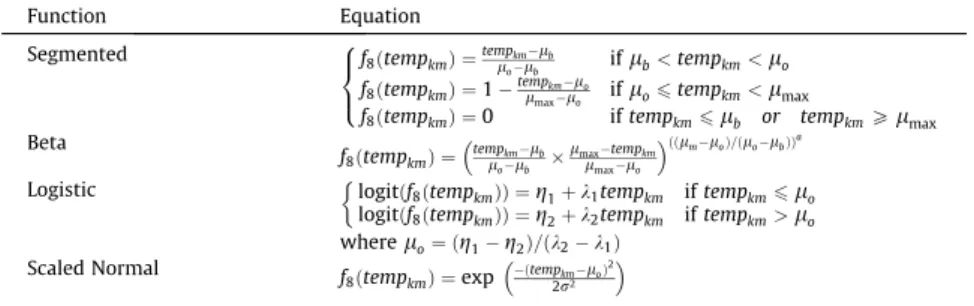
Kamkar et al. (2012)plus an additional logistic option. We also considered a strictly non-skewed function through a scaled Normal probability density function that ranged from 0 to 1 (Table 3).
2.5. Likelihood function formulation
The data presented in this study are actually interval censored seed lifetimes since observations were carried out periodically. As a consequence, the exact moment of germination is unknown. For each seedlin yearkat seed pointjin ploti, we only know that the germination time Tijkl took place within an interval of time where the upper bound is the observation confirming seed germi-nation and the lower bound is the previous observation when the seed had not yet germinated. In other words, we know that tlower,ijkl<Tijkl<tupper,ijkl where tlower,ijkl and tupper,ijkl represent the two limits of the time interval. If the seed fails to germinate during yeark, thentupper,ijkl=1andTijklis said to be right-censored.
Therefore, the marginal likelihood function for this experiment is
‘¼Y
i Y j Y k Y l
Sijklðtupper;ijklÞ Sijklðtlower;ijklÞ
qijkl
Sijklðtlower;ijklÞ
1qijkl
ð4Þ
whereSijkl(t) is the survival function that sums the daily hazards
h(xijklm,b) (Eq.(3)) in the terms shown in Eq.(2)andqijklis a dummy
variable that equals 1 when the seed has germinated during a known interval (tupper,ijkl–tlower,ijkl] and zero if it is right-censored in relation to this interval.
2.6. Model fitting and evaluation
In addition to the explanatory variables, we also tried to ac-count for the data structure. In fact, the sampling scheme is likely to result in clustered data and the correlation between observa-tions that belong to the same ploti, seed pointj, and/or yearkof study might be non-null. In order to prevent this violation of the independence assumption, a vectorbof random effectsui,
v
jand wk for the mentioned levels of variability was included through the expansion of parameterb0, the generic baseline. Random ef-fects are assumed to be normally distributed so thatbN(0,D), where D is the random effects variance–covariance matrix. Although random effects are commonly included as a multiplica-tive parameter and they are assumed to follow a distribution adopting non-negative values only (i.e. Gamma; (Lawless, 2003; p. 497)) computing limitations to accommodate our customized hazard function with correction for data correlation forced us to use the present formulation. Also severe problems of convergence arise when different levels of variability are simultaneously con-sidered, especially if it implies crossed effects. Therefore, random effects were tested separately and the resulting models were eval-uated in terms of Akaike’s Information Criteria (AIC).In order to illustrate the effect of each explanatory variable and optimal conditions for germination, the marginal hazard function was plotted against the covariate of interest whereas the rest was set to its theoretical maximum. Where possible, a comparison with average climatic conditions in the area was performed.IPOT influ-ence on germination needs to be interpreted in terms of density. Therefore,IPOTwas simulated in the central 70 m70 m subplot of a 100 m100 m plot at a scale of 1 m2for different stocking den-sities, considering regular spacing and identical diameters for all trees. TheIPOTeffect, where significant, was then computed based on the resulting model parameterization for each simulated plot.
interval across all seed points and compared with the correspond-ing observed values for those intervals. This approach provides evi-dence of the existence of bias (systematic error in the prediction of the mean) and shows in a simple manner the degree of agreement between model and data (overall agreement between the pre-dicted and observed pattern of germination). Additionally, bias was quantified through the mean error (E) ofF(t)for alln individ-ual observations:
E¼ P
ijkl FðtÞijkl^FðtÞijkl
n
All calculations were carried out using PROC NLMIXED in SAS 9.2.
3. Results
3.1. Hazard function
Optimization of the likelihood function shown in Eq.(4)was not straightforwardly achieved under the proposed parameterization. In the selection process we found most of the combinations of parameters to result in severe problems of convergence. This is particularly true in all cases wheredpkmand/orrhkmwere included in the model. When the model was fitted without the aforemen-tioned covariates, convergence was achieved either if GSFij and WHCijor, alternately,prepkmwere excluded from model formula-tion. When fitting the model considering the first possibility, prepkmwas the only non-significant covariate (p-value 0.2327). In regard to the second possibility, both GSFijand WHCijwere also found to be non-significant (p-values 0.9315 and 0.9877, respec-tively) and consequently the model was alternately fitted with each of them at a time. In this process, WHCij was found to be non-significant, whereas convergence was not attained when the model included GSFij. As it can be seen, both possibilities led to the same set of parameters when non-significant covariates are dropped of the model. Therefore, germination hazard was finally defined by the overstory competition (IPOTij), number of days elapsed from last frost event (frkm) and daily temperature (tempkm), all of them significant. These variables modulated the generic base germination through interaction with the baseline (parameterb0; p-value < 0.0106). The autoregressive term was also found to be significant. Out of all the mentioned options for the temperature effect (Table 3), only the scaled Normal approach proved adequate, as the rest implied poorly-resolved estimates with large values in the gradient matrix. Maximum daily temperature produced the best fits and was therefore used in preference to mean and minimum temperature. Selected fixed effects were similar irrespective of the variance structure tested. As regards the random
effects,yearlevel of variability performed better (AIC 24821) than seed point(AIC 24861) orplot(AIC 25218). The AIC value for the marginal model was 25242, which indicates a better performance when random effects are included.Table 4presents the parameter estimates of the preferred model.
In order to assure we did not have problems of collinearity among the spatial covariates that could yield an incorrect variable selection, the final model was additionally fitted excludingIPOTij and alternately testingGSFij andWHCij. As a result, convergence problems identically arose whenGSFijwas considered in absence ofWHCij, whereas the latter was non-significant (p-value 0.9820).
3.2. Optimum conditions for germination
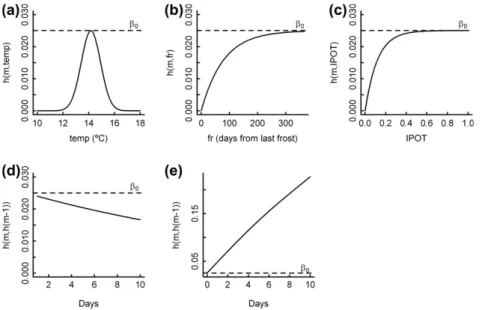
The parameterized hazard function produces a hyperplane, depending on climatic and environmental variables, from which a set of the most favourable conditions can be deduced. Optimum daily maximum temperature was found to be 14.17°C, the value of parameter
l
0, and the symmetric thermal interval ranges from 12 to 16°C approximately (Fig. 1a). The hazard-reducing effect of frost occurrence only became negligible after 300 days from the frost event, whereas germination risk is set to zero on days when freez-ing occurs (Fig. 1b). As regardsIPOT, only very low values for this variable notably reduced germination risk (whenIPOTequals 0.3, hazard reduction with respect to the maximum is only 10.5%). Fig. 2shows that densities over 25 stems ha1resulted in a reduc-tion in germinareduc-tion of up to 20% in simulated plots, which implies that only where the overstory is very sparse is there any notable conditioning of germination. Theoretically, germination hazard will be null when overstory competition completely disappears (Fig. 1c). Finally, the autoregressive term showed a notable influ-ence, for example, considerably mitigating the effect of frost (Fig. 1d). In addition, the autoregressive factor causes the hazardTable 3
Tested temperature functions. The Segmented and Beta functions comprise the following parameters defining the appropriate thermal interval for germination:lo(optimum temperature),lb(base temperature) andlmax
(ceiling temperature). The logistic function includes intercept (g12) and slope (k1-2) from wherelocan be
deduced. Parameters in the scaled Normal function areloandr, the latter accounting for the amplitude of the
thermal interval.tempkmstands for temperature at plotkin daym.
Function Equation
Segmented f8ðtempkmÞ ¼
tempkmlb
lolb iflb<tempkm<lo f8ðtempkmÞ ¼1templmaxkmlloo iflo
6tempkm<lmax
f8ðtempkmÞ ¼0 iftempkm6lb or tempkmPlmax
8 > < > : Beta
f8ðtempkmÞ ¼ tempkmlb
lolb
lmaxtempkm
lmaxlo
ððlmloÞ=ðlolbÞÞa
Logistic logitðf8ðtempkmÞÞ ¼g1þk1tempkm iftempkm6lo
logitðf8ðtempkmÞÞ ¼g2þk2tempkm iftempkm>lo
wherelo¼ ðg1g2Þ=ðk2k1Þ
Scaled Normal f
8ðtempkmÞ ¼exp ðtempkmloÞ
2 2r2
Table 4
Summary of parameter estimates for the selected model.b0is the generic baseline;b1 andb7are parameters related toIPOTand frost occurrence, respectively;lostands for
optimum daily maximum temperature whereasr2represents the variance of the (scaled) normally distributed germination response to maximum temperature;b9is the autoregressive parameter; andr2
wkis the variance linked to year random effect.
Parameter Estimate Stand. error df tValue p-Value
b0 0.0250 0.0057 4 4.53 0.0106
b1 8.4053 0.7211 4 11.66 0.0003
b7 0.0127 0.0016 4 7.94 0.0014
lo 14.1700 0.0537 4 263.76 <0.0001
r2
0.7486 0.0244 4 30.73 <0.0001
b9 0.9603 0.0023 4 421.8 <0.0001
r2
wk 0.0001 – – – –
value to increase beyond its theoretical maximum when suitable conditions for germination occur (Fig. 1e).
When considering historic climatic records,Fig. 3shows how temperatures between June and September over the last 10 years were higher in general than those suitable for germination. In win-ter, the effect of frost cancels out the potential hazard increase, even if adequate thermal conditions are possible (December and January). Given that frost presents a highly durable effect, spring germination is unlikely in the area and restricted to years with unusually warm winters, such as that of 2007–2008. It can be de-duced, therefore, that the optimum germination period in the Northern Plateau are the months of October and November, when
there is a greater probability of favourable conditions and the pos-sible influence of frost is less likely.
3.3. Model evaluation
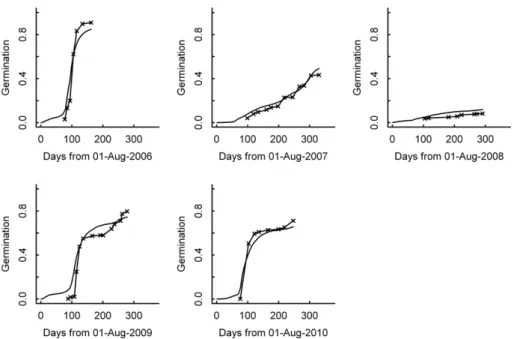
Predictions of the proportion of germinated seeds over time closely mimic the observed patterns in the two sample plots for all the years of the study (Fig. 4). The model proved to be highly accurate for all years, although displaying a slightly weaker perfor-mance in 2009–2010. Furthermore, no bias pattern was apparent, which is confirmed by the low absolute value of the mean error E(0.0166).
Fig. 1.Marginal effects on hazard of the different covariates included in the model (solid line). (a–c) Daily maximum temperature (temp), frost occurrence (fr),IPOT. The rest of fixed effects were set to 1 and autoregressive term not consider. (d–e) Autoregressive parameter over time (maximum initial hazard) during 10 consecutive freezing days and during 10 consecutive days of optimum temperature. Horizontal dashed line is the theoretical maximum hazardb0(autoregressive term excluded).
Fig. 3.Histograms of maximum (white) and minimum (light grey) daily temperatures. Dark grey area represents theoretical suitable thermal interval for germination. Vertical dashed line highlights freezing value (0°C).
Fig. 4. Predicted (solid line) and observed (crossed-solid line) cumulative proportion of germinated seeds. The abscissa is a 1 year temporal axis starting at the seed deployment date.
4. Discussion
4.1. Modelling approach
Although survival analysis techniques have been scarcely used in the context of seed germination compared to other methodolo-gies, the recent comparative studies carried out byOnofri et al. (2010, 2011)demonstrate the superiority of those models devel-oped through survival analysis. The present paper confirms the po-tential of survival analysis applied to germination when censored observations are present. We also demonstrate that conventional formulations can be successfully adapted to avoid strong assump-tions on the baseline of the process and to include non-standard explanatory variables. Furthermore, the proposed model extends the existing methods to fulfil further model assumptions, such as independence of observations through random effects. Although the use of mixed effect modelling is unavoidable when the inde-pendence assumption is violated, it has scarcely been employed in the context of survival analysis (but seeRose et al., 2006; Fortin et al., 2008). In our case, we allowed our generic baseline to vary randomly among years, thus absorbing unnoticed aggregate cli-matic influences on germination.
A common procedure in survival analysis is to assume a prior behaviour of the process in question (baseline). This prior behav-iour can be modified as a function of several covariates. For in-stance, Onofri et al. (2010)used an AFT model to predict seed germination based on a logistic baseline using water potential as an explanatory variable. However, under non-controlled field con-ditions, there is no evidence of an existing independent baseline for germination. In our model, we defined the germination hazard as a function of ecological factors with no prior assumptions as regards a baseline for seed germination, with the exception of a technically required scaling parameter.
In the present study we also show that germination can be accurately explained by climatic and stand covariates, at least in this particular case study. The proposed model gained applicability through the set of selected variables in two ways: firstly, they are readily available (as long as daily records are kept) and, secondly, they take into account the effects of forest structure and manage-ment on microclimatic conditions (stand variables). The inclusion of time-dependent variables allows predictions to be generated with varying field conditions. Although this paper focuses on the case ofP. pinea, these possibilities can be explored for most tree species. As a shortcoming, it should be noted that the use ofIPOT as a stand variable could produce non-comparable results if ap-plied to stands with very different structures.
In contrast to the majority of germination studies, the covari-ates relating to water availability proved non-significant or conver-gence was not achieved when included. Concerning water-holding capacity, the notable homogeneity of the variable throughout the two sampled plots could be behind this lack of significance. In re-gard to precipitation, the low values for water-holding capacity would imply high drainage coefficients (Müller, 2000) and, conse-quently, little impact of the covariate on water potential reduction. With respect to relative air humidity, it is known to be highly collinear to temperature, which in turn already determines water loss through evapotranspiration (Müller, 2000). Given the high ecological homogeneity of this region, it is presumable that these results would have not notably differed should we have had a replicated design throughout the Northern Plateau. Nevertheless, it is important to note that the non-significance of our water abil-ity-related variables does not necessarily mean that water poten-tial is irrelevant: it only implies that these covariates, under these conditions, could not capture water potential variability
and that the importance of water potential in this context is re-duced in contrast to the influence of thermal variables.
Dormancy is a major concern in seed ecology research (Chambers et al., 1999; Baskin and Baskin, 2001). In the case study presented here it was not possible to test dormancy processes, since the seed lots were exposed to natural conditions for a maxi-mum of 1 year. Non-germinatedP. pineaseeds are assumed to per-ish in the course of a year due to the high rodent predation rates occurring in the area (Manso et al., 2012a). Under these conditions, distinction between non-germinated seeds and true dormant seeds (if any) is not feasible. However, the proposed methodology allows us to take into account the abovementioned phenomenon in dor-mancy related experiments. The variables currently included in the model are common for interval and right censored observa-tions, meaning that non-germinated seeds result from an absence of suitable enhancing factors. In order to take into account poten-tially dormant seeds, the non-germinated fraction should be parti-tioned into those seeds that simply never abandoned latency and those that acquired dormancy. The latter can be related to a set of covariateszthought to induce the process through the function
p
(z), representing the probability of not germinating due to dor-mancy. Therefore, the likelihood function in Eq. (4) can be ex-tended as‘¼Y
i Y j Y k Y l
½ð1
p
ijklðzÞÞ ðSijklðtupper;ijklÞ Sijklðtlower;ijklÞÞ uijkl½pijklðzÞ þ ð1
p
ijklðzÞÞ Sijklðtlower;ijklÞ1uijklsimilar to those used in zero-inflated model fits (Affleck, 2006; Fortin and DeBlois, 2007; Calama et al., 2011), in this case, a zero-inflated binomial distribution (Tyre et al., 2003). A comparable ap-proach accounting only for the dormant fraction as right censored observations can be found inOnofri et al. (2011), as an extension of an AFT model.
4.2. Pinus pinea case study
The proposed model succeeded in determining the importance of germination inP. pineanatural regeneration in our sample plots, providing some prior outcomes about regeneration dynamics in the species. The results of this study seem to confirm our key hypothesis of climatic control for seed germination and the impor-tance of forest structure in the process.
The extrapolation of our findings toP. pineastands in the North-ern Plateau as a whole must be made prudently, as we did not have a randomized design over the region. However, the high homoge-neity of conditions throughout the area leads us to suggest that the role of germination in theP. pinearegeneration strategy could be described as follows:P. pineaseed dispersal takes place from June to early November (Manso et al., 2012b), whereas maximum rates of seed predation occur in winter months (Manso et al., 2012a) due to higher rodent activity in Mediterranean areas outside the dry period (Díaz et al., 2010). These circumstances lead to a seed-lim-iting scenario in spring, coinciding with the scarce likelihood of germination predicted for these months. In addition, Calama et al. (2012)found that seedlings established in the fall are more likely to survive the following summer drought period than those produced by spring germinated seeds. Therefore, rapid germina-tion in fall, regardless of site characteristics, could be a key factor for natural regeneration inP. pinea, creating a perfectly synchro-nized post-fructification strategy.
Consequently, a light-independent germination pattern would be expected. Our findings suggest such a pattern (non-significant GSF), at least in the Northern Plateau. Accordingly,Seiwa et al. (2009) stated that large-seeded, non-pioneer species show little sensitivity to environmental signals which enhance germination potential. Non-detection of light as a gap signal along with germi-nation reduction at very low densities leads to a seedling shadow which potentially mimics the seed shadow (Calama et al., 2012). This fact would confirm the medium shade-tolerant behaviour of P. pineareported byAwada et al. (2003)and therefore, the tendency to naturally produce uneven-aged stands (Calama et al., 2008a). In turn, this stand structure ensures long periods for seedling emer-gence in the absence of large gaps.
In contrast with the strategy described above, the currently-applied regeneration methods in the study area assume a strong shade-intolerant behaviour in stone pine (Montero et al., 2008). For this kind of species, intensive fellings are prescribed to achieve natural regeneration (Smith et al., 1996). However, such practices rapidly lead to seed limitation in P. pineaforests (Manso et al., 2012b). If efficient germination has not occurred prior to reducing tree density, natural regeneration will obviously be affected. Additionally, the presence of large gaps in the forest canopy is not favourable to germination.
The future climatic scenario in Spain is characterized by increasing mean and maximum temperatures, particularly during the warm period (De Castro et al., 2005). Minimum temperatures in winter, however, are expected to be more stable. According to these predictions, suitable conditions for germination in terms of daily temperature are likely to shift towards the colder months, although the continued occurrence of frosts during this period will reduce the likelihood of successful germination.
Under the present climatic conditions and management meth-ods employed inP. pineastands in the Northern Plateau, germina-tion can constitute a bottleneck for the natural regeneragermina-tion of the species. From an ecological perspective, the intensity of regenera-tion treatments should be reduced and also delayed until a few years after the occurrence of favourable germination/recruitment events in accordance with the light requirements of the species and subsequent natural forest dynamics. In a scenario of global cli-mate change, predictions for future climatic conditions in the Med-iterranean basin underline the necessity to consider the recommendations outlined in this paper.
Acknowledgements
We are grateful to the Forest Service of the Junta de Castilla y León for permission and support to carry out the field experiment. Also, we wish to thank Guillermo Madrigal, Santiago de Blas and Enrique Garriga for their help in the data collection, Eduardo López and Salvador Sastre for conducting the soil analysis and Adrienne Keller for language advice. This research was supported by projects AGL2010-15521 and RTA2007-00044.
References
Affleck, D.L.R., 2006. Poisson mixture models for regression analysis of stand level mortality. Can. J. For. Res. 36, 2994–3006.
Awada, T., Radoglou, K., Fotelli, M.N., Constantinidou, H.I.A., 2003. Ecophysiology of seedlings of three Mediterranean pine species in contrasting light regimes. Tree Physiol. 23, 33–41.
Barbeito, I., Lemay, V., Calama, R., Canellas, I., 2011. Regeneration of Mediterranean
Pinus sylvestrisunder two alternative shelterwood systems within a multiscale framework. Can. J. For. Res. 41, 341–351.
Baskin, C.C., Baskin, J.M., 2001. Seeds. Ecology, Biogeography, and Evolution of Dormancy and Germination. Academic Press, San Diego.
Bewley, J.D., Black, M., 1994. Seeds: Physiology of Development and Germination. Plenum Press, New York.
Bradford, K., 1990. A water relations analysis of seed germination rates. Plant Physiol. 94, 840–849.
Brudvig, L., Asbjiornsen, H., 2009. Dynamics and determinants of Quercus alba
seedling success following savanna encroachment and restoration. For. Ecol. Manage. 257, 876–884.
Calama, R., Barbeito, I., Pardos, M., Del Río, M., Montero, G., 2008a. Adapting a model for even-agedPinus pineaL. stands for complex multi-aged structures. For. Ecol. Manage. 256, 1390–1399.
Calama, R., Canadas, N., Montero, G., 2003. Inter-regional variability in site index models for even-aged stands of stone pine (Pinus pineaL.) in Spain. Ann. For. Sci. 60, 259–269.
Calama, R., Gordo, F.J., Mutke, S., Montero, G., 2008b. An empirical ecological-type model for predicting stone pine (Pinus pineaL.) cone production in the Northern Plateau (Spain). For. Ecol. Manage. 255, 660–673.
Calama, R., Madrigal, G., Manso, R., Garriga, E., Gordo, F.J., Pardos, M., 2012. Germinación, emergencia y supervivencia de regenerado enPinus pineaL. In: Gordo, J., Calama, R., Pardos, M., Bravo, F., Montero, G. (Eds.), La regeneración natural de los pinares en los arenales de la Meseta Castellana. Instituto Universitario en Gestión Forestal Sostenible (Universidad de Valladolid-INIA). Valladolid, pp. 113–129.
Calama, R., Mutke, S., Tomé, J., Gordo, J., Montero, G., Tomé, M., 2011. Modelling spatial and temporal variability in a zero-inflated variable: The case of stone pine (Pinus pineaL.) cone production. Ecol. Model. 222, 606–618.
Castro, J., Zamora, R., Hódar, A., Gómez, J., 2005. Ecology of seed germination of
Pinus sylvestris L. at its southern, Mediterranean distribution range. Invest. Agrar.: Sist Recur. For. 14, 143–152.
Chambers, J., Vander Wall, S., Schupp, E., 1999. Seed and seedling ecology of piñon and juniper species in the Pygmy woodlands of Western North America. Bot. Rev. 65, 1–38.
De Castro, M., Martín-Vide, J., Alonso, S., 2005. The climate of Spain: past, present and scenarios for the 21st century. In: A Preliminary Assessment of The Impacts in SPAIN due to the Effects of Climate Change. ECCE Project–Final report. Ministerio de Medio Ambiente, Madrid, pp. 1–64.
Díaz, M., Torre, I., Arrizabalaga, A., 2010. Relative roles of density and rainfall on the short-term regulation of Mediterranean wood mouse Apodemus sylvaticus
populations. Acta Theriol. 55, 251–260.
Dullinger, S., Dimböck, T., Grabherr, G., 2004. Modelling climate change-driven treeline shifts: relative effects of temperature increase, dispersal and invasibility. J. Ecol. 92, 241–252.
Evans, A.S., Mitchell, R.J., Cabin, R.J., 1996. Morphological side effects of using gibberellic acid to induce germination: consequences for the study of seed dormancy. Am. J. Bot. 83, 543–549.
Fortin, M., Bedard, S., DeBlois, J., Meunier, S., 2008. Predicting individual tree mortality in northern hardwood stands under uneven-aged management in southern Quebec. Canada. Ann. For. Sci. 65, 12.
Fortin, M., DeBlois, J., 2007. Modelling tree recruitment with zero-inflated models: the example of hardwood stands in Southern Québec. Forest Sci. 53, 529–539. Fox, G.A., Evans, A.S., Keefer, C.J., 1995. Phenotypic consequences of forcing germination – a general problem of intervention in experimental-design. Am. J. Bot. 82, 1264–1270.
Gandullo, J.M., 1985. Ecología Vegetal. Fundación Conde del Valle de Salazar, Madrid.
Gomez-Aparicio, L., 2008. Spatial patterns of recruitment in Mediterranean plant species: linking the fate of seeds, seedlings and saplings in heterogeneous landscapes at different scales. J. Ecol. 96, 1128–1140.
Gummerson, R., 1986. The effect of constant temperatures and osmotic potential on the germination of sugar beet. J. Exp. Bot. 37, 729–741.
Kamkar, B., Al-Alahmadi, M.J., Mahdavi-Damghani, A., Villalobos, F.J., 2012. Quantification of the cardinal temperatures and thermal time requirement of opium poppy (Papaver somniferumL.) seeds to germinate using non-linear regression models. Ind. Crop. Prod. 35, 192–198.
Keyes, C.R., Maguire, D.A., Tappeiner, J.C., 2009. Recruitment of ponderosa pine seedlings in the Cascade Range. For. Ecol. Manage. 257, 495–501.
Kuuluvainen, T., Pukkala, T., 1989. Effect of Scots pine seed trees on the density of ground vegetation and tree seedlings. Silva Fenn 23, 159–167.
Lawless, J., 2003. Statistical Models and Methods for Lifetime Data. John Wiley & Sons, Inc., Hoboken.
Manso, R., Calama, R., Madrigal, G., Garriga, E., De Blas, S., Gordo, F.J., Pardos, M., 2012a. Dispersión primaria, dispersión secundaria y predación post-dispersión enPinus pineaL. In: Gordo, J., Calama, R., Pardos, M., Bravo, F., Montero, G. (Eds.), La regeneración natural de los pinares en los arenales de la Meseta Castellana. Instituto Universitario en Gestión Forestal Sostenible (Universidad de Valladolid-INIA). Valladolid, pp. 99–114.
Manso, R., Pardos, M., Keyes, C.R., Calama, R., 2012b. Modelling the spatio-temporal pattern of primary dispersal in stone pine (Pinus pineaL.) stands in the Northern Plateau (Spain). Ecol. Model. 226, 11–21.
Montero, G., Calama, R., Ruiz Peinado, R., 2008. Selvicultura dePinus pineaL. In: Montero, G., Serrada, R., Reque, J. (Eds.), Compendio de Selvicultura de Especies. INIA - Fundación Conde del Valle de Salazar, Madrid, pp. 431–470.
Müller, C., 2000. Modelling Soil–Biosphere Interactions. CABI, New York. Onofri, A., Gresta, F., Tei, F., 2010. A new method for the analysis of germination and
emergence data of weed species. Weed Res. 50, 187–198.
Onofri, A., Mesgaran, M., Tei, F., Cousens, R., 2011. The cure model: an improved way to describe seed germination? Weed Res. 51, 516–524.
Pinheiro, J., Bates, D., 2000. Mixed-Effects Models in S and S-PLUS. Springer, Verlag New York.
Pyke, D.A., Thompson, J.N., 1986. Statistical-analysis of survival and removal rate experiments. Ecology 67, 240–245.
Rees, M., Long, M.J., 1993. The analysis and interpretation of seedling recruitment curves. Am. Nat. 141, 233–262.
Roman, E.S., Murphy, S.D., Swanton, C.J., 2000. Simulation ofChenopodium album
seedling emergence. Weed Sci. 48, 217–224.
Rose, C.E., Hall, D.B., Shiver, B.D., Clutter, M.L., Borders, B., 2006. A multilevel approach to individual tree survival prediction. Forest Sci. 52, 31–43.
Scott, S.J., Jones, R.A., 1990. Generation means analysis of right-censored response-time traits – low-temperature seed-germination in tomato. Euphytica 48, 239– 244.
Scott, S.J., Jones, R.A., Williams, W.A., 1984. Review of data-analysis methods for seed-germination. Crop Sci. 24, 1192–1199.
Seiwa, K., Ando, M., Imaji, A., Tomita, M., Kanou, K., 2009. Spatio-temporal variation of environmental signals inducing seed germination in temperate conifer plantations and natural hardwood forests in northern Japan. For. Ecol. Manage. 257, 361–369.
Smith, D., Larson, B., Kelty, J., Ashton, P., 1996. The Practice of Silviculture: Applied Forest Ecology. John Wiley & Sons, Inc., Hoboken.
Tyre, A.J., Tenhumberg, B., Field, S.A., Niejalke, D., Parris, K., Possingham, H.P., 2003. Improving precision and reducing bias in biological surveys: estimating false– negative error rates. Ecol. Appl. 13, 1790–1801.