Geoderma
Impact of fire and post-fire management techniques on soil chemical properties
M.X. Gomez-Rey
*,
A. Couto-Vazquez, S. Garcia-Marco, S.J. Gonzalez-Prieto
A B S T R A C T
The effects of fire (Control burned soil) and two emergency stabilisation techniques (grass Seeding and straw
Mulching) on 20 chemical characteristics were evaluated on 0-5 cm top-soils sampled 1, 90, 180 and
365 days after an experimental fire in a steep shrubland of a temperate-humid region (NW Spain). Most part of pH (in H20 and KC1) variance was explained by the sampling date. No clear temporal trends were identifiable for total soil C and N content, likely due to the large SOM pool in these soils; however, changes on soil 813C were explained by the deposition of 13C-depleted ashes, followed by its progressive erosion, while those on soil S15N were a consequence of fire induced N outputs. After the fire, NH^-N, P, Na, K, Mg, Ca, Mn, Cu, Zn and B concentrations increased, while those of NO^ -N, Al, Fe and Co did not vary significantly. Despite a significant decline with time, concentrations of Mg, Ca and Mn at the end of the study were still higher than in unburned soil, while those of K, Cu, Zn and B were similar to the pre-fire levels and those of Nftf-N, P and Na were below pre-fire values. Mulching and Seeding treatments for burned soil emergency stabilisation had significant effects on soil 815N and extractable K, Mg and Ca, while data were inconclusive for their possible effects on the extractable Al, Fe and Co.
1. Introduction
Although the use of fire by humans has modified forest ecosys-tems in NW Spain from at least 6000 years (Kaal et al., 2011), during the last decades this region became one of the areas with the highest fire incidence in Europe (Birot, 2009) due to a complex mixture of traditional use of fire as an agro-sylvo-pastoral tool, deep economic and demographic changes in rural areas and incendiarism as protest. Despite being a temperate-humid region, in Galicia from 1991 to 2010 more than 510,000 ha (almost one fifth of region's area) was burned by more than 175,000 wildfires (Ministerio de Agricultura y Medio Ambiente, 2012), causing huge economic and ecological dam-ages that probably will be worse in the foreseeing scenario of climate change. Globally, forest fires are one of the most widespread factors of forest destruction (Chandler et al., 1983) and also a strong soil desertifying factor, because fire accelerate the processes of soil degra-dation and nutrient losses through volatilization, leaching and ero-sion (Certini, 2005).
Most studies on the effects of fire on soil chemical quality have been focussed on evaluating changes in organic matter and available macro-nutrients (e.g. Carballas, 1997; Couto-Vazquez and Gonzalez-Prieto, 2006; Ubeda et al., 2006). Soil organic matter losses depend on fire sever-ity, but are inexorable in burned areas (Simard et al., 2001). Nitrogen is
the element most prone to direct losses to the atmosphere by com-bustion or NH3 volatilization (Fisher and Binkley, 2000) and 15N natural abundance has been employed to study the fire effects on N cycle in forests (Aranibar et al., 2003; Cook, 2001; Couto-Vazquez and Gonzalez-Prieto, 2006). As the vegetation and litter pools of organic P are key on the cycle of this element, their simultaneous removal by fire exhausts aboveground P reserves at a rate higher than the supply by mineral weathering (DeBano et al., 1998), although fires mineralize organic-P to ortophosphate leading to a transient increase in P availabil-ity (Cade-Menun et al., 2000; Saa et al., 1994; Serrasolsas and Khanna, 1995). Fire increases the soil available cations (Debano and Conrad, 1978; Trabaud, 1983) due to the accumulation of ashes rich in oxides and carbonates of basic ions (Carballas, 1997; Certini, 2005; Chandler et al., 1983; Kutiel et al., 1990). Besides these effects on nutrient budgets of burned ecosystems, ashes also play a key role on soil hydrology and erosion (Bodi et al., 2011, 2012; Stoof et al., 2010; Woods and Balfour, 2008), and, then, on post-fire soil quality and conservation.
Although available micronutrients in soils are generally present in small quantities, post-fire changes could be especially important for plants and lead to deficiencies or to toxicity effects in some soils (Garcia-Marco and Gonzalez-Prieto, 2008).
Wildfires can increase runoff and erosion by several orders of magnitude (e.g. Diaz-Fierros et al., 1987; Robichaud and Brown, 1999), mainly during the first months when the soil is bare, if intense rainfall events are frequent (Cerda, 1998; Cerda and Lasanta, 2005; Vega et al., 2005). Therefore, when the vegetation cover is completely destroyed by the fire, an emergency stabilisation treatment must be applied as soon as possible in the burned area to accelerate soil re-vegetation or to provide a ground cover with plant material, such as naturally occur with needles or leaves from not consumed canopy (Cerda and Doerr, 2008). Among these techniques, straw mulching and herbaceous seeding are commonly used (Fernandez et al., 2011; Groen and Woods, 2008; Robichaud, 2009; Vega et al., 2005). Although the effectiveness of emergency stabilisation techniques for reducing soil erosion has been studied (Diaz-Ravina et al., 2012; Fernandez et al., 2011; Groen and Woods, 2008; Wagenbrenner et al., 2006), their effects in burned soil quality has been scarcely quantified until recently (Diaz-Ravina et al., 2012; Fonturbel et al., 2012; Gomez-Rey et al., in press, submitted for publication).
Either if they are a natural component of many forest ecosystems (Turner et al., 2009) or modern creations of human habitation (Caldararo, 2002), wildfires affect most soil physical, chemical and bi-ological properties (Certini, 2005) and, then, soil quality (Carballas, 1997). The working hypothesis of present study is that post-fire emergency stabilisation treatments can affect soil characteristics that determine soil quality. Thus, our aim was to evaluate during one year the effects of an experimental fire and two post-fire stabilisation techniques (seeding and mulching), on 20 soil chemical characteristics useful as soil quality indices.
2. Material and methods
2.1. Site description and experimental design
The experimental field was located in the Monte Cabalar (42° 38' 58" N; 8° 29' 31" W, 660 m a.s.l.) at A Estrada (Galicia, NW Spain). The area has a temperate and rainy climate. During the study period (October 2009-December 2010), accumulated precipitation moni-tored in the area was 3036 mm. The soil, developed over granite and with a slope of 38-54%, has a sandy loam texture. Vegetation cover is dominated by Ulex europaeus L with some Pteridium
aquilinum (L.) Kuhn., Ulex gallii Planch., Daboecia cantabrica (Huds.)
K. Koch and Pseudoarrenhaterum longifolium Rouy, with an average height of 123 cm and 100% of ground cover.
After selecting an area of homogeneous slope, orientation, soil type and vegetation cover, 12 experimental plots (30x10 m each) were established with the longest dimension parallel to the maxi-mum slope. On June 2009, the shrub was cut and laid down directly on the ground, to facilitate litter and duff combustion, and four months later (October 14th and 15th) plots were burned with the backfire technique to favour soil organic cover consumption and soil heating. The rate of fire spread was slow (0.30-0.33 m min- 1) and the soil temperature reached, monitored with ten thermocouples 1< type per plot, was moderate at the mineral soil surface (153 °C) and low at two centimetres soil depth (34 °C) (Fonturbel et al., 2012).
After the experimental fire, three soil treatments were arranged in a fully randomized design with four replications: a) burned soil, considered as Control treatment; b) Mulching, burned soil with 230 g m~2 of straw mulch; c) Seeding, burned soil with a mixture of seeds at a rate of 45 g m~2 (Lolium multiflorum, 35%; Trifolium
repens, 25%; Dactylisglomerata, 20%; Festuca arundinacea, 10%; Festuca rubra, 5%; Agrostis tenuis, 5%). The soil stabilisation treatments were
applied the 6th of November 2009 manually in order to minimize soil perturbation.
2.2. Sampling and chemical analysis of soil
Soil was sampled from the A horizon (0-5 cm depth, including the ash layer) immediately before the experimental fire and after 1, 90, 180 and 365 days. In each occasion, ten squares (15x15 cm), uni-formly distributed inside each plot, were taken and combined to ob-tain a composite sample. The field-moist soil was sieved (<2 mm), homogenised and stored at 4 °C for inorganic N determination. Sub-samples were air-dried for chemical analyses.
The pH was measured with a pH-meter (Metrbhm, Switzerland) in H20 and KC1 employing a soihsolution ratio of 1:2.5. Total C, total N, 613C and 615N were measured on finely ground soil samples (<100um) with an elemental analyser (Carlo Erba CNS 1508) coupled on-line with an isotopic ratio mass spectrometer (Finnigan Mat, delta C, Bremen, Germany). Inorganic N was extracted by shak-ing 20 g of soil for 1 h with 2 M KC1 (1:5 soihsolution ratio). Extracts were passed through glass microfibre filters (Whatman GF/A, 125 di-ameter) and NOJ-N and NH^-N were analysed by a modified diffu-sion method (Khan et al., 1997). In order to sequentially liberate NH^-N and NO^ + N03~-N in the form of NH3, 50 ml aliquots of extracts, placed in a 500 ml wide-mouth glass jar, were treated suc-cessively (24 h periods at 50 °C) with MgO (0.1 g) and MgO (0.1 g) plus Devarda's alloy (0.4 g). Gaseous NH3 was trapped into 10 ml of 0.004 M H2S04 in a Teflon bottle attached to the glass jar and mea-sured by back titration of the excess of H2S04 with 0.004 M NaOH. For extractable Na, K, Mg, Ca, P, Al, B, Co, Cu, Fe, Mn and Zn analyses, soils (10 g) were shaken for 2 h with a mixture of 1 M NH4Ac and 0.005 M DTPA as extracting solution (1:5 soihsolution ratio); the extracts were filtered through cellulose paper (Filter-laboratory 1242, 90-mm diameter) and then analysed by simultaneous 1CP-OES (Varian Vista Pro, Mulgrave, Australia). All analyses were carried out in duplicate and the mean of both analyses was used in the statistical procedure.
2.3. Statistical analysis
Data on soil chemical characteristics were statistically analysed by two-way ANOVA, with treatment and sampling date as factors. The Levene's test was used for verifying the equality of variances among groups. In the case of homocedasticity, significant differences among the mean groups were established at p<0.05 using the Bonferroni's test for multiple comparisons. In the case of unequal variances, the original data were subjected to Cox-Box transformations to obtain equality of variances and then significant differences among the mean groups were established at p<0.05 using the Bonferroni's test.
Simple regression models between soil properties as dependent variables and time after fire (in days or its logarithmic transforma-tion) as independent variable were done after checking the fulfilment of the assumptions of linear regressions (independence, homo-cedasticity and normality). Statistical procedures were performed with SPSS 15.0 for Windows.
3. Results
Before the experimental fire there were no significant differences among the plots assigned to the different treatments for any of the variables studied showing an acceptable spatial homogeneity of the study area.
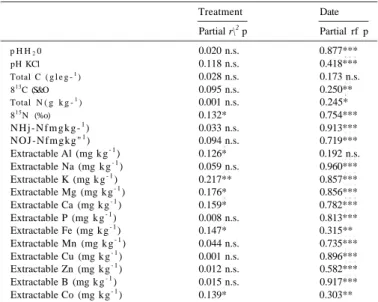
Table 1
Results of the two-way ANOVA for the main soil characteristics (pH, 813C, 815N and nutrient concentrations) with treatment and date as factors. No significant treatmentxdata interaction was observed for any variable.
(a)
Control ~^ Mulching • Seeding
Treatment Date
Partial r\2 p Partial rf p
p H H20 0.020 n.s. 0.877***
pH KCl 0.118 n.s. 0.418***
Total C ( g l e g -1) 0.028 n.s. 0.173 n.s.
O
'A
X X Q .
813C (S&O 0.095 n.s. 0.250**
O
'A
X X Q .
Total N ( g k g -1) 0.001 n.s. 0.245*
O
'A
X X Q .
815N (%o) 0.132* 0.754***
O
'A
X X Q .
N H j - N f m g k g -1) 0.033 n.s. 0.913***
N O J - N f m g k g "1) 0.094 n.s. 0.719***
Extractable Al (mg k g- 1) 0.126* 0.192 n.s.
Extractable Na (mg k g- 1) 0.059 n.s. 0.960***
Extractable K (mg k g- 1) 0.217** 0.857***
Extractable Mg (mg k g- 1) 0.176* 0.856***
Extractable Ca (mg k g- 1) 0.159* 0.782***
Extractable P (mg k g- 1) 0.008 n.s. 0.813***
Extractable Fe (mg k g- 1) 0.147* 0.315**
Extractable Mn (mg k g- 1) 0.044 n.s. 0.735*** Extractable Cu (mg k g- 1) 0.001 n.s. 0.896*** Extractable Zn (mg k g- 1) 0.012 n.s. 0.582*** Extractable B (mg k g- 1) 0.015 n.s. 0.917***
(b)
Extractable Co (mg k g- 1) 0.139* 0.303**
(b)
n.s. not significant *** p<0.001.
** p<0.01. * p<0.05.
as independent variable, explaining the 71% and 36% (pH in H20 and KCl, respectively) of the variance (Table 2).
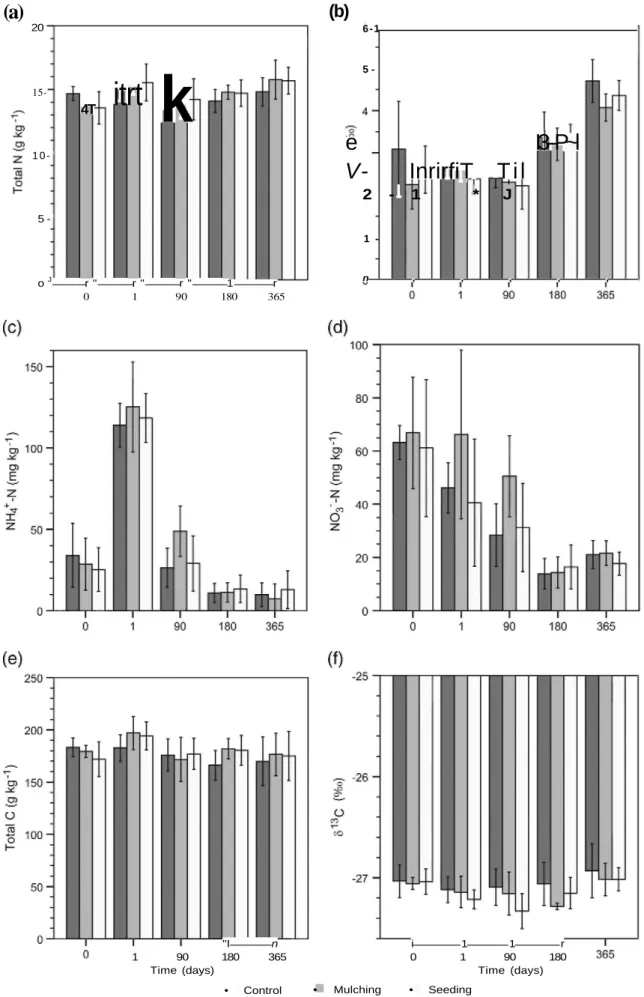
Soil N concentration (Fig. 2a) was not affected by the soil stabilisation treatments, but the two-way ANOVA showed a slight ef-fect(p<0.05; 24% ofvariance explained; Table 1) of sampling date, al-though no temporal trend could be identified. The soil 615N (Fig. 2b) was slightly affected by the emergency stabilisation treatments (p<0.05; 13% of variance explained; Table 1), increasing in the order Mulching (2.89%»), Seeding (3.00%») and Control (3.28%»), differ-ences being only significant between the first and the last. Sampling date had a strong effect on soil 615N (p<0.001; 75% of variance explained; Table 1), with lowest values at t = 0, 1 and 90 d (2.31 to 2.65%o), intermediate at t= 180 d (3.39%»), and highest at t = 365 d (4.38%o; Fig. 2b). A simple linear regression model of soil 615N with days after fire as independent variable explained 73% of its variance (p<0.0005; Table 2).
The two-way ANOVA showed no effect of soil stabilisation treat-ments on NH/-N, which was strongly influenced (p<0.001; 91% of variance explained; Table 1) by sampling date, with a high, but tran-sient, increase just after the fire (119 mg k g- 1) , a steady decline thereafter till prefire levels (29 mg k g- 1) at t = 90 d (35 mg k g- 1) and significantly lower at t = 1 8 0 and 365 d (10-12 mg k g- 1; Fig 2c). Like NH^-N, soil NO^-N concentration was not affected by the emergency stabilisation treatments and it was strongly influenced (p<0.001; 72% ofvariance explained; Table 1) by sampling date, with the highest values just before and after the fire (64 and 51 mg k g ~ \ respectively), intermediate at t = 90 d (37 mg k g- 1) and lowest at t= 180 and 365 d (20 and 15 mg kg"1, respectively). Both NH/-N and NOJ-N concentrations in soils can be fitted to simple linear re-gression models with the logarithm of days after fire as independent variable that explained 91% and 39%, respectively, of their variances (p<0.0005; Table 2). However, for the N03~-N concentration the fitting was only slightly better than that with days after fire (31% of variance explained; p<0.0005, data not shown).
Neither the soil stabilisation treatments nor the sampling date affected the C content (Fig. 2e), as shown by the two-way ANOVA (Table 1); however, the 13C natural abundance was influenced by sam-pling date (p<0.01; 25% ofvariance explained), with similar values
4
3
2
I
-fwh^h
m
nh*rh
^ r x ii i i i i 0 1 90 180 365
Time (days)
1 90 180 Time (days)
r
365
Fig. 1. Evolution of pH in H20 (a) and KCl (b) in the 0-5 cm soil layer along a year after the experimental Are in the Control, Seeding and Mulching treatments. For each sam-pling date, no significant differences between treatments were found.
before the fire and at t = 365 d ( — 27.03 ±0.17%o) and more negative at the other dates ( —27.17±0.16%o; Fig. 2f), although differences were only significant between soils collected at t = 90 and 365 d.
Table 2
Best linear regression models (p<0.0005) between main soil characteristics and time after Are (days) as independent variable.
R2 Equation
pHH20 0.711 y = 4.40-(0.0015-x)
pH KCl 0.360 y = 3 . 6 3 - (0.00052 -x)
8,5N 0.726 y = 2.27 +(0.0056-x)
NH^-N 0.911 y = 1 1 9 - ( 4 4 . 3 - l o g x )
NOJ-N 0.389 y = 52.2-(12.7-logx)
Extractable Na 0.925 y = 2 1 9 - ( 7 4 . 4 - l o g x ) Extractable K 0.827 y = 5 4 3 - ( 1 6 8 - l o g x )
Extractable Mg 0.697 y = 208-(52.9-log x)
Extractable Ca 0.709 y = 288-(78.9-log x)
Extractable P 0.682 y = 25.6-(6.21-log x)
Extractable Mn 0.752 y = 22.86-(7.24-log x)
Extractable Cu 0.755 y = 0.882-(0.349-log x)
Extractable Zn 0.493 y = 3.48-(0.748-log x)
(a)
20
151 0
5
-4T
itrt
k
o J r " r " r " 1 r 0 1 90 180 365
(b)
6 - 1
5
-e I3--P~l
V- InrirfiT T i l
2 - 1
* J
1
-n , , , , ,
"I n 1 90 180 365
Time (days)
• Control • Mulching
i 1 1 r 0 1 90 180
Time (days)
• Seeding
6 0 0
-I -I 180 365
(e)
c
* 300 -'cn
CD
E
tfl
d
Q 200
-m
Jrjl ,
CO
>
<
100
-o -
iti
u
ii l T "h
1
i 90
Time (days)
180 365
I I 90 180 Time (days)
Control D Mulching • Seeding
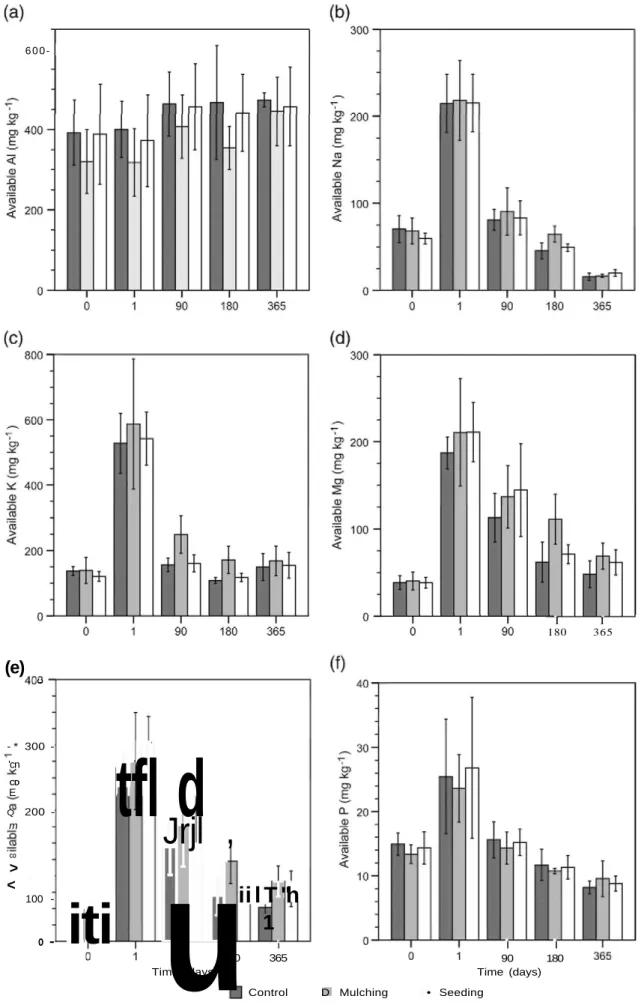
Fig. 3. Evolution of extractable element concentrations in the 0-5 cm soil layer along a year after the experimental Are in the Control, Seeding and Mulching treatments: Al
Sampling date had no effect on soil extractable Al (Fig. 3a), which varied slightly but significantly among emergency stabilisation treat-ments (p<0.05; 13% ofvariance explained; Table 1), with the highest values in Control (4.39 mg k g- 1; Fig. 3a), lowest in Mulching (3.69 mg k g- 1) and intermediate in Seeding (4.23 mg k g- 1) .
Treatment and sampling date had significant effects on available basic cation concentrations (Fig. 3b, c, d and e), explaining 16-22% and 78-86% of their variances, respectively (Table 1). Concentrations were significantly higher in Mulching (263,114 and 143 mg k g- 1 for K, Mg and Ca, respectively) than in Control (216,90 and 115 mg k g- 1 for K, Mg and Ca, respectively), intermediate values being found in
Seeding (219, 105 and 140 mg k g- 1 for K, Mg and Ca, respectively); no differences among treatments were detected for Na. The concen-trations of available basic cations in burned soils, with or without stabilisation techniques, were higher than in the unburned soils up until t = 90d (Na, 85-216 mg k g- 1; K, 189-552 mg k g- 1; Mg, 131-203 mg k g- 1; Ca, 174-281 mg k g- 1; Fig. 3). Despite a signifi-cant decline with time, concentrations of divalent cations at the end of the study (60 and 75 mg k g- 1 of Mg and Ca, respectively) were still higher than in unburned soil (39 and 45 mg k g- 1 of Mg and Ca, respectively). In contrast, concentrations of monovalent cations showed a fast reduction, returning to pre-fire levels at t = 1 8 0 d (Na, 53 mg k g- 1; K, 133 mg k g- 1) ; Na concentration decreased to even below pre-fire values at t = 365 d (18 mg k g- 1) .
According to the two-way ANOVA, soil extractable P was only affected by the sampling date (p<0.001; 81% of variance ex-plained; Table 1). Phosphorous concentration rose just after fire till 25 mg k g- 1 (Fig. 3f), but at t = 90 d it returned to prefire levels (14-15 mg k g- 1) and it continued to decrease at t = 1 8 0 d (11 mg k g- 1) and t = 365 d (9 mg k g- 1) , all differences being sig-nificant (p<0.05 to p<0.001). A simple linear regression model with the logarithm of days after fire as independent variable explained 68% of extractable P variance (p<0.0005; Table 2).
The concentration of all basic cations along the study period can be fitted to simple linear regression models with the logarithm of days after fire as independent variable that explained 93%, 83%, 70% and 71% of Na, K, Mg and Ca variances, respectively, (p<0.0005; Table 2). However, for the divalent cations the fitting was only slight-ly better than that with days after fire (63% and 60% of variance explained, respectively; p<0.0005, data not shown).
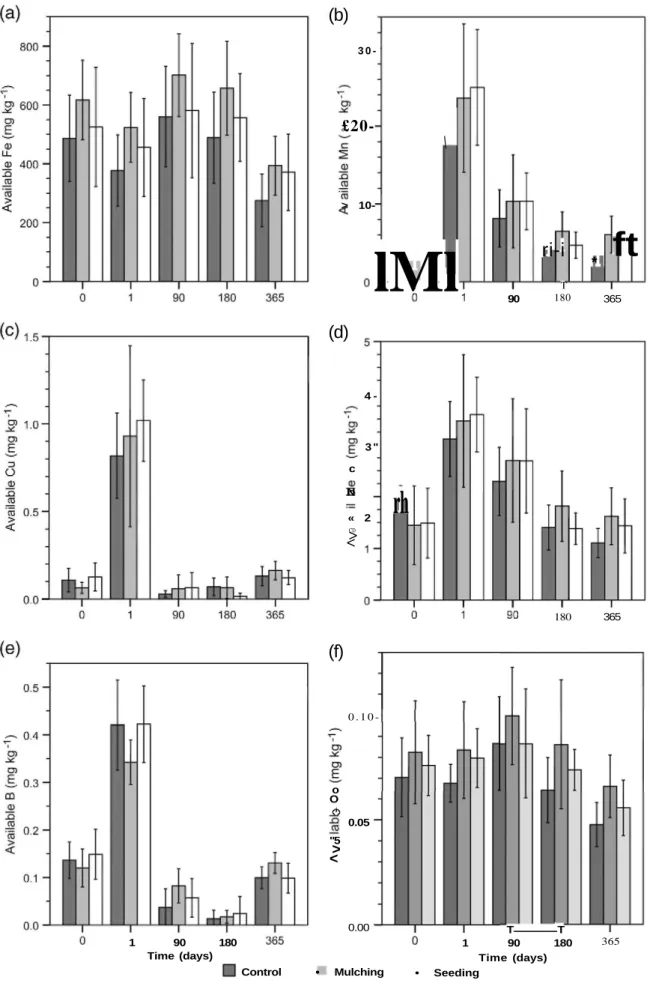
Available Fe concentration varied significantly among treat-ment and sampling date groups (15% and 31% of variance ex-plained, respectively); the highest values were found in Mulching (579 mg k g- 1) , the lowest in Control (438 mg k g- 1) and intermedi-ate in Seeding (497 mg k g- 1) . While the available Fe concentrations varied without a clear tendency during the first 180 days of the study (453-614 mg k g- 1; Fig. 4a), a significant reduction was ob-served at t = 365 d (363 mg k g- 1) when compared to those obtained at t = 90 and at t= 180 d (614 and 568 mg k g- 1, respectively).
The two-way ANOVA showed that the emergency stabilisation treatments had no significant effect on available Mn, Cu, Zn and B concentrations, however they were strongly influenced by the sam-pling date (58-92% ofvariance explained). In all cases, concentrations increased significantly just after the experimental fire (22.8,0.92,3.39 and 0.40 mg k g- 1 for Mn, Cu, Zn and B, respectively at t= 1 d) when compared with unburned soils (3.0, 0.10, 1.64 and 0.14 mg k g- 1 for Mn, Cu, Zn and B, respectively), but the subsequent evolution of each element differed (Fig. 4b, c, d and e). Three months later, a sig-nificant reduction of available Mn concentrations was observed (9.6 mg k g- 1) , values remaining stable (4.9 —5.2 mg k g- 1) , but higher than in the unburned soil (3.0 mg k g- 1) , up until the end of the study period. By the contrary, a fast decline was observed for available Cu concentrations and values returned to prefire levels since t = 90 d (0.05-0.14 mg k g- 1) . The increase in Zn concentra-tions was still evident 90 days after the fire (2.56 mg k g- 1) , but con-centrations significantly decreased at t = 1 8 0 and t = 365 d until
values (1.39-1.53 mg k g- 1) similar to those of the unburned soils (1.64 mg k g- 1) . After the initial increase, available B concentrations fell significantly, values being similar (0.11 mg k g- 1; t = 365 d) or even lower (0.02-0.06 mg k g- 1 at t = 90 and t= 180 d) than those found in unburned soils (0.14 mg k g- 1) . Despite these differences, the concentration of these trace element along the study can be fitted to simple linear regression models with the logarithm of days after fire as independent variable that explained 75%, 76%, 49% and 78%, respectively, of Mn, Cu, Zn and B variances (p<0.0005; Table 2), al-though for Zn the fitting was only marginally better than that with days after fire (47% of variance explained; p<0.0005, data not shown).
Available Co concentrations (Fig. 4f) varied significantly among treat-ment and sampling date groups (14% and 30% ofvariance explained; Table 1), with the highest values in Mulching (0.084 mg k g- 1) , the lowest in Control (0.067 mg k g- 1) and intermediate in Seeding plots (0.074 mg k g- 1) . The available Co contents varied without a clear trend during the study period, significant differences being only observed between t = 90 and t = 365 d (0.091 and 0.057 mg kg- 1, respectively).
4. Discussion
Considering that for soil pH in H20 most part of the variance was explained by the sampling date, it can be concluded that the oxides and carbonates of basic ions supplied by ashes (Certini, 2005) were steadily lost by leaching and runoff (Lasanta and Cerda, 2005), as well as with the eroded sediments (Gomez-Rey et al., in press). As a measure of potential acidity, pH in KC1 showed few changes during the study period, but almost half of its variance was still explained by the sampling date. Neither for pH in H20 nor in KC1 the emergency stabilisation treatments had a noticeable effect.
Despite the erosion of N-rich sediments throughout the whole study (see Gomez-Rey et al., in press), a clear temporal trend could not be identified for the soil N content, likely due to the big N pool in these soils. However, the strong positive linear relationship of soil 615N with the time after fire clearly suggests that the experimen-tal fire promoted N outputs, as also found Couto-Vazquez and Gonzalez-Prieto (2006) and Saito et al. (2007). This result was un-doubtedly a result of an increase in the lixiviation of nitrates (Lasanta and Cerda, 2005), which are 15N depleted (Hbgberg et al., 1995), and to the erosion of 15N depleted sediments (Gomez-Rey et al., in press). As N losses by erosion were reduced slightly by Seeding and strongly by Mulching (Gomez-Rey et al., in press), and probably the same was true for nitrate leaching, the consequence is that the emergency stabilisation treatments mitigated the post-fire 615N increase.
(b)
1 90 180 Time (days)
3 0
-
£20->
10-\
lMl
ri-i
*
ft
90
T
180 365
(d)
4
-3 &#-34;
c
N
« 2
CD
> <
rh
180 365
(f)
0 . 1 0
-o O
<*>
"5
>
<
0.05
0.00
Control • Mulching
T T 1 90 180
Time (days) • Seeding
365
Fig. 4. Evolution of extractable micro-nutrient concentrations in the 0-5 cm soil layer along a year after the experimental Are in the Control, Seeding and Mulching treatments: Fe (a),
concluded that neither Mulching nor Seeding affects the net ammoni-fication and nitriammoni-fication processes.
Although the ANOVA did not show a clear temporal trend for the SOM content, probably because of C richness of these soils, the regres-sion analysis revealed a small but significant decrease with the time after fire (17% of variance explained; p<0.01; data not shown). This result agrees with the fact that the sediments eroded from these plots were mainly constituted by charred plant and litter material (Gomez-Rey et al., in press). In the same way, de Koff et al. (2006) found that C concentration in the eroded sediments increased after a prescribed fire of low severity due to the C-rich ashes, while Couto-Vazquez and Gonzalez-Prieto (2006) reported that the SOM depletion they observed in burned soil may be a medium-term conse-quence of the fire-triggered erosion processes on the burned plot sur-face. The variations on soil 13C natural abundance during the study are explained by the deposition of 13C-depleted ashes compared with the unburned topsoil (around — l%o in these plots, (Gomez-Rey et al., in press); — 0.8%o in charred litter, Alexis et al., 2010), pre-fire levels being recovered with the progressive erosion of ash-enriched sedi-ments (Gomez-Rey et al., in press).
Despite Mulching had an apparent effect on soil extractable Al, this result should be interpreted cautiously because pre-fire values of ex-tractable Al in Mulching plots were slightly (but not significantly) lower than in other treatments.
The concentration of available basic cations increased significantly after the experimental fire, as usually reported for burned soils (Carballas, 1997; Certini, 2005; Couto-Vazquez and Gonzalez-Prieto, 2006; Trabaud, 1983) due to the accumulation of ashes rich in oxides and carbonates of basic ions (Carballas, 1997; Chandler et al., 1983; Kutiel et al., 1990). The long lasting effect of fire on soil concentra-tions of available divalent caconcentra-tions (more than a year) contrasted with the much shorter period for the monovalent cations (less than six months), a difference explained by the greater solubility and pro-pensity to leaching of the latter (Duchaufour, 1987; Khanna et al., 1994). In fact, several studies have demonstrated that the accelerated solute losses resulting from fire mainly occurred during the first months after fire (Lasanta and Cerda, 2005; Soto et al., 1995). Like for 615N, a small but significant effect of the emergency stabilisation treatments on basic cations availability was found, the higher values observed in Seeding and, especially, in Mulching being surely related with the lower nutrient losses by erosion in those plots reported by (Gomez-Rey et al., in press).
The significant post-fire increment in available P compared with the unburned soils may be a result of the strong mineralizing effect of fire on organic P (Cade-Menun et al., 2000; Saa et al., 1994), while its decrease during the whole study period was surely due to: a) P-enriched sediment losses found in these plots by Gomez-Rey et al. (in press), as well as in other burned areas (Andreu et al., 1996; Saa et al., 1994); and b) orthophosphate chemisorption of Al, Fe, and Mn oxides (see Certini, 2005). The lack of effects of Mulching and Seeding on soil extractable P showed that these soil stabilisation treatments did not have a measurable influence on post-fire P availability.
Even thought the relatively high extractable Fe content in the ashes (Gomez-Rey et al., submitted for publication), there were no signifi-cant changes on soil Fe availability during the first half of the study, mainly as a result of the scarce solubility of this element in ashes (Khanna et al., 1994). The decline of Fe availability one year after the experimental fire, usually reported in burned soils (Close et al., 2011; Garcia-Marco and Gonzalez-Prieto, 2008; Pivello et al., 2010; Ponder et al., 2009), might be associated with Fe losses with the erod-ed serod-ediments (Gomez-Rey et al., submitterod-ed for publication). This de-pletion, also reported by Pivello et al. (2010) and Close et al. (2011), suggests that recurrent fires could led to a significant reduction of soil available Fe, which constitutes a fertility problem in soils with low levels of plant available Fe (Garcia-Marco and Gonzalez-Prieto,
2008). The significant effect of Mulching on soil Fe availability showed by the ANOVA, should be treated with caution since the same trend among plots was already observed before the experimental fire.
The higher Mn availability in burned than in unburned soils agreed with results previously reported after wild (Gonzalez Parra et al., 1996) and prescribed fires (Close et al., 2011; Garcia-Marco and Gonzalez-Prieto, 2008). The initial increase may be a conse-quence of the burned vegetation ash contribution, which contained substantial quantities of this element (Demeyer et al., 2001; Gomez-Rey et al., submitted for publication), and the physiochemical breakdown of Mn complexed with organic matter (Gonzalez Parra et al., 1996). Fire effect on available Mn lasted until the end of the study, contrasting with the lack of difference reported by Garcia-Marco and Gonzalez-Prieto (2008) and Ponder et al. (2009) one year after pre-scribed fires, probably due to differences in fire intensity and amount and chemical composition of ashes.
In accordance with the enhancement on Zn availability reported for burned soils (Close et al., 2011; Garcia-Marco and Gonzalez-Prieto, 2008; StankovJovanovic et al., 2011), we found higher available Zn dur-ing the first 90 days after the experimental fire. This increase is consis-tent with the release of Zn by ashes from burned vegetation (Demeyer et al., 2001; Gomez-Rey et al., submitted for publication), although fire-induced changes in the soil constituents might have also contribute to this increment. The fact that most part of the variance of Zn concen-tration was explained by a simple linear regression model with days after fire (or with its logarithmic transformation), indicates that this el-ement could be quickly leached (Zhan et al., 1996) or lost in eroded sed-iments (Gomez-Rey et al., submitted for publication).
The initial increase on available Cu was a tendency also observed by other authors (Close et al., 2011; Stankov Jovanovic et al., 2011) whereas no short-term fire effects have also been reported (Garcia-Marco and Gonzalez-Prieto, 2008). The strong decline of soil available Cu content (linear with logarithm of days) suggested fast losses of this element from the burned soil, probably associated to complexed organic compounds or to fine particles eroded from the soil (Chirenje et al., 2002; Quinton and Catt, 2007), and agreed with the evolution of Cu content in sediments from the same plots (Gomez-Rey et al., submitted for publication).The evolution of soil available Cu content after fire could be also explained by solute losses, which increased during the first rain events following fire (see Smith etal., 2011).
Boron availability in our burned soils was higher than in the unburned ones, agreeing with the higher levels of extractable B reported for burned forest soils (Ponder et al., 2009), and for wood ash amended soils (Ferreiro et al., 2011; Merino et al., 2006). This transient increase might be explained by the high concentrations of B on ashes as soluble salts and oxides (Eary et al., 1990), which are easily dissolved (Khanna et al., 1994).
The lack of a clear tendency of soil available Co during the whole studied period agrees with the results obtained by Garcia-Marco and Gonzalez-Prieto (2008) after a prescribed fire and Aref et al. (2011) after forest fires. The slightly lower available Co contents found one year after the experimental fire suggested a potential re-duction in its availability after recurrent fires. As observed for Fe, the significant increase obtained for Mulching should be cautiously interpreted.
5. Conclusions
NH^-N and P concentrations in the burned top-soil were lower than prefire levels. Our results suggest that the evolution of soil nutrients in the post-fire period should be mainly related to soil erosion dy-namics and solute losses, as well as to the permanence of the ash layer. While the results were unconclusive for extractable Al, Fe and Co, the little but positive effects of Mulching and Seeding on N, K, Mg and Ca budgets point to a slightly beneficial influence of these emer-gency stabilisation treatments on burned soil quality.
Acknowledgements
We thank Jorge Benitez and M. Teresa Perez for their technical as-sistance in the laboratory. This research was supported by the Xunta de Galicia and the Spanish Ministry of Education and Science through projects numbers 08MRU002400PR and AGL2008-02823. The partic-ipation of S. Garcia-Marco and M.X. Gomez-Rey was supported by post-doctoral CS1C-13P contracts, while that of A. Couto-Vazquez was supported by a pre-doctoral CS1C-13P contract. The isotopic ratio mass spectrometer was partly financed by the European Region-al Development Fund (EU).
References
Alexis, M.A, Rumpel, C, Knicker, H., Leifeld, J., Rasse, D., Pechot, N., Bardoux, G., Mariotti, A, 2010. Thermal alteration of organic matter during a shrubland Are: A field study. Organic Geochemistry 41 (7), 690-697.
Andreu, V., Rubio, J.L, Forteza, J., Cerni, R, 1996. PostAre effects on soil properties and nutrient losses. International Journal of Wildland Fire 6 (2), 53-58.
Aranibar, J.N., Macko, S.A., Anderson, I.C., Potgieter, AL.F., Sowry, R, Shugart, H.H., 2003. Nutrient cycling responses to Are frequency in the Kruger National Park (South Africa) as indicated by stable isotope analysis. Isotopes in Environmental and Health Studies 39 (2), 141-158.
Aref, I.M., El Atta, H.A, Al Ghamde, ARM., 2011. Effect of forest fires on tree diversity and some soil properties. International Journal of Agriculture and Biology 13 (5), 659-664.
Living with wildfires: what science can tell us. In: Birot, Y. (Ed.), EFI Discussion Paper. European Forest Institute, Finland.
Bodi, M.B., Mataix-Solera, J., Doerr, S.H., Cerda, A, 2011. The wettability of ash from burned vegetation and its relationship to Mediterranean plant species type, burn severity and total organic carbon content. Geoderma 160, 599-607.
Bodi, M.B., Doerr, S.H., Cerda, A., Mataix-Solera, J., 2012. Hydrological effects of a layer of vegetation ash on underlying wettable and water repellent soil. Geoderma 191, 14-23.
Brye, K.R., Norman, J.M., Gower, S.T., 2002. The fate of nutrients following three- and six-year burn intervals in a tallgrass prairie restoration in Wisconsin. The American Midland Naturalist 148 (1), 28-42.
Cade-Menun, B.J., Berch, S.M., Preston, CM., Lavkulich, L.M., 2000. Phosphorus forms and related soil chemistry of Podzolic soils on northern Vancouver Island. II. The effects of clear-cutting and burning. Canadian Journal of Forest Research 30 (11), 1726-1741.
Caldararo, N., 2002. Human ecological intervention and the role of forest fires in human ecology. The Science of the Total Environment 292 (3), 141-165.
Carballas, T, 1997. Effects of fires on soil quality. Biochemical aspects. In: Balabanis, P., Eftichidis, G., Fantech, R (Eds.), Forest Fire Risk and Management European Commission, Brussels, Belgium, pp. 249-261.
Cerda, A, 1998. Postfire dynamics of erosional processes under mediterranean climatic conditions. Zeitschrift fur Geomorphologie 42 (3), 373-398.
Cerda, A, Doerr, S.H., 2008. The effect of ash and needle cover on surface runoff and erosion in the immediate post-Are period. Catena 74, 256-263.
Cerda, A, Lasanta, T, 2005. Long-term erosional responses after Are in the Central Spanish Pyrenees — 1. Water and sediment yield. Catena 60 (1), 59-80. Certini, G., 2005. Effects of Are on properties of forest soils: a review. Oecologia 143 (1),
1-10.
Chandler, C, Cheney, P., Thomas, P., Trabaud, L, Williams, D., 1983. Fire in forestry. Forest Are behavior and effects, vol. I. Wiley, New York.
Chirenje, T, Rivera, C, Ma, L.Q., 2002. Leachability of Cu and Ni in wood ash-amended soil as impacted by humic and fulvic acid. Geoderma 108 (1-2), 31-47. Close, D, Davidson, N., Swanborough, P, Corkrey, R, 2011. Does low-intensity surface Are
increase water- and nutrient-availability to overstorey Eucalyptus gomphocephalal Plant and Soil 349 (1), 203-214.
Cook G.D., 2001. Effects of frequent Ares and grazing on stable nitrogen isotope ratios of vegetation in northern Australia. Austral Ecology 26, 630-636.
Couto-Vazquez, A, Gonzalez-Prieto, S.J., 2006. Short- and medium-term effects of three Are Aghting chemicals on the properties of a burnt soil. The Science of the Total Environment 371 (1-3), 353-361.
de Koff, J.P., Graham, RC, Hubbert, K.R, Wohlgemuth, P.M., 2006. PreAre and postAre erosion of soil nutrients within a chaparral watershed. Soil Science 171 (12),
915-928.
Debano, L.F., Conrad, C.E., 1978. The effect of Are on nutrients in a chaparral ecosystem. Ecology 59 (3), 489-497.
DeBano, L.F., Neary, D., Ffolliott, P.F., 1998. Fires Effects on Ecosystems. John Wiley and Sons, New York, USA.
Demeyer, A, Voundi Nkana, J.C., Verloo, M.G., 2001. Characteristics of wood ash and in-Auence on soil properties and nutrient uptake: an overview. Bioresource Technol-ogy 77 (3), 287-295.
Diaz-Fierros, F., Benito Rueda, E., Perez Moreira, R., 1987. Evaluation of the U.S.LE. for the prediction of erosion in burnt forest areas in Galici (NW Spain). Catena 14, 189-199.
Diaz-Ravina, M., Martin, A, Barreiro, A, Lombao, A, Iglesias, L, Diaz-Fierros, F., Carballas, T, 2012. Mulching and seeding treatments for post-Are soil stabilisation in NW Spain: short-term effects and effectiveness. Geoderma 191,31-39. Duchaufour, P., 1987. Manual de Edafologia. Masson, Barcelona.
Eary, L.E., Rai, D., Mattigod, S.V., Ainsworth, C.C., 1990. Geochemical factors controlling the mobilization of inorganic constituents from fossil fuel combustion residues: II. Review of the minor elements. Journal of Environmental Quality 19 (2), 202-214. Fernandez, C, Vega, J.A., Jimenez, E., Fonturbel, T, 2011. Effectiveness of three post-Are treatments at reducing soil erosion in Galicia (NW Spain). International Journal of Wildland Fire 20 (1), 104-114.
Ferreiro, A, Merino, A, Diaz, N., Pineiro, J., 2011. Improving the effectiveness of wood-ash fertilization in mixed mountain pastures. Grass & Forage Science 66 (3), 337-350. Fisher, RF., Binldey, D., 2000. Ecology and Management of Forest Soils, 3rd ed. John
Wiley, New York
Fonturbel, M.T., Barreiro, A, Vega, J.A., Martin, A, Jimenez, E., Carballas, T, Fernandez, C, Diaz-Ravina, M., 2012. Effects of an experimental Are and post-Are stabilization treatments on soil microbial communities. Geoderma 191, 51-60.
Garcia-Marco, S., Gonzalez-Prieto, S., 2008. Short- and medium-term effects of Are and Are-Aghting chemicals on soil micronutrient availability. The Science of the Total Environment 407 (1), 297-303.
Gomez-Rey, M.X., Couto-Vazquez, A., Garcia-Marco, S., Vega, J.A., Gonzalez-Prieto, S.J., in press. Reduction of nutrient losses with eroded sediments by post-Are soil sta-bilization techniques. Int J. Wildland Fire. http://dx.doi.org/10.1071/WF12079. Gomez-Rey, MX, Garcia-Marco, S., Fernandez, C, Couto-Vazquez, A., Gonzalez-Prieto,
S.J., submitted for publication. Effectiveness of post-Are soil stabilization tech-niques for reducing trace element losses by erosion. Int. J. Wildland Fire. Gonzalez Parra, J., Cala Rivero, V, Iglesias Lopez, T, 1996. Forms of Mn in soils affected
by a forest Are. The Science of the Total Environment 181 (3), 231-236. Groen, AH., Woods, S.W., 2008. Effectiveness of aerial seeding and straw mulch for
re-ducing post-wildAre erosion, north-western Montana, USA International Journal of Wildland Fire 17 (5), 559-571.
Hogberg, P., Johannisson, C, Hogberg, M., Hogbom, L, Nasholm, T, Hallgren, J.E., 1995. Measurements of abundances of' 5N and 13C as tools in retrospective studies of N balances and water stress in forests: a discussion of preliminary results. Plant and Soil 168-169, 125-133.
Kaal, J., Carrion Marco, Y, Asouti, E., Martin Seijo, M., Martinez Cortizas, A., Costa Casais, M., Criado Boado, F., 2011. Long-term deforestation in NW Spain: linking the Holo-cene Are history to vegetation change and human activities. Quaternary Science Reviews 30 (1-2), 161-175.
Khan, S.A, Mulvaney, RL, Mulvaney, C.S., 1997. Accelerated diffusion methods for inorganic-nitrogen analysis of soil extracts and water. Soil Science Society of Amer-ica Journal 61, 936-942.
Khanna, P.K., Raison, R.J., Falkiner, R.A, 1994. Chemical properties of ash derived from eucalyptus litter and its effects on forest soils. Forest Ecology and Management 66 (1-3), 107-125.
Kutiel, P., Naveh, Z., Kutiel, H., 1990. The effects of a wildAre on soil nutrients and veg-etation in an Aleppo pine forest on Mount Carmel, Israel. In: Goldammer, J.G., Jenkins, M.J. (Eds.), Fire in Ecosystem Dynamics, Mediterranean and Northern Per-spectives. SPB Academic Publishing, The Hague, pp. 85-94.
Lasanta, A., Cerda, A., 2005. Long-term erosional responses after Are in the Central Spanish Pyrenees: 2. Solute release. Catena 60, 80-101.
Merino, A, Otero, V, Omil, B, Lastra, B, Pineiro, V, Gallego, P.P., 2006. Application of wood ash compared with ferrigation for improving the nutritional status and fruit produc-tion of kiwi vines. Journal of Plant Nutriproduc-tion and Soil Science 169 (1), 127-133. Ministerio de Agricultura y Medio Ambiente, 2012. http://www.magrama.gob.es/es/
biodiversidad/temas/defensa-contra-incendios-forestales/estadisticas-de-incendios-forestales/ (accessed 2012-06-15).
Pivello, V.R., Oliveras, I., Miranda, H.S., Haridasan, M., Sato, M.N., Meirelles, S.T., 2010. Effect of Ares on soil nutrient availability in an open savanna in Central Brazil. Plant and Soil 337 (1), 111-123.
Ponder, F., Tadros, M., Loewenstein, E.F., 2009. Microbial properties and litter and soil nutrients after two prescribed Ares in developing savannas in an upland Missouri Ozark Forest Forest Ecology and Management 257 (2), 755-763.
Prieto-Fernandez, A., ViUar, M.C., Carballas, M., Carballas, T, 1993. Short-term effects of a wildAre on the nitrogen status and its mineralization kinetics in an Atlantic forest soil. Soil Biology and Biochemistry 25 (12), 1657-1664.
Quinton, J.N., Cart, J.A., 2007. Enrichment of heavy metals in sediment resulting from soil erosion on agricultural Aelds. Environmental Science & Technology 41 (10), 3495-3500.
Robichaud, PR, 2009. Post-Are stabilization and rehabilitation. In: Cerda, A, Robichaud, P.R. (Eds.), Fire Effects on Soils and Restoration Strategies. Land Recon-struction and Management Science Publishers, EnAeld, NH, USA PP- 299-320. Robichaud, P.R, Brown, R.E., 1999. What happened after the smoke cleared: onsite
ero-sion rates after a wildAre in Eastern Oregon. Wildland Hydrology, Proceedings. Russell, J.D., Fraser, AR., Watson, J.R, Parsons, J.W., 1974. Thermal decomposition of
Saa, A., Trasar-Cepeda, M.C., Soto, B., Gil-Sotres, F., Diaz-Fierros, F., 1994. Forms of phos-phorus in sediments eroded from burnt soils. Journal of Environmental Quality 23 (4), 739-746.
Saito, L, Miller, W.W., Johnson, D.W., Quails, R.G., Provencher, L, Carroll, E., Szameitat, P., 2007. Fire effects on stable isotopes in a Sierran forested watershed. Journal of Environmental Quality 36 (1), 91-100.
Serrasolsas, I., Khanna, P.K., 1995. Changes in heated and autoclaved forest soils of S.E. Australia. II. Phosphorus and phosphatase activity. Biogeochemistry 29 (1), 25-41.
Simard, D.G., Fyles, J.W., Pare, D., Nguyen, T., 2001. Impacts of clearcut harvesting and wildfire on soil nutrient status in the Quebec boreal forest Canadian Journal of Soil Science 81 (2), 229-237.
Smith, H.G., Sheridan, G.J., Lane, P.N.J., Nyman, P., Haydon, S., 2011. Wildfire effects on water quality in forest catchments: a review with implications for water supply Journal of Hydrology 396 (1-2), 170-192.
Soto, B., Basanta, R, Perez, R, Diaz-Fierros, F., 1995. An experimental-study of the in-fluence of traditional slash-and-burn practices on soil-erosion. Catena 24 (1), 13-23.
Stankov Jovanovic, V.P., Ilic, M.D., Markovic, M.S., Mitic, V.D., Nikolic Mandic, S.D., Stojanovic, G.S., 2011. Wild Are impact on copper, zinc, lead and cadmium distribu-tion in soil and reladistribu-tion with abundance in selected plants of Lamiaceae family from Vidlic Mountain (Serbia). Chemosphere 84 (11), 1584-1591.
Stoof, C.R, Wesseling, J.G., Ritsema, C.J., 2010. Effects of Are and ash on soil water reten-tion. Geoderma 159, 276-285.
Trabaud, L, 1983. The effects of different Are regimes on soil nutrients levels in Quercus
coccifera garrigue. In: Kruger, T.J, Mitchel, D.T., Harvis, T.U.M. (Eds.), Mediterranean
type ecosystems. The Role of Nutrients. Ecological Studies, Vol. 43. Springer-Verlag, Berlin, pp. 233-243.
Turner, M.G, Smithwick E.AH, Tinker, D.B, Romme, W.H, 2009. Variation in foliar ni-trogen and aboveground net primary production in young postAre lodgepole pine. Canadian Journal of Forest Research 39,1024-1035.
Ubeda, X, Outeiro, LR, Sala, M, 2006. Vegetation regrowth after a differential intensity forest Are in a Mediterranean environment, northeast Spain. Land Degradation and Development 17 (4), 429-440.
Vega, J.A, Fernandez, C, Fonturbel, T, 2005. Throughfall, runoff and soil erosion after prescribed burning in gorse shrubland in Galicia (NW Spain). Land Degradation and Development 16 (1), 37-51.
Wagenbrenner, J.W, MacDonald, LR, Rough, D, 2006. Effectiveness of three post-Are rehabilitation treatments in the Colorado Front Range. Hydrological Processes 20 (14), 2989-3006.
Woods, S.W., Balfour, V, 2008. The effect of ash on runoff and erosion after a forest wildAre, Montana, U.S.A. International Journal of Wildland Fire 17, 535-548. Zhan, G., Erich, M.S, Ohno, T, 1996. Release of trace elements from wood ash by nitric