ScienceDirect
Procedia Engineering 00 (2016) 000–000
www.elsevier.com/locate/procedia
1877-7058 © 2016 The Authors. Published by Elsevier Ltd.
Peer-review under responsibility of the organizing committee of WMCAUS 2016.
World Multidisciplinary Civil Engineering-Architecture-Urban Planning Symposium 2016,
WMCAUS 2016
Learning for Parallel Virtual Urban Workshop: An innovate method
for teaching Planning
Ester Higueras
a, Isabel González
b, Francisco Lamiqiuiz
c aHigueras García, Ester, Departamento de Urbanística y Ordenación del Territorio. Escuela Técnica Superior de Arquitectura
de Madrid. Universidad Politécnica de Madrid. Av. Juan de Herrera, 4. 28040 Madrid (Spain) [email protected]
b González García, Isabel,Departamento de Urbanística y Ordenación del Territorio. Escuela Técnica Superior de Arquitectura
de Madrid. Universidad Politécnica de Madrid. Av. Juan de Herrera, 4. 28040 Madrid (Spain) [email protected]
c
Lamiquiz Daudén, Francisco J, Departamento de Urbanística y Ordenación del Territorio. Escuela Técnica Superior de
Arquitectura de Madrid. Universidad Politécnica de Madrid. Av. Juan de Herrera, 4. 28040 Madrid (Spain)
Abstract
enough mature to move forward to implement advanced networking tools. Following this concept, during this edition, a new methodology based in collaborative digital work through Moodle platform (Modular Object-Oriented Dynamic Learning Environment) has been incorporated, using digital tools as GPS Mappig or Google My Maps functionalities to create a common work space. This virtual workspace becomes wide opportunities to exchange experience between students and teachers to improve innovative initiatives in urban planning education and it is a successful experience to export not only to urban planners, but to other disciplines as well.
© 2016 The Authors. Published by Elsevier Ltd.
Peer-review under responsibility of the organizing committee of WMCAUS 2016.
Keywords:educational innovation, postgraduate courses, virtual workspaces, new methodologies for urban planning, comprehensive approach, international parallel workshop.
1. Introduction: The Paralell Urban Workshop (PUW) as an experience of educational innovation.
The constant regeneration of cities can only be achieved by integrating well-rounded strategies that encompass the complex socio-economic systems that inhabit and create the urban environment. The Paralell Urban Workshop (PUW) provides a practical and comparative insight on the theoretical concepts of the sustainable regeneration of neighborhoods, by combining the approaches from two different countries and planning cultures, year by year. In this way it enables the evaluation and critique of the criteria, which govern the evolution of future sustainable communities.
This workshop has been designed by the members of Innovation in Education at DUYOT-ETSAM-UPM* to give the post-graduate student in Urban Planning a quasi-professional project-based experience in developing urban planning strategies at a neighborhood scale, with a focus on regeneration and sustainable environments. Our purpose has been to utilize the different findings in the four-year experience of the Parallel Urban workshop to understand the determining factors that shape the outcomes of our workshop, and establish the guidelines to go increasingly digital in the pedagogical design, providing practical tools that can help our students through their transition to the practice of urban planning profession . The aim is to have a experiencing in how multi-disciplinary teams work, and how different layers of perception add both diversity and complexity to the process of project-development, with an extra emphasis on how digital technologies can be helpful tools into it.
The field of networked learning has been emerging as an exciting and innovative area of work since the 1990’s. It now includes a very active community of researchers investigating the nexus between the use of technology in higher education, and its underpinning theory, practice and pedagogy.
It is supported by the international bi-annual networked learning conference, which is regularly attended by an international group of researchers from many different countries and regions. The Networked Learning conference series has already produced two books based on papers presented at the conference. At NLC 2002 [1] and NLC 2010 [2]). As part of this proposed Book Series, plans are underway for a third book based on work presented at NLC 2012 in Maastricht [3].
The maturity of the networked conference, the books already published, plus the innovative, and high level, of work produced makes this a potentially very exciting series to support. Networked learning is a field that has become a highly relevant area of research and thinking in our networked and digital world.
The Paralell Urban Workshp is focused on four main academic objectives:
a) Exploring the emergent framework of Urban Regeneration and Sustainable Environments in Urban
Planning:
b) Developing of multidisciplinary and comprehensive skills for urban planning teamwork through a practical experience.
Thanks to the team’s diversity in students, teachers, backgrounds, nationalities, interests, skills, it’s able to learn together how to manage the resulting complexity to drive on our actions in urban planning. Our aim is to equip students with a thorough understanding of the competing drivers and processes, including development and funding arrangements, which govern sustainable urban environments. This way, the workshops enables students to evaluate urban policies, the legal context and the strategies used for implementing regeneration initiatives, taking account of contradictory stakeholders’ perspectives.
c) The internationalization of the understanding of urban phenomena
Through comparison and networking with other urban planning schools, being two parallel international teams, the workshops adds a different degree of diversity and complexity in the appreciation of urban planning, learning about its challenges in comparison and uncertainty of concepts, and its needs of building global understandings through local contexts. Student´s develop a critical appreciation of the theories of city form and function and the contemporary conceptual issues on which sustainable cities at a global and local level are appraised.
d) The usage of innovative technology
Innovative technology within the specific needs of the urban planning discipline for decision making and communication has had an extra emphasis in the workshop. Communication with our peers were done online, so both teams worked on a virtual cloud environment, in which participants had the chance of developing or improving skills in some basic apps and workflows through the course. Here introduce the paper, and put a nomenclature if necessary, in a box with the same font size as the rest of the paper. The paragraphs continue from here and are only separated by headings, subheadings, images and formulae. The section headings are arranged by numbers, bold and 10 pt. Here follows further instructions for authors.
2. Urban Parallel Workshop’s experience at School of Architecture of Madrid (ETSAM)
Every edition, since 2012 to present, the Urban Parallel workshop has been rather unique. Each year, it featured a different theoretical framework, a diverse set of students, and the pairing of our faculty with an international urban planning school to approach two parallel case studies. During the last four editions of the Workshop, we have experimented with the workflow of urban planning multidisciplinary teams, having the chance to observe our students and reflect on how different academic backgrounds, urban planning cultures, working methodologies and diverse case studies affect the very process of action in the discipline.
The module leaders propose a series of fields of interest that shape their expertise, and have a strong relation with the proposed workshop. The intention is to give the students a wide range of areas in which we can be helpful in guidance and advisory within the context of Urban Regeneration and Sustainable environments, as well as experience-based tools to better achieved research, valorization and decision making in Urban Planning .
Up until today, there have been five workshops: in 2012, a joint workshop between UPM (Madrid) and MIT (Boston); in 2013 and 2014, a collaborative workshop between UPM (Madrid) and UCL (London); in 2015, between UPM (Madrid) and KNG (London); currently, a parallel workshop is in progress between UPM (Madrid) and AF (Zagreb).or otherwise.
3. First workshops, first Results.
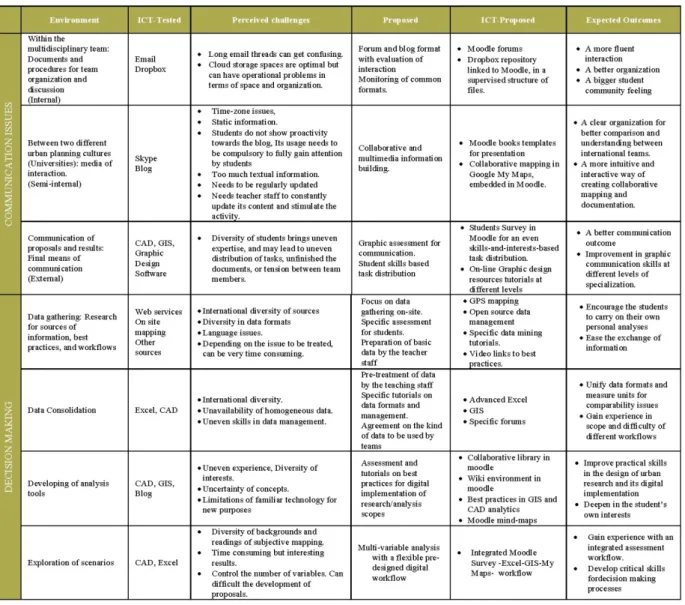
In terms of decision making, many different workflows have been applied to gather information, evaluate data, and visualize findings to have a clear subject of debate within the students. Calculation sheets, GIS workflows, and CAD software have been the major tools at this point. Most of this workflows have been established by the teachers, based in tested methodologies, but the outcomes of the workshop show that the diversity of students (and specially, academic backgrounds), can bring very interesting contributions to this dynamics. This diversity, on the other hand, can involve strong inequalities in digital skills, and can lead to unequal participation of students in activities, and even dropouts.
Figure 1. Development scheme and first results. Author´s own 2016
4. Implementation of new tools for advanced networks during 2016
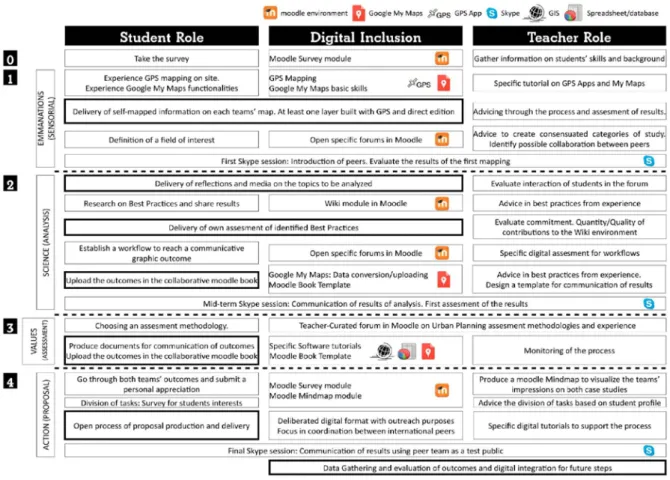
incorporated, using digital tools as GPS Mappig or Google My Maps functionalities to create a common work space. This virtual workspace becomes wide opportunities to exchange experience between students and teachers to improve innovative initiatives in urban planning education and it is a successful experience to export not only to urban planners, but to other disciplines as well.
Figure 2. Digital graph of the different roles of students and professors during all the term. Author: Manuel Benito. Junior researcher Gie UPM.
5. UPW an innovative educational project in continuous evolution.
In view of the positive results of the process, next year, we also want to incorporate a new methodological tool for evaluating urban regeneration processes from a holistic perspective. This tool has been developed by the Research Group in Architecture, Urbanism and Sustainability of the Superior Technical School of Architecture of Madrid, in the framework of the National Research Plan 2008-201 (http://www2.aq.upm.es/Departamentos/Urbanismo/blogs/re-hab).
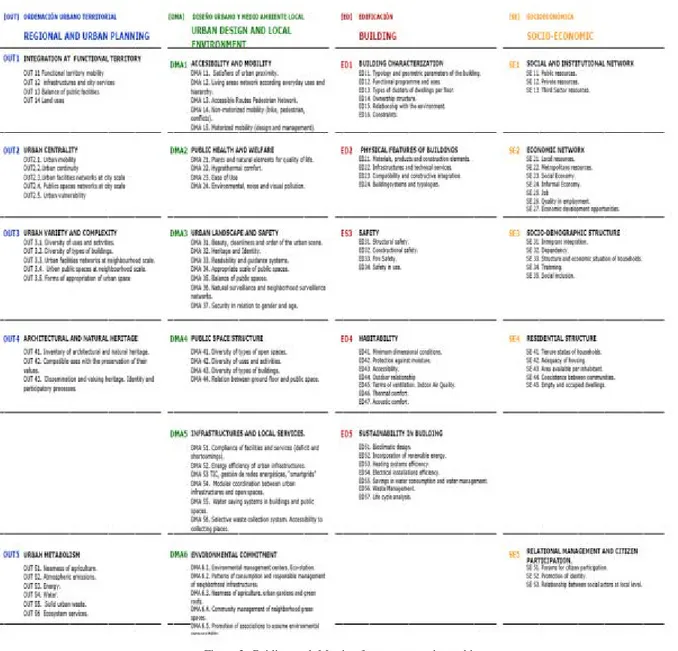
Figure 3: Guiding tool: Matrix of areas, categories and items.
This methodology is an open source tool that aims to facilitate decision making to visualize relationships between the different fields of action and show the priorities of the proposal. The guide tool comprises a matrix of items grouped in categories which in turn are clustered in four different areas. This matrix is organized around the four major areas of intervention that all comprehensive approach must include: Regional and Urban Planning, Urban design and local environment, Building and Socioeconomic area.
Figure 04: Daisies diagram. Visualization tool for diagnosis and proposals.
What should be the next challenges? We must continue implementing innovative network tools and deepen the methodological content of the analysis and the proposed intervention to bring students to real situations.
References
[1] Goodyear, P.; Banks, S., Hodgson, V. and McConnell, D. (Ed), 2004. Advances in Research on Networked Learning. Dordrecht: Kluwer [2] Dirckinck-Holmfeld, L.; Hodgson, V. and McConnell, D. (Ed.), 2012: Exploring the Theory, Pedagogy and Practice of Networked Learning.
NY, Springer.