
English language learners perceptions of their target and learning needs in a Technical and Technological Female Institution in Colombia
101
0
0
Texto completo
(2) ENGLISH LANGUAGE LEARNERS’ PERCEPTIONS OF THEIR TARGET AND LEARNING NEEDS 1 Declaration. I hereby declare that my research report entitled: English language learners’ perceptions of their target and learning needs in a Technical and Technological Female Institution in Colombia . is the result of my own work and includes nothing which is the outcome of work done in collaboration except as declared and specified in the text;. . is neither substantially the same as nor contains substantial portions of any similar work submitted or that is being concurrently submitted for any degree or diploma or other qualification at the Universidad de La Sabana or any other university or similar institution except as declared and specified in the text;. . complies with the word limits and other requirements stipulated by the Research Subcommittee of the Department of Foreign Languages and Cultures;. . has been submitted by or on the required submission date.. Date:. 29th January, 2014. Full Name:. Diana Angélica Parra Pérez. Signature:.
(3) ENGLISH LANGUAGE LEARNERS’ PERCEPTIONS OF THEIR TARGET AND LEARNING NEEDS 2 Acknowledgements My sincere thanks and gratitude to my project director Nohora Bryan, and my action research professor, Liliana Cuesta. Their help throughout this research process has been valuable. I would like to show my gratitude to directors, teachers and students at Instituto Superior de Ciencias Sociales y Económico Familiares (ICSEF) for their insightful contribution for the development of this study. I would also like to thank all the members of the Commission at the Foreign Language and Cultures Department at La Sabana University, for their unconditional support and confidence in me. My deepest appreciation and gratitude go to my family and all friends who stayed beside me and prayed for me to finish this project successfully. My deepest thanks go to God, for giving me the strength to keep going during this research journey..
(4) ENGLISH LANGUAGE LEARNERS’ PERCEPTIONS OF THEIR TARGET AND LEARNING NEEDS 3 Abstract This study describes the development of a language needs analysis for an English Language Program at a higher education female institution in Silvania, Colombia. The study aimed at examining students’ target and learning needs as perceived by the learners themselves, their English instructors and their content teachers. A mixed method procedure was followed collecting both quantitative and qualitative data. Quantitative data were collected by means of a questionnaire including items with four-point rating scales and multiple choice. Questions in the survey addressed learner’s target and learning needs in terms of preferences regarding their future occupational field and current learning situation. Qualitative data were collected through open questions in the questionnaires, a formal interview with English instructors and a focus group with students. Findings reveal both concurrences and discrepancies between subjective and objective needs regarding English language learners’ target and learning needs at the institution. The study also suggests that learners are motivated to learn English in view of the fact that this language is highly connected to their envisaged future ‘possible selves’. Suggestions are made for areas of focus for curriculum renewal, including addressing particular needs of learners’ advancing different programs. Key words: needs analysis, learning needs, target needs, tertiary education, curriculum, ESP..
(5) ENGLISH LANGUAGE LEARNERS’ PERCEPTIONS OF THEIR TARGET AND LEARNING NEEDS 4 Resumen El presente estudio describe el desarrollo de un análisis de necesidades para un programa de inglés en una institución de educación superior femenina en Silvania, Colombia. El estudio tuvo como objetivo examinar las necesidades de lengua de las estudiantes desde la perspectiva de las estudiantes mismas, la instructora de inglés y profesores de la institución. Se siguió un procedimiento de método mixto a través de recolección de datos cuantitativos y cualitativos. Los datos cualitativos se recolectaron administrando un cuestionario de preguntas con una escala de cuatro puntos y de opción múltiple. Las preguntas del cuestionario se orientaron hacia las necesidades objetivo y las necesidades de aprendizaje, en términos del futuro campo profesional y la actual situación de aprendizaje. Los datos cuantitativos se obtuvieron a través de preguntas abiertas del mismo cuestionario y una entrevista formal con las profesoras de inglés y un grupo focal con las estudiantes. Los resultados revelan discrepancias y concurrencias entre las necesidades objetivas y subjetivas en relación a las necesidades objetivo y las necesidades de aprendizaje de las estudiantes de inglés en la institución. El estudio también sugiere que las estudiantes están motivadas hacia el aprendizaje del inglés teniendo en cuenta que esta lengua está altamente conectada con su visión de sus futuros ‘posibles ser’. Se sugieren áreas de enfoque para la renovación del currículo, incluyendo atender a las necesidades particulares de las estudiantes que adelantan diferentes programas. Palabras claves: análisis de necesidades, necesidades objetivo, necesidades de aprendizaje, educación terciaria, currículo, ESP..
(6) ENGLISH LANGUAGE LEARNERS’ PERCEPTIONS OF THEIR TARGET AND LEARNING NEEDS 5. Table of Contents Acknowledgements ............................................................................................................. 2 Abstract ............................................................................................................................... 3 Resumen .............................................................................................................................. 4 Table of Figures .................................................................................................................. 7 Table of Tables .................................................................................................................... 8 Chapter One: Introduction................................................................................................. 10 Statement of the problem .............................................................................................. 11 Research Question ......................................................................................................... 13 Rationale ....................................................................................................................... 14 Chapter Two: Theoretical Framework .............................................................................. 16 Needs ............................................................................................................................. 16 Needs analysis ............................................................................................................... 18 Needs analysis procedures ........................................................................................ 19 Needs analysis principles .......................................................................................... 20 Needs analysis and curriculum.................................................................................. 22 Needs analysis: different views ................................................................................. 23 Chapter Three: Research Design ....................................................................................... 26 Type of study ................................................................................................................ 26.
(7) ENGLISH LANGUAGE LEARNERS’ PERCEPTIONS OF THEIR TARGET AND LEARNING NEEDS 6 Context .......................................................................................................................... 27 Participants .................................................................................................................... 29 Students ..................................................................................................................... 30 English instructors ..................................................................................................... 31 Content teachers ........................................................................................................ 32 Researcher’s role ........................................................................................................... 32 Data collection instruments and procedures ................................................................. 33 Questionnaires ........................................................................................................... 34 Focus group ............................................................................................................... 38 Semi-structured interview ......................................................................................... 39 Documentary evidence .............................................................................................. 39 Chapter Four: Results and Data Analysis ......................................................................... 41 Data analysis methods ................................................................................................... 41 Data analysis procedure ................................................................................................ 42 Quantitative data analysis procedures ........................................................................... 43 Quantitative findings ................................................................................................. 44 Qualitative data analysis procedures ............................................................................. 53 Findings after merging data .......................................................................................... 54 Findings concerning target needs .............................................................................. 54.
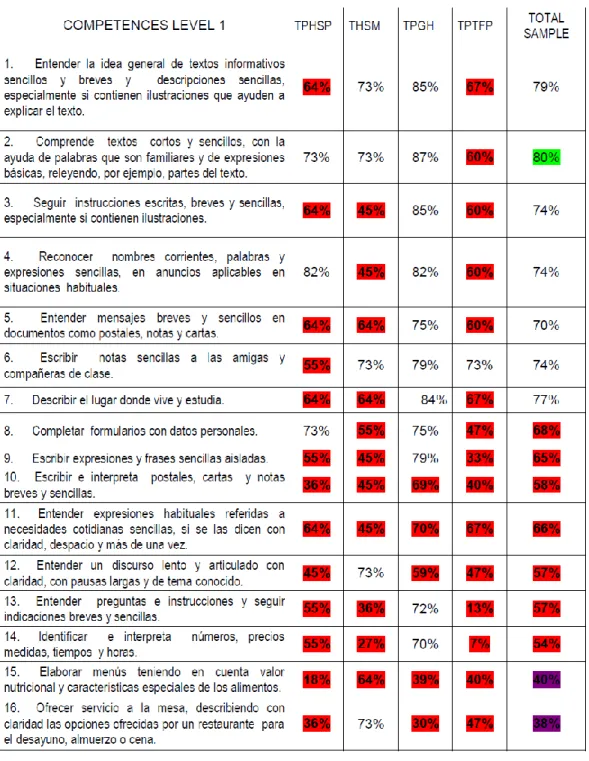
(8) ENGLISH LANGUAGE LEARNERS’ PERCEPTIONS OF THEIR TARGET AND LEARNING NEEDS 7 Findings concerning learning needs .......................................................................... 58 Findings concerning main discrepancies between objective and subjective needs .. 61 Chapter Five: Conclusions and Pedagogical Implications ................................................ 70 Pedagogical implications ................................................................................................ 73 References ......................................................................................................................... 79 Appendix A ....................................................................................................................... 85 Appendix B ....................................................................................................................... 90 Appendix C ....................................................................................................................... 95 Appendix D ....................................................................................................................... 96 Appendix E ....................................................................................................................... 97 Appendix F ........................................................................................................................ 98 Appendix G ....................................................................................................................... 99 Appendix H ..................................................................................................................... 100. Table of Figures Figure 1. Approaches to needs and their conceptualization (Brindley, 1984). ................. 18 Figure 2. Framework to analyze learners’ needs (Kaewpet, 2009) ................................... 21 Figure 3. Students’ self-rated proficiency in Level I syllabus competences..................... 48 Figure 4. Students’ self-rated proficiency in Level II syllabus competences ................... 49.
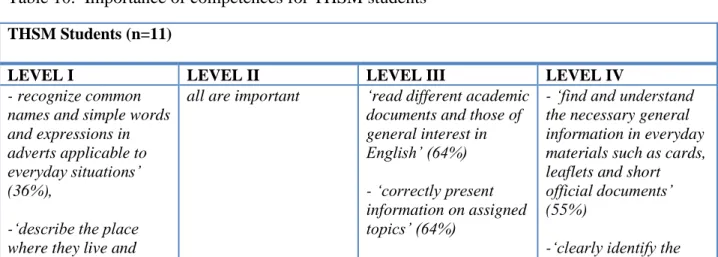
(9) ENGLISH LANGUAGE LEARNERS’ PERCEPTIONS OF THEIR TARGET AND LEARNING NEEDS 8 Figure 5. Students’ self-rated proficiency in Level III syllabus competences .................. 49 Figure 6. Students’ self-rated proficiency in Level IV syllabus competences .................. 50. Table of Tables Table 1. Total sample size and sample size per program. ................................................. 30 Table 2. Total sample size and sample size per level. ...................................................... 31 Table 3. Distribution of content teachers according to program in which they teach. ..... 32 Table 4. Distribution of content teachers according to their self-rated English level. ..... 32 Table 5. Correlation of research questions, questionnaire sections and items ................. 37 Table 6. Documentary evidence used in the present study and their contribution. ......... 40 Table 7. Convergent design procedures followed in this study (Creswell & Plano, 2011) ....................................................................................................................................................... 42 Table 8. Data analysis methods followed during this study............................................. 43 Table 9. Prospective situations with least use of English ................................................ 45 Table 10. Importance of competences for THSM students.............................................. 46 Table 11. Open-question 3 and 4 sample data: target needs ............................................ 55 Table 12. Additional prospective situations: open question ............................................ 56. List of Abbreviations CEFR. Common European Framework of Reference for Languages. EAP. English for Academic Purposes. ECAES. Exámenes de Calidad de la Educación Superior. EFL. English as Foreign Language.
(10) ENGLISH LANGUAGE LEARNERS’ PERCEPTIONS OF THEIR TARGET AND LEARNING NEEDS 9 ESP. English for Specific Purposes. FLCD. Foreign Languages and Cultures Department. ICSEF. Instituto Superior de Ciencias Sociales y Económico Familiares. L2. Second Language. MEN. Ministry of Education. NA. Needs Analysis. SENA. Servicio Nacional de Aprendizaje. THSM. Technologist in Hotel and Services Management. TPG. Technician Professional in Gastronomy. TPHSP. Technician Professional in Hotel and Services Processes. TPTFP. Technician on Processing and Trading of Food Products.
(11) ENGLISH LANGUAGE LEARNERS’ PERCEPTIONS OF THEIR TARGET AND LEARNING NEEDS 10 Chapter One: Introduction. The expansion of English as an international language has prompted different nonEnglish speaking countries to implement programs that foster the development of communicative competencies in English. Such is the case of Colombia, where the Ministry of Education (MEN hereafter for its acronym in Spanish) launched the National Bilingualism Program in 2004, establishing English as a Foreign Language (EFL, hereafter) for all the cycles of the education system for non-bilingual institutions in the country (MEN, 2005) The long-term goal set for this National Bilingual Plan is that high school students would reach an intermediate level while graduates from tertiary education institutions (college and universities) would reach a high intermediate level by 2019. That means, according to the Common European Framework of Reference for Languages (CEFR hereafter), B1 and B2 levels respectively. Under the circumstances described above, it is evident that education institutions in Colombia are called to reflect over the effectiveness of their current practices in teaching English. Institutions also need to consider the extent to which their language curriculums are meeting national government goals in terms of bilingualism. As can be expected, the Instituto Superior de Ciencias Sociales y Económico Familiares (ICSEF hereafter for its acronym in Spanish), one of the 54 technological institutions in Colombia, has taken significant and concrete actions to embark on such reflective process. As a starting point, a situation analysis was carried out in 2008 in order to gather authorities’ perceptions at the ICSEF, concerning the English language program. As a product of such analysis a document entitled “The ICSEF Proposal to Universidad de La Sabana” was written and handed in to the Foreign Languages and Cultures Department (FLCD) at Universidad de La Sabana. Together with the situation analysis report,.
(12) ENGLISH LANGUAGE LEARNERS’ PERCEPTIONS OF THEIR TARGET AND LEARNING NEEDS 11 the ICSEF authorities have requested counseling services to the FLCD on the subject of English language programs, which was the opportunity that gave rise to the current research study.. Statement of the problem As a technical and technological institution, the ICSEF needs to advance within the National Bilingual Plan goal. This task is described by the ICSEF authorities as an enormous challenge but certain actions have been taken to meet this challenge. In 2009, the ICSEF approached The University of La Sabana,-a higher education institution located in Bogota, Colombia, requiring the consultancy services in English Language Teaching (ELT hereafter) that the institution offers to State and private education institutions. The ICSEF had determined that they needed to strengthen their curriculum in order to advance their students’ performance in English as a foreign language. The decision had been taken after evaluating the results of an empirical situation analysis through which they had spotted critical issues that were affecting students’ EFL learning progress. According to the ICSEF those factors were: the students’ lack of schooling for long periods of time, the reduced training in EFL the students had received during their high school stage, some previous negative experiences the learners had undergone while learning English, the students’ unawareness of the importance of second language and communication skills for the labor market. The report handed in to the Sabana University also underscores students’ lack of motivation to study the foreign language. Beyond the goal imposed by the government and the need for technologist with proficiency in English, the ICSEF authorities acknowledge the pertinence of this lifelong skill for their graduates. One of the main ideologies of the directive board is that all students should be.
(13) ENGLISH LANGUAGE LEARNERS’ PERCEPTIONS OF THEIR TARGET AND LEARNING NEEDS 12 given the opportunity to learn a foreign language so as to provide them with more skills that will help them advance their education and guarantee personal as well as professional progress. All these aspects called for a strategy in order to achieve the outcomes expected by the institution. As a first line of attack, the ICSEF begun to implement different strategies to improve learners’ achievement in English before approaching the university: a placement test to identify students’ previous knowledge in English, weekly tutoring sessions to reinforce class work, and the putting into practice of an English for Specific Purposes (ESP) program: English for Hospitality. They had also started making use of their English Lab to provide conditions for students’ independent language learning. The ICSEF also underlined the importance of advancing their teachers on areas such as ELT methodology, successful assessment methods, development of learning guides to foster reading strategies and use of resources for English language teaching (ELT). In this respect the university has offered them different options to advance their teachers; however, due to different constrains the training is on hold. By 2010, the results they had obtained with the strategies above mentioned were unimpressive. Then, the ICSEF decided to make a thorough revision of their EFL Program. This time the consultant and the ICSEF agreed to start with an inquiry in order to obtain an in-depth insight from all stakeholders’ beliefs, opinions and views concerning the existing and the aimed learning situation in an attempt to guarantee that the new program framework aligns with learners’ needs. The program to be renewed was designed by the English teacher with a degree of advice from the Academic Coordinator. The situational analysis with which they approached the consultants was also carried out by the English teacher. Different authors (Murray & McPherson, 2004; Melles, 2010) have rejected the idea of teachers being the one and only participants in the construction of a program. Melles (2010) argued that “ESL teachers express a.
(14) ENGLISH LANGUAGE LEARNERS’ PERCEPTIONS OF THEIR TARGET AND LEARNING NEEDS 13 desire to retain autonomy to decide the form and nature of curriculum according to workable personal definitions” (p. 45) which may lead to evade existent learners’ needs. This issue could be of significant importance at the ICSEF where the same English syllabus is common to all students advancing different programs. Similarly, renowned experts in language learning (Balint, 2004; Jordan, 1997; Kayi, 2008; Nunan, 1991; Richards, 2001) have highlighted the importance of allowing what all stakeholders have to say when developing a curriculum or conducting a revision of language courses: students, mainstream lecturers, English teachers, administrators and in general all entities that may influence and be impacted by education.. Research Question Several factors led to the ICSEF implementing strategies in order to ameliorate its institutional English language learning landscape. These factors included the national goal that defines the “ought to” for students and institutions with respect to the students competence in English, the avowed need for technical workforce proficient in a foreign language, the results of State test and the findings of the analysis performed by the teachers. However, this thread of actions and decisions evidence that discernment on “product” neglects the importance of “learning” when pronouncements about the EFL curriculum are made. The main concern has always been students’ achievement: the end but not the process. Ignoring the process means ignoring the learners’ needs and the learning situation. Thus, it is very likely that a curriculum developed to follow authorities’ orientations will soon evidence “discrepancies between what learners aim to do with the target language in the future and what the government and/or the teachers want them to attain” (Watanabe, 2006, p.84). Uncovering students’ needs, as well as learning context needs before, during and after the implementation of the curriculum, is not only.
(15) ENGLISH LANGUAGE LEARNERS’ PERCEPTIONS OF THEIR TARGET AND LEARNING NEEDS 14 a healthy practice for curriculum effectiveness, but also the best tactic to abolish the commonly found TENOR (Teaching English for no Obvious Reasons) situations, as called by Abbot (1981, p.1). Exploring specific internal needs and assuring learners and all stakeholders’ awareness of the need for learning the language guarantees the offering of curricular solutions that satisfy specific pertinent purposes (Hutchinson & Waters, 1987, p. 53). One of the most recommended methods to develop and cultivate institutional consciousness about the need and reason to be of a program in an institution is needs analysis (Hutchinson & Waters, 1987; Brown, 1995; Richards, 2001; Nuñez, 2007). In order to contribute to decision making concerning the renewal of the curriculum at the ICSEF, this study gathered information about learners’ needs with regards to the target situation where they will use the language and also concerning the learning situation at the institution by means of a needs analysis that involved students and stakeholders. Subsequently, the following research questions guided the inquiry: 1) What are the ICSEF English learners’ perceived learning needs? 2) What are the ICSEF English learners’ perceived target needs? 3) Are there any significant differences between learners and other stakeholders in their perceptions?. Rationale As a result of a diagnosis conducted by the ICSEF in 2008, the institution declared their imminent need of examining their syllabus since they noticed that their students’ low achievement in English was not fulfilling the goals of the National Bilingualism Plan. Therefore,.
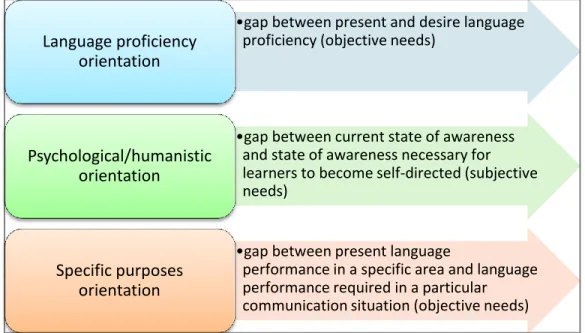
(16) ENGLISH LANGUAGE LEARNERS’ PERCEPTIONS OF THEIR TARGET AND LEARNING NEEDS 15 this study focuses on the identification of students’ target and English language learning needs as perceived by themselves and by some members of the academic community. At an international level, literature reveals a wide number of needs analysis studies in vocational and technological contexts of education (O’Neill & Gish, 2001; Murray, 2005; Chostelidou, 2010); however, records of research in Colombia is not that extensive. Therefore, the results of this study are expected to have an impact not only at the institutional level, but also at the national level. At the institutional level, recommendations of the study will provide decision-makers with reliable data to implement action plans that may help them fulfill their language learning goals. At national level, technical and technological institutions in the country may reply needs analysis procedures in their own context and follow the recommendations to achieve the National Bilingualism Plan goals. Given the importance of tertiary education in Colombia for economic development of the country, and the importance of learning a foreign language as a key competence in the globalized world, this study contributes to the country competitiveness, now that a Free Trade Agreement (TLC) has been signed with different countries. The results of this study should help the institution improve their practices in curriculum planning and enactment so as to assure they will contribute graduates with the expected level the productive sector and the country in general are anticipating..
(17) ENGLISH LANGUAGE LEARNERS’ PERCEPTIONS OF THEIR TARGET AND LEARNING NEEDS 16 Chapter Two: Theoretical Framework. This chapter discusses a review of the literature on the main constructs which support this study: needs and needs analysis. Clarifying what is meant by needs and identifying the preferred procedures to undertake a needs analysis is fundamental when aiming at gathering essential data for a solid framework concerning students’ and teachers’ views about learning and target needs.. Needs Literature reports a wide variety of definitions of needs (Richterich, 1972; Van Ek, 1975; Munby, 1978; Brindley, 1984, as cited in Van Avermaet & Gysen, 2006). However, definitions tend to rely on two categories: subjective and objective needs, according to Van Avermaet and Gysen (2006). The authors aver that “objective needs can be deduced by parties other that the learners themselves” while subjective needs “are based on the learners’ own statements” (p.4). Correspondingly, Nunan (1988) argues that subjective needs reflect perceptions, goals, and priorities of the learner. These needs inform the researcher on learners’ reasons to learn a second language and on preferences regarding classroom tasks and activities. With respect to objective needs, Nunan believes that these may be diagnosed by the teacher on the basis of the personal data of the learners (p. 18). Van Avermaet and Gysen (2006) also argue that curriculum must reflect learners’ objective domains to meet learners’ expectations and increase their motivation (p.58). It is highly recommended not to omit what students have to say about their cognitive and affective needs, perceptions, goals and priorities (Brindley, 1987; Nunan, 1988). Since a balance or middle.
(18) ENGLISH LANGUAGE LEARNERS’ PERCEPTIONS OF THEIR TARGET AND LEARNING NEEDS 17 ground can be achieved by applying interpretative expertise to students expressed needs (Berwik, 1989; Van Avermaet & Gysen, 2006), this study described both, objective and subjective needs. From another perspective, within Hutchinson and Waters’ (1987) frame needs divide into two categories: target needs which refer to what learners need to do in the target situation, and learning needs which refer to what learners require in order to be able to perform proficiently in the target situation. They also specify that target needs can be understood in terms of necessities, lacks and wants. The first two kinds of needs tell about objective needs, since necessities have to do with what the target situation demands and lacks have to do with the gap between current learners’ proficiency and the target proficiency. On the other hand, wants provide information regarding. subjective needs by informing about learners’ views regarding their learning situation. In this study the needs analysis focused on collecting evidence of both target and learning needs following Hutchinson and Waters’ definition (1987). For the purposes of this study, the concept of target needs was used to find information about situations, competences and work activities that the learners are expected to perform in their future work. In contrast, the concept of learning needs was employed to find evidence of the learners’ desired learning situation in terms of resources, content, evaluation and class activities. Brindley (1984) following Trimby (1979), outlines three approaches to needs: language proficiency orientation, psychological / humanistic orientation and specific purposes orientation. The three approaches differ in the way needs are conceived, as shown in Figure 1. Both language proficiency and specific purposes orientation focus on objective needs, while the psychological / humanistic orientation focuses on a more subjective point of view, addressing students’ level of awareness of his/her own needs (Brindley, 1984, p. 67). This study sought to.
(19) ENGLISH LANGUAGE LEARNERS’ PERCEPTIONS OF THEIR TARGET AND LEARNING NEEDS 18 identify both subjective and objective needs, the three approaches are, therefore, helpful to shed light on students’ target and learning needs.. Language proficiency orientation. •gap between present and desire language proficiency (objective needs). Psychological/humanistic orientation. •gap between current state of awareness and state of awareness necessary for learners to become self-directed (subjective needs). Specific purposes orientation. •gap between present language performance in a specific area and language performance required in a particular communication situation (objective needs). Figure 1. Approaches to needs and their conceptualization (Brindley, 1984).. Needs analysis As a process in curriculum development (Brown, 1995; Richards, 2001; Nuñez, 2007), needs analysis involves collecting information that increases understanding of the learners’ language needs, so that decisions can be made to set goals and content for a language course (Richards, 2001). Pursuing a needs analysis also involves asking the question “why do these learners need to learn English?” and the answer to that question is what makes clear the target situation in which learners will need to communicate in English (Hutchinson & Waters, 1987). This is why, for the current study, needs analysis is understood as the process of collecting relevant information that may be used for syllabus design purposes (Nuñez, 2007). The study also aligns to Brown’s (1995) definition of need analysis: “the systematic collection and analysis.
(20) ENGLISH LANGUAGE LEARNERS’ PERCEPTIONS OF THEIR TARGET AND LEARNING NEEDS 19 of all subjective and objective information necessary to define and validate defensible curriculum purposes that satisfy the language learning requirements of students within the context of particular institutions that influence the learning and teaching situation” (p. 36). Needs analysis procedures Researchers have identified useful approaches to conduct needs analysis. For example, Brindley (1984) proposes a learner-centered system to needs analysis where needs are validated by the negotiation of roles and expectations between teachers and learners. On the other hand, Jordan (1997) recommends 10 steps following Richterich’s (1983) fundamental questions to establish needs analysis as the starting point for syllabus design: 1) state purpose of analysis, 2) delimit student population, 3) decide upon the approach, 4) acknowledge constraints / limitations, 5) select methods of collecting data, 6) collect data, 7) analyze and interpret results, 8) determine objectives, 9) implement decisions (i.e. decide upon syllabus, content, material, methods, etc.) and 10) evaluate procedures and results (p. 23). Both approaches to needs analysis provide useful insights to be considered in the current study. In fact steps 1 to 7 are implemented in order to provide stakeholders with results for them to determine course objectives based on the findings in this study. Van Avermaet and Gysen (2006) suggest, for data collection in a needs analysis, designing a written questionnaire with a list of domains and language use situations that could be of potential relevance to the target group. With a questionnaire of this type, results might show predominant domains for teachers and students. They also suggest a second phase, in which the researcher establishes needs profiles for each language domain. Finally, observations in the target domain and in the selected language use situations are useful to validate results. It is also.
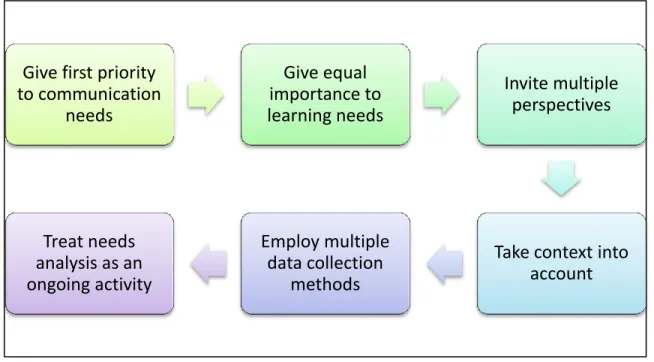
(21) ENGLISH LANGUAGE LEARNERS’ PERCEPTIONS OF THEIR TARGET AND LEARNING NEEDS 20 suggested to gather expert opinions with written and oral surveys, using open and/or closed questionnaires to people who have long-term experience in the domain and in the relevant situations (p. 8). The scope of this study included a written questionnaire based on domains and language situations stated in the existing language program at the institution. There were no observations in the target domains but experienced main stream teachers were consulted to validate stated domains and language situations. Needs analysis principles Kaewpet (2009) proposes a framework for investigating learner needs, which is extended to curriculum development. Similar to Brindley’s (1984) learner-centered system for needs analysis, the framework includes the implementation and evaluation of the curriculum while the course is underway, this, in order to establish if learners’ needs have been met. Kaewpet’s (2009) framework is significant for the current study since it provides some useful principles to be considered when analyzing learners’ needs at the technical and technological institution. The framework emphasizes the importance of anticipating learners’ actual communicative situations and any learning factors affecting the learning situation, among them, contextual factors. The framework also suggests involving multiple perspectives in the research, such as teachers, learners and stakeholders. Similarly, it is recommended to implement multiple data collection tools to validate data. Finally, Kaewpet (2009) points out that considering needs analysis as an ongoing activity permits expanding the process to include both curriculum development and action research (p. 214). The following figure illustrates the 6 principles suggested by Kaewpet in a needs analysis framework that may be extended to curriculum development..
(22) ENGLISH LANGUAGE LEARNERS’ PERCEPTIONS OF THEIR TARGET AND LEARNING NEEDS 21. Give first priority to communication needs. Give equal importance to learning needs. Invite multiple perspectives. Treat needs analysis as an ongoing activity. Employ multiple data collection methods. Take context into account. Figure 2. Framework to analyze learners’ needs (Kaewpet, 2009). In terms of the first principle, the first phase of the research involved anticipating learners’ actual communicative situations. This was achieved by exploring learners’ profiles in the four programs they were attending. In relation to the second principle, in this study the questionnaire administered to students asked for their level of achievement regarding the communicative competences established in their English course, as well as for their expectations, beliefs and opinions regarding the syllabus. In terms of the third principle, the study focused special attention on the nature of the technical and technological programs. These kinds of programs demand an English instruction closely connected to the technical knowledge that learners develop in their specialized areas. With reference to societal factors, society expectations are framed into the National Bilingual Program in Colombia and the adoption of the CEFR as point of reference. The fourth principle was implemented by a careful study of the documentary evidence and the involvement of learners, the main stream teachers and the English.
(23) ENGLISH LANGUAGE LEARNERS’ PERCEPTIONS OF THEIR TARGET AND LEARNING NEEDS 22 instructors in the data collection phase of the research. In terms of the fifth principle, four types of instruments were used: documents, questionnaires, an interview and a focus group. As for the sixth principle, the scope of the needs analysis procedure implemented in this study covered aspects that ranged from the identification of target and learners´ needs to the identification of significant differences between subjective and objective needs. It is expected that in further research, a renewed curriculum be implemented attempting to address those identified needs and that the whole action research process, as described by Kemmis and McTaggart (1998), will be undertaken. Needs analysis and curriculum According to Graves (2008), traditional approaches to curriculum development follow a linear process that makes it difficult to find coherence between the process itself and the final product: the curriculum. The process starts with a situation analysis, followed by a needs analysis that contributes to the definition of aims and goals, the syllabus design and the selection of materials. The process ends with the selection of assessment and evaluation procedures (p.148). In contrast to that linear process, Graves (2008) suggests a renewed approach to curriculum design, which involves three stages: planning, enacting and evaluating. She argues that the traditional stage of implementing must reflect the activity of teachers and learners in the classroom and that a curriculum cannot exist before it is enacted, that is, without teaching and learning experiences. Therefore, her perspective of curriculum design involves both teachers and students and does not follow a linear fashion but a dynamic interrelation among the stages: planning, enacting and evaluating (p.152). Graves’ perspective of curriculum development is of.
(24) ENGLISH LANGUAGE LEARNERS’ PERCEPTIONS OF THEIR TARGET AND LEARNING NEEDS 23 relevance for the present study, which will be based on the prescribed curriculum and gathers views of teachers and learners that have already experienced it in practice. In the study “Japanese Language Needs Analysis”, Iwai, Kondo, Lim, Ray, Shimizu and Brown (1999) provide a summary on needs analysis in ESL curriculum. They point out the importance of needs analysis when designing not only ESP courses, but also general language courses. They also highlight that needs analysis procedures take a central role in various perspectives of curriculum development, such as learner-centered curriculum, task-based curriculum, performance assessment and proficiency oriented curriculum. They also argue that learners’ motivation is an important issue in curriculum development that may be tackled by paying attention to students’ perceived needs. The approach of Iwai, et al. (1999) is significant for the current study, since it establishes the parameters to conduct needs analysis when it is intended to create a new curriculum or to reevaluate “existing perceptions of students’ needs” (p.7). Needs analysis: different views Berwick (1989) highlights four views of needs analysis in educational research. One view is the ‘discrepancy analysis’ in which needs are understood as “the discrepancy between what people know and what they ought to know” (p.52). Another view is the ’democratic approach’ in which the need reflects a references group’s wish of changing some form of educational practice (Berwick, 1989, p.53). This last one entails “consultations or interviews with prospective learners […] in order to accommodate individual’s goals” (Berwick, 1989, p. 52). Another view of needs is the ‘analytic view’, in which the assessment involves reliance on expert opinion to elaborate statements of needs. The last view is the ´diagnostic approach’, in.
(25) ENGLISH LANGUAGE LEARNERS’ PERCEPTIONS OF THEIR TARGET AND LEARNING NEEDS 24 which experts diagnose particular groups or individuals who have certain deficiency (Berwick, 1989, p.54). In accordance to the above mentioned approaches the present study held the discrepancy and democratic views. By analyzing students’ and teachers’ perceptions regarding learners’ current language proficiency in regards to the target proficiency, a discrepancy approach was assumed. This approach was also used to analyze stakeholders’ perceptions on other target and learning needs. A democratic approach was assumed by consulting different sources, such as the learners, the English instructors and the main stream teachers. The previous framework to analyze needs has been proven to be useful in various studies. Many of those studies stress the significance of considering learners’ expressed needs as part of curriculum development and the benefits of consulting views of stakeholders (Alshumaimeri, 2001; Chostelidou, 2010; Iwai, et al. 1999; O’Neill and Gish, 2001). Procedures adopted in those studies have also shown that the implementation of surveys and questionnaires is an effective method to collect data that can tell about mismatches and/or coincidences between learners’ and teachers’ expectations, learners’ present learning situation and target situation (Chostelidou, 2010; O’Neill and Gish, 2001; Murray, 2007; China Academic Journal, 2010). Triangulation of results has also proven to be useful through the administration of other data collection techniques, such as focus groups and interviews (Chostelidou, 2010; O’Neill & Gish, 2001). Finally, this framework to analyze needs has also been implemented in local contexts at a secondary and tertiary level of education in Colombia. Mora and Ramos (2003) identified ninth graders’ needs in a State school through written questionnaires, classroom observations, interviews and documentary evidence. The study revealed matches and mismatches among the aforementioned elements and findings contributed to raise the English teacher’s awareness of the importance of considering learners’ needs when planning the program (p. 44). At a tertiary level,.
(26) ENGLISH LANGUAGE LEARNERS’ PERCEPTIONS OF THEIR TARGET AND LEARNING NEEDS 25 a needs analysis was implemented with PhD students at a Colombian university (Janssen, Nausa, & Rico, 2012). Through the administration of a questionnaire data were collected aiming at revealing learners’ interests and situated context in order to contribute with EAP program development. Findings revealed EAP language skills as highly important for PhD students and a marked preference to skills situated in an international context. Results also highlighted the importance of implementing concise surveys when documenting the significance students give to different course goals (p. 60). Both studies provide interesting insights regarding the evaluation process of a program extended to reflective teaching that may be adopted in further research..
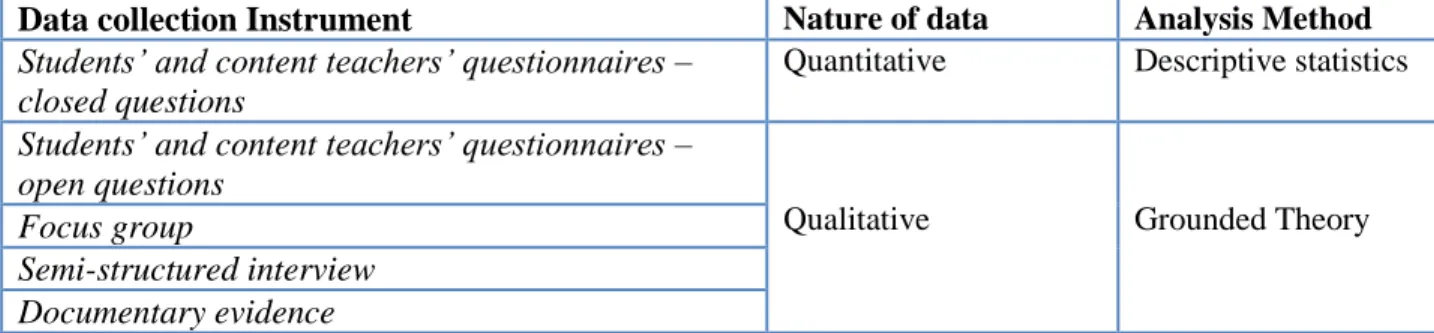
(27) ENGLISH LANGUAGE LEARNERS’ PERCEPTIONS OF THEIR TARGET AND LEARNING NEEDS 26 Chapter Three: Research Design. In this chapter a description of the procedures followed in this study are presented. First the reader will become acquainted with the type of study, then with a description of the participants and the data collection instruments. Finally, methods implemented to collect and analyze data are presented. Type of study Framed into a mixed-method research, this study involves a qualitative and a quantitative perspective. According to Creswell (2009) combining these two approaches expands understanding of the research problem (p.203). This mixed-method study included four instruments: documentary evidence, two questionnaires, an interview and a focus group. The quantitative data part of this study was collected by means of the questionnaires, including questions with four-point rating scales. The qualitative data were collected through open questions in the questionnaires, a semi-structured interview and a focus group. Students and content area teachers completed the questionnaires, while the two teachers in charge of English lessons were interviewed. As a strategy to gain more input on behalf of the students, a group of 6 learners were invited to participate in a focus group. The aim of qualitative approaches is to offer descriptions, interpretations and clarifications of naturalistic social contexts. Procedures followed based on this approach make use of data collection techniques, such as, observation and recording of events or behaviors in the context where they occur. The focus of the analysis is not only centered on linguistic or cognitive issues but it also covers a social dimension (Burns, 1999, p. 30). From this perspective, the current work involves the description of students’ current situation and the.
(28) ENGLISH LANGUAGE LEARNERS’ PERCEPTIONS OF THEIR TARGET AND LEARNING NEEDS 27 analysis of participants’ perceptions regarding English language learners’ target and learning needs. The development of a qualitative research requires the validation of its findings by following different procedures. Burns (1999) claims that the validity of the findings lies not only in the systematic ways in which the data are collected and analyzed but also in the process of triangulation to which the collection methods can be subdued (p. 163). Triangulation involves gathering data from a number of different sources so that the research findings or insights can be tested out against each other. Therefore, this research triangulates data by collecting and contrasting data from three sources: documentary evidence, learners and teachers. Context This research was developed at Instituto Superior de Ciencias Sociales y Económico Familiares (ICSEF) one of the 54 technological institutions in Colombia. These institutions are characterized by their orientation towards the technological field of knowledge with a foundation on science and research (Congreso de Colombia, 2002). Education and training focus on knowledge required for work-place performance in the productive and services work sector. The ICSEF is a located in Fusagasugá, a small town in Colombia, surrounded by a wide rural area, called Sumapaz. The ICSEF was founded in the year 1969, in Bogotá, aiming to promote women’s education. In 1974, the Ministry of Education in Colombia granted the institution approval to offer technical and technological education. The first cohort graduated in 1975. As a result of a feasibility study, by 1998, the ICSEF started operations in its new branch, in Fusagasugá (Cundinamarca, Colombia). From 2003 to 2006, a partnership program with Australian government and the non-governmental organization (NGO) RELEDEY benefited 960 women of.
(29) ENGLISH LANGUAGE LEARNERS’ PERCEPTIONS OF THEIR TARGET AND LEARNING NEEDS 28 the region to study at the ICSEF. It provided them with economic benefits. In 2006 a new partnership project with Belgian government and NGO ACTEN (Association for Cultural, Technical and Educational Corporation) provided the ICSEF with economic support to build 5 food classroom workshops in its facilities. Another benefit was the development of a program to support low-income women access to professional education and labor market. By 2008, the ICSEF started a joint program with Bogotá’s Chamber of Commerce, called the MEGA Program, and it aimed to offer consultation to food and agricultural sectors in the region, in order that they could grow and expand. With the support of the Minister of Foreign Affairs and the NGO ELIS, from 2008 to 2012, the ICSEF held a project to improve the social and economic conditions of rural families from the six communities located in Sumapaz. This project helped finishing the five food labs and sponsored six business initiatives of students advancing the Processing and Trading of Food Products program. Currently, the ICSEF is recognized by the Learning National Service (SENA, for its acronym is Spanish), a State technical and technological institution that can accredit other institutions of the same kind. This recognition provides learners with the benefit of being hired by Colombian enterprises during their trainee period. The MEN has granted the ICSEF approval to provide instruction in the following programs: Technician on Gastronomy, Technician on Hotel and Services Processes, Technician on Processing and Trading of Food Products and Technologist on Hotel and Services Management. Students enrolled in technical programs are required to take two language modules of English: Basic English A.1.1 (English I) and Basic English A.2.1 (English II). These courses are taken during the second year of the two-year program. Those who pursue the technological.
(30) ENGLISH LANGUAGE LEARNERS’ PERCEPTIONS OF THEIR TARGET AND LEARNING NEEDS 29 program, study two more levels which are Basic English A2.2 (English III) and Intermediate English B.1.1 (English IV). This last is taken as an intensive course, which means, students attend four hours of daily classes, during three weeks. Courses I to III comprise 96 hours distributed in 32 hours of class and 64 hours of independent study. Lessons taught during a regular semester are once a week and they last 2 academic hours. The program contains topics related to hospitality and competences are taken from the first three levels of the CEFR. The four modules focus on four language skills: listening, speaking, reading and writing. Two instructors are in charge of the four modules of English and class size depends on the number of students in each semester, but on average there are 15 students in each group. To support students’ independent language learning, the ICSEF has a Language laboratory and a library. In the library there are several textbooks for general English and few on English for Specific Purposes. The language Lab has various software programs and most computers have Internet access. Participants This study aimed at revealing perceptions regarding learners’ target and language learning needs, therefore, three groups of participants were included: learners, English instructor and content teachers. As English courses are attended by students of the four programs, participants in this study included the whole population of students at the ICSEF in the first semester in 2012, a total of 98 learners. The 13 content teachers working at the ICSEF at that moment were surveyed and the two English instructors were interviewed. Analysis of the first five questions of the written questionnaire revealed data regarding participants’ profile, which is detailed below..
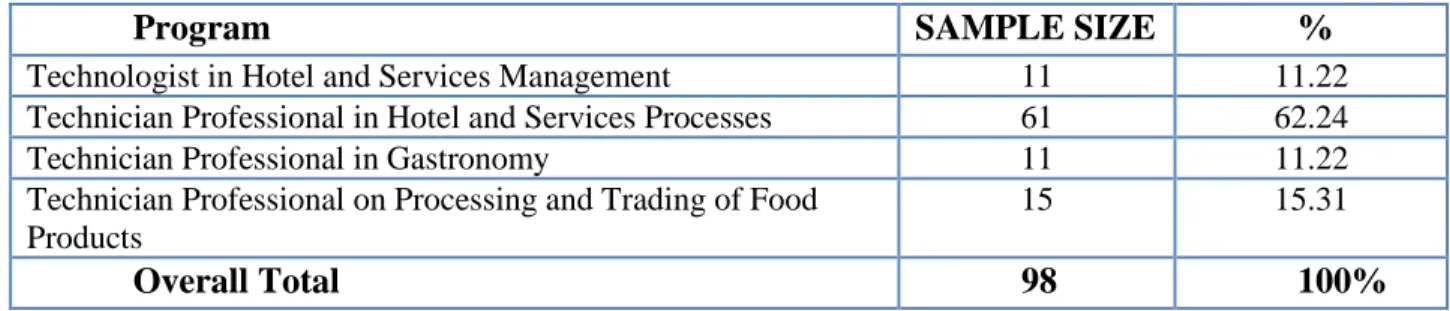
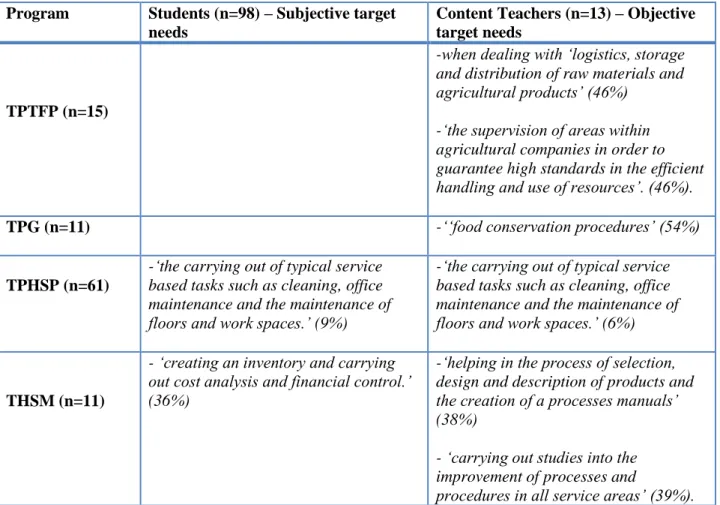
(31) ENGLISH LANGUAGE LEARNERS’ PERCEPTIONS OF THEIR TARGET AND LEARNING NEEDS 30 Students The ICSEF is a female institution. The age of students in the four programs ranges from 15 to 29 years old. The program with the oldest population was Processing and Trading of Food Products with students in an average age of 29 years, followed by Hotel and Services Management program, in which the students’ average age was 20 years. Hotel and Services Processes and Gastronomy programs have the youngest students with an average age of 18. The majority of students were single (90%) and did not have any other occupation different from studying at ICSEF (66%), though in Processing and Trading of Food Products, 13 out 15 students answered that they had an additional occupation. The highest level of education achieved by the 87% of the students was eleventh grade in high school. Just 11% of the population admitted to have been enrolled in English courses different from those provided by the school. By the time students were given the questionnaire, all were already familiar with English courses at the ICSEF since this subject is mandatory from first semester in the four programs. Table 1 shows the distribution of the student population that participated in the research. Clearly the majority of students belonged to the Hotel and Services Processes program: sixty-one out of 98 students. Table 1. Total sample size and sample size per program. Program Technologist in Hotel and Services Management Technician Professional in Hotel and Services Processes Technician Professional in Gastronomy Technician Professional on Processing and Trading of Food Products. Overall Total. SAMPLE SIZE. %. 11 61 11 15. 11.22 62.24 11.22 15.31. 98. 100%.
(32) ENGLISH LANGUAGE LEARNERS’ PERCEPTIONS OF THEIR TARGET AND LEARNING NEEDS 31 Out of 98 students surveyed, the largest group of students (45.46%) was in Basic English A1 class. The next group – 29.30% were attending Basic English A2.1. while no more than 9 students (9,9%) were in Basic English A2.2. A number of the students (45) were not currently attending English lessons because they were in a different cycle of their study programs, but they had already taken at least one English course at the ICSEF (See Table 2) Table 2. Total sample size and sample size per level. LEVEL English I - Basic English A1 English II - Basic English A2.1 English III - Basic English A2.2 None Overall Total. SAMPLE SIZE 15 29 9 45 98. % 45,46 29,30 9,9 15,15 100%. English instructors In the first semester in 2012, two English instructors were teaching the four courses of English at ICSEF. The most experienced instructor was a Colombian female who is in her forties and who has been teaching English for more than 25 years. She holds a BA in Education Science with emphasis on Languages Spanish and English. She has a postgraduate degree in University Teaching and holds a Masters in Administration and Supervision in the area of Education. In addition to teaching English classes, she designs materials and provides support in the development of the language program at the ICSEF. The other instructor was a Colombian female who is in her twenties. She graduated from the ICSEF as a Technologist in Hotel and Services Management. After studying English abroad for a year, she enrolled at the ICSEF as English instructor. She was teaching English III and IV, while the other instructor was teaching English I and II..
(33) ENGLISH LANGUAGE LEARNERS’ PERCEPTIONS OF THEIR TARGET AND LEARNING NEEDS 32 Content teachers A total of 13 content teachers were involved in this study in order to contrast their perceptions with that of learners and the English instructors. Their knowledge of the professional field of students is an important perspective to consider in the current study. Most of the content teachers taught courses in at least two of the programs (See Table 3). Table 3. Distribution of content teachers according to program in which they teach. Program Technologist in Hotel and Services Management (THSM) Technician Professional in Hotel and Services Processes (TPHSP) Technician Professional in Gastronomy (TPG) Technician Professional on Processing and Trading of Food Products (TPTFP). SAMPLE SIZE (N=13). %. 5 6. 38 46. 9 5. 69 38. Teachers may select more than one option, so percentages may add up to more than 100%.. When surveyed about their current English level, instructors who were teaching subjects other than English at the ICSEF self-rated in a variety of English levels (See Table 4). Table 4. Distribution of content teachers according to their self-rated English level. LEVEL Beginner Basic Pre- intermediate Intermediate Advanced Overall Total. SAMPLE SIZE 3 3 3 3 1 13. % 23 23 23 23 1 100%. Researcher’s role Implementing a Needs Analysis (NA hereafter) procedure allowed the researcher to focus on a problem derived from a particular educational setting. In the case of the current work the.
(34) ENGLISH LANGUAGE LEARNERS’ PERCEPTIONS OF THEIR TARGET AND LEARNING NEEDS 33 role of the researcher is performed from an external point of view, this is because the participation of the researcher makes part of a counseling process from the Sabana University to the ICSEF. According to Al-Husseini (2004) in cases in which the researcher is an outsider, a stage of familiarization is needed in order to gain a better involvement in the environment or target situation (p.77). The researcher needs to learn about biographical characteristics of the learners and teachers and gain a level of integration with the target population. The involvement of the researcher with teachers and students during the data collection process was an important factor that contributed to a better understanding of the target situation. The implementations of study recommendations will need to be approved by decision makers, that is, higher administration of the institution. Here, the researcher analyses the current situation and contrasts it to the desired situation, so that some conclusions and recommendations can be drawn and implemented according to decision-makers criteria.. Data collection instruments and procedures Seliger and Shohamy (1989) argue that the focus of the study and the specific variables to be identified are the elements which help determining what constitutes data and the procedures to be implemented in a research. They also highlight that “data can be drawn from any of the behaviors involved in a second language acquisition event” (p. 160). Therefore they suggest, as a first step, to specify the exact definition of the variables of the study, then operationalize them and finally identify specific behaviors that contribute to describe them. Consequently, the procedure for collecting data starts with a decision on what data to collect, how to collect them and finally define data collection parameters..
(35) ENGLISH LANGUAGE LEARNERS’ PERCEPTIONS OF THEIR TARGET AND LEARNING NEEDS 34 There are data collection procedures with a low degree of explicitness in the sense that they can be used simultaneously and involve informal data collection techniques, such as field notes, records, diaries, observations, informal interviews and conversation with the subjects (Seliger & Shohamy, 1989, p. 159). On the other hand, procedures with a high degree of explicitness involve the use of structured types of data collection techniques that have a clear focus on the data to be sought. Examples of these types of procedures include structured questionnaires, discrete point tests, formal interviews, and metalinguistic judgment tests. In all of these procedures the subject is required to respond to data determined in advance (Seliger & Shohamy, 1989, p. 159). As the main focus of this study is to determine target and language learners’ needs as perceived by the English instructors, content teachers and learners themselves, four data collection instruments were adopted as the most appropriate for the specific research purposes. These instruments are two types of questionnaires, interview, focus group and documentary evidence. Questionnaires A review of the literature related to data collection instruments guided the process of designing the final version questionnaire to be administered to students and content teachers. Two highly structured questionnaires with close questions were designed. The rationale for this choice is not only the size of the sample (98 learners and 13 content teachers), but also because responses from close and numerical questions allow comparing responses across groups in the sample, which is one of the aims of the present research. According to Hopkins (2008), “questionnaires that ask specific questions about aspects of the classroom, curriculum or.
(36) ENGLISH LANGUAGE LEARNERS’ PERCEPTIONS OF THEIR TARGET AND LEARNING NEEDS 35 teaching method are quick and simple way of obtaining broad and rich information from pupils” (p. 117). Questionnaires are considered useful instruments because they have several advantages over other methods of data collection. Cohen et al., (2011) argue that various advantages are that questionnaires provide structured and numerical data that can be administered without the presence of the researcher (p. 377). Additionally, data are straightforward to analyze. However, the same authors suggest that during the construction process, designers consider moving from a general area of interest to a specific set of features from which data can be gathered. This can be achieved by first, clarifying the questionnaire general purposes and turn them into a concrete aim or set of aims; second, identifying and itemizing topics that relate to its central purpose; third, formulating specific information requirements relating to each of the topics identified. A questionnaire also needs to be exhaustive in its coverage of the elements of inclusion, asks the most appropriate kinds of questions, elicit the most appropriate kinds of data to answer the research purposes and sub-questions and asks for empirical data. The types of questionnaire items included in the current study are multiple choice, fourpoint rating scales and open-ended questions (Cohen et al, 2011, p. 383). Close questions include a range of responses from which the respondent can choose. These types of items are quick to complete and straightforward to code, however they do not enable respondents to add information or expand responses. Cohen et al. (2011) suggests including open questions, so that respondents be able to write a free response in their own terms or explain and qualify their responses (p. 393). Cohen’s et al.’ (2011) suggestions guided the final version of the questionnaire in which a number of open ended questions were included to invite the respondents to add personal comments or add information that the researcher did not foresee in the design process and which might provide qualitative data that is rich, depth, honest and authentic (p.393)..
(37) ENGLISH LANGUAGE LEARNERS’ PERCEPTIONS OF THEIR TARGET AND LEARNING NEEDS 36 The other type of question designed for the questionnaire was rating scales. One great advantage of these items is that they allow the researcher to determine frequencies, correlations and different forms of quantitative analysis whilst opinions from respondents are gathered. In order not to limit students’ responses, all the rating scales designed for the present study included an item entitled “other” for respondents to feel free to add comments or add information. Respondents tend to avoid the two extreme poles at each end of the continuum (in a five-point scale). This is why the design of this questionnaire was based on a four-point scale. Cohen et al. (2011) argue that using an even number of scale points might contribute to force the respondent to make a decision on rating. The steps described for designing questionnaires (Cohen et al., 2011, p. 378) were followed and the instrument was piloted with 25 students, seven content teachers and the English instructor at the institution in 2011. This piloting allowed the researcher to validate the instrument with the English instructor and content teachers, who found it appropriate and aligned to the ICSEF English syllabus and to the students’ graduate profiles respectively. After piloting, the researcher decided that for the actual implementation it would be more appropriate to interview the English instructor, instead of administering to her the final version of the questionnaire. This last choice was made because the English instructor was in charge of syllabus design, therefore her answers might be biased. The piloting also demonstrated that it was more suitable to transform the open question about competences into a rating scale item, since the majority of respondents omitted that question or left it unanswered. It was also found that a number of items were repeated; therefore, for the final version this issue was corrected. Items in the final version of learners’ questionnaire (See Appendix A) were organized in four sections: items one and two attempt to collect learner’s bio-data and current level of.
(38) ENGLISH LANGUAGE LEARNERS’ PERCEPTIONS OF THEIR TARGET AND LEARNING NEEDS 37 English. Questions three to seven aim at gathering data related to professional interests of respondents and learners’ views on relevance of English in their desired occupational fields. Questions eight and nine were included in the hope of achieving information related to learners’ perceptions regarding prospective communicative situations and competences in English. The list of situations in question eight was taken from the graduate profiles in the four technical and technological programs, therefore this question varied according to the program the respondent was enrolled in, which implied that four versions of students’ questionnaire were implemented. The list of competences in question nine was taken from the performance evidence section in the existing English syllabus for each one of the English levels taught at the ICSEF. Questions eleven to seventeen gather data related to respondents perceptions regarding elements of the existing language program, such as: competences, learning contents, learning activities, learning resources and assessment methods. In order to address the specific audience, items in the content teachers’ questionnaire (See Appendix B) were adapted from section two to four in students’ questionnaire. The instrument focused on the following areas: teacher’s perception of relevance of English in learners’ future occupational field (Items Three, Four and Six), teachers’ perceptions regarding learners’ prospective communicative situations and English competences (Items Five and Six) and teacher’s perceptions regarding relevance of learning content in the existing language program (Item Seven and Eight). See Table 5 for a correlation of research questions, questionnaire sections and items. Table 5. Correlation of research questions, questionnaire sections and items Research Questions. Questionnaire Section 1. Respondents bio-data. Learners’ questionnaire Question 1 and 2. Content teachers’ questionnaire Question 1 and 2.
(39) ENGLISH LANGUAGE LEARNERS’ PERCEPTIONS OF THEIR TARGET AND LEARNING NEEDS 38 What are ICSEF English learners’ perceived target needs?. What are ICSEF English learners’ perceived learning needs?. 2. Perception of relevance of English in desired/ expected occupational field 3. Perception of relevance of English in prospective communicative situations and relevance of English competences 4. Perceived relevance for learning of elements in the existing language program. Questions 3 to 7. Questions 3 to 4. Questions 8 and 9. Questions 5 and 6. Questions 10 to 17. Questions 7 and 8. As stated above, after each rating scale or multiple choice question an open ended question was included in both teachers’ and students’ questionnaires for respondents to add, clarify or expand information. Finally, the last question in both questionnaires allowed the respondents to include their contact details in order to provide more information in case that the researcher needed to expand or clarify some information related to the questionnaire. Focus group According to Johnson and Christensen (2012, p. 204), “focus groups are used to collect qualitative data that are in the words of the group participants”. Thus, eliciting students’ perceptions through a focus interview permitted the researcher not only to add insights to the data collected with the questionnaire but also to contrast students’ and teachers’ views, since the same kind of questions were asked to instructors in the semi-structured interview. Six students were invited to participate in the focus group. All were studying Hotel and Services Processes program and had taken at least one English level at the ICSEF. The researcher moderated the discussion and completed the ten items in the focus group protocol in 12 minutes (See Appendix C). The entire discussion was held in Spanish and it was recorded in video..
(40) ENGLISH LANGUAGE LEARNERS’ PERCEPTIONS OF THEIR TARGET AND LEARNING NEEDS 39 Semi-structured interview A semi-structured interview was administered at the same time to both English instructors. Interviews allow the researcher to “obtain in depth information about participant’s thoughts, beliefs, knowledge, reasoning motivation and feelings about a topic” (Johnson & Christensen, 2012, p. 202). Bearing this in mind, by administering this instrument in this study the researcher aimed at gaining understanding of the instructors’ perspective (Patton, 1987, cited in Johnson & Christensen, 2012) regarding learners’ target and language learning needs. Wallace (1998, p 146) argues that semi-structured interviews “combine a certain degree of control with a certain amount of freedom to develop the interview”. Therefore, in this study ten open questions were planned (See Appendix D). However, during the course of the interview follow up questions and prompts were added in order to obtain more detailed responses. The interview lasted 40 minutes and it was conducted in Spanish. Documentary evidence Seliger and Shohamy (1989) describe documentary evidence as the group of documents (memos, letters, position papers, examination papers, newspaper clipping, etc.) surrounding curriculum achievement or other educational concern. The use of such material may provide background information and understanding of issues that would not otherwise be available. One advantage of using documentary evidence is that this data procedure helps the researcher gain a better understanding of the issues arising in the curriculum or teaching method. Documentary evidence also provides context and background information and it is an easy way to obtain other people’s perceptions (Seliger & Shohamy, 1989). In the current study, documentary evidence was a key instrument to define the educational context, the teaching situation and the learners’.
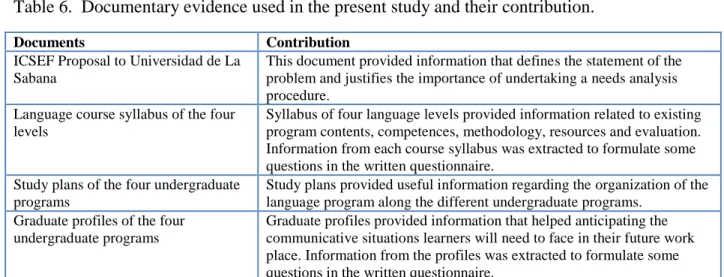
(41) ENGLISH LANGUAGE LEARNERS’ PERCEPTIONS OF THEIR TARGET AND LEARNING NEEDS 40 profiles. Table 6 shows the type of documents studied in this research and their contribution to the understanding on the target population context.. Table 6. Documentary evidence used in the present study and their contribution. Documents ICSEF Proposal to Universidad de La Sabana Language course syllabus of the four levels. Study plans of the four undergraduate programs Graduate profiles of the four undergraduate programs. Contribution This document provided information that defines the statement of the problem and justifies the importance of undertaking a needs analysis procedure. Syllabus of four language levels provided information related to existing program contents, competences, methodology, resources and evaluation. Information from each course syllabus was extracted to formulate some questions in the written questionnaire. Study plans provided useful information regarding the organization of the language program along the different undergraduate programs. Graduate profiles provided information that helped anticipating the communicative situations learners will need to face in their future work place. Information from the profiles was extracted to formulate some questions in the written questionnaire.. According to Cohen et al. documents “do not speak for themselves but require careful analysis and interpretation” (2011, p.253). Therefore, the authors suggest taking into consideration the educational, social, political and economic context in which they have been produced. Additionally, the researcher needs to pay close attention to the authorship, the audience, outcomes and influences of the documents. These recommendations were followed in the present study and documents were validated with authorities at the institution..
(42) ENGLISH LANGUAGE LEARNERS’ PERCEPTIONS OF THEIR TARGET AND LEARNING NEEDS 41 Chapter Four: Results and Data Analysis. This research explored learners’ target and learning needs as perceived by learners, the two English instructors and thirteen members of the faculty staff. To achieve the research objectives, the following questions were stated: 1) What are the ICSEF English learners’ perceived target needs? 2) What are the ICSEF English learners’ perceived learning needs? 3) Are there any significant differences between learners and other stakeholders in their perceptions? In order to address these questions, four instruments were used: content teachers’ and students’ questionnaires, a semi-structured interview, a focus group and documentary evidence. The interactive mixture of data collection provided this research with a holistic understanding of the topic under study by gathering perceptions of both teachers and learners and by giving account on both target and English learning needs. This chapter first illustrates methods, procedures and frameworks involved in data analysis; then, it describes the findings of the study.. Data analysis methods The approach followed in order to undertake data analysis in this study was a mixedmethod approach with a convergent parallel design (Creswell & Plano, 2011). According to Creswell & Plano, “the convergent design occurs when the researcher collects and analyzes both quantitative and qualitative data during the same phase of the research process and then merges the two sets of results into an overall interpretation” (p. 77). A crucial advantage of this approach is that it allows the researcher to analyze each type of data “separately and independently”, that is, by following an analysis technique for each data type. In addition, this approach provides a.
Figure

+7

Documento similar
Critical period effects in second language learning: The influence of maturational state on the acquisition of English as a second language.. Encyclopedic dictionary of
In this dissertation we have examined the development of foreign accent and comprehensibility in the oral productions of 25 adolescent Spanish learners of English before
The study was designed to investigate the usage and its frequency of language learning memory strategies by those students who are learning English as a
Finally, four original activities will be presented on some English language collocations, in order to facilitate the teaching and learning of this type of
The aim of this paper is to demonstrate that reading authentic literary material in the English as a Foreign Language (EFL) classroom can improve students’ language learning skills as
This study presents the findings of a year-long e-mail exchange between learners of English at Nebrija University in Madrid and learners of Spanish at Trinity College Dublin during
languages of study: Spanish, Catalan and English as a foreign language. Learners’
This research investigates the role of ICT in language learning inside two English classrooms - a primary and a secondary – in order to explore the nature of motivation
