
Oral Production through Interaction with Role plays in EFL classes
115
0
0
Texto completo
(2) ORAL PRODUCTION THROUGH INTERACTION WITH ROLE-PLAYS IN EFL CLASSES. Oral production through interaction with role-plays in EFL classes. A research study presented as requirement to obtain the degree of Bachelor in English. Theses advisors: Catalina Herrera Niño Claudia Yanive Prieto Castillo. Corporación Universitaria Minuto de Dios Faculty of Education Bachelor Degree in Language Teaching English Bogotá D.C 2018. 2.
(3) ORAL PRODUCTION THROUGH INTERACTION WITH ROLE-PLAYS IN EFL CLASSES. Acknowledgment I want to thank specially God for giving the willpower, knowledge, understanding and fortitude along this complex process to plan and learn in pedagogical intervention and write and reflect in this project when there were difficulties, tears, long nights and effort in frustrated and worried moments. Also, I thank with mi mother Marly, my father Lolo and for special foundation Chaminade who are in my process from the beginning and in that moment for giving me a big spirit, company encourage and lend a hand in each obstacle that I have during the research in which I did not give up until I get my goal and give to me and my mother a special reason to be proud. In addition, I am thankful to my advisors Catalina Lalle, Catalina Herrera and Claudio Prieto for having a big patient with me and sharing their time and knowledge, giving ideas and advices, values feedback and encourage in hard moments guidance in the development of this research with the idea to achieve the best in the process and me while I improve through a meaningful and unique process with their company and helped. Finally, last but by no means least, the principal Santo Toribio de Mogrovejo school for affording me the opportunity to carry out my research and implement a tool for children and also the institution in order to get them another way to learn English and improve different skills.. 3.
(4) ORAL PRODUCTION THROUGH INTERACTION WITH ROLE-PLAYS IN EFL CLASSES. Table of Content Acknowledge……………………………………………………………………….3 Abstract…………………………………………………………………………….8 Resumen……………………………………………………………………………9 Introduction………………………………………………………………………. 10 Chapter 1: Justification …………………………………………………………13 Research problem…………………………………………………………………16 Research questions………………………………………………………………..18 Research objectives……………………………………………………………….18 Chapter 2: Theoretical Framework……………………………………………19 Literature review ……………………………………………………………….…19 Theoretical Framework……………………………………………………………23 EFL Speaking…………………………………………………………………..….24 Classroom interaction and oral production ……………………………………….25 Types of interaction …………………………………………………………..…..31 Role-plays…………………………………………………………………………33 Chapter 3: Research design………………………………………………….…..38 Research Paradigm-Qualitative research…………………………………….…….38 Research approach- Action research………………………………………………39. 4.
(5) ORAL PRODUCTION THROUGH INTERACTION WITH ROLE-PLAYS IN EFL CLASSES. Setting……………………………………………………………………………..41 Participants………………………………………………………………..………42 Data instruments ………………………………………………………………….42 Transcriptions……………………………………………………………………..42 Field notes……………………………………………………………………..….43 Interviews…………………………………………………………………………44 Ethics ……………………………………………………………………………..45 Chapter 4: Pedagogical Intervention…………………………………………..46 Vision of language………………………………………………………………..46 Vision of learning………………………………………………………………..47 Vision of classroom ……………………………………………………………...47 Participant’s roles…………………………………………………………………49 Lesson planning ………………………………………………………………….50 Chapter 5: Data analysis………………………………………………………..53 Data analysis…………………………………………………………………..….53 Category 1: Student’s Organization…………………………………………...…55 Subcategory 1: Groupwork…………………………………………………….…57 Subcategory 2: Individual work…………………………………………………..61 Category 2: Interaction……………………………………………………….…...65. 5.
(6) ORAL PRODUCTION THROUGH INTERACTION WITH ROLE-PLAYS IN EFL CLASSES. Subcategory 1: Negotiation…………………………………………………..…...66 Subcategory 2: Feedback………………………………………………………....70 Chapter 6: conclusions and pedagogical implications……………………………76 Relevant findings…………………………………………………………………76 Pedagogical implications………………………………………………………….79 Limitations………………………………………………………………………..80 Further research…………………………………………………………………..81 References…………………………………………………………………………84 Annex A. Transcription one………………………………………………………86 Annex B. Field note one………………………………………………………….88 Annex C. Transcription four……………………………………………………..90 Annex D. Transcription five…………………………………………………….92 Annex E. Field note five………………………………………………………...93 Annex F. Interview one……………………………………………………….....95 Annex G. Interview four…………………………………………………………96 Appendixes………………………………………………………………………97 Appendix A. Pedagogical intervention (role-plays)……………………………..97 Appendix B. Field note sample………………………………………………….108 Appendix C. Interview questions sample……………………………………….109. 6.
(7) ORAL PRODUCTION THROUGH INTERACTION WITH ROLE-PLAYS IN EFL CLASSES. Appendix D. Transcriptions sample………………………………………………109 Appendix E. Consent letter for the institution (Santo Toribio de Mogrovejo)……110 Appendix F. Consent letter for parents……………………………………………111 Appendix G. English curriculum for fifth grade……………………………………113 LIST OF GRAPHICS Graphic 1 Constructs…………………………………………………………………24 Graphic 2. Kool’s interaction sequence……………………………………………….28 Graphic 3. Role-plays strengths for children………………………………………….35 Graphic 4. Action plan research………………………………………………………40 Graphic 5. Categories……………………………………………………….…..........55 LIST OF TABLES Table 1. Role-plays topics…………………………………………………………..48 Table 2. DBA checklist …………………………………………………………….53. 7.
(8) ORAL PRODUCTION THROUGH INTERACTION WITH ROLE-PLAYS IN EFL CLASSES. Abstract This Project was carried out at Colegio Santo Toribio de Mogrovejo with 26 students from fifth grade. The main objective was to improve the oral production in English according to the policies from the Ministry of Education of Colombia (MEN), because students did not demonstrate the proper level of oral expression in English, and at the same time they had problems with their interaction in class. To solve this important communicative element, it was stablished as a strategy the use of role plays. To identify the problem, it was necessary to collect data through the analysis of institutional documents (tests, curriculum plan, achievements of fifth the grade in English), teaching English policies (Guide No. 22, DBA (Basic Learning Rights), field notes, interviews and videos. This is a qualitative research and its approach was action research because researcher can realize about behaviors, attitudes, and reflect and act that the moment of an activity. Key words: English Oral production, role-plays, interaction en the classroom. 8.
(9) ORAL PRODUCTION THROUGH INTERACTION WITH ROLE-PLAYS IN EFL CLASSES. Resumen El presente proyecto de investigación se desarrolló en el colegio Santo Toribio de Mogrovejo con 26 estudiantes de grado quinto. El objetivo principal fue mejorar la producción oral en inglés de acuerdo a lo estipulado por el MEN de Colombia (Ministerio Nacional de Educación) en este grado, ya que en la práctica los estudiantes no mostraban el dominio de su expresión oral al igual que dificultades dentro de su interacción. Para dar solución a este importante elemento comunicativo se estableció como estrategia de trabajo el uso de los juegos de roles. Dentro de la identificación de la problemática se realizó una recolección de datos a través del análisis de diferentes documentos institucionales (evaluaciones, mallas curriculares, logros del grado en inglés), normativas en la enseñanza del inglés (Guía No. 22, DBA, Derechos Básicos de Aprendizaje), diarios de campo, entrevistas, y videos. Esta investigación fue de tipo cualitativo y utilizó como enfoque la investigación acción porque la investigadora puede dar cuenta de comportamientos, actitudes, reflexionar y actuar al momento de una actividad. Palabras claves: producción oral en inglés, juego de roles, interacción en el salón de clases.. 9.
(10) ORAL PRODUCTION THROUGH INTERACTION WITH ROLE-PLAYS IN EFL CLASSES. Introduction Oral production is an important and essential part of the communication process. To be part in a society, it is necessary to express our points of view, likes, thoughts, emotions, beliefs etc, according to the contexts in which we are. Nowadays, our students face many requirements to be successful in any field and they have to show a good level in their communicative abilities that allow them to have more opportunities or possibilities to get scholarships, better jobs etc. Checking some national policies in ELT, our students have to get specific levels in the development of their communicative skills in English. For example, in fifth grade we expect that they can produce a short and simple oral narrative text, and exchange information about habits, likes and preferences, (DBA, Ministerio de Educación Nacional, 2016). Because of this, we analyzed the situation in terms of interaction and communicative skills in English of our students of fifth grade at colegio Santo Toribio de Mogrovejo through different sources of information as test, field notes, interviews and check national documents. According to what, it was possible to identify that students did not fulfill the national policies (Guía No. 22 and DBA) and it was important to look for a solution to help them to get the expected level. For the school, this situation was important to check the English learning process because of, its commitment with the learning process of its students and second it is considered as a factor to be considered a good school and to be recognized because of its quality in terms of their English classes. Students need to continue their English learning process in secondary school and it could be a problem if they do not have at least the basic requirements in the different. 10.
(11) ORAL PRODUCTION THROUGH INTERACTION WITH ROLE-PLAYS IN EFL CLASSES. subjects. In the case of English, this is so important because the Bilingualism National Project demands students to get a specific level of proficiency according to the grade they are, i.e. in eleventh they have to get B1. In order to tackle that problem, it was necessary to apply a strategy that helped students increase their oral production in a different way where they were involved in a conversation; they were organized and taking turns while they could speak in English with simple structures such as asking questions and giving answers; understanding what they were saying, listening and finally following instructions; therefore, having a communication interchanging ideas and opinions. The achievement of this research was to improve the students’ oral production through interaction which was developed with role-plays as a pedagogical tool to practice students’ communicative competences following the standards from Guía No. 22 for MEN (Ministerio de Educación Nacional, 2016). The results were gathered from video transcriptions, field notes, interviews, and institutional documents (before, during and after the implementation) informed whether role-plays as a pedagogical strategy helped students improve their oral production through interaction among fifth graders at Santo Toribio de Mogrovejo School. To begin with, for this research it was necessary to apply a diagnosis which was stated as an initial pedagogical contact with children in English classes with the purpose to confirm if the problem existed or not. The difficulty to express ideas, opinions, doubts and knowledge in English in an oral way was identified as the problem of this research because children did not know how to express, listen, understand ideas and instructions in English in different speaking activities such as games and dynamics.. 11.
(12) ORAL PRODUCTION THROUGH INTERACTION WITH ROLE-PLAYS IN EFL CLASSES. Chapter one sets out the justification and presentation of the research problem. Then, the research question and objectives are presented to know the procedure of the research. After stating the principal objective for the research, the second chapter presents the theoretical support that includes the literature review that contains with the importance of international studies in different contexts for this research as they provide other perspectives for teaching a foreign language. In addition, the theoretical framework provides the principal constructs to support the research focused on speaking, oral production and classroom interaction, types of interaction, and role-plays in the English classroom. Chapter three deals with the research design such as the research paradigm (qualitative) and approach (action research), settings, participants, used data-collected instruments, and ethics which explains the methodology of this research. Chapter four covers the exploration of the pedagogical intervention implemented in the classroom and the visions of language, learning and classroom that it were selected to use role-plays. Chapter five and six describes and analyzes the data collected using transcriptions, field notes and interview. Finally, the conclusion and research question’s answer about improving oral production through interaction with role-plays are stated.. 12.
(13) ORAL PRODUCTION THROUGH INTERACTION WITH ROLE-PLAYS IN EFL CLASSES. Justification Nowadays, English is one of the most important subjects in our country because it is one of the most important languages around the world. Because of globalization English as a foreign language in our country it is relevant because our society needs to increase their English level and practice their communicative abilities in that language; that is why schools should give the opportunity to teachers and students to learn, use, interact and improve their English skills. The Ministry of Education stablishes some important documents such as Guía No. 22 and Basic Learning Right (DBA) (Ministerio de Educación Nacional, 2016) as a support to make students get the required level for each grade. This is in order to give our students standards to be competitive and develop their communicative abilities as exchanging information, likes and preferences; giving personal details and opinions in their speaking and writing skills. According to the standards, some dynamics and speaking activities can be applied with the students in order to show them how they meet and talk with new friends, listen each other, and share an idea or experience in English. Through these aspects, students can enjoy different speaking activities in which they interact in the classroom, taking communication as a part of oral production in different social contexts. In all of these, English teachers realize what, when and how they can carry out the aspects mentioned before. According to Phillips (1994) role-plays have as “goal to help to create a story and have fun.” (p. 3). With role-plays, students of this school can express opinions and ideas without fears or insecurity at the moment to talk in another language that sometimes is new for them because they can practice speaking or listening. 13.
(14) ORAL PRODUCTION THROUGH INTERACTION WITH ROLE-PLAYS IN EFL CLASSES. skills while they are enjoying playing a character. Because of their age, they can create, imagine, and act with a simple situation that they liked or did in their life. Therefore, at the beginning of the year, it was necessary to do a diagnosis in order to identify the level of students in English. In that diagnosis, it was observed that students did not express complete ideas and sentences in English in an oral way and also the vocabulary was not used according to their grade and level. Then It was identified that their English level was not acquired taking into account the Guide No. 22 from Ministerio de Educación Nacional. For the diagnosis, every class contained specific activities in English in which the teacher knew the student’s abilities and skills in English. In those activities, they expressed their ideas in Spanish after a question in English because it was difficult for them to say and answer with a simple sentence in English. Through speaking activities, oral production was tested through the use of vocabulary and pronunciation practiced before. So, those previous activities revealed student’s level as they responded an and answer. If they used specific vocabulary in a sentence or gave a main idea properly. Also, students felt insecure to pronounce something because they did not how to do it in English. For that reason, they answered in their native language. So, it was important to look for a strategy to help them communicating and expressing their thoughts and ideas in English. This research takes the importance to increase students’ English skills considering that some of them did not have the opportunity to work with an English, teacher who is responsible to teach English professionally. For that reason, students could not acquire and develop their English skills taking into account the different national policies. Therefore, they did not accomplish their English level for their grade. 14.
(15) ORAL PRODUCTION THROUGH INTERACTION WITH ROLE-PLAYS IN EFL CLASSES. Given that situation, in 2017 the school hired an English teacher who was at the same time the researcher who found an expected strategy to improve their oral production through interaction with role-plays. Thus, this study decided to use roleplays because in previous authors such as Philp, Walter & Basturkman (2010) state that, interaction can be encouraged in the classroom with this kind of activities. Besides, role-plays can give different possibilities to develop English skills such as listening, reading, speaking and writing, because in those exercises children build up their interactive and communicative capacities. They can listen to others and increased their relations with friends through oral production. According to Kusnierek (2015) role-play “boost students interaction in the classroom, educators should not forget about incorporating such a speaking activity to reflect learners theoretical knowledge of a language practice.” (p.81) Teacher can provide a meaningful task as a simulation where students feel free to express their ideas in meaningful situations like an encounter of a sad student with a rude teacher. with this example, teachers can provide a deep reflection in which students can speak and use the language in a natural way, as they are involved in a fictional character while they are interacting in a conversation.. 15.
(16) ORAL PRODUCTION THROUGH INTERACTION WITH ROLE-PLAYS IN EFL CLASSES. Research problem School Santo Toribio de Mogrovejo gave the researcher the opportunity to work with children of fifth grade. It was possible to observe there that children went to classes in the academic room with only one teacher who taught all subjects. They carried out activities to develop personal and academic abilities regarding English classes. Additionally, the teacher tried to explain in the best way but; they did not have English classes with an English teacher; it meant the English subject was taught by a teacher who taught all subjects, without a previous education in English pedagogy. During some classes, it was evidenced that children did not produce a proper oral language in English. For example, when the teacher said “good morning”, they answered “Buenos días teacher”. Also, in those dynamics, the teacher explained games and gave an example in English. After that, students tried to say some words in English; but they spoke very low; some of them gave their idea in Spanish to the teacher, trying to organize it; but at the end, they repeated the same sentences after the teacher. Also, children had problems with their listening because they did not understand utterance in English; they could not follow instructions or answered questions in English because they did not have the vocabulary and oral production needed to respond them. For those reasons, children in fifth grade did not have the level required in terms of their oral production through a simple interaction, as they did not develop their speaking skill properly. These things were expected by the school that expected them to show that they had reached the communicative competences to follow to the next educational cycle, their secondary school.. 16.
(17) ORAL PRODUCTION THROUGH INTERACTION WITH ROLE-PLAYS IN EFL CLASSES. Some activities were carried out to evidence that students did not understand English, that they had problems in expressing in the correct way, that they felt insecure at the moment to express an opinion or ask a question to teachers in English. For example, they wanted to say “I like apples”; but they said “me gustan las apples” or at the beginning, when they needed to go to the bathroom they just said “bathroom, please”. Those examples evidenced that students could not show an oral production adequate to express simple ideas in English. Therefore, teacher used to do writing and reading activities with vocabulary through flashcards, stories and reading in which students identified the vocabulary and specific simple grammatical topics because students had to do their writing homework in order to practice the topic previously explained in the class. For example, guides provided the verb to be structure taking into account activities where students filled the gaps and joined words with images and sentences. However, these activities like reading and writing in worksheets or guides sometimes did not help students to acquire and carry out an oral production in a basic level because they did not practice their speaking skill. Also, these children had some language problems in speaking in the classroom regarding the standards of the Guide No.22 MEN and DBA (Derechos Básicos de Aprendizaje). The school did not achieve it because it did not have the opportunity to afford an English teacher that students needed for each grade. For these reasons, it was possible to identify the lack of oral development in the interaction and communication among children in English class.. 17.
(18) ORAL PRODUCTION THROUGH INTERACTION WITH ROLE-PLAYS IN EFL CLASSES. Research question To what extend role-plays foster the oral production in English in fifth grade at Santo Toribio de Mogrovejo School during first semester 2017? General Objective To foster the oral production through role-plays in fifth grade in EFL classes at Santo Toribio de Mogrovejo School during first semester 2017. Specific objectives •. To diagnose students’ current oral production in English. •. To implement role-plays as a tool for increasing the interaction in the classroom.. •. To foster interaction and oral production processes through students’ performance during the role-plays.. •. To analyze the interaction’s elements initiation, response and evaluation in student’s oral activities during role-plays.. 18.
(19) ORAL PRODUCTION THROUGH INTERACTION WITH ROLE-PLAYS IN EFL CLASSES. Chapter 2 Literature Review This chapter presents the studies focused on oral production, interaction in the classroom and role-plays when teaching English in order to describe student’s development in speaking skills such as interaction, communication and listening. There are three international researches that analyze the oral production, the interaction’s process and role plays as a proper technique in the classroom. The first study done by Lyvtochenko (2009) How to make upper-level university English classes more interactive developed students’ interaction through task-based teaching with English upper-level engineering students. She wanted to improve student’s language learning through cooperation and interaction. Thus, Lyvtochenko (2009) conducted a qualitative study and she collected data with observations and interviews through tasks and oral activities. Lyvtochenko (2009) data analysis showed that task-based activities encouraged student’s communication in English. Besides, she noticed that the quietest students spoke more freely and interacted in group and pair group work. In that way, Lyvtochenko (2009) mentioned that before, she was afraid of students’ participation in the class because even though they were studying engineer they normally went to their English classes but for few hours. Most of students were men; and men were less talkative and reserved that women, she said. For that reason, she had to teach her students how to interact in English class through task-based activities. In conclusion, Lyvtochenko (2009) affirmed that student’s communication improved and they developed more the language and interaction with group and pair work. 19.
(20) ORAL PRODUCTION THROUGH INTERACTION WITH ROLE-PLAYS IN EFL CLASSES. because they were engaged in real communication situations among them and people outside of class, and they felt more confident as English speakers. This study was different to this one because it was applied with university students in other career that was engineering. Also, the students’ English level as different because they were able to pair up with their mutes of different high language levels with the purpose to use the grammatical sentences and vocabulary in the correct way while they were interacting. However, Lyvtochenko’s study provided to this research (2009) with the group and pair work strategies used in the classroom; and as a result, because students developed oral communication and interaction; and they lost their shyness. Thus, the support of this research was the group and pair work activities in the classroom because it was a good strategy for interacting, knowing their partner and speaking more freely in groups than in front of the whole class. The second study focused on interaction strategies through dialogues with EFL children in Spain while they performed a communicative task in the English classes. This research was done by Lazaro & Azpilicueta (2014) Investigating negotiation of meaning in EFL children with very low levels of proficiency. They found that students received limited amount of input in their English classes. Thus, they worked with sixteen children between seven to eight years’ old who attended an English school in Spain. So, they received five English lessons per week and they fostered the understandings of simple instructions in the classroom and production of guided and free language in a basic level. In that way, Lazaro & Azpilicueta (2014) used a mixed study; and they collected data through video recordings and questionnaires. The data analysis showed that students, at the beginning, had a low English level and they did not use interaction 20.
(21) ORAL PRODUCTION THROUGH INTERACTION WITH ROLE-PLAYS IN EFL CLASSES. strategies to be understood. Furthermore, during the dialogue’s implementation children started to use strategies such as giving correct feedback to each other and self-repetition. At the beninning, children did not use English to express ideas; it meant, when a child was asked something they said yes/no or sheik their head and made use of nonverbal communication signs to answer the questions or showed their emotions. On the other hand, the interaction was seen in children’s behaviors when they laughed, jumped, clapped their hands, and they were interested in participating with other children but in Spanish. Lazaro & Azpilicueta (2014) concluded that children were able to negotiate meaning and use the main interaction strategies when they corrected each other, made explicit corrections, and gave feedback. Also, the self-repetition provided an answer to a clarification request or confirmation check. Finally, it was concluded that after the implementation children rarely used L1 in the class because they frequently tried speaking in English. In conclusion, Lazaro & Azpilicueta’s (2014) study was useful and it gave a good contribution to this project as it provided oral interaction strategies that helped to know if children understood and learnt in the classroom. Besides it showed how the teacher can encourage children to use English in the classroom. Finally, it showed the way children can correct and receive the feedback themselves while they present a dialogue or interest in dynamic activities. The contribution was focused on how students can provide feedback using interaction strategies as comprehending checks while they are communicating when they do not understand something. Also, it contributed on how to foster student’s. 21.
(22) ORAL PRODUCTION THROUGH INTERACTION WITH ROLE-PLAYS IN EFL CLASSES. motivation to use English in their classroom all time; and how student’s relationships can increase through communicative tasks in the classroom through songs and games. However, this study was different sd this study did not use conversational adjudgments as clarification requests which are when the utterances are not understood and they need to ask for clarification using confirmation; and comprehension checks to make sure the comprehension of previous utterance. (Lazaro & Azpilicueta, 2014) To continue, Harni (2007) used role plays when teaching speaking. He presented how he developed the speaking skills through role-plays to children with lack of confidence in an English conversation. He worked with thirty students of ninth grade in an Islamic Junior High School in Indonesia. Harni (2007) chose a quantitative study and collected data through a pre-test and a post-test. Harni (2007) showed that 5% of students proved that their speaking was better through role-plays and that role-plays were enjoyable as they got students’ attention and stimulated participation. In contrast, 1% of the students did not response positively to role plays because they showed that they faced lack of confidence and lack of vocabulary. Besides, students felt uncomfortable and uncertain. Also, there were lapses of silence starting the activity. To sum up, role-plays were an effective technique in teaching speaking because they contributed to create an active increasing interaction, communication and participation to listen to others and take turns in a conversation. Taking into account the lack of vocabulary and lapses of silence, it was an idea that children learnt the vocabulary first though warm-up activities. On the other hand, it was evident the motivation in the classroom with role plays and the way the teacher monitored without pressure or any. 22.
(23) ORAL PRODUCTION THROUGH INTERACTION WITH ROLE-PLAYS IN EFL CLASSES. forces in the student’s interaction because they participated actively and voluntarily while the activities were carried out To sum up, this research study was supported with three different authors who gave examples of how the participants can learn to interact, have an oral communication, and comprehend at the same time. Thus, these studies gave interesting points of view in order to contextualize how oral production, role-plays and interaction are developed in English learning. Theoretical framework In order to contextualize this research study, it was necessary to check the theoretical concepts choosing speaking as the most relevant skill in English language learning which develops the oral production as the way to generate the language for pronouncing words and sentences to express an idea. This skill can be built up through the interaction as the strategy where students communicate with others. Finally, these can be connected with role-plays as a pedagogical tool with the purpose to share opinions and ideas. 23.
(24) ORAL PRODUCTION THROUGH INTERACTION WITH ROLE-PLAYS IN EFL CLASSES. through different situations acting as another person through speaking.. Speaking. Oral production and Interaction. Role-plays. Graphic. 1. Constructs ESL Speaking In the first place, speaking is defined by Fattah (2006) as “the production of auditory signal designs to produce differential verbal responses in a listener.” (p.33) In other words, speaking uses specific sounds in order to be understood through a language, that is for the listener to comprehend a message and respond it doing a speaking production. Also, it means that there are a lot of ways for communicating using signals, sounds, utterances, and body language when a person wants to express something through the speech using the different verbal and non-verbal acts. In the second place, language as a communication through speaking is seen as a tool according to Aamer (w.y) affirmed that “without speech we cannot communicate with one another. The importance of speaking skills, hence is enormous for the learners of any language.” (p.2-3) it makes reference to use our speech almost all the time because 24.
(25) ORAL PRODUCTION THROUGH INTERACTION WITH ROLE-PLAYS IN EFL CLASSES. it is the most important ability to express ideas, opinions and communicate with people. Besides, learners and the teacher of a second language need to speak in the same language with the purpose to understand each other and do a collaborative learning. In view of that, speaking is related communication in order to interact as part of having and creating social relationships. Bygate (1997) confirmed that “interaction skills involve making decisions about communication, such as: what to say, how to say it, and whether to develop it, in accordance with one’s intentions while maintaining the desired relation with others.” (p.6) it requires a speaking process to express a clear message in an adequate time in a conversation taking into account that there is a dialogue with another person who is listening and waiting a message to answer it. All in all, this project defines speaking as an important ability to communicate with others expressing a clear message with an intention in mind. Also, it defines how the relation between speaking and interaction provide a constructive dialogue while people are listening and understanding the same idea using their oral skills. ESL speaking skill is the most important skill in English because people begin to communicate since babies have not born when parents talk to them while mothers are pregnant. For this research, Speaking is the biggest communicative skill in which people can express personal information, opinions, feelings, knowledge and interact with others with the purpose to share a message and points of view about any topic. ESL Oral production and classroom interaction Classroom interaction is defined by Koole (2015) as “a social perspective to unearth the mechanism teachers and students use to conduct their classroom business” (p.1) This means that it is a negotiation in which students exchange ideas, opinions and 25.
(26) ORAL PRODUCTION THROUGH INTERACTION WITH ROLE-PLAYS IN EFL CLASSES. experiences in group-work through different kind of activities such as workshops debates and role-plays. Besides, classroom interaction develops social relationships between teacher-student and student-student because they have to interact and communicate together with the purpose to know each other and permit that each one must be listened and understood Philp, Adams & Iwashita (2014). Also, classroom interaction is seen as a responsibility shared by the teacher and students in which they can discuss and learn together. In this way, Kumpulain & Wray (2002) affirm that: The teacher and students share the expertise and responsibility of leading the discussion reframe that they jointly attempt to understand…teacher gives guidance and provide feedback according to the varying need of the participants. (p.11) It can be said that classroom interaction is managed within different contexts and situations in which students have the opportunity to discuss and make decisions during the interaction in order to be guided by the teacher (Kumpulain & Wray, 2002) All in all, this project defined classroom interaction as an exchange of ideas, experiences and knowledge inside the classroom. It facilitates students’ learning and the development of their relationships. Considering interaction as a communicative way to express anything, it really increases communicative abilities, knowledge and relations in order to develop cognitive and social life. (Kumpulain & Wray, 2002) On the other hand, oral production is part of classroom interaction because it is the way to communicate through speaking. Bilash (2009) affirmed that “speaking is found on the tree as one of the branches; it is labeled oral production and is one of the skills 26.
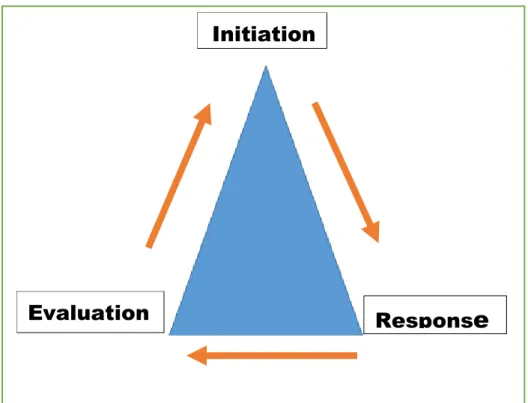
(27) ORAL PRODUCTION THROUGH INTERACTION WITH ROLE-PLAYS IN EFL CLASSES. students are to learn in their language development.”1 In other words, oral production implies a learning process in the classroom taking into account that interaction is the keyword in learning a foreign language. To support the definition before, oral production has an intention in the way that a person says somethings and according to Prieto (2007) who comments that “depend on such thing as what we have decided to say, how successful we have been so far…what our intentions are, and what sorts of relations we intent to establish or maintain with our interlocutors.” (p.79) in that sense, oral production might imply an interchange of messages in order to communicate something and express an idea or opinion with an appropriate language to be understood. Having a definition of what interaction and oral production are, it is time to show the two interaction sequences because they are a guide to follow and understand how students and teacher can carry out activities of interaction in the classroom. The first one was given by Kumpulainen &Wray (2002) and the second one was proposed by Koole (2015): Initiation-Response-Evaluation. In the first place, Kumpulainen &Wray’s (2002) interaction sequence is proposed as a triadic collective meaning-making process. It is understood as a cooperative work where students learn together. In addition, this sequence makes reference to have a critical development in order to make an intellectual process through activities where students analyze and engage in topics in depth. In the second place, the sequence proposed by Koole (2005) called InitiationResponse- evaluation is when teacher gives students a question or a problem. 1. Definition by Olenka Bilash Copyright © Olenka Bilash May 2009. 27.
(28) ORAL PRODUCTION THROUGH INTERACTION WITH ROLE-PLAYS IN EFL CLASSES. (initiation); then, students should answer (response) with a solution; and the teacher gives finally the feedback and assessment for their answers (evaluation). In this way, Koole’s sequence is more cognitive and instructional because it develops a needed constructive criticism in students who can be critical and conscious about content, questions, relevant topics and debates. It allows students to have a meaningful learning because students have a continuous feedback and evaluation during the process by their teacher and their peers.. Initiation. Evaluation. Response. Graphic No. 2. Koole’s interaction sequence.. In this way, this project used Koole’s sequence Initiation-Response-Evaluation because when carrying put the role-plays students chose a topic and teacher explained it (Initiation). After that, students had to create a dialogue or role-play in which they had to argue and negotiate during the activity (Response). Fnally, the teacher assessed students and provide feedback according to the process (Evaluation). In this order, Graphic #. 1. Koole’s interaction sequence. 28.
(29) ORAL PRODUCTION THROUGH INTERACTION WITH ROLE-PLAYS IN EFL CLASSES. Koole’s sequence helped to evaluate an interactive process because students could show a collective and integrated work. According to Koole (2005) the example below shows an interaction between teacherstudents, in which they take turns; there is a question with an answer; and at the end, the teacher gives the opportunity to students to correct their wrong answer and provide feedback to obtain a positive evaluation. Taking into account this example, this sequence can be used to organize properly a role-play between student-student taking turns; giving feedback; managing a position in the interaction; being respectful in a conversation and producing an oral production. 1 Teacher: Right, what is the smallest number here? Initiation 2 Student: Six (.) teen Response 3 Teacher: No, Evaluation 4 Student: Ten, ten Response 5 Teacher: Ten Evaluation This sequence provides a common interaction between a teacher with a student with questions and answers. However, this sequence can reflect the interaction process with role-plays in the following way: student to student make a question and the other one answer it, and together solve a doubt or a problem, share information about their interest 29.
(30) ORAL PRODUCTION THROUGH INTERACTION WITH ROLE-PLAYS IN EFL CLASSES. and help each other. This situation is about two students in the school with science subject, one of them does not understand and other helps him. Initiation Student A: what do you understand about science homework? Student B: I do not understand anything Response Student A: I understand something, do you want an explanation? Students B: yes, I do Students A: we have to write a letter asking for something Evaluation Student B: okay, I have to read a letter Student A: No, you should write down asking for something Taking into account the interaction sequences and their explanations, now some interactive strategies will be presented. These were suggested by Kumpulainen &Wray (2002). The first one is cooperative work, when students negotiate different topics communicating with the teacher and their partners. The second one is questioning; when students and the teacher solves doubts and asks questions to do something more clearly. Finally, evaluation, that consists in permitting to have more participation in the classroom doing a communicative activity that involves negotiation or solving a problem, a debate for example in this stage the teacher provides feedback and evaluates student’s performance.. 30.
(31) ORAL PRODUCTION THROUGH INTERACTION WITH ROLE-PLAYS IN EFL CLASSES. Therefore, the interaction strategies mentioned previously allow teachers to notice the social interaction and relationships built in the classroom with the purpose to develop a cooperative work because it will be an interactive construction giving a final feedback in each activity. Also, the interaction in small groups makes students express personal opinions and experiences. It is also necessary to discuss the roles that the teacher and students assume during classroom interaction. On one hand, this project narrates the student’s role as participant in the classroom. Kumpulainen & Wray (2002) suggested that students as active people should assume a responsibility in the classroom building up relationships because they spend time together for a week and half-day. On the other hand, the teacher, as a care giver during the interaction should be a guide and collaborative person (Kumpilainen & Wray 2002). They support and permit that students ask for help when they cannot control the interactive activity. In addition, teacher must monitor what students are talking about, the way they behave and the way they respect the others. Types of Interaction. There are three types of interaction: teacher-students, peer (student-students) and content-students interactions. This study focused on peer interaction because they spent a great quantity of time sharing and communicating together. Also, one of the aims of the research was to observe and analyze how students interacted among them and developed social interpersonal relationships. Role-plays involve in different types of interaction; but in this research, role-plays develop student-student interaction to have a. 31.
(32) ORAL PRODUCTION THROUGH INTERACTION WITH ROLE-PLAYS IN EFL CLASSES. conversation as they spoke in an organized way, took turns and responded for each question while they were performing the role-play. Peer interaction On one hand, Philp, Adams & Iwashita (2014) stated that peer interaction is “any communicative activity carried out between learners, where there is minimal or no participation from the teacher.” (p.3). Based on the previous definition, it could be said that peer interaction is a social interaction into the classroom which involves social responsibility because students have to learn to listen and express. Students share ideas, opinions, experiences and help working together. As a result, peer interaction gives opportunities for learning and knowing more about classmates building cooperative and respectful social relationships. Bruce & Hansson (2011) mentioned: “everybody contributes to his/her own language input. The more verbally active a child is the more language input s/he receives from his/her interactional partner reactions, answers, new question and comments” (p.314). In other words, interactive activities help students express freely and use the language they had learnt before. In the same way, communication is related to peer interaction, because it “entails opportunities to practice listening and language comprehension, a prerequisite for responsiveness, as well as expressing oneself, a prerequisite for assertiveness.” Bruce & Hansson (2011, p.314). It refers to practice through activities in which students can develop and interchange their knowledge and opinions. Also, the use of language and practice encourage students to achieve a goal; also, they can be themselves and be sure about what they are and what they learn.. 32.
(33) ORAL PRODUCTION THROUGH INTERACTION WITH ROLE-PLAYS IN EFL CLASSES. What is more, there are two types of interaction focused on the way how students are creating and processing information through a conversation. Planned and spontaneous interactions are the two types into communication. Spontaneous interaction according to Masqrray (2018) is “shaped by individual, resources, intentions and ideas in a particular setting, within a particular time…but instead create a contest which is fluid and dynamic. Spontaneous interaction salient context for the participants to perceive, detect, process and respond.” It means spontaneous interaction is carried out in the classroom when students are creating an activity with teacher’s support and help in order to clarify doubts. On the other hand, planned interaction is defined by this research taking into account student's interaction during the role-plays. Planned interaction is communication that students do when they are presenting something to a public. It is previously designed, prepared and practiced as a guide to follow. In this case, students carried out planned interaction when they were performing their role-plays and when they prepare the role-plays, the carried out spontaneous interactions. Role-plays A definition of role play given by Glenn (2014) says that they are an “experimental play-acting where the scenario contains more physiological and/or social theme through which personal and social understanding and/or growth can occur.” (p.3). He defined role-plays as a performance where students make social relations using a different perspective or role expressing different ideas and opinions. Taking into account the character they are playing. A second definition of role-play was given by Van Ment cited in Huff (2012) who affirmed that it is “an activity in which students are asked to view themselves or play another person in a certain context and act out the situation…students learn about 33.
(34) ORAL PRODUCTION THROUGH INTERACTION WITH ROLE-PLAYS IN EFL CLASSES. themselves, other students, and the situation provided by the role play.” (p.22). In the same way, role-plays increase English communicative skills through a performance where the context involves students’ communication and interaction freely. In addition, Dorathy (2011) stated that role plays are “an effective technique to animate the teaching and learning atmosphere, arouse the interests of learners, and make the language acquisition impressive…it gives students an opportunity to practice communicating in different social contexts and in different social roles.” (p.2). It means, role-plays encourages learners to learn through their interests where they can socialize from a different perspective. Besides, students develop their creativity and social skills as speaking in public and making interpretations. Now, some advantages of using role-plays in English classes are presented. According to Dorathy (2011) a role play should be used to simulate real-life situations; and it increases the teamwork and the use of every day expressions in class. Also, vocabulary can be acquired in a more dynamic way because children can learn it and use it through role-plays design and production. Besides, students have the opportunity to interact and learn because it encourages doing different activities, these are highlighted with yellow color. For examples, game have you ever (ask for something have done before) in which they have to ask and another respond and change their place. Also, the teacher gives them a word and they have to create a sentence in different groups. The following graphic shows the specific strengths and advantages that children could achieve during role-plays because they are increasing their knowledge and social relations as they develop a learning by their own when they express their feelings and emotions. They also correct mistakes to their partners or themselves; and develop a 34.
(35) ORAL PRODUCTION THROUGH INTERACTION WITH ROLE-PLAYS IN EFL CLASSES. comprehension through a dialogue, solve doubts and questions and experiment experiential learning. Finally, they take into account a content to follow so students manage a proper knowledge according to their ages and interest.. Facilitates learning across many areas of curriculum content Involve inditect experential learning. Provides inmediate feedback. ROLE-PLAY STRENGTHS. Facilitates expressions of attitudes and feelings Develops sympathetic understandings. Graphic # 2. Role-plays strengths for children adapted from adult’s strengths.2. In addition, role-plays allow teachers to create an environment in the classroom in which shyness is liberated because students can improve their self-confidence (Dorothy, 2011). When teaching English, role-plays help encouraging teamwork and interaction, social relations, speech, creativity, and body and language expression.. Role-plays strengths for children adapted from adult’s strengths. Copyright from https://roleplayasaninstructionalmethodforadultlearners.weebly.com/key-features-of-roleplay.html 2. 35.
(36) ORAL PRODUCTION THROUGH INTERACTION WITH ROLE-PLAYS IN EFL CLASSES. However, teacher should realize the problems role-plays may generate because they might bring personal consequences in students. Dorathy (2011) gives some difficulties that a teacher might find when applying role-plays in the classroom: Role playing can present in class members different kind of difficulties. Some may react negatively to participating in a specific situation which will be discussed and possibly criticized by other members of the class…Also, if the group has people from different status, they may be reluctant to become involved for fear of being humiliated before the members of the class who are smarter or more popular. (P.p.4-5) These difficulties emerge when students do not have a strong self-esteem or selfconfidence, because they feel scared of making mistakes and their classmates can ridicule them during or after the presentation. However, role-plays are taken as a process where students are learning and correcting together; so, they collaborate, interact and participate. Moreover, teacher should be a good counselor to students for them to have a proper process in their interaction in the role-play. Considering that, Dorathy (2011) gave three functions for role-plays to be successful in teaching English, which are the facilitator, the spectator and the participant. As she proposed, the teacher observes in role-plays how students perform and express; and teacher can help teaching unknown vocabulary that students do not know. Finally, different types of role-play proposed by Littlewood (1981) that are used in the communication activity were chosen for this research study. In the first one, roleplaying was controlled through cued dialogues, consisting on giving the complete conversation; and students have to act them out and learn it. The second, role-playing. 36.
(37) ORAL PRODUCTION THROUGH INTERACTION WITH ROLE-PLAYS IN EFL CLASSES. controlled through cues and information develop questions and key words that students should use during the role-play in order to ask questions. The last one, role-playing controlled through situations and goals consists in giving the situation and the students have to develop the dialogue and solve the problem in the activity. Each type of roleplay develops interaction and oral production through a situation, the creativity and responsibility that the learner has, and how the information and cues help learners create the interaction themselves. To conclude this chapter, the literature review give different perspectives about how oral production, interaction and role-plays can be used and worked with students in the classroom in order to support the analysis of data. Besides, the theoretical framework contains the concepts of this project that support the author’s point of views and definitions with the purpose to develop an own definition by the researchers taking into account the basis and examples about oral production, classroom interaction, and roleplays. Next chapter explains the methodological design used in this project.. 37.
(38) ORAL PRODUCTION THROUGH INTERACTION WITH ROLE-PLAYS IN EFL CLASSES. Chapter 3 Methodology This chapter aims to describe the procedures followed to identify students’ interaction process and oral production development during the role-plays. This research paper uses the qualitative paradigm and action research. In addition, the setting, the participant’s description and the data collection instruments such as transcripts, field notes and interview are presented. Finally, the ethic issue is described. Research Paradigm This study was a qualitative research in terms of the description and interpretation provided from the data-collection. Qualitative research is defined by Johnson & Christensen (2012) as the “research relying primarily on the collection of qualitative data (no numerical data, such as words and pictures) […] study a phenomenon in an open-ended way, without prior expectations […] based on their interpretations of what they observe” (p.376). It assumes that qualitative research provides a description of social and human characteristics in different situations with words and images in order to interpret what the researcher observes and identifies such as natural behaviors in a specific time and place, (Johnson & Christensen, 2012) According to the interaction in the classroom and social behaviors during an activity, Johnson & Christensen (2012) mention that “qualitative researchers view human behaviors as dynamic and changing, and they advocate studying phenomena in depth and over an extended period of time.” (p. 35). It is understood that there is an analysis of student’s behavior, in this case, their interaction because this qualitative research wanted to do a deep inquiry of how students could increase their oral communication 38.
(39) ORAL PRODUCTION THROUGH INTERACTION WITH ROLE-PLAYS IN EFL CLASSES. through interaction. All that information was collected in a specific time because students were changing their behaviors, and points of view through their preparation and performance of role-plays. Research approach The approach of this study was action research. According to Burns (2010) it made a relation of “the ideas of ‘reflective practice’ and ‘the teacher as researcher’. Action research involves taking a self-reflective, critical, and systematic approach to exploring your own teaching contexts.” (p.2). It was understood as a practical process where researcher established a problem and a possible solution, with the purpose to observe, act and reflect about teaching difficulties that were found in the classroom, where the teacher could make her own reflections and start planning and acting again in order to interpret abilities, problems and improvements. (Burns, 2010) In the same way, action research looked for solving specific problems, according to Johnson & Christensen (2012) action research “based on the idea that having the ‘researcher attitude’ is helpful in dealing with your complex and changing environments.” (p.12). the researcher had a big responsibility because he constructed during the long process different learning environments with the purpose to solve problems where he could help and have a reflective moment but, in a context, where researcher and students were involved into the classroom. (Johnson & Christensen, 2012) Moreover, in this research action research was used in real situations giving a contribution through a reflective research cycle. According to Burns (2010) this cycle involves “planning, acting, observing and reflecting” (p.4). It implied a teaching. 39.
(40) ORAL PRODUCTION THROUGH INTERACTION WITH ROLE-PLAYS IN EFL CLASSES. practice in which the researcher planned an activity or a class for identifying a problem; and then she put in action that activity while she made an observation to look for a difficulty in the classroom and finally, she carried out a reflection about what she observed. (Burns, 2010) Eventually, this project took Burn’s model (2010) of action research because the project was conducted in a process in which the researcher planned and acted in order to improve and reflect in what she might have failed or in things that did not work with the purpose to adjusting them doing a reflection. In the following graphic, the process is applied in this research. First, observations were made with the transcription of video-recordings in which students were some interacting and trying to speak English. The following step was planning in which roleplays were designed in order to review topics and standards in Guía No. 22(Ministerio de Educación Nacional, 2016). After that, the acting process was the role-play’s implementations. They were collected through field notes and video recording’s. And finally, the reflecting part was an interview where students and teacher checked the activity and corrected possible pitfalls in order to start again with new modifications in each activity applying therefore an action plan research.. Guide No.22 MEN, Field notes first activity, video Observing. Reflecting Check, correct and make changes. Action plan. Planning Design roleplays. Acting 12 interventions between preparation and presentation. 40.
(41) ORAL PRODUCTION THROUGH INTERACTION WITH ROLE-PLAYS IN EFL CLASSES. Graphic #. 3 Action Plan Setting Santo Toribio de Mogrovejo is a private school located in Rafael Uribe Uribe zone in San Agustin neirborhood in Bogotá. Santo Toribio School works with primary school with 450 students from pre-kinder to fifth grade in a social stratum 2. The Institutional Educational Project (PEI) of this institution was “Con excelencia integral formamos hombres y mujeres preparados para una vida de liderazgo.” (With integral excellence we form men and women prepared for a life of leadership) In accordance to the institutional philosophy school (2015) “students are intended to grow up in values, autonomy, responsibility and respect as God as its center for the society.” (p.3) taking into account the institution philosophy, the development of writing, reading and values appeared as a part of the educative process to be an essential based on the communication and interaction for student’s learning. In addition to that, one of the purpose of the school is to improve the level of English of its students according to the Ministry of Education standards (Ministerio de Educación Nacional, 2016). In 2017, the school provided English guides for each grade which contained vocabulary and grammatical aspects in order to practice writing and reading skills. However, most of the time, the teacher tried to use in a different method with the purpose to practice speaking and listening with songs and conversations taking into account the topic of the class. Those materials and methods helped the English class because children’s learning was meaningful through images, colorful activities and simple explanation with graphics or stories that caught their attention. For example, the verb to be guide had sentences with images that indicated the subject with verb to be 41.
(42) ORAL PRODUCTION THROUGH INTERACTION WITH ROLE-PLAYS IN EFL CLASSES. indicated. At the beginning of each class, the teacher asked about personal information, physical description in any moment of the class or sometimes in the school break with the purpose that they answered orally, when they responded in Spanish they had a penitence. In this way, teacher motived students to practice the verb to be. Participants The participants of this study were twenty-six students from fifth grade (5B) between nine to eleven years old; there were twelve girls and thirteen boys. They belonged to social stratum 2 and 3. This population was chosen firstly because the researcher had permanent contact with them and they presented a speaking and oral expression problem during the English classes. Secondly, because of their age, they were able to carry out role-plays in order to interact and express ideas while they were learning a specific vocabulary and practicing it through social activities with a Basic English level. In addition, children were able to memorize the vocabulary faster and practice among their classmates as they were asking and giving examples while they interacted. This information was collected by videos through speaking activities. Data collection instruments In order to answer the research question, this project applied three instruments: field notes, transcriptions and interviews with the objective to evidence children’s interaction and oral production process through role-plays. The information was collected in two phases. The first phase was to identify the problem through national and institutional documents. The second phase was to collect data during and after the implementation. Transcription. 42.
(43) ORAL PRODUCTION THROUGH INTERACTION WITH ROLE-PLAYS IN EFL CLASSES. Transcription is defined by Jupp (2006) as “the rendering of recorded talk into a standard written form…transcription of recorded talk is done to facilitate analysis.” (p.1) it means that in this project transcription helped the researcher understand better what students said and how they behaved during an activity analyzing and describing what and how ideas were expressed. Transcription was used with the objective to analyze student’s types of interactions during the different conversations and oral activities through role-plays. This instrument collected information about studentstudent interaction before, during and after the role-play with specific details about questions and answers that children made and used. Furthermore, transcriptions were taken from a video-recording as a help in which the researcher could write about the preparation and presentation of the role-play. She could notice what they were developing in their oral production during preparation and presentation of the roles play. In addition, transcripts helped notice how each person recognized and respected each other in terms of how they said and communicated ideas in the interaction between learner-learner. The transcription was written on a paper and then it was digitalized. Twelve videos of seven groups were recorded and; then, for each video, the transcriptions were written. In total there were twelve transcriptions. Each video record took around thirty to forty-five minutes. Those transcriptions were chosen by convenience because there were some groups who participated and interacted more that other in the activity. Field notes.. 43.
Figure
Documento similar
In addition to two learning modes that are articulated in the literature (learning through incident handling practices, and post-incident reflection), the chapter
This research investigates the role of ICT in language learning inside two English classrooms - a primary and a secondary – in order to explore the nature of motivation
Since the aim of this chapter is to analyse the role of third mission proxies in the evaluation of Spanish universities through efficiency analyses, we have performed eight
This article describes the current situation of desalinated seawater production and supply to agriculture in the southeast of Spain, and analyzes key questions such as its role
The Chapter presents termination conditions based on steady states covering a formulation of steady states inspired in the concept of Cauchy sequences and how to detect when
The expansionary monetary policy measures have had a negative impact on net interest margins both via the reduction in interest rates and –less powerfully- the flattening of the
Major conclusions: Androgen excess plays a prominent role in the development of metabolic disturbances associated with PCOS, with a discernible impact on key peripheral
Yugsi Llano, R. Teaching culture through films in the EFL classroom. The present article aims to identify useful tips derived from an action research experience in teaching
