
Functional properties of amaranth, quinoa and chia proteins and the biological activities of their hydrolyzates
56
0
0
Texto completo
(2) ACCEPTED MANUSCRIPT Functional properties of amaranth, quinoa and chia proteins and the biological activities of their hydrolyzates Débora. N.. Lópeza,b,. Micaela. Galantea,b,. Geraldine. Raimundoc,. Darío. Spelzinia,b*, Valeria Boerisa,b a. Área Fisicoquímica, Departamento de Química Física. Facultad de Ciencias. PT. Bioquímicas y Farmacéuticas, Universidad Nacional de Rosario (UNR) -. Facultad de Química e Ingeniería del Rosario, Pontificia Universidad Católica. SC. b. RI. CONICET. Suipacha 531, Rosario, Argentina.. Argentina. Pellegrini 3314, Rosario, Argentina.. Área Idiomas. Facultad de Ciencias Bioquímicas y Farmacéuticas,. NU. c. Universidad Nacional de Rosario (UNR) – Suipacha 531, Rosario, Argentina. MA. *Corresponding Author: Dr. Darío Spelzini. D. Facultad de Ciencias Bioquímicas y Farmacéuticas. Universidad Nacional de. PT E. Rosario – CONICET. Suipacha 531. (S2002RLK) Rosario. Argentina.. AC. CE. e-mail:[email protected].
(3) ACCEPTED MANUSCRIPT ABSTRACT Amaranth, quinoa and chia are non-conventional sources of proteins whose interest has increased in recent years due to their excellent nutritional value. Vegetable proteins can be used as food ingredients to replace animal proteins in human diet. The present article provides a comprehensive analysis of. PT. amaranth, quinoa and chia proteins and focuses on their solubility, superficial,. RI. gelling and textural properties as well as on the biological activities of enzymatic. SC. hydrolyzates.. AC. CE. PT E. D. MA. NU. Keywords: Vegetable protein; functional properties; enzymatic hydrolyzates.
(4) ACCEPTED MANUSCRIPT. 1. Introduction Amaranth (Amaranthum), quinoa (Chenopodium quinoa Willd) and chia (Salvia hispanica L.) are grains that are grown in Mexico, Bolivia, Argentina, Ecuador, Guatemala and Peru (Ixtaina, Nolasco & Tomas, 2008; Alvarez-. PT. Jubete, Arendt & Gallagher, 2010). They are non-conventional sources of. RI. protein that have been studied in recent years due to their excellent nutritional. SC. value (Caruso et al., 2018; Pellegrini et al., 2018). The amino acid composition of their proteins is well-balanced, with a high content of essential amino acids,. NU. and high bioavailability as well. In addition, the products obtained from these crops are gluten-free, which ensures an alternative source of nutrients for. MA. people with celiac disease (Alvarez-Jubete et al., 2010; Caruso et al., 2018). Amaranth seeds are processed in different ways for consumption, among. D. which the expanded grain form is perhaps the most popular (Caselato‐Sousa &. PT E. Amaya‐Farfán, 2012). The flour obtained from amaranth grain is being used in tortillas, breads, cookies, pasta and breakfast cereals (Avanza, Puppo & Añón,. CE. 2005b). Quinoa seeds are traditionally consumed as a main ingredient in hot dishes like soups or fermented beverages. Additionally, quinoa flour can be. AC. used in bread and biscuits. Nowadays, different quinoa-based products are commercially available: pre-cooked dishes, chocolates, snacks, pasta, baked products, drinks, among others (Caruso et al., 2018). Chia is commonly consumed raw in salads as well as in beverages or as in a mixture of cereals. The European Commission approved the use of chia seed in bread products. Also, chia is widely used for different applications such as breakfast cereals,.
(5) ACCEPTED MANUSCRIPT bars, cookie snacks, fruit juices, cakes and yoghurt (Mohd Ali et al., 2012; de Falco, Amato & Lanzotti, 2017). The wide range applicability of amaranth, quinoa and chia is due to their versatility as food ingredient. The use in food recipes of protein isolates obtained from these pseudocereals depends largely on the functional properties. PT. of their proteins (López, Galante, Robson, Boeris & Spelzini, 2017), which are. RI. directly related to their structural characteristics. These proteins are expected to. SC. have adequate solubility, water and fat absorption, gelation and emulsifying capacity, as well as film and foam formation capacity (Marcone & Kakuda,. NU. 1999; Avanza et al., 2005b; Duran, Galante, Spelzini & Boeris, 2018). In addition, these pseudocereals also represent an interesting field of. MA. research due to their high content of different macromolecules and phytochemicals with high biological value.. D. Numerous studies have demonstrated the potential use of protein hydrolysis. PT E. as a strategy to obtain peptides with biological activity. These hydrolyzates have already shown different in vitro biological properties (Aluko & Monu, 2003;. CE. Segura-Campos, Salazar-Vega, Chel-Guerrero & Betancur-Ancona, 2013; Vilcacundo et al., 2017a; Vilcacundo, Martínez-Villaluenga & Hernández-. AC. Ledesma, 2017b).. Based on recent research, the present review provides a comparative study on amaranth, quinoa and chia proteins and peptides by focusing on functional properties such as protein solubility, textural, superficial and solvation properties; and also on the biological activity of the peptides obtained by enzymatic hydrolysis of these proteins..
(6) ACCEPTED MANUSCRIPT 2. Solubility Proteins. exhibit. many. functional. properties. governed. by. their. physicochemical activities in a bulk liquid phase. Among these properties, solubility is of primary importance due to its significant influence on the other functional properties. In general, proteins used for functionality are required to. PT. have high solubility in aqueous media in order to provide good emulsion, foam,. RI. gelation and whipping characteristics (Nakai & Li-chan, 1985).. SC. Figure 1. Figure 1 shows a typical solubility profile of proteins from amaranth. NU. (Shevkani, Singh, Rana & Kaur, 2014b), quinoa (Mäkinen, Zannini & Arendt, 2015) and chia (Vázquez-Ovando, Betancur-Ancona & Chel-Guerrero, 2013).. MA. Shevkani et al.(2014b) have studied protein solubility of amaranth protein isolate (API) from six different cultivars over a pH range from 2 to 9. The. D. isolates were dispersed at 1 % w/v and the soluble protein was determined by. PT E. the Kjeldahl method. The minimum solubility was observed at pH 5 and it increased by either an increase or decrease of the pH value. The same results. CE. had been previously reported by Marcone & Kakuda (1999) when amaranth globulin isolates were studied. Therefore, the minimum solubility obtained by. AC. Shevkani et al.(2014b) may be due to the globulin fraction behavior. The effect of ionic strength on protein solubility was assessed by Bolontrade et al.(2013). Protein suspensions of API were prepared at 10 g/L at high and low ionic strengths (0.5 M and 0.06 M, respectively) and at pH 8 and 2. The soluble protein fraction was determined by the Lowry method. Protein solubility decreased at high ionic strength, being this effect higher in acid media. A different effect was reported by Mahajan & Dua (2002), who studied the.
(7) ACCEPTED MANUSCRIPT solubility of an amaranth meal from Amaranthus tricolor L.. A salting-in effect of NaCl (0.2-1M) was observed for amaranth meal proteins dispersed in distilled water. On the other hand, the presence of 0.2, 0.8 and 1M NaHCO 3 also increased the protein solubility, but the addition of NaHCO 3 at 0.4 M and 0.6 M resulted in a lower solubility. The differential effect of NaCl and NaHCO 3 could. PT. be explained by the fact that NaHCO3 produces not only an increase in ionic. RI. strength but also an increase in pH. The solubility of amaranth meal proteins. SC. was minimum at pH 4 and increased both below and above this level, as it was also observed by Salcedo-Chávez et al. (2002) for meals obtained from. NU. Amaranthus cruentus.. Quinoa protein isolate (QPI) was obtained by Abugoch et al. (2008) from. (Q11)-. followed. by. MA. quinoa seeds by alkaline solubilization -at pH 9 (named as Q9) and at pH 11 isoelectric. precipitation. and. spray-drying.. Protein. D. suspensions were prepared at 1 % w/v. The solubility of the QPI was. PT E. determined by Bradford´s method between pH 3 and 11 for both protein fractions (Q9 and Q11). The solubility of the QPI was dependent on the pH at. CE. which the protein was solubilized during the isolation procedure, being higher for the Q9 fraction than for the Q11 fraction. Nevertheless, the minimum. AC. solubility was obtained when pH range from 3 to 4 and increased above pH 5 in both samples.. Moreover, the functional properties of QPI and its hydrolyzates were studied by Aluko & Monu (2003). Protein solubility was studied in a pH range from 3 to 8, reaching a minimum at pH 5 and increasing above pH 6. The discrepancy found between these results and those reported by Abugoch et al. (2008) may be due to differences in the entire process, from isolate preparation.
(8) ACCEPTED MANUSCRIPT to solubility determination, including extraction and precipitation pH, the drying method, the ionic strength of the medium in which QPI was solubilized and the method used for protein quantification. On the other hand, solubility was studied by Mäkinen et al. (2015) from pH 3 to 9. They found that the minimum solubility was obtained around pH 5-6, and although the experimental conditions assayed. PT. were different, their results are consistent with those obtained by Aluko & Monu. RI. (2003).. SC. Chia protein solubility from a protein-rich fraction obtained by dry fractionation was studied by Vázquez-Ovando et al. (2013) in the pH range. NU. between 2 to 10. Protein suspensions were prepared at 0.5 % w/v and nitrogen solubility was determined by the Kjeldahl method. Solubility reached a minimum. MA. at pH 4, near the reported isoelectric point of chia proteins (pH=3) (Timilsena, Wang, Adhikari & Adhikari, 2016b).The effect of the temperature (20, 30, 40,. D. 50, 60 and 70 °C) and ionic strength (0, 0.5, 1.0, 1.5 and 2.0 M of NaCl. PT E. solutions) on the solubility profile of chia protein isolate (CPI) powders obtained by different processes (spray, freeze and vacuum drying methods) has been. CE. studied (Timilsena, Adhikari, Barrow & Adhikari, 2016a). Protein isolates were prepared at 10 mg/mL and the concentration of the soluble protein was. AC. measured using the bicinchoninic acid assay. The drying method had an effect on the solubility of the chia proteins. Within the whole pH range studied, the highest solubility was achieved for the isolate obtained by spray-drying. Timilsena et al. (2016a) related this fact to the lower extent of protein denaturation during this drying process. The solubility of the proteins reached a minimum and a maximum value at pH 3 and 12 respectively, for all the drying methods studied. The addition of NaCl up to 1 M produced the salting-in effect.
(9) ACCEPTED MANUSCRIPT (enhanced solubility), whereas the further addition of salt resulted in a saltingout effect (decreased solubility). The solubility of all CPI powders increased when the temperature increased up to 50 °C, after which it remained constant. Although there are vast differences among the different pHs at which the minimum solubility of these proteins is achieved, a similar behavior of protein. PT. solubility against pH may be noticed. According to the studies reviewed in this. RI. work, amaranth, quinoa and chia proteins proved to exhibit a similar solubility. SC. behavior, comparable to several vegetable proteins such as soybean, rice bran and pea protein. Proteins dispersed in slightly acidic pHs result in protein. NU. precipitation, while protein solubility is higher at alkaline pHs. 3. Solvation properties. MA. Water and oil absorption capacities are important functional properties since they affect the mouthfeel and flavor retention of protein isolates (Shevkani. D. et al., 2014b).. PT E. 3.1 Water absorption capacity. The amount of water retained by the hydrated protein after the. CE. application of an external force, i.e., after centrifugation, was referred to as “water holding capacity" by Ragab et al.(2004). However, Kinsella (1979) used. AC. the term “water-binding” to refer to the water retained by proteins (either bound or entrapped) after centrifugation. The water-binding properties of a protein isolate, usually referred to as water absorption, are a consequence of its interaction with water, mainly as a result of the presence in the proteins of polar amino groups, which are the primary sites of water-protein interactions. The differences in water-binding capacities of protein isolates could be attributed to.
(10) ACCEPTED MANUSCRIPT differences in protein purity as well as to various conformational characteristics (Chavan, McKenzie & Shahidi, 2001). In order to standardize the nomenclature, we decided to consider water absorption capacity (WAC) as the mass of water absorbed or retained per mass of sample when a weighted amount of protein sample is mixed and stirred with. PT. a weighted amount of distilled water and then centrifuged.. RI. The WAC of food products is an important parameter, as it mainly affects. SC. profitability and quality. Protein isolates with high WAC may be useful to the food industry by preventing water loss in breads and cakes and by increasing. NU. yields of cured sausages, canned fish and frozen products (Vioque, SánchezVioque, Clemente, Pedroche & Millán, 2000).. MA. WAC obtained at pH 7 for API from different Indian cultivars was reported by Shevkany et al. (2014b) and results are shown in Figure 2A. In addition,. D. Figure 2A shows the results of both Nasir et al. (2015), who studied QPI from. PT E. different cultivars from Pakistan, and Steffolani et al. (2015), who reported WAC values of QPI obtained from different cultivars from Peru and Bolivia. It is to be. CE. noted that WAC values obtained for quinoa proteins were higher than those reported for amaranth proteins.. AC. The effect of the extraction pH of the quinoa protein on WAC (expressed as mL of water imbibed per gram of sample) was determined by Aboguch et al. (2008). WAC was 1.7 mL/g and 2.6 mL/g for Q9 and Q11, respectively. These differences could be due to the level of hydration of both QPIs (Abugoch et al., 2008). In addition, these authors also determined WAC using another methodology: soluble proteins in the supernatant were taken into account in order to calculate the remaining solid protein amount before calculating WAC..
(11) ACCEPTED MANUSCRIPT Regarding the effect of pH on WAC, calculated as explained here, there is no agreement between Abugoch et al. (2008) and Steffolani et al. (2015) as it is shown in Figure 2B. Figure 2 Regarding chia, the WAC value of CPI was 4.06 ± 0.27 g water/g protein. PT. at isoionic pH (Olivos-Lugo, Valdivia-López & Tecante, 2010). The effect of the. RI. drying method on the WAC of CPI has also been studied (Timilsena et al.,. SC. 2016a). The WAC of CPI was higher for the isolates obtained by freeze-drying (2.9 ± 0.3 g water/g of isolate) than for those obtained by vacuum and spray. NU. drying methods (2.1 ± 0.2 g water/g of isolate and 2.3 ± 0.4 g water/g of isolate, respectively). It is worth noting that significantly different results were obtained. MA. in both studies. Even if we compare the same drying method, i.e. freeze-drying, this difference is still evident. The main difference between them could be. D. attributed to the applied methodologies: Olivos-Lugo et al. (2010) kept the. PT E. mixture CPI/water stirring for 1 h before the centrifugation step while Timilsena et al. (2016a) mixed each CPI with water in a rotary mixer for 30 s and then. CE. allowed the mixture to stand at room temperature for 30 min before the centrifugation step. As the CPI/water ratio was the same in both cases, the. AC. effect of stirring could be responsible for the higher ability of CPI to bind water.. 3.2 Oil absorption capacity Oil absorption capacity (OAC) is defined as the binding of fat by means of lateral non-polar protein chains. According to Kinsella (1979), the mechanism of fat absorption is mostly attributed to physical entrapment of the oil as well as to protein hydrophobicity. Non-polar residues of proteins are mainly responsible.
(12) ACCEPTED MANUSCRIPT for hydrophobic interactions at oil-water interfaces. Moreover, electrostatic, covalent and hydrogen bonds may also be taken into account when analyzing protein-lipid interactions (Steffolani et al., 2015). In order to determine the OAC of amaranth, quinoa and chia protein isolates, a similar methodology has been carried out in all cases. A weighed. PT. amount of a protein sample has been thoroughly mixed with a weighed amount. RI. of corn or sunflower oil. The protein-oil mixture was centrifuged and the. SC. supernatant was carefully removed in order to calculate the grams of oil retained per gram of protein. As Kinsella et al. (1976) have previously reported,. NU. the mechanism of fat absorption, as assessed by the previously mentioned method, is mainly attributable to physical entrapment of oil.. MA. As is shown in Figure 3, API from different cultivars showed a higher OAC varying from 3.6 to 6.4 g oil/g sample (Shevkani et al., 2014b). Regarding. D. QPI, Steffolani et al. (2015) have reported that cultivars coming from Bolivia. PT E. showed a higher OAC than those from Peru due to variations in the content of non-polar side chains. Quinoa cultivars from Pakistan presented lower OAC. CE. than the Bolivian cultivars (Nasir, Pasha, Butt & Nawaz, 2015). It is to be noted. AC. that the OAC values obtained for API were higher than those obtained for QPI. Figure 3. CPI studied by Olivos-Lugo et al. (2010) presented an OAC of 4.04 ± 0.14 g oil/g sample. Timilsena et al. (2016b) have studied the effect of three drying methods on the OAC of CPI. The highest OAC was obtained for powders made by vacuum-drying (3.6 ± 0.1 g oil/g isolate). The OAC for CPI obtained by freeze-drying was 3.3 ± 0.1 g oil/g isolate while the OAC for the CPI spray-dried was 2.7 ± 0.2 g oil/g isolate..
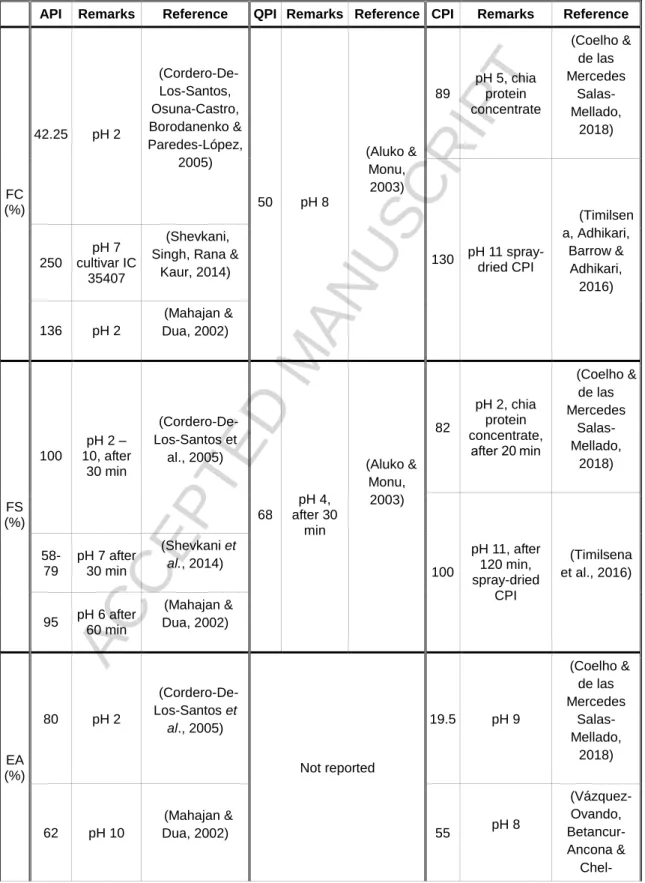
(13) ACCEPTED MANUSCRIPT Beyond the differences in OAC due to the drying method, significant differences may be observed in the OAC values obtained by Olivos-Lugo et al. (2010) and Timilsena et al. (2016b). As previously pointed out when comparing WAC, the higher stirring time carried out by Olivos-Lugo et al. (2010) to determine OAC may result in a higher value.. PT. 4. Superficial properties. RI. Proteins play an important role as foams or emulsions in fluid-fluid. SC. dispersions in food systems. Proteins’ ability to be adsorbed at the interface is required for the formation and stabilization of these structures (Salicio &. NU. Moreno, 2005). 4.1 Foam forming capacity and stability. MA. Foam forming capacity (FC), determined as the percentage increase in volume after suspension mixing; and foam stability (FS), determined as the. D. percentage of the remaining foam volume recorded after 30 minutes; have been. PT E. studied as a function of pH for the API obtained by isoelectric precipitation (Cordero-De-Los-Santos, Osuna-Castro, Borodanenko & Paredes-López, 2005). CE. and derived from different cultivars (Shevkani et al., 2014b). Besides, FC and FS values were studied for amaranth meal proteins (Mahajan & Dua, 2002).. AC. The higher values of FC and FS obtained in each work are shown in Table 1. Table 1. The effect of salt addition was studied for amaranth meal proteins against their foaming properties. NaCl and NaHCO3 decreased FC at all the studied concentrations (up to 1 M), while FS was improved at all NaCl concentrations (Mahajan & Dua, 2002)..
(14) ACCEPTED MANUSCRIPT FC of API has also been studied by conductimetry (Bolontrade et al., 2013). Foam was generated by sparing nitrogen gas through a porous G4 type glass disc rather than mixing, as mentioned above. The initial rate of foam formation (ν0), used as a measure of foaming capacity, was determined. The initial rate of foam formation was higher for samples of high ionic strength,. PT. whereas at low ionic strength, ν0 was higher at pH 2 than at pH 8. The maximal. RI. density of the foam, determined as the ratio between the mass of the liquid. SC. incorporated into the foam and the foam volume, was also studied. The densest foams were those obtained at pH 2, regardless of ionic strength.. NU. FS has also been studied for API by conductimetry (Bolontrade, Scilingo & Añón, 2014). Half time (t1/2, defined as the mean time of foam) and VLF10. MA. (volume of liquid remaining in the foam after 10 minutes) were calculated and allowed the authors to estimate FS. The effect of protein solubility was also. D. analyzed. At high ionic strength, (adjusted to 0.5) foams prepared at pH 2 were. PT E. more stable than those at pH 8. Authors mentioned that foams formed by a low content of insoluble protein favored FS, while those with a high content of. CE. insoluble protein favored destabilization mechanisms. It is worth highlighting that this finding was also reported by Shevkani et al. (2014b) in their study.. AC. Regarding the foaming properties of QPI, foams were prepared by mixing and the remaining volume of foam recorded after 30 minutes was used to calculate FS. Foam expansion was calculated as the ratio between the volume of foam formed and the initial volume of liquid, and is comparable to FC, (Table 1) (Aluko & Monu, 2003). Timilsena et al. (2016a) have studied the foaming properties of CPI powders obtained by different drying methods. Within the entire range of pH.
(15) ACCEPTED MANUSCRIPT studied, spray-dried CPI showed higher FC and FS than those obtained from freeze and vacuum drying. The effect of pH and chia protein concentration has been evaluated for powders obtained by spray-drying. The obtained FC and FS values are shown in Table 1. Within the range of protein concentrations studied, the highest FC and FS have been obtained at pH 11, whereas the lowest was. PT. reached at pH 3. Another study conducted by Olivos-Lugo et al. (2010) has. RI. reported that FC of CPI and chia glutelins were 70 and 77%, respectively. Foam. SC. was formed in a high-speed homogenizer and the initial volume of liquid as well as the volume of foam after formation was measured in order to calculate FS,. NU. as previously mentioned for QPI. Authors concluded that the glutelin fraction may substantially contribute to FC of CPI.. MA. The foaming capacity of a chia protein rich fraction was studied by Vázquez-Ovando et al. (2013). The percentage of increase in foam volume. D. measured at 30 s was defined as FC. The highest FC was found at pH 8 (28.68. PT E. %). The authors suggested that this low FC may be a consequence of the limited content of albumins in this protein rich fraction. The highest FS, recorded. CE. after 30 min of foam formation, was about 57% at pH 8. 4.2 Emulsifying activity and stability. AC. The emulsifying activity (EA) for API (Mahajan & Dua, 2002; Cordero-DeLos-Santos, Osuna-Castro, Borodanenko & Paredes-López, 2005) and CPI (Vázquez-Ovando et al., 2013) was calculated as the percentage represented by the emulsified layer volume within the entire content. Emulsifying stability (ES) was expressed as the percentage of the emulsified layer volume remaining in the original emulsion volume after 30-min of heat-treatment and centrifugation. These protein isolates showed high ES at pH 8, near 100% in.
(16) ACCEPTED MANUSCRIPT both cases. Coelho & Salas-Mellado (2018) calculated the emulsifying stability value of CPI at several pHs. The highest EA and ES values reported in each article are shown en Table 1. According to Mahajan & Dua (2002), the addition of NaCl or NaHCO3 to amaranth meal protein emulsions had no influence on EA, while ES was. PT. improved in the presence of these salts.. RI. The emulsifying activity index (EAI) and the emulsion stability index (ESI). SC. were also determined for API, according to the turbidimetric method proposed by Pearce & Kinsella (1978). The highest EAI was obtained at pH 9 (from 20.7. NU. to 52.7 m2/g) and the ESI was in the range from 85.4 to 149.5 min for the API from the different cultivars analyzed (Shevkani et al., 2014b). The lowest EAI. MA. values were obtained at acid pH.. The EAI was determined for QPI (Aluko & Monu, 2003), also obtaining. D. the highest values in alkaline media, at pH 8 (near 50 m 2/g). As in the case of. PT E. API, the lowest EAI values were obtained in acid media. 5. Color properties. CE. Instrumental color analysis has been performed for amaranth, chia and quinoa flours and protein isolates in order to characterize their color properties.. AC. The instrumental measurement of food color can be a quality check when it is necessary to determine the effect of the addition of a new ingredient, a change in process variables or modifications in storage conditions (Shittu, Raji & Sanni, 2007). However, the color parameters of raw materials may not always be the sole responsible for the resulting food color. During manufacturing, many food products are exposed to chemical processes which may result in pigment modification. For example, both the Maillard reactions and the caramelization.
(17) ACCEPTED MANUSCRIPT process are well-known simultaneous effects which lead to color development, such as browning in biscuits (Zanoni, Peri & Bruno, 1995). When vegetable flours or isolates are added to food products, protein and sugar contents are modified, and thus pigment modification caused by these reactions may change. Amaranth, quinoa and chia flours have been studied and their. PT. representative color parameters are shown in Figure 4. The color parameters of. RI. these flours vary depending on the variety and source, among others. Figure 4. SC. shows the average parameters calculated from the values previously reported (Taverna, Leonel & Mischan, 2012; Shevkani, Singh, Kaur & Rana, 2014a;. NU. Shevkani et al., 2014b; Bilgiçli & İbanoğlu, 2015; Steffolani et al., 2015; Bastos et al., 2016; Santillán-Álvarez et al., 2017; Pellegrini et al., 2018). Regarding. MA. chia flour, it showed a low L* value and it presented a reddish color (SantillánÁlvarez et al., 2017), while quinoa flour showed a yellow color and the highest. D. luminosity (Taverna et al., 2012; Bilgiçli & İbanoğlu, 2015). The coloration of. PT E. amaranth flour was intermediate, showing relatively high luminosity and a tendency towards red and yellow coloring (Fiorda, Soares, da Silva, Grosmann. CE. & Souto, 2013; Shevkani et al., 2014a; Bastos et al., 2016). Figure 4. AC. The differences attributed to the diverse sources or vegetable varieties and the possible subsequent variation in the chemical composition may affect the flour color parameters. In fact, a tendency to green (a* = -9.6) has been reported by Bilgiçli & İbanoğlu (2015) for quinoa flour purchased at a local market in Istanbul, Turkey, while a low reddish color (a* = 0.9) has been reported for quinoa protein flour from Jasmine, Brazil by Taverna et al. (2012)..
(18) ACCEPTED MANUSCRIPT Principal component analysis (PCA) for API reported by Shevkani et al. (2014b) showed that at higher ash contents of the samples, a* and b* values increased, whereas L* value decreased. This effect of ash content on luminosity has also been reported by Föste et al. (2015), when studying the quality and pureness of quinoa milling fractions by L* characterization. Taking this into. PT. account, it is also possible to relate the ash content of chia and quinoa flours. RI. with their color parameters: a high ash content (7.24 %) has been reported for. SC. chia flour (Santillán-Álvarez et al., 2017) and resulted in higher a* and b* values than those obtained for the quinoa flours, which exhibited a lower ash content. NU. (2.28 %) (Bilgiçli & İbanoğlu, 2015) and a higher luminosity. Color parameters of API from different cultivars have been characterized. MA. by Shevkani et al. (2014b). High luminosity was found in all the cultivars studied (from 81.87 to 87.22). The samples presented a slight red tint (a* from 0.24 to. D. 1.37) and a slight tendency to yellow (b* ranging from 10.99 to 13.61). API has. PT E. a higher L* and lower a* and b* values than amaranth flour. QPI from different varieties has been studied by Steffolani et al. (2015).. CE. These authors reported that the protein isolates showed similarities in the L*, a* and b* values, even though Bolivian QPI were slightly darker and less yellow. AC. than the QPI obtained from Peruvian cultivars. The authors also compared their results with those obtained by Marcone & Kakuca (1999) for API, and reported that QPI was less luminous. This could be due to the co-extraction of a pigment during protein isolation. The presence of this pigment might be responsible for a significant decrease in L* value in QPI when compared to quinoa flour.. A. marked tendency of QPI to red and yellow has been reported (Steffolani et al., 2015). As a consequence, Steffolani et al. (2015) recommended the use of QPI.
(19) ACCEPTED MANUSCRIPT mainly in chocolate desserts, bakery products, pasta, sausages, breakfast cereal, seasonings and breakfast food products. Regarding CPI, the effect of the drying methods on the color properties of the resultant isolates has been reported. Spray-drying resulted in a powder with higher luminosity (L*= 86.9 ± 2.6) than those obtained by freeze and vacuum. PT. drying (L*= 80.6 ± 2.2 and 71.2 ± 4.1, respectively). These results are similar to. RI. those previously reported and revised for API from different cultivars. The color. SC. parameters a* and b* were the highest for vacuum-dried powders and the lowest for the spray-dried ones. Consequently, a marked tendency to red and. NU. yellow has been evidenced. 6. Textural properties. MA. 6.1 Gelling properties. The gel-forming ability of proteins is an important property when it comes. D. to the development of textured foods.. PT E. 6.1.1 Heat-induced gelation. The process of heat-induced globular protein gelation involves the partial. CE. unfolding of proteins, the exposition of sulfhydryl groups and non-polar internal regions and the formation of aggregates through intermolecular interactions.. AC. Avanza et al. (2005a) studied the gel-forming conditions of amaranth protein isolates at different protein concentrations and incubation temperatures. This heat-induced gelation was studied by rheological and textural analyses. At least a 7 % w/v protein isolate heated at 70 °C was needed to form a self-supporting gel. Above these critical conditions, mainly elastic gels were obtained. The structural and functional properties (water holding capacity, solubility, color and microscopy) of these gels were studied later (Avanza et al., 2005b). The.
(20) ACCEPTED MANUSCRIPT increase in protein concentration as well as the increase in heating temperature and heating time resulted in more ordered gels with smaller pores. BejaranoLuján et al. (2010) also studied the heat-induced gelation properties of amaranth protein concentrates obtained by three different processes. The first one was the traditional process for protein isolation; the second one included an. PT. acid washing step prior to protein extraction and the third one involved heating. RI. (50 °C) during the alkaline extraction step. The dispersions (12 %, w/v) obtained. SC. under the different extraction conditions were heated at 55-90 °C and assessed by rheological measurements. Increasing the heat treatment temperature from. NU. 80 to 90 °C produced a more structured matrix with greater water holding capacity when compared to gels obtained at 70 °C, and these properties were. MA. influenced by the extraction processes used to obtain amaranth protein concentrates.. D. Ruiz et al. (2016) extracted quinoa seed protein by alkaline treatment at. PT E. various pH values (pH 8, 9, 10 and 11) to determine the effect of the extraction pH on heat-induced properties (aggregation, gelation, microstructure). Samples. CE. of 10 % w/w protein isolate suspensions were heated from 20 to 90 °C at a heating rate of 1 °C/min, kept at 90 °C for 5 min, and cooled to 20 °C at a rate. AC. of 3 °C/min. The protein isolates extracted at pH 8 and 9 resulted in lower protein yield as well as in less protein denaturation. Heating protein isolate suspensions at pH 8 and 9 led to increased aggregation and to the formation of semi-solid gels with dense microstructures. On the other hand, the isolate suspensions at pH 10 and 11 did not form self-supporting gels. Other authors studied the effect of pH (3.5 and 7) and protein concentration (10 or 15 %) on heat induced gelation of QPI obtained by protein.
(21) ACCEPTED MANUSCRIPT solubilization at pH 8 (Kaspchak et al., 2017). Samples were heated from 20 to 90 °C and then cooled to the initial temperature at a heating rate of 2 °C/min. Both concentrations studied showed gel-like structures, the gel strength being higher at higher protein concentration. Samples prepared at 10 % and pH 7 showed a gel-like structure which was not stable after heating. The addition of. PT. CaCl2 was not favorable for gel formation in the aforementioned samples.. RI. Moreover, the effect of MgCl2 was also studied and resulted in lower gel. SC. strength than that obtained without salt addition. The effect of these salts was different at pH 3.5, since they promoted crosslinking of the protein chains. The. NU. authors attributed these differences to the diverse nature of protein-divalent ions binding, concluding that gelling QPI at pH 3.5 is more suitable than neutral pH. MA. for strong gel formation.. Olivos-Lugo et al. (2010) obtained heat-induced gels from CPI. A. D. qualitative procedure was carried out to identify the lowest gel-forming. PT E. concentration of chia protein isolate and glutelins. Samples were heated in boiling water for 1 h. Then, they were immediately placed in ice and. CE. subsequently cooled for 2 h at 4 °C. Results showed that both the protein isolate and the glutelins formed stable gels at 20 and 25 %w/v, respectively.. AC. According to these authors, it could be concluded that the extraction pH plays an important role in determining the functionality of amaranth, quinoa and chia protein isolates. Protein isolation conditions may lead to differences in the extent of protein denaturation, thus modifying protein gelling properties. 6.1.2 Acid-induced gelation Cold gelation of proteins can be induced through the reduction of electrostatic repulsion either by lowering the pH towards the isoelectric point or.
(22) ACCEPTED MANUSCRIPT by adding salt. This process involves a first step in which the sample is heated before adding the acidifying agent (Alting et al., 2004). Mäkinen et al. (2015) investigated the effect of heat-treatments at pH 8.5 and pH 10.5 on QPI cold gelation. In order to study the gelation process during acidification, rheological changes were measured after the addition of D-. PT. Gluconic acid δ-lactone (GDL, 0.33 mg per mg protein) at 30 °C. Denaturation. RI. pH influenced the properties of cold gels; heat-denaturation at pH 10.5 enabled the proteins to form a finer and more regularly structured gel with a maximum. SC. G’. In addition, particle size analysis showed that pH 10.5-heated samples. NU. contained small particles (0.1–2 μm) which readily aggregated into large particles (30–200 μm) after GDL addition, when the pH was lowered to 5.5.. MA. Differences in the nature of the aggregates formed during the heating step may explain the significant variation in the gelation process.. D. 7. Film formation. PT E. The waste produced by petro-based plastic is nowadays one of the main sources of environmental pollution. As a result, an increasing number of. CE. research studies have focused their attention on the development of edible films or coatings to be used as food protection and to increase food products´ shelf-. AC. life (Jiménez, Fabra, Talens & Chiralt, 2012). Starch film-forming ability has been well-characterized and has been reviewed by Jiménez et al. (2012). New environmentally friendly polymers are currently being considered as they may form. biodegradable. polymeric. films. with. interesting. mechanical. and. physicochemical characteristics. For example, amaranth, quinoa and chia have been tested against their film-forming properties..
(23) ACCEPTED MANUSCRIPT The most commonly used method to form edible films (referred to as “wet method” or casting technique) consists in solution casting with subsequent drying. This method achieves the film formation by means of a dispersion or an emulsion. Then, the polymeric solution is poured onto a surface such as a Petri dish until films are dried. A vast number of researchers have reported the effect. PT. of drying conditions on the mechanical and barrier properties of edible films. RI. (Tapia-Blácido, Sobral & Menegalli, 2005a; Denavi et al., 2009; Thakhiew,. SC. Devahastin & Soponronnarit, 2010; Liu, Antoniou, Li, Ma & Zhong, 2015). In addition to water, plasticizers -usually polyols and low-molecular-weight. NU. polysaccharides- are frequently added to edible films. Due to their relatively small size, plasticizers allow greater molecular mobility, thus increasing film. MA. flexibility and workability (Talja, Helén, Roos & Jouppila, 2007; Vieira, da Silva, dos Santos & Beppu, 2011).. D. The effect of drying conditions and the use of glycerol or sorbitol as. PT E. plasticizers have been studied for amaranth flour-based films (Tapia-Blácido, do Amaral Sobral & Menegalli, 2013). Optimized conditions have also been. CE. reported. Optimum drying temperature and relative humidity (RH) turned out to be lower for films plasticized with sorbitol than for those plasticized with. AC. glycerol, due to a better interaction between sorbitol and starch and proteins from amaranth flour. Films plasticized with glycerol were more soluble, more permeable to water vapor and more stretchable. Amaranth films were formed from native isolates and from thermally (Condés, Añón & Mauri, 2013) or high-pressure (Condés, Añón & Mauri, 2015a) treated proteins. Moreover, amaranth films reinforced with maize starch nanocrystals have also been reported (Condés, Añón, Mauri & Dufresne,.
(24) ACCEPTED MANUSCRIPT 2015b). Film preparation was the same in all cases. The protein isolate and 1.25 % w/v glycerol were dispersed in distilled water, under 1 h stirring at room temperature and pH was adjusted to 10.5. Each film-forming dispersion was poured onto Petri dishes and dried at 60 °C for 3 h (Condés et al., 2013; Condés et al., 2015a) or at 40 °C for 4 h (Condés et al., 2015b). The dried films. PT. were conditioned at 20 °C and 58 % RH for 48 h before characterization.. RI. Although films made from amaranth native isolates displayed interesting barrier. SC. properties to water, they showed poor mechanical properties. Film mechanical resistance and solubility were improved by partial or complete heat protein. NU. denaturation while water vapor permeability decreased. High-pressure treated proteins formed films with better mechanical properties, lower water solubility. MA. and water vapor permeability than those made from native amaranth proteins. The authors reported that thickness, water content and color properties were. D. not modified.. PT E. Condés et al. (2015b) reported that neither thickness nor optical properties were modified in amaranth films reinforced with maize starch. showed. CE. nanocrystals due to the chemical affinity between the components. These films improved. water. vapor. permeability,. water. uptake,. surface. AC. hydrophobicity and mechanical behavior when compared to those formed by neat proteins.. Besides, the effect of amaranth starch granules and nanocrystals on the reinforcement of API films has recently been evaluated (Condés, Añón, Dufresne & Mauri, 2018). The general appearance was similar to that of the control API films, being homogeneous in all cases. Only the addition of starch nanocrystals did show a reinforcing effect of the protein matrix, probably due to.
(25) ACCEPTED MANUSCRIPT strong interactions between them. These films showed improved tensile strength, water vapor permeability and water susceptibility. Film formation without the use of plasticizers was studied for quinoa isolates and proved adequate when protein extraction was carried out at pH 12 (Valenzuela, Abugoch, Tapia & Gamboa, 2013). Casting methodology was. PT. used for film formation. After preparation, films were dried at 50 °C until. The. authors. reported. that. some. degree. of. SC. characterization.. RI. constant weight and were kept at 23 °C and 60 % RH for 48 h before. denaturation/aggregation/dissociation is needed to form a film using water as a. NU. plasticizer since water-protein and protein-protein interactions were mainly produced through hydrogen bonds and, to a lesser extent, through hydrophobic. strength and poor elongation.. MA. interactions. These films exhibited low water vapor permeability, high tensile. D. The synergistic effect of quinoa proteins and chitosan on the mechanical. PT E. and adhesive properties of mixed films has also been reported (Abugoch, Tapia, Villamán, Yazdani-Pedram & Díaz-Dosque, 2011). Mixed solutions. CE. composed by quinoa protein extract and chitosan were adjusted to pH 3 and stirred for 1 h. They were dried until constant weight at 50 °C and conditioned at. AC. 22 °C for three days before testing. The authors considered this biopolymer combination to be a new material with enhanced mechanical properties as compared to chitosan films. Later on, the study of the incorporation of an hydrophobic agent such as sunflower oil carried out by Valenzuela et al. (2013) demonstrated that these blend films improve film barrier properties against water vapor and have good mechanical properties. These films were dried to a constant weight at 35 °C..
(26) ACCEPTED MANUSCRIPT Then, they were conditioned at 23 °C and 60 % RH for 48 h before being used. Protein-polysaccharide interactions are essential to create a network which may impart the resulting film characteristics. In this case, complex coacervation, i.e. an associative phase separation phenomenon between at least two macromolecules (Cooper, Dubin, Kayitmazer & Turksen, 2005; Priftis, Laugel &. PT. Tirrell, 2012), is an important option when intending to form mixed films. The. RI. above mentioned authors reported that the electrostatic attraction between. SC. quinoa protein isolate and chitosan was optimal for complex formation when protein extraction was carried out at pH 8 and the quinoa protein/chitosan ratio. NU. was 0.1.. Up to date, only one research study has focused on film formation from. MA. chia flour (Dick et al., 2016). The absence of starch in this natural flour induced authors to incorporate maize starch in different ratios (1:0; 1:1 and 1:2 w/w,. D. respectively) in order to increase its mechanical strength and to improve film. PT E. stiffness. Glycerol (1 % w/w) was also added as plasticizer. pH values of the solutions were adjusted to 7.5. Solutions were stirred and heated at 70 °C for 45. CE. min. Then, 40 grams were poured into acrylic plates and dried at 35 °C for 1214 h. Dried film solutions were conditioned at 25 °C and 52 % RH for 48 h. AC. before characterization. In their work, the authors proved the ability of chia flour to form films. They also stated that the moisture content was similar to that reported by Tapia-Blácido et al. (2011) for amaranth flour , while films were darker, redder and yellower (Tapia-Blácido, Sobral & Menegalli, 2005b; Tapia‐Blácido, Mauri, Menegalli, Sobral & Añón, 2007). Interestingly, these films showed protection against UV radiation. The values obtained for solubility in water were lower than those reported for amaranth flour (Tapia-Blácido et al.,.
(27) ACCEPTED MANUSCRIPT 2011). The authors found that the tensile strength was higher for the films containing. chia flour when compared to those with amaranth flour (Tapia-. Blácido et al., 2005b), but similar to those containing quinoa flour (AraujoFarro, Podadera, Sobral & Menegalli, 2010). Water vapor permeability improved when maize starch was incorporated to chia flour-based films.. PT. Moreover, the creation of edible films with new environmentally friendly. RI. biopolymers is a possibility worth considering. Up to date, the reports revised in. SC. this work, which are based on film formation with flour and protein isolates from quinoa and amaranth, have provided reasonable proof of the vast applications. NU. of these materials. So far, chia has not been well-studied against film formation. In fact, none of the reports published focuses on edible films based on chia. MA. protein isolates and relatively little attention has been paid to chia flour. Edible films based on chia seed mucilage have received slightly more attention than. D. those raw materials previously mentioned (Muñoz, Aguilera, Rodriguez-. PT E. Turienzo, Cobos & Diaz, 2012; Dick, 2014; Dick et al., 2015). 8. Protein hydrolyzates. CE. In recent years, bioactive peptides have received increasing attention and there is a growing number of studies which focus on the enzymatic. AC. digestion of proteins from plant seeds and legumes such as chickpea, common bean, lentil, lupin, soybean, rice bran, pea, wheat gluten and sunflower (Berends, Appel, Eisele, Rabe & Fischer, 2014; Boschin, Scigliuolo, Resta & Arnoldi, 2014; Cheetangdee & Benjakul, 2015; Girgih et al., 2015; Ren et al., 2015). Among the pseudocereals revised in this work, amaranth seed protein hydrolyzates have been the most studied ones in recent years (Tovar-Pérez,.
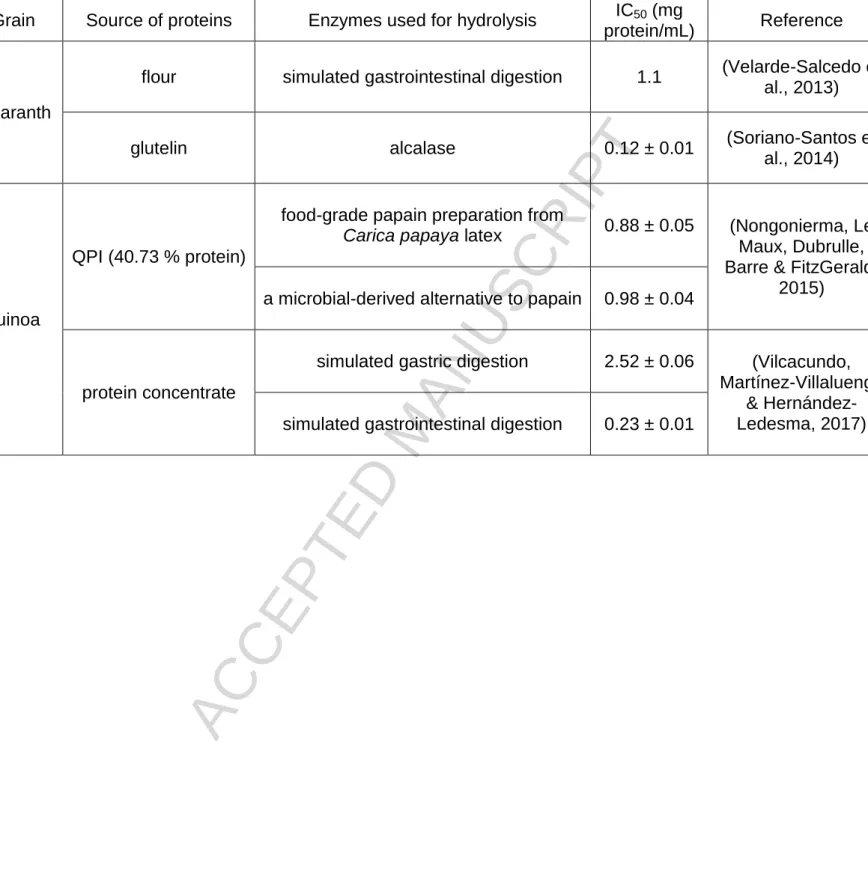
(28) ACCEPTED MANUSCRIPT Guerrero-Legarreta, Farrés-González & Soriano-Santos, 2009; Delgado, Tironi & Añón, 2011; Fritz, Vecchi, Rinaldi & Añón, 2011; Tironi & Añón, 2014; García Fillería & Tironi, 2015). The existence of amaranth peptides with a variety of biological activities has been extensively reported in many studies (Lipkin et al., 2005; Silva-Sánchez et al., 2008). Despite being abundant protein sources and. PT. having potential health benefits, quinoa and chia protein hydrolyzates have. RI. received scant attention.. Hypertension. is. considered. to. SC. 8.1 Inhibition of angiotensin I converting enzyme be. the. leading. risk. factor. for. NU. cardiovascular disease worldwide. Angiotensin I converting enzyme (ACE) inhibitors are nowadays widely used in order to decrease arterial pressure. MA. (Venkatesh et al., 2015). However, they may usually impart undesirable sideeffects such as cough and skin rashes (Sanz, 2014). Captopril is one synthetic. D. ACE inhibitor currently used as pharmaceuticals to treat hypertension. PT E. (Vercruysse, Van Camp & Smagghe, 2005), its half maximum inhibitory concentration (IC50) being 0.006 µmol/L (FitzGerald & Meisel, 2000). Over the. CE. past decade, studies on hypertensive patients have reported that peptides from food proteins hold promise as potent sources of natural blood-lowering peptides. AC. (Tiengo, Faria & Netto, 2009). This is the main reason why ACE-inhibitory activity is usually determined in protein hydrolyzates. In vitro studies have been the most commonly reported. Table 2 shows the minima IC50 values of hydrolyzed flour or protein fraction from amaranth, quinoa and chia seeds regarding ACE-inhibitory activity. The ultrafiltered hydrolyzates from quinoa and chia seed obtained by the.
(29) ACCEPTED MANUSCRIPT combination of alcalase and flavorzyme were the most efficient inhibitors of ACE. Table 2 Fritz et al. (2011) have studied not only the in vivo ACE- inhibitory activity of the alcalase hydrolyzates of an amaranth native isolate but also performed ex. PT. vivo assays, showing the important effect of amaranth hydrolyzates on lowering. RI. blood pressure.. SC. Although in vivo studies have not yet been reported for chia protein hydrolyzates, Segura-Campos et al. (2013) suggested that chia protein. NU. hydrolyzates may be absorbed in the small intestine, based on a previous study which reported that peptides from chia obtained by alcalase enzymatic. MA. hydrolysis resist gastrointestinal proteases (Matsufuji et al., 1994). The incorporation of chia hydrolyzates into food products was studied by. D. Segura-Campos et al. (2013). White bread containing chia protein hydrolyzates. PT E. did not improve its biological potential. These authors suggested that the fermentation process and the high temperature during the baking process. CE. caused the hydrolysis of the ACE-inhibitory peptides, without affecting antioxidant activity. On the other hand, the biological potential did improve in. AC. carrot creams, maybe due to a combined effect of the chia hydrolyzates and the milk peptides released during preparation.. 8.2 Inhibition of didpetidyl peptidase-IV The devastating prevalence of type 2 diabetes has prompted the search for new treatment strategies. Dipeptidyl peptidase-IV (DPP-IV) inhibitors offer novel opportunities of treatments. Various DPP-IV inhibitory drugs, known as.
(30) ACCEPTED MANUSCRIPT gliptins, present IC50 values in the nanomolar range (Sortino, Sinagra & Canonico, 2013). Natural alternatives to DPP-IV inhibitory drugs may exist in the diet, including DPP-IV inhibitory peptides released by the hydrolysis of food proteins (Nongonierma & FitzGerald, 2015).. quinoa proteins regarding DPP-IV-inhibitory activity.. RI. Table 3. PT. Table 3 shows the minima IC50 values of hydrolyzates of amaranth and. SC. Soriano-Santos et al. (2014) reported that amaranth glutelin peptides obtained by alcalase hydrolysis yielded the highest DPP-IV inhibitory activity,. NU. not only by in vitro experiments but also by in vivo assays with streptozotocininduced diabetic mice. The incorporation of amaranth peptides in a reduced salt. MA. fish restructured product has been studied, obtaining an acceptable product from a microbiological and technological point of view. This hydrolyzate partially. D. inhibited lipid oxidation, acting as a natural antioxidant as well (García Fillería &. PT E. Tironi, 2015).. In vitro gastrointestinal simulated digestion of quinoa proteins has also. CE. been studied. Non-digested quinoa protein concentrate did not show DPP-IV inhibitory activity. After simulated gastric digestion, the peptides had a moderate. AC. inhibitory activity (Table 3), and when quinoa proteins were also subjected to simulated intestinal digestion, the peptides obtained showed not only high DPPIV inhibitory activity but also the ability to inhibit α-amylase and α-glucosidase (Vilcacundo et al., 2017b). 9. Conclusion This article provides an overview of recently published research on the functional properties of amaranth, quinoa and chia proteins and the biological.
(31) ACCEPTED MANUSCRIPT activity of their enzymatic hydrolyzates. Figure 5 shows a scheme of the relationship among the functional properties of these proteins. There, the incidence of the isolation method on the composition and on the structural properties of the protein concentrates or isolates is also highlighted. In addition, in agreement with many authors, the importance of solubility is evinced since it. PT. affects other functional characteristics as WAC, emulsion, foam and gelation. RI. properties. In Figure 5, connected to every functional or biological property, the. Figure 5. SC. grains whose proteins presented better performance were indicated.. NU. Scientific research is the way to add value and diversify the use of vegetable proteins. Based on the bibliography revised, it is to be noted that chia. MA. proteins are the less studied ones regarding their functional and biological properties.. D. Future research on this subject would contribute to make these. PT E. pseudocereals an alternative protein source to replace animal-based protein in the development of new food products.. CE. Acknowledgements. The authors would like to thank the English Area of Facultad de Ciencias. AC. Bioquímicas y Farmacéuticas, UNR, for the language correction of the manuscript. Débora N. López and Micaela Galante would also like to thank Consejo Nacional de Investigaciones Científicas y Técnicas (CONICET) for the fellowship they were granted. This work was supported by grants from Agencia Nacional de Promoción Científica y Tecnológica (PICT 2014-1571), from Universidad Católica Argentina and from Universidad Nacional de Rosario (1BIO430)..
(32) ACCEPTED MANUSCRIPT 10. References Abugoch, L. E., Romero, N., Tapia, C. A., Silva, J. & Rivera, M. (2008). Study of some. physicochemical. and. functional. properties. of. quinoa. (Chenopodium quinoa Willd) protein isolates. Journal of agricultural and food chemistry, 56, 4745-4750.. PT. Abugoch, L. E., Tapia, C., Villamán, M. C., Yazdani-Pedram, M. & Díaz-. RI. Dosque, M. (2011). Characterization of quinoa protein–chitosan. SC. blend edible films. Food Hydrocolloids, 25, 879-886. Alting, A. C., Weijers, M., de Hoog, E. H., van de Pijpekamp, A. M., Cohen. NU. Stuart, M. A., Hamer, R. J., de Kruif, C. G. & Visschers, R. W. (2004). Acid-induced cold gelation of globular proteins: effects of protein. MA. aggregate characteristics and disulfide bonding on rheological properties. Journal of agricultural and food chemistry, 52, 623-631.. D. Aluko, R. & Monu, E. (2003). Functional and bioactive properties of quinoa seed. PT E. protein hydrolysates. Journal of Food Science, 68, 1254-1258. Alvarez-Jubete, L., Arendt, E. & Gallagher, E. (2010). Nutritive value of. CE. pseudocereals and their increasing use as functional gluten-free ingredients. Trends in Food Science & Technology, 21, 106-113.. AC. Araujo-Farro, P. C., Podadera, G., Sobral, P. J. & Menegalli, F. C. (2010). Development of films based on quinoa (Chenopodium quinoa, Willdenow) starch. Carbohydrate Polymers, 81, 839-848. Avanza, M., Puppo, M. & Añón, M. (2005a). Rheological characterization of amaranth protein gels. Food Hydrocolloids, 19, 889-898. Avanza, M. V., Puppo, M. C. & Añón, M. C. (2005b). Structural characterization of amaranth protein gels. Journal of Food Science, 70, E223-E229..
(33) ACCEPTED MANUSCRIPT Bastos, G. M., Júnior, M. S. S., Caliari, M., de Araujo Pereira, A. L., de Morais, C. C. & Campos, M. R. H. (2016). Physical and sensory quality of gluten-free spaghetti processed from amaranth flour and potato pulp. LWT-Food Science and Technology, 65, 128-136. Bejarano-Luján, D. L., Lopes da Cunha, R. & Netto, F. M. (2010). Structural and. PT. rheological properties of amaranth protein concentrate gels obtained. RI. by different processes. Food Hydrocolloids, 24, 602-610.. SC. Berends, P., Appel, D., Eisele, T., Rabe, S. & Fischer, L. (2014). Performance of enzymatic wheat gluten hydrolysis in batch and continuous. NU. processes using Flavourzyme. LWT-Food Science and Technology, 58, 534-540.. MA. Bilgiçli, N. & İbanoğlu, Ş. (2015). Effect of pseudo cereal flours on some physical, chemical and sensory properties of bread. Journal of Food. D. Science and Technology, 52, 1-5.. PT E. Bolontrade, A. J., Scilingo, A. A. & Añón, M. C. (2013). Amaranth proteins foaming properties: Adsorption kinetics and foam formation—Part 1.. CE. Colloids and Surfaces B: Biointerfaces, 105, 319-327. Boschin, G., Scigliuolo, G. M., Resta, D. & Arnoldi, A. (2014). ACE-inhibitory. AC. activity of enzymatic protein hydrolysates from lupin and other legumes. Food Chemistry, 145, 34-40.. Caruso, M., Favati, F., Di Cairano, M., Galgano, F., Labella, R., Scarpa, T. & Condelli, N. (2018). Shelf-life evaluation and nutraceutical properties of chia seeds from a recent long-day flowering genotype cultivated in Mediterranean area. LWT-Food Science and Technology, 87, 400405..
(34) ACCEPTED MANUSCRIPT Caselato‐Sousa, V. M. & Amaya‐Farfán, J. (2012). State of knowledge on amaranth grain: a comprehensive review. Journal of Food Science, 77, R93-R104. Coelho, M. S. & de las Mercedes Salas-Mellado, M. (2018). How extraction method affects the physicochemical and functional properties of chia. PT. proteins. LWT, 96, 26-33.. RI. Condés, M. C., Añón, M. C., Dufresne, A. & Mauri, A. N. (2018). Composite and. SC. nanocomposite films based on amaranth biopolymers. Food Hydrocolloids, 74, 159-167.. NU. Condés, M. C., Añón, M. C. & Mauri, A. N. (2013). Amaranth protein films from thermally treated proteins. Journal of Food Engineering, 119, 573-. MA. 579.. Condés, M. C., Añón, M. C. & Mauri, A. N. (2015a). Amaranth protein films. D. prepared with high-pressure treated proteins. Journal of Food. PT E. Engineering, 166, 38-44. Condés, M. C., Añón, M. C., Mauri, A. N. & Dufresne, A. (2015b). Amaranth. CE. protein films reinforced with maize starch nanocrystals. Food Hydrocolloids, 47, 146-157.. AC. Cooper, C., Dubin, P., Kayitmazer, A. & Turksen, S. (2005). Polyelectrolyte– protein complexes. Current Opinion in Colloid & Interface Science, 10, 52-78. Cordero-De-Los-Santos, M., Osuna-Castro, J., Borodanenko, A. & ParedesLópez, O. (2005). Physicochemical and functional characterisation of amaranth (Amaranthus hypochondriacus) protein isolates obtained.
(35) ACCEPTED MANUSCRIPT by isoelectric precipitation and micellisation. Food science and technology international, 11, 269-280. Cheetangdee, N. & Benjakul, S. (2015). Antioxidant activities of rice bran protein hydrolysates in bulk oil and oil‐in‐water emulsion. Journal of the Science of Food and Agriculture, 95, 1461-1468.. PT. de Falco, B., Amato, M. & Lanzotti, V. (2017). Chia seeds products: an. RI. overview. Phytochemistry Reviews, 16, 745-760.. amaranth. protein. or. their. SC. Delgado, M. C. O., Tironi, V. A. & Añón, M. C. (2011). Antioxidant activity of hydrolysates. under. simulated. NU. gastrointestinal digestion. LWT-Food Science and Technology, 44, 1752-1760.. MA. Denavi, G., Tapia-Blácido, D., Añón, M., Sobral, P., Mauri, A. & Menegalli, F. (2009). Effects of drying conditions on some physical properties of. D. soy protein films. Journal of Food Engineering, 90, 341-349.. PT E. Dick, M. (2014). Desenvolvimento de filmes biodegradáveis a partir da semente e da mucilagem de chia (Salvia hispanica L.).. CE. Dick, M., Costa, T. M. H., Gomaa, A., Subirade, M., de Oliveira Rios, A. & Flôres, S. H. (2015). Edible film production from chia seed mucilage:. AC. Effect of glycerol concentration on its physicochemical and mechanical properties. Carbohydrate Polymers, 130, 198-205.. Dick, M., Henrique Pagno, C., Haas Costa, T. M., Gomaa, A., Subirade, M., de Oliveira Rios, A. & Hickmann Flôres, S. (2016). Edible films based on chia flour: Development and characterization. Journal of Applied Polymer Science, 133, 1-9..
(36) ACCEPTED MANUSCRIPT Duran, N. M., Galante, M., Spelzini, D. & Boeris, V. (2018). The effect of carrageenan on the acid-induced aggregation and gelation conditions of quinoa proteins. Food Research International, 107, 683-690. Fiorda, F. A., Soares, M. S., da Silva, F. A., Grosmann, M. V. & Souto, L. R. (2013). Microestructure, texture and colour of gluten-free pasta made. RI. Food Science and Technology, 54, 132-138.. PT. with amaranth flour, cassava starch and cassava bagasse. LWT-. SC. FitzGerald, R. J. & Meisel, H. (2000). Milk protein-derived peptide inhibitors of angiotensin-I-converting enzyme. British Journal of Nutrition, 84, 33-. NU. 37.. Föste, M., Elgeti, D., Brunner, A.-K., Jekle, M. & Becker, T. (2015). Isolation of. MA. quinoa protein by milling fractionation and solvent extraction. Food and Bioproducts Processing, 96, 20-26.. D. Fritz, M., Vecchi, B., Rinaldi, G. & Añón, M. C. (2011). Amaranth seed protein. PT E. hydrolysates have in vivo and in vitro antihypertensive activity. Food Chemistry, 126, 878-884.. CE. García Fillería, S. & Tironi, V. A. (2015). Application of amaranth protein isolate and hydrolysate on a reduced salt fish restructured product:. AC. antioxidant. properties,. textural. and. microbiological. effects.. International Journal of Food Science & Technology, 50, 1452-1460.. Girgih, A. T., Chao, D., Lin, L., He, R., Jung, S. & Aluko, R. E. (2015). Enzymatic protein hydrolysates from high pressure-pretreated isolated pea proteins have better antioxidant properties than similar hydrolysates produced from heat pretreatment. Food Chemistry, 188, 510-516..
(37) ACCEPTED MANUSCRIPT Ixtaina, V. Y., Nolasco, S. M. & Tomas, M. C. (2008). Physical properties of chia (Salvia hispanica L.) seeds. Industrial crops and products, 28, 286293. Jiménez, A., Fabra, M. J., Talens, P. & Chiralt, A. (2012). Edible and biodegradable starch films: a review. Food and Bioprocess. PT. Technology, 5, 2058-2076.. RI. Kaspchak, E., de Oliveira, M. A. S., Simas, F. F., Franco, C. R. C., Silveira, J. L.. SC. M., Mafra, M. R. & Igarashi-Mafra, L. (2017). Determination of heatset gelation capacity of a quinoa protein isolate (Chenopodium. NU. quinoa) by dynamic oscillatory rheological analysis. Food Chemistry, 232, 263-271.. MA. Lipkin, A., Anisimova, V., Nikonorova, A., Babakov, A., Krause, E., Bienert, M., Grishin, E. & Egorov, T. (2005). An antimicrobial peptide Ar-AMP. PT E. 66, 2426-2431.. D. from amaranth (Amaranthus retroflexus L.) seeds. Phytochemistry,. Liu, F., Antoniou, J., Li, Y., Ma, J. & Zhong, F. (2015). Effect of sodium acetate. CE. and drying temperature on physicochemical and thermomechanical properties of gelatin films. Food Hydrocolloids, 45, 140-149.. AC. López, D. N., Galante, M., Robson, M., Boeris, V. & Spelzini, D. (2017). Amaranth, quinoa and chia protein isolates: physicochemical and structural. properties.. International. Journal. of. Biological. Macromolecules, 109, 152-159. Mahajan, A. & Dua, S. (2002). Salts and pH induced changes in functional properties of amaranth (Amaranthus tricolor L.) seed meal. Cereal Chemistry, 79, 834-837..
(38) ACCEPTED MANUSCRIPT Mäkinen, O. E., Zannini, E. & Arendt, E. K. (2015). Modifying the cold gelation properties of quinoa protein isolate: Influence of heat-denaturation pH in the alkaline range. Plant Foods for Human Nutrition, 70, 1-7. Marcone, M. & Kakuda, Y. (1999). A comparative study of the functional properties of amaranth and soybean globulin isolates. Food/Nahrung,. PT. 43, 368-373.. RI. Matsufuji, H., Matsui, T., Seki, E., Osajima, K., Nakashima, M. & Osajima, Y.. alkaline. protease. hydrolyzate. SC. (1994). Angiotensin I-converting enzyme inhibitory peptides in an derived. from. sardine. muscle.. NU. Bioscience, biotechnology, and biochemistry, 58, 2244-2245. Mohd Ali, N., Yeap, S. K., Ho, W. Y., Beh, B. K., Tan, S. W. & Tan, S. G.. MA. (2012). The promising future of chia, Salvia hispanica L. BioMed Research International, 2012.. D. Muñoz, L., Aguilera, J., Rodriguez-Turienzo, L., Cobos, A. & Diaz, O. (2012).. PT E. Characterization and microstructure of films made from mucilage of Salvia hispanica and whey protein concentrate. Journal of Food. CE. Engineering, 111, 511-518. Nakai, S. & Li-chan, E. (1985). Structure modification and functionality of whey. AC. proteins: Quantitative structure-activity relationship approach. Journal of Dairy Science, 68, 2763-2772.. Nasir, M. A., Pasha, I., Butt, M. S. & Nawaz, H. (2015). Biochemical characterization of quinoa with special reference to its protein quality. Pak. J. Agri. Sci, 52, 731-737. Nongonierma, A. B. & FitzGerald, R. J. (2015). Investigation of the potential of hemp, pea, rice and soy protein hydrolysates as a source of.
(39) ACCEPTED MANUSCRIPT dipeptidyl peptidase IV (DPP-IV) inhibitory peptides. Food Digestion: Research and Current Opinion, 6, 19-29. Olivos-Lugo, B., Valdivia-López, M. & Tecante, A. (2010). Thermal and physicochemical properties and nutritional value of the protein fraction of Mexican chia seed (Salvia hispanica L.). Food science and. PT. technology international, 16, 89-96.. RI. Pellegrini, M., Lucas-Gonzales, R., Ricci, A., Fontecha, J., Fernández-López, J.,. SC. Pérez-Álvarez, J. A. & Viuda-Martos, M. (2018). Chemical, fatty acid, polyphenolic profile, techno-functional and antioxidant properties of. NU. flours obtained from quinoa (Chenopodium quinoa Willd) seeds. Industrial Crops and Products, 111, 38-46.. MA. Priftis, D., Laugel, N. & Tirrell, M. (2012). Thermodynamic characterization of polypeptide complex coacervation. Langmuir, 28, 15947-15957.. D. Ren, J., Song, C.-L., Wang, P., Li, S., Kopparapu, N.-K. & Zheng, X.-Q. (2015).. PT E. Modification of structural and functional properties of sunflower 11S globulin hydrolysates. Czech Journal of Food Sciences, 33, 474-478.. CE. Ruiz, G. A., Xiao, W., van Boekel, M., Minor, M. & Stieger, M. (2016). Effect of extraction. pH. on. heat-induced. aggregation,. gelation. and. AC. microstructure of protein isolate from quinoa (Chenopodium quinoa Willd). Food chemistry, 209, 203-210.. Salcedo-Chávez, B., Osuna-Castro, J. A., Guevara-Lara, F., DomínguezDomínguez, J. & Paredes-López, O. (2002). Optimization of the isoelectric precipitation method to obtain protein isolates from amaranth (Amaranthus cruentus) seeds. Journal of agricultural and food chemistry, 50, 6515-6520..
(40) ACCEPTED MANUSCRIPT Salicio, M. M. V. & Moreno, M. D. M. (2005). Coloides e interfases, Ediciones Universidad de Salamanca. Santillán-Álvarez, Á., Dublán García, O., López Martínez, L. X., QuinteroSalazar, B., Gómez Oliván, L. M., Díaz-Bandera, D. & HernándezNavarro, M. D. (2017). Effect of chia seed on physicochemical and. PT. sensory characteristics of common carp restructured as functional. RI. food. Journal of Food Science and Engineering, 7, 115-126.. SC. Sanz, M. M. (2014). Uso combinado de medicamentos que actúan sobre el sistema renina-angiotensina (IECA/ARA II): restricciones de uso.. NU. Panorama actual del medicamento, 38, 640-641. Segura-Campos, M. R., Salazar-Vega, I. M., Chel-Guerrero, L. A. & Betancur-. MA. Ancona, D. A. (2013). Biological potential of chia (Salvia hispanica L.) protein hydrolysates and their incorporation into functional foods.. D. LWT-Food Science and Technology, 50, 723-731.. PT E. Segura Campos, M. R., Peralta González, F., Chel Guerrero, L. & Betancur Ancona, D. (2013). Angiotensin I-converting enzyme inhibitory. CE. peptides of chia (Salvia hispanica) produced by enzymatic hydrolysis. International Journal of Food Science, 2013, 1-8.. AC. Shevkani, K., Singh, N., Kaur, A. & Rana, J. C. (2014a). Physicochemical, pasting, and functional properties of amaranth seed flours: effects of lipids removal. Journal of Food Science, 79, C1271-C1277. Shevkani, K., Singh, N., Rana, J. C. & Kaur, A. (2014b). Relationship between physicochemical and functional properties of amaranth (Amaranthus hypochondriacus) protein isolates. International Journal of Food Science & Technology, 49, 541-550..
(41) ACCEPTED MANUSCRIPT Shittu, T., Raji, A. & Sanni, L. (2007). Bread from composite cassava-wheat flour: I. Effect of baking time and temperature on some physical properties of bread loaf. Food Research International, 40, 280-290. Silva-Sánchez, C., de la Rosa, A. P. B., León-Galván, M. F., de Lumen, B. O., de León-Rodríguez, A. & de Mejía, E. G. (2008). Bioactive peptides. PT. in amaranth (Amaranthus hypochondriacus) seed. Journal of. RI. agricultural and food chemistry, 56, 1233-1240.. SC. Soriano-Santos, J., Reyes-Bautista, R., Guerrero-Legarreta, I., Ponce-Alquicira, E., Escalona-Buendía, H. B., Almanza-Pérez, J. C., Díaz-Godínez,. NU. G. & Romαn-Ramos, R. (2014). Dipeptidyl peptidase IV inhibitory activity of protein hydrolyzates from Amaranthus hypochondriacus L.. MA. grain and their influence on postprandial glycemia in Streptozotocininduced diabetic mice. African Journal of Traditional, Complementary. D. and Alternative Medicines, 12, 90-98.. PT E. Sortino, M. A., Sinagra, T. & Canonico, P. L. (2013). Linagliptin: A thorough characterization. beyond. its. clinical. efficacy.. Frontiers. in. CE. Endocrinology, 4, 1-9. Steffolani, M. E., Villacorta, P., Morales-Soriano, E., Repo-Carrasco, R., León,. AC. A. E. & Perez, G. T. (2015). Physicochemical and functional characterization of protein isolated from different quinoa varieties (Chenopodium quinoa Willd). Cereal Chemistry, 93, 275-281.. Talja, R. A., Helén, H., Roos, Y. H. & Jouppila, K. (2007). Effect of various polyols and polyol contents on physical and mechanical properties of potato starch-based films. Carbohydrate Polymers, 67, 288-295..
(42) ACCEPTED MANUSCRIPT Tapia-Blácido, D., do Amaral Sobral, P. & Menegalli, F. (2011). Optimization of amaranth flour films plasticized with glycerol and sorbitol by multiresponse analysis. LWT-Food Science and Technology, 44, 17311738. Tapia-Blácido, D., do Amaral Sobral, P. & Menegalli, F. (2013). Effect of drying. of. amaranth. flour films.. LWT-Food. Science. and. RI. properties. PT. conditions and plasticizer type on some physical and mechanical. SC. Technology, 50, 392-400.. Tapia-Blácido, D., Sobral, P. & Menegalli, F. C. (2005a). Effects of drying. NU. temperature and relative humidity on the mechanical properties of amaranth flour films plasticized with glycerol. Brazilian Journal of. MA. Chemical Engineering, 22, 249-256.. Tapia-Blácido, D., Sobral, P. J. & Menegalli, F. C. (2005b). Development and. D. characterization of biofilms based on Amaranth flour (Amaranthus. PT E. caudatus). Journal of Food Engineering, 67, 215-223. Tapia‐Blácido, D., Mauri, A. N., Menegalli, F., Sobral, P. & Añón, M. C. (2007).. CE. Contribution of the starch, protein, and lipid fractions to the physical, thermal,. and. structural. properties. of. amaranth. (Amaranthus. AC. caudatus) flour films. Journal of Food Science, 72, E293-E300.. Taverna, L. G., Leonel, M. & Mischan, M. M. (2012). Changes in physical properties of extruded sour cassava starch and quinoa flour blend snacks. Food Science and Technology (Campinas), 32, 826-834. Thakhiew, W., Devahastin, S. & Soponronnarit, S. (2010). Effects of drying methods and plasticizer concentration on some physical and.
(43) ACCEPTED MANUSCRIPT mechanical properties of edible chitosan films. Journal of Food Engineering, 99, 216-224. Tiengo, A., Faria, M. & Netto, F. (2009). Characterization and ACE‐Inhibitory Activity of Amaranth Proteins. Journal of Food Science, 74, H121H126.. PT. Timilsena, Y. P., Adhikari, R., Barrow, C. J. & Adhikari, B. (2016a).. RI. Physicochemical and functional properties of protein isolate produced. SC. from Australian chia seeds. Food Chemistry, 212, 648-656. Timilsena, Y. P., Wang, B., Adhikari, R. & Adhikari, B. (2016b). Preparation and. NU. characterization of chia seed protein isolate–chia seed gum complex coacervates. Food Hydrocolloids, 52, 554-563.. MA. Tironi, V. A. & Añón, M. C. (2014). Antioxidant activity of amaranth protein hydrolysate against thermal oxidation of vegetable oils. Journal of the. D. American Oil Chemists' Society, 91, 1583-1594.. J.. PT E. Tovar-Pérez, E., Guerrero-Legarreta, I., Farrés-González, A. & Soriano-Santos, (2009).. Angiotensin. I-converting. enzyme-inhibitory. peptide. CE. fractions from albumin 1 and globulin as obtained of amaranth grain. Food Chemistry, 116, 437-444.. AC. Valenzuela, C., Abugoch, L. & Tapia, C. (2013). Quinoa protein–chitosan– sunflower oil edible film: Mechanical, barrier and structural properties. LWT-Food Science and Technology, 50, 531-537. Valenzuela, C., Abugoch, L., Tapia, C. & Gamboa, A. (2013). Effect of alkaline extraction on the structure of the protein of quinoa (Chenopodium quinoa Willd.) and its influence on film formation. International Journal of Food Science & Technology, 48, 843-849..
(44) ACCEPTED MANUSCRIPT Vázquez-Ovando, A., Betancur-Ancona, D. & Chel-Guerrero, L. (2013). Physicochemical and functional properties of a protein-rich fraction produced by dry fractionation of chia seeds (Salvia hispanica L.). CyTA-Journal of Food, 11, 75-80. Venkatesh, R., Kasaboina, S., Gaikwad, H. K., Janardhan, S., Bantu, R.,. of. 3-(3-((9H-carbazol-4-yl). oxy)-2-hydroxypropyl)-2-. RI. synthesis. PT. Nagarapu, L., Sastry, G. N. & Banerjee, S. K. (2015). Design and. SC. phenylquinazolin-4 (3H)-one derivatives to induce ACE inhibitory activity. European journal of medicinal chemistry, 96, 22-29.. NU. Vercruysse, L., Van Camp, J. & Smagghe, G. (2005). ACE Inhibitory peptides derived from enzymatic hydrolysates of animal muscle protein: A. MA. review. Journal of agricultural and food chemistry, 53, 8106-8115. Vieira, M. G. A., da Silva, M. A., dos Santos, L. O. & Beppu, M. M. (2011).. D. Natural-based plasticizers and biopolymer films: A review. European. PT E. Polymer Journal, 47, 254-263. Vilcacundo, R., Barrio, D., Carpio, C., García-Ruiz, A., Rúales, J., Hernández-. CE. Ledesma, B. & Carrillo, W. (2017a). Digestibility of quinoa (Chenopodium quinoa Willd.) protein concentrate and its potential to. AC. inhibit lipid peroxidation in the zebrafish larvae model. Plant Foods for Human Nutrition, 72, 294-300.. Vilcacundo, R., Martínez-Villaluenga, C. & Hernández-Ledesma, B. (2017b). Release of dipeptidyl peptidase IV, α-amylase and α-glucosidase inhibitory peptides from quinoa (Chenopodium quinoa Willd.) during in vitro simulated gastrointestinal digestion. Journal of Functional Foods, 35, 531-539..
(45) ACCEPTED MANUSCRIPT Zanoni, B., Peri, C. & Bruno, D. (1995). Modelling of browning kinetics of bread crust during baking. LWT-Food Science and Technology, 28, 604-. AC. CE. PT E. D. MA. NU. SC. RI. PT. 609..
Figure
Documento similar
focusing on (i) the role played by the anchoring groups between the molecule and the electrodes and (ii) the influence of the substituents on such on/off switch ratios, and bearing
This manuscript undertakes a review of the effects resulting from the intake of proteins and/or amino acids administered in carbohydrate drinks as well as whey protein and
As a result, after integrating all six data sets, 297 proteins and 9214 peptides were identified (FDR < 1% at both the protein and peptide levels); the list of identified proteins
Such treatment promotes the appearance of oxygen containing functions (hydroxyls, carboxylic acids, etc.) on the surface of the nanotube that, in turn, are vital to
We demonstrated some biological properties of these CaM mutants, such as their differential phosphorylation by the tyrosine kinase c-Src, and their action as compared
The latter is a modeling language intended for model-driven development of component- based software systems and for the early evaluation of non-functional properties such as
As a target reliability model we have considered the one presented in [12], that is a model that expresses the reliability on demand of a component-based system as a func- tion of:
The different reactivity of carbon nanoforms such as SWCNT, MWCNT and graphene involving sequential arylation and click chemistry reactions has important consequences on the
