PENÍNSULA OF SANTA ELENA STATE UNIVERSITY FACULTY OF SCIENCES OF EDUCATION AND LANGUAGES
ENGLISH LANGUAGE TEACHING CAREER
TOPIC:
“HANDBOOK OF ACTIVITIES TO IMPROVE SPEAKING SKILLS FOR TENTH GRADE STUDENTS AT UNIDAD EDUCATIVA MIXTA PARTICULAR “SAGRADOS CORAZONES”, SALINAS, PROVINCE OF SANTA ELENA, 2015– 2016”
RESEARCH PAPER
As a prerequisite to obtain a:
BACHELOR’S DEGREE IN ENGLISH
AUTHOR: PABLO IVÁN VALAREZO LOOR
ADVISOR: MSc. LEONARDO CHÁVEZ GONZABAY
UNIVERSIDAD ESTATAL PENÍNSULA DE SANTA ELENA FACULTAD DE CIENCIAS DE LA EDUCACIÓN E IDIOMAS
CARRERA DE LICENCIATURA EN INGLÉS
TEMA:
“HANDBOOK OF ACTIVITIES TO IMPROVE SPEAKING SKILLS FOR TENTH GRADE STUDENTS AT UNIDAD EDUCATIVA MIXTA PARTICULAR “SAGRADOS CORAZONES”, SALINAS, PROVINCE OF SANTA ELENA, 2015– 2016”
TRABAJO DE TITULACIÓN
Como un pre-requisito para obtener el título de: LICENCIADO EN INGLÉS
AUTOR: PABLO IVÁN VALAREZO LOOR
TUTOR: MSC. LEONARDO CHÁVEZ GONZABAY
LA LIBERTAD - ECUADOR
PENÍNSULA OF SANTA ELENA STATE UNIVERSITY FACULTY OF SCIENCES OF EDUCATION AND LANGUAGES
ENGLISH LANGUAGE TEACHING CAREER
TOPIC:
“HANDBOOK OF ACTIVITIES TO IMPROVE SPEAKING SKILLS FOR TENTH GRADE STUDENTS AT UNIDAD EDUCATIVA MIXTA PARTICULAR “SAGRADOS CORAZONES”, SALINAS, PROVINCE OF SANTA ELENA, 2015– 2016”
RESEARCH PAPER
As a prerequisite to obtain a:
BACHELOR’S DEGREE IN ENGLISH
AUTHOR: PABLO IVÁN VALAREZO LOOR
ADVISOR: MSC. LEONARDO CHÁVEZ GONZABAY
La Libertad, June 2016
ADVISOR’S APPROVAL
In my role as advisor of the research paper under the title“Handbook of Activities
to Improve Speaking Skills for Tenth Grade Students at Unidad Educativa Mixta
Particular “Sagrados Corazones”, Salinas, Province of Santa Elena, 2015 – 2016”
prepared by Pablo Valarezo undergraduate student of the English Teaching
Career, Faculty of Education and Languages at Peninsula of Santa Elena State
University, I declare that I have revised the project and approve it in its entirety,
because it meets the requirements and is sufficient for its submission to the
evaluation of the Board of Examiners.
Sincerely,
_________________________________ MSc. Leonardo Chávez Gonzabay
La Libertad, June 2016.
STATEMENT OF AUTHORSHIP
I, Pablo Iván Valarezo Loor with ID number. 091929645-9 undergraduate student
from the Península of Santa Elena State University, Faculty of Education and
Languages, as a prerequisite to obtain a Bachelor´s degree in English, in my role
as author of the research paper “Handbook of Activities to Improve Speaking
Skills for Tenth Grade Students at Unidad Educativa Mixta Particular “Sagrados
Corazones”, Salinas, Province of Santa Elena, 2015– 2016”, certify that this work
is of my authorship, except for the quotes and reflections used in this research
paper.
_______________________
Pablo Iván Valarezo LoorBOARD OF EXAMINERS
__________________ ____________________
Dra. Nelly Panchana Rodríguez, MSc. Lcda. Glenda Pinoargote Parra, M.A. Ed.FACULTY OF EDUCATIONAND ENGLISH TEACHING
LANGUAGES DEAN CAREER DIRECTOR
__________________________
_________________________
MSc. Leonardo Chávez Gonzabay Lcdo. Jorge Cevallos Salazar, MSc.ADVISOR SPECIALIST
______________________________ Abg. Brenda Reyes Tomalá, MSc.
DEDICATION
I dedicate this work to my family who I love very much and inspired me to obtain
my degree. In addition, I dedicate this work to my university, friends and my
professors.
ACKNOWLEDGMENT
First of all I thank God, who guided me throughout this process, to my advisor,
MSc. Leonardo Chávez Gonzabay who would have never accepted anything less
than my best efforts, to UPSE for all the support during these 5 years and to all
my professors for their dedication and patience.
A special recognition to the Director of the English Teaching Career MSc. Glenda
Pinoargote Parra for her guidance and expertise managing the English Teaching
Career.
DECLARATION
The content of the following graduation work is my responsibility; the intellectual
property belongs to Península of Santa Elena State University.
El contenido del siguiente trabajo de graduación es mi responsabilidad; la
propiedad intelectual pertenece a la Universidad Estatal Península de Santa Elena.
___________________________________ Pablo Iván Valarezo Loor
TABLE OF CONTENT
ADVISOR’S APPROVAL... iii
STATEMENT OF AUTHORSHIP ... iv
BOARD OF EXAMINERS ... v
DEDICATION ... vi
ACKNOWLEDGMENT... vii
DECLARATION ... viii
TABLE OF CONTENT ... ix
CHARTS ... xiii
GRAPHICS ... xiv
ILLUSTRATIONS... xv
APPENDIX ... xvi
ABSTRACT... xvii
INTRODUCTION ... 1
CHAPTER I ... 3
THE PROBLEM ... 3
1.1. TITLE... 3
1.2. STATEMENT OF THE PROBLEM ... 3
1.2.1. Context ... 3
1.2.2. Critical Analysis... 4
1.2.3. Guideline Questions ... 6
1.2.4. Problem Limitation ... 6
1.3. SIGNIFICANCE OF THE RESEARCH ... 7
1.4. OBJECTIVES ... 8
1.4.1. General Objective of the Research... 8
1.4.2. Specific Objectives of the Research... 8
CHAPTER II... 9
THEORETICAL FRAMEWORK ... 9
2.1. PREVIOUS RESEARCH ... 9
2.1.2. Handbook of activity... 11
2.1.3. How to improve the speaking in students ... 12
2.1.4. Teaching techniques... 13
2.1.5. Activity to improve speaking ... 14
2.2. PHILOSOPHICAL BASIS ... 15
2.3. FUNDAMENTAL CATEGORIES ... 16
2.4. LEGAL BASIS ... 17
2.5. HYPOTHESIS ... 18
2.6. VARIABLES OF THE STUDY ... 18
CHAPTER III ... 19
METHODOLOGY... 19
3.1 RESEARCH APPROACH ... 19
3.1.1 The Quantitative method... 19
3.1.2. Qualitative Method... 19
3.1.3 Deductive and Inductive Method ... 19
3.1.4. Scientific Method ... 20
3.1.5. Observation Method... 21
3.2. TYPE AND LEVEL OF INVESTIGATION ... 21
3.2.1 Field Research ... 21
3.2.2 Bibliographic Research ... 21
3.2.3 Applied Research ... 22
3.3. POPULATION AND SAMPLE ... 22
3.3.1 Population ... 22
3.3.2 Sample... 23
3.4 VARIABLES OPERATIONALIZATION ... 24
3.4.1 Dependent Variable: Speaking Skill ... 24
3.4.2 Independent Variable: a handbook of activities... 25
3.5 TECHNIQUES AND INSTRUMENTS FOR DATA COLLECTION ... 26
3.5.1.3 Interview ... 26
3.5.2 INSTRUMENTS... 26
3.5.2.1 Camera ... 26
3.5.2.2 Questionnaire ... 27
3.5.2.3 Observation guide ... 27
3.6 DATA COLLECTION PLAN ... 27
3.7 DATA PROCESSING PLAN... 28
3.8 ANALYSIS AND INTERPRETATION OF THE RESULTS ... 29
3.8.1 Interview to Specialist... 29
3.8.2 Interview to the Principal ... 30
3.8.3 Interview to English teacher ... 32
3.8.4 Survey directed to students ... 35
3.8.5 Analysis of Student Questions ... 43
3.8.6 Results of observation session ... 44
3.9 CONCLUSIONS... 45
3.10 RECOMMENDATIONS ... 45
CHAPTER IV ... 46
THE PROPOSAL ... 46
4.1 INFORMATIVE DATA ... 46
4.1.1 Title proposal ... 46
4.1.2 Executing institution ... 46
4.1.3 Beneficiaries... 47
4.1.4 Location... 47
4.1.5 Estimated time for execution ... 47
4.1.6 Responsibility... 48
4.1.7 Budget ... 48
4.2 Feasibility... 48
4.3 Characteristic of the proposal... 48
4.4 PROPOSAL BACKGROUND ... 49
4.5 SIGNIFICANCE ... 50
4.6.1 General objective ... 51
4.6.2 Specific objectives ... 51
4.7 DESIGN AND DEVELOPMENT OF THE PROPOSAL ... 51
4.7.1 What is a handbook? ... 51
4.7.2 Benefits of using handbooks ... 52
4.8 A handbook with activities to improve speaking skill ... 53
4.8.1 Introduction ... 54
4.8.2 Content of the handbook ... 55
4.8.3 Activities from the handbook... 57
4.8 Strategies of Improvement ... 69
4.9 EVALUATION... 69
4.9.1 Results of Diagnostic test... 70
4.9.2 Results of final test... 72
4.9.3 Results of students’ improvement... 74
CHAPTER V... 76
ADMINISTRATIVE FRAMEWORK ... 76
5.1. RESOURCES... 76
5.1.1. INSTITUTIONAL ... 76
5.1.2. MATERIALS ... 76
5.1.3. ECONOMIC (BUDGET)... 77
5.2 TIMETABLE ... 78
5.3 BIBLIOGRAPHY ... 79
CHARTS
Chart Nº 1: Population ... 22
Chart Nº 2: Dependent variable operationalization... 24
Chart Nº 3: Independent variable operationalization ... 25
Chart Nº 4: Data collection plan ... 27
Chart Nº 5: Data processing plan ... 28
Chart Nº 6: English language importance ... 35
Chart Nº 7: Students' appreciation about English ... 36
Chart Nº 8: Speaking difficultness for students ... 37
Chart Nº 9: Students' opinion about English teachers' training ... 38
Chart Nº 10: Students’ opinion about the application of strategies... 39
Chart Nº 11: Application of additional resources to practice speaking ... 40
Chart Nº 12: Students' opinion about their speaking proficiency ... 41
Chart Nº 13: Students' opinion about the application of a handbook ... 42
Chart Nº 14: Analysis of Students' survey ... 43
Chart Nº 15: Content of the handbook ... 55
Chart Nº 16: Strategies of improvement ... 69
Chart Nº 17: Results of diagnostic test applied to students ... 70
Chart Nº 18: Results of final test applied to students... 72
Chart Nº 19: Students' improvement... 74
Chart Nº 20: Materials for the development of the handbook ... 76
Chart Nº 21: Economic Budget... 77
Chart Nº 22: Timetable ... 78
Chart Nº 23: Observation guide ... 94
Chart Nº 24: Students of tenth grade names ... 95
GRAPHICS
Graphic Nº 1: English language importance ... 35
Graphic Nº 2: Students' appreciation about English ... 36
Graphic Nº 3: Speaking difficultness for students ... 37
Graphic Nº 4: Students' opinion about English teachers' training ... 38
Graphic Nº 5: Students’ opinion about the application of strategies... 39
Graphic Nº 6: Application of additional resources to practice speaking ... 40
Graphic Nº 7: Students' opinion about their speaking proficiency ... 41
Graphic Nº 8: Students' opinion about the application of a handbook ... 42
ILLUSTRATIONS
Illustration Nº 1: Unidad Educativa "Sagrados Corazones" ... 46
Illustration Nº 2: Students of tenth grade ... 47
Illustration Nº 3: Role play about doing the shopping ... 57
Illustration Nº 4: Students using common phrases in a dialogue... 58
Illustration Nº 5: Role play in a restaurant ... 59
Illustration Nº 6: Role play in a bus station ... 60
Illustration Nº 7: Discussion about technology advantages ... 61
Illustration Nº 8: Students describing a famous person physically... 62
Illustration Nº 9: Karaoke using common verbs ... 63
Illustration Nº 10: Storytelling using pictures... 64
Illustration Nº 11: Students reporting their favorite food ... 65
Illustration Nº 12: Physical description of family members ... 66
Illustration Nº 13: Students asking for and giving personal information... 67
APPENDIX
Appendix Nº 1: English teacher’s interview... 83
Appendix Nº 2: Principal's interview ... 85
Appendix Nº 3: Specialist's interview... 87
Appendix Nº 4: Students' survey... 89
Appendix Nº 5: Rubric for evaluating students' oral performance ... 93
Appendix Nº 6: Observation guide ... 94
Appendix Nº 7: Students' names-Tenth grade ... 95
Appendix Nº 8: Legal articles ... 96
Appendix Nº 9: Interview to the Principal ... 97
Appendix Nº 10: Interview with specialist ... 97
Appendix Nº 11: Students of Tenth Grade ... 98
Appendix Nº 12: Students during the survey ... 98
Appendix Nº 13: Application of the proposal ... 99
Appendix Nº 14: Students during the proposal application ... 99
Appendix Nº 15: Request letter to apply the proposal ... 100
Appendix Nº 16: Permission to apply the proposal ... 101
Appendix Nº 17: Certification of the proposal application... 102
Appendix Nº 18: Urkund report ... 103
Appendix Nº 19: Urkund report ... 104
Appendix Nº 20: Urkund report ... 105
PENÍNSULA OF SANTA ELENA STATE UNIVERSITY FACULTY OF EDUCATION AND LANGUAGES
ENGLISH LANGUAGE TEACHING CAREER TOPIC:
“HANDBOOK OF ACTIVITIES TO IMPROVE SPEAKING SKILLS FOR TENTH GRADE STUDENTS AT UNIDAD EDUCATIVA MIXTA PARTICULAR “SAGRADOS CORAZONES”, SALINAS, PROVINCE OF SANTA ELENA, 2015– 2016”
Author: Pablo Iván Valarezo Loor Advisor: MSc. Leonardo Chávez Gonzabay ABSTRACT
This research focuses on the development of speaking skills for tenth grade students at Unidad Educativa Mixta Particular “Sagrados Corazones”, located in
Salinas from the province of Santa Elena during the 2015-2016 school year, the methodology of this research is based on both approaches inductive and deductive. The deductive method was the basis to find all the general information needed for the research “Handbook of activities to improve speaking skills for tenth grade students at Unidad Educativa Mixta Particular “Sagrados Corazones”. The inductive method, helped to make some small observations in some of the activities seen during classes in order to improve speaking skills. Techniques used for collecting information were: survey, interviews and observation guides to have evidence of the process of learning English, especially the development of speaking skills at Unidad Educativa “Sagrados Corazones”. Speaking is a skill that students need to practice and domain it because of the necessity of sharing ideas and thoughts orally; therefore, it was important to develop a proposal that improve the oral communication and encourages students to use the target language orally.
INTRODUCTION
Nowadays, English language is important around the world because it is used to
communicate with foreign people with different objectives, such as, business,
education, tourism, and others. English is the most important language around the
world. Speaking is the most important skill in the development of the language
because it is one way to communicate with others. Many people do not feel
confident at speaking in English language due to the incorrect instruction they
have received during their academic life. However, speaking skill is an elemental
part of the English language acquisition.
Since speaking skill is needed for communicating with English speakers, it was
significant to develop a proposal in order to upgrade the oral proficiency of
students. For instance, this proposal attempts to support the development of
speaking skill of students of tenth grade at Unidad Educativa Mixta Particular
“Sagrados Corazones” through the application of a handbook with activities that
encourage students to produce the target language orally. Students need to be
motivated during the oral instruction using activities or exercises that are related
to their interests and necessities.
This research paper is organized by chapters and each one covers different aspects
of this work. Chapter I describes the statement of the problem, context, critical
analysis, formulation of the problem, guideline questions, limitation, research
project, significance and objectives of the research (general and specifics).
Chapter II is about literature review, it contains previous researches, philosophical
analysis and interpretation of the results and finally conclusions and
recommendations.
Chapter IV is about the proposal; it contains informative data, proposal
background, significance, objectives (general and specifics), design and
development of the proposal, activities for improving the speaking skill of
students of tenth grade, results of the proposal application.
Finally, chapter V shows the administrative framework, it contains the resources
needed to complete all information required to finish this investigation.
CHAPTER I
THE PROBLEM
1.1.TITLE
“HANDBOOK OF ACTIVITIES TO IMPROVE SPEAKING SKILLS FOR
TENTH GRADE STUDENTS AT UNIDAD EDUCATIVA MIXTA
PARTICULAR “SAGRADOS CORAZONES”, SALINAS, PROVINCE OF
SANTA ELENA, 2015 - 2016 ¨
1.2. STATEMENT OF THE PROBLEM
1.2.1. Context
English is one of the most spoken languages in almost every place around the
world. The necessity of having, at least, an idea of English basic knowledge is
increasing more and more as time passes by, with great changes and benefits that
allow people to get better job and social opportunities. People want to learn
English due to the different advantages that a second language may offer for
example opportunities to get better jobs, social interaction, and educational
advances.
In Ecuador, the study of the English language has become relevant in education
because it has become quite an important learning tool. Although English is
necessary, teaching this language is not considered as part of the Ecuadorian
educational curriculum from elementary levels to seventh grade and it is not
throughout high school. They are looking for motivating and developing linguistic
skills; private institutions have the possibility of implementing different strategies
and methodologies that allow students to be able to communicate correctly in
English language, according the requirement of the labor market.
Santa Elena province is constantly changing in different aspects; education is a
remarkable sample of that. The use of technical resources is needed in education
to improve the learning process of different subjects. Educational institutions are
preparing to be part of new challenges. It is relevant for high schools to
implement strategies and include different resources in order to achieve the
competences in students. A large amount of private schools have the privilege of
establishing new ways to teach English because of the necessity of improving the
English level of their students.
Unidad Educativa Mixta Particular “Sagrados Corazones” is an institution placed
in a touristic spot as Salinas; this school has new innovative ways of teaching. The
school is frequently organizing events and presentations to allow students to
demonstrate English advances of their students, but the reality is that the content
of these presentations are memorized. Students do not produce natural oral
communication and teachers do not pay attention and do not consider this
situation.
1.2.2. Critical Analysis
Speaking is one of the four basic English skills. Through speaking, students are
able to communicate with people from other nationalities. English is the second
most spoken language around the world and that is the main reason for its
acquisition. In Santa Elena province, there are private and public schools.
However, the level of English education in each institution depends on teachers
strategies and experiences of these schools, as far as English speaking skills
concerns are not transmitting the proper cognitive knowledge to students to learn
grammar, syntax, fluency and vocabulary to express the English language without
mistakes.
The problem in the development of speaking skill is that students must be able to
speak without mistakes and the listener has to understand the message
transmitted; in order to achieve this; students should possess better grammatical
syntax and vocabulary. At Unidad Educativa Mixta Particular “Sagrados
Corazones”, the English learning procedures uses the cognitive process of
memorization, this was proved to be real because the students do not understand
the rules, grammar and contextualization of speaking exercises, but they just
repeat words and speech or dialogues.
Teachers have to manage teaching methodology to improve the English learning
process in students. Teachers have to provide to the students enough exercises
according to real daily situations. And students apply their knowledge to express
it in a correct way.
The English language classes in the institution previously mentioned are boring.
As a consequence of that, students do not realize the importance of speaking in
English. The teacher does not practice exercise in class according to real
situations, therefore, students just repeat phrases in class.
Finally, Teachers do not have a handbook or additional activities to make classes
interesting. They just use the student’s book and workbook mechanically. They do
not encourage students to practice speaking at home and that is why students do
1.2.3. Guideline Questions
What is a handbook of English Activities?
How will the teachers improve the speaking skills in students?
What kind of activities will help to improve the speaking in students?
1.2.4. Problem Limitation
● FIELD: Education
● AREA: English.
● ASPECT: Handbook activities to improve speaking skills
● TITLE: “HANDBOOK OF ACTIVITIES TO IMPROVE SPEAKING SKILLS FOR TENTH GRADE STUDENTS AT UNIDAD EDUCATIVA
MIXTA PARTICULAR “SAGRADOS CORAZONES”, SALINAS,
PROVINCE OF SANTA ELENA, 2015– 2016”.
● PROBLEM: Lack of speaking skills in students of tenth grade at Unidad Educativa Mixta Particular “Sagrados Corazones”
● TIME LIMITATION: The research will be held during the school year 2015
- 2016
● SPACE LIMITATION: Unidad Educativa Mixta Particular “Sagrados Corazones”
● CONTEXT LIMITATION: This research will be focused on handbook
activities to improve speaking skills
1.3. SIGNIFICANCE OF THE RESEARCH
Speaking is an essential aspect in human communication. That is why, this project
has a great level of pedagogical significance because of the need of having and
mastering a different language from our mother tongue, especially in countries
with high rates of English foreigners’ visits; in these countries, as Ecuador, there
is a huge necessity for people to speak English. The ability to communicate
appropriately during oral presentations, dialogues, simulations, among others, is
an important aspect to work on in classes. Students need to get an effective oral
communication because it will help them in their academic performances.
The creation of a handbook with activities will be a great support for English
teachers and tenth grade studentsat Unidad Educativa Mixta Particular “Sagrados
Corazones”. Students will have the chance to practice, develop, and improve their
English oral communication due to the variety of exercises, which will increase
their interest in speaking using English language. The activities will also be
helpful for shy learners who do not feel confident enough at the moment of an
oral performance. The handbook will offer many teaching strategies for
ameliorating speaking skills, which is one of the most vital abilities to succeed in
future requirements of the relative society.
such as, games, songs, dialogues, etc. All activities from the handbook will
modify and improve the English teaching at Unidad Educativa Mixta Particular
“Sagrados Corazones”. The way of teaching is changing, teachers may have the
opportunity to elaborate a more dynamic and entertaining classes and students
may practice the language through up-to-date tools. The purpose is always to
facilitate the learning of students.
Finally, the viability of this project will be proved with the support and
collaboration of the authorities of Unidad Educativa Mixta Particular “Sagrados
Corazones”, teachers, who will be enriched by new strategies to improve speaking
and the cooperation of the students of tenth basic grade.
1.4. OBJECTIVES
1.4.1. General Objective of the Research
To develop speaking skills through activities for tenth grade students at Unidad
Educativa Mixta Particular “Sagrados Corazones”, Canton Salinas, Province of
Santa Elena 2015-2016.
1.4.2. Specific Objectives of the Research
To identify the level of the speaking ability in the tenth grade students.
To identify the most appropriate activities according to the English speaking level of tenth grade students.
CHAPTER II
THEORETICAL FRAMEWORK
2.1. PREVIOUS RESEARCH
Lynch and Anderson (2012) carried out an investigation; their research paper
focus on teachers techniques to improve speaking skills through oral activities in
class, but some students do not feel comfortable and confident to express
themselves correctly and they feel scared and worried to practice speaking. The
authors describe the importance of practicing speaking so students could openly
express in a real every-life situation to improve their speaking proficiency.
According to Harmer (2013), it is necessary to develop speaking skills and learn
enough vocabulary to be able to speak and interact with other people in different
situations. Students do not understand what the other people say and they do not
speak because they are not sure about what the other people try to express.
Teachers have to provide class activities, phrases, and encourage students to
practice in class and at home.
Bashir, Azeem, and Dogar (2011) point out that speaking is the way of
communication using oral expression to transmit a message or information.
Speaking is one of the most important skills to learn a second language, because
students express themselves in any circumstance.
Lundquist (2014) emphasizes on the use of English language to accomplish future
studies or to obtain the best opportunities in the business market, where it is a
Unidad Educativa Mixta Particular “Sagrados Corazones. In this institution,
Teachers have to use different techniques in class like the use of role-play, speech,
discussion about a specific topic, because it is essential to practice and students
develop self-confidence.
Chi (2011), in his research “Guidance for Learners Improvement of Speaking
Skills”, explains that teachers have to find the way to improve the speaking in
students and how to practice in class. Teachers have to give class activities and
execute an effective practice to be able to express in English language.
2.1.1. Speaking skill
According to Princeton (2010), many people feel that speaking is harder than the
other skills in English because, to be able to speak in English, students at the same
time have to remember vocabulary, pronunciation, intonation and syntax, and you
cannot check with anteriority. Students produce words direct to the listener who
receive the message, in an oral form. In the learning process of the speaking skill,
it is well known the use of dialogues according to the situations. It is necessary
that the students learn different aspect such as: grammar, syntax and vocabulary.
Furthermore, Richards (2006) mentions that speaking can be formal or informal:
Informal speaking is typically used with family and friends, or people you know
well. Formal speaking occurs in business or academic situations, or when meeting
people for the first time. Speaking is probably the language skill that most
language learners wish to master as soon as possible.
Palmer (2011) determines that instructors need to be aware that all students have
to practice and domain this skill (speaking) because of the necessity that people
have to communicate with others. Likewise, Snow, Eadie, Dalheim, McCusker
and Munro (2013) mention that students must develop oral competences in order
students need to practice constantly as a way to become good speakers and
communicators.
2.1.2. Handbook of activity
Fundar (2012) establishes that handbooks are tools in the teaching learning
process in different subjects, these tools help and provide information and
activities to practice and learn faster the information. With the application of
handbook, teachers improve the individual learning in the students.
Goodwyn and Branson (2005) make the point that handbooks provide additional
exercises to improve the learning process of any subject, students can practice and
improve the knowledge in English, math, statistics and others subjects, the use of
handbooks or guides is well known in distance education and promote the
self-education process.
A handbook is an educational material to promote the autonomous learning
process. It is used to evaluate and improve the quality of education. In the distance
modality in different universities the use of handbooks is very common. It is an
indispensable tool in the learning process, because it provides activities to
reinforce the objective of each unit. (UTPL, 2014)
Teachers of different subjects use a variety of texts and information from different
sources to prepare for their classes. They also elaborate guides with additional
activities, where students can find more information to improve the learning
process. Nelson (2000) claims that a handbook is an important tool with different
activities with the purpose of teaching and practicing the areas that a book does
not include. Additionally, a handbook provides a variety of strategies and
Cambridge English Language Assessment provides a range of qualifications for
learners and teachers of English. This handbook provides exams and activities for
general communication to improve the level of English in school-children these
exercises are aligned to the regulations of Cambridge University to certify the
English level proficiency in students, with tests of all four-language skills to
encourage positive learning experiences with a high level of information to young
learners, starters and high levels to obtain a Cambridge certificate. (Cambridge,
2009).
In the English learning process, students have to practice the four skills to be able
to communicate and manage the English language. To speak in English correctly,
students have to learn in an integral way the rules, grammar, pronunciation,
intonation and syntax, the use of a handbook is a new resource in this subject.
In Unidad Educativa “Sagrados Corazones”, it is necessary to improve the
speaking skills in students of tenth basic grade, because the high school is the
bases to develop the English language proficiency in students. The use of a
handbook of activities provides additional exercises to encourage to the students
to be able to communicate in English language, and express their ideas in English.
Slattery (2013) mentions that his work “The English for Primary Teachers” is a
handbook of classroom language activities to improve teaching English in the
elementary schools in an easy way. This guide provides information to advance
the four skills in English, with additional activities and technological resources to
mend the English learning process.
2.1.3. How to improve the speaking in students
Noonan (2011) mentions the importance of the strategies of teachers in class but
English language. Students have to be able to speak in public and communicate
with others. Because students have to improve the self-study efforts at home and
apply the information, vocabulary and activities to specific situations.
Likewise, Mukoroli (2011) establishes that pronunciation is an essential part for
improving speaking skill because if students do not pronounce words correctly,
they will not be able to transmit comprehensible messages. Students sometimes
feel worried to speak in English, because they do not know how to pronounce
correctly the words, that is the reason teachers have to provide dialogues to use in
different situations and enough vocabulary to be able to express in English
language. Students have to practice at home and the teachers encourage students
with interesting activities.
At the Unidad Educativa Sagrados Corazones, teachers should provide activities
or dialogues to the students to a specific situation, because it is necessary to know
enough vocabulary to speak in English.
Kline (2008) provides hints, anecdotal examples and the accumulated wisdom of
experience to communicate more effectively. This book gives tips and strategies
about the corporal expressions according to the situations, exercises to improve
the fluency and traditional conversations for common situation in the daily life.
2.1.4. Teaching techniques
Wallace (2012) determines that teaching speaking requires of a lot of strategies
and activities to encourage students; the author refers the application of different
methods to improve the speaking, because the use of a student book is not enough
Maleki (2010) determines that techniques that teachers apply in the speaking skill
instruction are important for developing oral communication of students. Maleki
also stipulates that teachers have to guide students to use techniques, such as,
paraphrasing, asking for clarification, interpretation, an others, in order for
students to produce the target language orally in different context by following
different techniques. The use of different techniques in class help to make the
class interesting and students practice English in an active way, it is importance to
emphasize the use of different dialogues or words agreeing the situation.
According to Princeton (2010), the principles advices for teaching speaking are:
Be aware of the differences of the contexts of the situations, the students have to
practice the fluency and accuracy, provide exercise by using group work or pair
work to practice the speaking in the class.
Students remember the activities that they understand, and they have to practice in
class and reinforce at home. The use of handbook of additional activities provides
exercises according to the theme and objective of the class. It is important to
improve the speaking to be able to communicate with the listener.
At Unidad Educativa Sagrados Corazones, the teaching techniques are traditional;
these activities consist in the repetition of words and vocabulary in class. They do
not have a representative learning process. The use of a handbook provides extra
exercises and activities according to the topics of each unit of the students’ book,
and this handbook help to improve the speaking in students.
2.1.5. Activities to improve speaking
According to Princeton (2010) there are some activities to improve the English
language, which help to reinforce the traditional exercises in class like the
Information gap is a useful activity where the students complete the information in a reading or in exercises like a song or a speech; the students
practice the pronunciation and recognize the different word
Jigsaw activities in the exercises, each student has a part of information of a whole story; they have to provide the information through their explanation to
complete the story or follow the instructions to do specific actions in the
classroom (Wulandari, 2009).
Role play is a good activity to improve the speaking. In a role play, students are given particular roles in a target language to develop an activity according
to real situations in English.
Simulations are more elaborated than role-plays, because the teacher provides a document and the students have to recreate the environment and the
circumstance according the information like a particular situation.
2.2. PHILOSOPHICAL BASIS
Jiang, Green, Henley, and Masten (2009) refer to the theories of learning process
in people indicated the techniques of reflex-logical and psychological research
was very critical of Pavlov and Bekhterev’s reflexology. The author explains the
classical techniques for building a conditional reflex and complete misfit between
such a technique and the task of finding scientific, determinist explanation of
human behavior as a whole. Vygotsky (1986), on the other hand, demanded the
objective investigation of conscious. According to him, consciousness was reflex
of reflexes. In his theory reflex was inseparable from the social consciousness that
In the case of Vygotsky (1986), this theory focuses in the constructivism method
where students build their knowledge practicing and doing and specific activity to
remember the information faster or the specific situation.
According to Piaget (1969), it comes as no surprise that two areas of principal
interest were those of logical and scientific thought. Piaget’s concerns with
reasoning and logic were of two sorts. First, to delineate and account for the
development of natural logical thinking, as such, and second, to model all rational
thought by means of logical theory, principally , with truth-functional logic.
Piaget’s new theory makes it clear that Piaget made some of the most radical
changes in his logic theory of rationality in the last years of his life.
Hamer (2001) defines the concept of habit formation of behaviorism: is the
theoretical basis of the audio-lingual method. To develop the speaking skill in
students it is necessary in the learners needed to forms good habits, lessons
involved a great deal of repetition. Students were not supposed to form bad habits,
so teachers treated spoken errors quickly. Teachers worried that if errors were left
untreated, the students might learn those erroneous forms. For Many years,
teaching speaking involved providing students with the components of the
language, in hopes that they would eventually put them together and speak. So
students might spend several semesters repeating after the teacher, studying
grammar Rules, reciting dialogues, and learning vocabulary. Unfortunately, actual
conversations did not sound like the text-book dialogues.
2.3. FUNDAMENTAL CATEGORIES
Speaking skill.- Speaking is the delivery of language through the mouth. To
speak, we create sounds using many parts of our body, including the lungs, vocal
Handbook. - It is a notebook with different activities to practice English
languages or another subject.
Activity. - There are exercises to practice a determinate subject to improve the
learning process in students.
Learning process. - The process of learning a specific activity using the cognitive
resources to obtain a representative learning.
Improve. - To get in better situation and activity or situations trough the practice
of the different exercises or activity.
Teaching techniques. - The teaching techniques are the activities and strategies
that the teacher uses in class to improve the learning process in students.
2.4. LEGAL BASIS
Art. 26 from Constitution of Ecuador. - Education is a right of people throughout
life and an unavoidable and inescapable duty of the State. Is a priority area of
public policy and government investment, ensuring equality and social inclusion
and essential for good living standards.
Individuals, families and society have the right and responsibility to participate in
the educational process.
Art. 27 from Constitution of Ecuador. - Education will focus on the human being
and ensure their holistic development, within the framework of respect for human
thinking, art and physical education, individual and community initiative and the
development of skills and abilities to create and work. Education is indispensable
for knowledge, the exercise of rights and the construction of a sovereign country,
and is a strategic area for national development.
2.5. HYPOTHESIS
The use of a handbook of activities improves the level of speaking in tenth grade
students atUnidad Educativa Mixta Particular “Sagrados Corazones”.
2.6. VARIABLES OF THE STUDY
Independent variable: Handbook of activities
CHAPTER III
METHODOLOGY
3.1 RESEARCH APPROACH
The design of this research was based on quantitative and qualitative methods;
these methods allow to gaining specific results about the research “handbook of
activities to improve speaking skills for tenth grade students at Unidad Educativa
Mixta particular “Sagrados Corazones”, Salinas, Province of Santa Elena, 2015
-2016 ¨.
3.1.1 Quantitative method
This method was used in this research paper in order to collect data related to the
different tasks that teachers apply in classes to develop speaking skills.
3.1.2. Qualitative Method
The qualitative method was for categorizing data into patterns as the primary basis
for organizing and reporting results, others techniques such as notes, journals,
interviews, and cameras contributed to collect valuable audios and videos. All
these instruments were used especially in the interview with experts and the
“Sagrados Corazones” Principal.
3.1.3 Deductive and Inductive Method
teacher´s techniques and strategies in the classroom. The inductive method works
in the opposite way, this method helped to obtain information from specific
observation to broader generalizations and theories. This is sometimes called
“bottom up” approaches.(Sampieri, 2010)
This research paper used both approaches inductive and deductive. The deductive
method was the base to find all the general information needed for the research
“Handbook of activities to improve speaking skills for tenth grade students at
Unidad Educativa Mixta particular “Sagrados Corazones”. It allowed contrasting
authors and theories to finally simplify all the data for the paper.
The Inductive method, helped to make some small observations in some of the
activities seen during classes in order to improve speaking skills.
In this research, several professionals were interviewed: The School´s principal
(MSc. Gustavo Guillen), English teachers (1), specialists (1) and students (19).
3.1.4. Scientific Method
The scientific Method is the base in the field of academic research, and it basically
means the techniques applied during the development of a research paper or thesis
work. This method focuses in the analysis of scientific information about
techniques to improve speaking skills.
Using this method, was possible to design some activities to improve speaking
skills in teenagers, the recommendation according to methodological theories and
the writing exercises to help students and they will be able to communicate with
3.1.5. Observation Method
This method helped to find out detailed information about causes and effects of
the different levels of speaking inside the classroom and how the use of a
handbook will reinforce speaking skill in the process of learning English. (Torres,
2012).
Pictures of the English classes are part of the evidence presented in this research.
The evidence is from tenth grade students of Unidad Educativa Mixta Particular
“Sagrados Corazones”.
3.2. TYPE AND LEVEL OF INVESTIGATION
3.2.1 Field Research
It was important to get information about reports and grades of the students to
demonstrate the interest they show to English as a foreign language and in the
same way to obtain evidence of methodology and strategies implemented by
teachers from this institution.
3.2.2 Bibliographic Research
It was used to search and select scientific-theoretical foundation on the subject of
investigation, the application of a handbook to reinforce speaking skills, the
importance of speaking skills and the uses of English language around the world.
In this research paper, different investigations from a variety of authors related to
3.2.3 Applied Research
This research was used to apply surveys and interviews to students, teachers,
specialists and the school principal in order to verify the importance of using a
handbook. The information provided by specialists made possible to propose
activities that help students in the process of learning a new language as well as to
improve their speaking skills. This type of research allowed the implementation of
a handbook of activities to reinforce the speaking skills of the students.
3.3. POPULATION AND SAMPLE
3.3.1 Population
The population of this research was composed by 19 students of tenth grade, the
principal and an English Teacher from "Unidad Educativa Mixta particular
“Sagrados Corazones”,as well as three specialists of English as a Foreign
Language.
Chart Nº 1: Population
Nº DESCRIPTION QUANTITY PERCENTAGE
1 Principal 1 2%
2 English teacher 1 2%
3 Students from tenth grade 19 96%
TOTAL 21 100%
Source: Secretary Department at Unidad Educativa“SagradosCorazones”
3.3.2 Sample
The sample is composed by the students mentioned in the population section
3.4 VARIABLES OPERATIONALIZATION 3.4.1 Dependent Variable: Speaking Skill
Chart Nº 2: Dependent variable operationalization
CONCEPTUALIZATION DIMENSIONS INDICATORS ITEMS TECHNIQUES AND
INSTRUMENTS
To communicate using words, grammar and syntax in oral form
Importance of speaking skills
Advantage skills
Activities to improve speaking
skills
Skills
Activities
Tests
What is the level of speaking skills of the students of tenth grade?
Are students able to communicate using English during classes?
What kind of activities teachers provide to students to improve speaking skills?
Observation
Tests
Lesson Plan
Interview
3.4.2 Independent Variable: a handbook of activities
Chart Nº 3: Independent variable operationalization
CONCEPTUALIZATION DIMENSIONS INDICATORS ITEMS
TECHNIQUES AND INSTRUMENTS
Didactic tool with
motivational activities to practice and improve speaking skill.
Didactic tool
Additional activities
Exercises to develop speaking
Didactic content to develop
speaking
Do you Consider that English subject in your school is interesting?
Is it difficult for you to speak in English?
Do you feel confident speaking in English?
Do you consider that speaking in English is necessary to communicate?
Observation
Tests
Interview
3.5 TECHNIQUES AND INSTRUMENTS FOR DATA COLLECTION
3.5.1 TECHNIQUES
The techniques are: Survey, interviews and observation guides to have evidence
of the process of learning English, especially the development of speaking skills
at Unidad Educativa“Sagrados Corazones”.
3.5.1.1 Observation
To have a general overview of the difficulties presented by the students in the
development of speaking skills.
3.5.1.2 Survey
The survey was directed to tenth grade students at Unidad Educativa Mixta
particular “Sagrados Corazones” from Salinas, Province of Santa Elena, 2015
-2016 using a questionnaire.
3.5.1.3 Interview
The interview was directed to the Principal and the English teacher of the
institution as well as to the specialists in English as a Foreign Language.
3.5.2 INSTRUMENTS
3.5.2.1 Camera
3.5.2.2 Questionnaire
A questionnaire was applied to discover the level and the perception of the
students about Speaking skills and the way they have been developed.
3.5.2.3 Observation guide
The observation guide was directly applied to students of tenth grade a Unidad
Educativa Mixta Particular “Sagrados Corazones” in order to recognize strategies
that English teacher applies for the development of a speaking lesson and for
determining the problems in the speaking instruction.
3.6 DATA COLLECTION PLAN
Chart Nº 4: Data collection plan
BASIC QUESTIONS EXPLANATION
1. - What for? To improve Speaking skills
2.–Which people or objects? Tenth grade students at Sagrados Corazones (try to write these sentences in English)
3. - About what aspects? To improve Speaking skills
4.–By Who? PabloValarezo Loor
5. - To whom? Tenth grade Students of Sagrados
Corazones High School
6.-When? 2015-2016 School year
7.-Where? At Sagrados Corazones
8. - How often? Once a month
9.-How? Individually
3.7 DATA PROCESSING PLAN
Chart Nº 5: Data processing plan DETERMINATION
OF A SITUATION
DATA SEARCH DATA RESULTS AND
ANALISIS
DEFINITION AND FORMULATION
STATEMENT OF SOLUTIONS
The low level of
speaking abilities of
tenth grade students at
Unidad Educativa
“Sagrados Corazones”
High school
After the identification
of the problem the
researcher began
looking for information
in the internet, online
books, text books,
articles and others.
The author applied a
survey and an interview
to get a better
understanding of the
problem at hand and to
have evidence.
Once the problem was
confirmed in students of
tenth grade, surveys and
interviews were applied
(survey to students and
interview to the
principal), this
information provide data
to analyze the
development of speaking
skills.
Using all the collected
data related to the
difficulties in speaking
skills the researcher
proposes additional tasks
to develop speaking
skills
The use of a
handbook provides
activities to the
students in order to
improve their
speaking skills.
3.8 ANALYSIS AND INTERPRETATION OF THE RESULTS
3.8.1 Interview to Specialist
PERSONAL INFORMATION SPECIALIST Full name Lcdo. Jorge Cevallos Salazar, MSc.
Degrees and qualifications
Licenciatura en Ciencias de la Educación-Mención en Inglés-Universidad Estatal de Guayaquil
Máster en Gerencia Educativa-Universidad Estatal de Guayaquil
Máster en Educación Superior-Universidad Estatal de Guayaquil
Years of Experience He has 15 years working as an English teacher.
Working Experience
English teacher at Academia Naval Vision (ANAVI) from Guayaquil.
English professor at Universidad Técnica Particular de Loja.
English professor at Universidad Estatal Península de Santa Elena.
Question 1: What is the importance of English in the academic life of a student?
Master Cevallos answered that English language is important in many aspects of
life because in present days people use English language for different situations.
And children have to learn English at school.
Question 2: What kind of strategies can teachers apply to develop speaking skills in class?
The specialist mentioned that teachers have to apply different strategies such as:
Question 3: Do you consider it is necessary to implement different activities in class to improve speaking skills?
Lcdo. Jorge Cevallos answered that the implementation of different activities is
important in the speaking instruction of students and he also stated that teachers
have to get the interest of students and they have to apply speaking skills in real
situations.
Question 4: Do you believe the English learning process requires practicing it every day?
The interviewee said that constant practice is required for mastering this important
language because in order to learn English effectively, it is necessary to apply
what it has been learned in real situations. The best way to do it is by practicing
every day and reinforcing it at home.
Question 5: Do you believe the use of a handbook will reinforce speaking skills in students, why?
The specialist assured that the use of handbook is an option to reinforce the
speaking in students because, it would represent an additional resource and it
provides tasks to improve specifically speaking skills.
3.8.2 Interview to the Principal
Question 1: Do you consider speaking skills an important factor in academic life?
The principal of Unidad Educativa Mixta Particular “Sagrados Corzones”, MSc.
Gustavo Guillén, considered that speaking skill is important because, nowadays,
in the educational field there are many books written in this language. And it is
Question 2: Do you consider that learning English is important today?
The principal mentioned that learning English language is important because,
according to different world wide magazines, it is the second most spoken
language around the world for business, tourism, education and some other
aspects.
Question 3: Do you believe it is necessary that students in your institution improve speaking skills?
MSc. Guillén said that it is necessaryto improve students’ speaking skill because
we live in a touristic place and there are many foreign people who visit Santa
Elena province and if students are able to speak in English they will communicate
with tourists.
Question 4: What kind of activities does English teacher apply to improve the speaking skills of students?
The principal answered that English teacher most of the time apply conversations,
dialogues or expositions in English during the teaching and learning process,
those are the most common activities in class.
Question 5: Do you consider that the use of a handbook contributes to improve the learning process of the English language?
The interviewee considered that the use of a handbook could contribute to
improve the learning process of English language because using this resource as
Question 6: Have English teacher of this institution ever worked with a handbook?
MSc. Guillén said that teachers have never worked with a handbook. They use the
student’s book and the notebook to take notes and do homework.
Question 7: According to your criteria, what would the benefits of the use of a handbook be?
The principal said that a handbook may reinforce speaking skills and students
would be able to practice more exercises at home.
3.8.3 Interview to English teacher
Question 1: Is English important in the academic life of the students?
English teacher form Unidad Educativa Mixta Particular “Sagrados Corazpnes”,
Lcda. Ester Rivera, considered that learning English language is important in
student’s academic life because there are a lot of texts in English language with
different topics.
Question 2: Do you consider that developing speaking skill is important for your students?
English teacher, Lcda. Ester Rivera, considered that speaking skill is an essential
part of the English language that students need to practice constantly because it is
Question 3: Are English Programs in this educational institution pedagogically designed to learn to speak English as a second language?
English teacher considered that English programs inUnidad Educativa “Sagrados
Corzones” are pedagogically designed to learn to speak English as a second
language, but they can be improved and adapted in many aspects according to the
real necessities and interests of students.
Question 4: To improve speaking skills, do you apply different strategies such as: discussions, role plays and other activities?
Lcda. Ester Rivera said that she applies different strategies in her English classes
to develop the speaking skills such as: discussions, role plays and other activities.
Question 5: Are teachers pedagogically prepared to develop English speaking skills?
Lcda. Rivera mentioned that English teachers are prepared to develop English
speaking skills to the students. However, it is always important to update
methodologies and strategies in order to improve the teaching and learning
process.
Question 6: Do you think that students can improve their speaking skill by practicing English with tasks according to real situations?
English teacher claimed that the application of activities based on real situations is
a great support for the development of speaking skill of students of tenth grade.
Question 7: Do you consider that the use of a handbook can reinforce the speaking practice of your students?
Lcda. Rivera considered that the application of a handbook with activities can
contribute to the betterment of speaking instruction and practice. Students need to
be engaged in the teaching and learning process and a handbook can be a good
3.8.4 Survey directed to students
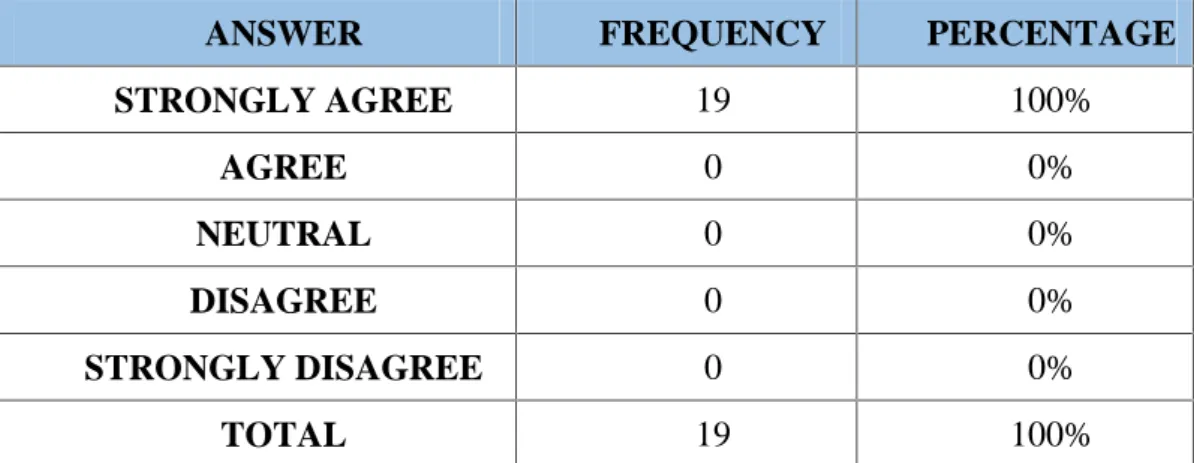
Question 1: Do you consider that English is important in the academic life? Chart Nº 6: English language importance
ANSWER FREQUENCY PERCENTAGE
STRONGLY AGREE 19 100%
AGREE 0 0%
NEUTRAL 0 0%
DISAGREE 0 0%
STRONGLY DISAGREE 0 0%
TOTAL 19 100%
Author: Pablo Iván Valarezo Loor
Source:Unidad Educativa “Sagrados Corazones”
Graphic Nº 1: English language importance
Author: Pablo Iván Valarezo Loor
Source:Unidad Educativa “Sagrados Corazones” 0%
10% 20% 30% 40% 50% 60% 70% 80% 90% 100%
STRONGLY AGREE
AGREE NEUTRAL DISAGREE STRONGLY
DISAGREE 100%
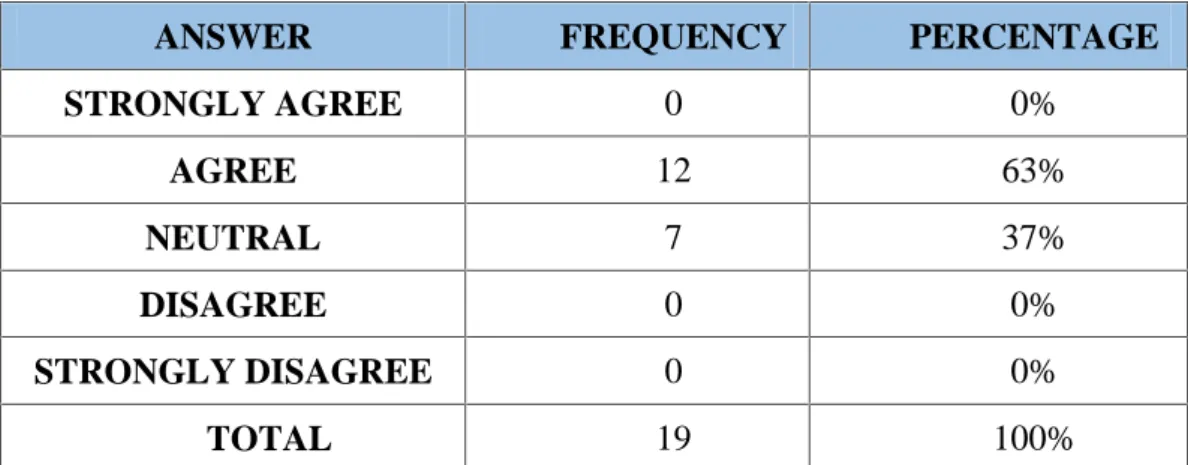
Question 2: Do you consider that English subject in your school is interesting?
Chart Nº 7: Students' appreciation about English
ANSWER FREQUENCY PERCENTAGE
STRONGLY AGREE 0 0%
AGREE 12 63%
NEUTRAL 7 37%
DISAGREE 0 0%
STRONGLY DISAGREE 0 0%
TOTAL 19 100%
Author: Pablo Iván Valarezo Loor
Source:Unidad Educativa “Sagrados Corazones”
Graphic Nº 2: Students' appreciation about English
Author: Pablo Iván Valarezo Loor
Source:Unidad Educativa “Sagrados Corazones”
Interpretation: 63 % of surveyed students agreed that English subject is
interesting, while 37% of students are neutral in their appreciation.
0% 10% 20% 30% 40% 50% 60% 70%
STRONGLY AGREE
AGREE NEUTRAL DISAGREE STRONGLY
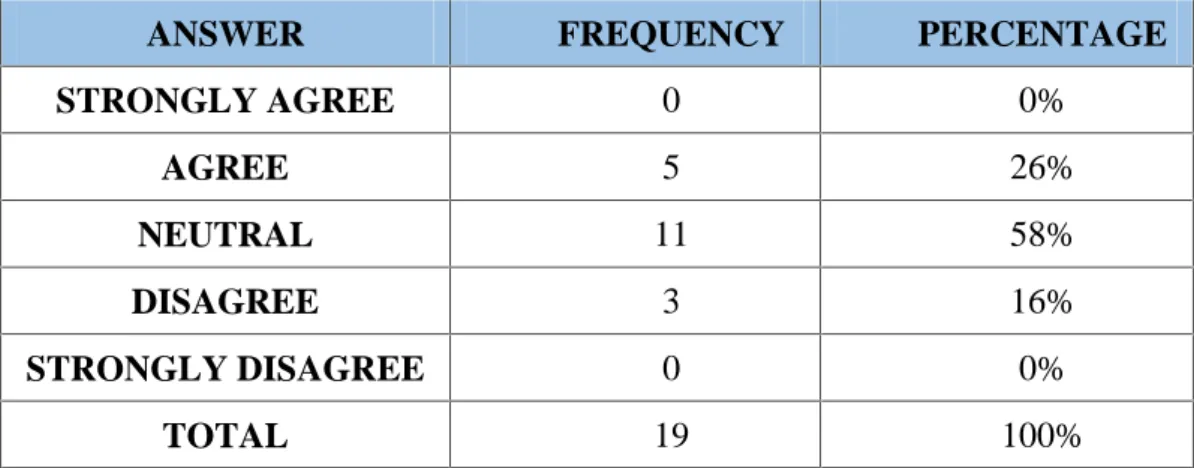
Question 3: It is difficult for you to speak in English?
Chart Nº 8: Speaking difficultness for students
ANSWER FREQUENCY PERCENTAGE
STRONGLY AGREE 0 0%
AGREE 5 26%
NEUTRAL 11 58%
DISAGREE 3 16%
STRONGLY DISAGREE 0 0%
TOTAL 19 100%
Author: Pablo Iván Valarezo Loor
Source:Unidad Educativa “Sagrados Corazones”
Graphic Nº 3: Speaking difficultness for students
Author: Pablo Iván Valarezo Loor
Source:Unidad Educativa “Sagrados Corazones”
Interpretation: Most students (58%) are neutral in their appreciation about the
difficultness of speaking in English; 26% considered that it is difficult for them to
0% 10% 20% 30% 40% 50% 60%
STRONGLY AGREE
AGREE NEUTRAL DISAGREE STRONGLY
Question 4: Are English teachers pedagogically prepared to develop English speaking skills?
Chart Nº 9: Students' opinion about English teachers' training
ANSWER FREQUENCY PERCENTAGE
STRONGLY AGREE 16 84%
AGREE 1 5%
NEUTRAL 0 0%
DISAGREE 2 11%
STRONGLY DISAGREE 0 0%
TOTAL 19 100%
Author: Pablo Iván Valarezo Loor
Source:Unidad Educativa “Sagrados Corazones”
Graphic Nº 4: Students' opinion about English teachers' training
Author: Pablo Iván Valarezo Loor
Source: Unidad Educativa“Sagrados Corazones”
Interpretation: 84% of students strongly agreed that teachers are pedagogically
prepared to develop English speaking skills, while 5% agreed, none feel neutral
and 11% of students disagreed that teachers are pedagogically prepared to develop
English speaking skills.
0% 10% 20% 30% 40% 50% 60% 70% 80% 90% STRONGLY AGREE
AGREE NEUTRAL DISAGREE STRONGLY
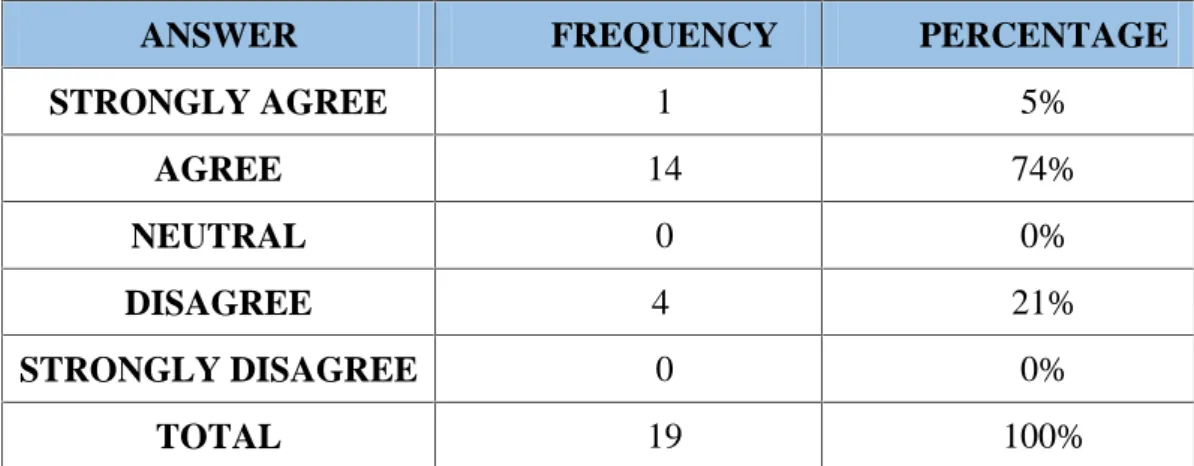
Question 5: Do you think that the use of different strategies in class will help to improve speaking in students?
Chart Nº 10: Students’opinion about the application of strategies
ANSWER FREQUENCY PERCENTAGE
STRONGLY AGREE 1 5%
AGREE 14 74%
NEUTRAL 0 0%
DISAGREE 4 21%
STRONGLY DISAGREE 0 0%
TOTAL 19 100%
Author: Pablo Iván Valarezo Loor
Source:Unidad Educativa “Sagrados Corazones”
Graphic Nº 5:Students’opinion about the application of strategies
Author: Pablo Iván Valarezo Loor
Source:Unidad Educativa “Sagrados Corazones”
Interpretation: 5% of students agreed that the use of different strategies in class 0%
10% 20% 30% 40% 50% 60% 70% 80%
STRONGLY AGREE
AGREE NEUTRAL DISAGREE STRONGLY
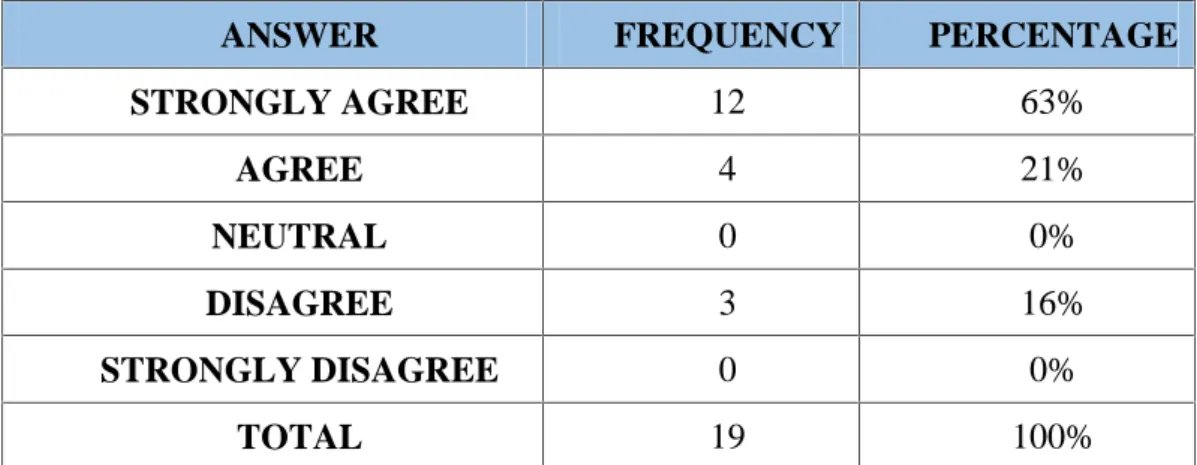
Question 6: Do you consider that teachers should use additional resources in class to reinforce the speaking practice?
Chart Nº 11: Application of additional resources to practice speaking
ANSWER FREQUENCY PERCENTAGE
STRONGLY AGREE 12 63%
AGREE 4 21%
NEUTRAL 0 0%
DISAGREE 3 16%
STRONGLY DISAGREE 0 0%
TOTAL 19 100%
Author: Pablo Iván Valarezo Loor
Source:Unidad Educativa “Sagrados Corazones”
Graphic Nº 6: Application of additional resources to practice speaking
Author: Pablo Iván Valarezo Loor
Source:Unidad Educativa “Sagrados Corazones”
Interpretation: 63% students strongly agreed that teachers should use additional
resources in class to reinforce the speaking practice, 21% agreed none feel neutral
and 16% disagreed.
0% 10% 20% 30% 40% 50% 60% 70%
STRONGLY AGREE
AGREE NEUTRAL DISAGREE STRONGLY
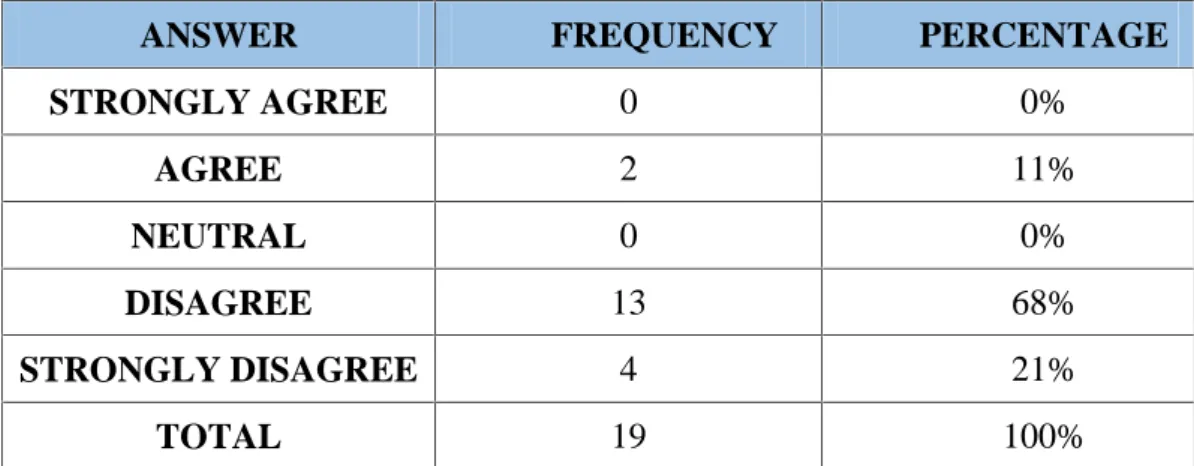
Question 7: Do you consider that you have developed your speaking skills satisfactorily?
Chart Nº 12: Students' opinion about their speaking proficiency
ANSWER FREQUENCY PERCENTAGE
STRONGLY AGREE 0 0%
AGREE 2 11%
NEUTRAL 0 0%
DISAGREE 13 68%
STRONGLY DISAGREE 4 21%
TOTAL 19 100%
Author: Pablo Iván Valarezo Loor
Source:Unidad Educativa “Sagrados Corazones”
Graphic Nº 7: Students' opinion about their speaking proficiency
Author: Pablo Iván Valarezo Loor
Source:Unidad Educativa “Sagrados Corazones”
Interpretation: Most students (68%) considered that they have not developed 0%
10% 20% 30% 40% 50% 60% 70%
STRONGLY AGREE
AGREE NEUTRAL DISAGREE STRONGLY
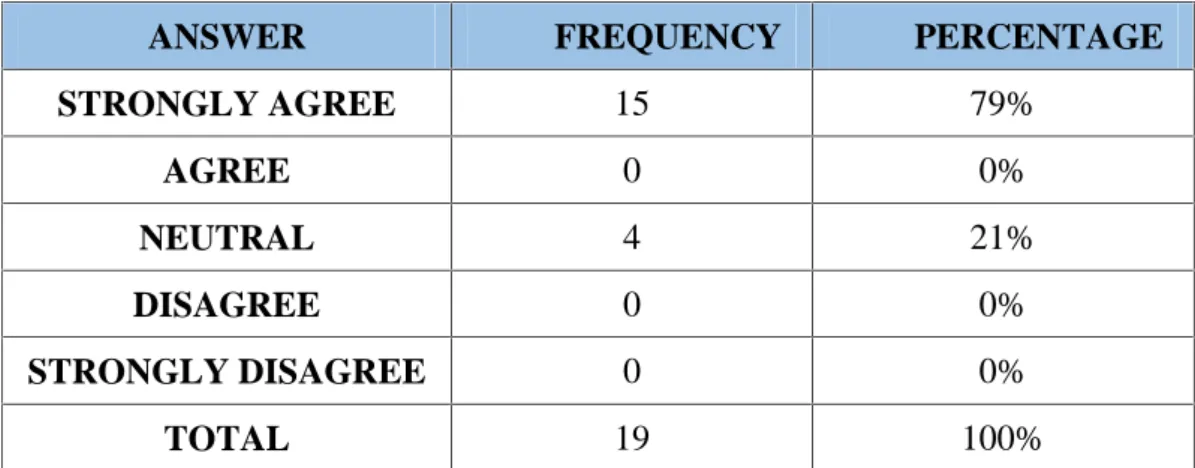
Question 8: Do you consider that the use of a handbook in class will reinforce the speaking skills?
Chart Nº 13: Students' opinion about the application of a handbook
ANSWER FREQUENCY PERCENTAGE
STRONGLY AGREE 15 79%
AGREE 0 0%
NEUTRAL 4 21%
DISAGREE 0 0%
STRONGLY DISAGREE 0 0%
TOTAL 19 100%
Author: Pablo Iván Valarezo Loor
Source:Unidad Educativa “Sagrados Corazones”
Graphic Nº 8: Students' opinion about the application of a handbook
Author: Pablo Iván Valarezo Loor
Source:Unidad Educativa “Sagrados Corazones”
Interpretation: Most survey students (79%) considered that the application of a
handbook is a good option to practice their speaking skill and 21% were not sure
in their answer.
0% 10% 20% 30% 40% 50% 60% 70% 80%
STRONGLY AGREE
AGREE NEUTRAL DISAGREE STRONGLY
3.8.5 Analysis of Student Questions
Then the general results of the 19 students for each of the 10 questions of the
survey were presented.
A - Strongly agree
B - Agree
C - Neutral
D - Disagree
E - Strongly disagree
Chart Nº 14: Analysis of Students' survey
Number of questions
A B C D E Total
1 14 5 0 0 0 19
2 4 8 7 0 0 19
3 6 1 0 11 1 19
4 16 2 0 1 0 19
5 12 4 1 2 0 19
6 12 4 3 0 0 19
7 3 3 13 0 0 19
9 9 8 1 1 0 19