PENÍNSULA OF SANTA ELENA STATE UNIVERSITY
FACULTY OF EDUCATION AND LANGUAGES
ENGLISH TEACHING CAREER
“PUPPETS AS A STRATEGY TO IMPROVE ENGLISH VOCABULARY FOR CHILDREN OF FIRST BASIC YEAR, AT U. E. ACADEMIA CAP. “LEONARDO ABAD ASTUDILLO”, LA LIBERTAD, SANTA ELENA PROVINCE, 2015-2016”
RESEARCH PAPER
As a prerequisite to obtain a:
BACHELOR´S DEGREE IN ENGLISH
AUTHOR: PATRICIA GONZÁLEZ ESPAÑA ADVISOR: ING. SANDRA CAAMAÑO MSc.
LA LIBERTAD – ECUADOR
UNIVERSIDAD ESTATAL PENÍNSULA DE SANTA ELENA
FACULTAD CIENCIAS DE LA EDUCACIÓN E IDIOMAS
CARRERA DE LICENCIATURA EN INGLÉS
“PUPPETS AS A STRATEGY TO IMPROVE ENGLISH VOCABULARY FOR CHILDREN OF FIRST BASIC YEAR, AT U. E. ACADEMIA CAP. “LEONARDO ABAD ASTUDILLO”, LA LIBERTAD, SANTA ELENA PROVINCE, 2015-2016”
Trabajo de Titulación previo a la obtención del título de:
LICENCIADA EN INGLÉS
AUTHOR: PATRICIA LORENA GONZÁLEZ ESPAÑA ADVISOR: ING. SANDRA CAAMAÑO MSc.
LA LIBERTAD – ECUADOR
PENÍNSULA OF SANTA ELENA STATE UNIVERSITY
FACULTY OF EDUCATION AND LANGUAGES
ENGLISH TEACHING CAREER
“PUPPETS AS A STRATEGY TO IMPROVE ENGLISH VOCABULARY
FOR CHILDREN OF FIRST BASIC YEAR, AT U. E. ACADEMIA CAP. “LEONARDO ABAD ASTUDILLO”, LA LIBERTAD, SANTA ELENA
PROVINCE, 2015-2016”
RESEARCH PAPER
As a prerequisite to obtain a:
BACHELOR´S DEGREE IN ENGLISH
AUTHOR: PATRICIA LORENA GONZÁLEZ ESPAÑA ADVISOR: ING. SANDRA CAAMAÑO MSc.
LA LIBERTAD – ECUADOR
I La Libertad, April 26th-2016
ADVISOR´S APPROVAL
In my role as advisor of the research paper under the title “Puppets as a strategy to improve English Vocabulary for Children of first Basic year, at U. E. Academia Cap. “Leonardo Abad Astudillo” La Libertad, Santa Elena Province, 2015-2016 prepared by Patricia González España undergraduate student of the English Teaching Career, Faculty of Education and Languages at Penínsulaof Santa Elena State University, I declare that I have revised the project and approve it in its entirety, because it meets the requirements and is sufficient for its submission to the evaluation of the Board of Examiners.
Sincerely,
_____________________________ Ing. Sandra Caamaño López MSc.
II La Libertad, April 26th-2016
STATEMENT OF AUTHORSHIP
I, Patricia Lorena González España with ID number 09-1685211-4 undergraduate student from the Península of Santa Elena State University, Faculty of Education and Languages, as a prerequisite to obtain a Bachelor´s degree in English, in my role as author of the research paper “Puppets as a strategy to improve English Vocabulary for Children of first Basic year, at U. E. Academia Cap. “Leonardo Abad Astudillo” La Libertad, Santa Elena Province, 2015-2016”,
certify that this work is of my authorship, except for the quotes and reflections used in this research paper.
____________________________
III
BOARD OF EXAMINERS
__________________ ___________________
Dra. Nelly Panchana Rodríguez, MSc. Lcda. Glenda Pinoargote Parra, M.A.FACULTY OF EDUCATION AND ENGLISH TEACHING CAREER DIRECTOR LANGUAGES DEAN
__________________________ _________________________
Ing. Sandra Caamaño López. MSc. Ing. Tatiana García Villao. MSc. ADVISOR AREA PROFESSOR
_____________________________________ Ab. Joe Espinoza Ayala, MSc.
IV
DEDICATION
This thesis is dedicated to my parents who have supported me since the beginning of my studies. Also, this thesis is dedicated to my husband, my son and my daughter who have been a great source of motivation and inspiration. Finally, this thesis is dedicated to all those who believe in the richness of learning especially to my teachers and friends.
I dedicate this work to my family who I love very much and inspired me to finish my career.
V
ACKNOWLEDGMENT
Foremost, I would like to express my sincere gratitude to God, and to my advisor Ing. Sandra Caamaño MSc. for the continuous support, for her patience, motivation, enthusiasm, and immense knowledge. Her guidance helped me through the process of this research. I could not have imagined having a better advisor and mentor for my Bachelor´s Degree in English.
A special recognition to the Director of the English Teaching Career MSc. Glenda Pinoargote Parra for her guidance and expertise managing the English Teaching Career.
VI
DECLARATION
“The Content of the following Graduation Work is my responsibility; the intellectual property belongs to the Peninsula of Santa Elena State University”.
_______________________________
VII
GENERAL CONTENT
ADVISOR´S APPROVAL ... I STATEMENT OF AUTHORSHIP ... II BOARD OF EXAMINERS ... III DEDICATION ... IV ACKNOWLEDGMENT ... V DECLARATION ... VI GENERAL CONTENT ... VII ABSTRACT ... XIV
INTRODUCTION ... 1
CHAPTER I: THE PROBLEM 1.1. Title ... 3
1.2. Statement of the problem ... 3
1.2.1. Contex ... 3
1.2.2. Critical analysis ... 4
1.2.3. Formulation of the problem ... 5
1.2.4. Guideline questions ... 5
1.2.5. Delimitation of research object ... 5
1.3. Significance ... 6
1.4. Objectives of the research ... 7
1.4.1. General ... 7
1.4.2. Specific ... 7
CHAPTER II: LITERATURE REVIEW 2.1. Previous research ... 8
2.1.1. Developing English in children ... 8
2.1.2. First Language Acquisition ... 9
2.1.3. How children learn vocabulary? ... 10
VIII
2.1.5. The role of vocabulary teaching ... 12
2.1.6. Vocabulary and Linguistic ... 12
2.1.7. Vocabulary Learning Occurs ... 13
2.1.9. What is Vocabulary? ... 15
2.1.10. What are puppets? ... 16
2.1.11. Puppets in English ... 17
2.1.12. Puppets in Education ... 17
2.1.13. Puppet Theater ... 18
2.2. Philosophical Basis ... 19
2.3. Pedagogical basis ... 19
2.4. Legal Basis ... 20
2.4.1. Constitution of the Republic of Ecuador ... 20
2.4.2. Law of intercultural Education... 20
CHAPTER III: METHODOLOGY 3.1. Research approach ... 21
3.1.1. The Quantitative Method ... 21
3.1.2. Qualitative Method... 21
3.1.3. Deductive and Inductive Method ... 21
3.1.4. Scientific method ... 22
3.2. Level of type of research ... 22
3.3. Population and sample ... 23
3.3.1. Population ... 23
3.3.2. Sample ... 23
3.4. Variables operationalization... 24
3.4.1. Dependent variable: Vocabulary ... 24
3.4.2. Independent variable: Puppets ... 25
3.5. Techniques and instruments for data collection ... 26
3.5.1. Techniques ... 26
3.5.1.1. Observation ... 26
IX
3.5.3. Instruments ... 26
3.5.3.1. Camera ... 26
3.6. Data collection plan... 27
3.7. Data processing plan ... 28
3.8. Analysis and interpretation of the results ... 29
3.8.1. Interview to Specialist ... 29
3.8.2. Interview to principal ... 31
3.8.3 Interview to the English teacher ... 33
3.9 CONCLUSIONS AND RECOMMENDATIONS ... 35
3.9.1 Conclusions ... 35
3.9. 2 Recommendations ... 35
3.10 Observation Guide………....36
CHAPTER IV: PROPOSAL 4.1. Informative data ... 37
4.2. Feasibility ... 39
4.2.1. Characteristics of the proposal ... 39
4.3. Proposal background ... 39
4.4. Significance ... 40
4.5. Advantages of using Puppets ... 40
4.6. Objectives ... 41
4.6.1. General objective ... 41
4.6.2. Specific objectives ... 41
4.7. Design and development of the proposal ... 41
4.7.1. Benefits of using puppets with children ... 41
4.7.2. Ways to use puppets with children... 42
4.7.3. Types of puppets ... 43
4.7.4. Activities developed with puppets in class ... 44
4.7.5. Activities ... 44
X
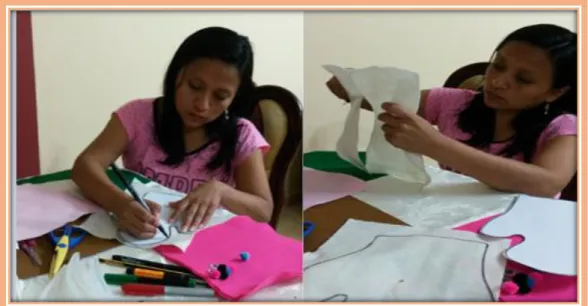
4.7.8. Step to design a puppet: ... 46
4.8.Topics of The Vocabulary ... 47
4.9. Conclusions and Recommendations……..……….65
CHAPTER V: ADMINISTRATIVE FRAMEWORK CONCLUSIONS ... 66
RECOMMENDATIONS ... 67
5.1. Resources ... 68
5.1.1.Materials ... 68
5.1.2.Budget ... 69
5.2.Timetable... 70
XI
LIST OF ILLUSTRATIONS
ILLUSTRATION 1: PUPPETS ... 16
ILLUSTRATION 2: PUPPET THEATER ... 18
ILLUSTRATION 3: U.E. ACAD. CAP.“LEONARDOABADASTUDILLO” .... 37
ILLUSTRATION 4: CHILDREN AT U.E. ACAD. CAP. LEONARDO ABAD . 38 ILLUSTRATION 5: PUPPETS PULLED OVER HANDS ... 43
ILLUSTRATION 6: BOOK OF FIRST GRADE ... 44
ILLUSTRATION 7: PUPPETS THEATER ... 44
ILLUSTRATION 8: MATERIALS TO MAKE A PUPPET ... 45
LLUSTRATION 9: MAKING PUPPET ... 46
ILLUSTRATION 10: MAKING PUPPET ... 46
ILLUSTRATION 11: ANIMALS ... 48
ILLUSTRATION 12: COLORS ... 49
ILLUSTRATION 13: TOYS ... 50
ILLUSTRATION 14: FIVE SENSE ... 51
ILLUSTRATION 15: DAYS OF THE WEEK ... 52
ILLUSTRATION 16: ALPHABET ... 53
ILLUSTRATION 17: MY FAVORITE CLOTHES ... 54
ILLUSTRATION 18: OBJECTS IN THE CLASSROOM ... 55
ILLUSTRATION 19: OCCUPATIONS ... 56
XII
LIST OF CHARTS
CHART 1: POPULATION ... 23
CHART 2: SAMPLE ... 23
CHART 3: DEPENDENT VARIABLE ... 24
CHART 4: INDEPENDENT VARIABLE ... 25
CHART 5: INDEPENDENT VARIABLE ... 27
CHART 6: DATA PROCESSING PLAN ... 28
CHART 7: TOPICS OF THE VOCABULARY ... 47
CHART 8: TOPICS OF THE VOCABULARY ... 58
CHART 9: BLOOM’S TAXONOMY ... 59
CHART 10: DIAGNOSTIC TEST RESULTS ... 60
CHART 11: POST TEST RESULTS ... 61
CHART 12: IMPROVEMENT IN VOCABULARY ... 62
CHART 13: DIAGNOSTIC TEST RESULTS ... 63
CHART 14: POST TEST RESULTS ... 64
CHART 15: IMPROVEMENT IN VOCABULARY ... 65
CHART 16: PUPPETS MATERIALS ... 68
CHART 17: BUDGET ... 69
XIII
LIST OF APPENDIX
APPENDIX 1: INTERVIEW TO THE PRINCIPAL ... 75
APPENDIX 2: INTERVIEW TO THE TEACHER ... 76
APPENDIX 3: INTERVIEW TO THE SPECIALIST ... 77
APPENDIX 4: STUDENTS LIST ... 78
APPENDIX 5: STUDENTS LIST ... 79
APPENDIX 6: IMPROVEMENT OF THE PROPOSAL ... 80
APPENDIX 7: IMPROVEMENT OF THE PROPOSAL ... 81
APPENDIX 8: VIDEOS CAPTURE SCREEN ... 82
APPENDIX 9: INTERVIEW TO THE PRINCIPAL AND TEACHER ... 83
APPENDIX 10: INTERVIEW TO THE SPECIALIST ... 84
APPENDIX 11: URKUND CERTIFICATION ... 85
APPENDIX 12: ADVISOR CERTIFICATION ... 86
APPENDIX 13: AUTHORIZATION TO APPLY THE PROPOSAL ... 87
XIV
PENÍNSULA OF SANTA ELENA STATE UNIVERSITY
FACULTY OF EDUCATION AND LANGUAGES
ENGLISH TEACHING CAREER
“PUPPETS AS A STRATEGY TO IMPROVE ENGLISH VOCABULARY FOR CHILDREN OF FIRST BASIC YEAR, AT U. E. ACADEMIA CAP. “LEONARDO ABAD ASTUDILLO” LA LIBERTAD, SANTA ELENA PROVINCE, 2015-2016 ”
Author: Patricia González España.
Advisor: Ing. Sandra Caamaño López MSc.
ABSTRACT
This research is focused on the use of puppets to improve English vocabulary because for children the use of puppets is a good and educational strategy. Children at an early age learn new things faster than adults, in the case of languages acquisition the first years in elementary school are important. Students process information and learn new knowledge but the learning process has to be motivated by the teachers with new and different methodologies to capture the attention of them. Puppets catch the attention of students in all languages, these resources are well known in several subjects, and in the elementary school at Unidad Educativa. Academia Cap. “Leonardo Abad Astudillo”, the use of puppets contributed to improve English vocabulary in the first year of basic education. The results permitted that Children increase their vocabulary through scientific method and It proved the effectiveness of its application.
1
INTRODUCTION
Nowadays, English language is important around the world because it is used to communicate with foreign people with different purposes for business, education tourism and others. English is the most important language around the world. In the case of children, the acquisition of a new language is elemental at early childhood. Children have a learning process different from adults. Children are influenced by the surrounding and the people in their lives they have contact with they receive new information and students learn new things every day.
The purpose of this investigation is to use puppets as a strategy to improve English Vocabulary because this didactical resource captures the attention in students and makes active and participative classes. This research paper is organized by chapters and each one covers different aspects of this work.
Chapter I describes the statement of the problem, context, critical analysis, formulation of the problem, guideline questions, limitation, research project, significance and objectives of the research (general and specific).
Chapter II is about literature review, it contains previous research, philosophical basis, fundamental categories, legal basis, hypothesis and variables of the study.
Chapter III is based on the methodology; on it you will find the research approach, level or type of the research, population and sample, techniques and instruments, analysis and interpretation of the results and finally, conclusions and recommendations.
2 development of the proposal, charts, tables and graphs, and interpretations of the results of surveys.
3
CHAPTER I
THE PROBLEM
1.1.Title
“PUPPETS AS A STRATEGY TO IMPROVE ENGLISH VOCABULARY FOR CHILDREN OF FIRST BASIC YEAR, AT U. E. ACADEMIA CAP. “LEONARDO ABAD ASTUDILLO” LA LIBERTAD, SANTA ELENA PROVINCE, 2015-2016”.
1.2. Statement of the problem 1.2.1. Context
English is a universal language, people all over the world requires to achieve in this language at a progressively higher level. A good level of knowledge in the English language is today essential more than a choice. Phenomena like globalization and technology make more investigations challenging and Education standards, make English ability a mandatory requisite in any field of proficiency.
The Ecuadorian Ministry of Education and officials who are directing the change in the Teaching regulation and performances should pay special attention to the teaching and learning process in public schools. Educators can greatly take advantage from the present work in order to understand how they could improve as teachers, including new methods and implementing didactic resources.
4 In Ecuador, some private institutions prepare their students with a good level of English because parents are responsible for buying children´s school supplies including textbooks and other materials which can be expensive but the majority of public schools at the Province Santa Elena don´t apply new approaches since beginning standard to achieve a good English level.
The U.E. Academia Naval Cap. “Leonardo Abad Astudillo” in La Libertad, Santa Elena Province students take English since kindergarten and they are at an age that they can learn English easily and the application of the puppets is a tool that can contribute to reach this goal.
1.2.2. Critical analysis
Puppets are an important resource in the classroom, because they activate the previous knowledge of pupils, beginning from any discipline and also transforms behavior, develops body language. It is an approach to develop language skills allowing students to accomplish goals. Group activities can help students to work with enthusiasm and effort.
Using stories with puppet plays, permit to work cooperatively with others and also reinforce their individual necessities. Using puppets as a pedagogical strategy can turn a resource of great attraction for children, because they change the world, transform, interact and easily penetrate to the history or facts that are represented.”
5 classroom where there are not many events and tactics that captivate students´ attention for the enhancement of the language.
1.2.3. Formulation of the problem
How can Puppets help to teach vocabulary to Children of first Basic year at U.E. Academia Naval Cap. “Leonardo Abad Astudillo”?
1.2.4. Guideline questions What is Vocabulary?
What is the influence of the use of Puppet Theater to improve English Vocabulary for Children of first Basic year at U.E., Academia Naval Cap. “Leonardo Abad Astudillo”?
What are Puppets?
1.2.5. Delimitation of research object FIELD: Education.
AREA: English.
ASPECT: Puppets as a strategy to improve English Vocabulary in children of first Basic year.
TITLE: “Puppets as a strategy to improve English Vocabulary for Children
6
PROBLEM: English vocabulary on children of first basic year at U.E. Academia Cap. “Leonardo Abad Astudillo”.
TIME LIMITATION: During the academic year 2015-2016.
POPULATION LIMITATION: First year students at U.E. Academia Cap. “Leonardo Abad Astudillo”.
SPACE LIMITATION: U.E.Academia Cap. “Leonardo Abad Astudillo”.
CONTEXT LIMITATION: The use of the puppets as a strategy to improve Vocabulary for children of first basic year, at U.E. Academia Cap. “Leonardo Abad Astudillo”.
1.3. Significance
Many children arrive from kindergarten to basic school with curiosity to learn things with the interest to absorb what surrounds the world. An educator´s responsibility is to encourage this knowledge, motivating to make learners experiment, as well as defend them.
Studies have demonstrated that using puppets in a class has many benefits; puppets provide an opportunity to develop student´s communication and social skills and high-quality primary programs have long-lasting optimistic effects on theoretical accomplishment. Puppets can be used to impart the language meanings and the social helps of greeting, answering to dialogue, and introducing a conversation.
7
1.4. Objectives of the research 1.4.1. General
To improve English vocabulary through the use of puppets as a strategy for children of first basic year at U.E. Academia Cap. “Leonardo Abad Astudillo” La Libertad Canton, Santa Elena Province, 2015-2016.
1.4.2. Specific
To improve English vocabulary to the students of first basic year at U.E. Academia Cap. “Leonardo Abad Astudillo”.
To identify appropriate activities using Puppets to improve English Vocabulary for Children of first Basic year, at U.E. Academia Cap. “Leonardo Abad Astudillo”.
8
CHAPTER II
THEORETICAL FRAMEWORK
2.1. Previous research
2.1.1. Developing English in children
“Imagination is more important than knowledge. Knowledge is limited. Imagination encircles the world” (Einstein, 2013)
This investigation is focused on discovering how to improve English vocabulary to children using puppets. Even though working with kids is entertaining and exciting, it is demanding because it is necessary for teachers apply correct strategies in the classroom. A puppet is an excellent instrument in Education because it can be used to express thoughts and feelings. Puppetry can be represented with objects, animals and other things that the imagination can create.
(Marcos, 2010) Teachers in preschool kids have to use different methodologies. They have to use songs, toys or other didactical resources. Because in childhood, it is important to practice and motivate students to speak in English, in early childhood, students can learn languages easier than When they are teenagers.
According to (Kristenova, 2006)English language acquisition is fundamental nowadays because around the world people make business in English. In many aspects of life English is a requirement.
9 Children learn through the contact with people around them. Children sometimes acquire proficiency in the speaking skill but they do not realize the rules or the other components of the languages as the grammar and syntax.
According to (British Association, 2010) Children interact with other people and learn from them every day. In preschool children develop different skills; teachers have to encourage them to work in English class. Kids should enjoy doing individuals exercises and group exercises to develop English language acquisition. Every child learns in a different way and teachers have to find the best strategy in class.
2.1.2. First Language Acquisition
According to (Torikul, 2013) kids in the early childhood learn vocabulary with the repetition and with contact of people who speak English, and people respond to specific stimulus but this methodology contributes in the learning process of a foreign language too.
(Diessel, 2011) indicates two theories about first language acquisition the dependence on the learning mechanism of each people, and on the other hand, the language acquisition is influenced by the surround and the environment and individuals do not learn languages alone. It is necessary the contact with other people.
10 Noam Chomsky’s theory about the learning process of languages is innate in children. It depends on the environment. The faculty of learning a new language comes in the genetic part of the children. They are born with an innate mechanism in their brain and that helps to acquire the language. They do not realize about the learning process but they can speak their native language. (Johnston, 2015).
(OGrady, 2010) Talks about how language acquisition occurs in children, it depends on the environment, the family context, the toys and pictures and also the place where they live, but children capture just one part of the information and the other part depends on the instructions of adults and the learning process promoting by teachers on elementary school.
2.1.3. How children learn vocabulary?
Children learn a new language with the contact of the environment because they repeat all the words and things that adults make at home. They repeat and learn to pronounce the words. In an English class, teachers use repetition and pictures to show the objects and the words of the different things. (Padilla, 2014).
According to (Nunes, 2004)showed the interest in students to learn vocabulary. and how students through memorizing and remembering the word try to learn vocabulary. In the cases of children the application of visual aids, flash card, toys or another didactical resources is recommended to help in the English learning process.
11 the subject in the English language, students have to learn how to pronounce the words and they have to learn vocabulary in class and reinforce at home.
According to (McKeown, 2008) the learning process of Vocabulary in kindergarten influences in the reading comprehension in the intermediate and middle school years in the students. The learning process of vocabulary affects the reading comprehension in the future of the students.
2.1.4. Teaching vocabulary to children
(Kristenova, 2006) Indicates the importance to improve English Vocabulary to children and how it is relevant to teach in an active way to kids. The different techniques are pictures, plays, situations, gesture, explanations. Students have to enjoy the class, this stimulates the learning process.
Vocabulary is fundamental to develop the English language acquisition because vocabulary helps to understand the language. Students are able to answer questions and speak in English if they know enough words. With the practice, students learn fluency but first, they have to learn vocabulary correctly. (Tesol, 2010).
(Trujillo, 2012) Manifests that teaching a new language is difficult in children. Because depending on the ages, they do not have the ability to write or read in the native tongue and it is more difficult to teach another language without didactical resources.
12 (Sloan, 2015) indicates that vocabulary is necessary to express in a new language. Students have to know the meaning of the word and the probable application or context for the use of the vocabulary. If English is not the native language of the children, in most cases they have several problems to communicate in English. Students have problems in the other subjects at school. They do not understand the message of the teacher or partner.
2.1.5. The role of vocabulary teaching
(Arroyo, 2010) Suggests the use of new techniques in English class using technological resources in elementary schools like: computer, projector, internet, CD play. It is necessary that students have to be active. Students have to enjoy and understand the class not just repeat the words to learn vocabulary. Teaching vocabulary requires different techniques and strategies to encourage students to speak in English.
According to (Diessel, 2011) teachers have to motivate students to speak in class. Teachers have to apply strategies to improve English Vocabulary. In the case of students in the early childhood the use of songs, toys, puppets, and flashcards is necessary to get the attention in the children.
(Stamos, 2013) Says that the learning process of a new language is necessary to learn in first place the vocabulary. In the case of children, in the early age they learn vocabulary. They do not know the grammar rules in their native language or in the foreign language. Even in the adulthood, students learn new vocabulary and they learn the application or use the words for a specific subject.
2.1.6. Vocabulary and Linguistic
13 listening. Vocabulary is relevant to these four skills. Vocabulary makes people communicate with others in English.
The linguistic components in English are grammar, vocabulary and pronunciation because the English language acquisition depends on this tree aspects. Students of all ages require developing this linguistic component to obtain communicative competence in English languages or in any language.
Vocabulary is necessary to speak correctly. If people do not know vocabulary, they are not able to communicate with others. In childhood, teachers use toys and other resources to develop the English languages acquisition also. Teachers have to teach grammar and pronunciation.
Students have to learn new vocabulary because these expressions help to answer according different situations. To learn grammar is fundamental to develop the four skills in English but if students do not know enough vocabulary they cannot communicate with other people. There are a lot of strategies to improve English Vocabulary using reading or other activities in the case of children. Teachers have a lot of things to do, they have to use pictures, toys or some resources to get the attention of the students in class. (Marsaysk, 2012).
(Akbarian, 2012) The author studies the elements and parts of the words and the different vocabulary or conversation most applied according to the situation, the structures of words and the importance of the application of vocabulary in the English language. In this paper, the researcher gives some exercises to develop the use of new vocabulary in a conversation or how to apply vocabulary exercises in children.
2.1.7. Vocabulary Learning Occurs
14 words, they relate the pictures with the words and the information is processed. Students learn the context of the vocabulary. (Trujillo, 2012).
According to (Arroyo, 2010) Vocabulary learning occurs through direct instruction in the English class. The behaviorism theory occurs because in English class teachers use repetition of the different words to teach pronunciation to the students in class.
In (Silverman, Hartrant , & Meyer, 2014) this book presented different strategies to promote English vocabulary in children and how the visuals aids, songs, puppets and toys are a complement to the English learning process in students.
2.1.8. Importance of vocabulary in Children
The childhood is the period of time that when the brain absorbs more information. There are several studies about the learning process of children. In the case of learning English is necessary to learn this language in the childhood. Teachers have to apply special a method with pictures to relate the words with the things and context. (Navarro, 2009).
According to (Marcos, 2010) Behaviorism is a traditional learning theory in the case of the English learning process. It is part of Behaviorism to learn English because children repeat the words and sing songs in a mechanic form in the English class. They learn the pronunciation through repetition.
(John & Pikulsky, 2012) Express the acquisition of vocabulary is a great tool in all levels of education. In the second language acquisition, the learning process of new vocabulary is more difficult. In some occasions teachers have to use the process of memorization but in the case of children.
15 understand the new words. The development of English language acquisition depends on the vocabulary or phrase that students have learned in class.
2.1.9. What is Vocabulary?
According to (Ma, 2009) vocabulary is the use of words and the learning process of use this words according the context in English language. People have to know enough words according the situations.
In (Denning, Kessler, & Leben, 2007) vocabulary is words applied in different situations and contexts. In the case of English vocabulary, the English language has some synonymous and students have to know the context of the situations to apply a word.
According to (McKeown & Curtis , 2014) vocabulary is a vital element of the language studied by scholars of different levels to apply this word in different aspects or subjects. If students do not know enough vocabulary, they cannot speak successfully or say ideas in written form and oral. Vocabulary is the ability to know the meaning of words. Nevertheless, vocabulary is more difficult than this meaning indicates. This term derives two ways: Print and Oral.
According to (Finocchiaro, 2002) “the active vocabulary is the one that is taught very actively with respecting form, significance, and purpose in this manner that the student will be competent to apply it in all the writing activity, reading, speaking and listening. At difference that passive vocabulary is the one that is incorporated at the students in a talked or written content, but the student cannot reproduce the same on his own”.
16 used to identify in speaking and listening. Print Vocabulary consists on those words when they are used to identify in reading and writing.
Vocabulary is important to be able to understand the reading, answer questions and develop the speaking in students because using words people can communicate with others. In children, learning speaking is empathized in the preschool years or in the early childhood because students do not know how to write correctly. They have not learned grammar rules and syntax. They just memorize and remember the vocabulary. (Young, 2013)
2.1.10. What are puppets?
According to (CHETNA, 2008) puppets are the representation of a living character to tell a story. Puppets are made with different materials like: wood, cardboard and fabric. The style and the objective are different. Puppets are didactical resources. They are used to tell a story or teach vocabulary or new topics in children. Puppets get the attention of students in Spanish or English languages.
Teachers can teach vocabulary trough songs, a story, games or exercises. Children will feel happy in the class because puppets get the attention in children.
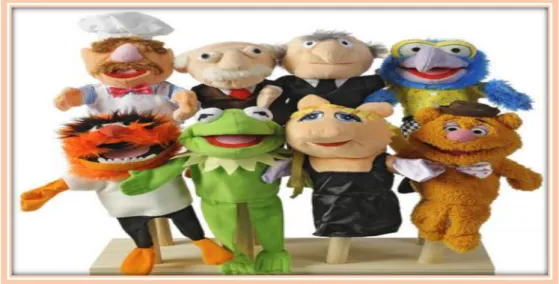
Illustration 1: Puppets
Source: www.google.com /images
17
2.1.11. Puppets in English
English language is the most important language around the world. Teachers have to use different methodologies to teach English in children because they have to get the attention of students.
Puppets are a good strategy to improve English vocabulary in students in preschool. They listen the words and repeat or students just listen the story. Puppets for children are toys and they have fun.
(Lopez, 2012) said teachers do not use puppets. Teachers have to prepare activities using this didactical resources because in the English learning process the use of puppets can help to interact in class. Teachers have to plan the English lesson or activity. The presentation with puppets motivates the students to talk and answer questions.
2.1.12. Puppets in Education
According to (Kristenova, 2006) children like puppets because they use their imagination and make things speak. They use toys, shoes or other things. Puppets is a good strategy in education because through this inanimate objects you can get the attention of the children.
Puppets have some benefits because children feel confidence to speak with puppets. These objects are like illustration in a story, students in early childhood enjoy the use of puppets and they are interested in the information.
18
2.1.13. Puppet Theater
According to (CHETNA, 2008) A puppet theater is a representation of a story or a song using puppets or toys. All the activities in the puppet theater have an objective to improve English Vocabulary, to send a message to the students or teach a story.
(Green, 2013) described ideas to apply to use puppets in the English learning of students and how puppets can be used, how visual resources are used to tell beautiful stories to young children in kinder garden and described the used of drama as a model of storytelling. The infancy is not a race to see how quickly a child can read, write and count. Childhood is a small window of time to learn and develop at the pace, which is right for each individual child. Education is a process where each person develops a series of rules and values in a society. There are many factors involving the progress of children´s learning like: family, school, technology and media. The school and family are vital to make children develop their abilities and skills. Puppetry is a form of theatre or performance, which involves the manipulation of puppets. It is used to tell a story. Puppetry takes many forms but they all share the process of animating inanimate performing objects. Puppets are used to capture the attention of people especially in kids from 3 to 7 years old. Most puppetry involves storytelling. (Lopez, 2012).
Illustration 2: Puppet Theater
Source: www.google.com / images
19
2.2. Philosophical Basis
(Harmer, 2007) On his work “How to teach English” claims that: “Language acquisition seems to be almost guaranteed for children up to about the age of six. They seem to be able to learn languages with incredible facility”. Children at this age have a sponge brain and they absorb knowledge and learn easily.
(McMahon, 2008) concludes that: “Children naturally invent stories, create settings, develop characters, and use expressive dialogue as they play. An observant bystander can easily see the similarities between children “playing” and performing “a play”. Children develop creativity when they play, when they act they can perform different activities.
2.3. Pedagogical basis
Children develop physically, cognitively and emotionally at a faster rate than at any other time in their lives. All professionals need to respond to this by supporting children as they learn to walk and run, speak and communicate, relate to others, play, and explore their world.
According to (Moyles & Musgrove, 2002) claim: “Pedagogy develops from a range of factors including theories and research evidence, political drivers evidence from practice, individual and group reflection, educators’ experience and expertise and community expectations and requirements.
20 This means pedagogy in children is complex and that is why the teacher should be careful when training and teaching to children, puppets are an excellent tool to make children acquire the language and share experiences between them.
2.4. Legal Basis
2.4.1. Constitution of the Republic of Ecuador
This research is based on the Ecuadorian Constitution of 2008 article 26 that mentions that Ecuadorians' Education is a right of people along life and it is an obligation from the government guarantying good living quality conditions. Families, community and persons have the responsibility and the right to participate in the educative process.
Article 27 says that education will consider the human beings to guarantee their universal development, inside the setting of respect of human rights, democracy and environment. It will be intercultural, democratic, inclusive, obligatory, participatory and with good quality.
It will promote quietness, gender fairness, solidarity and justice, encourage critical thinking, and the development of abilities and skills to accomplish their obligations and work. Education is essential for awareness of human rights and the building of a sovereign country, and is a strategic point for national growth.
2.4.2. Law of intercultural Education
According to article 6, it ensures continuous improvement of the quality of education and guarantee that all educational Institutions, promote a complete education, coeducational with a transversal visualization and application on rights.
21
CHAPTER III
METHODOLOGY
3.1. Research approach
The research was oriented on qualitative and qualitative methodology to determine the application of “Puppets as a strategy to improve English Vocabulary for Children of first Basic year, at U.E. Academia Cap. “Leonardo Abad Astudillo”, La Libertad, Santa Elena Province, 2015-2016.
Surveys were applied to determinate the impact of the application of puppets to teach vocabulary in children.
3.1.1. The Quantitative Method
This method was used to collect the data related to the research and present statistical data about the improvement in the English vocabulary in students at U.E. Academia “Leonardo Abad Astudillo”.
3.1.2. Qualitative Method
This method was used in order to classify information, to describe and get some conclusions of the results of the proposal.
3.1.3. Deductive and Inductive Method
22
3.1.4. Scientific method
The scientific method was used to verify the obtained results to improve English Vocabulary in Children of first Basic year, at Unidad Educativa Academia Cap. “Leonardo Abad Astudillo”.
3.1.5. Observation Method
This method took place in the classroom to help to analyze the problem.
3.2. Level of type of research
Field Research.- It was important to collect information about the reports and scores of the students to demonstrate the low level of vocabulary to obtain evidence of the methodology and resources used by teachers in the institution.
Bibliographic Research. - It was used to search and select scientific-theoretical information in journals, books, web pages to obtain the data related about teaching vocabulary and the use of puppets.
23
3.3. Population and sample 3.3.1. Population
The population of this investigation was composed by two classes: First Grade “A” with 35 students and First Grade “B” with 38 students, a total of 73 students, principal (1), teachers (1) and (1) English Language expert.
Chart 1: Population
Source: Principal “U.E. Academia Cap. “Leonardo Abad Astudillo”
Author: Patricia González España.
3.3.2. Sample
No sample was taken because the population is less than 100 students. The population is 73 students.
Chart 2: Sample
CLASS STUDENTS
First Grade “A” 35 students
First Grade “B” 38 students
TOTAL 73 students
Source: Secretary Department
Author: Patricia González E.
NO DESCRIPTION QUANTITY PERCENTAGE
1 2 3
Principal English Teachers Students First grade
1 1 73
1% 1% 98%
24
3.4. Variables operationalization
3.4.1.
Dependent variable: VocabularyChart 3: Dependent Variable
Conceptualization Dimensions Indicators Items Techniques and
Instruments
Words used in a language to express oneself in different situations or contexts.
Words
Definitions
Test Homework Activities
Are students learning new vocabulary?
Can students communicate in English?
Act-out Lesson Plans Interview Test
Author: Patricia González E.
25
3.4.2.
Independent variable: Puppets
Chart 4: Independent Variable
Conceptualization Dimensions Indicators Items Technique and
instruments
Puppets are inanimate toys made of cloth or wool used to play or tell a story. Theatrical resources Arts Dramatization Didactic Resources
Involve teachers of pre-school with the implementation of the puppets in the classroom. Involve teachers in the use of the puppets in the classroom. Puppets in the teaching of new vocabulary.
Associating puppets in children's class.
Are puppets a useful resource to improve English vocabulary?
Can puppets teach English vocabulary in the students of first grade? Observation Roleplay Interview Survey Tests Activities
Author: Patricia González E.
26
3.5. Techniques and instruments for data collection
3.5.1. Techniques
In this research paper the following techniques were applied: observation and interview.
3.5.1.1. Observation
It was applied directly to the students of first basic year at U. E. Cap. “Leonardo Abad Astudillo”. This method will permit to identify the methods and strategies applied for the teacher in her classes.
3.5.1.2. Interview
It was applied to the principal, an specialist and the English teacher of first basic year at U.E. Cap. “Leonardo Abad Astudillo”.
3.5.3. Instruments 3.5.3.1. Camera
27
3.6. Data collection plan
Chart 5: Independent Variable
Basic questions Explanation
1. - What for? To improve vocabulary
2. - From which people or objects?
The students of first grade at U.E. Academia Cap. “Leonardo Abad Astudillo”.
3. - About what aspects? Vocabulary and use of puppets
4. - Who? Patricia Lorena González España.
5. - To whom? Principal, English teacher, students of
pre-school.
6.-When? 2015-2016
7.-Where? At U.E. Academia Cap. “Leonardo
Abad Astudillo”.
8. - How many times? Twice a month
9.-How? Group
10. - What data collection techniques? Interviews and observation
11.-With what? Camera. Computer. Puppets
28
3.7. Data processing plan
Chart 6: Data Processing Plan
Author: Patricia González España
Determination of a
situation Data search
Data pick up and analysis
Definition and
formulation Statement of solutions
The low level of vocabulary in children of first basic year at Unidad Educativa Cap. “Leonardo Abad Astudillo”.
After the identification of the problem, the researcher looked for information related to the use of puppets to develop vocabulary in the internet, books, etc. Three Interviews were applied.
Once the problem was ratified in the children of first year at Unidad Educativa Cap. “Leonardo Abad Astudillo”.
The researcher started to collect information and analyze the stated problem.
Using all the collected data and evidence of the impact of using puppets to improve children’s
vocabulary
29
3.8. Analysis and interpretation of the results
3.8.1. Interview to Specialist
Ms. Vanessa Ortiz, English Coordinator of Academia “Leonardo Abad Astudillo”. Bachelor in English Language and ten years working with children.
Question 1. What is the importance to learn a new language at childhood? The specialists expressed that at childhood, the learning process is faster than in adults, students learn a new language faster in the childhood, that is the reason the English learning acquisition starts at early childhood.
Question 2. What are the advantages of learning English at early childhood?
The specialists expressed that at early childhood the children process information faster and the interaction with foreign people influences in the English language acquisition. Children learn English in a natural form with the contact of the environment.
Question 3. Why is it important to learn English?
Because nowadays the English language is used around the world to communicate with people from other nationalities. It is the second language most spoken in the world.
Question 4. What are the strategies applied to teach English to kids?
To teach kids, teachers use flashcards, songs or pictures to improve English vocabulary because these resources get the attention of students.
Question 5. What kind of activities do you recommend to teach English?
30
Question 6. Have you ever used puppets in class?
Specialists indicated that they usually use puppets to teach English to children from 4 to 7 years old.
Question 7. Do you believe the use of puppets will improve vocabulary in students, in what aspects?
Specialists said that they agree that the use of puppets will improve the language learning in students.
Question 8. What kind of activities teachers can do in class using puppets?
Using puppets teachers can tell a story, sing a song, show new vocabulary and play some games with children in class.
Question 9. What kind of skills puppets can develop in children?
Specialists said that with the use of puppets children feel more confident to ask questions or repeat words, they enjoy the class and interact with other students.
Question 10. What resources do you apply to develop English vocabulary in children?
31
3.8.2. Interview to principal
Lcda. Sonia Barzola de Abad, principal of Academia “Leonardo Abad Astudillo for 18 years.
Question 1. Why do you consider English is fundamental in Education today?
It is fundamental because the English level is of vital importance to achieve new goals because around 30 countries in the world speak English.
Question 2. What are the strategies that your teachers have applied in their classes?
There are a lot of strategies. Teachers work with each student with inductive and deductive methods. Teachers reinforce the questions of the students.
Question 3. What experience have your teachers had during their classes with children in your school?
Wonderful experience and results. Students in high school speak English fluently and with foreign people.
Question 4. What are the most common resources used for teachers in your institution?
Song, videos, computer are the resources most used in this institution.
Question 5. What are the benefits and importance of learning English at early childhood?
There are a lot of benefits because students can learn faster at childhood.
Question 6. Do you think the use of puppets in class, can enhance children vocabulary for learning English? why?
32
Question 7. What kind of skills do you believe that the use of puppets can develop in children?
Puppets improve the speaking in the early childhood.
Question 8. What are the activities that your teachers have applied in class?
There are multiple activities, song, conversations, games, plays and others.
Question 9. Would you support the application of puppets for teaching English to children of first years?
33
3.8.3 Interview to the English teacher
Ms. Grace Béjar, English Teacher at Academia Cap. “Leonardo Abad Astudillo”, six years working with children.
Question 1: What resources do you use in your English classes?
The resources that I use in English class are: a computer, a projector, and a CD player.
Question 2: What kind of activities do you apply in your classes?
I apply individual and group work activities to know the level of comprehension of the students in class.
Question 3: Why is it important to teach English at childhood?
It is important to teach English at childhood because it is the precise stage to learn a new language.
Question 4: What are the benefits of leaning English at an early age?
When students are children their brain are like a sponge. They learn faster than adults. They can learn several languages.
Question 5: What skills can the use of puppets develop in children?
Puppets are other resources that I use in class to have an active class with children.
Question 6: What aspects in the use of puppets can help to improve the English teaching process?
For example when we practice speaking or repeat new vocabulary.
Question 7: What kind of exercises do you think contribute to better with the learning process of English?
34 understand the words and vocabulary.
Question 8: Do you think that using puppets in class is a good strategy to teach English to children. Why?
It is good because the use of puppets help to develop new skills in children.
Question 9: Have you ever used toys or puppets in class?
Yes, I have used puppets to teach vocabulary or new topics in class.
Question 10: What is your opinion about the use of puppets in first year of basic education?
35
3.9CONCLUSIONS AND RECOMMENDATIONS
3.9.1 Conclusions
1. Most of the interviewed people agreed that the use of puppets is a good strategy to improve English Vocabulary for children of first basic year at Unidad Educativa Cap. “Leonardo Abad Astudillo”.
2. Puppets are a good resource to get the attention of children.
3. The early childhood is the precise stage to learn a new language because the brain is like a sponge and children can learn faster than adults.
3.9. 2 Recommendations
1. All the English teachers of U. E. Cap. “Leonardo Abad Astudillo” should apply puppets to teach English vocabulary and prepare different activities.
2. Puppets should be used in the English classes especially with little children: Initial and First Basic year.
36
3.10 OBSERVATION GUIDE
GENERAL INFORMATION
Observer: Patricia González España.
Institution: U.E. Academia Naval Cap. “Leonardo Abad Astudillo”
Observed Teacher: Miss Vanessa Urdiales Course: First Grade “A” y “B”
Date: October 7th, 2015 Beginning time: 09:00 Finishing time: 09:45
Objective: To evaluate the teacher’s strategies and methodology applied to
develop English Vocabulary of first Basic year.
Nº DESCRIPTION YES NO PARTIALLY
Introduction and Content
1 Teacher establishes the objectives of class X
2 Teacher introduces English vocabulary
appropriately. X
3 Teacher shows students of the target vocabulary. X
4 Teacher provides children explanation of the new English Vocabulary. X Methodology
5 Teacher applies effective strategies to teaching English vocabulary to children. X 6
Teacher implements appropriate techniques according to the age and motivate to the children to repeat the new vocabulary.
X Didactic Resources
7 Teacher uses didactical resources to capture the attention in children. X 8 Teacher uses tools and creative resources to teach students English Vocabulary. X
9 Teacher encourages students to practice new words of the vocabulary. X
10 The teacher uses of didactical resources assistance to teach new vocabulary. X Evaluation
37
CHAPTER IV
THE PROPOSAL
4.1. Informative data
Title proposal
“PUPPETS AS A STRATEGY TO IMPROVE ENGLISH VOCABULARY FOR CHILDREN OF FIRST BASIC YEAR, AT U.E. ACADEMIA CAP. “LEONARDO ABAD ASTUDILLO”, LA LIBERTAD, SANTA ELENA PROVINCE, 2015-2016”.
Executing Institution
Unidad Educativa Academia Naval Cap. “Leonardo Abad Astudillo”
Illustration 3: U.E. Academia Cap. “Leonardo Abad Astudillo”
Author: Patricia González E.
38
Beneficiaries:
Children of First Basic year, at U.E. Academia Cap. “Leonardo Abad Astudillo”
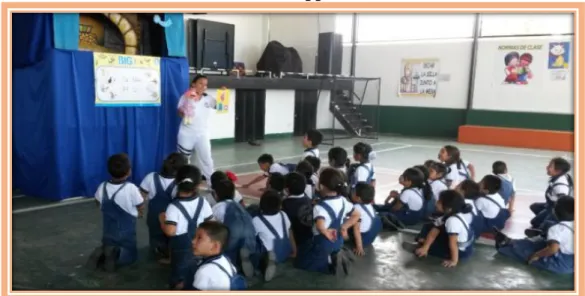
Illustration 4: Children at U.E. Academia Cap. Leonardo Abad
Author: Patricia González E.
Source: U.E. Academia Cap. “Leonardo Abad Astudillo”
Location:
La Libertad, Santa Elena Province
Estimated time for execution:
Three months
Responsibles:
Author: Patricia González
Advisor: Sandra Caamaño López Msc.
Budget
39
4.2. Feasibility
This proposal is feasible because its application was accepted by the principal of the institution, Lcda. Sonia Barzola, and it has the support of parents and the budget to apply it.
4.2.1. Characteristics of the proposal
This proposal is:
Dynamic
Pedagogical.
Creative
4.3. Proposal background
The stage at which an individual starts learning English as another language creates a difference. Children who acquire how to communicate with a second tongue at a very young age, learn faster and they look like a native speaker. Puppets are a shining tool to stimulate and motivate even the most timid children to practice speaking and vocabulary in a new language. Communicating with a puppet is fewer intimidating for pupils than interacting taking a regular class with an adult or teacher.
One of the purposes at U. E. Academia Cap. “Leonardo Abad Astudillo”, is that its students reach a good level of English. Children take English Language from initial to seventh grade being of significance especially at early ages.
40 This research proposes the implementation of puppets as a strategy to improve English vocabulary for children of first basic year, at U. E. Academia Cap. “Leonardo Abad Astudillo”, La Libertad, Santa Elena Province, 2015-2016.
4.4. Significance
Puppets can transform the classroom and develop more possibilities for critical thinking, curiosity, creativity, and collaboration.in children. Using puppets teachers motivate to imagine different things.
Working with puppets for teaching vocabulary offers some opportunities. The puppet is a facilitator between the kids and teacher in all circumstances. It aids children to say their ideas and thoughts, social skill, like creating interaction with puppets and telling stories. Using puppets in an excellent proposal to enhance English Vocabulary to children, help them to develop not only English vocabulary but also listening and speaking.
4.5. Advantages of using Puppets
Puppets make a class fun and interesting and teachers can get children´s attention.
Pupetts involve communication with children and entertain them with the topic of the class.
Pupetts are an cexcellent didactic resource to motivate creativity and imagination in children.
Puppets can be used to practice grammar rules, tell stories, sing songs or say
commands to the students. Puppets give magical experiences in class.
All these points make this proposal interesting and of significance in the
41
4.6. Objectives
4.6.1. General objective
To improve English vocabulary in children of first grade at “Unidad Educativa Academia Naval Cap. “Leonardo Abad Astudillo”.
4.6.2. Specific objectives
To evaluate students vocabulary.
To look for the best activities using puppets to improve English vocabulary.
To develop activities using puppets to make children acquire vocabulary.
4.7. Design and development of the proposal 4.7.1. Benefits of using puppets with children
Puppets engage imagination and the attention in children of all ages making them learn new skills, ideas, notions and concepts.
Social skills: Puppets make increase children's communication and social skills for example:
a. Sense of humor
b. Communication of needs and ideas c. Friendship skills
d. Empathy
e. Maintenance skills
f. Conflict resolution by providing structured opportunities to interact with the puppets.
42
Confidence in reading and speaking: Puppets help children to feel more confidence to develop speaking specially in children who are timid, nervous or shy to read or talk.
Music appreciation: Puppets can make music and they can dance with a song.
Motor skills: Manipulating puppets students have to repeat the movements and do exercises.
Guidance: Children can learn manners and appropriate behaviors.
Encouraging creativity: Children can use puppets to create their own story or tell stories.
Capturing attention: A hand puppet can be a good instrument to obtain the attention of young boys and girls to ask questions or repeat some activities because they feel confident.
4.7.2. Ways to use puppets with children
Puppets can be used in:
Games: Puppets are a good instrument for making children interact in class, repeating vocabulary and participating in games.
Dramatic play: Puppets can act out stories and be used in plays.
Puppet Shows: Boys and girls can manipulate puppets to make on their own puppet presentation for other groups of students in the English class.
43
Reading: : kids can practice reading their favorite books and tell the story manipulating the puppets.
4.7.3. Types of puppets
Puppets are made-up with different materials, diversity of colors, sizes, shapes. They have eyes, mouths, arms, legs, and they move. Puppets can be:
Man/Woman
Plants and Animals
Insect
Store-bought
Hand Make
With fingers
Pulled over hands
Furthermore, children can create their own personal puppets of socks or brown paper bags, balls, gloves, or any materials, children can use their puppets in class.
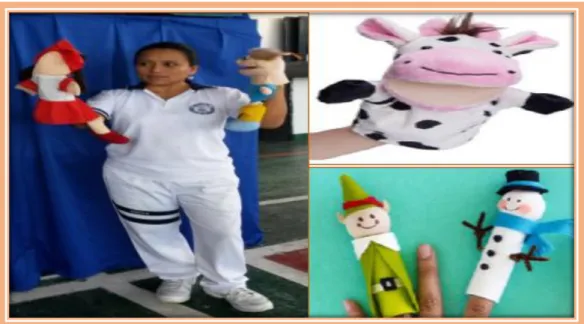
Illustration 5: Puppets pulled over hands
Source: http://ecx.images-amazon.com/images/I/41rvjwCBh6L._SL250_.jpg
44
4.7.4. Activities developed with puppets in class
The researcher created the puppets and the activities according to each unit of the student’s book, called “Big Fun”.
Illustration 6: Book of First Grade
Author: Patricia González España
4.7.5. Activities
The proposal has the following activities:
Stories Dialogues
Songs Theater
Illustration 7: Puppets Theater
45
4.7.6. Background
There were 5 puppets in classrooms which were not used by teachers. After analyzing the benefits of using puppets in the classroom, the researcher decided to use them and make 12 more puppets as a valuable strategy to teach children English vocabulary.
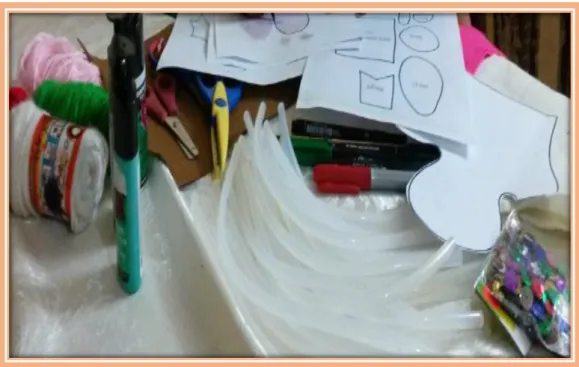
4.7.7. Puppets materials
Glue
1 Meter of cotton cloth
Socks
Buttons
Wool
Plastic eyes
Thread and needle
A Plastic cup
Illustration 8: Materials to make a puppet
46
4.7.8. Steps to design a puppet:
1. Make the head with cotton cloth
2. Make the mouse with cardboard and a piece of wool for the tongue 3. In the head , sew on a couple of buttons for eyes
4. Make the hair with a lot of wool. 5. Make the body with a part of socks
llustration 9: Making Puppet
Author: Patricia González
Illustration 10: Making Puppet
47
4.8. TOPICS OF THE VOCABULARY
Chart 7: Topics of the Vocabulary
Topics of the Vocabulary
Animals
Colors
My Toys
My Senses
Days of the week
Alphabet Letters
Clothes
Objects in the classroom
Community Worker
48
Instructions
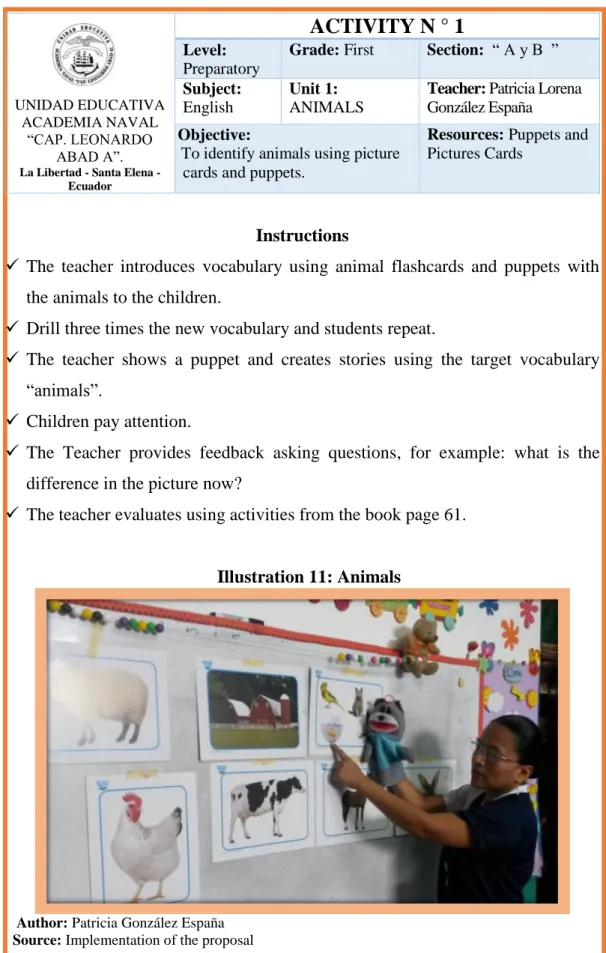
The teacher introduces vocabulary using animal flashcards and puppets with the animals to the children.
Drill three times the new vocabulary and students repeat.
The teacher shows a puppet and creates stories using the target vocabulary “animals”.
Children pay attention.
The Teacher provides feedback asking questions, for example: what is the difference in the picture now?
The teacher evaluates using activities from the book page 61.
Illustration 11: Animals
Author: Patricia González España
Source: Implementation of the proposal UNIDAD EDUCATIVA
ACADEMIA NAVAL “CAP. LEONARDO
ABAD A”. La Libertad - Santa Elena -
Ecuador
ACTIVITY N ° 1
Level:
Preparatory
Grade: First Section: “ A y B ”
Subject:
English
Unit 1:
ANIMALS
Teacher: Patricia Lorena González España
Objective:
T To identify animals using picture cards and puppets.
49
Instructions
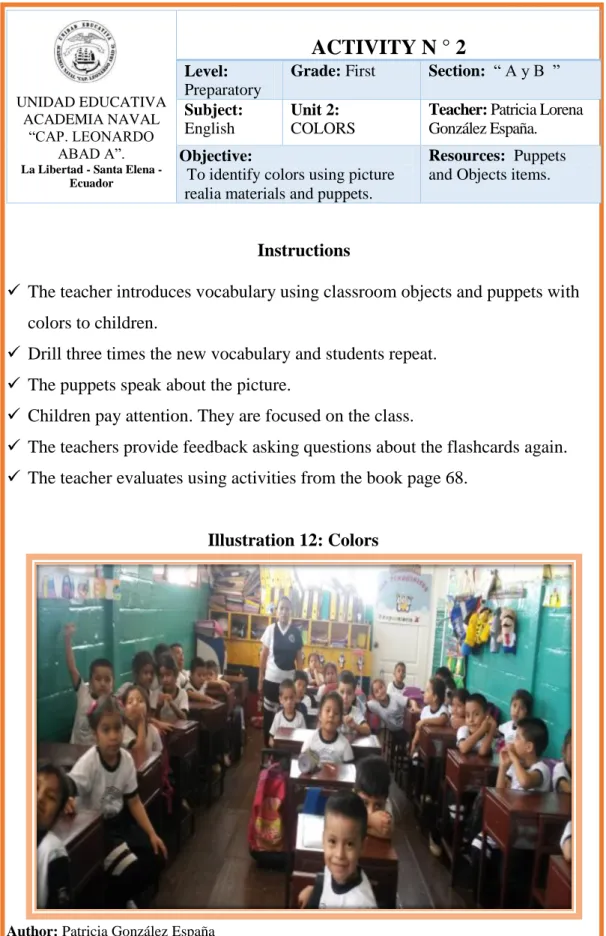
The teacher introduces vocabulary using classroom objects and puppets with colors to children.
Drill three times the new vocabulary and students repeat.
The puppets speak about the picture.
Children pay attention. They are focused on the class.
The teachers provide feedback asking questions about the flashcards again.
The teacher evaluates using activities from the book page 68.
Illustration 12: Colors
Author: Patricia González España
Source: Implementation of the proposal UNIDAD EDUCATIVA
ACADEMIA NAVAL “CAP. LEONARDO
ABAD A”. La Libertad - Santa Elena -
Ecuador
ACTIVITY N ° 2
Level:
Preparatory
Grade: First Section: “ A y B ”
Subject:
English
Unit 2: COLORS
Teacher: Patricia Lorena González España.
Objective:
T To identify colors using picture realia materials and puppets.
50
Instructions
The teacher introduces vocabulary using toys flashcards.
The puppets speak about the picture.
The teacher talks using the puppets.
Students repeat the vocabulary.
The teacher asks the name of the pictures.
Children watch a video about toys.
Teachers provide feedback asking questions about the flashcards again.
Teachers makes feedback asking questions for example what is the difference in the picture now?
The teacher evaluates using activities from the book page 33.
Illustration 13: Toys
Author: Patricia González España UNIDAD
EDUCATIVA ACADEMIA NAVAL
“CAP. LEONARDO ABAD A”. La Libertad - Santa Elena -
Ecuador
ACTIVITY N ° 3
Level:
Preparatory
Grade: First Section: “ A y B ”
Subject:
English
Unit 2: My toys Teacher: Patricia Lorena González España.
Objective:
T To Identify toys using picture realia materials and puppets.