UNIVERSIDAD LAICA VICENTE ROCAFUERTE DE GUAYAQUIL
FACULTAD DE CIENCIAS DE LA EDUCACIÓN CARRERA MENCIÓN INGLÉS
RESEARCH PROJECT:
“THE EFFECTS OF APPLYING COMMUNICATIVE LANGUAGE TEACHING METHOD ON 10TH EGB STUDENTS AT UNIDAD EDUCATIVA MONSEÑOR ROBERTO MARIA DEL POZO HIGH SCHOOL DURING THE SCHOOL YEAR
2017-2018 TO OVERCOME SPEAKING ANXIETY ISSUES ”
PREVIO A LA OBTENCIÓN DEL TITULO DE:
LICENCIADAS EN LENGUA INGLESA MENCIÓN EN ENSEÑANZA Y
ADMINISTRACIÓN DE SISTEMAS EDUCATIVOS EN TEFL
TUTOR:
MTEFL. JANETH LETICIA MORA ZAPATER
AUTHORS:
ANDREA STEFANÍA CUSME CAMPOS SHEELA GABRIELA VALLE ESPINOZA
GUAYAQUIL-ECUADOR
II
CERTIFICACION DE ACEPTACION DEL TUTOR
En mi calidad de Tutora del Proyecto de Investigación, nombrada por el Consejo Directivo de la Facultad de Educación- Carrera de Ciencias de la Educación mención Inglés.
CERTIFICO
Yo, MSc. JANETH LETICIA MORA ZAPATER, certifico que el Proyecto de Investigación con el tema: “THE EFFECTS OF APPLYING COMMUNICATIVE
LANGUAGE TEACHING METHOD ON 10TH EGB STUDENTS AT UNIDAD EDUCATIVA MONSEÑOR ROBERTO MARIA DEL POZO HIGH SCHOOL DURING THE SCHOOL YEAR 2017-2018 TO OVERCOME SPEAKING ANXIETY ISSUES ”, ha sido elaborado por la Señorita ANDREA STEFANIA CUSME CAMPOS, bajo mi tutoría y que el mismo reúne los requisitos para ser defendido ante el tribunal examinador, que se designe al efecto.
TUTORA
III
CERTIFICACION DE ACEPTACION DEL TUTOR
En mi calidad de Tutora del Proyecto de Investigación, nombrada por el Consejo Directivo de la Facultad de Educación- Carrera de Ciencias de la Educación mención Inglés.
CERTIFICO
Yo, MSC. JANETH LETICIA MORA ZAPATER, certifico que el Proyecto de Investigación con el tema: “THE EFFECTS OF APPLYING COMMUNICATIVE
LANGUAGE TEACHING METHOD ON 10TH EGB STUDENTS AT UNIDAD EDUCATIVA MONSEÑOR ROBERTO MARIA DEL POZO HIGH SCHOOL DURING THE SCHOOL YEAR 2017-2018 TO OVERCOME SPEAKING ANXIETY ISSUES”, ha sido elaborado por la Señorita SHEELA GABRIELA VALLE ESPINOZA, bajo mi tutoría y que el mismo reúne los requisitos para ser defendido ante el tribunal examinador, que se designe al efecto.
TUTORA
IV
DECLARACION DE AUTORIA Y CESION DE DERECHOS DE AUTOR
DECLARACION DE AUTORIA
Yo, ANDREA STEFANIA CUSME CAMPOS, con cédula de ciudadanía No. 2400246761, en calidad de autora, declaro bajo juramento que la autoría del presente trabajo me corresponde totalmente y me responsabilizo de los criterios y opiniones que en el mismo se declaran, como producto de la investigación que he realizado.
Que soy la única autora del trabajo del Proyecto de Investigación: “THE EFFECTS OF APPLYING COMMUNICATIVE LANGUAGE TEACHING METHOD ON 10TH EGB STUDENTS AT UNIDAD EDUCATIVA MONSEÑOR ROBERTO MARIA DEL POZO HIGH SCHOOL DURING THE SCHOOL YEAR 2017-2018 TO OVERCOME SPEAKING ANXIETY ISSUES”.
Que el perfil del proyecto es de mi autoría, y que en su formulación he respetado las normas legales y reglamentarias pertinentes, previa la obtención del título de “Licenciada en Lengua Inglesa mención en Enseñanza y Administración de Sistemas Educativos en TEFL”, de la Facultad de Educación- Carrera de Ciencias de la Educación mención Inglés de la Universidad Laica Vicente Rocafuerte de Guayaquil.
_______________________________ Andrea Stefania Cusme Campos
V
CESIÓN DE DERECHOS DE AUTOR
De conformidad con lo establecido en el Capítulo I de la Ley de Propiedad Intelectual del Ecuador, su reglamento y normativa institucional vigente, dejo expresado mi aprobación de ceder los derechos de reproducción y circulación de esta obra, a la Universidad Laica Vicente Rocafuerte de Guayaquil. Dicha reproducción y circulación se podrá realizar, en una o varias veces, en cualquier soporte, siempre y cuando sean con fines sociales, educativos y científicos.
El autor garantiza la originalidad de sus aportaciones al proyecto, así como el hecho de que goza de la libre disponibilidad de los derechos que cede.
_____________________________ Andrea Stefania Cusme Campos
VI
DECLARACION DE AUTORIA Y CESION DE DERECHOS DE AUTOR
DECLARACION DE AUTORIA
Yo, SHEELA GABRIELA VALLE ESPINOZA, con cédula de ciudadanía No. 0923272983, en calidad de autora, declaro bajo juramento que la autoría del presente trabajo me corresponde totalmente y me responsabilizo de los criterios y opiniones que en el mismo se declaran, como producto de la investigación que he realizado.
Que soy la única autora del trabajo del Proyecto de Investigación: “THE EFFECTS OF APPLYING COMMUNICATIVE LANGUAGE TEACHING METHOD ON 10TH EGB STUDENTS AT UNIDAD EDUCATIVA MONSEÑOR ROBERTO MARIA DEL POZO HIGH SCHOOL DURING THE SCHOOL YEAR 2017-2018 TO OVERCOME SPEAKING ANXIETY ISSUES”.
Que el perfil del proyecto es de mi autoría, y que en su formulación he respetado las normas legales y reglamentarias pertinentes, previa la obtención del título de “Licenciada en Lengua Inglesa mención en Enseñanza y Administración de Sistemas Educativos en TEFL”, de la Facultad de Educación- Carrera de Ciencias de la Educación mención Inglés de la Universidad Laica Vicente Rocafuerte de Guayaquil.
______________________________ Sheela Gabriela Valle Espinoza
VII
CESIÓN DE DERECHOS DE AUTOR
De conformidad con lo establecido en el Capítulo I de la Ley de Propiedad Intelectual del Ecuador, su reglamento y normativa institucional vigente, dejo expresado mi aprobación de ceder los derechos de reproducción y circulación de esta obra, a la Universidad Laica Vicente Rocafuerte de Guayaquil. Dicha reproducción y circulación se podrá realizar, en una o varias veces, en cualquier soporte, siempre y cuando sean con fines sociales, educativos y científicos.
El autor garantiza la originalidad de sus aportaciones al proyecto, así como el hecho de que goza de la libre disponibilidad de los derechos que cede.
_____________________________ Sheela Gabriela Valle Espinoza
VIII
DEDICATION
I want to dedicate this Project to my mother who told me the importance to study a University career and gave me the strength to continue with my dreams and wishes. My father who always told me that we can do everything, in the last year of my studies he gave me his support to continue with my classes.
My boyfriend who help me in many situations related to the university and was with me in bad and good moments of my classes and courses.
My aunt and uncle who gave me the opportunity to study and job at the same time in order to pay my studies. They believed in me and my dream to become an English teacher. My dear students who inspire me to do the project and be part of it, and my boss for gave me the chance to develop my project in her institution and get amazing results with my students of 10th grade.
IX
DEDICATION
To my parents, for their unconditional support, love, wisdom and dedication to me; allowing me to reach this new goal as person and professional.
To my beloved sister Sharon, for her support and encouragement when it was necessary.
X
ACKNOWLEGMENT
This work was create by the amazing supervision of our tutor MSc. Janeth Mora Zapater. She was our support not only in this project, but also in all the university period. She was who guide us to be better in all the aspects.
To my dear project partner Sheela Valle Espinoza who was from the first year of classes my partner and best friend. One day, we dreamed to do the thesis together and I don’t believe that I am writing this acknowledgment in this moment, because this show that when someone have clear goals could become real.
To God to give me strength and support in all my life, studying and working at the same time were not easy, many days I wanted to give up, but with each prayers he gave me breath to continue with my dreams.
XI
ACKNOWLEGMENT
Once again I thank God for always being with me and for the blessings that will come as a reward for so much effort.
To my tutor MSc. Janeth Mora Zapater whom I greatly admire as a teacher, I thank you for all the support provided for the development of this research project.
To my professors for their support given throughout this career, their friendship and motivation to reach life goals.
To my friends for all the moments we shared and enjoyed in classes, they silently taught me to fight for my dreams even if the world falls apart.
One last thing to say that the older I get, the more I realized that there are certain times in your life that you really need a friend… but sometimes you get someone better… you get an Andrea. If that happens, grab ahold and do not let go. I never did! Cousin our greatest adventures are yet to come.
XII
Table of Content
INTRODUCTION ... 1
CHAPTER I ... 3
1. THE RESEARCH PROBLEM ... 3
1.1 Background of the Problem ... 3
1.2 Statement of the Problem ... 5
1.3 Systematization of the Problem ... 5
1.4 Broad Objective ... 6
1.5 Specific Objectives ... 6
1.6 Significance of the Study ... 6
1.7 Scope and Delimitations of the Study ... 8
1.8 Hypothesis ... 8
1.9 Identification of Variables ... 8
1.10 Operationalization of Variables ... 9
CHAPTER II ... 11
2. RESEARCH THEORETICAL FOUNDATIONS ... 11
2.1 Literature Review ... 11
2.1.1 Communicative Language Teaching ... 11
2.1.2 Speaking Anxiety ... 15
2.2 Theoretical Framework ... 18
2.2.1 Communicative Language Teaching (CLT) ... 18
XIII
2.3 Legal Framework ... 30
2.4 Conceptual Framework ... 33
CHAPTER III ... 35
3. RESEARCH METHODOLOGY ... 35
3.1 Type of Research Description ... 35
3.2 Methods, Techniques and Research Instruments ... 35
3.3 Research Population and Sample ... 36
3.4 Sources, Resources and Timeline ... 36
3.5 Processing, Presentation and Analysis of Results ... 39
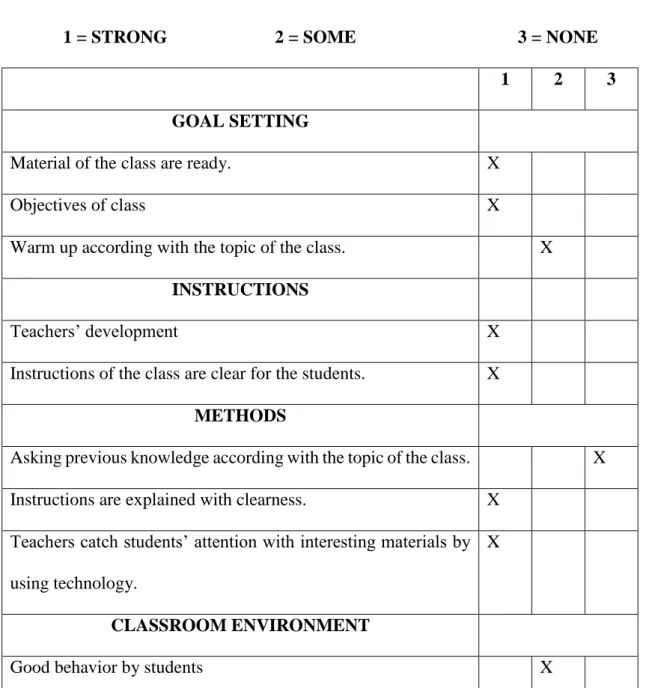
3.5.1 Class Observation Guide ... 39
3.5.2 Students’ Survey ... 42
3.5.3 Teacher’s Interview ... 55
3.6 Preliminary Conclusions ... 57
CHAPTER IV ... 59
4. PROPOSED PROJECT PLAN ... 59
4.1 Title ... 59
4.2 Justification ... 60
4.3 General Objective ... 61
4.4 Specific Objectives ... 61
4.5 Content Framework of the Proposed Project Plan ... 61
4.6 “Take a Risk” Proposed Project Plan... 62
XIV
4.6.2 Mini City ... 64
4.6.3 Fashion Runway Show ... 66
4.6.4 Comic Con... 68
4.6.5 Ecuadorian Gastronomic Fair... 69
4.6.6 Post Test ... 71
4.7 Validation of the Proposed Project Plan ... 77
4.8 Impact/ Benefits of the Proposed Project Plan ... 81
CONCLUSIONS ... 83
RECOMMENDATIONS ... 86
REFERENCE LIST ... 88
XV
LIST OF TABLES
Table 1 Variables and Indicators ... 9
Table 2 Sources for the Research Project ... 36
Table 3 Resources for the Research Project ... 37
Table 4 Timeline of the Research Project ... 38
Table 5 Class Observation Guide ... 40
Table 6 Students Survey Results ... 42
Table 7 Practice Oral Communication ... 45
Table 8 Speaking Production ... 46
Table 9 Teachers’ Personality ... 47
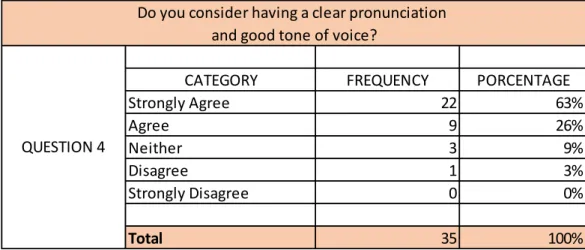
Table 10 Clear Pronunciation and Tone of Voice ... 48
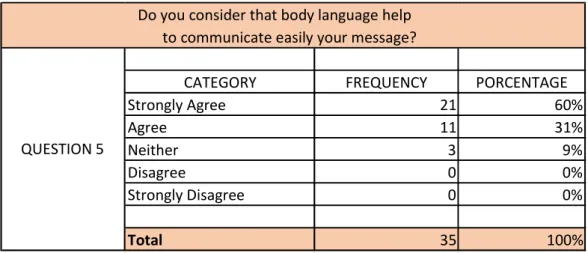
Table 11 Body Language ... 49
Table 12 Correct Pronunciation ... 50
Table 13 The Importance of Fluency ... 51
Table 14 English inside the Classroom ... 52
Table 15 Understanding your English Teachers... 53
Table 16 Challenging Skill ... 54
Table 17 Countries Presentations ... 71
Table 18 Mini City ... 72
Table 19 Fashion Runway Show ... 73
Table 20 Comic Con ... 74
XVI
LIST OF FIGURES
Figure 1 The Skeleton of a Conversation ... 24
Figure 2 Rescher’s two-cycle model ... 25
Figure 3 English as a Foreign Language Curricular Threads ... 31
Figure 4 Students Survey Results ... 44
Figure 5 Practice Oral Communication Results ... 45
Figure 6 Speaking Production Results... 46
Figure 7 Teachers’ Personality Results ... 47
Figure 8 Clear Pronunciation and Tone of Voice Results ... 48
Figure 9 Body Language Results ... 49
Figure 10 Correct Pronunciation Results ... 50
Figure 11 The Importance of Fluency Results ... 51
Figure 12 English inside the Classroom Results ... 52
Figure 13 Understanding your English Teachers Results ... 53
Figure 14 Challenging Skill Results ... 54
Figure 15 Proposed Project Plan Logo ... 59
Figure 16 Post Test Analysis Results ... 76
Figure 17 Validation 1 ... 78
Figure 18 Validation 2 ... 79
XVII
ABSTRACT
When talking about communication it is impossible not to mention language, taking into consideration that communication methods are very important at the time of acquiring a foreign language. Learning English is considered by some students, a difficult process that takes years of study. Thus, practicing the speaking skill could be known as the hardest part of language acquisition; not having anything to say, the misunderstanding of a phrase or even the lack of motivation are some reasons why they form speaking anxiety on their own. Consequently, “Take a Risk” Proposed Plan was created for students who do not how to practice and produce English as a Foreign Language. The main purpose of this research is focused on describing the effects that could make students overcome speaking anxiety through the application of Communicative Language Teaching Method on 10th EGB students at Monseñor Roberto Maria del Pozo School. Some of the research objectives are to enable students to communicative in the target language and to provide students different types of creative and entertaining oral activities to encourage their learning process. As a way to obtain guidance and results, research instruments were used as surveys to students of 10th EGB in order to collect data and to know what they think about learning English (focused on the Speaking Skill), deep class observation to evaluate teacher way of giving a class and manage a group of students ,and interviews to teachers. After applying the Proposed Plan, students were confident enough to express their opinions, give their points of view, also as starting, keeping and ending a conversation in the target language. Speaking anxiety decreased in a notorious way; teachers, authorities and students were benefited throughout the application of the activities. English teachers need to be updated to the different kinds of problems students are facing such as fear of making mistakes, not knowing what to say or how to express their feelings. Teachers should adequate and create a good environment for improving students desire to learn. Speaking should be a natural process students enjoy, with the early detection of speaking anxiety in students, the appropriate environment, and the usage of the Community Language Learning Method will prepare them to produce English in an excellent way.
1
INTRODUCTION
One important factor in the acquisition of a new language is to know the difference between traditional teaching methods and the current ones. Every person is a unique world and teachers need to be aware of the newest techniques to adapt in the classrooms. Facilitators of English should focus on meaning and communication in order to develop the communicative competence in the students through meaningful interaction. Focusing on the Communicative Approach is about exchanging information that is integral and relevant to events and experiences in students’ daily lives.
It is necessary to be attentive that English has been taught to people and not machines, so memorizing should not be the best option in order to acquire a different language. Students can be prepared and relaxed when facing an opportunity to produce English, forgetting about Speaking Anxiety.
Many of the students are afraid of speaking in English because they suppose that others would criticize them or judge the way of communicating. Parents’ role is a very important factor in the teaching of a new language. They should prepare their kids in advance, talking about some of the benefits that English provides. If parents do not have enough information about the topic the second in charge is the school, by explaining through a workshop some details about English benefits for their life.
Students at Monseñor Roberto Maria del Pozo School have failures in the speaking skill because of the limited time to practice the language inside the classroom and lack of motivation from the school, parents and students themselves. That is why students at school should be involved in meaningful uses of English by taking advantages in the activities that the teacher offers them. One of the causes they do not like to speak in English is because the typical “situations” that a textbook provide that is so far from the reality.
2
3
CHAPTER I
1.
THE RESEARCH PROBLEM
“The Effects of Applying Communicative Language Teaching Method on 10th EGB Students at Unidad Educativa Monseñor Roberto Maria del Pozo High School During the School Year 2017-2018 to Overcome Speaking Anxiety Issues ”
1.1 Background of the Problem
Unidad Educativa Monseñor Roberto Maria del Pozo High School is a private institution located in Guasmo Sur –Cooperativa Union de Bananeros, next to La Dolorosa Church, in front of Comisariato El Constructor. It has seven hundred students, thirty-five teachers and only two of them are English teachers for the entire high school. Thus, there is no an English Department. It is administered by Paulina Pucha and directed by Edinson Anzules.
A first observation process was made with regards to getting familiar with the teacher procedures. During the class, many aspects were avoiding the normal course of English as a la foreign language. Students talked in Spanish all the time, they did not pay attention to the teacher who was trying to explain the instructions, and they were sitting in the traditional way (rows/columns). See Annex D
In addition to the lack of motivation for learning the language, students avoided any kind of oral participation, when the teacher provided the opportunity to respond a question they changed their body position, they shook their hands, were anxious and had a lower tone of voice, had a nervous laugh, and others had the willing to answer but they were shy. Empirical research shows that anxious foreign language students are less willing to participate in learning activities, and have lower performance than non-anxious students (Aida, 1994) (MacIntyre & Gardner, 1991).
4
Afterwards the observations, it was noticed that the teacher was enthusiastic about the classes but she did not know how to get students’ attention. Teachers and students know that dealing with anxiety can be a challenge during the acquisition process of a new language, students are exposed to a different environment where it has to be discovered step by step.
The creation of the Proposed Plan is to find a way to support students in their learning process making it interesting and different to produce the language. Thus, the main objective of the research project is to describe the effects that could make students overcome Speaking Anxiety through the application of Communicative Language Teaching Method. It is important to understand that mistakes are seen as a natural outcome, so an accurate advice for the teacher is to write students’ mistakes and give feedback to them at the end of the conversation or activity.
The first cause why students have developed Speaking Anxiety Issues is that the environment does not support the students to speak English fluently, spontaneously without pressure. According to Kitano (2001),
In relation to learners’ perception of low ability, teachers should make interventions in the classroom environment and practices and create a “sense of community in the classroom”, so that students do not perceive it a competitive, while pair and group work can be incorporated (Kitano, 2001).
The environment has to be comfortable in order to increase the self-confidence in students, so they do not feel rejected by people around them. Frustration appears when trying to produce orally the language and do not success while trying. Some students tend to get confused in English grammar, they feel insecure and in most of the cases embarrassed when they want to produce the second language orally. It is considered necessary for teachers to force students only to speak in English during the class because they are able to listen the correct pronunciation, tone of voice and be familiarized with the different types of intonations.
5
1.2 Statement of the Problem
The majority of the students want to translate all the words in Spanish and if they could not find the exact word they get frustrated and block themselves. Grammar is the join of those ideas that come to mind, and they believe that if they do not know everything about grammar they are lost.
To introduce the Communicative Language Teaching method is the best remedy of this problem, and as teachers, it is very important to think as teenagers and remember the type of difficulties we had at that time.
For that reason, the Statement of the Problem is:
What are the effects of applying communicative language teaching method on 10th EGB students at Unidad Educativa Monseñor Roberto Maria del Pozo High School during the school year 2017-2018 to overcome Speaking Anxiety issues?
1.3 Systematization of the Problem
1. What kind of environment does Communicative Language Teaching Method create in the classroom?
2. How does Communicative Language Teaching Method change the way teachers give their class?
3. What kind of results are assumed to receive teachers when adapting a different teaching method?
4. In what way does Speaking Anxiety can affect the learning of a foreign language? 5. How can teachers help students in order to overcome the Speaking Anxiety inside
and outside the classroom?
6
1.4 Broad Objective
To describe the effects of applying Communicative Language Teaching Method on 10th EGB students at Unidad Educativa Monseñor Roberto Maria del Pozo high school during the school year 2017-2018 to overcome Speaking Anxiety Issues
1.5 Specific Objectives
To compare traditional methods results with Communicative Language Teaching method
To describe the significance of achieving the goal established for Subnivel Superior A2.1 Education Ministry
To identify and handle with Speaking Anxiety symptoms in oral performances
To describe teachers and students roles inside the classroom to overcome speaking difficulties
To analyze the importance of creating a dynamic, entertaining classroom environment
To increase students learning process with relevant topics of their interest
1.6 Significance of the Study
The results for the teacher class observations, a survey taken to students at the beginning of the proposed project and oral activities performed by students led the authors to create a Speaking Project Plan in order to help students as well as English teachers in the learning process. The research will be significant for authorities, teachers and learners.
7
Language Teaching Method and the application of creative and thought-provoking oral activities.
One important aspect of the research project lies in applying real-life topic situations in which teenagers will be exposed to different kind of dialogues, phrases, and moods letting them analyze and handle the problem using previous knowledge learnt in class with the entire class.
By introducing meaningful, organized and modern activities, teachers can help students to overcome their detected issue which in this case is speaking anxiety. According to Gaibani & Elmenfi (2016) speaking anxiety is defined as “a type of shyness characterized by fear about communicating with people”. L2 learners deal with many problems such as examination system, students’ weak position and foundation in English, large classes, passive learning, uninteresting, lengthy, difficult literature based syllabi, the poor performance of the English teachers and old methodologies (Malik, 1996). Thus, all this factors are considered to be obstacles at time of learning English.
According to Richards and Renandya (2002) “A large percentage of the worlds’ language learners study English in order to develop proficiency in speaking”. The speaking skill is important inside classes because it helps people to develop and reinforce relations with the rest of the world. Providing entertaining activities, relevant topics, according to students’ age, culture and preferences will help with the improvement of the skill.
Consequently, the first beneficiaries of the Proposed Plan are students. The major problem of learners is that they attend to classes because it is on the schedule and they need to pass the grade. Students are not interested enough to learn a new language because of the lack of encouragement, motivation and also information. Teenagers are sitting in the same positions every class, they get bored easily because of the activities that the book provides do not satisfy their needs. In addition, students are not relaxed during the class, they are afraid, nervous and not confident to answer or provide an argument related to the topic.
8
Finally, the last beneficiary is the high school because students will be able to reach the Standard English proficiency level A2.1 according to the Common European Framework Reference (English as a Foreign Language for Subnivel Superior, 2016). Original ideas and procedures are going to be mirrors for other institutions so people would compare English area with other private and also public high schools.
1.7 Scope and Delimitations of the Study
Unidad Educativa Monseñor Roberto Maria del Pozo High School was the institution where the proposed plan was applied, located at Guasmo Sur -Coop. Unión de Bananeros – Next to la Dolorosa Church, in front of Comisariato El Constructor, Guayas-Guayaquil.
The institution only counts with two English teachers, then it does not have an English Department where teachers can meet and share students’ needs and differences in order to use new methods to deal with them. Teachers were not trained or prepared enough to handle with all the grades (8th grade to III bachillerato).
The research project took place during August 2017 to January 2018, and the activities were applied and evaluated on thirty five students at 10th EGB to analyze and demonstrate the effect of Communicative Language Teaching method.
1.8 Hypothesis
The application of Communicative Language Teaching reduces 10th EGB students’ level of speaking anxiety.
1.9 Identification of Variables
Independent Variable: Speaking Anxiety
9
1.10 Operationalization of Variables
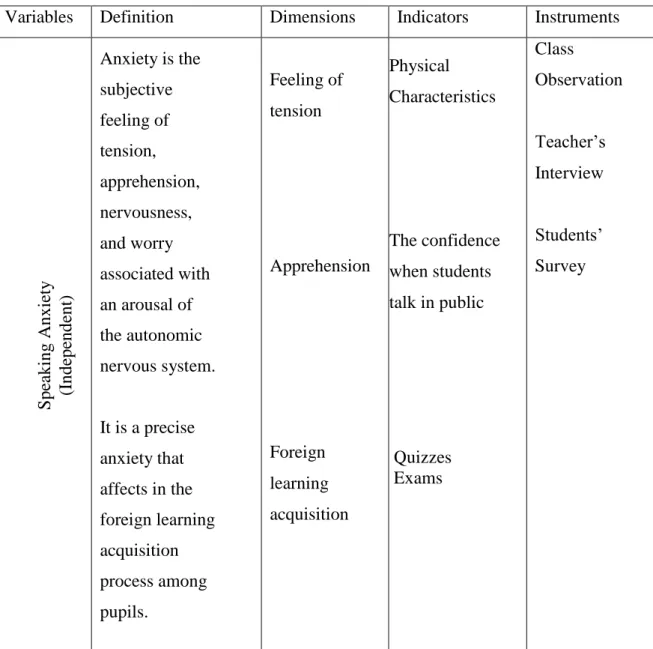
Table 1 Variables and Indicators
Variables Definition Dimensions Indicators Instruments
10
Resource: (Brown, 2007) ; (Humphries, 2011)
11
CHAPTER II
2. RESEARCH THEORETICAL FOUNDATIONS
2.1 Literature Review
Through the time, researchers have investigated about Communicative Language Teaching in many parts of the World, providing results in order to analyze the different kinds of obstacles and situations that could appear if applying the method.
On the other hand, Speaking Anxiety is a new term that only few researchers have look for results in difference with the general Foreign Language Anxiety. Learning is a complicated process and if adding a foreign language could make things more difficult, for that reason teachers should be aware of the new methods that teaching a language involves, also as the difficulties their students could be facing as Speaking Anxiety Issues.
2.1.1 Communicative Language Teaching
*According to Mirsane and Khabiri in their research study: The Effect of Teaching Communicative Strategy on EFL Learners' Willingness to Communicate (2016) Willingness to Communicate (WTC) is referred as an old term when talking about L1 (Language 1 or mother tongue), but with many studies about Communicative Language Teaching this term has obtained more respect. The main objective was to investigate if teaching communicative strategies to learners affects on their WTC. In this study, sixty students were selected from an international exam called P.E.T (Preliminary English Test) to be sure that they have the same proficiency level. The learners were divided into two groups, the control group and the experimental group in which nine communicative strategies were taught to them to improve their speaking skills in different kind of situations (circumlocution, appeal for help, approximation, time-stalling devices, message abandonment, confirmation check, clarification request and all- purpose word) from Dornyei and Scott’s taxonomy (Dörnyei & Scott, Communication strategies in second language: Definitions and taxonomies , 1997) to encourage language learning and increase risk-taking during oral performances.
12
teacher plays an important role inside the classroom, he or she must create a good learning environment without forgetting the communicate strategies that will help English as a Foreign Language (EFL) learners in their way of acquiring the new language.
Results of the study totally prove that students feel less anxious, and more confident at the moment of rising their hand to give an oral answer, they learned how to deal with difficult questions, how to evade whenever they cannot communicate. They start to feel like if they were practicing in real life situations because as they are teenagers, the teacher should adapt entertaining questions and scenarios for them to practice and produce the language.
The research study Communicative Language Teaching in an EFL Context: Learners’ Attitudes and Perceived Implementation (Assassfeh, Khwaileh, Al-Shaboul, & Alshboul, 2012) aimed to collect information about learners’ attitudes towards the implementation of Traditional form-focused instruction and Communicative meaning-oriented instruction of English. Asian learners reflected that their highest preferences were totally associated with having a good learning atmosphere prepared by their teacher, motivating them to use English at the moment of class.
Communication-based English teaching and having grammar lessons were something they kept in mind, they knew that having the knowledge is important as well as the desire to practice it orally. The results also shows that female are more likely to enjoy Communicative Meaning-Oriented Instruction (MOI) rather than males whose results show that they are more interest in the grammar part. Having those research studies from the other parts of the world where English is teaching as a foreign language gives the motivation to apply those methods at Monseñor Roberto Maria del Pozo students in Ecuador, creating a non-stressful environment where teenagers want to practice the target language in a real, natural way will definitely show future positive results.
13
Communicative Language Teaching. To summarize the shift in pedagogy in Senegal from traditional teaching methods (Audio-lingual methods and grammar translation methods) to communicate language teaching and the ways in which adopted pedagogy is faced with local challenges at the implementation level.
Diallo argued about three challenges in order to implement CTL (Communicative Language Teaching); the first is related to teaching materials, namely the availability. Ease of access and the use of relevant English language communicative teaching materials. The second challenge is to provide and maintain a regular supply of English teachers well-trained in CLT, third and the last is about localized cultural constraints to implementing communicate teaching (Diallo, 2014). Similarly, at Monseñor Roberto Maria Del Pozo teachers need training in order to know how they can convey information and teach the language to their students in 10th grade, because they enter to baccalaureate, they need to develop their oral communication skills. All the changes are difficult at the beginning, but teachers and students have to work together in order to overcome this anxiety for speaking in classes.
*The Communicative Language Teaching Method, in terms of language teaching is considered the most recent and the most popular of all teaching methods. This method can be understood as a set of principles about the goals of language teaching, how learners learn a second language, the kinds of methods and activities in classes that facilitate learning, and roles of teachers and learners inside the classroom. Mulaudzi (2016) in his recent study of University of Venda South Africa argued that, “among problems that students in the first year of high school confronted with is the inability to comprehend English as it is used in text and also to express themselves clearly in English”. Communicative language emphasizes on the development of the main goal of language learning which communicative competence is. It is defined as the ability to use the language correctly and appropriately to accomplish communication goals.
14
in both disciplinary knowledge (LMP Mulaudzi, 2016). It means that knowledge will also enable teachers to design learning tasks with clear objectives and learning tasks or materials that will be benefit students’ learning acquisition. It is important that English teachers can evaluate their common way of handle a class; training them and listening to their difficulties will be one of many ways teachers can be updated and ready for encourage their students to increase the learning production in class.
*Another research is about the study of foreign language that demonstrated the second language anxiety and learner beliefs. It also analyzes some pedagogical strategies avoiding incorrect beliefs about language learning. This study was conducted on Spanish and Arab students who evade structures in English language. This situation was made to investigate language learners who tend to compare themselves with others students that have a high level in the second language, and they become victims of lower self-esteem.
Foreign Language Anxiety and Learners Beliefs in Second Language study explains about a speaking anxiety scale which consisted of three main components communication anxiety, test anxiety and fear of negative evaluation (Bux, Ali, Aijaz, & Faiz, 2016). In this research students who have low level in English were more interested in activities where they have to work in groups feeling less anxious while learning. The teacher involves in classroom as a facilitator, this was positively reported to be a lower anxiety factor. For that reason, students of 10th grade at Monseñor Roberto Maria Del Pozo prefer working in groups when they have to expose in front of the class or share ideas/ comments. They say that when the teachers talk about the group’s mistakes they feel less ashamed than when teachers talk about individual ones. Teachers need to understand and listen to students’ problems associated with their learning development in order to help them. Students’ beliefs have an important role, because teachers must break their myths that block them to understand or learn something new. In the study was reported that learners were stuck with the idea that pronunciation is the most important factor to learn in second language. As they already know structure and vocabulary, they do not want to speak because they do not know how to pronoun the words in English.
15
2.1.2 Speaking Anxiety
*According to the research study (2015): Indonesian EFL students’ anxiety in speech production by Christina Lhaksmita there is an issue that teachers have forgotten in the area of oral production and that is Foreign Language Anxiety. The study was applied on students who were majoring in English Language Education who felt that their written tasks were so different in quality than oral presentations even performing in front of their classmates.
Based on the results of the method they used, they concluded that self-reflection activities can help students to overcome Foreign Language Anxiety because they are able to see their own performances calmly and give their points of view in real time. The method was used in Indonesia but can be used for Ecuadorian students who may be facing the same difficulties as a non-speaking English country. As a matter of fact, teenagers also believe that they are not well prepared or capable to speak English in front of their own classmates due to the critics they can receive.
A good way to help them to overcome Speaking Anxiety could be if the teacher, the only person authorized to have a camera, records the role play, round-table participation or spontaneous dialogues and then students can watch the video, noticing how the message was conveyed, the pronunciation of the words, tone of voice and even gestures. After watching the video, a list of their strengths and weaknesses can be written in order to find out a solution for the next presentations.
*Following the same line of study researches, goods results came from the deep analysis from Omid Sanaei (Investigating Anxiety Symptoms and Reactions within EFL Learners' Oral Narrative: The Case of Intermediate Level Students, 2016). They choose eleven students in order to investigate anxiety symptoms and reactions in EFL learners’ oral narratives. In order to collect information, they provided students picture stories (no longer than nine) for narrative tasks. The results given show that anxiety symptoms and reactions appear in those anxious students.
16
reactions (blushing, perspiration and palpitations) were found in slightly anxious learners during their oral participation.
The own author of this research gives the idea to further the investigation to test foreign language anxiety symptoms and reactions with a larger sample, so in this case with Ecuadorian English Foreign Language learners a good resource could be video-recording the oral performances such as debates, role plays, dialogues and teachers are able to investigate and analyze in depth their own students’ anxiety symptoms for solutions to their reactions.
*According to Masoud Mahmoodzadeh in his research (Investigating Foreign Language Speaking Anxiety within the EFL Learners' Interlanguage System: The Case of Iranian Learners, 2012), there are three interlanguage constituents (phonology, grammar and meaning system) that may cause anxiety among EFL learners, so one objective was to determine the most influential constituent at the moment of speaking in English inside the classroom; another goal was to indicate the predominant gender to failed at the moment of speaking. Seventy-four Iranian students were evaluated (thirty one males and forty three females) also results demonstrated that students tend to attribute their Foreign Language Anxiety to their interlanguage meaning system rather than phonology or grammar.
The gender who suffer the most speaking anxiety issues is females but on the other hand, males are less efficient in grammar and phonology than females. The level of English is an important factor in Speaking Anxiety because researches has determined that the more level a person has, the more anxious he or she will be because of the advanced structures and rules he or she know. This research made in Iran can be applied in Ecuador to discover the constituents that affect oral productions inside the classroom. Teachers can adopt the advice in the study which says that English teachers need to indicate to their students that they are understanding what they are explaining, because learners are doing the best effort to convey the message in a clearly and non-boring way. To support students for the improvement of their performances is indicated to correct their mistakes at the end of the class, giving also positive feedback at the beginning of the commentary.
17
was measured with Anxiety Scale and Oral Test Scale. This research investigated the relationship between test anxiety and foreign language test performance in general.
In conclusion with the results of this study, English teachers should try to decrease anxiety inside the classroom by creating a welcome, friendly atmosphere, encouraging students’ in oral activities. Considering the difficulties role of language anxiety and test anxiety in language classes, teachers should take measures to reduce both types of anxiety.
Students in 10th grade at Monseñor Roberto Maria del Pozo High School with low grades in other skills such as: grammar, listening and writing generally have troubles in speaking, because they consider that if they do not manage all the skills, they will not be good English speakers. Teachers should enhance self-confidence by encouraging students’ classroom activities and creating a comfortable environment. Using pair work, small group work, games, role-plays may improve the class atmosphere, because learners feel more comfortable about speaking with a small number of people than confronting the whole class (Salehi & Marefat, 2014)
To sum up, the study showed that both language anxiety and oral test anxiety were negatively to foreign language performances. Familiarized activities tend to create less anxiety in students because they provide opportunities to practice English in a spontaneous way, learner will increase confidence to reduce anxiety.
*Marius Narcis in his study said that: “Language teaching was a deep analysis of the communicative meaning that a language learner needs to understand and express” (Narcis, 2012).
18
learning disabilities and they have to find the way that they learn as the rest of their classmates. In conclusion, teachers have a huge responsibility with their students’ learning process. The need to be aware of the difficulties and how to solve them could be a stressful feeling when teaching.
2.2 Theoretical Framework
2.2.1 Communicative Language Teaching (CLT)
2.2.1.1 Definition of Communicative Language Teaching (CLT)
According to Brown (2007) Communicative Language Teaching is “an approach to language teaching methodology that emphasizes authenticity, interaction, student-centered learning, task based activities, and communication for the real world, meaningful purposes”. It is important that English teachers take into consideration those aspects in order to provide a complete and relevant class environment to their students.
There are many definitions for this variable because not all the researchers have come to an equal agreement through the years. Ying (2010) argues that CLT “is an approach to the teaching of second languages that emphasizes interaction as both the means and the ultimate goal of learning a language”. How students use the new language is related on the opportunities that the teacher creates for them to practice.
The major goal of CLT is to focus on communication rather than rules, structures or patterns to memorize and follow without making any mistakes; also to practice with meaningful tasks where learners find them entertaining and interesting. In addition, using Communicative Language Teaching is to develop a stronger communicative competence among students who are learning English a foreign language.
English learners can get grammatical rules by the time they use them in social contexts. Students could learn a new language without the pressure of teachers, peers, and also parents. The more natural, the faster they will acquired structures and experience important for the development of the learning process.
19
forms or structures, because with practice learners will be able to correct their mistakes and give constructive criticisms to their classmates.
The traditional teacher-centered approach is being replaced by most of the English teachers due to the lack of participation and production from the students inside the classroom. Communicative Language Teaching pretends that learners feel more relaxed and opened to participate inside the class when the teacher establishes an activity. Social relationships would be handled in a natural way in order to adapt children in a real-life learning environment.
According to Brown (2007) this learner-centered approach gives students a greater sense of “ownership” of their learning and enhances their motivation to learn English. The way teachers convey the language should be without poses that children could feel weird or wonder how they will use the grammar taught in classes. That sense of property will empower them to go beyond their boundaries and to push harder in the knowledge area.
There are four interconnected features that Brown (2007) offers:
1. Classroom goals are focused on all of the components of CC (communicative competence) and not restricted to grammatical or linguistic competence.
2. Language techniques are designed to engage learners in the pragmatic, authentic, functional use of language for meaningful purposes. Organizational language forms are not the central focus but rather aspects of language that enable the learner to accomplish those purposes.
3. Fluency and accuracy are seen as complimentary principles underlying communicative techniques. At times fluency may have to take on more importance than accuracy in order to keep learners meaningfully engaged in language use. 4. In the communicative classroom, students ultimately have to use the language, productively and receptively, in unrehearsed contexts (pag. 241).
20
A learner-centered attitude is a special feature that teachers should possess or acquire. It means that the teacher regards students as partners. The teacher’s role changes during the class.
When teachers use Communicative Language Teaching in their classroom, they are helping their students’ development of oral communication skills. While learners practice, they start to lose speaking anxiety and fear of communicating in English. Students’ confidence, self-esteem and security will be increasing every day inside the class; for that reason, encouraging students to speak freely and to become part of the activities prepared in advanced by the teacher will cause positive and good results for their English learning process within the Speaking skill.
Communicative Learning Teaching proposes that students should be negotiators, communicators, discoverers, and contributors of knowledge and information (Nunan, 1991). Teachers do not have to be the main characters inside the class, they do not have to be the center of the classroom environment.
The role that teachers have in classes is as communicator, facilitator of the language, organizer of resources, someone ready to help students at give them feedback for further activities. Teachers can also learn from students because modern kids have useful devices as smartphones, iPads, tablets and they are updated in the technological field.
A very important CLT principle is that what is to be taught by teachers and learnt by students do not have to be structural, the rhythm has to flow without obstacles; for that reason, teachers should look for extra activities to increase students learning process.
21
2.2.1.2 Communicative Strategies (CS)
Every method comes with techniques that teachers can use to apply inside the classroom and help learners to achieve class objectives. Communicative Strategies are a useful and necessary way to overcome communication difficulties in the learning process as well as speaking anxiety.
As Cohen says that “a major trait of successful speakers is that they use strategies to keep the conversation going” (Cohen, 1990). Teachers should know that strategies can make learning funnier and more entertaining; providing the tools to fill second language gaps while they are talking and sharing their thoughts.
According to the Oxford Dictionary (English Oxford Living Dictionaries), Strategy means: A plan of action designed to achieve a long-term or overall aim. Basically, Communicative Strategies are plans, ways of sharing information to achieve a particular social, political, psychological, or linguistic purpose. Those strategies will help and encourage students to keep practicing and learning from previous mistakes how to communicate in English naturally. According to Dörnyei (1995), he establishes that
Teaching Communicative Strategies increase learners’ motivation to initiate conversation, gives them a sense of security, and helps them stay in conversation. Based on his suggestion, communicative strategy instruction should follow the following steps:
1. Raising learner awareness about the nature and communicative potential of CSs by making learners conscious of strategies already in their repertoire, sensitizing them to the appropriate situations where these could be useful, and making them realize that these strategies could actually work.
2. Encouraging students to be willing to take risks and use CSs.
3. Providing L2 models of the use of certain CSs through demonstrations, listening materials and videos, and getting learners to identify, categorize, and evaluate strategies used by native speakers or other L2 speakers.
22
5. Teaching CSs directly by presenting linguistic devices to verbalize CSs which have a finite range of surface structure realizations.
6. Providing opportunities for practice in strategy use appears to be necessary because CSs can only fulfill their function as immediate first aid devices if their use has reached an automatic stage (pag. 62-64)
Using Communication Strategies will be a good option to help students who have Speaking Anxiety Issues. Talking in a new language is going to be difficult and different at the beginning and in most of the times unsuccessful. Pronunciation, vocabulary and grammar are causes of misunderstandings as well as anxiety. Thus, the pressure learners have limit them to produce the target language in a natural way.
In a CLT classroom, students strive to get their meaning across and in order to perform this task CSs are a useful way to overcome communication difficulties. CSs supply students with the tools necessary to fill L2 gaps while they are communicating with partners, either native speakers or non-native speakers and allow them to continue speaking (Wood, 2011).
2.2.1.3 Stephen Krashen’s Theory of Second Language Acquisition
"Language acquisition does not require extensive use of conscious grammatical rules, and does not require tedious drill" Stephen Krashen Krashen's theory of second language acquisition consists of five main hypotheses:
The Acquisition-Learning hypothesis
The Monitor hypothesis
The Input hypothesis
The Natural Order hypothesis
The Affective Filter hypothesis
23
Input Hypothesis
This hypothesis created by Krashen was an attempt to explain how learners acquire a second Language. Students are trying to acquire a Language and not really learn it and for that situation some challenging input activities should be given to them so that learners can solve those task by the context or situation of the practice.
According to this hypothesis, foreign language learners improve and progress when they are exposed to second language 'input' that is one step beyond their current competence. That situation gives them the opportunity to use their previous knowledge and try to do their best.
It is vital that the teacher knows the level of their students, some will have a higher level than others so the teacher should plan and arrange the class by giving all the opportunity to talk and at the same time they will be encouraged to talk in English without pressure.
The Affective Filter
In this part the hypothesis deals with the fact that affective variables play an important role in second language acquisition. The variables are: motivation, anxiety and self-confidence. Stephen Krashen says that learners with high rates on these variables are better for acquiring a second language. For example, students who have their motivation high, a good self-image and on the other hand a low level of anxiety are the variables that a students should have.
24
2.2.1.4 Gordon Pask’s Conversation Theory of Second Language Acquisition
The Conversation Theory was originated with Gordon Pask in 1970. Terms like negotiation and scaffolding are part of it. The first term (negotiation) refers that both students have to participate and give the best they have. All their abilities and skills should put in practice. One important point is that students need to understand what they are talking about so they will continue with the conversation.
The other term which is scaffolding refers that one of the two learners helps the other with the conversation. In this case one student is going to have higher level of English in order to help with the growth of the dialogue. They must work together and do not permit that the flow of the conversation dies. The student with higher proficiency in English can ask questions and the other person answers.
How to teach a language have changed lately because language plays a major role in social systems where interpretation of another’s behavior influences responses and where a conversation enables the creation of meaning.
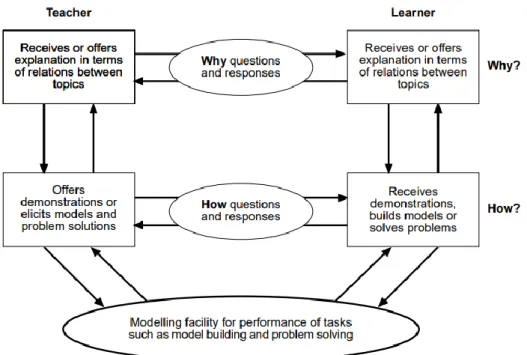
Figure 1 The Skeleton of a Conversation
Source: Pask (1976)
25
The horizontal connections represent the verbal exchanges. Pask argues that all such exchanges have, as a minimum, two logical levels. In the figure these are shown as the two levels: “how” and “why”.
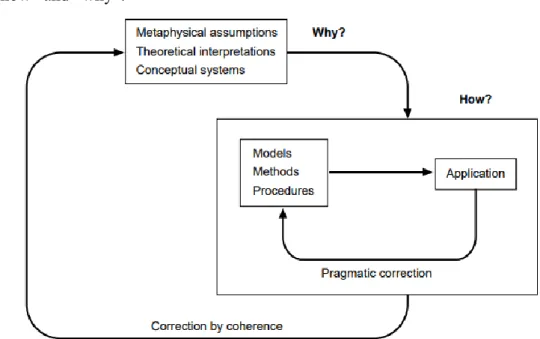
Figure 2 Rescher’s two-cycle model Source: Rescher (1973)
As in Rescher’s model, the “how” level is concerned with how to “do” a topic: how to recognize it, construct it, maintain it and so on; the “why” level is concerned with explaining or justifying what a topic means in terms of other topics.
The vertical connections represent causal connections with feedback, an hierarchy of processes that control or produce other processes. At the lowest level in the control hierarchy there is a canonical world, a “universe of discourse” or “modelling facility” where the teacher may instantiate or exemplify the topic by giving non-verbal demonstrations. Typically, such demonstrations are accompanied by verbal commentary about “how” and “why”. In turn the learner may use the modelling facility to solve problems and carry out tasks set. He or she may also provide verbal commentary about “how” and “why”.
26
2.2.2 Speaking Anxiety
2.2.2.1 Definition of Speaking Anxiety inside the Classroom
There are many issues around learning a foreign language, such as age, aptitude, attitude or affective factors. This study is about forming confidence that helps to alleviate some of the stress experienced by second language students outside the language classroom, because while having a good relationship between teachers and students, the fear of negative evaluation is reduced and the level of reliance increased.
“Anxiety is the subjective feeling of tension, apprehension, nervousness, and worry associated with an arousal of the autonomic nervous system” (Humphries, 2011). Language anxiety is the feeling of the tension and apprehension especially connected with second language context, including learning, speaking and listening. In all the educational institutions, anxiety performance exists between teachers and students. The majority of the situations teachers cannot worry for all their students’ cases or personal problems.
Teenagers have many conflicts in their houses or with their friends. The good relationships in those ages are difficult with their parents or adults. They need attention and understanding for their teachers too. The foreign language is a trouble for them, as a result the most difficult skills is speaking. To talk in front of the class is a challenge; the fear of a negative evaluation greatly contributes to the worry students experience when trying to communicate in the target language.
Self-confidence plays a key role in student’s approaches to learning and use of second language. It is extremely important if they are to be expected to initiate conversation, practicing and improving the second language. An examination of literature on speaking anxiety says that the majority of the learners have been classroom-based, focusing on the relationship between speaking anxiety and interaction between the students and the teacher. (Humphries, 2011). The students’ anxiety for speaking in the inside the classroom is reduced for teachers that have a better correlation with them, they can learn more effectively.
27
be outside the classroom too. When the students arrive to High School, take a break or return to their houses, they have contact with English language through short conversations, greetings or brief summaries of the last class, this could be essential to lose the fear for speaking English, without rubrics or embarrassing evaluations.
2.2.2.2 Overcoming Speaking Anxiety in English through Meaningful activities
Teachers find that speaking is one of the most desirable skills that English students want to get. However, they cannot see English as a necessary subject until a teacher starts to persuade them. According with the study that focused in public school students, they never received English in primary, but now they are teenagers in high school, they feel insecure and nervous about speaking English. The key aspects in this theory was to change the methodology, and interest in promoting oral communication, the use of the games and enjoyable activities to create a relaxed environment that helps the learners overcome their fears and nervousness in speaking skill (Buitrago & Ayala, 2008).
Engage learners through role-plays, presentations, expositions and debates contribute in English teachers’ classes for increasing interest in the students. They are useful tools for students participate actively and let them work cooperatively.
2.2.2.3 Cooperative Learning
Cooperative learning is a situation where students work together to accomplish shared objectives. They can foster learner growth in terms of both academic achievement, personal growth and the development, personal growth and the development of social and learning skill (Buitrago & Ayala, 2008). Considering some factors for working in a better way in groups:
They must be the same goal.
They must feel committed to the work.
28
Using games could be a good option to create the right environment to talk. Promoting spontaneous communication, students forget the pressure to think in grammar or syntax. When they have fun, they ignore the fear, and can notice that they can make a good performance while they are not thinking in the fear of failure. Learners can discover, interact, and promote new ideas games, such as increase motivation and break the monotony in the classroom.
2.2.2.4 Methodological Strategies
Increasing confidence and self-esteem are good strategies for overcoming speaking anxiety, because students’ attitude is the principal problem. During the classes, activities practice pronunciation to become less timid students, and as they know, how pronoun words they feel secure to speak. Make more interesting homework to motivate students or participate in active projects. To take information from the web, update the teachers’ knowledge for inspire in the classes’ lesson plans in order to improve the learners’ points of view of English classes.
Organize in English open houses or fairs to encourage to low-performing students to participate for increasing their self-confidence and show them that they can do a good job as the rest of the students. Learners devoted hours repeating, reading aloud and asking for confirmation of pronunciation. The frequency of the presentations was a positive influence in reducing their nervousness (Buitrago & Ayala, 2008).
2.2.2.5 Helping Students Overcome Foreign Language Anxiety in the English Classroom.
29
The aim of the research study is the motivation to learn, increase English language acquisition and struggle speaking anxiety with everyday classroom practice. The participant of this study were students around 13-14 years old, as learners in Monseñor Roberto Maria Del Pozo in 10th grade. They argued that do not want to participate in speaking activities, because consider that they are not good speakers in English. Consequently, they feared that their fellow students would evaluate them negatively. One of they said: “I like English, but don’t take part in speaking, because I’m so bad at speaking, and my friends will laugh at me” (Tsiplakides, 2009).
Recognizing the origin of their fear at the moment to speak, the followings classrooms interventions were implemented in order to help them overcome it:
Projects Work: To involve students in interesting topics, students can have active role and responsibilities, their confidence increases and reduce the effects of perceptions of low ability in the second language.
Teacher-students relations: A set of classroom rules can be negotiated with the students for collaborative atmosphere. Students were encouraged to ask for help without running the risk of embarrassment.
Providing indirect, rather than direct correction: To provide scaffolding so that learners had an opportunity to continue speaking despite making mistake. Include a model, which explain the steps necessary for task completion.
30
2.3 Legal Framework
According to Ministerio de Educacion (2014) No. MINEDUC-SFE-2014-0034-M:
La Lengua Extranjera se estudie únicamente en la basica superior y no desde los primeros grados de la Educacion General Basica. En función de los actuales demandas de la Sociedad del conocimiento, el manejo del idioma ingles es fundamental y necesario como herramienta general de comunicación y de acceso a la información científica y tecnológica actualizada; en esa medida, es imprescindible el abordaje de la enseñanza de este idioma desde edades tempranas, razón por la cual se requiere una carga horaria de Ingles a partir del Segundo año de EGB (p. 2)
According to La Constitución de la República del Ecuador (2008) Capitulo Segundo, Derechos del buen vivir, Sección quinta, Educacion:
Art 27.- La educacion se centrara en el ser humano y garantizara su desarrollo holístico, en el marco del respeto a los derechos humanos, al medio ambiente sustentable y a la democracia; será participativa, obligatoria, intercultural, democrática, incluyente y diversa, de calidad y calidez; impulsara la equidad de género, la justicia, la solidaridad y la paz; estimulara el sentido crítico, el arte y la cultura física, la iniciativa individual y comunitaria, y el desarrollo de competencias y capacidades para crear y trabajar (p. 27)
31
Figure 3 English as a Foreign Language Curricular Threads Source: Ministerio de Educacion (2016)
In 2016, Dr. Miguel Herrera and MAT. Alexandra Perez stablished a new form to classify and order how English teachers plan and work inside the classroom with their students. The first English as a Foreign Language (EFL) Curriculum was created to get the right balance between:
Ambition vs. Realism
International models v. Local conditions
There are three main goals of the EFL Curriculum (2016):
To develop learners’ understanding of the world –of other cultures and their own- and to communicate their understanding and views to others through English
32
To create a love of learning languages starting at a young age, by means of engaging and positive learning experiences, in order to foster students’ motivation to continue learning English throughout EGB and BGU, as well as work and beyond.
Ecuador has linked the English level each grade has to achieve to the Common European Framework Reference (CEFR). For this case, the EFL curriculum for EGB Superior has taken into consideration the cognitive, social, emotional and physical growth of the learners, as well as their language abilities, so they are able to pass from level A1.1 to A2.1 of the CEFR. (English as a Foreign Language for Subnivel Superior, 2016)
This research study focuses on those objectives to create an entertaining, motivational way to engage students to practice and produce English. For that reason, English teachers need to be updated and informed about new methods and techniques to teach different kind of students’ personalities.
33
2.4 Conceptual Framework
Foreign Language: A language that is not native, or do not come from the origin country of someone.
Second Language Acquisition: To learn a different language that is not a native language of someone.
EGB: Educacion General Basica.
BGU: Bachiller General Unificado.
Motivation: To animate, cheer up someone with something.
Attitude: Disposition of someone to do something, it could be positive or negative.
Self-esteem: To believe oneself, the confidence in their abilities.
Self-Confidence: Do not have doubts about oneself, to trust in oneself.
Approach: A specific focus, attention to something.
Interaction: To communicate with someone.
Fear: A worried or dangerous feeling.
Speaking Anxiety: Fear to talk in front of groups or public in a foreign language.
Learning Strategies: Different kind of ways to learn specific things.
Overcoming Fear: To handle or deal positively in front of an uncertain feeling.
Cooperative Learning: To work together with the same aim in order to learn a specific information.
Oral Interaction: To contact with someone by using the speaking skill.
Availability: Good disposition to do something.
Regard: To have an opinion about something.
Linguistic: Connected with language or the study of language.
Encourage: To motivate to do something with an aim.
34
Techniques: specific activities developed in the classroom that worked together with the methodology for the good acquisition of the language.
35
CHAPTER III
3. RESEARCH METHODOLOGY
3.1 Type of Research Description
Based on the main goal of the research project the types of research were: Exploratory and Descriptive.
The former is based on a first analysis observed among students during an oral explanation. They did not have the correct attitude for speaking in front of an audience. The information given was not accurate for their age or English level. They seemed to be worried about the final score, and looked really nervous.
The latter type is based on a common English class during the week. Students did not pay attention during the class so they did not understand instructions for that reason the communication was broken. The activities that the book provided were not meaningful for them, they were afraid of speaking in the foreign language.
3.2 Methods, Techniques and Research Instruments
The research project was based on two methods: Inductive and deductive. The inductive one has a qualitative approach where based on observation and interviews, authors obtained data. Observation inside the classroom allowed researches to collect information about the way students behave when working in pairs or team work.
The deductive method has a quantitative approach and were based on students’ survey. The results showed that they did not count with materials, electronic devices and specific techniques to teach English as a foreign language on 10th grade EGB students.
The techniques used were surveys and interviews. The survey was taken to students in order to collect information and have a foundation about speaking anxiety issue. The different kind of answers where compared and researchers analyzed the results among students. The survey was taken on a classroom with fifteen students first and then the other half.