
TítuloLa percepción de la arquitectura eclesial latinoamericana en la época del Concilio Vaticano II: estudios desde la Europa centro oriental
8
0
0
Texto completo
(2) PERCEPTION OF LATIN AMERICA’S CHURCH ARCHITECTURE IN THE TIME OF II VATICAN COUNCIL. STUDIES FROM EAST-CENTRAL EUROPE. Fig. 01. Prosecution of archbishop József Mindszenty, Budapest (Hungary), 1949.. We point out that these changes coincide with the period of the Council. In accordance with the spirit of the conference, we present the opportunity for appearance of sacral architecture in the period of remission. The publications about modern architecture of Latin America —that are also available in Eastern Europe in the course of time— has almost totally parallel appearance with this process. The analysis was conducted by evaluating periodicals dealing with architecture and liturgy – which had been controlled by the state, so considered to be official opinions of state of art. This time, we disregarded the Western European periodicals of limited availability, but these and the later accessible books could become determining literature starting from the period of political easement. The process of the research revealed that the period named in the title has to be extended, so that we can successfully present our hypothesis regarding the architectural effects. The critical evaluation of the processes gives opportunity for the recognition of architectural comparisons. So our study in the field of history of architecture explores the internal processes and the architectural appearance of the Church fighting for survival in the basically atheist states of the Eastern Block during the period of the II Vatican Council and the following decade.. OPPRESSION AND FAITH At the end of World War II, Eastern Europe was liberated by the Soviet Union’s army that largely extended its sphere of influence to these countries. The communist political system was basically atheist, the cessation of the Church was considered as an inner political aim. The countries of the Eastern Block were traditionally Catholic countries, but a significant number of Reformed Communities can be found, as well as Orthodox Churches in the Southern and Eastern areas. A powerful secularization was proclaimed by the Soviet-type powers1. Due to the political takeover, the basic conditions of the Church’s operation were almost completely wound up: taking away landholdings, nationalization of schools, liquidation of monastic orders, the cessation of church foundations and organizations aimed the structural basis of the short term liquidation of the Church. Personal intimidation (Fig. 01) was also applied by means of political show trials: the uncooperative senior priests were imprisoned or forced into house arrest during 1948/51 (Turcescu and Stan 2015, 75-103; see also Balogh 2014, 88-114). These processes were unacceptable for the Holy See, but the Episcopal Conferences were instructed to refuse the provisions to no avail, the Church leaders, having limited room for maneuver, were obliged to cooperate in the course of time (Völgyesi 2011, 25-34).. Actas del Congreso Internacional de Arquitectura Religiosa Contemporánea 4 (2015). 47.
(3) ZORÁN VUKOSZÁVLYEV. 48. Actas del Congreso Internacional de Arquitectura Religiosa Contemporánea 4 (2015).
(4) PERCEPTION OF LATIN AMERICA’S CHURCH ARCHITECTURE IN THE TIME OF II VATICAN COUNCIL. STUDIES FROM EAST-CENTRAL EUROPE. As the Holy See saw the secularization carried out with brutal means, changed its tool in accordance with the spirit of the maturing process of the II Vatican Council. The proclaimed Ostpolitik made contact with the atheist governments, for the period of the Council, several bishops from the socialist countries could take part in the sessions, due to the advanced discussions. The Council had not been terminated yet, when the Holy See signed the intergovernmental agreement with Hungary, first among the socialist countries, in 1964 (Gergely 1985; see also Balogh 1997, 386-439). The event triggering international recognition resulted in lifting the isolation of the Eastern Block and slowly normalizing the relations with the other countries as well2. The gesture of the Holy See resulted in a mutual trust. The events of Hungary in 1956, then of the Czech Republic in 1968, projected the fall of the untenable atheist world order. Whereas religiousness hasn’t disappeared. Poverty and oppression strengthened the spiritual attitude. OPPORTUNITY OF LIGHT However, before the easement of the ’70s, the communist-minded state power sought to limit the appearance of the Church in all media. In connection with the research, we examined the official architectural periodicals of the Eastern Bloc’s countries. The anticlerical political processes and the intergovernmental relations are well characterized by the number and quality of the articles in connection with sacral architecture in architectural press. In the 1950s, nothing was allowed to appear under the title of sacral architecture, while small church communities realized buildings, in defiance of every restriction. After the release of ideological restrictions of architecture in official media at the end of the ‘50ies —when the Stalinist socialist realism style was no longer applicable as a dictate—, modern architecture returned, thus publications concerning churches could be randomly published, exclusively in connection. Fig. 02. Cover (a) and first page (b) of the article on Corbusier’s Ronchamp: «Új tér-Új formák. Látogatás Ronchampban» [New Space–New Form. A visit in Ronchamp]. Fig. 03. 13th UIA Congress in Mexico. Special congress issue: «The restoration of the Reformed Church of Rudabánya». Fig. 04. «Ruch nowoczesny w architektuze sakralnej: nowoœæ a tradycja myœli klasycznej» [Modern movement in sacred architecture: novelty and tradition of classical thought].. with the international processes of modernism. Le Corbusier’s life work could be published with one of his last works already in ’58, but the censorship of the church’s presentation is well shown by the fact that there is no photo of the altar space in the 8-page article (Fig. 02). Participations in congresses and newscast held special opportunities due to the political opening. The published catalogs, booklets, reports implied a calm world view: sacral architecture was represented only until 1945, cooperation with the Church was carefully displayed, but churches were presented only in relation with monument restorations, but carefully avoiding those sacral characteristics with the previously mentioned carefulness (Fig. 03). A strong easement was experienced in the ’70s. The provisions of the II Vatican Council were completely translated, the new mass order was introduced. The coexistence of the socialist state and the Church became part of the everyday routine. Churches could already take place in architectural press among the presented works of the closer European and the farther North American architects: Poland led the way in this process. Architectural, sociological writings were published in connection with the man’s place in modern society. Remembrance and collective memory are characteristic topics of this era, which brought along the public mediation of sacral architecture, as well. The overviews appeared in the early ’80s also highlighted continuity: drawing a comparison between the Arka Pana in Nowa Huta and Corbusier’s Ronchamp Chapel might not be a coincidence (Fig. 04). PERCEPTION AND INSPIRATION The aim of this introduction was to give an overview of political and social environment. Following this we would like to highlight such possible comparisons regarding the Eastern European perception of the by now explicitly Latin American sacral architecture. In the late ‘70s something has changed vigorously. It is not only about the change of head of the church (since Pope Paul VI died in 1978, a new pope, John Paul II, was chosen for this duty first in the time of Rome a man from East-Europe), but really a cognitive process of new opening. The new political line, having been defined for several years, proclaimed conciliation towards the Church. Church constructions, that already. Actas del Congreso Internacional de Arquitectura Religiosa Contemporánea 4 (2015). 49.
(5) ZORÁN VUKOSZÁVLYEV. Fig. 05. Enrique de la Mora with Felix Candela, Chapel of Nuestra Señora de la Soledad, Coyoacán, Mexico DF, 1955/57. Fig. 06. Ferenc Török, Holy Spirit, Nemeshetés (Hungary), 1973/76. Fig. 07. Ferenc Török, St. Elisabeth the Hungarian, Balatonfenyves (Hungary), 1975/77. Fig. 08. Holzbauer-Kurrent-Spalt, Kisrche Heiligen Blut, Salzburg-Parsch (Austria), 1956.. 50. Actas del Congreso Internacional de Arquitectura Religiosa Contemporánea 4 (2015).
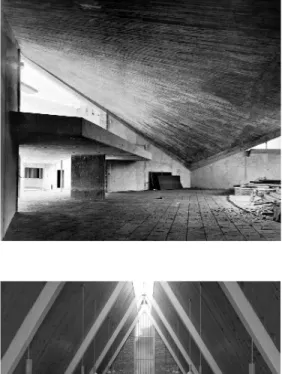
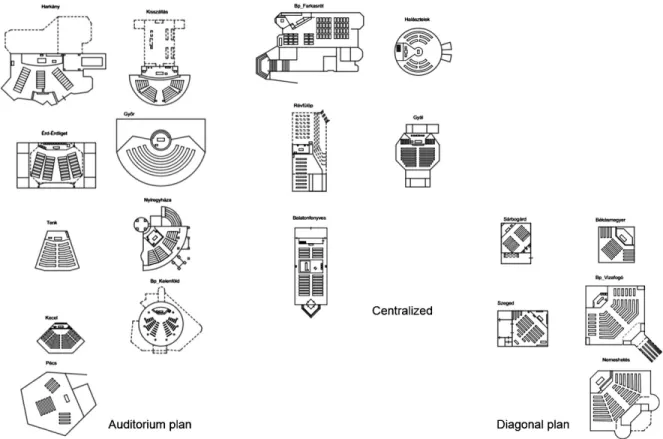
(6) PERCEPTION OF LATIN AMERICA’S CHURCH ARCHITECTURE IN THE TIME OF II VATICAN COUNCIL. STUDIES FROM EAST-CENTRAL EUROPE. applied new tendencies, started off in a wider range, though with supervision3. All this coincides with the practice of cultural opening. At the universities, Western European professional literature was easier to obtain since the middle ’60s (Christ-Janer and Foley 1962). Books, dealing with modernism published in the ’50s, included churches in the most natural way (Mindlin 1956; Cetto 1961). The solutions and shapes of these could be adopted with adjusting it to domestic architectural practice. The new patterns were rapidly built in to the booming practice of church architecture from the eartly ’70s, mostly by those architects who had access to this literature due to their ties to the university. Architectural design is a very complex process, we can’t say that high-quality works can be created by unequivocally taking over a prefiguration. The diagonally composed floor plan or the precisely structured space organization of the Mexican Chapel of Nuestra Señora de la Soledad by Felix Candela (Fig. 05) compared to Holy Spirit Church in Nemeshetés by Ferenc Török (Fig. 06) shows a great affinity with the diversity of church architecture introduced by the above-mentioned remission. We are not talking about unequivocal copying, but associative thinking of architecture. Let it be a church built for another Christian denomination, the composition of light treating may inspire Catholic church designs, too. Just to compare the treaty of lateral light and the gothic proportion of triangular composition of churches Fort Wayne (Ind., USA), Church at Concordia Senior College Lutheran Seminary, 1957 by Eero Sarinen, and Balatonfenyves (Hungary) Church of St. Elisabeth the Hungarian, 1975/77 by Török Ferenc. If we better examine the unique floor plan in Hungarian materials, we can find the equivalent of this form in the neighboring country of Austria (Salzburg-Parsch, Heiligen Blut, 1956 by Holzbauer/Kurrent/Spalt), in a literature piece obtained in the early ’70s, as well4 (Fig. 07-08). Finally, I would like to briefly present the current research direction of the Sacral Architecture Studio organized at the Department of History of Architecture at the Budapest University of Technology —the work of Gréta Garai (2015) and Erzsébet Urbán (Vukoszávlyev and Urbán 2016). The collection, intensively started in 2013, examines the churches built after World War II, during the period of socialism. The floor. plans of the churches established in the ’70s-80s, in light of the church political and social backgrounds, indicate well that the renewal processes of liturgy, taking place for decades in Western Europe, appeared about one and a half decade later in Eastern Europe (Fig. 09). The basically traditional longitudinal floor plan system is then already enriched by more special architectural solutions5. We can state the conclusion of our research that while the churches had been oppressed in Eastern European countries due to ‘50-70s, yet the churches realized in this period applied quickly international design trends of new spatial organisations, thanks to high quality examples of Western European and Latin American books on modern architecture and church design. NOTES (1) One of latest conferences on this topic: Nagy and Zombori 2014. See also: Fiamová and Jakubèin 2010. Wide overview of the situation of Christianity after WWII: Berglund and Porter-Szûcs 2010. (2) Some topics on Ostpolitik in relation to Hungary: Szabó 2005. (3) The new liturgic space form appeared first in case of monumental restorations (that were already urged by state authority), but in general, these new space compositions were not easily adopted, the transformation of the liturgic space was often realized only in the early ’80s. Two main publications of his era (identifying the start and the flourishing period of transformations in Hungary): Lévárdy et al. 1971; Levárdy 1982. (4) Importance of this unique example is highlighted in the publication on Hungarian Church Architecture of ’70ies presented in Austrian christian art journal: Rombold 1984, 121-124. (5) Visual appearance of the research on Hungarian Church architecture after WWII: www.egyhaziepiteszet.wordpress.com, accesed October 12, 2015. BIBLIOGRAPHY Balogh, Margit. 1997. «Egyházak a szovjet rendszerben (1945–1989)» [Churches in the Soviet system (1945-1989)]. In Magyarország a XX. században. 2. köt., edited by Tarsoly I. Kolléga, 386-439. Szekszárd: Babits Kiadó.. Actas del Congreso Internacional de Arquitectura Religiosa Contemporánea 4 (2015). 51.
(7) ZORÁN VUKOSZÁVLYEV. Fig. 09. Special spatial organisation of Hungarian Catholic churches of ‘70s.. Balogh, Margit. 2014. «Diplomatic Missions of the Holy See in Hungary and East-Central Europe after the Second World War». Central European Papers 2/1:88-114. Berglund, Bruce R. and Brian Porter-Szûcs. eds. 2010. Christianity and Modernity in Eastern Europe. Budapest/New York: Central European University Press. Biedrzynski, Richard. 1958. Kirchen unserer zeit. München: Hirmer Verlag. Cetto, Max. 1961. Moderne architektur in Mexico. Stuttgart: Verlag Gerd Hatje. Christ-Janer, Albert, and Mary Mix Foley. 1962. Modern church architecture–A guide to the form and spirit of 20th century religious buildings. New York/Toronto/London: Dodge/McGraw-Hill.. 52. Fiamová, Martina, and Pavol Jakubèin. eds. 2010. Prenasledovanie cirkví v komunistických štátoch strednej a východnej Európy [Persecution of Churches in the Communist Countries in Central and Eastern Europe]. Bratislava: Ústav Pamäti Národa. Garai, Géta. 2015. A közösség centrumában Magyar katolikus templomépítészet 1970-1986 között [The center of the community - Hungarian Catholic Church Architecture 1970-1986]. Budapest: Manuscript for BUTE Scientific Conference of Students. http://tdk.bme.hu/EPK/DownloadPaper/Akozosseg-centrumaban-Magyar-katolikus, accesed October 12, 2015. Gergely, Jenõ. 1985. A katolikus egyház Magyarországon 1944-1971 [The Catholic Church in Hungary 1944-1971]. Budapest: Kossuth Könyvkiadó.. Actas del Congreso Internacional de Arquitectura Religiosa Contemporánea 4 (2015).
(8) PERCEPTION OF LATIN AMERICA’S CHURCH ARCHITECTURE IN THE TIME OF II VATICAN COUNCIL. STUDIES FROM EAST-CENTRAL EUROPE. Lévárdy, Ferenc, et. al. 1971. Egyházi épületek és mûtárgyak gondozása [Maintanence of religious buildings and artfacts]. Budapest: Képzõmûvészeti Alap Kiadóvállalata. Levárdy, Ferenc. 1982. Magyar templomok mûvészete [The art of Hungarian churches]. Budapest: Szent István Társulat. Mindlin, Henrique Ephim. 1956. Modern architecture in Brazil. New York: Reinhold Publishing Corporation. Nagy, Mihály Zoltán, and István Zombori. eds. 2014. Állam és egyház kapcsolata Kelet-KözépEurópában 1945-1989 között. Intézmények és módszerek [State and church relations in Central and Eastern Europe in the period 1945-1989. Institutions and Methods]. Budapest: METEM Historia Ecclesiastica Hungarica Alapítvány. Rombold, Günther. 1984. «Neubeginn im ungarischen Kirchenbau». Kunst und Kirche 1984/2:121124. Szabó, Csaba. 2005. A Szentszék és a Magyar Népköztársaság kapcsolatai a hatvanas években [The Holy See and the Hungarian People's Republic relations in the sixties]. Budapest: Szent István Társulat/Magyar Országos Levéltár.. Turcescu, Lucian, and Lavinia Stan. 2015. «Church Collaboration and Resistance under Communism Revisited: The Case of Patriarch Justinian Marina (1948-1977)». Eurostudia 10/1:75-103. Vukoszávlyev, Zorán, and Erzsébet Urbán. 2016. «Magyarország templomépítészete 1945-1963 között - Vázlatok az egyes alkotói munkásságok értékelésével megállapítható építészeti folytonosságról» [Hungarian church architecture between 19451963–Outlines of architectural continuity by evaluation of individual practices]. Építés- Építészettudomány 44/1-2:247-315. Völgyesi, Zoltán. 2011. «A kommunista egyházpolitika szakaszai Magyarországon 1948-tól 1964ig.» [Sections of the communist policy of churches in Hungary from 1948 until 1964] Mediárium: Társadalom–egyház–kommunikáció 5/4:25-34. SOURCE OF FIGURES Fig. 01 and 06-07. Zorán Vukoszávlyev’s archive. Fig. 02. Magyar Építõmûvészet 1958/6. Fig. 03. Magyar Építõmûvészet 1978/2. Fig. 04. Architektura Polska 1983/5. Fig. 05. Christ-Janer and Foley 1962. Fig. 08. Biedrzynski 1958. Fig. 09. Drawings by Gréta Garai.. Actas del Congreso Internacional de Arquitectura Religiosa Contemporánea 4 (2015). 53.
(9)
Figure

Documento similar
