
Non symbiotic nitrogen fixation during leaf litter decomposition in an old growth temperate rain forest of Chiloe Island, southern Chile: Effects of single versus mixed species litter
10
0
0
Texto completo
(2) S P E C I E S E F F E C T O N AC E T Y L E N E R E D U C T I O N R AT E S. ‘quality’ substrates, that is, characterized by high C to N ratios and high lignin content, would exhibit a higher rate of N-fixation by free-living microbes. Because ATP is the molecular energy source for N fixation, it can also be expected that phosphorus (P) availability may limit heterotrophic N fixation in leaf litter of some forest ecosystem (Reed et al. 2007). Southern temperate rainforests have a high diversity of functional groups (Wardle et al. 1997) and native forests in Chile are dominated by tree species that differ markedly in litter C/N ratios, % N retranslocation, and phosphorus and lignin concentrations (Diehl et al. 2003; Pérez et al. 2003), in addition to morphological and chemical leaf traits which can potentially affect decomposition rates (Pérez 1996; Gurvich et al. 2003). All of these variables can have either positive, negative or no effect on the rates of non-symbiotic N fixation (Crews et al. 2000; Vitousek & Hobbie 2000; Reed et al. 2007; Pérez et al. 2008). Unpolluted, temperate rainforests of southern Chile represent therefore a natural laboratory to investigate species-specific effects on ecosystem processes, particularly those highly sensitive to industrial pollution, such as heterotrophic N fixation. Identifying species effects on ecosystem functions and their response to N variability may have important implications for assessing ecosystem services and defining protocols for native forest management to reduce the impacts of future industrial pollution. Here, we tested the hypothesis that decomposing single-species litter of three selected tree species, which differ greatly in chemical quality, would differentially affect heterotrophic N fixation rates in an old-growth, temperate evergreen rainforest of Chiloé Island, Chile. Additionally, we test one prediction of the ‘niche complementarity’ hypothesis (Loreau 1998), which proposes that diazotrophs living in mixed-species litter (i.e. a species-rich, and chemically heterogeneous substrate) on the forest floor would fix N at higher rates than those found in leaf litter from a single species. Additionally, at the ecosystem level, we tested the hypothesis that in this unpolluted forest, the inputs of nitrogen via non-symbiotic N fixation may be coupled to internal N circulation via net mineralization.. MATERIALS AND METHODS Study site The study site was located in north-western Chiloé Island, within Senda Darwin Biological Station (41°50′S, 73°48′W), about 15 km north of Ancud, Chile. We studied a lowland (about 100-m elevation) old-growth temperate rain forest. The stand has a minimum age estimated from tree ring counts of 200 years, and the canopy is dominated by ever-. © 2009 The Authors Journal compilation © 2009 Ecological Society of Australia. 149. green tree species, including Nothofagus nitida (Nothofagaceae), Podocarpus nubigena (Podocarpaceae) and Drimys winteri (Winteraceae). A 50 ¥ 20 m permanently marked plot established in this forest for assessment of canopy structure and dynamics (Gutiérrez et al. 2004) was used for the present study.The three dominant tree species accounted for 54 % of the total stand basal area, which was 72 m2 (Gutiérrez et al. 2004). Soils are moderately well drained, highly organic cambisols with a low bulk density and a high C/N = 34. Soils are derived from fluvioglacial deposits and terraces from the late glacial forming an undulated hilly landscape of about 100-m elevation.The prevailing climate is wet-temperate with a strong oceanic influence (Di Castri & Hajek 1976). Meteorological records (4 years) at Senda Darwin Biological Station indicate an annual rainfall of 2090 mm and a mean annual temperature of 12°C. Maximum monthly temperatures (January) are 16°C and minimum monthly temperatures (July–August) are 5°C. Rainfall occurs throughout the year, but 64% of the precipitation falls between April (austral autumn) and September (austral spring).. Litterfall and fresh leaf sampling Fine litter material was retrieved monthly from August 2001 to June 2002 from 12 litter traps (0.2 m2) installed within one 50 ¥ 20 m permanent plot inside the forest, and >100 m away from any edge. Random samples of three litter traps per date were sorted by species and dry weighed to provide material for each single species type of litter. To assess the percentage of N retranslocated before leaf abscission, fresh leaves of each of the three species, Nothofagus, Drimys and Podocarpus, were hand-picked from reachable branches (n = 3 per species) every month from October 2001 until June 2002.. Litter decomposition experiment We used the litterbag approach to estimate the mass loss of fresh leaf litter through time. We used a 2-mm mesh size to allow the access of most of the mesofauna and all the microfauna of decomposers. Decomposition bags were filled with fresh litter (approximately 10 g dry mass per litter bag) collected from litter traps in the same rain forest. The leaf and fine woody material gathered in litter traps was periodically collected and oven dried (70°C) until a constant weight of about 500 g dry mass. The leaf litter of the three dominant tree species in the forest canopy was individually sorted by species: N. nitida, P. nubigena and D. winteri. In January 2002, nine litter decomposition bags per tree species were deposited on the forest floor at each of five sample points located about 10 m apart along a transect line, making a total of 45 litterbags per species. Litter bags were removed 91, 124, 182, 239, 315, 550, 749, 943, 1161 days after the initiation of the study, and then taken to the lab to estimate mass loss since the initiation of the experiment. The material was then ground to determine the contents of total carbon and nitrogen in plant tissue (see below). The last sample in this assay was retrieved in March 2005. To obtain the decay constant. doi:10.1111/j.1442-9993.2009.02020.x.
(3) 150. C . A . P É R E Z ET AL.. Table 1. Leaf litter C/N ratio, contents of lignin, hemicellulose and soluble carbohydrates in leaf material, % N-retranslocated (RT) and N return in litterfall, decomposition constant (k), % P, and ARR in decomposing leaf litter (nmol g-1 h-1), as a surrogate of non-symbiotic N fixation, for the dominant tree species and mixed litter (O1 horizon) in an unpolluted temperate, evergreen rain forest in Chiloé Island, southern Chile. Leaf litter C/N Lignin (%) Soluble carbohydrates (%) Hemicellulose (%) % RT N return (kg ha-1 year-1) k (year-1) %P ARR. Drimys winteri. Nothofagus nitida. Podocarpus nubigena. Mixed litter. 50.6a ⫾ 4.8 45.49ab ⫾ 6.28 59.3a ⫾ 15.43 6.48a ⫾ 1.99 19.7 5.1a ⫾ 1.6a 0.29a 0.12a ⫾ 0.02 10.2a ⫾ 4.01. 78.7b ⫾ 4.5 59.27a ⫾ 4.09 23.32b ⫾ 2.62 9.27a ⫾ 4.64 51.0 5.35a ⫾ 1.92 0.47b 0.14a ⫾ 0.04 34.09b ⫾ 0.34. 54.4ac ⫾ 2.9 40.31b ⫾ 6.86 33.62ab ⫾ 3.55 10.08a ⫾ 4.75 19.9 15.1b ⫾ 0.38 0.29a 0.11a ⫾ 0.02 4.11a ⫾ 0.71. 60.7† ⫾ 4.2c n.a. n.a n.a n.a. n.a. 0.36‡ 0.09† ⫾ 0.03 8.08a ⫾ 2.1. Different letters indicate significant differences among species (Tukey’s a posteriori test, P < 0.05). n = 3 litter traps per species, averaged over 8 months. Decomposition constant k estimated for in situ measurement during 3 years. †Values for Ol horizon (n = 6 samples). ‡Values for a reference evergreen old-growth lowalnd forest in the study region.. (k) for each single species litter type, a negative exponential model was fitted to the tendency of mass loss through time (Olsen 1963). Mixed litter was not used in the decomposition experiment in the studied forest, but we presented as a reference the decomposition rate of mixed litter obtained from the Ol horizon of another lowland evergreen rainforest within the studied region, in northern Chiloé Island (Pérez et al., unpublished data, 2005, Table 1).. In situ non-symbiotic N-fixation rates Non-symbiotic N fixation rates were estimated using the acetylene reduction technique (Myrold et al. 1999). From December 2002 (after 336 days of decomposition) until January 2005 (after 1104 days of decomposition) litter of each individual species contained in the decomposition bags was incubated in situ four times each year (summer, autumn, winter and spring) to assess ethylene production (see below). Parallel to these experiments we also incubated unsorted litter samples taken from the Ol horizon in the forest floor (mixed species litter) and mineral soil samples (Ah horizon). Mixed litter samples were composed of a mixture of senescent leaves of different tree and vine species and other materials in the following proportions (by dry weight) = 37% senescent leaves of the three dominant and focal canopy species, 29% senescent leaves of eight other woody species, 29% fine woody debris < 5 cm diameter, and 5% unknown fragments and highly decomposed plant tissue. For incubation assays using mixed litter (Ol horizon) and soil samples (Ah horizon), we set up two parallel 50-m-long transects, 10 m apart from one another, within a 50 ¥ 20 m permanent plot. Every 12 m along each transect we set up one sampling point, making a total of six sample points per stand. For mixed litter samples, about 20–300 g fresh weight of fine litter (leaves and twigs) was collected by hand (using clean rubber gloves) from an area adjacent to each sample point and placed inside an incubation glass jar. In order to characterize mixed litter of the Ol horizon for C/N ratio and content of total P, samples were taken once during the experiment. For mineral soil, 100 cm3 volume samples were. doi:10.1111/j.1442-9993.2009.02020.x. extracted with a steel cylinder at the same sampling points and placed inside incubation jars. Samples from decomposing litterbags of individual tree species, mixed litter from the forest floor, and the intact soil cores were incubated inside 1-L hermetic jars containing a 10% v/v acetylene/air. Samples were incubated during two consecutive days (Pérez et al. 2004). Each day, a sample of air was taken from inside each jar and injected in 3 mL Venojets. Gas samples were frozen and analysed within 1 week for ethylene (C2H4) production using a Schimadzu gas chromatograph equipped with a Porapack column and an FID detector. The detection limit of this analysis was 0.01 nmol C2H4 mL-1. Acetylene reduction rates (ARR) were estimated from the slope of the ethylene accumulation curve in the headspace after 2 days of incubation. To estimate ethylene concentration dilutions of 100 ppm standard gas (Scotty Specialty Gases) was used. One subsample without acetylene was used as control in the samples of Ol and Ah horizons. Control samples showed zero or almost negligible ARR. Annual rates of non-symbiotic N fixation for litter and soil samples were estimated by assuming the stoichiometric conversion factor of 1/3 of the ARR, multiplied by the estimated litter mass on the forest floor for the entire stand. Standing crop of fine litter was estimated from the dry weight of six litter samples collected with a 20 ¥ 25 cm metal frame in each sample point (from Pérez et al. 2004).. Total carbon, nitrogen and phosphorus The total contents of carbon and nitrogen of litter from individual species (from litter traps), mixed litter (Ol horizon; n = 6 samples taken in August 2003) and decomposing leaf litter were determined by flash combustion using a CarloErba NA 2500 Elemental Analyzer. Additionally, the total P content of litter sorted by species (from litter traps) and mixed litter from the forest floor (Ol horizon) was determined. Average C/N ratios per species and the content of total phosphorus (% P w/w) were obtained for eight sampling dates from August 2001 to June 2002. We also estimated N flux in leaf litter by multiplying N concentration in. © 2009 The Authors Journal compilation © 2009 Ecological Society of Australia.
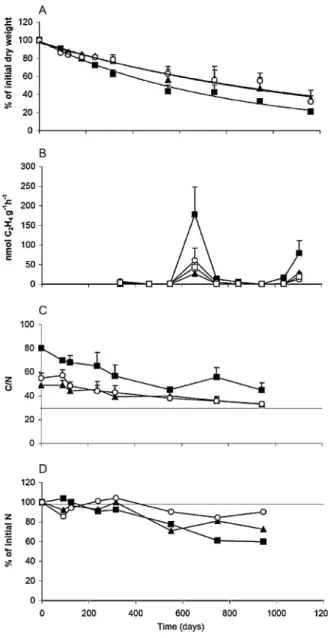
(4) S P E C I E S E F F E C T O N AC E T Y L E N E R E D U C T I O N R AT E S. leaf litter by the litter mass flux of each tree species obtained from litter traps. The % N retranslocation (% RT) for each tree species was determined as the proportion of leaf N lost in litterfall divided by the proportion of N present in fresh leaves (Pérez et al. 2003). Total P was extracted from ground leaf litter using a concentrated sulphuric acid/hydrogen peroxide digestion in a Hach Digesdahl Digestor and P mass was determined by the ascorbic acid molybdate colorimetric method (Kuo 1996).. Lignin, hemicellulose and soluble carbohydrates We randomly selected three samples per species of the leaf material collected during the sampling period. In these samples we determined the concentration of lignin, hemicellulose and soluble carbohydrates by sequential extraction with strong acid detergent according to Van Soest (1963).. 151. hemicellulose and soluble carbohydrates contents in leaf material, C/N ratios and P contents in the Ol horizon and on the average ARRs in decomposing leaf litter, one-way anovas (with species as treatment levels) and a-posteriori Tukey’s tests were used. We evaluated the interspecific differences in decomposition rates (k) using multiple comparisons of slopes by Tukey’s tests (Zar 1996). To assess both the effects of tree species and sampling time on ARRs, C/N ratio, and % of initial N in the decomposing leaf litter, we performed a two-way repeated measurements anova (Zar 1996) using the program Statistica. A posteriori Tukey’s tests were applied to identify individual species effects in each sampling period. Pearson correlation analyses were performed to test for the degree of association between in situ acetylene reduction activity and net N mineralization in forest soils.. RESULTS N immobilization Chemical characterization of leaf litterfall The % of N immobilized in decomposing leaf litter, either biotically or abiotically, was estimated as the absolute concentrations (mg N g dry weight-1) of N that remained in decomposing leaf litter with respect to the total N present in leaf litter before the initiation of decomposition assays.Values higher than 100% indicated the occurrence of net N immobilization.. In situ net N mineralization In order to assess the temporal coupling of nitrogen input via non-symbiotic nitrogen fixation and its release to the soil solution, we estimated the rates of net nitrogen mineralization in surface soils in the same forest each season from December 2002 to January 2005. Soil was sampled from the same points used for the determination of ARR in the litter layer (Pérez et al. 2004). Seasonally (summer, autumn, winter and spring), at each sampling point, samples of surface (0–10 cm) soils were collected using a shovel. Soil samples were sieved in a 2-mm mesh size to separate roots and the coarse fraction of soil. Each sample was then divided into two subsamples. One subsample was taken to the lab to determine the initial ammonium and nitrate contents in the soil solution. The second subsample was placed inside a polyethylene zip lock bag and returned to the soil at the same location and depth of collection (Pérez et al. 1998, 2004). Field incubated samples were retrieved after 30–35 days and taken to the laboratory to determine the final ammonium and nitrate contents. A 0.021 mol L-1 KAl(SO4)2 solution was used for the extraction of available N from soil samples (1:4 soil/solution). Ammonium and nitrate contents were assessed by fractionated steam distillation (Pérez et al. 1998). Monthly rates of net N mineralization were estimated as the difference between the initial and final N contents of fieldincubated soil samples.. Leaf litterfall of N. nitida had a significantly higher C/N ratio than that of D. winteri and P. nubigena (Table 1; anova, Tukey’s test P < 0.001). Nothofagus nitida presented higher content of lignin than P. nubigena (anova, Tukey’s test P = 0.046) and lower content in soluble carbohydrates than D. winteri (Table 1, anova, Tukey’s test P = 0.021). The higher C/N ratio of N. nitida was associated with higher percentages of N retranslocation from senescent leaves. The highest N return in litterfall was recorded for the conifer P. nubigena (Table 1, anova, Tukey’s test, P < 0.0001). The mixed litter in the Ol horizon on the forest floor had significantly lower C/N ratio than leaf litterfall of N. nitida but higher than litter of D. winteri (Table 1, anova, Tukey’s test, P < 0.03). The total P content of leaf litterfall was similar across all three dominant canopy species (Table 1).. Decomposition rates The comparison of decay constants (k values) indicated significant differences among tree species (F2,143 = 22.76, P < 0.001). Leaf litter of N. nitida presented higher decomposition rates than both P. nubigena and D. winteri (Tukey’s test, P < 0.05), without differences in k values for the two latter species (Table 1).. Acetylene reduction rates during litter decomposition. Statistical analyses To test for differences among the three main canopy species on C/N ratios, % P and N fluxes in the litterfall and lignin,. © 2009 The Authors Journal compilation © 2009 Ecological Society of Australia. Acetylene reduction rate, as a surrogate of nonsymbiotic N fixation, differed among tree species and among sampling times during the course of litter doi:10.1111/j.1442-9993.2009.02020.x.
(5) 152. C . A . P É R E Z ET AL.. Table 2. Repeated measures anova for the remaining dry mass of litter, acetylene reduction rates (ARR), C/N ratios and % of initial N in the decomposing leaf litter of the three main canopy species (Nothofagus nitida, Drimys winteri, Podocarpus nubigena) in an evergreen, broad-leaved oldgrowth rain forest of Chiloé Island Source of variation Remaining mass Species Month Species ¥ month ARR Species Month Species ¥ month C/N ratio Species Month Species ¥ month % of initial N Species Month Species ¥ month. d.f.. F. P. 2,12 8,96 16,96. 27.378 134.786 2.453. <0.001 <0.001 <0.001. 3,17 8,136 24,136. 5.938 14.76 3.191. <0.006 <0.001 <0.001. 2,6 6,36 12,36. 80.67 18.88 1.46. <0.001 <0.001 <0.181. 2,6 6,36 12,36. 6.717 9.95 2.527. <0.029 <0.001 <0.015. decomposition (Table 2). ARR measured in leaf litter of D. winteri was higher than that of P. nubigena and N. nitida for days 336 and 461 of the decomposition assay. Leaf litter of N. nitida presented a higher ARR than the two other species thereafter, except for three sampling times, when there was no difference among tree species or between canopy species and mixed species litter from the Ol horizon (Tukey’s tests for all dates, P < 0.05, Fig. 1B). In first 1.3 years of the litter decomposition process, N fixation (as measured by ARR) associated with the decomposing leaf litter of D. winteri was one to two orders of magnitude higher than for the litter of N. nitida. At a longer temporal scale, during the course of leaf litter decomposition, we found two peaks of N-fixer activity; one after about 1.8 years, and a second lower one, after about 3 years of leaf litter decomposition. Leaf litter of N. nitida presented on average significantly higher rates of acetylene reduction than litter of P. nubigena, D. winteri and mixed litter (F3,17 = 6.114, P < 0.005, Tukey’s test; P < 0.05). There were no differences among the last three litter types (Table 1).. C/N ratio and N immobilization C/N ratio of leaf litter declined during the decomposition process for all species. We found significant differences in litter C/N ratios among the three canopy species and among sampling dates (Table 2). Single species leaf litter of P. nubigena and D. winteri reached a C/N ratio which was similar to the mineral soil of the doi:10.1111/j.1442-9993.2009.02020.x. Fig. 1. Percentage of the initial dry mass of litter remaining (A); Acetylene reduction activity (B); litter C/N ratio (C); % of initial N remaining (D), during the litter decomposition process in an old-growth, temperate rain forest of Chiloé Island. Black squares: single species litter of Nothofagus nitida, black triangles: Podocarpus nubigena, open circles: Drimys winteri, open squares: Mixed species litter taken from the forest floor (Ol horizon). The line starting from y axis in 1C indicates soil C/N ratio and 1D indicates the initial N concentration.. same forest within 1 year of decomposition (Fig. 1C). During most of the decomposition process N. nitida had a litter C/N ratio significantly higher than the two other tree species except for 315 and 550 days after initiation of the experiment (Tukey’s tests for all dates, P < 0.05, Fig. 2C). There was almost no net N immobilization (values >100%) in the decomposing leaf litter of the three canopy species and there was a gradually (roughly linear) decline in the % of initial N © 2009 The Authors Journal compilation © 2009 Ecological Society of Australia.
(6) S P E C I E S E F F E C T O N AC E T Y L E N E R E D U C T I O N R AT E S. Fig. 2. Seasonal variation of non-symbiotic N fixation, measured by acetylene reduction activity (A), associated with mixed leaf litter (Ol horizon): open triangles, mineral soil (Ah horizon): black circles, and soil net N mineralization (B): dark squares, recorded over two growing seasons in an oldgrowth temperate rain forest of Chiloé Island, Chile.. that remained in the sample (Fig. 2D). Species and sampling dates had statistically significant effects on % of the initial N (Table 2).The decomposing litter of N. nitida conserved a lower % of the initial N content than did the litter of D. winteri towards the end of the decomposition assay (days 749 and 943; Tukey’s tests for all dates, P < 0.03) (Fig. 1D). The leaf litter of P. nubigena did not differ from the other two species in % of initial N remaining at the end of the assay.. Coupling between soil net N mineralization and ARR Acetylene reduction rates measured in the Ol horizon (Pearson’s r2 = 0.626, P < 0.033) and in the Ah horizons (r2 = 0.676, P < 0.012) (Fig. 2A) were significantly correlated with in situ net N mineralization in surface soils recorded during two consecutive growing seasons (Fig. 2B). The highest values for the three rates were recorded during the austral spring in the first year and during summer in the second year (Fig. 2).. DISCUSSION Litter decomposition and N fixation Decomposition rates of single species leaf litter and the reference mixed litter reported in this study for © 2009 The Authors Journal compilation © 2009 Ecological Society of Australia. 153. evergreen temperate rain forests (Table 2) are consistent with the range of values estimated for other temperate forests in the northern and southern hemispheres (Mean k = 0.36 ⫾ 0.17 year-1, n = 96; Aerts 1997). The almost identical decomposition rates obtained when averaging the rates of the three single species (k = 0.36) and the values obtained from the in situ experiment of mixed leaf litter of the Ol horizon (k = 0.35) in the reference forest suggest a neutral effect of mixed litter in decomposition. The annual rate of non-symbiotic N fixation estimated in this study was 4.6 kg N ha-1 year-1 in the Ol horizon and in 1.3 kg N ha-1 year-1 in the Ah horizon. Similar values have been reported for lowland, old-growth temperate rain forests with a similar tree species composition in other areas of Chiloé Island (Pérez et al. 2004). In contrast, annual rates of nonsymbiotic N fixation reported for northern hemisphere temperate forests averaged about 1.0 ⫾ 1.2 kg N ha-1 year-1 (n = 56, Cleveland et al. 1999), including polluted and unpolluted forests. In our study, annual N input via non-symbiotic N fixation in the forest soil was close to the average N return (5–15 kg N ha-1 year-1) via litterfall per tree species in this study site (Table 1). Higher non-symbiotic N fixation (as measured by ARR) associated with the decomposing leaf litter of D. winteri was also found at a short time scale (<1 year) (Carmona 2004). At a longer temporal scale, two peaks of N fixation have also been reported during litter decomposition of Metrosideros polymorfa in Hawaiian forests (Vitousek & Hobbie 2000). The highest N fixation rate during litter decomposition was recorded for N. nitida, which also had the highest C/N ratio of leaf litter and high lignin content in leaves.This ratio remained high (45–70) throughout the course of the decomposition assay. Such findings agree with the hypothesis that a high C/N ratio of leaf litter, depending on the species and stage of decomposition, provides a better substrate for free-living N-fixers. This hypothesis derives from the knowledge that diazotroph N-fixing bacteria have a higher competitive ability over non-fixers in the microbial community when growing on N-poor substrates but carbon rich substrates (Thompson & Vitousek 1997; Vitousek & Hobbie 2000). In other carbon rich substrates, such as in litter of mangrove ecosystems, non-symbiotic N fixation is described as an important input of new nitrogen to microbes and plants. Similar species effects on nonsymbiotic N fixation have been reported for decomposing leaf litter of Rhizophora mucronata and Cerips tangai, mangrove tree species in Kenya (Woitchik et al. 1997), but not for mangrove tree species in Florida Rhizophora mangle and Avicennia germinans (Pelegri & Twilley 1998), even though both species differed in litter quality. Recently, Reed et al. (2008) reported that species differences in non-symbiotic N fixation were doi:10.1111/j.1442-9993.2009.02020.x.
(7) 154. C . A . P É R E Z ET AL.. related to differences in phosphorus content either at the canopy or soil level in a tropical forest. Our results also indicate that a higher litter C/N ratio and lignin content of N. nitida was associated with a faster decomposition rate of this single species litter, which is in contrast to the expectations based on the stoichiometry of substrate (Melillo et al. 1982), suggesting the existence of microbes able to use recalcitrant forms of C. Similarly, higher litter C/N ratio was associated with higher decomposition rates in mangrove tree species (Woitchik et al. 1997). Several lines of evidence show that substrates with higher N supply (low litter C/N ratio) can have faster, neutral or even lower decomposition rates than N-poor substrates (e.g. Hobbie 2005). Likewise, several authors have reported a decline in decomposition rates of leaf litter following experimental N addition (e.g. Craine et al. 2007). This line of evidence and our results lend support to the hypothesis of the ‘N mining effect’, which proposes that specialized microbes and fungi growing on a substrate with high C/N ratio can use recalcitrant carbon such as phenols and lignin as nitrogen sources (Moorhead & Sinsabaugh 2006). The inhibition of decomposition observed in N-rich, high quality substrates, is described by the negative exponential model of litter decomposition associated with declining litter C/N ratio. In summary, the high litter C/N ratio and a high content of lignin of N. nitida favours both N miners of recalcitrant carbon substrates and N-fixers, both of which may be highly specialized in these types of unpolluted forests. In this study we documented differences in nonsymbiotic N fixation when comparing litter decomposition of single tree species differing in litter quality and these differences among species were maintained even after 3 years of leaf litter decomposition. However, the effect of C/N ratio on N fixation rates was manifested more strongly in older litter (after 1.8 years). Earlier during decomposition (<1.3 years), other factors related to species leaf traits may explain differences in N-fixer activity among tree species. In the particular case of D. winteri, which had lower litter C/N ratio and higher content of soluble carbohydrates in leaves than N. nitida, we recorded a high N fixation associated with one of the largest leaf areas (73 cm2) among Chilean trees (Weinberger et al. 1973), which would favour the colonization of Drimys leaves by N fixers in the early stages of decomposition. Phosphorus content (% P) in the fallen litter of the three tree species compared here was always above the limit value of 0.04% which has been cited to describe evergreen species with a high P resorption proficiency, frequently associated with ecosystems under P limitation (Killingbeck 1996). These results suggest that P may not be limiting diazotroph activity on the decomposing leaf litter of any of the three canopy species. P additions in mixed litter of evergreen lowland rainfordoi:10.1111/j.1442-9993.2009.02020.x. ests in Chiloé Island had shown a non significant effect on ARR (Pérez et al. 2008).. The balance among N immobilization, net N mineralization and N fixation The negligible or null immobilization measured in the leaf litter of the three species indicates a net release of N from litter over the course of decomposition. Low immobilization characterizes the decomposition of leaf litter of Cheirodendron and Metrosideros in tropical oldgrowth forests (Thompson & Vitousek 1997; Vitousek & Hobbie 2000).The ARR estimated for decomposing fine litter in the forest floor of this Chilean temperate rain forest (up to 50 nmol C2H4 g-1 h-1) is similar in magnitude to tropical montane forests of Hawaii. However, the non-symbiotic N-fixation rate (based on ARR) reported here for the first year of leaf litter decomposition of N. nitida (>150 nmol C2H4 g-1 h-1) is higher than values reported for tropical forests (Thompson & Vitousek 1997; Vitousek & Hobbie 2000). In situ net N mineralization estimated in surface soils and N fixation estimated in leaf litter of this temperate forest were strongly coupled, as suggested by the significant positive correlation observed during two consecutive growing seasons. This temporal coupling together with our finding of low N immobilization in decomposing litter of individual tree species, suggest that once fixed, N becomes readily available for plant or microbial uptake. Hawaiian forests growing on young lava flows show much higher values of N immobilization in decomposing leaf litter, following nonsymbiotic N fixation, up to 140% for Dicranopteris (Russel & Vitousek 1997) or even 239% for Rhizophora in mangrove ecosystems (Woitchik et al. 1997). The lack of N-immobilization in decomposing leaf litter of evergreen tree species in Chiloé forests makes it possible to record a second peak of N fixation, even after nearly 3 years of litter decomposition. In this case, the maintenance of a high litter C/N ratio through most of the decomposition processes may favour the activity of free-living N fixers, as low N availability would enhance N input to the ecosystem via non-symbiotic N-fixation. Even after 3 years of decay, leaf litter of N. nitida was slower to reach the soil C/N ratio than decomposing litter of P. nubigena and D. winteri, both of which reached mineral soil values within a year of decomposition. We postulate that the dominant canopy tree in this evergreen forest, N. nitida, with its persistently high C/N ratio during litter decomposition, plays a key role by favouring high rates of heterotrophic N fixation on the forest floor and thus enhancing new N input to the ecosystem by rapid N release from decomposing leaf litter. Thus, in spite of © 2009 The Authors Journal compilation © 2009 Ecological Society of Australia.
(8) S P E C I E S E F F E C T O N AC E T Y L E N E R E D U C T I O N R AT E S. the high ARR in this species, that is, high N fixation, N immobilization is low and C/N ratio remains high during the decomposition of N. nitida leaf litter. This suggests that high decomposition rate is the effect of the activity of N-miners, which could be highly specialized in decomposing recalcitrant leaf substrate of the dominant species in this type of unpolluted ecosystem. Specialized lignin degraders such as whiterot fungi (Berg & McClaugherty 2008) may be abundant in the decomposing litter of N. nitida. On the other hand, our results suggest that N limitation in southern temperate forests can be sustained through a negative feedback mechanism, where N fixation would decrease as litter C/N ratio declines during the process of decomposition, as available N is enhanced in the forest soil. The negative non-additive effect of mixed litter (i.e. in relation to N. nitida), or neutral (i.e. in relation to the P. nubigena and D. winteri) in acetylene reduction activity (Table 1), allow us to predict that the functional characterization of specific leaf litter by its C/N ratio and lignin content may be more relevant to predict non-symbiotic N-fixation than the number of different components of mixed litter (i.e. diversity). The lack of a complementary effect of mixed litter, as would be the case if different carbon sources increase diazotroph diversity and activity in the mixed litter, suggests that other carbon sources in mixed litter may ‘dilute’ the effect of low quality Nothofagus litter as a carbon source, thereby reducing C/N ratio of mixed litter. We report here that diazotrophs present in the leaf litter of D. winteri have a higher acetylene reduction activity during the early stages of decomposition. Taken together, these findings lend support to the hypothesis that the effects of species diversity on ecosystems are temporally dynamics, as has been found in diversity–productivity relationships in northern temperate ecosystems (Cardinale et al. 2007; Weiss et al. 2007). In our case, changes in the role of a specific substrate on heterotrophic N fixation during decomposition may bring together changes in the diversity effect on ARR. From these we hypothesize that experiments manipulating the number of species of leaf litter in the course of decomposition will have a differential effect on non-symbiotic nitrogen fixation, depending on the species identity considered in each treatment.. ACKNOWLEDGEMENTS Funding for this work was provided by IAI-CRN 012, Fondecyt-Fondap 1501-0001 to CASEB, P. Universidad Católica de Chile, Fondecyt 1990946 (1999), and Millennium Scientific Initiative, MIDEPLAN grant P05-002 to the Institute of Ecology and © 2009 The Authors Journal compilation © 2009 Ecological Society of Australia. 155. Biodiversity.This is a contribution to the research programme of Senda Darwin Biological Station, Chiloé.. REFERENCES Aerts R. (1997) Climate, leaf litter chemistry and leaf litter decomposition in terrestrial ecosystems: a triangular relationship. Oikos 79, 439–49. Berg B. & McClaugherty C. (2008) Plant Litter. Springer, Heilderberg. Cardinale B. J., Wright J. P., Cadotte M.W. et al. (2007) Impacts of plant diversity on biomass production increase through time because of species complementarity. Proc Natl Acad Sci U S A 104, 18123–8. Carmona M. (2004) Fijación No- Simbiótica de nitrógeno en la detritósfera de un bosque templado en Chiloé: Regulación interna y su relación con el proceso de descomposición. Tesis de Doctorado en Ciencias, Facultad de Ciencias, Universidad de Chile, Santiago, Chilepp 170 pp. Cleveland C. C., Townsend A. R., Schimel D. S. et al. (1999) Global patterns of terrestrial nitrogen (N2) fixation in natural ecosystems. Global Biogeochemical Cycles 13, 623– 45. Craine J. M., Morrow C. & Fierer N. (2007) Microbial nitrogen limitation increase decomposition. Ecology 88, 2105–13. Crews T. E., Farrington H. & Vitousek P. M. (2000) Changes in asymbiotic heterotrophic nitrogen fixation on leaf litter of Metrosideros polymorpha with long term ecosystem development in Hawaii. Ecosystem 3, 386–95. Di Castri F. & Hajek E. R. (1976) Bioclimatología de Chile. Vicerrectoría de Comunicaciones, Universidad Católica de Chile. Santiago. Diehl P., Mazzarino M. J., Funes F., Fontenla F., Gobbi M. & Ferrari J. (2003) Nutrient conservation strategies in native Andean-Patagonian forests. J.Veg. Sci. 14, 63–73. Gurvich D. E., Easdale T. A. & Pérez-Hardingueduy N. (2003) Subtropical montane tree litter decomposition. Austral Ecol. 28, 666–73. Gutiérrez A., Armesto J. J. & Aravena J. C. (2004) Disturbance and regeneration dynamics of an old-growth NordPatagonian rainforest in Chiloé Island, Chile. J. Ecol. 92, 598–608. Hobbie S. (2005) Contrasting effect of substrate and fertilizer nitrogen on the early stages of litter decomposition. Ecosystems 8, 644–56. Killingbeck K. T. (1996) Nutrients in senesced leaves: Keys to the search for potential resorption and resorption proficiency. Ecology 77, 1716–27. Kuo S. (1996) Phosphorus. In: Methods of Soil Analysis. Part 3. Chemical Methods (ed. Sparks D. L.) pp. 869–919. SSSA and ASA, Madison, WI. Loreau M. (1998) Biodiversity and ecosystem function: a mechanistic model. Proc Natl Acad Sci U S A 95, 5632–6. Melillo J. M., Prentice I. C. & Farquhar E. D. (1982) Nitrogen and lignin control of hardwood leaf litter decomposition dynamics. Ecology 63, 621–6. Moorhead D. L. & Sinsabaugh R. L. (2006) A theoretical model of litter decay and microbial interaction. Ecol. Monogr. 76, 151–74. Myrold D. D., Ruess R. R. & Klug M. J. (1999) Dinitrogen fixation. In: Standard Soil Methods for Long Term Ecological Research (eds G. P. Robertson, D. C. Coleman, C. S.. doi:10.1111/j.1442-9993.2009.02020.x.
(9) 156. C . A . P É R E Z ET AL.. Bledsoe & P. Sollins) pp. 241–57. Oxford University Press, New York. Olsen J. S. (1963) Energy storage and the balance of producers and decomposers in ecological systems. Ecology 44, 322–31. Paul E. A. & Clark F. E. (1989) Soil Biology and Biochemistry. Academic Press, San Diego, CA. Pelegri S. P. & Twilley R. R. (1998) Heterotrophic nitrogen fixation (acetylene reduction) during leaf litter decomposition of two mangrove species from South Florida, USA. Mar. Biol. 131, 53–61. Pérez C. (1996) Litter decomposition processes in coastal temperate forests: interactions between plant, soil and vegetation. In: Ecología de los bosques nativos de Chile (eds J. J. Armesto, C. Villagrán, & M. Kalin). pp. 301–15. MEditorial Universitaria, Santiago. Pérez C. A., Hedin L. O. & Armesto J. J. (1998) Nitrogen mineralization in two unpolluted old-growth forests of contrasting biodiversity and dynamics. Ecosystems 1, 361– 73. Pérez C. A., Armesto J. J., Torrealba C. & Carmona M. R. (2003) Litterfall dynamics and nutrient use efficiency in two evergreen temperate rain forests of southern Chile. Austral Ecol. 28, 291–600. Pérez C. A., Carmona M. R., Aravena J. C. & Armesto J. J. (2004) Successional changes in soil nitrogen availability, non symbiotic nitrogen fixation and C/N ratios in southern chilean forest ecosystems. Oecologia 140, 617–25. Pérez S. E., Pérez C. A., Carmona M. R., Fariña J. M. & Armesto J. J. (2008) Efectos del fósforo y carbono lábiles en la fijación no-simbiótica del N2 de bosques siempreverdes manejados y no manejados de la Isla de Chiloé, Chile. Rev. Chil. Hist. Nat. 81, 267–78. Reed S. C., Cleveland C. C. & Townsend A. R. (2007) Controls over leaf litter and soil nitrogen fixation in two lowland tropical rainforests. Biotropica 39, 585–92. Reed S. C., Cleveland C. C. & Townsend A. R. (2008) Tree species control rates of free-living nitrogen fixation in a tropical rain forest. Ecology 89, 2924–34.. doi:10.1111/j.1442-9993.2009.02020.x. Russel A. E. & Vitousek P. M. (1997) Decomposition and potential nitrogen fixation in Dicranopteris linearis litter on Mauna Loa, Hawaii. J. Trop. Ecol. 13, 579–94. Sylvia D. M., Fuhrmann J. J., Harte P. G. & Zuberer D. A. (1998) Principles and Applications of Soil Microbiology. Prentice Hall, Upper Saddle River, NJ. Thompson M. V. & Vitousek P. (1997) Asymbiotic nitrogen fixation and litter decomposition on a long soil-age gradient in Hawaiian montane rain forest. Biotropica 29, 134–44. Van Soest P. J. (1963) Use of detergents in analysis of fibrous feed II: a rapid method for the determination of fiber and lignin. J. Assoc. Off. Agric. Chem. 46, 829–35. Vitousek P. M. & Field C. V. (1999) Ecosystem constraints to symbiotic nitrogen fixers. A simple model and its implications. Biogeochemistry 46, 179–202. Vitousek P. M. & Hobbie S. (2000) Heterotrophic nitrogen fixation in decomposing litter: patterns and regulation. Ecology 81, 2366–76. Vitousek P. M., Cassman K., Cleveland C. et al. (2002) Towards an ecological understanding of biological nitrogen fixation. Biogeochemistry 57/58, 1–45. Wardle D. A., Donner K. I. & Nicholson K. S. (1997) Biodiversity and plant litter: experimental evidence which do not support the view that enhanced species richness improves ecosystem functions. Oikos 79, 247–58. Weinberger P., Romero M. & Oliva M. (1973) Untersuchungen über die Dürreresistenz patagonisher immergrüner Gehölze. Vegetatio 28, 75–98. Weiss J. J., Cardinale B. J., Forshay K. J. & Ives A. R. (2007) Effects of diversity on community biomass productivity change over the course of succession. Ecology 88, 929–39. Woitchik A. F., Ohowa B., Kazungu J. M., Rao R. G., Goeyens L. & Deharis F. (1997) Nitrogen enrichment during decomposition of mangrove leaf litter in an east African coastal lagoon (Kenya): relative importance of biological nitrogen fixation. Biogeochemistry 39, 15–35. Zar J. H. (1996) Biostatistical Anlysis. Prentice Hall, Upper Saddle River, NJ.. © 2009 The Authors Journal compilation © 2009 Ecological Society of Australia.
(10) Copyright of Austral Ecology is the property of Wiley-Blackwell and its content may not be copied or emailed to multiple sites or posted to a listserv without the copyright holder's express written permission. However, users may print, download, or email articles for individual use..
(11)
Figure
Documento similar
The accumulation of floating litter in semi-enclosed sea basins such as the Black Sea and the Mediterranean Sea, although highly exposed to litter input from rivers and
Particularly, we examined which meadow attributes (i.e., seagrass leaf area and density, cover and richness of associated algae, and biomass of leaf epiphytes) and envi- ronmental
Ozone treatments only increased leaf K concentration, did not change the total nitrogen and phosphorus extracted by plants, but decreased the total potassium extracted.. In
Irrigation and nutrition effects on olive leaf nitrogen content, oil yield, plant growth, 195.. alternate bearing index, and harvest index
aerial captures, understory height, litter biomass, stream distance and the type of land 295. uses surrounding the focal forest patches individually explained substantial variation in
Table 1. Results of Mixed-model ANOVA of A) plant height RCR, B) number of leaves RCR, C) Chlorophyll Content Index RCR, and D) leaf area RCR in response to Planococcus
The influence of various environmental factors (altitude, slope, vegetation density and aspect) on leaf composition (nitrogen, carbon chlorophyll content and chlorophyll
annuum showed differences in leaf traits (leaf area, leaf toughness and trichome density) and differential response to oviposition and nymphal mortality of B.. The genotypes Amaxito
