
TítuloOn conditionality: a corpus based study of conditional structures in late modern english scientific texts
334
0
0
Texto completo
(2)
(3) Dona Begoña Crespo García, en calidade de directora da tese de doutoramento On conditionality: A corpus-based study of conditional structures in Late Modern English scientific texts escrita polo doutorando Luis Miguel Puente Castelo ACREDITO Que a devandita tese de doutoramento reúne os requisitos formais e técnicos necesarios para a súa lectura e defensa pública, e que cumple tamén cos requisitos para optar á mención internacional.. Na Coruña, a 9 de xaneiro de 2017. Asdo: Begoña Crespo García.. iii.
(4)
(5) “Turpe autem nobis sit, si globi materiati tractus, terrarum videlicet et marium, nostris temporibus in iramensum aperti et illustrati sint: globi autem intellectualis fines, inter veterum inventa et angustias steterint.” [It would be something that we should be ashamed of, if, now that the ample spaces of the material universe, the lands, and the oceans have been discovered and explored; the frontiers of the intellectual universe were fixed by the exiguous discoveries of the Ancient.] Bacon, Francis. 1608. Redargiutio Philosophiarum. In Spedding, James; Robert L. Ellis & Douglas D. Heath (eds.) 1857-1859. The Works of Francis Bacon. Cambridge: Riverside Press. Volume VII, 93.. “It [the conditional] is not a creature of constant hue, but chameleon-like, takes on the colour of its surroundings: its meaning is determined to some extent by the very propositions it connects.” Wason, Peter Cathcart & Philip N Johnson-Laird. 1972. Psychology of Reasoning, Structure and Content. Cambridge, MA: Harvard University Press. 72.. v.
(6)
(7) Acknowledgments I have had the pleasure of being helped, one way or another, by an enormous number of people during the process which led to the production of this dissertation, and I cannot and would not forget thanking them. First, I would like to thank my supervisor, Dr. Begoña Crespo, for her support during the process of writing, discussing, correcting and proofreading this dissertation. Her mentoring has been second to none, and I can now say that her meticulous corrections, which my past self would have considered a nuisance, had definitely a point (or two). I would also like to thank the Department of English Philology and the Faculty of Philology of the Universidade da Coruña as a whole, and their faculty and staff in particular, for allowing me to grow into a researcher under their guidance and help. I would like to thank in particular the staff at our library for their continuous help over the years since I first crossed its doors, and the staff at the Departments Administrative Unit (UADI) for their help whenever I panicked over paperwork. I am also immensely grateful to everyone at the Department of English Language and Applied Linguistics and at the Centre for Advanced Research in English of the University of Birmingham during my three, shorter-than-I-would-have-liked, stays there. I am deeply grateful to Dr. Suganthi John and Prof. Susan Hunston for their academic guidance and for providing a fresh point of view on my dissertation, and, most particularly, to CARE administrator Michelle Devereux, as the most helpful, caring person one would like to find after arriving at a foreign city and new university. My stay in Birmingham could not have been the same without the comfortable environment of the Wesley International Hall, and I would like to thank all the staff and fellow residents for making it a real home away from home. I would also like to thank my fellow visiting researchers at CARE, with whom more than a coffee was shared, and, particularly, Dr. Isabel Herrando-Rodrigo, for her good ideas and friendly chat over coffee, lunch, drinks or Full English breakfasts somewhere in Bristol Road. I could not forget my colleagues, and now friends, in our research group: Gonzalo Camiña, Inés Lareo, María José Esteve, Iria Bello, Estefanía Sánchez, Paula Lojo, Emma Lezcano, and Isabel Moskowich. In some manner or other, from compiling our corpus to providing good advice, this is also yours. A special place among them is reserved to my colleague and fellow sufferer Maria Monaco, for her advice, help, and proofreading, and for her psychological support whenever I had one of my (admittedly fairly frequent) crises. I must also extend this gratitude to my fellow PhD students in the faculty, and particularly to Sonia Rico for all these years of office-sharing in our beloved (but ultimately cold) “catacombs”. Since I have started thanking colleagues who now are friends, I must also thank all my friends for supporting me during these years of writing, during which I have perhaps not been as readily available vii.
(8) as they would have wanted. This includes the large number of friends with whom I have shared library hours and coffee breaks (leading to the coining of the verb bibliotequear), and who have played a crucial role in the happy ending of this process. Although I want this paragraph to include everyone who have helped me in any way (and therefore naming names would be somewhat of a risk), I have to highlight the role of my best friend, Iago Varela, who has always been ready to help, support, and give courage, and without whom this would not have been possible. I would also like to thank my family, Mum, Iris, Brais, Miguel, for bringing me up in a loving and caring environment as a responsible individual, conscious of my place in the world, and ever thankful of the work of my parents, and for loving me a lot. This extends to my partner, best friend, and flatmate, Sandra, for her love and her patience. Particularly for her patience. I owe you a lot. Finally, I would like to thank the state-funded education system. Without the extensive net of support in the form of grants and scholarships in the state-funded education system for which our parents and grandparents fought, and from which my generation have benefitted, it would have been impossible for the son of a working-class family as myself to make it to the end of a university degree, let alone a doctoral dissertation. Now that this system seems more at risk than ever, it is precisely the moment when it must be most appreciated (and fought for). Thank you. A Coruña, May 21, 2016.. viii.
(9) Resumo Sobre a condicionalidade: Un estudo baseado en corpus das estruturas condicionais en textos científicos de Inglés Moderno Tardío. Os séculos XVIII e XIX representan o período principal de desenvolvemento do rexistro científico en inglés. Este rexistro, porén, non debe entenderse coma un ente monolítico, senón, ao contrario, coma unha entidade con múltiples facetas que presenta importantes variacións en función dunha serie de parámetros, como a disciplina e o xénero dos textos ou a orixe xeográfica e o sexo dos autores, ademais da evidente variación ao longo do tempo. Unha das características principais do rexistro científico durante o período estudado é a súa evolución cara a un modelo no cal os autores teñen que persuadirse uns a outros da veracidade das súas afirmacións, o que fan mediante o uso de certas estratexias lingüísticas determinadas. As condicionais son unha destas estratexias. As condicionais presentan unha moi importante variabilidade tanto formal coma funcional, realizando os máis diversos roles no discurso, entre eles o de modular afirmacións dun autor de cara a obter unha mellor recepción da audiencia. O obxectivo principal desta tese é analizar os usos das condicionais nos textos científicos dos ss. XVIII e XIX, analizando a variabilidade tanto formal como funcional das condicionais e os seus usos como estratexias discursivas de cara a conseguir unha mellor recepción do discurso. Para facer isto, analizarase o uso das condicionais en tres subcorpus do Coruña Corpus of English Scientific Writing, prestando atención tanto á forma das condicionais (partícula, orde dos constituíntes, combinacións de verbos), como á súa función, e analizando os datos en función dos diversos parámetros de variabilidade do rexistro científico (diacronía, disciplina, xénero, orixe e sexo), de cara a observar posibles diferencias nos usos das condicionais nos diferentes tipos de rexistro científico.. ix.
(10)
(11) Resumen Sobre la condicionalidad: Un estudio basado en corpus de las estructuras condicionales en textos científicos del Inglés Moderno Tardío. Los siglos XVIII y XIX representan el periodo principal de desarrollo del registro científico en inglés. Este registro, sin embargo, no debe entenderse como un ente monolítico, sino, al contrario, como una entidad con múltiples facetas que presenta importantes variaciones en función de una serie de parámetros, como la disciplina y el género de los textos o el origen geográfico y el sexo de los autores, además de la evidente variación a lo largo del tiempo. Una de las características principales del registro científico durante el periodo estudiado es su evolución hacia un modelo en el cual los autores tienen que persuadirse mutuamente de la veracidad de sus afirmaciones, lo que conseguían mediante el uso de algunas estrategias lingüísticas determinadas. Las estructuras condicionales son una de estas estrategias. Las condicionales presentan una variabilidad muy importante, tanto formal como funcionalmente, llevando a cabo diversos roles en el discurso, entre ellos el de modular las afirmaciones de un autor para obtener una mejor recepción por parte de la audiencia. El objetivo principal de esta tesis es analizar los usos de las condicionales en textos científicos de los siglos XVIII y XIX, analizando la variabilidad, tanto formal como funcional, de las condicionales, así como sus usos como estrategias discursivas para conseguir una mejor recepción del discurso. Para haces esto, se analizará el uso de las condicionales en tres subcorpus del Coruña Corpus of English Scientific Writing, prestando atención tanto a la forma de las condicionales (partícula, orden de los constituyentes, combinaciones de verbos) como a su función, y analizando los datos en función de diversos parámetros de variabilidad en el registro científico (diacronía, disciplina, género, origen y sexo), con el objetivo de observar posibles diferencias en los usos de las condicionales en los diferentes tipos de registro científico.. xi.
(12)
(13) Abstract The eighteenth and nineteenth centuries represent the main period of development of English scientific register. This register must not be considered as a monolithic entity, but, rather, as a multifaceted entity with important variation depending on several parameters, such as the discipline and genre of the text or the sex and geographical origin of the authors, besides the evident diachronic variation. One of the characteristics of scientific register during this period is its evolutions towards a model in which authors have to persuade one another of the veracity of their claims, by means of using particular linguistic strategies. Conditionals are one of these strategies, as they present a very noticeable variability, both formal and functional, performing diverse roles in discourse, including that of modulating an author’s claims so as to obtain a better reception by the audience. The main aim of this dissertation is to analyse the uses of conditionals in eighteenth and nineteenth century scientific texts, analysing the formal and functional variability of conditionals and their uses as discursive strategies to obtain a better reception for a discourse. To do this, three subcorpora of the Coruña Corpus will be analysed for the use of conditionals, paying attention both to their form (particles, constituent order, verb form combinations) and to their function. I will also analyse the data in relation with several parameters for variability in scientific register (diachrony, discipline, genre, origin and sex) in order to observe possible differences in the use of conditionals in the different types of scientific discourse.. xiii.
(14)
(15) Table of contents Acknowledgments. vii. Resumo. ix. Resumen. xi. Abstract. xiii. Table of contents. xv. Index of tables. xxi. Index of figures. xxv. GENERAL INTRODUCTION. 1. Introduction. 1. 1. Description of the study.. 1. 1.1. Register, discourse, genre, text type, style. A short overview: 1.1.1. Use of register in this dissertation.. 2 4. 1.2. Methodology: Uses of corpora in register variation.. 5. 1.3. Objectives of the dissertation. 6. 1.4. Contents of the dissertation. 7. 2. Contextualisation of the study 2.1. Studies on conditionals in scientific discourse. 8 9. CHAPTER 1: SCIENCE AND SCIENTIFIC DISCOURSE IN THE EIGHTEENTH AND NINETEENTH 13 CENTURY. Introduction. 13. 1. How science became what it is. The emergence of New Science.. 14. 1.1. A controlled science: Scholasticism. 16. 1.1.1. Origins of scholasticism. 16. 1.1.2. The paradigm: scholasticism. 17. 1.1.3. First departures from scholasticism.. 18. 1.2. A new science: The emergence of a new paradigm. 20 xv.
(16) 1.2.1. Characteristics of the new paradigm. 21. 1.2.2. A new system of power and control over knowledge.. 22. 1.3. The role of women in a developing science.. 24. 1.3.1. Women in science during the 18 and 19 centuries. th. th. 25. 1.4. Disciplinary advances in the eighteenth and nineteenth centuries: astronomy, 26 philosophy and life sciences. 2. A new language for a new science: the emergence of scientific register 28 2.1. An organised effort: Scholastic discourse and proposals of change before 1700 2.1.1. First proposals of change: Early seventeenth century criticism.. 29 29. 2.1.2. Scientific discourse reform as part of the agenda of the Royal Society: Linguistic 30 change 2.1.3. Scientific discourse reform as part of the agenda of the Royal Society: Generic 31 change 2.2. Scientific discourse in the eighteenth and nineteenth centuries. 31. 2.2.1. Author-centered approches. 31. 2.2.2. Object-centered approaches. 32. 2.2.3. Scientific discourse as a dialogic exercise.. 33. 2.2.4. Changing the vehicle for the dissemination of science: the expansion of the 34 scientific article. 2.3. Particular uses of scientific writing.. 35. 2.3.1. Women’s scientific register.. 35. 2.3.2. Particular disciplinary-related uses of scientific discourse.. 36. Summary of the chapter.. 37. CHAPTER 2: CONDITIONALS: DEFINITION, SCOPE AND FORMAL VARIABILITY.. 39. Introduction. 39. 1. Towards a definition of conditionals. 40. 1.1. Implication and conditionals: Traditional accounts. 41. 1.2. Differences between implication and conditionals. 42. 1.2.1. Formal differences. 42. 1.2.2. Mismatches in the semantic interpretation: conditional perfection. 43. 1.2.3. Functioning at different levels of discourse.. 44. 1.2.4. Truth-value as an insufficient criterion for acceptable conditionals.. 45. 1.3. A working definition of conditional. 47. 2. Formal classification of conditionals. 48. 2.1. Identifying conditional markers. 48. 2.2. Particularities of the different types.. 53. xvi. 2.2.1. If. 53. 2.2.2. Unless. 54. 2.2.3. Peripheral subordinators. 55.
(17) 2.2.4. Operators triggering inversion. 56. 3. Other grammatical aspects in conditionals.. 59. 3.1. Formally non-prototypical conditionals. 59. 3.1.1. Non-clausal conditionals. 59. 3.1.2. Apodosis-less conditionals.. 60. 3.2. Order of conditionals. 60. 3.3. Verbal patterns. 62. 3.3.1. Modality. 64. 3.3.2. Verbless and non-finite clauses. 67. Summary of the chapter. 69. CHAPTER 3: CONDITIONALS, FUNCTION IN DISCOURSE. 71. Introduction. 71. 1. Functions of Conditionals in Scientific Discourse. 72. 1.1. Conditionals in scientific writing: content-related functions. 72. 1.2. Conditionals in scientific writing: interpersonal functions.. 74. 1.3. Defining the interpersonal uses of conditionals.. 76. 2. A review of conditional typologies. 79. 2.1. Traditional typologies. 81. 2.2. Second generation typologies. 82. 2.2.1. Typologies based on the syntactic relationship of the constituents. 83. 2.2.2. Typologies based on the notion of “possible world”.. 83. 2.2.3. Typologies based on the notion of domains of discourse. 84. 2.3. Contemporary typologies. 89. 2.3.1. Declerck & Reed’s (2001) typology. 89. 2.3.2. Gabrielatos’ (2010) typology.. 92. 2.4. Typologies of conditionals in discourse. 94. 2.5. Typologies of conditionals in scientific discourse. 96. 2.5.1. Carter-Thomas & Rowley-Jolivet’s (2008) typology. 96. 2.5.2. Warchal’s (2010) typology.. 98. 3. A new functional typology of conditionals in scientific writing.. 99. 3.1. Criteria used to devise the typology.. 100. 3.2. Typology.. 101. 3.3. Interpersonality and mitigation in the typology.. 107. Summary of the Chapter. 110. xvii.
(18) CHAPTER 4: CORPUS AND METHODOLOGY. 111. Introduction. 111. 1. The Coruña Corpus. 112. 1.1. General design of the Coruña Corpus. 112. 1.1.1. Time span. 113. 1.1.2. Size. 113. 1.1.3. The Coruña Corpus in context. 114. 1.2. Principles of compilation. 115. 1.2.1. Suitability of texts as examples of scientific writing. 115. 1.2.2. Balance and representativeness of the samples. 116. 1.3. Computerisation and editorial policy 1.3.1 Editorial decisions 2. Corpora used in this study. 120 121 125. 2.1. Disciplines. 125. 2.2. Period of study. 126. 2.3. Genre of the samples. 127. 2.4. Geographical distribution. 128. 2.5 Sex of the authors. 129. 3. The Coruña Corpus Tool (CCT). 130. 3.1 Info Tab. 130. 3.2. Search tab. 132. 3.2.1. Simple searches. 134. 3.2.2. Advanced searches. 135. 3.3. Term lists 4. Methodology. 137 138. 4.1. Searching and disambiguation. 139. 4.2. Parameters of the study. 139. 4.2.1. Extra-linguistic parameters. 139. 4.2.2. Linguistic parameters. 141. Summary of the chapter. 149. CHAPTER 5: ANALYSIS OF THE RESULTS. 151. Introduction. 151. 1. General results. 152. xviii. 1.1. Diachronic analysis.. 153. 1.2. Results per discipline of the sample.. 154. 1.3. Results per genre of the sample.. 155. 1.4. Results per sex of the author.. 156.
(19) 1.5 Results per origin of the author. 2. Results per type of conditional. 157 158. 2.1. Diachronic analysis. 160. 2.2. Results per discipline of the sample. 163. 2.3. Results per genre of the sample. 166. 2.4. Results per sex of the author. 167. 2.5. Results per origin of the author. 168. 3. Results per function in discourse. 169. 3.1. Diachronic analysis. 173. 3.2. Results per discipline of the sample. 174. 3.3. Results per genre of the sample. 176. 3.4. Results per sex of the author. 178. 3.5. Results per origin of the author. 180. 3.6. Results per type of conditional. 181. 4. Results per order of the constituents. 183. 4.1. Diachronic analysis. 184. 4.2. Results per discipline of the sample. 185. 4.3. Results per genre of the sample. 187. 4.4. Results per sex of the author. 188. 4.5. Results per origin of the author. 189. 4.6. Results per type of conditional. 189. 4.7. Results per function in discourse. 191. 5. Results per verb forms used. 192. 5.1. Diachronic analysis. 195. 5.2. Results per discipline of the sample. 197. 5.3. Results per genre of the sample. 200. 5.4. Results per sex of the author. 202. 5.5. Results per origin of the author. 203. 5.6. Results per type of conditional. 204. 5.7. Results per function in discourse. 208. 5.8. Results per order of the constituents. 210. Summary of the chapter. 212. CHAPTER 6: DISCUSSION. 217. Introduction. 217. 1. Use of conditionals on account of socio-historical factors.. 218. 1.1. Use of conditionals on account of extra-linguistic parameters: Sex, discipline and 218 diachronic evolution. 1.1.1. Three parameters with intertwined results. 218 xix.
(20) 1.1.2. A problem to measure the importance of the different parameters. 219. 1.1.3. Reconsidering the weight of the parameters: Further evidence. 220. 1.1.4. A model of explanation. 220. 1.2. Use of conditionals on account of extra-linguistic parameters: Differences per genre. 2. Conditional functions, mitigation and interpersonal uses. 2.1. Results in the corpus. 222 224 226. 3. Inadequacy of the three-type canonical model of conditionals and verb forms.. 229. 4. Correlations between form and function.. 231. 5. Conclusion: The use of conditionals as a reflection of the evolution of scientific writing in 235 the eighteenth and nineteenth centuries.. CONCLUSIONS. 237. 1. Findings in the results. 237. 1.1. Findings from raw data. 237. 1.2. Findings on account of socio-historical factors. 238. 1.3. Findings on account of the linguistic environment.. 240. 1.4. Final findings. 242. 2. Possible further lines of research. 242. REFERENCES. 245. APPENDIX 1: Samples used in the dissertation. 261. APPENDIX 2: Results per sample. 267. APPENDIX 3: Resumo. 299. xx.
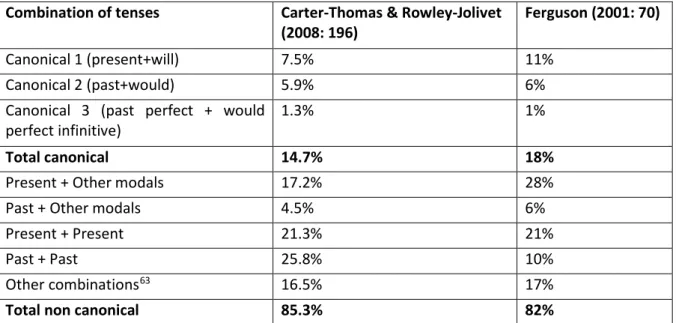
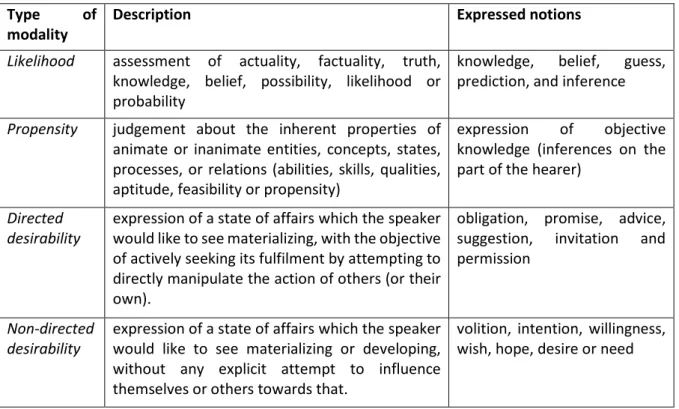
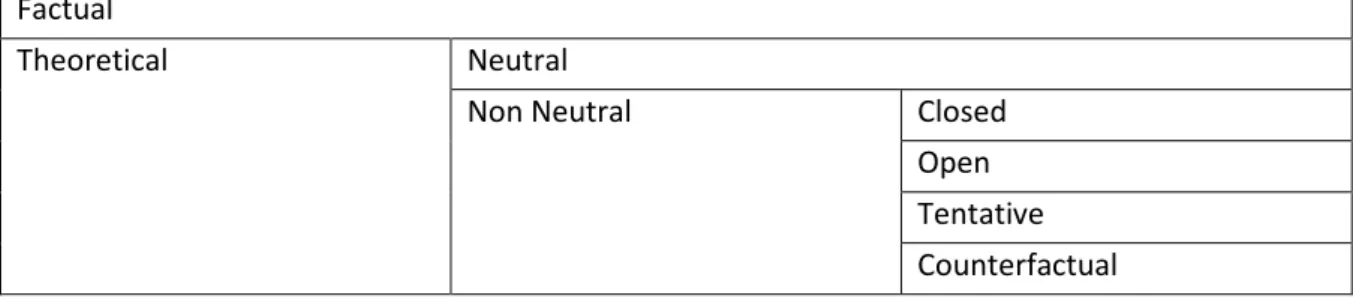
(21) Index of tables Table 1: studies analysing conditionals in scientific or disciplinary discourse, with their 10 basic characteristics Table 2.1: Truth table of the relationship of implication. 41. Table 2.2: Particles identified as elements introducing clauses with conditional 51 interpretations in Quirk et al. (1985) and Declerck & Reed (2001). Table 2.3: Elements introducing clauses with conditional interpretations during the 53 period 1700-1900. Table 2.4: Proportion of use of different combination of tenses in conditional data, 63 according to Ferguson (2001) and Carter-Thomas & Rowley-Jolivet (2008). Table 2.5: Types and degrees of modality in von Wright (1951) apud Vihla (1999: 25). 65. Table 2.6: Types of modality in Gabrielatos (2010: 139-141). 66. Table 3.1: Traditional typologies. 82. Table 3.2: Typology in Quirk et al. (1985). 85. Table 3.3: Typology of conditionals in Athanasiadou & Dirven 1996 (adapted from 88 Gabrielatos 2010: 158, categories present in both 1996 and 1997’s works are marked in bold type). Table 3.4: Declerck & Reed’s (2001) first typology.. 90. Table 3.5: Declerck & Reed’s (2001) second typology.. 91. Table 3.6: Gabrielatos’s (2010) typology.. 94. Table 3.7: Conditionals in Ford & Thompson (1986). 95. Table 3.8: Interactional functions of conditionals in Ford (1997).. 95. Table 3.9: Conditional typology in Warchal (2010). 98. Table 3.10: Typology of conditionals proposed in this work. 107. Table 3.11: Classification of conditional structures according to their interpersonal and 109 mitigating function. Table 4.1: Subcorpora of the Coruña Corpus and their disciplines. 117. Table 4.2: Definitions of categories according to Görlach (2004: 88) and the Oxford 119 English Dictionary (apud Moskowich, 2012b: 29-30) Table 4.3: TEI tags used in the Coruña Corpus (Taken from Camiña & Lareo, 2012: 51- 121 52) Table 4.4: Editorial marks used in the Coruña Corpus. 124. xxi.
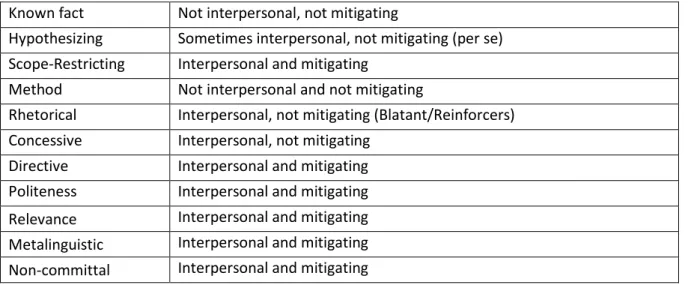
(22) Table 4.5: Wildcards accepted in the CCT (Taken from Lareo & Moskowich, 2012: 18- 137 24) Table 4.6: editorial marks and tags which the CCT identifies in searches. 137. Table 4.7: Elements introducing clauses with conditional interpretations during the 142 period 1700-1900. (Already presented as Table 2.3 in Chapter 2) Table 4.8: Typology of conditionals proposed in this work. (Already presented as Table 143 3.10 in Chapter 3) Table 4.9: Textual functions assigned to each category.. 144. Table 5.1: Matrix presenting the organisation of the section on analysis of data, 152 presenting the subsection for each combined analysis. Table 5.2: Use of conditionals per decade. Normalised figures. 153. Table 5.3: Uses of conditionals per discipline, whole corpus.. 155. Table 5.4: Uses of conditionals per genre, whole corpus.. 156. Table 5.5: Uses of conditionals per origin of the author, whole corpus.. 157. Table 5.6: Use of conditionals per type of conditional.. 158. Table 5.7: Use of types of conditionals per genre. Normalised figures. 166. Table 5.8: Use of types of conditionals per sex of the author and discipline. Normalised 168 figures. Table 5.9: Use of conditionals per function in discourse.. 169. Table 5.10: Use of the functions of conditionals in discourse per century. Normalised 173 figures Table 5.11: Use of functions of conditionals in discourse per sex of the author and 179 discipline. Normalised figures. Table 5.12: Use of functions of conditionals in discourse per type of conditional. 181 Normalised figures between brackets. Table 5.13: Use of the different orders of conditional constituents per genre. 187 Normalised figures. Table 5.14: Use of the different orders of conditional constituents per origin of the 189 author. Normalised figures. Table 5.15: Use of the different orders of conditional constituents per type of 190 conditional. Normalised figures Table 5.16: Uses of conditionals per verb forms in their constituents. Raw data.. 193. Table 5.17: Conditional categories according to the combinations of verb forms in the 194 conditional constituents. Table 5.18: Use of conditionals per verb forms in their constituents per century. Raw 196 data. Table 5.19: Use of conditionals per verb forms in their constituents per discipline of the 198 text. Raw data. Table 5.20: Use of conditionals per verb forms in their constituents per genre of the 201 text. Raw data. Table 5.21: Use of conditionals per verb forms in their constituents per sex of the 203 author. Raw data.. xxii.
(23) Table 5.22: Use of conditionals per verb forms in their constituents in if and unless 204 conditionals. Raw data. Table 5.23: Use of conditionals per verb forms in their constituents in inversion and 205 peripheral conditionals. Raw data. Table 5.24: Use of conditionals per verb forms in their constituents in inversion 206 conditionals. Raw data. Table 5.25: Use of conditionals per verb forms in their constituents in peripheral 207 conditionals. Raw data. Table 5.26: Use of conditionals per verb forms in their constituents per order of the 211 constituents of conditionals Table 6.1: Classification of conditional functions in discourse according to their 225 interpersonal and mitigating nature. (Already presented as Table 3.11 in Chapter 3) Table 6.2: Proportion of use of different combination of tenses in conditional data, 229 according to Ferguson (2001) and Carter-Thomas & Rowley-Jolivet (2008). (Already presented as Table 2.4 in Chapter 2). xxiii.
(24)
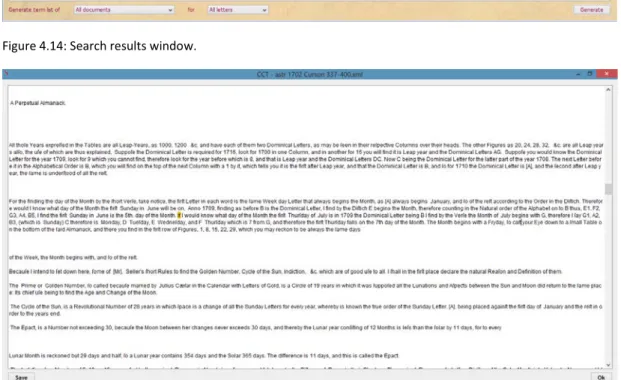
(25) Index of figures Figure 4.1: Header and first lines of Curson’s 1702 text.. 122. Figure 4.2: Process of computerisation of the first page of Kirkpatrick’s 1730 sample. 124 From left to right, original scanned text, XML-tagged text and output of the text in the document view of the CCT. Figure 4.3: Words per discipline. 126. Figure 4.4: Distribution of words per century. 126. Figure 4.5: Distribution of words per decade (N.B: y axis starts at 58,000 words). 127. Figure 4.6: Distribution of samples and words per genre.. 128. Figure 4.7: Distribution of word per provenance of the author.. 129. Figure 4.8: Distribution of words per sex of the author. 129. Figure 4.9: Metadata file of William Whiston’s 1717 sample.. 131. Figure 4.10: Document file of Curson’s 1702 sample.. 131. Figure 4.11: View of the Search window of the CCT.. 132. Figure 4.12: View of the subset selection window of the CCT.. 132. Figure 4.13: Selection by metadata window of the CCT.. 133. Figure 4.14: Search results window.. 134. Figure 4.15: Context location window.. 134. Figure 4.16: Results summary window.. 135. Figure 4.17: Term list window.. 138. Figure 5.1: Use of conditionals per century. Normalised figures.. 153. Figure 5.2: Diachronic evolution in the use of conditionals, whole corpus. Normalised 154 figures Figure 5.3: Uses of conditionals per discipline and century. Normalised figures.. 155. Figure 5.4: Uses of conditionals per sex of the author. Normalised figures.. 156. Figure 5.5: Uses of conditionals per sex of the author and discipline. Normalised figures. 157 Figure 5.6: Use of conditionals per type of conditional.. 158. Figure 5.7: Use of different types of peripheral conditionals. 159. Figure 5.8: Use of different types of inversion conditionals. 160. Figure 5.9: Use of types of conditionals per century. Normalised figures.. 161. Figure 5.10: Diachronic evolution in the use of types of conditionals. Normalised figures 161. xxv.
(26) Figure 5.11: Diachronic evolution in the use of types of conditionals (detail). Normalised 162 figures. Figure 5.12: Use of had, were and should as inversion triggers vs. inversion conditionals 163 with other triggers, per decade. Figure 5.13: Use of types of conditionals per discipline, normalised frequencies.. 163. Figure 5.14: Proportion of use of types of conditionals per discipline.. 164. Figure 5.15: Proportion of use of peripheral conditional subordinators per discipline.. 164. Figure 5.16: Proportion of use of inversion conditional triggers per discipline.. 165. Figure 5.17: Uses of types of conditionals per discipline and century. Normalised figures 165 Figure 5.18: Uses of types of conditionals per discipline and century (excluding if). 166 Normalised figures Figure 5.19: Use of types of conditionals per sex of the author, normalised frequencies. 168 Figure 5.20: Use of types of conditionals per origin of the author, normalised 169 frequencies Figure 5.21: Use of conditionals per function in discourse.. 170. Figure 5.22: Diachronic evolution in the proportion of use of functions of conditionals 174 in discourse Figure 5.23: Use of the functions of conditionals in discourse per discipline.. 175. Figure 5.24: Use of the functions of conditionals in discourse per discipline and century. 176 Normalised figures. Figure 5.25: Use of the functions of conditionals in discourse per genre. Normalised 177 figures. Figure 5.26: Use of the functions of conditionals in discourse per sex of the author. 178 Normalised figures. Figure 5.27: Use of functions of conditionals in discourse per sex of the author and 180 discipline. Normalised figures. Figure 5.28: Use of functions of conditionals in discourse per origin of the author. 180 Normalised figures. Figure 5.29: Proportion of use of functions of conditionals in discourse per type of 182 conditional Figure 5.30: Proportion of use of functions of conditionals in discourse among inversion 182 conditionals. Figure 5.31: Proportion of use of functions of conditionals in discourse among 183 peripheral conditionals Figure 5.32: Uses of conditionals according to the different orders of their constituents 184 Figure 5.33: Use of the different orders of conditional constituents per century. 184 Normalised figures Figure 5.34: Diachronic evolution in the proportions of use of the different orders of 185 conditional constituents. Figure 5.35: Use of the different orders of conditional constituents per discipline. 186 Normalised figures. Figure 5.36: Use of the different orders of conditional constituents per discipline and 186 century. Normalised figures. xxvi.
(27) Figure 5.37: Use of the different orders of conditional constituents per sex of the 188 author. Normalised figures Figure 5.38: Use of the different orders of conditional constituents per sex of the author 188 and discipline. Normalised figures. Figure 5.39: Proportion of use of the different orders of conditional constituents among 190 inversion conditionals Figure 5.40: Proportion of use of the different orders of conditional constituents among 191 peripheral conditionals. Figure 5.41: Proportion of use of the different orders of conditional constituents among 191 the functions of conditionals in discourse. Figure 5.42: Uses of conditionals per verb forms in their constituents, grouped in 195 categories. Figure 5.43: Proportion of use of conditional categories according to the verb forms in 196 their constituents per century Figure 5.44: Diachronic evolution of the use of conditionals with present simple and 197 present subjunctive in their protases Figure 5.45: Proportion of use of conditional categories according to the verb forms in 199 their constituents per discipline of the text. Figure 5.46: Proportion of use of conditional categories according to the verb forms in 199 their constituents per discipline and century of the text. Figure 5.47: Proportion of use of conditional categories according to the verb forms in 202 their constituents per genre of the text. Figure 5.48: Proportion of use of conditional categories according to the verb forms in 202 their constituents per sex of the author. Figure 5.49: Proportion of use of conditional categories according to the verb forms in 204 their constituents per origin of the author Figure 5.50: Proportion of use of conditional categories according to the verb forms in 206 their constituents per type of conditional. Figure 5.51: Proportion of use of conditional categories according to the verb forms in 208 their constituents among the different functions of conditionals in discourse. Figure 5.52: Proportion of use of conditional categories according to the verb forms in 210 their constituents per order of the constituents of conditionals. xxvii.
(28)
(29) Introduction. Introduction The aim of this study is to describe the use and functions of conditionals in English scientific writing during the eighteenth and nineteenth centuries with the help of the Coruña Corpus of English Scientific Writing (Coruña Corpus or CC). This introduction aims at providing a general overview of the contents in this dissertation. It will be divided in two main sections: the first one will present a general description of the study, whilst the second will focus on the relevance of the study in relation with the existing literature on the topic.. 1. Description of the study. This dissertation stems from the tradition of studies on register, and, more particularly, on scientific register. The study of scientific discourse (and, particularly, scientific writing 1) has been developing as a focal point for linguistic studies during the past few decades, configuring an exuberant area of research.. Even though oral transmission of knowledge was essential for the continuing exercise of science in the Medieval Era, the use of the written (rather than the oral) medium for the transmission of knowledge has been a defining feature of Institutionalised Science at least since Socrates’ dialogues were put into writing by Plato. This institutionalisation was the result of a series of factors, in which the natural longer permanence of the written form combined with the “sacredness” sometimes associated to the Bible (and, by extension, to all written material) in medieval times. However, nowadays the prevalence of writing is also explained by the fact that scientific writing materials (articles, essays…) are, in Bazerman’s words, “the primary product of most disciplines, and a secondary product of all…” (1994: 104), to the point that these pieces of writing “are taken to constitute the knowledge of the disciplines”.. 1. 1.
(30) A corpus-based study of conditional structures in Late Modern English Scientific Texts. This surge of interest have manifested principally in two main approaches: one is related with the teaching processes of academic writing as a subject taught both to native and non-native English speakers: the emergence of English for Academic Purposes as a discipline led to the necessity of having insightful descriptions of disciplinary discourse with which to inform its teaching processes. The other approach studies scientific discourse as an example of register variation, using the main product of the scientific endeavour, the scientific text, as evidence to analyse the practices and culture of the different disciplines, movements, paradigms, or schools. In Gray’s words, “describing and understanding patterns of language use in academic prose allows us to understand the disciplinary cultures and practices that they embody” (2011: 1). This study is ingrained in this latter tradition, as it tries to contribute to the description of a given type of scientific discourse (English scientific writing in the eighteenth and nineteenth centuries) and to identify the differences between different subtypes of this discourse, whilst at the same time relating these results to the reality of the different communities of scientists developing at the time, using the linguistic data as evidence to forward these analyses 2. In what follows, the study will be described in full, with subsections focusing on its methodology, objectives, and contents. However, and before starting with these issues, it is necessary to clarify a crucial terminological issue. 1.1. Register, discourse, genre, text type, style. A short overview: The reader may have noticed that the concepts scientific discourse or scientific writing have been used interchangeably in the previous paragraphs, referring to similar (or nearly similar) realities. It has also been common in the literature to refer to these same realities as genres, as did Biber (1988), distinguishing spoken and written genres; or Bhatia (1993, 1996, 2002), writing about academic or research genres. Thus, register and genre are two concepts that have been frequently used by different authors to refer to a similar reality, that of “varieties associated with particular situations of use and particular communicative purposes” (Biber & Conrad 2009: 21). Regretfully, these concepts are not perfectly synonymous, and are often defined with differing, sometimes opposite, criteria. Thus, it is necessary to delimit the meaning of these and some other related concepts (discourse, text type, style) in this dissertation. One example of author providing a distinction between these concepts is Johnstone. She (2002: 158) understands register as “a variety of language” which is used in a particular situation (i.e. scientific However, and despite the tendency in some of these studies, theoretical frameworks have not been followed, but only taken as a reference, considering the general approach of the dissertation as eclectic.. 2. 2.
(31) Introduction. discourse, testamentary language), whilst genre would be a “recurrent verbal form” adopted by the given variety of language (i.e. a research article, a will) 3. Both concepts do not purport a biunivocal relation: a single register may use different genres (scientific discourse can appear in the shape of a research article, but also as a conference presentation), whilst a single genre may “cut across registers” (Bhatia 1996: 45), as do text-books, which, irrespectively of the different disciplines they could be dealing with (this is, irrespectively of the particular register in each of them) present comparable communicative purposes. Taavitsainen (2001: 140) however, considers genres as a “mental frame in people’s minds which gets realised in texts for a certain purpose in a certain cultural context”, whilst the linguistic realisation of these mental frames would be a text-type. Biber (1988) in a first stage distinguishes between genres and text types. Genres would be categories of texts on account of rhetorical and non-linguistic criteria, most particularly the purpose of the author, whilst text-types are categories of texts which are grouped “on the basis of similarities in linguistic form, irrespective of genre classifications” (1988: 206). This is, the classification of text-types would initially ignore any extra-linguistic information, and would only interpret possible functional similarities after the linguistic-based groupings are made. Biber later evolved his stance on this terminological problem, readdressing it several times and changing the labels used to name the concepts, sometimes together with Finegan and Conrad. In Biber & Conrad (2009), the concepts whose distinctions are described are those of register, genre and style. Register is “a variety associated with a particular situation of use (including particular communicative purposes)” and it is described on account of “three major components: the situational context, the linguistic features, and the functional relationships between the first two components” (Biber & Conrad 2009: 6). Genres, on the contrary, are characterised by their rhetorical organisation, with their defining characteristics presenting a structural function in the text which is frequently the result of conventional constraints. Thus, scientific register would be characterised by particular linguistic features which are typical of the register and which have a function in it, whilst the research article as a genre would be characterised by its structural properties, such as the conventional structure Introduction-Method-Result-Discussion (IMRD), as well as the presence of an abstract and a conclusion. This difference implies that whilst registers can be analysed with the help of corpora, genres need complete texts, thus putting genre analysis beyond the scope of corpus linguistics and. This is, register (assimilated by Johnstone to the concept of style) would be characterised by the situation which raises the necessity of using the register and its particular linguistic characteristics, whilst genre (assimilated to text type) would be characterised by its communicative purposes and by how these purposes (as a result of the various influences of its practitioners over time) give way to different conventions around the way knowledge and information is transmitted and organised and how this is reflected in the formal nature of the texts.. 3. 3.
(32) A corpus-based study of conditional structures in Late Modern English Scientific Texts. into the realm of rhetorical analysis. Finally, Biber and Conrad conceive styles, much like registers, as being characterised by their linguistic features, but, in this case, with features which are not the result of situational constraints, but which are, on the contrary, “associated with aesthetic preferences, influenced by the attitudes of the speaker/writer about language” (Biber & Conrad 2009: 18). Thus, the particular way of writing of an author or a group of authors would be an example of style. 1.1.1. Use of register in this dissertation. This dissertation will follow Biber & Conrad’s (2009) definition of register as a situational variety of language which presents particular communicative purposes and particular linguistic uses with a definite function in it. The concepts scientific discourse and scientific writing will be used interchangeably with scientific register. The latter concept is, admittedly, not perfectly synonymous (scientific register includes both oral and written texts), but, given that this dissertation will only study written texts, the three concepts will be used interchangeably, taken to mean “(written) scientific register”. An important characteristic of Biber & Conrad’s concept of register is that it is scalable, this is, it can be “defined at varying levels of specificity” (Gray 2011: 3), since linguistic productions are affected by several situational factors at once and, consequently, they allow different analyses focusing on the influence of any of these situational factors on a single linguistic variety. For instance, scientific register as a whole presents a series of particular situational characteristics, which can be the object of analysis by themselves or in contrast with other types of registers; but this is also the case with, for example, the different disciplines of scientific register, which constitute different disciplinary registers that can also be analysed by themselves or contrasting with one another. The aim of this study is to analyse the scientific register in English as a whole, examining a corpus of texts which are taken to be representative of the general uses of the register, but it will also focus on several parameters at a higher level of specificity, such as the discipline to which the texts belong, the moment in time they were written, or the sex of the author, among others. However, in this dissertation, the term register will be reserved to refer to the lowest level of specificity only, this is, to scientific register as a whole. Consequently, analyses at a higher level of specificity will be said to study “scientific register on account of the parameter X”. There are five such parameters: the year of publication of the text, denoting the diachronic evolution of the language, the sex of the author, their geographic origin, the discipline of the text and its genre 4.. Genre as the name of this parameter is not to be understood in Biber & Conrad’s sense, but rather in Johnstone’s (2002), as a recurrent formal structure on which information could be transmitted, being an. 4. 4.
(33) Introduction. 1.2. Methodology: Uses of corpora in register variation. Since the 1960s and 1970s, the emergence of large electronic corpora has opened the way for large scale studies of register variation, allowing comparison of different registers, in different languages, and from a diachronic or synchronic point of view, among an enormous range of other different parameters. However, as far as the design of corpus research is concerned, any corpus study on register variation can be described on account of two criteria, defined by Gray (2011: 18ff): the comprehensiveness of the linguistic features being investigated and the way the information is obtained from the corpus. In what concerns the first of the criteria, Gray distinguishes three different possibilities for the scope of the research. The first is studying a single linguistic feature in detail (be it a word, a grammatical structure or “a set of related items”) and focusing on its different variants. An example of this type of study is, for instance, a study on the prefixes and suffixes of nouns in astronomy and philosophy texts (Camiña 2012), or a study of deverbal nominalizations in astronomy texts (Bello 2014). The second type examines a series of related features which share a common communicative purpose, such as extenders in scientific discourse (Sánchez Barreiro, forthcoming). Finally, the third type focuses on a large set of non-necessarily-related linguistic features which help describing a language or linguistic variety. An example of such a study could be a Multidimensional Analysis (Biber 1988) on the scientific register in the eighteenth and nineteenth century (Monaco, forthcoming). These three categories are somewhat in a continuum, with certain studies presenting traces of both the first and second or the second and third types (Gray 2011: 20). This criterion was also defined by Biber (1988), who distinguished between macroscopic and microscopic studies: a microscopic study of textual variation “provides a detailed description of the communicative functions of particular linguistic features”, while a macroscopic one “attempts to define the overall dimensions of variation in language” (Biber 1988: 61) The second criterion focuses on how the information is extracted from the corpus. If the researcher approaches the corpus with a set of preconfigured search elements (mainly lexical items, or grammatical tags in tagged corpora), the research is considered to be corpus-based. Contrarily, if the researcher approaches the corpus as a whole, looking at general results in the whole corpus without a preconfigured set of searches, (for instance, keywords or frequently repeated patterns of words) the. expression of conventional discourse practices inside the scientific community. The use of this denomination has been decided by compilers of the Coruña Corpus after a lengthy consideration, which goes beyond the scope of this dissertation (although a very brief summary is provided in Chapter 4). It will be maintained for the sake of terminological unity in works using the Coruña Corpus. 5.
(34) A corpus-based study of conditional structures in Late Modern English Scientific Texts. research is considered to be corpus-driven. There is, again, a cline between corpus-based and corpusdriven studies, presenting a plethora of intermediate approaches showing varying levels of hybridity between the two. Multidimensional analyses, with their guided selection of a set of features to be searched but entirely automatised factor analyses grouping these features together, are good examples of this hybrid approach. This study will focus on a single grammatical structure, conditionals, which will be described comprehensively, studying its different formal and structural variations as well as its functions. The quantitative information to perform the analysis will be obtained from the Coruña Corpus by means of searching for a series of particles, which will be predefined after a review of the literature (in Chapter 2). Consequently, this study would be classified as a Type 1 (microscopic), corpus-based study. As noted by Gray (echoing Reppen, Fitzmaurice & Biber (2002)), type 1 studies “often incorporate a register perspective by comparing the frequency and variants across registers” (2011: 21). This comparative approach is adopted here by comparing the distribution of the different types of conditionals and its functions across the different subsets of texts. This is done by means of selecting a series of parameters, both linguistic and extra-linguistic, whose interaction is then studied. There are four linguistic parameters, defined in Chapters 2 and 3: the formal type of conditional (this is, the conditional particle in use), the order of the constituents of the conditional structure, its combination of verb forms, and its function in discourse. The extra-linguistic parameters, further explained in Chapter 4, are five: the sex and origin of the author, the discipline and the genre of the texts, and the date of publication of the sample, which helps analyse the diachronic evolution of the language. The analysis of the results according to these different parameters makes it possible to provide a complete analysis of the use of conditionals as examples of the variation in scientific register as a whole, presenting a high number of different nuances which both enrich and deepen the study. 1.3. Objectives of the dissertation The main goal of this study is to describe the use and functions of conditionals in English scientific writing during the eighteenth and nineteenth centuries, trying to ascertain whether and how the use of conditionals reflects the general evolution of the scientific register during the period. As explained above, according to Biber & Conrad, there are three major components to describe a register: “the situational context, the linguistic features, and the functional relationships between the first two components” (2009: 6). Following this model, this dissertation presents three main 6.
(35) Introduction. intermediate objectives. The first objective is to present a description of the context in which the register is used, analysing the different social and historical circumstances relevant to the shaping of the register. This objective occupies Chapter 1. The second objective is to describe the linguistic information obtained during the study. After this objective is fulfilled, there will be “[b]aseline data on what types of conditional occur and how they relate to their discourse contexts”, data which “are essential if we hope to explain how conditionals are used rather than how we think they are used” (Ford & Thompson 1986: 354). In order to achieve this second aim, it is necessary to fulfil a number of intermediate objectives. First, it is necessary to identify the scope of the structure under analysis, in order to delimit the different linguistic productions which are going to be analysed. This is examined in Chapter 2. Second, it is necessary to identify the parameters used to analyse the structure. These parameters are divided into two groups: linguistic parameters, which are analysed in Chapters 2 and 3, and extra-linguistic parameters, which are the object of analysis in Chapter 4. Third, it is necessary to describe the corpus from which the data has been extracted, also the object of Chapter 4. Finally, it is necessary to provide the actual quantitative data in relation with the different parameters and their interactions, providing the aforementioned “baseline data”. This is the objective of Chapter 5. Finally, as in order to define a register it is not sufficient to present quantitative data, the last objective is to bring together the previous two steps and to analyse the associations (functional, conventional or otherwise) between the context and the linguistic features of the register, in order to explain the distribution of the results and the possible ways in which they may (or may not) be representative of the general nature of the register. This is the objective of Chapter 6 and the conclusions. 1.4. Contents of the dissertation This dissertation is, then, organised as follows: Chapter 1 will present the context of the register, analysing the period under study (the eighteenth and nineteenth centuries) and the development of scientific register occurring at that moment. Chapter 2 will focus on conditional structures, providing a definition of what is understood as such and determining their scope, as well as the parameters having to do with their formal variability. Chapter 3 will present, after an extensive examination of the literature, a new typology to classify conditionals according to their function in discourse.. 7.
(36) A corpus-based study of conditional structures in Late Modern English Scientific Texts. Chapter 4 will describe the corpus from which the data has been obtained, the Coruña Corpus, and will also explain the methodology which has been followed as well as the extra-linguistic parameters which have been used to classify conditionals. Chapter 5 will present the actual results of the analysis of data, according to the different linguistic and extra-linguistic parameters defined above. Chapter 6 will relate the linguistic and the contextual data in order to explain how the results reflect the nature of the register under study. And finally, the Conclusions will provide a summary of the dissertation and a reflection of the main findings in it. 2. Contextualisation of the study This second section consists of a review of part of the literature about conditionals, mapping the field and placing this dissertation in context. At the same time, by showing that this is the first corpus-based study of the uses and functions of conditionals on Late Modern English scientific writing, it also contributes to make the case for the relevance of the dissertation. Conditionals have been an important object of study for different disciplines, namely logic, philosophy of language, psychology, and linguistics in its different subareas, developing different questions and approaches which have sustained a continuous interest in the field and, consequently, a sizable number of works. Among the most relevant monographs and edited volumes on conditionals, either analysing them from a holistic point of view or providing collections of analyses from different approaches, it is worth mentioning Harper, Stalnaker & Pearce’s Ifs, conditionals, belief, decision, chance and time (1981), Traugott et al.’s On Conditionals (1986), and its sequel Athanasiadu & Dirven’s On Conditionals Again (1997), Dancygier’s Conditionals and Prediction: Time, knowledge and causation in conditional constructions (1998), Declerck & Reed’s Conditionals: A Comprehensive Empirical Analysis (2001), Dancygier & Sweetser’s Mental spaces in grammar: conditional constructions (2005) and Gabrielatos’ dissertation A corpus-based examination of English if-conditionals through the lens of modality: Nature and types (2010). Apart from these, there have been a series of works focusing on particular elements of conditionals, such as their nature (Dancygier & Mioduszewska 1984, Sweetser 1990, and Athanasiadou & Dirven 1996), or the phenomenon of Conditional Perfection, further explained in Chapter 2, (Geis & Zwicky 1971, van der Auwera 1997, Horn 2000, and Van-Canegem Ardijns & Van Belle 2008). 8.
(37) Introduction. Another important topic of interest has been the limitations of the typology of conditionals commonly presented in ESL manuals, studied by Hwang (1979), Maule (1988), Fulcher (1991), and Jones & Waller (2011), among many others. It is also interesting to note a series of works focusing on the particular formal types of conditionals, such as Closs Traugott (1997) on unless, or Iatridou & Embick (1994), Jong Bok (2011), and Biezma (2011) on inversion conditionals. 2.1. Studies on conditionals in scientific discourse However, these studies analyse conditionals in general discourse, and this study aims at describing conditionals in scientific discourse. The particular uses of conditionals in scientific discourse have been analysed in the literature in a series of works which are of special interest to this dissertation, particularly since most of them also use corpus or data-based approaches. These are briefly summarised in here. Horsella & Sindermann (1992) studied the argumentative use of conditionals in four samples of texts from physics, medicine and economics, taken from a non-described “larger corpus”, in order to test the validity of a model of analysis of argumentation with conditionals in scientific texts. Facchinetti (2001) analysed the uses of conditionals in legal texts from 1500 to 1800, using the Helsinki and Archer corpora. She concentrated on analysing the verbal forms of the conditionals, as well as their different uses, in two types of legal texts: statutes and legal cases 5. Ferguson (2001) analysed conditionals in three types of medical writing: research articles, journal editorials and doctor-patient consultations, using a 100,594-word corpus. He classified conditionals according to a typology by Athanasiadou & Dirven (1997), finding interesting differences in their distribution among genres, as well as a concentration of particular types of conditionals in particular sections of the text. Carter-Thomas & Rowley-Jolivet (2008) analysed the uses of conditionals in academic discourse, compiling a corpus of three genres of medical discourse (30 articles, 15 conference presentations and 74 journal editorials), totalling c. 250,000 words. They defined an ad-hoc typology “based on the regularity found in the data” (2008: 193), and aiming at reflecting their focus on argumentative uses of conditionals, as they defend that the view of ESL manuals is incorrect and that the classification of conditionals should not ignore “discipline-specific forms of argumentation” (2008: 192).. For the purposes of this dissertation, “science” is understood in its broadest sense, and thus texts on law would be included. However, it could be reasonably argued that the nature of the texts analysed in Facchinetti’s study are instances of disciplinary discourse, rather than scientific texts.. 5. 9.
(38) A corpus-based study of conditional structures in Late Modern English Scientific Texts. Warchal (2010) presented a corpus-based analysis of the functions of conditionals in a corpus of research articles on linguistics. She created a new typology, influenced by Sweetser (1990) and Quirk et al. (1985), in which she distinguishes eight different functions. Her study presents two stages, first making a pilot study in a 200-article corpus from five different journals, totalling 2.4 million words; and later providing an in-detail study in 40 of those articles totalling 430,000 words. Finally, Hesabi, Dehaghi & Shahnazari (2013) compared the frequency of use and functions according to Sweetser’s (2010) methodology, in research articles on Applied Linguistics & Chemistry. However, they never reveal the number of words in their corpus, and as they only provide actual (not normalised) figures, it is impossible to know the relative frequencies of the uses they analyse. A summary of the main characteristics of all these studies can be seen in Table 1 below. Work Methodology Carter-Thomas & Corpus based Rowley-Jolivet (2008). Corpus used / Size 30 articles, 15 presentations, 74 c.250,000 words.. Variety of Language conference Scientific register: editorials Medicine. Facchinetti (2001). Corpus based. Archer, Helsinki. 82,455 words.. Ferguson (2001). Corpus based. 18 articles, 40 editorials, 34 Scientific consultations: 100,594 words in Medicine total.. Disciplinary discourse: Law register:. Hesabi, Dehaghi & Corpus based, Twenty-one articles on linguistics, Scientific register: Shahnazari (2013) but faulty twenty-nine articles on chemistry. Applied linguistics and chemistry. Horsella Sindermann (1992) Warchal (2010). & Data derived. Corpus based. Analysis of four passages “from a Scientific register: larger corpus”, which is never Physics, economics, described. medicine Pilot: 200 articles, 2.4 million words. Scientific In-detail: 40 articles: 430,000 Linguistics words.. register:. Table 1: Studies analysing conditionals in scientific or disciplinary discourse, with their basic characteristics.. As shown in Table 1 above, there is a moderately important number of studies analysing the uses of conditionals in scientific register using a corpus-based methodology, which join all the studies on conditionals in general language referenced above. However, and despite their valuable insights, none of these studies presents a comprehensive corpusbased analysis of the use of conditionals in eighteenth and nineteenth century scientific register. They present three main problems. First, as it is obvious, all these studies are based on Present-Day English, rather than on eighteenth and nineteenth-century English.. 10.
(39) Introduction. Second, most of these studies are single-discipline analysis. Among them only Hesabi, Dehaghi & Shahnazari’s (2013) and Horsella & Sindermann’s (1992) compare the uses of more than one discipline. The rest, being single-discipline analyses and despite their intrinsic value as a description of a particular disciplinary register, make it impossible to discriminate whether the results found are attributable to their particular characteristics as a discipline or to their general nature as scientific texts. Finally, only Warchal’s (2010) and Carter-Thomas & Rowley-Jolivet’s (2008) use medium-sized corpora, while the other studies either do not use corpus methodologies (Horsella & Sindermann 1992), do not provide data about their corpus (Hesabi, Dehaghi & Shahnazari 2013), or use small corpora (Ferguson 2001, Facchinetti 2001), which are not large enough to avoid the potential bias of an excessive influence of particular authorial idiosyncrasies in the results. This dissertation aims at presenting a corpus-based study of the uses of conditionals in scientific register, comparing three disciplines (astronomy, philosophy, life sciences) in order to be able to infer conclusions applicable to scientific register as a whole (as well as the valuable particular descriptions of their disciplinary characteristics), and using a sufficiently large corpus (c. 1,200,000 words) so as to avoid potential biases. However, perhaps the most interesting characteristic of this dissertation is that it is the first study focusing on the uses and functions of conditionals in eighteenth and nineteenthcentury scientific register, allowing to investigate how conditionals were used during a period of incredible effervescence in the intellectual circles, and whether and how these uses reflect this context, as shown in what follows.. 11.
(40)
(41) CHAPTER 1:. Science and scientific discourse in the eighteenth and nineteenth centuries. Introduction The first step in any dissertation studying a particular register must necessarily be a close examination of the register under study. Thus, in this dissertation, which studies the uses of conditionals in eighteenth and nineteenth century scientific register, this first step has to consist in examining how science, and scientific writing, were at the period. The period of study (the eighteenth and nineteenth centuries) is not arbitrary, but rather, conforms a well-delimited stage within the history of science, with two important facts acting as bookends. The start of the eighteenth century marks the culmination of the process of change in science which started in the seventeenth century and caused the dramatic transformation of the old scientific paradigms. This coincides with the dissemination of Newton’s ideas about gravity, changing the basis of physics completely and influencing a good proportion of scientific research during the following two centuries. The turn of the twentieth century coincides with another major breakthrough, Einstein’s 1905 paper on the Special Theory of Relativity (still considered a foundation for research in a plethora of disciplines), as well as with the discovery of the electron by J.J. Thompson in 1896, the crisis in the grounding of mechanical physics announced by Mach, Kirchhoff, or Bolzmann in 1896, and Planck’s announcement of quantum mechanics in 1900, among other discoveries (Moskowich 2012: 48).. 13.
(42) A corpus-based study of conditional structures in Late Modern English Scientific Texts. As “changes in scientific thought imply changes in the way in which knowledge is conveyed” (Moskowich & Parapar 2008), these changes in science had a correlation at the linguistic level: this is the period referred to as Late Modern English. Although there have been several suggestions for the starting point of this period 6, it is here considered to start in 1700 and to end in 1900, with the turn of the twentieth century being considered the start of Present Day English. These two centuries witness comparably little change in phonetics, morphology, or syntax of the English language, but coincide with several events of a supra-linguistic nature which influence the development of a distinct scientific discourse. On the one hand, the expansion of science led to the development of a new genre, scientific prose, as shown in Section 2 below. On the other hand, there is a general preoccupation for the good use of language and particularly of scientific discourse, as shown in the publication of grammars, which also prompted the loss of dialect, especially in scientific discourse (Freeborn 1992: 180, Moskowich 2001: 625). This preoccupation for the language was manifest in the preference for the coinage of new words with morphological processes (Camiña 2012) rather than for borrowing foreign words (Beal 2012), after the developments in science caused a necessity of new, clear terminology. The end of the period is also marked by linguistic change, as the turn of the twentieth century witnessed several arguments for a new scientific style, such as Thomas Huxley’s at the 1897 International Congress of Mathematics. (Moskowich 2012: 48). This chapter is divided in two sections. Section 1 deals with the history of science and scientific communities during the period studied. Section 2 examines the development of the scientific register. Finally, a summary of the most important findings in the chapter will also be provided. The two sections present a parallel structure: they study, from their respective points of view, the precedents of the new scientific paradigm in order to understand its emergence, adopting an approach in which the social nature of science is emphasised. They also devote respective subsections to the role and linguistic uses of women in science and to the particularities of the development of scientific practice and discourse in the three disciplines under study in this dissertation: astronomy, philosophy, and life sciences.. 1. How science became what it is. The emergence of New Science. The period around the eighteenth and nineteenth centuries is a period of change, it redefined what was understood as science. However, processes of change do not stick to arbitrary limits such as those 6. Among others 1660, 1725, 1776 or 1800 (see Moskowich 2012: 47-48).. 14.
(43) Chapter 1: Science and Scientific Discourse in the 18th and 19th centuries. of centuries, and their description in such compartmentalised terms would lead to oversimplification. This is why, for contextualisation, the period object of description in these sections will surpass the thresholds of the two centuries, using instead the concepts of the long 18th and long 19th centuries. These, following Beal (2012: 2), stretch from the Restoration in the 1660s to the fall of Napoleon in the 1815 and from the French Revolution in 1789 to the end of World War I in 1918, respectively 7. At the same time, in order to fully explain the situation of any given topic at a moment in time, one needs to look back into the past. Thus, in order to explain the development of science from the final decades of the seventeenth century, it is necessary to make an excursion into the paradigm that was being substituted, scholasticism. Thus, Section 1.1 below presents the precedents of science in the period under examination, studying scholasticism, the medieval paradigm of knowledge. Section 1.2 deals with the characteristics of New Science, focusing on the aspects defining science as a social activity and specifically on the groups of power and the elements of control over knowledge, whilst Section 1.3 focuses on the role of women in science at this time, and Section 1.4 briefly explains the evolution of astronomy, philosophy and life sciences during the period. In relation with the approach selected in this section, it is important to state that processes of change are not conceived here as changes en masse, but as a complex set of factors which interrelate and influence each other in an incremental way, in order to change a set of elements from a given state of events to another, different, state. In this sense, the approach taken in this section follows Burke’s (2000) Social History of Knowledge in two aspects. The first one has to do with this multifactorial conception of how scientific paradigms change. Burke’s model follows Kuhn’s (1962) model of Scientific Revolutions in that the discomfort with orthodox, established thought evolves into a new paradigm which later becomes established itself. However, Burke conceives changes as being multifactorial (this is, influenced by different factors acting on different features at different speeds and rates) rather than recursive and straightforward, as Kuhn did. The second aspect is that the changes in scientific paradigms are conceived of as being the consequence of the very social nature of science, this is, of the nature of science as an exchange of knowledge between individuals in a society, and not as the result of the influence of ideas or events devoid of their incardination in these social communities of scientists, or on a mere relation of new discoveries and theories.. This however, does not imply the extension of the period of the data analysed in the dissertation, which sticks to the two centuries, from 1700 to 1900.. 7. 15.
(44) A corpus-based study of conditional structures in Late Modern English Scientific Texts. 1.1. A controlled science: Scholasticism Even though science was never completely abandoned after the fall of the classical world, the period between the fifth and the eleventh centuries is commonly depicted as a Dark Age in which little knowledge is created8. It is from the end of the eleventh century and the twelfth century that a series of events would coalesce into the emergence of the Lower Middle Ages’ paradigm of knowledge: Scholasticism. 1.1.1. Origins of scholasticism Scholasticism is considered to have been greatly influenced in its development from the end of the eleventh centuries by two main elements: First, contacts with the Muslim world allowed for the recovery of part of the previously lost or inaccessible classical tradition and, specifically, Aristotelian thought. Aristotle’s works had been lost in Western Europe since the fall of the Roman Empire, but they had been preserved in Muslim Territories, where they helped develop a Muslim philosophical school which produced scholars such as Ibn Sina and Ibn Rusd. Access to Muslim knowledge, which also included inventions such as the astrolabe (Pearsall 1999: 218), was possible because of the cohabitation of Christians and Muslims in the Iberian Peninsula. The availability of these texts would improve after the conquest of Toledo in 1085, giving Christian scholars physical access to them and prompting the foundation of a school of translators, who made Latin versions of these classical works. These new texts transferred Aristotelian ideas through Europe, influencing authors such as Albertus Magnus and St. Thomas Aquinas, who integrated Aristotelian philosophy and Christian thought and whose work would serve as the basis of the institutionalised worldview of the period in Western Europe. Second, the foundation of medieval universities expanded and amplified this new knowledge. These new institutions were founded as a consequence of the good economic situation of the period, in which agricultural innovations and the development of cities and commerce helped raising money for other onerous quests such as the Crusades or the building of cathedrals. The first universities, in Paris, Bologna, Oxford, or Salamanca evolved from cathedral schools at the middle of the twelfth century, and continued their development during the following centuries under the control of the Church.. This is, admittedly, a Eurocentric view. It is true that the fall of the Roman Empire caused the physical loss of an important number of documents, but, at the same time, science was being cultivated in the Middle East and, especially, in China. Even though caution has been taken to refer in the text to the fact that the object of the narration is European science, any claims in which this is not explicitly stated or denied must be also understood as referring to the European reality, or, after the development of North American Science, to the Western reality.. 8. 16.
Figure

+7



Documento similar