
New variable stars in the globular cluster NGC 5694
6
0
0
Texto completo
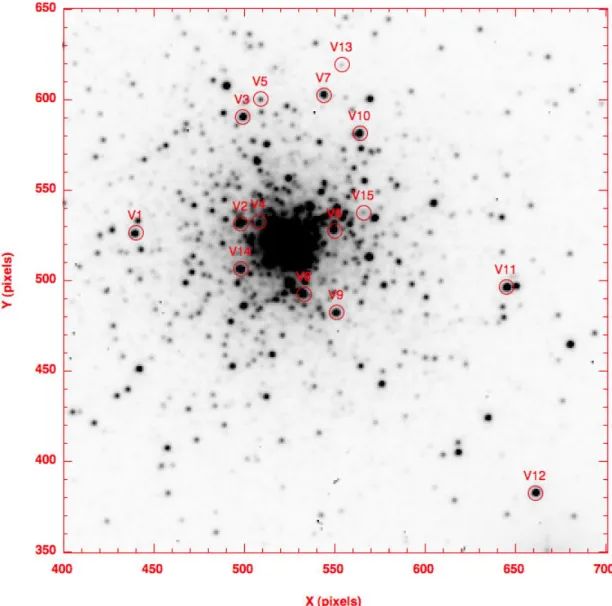
(2) 2. IBVS 6037. the 1.3m telescope, comprising a total of 41, 43, and 44 images in B, V , and I, respectively. The second dataset was obtained in the course of 4 nights, between June 30 and July 23, 2007, with the 0.9m telescope, comprising a total of 5 images per filter. The third dataset was again obtained in the course of 4 nights, between January 10 and 14, 2010, with the 1.0m telescope, comprising a total of 6 images per filter. To search for variability in our data, we used the image subtraction technique with the package ISIS v2.2 (Alard & Lupton 1998; Alard 2000), only on the 1.3m images, since there were not enough images from the other telescopes.. Figure 1. Finding chart for the variable star candidates in NGC 5694. North is up and East is to the right. The plate scale is 0.371 arcsec/pixel.. We also performed PSF photometry on these data, using the DAOPHOT package (Stetson 1987) in IRAF.1 This photometry was used to construct a CMD, generate independent light curves (using the coordinates of the variable stars generated by ISIS), 1 IRAF is distributed by the National Optical Astronomy Observatories, which are operated by the Association of Universities for Research in Astronomy, Inc., under cooperative agreement with the National Science Foundation..
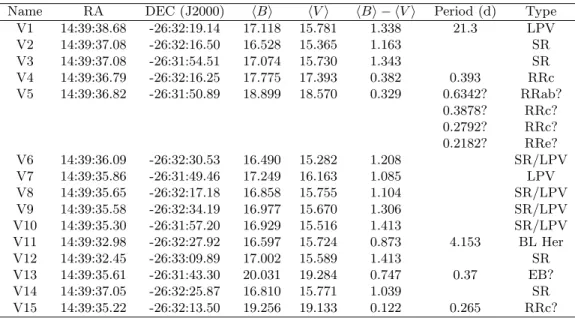
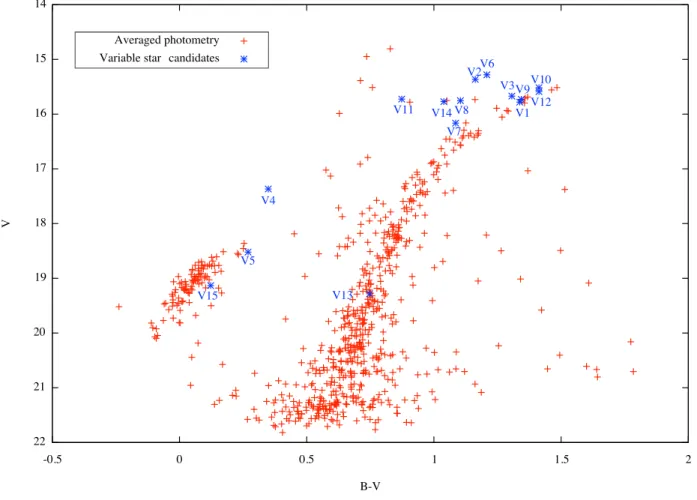
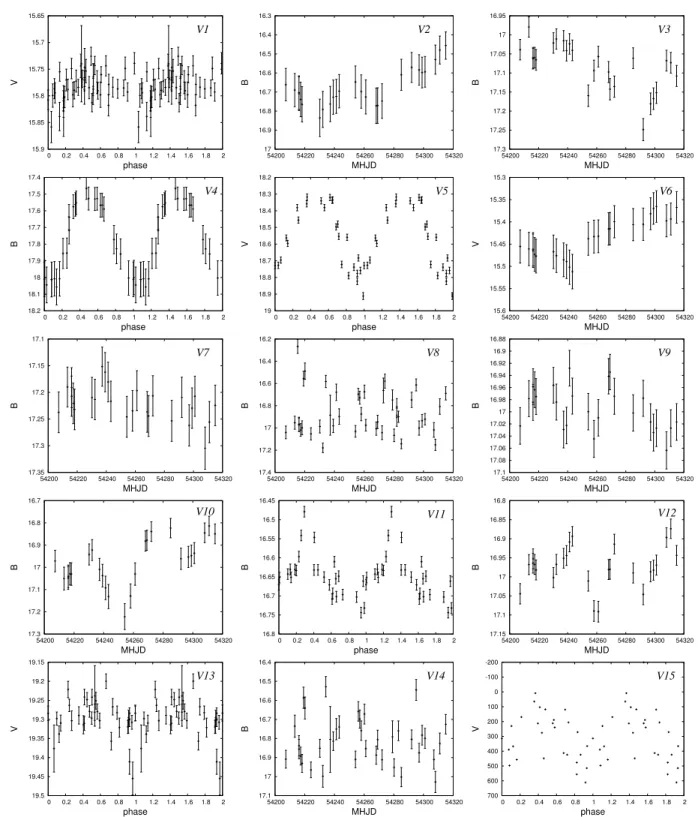
(3) IBVS 6037. 3. and calibrate the ISIS light curves into standard magnitudes. DAOPHOT also enabled us to incorporate the images obtained with the 0.9m and 1.0m telescopes into our final light curves. We used the Stetson (2000) photometric standard field to perform the photometric calibration of the B and V data. Since there is no standard field available for NGC 5694 in the I filter, we could not calibrate the I-band data. The astrometry of our images was also done using the Stetson standards. In our work, we found 15 variable star candidates, listed in Table 1 with their coordinates, intensity-weighted mean B and V magnitudes and possible period and variability type. Their positions in the cluster are shown in Figure 1, and our preliminary CMD with the variable candidates highlighted is given in Figure 2. B- or V -band light curves for all candidates are shown in Figure 3. For V15, the second faintest star in our sample, we were not able to calibrate the ISIS light curves. The star was detected with DAOPHOT on only 3 images, and ISIS only detected its variability in the V -band. For the same reason, the magnitudes and colors of V15 listed in Table 1 are not an average over the whole curve, and its position in the CMD is not very precise. Table 1. Variable star candidates in NGC 5694. Name V1 V2 V3 V4 V5. RA 14:39:38.68 14:39:37.08 14:39:37.08 14:39:36.79 14:39:36.82. DEC (J2000) -26:32:19.14 -26:32:16.50 -26:31:54.51 -26:32:16.25 -26:31:50.89. hBi 17.118 16.528 17.074 17.775 18.899. hV i 15.781 15.365 15.730 17.393 18.570. hBi − hV i 1.338 1.163 1.343 0.382 0.329. V6 V7 V8 V9 V10 V11 V12 V13 V14 V15. 14:39:36.09 14:39:35.86 14:39:35.65 14:39:35.58 14:39:35.30 14:39:32.98 14:39:32.45 14:39:35.61 14:39:37.05 14:39:35.22. -26:32:30.53 -26:31:49.46 -26:32:17.18 -26:32:34.19 -26:31:57.20 -26:32:27.92 -26:33:09.89 -26:31:43.30 -26:32:25.87 -26:32:13.50. 16.490 17.249 16.858 16.977 16.929 16.597 17.002 20.031 16.810 19.256. 15.282 16.163 15.755 15.670 15.516 15.724 15.589 19.284 15.771 19.133. 1.208 1.085 1.104 1.306 1.413 0.873 1.413 0.747 1.039 0.122. Period (d) 21.3. 0.393 0.6342? 0.3878? 0.2792? 0.2182?. 4.153 0.37 0.265. Type LPV SR SR RRc RRab? RRc? RRc? RRe? SR/LPV LPV SR/LPV SR/LPV SR/LPV BL Her SR EB? SR RRc?. V5 is a particularly interesting star, as we have found at least four periods which may phase the available data, as shown in Table 1. Irrespective of the adopted period, the shape of the light curve seems nearly sinusoidal, which would be more consistent with a c-type RR Lyrae. However, the least noisy light curve is obtained with a period around 0.634 d, which is more typical of ab-type RR Lyrae. The light curve amplitudes can help with the classification. However, while for most of our stars the amplitudes obtained on the basis of DAOPHOT and ISIS are consistent, this is not so in the case of V5, for which we find a smaller amplitude in the B band with ISIS than with DAOPHOT. This may be due to a calibration problem. If the amplitude is really close to 1 mag in B, as ISIS suggests, that might be more consistent with an RRab than an RRc. On the other hand, the smaller DAOPHOT amplitudes in this filter (and also in the V data) suggest an RRc (or even an RRe) instead. Clearly, the photometry and calibration of this star must be revisited in future work, but meanwhile it seems almost certain that the star is indeed an RR Lyrae. The period used to plot its light curve in Figure 3 is 0.3876 d. As for V1, although the data suggest low-amplitude variability with a 21.3 d period,.
(4) 4. IBVS 6037. this needs confirming because it would be unusually short for a variable near the tip of the red giant branch (RGB). The presence of a candidate short-period type II Cepheid, V11, is also worth noting. Type II Cepheids are typically found in systems with blue HB morphologies (see §4.2 in Catelan 2009 for a recent review). It is unclear why this star was not detected in previous studies, especially in view of the fact that it is not located near the cluster core (Fig. 1). In this sense, it should be noted that the light curves for the star in the other passbands are significantly noisier than the one in the B band that is shown in Figure 3. As for V13, it is a possible eclipsing binary (EB) with a 0.37 d period. However, its location in the CMD indicates a star starting to ascend the RGB, and a period of 0.37 d may be a problem for an eclipsing star where at least the brighter member is a red giant. Since the eclipser classification mainly depends on two low points, more and better data will be needed in order to properly classify this star. Unfortunately, NGC 5694 turns out to be an intrinsically very RR Lyrae-poor cluster, and so it is impossible to properly classify the cluster in terms of an Oosterhoff status.. Figure 2. The NGC 5694 CMD, with the positions of the variable star candidates shown as asterisks..
(5) IBVS 6037. 5. 15.65. 16.3. V1. 16.95. V2. 16.4. V3. 17. 15.7 16.5 15.75. 17.05. B. 17.1. B. V. 16.6 16.7. 15.8. 17.15. 16.8. 17.2. 16.9. 17.25. 15.85. 15.9 0. 0.2. 0.4. 0.6. 0.8. 1. 1.2. 1.4. 1.6. 1.8. 17 54200. 2. 54220. 54240. 54260. phase 17.4. 54300. 17.3 54200. 54320. 18.5. 17.8. 18.7. 18. 18.8. 18.1. 18.9. 18.2. 19 0.4. 0.6. 0.8. 1. 1.2. 1.4. 1.6. 1.8. 2. 54320. V6. 15.45. 15.5. 15.55. 0. 0.2. 0.4. 0.6. 0.8. 1. 1.2. 1.4. 1.6. 1.8. 15.6 54200. 2. 54220. 54240. phase. 54260. 54280. 54300. 54320. MHJD. 16.2. 16.88. V7. V8. V9. 16.9. 16.4. 17.15. 54300. 15.4. phase 17.1. 54280. 15.35. 18.6. 17.9. 54260. 15.3. V. 17.7. V. 18.4. 0.2. 54240. V5. 18.3. 17.6. 0. 54220. MHJD. 18.2. V4. 17.5. B. 54280. MHJD. 16.92 16.94. 16.6. 16.96. B. B. B. 17.2 16.8. 16.98 17. 17.25. 17.02. 17. 17.04 17.3. 17.06. 17.2. 17.08 17.35 54200. 54220. 54240. 54260. 54280. 54300. 17.4 54200. 54320. 54220. 54240. MHJD. 54260. 54280. 54300. 17.1 54200. 54320. 54220. 54240. MHJD. 16.7. 16.45. 54280. 54300. 54320. 16.8. V10. V12. V11. 16.5. 16.8. 54260. MHJD. 16.85. 16.55. 16.9. 16.6. 16.95. 17. B. B. B. 16.9. 16.65. 17. 16.7. 17.05. 17.1. 17.2. 16.75. 17.3 54200. 17.1. 16.8 54220. 54240. 54260. 54280. 54300. 54320. 0. 0.2. 0.4. 0.6. MHJD. 0.8. 1. 1.2. 1.4. 1.6. 1.8. 17.15 54200. 2. 54220. 54240. phase. 19.15. 16.4. V13. 19.2. 54260. 54280. 54300. 54320. MHJD -200. V14. 16.5. V15. -100 0. 19.25. 16.6. 19.3. 16.7. V. 200. B. V. 100. 19.35. 16.8. 19.4. 16.9. 19.45. 17. 300 400 500. 19.5 0. 0.2. 0.4. 0.6. 0.8. 1. phase. 1.2. 1.4. 1.6. 1.8. 2. 17.1 54200. 600 700 54220. 54240. 54260. MHJD. 54280. 54300. 54320. 0. 0.2. 0.4. 0.6. 0.8. 1. 1.2. 1.4. 1.6. 1.8. 2. phase. Figure 3. B- or V -band light curves of the NGC 5694 variable star candidates V1–V15. For V15, for which magnitudes could not be obtained, the y-axis scale corresponds to relative ISIS fluxes..
(6) 6. IBVS 6037. Acknowledgments: We thank P. Arriagada, C. Contreras, and P. Amigo for some useful discussions. Support for L.R. and M.C. is provided by the Ministry for the Economy, Development, and Tourism’s Programa Inicativa Cientı́fica Milenio through grant P07-021-F, awarded to The Milky Way Millennium Nucleus; by Proyecto Basal PFB-06/2007; by Proyecto FONDECYT Regular #1110326; and by Proyecto Anillo ACT-86.. References: Alard, C. 2000, A&AS, 144, 363 Alard, C., & Lupton, R. H. 1998, ApJ, 503, 325 Catelan, M. 2009, Ap&SS, 320, 261 Correnti, M., Bellazzini, M., Dalessandro, E., Mucciarelli, A., Monaco, L., & Catelan, M. 2011, MNRAS, 417, 2411 Harris, W. E. 1996, AJ, 112, 1487 Hazen, M. L. 1996, AJ, 111, 1184 Lee, J.-W., López-Morales, M., & Carney, B. W. 2006, ApJ, 646, L119 Oosterhoff, P. T. 1939, Observatory, 62, 104 Oosterhoff, P. T. 1944, Bull. Astron. Inst. Neth., 10, 55 Ortolani, S., & Gratton, R. 1990, A&AS, 82, 71 Piotto, G., et al. 2002, A&A, 391, 945 Stetson, P. B. 1987, PASP, 99, 191 Stetson, P. B. 2000, PASP, 112, 925.
(7)
Figure
Documento similar
Government policy varies between nations and this guidance sets out the need for balanced decision-making about ways of working, and the ongoing safety considerations
In this paper, we present new IZJHK s -band photometry and a re-analysis of previous data of the σ Orionis cluster, allowing us to search for faint candidates in an area of ∼790
In this article, we present a new release of the DANCe- Pleiades catalog including new photometry and updated mem- bership probabilities (Appendix A), as well as a new analysis of
By using a set of custom-designed numerical methods able to efficiently generate the required training data sets, we demonstrate this approach in the context of three very
Using a combination of optical photometry and spectroscopy we esti- mate stellar masses, ages, and foreground extinction values of the brightest part of the population
In the edition where the SPOC materials were available, we have observed a correlation between the students’ final marks and their percentage rate of
In order to shed light into the internal structure and the relative chromophore arrangement in these Pc nanoclusters we performed molecular modeling studies
In the present paper we construct a new, simple and powerful test for independence by using symbolic dynamics and permutation entropy as a measure of serial dependence.. We also
