UNIVERSIDAD DE CUENCA
FACULTAD DE FILOSOFÍA, LETRAS Y CIENCIAS DE LA EDUCACIÓN
The use of Bottom-up and Top-down Processing as an EFL Teaching Tool Based on Schema Theory to Develop Reading Skills in 9th Graders at “Técnico Salesiano” High School in Cuenca.
AUTORES: Lilian Estefanía Calle Méndez C.I. 0104626304
Tania Maribel Lalvay Llivigañay C.I. 0105143184
DIRECTORA: Mgt. Yola Indaura Chica Cárdenas C.I. 0102186772
Cuenca – Ecuador
2017
Universidad de Cuenca
2 RESUMEN
Este estudio se enfoca en la metodología adecuada para la enseñanza de la lectura
dentro de un aula de clase. La metodología está basada en la teoría del esquema y sus
procesos bottom-up y top-down. Dentro de esta metodología la memoria juega un papel
muy importante ya que es la que permitirá que el estudiante pueda adquirir
conocimientos nuevos. Para poder alcanzar el objetivo de este estudio se ha realizado
una encuesta a los estudiantes de noveno año de educación básica del colegio técnico
superior salesiano. Esta encuesta fue la base para detectar los intereses que tiene cada
uno en la lectura y sobre todo la metodología que utiliza el docente en el desarrollo de
esta destreza. Basado en los resultados obtenidos de la encuesta, se ha desarrollado
una guía didáctica para el docente incluyendo actividades con el propósito de facilitar
una metodología de enseñanza que podrá ayudar en el proceso de la destreza de
lectura.
Palabras clave: esquema, bottom-up, top-down, lectura, metodología, proceso,
Universidad de Cuenca
Autoras: Lilian Estefanía Calle Méndez
Tania Maribel Lalvay Llivigañay 3
ABSTRACT
This study focuses on the appropriate methodology for teaching reading in an English
as a foreign language classroom. The methodology is based on the schema theory and
its bottom-up and top-down processing. Within this methodology, the memory plays a
very important role since it is the one that will allow the student to acquire new
knowledge. In order to reach the objective of this study a questionnaire has been carried
out on the students of the ninth grade of basic education of the ‘Técnico Salesiano’ high
school. This questionnaire was the basis for detecting the interests that each student
has in reading and especially the methodology used by the teacher in the development
of this skill. Based on the results obtained from the questionnaire, a didactic guide has
been developed for the teacher including activities with the main purpose to facilitate a
methodology of teaching that can be helpful in the process of the reading skill.
Key words: schema, bottom-up, top-down, reading, methodology, processing, prior
Universidad de Cuenca
1.2 Description of the problem ... 15
1.3 Background ... 15
2.1.2 The Importance of Reading. ... 20
2.1.3 Approaching reading in the foreign language classroom. ... 22
2.1.4 Reading strategies. ... 26
2.1.5 Elements for teaching reading. ... 28
2.2 The schema theory ... 29
2.2.1 What is the schema theory? ... 29
2.2.2 Types of schemata. ... 32
2.2.3 Limitations in the use of schema theory in ESL teaching. ... 35
2.3 Bottom-up and top-down processing in reading ... 37
Universidad de Cuenca
Autoras: Lilian Estefanía Calle Méndez
Tania Maribel Lalvay Llivigañay 5
2.3.2 What is top-down processing? ... 39
2.4 The influence of bottom-up and top-down process in the reading skill ... 40
CHAPTER III ... 43
METHODOLOGY ... 43
3.1 Method ... 43
3.2 Human resources: Participants’ description ... 44
3.3 Description of the questionnaire ... 45
3.4 Description of the questionnaire’s process of application ... 45
3.5 Description of the Booklet ... 46
3.5.1 General considerations. ... 46
3.5.2 Suggested reading activities. ... 47
3.5.3 Suggested methodology based on top-down and bottom-up processing. .... 48
CHAPTER IV ... 51
RESULTS – ANALYSIS AND INTERPRETATION ... 51
4.1 Presentation and Analysis of the Questionnaire Results ... 51
4.2 Socialization of the booklet ... 60
Universidad de Cuenca
Autoras: Lilian Estefanía Calle Méndez
Tania Maribel Lalvay Llivigañay 6
TABLE OF CHARTS TABLE 1 READING FREQUENCY ... 51
TABLE 2 REASONS FOR READING ... 52
TABLE 3 THE OPINIONS OF THE READING? ... 53
TABLE 4 ENGAGE READING ACTIVITY ... 55
TABLE 5 ACTIVATE READING ACTIVITIES ... 57
TABLE 6 TYPES OF READING ... 59
TABLE OF FIGURES FIGURE 1 READING FREQUENCY ... 52
FIGURE 2 REASONS FOR READING ... 53
FIGURE 3 READING IS CONSIDERED ... 54
FIGURE 4 ENGAGE READING ACTIVITY ... 56
FIGURE 5 ACTIVATE READING ACTIVITIES ... 58
Universidad de Cuenca
Autoras: Lilian Estefanía Calle Méndez
Tania Maribel Lalvay Llivigañay 7
Universidad de Cuenca
Autoras: Lilian Estefanía Calle Méndez
Tania Maribel Lalvay Llivigañay 8
Universidad de Cuenca
Autoras: Lilian Estefanía Calle Méndez
Tania Maribel Lalvay Llivigañay 9
Universidad de Cuenca
Autoras: Lilian Estefanía Calle Méndez
Tania Maribel Lalvay Llivigañay 10
Universidad de Cuenca
Rómulo and Rosa, who taught me to trust in God and for
supporting and encouraging me to believe in myself.
To my siblings, Mónica, Byron, Danny and Karina,
for believing in me, for helping me to achieve my goals
no matter how difficult these will be.
To my best friend, Estefania Calle for believing in
me, encouraging me and being always there for
everything, not only to carry out this research project, but
also for being part of the small world of indispensable
and important people in my life.
-Tania Maribel
To God who has been my guide, my way, truth and
life. Glory and honor to him for every achievement.
To my parents, Gonzalo and Gladys. For their
support, patience and above all for the love they have
given to me at every step of my life.
To my nephews and nieces, every achievement is
dedicated to you who gladden my life and fill my days with
infinite happiness.
To my best friend, colleague and counselor, Tania,
who has lifted me up when my world has collapsed.
To my grandparents, my angels who see me from
heaven, for a life as full as theirs.
Universidad de Cuenca
Autoras: Lilian Estefanía Calle Méndez
Tania Maribel Lalvay Llivigañay 12
ACKNOWLEDGMENT
First, we would like to thank to God for the healthy life and the wonderful family
that we have.
Second, we would like to express our sincere gratitude to our tutor, Mgs. Yola
Chica, for guiding us with her knowledge to the successful development of this
project.
Finally, to all the teachers who have guided and trained us to become the best
Universidad de Cuenca easy as it looks. Difficulties are often experienced by teachers when reading is involved in the classroom. Some of them are related to the material that is used and the process followed to develop reading activity.
Reading materials may be useful and interesting to the students that are learning English as a foreign language (EFL), but when the teacher does not use the correct process to engage students in the reading activity, the usefulness of the material will become lost. So how can teachers transform a reading class into an interactive environment that will facilitate learning? Moreover, what tools can help with this transformation? This thesis project attempts to answer these questions.
In order to facilitate teachers to improve students’ reading skill, two major processes are taken into consideration for use in the classroom. The first one, bottom-up processing happens when someone tries to understand language by looking at individual meanings or grammatical characteristics of the most basic units of the text. The second one, top-down processing is related to the previous knowledge and experiences that students have to predict the meaning of the text that they are going to or read.
Universidad de Cuenca
Autoras: Lilian Estefanía Calle Méndez
Tania Maribel Lalvay Llivigañay 14
Universidad de Cuenca
The Use of Bottom-up and Top-down Processing as an EFL Teaching Tool Based on Schema Theory to Develop Reading Skills in 9th Graders at “Técnico Salesiano” High School in Cuenca.
1.2 Description of the problem
It can be said that nowadays a minority in society reads books for pleasure; therefore, there is also a noticeable lack of reading skills. Previous experience acquired from the pre-professional practicum has shown the researchers of this project that, in an EFL class, reading is not considered as important as the other skills. Sadly, teachers, who were guiding the practicum, have forgotten the ways of enhancing the students desire to read. Also, they skip some readings from the books that they are using in class because of the widespread belief that students are not interested in reading, or that they do not appreciate it. Consequently, teachers are not familiar with reading skills processing and how to involve students in it; for that reason, the researchers have decided to focus the development of this project on this skill and its processing.
1.3 Background
Universidad de Cuenca
Autoras: Lilian Estefanía Calle Méndez
Tania Maribel Lalvay Llivigañay 16
all academics and the medium by which one conducts business, science, politics and relationships [...]” (p. 11). Richards (2007), an educator specialized in international literacy, considers English a ‘chief language of communication’ that connects people around the world. He mentions that there is nothing else that could make him feel more satisfied than people reading and speaking in English. Regarding the current situation in Ecuador, English is taught as a foreign language and as a mandatory subject in all high schools around the country.
Reading skills are still considered one of the most complex skills. Eide (2012) observes that children learn to read in a standardized style. According to the author, many teachers try to teach reading using the same method that they use for developing speaking skills. They expose the students to books because they think this will encourage students to read. However, this inspirational approach has been a complete disaster. In fact, teachers need to take into consideration how different the development of reading skills is from the development of speaking skills in the process of language acquisition.
1.4 Justification
Universidad de Cuenca understanding of the written language has been worked out by advancing from sounds to words, to grammatical relationships and lexical meanings. In bottom-up processing readers “recognize letters, morphemes, syllables, words, phrases, grammatical cues, discourse markers, etc. From the perceived data, the reader selects the signals that make some sense that cohere the meaning” (Brown, 2001, p. 35).
The researchers of this project have proposed a booklet that will underlie real
life events since it will come from authentic sources. This authentic reading material will contain different kinds of written language: recipes, signs, labels, short stories, greeting cards, email messages, etc., to allow students to choose strategies for extracting necessary information from the given reading material; some strategies will be described in later chapters. The previously mentioned booklet is directed to teachers because Harmer (1998) mentions that they are the ones who act as class monitors and keep students engaged in the class.
Universidad de Cuenca
To provide a booklet containing bottom-up and top-down processing reading activities for 9th graders at “Técnico Salesiano” High School to bottom-up processing that enhance 9th graders’ reading skills, according to the national curriculum, and which address students’ interests and needs.
• To create a booklet containing texts and activities to enhance the students’ reading skills.
Universidad de Cuenca
Learning English as a foreign language involves the development of four basic skills. Reading skills ares one of those language skills, but what is reading? What aspects does reading involve? According to Falk-Ross (2015), “reading is a number of interactive processes between the reader and the text, in which readers use their knowledge to build, to create, and to construct meaning” (p. 61). It means that reading is a process in which people interpret a written message based on a critical and analytic reflection. In other words, “reading is the construction of the meaning from a printed or written message. The construction of meaning involves the reader connecting information from the written message with previous knowledge to arrive at meaning, at an understanding” (R. Day & Bamford, 2010, p. 13).
Universidad de Cuenca
Autoras: Lilian Estefanía Calle Méndez
Tania Maribel Lalvay Llivigañay 20
For the professor, according to Anderson, reading is a basic life skill because it becomes an important tool of a child's success in school, and obviously throughout his life. He thinks that without the ability to read well, opportunities for personal fulfillment and job success will inevitably be lost. (Anderson, 2012)
According to the given definitions, the researchers of this project consider reading to be a complex process in which a person recognizes written words from a book, magazine, texts, articles, etc., and uses his/her brain to construct an understanding of them in order to derive a meaning from print.
2.1.2 The Importance of Reading.
Literacy is considered to be one of the most important tools for the development of a country (Eide, 2012). A person who reads will have many opportunities in life. According to the American report, To Read or Not to Read,
reading is one of the most important skills for economical, political, civic and social improvement. This publication mentions that a person who reads will have more opportunities to become a successful person and will be free. A ‘free’ person could be considered to be a person whose behavior is positive and prosperous among others attributes (National Endowment for the Arts, 2007).
Universidad de Cuenca
Autoras: Lilian Estefanía Calle Méndez
Tania Maribel Lalvay Llivigañay 21
Emphasizing the significance of literacy, Kassam (1994) affirms,
“[…] Literacy enables people to read their own world and to write their own history. Literacy makes people aware of their basic human rights and enables them to fight for and protect their rights. Literacy enables people to have a greater degree of control over their own lives. Literacy helps people to become self-reliant and resist exploitation and oppression. Literacy provides access to written knowledge--and knowledge is power” (p. 3)
Using as a reference the importance of literacy on human beings and their educational improvement, it is important to mention that teachers should follow the correct process and use the appropriate tools in order to help students to develop good reading habits. Reading is an important tool used by teachers as a process that helps students to develop their knowledge of a foreign language because they can increase their vocabulary considerably (Bharuthram, 2012). However, the researchers of this project have seen during the process of this investigation that teachers from Técnico Salesiano High School have not considered this idea when teaching reading skills and, for that reason, 9th graders of this high school have a weak level in this skill. It happens because, most of the time, they have to read complex texts which they do not understand. So, if they do not understand the text, they are not interested in reading it.
Universidad de Cuenca
Autoras: Lilian Estefanía Calle Méndez
Tania Maribel Lalvay Llivigañay 22
mentioned by Bharuthram (2012). She agrees that a poor ability to read and digest course material impacts negatively on students' performance and on their self-esteem; she also says that an inability to read affects students' ability to follow written instructions because they can become confused while they are performing the reading task. Finally, Bharuthram (2012) emphasizes that an inability to read texts impacts negatively on the students' ability to model their writing skill conceptually, linguistically and structurally because of the connection between reading and writing.
For these reasons, teachers should take into consideration that it is important to teach reading in the correct way. They need to focus on the students’ needs and interests before selecting a text.
2.1.3 Approaching reading in the foreign language classroom.
Universidad de Cuenca
Autoras: Lilian Estefanía Calle Méndez
Tania Maribel Lalvay Llivigañay 23
because nowadays teachers are originally trained to fulfill a social purpose in the language community for which it was intended. It is necessary to say that, no matter the factors that can affect the reading process, the most important thing is to reach an educational goal, which is mentioned at the National Ecuadorian Curriculum, through the selection of good texts that can help students to develop their reading skills.
The selection of a good text is the main priority when teaching reading. Many teachers are worried about not using traditional reading material, so they look for authentic material that helps to overcome the students’ differences. In his investigation, Welbourn (2010) mentions that authentic reading material could be anything from a tourist brochure, a national newspaper, a novel, a recipe, an advertisement, a handbook or even a telephone directory. Consequently, for the researchers it is easy to find authentic reading material because nowadays there are many sources such as the internet, magazines, newspaper, etc. that can help teachers to gather the most appropriate texts.
Universidad de Cuenca
Autoras: Lilian Estefanía Calle Méndez
Tania Maribel Lalvay Llivigañay 24
It is important to mention that sometimes the language provided in textbooks does not live up to the realistic situations in which students’ interest in reading will be aroused. The great advantage of natural, idiomatic texts over artificial ‘methods’ or ‘series’ is that they do justice to every feature of the language. On the other hand, the artificial systems tend to cause incessant repetition of certain grammatical constructions, certain elements of the vocabulary, certain combination of words almost to the total exclusion of others which are equally, or perhaps even more essential (Welbourn, 2010).
The English area coordinator of “Técnico Salesiano” High School made available to the researchers of this project the information about the selection of extra reading material which is related to the readings from the textbook. Also, these readings are adapted to students’ level. Regarding these adapted texts, Cardoso and Ferreira (2011) mention:
“It is debatable whether using adapted texts is any less pedagogical than using authentic texts, and certainly within the lower grades there are advantages to using ‘levelled readers’ for beginners or intermediate learners. The use of the textbook is almost inevitable within second language learning, and here the author’s adaptation of texts to coincide with highlighted grammatical features is both an aid to teacher and students alike” (p. 567)
Universidad de Cuenca
Autoras: Lilian Estefanía Calle Méndez
Tania Maribel Lalvay Llivigañay 25
every teacher should be careful and provide, on the one hand the student’s interests and, on the other, students’ capabilities. Based on the information given, Harmer (1998) suggested the use of the different reading types for both, native speakers and EFL students. So, the teacher has to consider who the students are in order to choose the correct text which helps students to overcome their reading difficulties.
According to the descriptions given about traditional texts and authentic reading material, teachers should take into consideration the advantages and disadvantages of both kinds of reading materials in order to establish a correct match with a reader’s literacy level.
Harmer (1998) remarks that “good teachers integrate the reading text into interesting class sequences, using the topic for discussion and further tasks, using the language for Study and later Activation” (p. 71). According to Harmer,
Universidad de Cuenca
Autoras: Lilian Estefanía Calle Méndez
Tania Maribel Lalvay Llivigañay 26
2.1.4 Reading strategies.
Izquierdo and Jiménez (2014), in their article Building up Autonomy Through Reading Strategies, have mentioned that reading strategies are useful in order to engage students in the reading process and promote comprehension. To achieve these goals, they suggest the following strategies be put into practice:
• Scanning refers to the seeking of specific information without reading the whole text. It is considered a quick reading for “specific reading goals” (p. 70).
• Skimming is to look briefly at the text and find the main ideas focusing just on “main lines and headings” (p. 70).
• Making predictions is a strategy that focuses on guessing or making presumptions on what the text is about. Based on the results of their research, Echeverri and McNulty (2010) comment that students like this strategy much more than other strategies. Students think that besides interpreting what the reading refers to, they can communicate what they think about it. Also, they say that making predictions with extra material, such as pictures, is even better for understanding the text when performing the reading skill.
Universidad de Cuenca
• According to their research, activating students’ previous knowledge is
helpful to engage students in the reading activity. The students develop their imagination and bring out more ideas and curiosity. Also, the students concentrate and understand the text easily while linking it with their previous knowledge. It is important to take into consideration that the information from the reading activity will be lacking the previous knowledge. In other words, students may not have prior information by which to infer the meaning or relating some previous experiences with the topic of the text. Therefore, during the presentation it must be as understandable as possible so students will build up new knowledge from its deficiency. For example, let’s suppose that students have a text titled, “A Day at the Beach”; if the student has never been to the beach, they cannot infer what to do or what activities to perform at the beach. At this point, the teacher must give a clear explanation pointing out the main ideas that are going to be developed during the text. Thus, the student will be able to read the text without hesitation (Christen &Murphy, 1991, as cited in Echeverri and McNulty, 2010).
• Completing graphic organizers is a dynamic way for students to be aware
Universidad de Cuenca
Autoras: Lilian Estefanía Calle Méndez
Tania Maribel Lalvay Llivigañay 28
strategy applied by Echeverri and McNulty helps them to think about the topic, clarify doubts, develop curiosity and imagination, understand and learn more about the reading text. This activity can be used before and after reading.
• Answering questions was very well accepted for students in Echeverri and McNulty’s research. Echeverri and McNulty said that this strategy is profitable after reading because they can check student’s comprehension and also the students will understand even more about the text. Likewise, students can check to see if they are able to remember information and give their own opinion about it or not.
Based on the information given above, the researchers of this work will be able to develop a booklet giving some instructions that will be effective and successful in teaching reading to 9th graders at “Técnico Salesiano High School”.
2.1.5 Elements for teaching reading.
There are three important elements for successfully teaching/learning reading skills, according to Harmer (1998).
Universidad de Cuenca
Autoras: Lilian Estefanía Calle Méndez
Tania Maribel Lalvay Llivigañay 29
story or anecdote, music, discussions, asking questions, guessing, etc. The use of these materials and activities arouses student’s attention, and they learn better.
The second element that Harmer remarked is Study. This element refers to the presentation or construction of knowledge; Harmer pointed out different styles for developing this element, one of them is that the teacher introduces the language and explains the grammar, also the students can work individually or in groups for discovering grammar, vocabulary, etc. At this moment, in reading activities, students develop the reading task.
Universidad de Cuenca
Autoras: Lilian Estefanía Calle Méndez
Tania Maribel Lalvay Llivigañay 30
special role for acquiring new knowledge. Consequently, previous apprehension may work as a source for inferring what is preceded.
The Schema theory addresses “how the reader brings information, knowledge, emotion, experience, and culture to the printed word” (Brown, 2001, p. 42). The aforementioned theory is remarkably important for developing reading skills. Bartlett (1997) mentioned that comprehension is a constructive process in which previous knowledge plays an important role when acquiring and understanding a certain passage.
Consequently, journalist Carolyn Yang (2013) gave some suggestions based on her case study about the application of the schema theory in an EFL classroom.
The first one is to choose appropriate texts. It means that students must be surrounded in class by reading texts according to their English level of proficiency. At this point, the teacher is the one who has to provide reading texts that fit the student’s schemata in order to comprehend without extensive new vocabulary or massive amounts of new information.
Universidad de Cuenca
Autoras: Lilian Estefanía Calle Méndez
Tania Maribel Lalvay Llivigañay 31
students’ schemata in order to improve their reading comprehension” (Yang, 2013, p. 3).
The third one is to learn the relationships among words. It involves the ability of decoding the non-written information that the writer wants to convey. The author suggests that it is even better to associate words with the student’s reality, placing them into a context by giving examples using synonyms, antonyms, etc. (Yang, 2013) It is important to avoid giving lists of words including just the meaning since it is not relevant for learning a foreign language.
The fourth one is foster interaction between bottom-up and top-down processing. It involves the teacher’s ability to engage the students in the reading activity. (Yang, 2013) In many cases, the students are not trained enough to guess or infer the meaning of a word in the context, they tend to translate them, word by word, into their mother tongue. The students use the bottom-up processing when they perform the action of translating words, but a successful reading is the result of the combination of both top-down and bottom-up processing.
Universidad de Cuenca
The sixth one is to encourage further cultural or topical study. At this point, it is important to have a background knowledge about English cultures in order to truly comprehend English texts better. (Yang, 2013) The students need to be involved in English traditions, daily life, school life and ways of thinking, etc. so, the whole class shares the same schemata that native English people do.
The last one is to use activities based on real experience. Avoiding the use of artificial reading texts is very important for motivating the students’ reading skills. (Yang, 2013)
In conclusion, schema theory influences significantly in the reading process because it helps to acquire new information and retaining it as a background knowledge that can be helpful for applying in new reading activities that will be presented in further English classes.
2.2.2 Types of schemata.
Universidad de Cuenca
Autoras: Lilian Estefanía Calle Méndez
Tania Maribel Lalvay Llivigañay 33
meaning, then moving to the bottom-up approach to check whether that is really what the writer says.” (Nuttall, 1996, as cited in Brown, 2001, p. 17)
Formal schemata refer to the knowledge of phonemes, vocabulary, phrase, paragraph, sentence structure, grammar, cohesive structure, etc. Schemata play a basic role in a comprehensive understanding of the text. The schemata involve the organizational forms and rhetorical structures of written texts. These schemata include knowledge of different text types and genres. Also, they include the text’s organization, language structures, vocabulary, and grammar. Formal schemata are described as abstract, encoded, internalized, and coherent patterns of meta-linguistic, discourse and textual organization. All these characteristics of formal schemata guide the expectation in understanding a meaningful piece of language (Xiao-Hui & Wang, 2010).
Readers use their schematic representations of the text such as fiction, poems, essays, newspaper articles, academic articles in magazines and journals as an aid to comprehend the information in the text. Studies show that the knowledge of what type and genre the text is can facilitate reading comprehension because the type of the text will offer detailed evidence of the content of the text.
Universidad de Cuenca
Autoras: Lilian Estefanía Calle Méndez
Tania Maribel Lalvay Llivigañay 34
knowledge of differences in genre, differences in the structure of fables, simple stories, scientific texts, newspaper articles, poetry, and so forth (Xiaoli, 2012).
In other words, content schemata refer to the “background knowledge of the content area of a text, or the topic a text talks about. It includes topic familiarity, cultural knowledge and previous experience within a field” (Xiao-Hui & Wang, 2010, pg. 19). It means that content schemata deal with the knowledge relative to the content domain of the text, which is the key to the understanding of texts.
In the Analysis of schema theory and its influence on reading done by Xiao-Hui & Wang (2010), it is mentioned that one language is not only the simple combination of vocabulary, sentence structure, and grammar, but also the bearer of different levels of the language’s culture. To some extent, content schemata can make up for the lack of language schemata, and thus help learners understand texts by predicting, choosing information, and removing ambiguities. Many studies show that readers’ content schemata influence their reading comprehension more greatly than formal schemata. On the whole, the familiarity of the topic has a direct influence on readers’ comprehension (Xiao-Hui & Wang, 2010). The more information the reader knows about the topic, the more easily and quickly he or she can get the information of the text.
Universidad de Cuenca
Autoras: Lilian Estefanía Calle Méndez
Tania Maribel Lalvay Llivigañay 35
more prior knowledge can better comprehend and remember more information from the text.
2.2.3 Limitations in the use of schema theory in ESL teaching.
Schema theory is not immune to criticism. Many researchers and theorists have criticized this theory. They have maintained the idea that schema theory is not a good framework to explain the structure of knowledge. Also, they supported the idea that schemata cannot be stored or archived, rather these are a dynamic change according to new experiences (Maarof, 2016). Despite the critics, schema theory has been applied for many years when focusing on the skill of reading. This theory has helped to describe how readers’ previous knowledge has an influence in a higher comprehension in reading (Grabbe, 1991, as cited in Maarof’s book).
According to Carrel’s (2004), there are some studies that have found overreliance when applying Schema Theory in an ESL classroom. She mentioned the following causes of overreliance: First, schema availability refers to the lack of relevant previous knowledge or background. If there is no background, the reader should not be able to develop this theory.
Universidad de Cuenca
Autoras: Lilian Estefanía Calle Méndez
Tania Maribel Lalvay Llivigañay 36
graders, not lower graders. At this level, they have acquired knowledge in grammar; also, through previous experiences or background, they can understand or associate the new information with the previous one.
Second, Carrel (2004) mentions that skills deficiencies are considered counterproductive when applying schema theory. The cause is divided into two: linguistic and reading skills deficiencies. It is very important to focus on linguistic structures, and of course, to know vocabulary related to the text. Otherwise, the readers will just rely on previous knowledge or just infer or guess without putting any effort into real understanding or into processing the text.
Third, there are some conceptions about reading, one of them is that the “meaning is in the text” (Spiro 1979, as cited in Carrel’s book, 2004). In other words, the readers are not able to answer questions about the reading when extra textual information is needed. Readers just focus on what is written. Conceptions about reading is something that almost all ESL readers have suffered in class. It is because, in most of the cases, reading is done for the teachers’ purpose and not for students’, also that comprehension is always tested with comprehension questions. At this point, it is meaningful to take into consideration students’ interests, so they will feel part of the learning process. Thereupon, the researchers of this project have applied a questionnaire to 9th graders to know their interests in reading. It will be explained deeply in Chapter III.
Universidad de Cuenca
Consequently, Carrel advises that researchers and teachers have to find the best way to adapt a theory or style when trying to improve reading in an ESL classroom and to be aware of the consequences that applying them will have (Carrel, 2004).
2.3 Bottom-up and top-down processing in reading
From the two basic categories that schema theory has for the development of reading skills, some processes, known as top-down and bottom-up activities, which can help foreign language learners to develop reading, have emerged. The researchers of this project emphasize the importance of applying these processes in an EFL classroom, but, first it is important for the teachers to know what the bottom-up and top-down processes are.
2.3.1 What is bottom-up processing?
Universidad de Cuenca
Autoras: Lilian Estefanía Calle Méndez
Tania Maribel Lalvay Llivigañay 38
from the message itself (Ambuyat, 2013). In other words, students rely on the language, in the message that is the combination of sounds, words and grammar that helps them to create meaning.
Dambacher (2010) remarks that the reading process is “determined by the bottom-up processing of visual information” (p. 8). Bottom‐up is a processing strategy of the reading system (Birch, 2015). This process follows an order; first it is important to interpret letters and words. Then, in this process the reader has to perceive phrases and paragraphs in order to interpret the whole text (Maroof, 2016). The most important characteristic for developing this processing is to observe the sequence in which the words occur in order to identify and understand the text (Dambacher, 2010).
Universidad de Cuenca
Autoras: Lilian Estefanía Calle Méndez
Tania Maribel Lalvay Llivigañay 39
and sentences unconsciously through the recognition of words to construct the meaning of a text (Birch, 2015).
The researchers of this project conclude that bottom-up processing has to do with how a text is structured. The presence of words, the connection of sentences, and paragraphs are important in a text. Also, the researchers think that without this processing and its strategies, the development of the reading skill will not be enhanced or improved.
2.3.2 What is top-down processing?
Top-down is processing that allows readers to bind their knowledge with the text. Maroof (2016) has cited Goodman’s thought about the fact that a meaningful reading is not the result of a perfect perception of details or elements. For Goodman it is even important to assimilate the most relevant elements that will give the reader some prompts for guessing or inferring the idea that a phrase or sentence is trying to transmit. In agreement with the Ecuadorian English Curriculum, “Reading lessons should start with a global understanding,” based on top-down processing. (Ministerio de Educación, 2016, pg. 262)
Universidad de Cuenca
2.4 The influence of bottom-up and top-down process in the reading skill
According to Birch (2015), getting to the bottom, some teachers and teacher-trainers discuss which one is the best, bottom-up or top-down processing, for developing the reading skill. The author mentions that in a successful reading both processing strategies work together. The reader needs to analyze the written form through letters and words in order to construct meaning. Therefore, world knowledge or background is needed to make the construction of meaning and understanding even easier.
The researchers remark upon the importance of the combination of top-down and bottom-up strategies. These strategies will become more effective in the learning process because students will be in touch with real-life situations. Bottom-up is viewed as a process of decoding messages proceeding from grammatical elements focusing on macro-features of discourse such as the speaker's or reader’s purpose. Whereas, top-down is viewed as a process of activating students´ background information for a global understanding of the message (Birch, 2015).
Universidad de Cuenca
Autoras: Lilian Estefanía Calle Méndez
Tania Maribel Lalvay Llivigañay 41
about how to read in a foreign language. Stage 0, Chall mentioned that it is a pre-reading stage. Pre-readers can name alphabet words and write just their own names. They have a meaningful reading through pictures and guesses according to their previous knowledge.
Stage 1. In this stage, readers are focused on the written part and sounds. This is the introductory part of reading in which readers practice how to read aloud.
At stage number 2, successful readers have a strong connection with the two processing stages. They can combine bottom-up and top-down processing when reading a text. Also, they have the needed time for decoding letters, words, and meaning using their prior knowledge. However, the great development and success at this stage depend on the fact that the readers are still motivated for reading. Many causes such as teachers forcing readers to read long, difficult, and non-motivating texts, or readers dropping the practice of reading, not allowing the proper development of this skill.
Universidad de Cuenca
Autoras: Lilian Estefanía Calle Méndez
Tania Maribel Lalvay Llivigañay 42
Stage number 4 is developed in high school and number 5 in college. These readers “must be skillful at analysis, criticism, synthesis and detecting a second meaning” through previous experience applying both top-down and bottom-up processing (Birch, 2015, p. 9).
Universidad de Cuenca
This study incorporated a qualitative analysis. The incorporation and use of a qualitative method was emphasized because it began with an extensive bibliographic research. Data related to bottom-up and top-down processing was collected from books, journals and articles.
The techniques used in this study were: bibliographic research and a questionnaire. The first one was used to obtain relevant information about bottom-up and top-down processing. The bibliographic research was an essential technique for the development of this study since it is the basis for the development of the same. This bibliographic research is the one that guided the researchers and help them to have a clear idea of the study. The second technique was used to gather information from the participants that were involved in this project.
Universidad de Cuenca
Autoras: Lilian Estefanía Calle Méndez
Tania Maribel Lalvay Llivigañay 44
of this project, because they provided the main information in order to develop a material, in this case a booklet, based on their interests and needs.
At this point, it was good to remember the research question that guided this project: What activities based on the schema theory would be used to develop reading skills according to the top-down and bottom-up processing characteristics? Based on the answers from the questionnaire, the researchers were ready to develop some activities that would fit the main interests or necessities of the 9th graders applying the correct processing characteristics.
3.2 Human resources: Participants’ description
The participants involved in this study were 9th graders at Técnico Salesiano High School between thirteen and fourteen year of age. There were ten courses concerning to this level, with 36 to 40 students per class. In total, there were one hundred ninety-three students that participated in answering the questionnaire because these amounts of participants were considered by the researchers as a good number of people in order to get real and useful information. In other words, the questionnaire was applied to six courses full of 9th graders selected randomly.
Universidad de Cuenca purpose. The first one is related to reading frequency, the second one is about the reasons that students have been interested in reading activities. The third one deals with how the students consider the reading activities; it means do they enjoy or become bored while reading the texts. The fourth one was about how the teacher engages the classroom in the reading activity. The fifth one refers to the ‘activate’ stage in the teaching of the reading process. The last one was designed to obtain information about students' preferences in reading types.
3.4 Description of the questionnaire’s process of application
Universidad de Cuenca
Autoras: Lilian Estefanía Calle Méndez
Tania Maribel Lalvay Llivigañay 46
misunderstandings and also because it was very important for the researchers to get real information.
All the information collected was analyzed and synthetized in order to facilitate the creation of a booklet with different texts that follow top-down and bottom-up processing. This booklet, with EFL reading material, was given to the English teachers of 9th graders at “Técnico Salesiano” High School. It was important to mention that the reading activities were taken from the book “Uncover 2” and also from a website.
3.5 Description of the Booklet
After designing and applying the survey to the aforementioned courses, plus bibliographical support, there has been designed a booklet based on the interests and needs of the students. This booklet consists of different activities based on the research topic (bottom-up and top-down processing) to develop correctly the process of reading in an English as a Foreign Language classroom (EFL). The booklet presents strategies for the readings provided by the Uncover study book corresponding to Cambridge editorial. Also, the researchers added new readings taken from the web page, California Distant Learning Project (CDLP) and from a reading book by Oxford editorial, "People, Places and Things."
3.5.1 General considerations.
Universidad de Cuenca
Autoras: Lilian Estefanía Calle Méndez
Tania Maribel Lalvay Llivigañay 47
methodology. The skill of reading is not easy to develop because nowadays students lack interest for reading or for getting knowledge through reading. This chapter will focus on how the booklet was developed and the reading activities used to encourage students’ reading comprehension.
3.5.2 Suggested reading activities.
The reading activities suggested in this proposal are from the book “Uncover 2” by Cambridge Editorial, the same book that is used in this course. However, the researchers have looked for some extra readings that fit the needs and interests of students based on the results of the surveys conducted previously. The teacher in charge of the class is the one who decides which reading is going to be used.
The researchers suggest that the teacher start the reading activity with an ‘Engage’ activity. In this activity, the students use their previous knowledge (top-down processing), to understand or relate it to what is coming. The use of flashcards, short videos, anecdotes, short stories will be helpful at the moment of introducing the topic to students.
Universidad de Cuenca
Autoras: Lilian Estefanía Calle Méndez
Tania Maribel Lalvay Llivigañay 48
The ‘Activate’ activities need to be monitored all the time in order to be sure that students are working on what has been asked. Especially if they are working in groups or pairs is it important to be checking their progress or to seeif they need some help from the teacher.
At this point of the research, it is time to start working on what activities based on the schema theory would be used to develop the reading skills according to the top-down and bottom-up processing characteristics.
3.5.3 Suggested methodology based on top-down and bottom-up
processing.
There are five didactic units that must be considered during a school year. It
is suggested to cover at least two reading texts per block. The researchers based on the readings from the book mentioned before, developed the following methodology.
The first didactic unit is numbered as 6 and titled Home, Sweet Home. It has these grammar points: comparatives, superlatives and modal verbs. The first reading activity is titled A Home in the Jungle. It is recommended that the teacher works in the following sequence using processing that is meant for in this research.
Universidad de Cuenca
Autoras: Lilian Estefanía Calle Méndez
Tania Maribel Lalvay Llivigañay 49
try to match each one with the name that is written on small cards. Once they have worked on this activity, the monitor asks where they live. Students will work on top-down activities, using previous knowledge to name the habitat of those animals. By the end, they will conclude that animals live in the jungle. In case the students name it in Spanish, it is considered important to give the meaning in English. The student based on previous knowledge will learn new vocabulary about some animals and their habitats.
b. Study activity: The students are asked to read the text in their book about the biggest hotel in the jungle. At this time, they decode from letters to paragraphs in order to comprehend the whole text. A suggestion is to develop the first reading of the text with the whole class. Thus, they can socialize and ask questions (activating previous knowledge) when reading. A second reading may be done individually.
Universidad de Cuenca
Autoras: Lilian Estefanía Calle Méndez
Tania Maribel Lalvay Llivigañay 50
Universidad de Cuenca
Autoras: Lilian Estefanía Calle Méndez
Tania Maribel Lalvay Llivigañay 51
CHAPTER IV
RESULTS – ANALYSIS AND INTERPRETATION
4.1 Presentation and Analysis of the Questionnaire Results
The questionnaire used consisted of 6 questions. The result of each individual question is presented below. A chart is used to facilitate a better comprehension of the results followed by an analysis and interpretation of them.
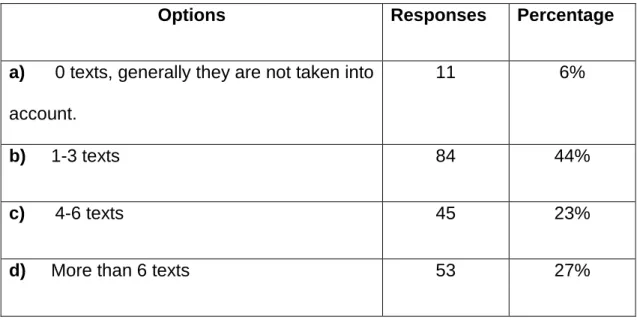
Table 1 Reading Frequency
Question 1. How many texts have you read in English during the last month?
Results:
Options Responses Percentage
a) 0 texts, generally they are not taken into account.
11 6%
b) 1-3 texts 84 44%
c) 4-6 texts 45 23%
Universidad de Cuenca
Autoras: Lilian Estefanía Calle Méndez
Tania Maribel Lalvay Llivigañay 52
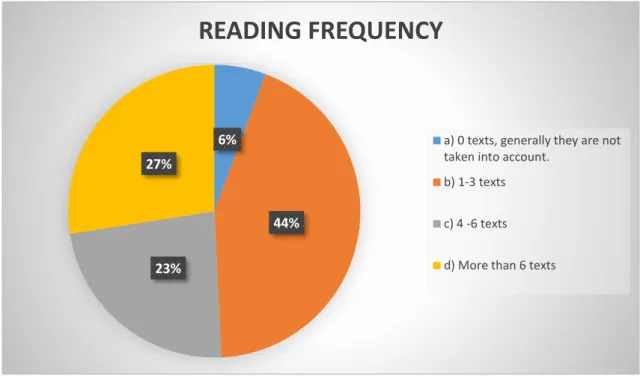
Figure 1 Reading Frequency
The first question refers to reading frequency in which 44% of the participants tended to read one to three texts per month. The results show an intermediate level of students’ interest in reading.
Universidad de Cuenca
Autoras: Lilian Estefanía Calle Méndez
Tania Maribel Lalvay Llivigañay 53
Figure 2 Reasons for Reading
According to the results, 52% of participants disclose that they have to read because it is a required reading. They are not interested in reading any text. However, 48% of participants read texts in English of their own initiative. They are involved in this activity without any obligation. Most of the time, students do not feel motivated about reading. Consequently, the teacher must find the correct strategies based on a good methodology and develop the reading process for enhancing students desire to read.
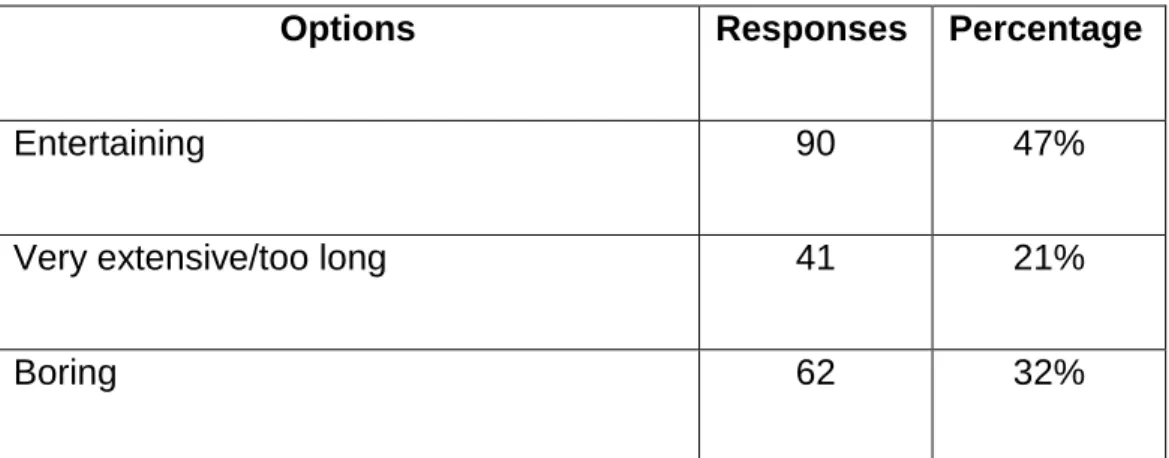
Table 3 The Opinions of the Reading?
Question 3 How do you like the reading texts in the class?
48% 52%
REASONS FOR READING
Universidad de Cuenca
Autoras: Lilian Estefanía Calle Méndez
Tania Maribel Lalvay Llivigañay 54
Results:
Options Responses Percentage
Entertaining 90 47%
Very extensive/too long 41 21%
Boring 62 32%
Figure 3 Reading is considered
47% of participants see reading texts as something entertaining. This circumstance finds correspondence with the fact that, as mentioned in the
47%
21% 32%
READING IS CONSIDERED:
Universidad de Cuenca
Autoras: Lilian Estefanía Calle Méndez
Tania Maribel Lalvay Llivigañay 55
literature review section, experts consider that reading authentic material will arouse the students’ interests as well as catch their attention. So, if the reading text is interesting, the students will read a text without seeing it as a required reading. However, 32% of students see reading as a boring activity. Also, 21% of them affirms that the reading text is very extensive. Linking the two facts, boring and very extensive texts, the reading activity will be seen as something that students need to do by obligation, not as something that they are involved in of their own initiative.
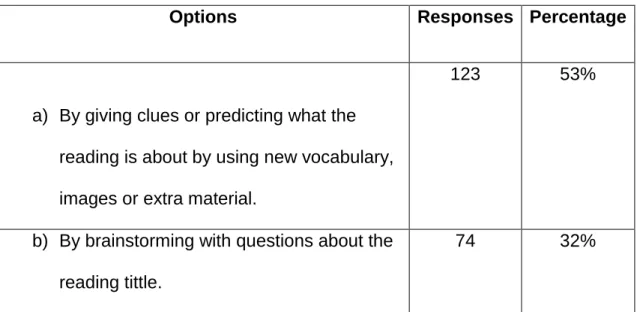
Table 4 Engage Reading Activity
Question 4 How does your teacher start the reading activity?
Results:
Options Responses Percentage
a) By giving clues or predicting what the reading is about by using new vocabulary, images or extra material.
123 53%
b) By brainstorming with questions about the reading tittle.
Universidad de Cuenca
According to the obtained results, 53% of participants say that their teacher starts the reading activity by giving clues or predicting what the reading is about by using new vocabulary, images or extra material. These results show that before starting a reading activity, there is an ‘engage’ activity that arouses students’ curiosity. Also, there are 32% of students who say that their teacher brainstorms about the title of the reading in order to have students imagine what
Universidad de Cuenca
Autoras: Lilian Estefanía Calle Méndez
Tania Maribel Lalvay Llivigañay 57
the text will be about. However, repeating activities in the engaging stage of teaching reading will become boring for the students. They will lose motivation and interest on the reading lesson. This is an important characteristic that is taken into account for the development of activities based on top-down processing, because the engaging activity must have a purpose. In other words, the engaging activity is not a stage just for playing, showing pictures or brainstorming, it must be considered a stage of waking up the previous knowledge for acquiring and storing something new in students’ mind.
Table 5 Activate Reading Activities
Question 5 After reading a text, what kind of activity do you do?
Results:
Options Responses Percentage
Universidad de Cuenca
d) Comprehension activities that cannot be developed by myself and I have to ask a classmate or teacher for help.
53 14%
e) We do not do any activity. 9 2%
Figure 5 Activate Reading Activities
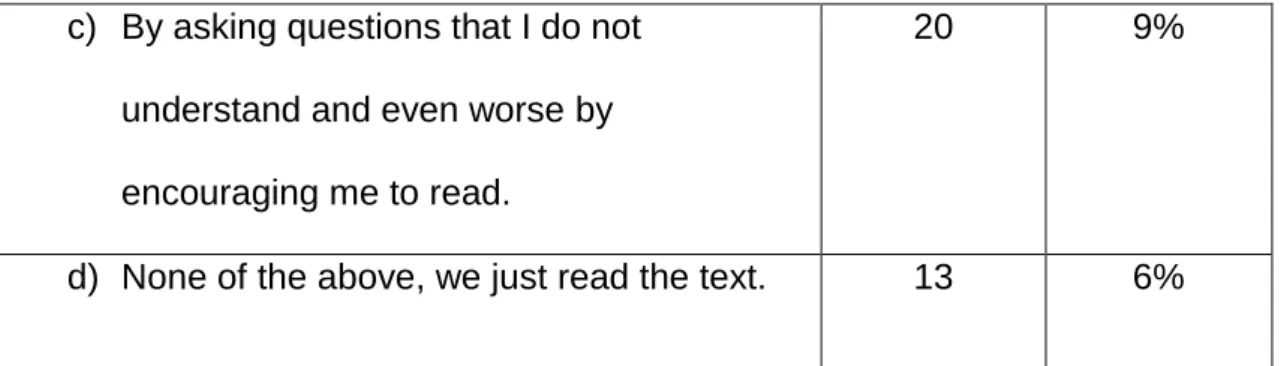
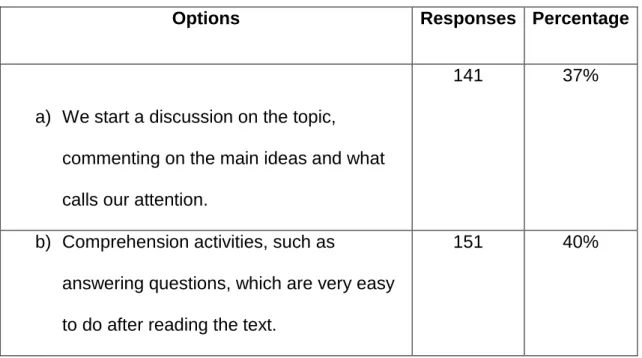
After reading a text, there is an activate activity, which according to the results, 40% consist of comprehension activities, such as answering questions that are very easy to do. Sometimes, the teacher and the students start a
Universidad de Cuenca
Autoras: Lilian Estefanía Calle Méndez
Tania Maribel Lalvay Llivigañay 59
discussion on the topic, commenting on the main ideas and what catches the students’ attention. Nevertheless, it is not enough just to rely on comprehension activities. The students need to produce the language and put it in practice. The activate stage includes both, top-down and bottom-up processing. For example, the students will have a questionnaire to answer about “Holidays.” They apply top-down processing when remembering their previous experiences about holidays in Ecuador. Then, they use bottom-up processing when reading, decoding and asking questions in order to give an appropriate answer.
Table 6 Types of Reading
Question 6 What kind of texts do you prefer?
Results:
Options Responses Percentage
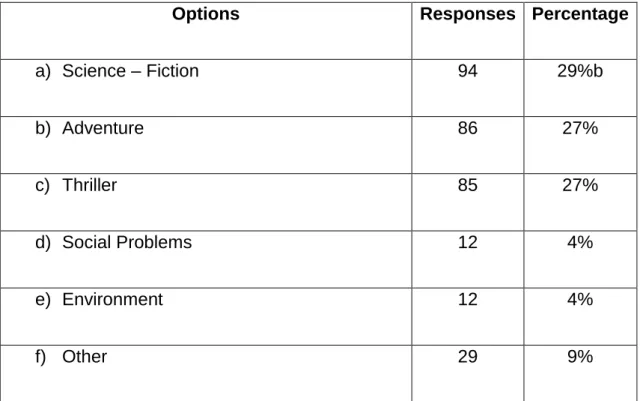
a) Science – Fiction 94 29%b
b) Adventure 86 27%
c) Thriller 85 27%
d) Social Problems 12 4%
e) Environment 12 4%
Universidad de Cuenca
Autoras: Lilian Estefanía Calle Méndez
Tania Maribel Lalvay Llivigañay 60
Figure 6 Types of Reading
This question is related to students’ preferences. The results show that 29% of the students prefer science-fiction readings. 27% of participants prefer adventure and thriller readings. This means that the readings from the book “Uncover 2” is able to stimilate the students’ interests. For raising students’ enthusiasm about reading, the teacher can use other reading texts from different sources.
4.2 Socialization of the booklet
The researchers socialized about the correct way to use the booklet in the classroom with 9th grade teachers. There were six teachers who participated in the socialization of the booklet. Also, emphasized was the importance of following the bottom-up and top-down processing to guarantee the successfulness of
Universidad de Cuenca
The researchers explained that the development of reading consists of three stages that are essential to ensure success in learning through reading. So, they focused on the characteristics of each stage since the booklet does not mention in depth what each of them refers to. At this point, some of the teachers remembered the stages of teaching reading, but others could not name them. The researches of this project talked about the importance of correctly performing each stage for effective instruction in reading.
A booklet was given to each teacher, and it was very emotional to observe how they took notes of each socialized point. They reviewed it carefully and commented that the videos proposed are very pleasant since the researchers presented them with the help of a tablet.
Universidad de Cuenca
Based on the literature review investigation, the researchers conclude that the use of schema theory helps readers to understand what they are reading. For example, the format of letters, emails and magazine ads are similar from one culture to another. Their format, whether in the reader’s first or second language, provides specific and useful information about what they can likely expect.
Top-Down and Bottom-Up processing are playing a significant role in acquisition of language. As mentioned on the literature review part, Top–Down helps the students to reach the meaning of the reading activities by applying their prior knowledge such as guessing or predicting the gist of a text. This processing is helpful if the students have background knowledge about the text or know some of the meanings of the words which appear in the text. Bottom-Up techniques give attention to the basic components of the language such as sounds, letters, words, sentences, paragraphs and text. So, this helps them to acquire the vital components of the language. If they learn these components, they will acquire the language because they are building new knowledge based on previous knowledge.
Universidad de Cuenca reading skills following the teacher’s guide that has been provided by an editorial. Of course, they are useful, however all of them can not fit the needs of all the classrooms around the world.
Finally, a teacher can create new activities following bottom-up and top-down processing. It is just a creativity issue taking into account the group of students that the teacher is working with. That is, students’ needs, learning rhythm and background knowledge.
5.2 Recommendations:
The researchers recommend to teachers of ninth grades classes of Técnico
Salesiano High School to use the booklet correctly in order to guarantee the successfulness of the reading activity.
To improve the students’ reading skill, it is helpful to use some extra readings related with the grammar point that is studied and to link the students’ needs and interests with bottom-up and top-down processing.
Universidad de Cuenca
Autoras: Lilian Estefanía Calle Méndez
Tania Maribel Lalvay Llivigañay 64
bottom-up and top-down processing. In this way, students will be interested in reading and doing activities related to the text using technology. The suggested website by the researchers of this project was www.cdlponline.org (California Distance Learning Project).
Teachers should not focus on what the teacher’s guide strategies suggest for developing the reading lesson. The readings presented by Cambridge editorial are good ones and they can be developed in a better way rather than merely repetitive lessons for enhancing reading.
Universidad de Cuenca
Autoras: Lilian Estefanía Calle Méndez
Tania Maribel Lalvay Llivigañay 65
REFERENCES:
Ambuyat, G. (2013, July 19). Strategies for developing listening skills. Retrieved November 12, 2015, from
http://es.slideshare.net/glady_sambuyat28/strategies-for-developing-listening-skills
Anderson, R. (2012). Reading Definitions. Edinburgh: The Queen’s Medical
Research Institute.
Bartlett, F. (1997). Remembering, a study in experimental and social psychology. New York: University of Cambridge Press.
Beasley, R. (Director). (2012). Houses around the world [Motion Picture].
Bharuthram, S. (2012, January ). Making a case for the teaching of reading across the curriculum in higher education. 32(2), 23-24.
Brown, A. (Director). (2009). Television Development [Motion Picture]. Retrieved from https://www.youtube.com/watch?v=B7RxfbCXYz8.
Brown, D. H. (2001). Teaching by principles an interactive approach to
language pedagogy (Segunda ed.). San Francisco: San Francisco State University Longman.
Universidad de Cuenca
Autoras: Lilian Estefanía Calle Méndez
Tania Maribel Lalvay Llivigañay 66
CDLP. (2016, September 26). Housing Plan to End Homelessness . Retrieved from
http://www.cdlponline.org/index.cfm?fuseaction=activity1&topicID=3&stor yID=251
Echeverri, L., & McNulty, M. (2010, April). Reading Strategies to Develop Higher Thinking Skills for Reading Comprehension. PROFILE (Issues in Teachers' Professional Development), 12(1). Retrieved from
http://www.redalyc.org/articulo.oa?id=169216302008
Eide, D. (2012). Uncovering the logic of English: A common sense approach to reading, spelling, and literacy (Segunda ed.). Pedia Learning Inc.
Falk-Ross, F. (2015). Language - Based Approaches to Support Reading Comprehension. London: Rowman & Littlefield.
Harmer, J. (1998). How to teach English: An introduction to the practice of English language teaching. . Pearson Education Limited.
Izquierdo, A., & Jiménez, S. (2014, October). Building up Autonomy Through Reading Strategies. PROFILE (Issues in Teachers' Professional Development), 16(2), 70-72. Retrieved from
http://www.redalyc.org/articulo.oa?id=169232511006
Universidad de Cuenca
Autoras: Lilian Estefanía Calle Méndez
Tania Maribel Lalvay Llivigañay 67
Lin, J. (Director). (2008). Fast & Furious 4 Race Scene HD [Motion Picture]. Retrieved from https://www.youtube.com/watch?v=lbyx_opE1Bw
Lingzhu, J. (2003, November 11). Reading activities for effective Top-down processing. Retrieved December 18, 2015, from
http://iteslj.org/Techniques/Lingzhu-Reading.html
Lougheed, L. (2010). People, Places, and Things 1 (Second ed.). New York: Oxford University Press.
Ministerio de Educación. (2016). English as a Foreign Language. Currículo de los niveles de educación obligatoria , 262. Quito, Ecuador.
National Endowment for the Arts. (2007, September 07). To read or not to read, a questions of national consequence. Washington, DC: National
Endowment for the Arts. Retrieved November 12, 2015, from https://www.arts.gov/sites/default/files/ToRead.pdf
Parker, A. (Director). (1982). Another Brick In The Wall [Motion Picture]. Retrieved from https://www.youtube.com/watch?v=YR5ApYxkU-U
R. Day, R., & Bamford, J. (2010). Extensive Reading in the Second Language Classroom . Cambridge University Press .
Universidad de Cuenca
Autoras: Lilian Estefanía Calle Méndez
Tania Maribel Lalvay Llivigañay 68
Treiman, R. (2013). Linguistics and Reading. San Luis: Washington University in St. Louis.
Welbourn, M. (2010). Approaching authentic texts in the second language classroom. Malmö högskola.
Wixson, P., & Weber, R. (2010). Definitions of Reading and Word Identification.
Michigan: Houghton Mifflin Company.
Xiao-Hui, L., & Wang, W.-h. (2010). Analysis of schema theory and its influence on reading. US - China Foreing Language, 5(11), 19-20.
Xiaoli, J. (2012, February 12). The application of Schema Theory in collede English. Retrieved October 04, 2015, from
http://www.academypublication.com/issues/past/tpls/vol02/02/11%20.pdf
Universidad de Cuenca
Autoras: Lilian Estefanía Calle Méndez
Tania Maribel Lalvay Llivigañay 69
Universidad de Cuenca
Autoras: Lilian Estefanía Calle Méndez
Tania Maribel Lalvay Llivigañay 70
APPENDIX 1
QUESTIONNAIRE
Estimado estudiante,
La siguiente encuesta pretende recolectar información cuyos resultados serán usados como base para el desarrollo del proyecto investigativo titulado The Use of Bottom-up and Top-down Processing as an EFL Teaching Tool Based on Schema Theory to Develop Reading Skills in 9th graders at “Técnico
Salesiano” High School in Cuenca. Por favor, ayúdenos con la siguiente
información:
Edad _______________________ Fecha: ______________________
Encierre en un círculo la opción que considere correcta de acuerdo a su
experiencia:
1. Durante el último mes cuantos textos en inglés ha leído en clases:
a) 0 textos, por lo general pasa desapercibida las lecturas b) 1-3 textos
c) 4-6 textos
d) más de 6 textos 2. Usted lee en inglés por: